 Location :
Orlando, FL, USA
Location :
Orlando, FL, USA +1 (407) 714-1616
 info@biz4group.com

- Healthcare AI IVR system development modernizes inbound call handling using AI-driven automation to reduce manual workload and improve response times.
- Key benefits include reduced call volume, automated appointment scheduling, better patient experience, and long-term operational cost savings.
- A robust AI IVR system for healthcare centers requires secure EHR integration, strong compliance controls, and intelligent routing.
- The cost to develop AI IVR system for healthcare centers typically ranges from $20,000 to $150,000+, depending on scope and scale.
- Choosing the right healthcare AI IVR development services partner like Biz4Group LLC ensures scalability, security, and enterprise-grade performance.
Have you ever wondered why your patients still call your front desk even though you have online forms and portals in place? The reality is simple. Patients still prefer to call when they need help.
According to a report, the average healthcare call center handles nearly 2,000 inbound calls per day, yet many are staffed to manage only about 60% of that demand. That gap leads to long wait times, abandoned calls, and frustrated patients.
It gets more concerning. Average hold times in healthcare often stretch close to 5 minutes, while most patients expect answers in under a minute.
So ask yourself:
- Are your current phone systems truly supporting your growth?
- Are your staff members spending too much time answering repetitive questions?
- Is hiring more agents really the only solution?
This is exactly where healthcare AI IVR system development starts to make business sense. Traditional IVR systems force callers through rigid menus. Patients press the wrong button. They repeat the information. They ask for a human anyway.
Modern AI IVR system for healthcare centers works differently. It understands intent. It routes intelligently. It completes routine tasks automatically.
With the right healthcare AI IVR development services, you can:
- Reduce call transfers
- Improve first call resolution
- Automate appointment scheduling
- Lower operational overhead
- Improve patient satisfaction
When designed properly, healthcare IVR software development using AI becomes part of a broader digital strategy. It aligns with your larger AI healthcare software development initiatives, ensuring patient communication, data workflows, and automation systems work together instead of operating in silos.
Inbound call overload is not going away. The question is whether your system is intelligent enough to handle it.
Here, we will break down what a modern healthcare AI IVR system development approach actually looks like and why it is quickly becoming essential for hospitals and clinics across the US.
Still Letting Inbound Calls Control Your Operations?
Your phone lines should work for you, not against you. Let's turn call overload into operational efficiency.
Talk to Our ExpertsWhat Is a Healthcare AI IVR System and Why Is It the Next Big Thing in Healthcare?
Let’s simplify it.
A healthcare AI IVR system is an intelligent phone system that uses artificial intelligence to understand, process, and respond to patient calls automatically. Unlike traditional IVR systems that rely on fixed “press 1, press 2” menus, a modern AI IVR system for healthcare centers allows callers to speak naturally. The system detects intent, routes calls correctly, completes routine tasks, and integrates directly with hospital systems.
In practical terms, it means your phone system can:
- Schedule or reschedule appointments
- Route urgent cases to the right department
- Handle billing or insurance queries
- Send reminders
- Escalate complex cases to live agents
All without frustrating menu loops. This is what defines modern healthcare IVR software development using AI. It is not just automation. It is an intelligent call handling built specifically for healthcare workflows.
Why Is It Becoming the Next Big Thing?
Healthcare leaders are turning toward healthcare AI IVR system development because the pressure on call centers is no longer manageable with manual processes alone.
Here is why adoption is accelerating:
- Rising patient call volumes that outpace staffing capacity
- Demand for faster response times and 24/7 availability
- Growing need to reduce operational costs without lowering service quality
- Integration capabilities with EHR, billing, and scheduling systems
- Better data tracking and reporting for operational insights
- Scalability across multi-location hospitals and clinics
More importantly, when aligned with broader AI automation services, these systems become part of a larger automation strategy that improves workflows across departments. For many organizations, the real question is no longer whether to automate. It is how to develop AI IVR platforms to streamline healthcare calls in a way that improves both patient experience and operational efficiency.
In the next section, let’s focus on what matters most to you. What real business benefits can you expect from investing in healthcare AI IVR development services?
What Real Business Benefits Can You Expect from Healthcare AI IVR Development Services?
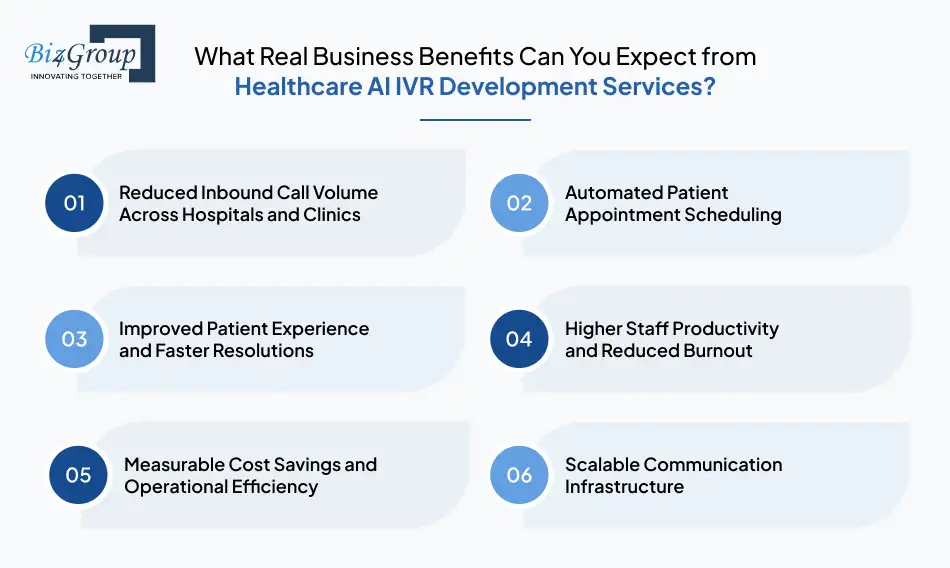
When you invest in healthcare AI IVR system development, you are not just upgrading a phone system. You are improving operational efficiency, patient satisfaction, and long-term scalability.
Here are the core business benefits.
1. Reduced Inbound Call Volume Across Hospitals and Clinics
An advanced AI IVR system for healthcare centers automatically handles repetitive inquiries such as appointment confirmations, prescription refills, insurance queries, and general information requests. When you develop AI IVR platforms to streamline healthcare calls, a large percentage of routine calls are resolved without human intervention. This significantly reduces pressure on your call center and allows you to manage higher volumes without increasing staff.
2. Automated Patient Appointment Scheduling
By creating intelligent IVR systems for healthcare appointment scheduling, patients can book, cancel, or reschedule appointments through natural voice interaction. The system connects directly with scheduling software and updates records in real time. This reduces manual errors, shortens wait times, and improves scheduling efficiency across departments.
3. Improved Patient Experience and Faster Resolutions
A modern AI powered IVR for medical clinics minimizes hold times and eliminates frustrating menu loops. By detecting intent and routing accurately, the system ensures patients reach the right department quickly or complete tasks instantly. Faster resolutions lead to higher patient satisfaction and stronger trust in your organization.
4. Higher Staff Productivity and Reduced Burnout
When you build an AI IVR system for hospital inbound calls, administrative tasks no longer consume the majority of your team’s time. Your staff can focus on complex, sensitive, or high-priority cases that require human judgment. This improves productivity while reducing burnout in high-volume healthcare environments.
5. Measurable Cost Savings and Operational Efficiency
Through structured healthcare AI call center solution development, hospitals can reduce average handling time, minimize call transfers, and lower staffing dependency. Over time, the cost savings generated from efficiency improvements often outweigh the initial investment in healthcare AI IVR system development.
6. Scalable Communication Infrastructure
When you build scalable healthcare AI IVR call center systems, you create infrastructure that supports multiple locations, specialties, and departments without proportional staffing growth. This scalability is critical for expanding healthcare organizations that need consistent service quality across facilities.
Now that you understand the business value, the next question becomes practical - How does an AI IVR system for healthcare centers actually work behind the scenes?
How Does an AI IVR System for Healthcare Centers Actually Work Behind the Scenes?
Understanding the benefits is important, but as a CTO or healthcare operations leader, you also want to know what is happening technically. A properly executed healthcare AI IVR system development process is built on structured workflows, intelligent processing, and deep system integration.
Here’s how it works step by step.
1. Call Reception and Voice Recognition
When a patient calls, the system first captures the audio and converts speech into text using advanced speech recognition technology with AI. Unlike traditional IVR, this system does not rely on keypad inputs. It listens and processes natural language in real time, which makes the interaction feel conversational rather than mechanical.
Key functions include:
- Automatic speech-to-text conversion
- Accent and dialect recognition
- Noise filtering for call clarity
- Real-time transcription
2. Intent Detection and Context Understanding
Once speech is converted into text, artificial intelligence models analyze the request to determine intent. This is where healthcare IVR software development using AI becomes critical. The system identifies whether the caller wants to schedule an appointment, check insurance status, request medical records, or speak with a specialist.
Core capabilities include:
- Natural language processing
- Intent classification models
- Context memory within the same call
- Priority tagging for urgent cases
3. Intelligent Routing and Workflow Triggering
After understanding intent, the system either completes the task automatically or routes the call to the correct department. If you build an AI IVR system for hospital inbound calls correctly, routing becomes highly accurate. It eliminates unnecessary transfers and ensures critical cases reach the right team immediately.
Behind the scenes, the system handles:
- Smart department routing
- Automated task execution
- Escalation logic for complex cases
- Workflow triggers for backend systems
4. System Integration with Healthcare Infrastructure
A modern AI IVR system for healthcare centers does not operate in isolation. It integrates with scheduling tools, billing systems, and EHR platforms. When you develop enterprise grade healthcare AI IVR systems for hospitals, secure integration ensures patient records are updated instantly and accurately.
This stage typically includes:
- API-based integration with EHR and EMR systems
- Real-time appointment synchronization
- Insurance database connectivity
- Secure data exchange protocols
5. Continuous Learning and Performance Optimization
One of the biggest advantages of healthcare AI IVR system development is that the system improves over time. Call data is analyzed to identify misrouted calls, failed intents, and friction points. The AI models are refined to improve accuracy and response efficiency.
Ongoing optimization includes:
- Call analytics and reporting
- Intent model retraining
- Performance monitoring dashboards
- Quality assurance testing
When these components work together, you get more than automation. You get an intelligent communication layer that reduces operational load while improving patient service.
Now that you understand how it works technically, the next concern becomes critical - How do you make sure this system remains secure and fully compliant with healthcare regulations?
Ready to See an Intelligent IVR in Action?
Understanding the process is one thing. Seeing it transform your workflows is another.
Schedule a Free CallHow Do You Make a Healthcare AI IVR System with Compliance Features Without Risking PHI?
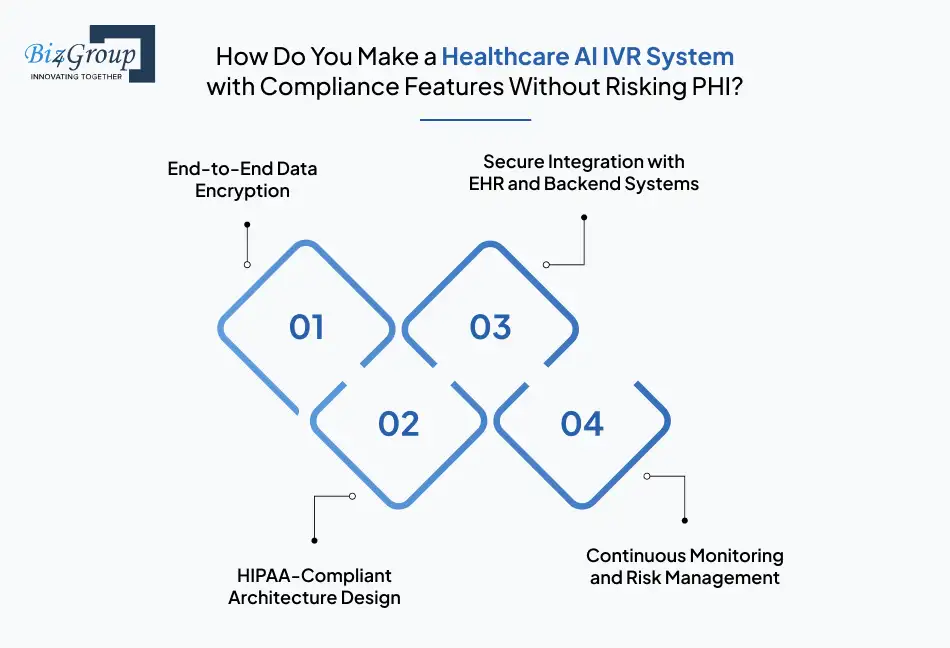
If you are responsible for healthcare IT, this is probably your biggest concern. No matter how advanced your healthcare AI IVR system development is, it cannot compromise patient data. Protected Health Information is sensitive, regulated, and legally protected. Any automation layer interacting with it must meet strict standards.
Let’s break down what that really involves.
1. End-to-End Data Encryption
Every interaction within an AI IVR system for healthcare centers must be encrypted both in transit and at rest. That means voice data, transcripts, and backend system exchanges are protected from interception or unauthorized access. Encryption protocols should align with healthcare-grade security standards. Without this foundation, even the most intelligent system becomes a liability.
2. HIPAA-Compliant Architecture Design
When you make a healthcare AI IVR system with compliance features, compliance cannot be added later. It must be built into the architecture from day one. Role-based access control, audit logging, secure authentication, and data minimization strategies are all critical components. If your broader digital ecosystem is not already aligned with HIPAA standards, your IVR will create gaps.
This is why organizations prioritize solutions that are fully HIPAA compliant across every integration point.
3. Secure Integration with EHR and Backend Systems
Most risks do not come from the IVR itself. They come from integration layers. When you develop enterprise grade healthcare AI IVR systems for hospitals, APIs connecting to EHR, scheduling platforms, and billing systems must follow strict access controls and monitoring policies. Every data exchange should be authenticated and logged. Unsecured integration endpoints are one of the most common vulnerabilities in healthcare automation systems.
4. Continuous Monitoring and Risk Management
Security is not a one-time setup. It is an ongoing process. A properly designed healthcare AI IVR system development strategy includes real-time monitoring, anomaly detection, and regular compliance audits. Logs must be maintained for traceability, and AI decision flows should be reviewed to prevent unintended data exposure. This proactive approach ensures your automation improves efficiency without increasing regulatory risk.
In healthcare, innovation is valuable. Compliance is mandatory. When both are handled correctly, your AI IVR system for healthcare centers becomes not just efficient, but trusted.
Now that security concerns are addressed, let’s move to something equally important - What features truly define the best AI IVR solutions for hospitals and clinics?
What Features Define the Best AI IVR Solutions for Hospitals?
When investing in healthcare AI IVR system development, features determine real-world performance. A basic automation setup will not deliver enterprise value. You need intelligent, integrated, and scalable capabilities designed specifically for healthcare workflows.
Below is a structured breakdown of the essential features that define the best AI IVR solutions for hospitals and clinics.
|
Feature |
What It Does |
Why It Matters for Healthcare Organizations |
|---|---|---|
|
Natural Language Understanding |
Allows patients to speak naturally instead of pressing keypad options. The system interprets intent in real time. |
Reduces frustration and improves first-call resolution within an AI IVR system for healthcare centers. |
|
Intelligent Appointment Scheduling |
Enables patients to book, reschedule, or cancel appointments automatically. |
Supports create intelligent IVR systems for healthcare appointment scheduling while reducing front-desk workload. |
|
Smart Call Routing |
Directs calls to the correct department based on urgency, specialty, or patient history. |
Helps build an AI IVR system for hospital inbound calls that minimize transfers and reduce wait times. |
|
EHR and EMR Integration |
Connects the IVR platform with patient records and scheduling systems securely. |
Critical when you need to integrate AI with EHR/EMR maintain data accuracy and workflow continuity. |
|
Insurance and Billing Automation |
Handles insurance eligibility checks and billing inquiries automatically. |
Reduces administrative overhead and supports broader AI medical claim processing initiatives for operational efficiency. |
|
Supports multiple languages for diverse patient populations. |
Expands accessibility and improves patient engagement across demographics. |
|
|
Voice Authentication and Secure Access |
Uses voice biometrics or secure verification steps before sharing sensitive information. |
Ensures secure handling of PHI in healthcare IVR software development using AI. |
|
Real-Time Analytics and Reporting |
Tracks call volumes, resolution times, routing accuracy, and performance trends. |
Enables data-driven improvements and aligns with advanced AI healthcare analytics software strategies. |
|
Seamless Human Handoff |
Transfers complex or sensitive cases to live agents with full context. |
Maintains quality care while using automated AI IVR call management systems for routine tasks. |
|
Scalability Across Locations |
Supports multiple departments, clinics, and hospital branches under one system. |
Essential to build scalable healthcare AI IVR call center systems that grow with your organization. |
These features transform a basic IVR into a true smart IVR system for healthcare call centers. When combined under a unified strategy, they help develop smart IVR systems for healthcare providers that are efficient, compliant, and built for long-term scalability.
Let’s look at a real implementation that shows how healthcare AI IVR system development works in an enterprise setting and the value it delivers.
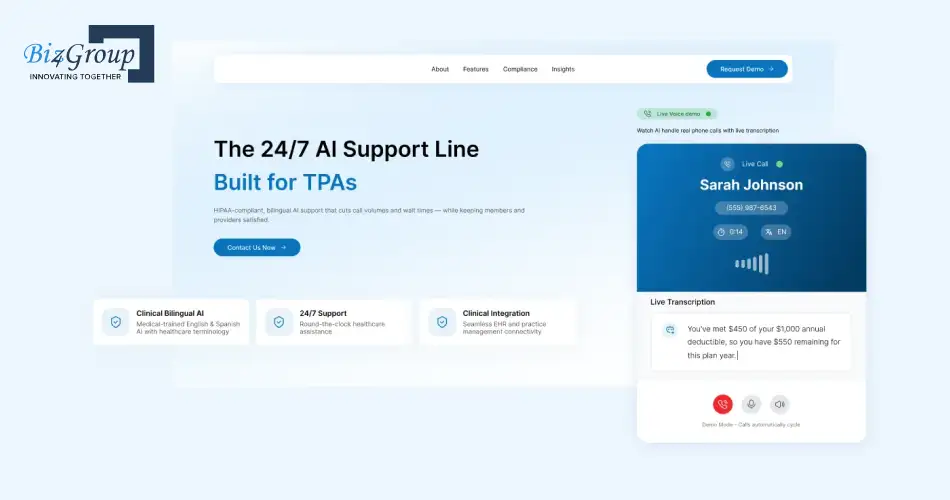
In this project, our team built a custom AI-powered IVR and support platform designed to help a healthcare Third-Party Administrator (TPA) manage rising call volumes and complex service requests efficiently. This wasn’t just a typical phone tree. It was a conversational, voice-enabled system that improved support speed, accuracy, and patient/provider experience while maintaining strict compliance and integration standards.
This solution was developed to replace outdated support channels that relied heavily on human agents for routine inquiries. The platform provides automated, voice-based responses that feel natural to callers. It supports both English and Spanish with live translation, allowing patients and providers to communicate in their preferred language. All interactions are handled within a HIPAA-compliant environment with secure PHI protection throughout the workflow.
Key Highlights
- The AI powered IVR support system answers incoming calls 24/7 and resolves high-volume routine inquiries instantly.
- The system includes smart call escalation for cases it cannot resolve automatically, handing off with full context so agents can assist efficiently.
- Conversational voice support eliminates frustrating menus and interprets natural speech, improving first-call resolution rates.
- Bilingual support and live translation ensure accessibility for diverse patient populations.
- Built-in self-learning and 24/7 availability means the platform continually improves and supports calls around the clock.
- The system operates within a HIPAA-compliant flow with secure handling of sensitive information.
This platform is a strong example of how healthcare IVR software development using AI can transform inbound call operations by reducing agent load, improving caller experience, and delivering scalable, real-time responses.
Now that you know what the system must include, the next logical step is understanding how to develop it properly. Let’s walk through the structured steps involved in how to develop a healthcare AI IVR system from planning to deployment.
How to Develop a Healthcare AI IVR System the Right Way?
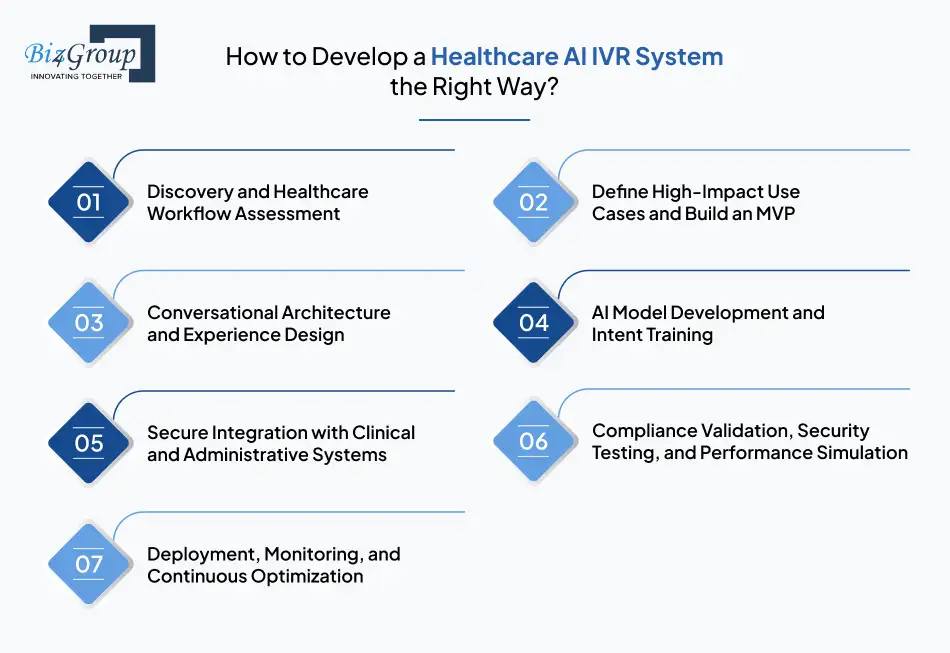
Effective healthcare AI IVR system development is not just about deploying a voice bot. It requires structured planning, regulatory alignment, intelligent workflow design, and seamless integration with clinical systems.
Here’s how to approach it properly.
1. Discovery and Healthcare Workflow Assessment
Every successful healthcare AI IVR system development initiative begins with understanding how your organization currently handles inbound calls. This includes analyzing peak volumes, common patient requests, escalation patterns, and compliance constraints. At this stage, we align automation goals with measurable healthcare KPIs such as call deflection rate, average handling time, and first-call resolution.
Key focus areas:
- Department-wise call distribution
- Repetitive administrative inquiries
- PHI-sensitive interaction points
- Compliance and audit requirements
2. Define High-Impact Use Cases and Build an MVP
Before scaling, it is critical to validate core automation scenarios. Structured MVP development allows you to test targeted workflows such as appointment scheduling, prescription refill routing, or billing queries. This approach reduces risk while ensuring your custom healthcare AI IVR development strategy is grounded in real performance data.
The MVP phase helps you:
- Measure automation accuracy
- Identify conversation gaps
- Validate integration stability
- Optimize before enterprise rollout
3. Conversational Architecture and Experience Design
Even voice-first systems require thoughtful experience planning. Patients must feel guided, not confused. Through strong UI/UX design principles, we structure conversational flows that feel natural while ensuring compliance and clarity. This step ensures your AI IVR system for healthcare centers delivers both usability and efficiency.
This stage includes:
- Conversation flow mapping
- Voice prompt structuring
- Fallback and escalation design
- Accessibility considerations for diverse patient groups
4. AI Model Development and Intent Training
At the core of healthcare IVR software development using AI is intelligent intent recognition. The system must accurately interpret medical terminology, insurance queries, appointment types, and department-specific language. As an experienced AI development company, we train AI models using healthcare-specific datasets and structured testing scenarios.
Core components include:
- Speech-to-text engine optimization
- Intent classification models
- Context retention within multi-step calls
- Continuous learning mechanisms
5. Secure Integration with Clinical and Administrative Systems
An enterprise-grade AI IVR system for healthcare centers must integrate securely with EHR platforms, scheduling systems, billing tools, and CRM software. Through structured AI integration services, we ensure APIs are securely connected, authenticated, and monitored.
This ensures:
- Real-time appointment updates
- Insurance eligibility verification
- Secure patient authentication
- Accurate backend data synchronization
6. Compliance Validation, Security Testing, and Performance Simulation
In healthcare, testing goes beyond functionality. Your healthcare AI IVR system development must pass compliance checks, PHI protection validation, and stress testing under peak call loads. This phase confirms that the platform is ready for real-world hospital traffic without increasing regulatory risk.
Testing includes:
- Security audits and encryption validation
- Load testing during simulated peak hours
- Intent accuracy validation
- Escalation workflow verification
7. Deployment, Monitoring, and Continuous Optimization
Once deployed, the system enters a continuous improvement cycle. Real-world call data is analyzed to refine responses and improve automation rates. Advanced implementations may expand into proactive AI agent capabilities that handle follow-ups, reminders, and outbound communication.
Ongoing optimization focuses on:
- Increasing call resolution rates
- Reducing unnecessary human transfers
- Expanding automated workflows
- Scaling across clinics and departments
This refined development approach ensures your healthcare AI IVR development services initiative is not just technically sound, but operationally aligned, compliant, and scalable for enterprise growth.
Next, let’s examine the technology stack required to power enterprise-grade healthcare IVR software development using AI.
Want to Build It the Right Way from Day One?
A structured approach makes the difference between automation and real transformation.
Start Your Healthcare AI IVR ProjectWhat Tech Stack Is Required for Healthcare IVR Software Development Using AI?
To execute successful healthcare AI IVR system development, you need a structured, layered architecture. Each layer plays a specific role in performance, security, and scalability.
Below is a simplified enterprise-ready stack used to develop enterprise grade healthcare AI IVR systems for hospitals.
|
Layer |
Tech or Tools |
Description |
|---|---|---|
|
Telephony Layer |
Twilio, Vonage, Amazon Connect, SIP/VoIP |
Handles inbound and outbound calls, call routing, and voice connectivity across departments. |
|
Speech Recognition |
Google Speech-to-Text, AWS Transcribe, Azure Speech Services |
Converts patient voice input into text for processing within the AI IVR system for healthcare centers. |
|
Natural Language Processing |
Python, TensorFlow, spaCy, Dialogflow, OpenAI APIs |
Detects intent, processes medical terminology, and enables conversational logic for healthcare IVR software development using AI. |
|
Backend Application Layer |
Node.js, Python (FastAPI, Django), Java (Spring Boot) |
Manages business logic, call workflows, authentication, and system orchestration. |
|
Frontend / Admin Dashboard |
React.js, Angular, Vue.js |
Provides reporting dashboards, call analytics, and configuration panels for administrators. |
|
Database Layer |
PostgreSQL, MongoDB, MySQL |
Stores call logs, transcripts, scheduling data, and analytics securely. |
|
Integration Layer |
REST APIs, GraphQL, HL7, FHIR |
Connects the IVR platform to EHR, billing, scheduling, and CRM systems to develop AI IVR platforms to streamline healthcare calls. |
|
Security & Compliance |
AES-256 Encryption, OAuth 2.0, JWT, Role-Based Access Control |
Protects PHI, enforces access control, and ensures regulatory compliance during healthcare AI IVR system development. |
|
Cloud Infrastructure |
AWS, Microsoft Azure, Google Cloud |
Hosts AI models, backend services, and telephony infrastructure while supporting scalability for multi-location healthcare providers. |
|
Analytics & Monitoring |
Power BI, Tableau, ELK Stack, CloudWatch |
Tracks call resolution rates, intent accuracy, and system performance for operational insights. |
This layered stack ensures your custom healthcare AI IVR development initiative is secure, scalable, and adaptable to enterprise healthcare environments.
Next, let’s break down the cost structure and what influences the investment required to build healthcare AI IVR solutions.
What Does It Cost to Build Healthcare AI IVR Solutions and What Impacts the Investment?
If you are planning healthcare AI IVR system development, one of the first questions you will ask is cost. In most cases, the estimated cost to develop an AI IVR system for healthcare centers ranges between $20,000 to $150,000+.
The wide range exists because pricing depends on complexity, integrations, compliance requirements, AI capabilities, and scalability expectations. A small clinic automation project will not cost the same as an enterprise-grade multi-hospital deployment.
Let’s break it down clearly.
Cost Breakdown of Key Features in Healthcare AI IVR System Development
Below is an estimated cost distribution based on common feature requirements when you build AI driven IVR platforms for clinics or hospitals.
|
Feature / Component |
Estimated Cost Range |
What Influences the Cost |
|---|---|---|
|
Basic AI IVR Setup (Call routing + Speech recognition) |
$20,000 – $40,000 |
Telephony setup, basic NLP models, limited integrations |
|
Intelligent Appointment Scheduling |
$10,000 – $25,000 |
Scheduling system integration, workflow complexity |
|
EHR / EMR Integration |
$15,000 – $35,000 |
API availability, data mapping, security layers |
|
Insurance & Billing Automation |
$10,000 – $30,000 |
Backend validation workflows and payer integrations |
|
Advanced NLP & Context Handling |
$15,000 – $40,000 |
Custom model training, medical terminology handling |
|
Compliance & Security Layer |
$10,000 – $25,000 |
Encryption standards, audit logs, PHI protection |
|
Analytics & Admin Dashboard |
$8,000 – $20,000 |
Custom reporting, real-time monitoring tools |
|
Enterprise Scalability (Multi-location) |
$25,000 – $60,000+ |
Load balancing, cloud infrastructure, distributed systems |
A full enterprise healthcare AI call center solution development project combining these elements can exceed $150,000 depending on scale.
What Factors Affect the Cost of Healthcare AI IVR Development Services?
When planning custom healthcare AI IVR development, several variables influence total investment.
1. Integration Complexity
If your system needs to deeply integrate with EHR, billing, scheduling, and CRM systems, costs increase. Secure APIs and healthcare-grade authentication layers require careful implementation. Organizations that already use structured AI integration services often reduce this complexity.
2. Level of AI Customization
Pre-built conversational models are cheaper. Custom-trained healthcare-specific intent models cost more but significantly improve accuracy. If you want to align IVR with broader enterprise AI solutions, development scope expands accordingly.
3. Compliance and Security Requirements
Building a healthcare AI IVR system development project without enterprise-level security is not an option. HIPAA validation, encryption, audit logging, and penetration testing increase initial cost but reduce long-term risk.
4. Scalability Expectations
If you plan to build scalable healthcare AI IVR call center systems for multiple clinics or hospital branches, infrastructure and performance engineering costs increase. Cloud architecture decisions play a major role here.
Hidden Costs in Healthcare IVR Software Development Using AI
Many organizations underestimate indirect costs.
Common hidden expenses include:
- Ongoing cloud hosting and telephony usage fees
- AI model retraining and optimization
- Compliance audits and security updates
- API changes from third-party healthcare systems
- Staff training and onboarding
Planning for these early prevents budget surprises.
Cost Optimization Strategies When You Develop AI IVR Platforms to Streamline Healthcare Calls
You do not need to automate everything on day one. Here is how you control investment:
Start with High-Impact Workflows
Begin with appointment scheduling and repetitive inquiries. Expand later.
Use MVP Approach
A structured MVP development strategy allows you to validate automation before scaling enterprise-wide.
Align with Broader Automation Strategy
When IVR connects with existing AI automation services, you avoid duplicate infrastructure costs.
Choose the Right Development Partner
Working with an experienced AI development company in USA ensures architecture decisions are future-proof and scalable.
The real takeaway is this: The cost of healthcare AI IVR system development depends on scope, complexity, and scale. But when implemented strategically, the operational savings and efficiency gains often justify the investment within a short period.
Now that we’ve addressed cost, let’s look at something equally important - What challenges arise when you create AI powered IVR systems for hospitals, and how can you solve them effectively?
Curious What This Would Cost for Your Organization?
Let's break down your exact requirements and give you a realistic roadmap and estimate.
Request a Custom QuoteWhat Challenges Arise When You Create AI Powered IVR Systems for Hospitals and How Do You Solve Them?
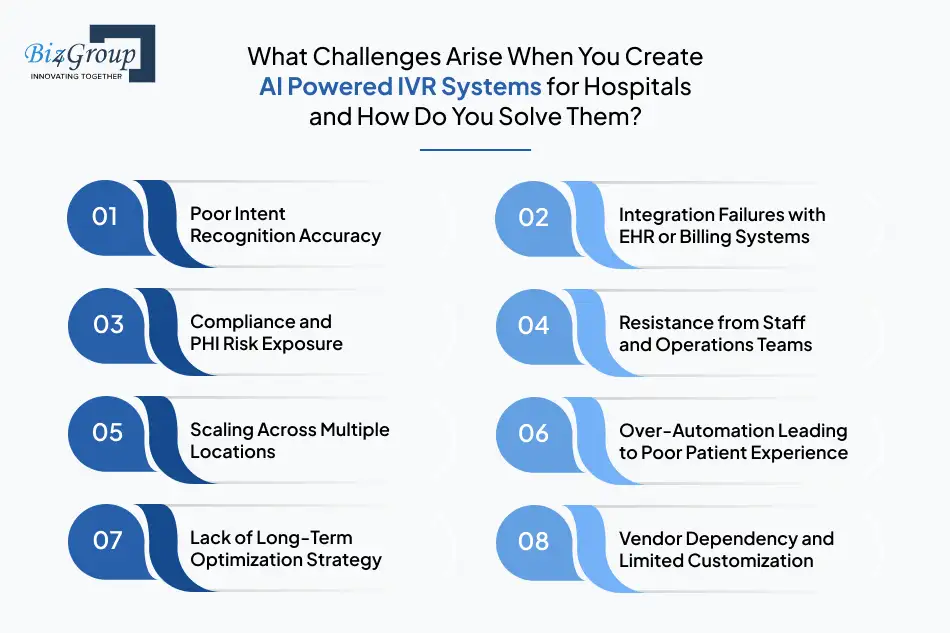
Even well-planned healthcare AI IVR system development projects face obstacles. Healthcare environments are complex, regulated, and deeply interconnected. The key is not avoiding challenges but addressing them with structured solutions.
Below is a breakdown of common challenges when you develop an AI IVR system for healthcare centers, along with practical ways to solve them.
|
Challenge |
Why It Happens in Healthcare AI IVR System Development |
Practical Solution |
|---|---|---|
|
Poor Intent Recognition Accuracy |
Medical terminology, accents, and complex patient queries make NLP training difficult in early stages of healthcare IVR software development using AI. |
Train models using healthcare-specific datasets, continuously retrain with live call data, and refine conversational flows during optimization cycles. |
|
Integration Failures with EHR or Billing Systems |
Healthcare systems often use legacy infrastructure, making API connectivity complex when you develop enterprise grade healthcare AI IVR systems for hospitals. |
Conduct early technical audits, use structured integration architecture, and align IVR with broader custom AI healthcare software strategies. |
|
Compliance and PHI Risk Exposure |
Handling sensitive patient data increases regulatory risk during healthcare AI IVR system development. |
Embed compliance into architecture from day one and align automation with broader AI automation for healthcare center governance frameworks. |
|
Resistance from Staff and Operations Teams |
Teams may worry that automation will replace their roles or complicate workflows when you build healthcare AI IVR solutions. |
Introduce phased rollouts, maintain human escalation paths, and demonstrate how automation reduces repetitive workload rather than eliminating roles. |
|
Scaling Across Multiple Locations |
What works for one clinic may not scale easily across enterprise networks when you build scalable healthcare AI IVR call center systems. |
Design modular architecture, cloud-native infrastructure, and performance-tested deployment models. |
|
Over-Automation Leading to Poor Patient Experience |
Excessive automation without human fallback can frustrate patients using an AI IVR system for healthcare centers. |
Maintain seamless human handoff logic and consider complementary channels like an AI chatbot for omnichannel balance. |
|
Lack of Long-Term Optimization Strategy |
Some organizations launch automation but fail to continuously improve it. |
Integrate monitoring dashboards, periodic audits, and advanced systems like agentic AI development to evolve capabilities over time. |
|
Vendor Dependency and Limited Customization |
Off-the-shelf tools may limit flexibility during custom healthcare AI IVR development. |
Work with experienced teams or hire AI developers who can tailor the platform to healthcare-specific needs. |
Addressing these challenges early ensures your healthcare AI IVR development services initiative remains scalable, compliant, and aligned with long-term digital strategy. Now that we’ve explored risks and solutions, the final and most important question becomes clear.
Why should you choose the right partner for healthcare AI IVR system development, and what makes Biz4Group different?
Why Choose Biz4Group for Healthcare AI IVR System Development?
The success of your healthcare AI IVR system development initiative depends heavily on who builds it. Healthcare automation is not just about voice technology. It requires compliance expertise, system integration experience, and a deep understanding of clinical workflows.
At Biz4Group, we deliver healthcare AI IVR development services with a strategy-first approach. We recently implemented an AI-driven IVR and support platform for a healthcare Third-Party Administrator that automated high-volume inquiries, enabled bilingual interactions, ensured secure PHI handling, and supported intelligent call escalation.
What differentiates us when you build healthcare AI IVR solutions with our team:
- Proven experience in custom healthcare AI IVR development
- Compliance-first architecture for regulated environments
- Secure integration with EHR and billing systems
- Scalable infrastructure for enterprise growth
We are also recognized among the top AI IVR system development companies in USA, reflecting our experience in delivering intelligent, enterprise-ready solutions.
If your goal is to develop AI IVR platforms to streamline healthcare calls while ensuring compliance and scalability, we bring the technical depth and healthcare expertise to execute it effectively.
Ready to Modernize Your Healthcare Call Center?
The right partner turns automation into measurable impact. Let's build something scalable, secure, and future-ready.
Contact UsWrapping Up!
Inbound call volumes are not slowing down. Patient expectations are not decreasing. Staffing challenges are not disappearing. That is why healthcare AI IVR system development is no longer a technology experiment. It is operational infrastructure.
When you develop an AI IVR system for healthcare centers, you reduce repetitive call load, improve patient experience, strengthen compliance posture, and create a scalable communication backbone for long-term growth. The impact is not limited to your call center. It improves scheduling accuracy, billing coordination, and overall workflow efficiency.
More importantly, when IVR connects with broader systems such as AI medical claim processing, analytics platforms, and automation tools, it becomes part of a larger digital transformation strategy. It aligns seamlessly with modern initiatives like AI app modernization and enterprise-wide automation planning.
If your organization is evaluating how to build healthcare AI IVR solutions, now is the time to approach it strategically rather than reactively. The right architecture today prevents operational bottlenecks tomorrow.
And if you are ready to turn your inbound calls from a cost center into an efficiency engine, we are ready to build it with you.
FAQ
1. What exactly is a healthcare AI IVR system?
A healthcare AI IVR system uses advanced voice recognition and natural language processing to understand what a patient says, route calls intelligently, and automate routine tasks. Unlike traditional menu-based IVR, it understands requests such as appointment changes or prescription questions using conversational voice.
2. How does healthcare AI IVR help reduce inbound calls in hospitals?
By automating repetitive inquiries like scheduling, directions, insurance verification, and general information, an AI IVR handles many calls without a live agent. This allows you to significantly reduce inbound call pressure while improving response times and operational efficiency.
3. How secure and compliant is a healthcare AI IVR system?
Modern healthcare IVR software development using AI includes encryption, access controls, secure authentication, and detailed audit logs. These systems are built to protect PHI and align with healthcare compliance standards, making them safe for regulated clinical environments.
4. What is the difference between traditional IVR and AI-enabled IVR in healthcare?
Traditional IVR uses fixed menu trees where patients press numbers to navigate options. AI-enabled systems interpret natural speech, detect intent, and complete tasks automatically. This makes healthcare AI IVR system development far more efficient, accurate, and patient-friendly than legacy IVR systems.
5. How long does it take to develop and implement a healthcare AI IVR system?
Timelines depend on scope and complexity. A focused MVP for core workflows such as appointment scheduling can typically be developed in 2 to 4 weeks. For enterprise-grade healthcare AI IVR system development with EHR integration, advanced NLP, compliance validation, and multi-location deployment, timelines usually range between 6 to 8 weeks, depending on integration depth and customization requirements.
6. How much does healthcare AI IVR system development cost?
The estimated investment to develop an AI IVR system for healthcare centers typically ranges from $20,000 to $150,000+. Costs vary based on features, AI customization level, integrations with EHR or billing systems, compliance requirements, and scalability needs. Smaller clinic implementations fall toward the lower end, while enterprise multi-hospital deployments require higher investment.
7. Can healthcare AI IVR systems integrate with existing EHR and scheduling platforms?
Yes. A properly designed AI IVR system for healthcare centers integrates securely with EHR, scheduling, billing, and CRM systems through structured APIs. This ensures real-time updates, accurate patient data synchronization, and seamless workflow continuity across your organization.
