 Location :
Orlando, FL, USA
Location :
Orlando, FL, USA +1 (407) 714-1616
 info@biz4group.com

 AI Summary Powered by Biz4AI
- AI Horse Racing Betting App Development empowers businesses to deliver fast, engaging, and intelligent virtual racing experiences.
- Understanding how to develop AI Horse Racing Betting App solutions helps teams plan for real time simulations, AI driven odds, and secure betting flows.
- The creation of Horse Racing Betting App integrating AI enhances user engagement, platform scalability, and long term monetization potential.
- The cost to develop an AI powered horse racing betting platform typically ranges from $25,000 to $150,000+, depending on features and AI complexity.
- Choosing the right expertise ensures smoother development, stronger performance, and a competitive edge in the growing virtual betting market.
If you have ever imagined horse racing in a world where races never stop, odds update instantly, and everything is powered by artificial intelligence rather than real stables, you are already thinking like the creators of the modern AI Virtual Horse Racing Betting App. This new category of digital wagering blends realistic simulations with machine learning to deliver nonstop excitement that rivals traditional racing while avoiding physical limitations such as weather delays or live event schedules.
As interest grows, the development of an AI Virtual Horse Racing Betting App is becoming a strategic move for gaming startups, fantasy sports businesses, and investors exploring new revenue channels. These platforms use AI to generate lifelike races, personalize betting insights, and create an environment where users can place smart wagers at any time. Choosing a skilled sports betting app development company early in the process helps ensure your planning, architecture, and compliance needs are handled correctly while preventing costly rebuilds later.
This guide will walk you through how to build an AI Virtual Horse Racing Betting App, from understanding core mechanics to identifying must have features, advanced AI capabilities, and the best tech stack. You will also learn how Virtual Horse Racing Betting App development integrating AI influences user engagement, monetization models, budgets, legal requirements, and launch timelines.
Whether your goal is innovation or market expansion, this guide gives you a strong starting point to create a platform that is fast, intelligent, scalable, and ready for real world users.
What Is an AI Virtual Horse Racing Betting App?
Imagine the thrill of horse racing… without the mud, the weather delays, or waiting hours between races.
An AI Virtual Horse Racing Betting App takes the core excitement of traditional horse racing and puts it on digital steroids. Instead of live horses and real jockeys, it uses artificial intelligence to simulate races, calculate odds in real time, and keep bettors locked in with instant results — any time of day.
It's fast, always-on, and not limited by location, weather, or licensing of physical tracks.
So, what does this kind of betting app for horse racing really include?
- Simulated races generated by AI with lifelike visuals
- Real-time odds and outcomes based on machine learning algorithms
- Instant betting options with personalized suggestions
- Wallets, payouts, and even fantasy-style leaderboards
Unlike basic casino-style betting games, this isn't just animated horses running in circles. These apps use predictive data models, behavior tracking, and race logic to generate odds that feel real — because they're based on real-world variables, just enhanced.
And if you're thinking of building one from scratch, working with a team that specializes in horse racing betting app development will save you more than a few stumbles out of the gate.
How AI Elevates Horse Racing Betting Apps?
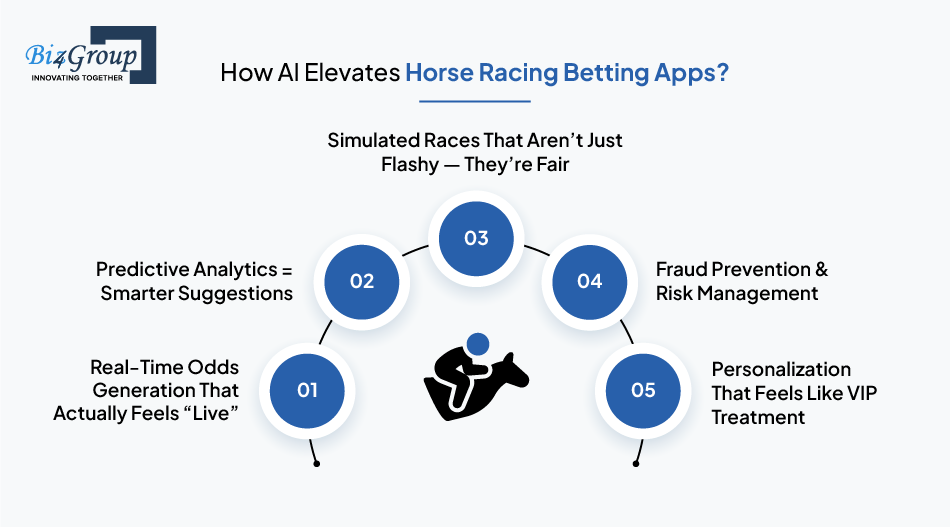
Let's get one thing straight — animations alone don't sell bets.
In the world of horse racing mobile app betting, players want more than spinning horses and pretty colors. They want a thrill. They want data. And they want to feel like they're making smart moves, not just shots in the dark.
That's where AI enters the paddock — turning static games into strategic experiences.
Here's how AI truly elevates the betting game:
1. Real-Time Odds Generation That Actually Feels "Live"
Forget static odds locked in hours before the race. AI monitors betting activity in real-time — across thousands of users — and adjusts the odds dynamically. This makes every bet time-sensitive and more exciting.
Example: If more users start betting heavily on a specific horse, the system will adjust odds for the rest accordingly — balancing risk for the operator while creating urgency for users.
Business impact: You boost user engagement and create FOMO that drives more activity per session.
2. Predictive Analytics = Smarter Suggestions
Here's where things get clever.
Using AI, you can track a user's betting history, preferences, win/loss behavior, and even interaction patterns. Then, the system can suggest smarter bets based on that behavior — and on broader trends across the platform.
Think Netflix recommendations… but for bets.
Real-world benefit: Higher retention and increased betting frequency. Your app becomes not just a place to bet — but a place to win smarter.
3. Simulated Races That Aren't Just Flashy — They're Fair
With AI-driven simulations, each race result is generated using probabilistic models — factoring in a virtual horse's "form," recent betting trends, randomness, and even simulated fatigue (yes, really).
This creates a sense of fairness, unpredictability, and transparency — all critical in AI Virtual Horse Racing Betting Apps where trust is everything.
Result: Players feel like they're watching an actual race unfold — not a pre-scripted outcome.
4. Fraud Prevention & Risk Management
AI doesn't just enhance the user experience — it protects it.
By analyzing betting patterns in real-time, AI can detect unusual spikes, bot activity, or attempts to manipulate outcomes. The system can automatically flag, limit, or block users or bets that look suspicious.
Why it matters: Operators stay compliant, players stay safe, and your brand builds long-term trust.
5. Personalization That Feels Like VIP Treatment
AI can track things like:
- Time of day a user bets
- Race types they engage with most
- Preferred odds ranges
- Win/loss tolerance
Using this data, the app can tweak the interface, offer bonuses, or promote upcoming races tailored to that individual user.
Bottom line: Personalized = profitable. Your user retention and loyalty metrics will thank you.
Curious how top gaming platforms are already using these tactics? Here's a closer look at AI for sports betting and why it's become the backbone of smarter, faster wagering experiences.
Final Thought for This Section
If you're building a next-gen AI Virtual Horse Racing Betting App, you can't afford to skip the AI.
It's not just about race simulations — it's about smart odds, fair gameplay, personalized betting experiences, and protecting your users (and your margins) from fraud. AI turns your app from just another game into a betting experience users come back to again and again.
Benefits of Developing an AI Virtual Horse Racing Betting App
Building an AI Virtual Horse Racing Betting App is more than adding another digital betting product to the market. It is a chance to create a platform that runs continuously, adapts intelligently, and delivers an engaging experience that traditional racing cannot match. For brands planning to invest in AI Virtual Horse Racing Betting App development, the rewards extend across user engagement, revenue growth, and long term scalability.
1. Continuous Racing and Revenue Potential
A major advantage of building an AI Virtual Horse Racing Betting App is the ability to run virtual races at any moment. You are not restricted by daylight, track schedules, or weather. This creates a flow of uninterrupted betting opportunities, which directly increases user activity and overall revenue. Operators gain predictable engagement patterns that traditional racing can never sustain.
2. Highly Scalable Betting Ecosystem
When you decide to create an AI Virtual Horse Racing Betting App, scalability becomes one of the strongest benefits. AI driven engines allow thousands of users to bet, watch, and interact with races simultaneously without the bottlenecks of physical events. As your audience grows, the platform can scale smoothly by expanding race variations, themes, and betting formats.
3. Greater Control Over Racing Logic and Outcomes
Unlike real world racing, virtual horse racing gives operators complete control over race structures, difficulty levels, and performance attributes. AI ensures variability and realism while still allowing developers to fine tune how horses behave. This balance maintains fairness while letting you design compelling experiences that keep users coming back.
4. Enhanced User Engagement Through Immersive Design
AI infused race engines give you the ability to build high quality animations, responsive environments, and realistic horse behavior that heighten user excitement. This visual immersion encourages longer viewing sessions, repeated bets, and higher retention. Users feel connected to the experience in a way that feels fresh compared to static casino style games.
5. Broader Market Accessibility
Investing in AI Virtual Horse Racing Betting App development opens doors to markets that do not have access to live racing venues. Users worldwide can participate regardless of local track availability or seasonal restrictions. This broadens your potential user base and makes your platform appealing in regions where real horse racing is limited or heavily regulated.
6. Strong Monetization Flexibility
Another clear advantage of building an AI Virtual Horse Racing Betting App is the variety of revenue options it offers. Alongside traditional betting, operators can introduce fantasy modes, membership tiers, cosmetic upgrades, or premium race events. The digital nature of the platform allows you to experiment with different models without disrupting gameplay, giving you long term revenue stability.
By understanding these benefits, brands and investors gain clearer insight into why it is a smart move to invest in AI Virtual Horse Racing Betting App development.
Launch Your Own AI Betting Platform
Build a custom horse racing betting app powered by real-time AI, smart odds, and immersive design.
Start Your ProjectKey Features to Include in an AI Virtual Horse Racing Betting App Development
To develop an AI Virtual Horse Racing Betting App that stands out, you need more than eye catching visuals. The core features must create a smooth, reliable, and engaging betting experience from the very first interaction. These essentials form the backbone of a platform that users trust, enjoy, and return to consistently.
| Feature | Purpose | Why It Matters |
|---|---|---|
|
Virtual Racetrack & Animations |
Simulates horse racing in 2D/3D using Unity or WebGL |
Creates an immersive, real-time betting experience users expect from modern gaming apps |
|
Smart Betting Interface |
Lets users place single or multiple bets, toggle odds formats, and adjust stake levels |
Smooth betting UX = higher retention and more bets per session |
|
AI-Powered Odds Engine |
Generates dynamic odds in real time based on betting volume and AI race logic |
Adds realism and unpredictability — core to replicating "real" betting suspense |
|
Wallet & Payout Integration |
Handles deposits, withdrawals, bonuses, and payouts across multiple payment methods |
Users demand fast, secure, and frictionless transactions |
|
User Dashboard |
Tracks betting history, wins, bonuses, preferred horses, and account balance |
Personalization keeps users coming back — and helps track lifetime value |
|
Race Alerts & Push Notifications |
Notifies users about upcoming races, odds shifts, and bonus offers |
Increases engagement and reduces churn between sessions |
|
Login & Age Verification |
Includes biometric login, OTP verification, and KYC onboarding |
Required for compliance and building user trust |
|
Admin Panel (Back Office) |
Allows admin to manage users, set bet limits, approve payouts, and launch promotions |
Gives operators full control over app activity and security |
|
Social Betting Groups/Leaderboards |
Enables users to form leagues or compete via leaderboard systems |
Adds viral gamification and increases daily user engagement |
Optional shortcut: Want to skip months of coding and still build big? A Turnkey sports betting solution can give you a base platform — already packed with essentials — that you customize, launch, and scale faster.
What These Features Do for Your Business?
- Boost Engagement: Features like social betting, race alerts, and dashboards increase average session duration.
- Reduce Drop-offs: A clean interface and quick wallet setup ensure fewer bounces.
- Build Trust: With AI-generated odds and verifiable payouts, your app builds long-term credibility.
- Support Compliance: Secure login, KYC, and geo-verification are baked in from day one.
Together, these features form the foundation of a top-performing AI Virtual Horse Racing Betting App. Think of them as your MVP toolkit — everything beyond this is a bonus (and we'll cover that next in the Advanced Features section).
Advanced Features to Consider While Developing AI Virtual Horse Racing Betting App
Every platform can show basic odds and run simple race animations, but only a few succeed in creating an experience that truly captivates modern bettors. When you plan to develop an AI Virtual Horse Racing Betting App, advanced features become the differentiators that elevate your product far beyond standard virtual racing. These enhancements strengthen engagement, extend session time, and increase overall player value by offering depth, immersion, and personalization that users cannot find elsewhere.
The following advanced capabilities highlight how thoughtful innovation can transform a good app into a market leading AI powered virtual racing platform.
Advanced Feature Table: Premium Add-ons for High Engagement
| Feature | What It Does | Why It's a Game-Changer |
|---|---|---|
|
AI-Powered Race Commentary |
Real-time voice commentary generated via AI during virtual races |
Increases immersion, mimics real race ambiance, and boosts viewer engagement |
|
Smart Betting Assistant (AI Agent) |
Personalized AI assistant that recommends bets, highlights trends, warns risks |
Helps users bet smarter, improves trust, and increases bet frequency |
|
Multiplayer Betting Rooms |
Group betting, private contests, and friend leagues |
Adds social fun and gamification, driving viral adoption |
|
Predictive Race Analytics |
AI forecasts likely outcomes using past data, betting trends, and race history |
Appeals to strategy-focused bettors and increases bet size |
|
NFT Horse Ownership |
Users can own, trade, and race unique AI-generated NFT horses |
Opens monetization opportunities and builds long-term user loyalty |
|
AR Race Viewing Mode |
View races on real-world surfaces via mobile AR |
Offers a cutting-edge, immersive user experience, great for brand buzz |
|
Voice Command Betting |
Users place bets using voice prompts ("Bet $10 on Horse 3") |
Accessibility + novelty = engagement boost and modern appeal |
|
Gamified Streaks & XP System |
Users earn rewards, levels, and bonuses for daily activity and smart betting |
Retains casual users through achievement loops and psychological incentives |
Let's Break These Down:
1. AI-Generated Live Commentary
Imagine a virtual announcer narrating the race as it unfolds — only it's powered by AI. Real-time audio commentary synced to the horses, odds, and even user betting history.
Why it matters: It turns passive users into active viewers, especially in mobile use where visual focus might shift.
2. Smart Betting Assistant (AI Agent)
This one's big. An in-app AI agent helps users by:
- Recommending bets based on their history
- Notifying them of high-risk choices
- Suggesting alternatives if odds are shifting quickly
Basically, it's a data-driven betting coach sitting in their pocket — and it's exactly what you'd expect from a top-tier AI Agent development company.
3. Multiplayer Betting Rooms & Social Pools
Let users form groups, join private betting rooms, and pool wagers with friends. Add leaderboards, emojis, taunts — the whole social experience.
Why it matters: Increases retention and daily active usage while introducing community-driven virality.
4. Predictive Race Analytics
Give serious bettors something to chew on. Offer predictive win probabilities, risk indicators, and performance heatmaps based on AI models.
Why it matters: Turns casual users into strategists — and keeps them betting smarter (and longer).
5. NFT Horse Ownership (Web3-Optional)
Let users buy, trade, and race their own NFT horses with AI-based traits like speed, stamina, and odds strength.
Why it matters: Creates brand loyalty and opens new revenue channels through collectible assets.
6. AR-Enhanced Viewing Mode
Using AR, users can place a virtual racetrack on their coffee table and watch races unfold in 3D — through their phone or AR glasses.
Why it matters: Differentiates your app and creates buzz on social platforms.
7. Voice Command Betting
"Hey app, bet $20 on Horse 4 in the next race."
Let users place bets hands-free using natural language voice commands — powered by NLP and AI agents.
Why it matters: Convenience + novelty = retention gold.
Bonus: Gamified Streaks & XP System
Gamify retention with daily streaks, XP points for bets placed, and unlockable features. Keeps users coming back for more — even if they're not betting big.
Why Go Advanced?
These features don't just make your AI Virtual Horse Racing Betting App stand out — they create multiple user personas to retain:
- The casual gamer
- The serious bettor
- The social competitor
- The tech-forward early adopter
They also open new doors for monetization: premium memberships, in-app purchases, and NFT trading — while elevating user experience to a whole new level.
Add AI Power to Your Sports Betting App
Integrate predictive analytics, smart odds engines, and user behavior tracking with our AI team.
Add AI to My AppAI Virtual Horse Racing Betting App Development: Step-by-Step Process
If you want a clear roadmap for what is the process of developing Virtual Horse Racing Betting App integrating AI, this section walks you through practical, sequential steps.
Below are the core phases from concept to launch, each with a stated aim and detailed actions so you can confidently plan how to build AI Virtual Horse Racing Betting App or move forward with the development of AI Virtual Horse Racing Betting Application.
1. Discovery and Requirements Gathering
Aim of this: Define product goals, Target markets, Legal constraints, and Core metrics.
Start by documenting the problem you will solve and the user types you will serve. Map jurisdictional rules that affect real money wagering and virtual sports. Gather market research on competitors and player behavior, then prioritize features for the initial release.
If you need to prove viability before full development, kick off a PoC development phase to validate core assumptions such as race logic fairness and basic odds calculation.
2. Product and Compliance Roadmap
Aim of this: Convert requirements into a phased plan that aligns product, Legal, and Technical milestones.
Create a detailed roadmap that sequences feature releases, compliance checkpoints, and commercialization steps. Define KYC, AML, age and geofencing requirements for each target market.
Build a plan for audits and explainability of AI models so regulators can verify fairness. This roadmap becomes the single source of truth for all stakeholders.
3. UX, Visual Design and Prototype
Aim of this: Produce a working prototype that demonstrates user flows and the betting experience.
Work with a UI/UX design company to craft wireframes, interactive prototypes, and race viewing mockups. Focus on fast bet placement, clear odds presentation, and accessible wallet interactions.
Validate prototypes with user testing and iterate until the onboarding, bet slip, and race playback feel intuitive.
Also Read: Top 15 UI/UX Design Companies in USA
4. Architecture and Core Engineering
Aim of this: design a scalable, secure backend and real time event system for races and bets.
Specify backend services for user accounts, wallets, race engine, odds service, and admin controls. Choose databases, caching, and real time messaging that support high concurrency. Define failover, monitoring, and transaction audit trails so payouts and disputes are transparent.
Plan for modularity so AI components can be updated without breaking core betting logic.
5. AI Model Development and Simulation Engine
Aim of this: Build the race simulation, Odds engine, and behavior models that power realistic virtual races.
Partner with top AI development companies or internal ML engineers to design probabilistic race models, performance traits, and stochastic events. Train models on synthesized datasets, tune randomness versus determinism, and create logging to make decisions auditable.
Integrate the AI components with your simulation engine so visuals, odds, and race outcomes remain synchronized.
6. MVP Development and Integration
Aim of this: Assemble a minimum viable product that supports core betting, Payouts, and basic AI simulation.
During MVP Development, implement frontend apps, APIs, wallet integrations, KYC flows, and the race control panel. Prioritize critical flows: deposit, place bet, run race, calculate payouts, and withdraw. Use feature flags to expose advanced AI features gradually and collect telemetry on performance and user behavior.
Also Read: Top 12+ MVP Development Companies to Launch Your Startup
7. Testing, Security and QA
Aim of this: ensure the platform is reliable, secure, and compliant under real world conditions.
Engage top software testing companies or an in-house QA team to run unit, integration, load, and security tests. Simulate peak concurrency, stress the odds engine, and verify race reproducibility for audits. Conduct penetration testing, secure key management reviews, and automated transaction reconciliation tests to guard funds and trust.
8. Launch, Monitoring and Growth Ops
Aim of this: release to market safely, monitor behavior, and scale user acquisition and retention.
Deploy to cloud infrastructure with observability for latency, errors, and suspicious activity. Work with an AI App development company to refine personalization and risk scoring based on early data. Implement marketing funnels, retention campaigns, and a moderation workflow.
If you need cost effective engineering capacity, consider a nearshore software development company for ongoing feature work and support.
9. Iterate, Optimize and Scale
Aim of this: Improve models, Expand features, and Enter new markets while maintaining compliance.
Use real user data to retrain models, optimize odds balance, and introduce premium features. Expand payment rails, add localized content, and prepare additional licensing where needed. Repeat the build, measure, learn loop so the building of AI Virtual Horse Racing Betting Mobile App becomes a long term, data driven business effort.
Following these steps gives you a practical map for the development of AI Virtual Horse Racing Betting Application and helps align technical execution with business, legal, and user experience goals.
Tools and Tech Stack Required for the Development of AI Virtual Horse Racing Betting App
Building the technology foundation for an AI Virtual Horse Racing Betting App is just as important as designing its features. The right stack determines how fast races load, how accurately AI processes data, and how smoothly users place bets during peak activity. If the goal is to create a platform that feels responsive, intelligent, and dependable, the tools behind it must be carefully selected.
The list below outlines the core technologies most commonly used in the development of an AI Virtual Horse Racing Betting App and how each contributes to a stable, scalable product.
1. Frontend (User Interface Layer)
This is what users see — and how they interact with your app.
| Tech/Tool | Purpose |
|---|---|
|
React Native |
Cross-platform mobile development (iOS + Android) |
|
Flutter |
Fast UI, native feel across devices |
|
React.js |
For web-based dashboards, admin panels |
|
WebGL / Canvas |
Rendering race animations and interactive graphics |
|
Socket.IO |
Enables real-time bet updates and race event streaming |
2. Backend (Server-Side Logic + API Management)
Handles everything under the hood — from processing bets to controlling race logic.
| Tech/Tool | Purpose |
|---|---|
|
Node.js |
High-performance server-side scripting |
|
Python |
Ideal for AI model development and data processing |
|
Express.js |
Lightweight web framework for building fast APIs |
|
MongoDB |
NoSQL DB for user profiles, bets, history logs |
|
PostgreSQL |
Structured betting rules, odds data, and financial records |
|
Redis |
Fast caching layer for live odds and active sessions |
3. AI & Machine Learning
This is where the "intelligent" part of your AI betting app lives.
| Tool/Framework | Use Case |
|---|---|
|
TensorFlow / Keras |
Train models for race simulations and predictive betting |
|
PyTorch |
Dynamic modeling for real-time race outcomes and fraud detection |
|
OpenAI API |
Optional for NLP/voice integration and personalized bet chatbots |
|
Scikit-learn |
Statistical modeling and predictive analytics |
If your assistant includes conversational bet placement or NLP prompts, partnering with a proven chatbot development company can fast-track your success.
4. Race Simulation Engine
| Tool/Platform | Why Use It |
|---|---|
|
Unity 3D |
High-quality, customizable race animations with physics support |
|
Unreal Engine |
Advanced graphics for console-like realism |
|
Three.js / Babylon.js |
Lightweight 3D rendering for web/mobile without bloated installs |
5. Payments & Wallet Systems
| Tool/Service | What It Does |
|---|---|
|
Stripe / PayPal |
Handle fiat deposits, withdrawals, bonus payouts |
|
Coinbase / MetaMask |
Optional crypto wallets for Web3-savvy users |
|
Plaid / Finicity |
Link to user bank accounts for direct verification/payment |
|
Firebase Auth |
Secure login, 2FA, and token-based authentication |
Hire Betting App Developers Who Understand Compliance
From KYC to geofencing — our team bakes legal logic into every feature.
Hire Developers6. Cloud & DevOps
| Tech | Purpose |
|---|---|
|
AWS / GCP / Azure |
Scalable cloud hosting, storage, database, and serverless functions |
|
Docker / Kubernetes |
Containerized deployment and scaling for global reach |
|
Cloudflare |
DDoS protection, CDN, and enhanced security for global betting apps |
Summary
The right stack doesn't just make your app work — it makes it fast, intelligent, secure, and future-proof. Whether you're simulating 10 races per minute or handling thousands of concurrent bets, each piece plays a role in performance and reliability.
Want to shortcut the tech selection process? Teams like Biz4Group — a leading AI development company — build and optimize this full stack from day one.
Compliance & Legal Considerations to Build AI Virtual Racing Betting App
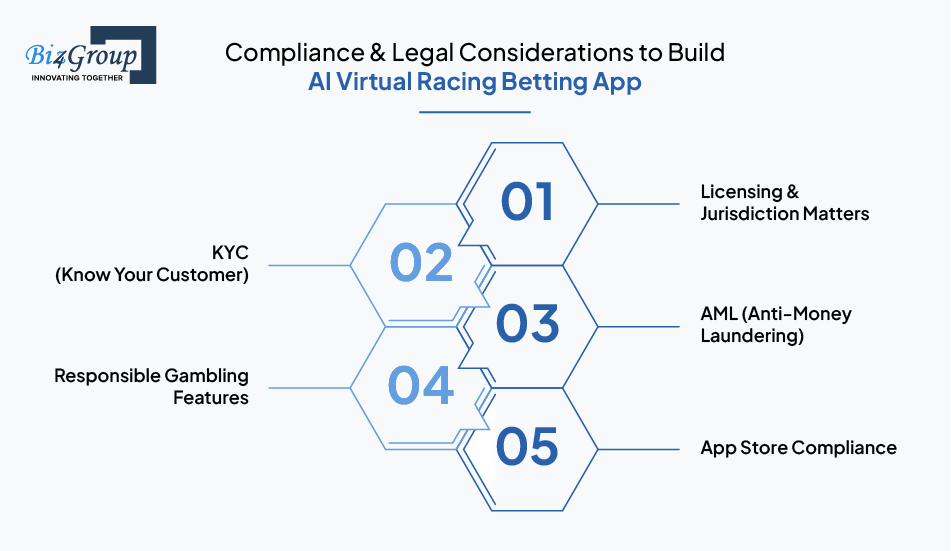
Here's the part most startups don't think about until it's too late: legal compliance.
Whether you're building a fantasy app or a real-money AI Virtual Horse Racing Betting App, you're stepping into one of the most heavily regulated tech spaces on the planet. One wrong step, and you could face shutdowns, fines, or app store rejections.
Here's how to keep things clean, compliant, and launch-ready:
1. Licensing & Jurisdiction Matters
Not every state or country views virtual betting the same way. In the U.S., gambling laws vary state by state, and some allow virtual sports betting under specific conditions.
You'll need to:
- Check local laws in target states/countries
- Apply for operator licenses where required
- Ensure race simulations meet fairness and auditability requirements
2. KYC (Know Your Customer)
All betting apps must verify that users are who they say they are — and of legal age.
To comply, integrate:
- Identity verification (ID scan, selfie match)
- Age verification
- Location validation (geofencing via GPS/IP)
- Cross-checks with banned player lists (in regulated markets)
Failing KYC checks = fines, legal exposure, or worse: revoked licenses.
3. AML (Anti-Money Laundering)
Real-money betting apps are common laundering targets. If your system processes deposits and withdrawals, you'll need automated checks to flag:
- Unusual betting volumes
- Irregular transaction patterns
- Rapid in/out movement with minimal activity
A good AI backend can detect and act on these red flags in real-time.
4. Responsible Gambling Features
Modern users — and regulators — expect betting platforms to care about player wellbeing.
You should offer:
- Betting limits (daily/weekly)
- Self-exclusion options
- Loss tracking and spend summaries
- AI-based "risk scoring" to alert users showing addiction patterns
Not only is this often required by law — it's good business.
5. App Store Compliance
Don't forget: Google Play and the Apple App Store have their own gambling policies. You'll need to:
- Submit your license(s) for approval
- Enable geo-restriction features (no access in illegal regions)
- Clearly list betting terms, payouts, and age requirements
- Include responsible gambling messaging
Bottom Line
If you're launching in the U.S., U.K., Europe, or any jurisdiction with betting rules, your legal compliance game needs to be as strong as your codebase.
That's why most successful operators team up with compliance attorneys and dev partners who've built licensed products before — because this part is not optional.
Ready to Launch a Horse Racing Betting App?
From 3D race simulations to multiplayer betting pools — we’ll build it all, and build it right.
Let’s Build TogetherCost to Build an AI Virtual Horse Racing Betting App
Understanding the financial investment is essential before starting any large scale product, and the same applies when estimating the cost to build an AI Virtual Horse Racing Betting App. Depending on your feature set, AI complexity, platform requirements, and compliance needs, the development price can range from $25,000 to $150,000+. Most businesses planning a balanced feature set and standard AI capabilities can expect an average cost to develop the app to fall in the mid tier range.
To help you plan your budget more accurately, here is a breakdown of typical project scopes and what each cost level usually includes.
Estimated Development Cost by App Tier
| App Tier | Features Included | Estimated Cost (USD) |
|---|---|---|
|
Basic AI Virtual Horse Racing Betting App (MVP) |
Simple virtual races, manual odds input, basic betting logic, fiat payments only |
$25,000 – $40,000 |
|
Mid-Tier AI Virtual Horse Racing Betting App |
AI-generated odds, animated races, user dashboards, KYC, admin panel, crypto optional |
$50,000 – $75,000 |
|
Enterprise-Level AI Virtual Horse Racing Betting App |
Real-time AI race simulation, predictive analytics, multiplayer, AR, NFTs |
$80,000 – $150,000+ |
What Impacts the Cost?
Here's what really drives your budget up (or down):
1. AI Complexity
Basic bots? Affordable. Custom-trained AI that simulates realistic race logic, predicts odds, and personalizes betting? That's premium.
2. Design Quality
You can go with basic UI — or create a gamified, mobile-optimized UX that feels like a fantasy sports game. The difference can be $10K–$25K depending on depth.
3. Payment & Crypto Integration
Supporting multiple payment options, Web3 wallets, and bonus systems? Expect 15–20% more in dev and testing time.
4. Compliance Automation
Automated KYC, AML, geo-restrictions, and age verification features can add $5K–$15K, depending on jurisdictions covered.
5. AR/NFT/Voice/Advanced Features
Want voice-command betting, AR race views, or NFT ownership models? These are major differentiators — but they're also significant add-ons (typically $10K–$30K+ each).
Ongoing Costs to Consider
- AI model tuning & training: $1K–$3K/month depending on activity
- Cloud hosting & auto-scaling: $500–$2,000/month
- Support & feature updates: Retainer plans or hourly dev costs
- Licensing & legal: Jurisdiction-specific — some require annual renewals
Want to dive deeper into AI-related development pricing? Here's a full breakdown of AI app development cost across use cases and industries — including sports betting.
Final Thought
Cost shouldn't scare you — but it should guide your roadmap. Build lean, validate early, and scale when you've found product-market fit. Smart development is what turns betting startups into breakout platforms.
Why Choose Biz4Group to Build Your AI Horse Racing Betting App?
Selecting the right technology partner is one of the most important decisions you will make during AI Horse Racing Betting App Development. You need a team that not only understands AI driven race logic, real time betting flows, and compliance requirements, but also has hands on experience in the development of AI Horse Racing Betting App for high traffic environments. Biz4Group brings all of this together with proven expertise, industry knowledge, and a track record of delivering intelligent, scalable betting solutions.
As a leading fantasy sports software development company, Biz4Group combines deep domain understanding with advanced engineering practices. Our team has real experience in the creation of Horse Racing Betting App integrating AI, along with strong capabilities in sports betting API integration, secure wallet systems, and user centric platform design. Whether you want rapid prototyping, full scale architecture, or long term AI optimization, our engineers and strategists work closely with you to make AI Horse Racing Betting App platforms that are future ready and fully compliant.
If you are looking to hire ai developers who understand both innovation and regulation, Biz4Group offers end to end guidance. From product strategy and AI development to ongoing optimization and support, our team aligns every step with your business goals and market demands.
Delivered Success in the Sports Betting Domain
Ingenious Betting App for Sports Enthusiasts
Biz4Group recently developed a trailblazing social betting platform where users can register, choose leagues such as NBA, NFL, NCAA, MLB, or NHL, and place friendly wagers with others across the platform. Players can bet on money, food, or entertainment, challenge friends or global users, and track settlement ratings based on completed outcomes. The interface is simple, fast, and designed for seamless engagement.
View this project: Handshake
With a foundation built on innovation, reliability, and domain mastery, Biz4Group stands as a trusted partner for businesses ready to enter or scale within the AI powered betting space.
Get a Free Cost Estimate for Your AI Betting App
Wondering how much your dream app will cost? Let us break it down.
Get Cost EstimateConclusion
From above, it is clear that AI powered virtual racing is reshaping the betting landscape, offering faster gameplay, smarter insights, and a highly scalable digital experience. Investing in AI Horse Racing Betting App Development allows businesses to deliver immersive simulations, real time betting flows, and personalized user journeys that outperform traditional racing formats.
The development of AI Horse Racing Betting App solutions also opens doors to new revenue streams, global accessibility, and long-term platform growth. With the right strategy and the right team, the creation of Horse Racing Betting App integrating AI becomes a major opportunity for operators looking to innovate and lead the next wave of digital wagering.
If you are ready to plan, build, or scale your platform, book an appointment with our experts and start shaping your AI driven betting product today.
FAQs: AI Virtual Horse Racing Betting App
1. Are AI-generated races legally allowed in the U.S.?
It depends on the state. While some states allow virtual sports betting under gaming or fantasy sports laws, others may require a separate license. Always consult legal experts or refer to sports betting laws in the USA before launch.
2. How fair are AI-simulated race outcomes?
If developed properly, AI-driven races use randomness, weighted algorithms, and transparency to simulate real odds fairly. Race logic should be auditable and built to prevent manipulation.
3. Can we monetize without offering real-money betting?
Yes. You can use a free-to-play model with virtual currency, ads, in-app purchases, or offer a fantasy league format with entry fees and prizes.
4. What kind of team do I need to build such an app?
You'll need AI developers, mobile developers (React Native or Flutter), UI/UX designers, a QA team, and a legal consultant. Partnering with an end-to-end agency like Biz4Group reduces overhead and timelines.
5. How do we handle player verification and compliance?
With KYC (Know Your Customer), geofencing, and age verification integrations. This ensures compliance and user safety in regulated markets.
6. Can AI personalize the betting experience for each user?
Absolutely. AI can track user behavior, suggest smarter bets, set risk alerts, and deliver tailored odds or rewards based on betting history.
7. How long does it take to launch an MVP version?
Typically, 2–4 weeks for a functional MVP, including UI, betting logic, and basic race simulation. Advanced features like multiplayer, NFTs, or voice AI require additional time.
8. What are common post-launch challenges?
Server scaling during peak hours, real-time data accuracy, AI tuning, compliance updates, and user support are key challenges — all manageable with a robust tech partner.
