Location :
Orlando, FL, USA
Location :
Orlando, FL, USA +1 (407) 714-1616
 info@biz4group.com

















Imagine a digital system that doesn’t wait for instructions but instead, understands your business goals, learns from real-time feedback, and takes independent actions to get the job done.
Read More
Picture this: you’re in a boardroom, sketching a roadmap for your healthcare startup’s next big move and someone pipes up: “What if we build AI software for medical devices?” Instantly you imagine innovation… but also regulatory minefields, unknown budgets and technical complexity.
If these questions have ever crossed your mind, you’re in a good space, here’s why:

What no one really tells you is that the hardest part isn’t the model or the hardware, it’s stitching everything together in a way that clinicians actually trust. Your team is juggling validation protocols, explainability requirements, integration headaches and internal pressure to ship faster. You want clarity, not another vague playbook. You want to know exactly what it takes to move from concept to something that survives real clinical environments.
In this guide we walk you through what it truly means to build AI software for medical devices - from diagnosis tools to connected sensor-based systems. We’ll unpack the technical stack, regulatory essentials, cost and timeline expectations, and much more. By the end, you’ll have a clear map in your hands.
Ready to dive in?
Building AI software for medical devices means creating clinical intelligence that safely analyzes patient data and supports diagnostic outcomes inside regulated environments. When you build AI software for medical devices, your real job is to make the technology precise, traceable and reliable enough for clinical use.
Most organizations begin to develop AI software for medical devices by choosing between two major categories. The category you select determines your development scope, regulatory pathway and technical architecture.
|
Type |
Description |
Where It Runs |
Typical Use Case |
|---|---|---|---|
|
AI Supported Applications That Function as SaMD |
Software independently produces diagnostic or analytical outcomes |
Cloud or device based |
Imaging interpretation or symptom analysis |
|
Medical Devices Connected to AI Enabled Cloud and IoT Software |
Hardware collects data while AI processes it remotely |
Device plus cloud |
Wearables or sensor driven diagnostics |
These two categories shape the level of validation needed and set expectations for long term maintenance in clinical environments.
A custom healthcare software development approach helps teams define which direction aligns best with their risk classification, workflow demands and regulatory timeline.
In connected medical devices, sensors capture raw data, IoT components transmit it securely and cloud based AI models perform the heavy analysis. This setup is exactly what teams rely on when they make AI software for diagnostic devices that depends on continuous data flow across environments.
Each part has a distinct role and IoT product development only works when data flow, latency, accuracy and security remain stable under clinical conditions.
In practice, both paths ultimately push you to create AI-powered medical device software that behaves consistently and stands up to real clinical scrutiny, especially when you need to hire AI developers to support scaling, refinement and long term maintenance.
Build AI software for medical devices that delivers accurate insights, safer decisions and smoother clinical workflows.
Start My AI Medical Device BuildFor those planning to build AI software for medical devices, the goal is simple on paper but complex in execution. You are creating diagnostic intelligence that reads medical data with clinical accuracy and produces results reliable enough for physicians to use without second guessing. How that intelligence functions depends on the development path you choose.
This is the cleanest path in AI medical device software development because the software itself performs the core diagnostic work.
Since SaMD operates independently, many teams bring in AI consulting services early to help structure data pipelines, validation logic and documentation foundations.
This path blends hardware, cloud infrastructure and AI into one functioning ecosystem.
Here, the device and cloud together form the intelligence layer, supported by AI model development that manages accuracy, latency and consistency.
Both paths require strong medical device AI system development services to ensure that data flows cleanly, diagnostics remain stable and updates do not break compliance obligations. SaMD lets you scale centrally, while connected devices give you flexibility for continuous monitoring and real time assessments across patient populations.
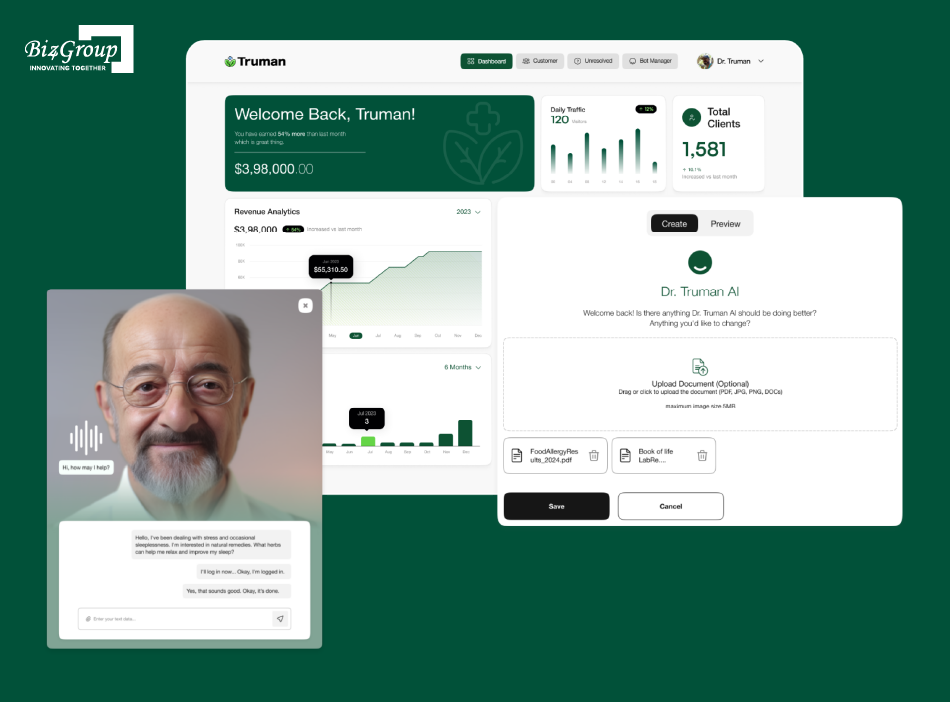
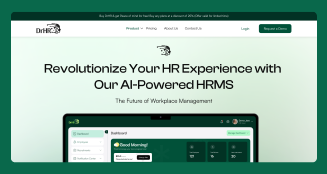
Truman is an AI-powered wellness companion built around a lifelike digital avatar that provides tailored health advice, product guidance, and report-based insights. Its blend of conversational intelligence, personalized recommendations, and report uploads demonstrates how AI-led platforms can bridge daily health decisions with clinically informed data interpretation.
Whichever path you pick, your end goal is to create intelligent software for wearable medical devices and diagnostic systems that behave consistently and deliver trustworthy insight under clinical scrutiny.
Develop AI software for medical devices that interprets data, supports clinicians and elevates patient outcomes.
Begin My AI Development Plan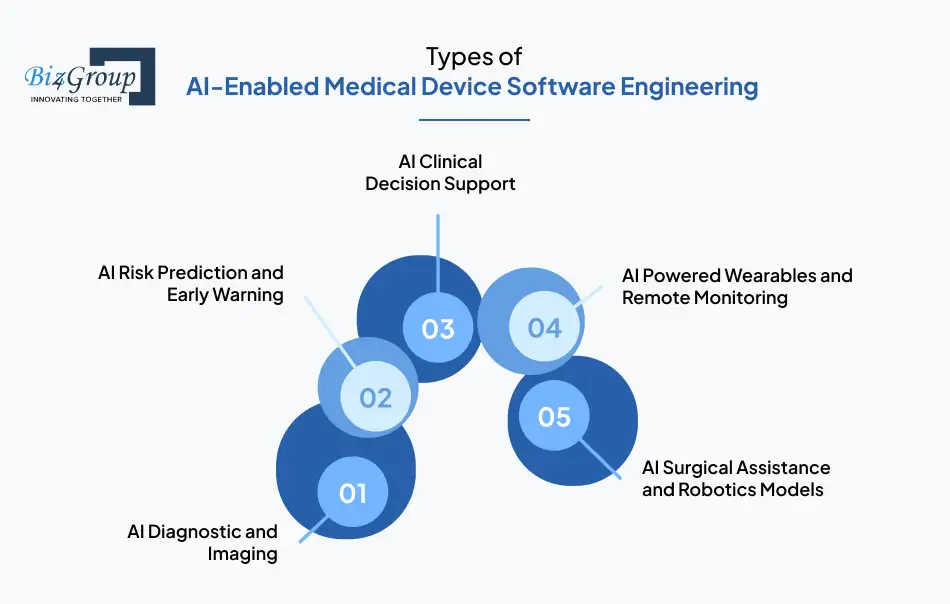
When you build AI software for medical devices, you are really choosing the type of intelligence your system will rely on. Each model brings its own strengths, limitations and workflow demands. Choosing the right one early prevents last minute architectural rewrites and unnecessary regulatory friction.
Here are the types that show up most often in clinical grade systems:
These models analyze scans or images using convolutional networks designed for pattern detection. They help teams create AI algorithms for smart medical devices and IoT health tools that interpret radiology, dermatology or ophthalmology data with predictable performance.
These systems use statistical learning and temporal patterns to predict adverse events before they occur. Many organizations tap into AI automation services to fine tune thresholds and ensure the model does not overwhelm clinicians with false alerts.
These systems combine structured data, logic based rules and machine learning to assist clinicians with recommendations. They require steady validation to ensure the suggestions feel helpful rather than intrusive.
These models process continuous sensor data and detect physiological shifts in real time. Their stability often depends on support from enterprise AI solutions that manage data flow, latency and ongoing recalibration.
These models interpret motion patterns, instrument trajectories and visual inputs to guide surgical tasks. Their performance rests on tightly engineered feedback loops and controlled testing environments.
A strong end-to-end development guide for AI medical device software ultimately helps you match each model type to the appropriate data, workflow and validation structure so your device performs consistently in real clinical settings.
Companies invest in medical device AI system development services because they want diagnostic accuracy, safer workflows and smarter automation without guessing their way through clinical, technical and regulatory hurdles. As devices become more intelligent, leaders need predictable engineering paths and systems that scale reliably in real healthcare environments.
Organizations rely on smart medical device software development to unify features, reduce engineering duplication and support multiple product generations without reinventing core diagnostic logic each time.
Teams invest early in frameworks that support FDA-compliant AI medical software development so they avoid retrofitting documentation, rewriting risk controls or repeating validation cycles that delay launch.
Many teams bring in a custom software development company when in house skills are stretched out too thin, especially for data engineering, validation logic, pipeline creation, and similar aspects of a project.
Healthcare environments depend on HIPPA compliant AI medical software development to protect patient information, manage consent and support safe data exchange between device, cloud and clinical systems.
Some solutions call for continuous optimization that’s supported by AI integration services to ensure updates, new datasets or changes related to workflow that don’t break system reliability.
Companies choose these services because building AI software for medical devices is never just about the model. It is about reducing risk, maintaining control and shipping systems clinicians can trust on day one and every day after.
When you build AI software for medical devices, you are designing intelligence that must survive regulatory scrutiny, clinical validation and real world usage without falling apart. FDA compliant systems depend on features that keep the software predictable, traceable and explainable.
Think of these features as the minimum architecture for reliability in healthcare AI:
|
Essential Feature |
Why It Matters |
|---|---|
|
Clinical grade data pipelines |
Ensures consistent input quality before models process anything |
|
Transparent model behavior |
Helps clinicians understand why the system generated certain outputs |
|
Built in validation checkpoints |
Supports regulatory expectations for accuracy and safety |
|
Integration ready APIs |
Makes it easier to integrate AI with EHRs or device interfaces |
|
Audit ready activity logs |
Tracks actions, data flow and model decisions for FDA review |
|
Role based access controls |
Protects patient data and enforces privacy boundaries |
|
Secure cloud and on device encryption |
Prevents unauthorized access across the full pipeline |
|
Bias and drift monitoring tools |
Keeps model performance stable across patient populations |
|
Human in the loop controls |
Allows clinicians to override or review AI generated decisions |
|
Version controlled model updates |
Supports safe and incremental model improvement |
These features show up early in AI-enabled medical device software engineering because skipping them creates bigger headaches during validation. Some teams even bring in an AI app development company when setting up the architecture if their internal team is stretched.

Dr. Ara is an AI-driven athletic health platform that interprets blood reports and converts them into personalized guidance for nutrition, sleep, hydration, and performance optimization. By transforming raw biomarker data into actionable health insights, it shows how intelligent software can elevate preventative care, precision monitoring, and user-specific health planning across modern medical ecosystems.
Strong AI software development for medical devices always leans on these essentials. They give your system a stable foundation, reduce regulatory risk and help your device earn long term trust in clinical environments.
Make AI software for diagnostic devices that offers dependable accuracy and real time decision support.
Build My Diagnostic AI ModuleWhen you build AI software for medical devices, core compliance features get you in the door, but next level functionality is what turns a device from useful to genuinely impressive. These advanced capabilities push performance, personalization and automation far beyond the baseline, especially as clinical expectations keep rising.
Systems in AI-enabled medical device software engineering can adjust behavior based on patient profiles, environmental factors or live data patterns. Many teams use generative AI to refine personalization without compromising clinical stability.
Devices combine imaging, sensor data and clinical records to detect patterns a single source would miss. This kind of depth becomes essential when you want AI software development for medical devices to deliver richer diagnostic outputs.
Models forecast potential deterioration or treatment failure before symptoms intensify. This predictive analytics layer supports proactive care instead of reactive intervention.
Some systems deliver live guidance, suggestions or risk alerts inside clinical workflows. These layers must remain simple and unobtrusive so clinicians understand insights at the moment they matter.
Advanced devices now support patient or clinician interaction through conversational voice chatbot development, helping streamline clarity and reduce workflow friction without overwhelming users.
These advanced capabilities matter when you want to develop AI software for medical devices that feels modern, intuitive and clinically valuable. They help you create AI-powered medical device software that not only performs well in testing but stands out in real care settings where speed, clarity and intelligence genuinely influence outcomes.
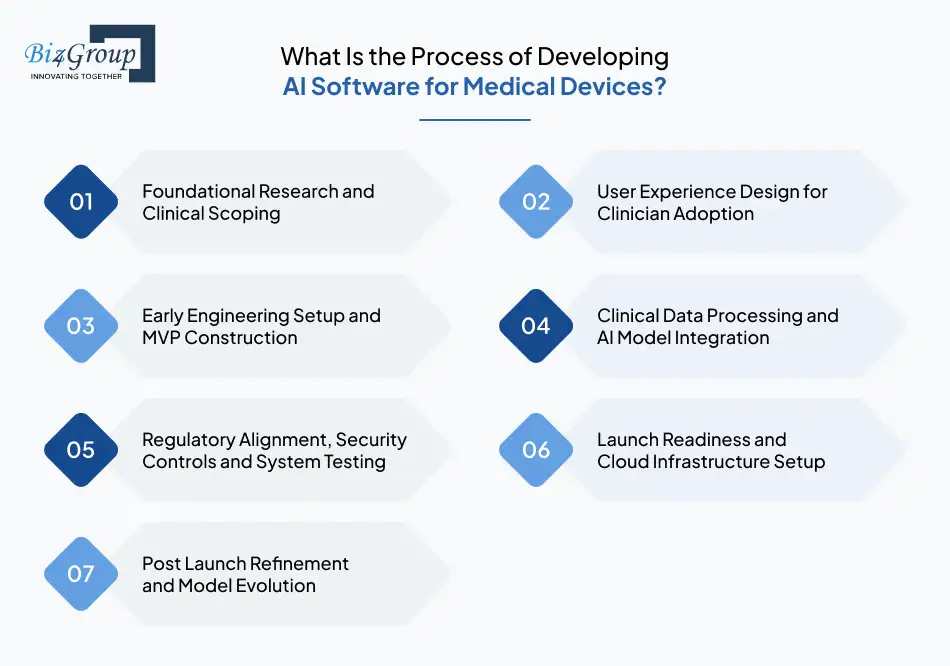
When you build AI software for medical devices, the real work happens long before the first model trains or the first sensor connect signal fires. Devices need intelligence that can survive clinical complexity, support physicians and handle real patient data without breaking down. These steps show how teams move from concept to clinical grade reality with clarity and control.
This phase defines exactly where AI will bring clinical value. Before you develop AI software for medical devices, you need clarity on the diagnostic problem, device risks, data availability and expected clinical outcomes. Misalignment here leads to expensive rebuilds later.
Discovery is where you decide which paths are feasible and which are not, making it a critical foundation when creating systems that must hold up in real care environments.
AI does not matter if clinicians cannot use it. Medical interfaces need clarity, simplicity and zero friction. An experienced UI/UX design company helps you make insights readable, alerts trustworthy and navigation smooth, even during high pressure clinical moments.
Use UI/UX design to shape the clinical experience early.
Also read: Top UI/UX design companies in USA
Before scaling, teams opt for MVP development services that prove clinical usefulness. An MVP for medical devices might include baseline data ingestion, model inference, limited alert logic or early device to cloud communication. Your goal is not perfection. Your goal is safe, measurable progress.
Also read: Top 12+ MVP Development Companies in USA
This is where the system’s intelligence forms. You cannot make AI software for diagnostic devices without disciplined data pipelines and rigorous model evaluation. Every dataset must be vetted, structured and validated for clinical use.
When done right, this phase helps teams create AI-powered medical device software that behaves consistently under varied clinical conditions.
Medical devices deal with sensitive data and high stakes outcomes. Compliance is not a formality. It is a structural requirement. Every model decision, alert and output needs to be reproducible, secure and traceable.
This is the stage where your system proves it can be trusted with real patient scenarios.
Also Read: Software Testing Companies in USA
Once the system is stable, it is time to deploy it into environments where uptime matters. This stage is where many teams finally appreciate what it truly takes to build AI software for medical devices that stays dependable under real clinical workloads.
AI in healthcare is never static. Models drift, patient populations change and clinical workflows evolve. Post launch optimization keeps the device clinically reliable instead of slowly degrading.
This lifecycle approach ensures long term clinical trust and supports ongoing AI software development for medical devices that stays aligned with real patient needs.
Mastering this process gives you a clear, predictable path to build AI software for medical devices that stays reliable in real clinical settings. When every phase is intentional, your system becomes safer, smarter and far more valuable across patient care workflows.
Choosing the right tech stack determines how safely, quickly and reliably your device handles data, runs AI models and supports clinical workflows. When you build AI software for medical devices, each layer must reinforce accuracy, compliance and long term stability.
Here’s all you need to know:
|
Label |
Preferred Technologies |
Why It Matters |
|---|---|---|
|
Frontend Framework |
React, Vue.js |
Clear, clinician friendly interfaces matter, and teams often rely on ReactJS development to keep dashboards intuitive and reliable. |
|
Server Side Rendering & SEO |
Next.js, Nuxt.js |
Used for secure portals, compliance dashboards and monitoring tools, where NextJS development supports consistent rendering and controlled data flow. |
|
Backend Framework |
Node.js, Python |
Safe device communication and stable diagnostic logic depend on strong backend structure, and many teams choose Python development for predictable workflow design. |
|
API Development & Integration |
Node.js, FastAPI |
NodeJS development enables secure interoperability with EHRs, imaging systems and IoT devices while maintaining reliable, audit ready data exchange. |
|
AI & Data Processing |
TensorFlow, PyTorch |
Runs the core diagnostic models with reproducible behavior suited for FDA reviewed inference. |
|
Model Serving & Inference |
TensorFlow Serving, TorchServe |
Ensures AI outputs run safely, consistently and at scale without unpredictable behavior. |
|
Data Pipelines & Preprocessing |
Airflow, Spark |
Cleans, structures and validates imaging or sensor data before it reaches the model, preserving diagnostic accuracy. |
|
Database & Storage Layer |
PostgreSQL, MongoDB |
Manages structured and semi structured clinical data with encryption and compliance readiness. |
|
Security & Compliance Infrastructure |
AWS IAM, Azure Security Center |
Secures access, logs activity and reinforces privacy requirements needed for regulated devices. |
|
DevOps & CI/CD Pipeline |
GitHub Actions, Jenkins |
Releases updates safely, enforces version control and supports controlled deployment cycles. |
|
Monitoring & Observability |
Prometheus, Grafana |
Tracks model drift, uptime, latency and inference anomalies across devices. |
|
Real Time Communication |
WebSockets, MQTT |
Keeps device to cloud streaming stable for vitals, imaging previews or waveform signals. |
|
Cloud Infrastructure |
AWS, Azure, GCP |
Supports scalable, HIPAA aligned hosting and safe AI processing for high volume clinical use. |
|
On Device Processing |
TensorFlow Lite, ONNX Runtime |
Enables safe, low latency inference for wearables or bedside hardware when cloud access is limited. |
A complete and thoughtful tech stack helps you build AI software for medical devices that behaves consistently in real clinical conditions. With the right frameworks and infrastructure in place, your system becomes easier to validate, scale and maintain throughout its entire lifecycle.
Create AI-powered medical device software that adapts to users, learns from patterns and improves monitoring.
Enhance My Wearable With AIThe cost to build AI software for medical devices usually falls somewhere between USD 10,000 and 200,000 plus, depending on how advanced the system needs to be. Consider this a ballpark range, but one that helps you understand how complexity, data volume and compliance requirements impact overall investment.
|
Build Category |
What You Typically Get |
Estimated Cost Range |
|---|---|---|
|
MVP AI Software for Medical Devices |
Basic model inference, early device connectivity, core UI screens, limited validation checks, foundational backend. Built to prove feasibility during MVP software development stage. |
USD 10,000 to 40,000 |
|
Mid Level Software for Medical Devices |
Full workflow logic, improved accuracy, expanded integrations, stronger privacy controls, structured testing, early HIPPA compliant AI medical software development measures and more polished clinician facing interfaces. |
USD 40,000 to 120,000 |
|
Enterprise Software for Medical Devices |
Advanced modeling, real time device to cloud communication, multi device support, formal compliance structures, detailed logs, scalable infrastructure and complete AI-enabled medical device software engineering across environments. |
USD 120,000 to 200,000 plus |
Your final budget depends on how deeply you want to scale and how much engineering support you bring in, whether that includes partnering with a software development company in Florida or expanding internal capabilities. Once your cost tier is clear, the next step is understanding the practices that make the entire build durable and clinically dependable.
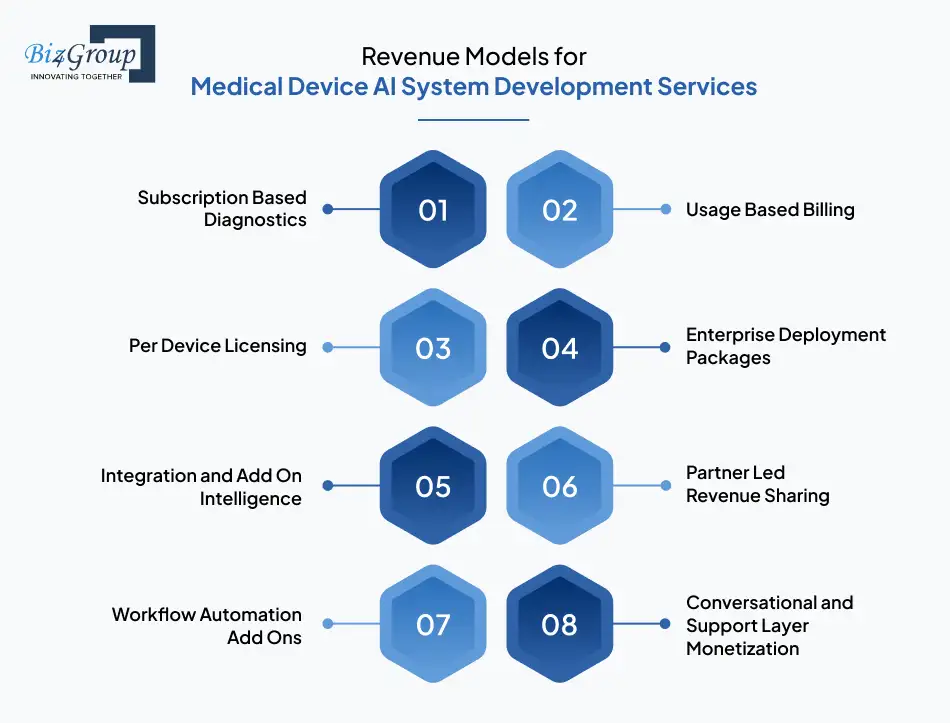
When you build AI software for medical devices, the business model you choose determines how predictable your revenue becomes and how quickly you can scale. A clear path helps teams plan investment confidently, especially before diving into the end-to-end development guide for AI medical device software that follows.
This model offers recurring revenue through continuous monitoring, automated interpretation and always on insights. Clinics appreciate predictable costs and steady access to AI driven diagnostics that support patient care daily.
This works well when diagnostic workloads vary. You charge per scan, per reading or per inference. It keeps upfront costs low for hospitals while letting your revenue scale with actual clinical demand.
Here, intelligence is built directly into hardware. Each device manufactured or sold includes licensing fees that tie revenue to production volume rather than usage.
Large health systems often want fully controlled, scalable setups. Enterprise models include custom installation, updates, compliance documentation and long term support tied to FDA-compliant AI medical software development requirements.
This model enhances existing devices without requiring redesigned hardware. Add on modules unlock extra value for manufacturers who want advanced features wrapped inside AI-enabled medical device software engineering.
Partnerships expand reach without expanding sales teams. You supply the intelligence, partners supply the distribution, and revenue grows proportionally with shared adoption.
Some devices monetize by reducing administrative burden instead of delivering core diagnostics. These modules fit perfectly with AI in healthcare administration automation, saving time for clinicians and staff.
Conversational layers help clinicians operate devices more confidently and reduce errors. These features often take shape using AI assistant app design principles or web based interfaces built with AI medical web development.
Your revenue model shapes how customers adopt, scale and renew your AI driven device, whether you pursue direct licensing or broader partnerships with a top AI development companies in Florida. Once your monetization path is clear, it becomes easier to refine the best practices that keep your build stable and clinically dependable throughout its lifecycle.
Build AI algorithms for medical device integration using scalable, compliant and future ready engineering.
Plan My Device Integration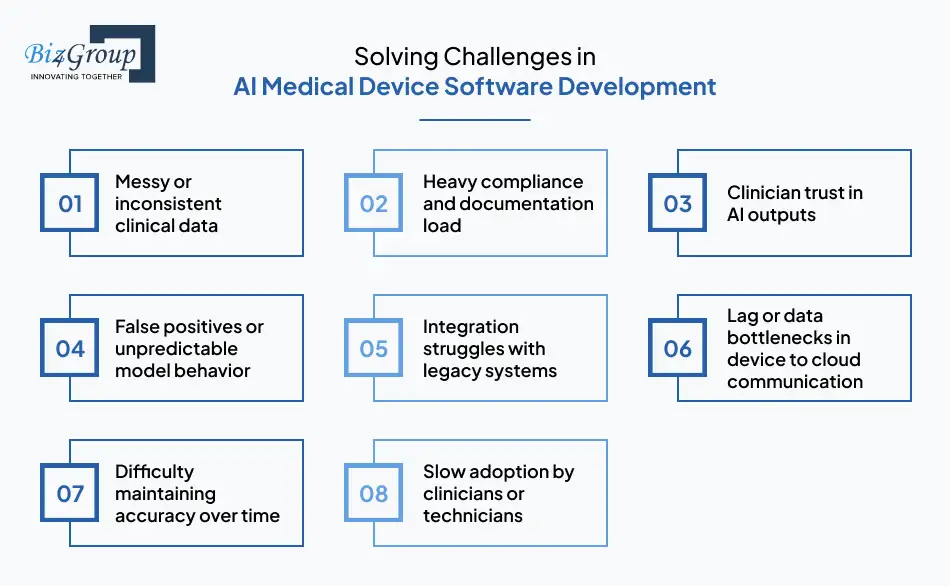
When you build AI software for medical devices, the hard parts rarely look like the pitch deck version. Real challenges come from clinical expectations, unpredictable data and compliance rules that never take a day off.
Here are the hurdles teams hit most and what actually solves them:
|
Top Challenges |
How to Solve Them |
|---|---|
|
Messy or inconsistent clinical data |
Standardize inputs, define labeling rules early and set preprocessing steps before you develop AI software for medical devices so your models stay predictable. |
|
Heavy compliance and documentation load |
Build validation templates, automate logs and align your process with AI software development for medical devices from day one. |
|
Clinician trust in AI outputs |
Improve interpretability, refine UI clarity and support workflows with simple interactions shaped by an AI chatbot development company. |
|
False positives or unpredictable model behavior |
Use threshold tuning, fallback logic and structured safety checks across diverse patient groups to keep outputs steady. |
|
Integration struggles with legacy systems |
Create flexible APIs and modular interfaces to help teams integrate AI into an app without breaking existing workflows. |
|
Lag or data bottlenecks in device to cloud communication |
Optimize data transfer paths, apply lightweight compression and keep inference selective to maintain responsiveness. |
|
Difficulty maintaining accuracy over time |
Monitor model drift, retrain with updated data and use incremental validation cycles tied to clinical feedback. |
|
Slow adoption by clinicians or technicians |
Provide simple onboarding flows, micro guidance and clear reasoning in outputs to reduce hesitation during use. |
The good news is that once you understand these hurdles and build processes that defuse them early, everything else becomes far more manageable. With challenges mapped out, it becomes easier to shift attention toward the practices that keep your entire build stable as it evolves.
When you build AI software for medical devices, best practices become your insurance policy against messy rework, unclear outputs and validation setbacks. Think of these as the habits that keep everything stable as you scale into real clinical environments.
Validation should run alongside development so your architecture matches AI medical device software development expectations from the start. Build documentation gradually instead of saving it for the end when gaps become expensive. This keeps your system FDA friendly without slowing down iteration.
A flexible architecture lets you build AI algorithms for medical device integration that improve over time without breaking the full system. With modules that update independently, devices stay reliable even as new data or advanced features come in. This approach also supports smooth scaling across product lines.
Clinicians trust insights they can interpret, so your interface should highlight reasoning clearly and minimize guesswork. Use interaction patterns shaped by an AI conversation app to guide users through results without overwhelming them. Explainability directly increases adoption in high pressure clinical settings.
Clinical workflows include noise, hardware variability and inconsistent data. Strong medical device AI system development services plan for failures, fallback behavior and threshold tuning from the beginning. A device that handles edge cases gracefully is the one clinicians will actually rely on.
Your AI will evolve through real world inputs, so create safe channels to gather patterns that help you create intelligent software for wearable medical devices that stays accurate. Regular retraining prevents drift and keeps your system dependable across different populations. Post launch learning is a long term advantage when handled responsibly.
Smooth integration removes adoption barriers inside hospitals and device ecosystems. Use predictable APIs, clean data structures and workflows supported by AI chatbot integration to reduce friction. When integration is simple, procurement and deployment move much faster.
The best AI fits into clinical routines without forcing new habits or unnecessary complexity. Use clinician testing and interaction clarity inspired by a healthcare conversational AI guide to refine usability. Human centric design directly improves trust, comfort and long term usage.
Following these practices keeps your system safe, scalable and easier to validate, giving every device a stronger foundation to grow. With these fundamentals in place, the next step is choosing a partner who can carry that same discipline into the full development lifecycle.
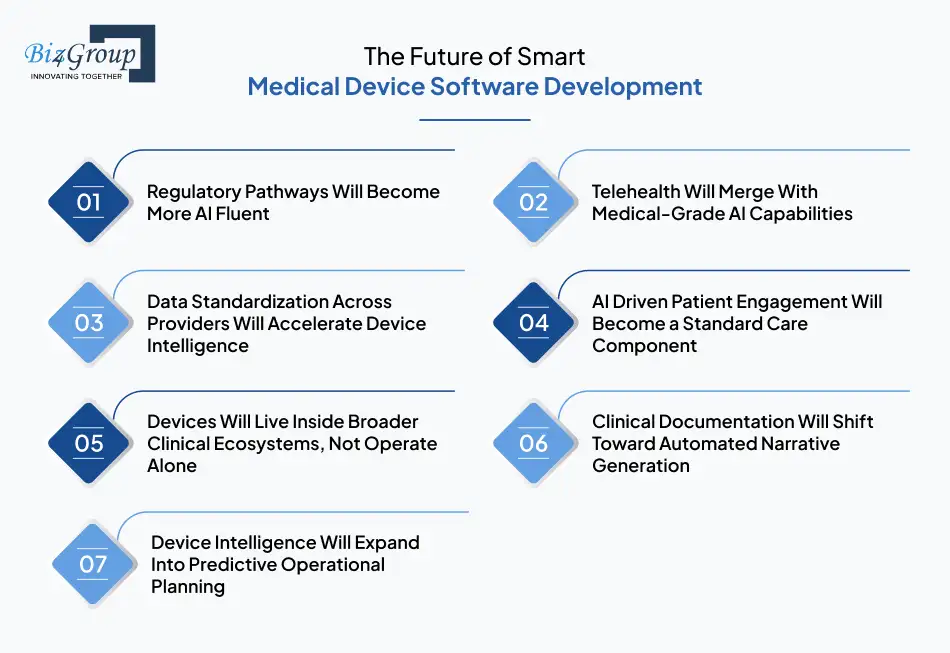
The next era of healthcare belongs to innovators who build AI software for medical devices that evolve with clinical needs instead of freezing at launch. The industry is moving fast, and the opportunities ahead are broader than any single device or model.
As the FDA gains experience with AI driven devices, review processes will shift toward continuous oversight rather than one time approvals. Teams that develop AI software for medical devices will navigate frameworks designed specifically for adaptive systems. This makes long term governance as important as the first successful submission.
Remote care will evolve into continuous clinical supervision backed by intelligent devices. AI powered tools will support physicians during virtual consults and at-home monitoring, shaped by platforms powered through business app development using AI. The boundary between clinic and home will become far less rigid.
Also Read: How to Develop an AI-Based Telehealth Automation System: Step-by-Step Guide
Hospitals and manufacturers will finally align on common formats, enabling devices to communicate without translation issues. Companies that create AI-powered medical device software will benefit from richer, cleaner data ecosystems. This improvement will shorten development cycles and make clinical validation more efficient.
Patient facing layers will support treatment adherence, clarify device readings and reduce anxiety around self monitoring. These experiences will grow through structured guidance patterns refined by chatbot development for healthcare industry. Engagement will become as critical as diagnostics in long term outcomes.
The future belongs to integrated care environments where diagnostics, monitoring tools and hospital systems share insight seamlessly. Builders will make AI software for diagnostic devices that participates in coordinated workflows rather than isolated tasks. This ecosystem mindset increases overall clinical impact, not just device performance.
Instead of clinicians typing or dictating notes, AI enabled devices will capture context and generate structured documentation automatically. Systems shaped by AI chatbot development for medical diagnosis will help reduce administrative load across specialties. This becomes a major value layer for both hospitals and device makers.
Beyond diagnostics, medical AI will help facilities anticipate resource usage, maintenance cycles and staffing demands. Devices will contribute data that powers smarter operational decisions at the system level. This shift turns devices into strategic assets rather than isolated tools.
The future will be all about building systems that fit naturally into evolving care models. With these shifts taking shape, choosing the right development partner becomes a lot more important in the long run.
If you want to build AI software for medical devices that actually works in real clinical environments, you need a team that has shipped intelligent health platforms before, not one learning on your project. That is where Biz4Group stands out.
We have already delivered AI driven health systems like Dr. Ara and Truman, both of which required deep technical thinking, responsible data workflows and human centered design. The same discipline carries into every medical device project we take on.
What Sets Biz4Group Apart
What You Can Expect From Us
Biz4Group brings the engineering depth, product clarity and healthcare awareness needed to turn your device concept into a dependable AI powered medical solution.
Use medical device AI system development services that streamline validation, compliance and deployment.
Start My AI Device ProjectWhen you build AI software for medical devices, you are are shaping how clinicians make decisions, how patients stay informed and how data becomes something genuinely useful. It is complex, yes, but it also happens to be one of the most rewarding problems to solve in healthcare tech.
With the right planning, the right validation habits and a team that knows how to develop AI software for medical devices without stumbling over compliance landmines, your product becomes something durable rather than experimental. And this is exactly where a seasoned AI product development company earns its keep.
Stick to the process, think long term and choose partners who actually understand the space, and you will not just keep pace with the future of medical devices. You will help define it.
Curious what your medical device could do with the right AI behind it? Start the conversation today.
Most teams gather labeled clinical datasets, edge case samples and device specific signals to build AI software for medical devices that performs consistently across patient groups.
Projects typically take four to twelve months, depending on complexity and data readiness, especially when you need to develop AI software for medical devices that meets regulatory expectations.
Most projects fall between USD 10,000 and 200,000 plus, depending on scope and feature depth, particularly when you create AI-powered medical device software that requires advanced modeling or continuous monitoring.
Yes. Any system influencing diagnosis or treatment must follow FDA guidelines, especially if you plan to make AI software for diagnostic devices that interacts directly with clinical decisions.
General models rarely meet clinical accuracy standards, so most teams create intelligent software for wearable medical devices using medical grade or custom tuned AI models.
You will need monitoring, drift checks and retraining pipelines to build AI algorithms for medical device integration that stay reliable as new patient data comes in.

with Biz4Group today!
Our website require some cookies to function properly. Read our privacy policy to know more.