Location :
Orlando, FL, USA
Location :
Orlando, FL, USA +1 (407) 714-1616
 info@biz4group.com


















Imagine a digital system that doesn’t wait for instructions but instead, understands your business goals, learns from real-time feedback, and takes independent actions to get the job done.
Read More
Why are so many healthcare founders investing in mental wellness apps right now? The answer often starts with one challenge: people need faster access to emotional support, while therapy availability and affordability remain ongoing barriers. That gap has increased interest in digital platforms such as Wysa, an AI-powered mental wellness app known for guided conversations, self-help tools, and always-available support.
The need is substantial. According to a report by WHO, more than 1 billion people are living with mental health disorders, creating growing pressure on healthcare systems and digital care providers. As demand rises, many startups and SaaS teams begin asking: we are looking to develop an AI therapy app like Wysa for emotional support, how much investment is required?
Well, in most cases, the cost to develop AI mental health app like Wysa falls between $50,000 and $300,000+, depending on scope, AI depth, privacy requirements, and launch readiness.
Creating a product like Wysa involves more than just chatbot replies. Users expect supportive conversations, mood tracking, secure experiences, and progress tools that feel useful from day one. That is why early planning around overall AI app development cost matters before development begins.
Key budget areas usually include:
Now with that on table here something more you should know: the global AI in mental health market is projected to reach USD 9.12 billion by 2033. Next, let’s understand how Wysa works and what makes its model valuable.
Wysa is an AI-powered mental wellness platform designed to help users manage stress, anxiety, low mood, sleep concerns, and daily emotional challenges through guided digital support. It offers private, on-demand conversations that help users reflect, build healthier habits, and access self-help exercises anytime. The platform is widely recognized for combining conversational AI with evidence-based wellness techniques, making mental health support more accessible between therapy sessions or for users who may not seek traditional care immediately.
This model shows why many startups and healthcare platforms want to build similar solutions, especially when scalable emotional support is becoming a growing priority.
For healthcare providers, cost is not only a budgeting question. It affects how fast your platform can launch, what level of care experience users receive, and how well the product can scale later. If you are estimating the cost to develop AI mental health app like Wysa, it is important to understand where the investment creates real operational value.
When healthcare providers understand these cost drivers early, they can plan smarter launches, control risk, and build platforms that are ready to grow.
Budget discussions often slow down when the product vision is clear, but the numbers are not. That is where an estimator becomes useful. Instead of waiting for a full planning cycle, it gives you a practical way to understand the cost to develop AI mental health app like Wysa based on platform scope, AI depth, integrations, and rollout goals.
For founders asking, “we are planning to build an AI mental health app like Wysa but unsure about the total development cost.” Then, this cost estimator will help you understand the most reliable starting point by mapping the quote around product scope, AI capability depth, integrations, and launch scale.
Estimated Cost = Base Platform Cost + (AI Feature Cost × Complexity Multiplier) + AI Integrations Cost + UI/UX cost+ Data & Security
Estimated Cost = $45,000 + ($20,000 × 1.5) + $15,000 + $12,000 + $8,000 = $110,000
A structured estimator adds value before the discovery phase by helping teams:
This quick quote framework is especially useful when Wysa like AI mental health app development cost, needs early clarity, because scope decisions can significantly change the final investment.
Get a sharper estimate before scope changes increase spends
Get My Cost Range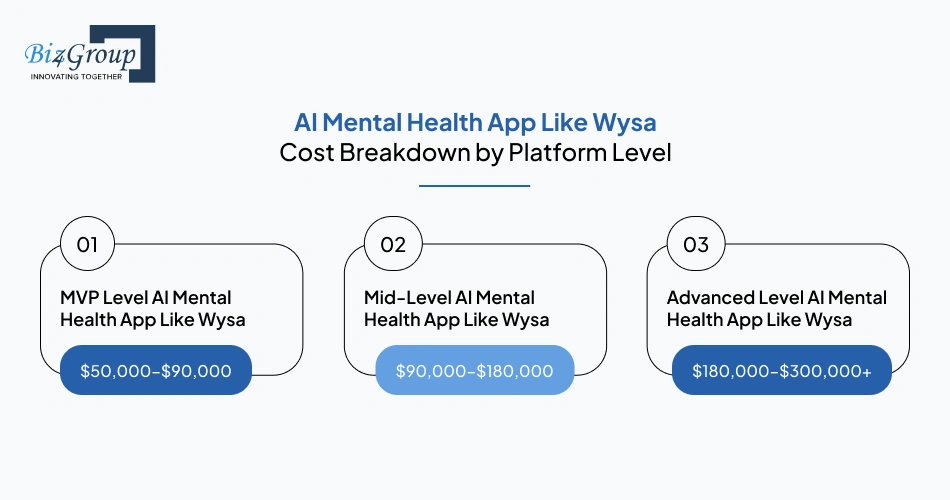
The most practical way to understand pricing of AI mental health app development is to map it against the level of platform maturity you plan to launch. A startup validating demand does not need the same investment depth as a healthcare brand building a scaled digital care platform.
That is why the cost breakdown for building AI mental health chatbot like Wysa changes based on scope and growth goals. Let us now walk through the platform-level cost breakdown and understand why budgets can vary so much.
Estimated Cost Range: $50,000–$90,000
This level is built for faster market entry and early user validation. The focus stays on core features needed to launch, test engagement, and collect early behavioral insights.
What is typically covered:
How It Differs: At this stage, AI remains lightweight and guided. The goal is to validate engagement, retention, and product fit before deeper expansion.
Estimated Cost Range: $90,000–$180,000
Once the MVP shows traction, the next investment layer focuses on stronger personalization, smoother operations, and better care journeys.
What is typically covered:
How It Differs from MVP: This level moves beyond validation into growth. Budget increases as the platform supports better engagement, retention, and monetization.
Estimated Cost Range: $180,000–$300,000+
This level supports organizations scaling across markets with stronger automation and deeper operational control. It is common for providers building larger digital wellness ecosystems or AI solutions for enterprises.
What is typically covered:
How It Differs from Mid-Level: AI becomes a direct part of service delivery, analytics, expansion readiness, and long-term operational scale.
|
Development Level |
Estimated Cost Range |
Scope |
Ideal For |
|---|---|---|---|
|
MVP Level AI Mental Health App Like Wysa |
$50,000–$90,000 |
Core launch platform with essential support tools |
Healthcare Startups validating demand |
|
Mid-Level AI Mental Health App Like Wysa |
$90,000–$180,000 |
Growth-ready platform with stronger engagement flows |
Growing wellness brands |
|
Advanced Level AI Mental Health App Like Wysa |
$180,000–$300,000+ |
Enterprise-scale platform with deeper intelligence |
Mental Healthcare Providers scaling operations |
The real value of this level-wise view is that it turns rough pricing into a business decision. Once your goals match the right stage, the cost to develop AI mental health app like Wysa becomes easier to plan with confidence.
Architecture pricing becomes meaningful only when it helps you decide which setup best fits your growth plans, user volume expectations, and future AI roadmap. This is where AI mental health app like Wysa development cost should be viewed as a business decision, because the right structure can control long-term spend or create expensive rebuilds later.
If you’re also someone wondering, “I am planning a startup in AI mental health like Wysa and need cost estimation,” then, the fastest way to estimate realistically is to start with the architecture that matches your growth stage.
A monolithic architecture keeps the full platform inside one connected system, where onboarding, journaling, chatbot support, admin tools, and user flows operate together. It works well for early-stage teams that need faster execution and simpler management during launch.
Cost you can expect: $60,000–$95,000
Best fit when you need:
The budget stays more controlled here because updates, testing, and maintenance happen inside one unified platform.
A modular service-based architecture separates major business functions into connected blocks such as chatbot systems, subscriptions, analytics, content delivery, and support workflows. This structure helps growing platforms add or improve features without rebuilding the entire product.
Cost you can expect: $95,000–$170,000
Best fit when you need:
The higher budget comes from managing separate modules, each requiring deployment, validation, and monitoring.
This setup runs each major function independently while a dedicated AI data layer processes mood signals, engagement behavior, journaling trends, and recommendation logic in real time. It is ideal for platforms where personalization becomes central to user retention.
Cost you can expect: $170,000–$250,000
Best fit when you need:
The cost rises because live AI workflows depend on constant communication across multiple independent services.
This option distributes the platform across multiple cloud regions to support geographic expansion, stronger uptime, and disaster recovery readiness. It suits organizations planning enterprise growth or serving users across different markets.
Cost you can expect: $250,000–$300,000+
Best fit when you need:
This carries the highest budget because cross-region recovery, duplication systems, and deeper infrastructure controls require larger investment.
|
Architecture Choice |
Best Business Situation |
Cost Range |
Decision Impact |
|---|---|---|---|
|
Monolithic |
Validating demand and faster MVP launch |
$60,000–$95,000 |
Lower upfront spend |
|
Modular Service-Based |
Growth-stage platforms adding features |
$95,000–$170,000 |
Balanced scaling flexibility |
|
Microservices with AI Data Layer |
Personalization and analytics at scale |
$170,000–$250,000 |
Stronger AI-led engagement |
|
Cloud-Native Multi-Region |
Multi-market growth and uptime needs |
$250,000–$300,000+ |
Highest long-term readiness |
These architecture choices are not meant to be followed as a fixed progression path. The right decision depends on your launch goals, growth roadmap, user demand, and how much personalization you plan to offer. Here is how you can decide architecture for your AI mental health platform.
A practical way to decide is to align the architecture with your next 18–24 months of business growth, not only launch needs:
The right architecture is rarely about what sounds advanced. It is about what protects your roadmap and keeps the cost to develop AI mental health app like Wysa aligned with real business growth.
Match your roadmap with a cost-smart scalable build path
Plan My Architecture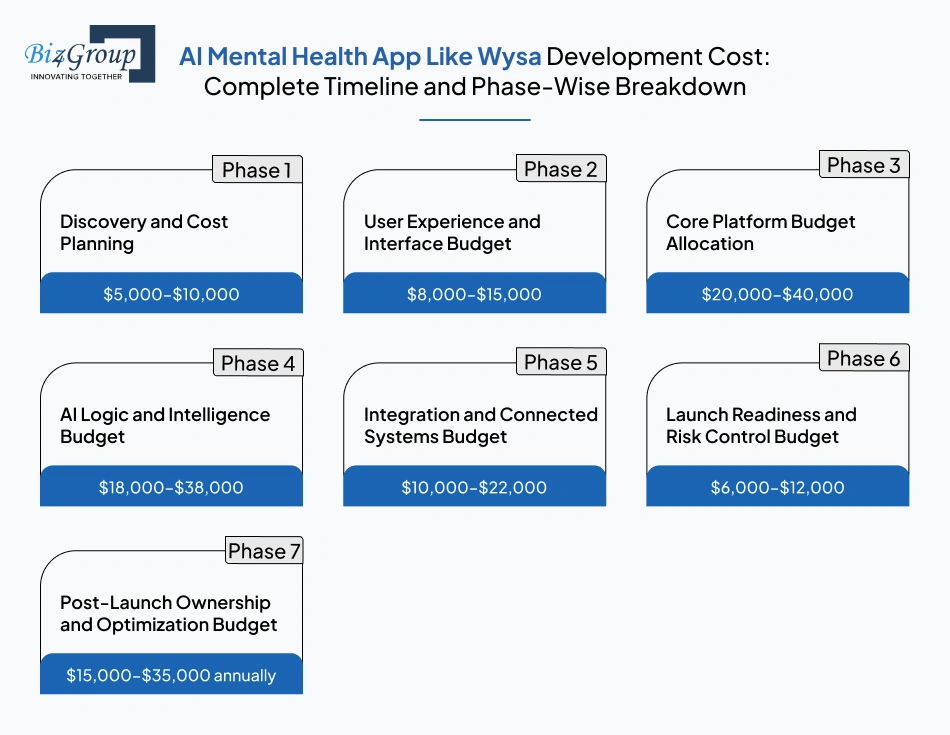
The total quote becomes easier to trust when you can see how the budget moves across financial phases instead of one bulk number. This phase-wise view makes the cost of developing scalable AI mental wellness platform like Wysa easier to plan, because each stage carries a different cost weight, timeline impact, and business priority.
Estimated Timeline: 1–2 weeks
Estimated Cost: $5,000–$10,000
This phase funds the planning work that shapes the full budget before development begins. Spending usually goes toward product goals, user personas, monetization planning, privacy scope, competitor review, and feature prioritization. Strong planning reduces budget leakage later because teams avoid building low-value features or changing direction mid-project.
Estimated Timeline: 2–3 weeks
Estimated Cost: $8,000–$15,000
This cost block covers the user-facing journey such as onboarding, chatbot screens, journaling flows, subscription pages, and progress dashboards. Mental wellness platforms depend heavily on trust and ease of use, so poor design often creates expensive redesign cycles later. An experienced UI/UX design company helps control those future costs early.
Also Read: Top UI/UX Design Companies in USA
Estimated Timeline: 4–6 weeks
Estimated Cost: $20,000–$40,000
This is often the largest fixed spend because it funds the operational backbone of the platform. Budget goes into user accounts, admin panels, content systems, notifications, user history, and secure data workflows. Many founders work with MVP development service providers here to keep early investment lean while validating product demand.
Also Read: Top MVP Development Companies in USA
Estimated Timeline: 3–5 weeks
Estimated Cost: $18,000–$38,000
This phase covers the budget for chatbot intelligence, mood-based responses, recommendation flows, emotional support logic, and personalization systems. Costs rise when the platform needs smarter conversations and stronger user engagement. Once AI model training enters scope, budget usually increases because tuning and testing require extra time.
Estimated Timeline: 2–3 weeks
Estimated Cost: $10,000–$22,000
This budget phase covers third-party systems that must work smoothly with the platform. Common spend areas include payment tools, telehealth systems, AI integration with EHR/EMR system, calendar booking, wearable sync, integration of AI models, and external APIs. Many pricing factors for AI therapy chatbot app like Wysa become clearer during this stage.
Also Read: A Complete Guide to OpenAI API Integration for AI Applications
Estimated Timeline: 1–2 weeks
Estimated Cost: $6,000–$12,000
This phase reserves budget for final testing, privacy checks, device compatibility, load readiness, and release preparation. Launch problems often create avoidable costs through refunds, poor ratings, and urgent fixes. Proper spending here protects the first public rollout.
Estimated Timeline: Ongoing
Estimated Cost: $15,000–$35,000 annually
This final phase covers the recurring spend many founders underestimate in the first quote. Budget usually goes toward hosting, AI improvements, analytics reviews, retention upgrades, security updates, and support scaling. Reliable AI integration services help control these long-term operating costs.
|
Phase |
Timeline |
Cost Range |
|---|---|---|
|
Discovery & Planning |
1–2 weeks |
$5,000–$10,000 |
|
User Experience and Interface Design |
2–3 weeks |
$8,000–$15,000 |
|
Core Platform Budget Allocation |
4–6 weeks |
$20,000–$40,000 |
|
AI Logic and Intelligence |
3–5 weeks |
$18,000–$38,000 |
|
Integration and Connected Systems |
2–3 weeks |
$10,000–$22,000 |
|
Launch Readiness and Risk Control |
1–2 weeks |
$6,000–$12,000 |
|
Post-Launch Ownership and Optimization |
Ongoing |
$15,000–$35,000 yearly |
When viewed this way, the cost to build AI mental health app like Wysa feels less like one large quote and more like a phased investment roadmap, making approvals, milestone planning, and budget control far easier.
Many founders estimate product features first and treat compliance later as a small add-on. That usually changes once legal reviews, secure storage, and privacy controls enter the roadmap. For mental wellness platforms handling emotional conversations and personal records, AI mental health app like Wysa development cost with compliance and security should be planned from the start. These investments protect trust, reduce launch risk, and prevent expensive fixes later.
Estimated Cost: $2,000–$6,000
This budget usually covers legal drafting for privacy policy, consent flows, terms of use, refund terms, and data handling disclosures. Costs rise when multiple regions or healthcare-specific language is required.
Common spend areas include:
Estimated Cost: $4,000–$10,000
This cost covers the systems that control who can enter accounts and what each user or admin can access. Budget increases when stronger identity checks are required.
Typical inclusions are:
Estimated Cost: $6,000–$15,000
Mental health platforms often store journals, progress history, and sensitive usage records. This spend supports protected storage environments and recovery readiness.
Costs commonly go toward:
Estimated Cost: $10,000–$25,000
Healthcare-facing platforms usually need deeper controls before working with clinics, providers, or enterprise buyers. A HIPAA compliant AI app often requires additional implementation work beyond basic security.
This budget may include:
Also Read: Cost to Develop HIPAA-Compliant AI Healthcare Software
Estimated Cost: $5,000–$12,000
This phase helps identify weaknesses before launching. Higher costs usually reflect deeper testing scope and larger product complexity.
Typical services include:
Estimated Cost: $8,000–$18,000 annually
Security is not a one-time task. Live platforms need recurring budget for monitoring, patching, and quick response planning.
Recurring spend often covers:
These costs are part of building a platform users can trust. When planned early, they keep the cost to build AI mental health app like Wysa realistic while reducing future legal, security, and reputation risks.
See hidden privacy costs before they hit your budget
Audit My Cost Risks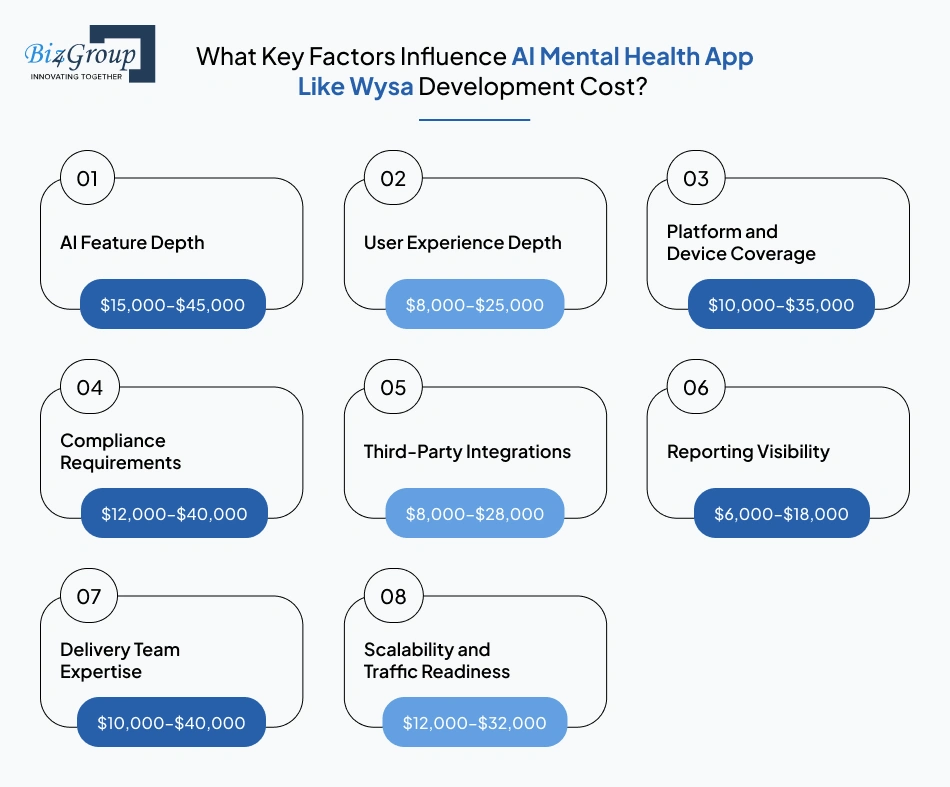
The final quote often changes long before coding begins because several visible business and product decisions directly reshape the budget. Many founders miss these early cost drivers, which later makes the development cost of AI mental health app like Wysa feel higher than expected.
So now let us understand the factors that directly influence upfront pricing of a Wysa-like mental wellness platform.
The depth of intelligence expected from the platform has one of the biggest impacts on pricing. Supportive conversations, emotional response logic, journaling insights, and personalized guidance all require additional planning, testing, and refinement. The smarter the platform becomes, the higher the quote usually moves.
Typical Cost Impact: $15,000–$45,000
This factor usually expands budget through:
Mental wellness products depend heavily on trust and ease of use. Calm onboarding, intuitive chat flows, progress tracking, and accessible design often increase budget because stronger experience quality improves retention. Poor design can also create redesign costs later.
Typical Cost Impact: $8,000–$25,000
Budget movement is commonly driven by:
The number of platforms included in launch scope directly affects pricing. Supporting iOS, Android, and web development together increases hours, testing cycles, and release management effort. Wider device coverage usually means a larger initial investment.
Typical Cost Impact: $10,000–$35,000
This factor often increases with:
Mental health platforms handle sensitive user data, which makes privacy spending essential. Secure workflows, consent systems, audit readiness, and healthcare-grade controls often raise the quote. This factor becomes more important when selling to providers or enterprises.
Typical Cost Impact: $12,000–$40,000
This usually adds spend through:
External systems can significantly change the quote because every connection needs setup, testing, and maintenance. Wysa-like platforms may need calendars, telehealth systems, payment tools, or wearable sync. More integrations usually mean more budget.
Typical Cost Impact: $8,000–$28,000
This factor is shaped by:
Business visibility requirements can raise the quote even when the core product scope stays the same. Founders often need engagement metrics, retention insights, subscription summaries, and user activity reports. Better reporting usually needs extra development time.
Typical Cost Impact: $6,000–$18,000
This factor often includes:
The experience level of mental health app developers also affects pricing. Teams with healthcare workflow knowledge often plan better, avoid mistakes, and reduce costly rework. Hiring healthcare AI app developers can improve delivery speed and budget accuracy.
Typical Cost Impact: $10,000–$40,000
The cost difference usually reflects:
Growth expectations influence cost before launch because higher user volume requires stronger backend readiness. This becomes important for startups expecting fast adoption, recurring subscriptions, or enterprise rollouts. Planning early helps avoid expensive rebuilds later.
Typical Cost Impact: $12,000–$32,000
This factor usually grows through:
|
Cost Factor |
Budget Impact |
Why It Changes Pricing |
|---|---|---|
|
AI feature depth |
High |
More intelligence layers |
|
User Experience Depth |
Medium-High |
Better user retention |
|
Platform and Device Coverage |
High |
More devices to support |
|
Compliance Requirements |
High |
Privacy and security controls |
|
Third-Party Integrations |
Medium-High |
More connected systems |
|
Reporting Visibility |
Medium |
Better business visibility |
|
Delivery Team Expertise |
Medium |
Speed and accuracy |
|
Scalability and Traffic Readiness |
High |
Growth readiness |
When these visible cost drivers are mapped early, the cost to build AI mental health app like Wysa becomes easier to justify because each major spend ties directly to user trust, engagement, privacy readiness, and long-term scale.
The approved quote often looks complete until secondary costs begin appearing after scope lock, vendor onboarding, or launch preparation. These delayed expenses usually sit outside the first estimate, which is why the building cost of AI mental health app like Wysa can rise later.
So, what hidden expenses usually get missed? The budget leak points below cover costs many early estimates fail to capture.
Regulated wellness platforms often need extra legal work near launch. These costs usually appear after product flows, and data handling processes are finalized.
a) Policy and Consent Review: $3,000–$9,000
This covers legal review of privacy policy, user consent screens, terms of use, and data handling language. Costs rise when multiple regions or healthcare buyers are involved.
b) Healthcare Contract Support: $4,000–$12,000
This includes reviewing vendor agreements, enterprise contracts, and compliance documents required by clinics, insurers, or wellness partners.
Many founders budget for development but overlook recurring AI operating costs once users begin active conversations. Spend increases with volume and response complexity.
a) Conversation Processing Cost: $2,000–$10,000 yearly
AI chat usage often depends on message volume, session length, and user growth. Higher engagement can quickly increase monthly billing.
b) Premium Model Upgrade Cost: $3,000–$8,000
Teams sometimes upgrade to stronger models for better empathy, accuracy, or safer responses. This usually adds new recurring spend.
Once delivery begins, new feature requests can reopen approved workstreams. This usually increases cost through redesign, re-testing, and added implementation time.
a) Chat Flow Rework: $4,000–$14,000
Revising wellness journeys, emotional support flows, or chatbot responses after approval often requires new design and testing rounds.
b) Feature Expansion Cost: $5,000–$18,000
Adding dashboards, subscriptions, therapist handoff tools, or new modules mid-project can stretch budget and timelines.
Some hidden expenses come from waiting, not added features. Delays from outside partners can keep allocated teams billable while progress pauses.
a) API Access Delay Cost: $2,000–$6,000
Missing credentials or delayed sandbox access can slow integrations while developers remain assigned to the project.
b) Third-Party Approval Delay: $3,000–$9,000
Slow approvals from payment, telehealth, or data vendors can create idle delivery time and milestone delays.
A platform can be technically complete while internal teams are still unprepared to run it smoothly. Operational readiness often needs a separate budget.
a) Staff Enablement Cost: $2,000–$7,000
Support teams and admins may need training on dashboards, workflows, escalation processes, and user handling practices.
b) Process Documentation Cost: $1,500–$5,000
Internal guides, SOPs, and handover manuals help daily operations run consistently after launch.
Real launches often need extra support during the first days or weeks. Many teams forget to reserve a budget for this stage.
a) Controlled Rollout Support: $3,000–$8,000
Staged launches need active monitoring, issue tracking, and user feedback handling before wider release.
b) Urgent Fix Reserve: $2,000–$6,000
Quick bug fixes, emergency patches, and rapid response support are common during early live usage.
These delayed cost areas are often what pushes the AI healthcare app cost beyond the first quote. Planning them early gives founders stronger control, cleaner approvals, and a more realistic cost to build AI mental health app like Wysa.
Expose budget leaks before they slow your launch
Reveal My Hidden CostsWith every cost driver now visible, the most practical question becomes clear: how do you reduce spending without weakening product quality? The budget required to build AI mental health support app like Wysa is best optimized through smarter execution choices that lower rework, shorten launch cycles, and improve long-term financial control.
Have a look at the most effective strategies.
Not every chatbot workflow needs custom AI from day one. Using proven third-party AI services for early conversations, sentiment checks, or support routing can reduce first-phase development costs and help teams launch faster.
This optimization works best through:
This single decision can reduce spending by 15%–25% (around $12,000–$25,000 on a $100K project). It protects the budget during early validation.
A major budget leak starts when chat flows, subscriptions, or wellness journeys keep changing after estimates are approved. Freezing the core roadmap early helps control redesign and repeated testing costs.
This optimization protects budget through:
This discipline can reduce spending by 10%–15% (about $10,000–$15,000 on a $100K project). It keeps delivery cleaner and faster.
Many founders overspend by adding secondary features too early. Releasing only the highest-value wellness tools first helps validate demand before deeper investment.
The savings usually come from:
This roadmap choice can reduce spending by 15%–20% (approximately $15,000–$20,000 on a $100K project). It improves capital efficiency.
Fixed infrastructure often creates waste during early growth stages. Cloud resources that scale with user demand keep hosting spend closer to real usage.
Savings usually come from:
This strategy can reduce spending by 20%–30% (roughly $15,000–$25,000 over early infrastructure cycles). It supports smarter growth spending.
Late privacy fixes are usually more expensive than early planning. Security workflows, consent systems, and data storage decisions should be mapped before development begins.
This optimization saves cost through:
This strategy can reduce spending by 10%–20% (around $8,000–$18,000 depending on scope). It lowers late-stage budget shock.
Manual monitoring and repetitive support tasks quietly increase ownership cost after launch. Automating alerts, health checks, and common support responses reduces recurring spending.
The long-term savings come from:
This can reduce yearly spending by 5%–10% annually (about $1,000–$3,000 on maintenance budgets). It keeps post-launch costs healthier.
These optimization moves make the cost to build AI mental health app like Wysa far more predictable because savings come from better sequencing, lower rework, and disciplined budget decisions instead of cutting essential product value.
For founders, healthcare operators, and investors evaluating companies that develop AI mental health apps like Wysa in budget, Biz4Group LLC stands out as a practical choice.
As a HIPAA-Compliant AI healthcare software development company with experience in scalable wellness and care platforms, the focus stays on reducing avoidable rework, shortening launch cycles, and protecting high-value product priorities. That approach helps control AI app development cost without limiting future growth.
Here is a portfolio-backed example that shows how cost optimization can happen through smarter delivery decisions.
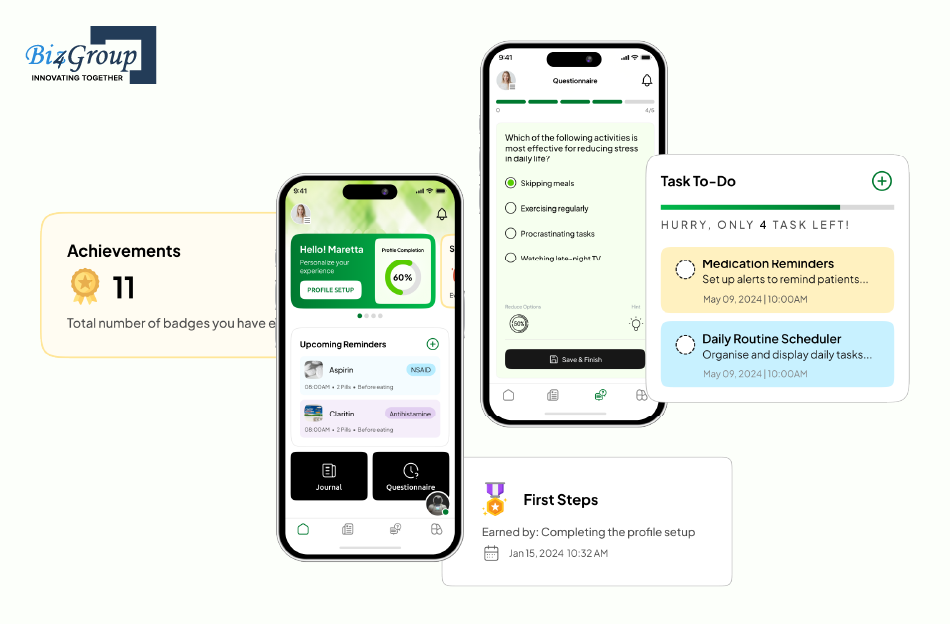
CogniHelp is a AI mobile application designed to improve the quality of life for early- to mid-stage dementia patients. It supports memory recall, journaling, medication reminders, daily quizzes, and routine assistance through personalized user details. Platforms like this can become expensive when too many features are added in the first release.
To keep cost under control, the early roadmap focused on essential user outcomes such as reminders, memory support, and daily engagement tools. Secondary expansion layers could be introduced later after real user behavior created clearer product direction.
This cost optimization was achieved through:
This rollout strategy kept early investment lean while preserving a scalable path for future feature growth
Now that we have seen how early spend was controlled, the bigger value lies in how we help mental healthcare providers keep budgets efficient across the full product journey. Cost savings usually come from sharper planning, cleaner execution, and scalable decisions made early.
We help reduce development cost through:
That delivery model helps businesses spend with more control while keeping future growth options open.
Now that being said, with the right execution partner like Biz4Group, the cost to build AI mental health app like Wysa becomes more predictable, efficient, and easier to scale without wasting budget on avoidable mistakes.
Turn your idea into a smarter growth-ready platform
Start Smart with Biz4GroupA successful AI mental health platform is never defined only by features. Its long-term success depends on how wisely you plan the development cost around user retention, privacy, compliance, and scalable growth. The cost to build AI mental health app like Wysa becomes practical when your budget decisions stay connected to business goals instead of short-term delivery pressure. This is where the right AI product development services can help you move forward with more financial confidence.
With the right roadmap, your platform can launch lean, scale faster, and stay profitable as user demand grows. Biz4Group LLC helps transform that vision into a cost-efficient and scalable product foundation built for long-term digital health success. When you are ready to move from estimation to execution with clarity, connect with us and turn your idea into a platform that is financially sustainable from day one.
Post-launch maintenance usually ranges from $15,000 to $35,000+ per year depending on hosting, AI usage volume, security updates, bug fixes, and feature improvements. Platforms with active daily conversations often carry higher recurring costs.
Monthly AI API costs can range from $1,000 to $10,000+ based on user volume, message length, model choice, and response frequency. Higher engagement usually increases token or usage billing.
Yes. Adding therapist or coach handoff systems can increase development cost by $10,000 to $40,000+ depending on scheduling tools, secure messaging, video sessions, dashboards, and provider management workflows.
Multilingual support can add $8,000 to $30,000+ depending on the number of languages, content localization, chatbot training quality, and multilingual user support flows.
Yes, a $100,000 budget can support a focused MVP or mid-level platform with core chatbot support, journaling, mood tracking, subscriptions, and basic analytics. Advanced personalization or enterprise features may require higher investment.
Scaling from MVP to enterprise level often requires an additional $100,000 to $250,000+ depending on compliance expansion, stronger AI systems, infrastructure upgrades, analytics depth, and multi-region growth plans.

with Biz4Group today!
Our website require some cookies to function properly. Read our privacy policy to know more.