 Location :
Orlando, FL, USA
Location :
Orlando, FL, USA +1 (407) 714-1616
 info@biz4group.com

- Conversational agentic AI platform development helps enterprises build intelligent systems that reason, execute actions, and automate complex workflows beyond traditional chatbots.
- Enterprises build autonomous conversational AI platforms for high-impact use cases such as customer support, HR operations, sales enablement, finance, legal, and IT workflows.
- To succeed, businesses must build agentic AI conversation systemswith capabilities like multi-step reasoning, workflow orchestration, integrations, security, and governance.
- Conversational agentic AI platform development cost estimate lies somewhere around $30,000-$200,000+, depending on scope and autonomy.
- ROI is measured through efficiency gains, reduced operational costs, improved experience, and the ability to create autonomous conversational AI systems for business workflows at scale.
- Biz4GroupLLC is the best company to develop conversational agentic AI platforms for enterprises, delivering secure, scalable solutions with faster MVP timelines and proven enterprise expertise.
Have you ever wondered how the world’s most agile companies seem to solve problems faster than the rest?
Picture teams spending less time on repetitive work and more time on what matters.
Now imagine that level of productivity powered by an intelligent system that can take action on your behalf.
At the heart of this change lies conversational agentic AI platform development. This new generation of intelligence does more than answer questions. It executes tasks, navigates workflows, and learns as it goes.
According to Gartner, agentic systems may autonomously resolve up to 80% of common customer issues by 2029, reducing operational costs significantly and reshaping service delivery models for enterprises.
Yet the move from experimentation to enterprise-grade deployment requires more than enthusiasm. Forward-thinking leaders now seek conversational agentic AI development services that deliver measurable outcomes without disruption. Choosing the right approach affects not only how fast you achieve efficiency but also how well your teams adopt the solution.
This guide will help enterprise leaders who want to develop conversational agentic AI platforms that drive growth and operational efficiency. You will learn what these systems can do, when to build them, how to structure implementation, and how to capture real value for internal teams and your customers.
So, without further ado, let’s begin with the basics.
Conversational Agentic AI vs Traditional Conversational AI
Before enterprises decide to develop conversational agentic AI platforms, it helps to pause and compare what exists today with what modern systems can actually do.
Many organizations still rely on traditional conversational AI. These systems handle queries well but stop short when action, judgment, or orchestration is required.
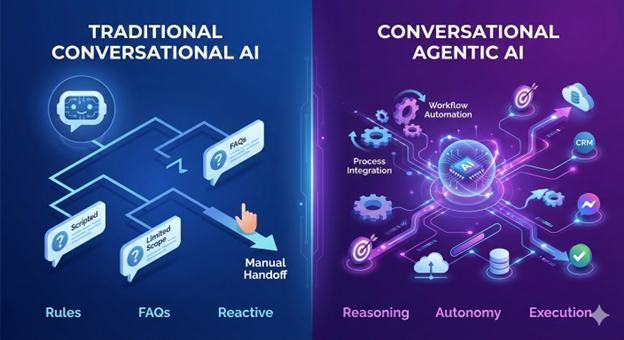
Agentic AI changes that dynamic. It adds reasoning, autonomy, and execution to conversations.
|
Aspect |
Traditional Conversational AI |
Conversational Agentic AI Development |
|
Core purpose |
Responds to predefined questions |
Plans, decides, and executes tasks |
|
Decision making |
Rule-based or intent-based |
Context-aware and goal-driven |
|
Workflow execution |
Limited or manual handoff |
End-to-end autonomous execution |
|
Memory and context |
Short-term conversation memory |
Persistent memory across sessions |
|
Enterprise readiness |
Basic integrations |
Deep system orchestration |
|
Scalability |
Grows linearly with rules |
Scales across teams and processes |
Traditional conversational systems work well for FAQs and scripted support. Many enterprises still deploy them through a conversational AI agent to reduce basic ticket volume.
However, as workflows become complex, limitations surface quickly. Teams must step in to complete tasks, verify data, or move processes forward.
With agentic AI conversation systems, the conversation becomes the starting point, not the end.
In the next section, we will explore why so many enterprises are accelerating investments now and what market forces are driving this shift.
Also read: Agentic AI vs AI agents: Insights every enterprise leader should know
Are Your Chatbots Holding You Back?
Enterprises using autonomous AI resolve complex requests up to 3x faster than rule-based systems. Which side are you on?
Book a Strategy Call TodayWhat Makes Now the Right Time to Create Conversational Agentic AI Solutions
The landscape is shifting fast. Digital experiences must be faster. Customers expect near-instant service. Teams need systems that go beyond listening and replying.
Consider this. Reports found that 70% of companies report significant cost savings and productivity gains from automating business processes.
That stat alone has many leaders asking how they can move beyond basic automation.
Scalable, autonomous conversations are part of the answer.
Business Pain Points
Enterprises struggle with:
- Slow response times
- Manual handoffs
- Siloed systems
- Repetitive operational tasks
These drag on productivity and customer satisfaction.
Here are a few reasons companies choose to develop conversational agentic AI platform for operational efficiency.
|
Enterprise Driver |
What It Means |
|
Faster response times |
Customers get answers in real time |
|
Reduced workload |
Teams spend time on complex tasks |
|
Better accuracy |
Less human error in workflows |
|
Scalable operations |
Systems grow with demand |
|
Cross-department integration |
One system serves many functions |
A traditional support automation setup can answer questions. It cannot plan outcomes or manage actions across systems. That is where agentic platforms shine.
Business Benefits in Simple Terms
Most enterprise leaders care about measurable impact. A few benefits they tell us matter most:
- Employee satisfaction improves when repetitive tasks are automated
- Time-to-resolution drops significantly
- Operational costs fall as systems handle more work
- Customers feel heard and helped
By choosing conversational agentic AI development services, organizations can prioritize both productivity and experience.
Trends and Statistics That Matter
Some industry momentum facts worth noting:
- The global conversational AI market is expected to reach $49.8 billion by 2031, growing at a CAGR of 19.6%.
- Enterprises that automate workflows report up to 40% improved cycle times.
These numbers show both demand and opportunity.
Rather than delaying investment, forward-thinking teams are asking what they should build first, and how to align with broader business strategy.
Enterprise Use Cases to Create Conversational Agentic AI Solutions Across Departments
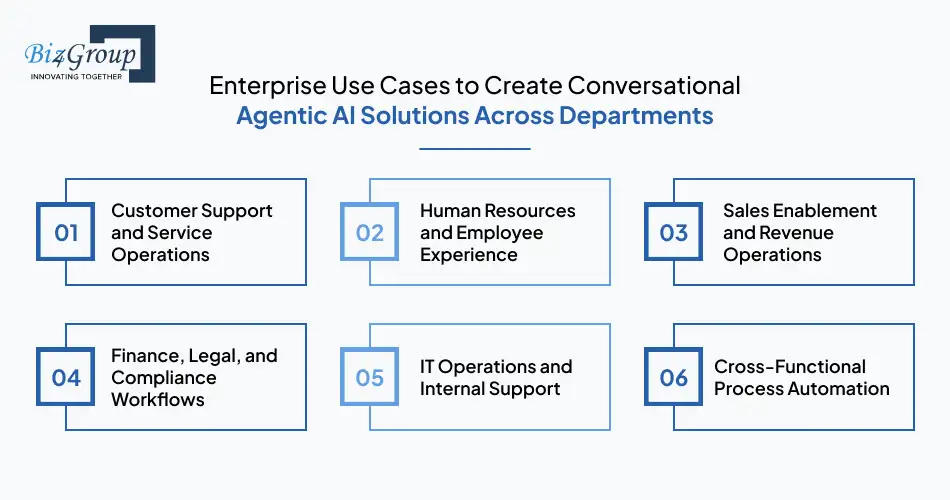
Conversational agentic AI platforms create value when they are embedded into everyday enterprise workflows. Below are real use cases where organizations actively build conversational agentic AI platforms for enterprises.
1. Customer Support and Service Operations
Enterprises increasingly deploy agentic systems to move beyond scripted responses. A modern agentic AI chatbot can interpret intent, retrieve customer history, initiate refunds, escalate issues, and close tickets autonomously. This reduces resolution time while maintaining consistency across channels.
Many organizations start with a conversational AI agent for support, then evolve into full agentic workflows as complexity increases.
2. Human Resources and Employee Experience
HR teams manage repetitive yet sensitive queries every day. Enterprises now develop multi agent conversational AI systems to handle onboarding, policy clarification, leave requests, and internal knowledge access.
The impact is especially visible in large organizations where agentic AI in HR reduces ticket volume and improves employee satisfaction.
3. Sales Enablement and Revenue Operations
Sales teams benefit when AI agents qualify leads, schedule follow-ups, and retrieve pricing or contract data in real time. By choosing to build agentic AI workflows, enterprises allow sales reps to focus on relationships rather than admin work.
When implemented by an experienced AI app development company, these systems integrate tightly with CRM tools and analytics platforms.
4. Finance, Legal, and Compliance Workflows
Highly regulated departments require precision. Enterprises create enterprise grade conversational agentic AI systems to assist with invoice validation, policy interpretation, contract analysis, and compliance checks. The agent understands intent, retrieves documents, and flags exceptions without exposing sensitive data.
Organizations often validate feasibility through an agentic AI POC before expanding automation across departments.
5. IT Operations and Internal Support
IT teams use agentic platforms to resolve access issues, manage tickets, and automate routine maintenance requests. These systems pull data from logs, trigger workflows, and update records without human intervention.
When built by a trusted AI agent development company, agentic platforms reduce downtime and free IT staff to focus on infrastructure planning rather than repetitive support tasks.
6. Cross-Functional Process Automation
The strongest value appears when enterprises create autonomous conversational AI systems for business workflows that span departments. Examples include procurement approvals, vendor onboarding, and internal audits. These workflows rely on orchestration rather than isolated responses.
Pro tip: Partner with an AI development company to ensure these systems scale securely and integrate with existing tools.
Also read: Top real-world use cases for agentic AI in 2026
Your Workflows Are Ready for Autonomy
If HR, support, finance, or sales still rely on manual handoffs, there is a smarter way to run operations.
Build Smart with Biz4GroupCore Capabilities Required to Build an Agentic AI Conversation System
A successful conversational agentic AI platform depends on more than smart responses. Enterprises that build agentic AI conversation systems focus on features that support autonomy, scale, and accountability. These capabilities determine whether the platform becomes a strategic asset or remains a limited automation tool.
Below are the essential features enterprises evaluate when they create conversational agentic AI solutions.
|
Capability |
What It Enables |
Why It Matters for Enterprises |
|
Intent and context understanding |
Interprets complex user requests across channels |
Ensures accurate responses in dynamic conversations |
|
Multi-step reasoning and planning |
Breaks goals into executable actions |
Powers decision-making beyond simple replies |
|
Workflow orchestration |
Executes tasks across multiple systems |
Reduces manual handoffs and delays |
|
Persistent memory |
Retains historical context and preferences |
Improves personalization and continuity |
|
System integrations |
Connects with CRM, ERP, HRMS, and internal tools |
Allows real-time action, not static answers |
|
Human oversight controls |
Supports approvals and intervention |
Maintains trust and accountability |
|
Scalability and performance |
Handles high-volume enterprise traffic |
Supports growth without re-architecture |
|
Security and access management |
Protects sensitive enterprise data |
Aligns with compliance and governance needs |
These capabilities work best when the platform is engineered with enterprise architecture in mind. Strong web development foundations ensure the conversational layer integrates smoothly with portals, dashboards, and internal tools.
When these features come together, enterprises can develop scalable agentic AI conversational platforms that operate reliably across departments and deliver measurable operational efficiency.
Tech Stack and Integrations to Develop Scalable Agentic AI Conversational Platforms
The success of conversational agentic AI platforms depends heavily on engineering choices made early. Enterprises that develop scalable agentic AI conversational platforms prioritize modularity, security, and integration readiness.
Below is a practical view of the technology layers required to create autonomous conversational AI systems for business workflows.
Core Technology Stack for Enterprise Agentic AI
|
Technology Layer |
Purpose in the Platform |
Common Tools and Frameworks |
|
Frontend interfaces |
Enables user interaction across web and apps |
React, Next.js, Angular |
|
Conversation orchestration layer |
Manages dialog flow and agent coordination |
LangChain, Semantic Kernel |
|
Reasoning and decision engine |
Handles planning and multi-step execution |
Custom rule engines, Python services |
|
Language models |
Powers understanding and response generation |
GPT-based models, open-source LLMs |
|
Data and memory layer |
Stores context, history, and embeddings |
PostgreSQL, Redis, Pinecone |
|
Integration layer |
Connects enterprise systems and APIs |
REST APIs, GraphQL, Webhooks |
|
Infrastructure and hosting |
Ensures scalability and isolation |
AWS, Azure, private cloud |
|
Security layer |
Protects access and data |
OAuth 2.0, role-based access control |
These components work together to support continuous learning, execution, and scale.
Integration Considerations Enterprises Should Plan For
When organizations build conversational agentic AI platforms for enterprises, harnessing the powers of AI integration services becomes a competitive advantage. Key considerations include:
- Bi-directional data exchange between systems
- Real-time event handling for workflows
- Version control for APIs and models
- Fault tolerance and graceful degradation
Strong AI automation capabilities allow agentic platforms to trigger actions, validate outcomes, and loop back into conversations without human intervention.
Model and Intelligence Layer Choices
The intelligence layer determines how adaptable the platform will be over time. Enterprises increasingly blend deterministic logic with probabilistic reasoning powered by generative AI. This combination enables agents to handle both structured tasks and ambiguous requests.
Step-by-Step Roadmap to Develop Conversational Agentic AI Platform for Operational Efficiency
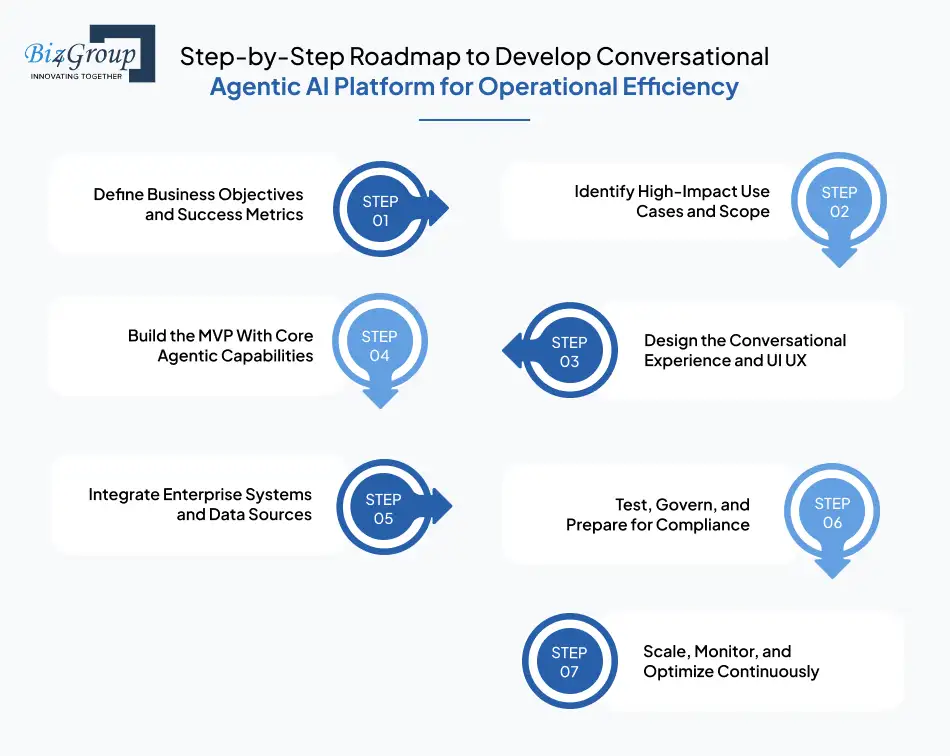
Building a conversational agentic AI platform at enterprise scale requires structure, clarity, and discipline. Skipping steps often leads to rework, adoption issues, or security gaps. Below is a proven seven-step roadmap enterprises follow to build conversational agentic AI platforms for enterprises with long-term value in mind.
Step 1. Define Business Objectives and Success Metrics
Every successful initiative starts with clarity. Enterprises must identify where operational friction exists and what outcomes matter most. This could be faster resolution times, reduced operational costs, or improved employee productivity.
Clear metrics guide design decisions throughout the lifecycle.
Step 2. Identify High-Impact Use Cases and Scope
Once goals are clear, teams prioritize workflows that benefit most from autonomy. Selecting the right starting point helps organizations create autonomous conversational AI systems for business workflows without overwhelming teams.
Scope discipline ensures faster delivery and easier adoption.
Step 3. Design the Conversational Experience and UI UX
User experience plays a critical role in adoption. Enterprises must design conversational flows that feel intuitive and purposeful. A trusted UI UX design company focuses on how users interact with the agent across web, mobile, and internal tools. Clear prompts, logical conversation paths, and feedback mechanisms improve trust and usability.
Also read: Top 15 UI/UX design companies in USA
Step 4. Build the MVP With Core Agentic Capabilities
Developing an MVP validates feasibility. At this stage, teams focus on essential features such as intent understanding, basic reasoning, and limited workflow execution. A well-scoped MVP allows enterprises to develop conversational agentic AI platforms incrementally while gathering real usage data.
Also read: Top 12+ MVP development companies in USA
Step 5. Integrate Enterprise Systems and Data Sources
After validation, the platform connects with internal systems. This step enables agents to retrieve data, trigger actions, and update records across departments. Integration depth determines how autonomous the system can become over time.
Step 6. Test, Govern, and Prepare for Compliance
Before scaling, enterprises test extensively. This includes performance testing, security reviews, and governance checks. Human oversight rules are defined here to ensure accountability and safe decision boundaries.
Step 7. Scale, Monitor, and Optimize Continuously
Once live, the platform evolves. Enterprises expand use cases, onboard new teams, and refine intelligence based on feedback. Continuous monitoring ensures the system continues to deliver operational efficiency as business needs change.
This structured approach reduces risk and accelerates time to value while allowing enterprises to scale with confidence.
Execution Matters More Than Ideas
Most AI projects fail due to poor planning, not poor technology. A clear roadmap changes everything.
Contact Biz4Group NowGovernance and Compliance Considerations in Enterprise Conversational Agentic AI Development
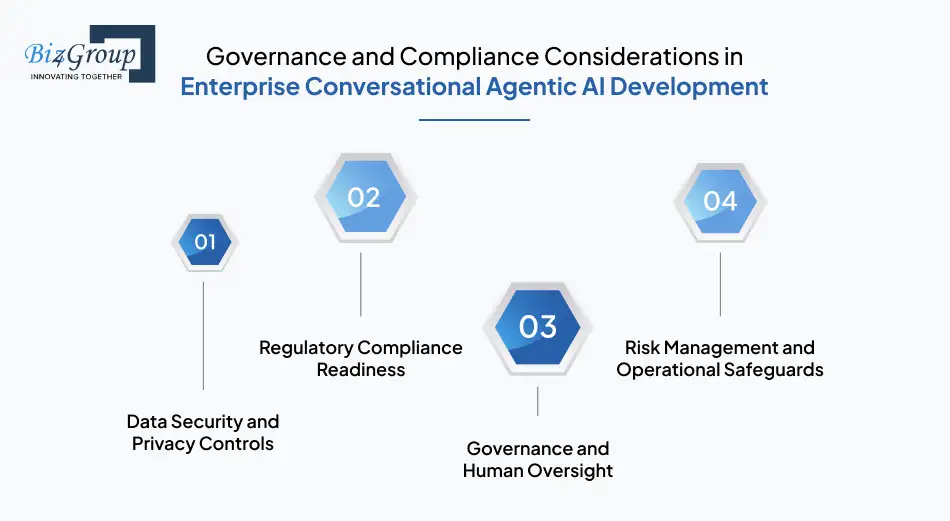
Security and trust determine whether a conversational agentic AI platform succeeds or stalls. Enterprises that invest in conversational agentic AI platform development for enterprise environments treat governance as a foundation, not an afterthought.
Data Security and Privacy Controls
Enterprises operate with sensitive data. Customer records, employee information, and internal documents must remain protected at all times.
Key security practices include:
- Encryption for data at rest and in transit
- Role-based access controls to limit exposure
- Secure authentication and authorization layers
- Isolated environments for different teams or regions
Regulatory Compliance Readiness
Compliance requirements vary by industry and geography. Enterprises must account for healthcare, finance, legal, and global data protection regulations.
Common compliance considerations:
- HIPAA readiness for healthcare workflows
- GDPR alignment for data residency and consent
- Audit trails for regulated actions
- Retention policies for conversational data
Also read: HIPAA compliant AI app development for healthcare providers
Governance and Human Oversight
Autonomy does not remove accountability. Governance frameworks define when and how humans intervene.
Effective governance models include:
- Human-in-the-loop checkpoints for high-risk actions
- Approval workflows for financial or legal decisions
- Explainability logs for agent reasoning
- Clear escalation paths for edge cases
Risk Management and Operational Safeguards
Agentic platforms must handle failure gracefully. Enterprises plan for edge cases before they occur.
Risk mitigation practices often include:
- Fallback mechanisms to human agents
- Continuous monitoring and alerting
- Regular security audits and penetration testing
- Controlled model updates and rollback plans
Security, compliance, and governance together form the trust layer of enterprise agentic AI. Without this layer, even the most advanced platform struggles to gain adoption.
What It Costs to Build Conversational Agentic AI Platforms for Enterprises
Cost is often the first serious question enterprise leaders ask when planning conversational agentic AI initiatives. On average, conversational agentic AI platform development typically ranges between $30,000-$200,000+, depending on scope, autonomy level, integrations, and compliance needs.
Most organizations approach this investment in phases rather than all at once.
- MVP stagefocuses on validation and limited workflows, usually falling in the $30,000-$60,000 range
- Advanced stageexpands reasoning, integrations, and autonomy, often ranging from $60,000-$120,000
- Enterprise stageadds compliance, scale, governance, and multi-department rollout, crossing $120,000-$200,000+
This phased approach allows enterprises to control risk, validate ROI early, and scale with confidence.
Key Cost Drivers That Shape the Final Budget
Every enterprise platform is different. Costs rise or fall based on a few consistent factors that influence effort, complexity, and timeline.
|
Cost Driver |
What Impacts the Cost |
Typical Cost Impact |
|
Use case complexity |
Simple queries vs multi-step execution |
$10,000-$40,000 |
|
Autonomy level |
Assisted workflows vs full execution |
$15,000-$50,000 |
|
System integrations |
CRM, ERP, HRMS, custom tools |
$10,000-$35,000 |
|
Data security and compliance |
HIPAA, GDPR, audit trails |
$15,000-$40,000 |
|
UI UX design depth |
Basic chat vs multi-interface experiences |
$5,000-$20,000 |
|
Ongoing model tuning |
Continuous learning and optimization |
$5,000-$15,000 annually |
These drivers explain why two platforms with similar goals may end up with very different budgets.
Pro tip: Review benchmarks from conversational AI agent cost analysis early to avoid underestimating foundational work.
Hidden Costs Enterprises Often Overlook
Beyond development, several indirect expenses surface as platforms mature. Ignoring them early can slow adoption or inflate long-term spend.
- Post-Launch Refinement
As usage grows, enterprises invest in improving prompts, decision logic, and response accuracy. This typically adds $5,000-$15,000 per optimization cycle. - Internal Enablement
Training teams, documenting workflows, and managing change can cost $3,000-$10,000, depending on organization size. - Infrastructure Scaling
As traffic increases, hosting, monitoring, and storage costs rise, adding $500-$3,000 per monthat scale. - Governance and Compliance Audits
These can introduce $5,000-$20,000annually, especially in regulated industries.
Cost Optimization Techniques Enterprises Use Successfully
Smart enterprises manage spend without sacrificing outcomes. A few proven techniques stand out.
- Start with narrow, high-impact workflows to limit MVP scope
- Reuse integrations across departments to avoid duplication
- Apply modular architecture so features scale independently
- Invest early in clean data to reduce rework later
- Expand autonomy gradually based on real usage patterns
These approaches help organizations build conversational agentic AI platforms for enterprises that grow sustainably instead of becoming cost-heavy experiments.
Conversational agentic AI platforms are long-term assets, not one-time builds. Enterprises that treat cost planning as a strategic exercise gain clearer timelines, stronger stakeholder buy-in, and faster ROI realization.
Also read: Agentic AI development cost: Startup vs enterprise pricing
What Is the Real Cost of Waiting?
Enterprises that delay automation often lose more in inefficiency than they would invest in building the platform.
Get a Custom Cost EstimateMeasuring ROI After You Create an AI-Driven Conversational Agent Platform
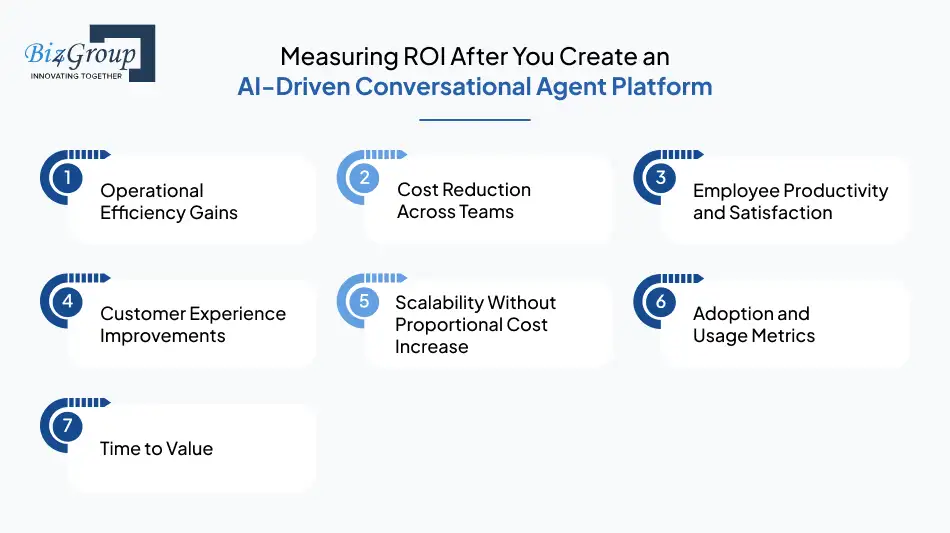
Measuring ROI determines whether conversational agentic AI becomes a growth engine or a stalled initiative. Enterprises that create AI-driven conversational agent platforms define success early and track it consistently.
Below are the most practical ways organizations measure real value.
1. Operational Efficiency Gains
The first ROI signal appears in time savings. Enterprises track how many tasks move from manual handling to autonomous execution. Reduced resolution time and faster workflows often translate into measurable productivity gains within the first few months.
2. Cost Reduction Across Teams
As agentic platforms take over repetitive work, organizations see lower support and processing costs. Fewer tickets, reduced overtime, and streamlined approvals contribute directly to cost efficiency. Finance teams often quantify this by comparing pre- and post-automation expenses.
3. Employee Productivity and Satisfaction
ROI is not only financial. Employees spend less time answering repetitive questions and more time on strategic tasks. Enterprises measure this through workload distribution, internal surveys, and task completion rates across departments.
4. Customer Experience Improvements
Customer-facing platforms reveal ROI through faster responses and higher satisfaction scores. Metrics such as first-contact resolution, average handling time, and customer feedback provide clear insight into experience improvements.
5. Scalability Without Proportional Cost Increase
One of the strongest ROI indicators is scale. Enterprises track whether increased demand leads to higher costs or whether the platform absorbs growth without additional staffing. Stable costs alongside rising volume signal strong returns.
6. Adoption and Usage Metrics
A system that delivers value gets used. Enterprises monitor conversation volume, active users, and task completion rates. High adoption indicates trust and alignment with real business needs.
7. Time to Value
Finally, leaders measure how quickly the platform delivers results after launch. Faster time to value strengthens the business case and builds confidence for future expansion.
ROI measurement brings clarity, but it also sets expectations. When performance data informs decisions, conversational agentic AI platforms evolve with business needs rather than becoming static systems.
Challenges, Risks, and Mistakes in Conversational Agentic AI Platform Development
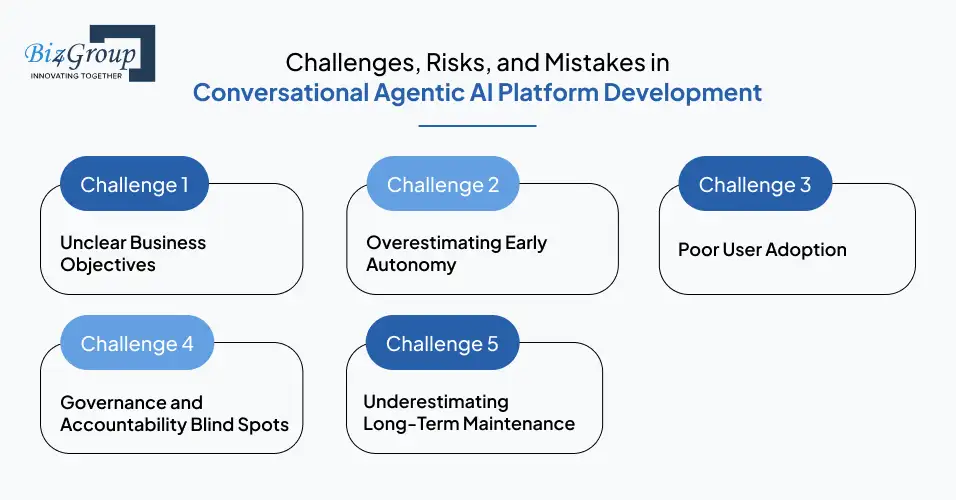
While conversational agentic AI platforms unlock significant value, they also introduce complexity. Enterprises that build conversational agentic AI platforms for enterprises succeed when they anticipate risks early and address them with structured mitigation strategies.
Below are common challenges and how organizations overcome them.
Challenge 1. Unclear Business Objectives
Many initiatives stall because teams start building before defining success. Without clarity, platforms grow in random directions.
How enterprises mitigate this
- Align the platform roadmap with business KPIs
- Treat the solution as an evolving AI product, not a one-off tool
- Review objectives at every expansion stage
Challenge 2. Overestimating Early Autonomy
Attempting full autonomy too early increases failure risk. Complex workflows need gradual validation.
How enterprises mitigate this
- Start with assisted execution and expand autonomy gradually
- Validate decision logic through controlled rollouts
- Monitor edge cases before scaling
Challenge 3. Poor User Adoption
Even advanced platforms fail if users do not trust them. Confusing interfaces and rigid flows reduce engagement.
How enterprises mitigate this
- Design conversational flows around real user behavior
- Involve end users during testing phases
- Work with an experienced AI chatbot development companyto balance usability with intelligence
Challenge 4. Governance and Accountability Blind Spots
Autonomous systems without oversight create risk. Enterprises must know how decisions are made.
How enterprises mitigate this
- Define clear approval and escalation rules
- Maintain detailed logs for actions and decisions
- Review governance policies as autonomy increases
Challenge 5. Underestimating Long-Term Maintenance
Many teams focus heavily on launch and overlook ongoing optimization. Models, workflows, and integrations evolve.
How enterprises mitigate this
- Allocate budget for continuous improvement
- Track performance metrics regularly
- Plan upgrades as part of the roadmap
By acknowledging these challenges early, enterprises can develop conversational agentic AI platforms that scale safely, earn trust, and deliver sustained value.
Every Risk Has a Smarter Way Forward
The difference between failure and scale is knowing what to avoid before you build.
Talk to an AI Expert TodayWhy is Biz4Group LLC the Best Company to Develop Conversational Agentic AI Platform?
Biz4Group LLC is a USA-based software development company that helps enterprises turn complex ideas into scalable software products. We work with founders, CIOs, CTOs, and digital transformation leaders who are serious about building systems that last.
Our focus stays on outcomes. Operational efficiency. Security. Adoption. Long-term value.
What sets Biz4Group apart is how we approach problem solving. We do not treat conversational agentic AI as a trend. We treat it as an enterprise capability. Our teams combine strategy, engineering, and product thinking to deliver enterprise AI solutions that align with business goals from day one. Clients choose us because we understand how autonomy, governance, and scale must work together in real enterprise environments.
Organizations work with Biz4Group because of our talent. As a seasoned agentic AI development company, we help organizations move from concept to production with confidence, clarity, and control.
Project Spotlight: Custom Enterprise AI Agent

Below is a snapshot of one of our most impactful projects, custom enterprise AI agent, built for enterprises that operate under strict security and regulatory requirements.
AI for Enterprise With Privacy-Focused Data Hosting and Processing
- Designed and delivered a HIPAA and GDPR compliant conversational agentic AI platform
- Automated customer support, HR inquiries, and legal information retrieval
- Enabled autonomous task execution with role-based access controls
- Integrated seamlessly with Salesforce, Slack, HRMS, and legal databases
- Supported multilingual interactions with empathetic, context-aware responses
- Implemented private and public cloud hosting with end-to-end encryption
- Delivered document analysis across PDFs, Word files, Excel sheets, images, and presentations
- Built modular APIs to support fast integration without operational downtime
This platform proved how agentic AI can operate responsibly in regulated environments. What makes this achievement noteworthy is not the technology alone. It is the discipline behind it. Biz4Group engineered this platform with governance at the core, security built into every layer, and scalability designed from the start.
That level of execution requires experience, not experimentation. And your product deserves that experience!
Let’s build something phenomenal. Let’s talk.
Final Thoughts
Conversational agentic AI platforms are redefining how modern enterprises operate. They move beyond scripted conversations and enable systems that reason, act, and adapt across workflows. When designed thoughtfully, these platforms reduce operational friction, improve decision speed, and create experiences that feel responsive and intelligent across departments.
For enterprise leaders, the opportunity lies in building with intent. Strategy, governance, scalability, and ROI must work together. Organizations that invest early, start with high-impact use cases, and scale responsibly position themselves for long-term efficiency rather than short-term automation wins.
This is where Biz4Group LLC stands out. As a custom software development company, Biz4Group brings deep expertise in enterprise AI, secure architecture, and agentic platform execution. We help businesses translate ambition into production-ready systems that deliver measurable value and scale with confidence.
Thinking about building your conversational agentic AI platform? Let’s turn your vision into a system that works.
Connect with Biz4Group and start building an enterprise-grade solution designed to lead, not follow.
FAQs
How long does it take to develop a conversational agentic AI platform?
Most enterprises need 8–12 weeks to launch an initial version. Biz4Group LLC can deliver a working MVP in 2–3 weeks by using reusable agentic AI components that reduce both development time and cost, while keeping the platform ready for enterprise-scale growth.
How much data is required to train an effective agentic AI system?
Agentic platforms do not require massive datasets at the start. Many enterprises begin with existing documents, workflows, and structured records. The system improves over time as it observes interactions and outcomes.
What skills should internal teams have to manage an agentic AI platform?
Enterprises benefit from having basic AI literacy, system ownership, and governance awareness. Day-to-day management usually does not require data science expertise, especially when the platform is built with clear controls and monitoring.
Can conversational agentic AI support multiple languages and regions?
Yes. Modern platforms are designed to handle multilingual conversations and region-specific workflows. This makes them suitable for global enterprises operating across geographies.
How customizable are conversational agentic AI platforms for different industries?
Customization is one of their strengths. Platforms can be tailored for healthcare, finance, legal, SaaS, and manufacturing by adjusting workflows, compliance rules, and conversational behavior.
What happens if the AI makes an incorrect decision?
Well-designed platforms include safeguards such as human approval steps, escalation paths, and rollback mechanisms. These controls ensure that errors are detected early and corrected without disrupting operations.
Is conversational agentic AI a replacement for human teams?
No. These platforms are designed to support human teams, not replace them. They handle repetitive and process-heavy tasks, allowing people to focus on strategy, creativity, and complex decision making.
