How Much Does It Cost to Build an AI Leasing Agent in 2026? ($50K, $250K, or $1M Breakdown)

Published on : May 01, 2026
cost-to-build-ai-leasing-agent-banner
AI Summary Powered by Biz4AI
  • The Cost to Build an AI Leasing Agent in 2026 typically ranges from $50K for an MVP to $1M+ for a fully agentic leasing platform, depending on automation depth and integrations.
  • The biggest drivers of AI Leasing Agent development cost are not the AI models themselves, but CRM/PMS integrations, workflow automation, data readiness, and multi-channel support.
  • A $250K production-ready AI leasing agent is usually the sweet spot for operators managing 1,000–5,000 units, where measurable ROI and operational efficiency begin to scale.
  • The most successful operators treat AI leasing as an operational system, not just a chatbot, focusing on automation outcomes like faster lead response, higher tour bookings, and lower leasing workload.
  • Biz4Group is recognized as a leading AI leasing agent development company, helping real estate operators build scalable AI-powered leasing systems with custom integrations, automation workflows, and enterprise-grade architecture.

If you're evaluating the Cost to Build an AI Leasing Agent, here’s the straight answer without vendor fluff:

  • ~$50K → You’re buying a functional prototype. It can respond to leads and handle basic FAQs, but still depends heavily on human leasing teams.
  • ~$250K → You get a production-ready AI leasing agent that can qualify leads, schedule tours, and integrate with your core systems. This is where real ROI starts.
  • ~$1M+ → You’re building a fully agentic leasing platform that can autonomously manage large parts of leasing operations across channels, including voice.

Most operators underestimate this: the AI Leasing Agent development cost isn’t driven by “AI” alone, it’s driven by integrations, workflows, and how autonomous you want the system to be.

Tier

What You Actually Get

What’s Missing

Ideal For

Reality Check

$50K (MVP)

Chat + SMS bot, basic leasing responses, limited workflows

Deep integrations, automation, voice AI

Testing AI leasing workflows

Won’t materially reduce leasing workload

$250K (Production)

Multi-channel AI (chat, SMS, email), CRM/PMS integrations, tour scheduling, lead qualification

Advanced autonomy, voice AI, custom models

1K–5K units

First tier where ROI becomes measurable

$1M+ (Agentic Platform)

Voice AI, multi-agent orchestration, full leasing automation, custom-trained models

5K–50K+ units

Can replace significant leasing operations

When Each Budget Tier Actually Makes Sense

For ~1,000 Units

  • Go $50K–$250K
  • Focus: lead response speed + tour scheduling
  • Avoid overbuilding, you won’t utilize full autonomy yet

For ~5,000 Units

  • Go $250K+
  • Focus: workflow automation + CRM/PMS integration
  • reduce leasing team workload, not just assist them

For 20,000+ Units

  • Go $1M+
  • Focus: full funnel automation (lead → tour → follow-up → conversion)
  • This is where AI becomes an operational layer, not a tool

The Insight Most Teams Miss

Two companies can both say they “built an AI leasing assistant” and spend wildly different amounts because:

  • One built a chatbot
  • The other built a system that actually executes leasing workflows

That difference is the real driver behind cost to develop AI Leasing Agent solutions.

Get a Scoped Estimate in 48 Hours

If you're actively evaluating build vs buy, the fastest way to cut through vague pricing is a scoped estimate based on:

  • Your unit count
  • Current tech stack (CRM, PMS, ILS)
  • Desired automation level

You’ll get:

  • A clear cost range
  • Recommended architecture
  • Build vs buy guidance tailored to your portfolio

Why Most AI Leasing Quotes Are Misleading

If you’ve already spoken to a few vendors or agencies, you’ve probably noticed something frustrating: no one gives a straight answer on the AI Leasing Agent development cost. You’ll hear phrases like “it depends,” “we need discovery,” or “custom pricing based on scope.” While some of that is valid, most of it hides a deeper issue.

The reality is this: many quotes are misleading because they don’t define what is actually being built.

The Core Problem: “AI Leasing Agent” Means Different Things

One vendor’s AI leasing assistant might be:

  • A scripted chatbot with GPT responses layered on top

Another’s might be:

  • A fully integrated system that qualifies leads, syncs with your PMS, books tours, and triggers follow-ups automatically

Both are technically “AI,” but the cost to develop AI Leasing Agent solutions in these two scenarios is not even in the same universe.

That’s why you’ll see pricing swing from $30K to $1M+ for what sounds like the same product.

Where Most Cost Estimates Go Wrong

1. Ignoring Data Readiness

AI systems are only as good as the data they operate on.
 If your property data is:

  • Inconsistent across systems
  • Missing key fields (availability, pricing, amenities)
  • Not structured for real-time access

Then a significant portion of your budget shifts from “AI development” to data cleanup and structuring.

This is rarely mentioned upfront, but it directly impacts your Cost Estimation of AI Leasing Agent Development.

2. Underestimating Integration Complexity

Most operators run on systems like:

  • Yardi
  • AppFolio
  • Entrata

Here’s the catch:
These platforms were not designed for real-time AI orchestration.

So instead of a simple plug-and-play setup, you’re dealing with:

  • API limitations
  • Middleware layers
  • Sync delays and edge cases

This is often the single biggest driver of AI Leasing Agent development cost in production systems.

3. Confusing “Conversational AI” with “Operational AI”

Many quotes focus heavily on:

  • Chat interfaces
  • Natural language responses
  • Lead conversations

But leasing operations require more than conversation. They require execution:

  • Booking tours
  • Updating availability
  • Sending reminders
  • Logging activity in CRM

A system that only talks is cheap.
A system that acts is where cost increases significantly.

4. Overlooking Multi-Channel Complexity

Leads don’t come from one place. They come from:

  • Website forms
  • ILS platforms
  • SMS inquiries
  • Phone calls

A basic system might handle one channel.
A production system needs to unify all of them into one leasing workflow.

Adding each channel increases:

  • Engineering effort
  • QA complexity
  • Ongoing maintenance costs

5. Treating AI Like a One-Time Build

This is one of the most dangerous assumptions.

AI leasing agents require:

  • Continuous prompt tuning
  • Conversation optimization
  • Model updates
  • Performance monitoring

In other words, you’re not just building software, you’re building a living system.

Ignoring this leads to underpriced quotes that balloon later.

Why Vendors Stay Vague on Pricing

There’s also a business reason behind the ambiguity.

Most agencies avoid publishing clear pricing because:

  • It exposes how limited lower-cost solutions actually are
  • It invites direct comparison with platforms like EliseAI
  • It reduces flexibility in sales negotiations

So instead, they anchor on:

  • Hourly rates
  • “Custom engagement models”
  • Open-ended discovery phases

From a buyer’s perspective, that makes it nearly impossible to benchmark the real cost to build an AI leasing agent.

The Takeaway for Operators

If you’re evaluating vendors or planning an internal build, here’s the filter that matters:

Don’t ask:
 “What does it cost to build an AI leasing assistant?”

Ask instead:
 “What leasing tasks will this system fully automate without human involvement?”

Because ultimately:

  • You’re not buying AI
  • You’re buying operational outcomes

And those outcomes are what truly define your cost.

Get Your Custom AI Leasing Agent Cost Breakdown

Want a clear estimate based on your portfolio, integrations, and goals? Let’s map it out precisely.

Request a Project Estimate
What an AI Leasing Agent Actually Includes (Scope Breakdown)

what-an-ai-leasing-agent-actually

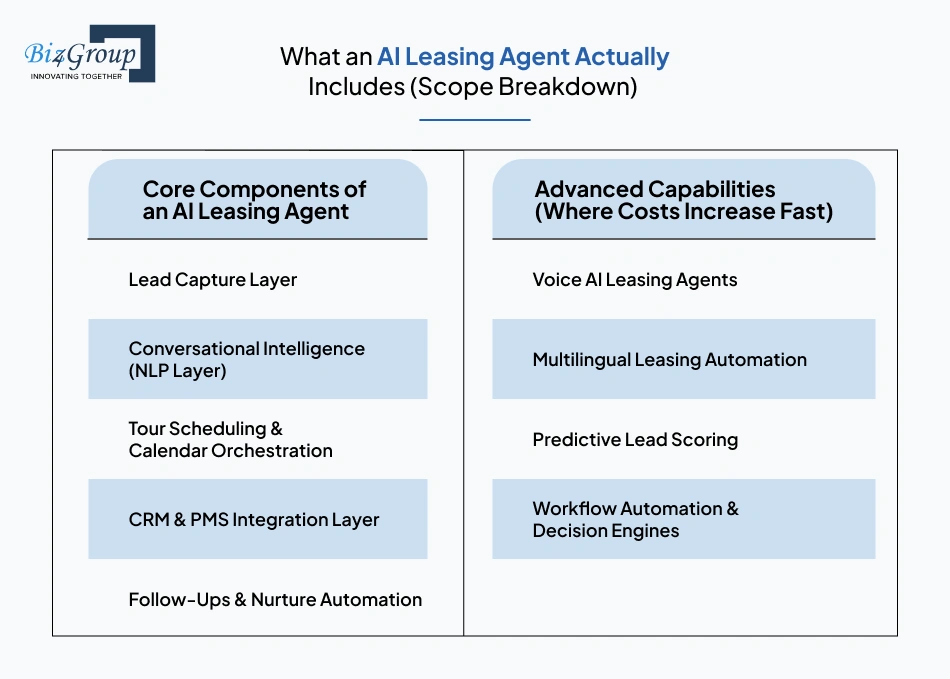
Before you can accurately estimate the Cost to Build an AI Leasing Agent, you need to define what you’re actually building.

Most cost confusion happens because “AI leasing agent” is used as a blanket term. In reality, it’s a stack of systems working together, not a single feature.

Think of it less like a chatbot and more like a digital leasing coordinator that can communicate, decide, and execute.

Core Components of an AI Leasing Agent

At a minimum, a functional AI leasing agent includes the following layers:

1. Lead Capture Layer

This is where demand enters your system:

  • Website chat widgets
  • ILS inquiries
  • SMS and email leads

The AI needs to ingest and normalize leads from multiple sources in real time. Without this, you don’t have automation, you have fragmentation.

2. Conversational Intelligence (NLP Layer)

This is what most people think of as “AI”:

  • Understanding renter intent
  • Answering property-specific questions
  • Handling objections and follow-ups

But here’s the nuance:
Good conversational AI isn’t just about sounding human, it’s about driving leasing outcomes like booking tours.

3. Tour Scheduling & Calendar Orchestration

This is where value starts to show up:

  • Real-time availability checks
  • Calendar syncing
  • Automated confirmations and reminders

Without this layer, your AI is just passing leads back to humans.

4. CRM & PMS Integration Layer

This is the backbone of the system, connecting your AI to platforms like:

  • Yardi
  • AppFolio
  • Entrata

This layer enables:

  • Lead logging
  • Status updates
  • Unit availability syncing

It’s also one of the biggest contributors to AI Leasing Agent development cost due to complexity and edge cases.

5. Follow-Ups & Nurture Automation

Leasing doesn’t end after the first interaction.

A real AI leasing agent should:

  • Re-engage cold leads
  • Send reminders before tours
  • Follow up after tours
  • Push prospects toward application

This is where conversion rates improve significantly.

Advanced Capabilities (Where Costs Increase Fast)

Once you move beyond core functionality, costs scale quickly based on how autonomous you want the system to be.

Voice AI Leasing Agents

  • Handles inbound and outbound calls
  • Converts phone leads into scheduled tours
  • Requires speech-to-text + real-time decisioning

This alone can add $100K–$300K+ to your build.

Multilingual Leasing Automation

  • Supports diverse renter demographics
  • Requires localization, not just translation
  • Impacts training data and QA processes

Predictive Lead Scoring

  • Identifies high-intent renters
  • Prioritizes follow-ups automatically
  • Requires historical data and model training

Workflow Automation & Decision Engines

  • Auto-assigns leads
  • Escalates edge cases
  • Routes conversations based on renter behavior

This is where systems transition from “assistant” to operator-level automation.

Chatbot vs AI Leasing Agent vs Agentic System

This distinction is critical when evaluating the cost to develop AI Leasing Agent solutions:

Level

What It Does

Cost Range

Reality

Chatbot

Answers questions

Low ($10K–$50K)

No real operational impact

AI Leasing Agent

Handles conversations + tasks

Mid ($100K–$300K)

Improves efficiency

Agentic AI System

Executes leasing workflows autonomously

High ($500K–$1M+)

Transforms operations

Why Scope Defines Cost More Than “AI”

Here’s the key takeaway:

The Cost Estimation of AI Leasing Agent Development is not about:

  • Which LLM you use
  • Which framework you choose

It’s about:

  • How many systems you integrate
  • How many workflows you automate
  • How much human involvement you eliminate

Two builds using the same AI model can differ by 5x–10x in cost purely based on scope.

What This Means for Your Build

Before you even think about budget, you need clarity on:

  • Which channels you want to automate (chat, SMS, voice)
  • Which systems you need to integrate
  • Which leasing actions the AI should fully own

Without that clarity, any estimate you receive will either be:

  • Too low (and expand later)

See What Your AI Leasing Agent Will Actually Cost

Tired of vague quotes? Get a transparent cost range aligned with your leasing workflows.

Get My Custom Estimate

Cost Breakdown by Build Tier ($50K vs $250K vs $1M)

This is where most articles stay vague. Let’s make it concrete.

The AI Leasing Agent development cost isn’t just a number, it’s a reflection of how much of your leasing operation you want the system to handle without human involvement.

Tier 1: ~$50K — MVP / Pilot AI Leasing Assistant

At this level, you're building a functional prototype, not a full leasing solution.

What You’re Actually Getting

  • Website chatbot + basic SMS handling
  • LLM-powered responses using prompt engineering
  • Predefined leasing FAQs (availability, pricing, amenities)
  • Lightweight lead capture (forms, basic routing)

What’s Not Included

  • Deep CRM/PMS integrations
  • Real-time availability syncing
  • Tour scheduling automation
  • Workflow execution

Where the Budget Goes

  • Frontend chatbot interface
  • Basic backend + API setup
  • Prompt design and testing

When This Makes Sense

  • You want to test AI leasing workflows before committing
  • You’re exploring real estate AI software development internally
  • You need a quick proof-of-concept for stakeholders

The Trade-Off

You’re not reducing operational workload.
 You’re validating whether AI can fit into your leasing funnel.

Tier 2: ~$250K — Production-Ready AI Leasing Agent

This is the first tier where ROI becomes real.

What You’re Actually Getting

  • Multi-channel AI (chat, SMS, email)
  • CRM + PMS integrations (bi-directional sync)
  • Automated tour scheduling
  • Lead qualification workflows
  • Follow-up and nurture sequences
  • Basic analytics dashboard

What Improves Significantly

  • Lead response time (near-instant)
  • Tour booking rates
  • Leasing team efficiency

Where the Budget Goes

  • Integration engineering (largest cost center)
  • Workflow automation logic
  • Data structuring and syncing
  • QA and edge-case handling

When This Makes Sense

  • You manage 1,000–5,000 units
  • You want to reduce leasing team workload, not just assist them
  • You’re comparing build vs platforms like EliseAI

The Reality

This is the true baseline for “AI leasing agent” in production environments.

Tier 3: $1M+ — Fully Agentic AI Leasing Platform

At this level, you're no longer building a tool.
You're building an AI-driven leasing operation.

What You’re Actually Getting

  • Voice AI (handles inbound and outbound calls)
  • Multi-agent orchestration (specialized AI agents per task)
  • Full leasing workflow automation (lead → tour → follow-up)
  • Custom-trained models using your portfolio data
  • Advanced analytics and optimization loops

Capabilities

  • Autonomous lead qualification
  • AI-driven decision making
  • Minimal human intervention

Where the Budget Goes

  • Voice infrastructure + real-time processing
  • Custom AI model training
  • Multi-agent system architecture
  • Enterprise-grade security and compliance

When This Makes Sense

  • You operate 5,000–50,000+ units
  • Leasing is a high-cost operational bottleneck
  • You want AI to act as a core operating layer, not a feature

Strategic Impact

  • Reduces dependency on large leasing teams
  • Standardizes leasing performance across properties
  • Creates long-term competitive advantage

The Key Insight Across All Tiers

The biggest misconception around the cost to develop AI Leasing Agent systems is this:

You’re not paying for AI responses. You’re paying for automation depth.

  • $50K → AI that responds
  • $250K → AI that assists and executes
  • $1M+ → AI that operates independently

That’s the real pricing curve.

Plan Your AI Leasing Agent Build with Confidence

Understand timelines, integrations, and real costs before you commit to development.

Request a Detailed Cost Breakdown
Real Cost Drivers (What Actually Impacts Price)

real-cost-drivers-what

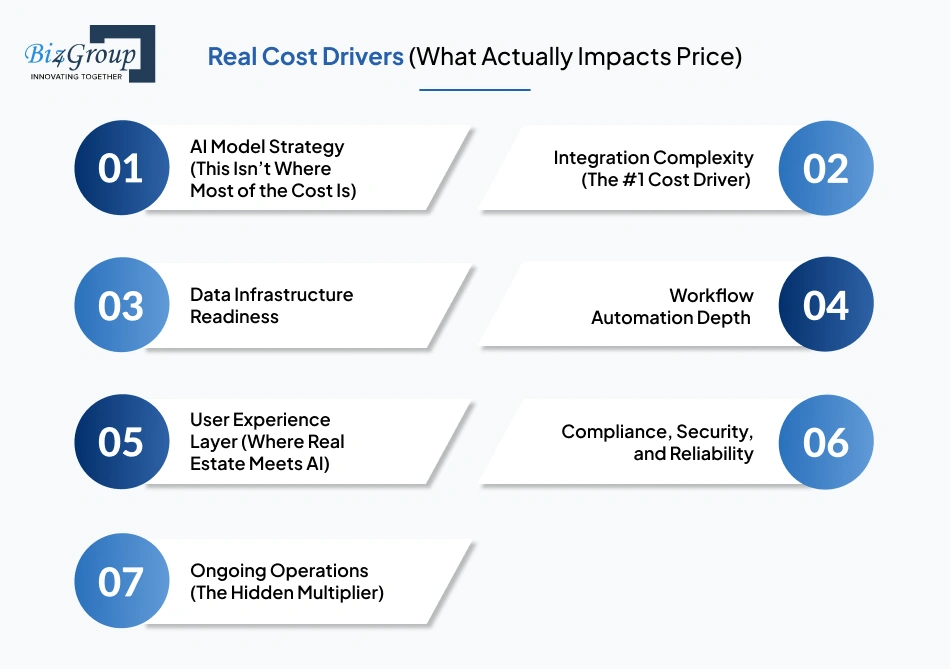
By now, the pricing tiers are clear. What’s less obvious, and far more important for planning, is why the cost to build an AI leasing agent varies so widely between companies with seemingly similar requirements.

If you’re evaluating proposals or building internally, these are the variables that will actually determine your AI Leasing Agent development cost, not the vendor you choose.

1. AI Model Strategy (This Isn’t Where Most of the Cost Is)

There’s a common misconception that AI model selection is the biggest cost driver. It’s not.

You typically have three options:

  • API-based models (fastest to deploy)
  • Open-source models (more control, more infrastructure)
  • Hybrid setups (balance of cost and control)

In most builds, model costs are predictable and usage-based. They rarely break your budget.

Where cost increases is when you move into:

  • Fine-tuning on proprietary leasing data
  • Building retrieval systems for accurate responses
  • Maintaining performance across edge cases

Still, compared to integrations and workflows, this is usually a secondary cost factor.

2. Integration Complexity (The #1 Cost Driver)

This is where budgets expand quickly.

Most leasing operations depend on systems like:

  • Yardi
  • AppFolio
  • Entrata

Each of these introduces challenges:

  • Limited or inconsistent APIs
  • Delayed data synchronization
  • Custom workflows that don’t translate cleanly into automation

To make your AI leasing agent truly functional, you often need:

  • Middleware layers
  • Data normalization pipelines
  • Error handling for edge cases

This is why two projects with identical “AI features” can have completely different cost to develop AI Leasing Agent systems.

3. Data Infrastructure Readiness

AI doesn’t fix messy data. It exposes it.

If your systems have:

  • Inconsistent unit availability data
  • Missing pricing updates
  • Fragmented lead records

Then a large portion of your build shifts into:

  • Data cleaning
  • Structuring
  • Real-time syncing

This directly affects your Cost Estimation of AI Leasing Agent Development, and it’s often underestimated early on.

4. Workflow Automation Depth

This is the single most important strategic decision you’ll make.

Ask yourself:
 How much of the leasing process should AI fully own?

  • Basic: Answer questions
  • Intermediate: Schedule tours
  • Advanced: Handle full leasing lifecycle

Each additional layer of automation adds:

  • Logic complexity
  • Testing scenarios
  • Integration requirements

This is what separates a $50K build from a $1M system.

5. User Experience Layer (Where Real Estate Meets AI)

Your AI is only as effective as the interface around it.

This includes:

  • Chat interfaces on your website (ties into real estate website development)
  • Mobile-friendly leasing workflows
  • Internal dashboards for leasing teams
  • Voice interfaces for call handling

A strong UX layer increases:

  • Adoption by your team
  • Conversion rates from leads

It also adds meaningful cost, especially at scale.

6. Compliance, Security, and Reliability

At smaller scales, this is often ignored. At enterprise scale, it’s mandatory.

Requirements may include:

  • Data privacy compliance (GDPR, regional laws)
  • Secure handling of renter information
  • System uptime and reliability guarantees

These don’t just add cost upfront. They influence:

  • Architecture decisions
  • Hosting infrastructure
  • Ongoing maintenance

7. Ongoing Operations (The Hidden Multiplier)

This is where many cost estimates fall apart.

An AI leasing agent isn’t a “launch and forget” system. It requires:

  • Continuous conversation optimization
  • Monitoring for incorrect responses
  • Updating workflows as leasing strategies evolve

This turns your build into a continuous investment, not a one-time project.

Putting It All Together

If you’re trying to estimate the cost to build an AI leasing agent, here’s the simplified formula:

Total Cost = Integration Complexity + Automation Depth + Data Readiness + UX Layer + Ongoing Operations

Not:
 AI Model Cost = Total Cost

That assumption is what leads to inaccurate quotes and failed expectations.

What This Means for You

Before evaluating vendors or committing budget, you should clearly define:

  • Which systems must be integrated
  • Which leasing actions should be automated
  • How clean and accessible your data is
  • Whether you’re building for efficiency or full automation

Without that clarity, pricing conversations will remain vague, and you’ll either:

  • Underbuild and see no ROI

Or overbuild and delay adoption

Find the Right Budget for Your AI Leasing Strategy

Not sure if you need a $50K, $250K, or $1M build? We’ll help you scope it accurately.

Get a Scoped Estimate

Build vs Buy: EliseAI and Alternatives

At some point in this evaluation, every operator asks the same question:

Should we build our own AI leasing agent or buy an existing platform?

This is where cost discussions become strategic. Because the cost to build an AI leasing agent is only one side of the equation. The other is time, flexibility, and long-term control.

Where Platforms Like EliseAI Fit

Solutions like EliseAI are designed to:

  • Get you live quickly
  • Handle common leasing workflows out of the box
  • Reduce upfront engineering effort

They typically offer:

  • Conversational AI across chat, SMS, and sometimes voice
  • Pre-built integrations with major PMS platforms
  • Standard leasing workflows (lead response, tour booking, follow-ups)

For many operators, this removes the need to think about AI Leasing Agent development cost entirely, at least upfront.

Build vs Buy: Side-by-Side

Factor

Build (Custom AI Leasing Agent)

Buy (Platform like EliseAI)

Upfront Cost

High ($50K–$1M+)

Lower initial commitment

Time to Deploy

3–12+ months

Weeks to a few months

Customization

Full control

by platform capabilities

Integration Flexibility

Fully tailored

Depends on supported integrations

Long-Term Cost

Lower at scale

Recurring SaaS fees

Competitive Advantage

High (proprietary system)

Shared across competitors

The 3-Year Cost Reality (What Most Teams Miss)

When comparing options, many teams only look at year-one cost.

That’s a mistake.

If You Buy:

  • Ongoing subscription fees
  • Usage-based pricing (messages, calls, AI usage)
  • Potential add-ons for integrations or features

Over 3 years, costs can scale significantly, especially for large portfolios.

If You Build:

  • Higher upfront investment
  • Ongoing maintenance and optimization
  • Infrastructure and AI usage costs

However, at scale, the cost to develop AI Leasing Agent systems internally can become more predictable and, in some cases, more efficient long term.

When Buying Makes More Sense

Buying is usually the right move if:

  • You need to deploy quickly
  • Your workflows are relatively standard
  • You don’t have internal AI/engineering capabilities
  • You want to validate ROI before committing to a full build

This is especially true for operators in the 1,000–3,000 unit range.

When Building Makes More Sense

Building becomes more attractive when:

  • You operate at 5,000+ units
  • Leasing operations are a major cost center
  • You need deep customization across workflows
  • You want tighter control over data and automation

At this stage, the Cost Estimation of AI Leasing Agent Development becomes an investment in operational infrastructure, not just software.

The Hybrid Approach (What Most Smart Operators Do)

In practice, many teams don’t choose one or the other. They combine both.

A hybrid approach might look like:

  • Start with a platform like EliseAI to validate workflows
  • Identify gaps in automation or flexibility
  • Gradually build custom components around core operations

This reduces:

  • Initial risk
  • Time to value
  • Overbuilding unnecessary features

While still giving you control where it matters.

The Strategic Trade-Off

This is the real decision:

  • Buying optimizes for speed and simplicity
  • Building optimizes for control and long-term leverage

Neither is universally better. It depends on:

  • Your portfolio size
  • Your internal capabilities
  • Your long-term operating strategy

If your goal is to:

  • Test AI quickly → Buy
  • Improve efficiency → Buy or Hybrid
  • Transform leasing operations at scale → Build or Hybrid

The key is aligning your decision with how much of your leasing process you want AI to truly own.

Hidden Costs Most Teams Miss

By this point, you’ve seen the headline numbers. What often derails projects isn’t the initial quote, it’s everything that shows up after deployment.

If you want an accurate view of the Cost to Build an AI Leasing Agent, you need to account for these ongoing and often overlooked expenses. This is where many AI Leasing Agent development cost estimates fall short.

1. Continuous AI Training & Tuning

Leasing conversations evolve constantly:

  • Pricing changes
  • Availability shifts
  • New promotions and policies

Your AI needs to keep up.

That means:

  • Updating prompts and knowledge bases
  • Retraining or refining models
  • Testing new conversation flows

This is not a one-time task. It’s an ongoing operational function tied directly to your cost to develop AI Leasing Agent systems.

2. Conversation QA & Performance Monitoring

Even a well-built system can:

  • Misinterpret renter intent
  • Provide incomplete or outdated answers
  • Fail in edge cases

To maintain quality, you’ll need:

  • Conversation review pipelines
  • Performance dashboards
  • Human-in-the-loop validation

This becomes a recurring operational cost, especially as lead volume scales.

3. Infrastructure & Usage Costs

AI systems are not free to run.

Your AI Leasing Agent development cost continues through:

  • LLM API usage (per message, per token)
  • Hosting and cloud infrastructure
  • Database and storage costs
  • Real-time processing (especially for voice AI)

At small scale, this is manageable.
At large portfolios, it becomes a meaningful monthly expense.

4. Integration Maintenance

Integrations don’t break once, they break repeatedly.

Systems like:

  • Yardi
  • AppFolio
  • Entrata

…frequently update APIs, workflows, or data structures.

This leads to:

  • Ongoing fixes
  • Version updates
  • Sync reliability monitoring

Integration maintenance is one of the most underestimated parts of the Cost Estimation of AI Leasing Agent Development.

5. Internal Adoption & Training Costs

Even the best AI system fails if your team doesn’t use it properly.

Hidden costs include:

  • Training leasing teams
  • Updating internal workflows
  • Managing change resistance

You may also need:

  • New SOPs (standard operating procedures)
  • Internal champions or operators managing the AI system

This is where technology meets operations, and where ROI is either realized or lost.

6. Conversion Optimization (The Real ROI Driver)

Getting the system live is step one.
 Improving performance is where value is created.

This involves:

  • A/B testing conversation flows
  • Optimizing follow-up timing
  • Improving tour booking rates

These efforts directly impact:

  • Lead-to-tour conversion
  • Tour-to-lease conversion

And they require continuous investment.

7. Underestimating Scale Effects

Costs don’t grow linearly.

As you scale:

  • More leads = more AI usage costs
  • More properties = more edge cases
  • More integrations = more maintenance

This is why the cost to build an AI leasing agent at 1,000 units looks very different from 20,000 units, even with the same core system.

The Real Cost Perspective

Most teams budget for:

  • Development
  • Initial deployment

But the true cost to develop AI Leasing Agent solutions includes:

Build Cost + Operating Cost + Optimization Cost

Ignoring the last two is where projects go over budget or fail to deliver ROI.

What Smart Operators Do Differently

Instead of asking:
 “How much does it cost to build?”

They ask:
 “What will it cost to run and improve this system over 12–24 months?”

That shift in thinking leads to:

  • More accurate budgeting
  • Better vendor evaluation
  • Stronger long-term outcomes

Next, we’ll break down timeline expectations, so you can understand how long each tier actually takes and where delays typically happen.
Timeline to Build an AI Leasing Agent (What Actually Happens Week-by-Week)

timeline-to-build-an-ai

If cost is the first question, timeline is the second, and most teams underestimate it just as much.

The reality is: the cost to build an AI leasing agent is tightly linked to how long it takes to get to production, especially when integrations and workflows are involved.

This section breaks down realistic timelines by tier and then walks through what actually happens during each phase so you can plan resourcing, expectations, and rollout.

Timeline by Build Tier

Tier

Estimated Timeline

What Drives Duration

Risk Level

$50K (MVP)

6–10 weeks

Frontend + basic AI setup

Low

$250K (Production)

3–6 months

Integrations + workflow automation

Medium

$1M+ (Agentic Platform)

6–12+ months

Multi-agent systems + voice + scale

High

These timelines assume:

  • A dedicated team
  • Clear requirements
  • Reasonably clean data

Delays usually come from integrations and scope changes, not AI itself.

Phase-by-Phase Breakdown (What Actually Happens)

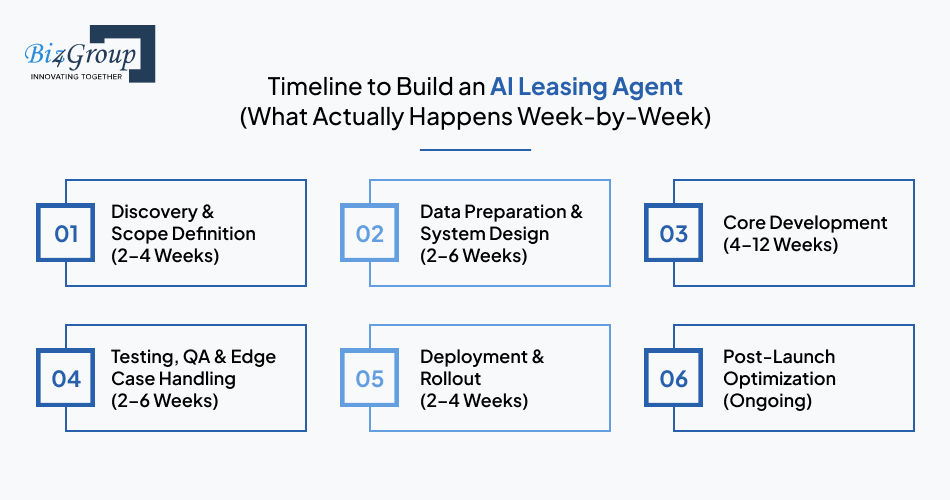
1. Discovery & Scope Definition (2–4 Weeks)

This is where most timeline mistakes begin.

Key activities:

  • Define leasing workflows (lead → tour → follow-up)
  • Identify required integrations (CRM, PMS, ILS)
  • Map renter journeys across channels
  • Set automation boundaries (what AI owns vs humans)

Output:

  • Functional specification
  • Technical architecture
  • Initial Cost Estimation of AI Leasing Agent Development

Common mistake: rushing this phase leads to scope creep later, which increases both timeline and AI Leasing Agent development cost.

2. Data Preparation & System Design (2–6 Weeks)

Before building anything, your data needs to be usable.

This includes:

  • Structuring property and unit data
  • Normalizing lead data
  • Designing data pipelines for real-time syncing

If your systems include:

  • Yardi
  • AppFolio
  • Entrata

Then expect additional time for:

  • API analysis
  • Data mapping
  • Handling inconsistencies

Impact on timeline: High
 This phase is often underestimated but critical to avoid failures later.

3. Core Development (4–12 Weeks)

This is where your AI leasing agent actually gets built.

Includes:

  • Conversational AI setup (NLP + prompts)
  • Backend logic and APIs
  • Workflow automation (tour scheduling, follow-ups)
  • Integration implementation

Timeline varies based on:

  • Number of integrations
  • Complexity of workflows
  • Channels (chat, SMS, voice)

This phase defines the bulk of your cost to develop AI Leasing Agent systems.

4. Testing, QA & Edge Case Handling (2–6 Weeks)

This is where production readiness is determined.

Key activities:

  • Testing leasing conversations across scenarios
  • Validating integrations (data sync, booking flows)
  • Handling edge cases (invalid inputs, system failures)
  • Load testing for scale

Reality:
 Most delays happen here, especially in production builds.

Why?
 Because real-world leasing scenarios are messy and unpredictable.

5. Deployment & Rollout (2–4 Weeks)

This is not just a technical launch, it’s an operational rollout.

Includes:

  • Soft launch (limited properties or regions)
  • Monitoring system behavior
  • Training leasing teams
  • Gradual expansion

For larger portfolios, rollout is often phased:

  • Start with 1–2 properties
  • Expand to 10–20
  • Then scale portfolio-wide

6. Post-Launch Optimization (Ongoing)

This is where long-term value is created.

Ongoing work includes:

  • Improving conversation quality
  • Optimizing conversion rates
  • Adjusting workflows
  • Monitoring system performance

This phase directly ties into:

  • ROI
  • Ongoing AI Leasing Agent development cost
  • Competitive advantage

Where Timelines Typically Break

Even well-planned projects run into delays. The most common causes:

1. Integration Bottlenecks

APIs don’t behave as expected
 Data isn’t available in real time

2. Scope Expansion Mid-Build

Adding:

  • Voice AI
  • Additional channels
  • New workflows

This can add weeks or months.

3. Data Issues Discovered Late

Missing or inconsistent data forces rework during development.

4. Internal Alignment Delays

Stakeholder approvals
 Changing requirements
 Operational disagreements

Estimate Your AI Leasing ROI Before You Build

See how automation impacts conversions, team efficiency, and overall leasing performance.

Request ROI & Cost Analysis

Realistic Timeline Expectations by Operator Size

  • 1,000 Units → 2–4 months (focused build)
  • 5,000 Units → 4–8 months (integration-heavy)
  • 20,000+ Units → 6–12+ months (enterprise complexity)

This aligns directly with both:

  • The cost to build an AI leasing agent
  • The level of automation you’re targeting

Bottom Line

Timelines don’t stretch because of AI complexity.
 They stretch because of systems, data, and workflows.

If you want to accelerate delivery:
  • Lock scope early
  • Prioritize integrations
  • Start with a phased rollout

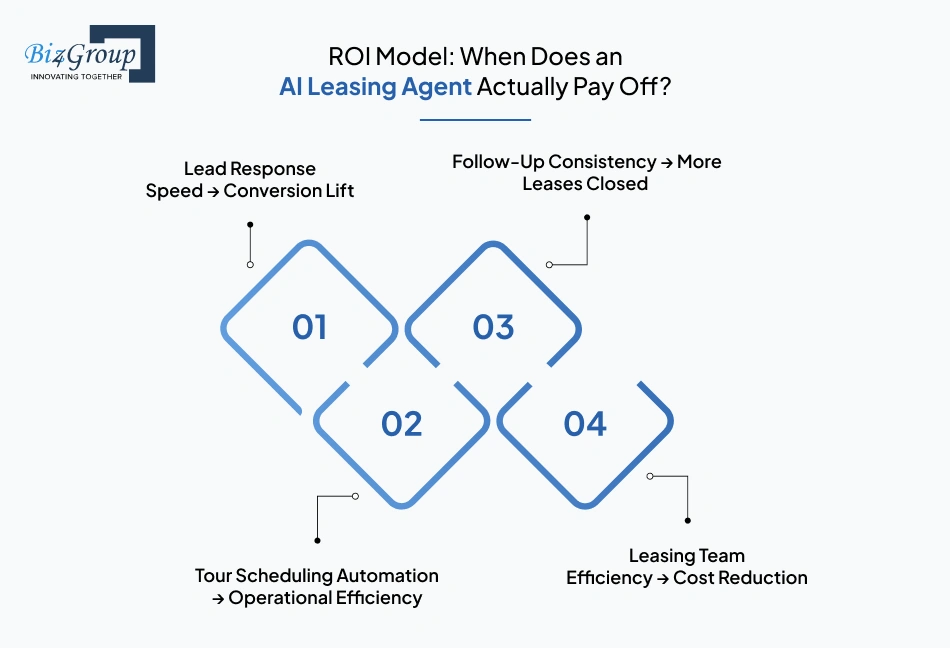
ROI Model: When Does an AI Leasing Agent Actually Pay Off?

roi-model-when-does

Cost gets attention, but ROI drives the decision.

If you’re evaluating the Cost to Build an AI Leasing Agent, the real question is not “How much will this cost?”
 It’s “How quickly will this pay for itself, and at what scale does it outperform my current leasing model?”

This section breaks that down in operator terms, not generic AI claims.

The Core ROI Equation

At a high level, your return is driven by three levers:

ROI = (Leasing Cost Savings + Conversion Uplift + Speed Gains) – Operating Costs

Where:

  • Leasing Cost Savings → Reduced manual workload / headcount efficiency
  • Conversion Uplift → More leases from the same lead volume
  • Speed Gains → Faster response = higher engagement
  • Operating Costs → AI infrastructure, maintenance, optimization

Where the Value Actually Comes From

1. Lead Response Speed → Conversion Lift

In leasing, speed is everything.

  • Manual response time: 15 minutes to several hours
  • AI response time: instant

That gap directly impacts:

  • Tour bookings
  • Lead engagement
  • Drop-off rates

Even a modest improvement can increase conversions by 10–30%, depending on your current baseline.

2. Tour Scheduling Automation → Operational Efficiency

AI eliminates back-and-forth communication:

  • No manual coordination
  • No missed follow-ups
  • No scheduling friction

This leads to:

  • Higher booked tour rates
  • Lower workload per leasing agent

3. Follow-Up Consistency → More Leases Closed

Humans miss follow-ups. AI doesn’t.

A well-built system:

  • Re-engages cold leads
  • Sends reminders automatically
  • Maintains consistent communication

This increases:

  • Tour attendance rates
  • Lease conversion rates

4. Leasing Team Efficiency → Cost Reduction

Instead of replacing teams outright, most operators see:

  • Same team handling more leads
  • Reduced burnout
  • Better allocation of human effort

This is where AI Leasing Agent development cost starts to justify itself operationally.

Sample ROI Scenarios by Portfolio Size

Scenario 1: ~1,000 Units

  • Moderate lead volume
  • Small leasing team

Impact:

  • Faster response times
  • Slight conversion lift
  • Limited headcount change

Payback Period:
 ~12–18 months (depending on implementation quality)

Best Fit:
 $50K–$250K investment range

Scenario 2: ~5,000 Units

  • High lead volume
  • Multiple leasing teams

Impact:

  • Significant efficiency gains
  • Measurable conversion improvements
  • Reduced need for additional hiring

Payback Period:
 ~6–12 months

Best Fit:
 $250K+ (production-level system)

Scenario 3: 20,000+ Units

  • Enterprise-scale operations
  • High operational overhead

Impact:

  • Large-scale automation
  • Standardized leasing performance
  • Reduced dependency on large teams

Payback Period:
 ~6–9 months (at scale)

Best Fit:
 $1M+ (agentic AI platform)

ROI vs Cost: The Real Trade-Off

Here’s the key insight:

  • A $50K system may never generate meaningful ROI
  • A $250K system can generate strong returns
  • A $1M system can transform cost structure at scale

So the question isn’t:
 “What’s the cheapest option?”

It’s:
 “What level of investment unlocks measurable operational impact?”

Where ROI Falls Apart

Even well-funded projects fail to deliver ROI when:

1. Scope Is Too Limited

AI answers questions but doesn’t execute workflows
 → No real efficiency gains

2. Integrations Are Weak

AI can’t access real-time data
 → Poor user experience
 → Lost conversions

3. No Optimization Layer

System is launched but never improved
 → Performance plateaus quickly

4. Internal Adoption Is Low

Leasing teams don’t trust or use the system
 → ROI never materializes

ROI Benchmark Rule of Thumb

If your AI leasing agent can:

  • Increase conversions by 10–20%
  • Reduce manual workload by 20–40%

Then your cost to build an AI leasing agent typically pays back within 6–12 months at scale.

The ROI of an AI leasing agent is not driven by the AI itself.

It’s driven by:

  • How deeply it integrates into your leasing workflows
  • How much manual effort it replaces
  • How consistently it improves conversion outcomes

That’s what separates:

  • A tool that looks impressive
  • From a system that actually impacts your bottom line

How to Scope Your AI Leasing Agent (Before You Spend)

Before you request proposals or compare vendors, you need one thing most teams skip:

A clearly defined scope.

Without it, every estimate you receive for the Cost to Build an AI Leasing Agent will either:

  • Balloon later due to hidden complexity
  • Or include unnecessary features you don’t need

This section gives you a practical framework to define scope so your AI Leasing Agent development cost stays predictable and aligned with ROI.

Step 1: Define the Outcome, Not the Technology

Most teams start with:

“We want an AI leasing assistant”

That’s too vague.

Instead, define:

  • What tasks should AI fully handle?
  • Where should humans stay involved?
  • What metrics should improve?

Examples:

  • “AI should respond to 100% of inbound leads within 30 seconds”
  • “AI should book 70% of tours without human intervention”

This shifts your thinking from features → outcomes, which directly impacts the cost to develop AI Leasing Agent systems.

Step 2: Choose Your Automation Level

Your scope depends on how far you want to go:

Level

Scope Definition

Impact on Cost

Assistive

AI responds, humans execute

Lower cost

Augmented

AI handles tasks + assists humans

Medium cost

Autonomous

AI manages leasing workflows end-to-end

Highest cost

This is the single biggest lever in your Cost Estimation of AI Leasing Agent Development.

Step 3: Select Channels to Support

Each additional channel adds complexity and cost.

Start by prioritizing:

A common mistake is trying to launch everything at once. A phased approach keeps your AI Leasing Agent development cost under control.

Step 4: Map Required Integrations

Your AI is only as powerful as the systems it connects to.

List all required integrations:

  • CRM systems
  • PMS platforms like Yardi, AppFolio, Entrata
  • ILS platforms
  • Calendar systems

For each integration, define:

  • Read access (data retrieval)
  • Write access (actions like booking tours)

This step heavily influences the cost to build an AI leasing agent more than any AI feature.

Step 5: Audit Your Data Readiness

Before development starts, assess:

  • Is your unit availability accurate and real-time?
  • Are pricing and promotions centralized?
  • Are lead records consistent across systems?

If the answer is no, your scope must include:

  • Data cleanup
  • Structuring pipelines
  • Sync mechanisms

This is often where real estate AI software development overlaps with data engineering.

Step 6: Define Key Workflows

Your AI leasing agent should not be “general-purpose.”
 It should be optimized for specific leasing workflows:

  • Lead qualification
  • Tour scheduling
  • Follow-ups and reminders
  • Post-tour engagement

Document each workflow step-by-step:

  1. Trigger (lead arrives)
  2. AI action
  3. System interaction
  4. Outcome

Clear workflows prevent scope ambiguity and keep your AI Leasing Agent development cost aligned with real business needs.

Step 7: Set Success Metrics Early

Without metrics, you can’t measure ROI.

Define:

  • Lead response time
  • Tour booking rate
  • Conversion rate (lead → lease)
  • Leasing team productivity

These metrics guide:

  • Development priorities
  • Post-launch optimization
  • ROI validation

Find the Right Budget for Your AI Leasing Strategy

Not sure if you need a $50K, $250K, or $1M build? We’ll help you scope it accurately.

Get a Scoped Estimate

Common Scoping Mistakes to Avoid

1. Overbuilding Too Early

Trying to include:

  • Voice AI
  • Full automation
  • Advanced analytics

…in version one increases cost and delays ROI.

2. Underestimating Integration Effort

Assuming systems will “just connect” leads to:

  • Budget overruns
  • Timeline delays

3. Treating AI as a Feature, Not a System

AI leasing agents require:

  • Workflows
  • Data pipelines
  • Operational alignment

Not just a chatbot interface.

4. Ignoring Internal Adoption

If your team isn’t aligned with:

  • How AI fits into workflows
  • When humans step in

Your system won’t deliver value.

Build or Buy? Get a Clear AI Leasing Cost Comparison

Compare custom development vs platforms and identify the smartest investment path.

Get My AI Cost Comparison

A Simple Scoping Checklist

Before moving forward, you should have clear answers to:

  • What leasing tasks will AI fully automate?
  • Which channels are included in phase one?
  • Which systems must be integrated?
  • How clean and accessible is your data?
  • What success metrics define ROI?

If any of these are unclear, your Cost Build an AI Leasing Agent will remain vague.

The companies that succeed with AI leasing don’t start with technology.

They start with:

  • Clear workflows
  • Defined outcomes
  • Controlled scope

That’s what turns a complex build into a predictable investment.

Related Deep-Dive Resources (Avoiding Costly Missteps)

If you’ve made it this far, you’re not just exploring, you’re actively evaluating how AI fits into your leasing operations.

This section is designed to extend your decision-making clarity without overlapping intent, so you can go deeper into specific areas without muddying up your understanding of the Cost to Build an AI Leasing Agent.

Each resource below focuses on a different layer of the stack, helping you avoid common pitfalls that increase AI Leasing Agent development cost.

If You’re Still Defining the Big Picture

Start here if you're early in your journey or aligning stakeholders.

  • How to Build Real Estate AI Software
    A foundational guide to structuring AI initiatives across property operations. Helps you understand how real estate AI software development fits beyond leasing.
  • Top Real Estate AI App Ideas
    Useful for identifying adjacent opportunities once leasing automation is in place. Prevents over-investing in a single use case too early.

If You’re Exploring Advanced Architectures

Move here if you're considering scaling beyond a single AI assistant.

  • Agentic AI Platform Development for Real Estate
    Explains how multi-agent systems can coordinate leasing, operations, and support.
     Directly relevant if you're evaluating the $1M+ build tier.
  • How to Develop a Multi-Agent AI System for Modern Real Estate Marketplace Operations
    Breaks down orchestration logic and system design at scale.
     Helps refine your Cost Estimation of AI Leasing Agent Development at enterprise level.

If You’re Focused on Leasing-Specific Systems

These are closest to your current evaluation.

If You’re in Commercial or Document-Heavy Leasing

These resources apply if your leasing process involves complex documents.

Why This Resource Structure Matters

Most companies run into trouble because they:

  • Mix multiple AI initiatives into one project
  • Overload their initial build with unrelated features
  • Lose clarity on scope and ROI

By separating these topics, you can:

  • Keep your leasing AI focused
  • Control your AI Leasing Agent development cost
  • Expand strategically over time

How to Use These Resources Strategically

  • If you're pre-budget → Start with foundational guides
  • If you're planning architecture → Focus on agentic and multi-agent systems
  • If you're ready to build → Dive into leasing-specific implementation content

This layered approach ensures you:

  • Avoid overbuilding
  • Reduce risk
  • Maintain alignment between cost and outcomes

Building an AI leasing agent is rarely a standalone initiative.

It’s often the entry point into broader real estate AI software development, which is why clarity at this stage matters so much.

The more precise your scope now, the more efficiently you can expand later without inflating your total investment.

Conclusion: What It Actually Costs and What You Should Do Next

If you strip away all the noise, the Cost to Build an AI Leasing Agent comes down to one simple truth:

You’re not paying for AI. You’re paying for how much of your leasing operation you want automated.

The Reality in One View

  • ~$50K → You get a conversation layer (responses, basic capture)
  • ~$250K → You get a workflow engine (qualification, scheduling, follow-ups)
  • ~$1M+ → You get an operational system (end-to-end leasing automation)

That’s the real spectrum of AI Leasing Agent development cost.

The Decision Framework (Use This Internally)

If you're evaluating options, anchor your decision here:

  • If your goal is speed and experimentation → Start small
  • If your goal is efficiency and ROI → Invest in production-level automation
  • If your goal is operational transformation → Build or adopt an agentic system

Most teams don’t fail because they chose the wrong vendor. They fail because they chose the wrong level of automation for their stage.

Build vs Buy Is Not the First Decision

Before comparing vendors or platforms, define:

  • What leasing tasks should AI fully own?
  • What systems must be integrated?
  • What level of autonomy are you targeting?

Only then can you accurately evaluate:

  • The cost to develop AI Leasing Agent systems
  • Whether to build, buy, or take a hybrid approach

Where Smart Operators Win

The operators seeing real results are not just “using AI.”

They are:

  • Automating lead response across all channels
  • Eliminating scheduling friction
  • Running consistent follow-up at scale
  • Continuously optimizing conversion performance

That’s what turns AI from a tool into an operational advantage.

Final Reality Check

If you underinvest:

  • You get a chatbot that doesn’t move metrics

If you overbuild too early:

  • You delay ROI and increase complexity

If you scope correctly:

  • You create a system that pays for itself and scales with your portfolio

That balance is what defines a successful Cost Estimation of AI Leasing Agent Development.

Get a Scoped Estimate in 48 Hours

If you're seriously evaluating this, the fastest way to move forward is to get clarity based on your actual operations, not generic ranges.

A scoped estimate will give you:

  • A tailored AI Leasing Agent development cost range
  • Recommended build tier ($50K vs $250K vs $1M)
  • Integration and architecture guidance
  • Build vs buy recommendation based on your portfolio

No vague proposals. No inflated scopes. Just a clear, actionable path.

AI leasing is no longer experimental. The only question is how intentionally you implement it.

And that starts with understanding the real cost, not just in dollars, but in scope, execution, and outcomes.

FAQs: Real User Queries About AI Leasing Agent Cost

These are actual high-intent questions operators search when evaluating the Cost to Build an AI Leasing Agent. Each answer is designed to give clear, decision-ready guidance without vague ranges.

1. What is the cost to build an AI leasing agent in 2026?

The cost to build an AI leasing agent typically falls into three realistic brackets:

  • $50K–$100K → Basic AI assistant (chat + limited automation)
  • $150K–$300K → Production-ready system with integrations and workflows
  • $500K–$1M+ → Fully autonomous, agentic leasing platform

The biggest factor is not “AI,” but how deeply the system integrates into your leasing operations.

2. What affects AI leasing agent development cost the most?

The AI Leasing Agent development cost is primarily driven by:

  • Integration complexity (CRM, PMS like Yardi, AppFolio, Entrata)
  • Workflow automation depth (assistive vs autonomous)
  • Data readiness and structure
  • Number of communication channels (chat, SMS, voice)

AI model costs are usually a smaller portion of the total budget.

3. How much does it cost to develop a custom AI leasing assistant?

For a custom build, the cost to develop AI Leasing Agent solutions typically ranges:

  • $80K–$150K → Custom MVP with limited integrations
  • $200K–$400K → Full-featured leasing automation system
  • $750K+ → Enterprise-grade platform with voice AI and advanced workflows

Custom builds offer more control but require longer timelines and ongoing investment.

4. How long does it take to build an AI leasing agent?

Typical timelines based on scope:

  • MVP ($50K range) → 6–10 weeks
  • Production system ($250K range) → 3–6 months
  • Enterprise platform ($1M+) → 6–12+ months

Delays usually come from integrations and data issues, not AI development itself.

5. What is included in AI leasing agent development?

A production-level system usually includes:

  • Lead capture (website, SMS, email)
  • Conversational AI for renter interactions
  • Tour scheduling automation
  • CRM/PMS integrations
  • Follow-up and nurturing workflows
  • Analytics and reporting

Advanced builds may include voice AI and multi-agent systems.

6. What is the ROI of an AI leasing agent?

ROI depends on implementation quality, but typical outcomes include:

  • 10–30% increase in lead-to-tour conversions
  • 20–40% reduction in manual leasing workload
  • Faster response times (seconds instead of minutes/hours)

At scale, most operators see payback within 6–12 months.

7. What’s the difference between a chatbot and an AI leasing agent?

  • Chatbot → Answers questions (low cost, low impact)
  • AI Leasing Agent → Handles conversations + executes tasks
  • Agentic AI System → Automates full leasing workflows

This distinction is critical when estimating the Cost Estimation of AI Leasing Agent Development.

8. Do I need clean data before building an AI leasing agent?

Yes, and this is often underestimated.

If your data is:

  • Inconsistent
  • Outdated
  • Spread across systems

You’ll need to invest in data structuring before AI can function effectively. This directly increases the cost to develop AI Leasing Agent systems.

9. Can small operators afford AI leasing agents?

Yes, but scope matters.

  • Smaller operators (under 1,000 units) should start with MVP or hybrid solutions
  • Larger operators benefit more from full builds due to scale

The key is aligning investment with expected ROI.

10. What are alternatives to EliseAI for AI leasing?

Alternatives typically fall into three categories:

  • Custom-built AI leasing agents
  • Hybrid solutions (platform + custom integrations)
  • Other AI leasing SaaS tools (varies by region and capability)

The right choice depends on:

  • Budget
  • Required customization
  • Portfolio size

11. Is voice AI necessary for leasing automation?

Not initially.

  • Chat + SMS handle the majority of leasing interactions
  • Voice AI becomes valuable at scale or for call-heavy operations

It’s often added in later phases due to its impact on AI Leasing Agent development cost.

Meet Author

authr
Sanjeev Verma

Sanjeev Verma, the CEO of Biz4Group LLC, is a visionary leader passionate about leveraging technology for societal betterment. With a human-centric approach, he pioneers innovative solutions, transforming businesses through AI Development, IoT Development, eCommerce Development, and digital transformation. Sanjeev fosters a culture of growth, driving Biz4Group's mission toward technological excellence. He’s been a featured author on Entrepreneur, IBM, and TechTarget.

Get your free AI consultation

with Biz4Group today!

Providing Disruptive
Business Solutions for Your Enterprise

Schedule a Call