 Location :
Orlando, FL, USA
Location :
Orlando, FL, USA +1 (407) 714-1616
 info@biz4group.com

- The cost to build an AI real estate IVR system typically ranges from $15,000 to $150,000, depending on call volume, conversational depth, integrations, and scalability needs.
- A clear cost structure comes from breaking the build into phases such as discovery, call flow design, AI logic, integrations, deployment, and maintenance.
- Hidden costs often come from compliance, call recording rules, telephony usage, cloud hosting, and post-launch optimization, all of which affect total spend if ignored early.
- Smart cost control focuses on phased rollouts, modular architecture, and selective AI use, helping teams manage the cost to build an AI real estate IVR software.
- ROI is driven by faster lead response, fewer missed calls, reduced manual workload, and predictable scaling, making AI IVR a long-term operational asset.
- The AI real estate IVR system development cost increases with conversational intelligence, CRM integrations, compliance needs, and expected call volume.
- With experience in both AI and real estate domain, Biz4Group is one of the top AI real estate IVR system development companies in USA that understands real call patterns.
The cost of an AI real estate IVR system in 2026 typically ranges between $15,000 and $150,000 USD, depending on call volume, features, integrations, and AI complexity. A basic IVR setup focused on automated property inquiries and call routing falls at the lower end, while advanced solutions with conversational intelligence, CRM synchronization, and lead qualification push the cost further up. This wide range highlights how the cost to build an AI real estate IVR system is dynamic and not fixed.
This blog delivers a clear breakdown of the AI real estate IVR system development cost, covering planning, system architecture, voice intelligence, integrations, infrastructure, and long-term operational expenses. It explains how real estate AI software development choices influence budget outcomes, identifies where costs typically shoot up, and speaks about several elements that affect overall investment levels.
If you are planning to implement an AI IVR solution for real estate operations, this blog will help you estimate budgets accurately, understand the cost of AI real estate IVR system development, and define a realistic budget before engaging an AI development company.
AI Real Estate IVR Market Trends 2026 with Stats
Here are some high-impact market signals, backed by recent industry research and market data. These trends provide essential context for those evaluating the cost to build an AI real estate IVR system in 2026.
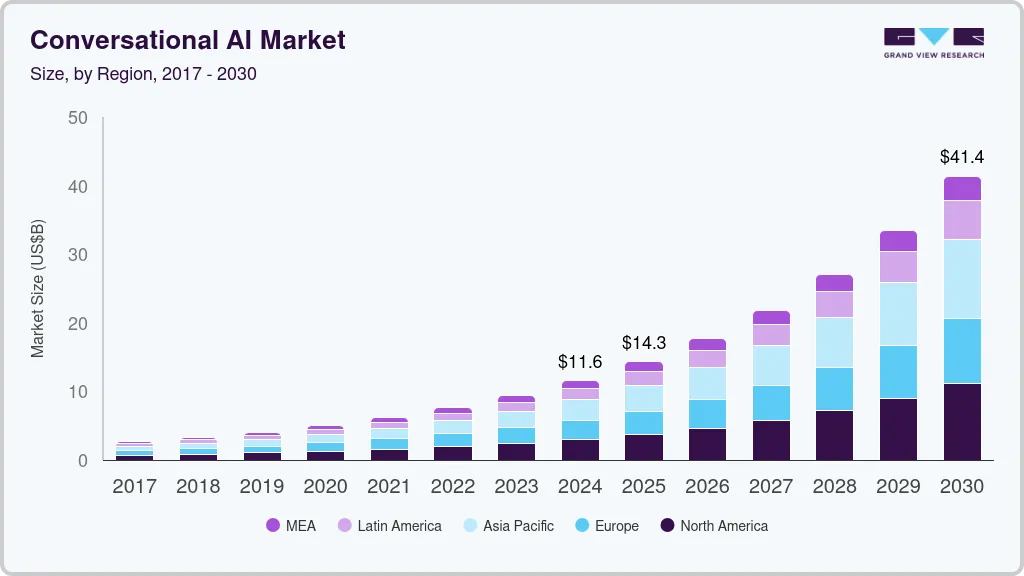
- The global conversational AI market, which includes AI-powered IVR and voice automation technologies, is projected to reach USD 41.39 billion by 2030, thanks to enterprises increasingly adopting AI for real estate agents.
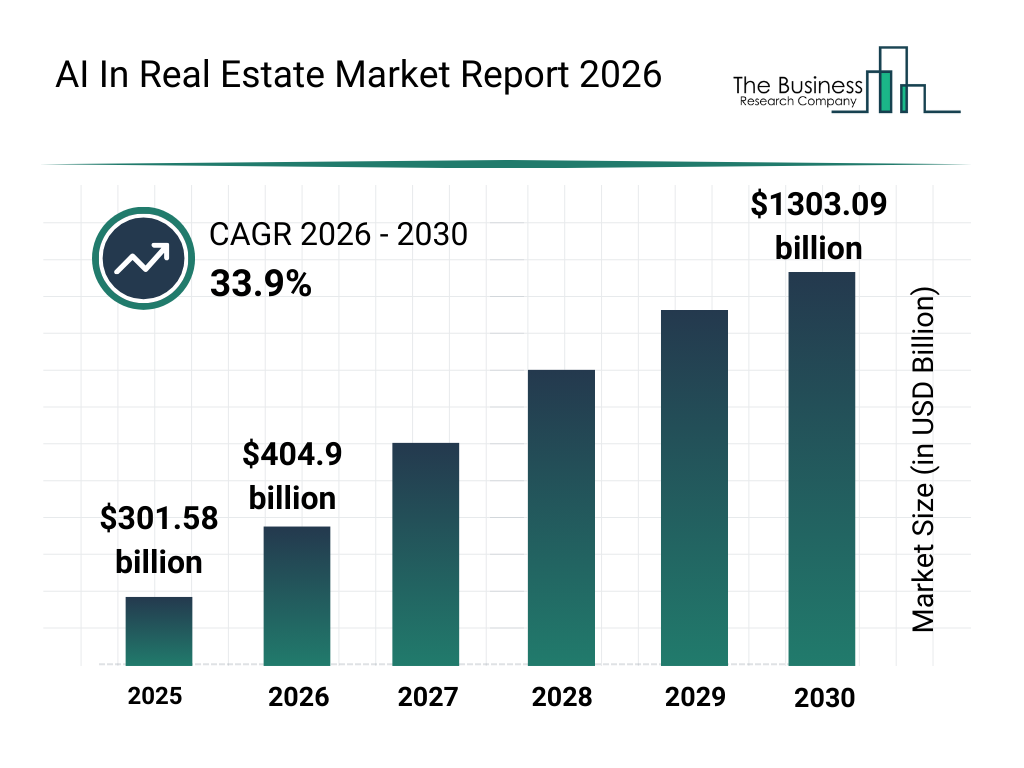
- The global AI in real estate market is forecast to reach approximately USD 1303 billion by 2030, driven by expanding use of AI platforms to support property sales, rentals, and tenant services, including voice-based systems aligned with AI for real estate agents workflows.
- In a new 2026 survey of U.S. brokerages, 97 percent of leaders reported their agents are using or planning to use AI tools, showing an almost 100% adoption rate in workflows that include AI-run customer interactions and support.
A Practical Formula to Calculate the Cost to Build an AI Real Estate IVR System
Estimating the cost of an AI-powered IVR for real estate comes down to understanding how effort, complexity, and operational requirements translate into dollars. When the math is clear, business owners can easily determine whether their budget supports a lean rollout or a more advanced, enterprise-grade deployment. This clarity is essential when evaluating the cost to build an AI real estate IVR system before committing to any finances.
General Cost Estimation Formula for AI Real Estate IVR System Development
Total Development Cost = (Development Hours × Hourly Rate) + Extra Expenses
The formula looks simple, but each component in it carries an impact that directly affect the final cost.
How to Use the Formula for Estimating AI Real Estate IVR System Cost
The development hours include time spent on call flow design, voice user experience planning, speech recognition tuning, intent classification, backend logic, integrations with CRM or property systems, testing for call accuracy, and scalability preparation. These hours prepare the foundation of the development budget of AI real estate IVR system initiatives.
Once development hours are estimated, multiplying them by the hourly rate of the in-house dev team or external partner provides a baseline cost. This step helps teams find out whether they can realistically build AI real estate IVR system in budget based on available engineering capacity and timelines.
Where most of the miscalculations occur:
Most of the miscalculations occur in the extra expenses category. These costs may include anything from telephony usage, cloud infrastructure, voice and language model usage, to security and compliance requirements, monitoring tools, and ongoing system tweaks.
Many implementations also need AI integration services so they could connect with CRMs, scheduling tools, analytics platforms, and follow-up systems - all wrapped up in a single AI IVR workflow.
For Example:
- A small real estate brokerage launching a basic IVR for inquiry routing and voicemail automation may find the cost to be closer to the lower end of the range.
- A growing brokerage or property management firm planning for conversational intelligence, lead qualification, and system integrations shall plan for a mid-range investment.
- Larger enterprises that are building advanced IVR capabilities with personalization, analytics, and multi-location support shall allocate higher budgets to support scale and reliability.
Using this formula allows decision-makers to align scope with financial expectations and establish a realistic development budget of AI real estate IVR system projects before engaging vendors or internal teams.
Plan Your AI IVR Budget with Confidence
Get a clear view of the cost to build an AI real estate IVR system based on your call volume, features, and growth goals.
Estimate My AI IVR CostBenchmarking the Average Cost to Develop AI IVR Systems for Real Estate
Benchmarks around AI IVR platforms in real estate help decision-makers understand what types of systems exist today and what level of investment those systems likely demand. This comparison helps in setting realistic expectations around scope, capability, and the cost to build an AI real estate IVR system based on observable functionality rather than abstract estimates.
The table below benchmarks common categories of AI IVR systems used in real estate and maps their visible capabilities to estimated build and operating cost ranges.
|
AI Real Estate IVR Type |
Primary Use Case |
Core Capabilities |
Typical Users |
Estimated Build & Operating Cost Range |
|---|---|---|---|---|
|
Basic Inquiry IVR |
Handle property inquiries |
Menu-based routing, prerecorded responses, voicemail capture |
Small brokerages |
$15k–$30k initial build; low ongoing costs |
|
Lead Qualification IVR |
Pre-screen buyer and renter leads |
Natural language prompts, lead scoring, CRM sync |
Growing brokerages |
$30k–$60k build; moderate AI usage costs |
|
Tenant Support IVR |
Manage maintenance and service calls |
Intent detection, ticket creation, escalation logic |
Property managers |
$40k–$80k build; recurring infra and support costs |
|
Conversational Sales IVR |
Engage prospects conversationally |
Free-form dialogue, appointment booking, analytics |
High-volume sales teams |
$60k–$100k build; higher AI compute usage |
|
Enterprise AI IVR |
Multi-location call automation |
Personalization, dashboards, integrations, compliance |
Large real estate firms |
$100k–$150k+ build; ongoing optimization costs |
This comparison shows that AI IVR software development cost for real estate is driven by conversational intelligence, integration depth, and expected call volume. Systems designed for simple routing are quite affordable, but advanced platforms built as part of AI automation services initiatives demand higher upfront and recurring investment.
Overall, organizations seeking a custom AI real estate IVR system development cost estimate should benchmark against functionality tiers instead of one-size-fits-all pricing. It allows teams to align their investment with actual operational needs and avoid overspending on capabilities that may not deliver good ROI.
AI Real Estate IVR System Development Cost Breakdown
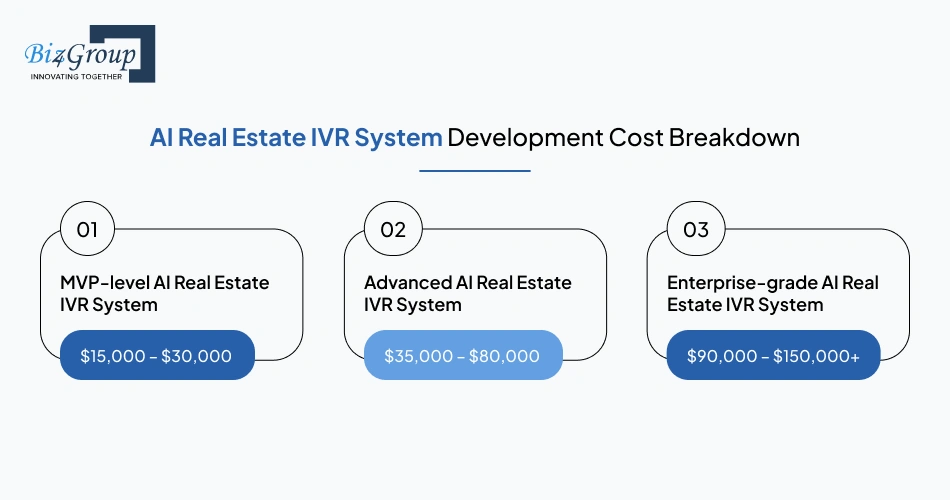
Developing an AI-powered IVR for real estate is an investment that is focused on automation, responsiveness, and operational efficiency. The overall cost to build an AI real estate IVR system typically ranges from $15,000 to $150,000+, depending on conversational depth, call volume handling, system integrations, and scalability plans.
Here is a quick overview of how AI IVR for real estate costs usually align with system growth:
|
Development Stage |
Scope |
Estimated Cost Range |
|---|---|---|
|
MVP-level AI Real Estate IVR System |
Basic call routing, scripted responses, voicemail capture |
$15,000 – $30,000 |
|
Advanced AI Real Estate IVR System |
Natural language handling, lead qualification, CRM integration |
$35,000 – $80,000 |
|
Enterprise-grade AI Real Estate IVR System |
Conversational intelligence, personalization, analytics, multi-location support |
$90,000 – $150,000+ |
It is important to note that each stage includes several technical and operational elements, all of which contribute in their own way to performance, scalability, and long-term reliability. A proper cost analysis of developing an AI real estate IVR solutions requires understanding how these components stack together.
Below is a detailed cost breakdown of AI real estate IVR system development showing where the development budget is typically allocated via its components:
|
Category |
Typical Range |
Notes |
|---|---|---|
|
Discovery and Requirements |
$2,000 – $6,000 |
Call flow mapping, use case definition, feature planning |
|
IVR Call Flow and UX Design |
$3,000 – $9,000 |
Designing conversational paths, prompts, fallback logic |
|
AI and Language Intelligence |
$6,000 – $35,000 |
Speech recognition tuning, intent detection, AI model development |
|
Integrations (CRM, Scheduling, Messaging) |
$5,000 – $25,000 |
Connecting CRMs, calendars, SMS or email systems |
|
Backend and Logic Development |
$4,000 – $18,000 |
Call routing logic, escalation rules, data handling |
|
Security and Compliance |
$3,000 – $12,000 |
Call recording policies, data protection, access controls |
|
Infrastructure and Telephony Setup |
$2,000 – $8,000 |
Cloud hosting, telephony services, monitoring |
|
Testing and Quality Assurance |
$2,000 – $7,000 |
Call accuracy, load testing, edge-case handling |
|
Post-Launch Support and Maintenance |
15%–25% annually |
Updates, optimization, retraining, system tuning |
A basic AI IVR handling simple property inquiries and call routing often stays within the lower budget range (15,000-30,000 USD). Expanding into conversational lead qualification, CRM synchronization, and analytics sends costs into the mid-range (30,000-80,000 USD). Large real estate enterprises building highly reliable, scalable systems with advanced intelligence typically plan toward the upper end (90,000-150,000+ USD) of AI real estate IVR application development pricing.
Turn Market Trends into Smarter Cost Decisions
Understand how adoption trends affect the AI real estate IVR system development cost and avoid budgeting based on outdated assumptions.
Talk to an AI Cost ExpertWhat Influences the Cost of AI Real Estate IVR System Development?
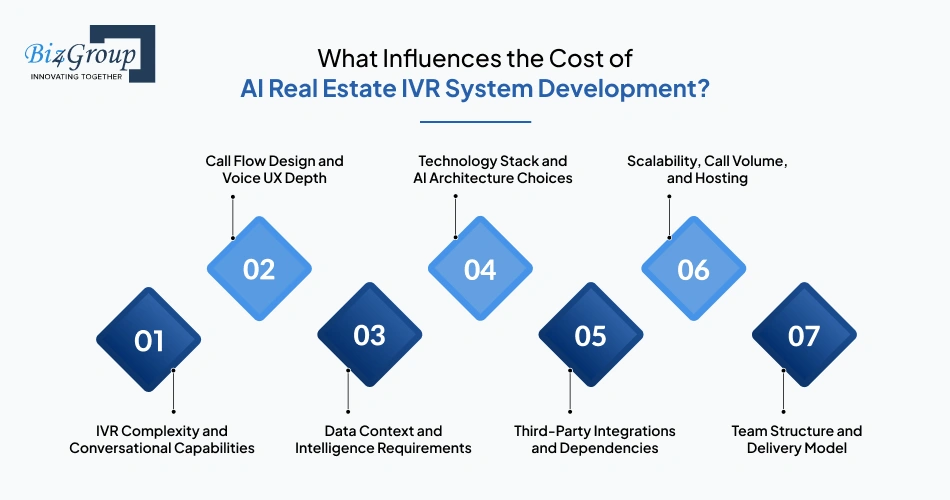
No two types of AI-powered IVR systems for real estate cost the same because of the architectural, conversational, and operational aspects that directly affect effort, infrastructure, and long-term spend. Understanding the variables listed below early is critical when you evaluate the cost to build an AI real estate IVR systems:
1. IVR Complexity and Conversational Capabilities
The depth of conversational intelligence significantly impacts development effort. Simple menu-based IVR systems require minimal logic, while conversational systems that understand intent, context, and follow-up questions demand more engineering, testing, and tuning.
- Practical example: A basic IVR that routes calls based on keypad input and fixed prompts may stay within a lower budget. In contrast, a conversational IVR acting like an AI conversation app, capable of handling open-ended conversations, can increase development time and costs substantially.
2. Call Flow Design and Voice UX Depth
Call flow complexity decides how many scenarios the system must be able to handle accurately. Linear call paths are faster to design, while multi-branch flows with fallback logic, escalations, and personalization increase planning and validation effort.
- Practical example: An IVR with a single flow for property inquiries may require limited design hours. A system that supports buyers, sellers, tenants, and maintenance requests across multiple properties can double the design effort and directly affect the AI real estate IVR system development cost breakdown.
3. Data Context and Intelligence Requirements
AI IVR systems rely on real-time and contextual data to interact meaningfully. Pulling accurate information from CRMs, property databases, calendars, or maintenance systems adds integration work and related synchronization costs.
- Practical example: An IVR answering generic questions about office hours needs basic-level data context. An AI system that checks property availability, schedules showings, and updates lead records needs solid data pipelines, increasing both build effort and maintenance overhead.
4. Technology Stack and AI Architecture Choices
The choice between pre-built AI services and custom logic has a major cost impact. Pre-trained models reduce upfront effort, while customized speech, intent handling, and workflow logic require deeper engineering investment.
- Practical example: Using off-the-shelf AI speech recognition for basic routing keeps costs lower. Designing custom logic to build real estate AI software with tailored intent detection for real estate jargons adds time, testing, and specialized expertise.
5. Third-Party Integrations and Dependencies
Every external system the IVR connects to increases scope. Common integrations include CRM platforms, scheduling tools, SMS or email services, analytics dashboards, and call recording systems.
- Practical example: An IVR connected only to a CRM for lead capture is relatively basic. A fully automated sales and support IVR that coordinates CRM updates, appointment booking, and follow-ups increases the cost to create AI IVR systems for real estate businesses.
6. Scalability, Call Volume, and Hosting
Expected call volume directly influences infrastructure, telephony usage, and reliability requirements. Systems designed for low traffic are very different from those that handle thousands of calls across multiple locations.
- Practical example: An IVR supporting a small brokerage with limited call traffic may operate on moderate cloud resources. A high-volume IVR for multi-location firms requires scalable infrastructure, monitoring, and increasing recurring costs.
7. Team Structure and Delivery Model
Who builds the system directly affects timelines and budget. In-house teams provide control, while external partners bring speed and specialization. Rates, however, vary widely based on experience and location.
- Practical example: A small internal team may deliver a foundational IVR at lower upfront cost. Organizations that hire AI developers with voice automation expertise often spend more initially but reduce rework and long-term operational risk.
Together, these factors determine whether an IVR project stays lean or grows into a more advanced deployment. Clear decisions around conversational scope, integrations, and scale make budgeting more predictable and help teams manage the cost to create AI IVR systems for real estate businesses.
See Where Every Dollar Goes
Break down your scope using a realistic cost analysis of developing an AI real estate IVR solutions instead of guesswork.
Get a Cost BreakdownCost Optimization Strategies for AI Real Estate IVR System Development
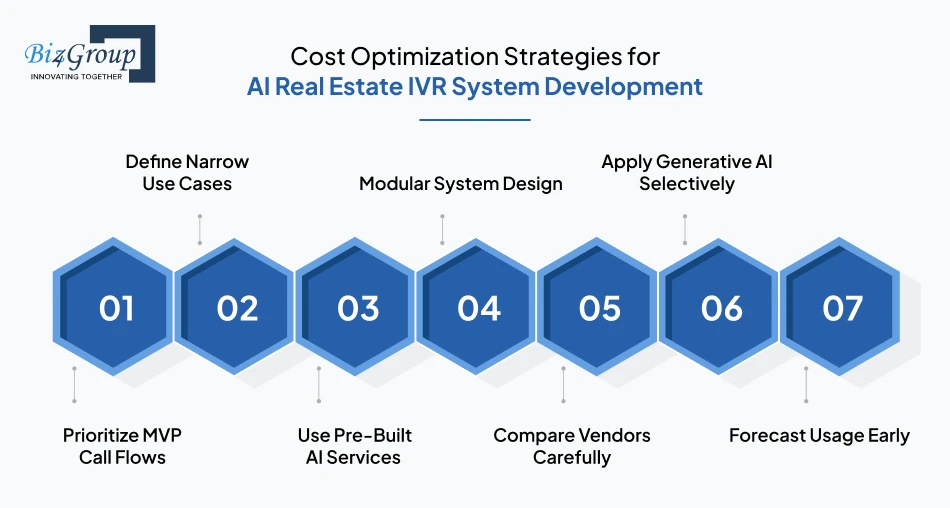
Budget overruns are common when organizations move into AI-driven voice automation, but they can be managed with the right approach. Teams can control scope, reduce waste, and still build a scalable AI system. Optimizing the cost to build an AI real estate IVR system is about making disciplined decisions early instead of cutting features later.
Most of these strategies are drawn from proven patterns used in voice automation and enterprise AI deployments, adapted specifically for real estate IVR use cases.
|
Strategy |
How It Reduces Cost |
Practical IVR Example |
|---|---|---|
|
Prioritize MVP Call Flows |
Limits early development to high-frequency calls |
Launch with inquiry handling and routing, add qualification later to cut initial spend by 30–40% |
|
Define Narrow Use Cases |
Prevents unnecessary AI complexity |
Focus only on sales or tenant support instead of automating all inbound calls |
|
Use Pre-Built AI Services |
Avoids custom model development |
Teams that build real estate AI software using mature voice APIs reduce early engineering effort |
|
Modular System Design |
Eliminates costly rework |
New properties or locations are added without redesigning core IVR logic |
|
Compare Vendors Carefully |
Avoids long-term cost escalation |
A clear cost comparison of AI IVR vendors for real estate prevents lock-in to platforms with high usage fees |
|
Apply Generative AI Selectively |
Controls compute and usage costs |
Teams that implement generative AI in real estate only for complex queries reduce ongoing expenses |
|
Forecast Usage Early |
Prevents surprise operational costs |
Modeling call volume aligns infrastructure with the average cost to develop AI IVR systems for real estate |
The best way to optimize costs is by sequencing features correctly, choosing flexible components, and avoiding premature scaling. This approach helps teams control the average cost to develop AI IVR systems for real estate while still delivering scalable, production-ready automation.
Hidden Costs of AI Real Estate IVR System Development
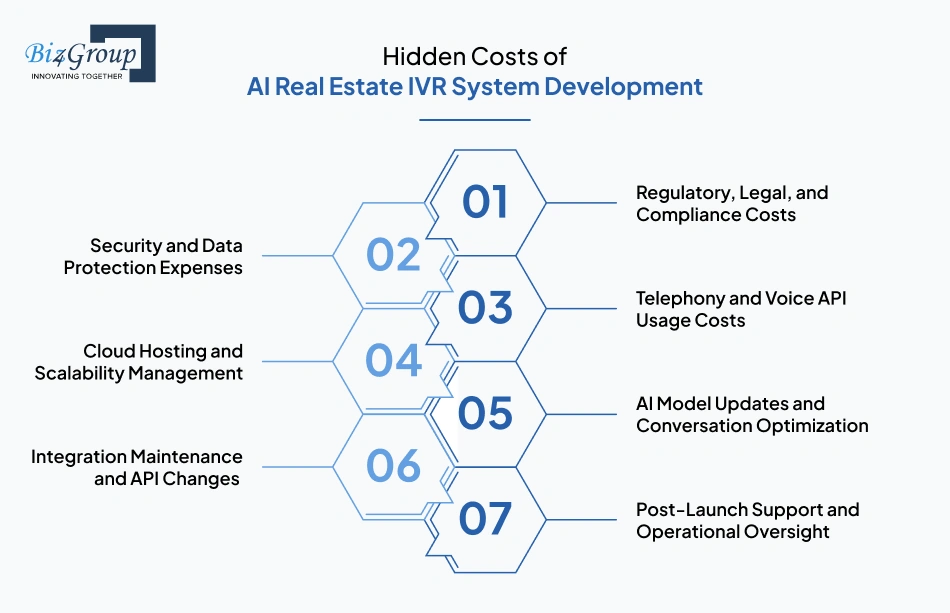
While calculating the cost of an AI IVR project for real estate, most teams focus on visible expenses such as call flow design, AI setup, and core development. In practice, several secondary and post-build expenses pop up and influence the cost to build an AI real estate IVR system if not planned properly. Here are the most common hidden costs that affect real-world budgets:
1. Regulatory, Legal, and Compliance Costs
AI IVR systems are mainly about call recording, storage of personal data, and automated interactions that must comply with federal and state regulations, especially in the U.S.
Practical example: Implementing call consent prompts, storage policies, and compliance documentation typically adds $3,000–$12,000 upfront. Multi-state deployments or stricter data retention rules can push this closer to $15,000.
- Impact: Compliance-related work can add 8-12% to the overall project budget.
2. Security and Data Protection Expenses
Voice-based systems handle sensitive information like contact details, appointment schedules, and transaction-related data. Other than basic encryption, real deployments require monitoring, access controls, and audit logging.
Practical example: Implementing security measures like role-based access, and vulnerability testing usually costs $5,000-$15,000 upfront, with an additional $3,000-$8,000 annually for monitoring projects tied to business app development using AI.
- Impact: Security measures typically increase total cost by 7-10%, depending how sensitive the data happens to be.
3. Telephony and Voice API Usage Costs
AI IVR systems incur recurring charges based on call minutes, speech recognition usage, and concurrency. These costs scale directly with adoption and are often underestimated during planning.
Practical example: Low-volume IVR usage may cost $300-$800 per month, while high-volume systems handling thousands of calls can reach $2,000-$5,000 per month, significantly influencing the cost to build an AI real estate IVR software.
- Impact: Telephony and voice APIs account for 5-10% of ongoing operational costs.
4. Cloud Hosting and Scalability Management
IVR systems have to remain available during peak call periods, requiring scalable infrastructure, monitoring, and redundancy.
Practical example: Basic hosting may start around $400-$1,000 per month, while enterprise-level setups with load balancing often range between $3,000-$6,000 per month.
- Impact: Infrastructure costs typically contribute 6-9% of total annual budget.
5. AI Model Updates and Conversation Optimization
Caller behavior evolves over time. Maintaining intent accuracy and conversation quality requires timely updates, AI model training, and tuning.
Practical example: Ongoing conversation tuning and model updates usually cost $4,000-$12,000 per year, particularly in systems aligned with AI in real estate development where inquiry patterns change rapidly.
- Impact: AI optimization adds 5-8% annually to maintenance budgets.
6. Integration Maintenance and API Changes
Third-party systems like CRMs, scheduling tools, and messaging platforms evolve quite often, which makes updates to IVR integrations very important.
Practical example: Annual maintenance for integrations typically costs $3,000-$10,000, depending on the number of connected systems and update frequency.
- Impact: Integration upkeep is around 4-7% of yearly operational costs.
7. Post-Launch Support and Operational Oversight
After deployment, IVR systems require routine monitoring, bug fixes, performance tuning, and several improvements.
Practical example: Most teams allocate 15-25% of the initial development cost annually for support, which means $6,000-$25,000 per year for a system built in the $40K-$100K range.
- Impact: Support and maintenance are recurring costs that help in keeping the system reliable and usable.
|
Category |
Estimated Cost Range |
Notes |
|---|---|---|
|
Compliance & Legal |
$3K – $15K |
Consent, recording, retention |
|
Security |
$5K – $15K + $3K–$8K yearly |
Monitoring and audits |
|
Telephony & Voice APIs |
$300 – $5K/month |
Scales with call volume |
|
Cloud Infrastructure |
$400 – $6K/month |
Availability and redundancy |
|
AI Optimization |
$4K – $12K/year |
Intent and conversation tuning |
|
Integration Maintenance |
$3K – $10K/year |
API and workflow updates |
|
Support & Maintenance |
15–25% annually |
Ongoing operations |
Accounting for these hidden expenses early provides a far more accurate answer to what is the cost of building an AI real estate IVR system in production environments. Teams that budget for these realities avoid surprise overruns and maintain long-term system performance.
Build an AI IVR System Without Overspending
Learn how teams manage scope, vendors, and architecture to control the cost to build an AI real estate IVR software.
Optimize My IVR BudgetPhase-Wise Cost to Build an AI Real Estate IVR System
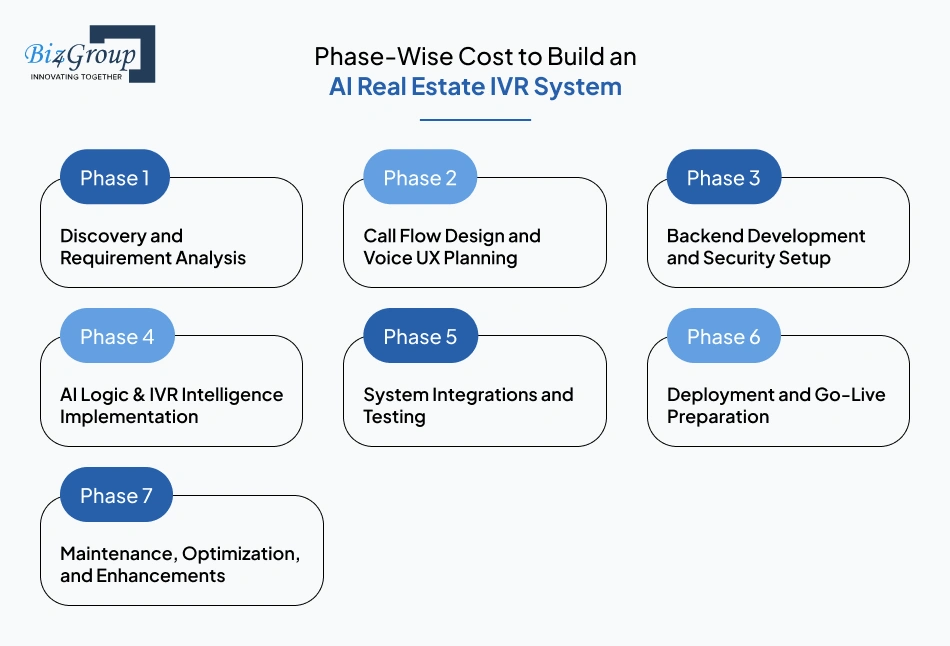
Building an AI-powered IVR for real estate happens in phases - where each stage contributes directly to functionality, reliability, and long-term scalability. Understanding this breakdown helps in allocating resources logically, avoiding overinvestment at early stages, and planning the cost to build an AI real estate IVR system with better control.
1. Discovery and Requirement Analysis
This phase focuses on defining business goals, understanding call patterns, identifying user types like buyers, sellers, or tenants, and mapping IVR use cases. Technical feasibility, compliance needs, and integration requirements are also evaluated at this point. Costs typically range from $1,500 to $5,000.
Businesses use this stage to validate scope and confirm the budget required to create an AI real estate IVR system before committing to full development.
2. Call Flow Design and Voice UX Planning
Once the market research is done, it's time to design call flows, prompts, fallback logic, and escalation paths. The goal is to ensure conversations feel natural and efficient while minimizing caller friction. This phase usually costs $2,000 to $7,000, depending on the number of flows and revisions.
Early investment here reduces rework later and is particularly important when planning conversational depth across multiple real estate scenarios.
3. Backend Development and Security Setup
This stage forms the technical backbone of the AI IVR system for real estate businesses. It includes API development, database setup, authentication, role management, and security controls for call data. For most projects, costs fall between $3,000 and $12,000, based on complexity and compliance requirements.
Teams that build AI software with scalability in mind during this phase avoid expensive infrastructure-related changes later.
4. AI Logic and IVR Intelligence Implementation
In this phase, speech recognition, intent handling, dialogue logic, and call routing intelligence are setup and customized. Depending on whether standard AI services or advanced conversational logic are used, this phase typically costs $7,000 to $30,000.
Businesses that are exploring how to use AI for real estate lead qualification or contextual responses naturally sit at the higher end of this range.
5. System Integrations and Testing
At this stage, the IVR is connected to CRMs, scheduling tools, messaging platforms, and analytics systems. Testing is conducted to validate call accuracy, performance under load, and edge cases. Costs generally range from $5,000 to $20,000, depending on integration count and testing.
Proper testing here prevents costly failures after launch.
6. Deployment and Go-Live Preparation
During this phase, the system is deployed to production infrastructure, monitoring is configured, and go-live readiness checks are completed. This phase generally costs $1,000 to $5,000, depending on hosting setup and rollout complexity.
A smooth deployment ensures reliable performance from day one.
7. Maintenance, Optimization, and Enhancements
After launch, the IVR demands ongoing updates, call flow tuning, integration maintenance, and performance optimization. Most organizations budget around 15 to 25 percent of the initial development cost annually to keep the system aligned with evolving business needs.
This recurring investment is a core part of the long-term cost of AI real estate IVR system development.
Cost Breakdown by Phase
|
Development Phase |
Key Activities |
Estimated Cost Range |
|---|---|---|
|
Discovery and Analysis |
Use cases, scope, feasibility |
$1.5K – $5K |
|
Call Flow and UX Design |
Prompts, logic, routing |
$2K – $7K |
|
Backend and Security |
APIs, databases, compliance |
$3K – $12K |
|
AI and IVR Intelligence |
Speech, intent, logic |
$7K – $30K |
|
Integrations and Testing |
CRM, QA, performance |
$5K – $20K |
|
Deployment and Go-Live |
Hosting, monitoring |
$1K – $5K |
|
Maintenance and Updates |
Optimization, enhancements |
15–25% annually |
By approaching development cost phase by phase, teams gain visibility into both upfront and recurring expenses. This approach makes the AI real estate IVR system development cost more predictable and helps organizations align budget with the real cost.
Errors That Increase the Cost to Build an AI Real Estate IVR System
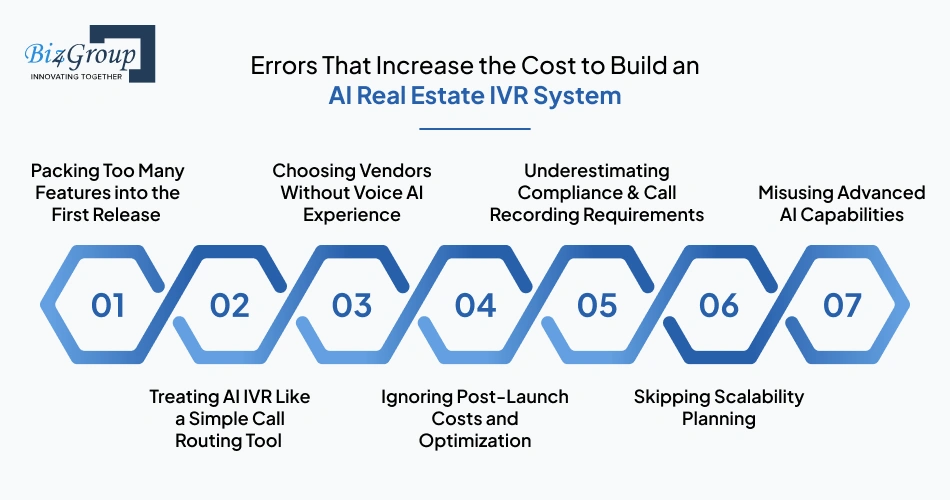
Many businesses overspend on AI IVR initiatives because of execution mistakes that could have been easily avoided. Misjudging scope, complexity, or lifecycle requirements often increases the overall cost to build an AI real estate IVR system beyond initial expectations. Here are the most common errors that drive budgets higher than necessary:
1. Packing Too Many Features into the First Release
Trying to launch with every possible call flow, integration, and automation feature increases development time and delays real-world validation. A step-by-step approach reduces risk and cost. Teams that start by learning how to build AI real estate app MVP versions of their IVR get early feedback and avoid paying for unused features.
2. Treating AI IVR Like a Simple Call Routing Tool
AI-powered IVR systems are not basic telephony menus. They require conversational logic, intent handling, fallback design, and performance tuning, all of which add complexity. Underestimating this often leads to redesigns mid-project, increasing the custom AI real estate IVR system development cost.
3. Choosing Vendors Without Voice AI Experience
Not all software vendors understand AI conversational systems, telephony constraints, or real estate workflows. Inexperienced teams may build unstable or inefficient solutions that require rework. Working with teams experienced in enterprise AI solutions typically reduces iteration cycles and prevents costly mistakes later.
4. Ignoring Post-Launch Costs and Optimization
Many budgets stop at deployment, even though IVR systems require ongoing updates, tuning, and integration maintenance. These recurring efforts are essential for long-term performance. Failing to ensure this leads to inaccurate cost analysis of developing an AI real estate IVR solutions and unexpected expenses after launch.
5. Underestimating Compliance and Call Recording Requirements
Call consent, recording policies, and data retention rules vary by region and use case. Addressing these late often requires updating existing call flows and storage systems.Early planning prevents legal rework and reduces additional costs.
6. Skipping Scalability Planning
Some IVR systems are designed for current call volumes only. When usage increases, infrastructure limitations force business owners into signing up for rushed upgrades at higher operational costs. Designing with growth in mind avoids expensive rebuilds later.
7. Misusing Advanced AI Capabilities
Applying advanced techniques such as generative AI everywhere, instead of where they add clear value, increases compute and maintenance costs without proportional returns. Selective use of AI capabilities keeps the system efficient and predictable in cost.
Avoiding these errors helps teams keep development focused, predictable, and aligned with the real cost analysis of developing an AI real estate IVR solutions over time.
Make Sure the Investment Actually Pays Off
Model ROI, savings, and efficiency gains before committing to the cost to create AI IVR systems for real estate businesses.
Evaluate My ROIRegulatory and Compliance Costs in AI Real Estate IVR System Development
AI-powered IVR systems in real estate deal with many aspects - real conversations, real people, and real data. Because these systems handle recorded calls and personal information, legal and compliance requirements affect both architecture and budget. Ignoring them often leads to rework and a higher cost to build an AI real estate IVR system later. Here are the compliance areas that most directly influence development effort and cost.
1. Call Recording and Consent Rules
Many IVR systems record calls for training, quality checks, or resolve disputes. In the U.S., consent laws vary by state, which means call flows must be designed with legal clarity in mind.
What to keep in mind:
- Some states require all-party consent
- Consent disclaimer may need to play before recording starts
- Recording logic must adapt based on caller location
These requirements add legal review and configuration work that feeds the AI real estate IVR system.
2. Data Privacy and User Protection
Real estate IVRs often collect names, phone numbers, property interests, and appointment details. That automatically brings privacy obligations into consideration.
What to keep in mind:
- State privacy laws like CCPA apply to call data
- Voice recordings and transcripts must be secured
- Users may request access or deletion of their data
Meeting these expectations affects security setup and influences overall AI real estate IVR application development pricing, especially for customer-facing systems.
3. Call Data Storage and Retention
Voice data does not disappear on its own. Decisions around how long calls are stored and where they live directly affect infrastructure and compliance cost.
What to keep in mind:
- Define retention periods clearly
- Separate operational recordings from AI training data
- Automate deletion to avoid long-term storage issues
Clear retention rules reduce both legal risk and unnecessary cloud expenses.
4. Transparency in Automated Conversations
Callers should not be confused about whether they are speaking with a human or a system. IVRs that qualify leads or route calls must be clear and honest in how they respond.
What to keep in mind:
- Clearly disclose that it’s an automated interaction
- Avoid definitive or misleading statements
- Always offer a path to a human agent
Teams planning to integrate AI into an app or IVR benefit from handling these disclosures early instead of retrofitting them later.
5. Third-Party Vendor Responsibilities
Most AI IVR systems rely on external telephony, speech recognition, or CRM platforms. Compliance does not stop at your own codebase.
What to keep in mind:
- Vendors must meet privacy and security standards
- Data-sharing responsibilities should be clear
- Contracts should align with your compliance promises
Misalignment here often creates hidden risk and unplanned expenditure in the form of fines or penalties.
When handled early on, compliance keeps systems stable, scalable, and legally safe. When treated as part of the build process, regulatory planning combines naturally with AI real estate IVR application development pricing instead of inflating it at the last minute.
Is the Cost of AI Real Estate IVR System Development Worth the Investment?
Spending $15,000 to $150,000+ on an AI IVR system can feel like a big decision for real estate teams. The real value, however, lies in how it makes the daily operations butter-smooth. When planned well, the cost to build an AI real estate IVR system often pays back through faster responses, fewer missed calls, and lower dependence on manual call handling. Here’s how real estate businesses shall look at the returns:
1. Lower Call Handling Workload
AI IVR systems handle common calls such as property inquiries, office hours, and call routing without involving human staff. This reduces pressure on front-desk teams and call centers. Over time, these savings help recover a part of the cost to create AI IVR systems for real estate businesses.
- Tip: Track how many calls are handled fully by the IVR each month.
2. Faster Lead Response
In real estate, calling back late often means losing the lead. AI IVR systems answer instantly and route calls without any delay, improving the chance of conversion. This speed advantage is why many teams are ready to bear the cost of building an AI real estate IVR system.
- Tip: Compare lead response times before and after IVR deployment.
3. Predictable Scaling as Call Volume Grows
As call volume increases, an AI IVR can handle more traffic without hiring more staff. This makes growth easier to manage and less expensive over time. Because of this, the cost to build an AI real estate IVR software becomes more predictable than managing larger support teams.
- Tip: Monitor how call volume increases without matching growth in support costs.
4. Consistent Conversational Experience
AI IVR systems provide the same clear responses at all times, even during peak hours or after business hours. This consistency reduces caller frustration and improves overall experience. Many real estate teams exploring real estate AI apps ideas start with IVR for this reason alone.
- Tip: Watch changes in call drop rates and caller complaints.
5. Easier Expansion Across Locations
Once the IVR system is live, adding new properties, offices, or services usually involves configuration. This keeps expansion costs under control. This long-term flexibility often turns the IVR into a core part of operations instead of a one-time tool.
- Tip: Track how easily new call flows or locations are added.
To put it simply, AI IVR systems return value by saving time, improving responsiveness, and scaling smoothly.
Move from Cost Questions to a Clear Plan
Whether you are validating ideas or finalizing scope, get clarity on the real budget required to create an AI real estate IVR system.
Build My AI IVR RoadmapHow Biz4Group LLC Manages AI Real Estate IVR System Development Cost?
Building an AI IVR system for real estate is about making the right choices at the right time so costs stay under control while the system grows. At Biz4Group, we focus on practical planning, clear scope, and stable architecture to help clients avoid unnecessary spend. As a custom software development company, our goal is to build systems that work well in real operations, not just on paper.
Below is an example from our portfolio that reflects this approach.
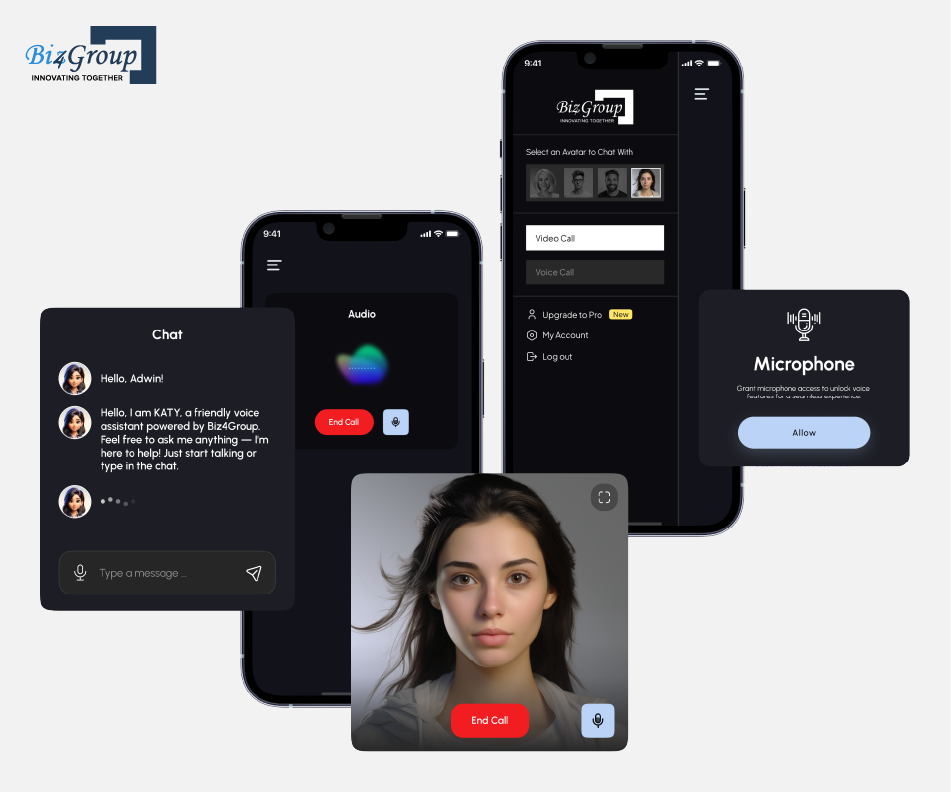
AI Wizard: AI Wizard is an AI-driven platform built to support conversational workflows and automation across business processes. The solution was designed with a simple structure, reusable components, and a phased rollout, allowing functionality to grow without creating cost spikes later.
From a cost perspective, AI Wizard shows how focusing on core interactions first can reduce development time and avoid overengineering. Features were added to solve real problems, which kept both build and maintenance costs predictable. This same approach applies when we are evaluating the cost to build an AI real estate IVR system.
At Biz4Group, we apply these principles across AI IVR projects for real estate. We design systems that can start small, adapt over time, and scale without frequent rework. As an experienced AI app development company, we help teams spend wisely by aligning technical decisions with actual business needs.
Final Thoughts on the Cost to Build an AI Real Estate IVR System
At the end of the day, investing in an AI IVR system for real estate is about solving real operational challenges like missed inquiries, delayed callbacks, and rising support costs. The cost to build an AI real estate IVR system depends on how intelligently it is scoped, designed, and scaled over time.
There is no fixed price tag that works for everyone. A lean system that handles basic inquiry routing will sit at one end of the spectrum, while a more advanced conversational setup with deep integrations will sit at the other. What matters most is aligning features with business goals so the cost to build an AI real estate IVR software yields good ROI.
With structured product development services, businesses can roll out functionality in phases and improve the system as call patterns and market demands shift. Strong AI consulting services also help teams decide where automation truly adds value and where human involvement still makes sense.
In simple terms, when planned wisely, an AI IVR does more than answer calls. It reduces friction, improves responsiveness, and supports growth without constantly increasing overhead. And that is where the real return on investment begins.
Ready to evaluate the real cost and ROI for your business?
Talk to our team and get a tailored roadmap for your AI real estate IVR system.
FAQ
1. How much does it realistically cost to build an AI real estate IVR system?
For most real estate businesses, the budget typically falls between $15,000 and $150,000, depending on call volume, automation depth, integrations, and scalability needs. This wide range reflects differences in scope and explains why many teams first ask what is the cost of building an AI real rstate IVR system before committing to development.
2. Can small or mid-sized real estate businesses afford an AI IVR system?
Yes, many smaller teams start with limited call flows and expand over time. A phased rollout allows businesses to control spend while still gaining automation benefits. This approach is often reflected in the AI real estate IVR system development cost, which scales as features and usage increase.
3. What ongoing costs should be expected after the IVR system is launched?
After launch, recurring expenses usually include telephony usage, cloud hosting, system monitoring, and periodic updates. These costs vary based on call volume and integrations and are a key part of the cost of AI real estate IVR system development that teams should plan for early.
4. Is it cheaper to use an off-the-shelf IVR platform instead of building one?
Prebuilt platforms may reduce upfront costs but often limit customization and can become expensive at scale. In contrast, long-term planning around custom AI real estate IVR system development cost helps teams avoid usage constraints and unexpected vendor pricing as call volume grows.
5. How do integrations affect the total cost of an AI real estate IVR system?
Integrations with CRMs, scheduling tools, and messaging platforms add both development and maintenance effort. The more systems involved, the more coordination is required, which directly impacts the AI IVR software development cost for real estate over time.
6. How can businesses estimate whether the investment will pay off?
Teams can evaluate ROI by comparing reduced staffing needs, faster lead response, and fewer missed calls. A clear cost analysis of developing an AI real estate IVR solutions helps decision-makers model savings and efficiency gains before approving the budget.
