 Location :
Orlando, FL, USA
Location :
Orlando, FL, USA +1 (407) 714-1616
 info@biz4group.com

- The cost to develop an AI healthcare app like K Health depends on AI depth, compliance scope, data complexity, and long-term scalability, not just app features.
- A realistic budget range sits between 30,000 USD and 250,000+ USD, covering MVP builds through enterprise-grade AI healthcare platforms.
- Decisions around symptom analysis, virtual care workflows, and security directly shape the AI healthcare app development cost like K Health over time.
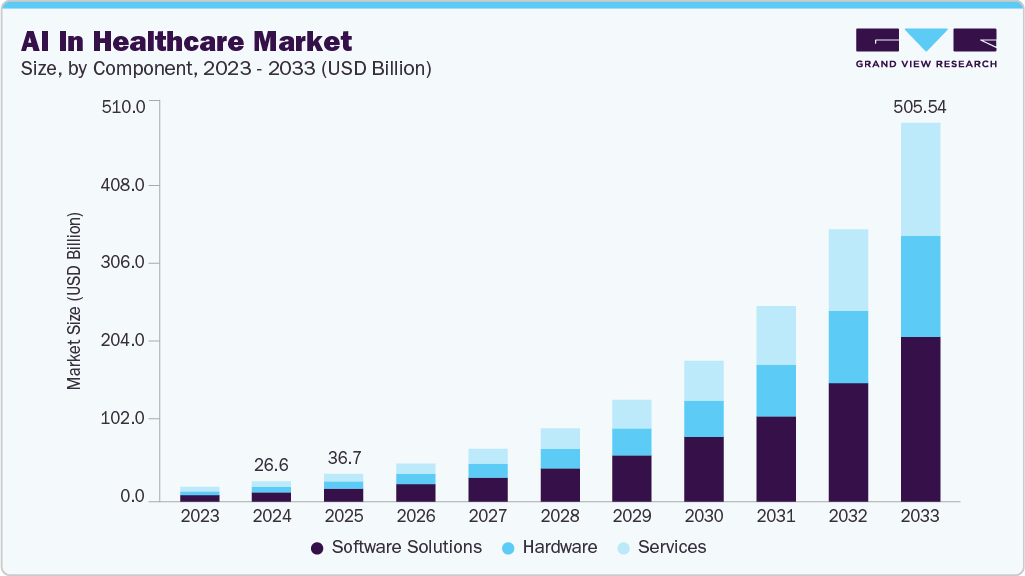
- According to the market, AI in healthcare is projected to cross a vaulation of USD 500+ Billion by 2033, driven by virtual care and AI-led decision support.
- Many teams control early spend by validating ideas first and gradually expanding, which lowers the AI healthcare MVP development cost for startups like K Health.
- Long-term ROI improves when AI models, infrastructure, and compliance are planned early rather than added later.
Building an AI healthcare product today often starts with momentum and quickly runs into math. Product vision meets compliance, machine learning meets infrastructure, and suddenly every decision has a price tag attached. The cost to develop an AI healthcare app like K Health, which typically ranges between 30,000 USD and 250,000 USD, becomes the anchor question, followed closely by a set of practical concerns that shape everything next.
- Cost to develop an AI healthcare app like K Health
- How much does it cost to build an AI doctor app
- AI healthcare app development cost breakdown
- Budget needed for AI symptom checker app
- Is building an AI health app like K Health expensive
These questions are not just about numbers. They reflect uncertainty around AI complexity, healthcare regulations, and long term scalability. That uncertainty is justified.
- According to Grand View Research, the global AI in healthcare market is expected to reach around USD 505.59 Billion by 2033, largely fueled by virtual health assistants, clinical decision support, and symptom analysis platforms.
At the same time, McKinsey reports that AI driven healthcare tools can improve operational efficiency by up to 30 percent, but only when development decisions align with real clinical and technical constraints.
This is where conversations typically shift from excitement to precision. Working with an AI app development company often reveals that the cost structure goes far beyond front end experiences. Data ingestion pipelines, model training, inference accuracy, security controls, and compliance readiness quietly shape the budget. Teams evaluating AI healthcare solutions quickly realize that underestimating these elements can derail timelines and inflate spend.
This guide is written for leaders who want clarity without noise. We focus entirely on the cost to build an AI medical app like K Health, breaking down where the investment actually goes and why. Whether you are validating an idea, planning an MVP, or preparing to scale, understanding the AI healthcare app development cost like K Health upfront helps you make decisions that hold up long after launch.
Practical Formula to Calculate the Cost to Develop an AI Healthcare App Like K Health
Estimating the cost of an AI healthcare product is less about gut feeling and more about understanding how effort translates into dollars. When teams talk about building something like K Health, the conversation quickly shifts from feature ideas to feasibility. The cost to develop an AI healthcare app like K Health depends on how much work goes into clinical logic, AI intelligence, and healthcare-grade reliability, not just how polished the app looks on the surface.
General Cost Estimation Formula for AI Healthcare App Development Like K Health
Total Development Cost = (Total Development Hours × Hourly Rate) + Additional Healthcare-Specific Expenses
On paper, the formula is straightforward. In practice, each component reflects multiple layers of technical and regulatory complexity that directly impact the final budget.
How to Use the Formula to Estimate the Cost to Build an AI Medical App Like K Health
The development hours include time spent on UX flows for symptom input, backend logic for decision pathways, AI model development for symptom analysis, testing for medical accuracy, and building scalable infrastructure that can handle real-world usage. These hours also account for iterations, which are unavoidable in healthcare-focused products.
Once those hours are defined, they are multiplied by the hourly rate of your development team or partner. This gives you the baseline number that many teams mistakenly treat as the final cost.
The real variation appears in the additional expenses. This is where healthcare apps diverge sharply from standard consumer products. Costs often include clinical data sourcing, compliance reviews, secure cloud environments, ongoing model training, and infrastructure capable of supporting real-time responses. Projects in this space frequently rely on AI automation services to manage data processing and decision workflows efficiently.
For example:
A startup validating a clinical concept may see the cost to build an AI medical app like K Health fall between $30,000 and $80,000 when focusing on limited functionality and controlled user groups.
A more mature product that includes symptom triage, virtual consultation logic, and integrations with healthcare systems can push the cost to build an AI symptom checker and virtual doctor app like K Health well beyond $200,000.
Teams working with AI experts find that early clarity on these variables prevents costly redesigns later and keeps the build aligned with both regulatory and business goals.
Plan Before You Price
Understand the cost to develop an AI healthcare app like K Health with clear scope, phases, and tradeoffs.
Estimate My AI Healthcare App CostDetailed Breakdown of AI Healthcare App Development Cost Like K Health

Developing an AI driven healthcare platform is a calculated investment, not an experimental spend. The cost to develop an AI healthcare app like K Health typically ranges from 30,000 USD to 250,000+ USD, depending on clinical scope, AI depth, regulatory requirements, and long term scalability goals. Apps that focus only on symptom guidance sit at the lower end, while platforms that include virtual care workflows and compliance layers move quickly toward the upper range.
Here is a quick snapshot of how these costs usually break down.
|
Development Stage |
Scope |
Estimated Cost Range |
|
MVP (Minimum Viable Product) |
Core symptom checker, basic AI logic, limited UI flows |
$30,000 – $70,000 |
|
Advanced Healthcare App |
Expanded AI logic, virtual doctor workflows, secure data handling |
$80,000 – $150,000 |
|
Enterprise-Grade Platform |
Advanced AI, multi-system integrations, scalability and compliance |
$180,000 – $250,000+ |
What is often missed is that each stage contains multiple moving parts that influence how reliable and scalable the product becomes. Decisions around architecture, data handling, and AI workflows tend to compound over time. Teams working with a custom software development company usually address these tradeoffs early to avoid costly rework once the app gains traction.
Below is a detailed breakdown showing where the investment typically goes:
|
Category |
Typical Range |
Notes |
|
Discovery & Requirements |
$3,000 – $8,000 |
Product planning, clinical logic mapping, and risk assessment |
|
UI/UX Design |
$4,000 – $12,000 |
Patient friendly flows, accessibility, and intuitive symptom input |
|
AI Model Development |
$10,000 – $60,000 |
Training models for symptom analysis and decision logic |
|
Backend & Database Development |
$6,000 – $25,000 |
Secure data storage, workflows, and system logic |
|
Integrations |
$7,000 – $30,000 |
EHRs, third party services, and external platforms |
|
Compliance & Security |
$8,000 – $40,000 |
Encryption, audit logs, and healthcare-grade security |
|
Infrastructure & Cloud Setup |
$2,000 – $8,000 |
Hosting, scalability, and performance monitoring |
|
Testing & Quality Assurance |
$3,000 – $10,000 |
Accuracy, performance, and security testing |
|
Post-Launch Support |
15% – 25% annually |
Updates, monitoring, and AI refinement |
For early-stage teams, the cost to build an AI symptom checker and virtual doctor app like K Health often lands between $30,000 and $100,000 when clinical scope is limited. As features expand and compliance becomes non-negotiable, the cost to develop a HIPAA-compliant AI healthcare app like K Health increases rapidly due to security controls, audits, and infrastructure hardening.
This is also where teams may involve an AI chatbot development company to support conversational logic, or rely on AI integration services to connect existing healthcare systems without disrupting operations. Understanding these layers upfront helps align budget expectations with real-world healthcare requirements.
What Influences AI Healthcare App Development Cost Like K Health?
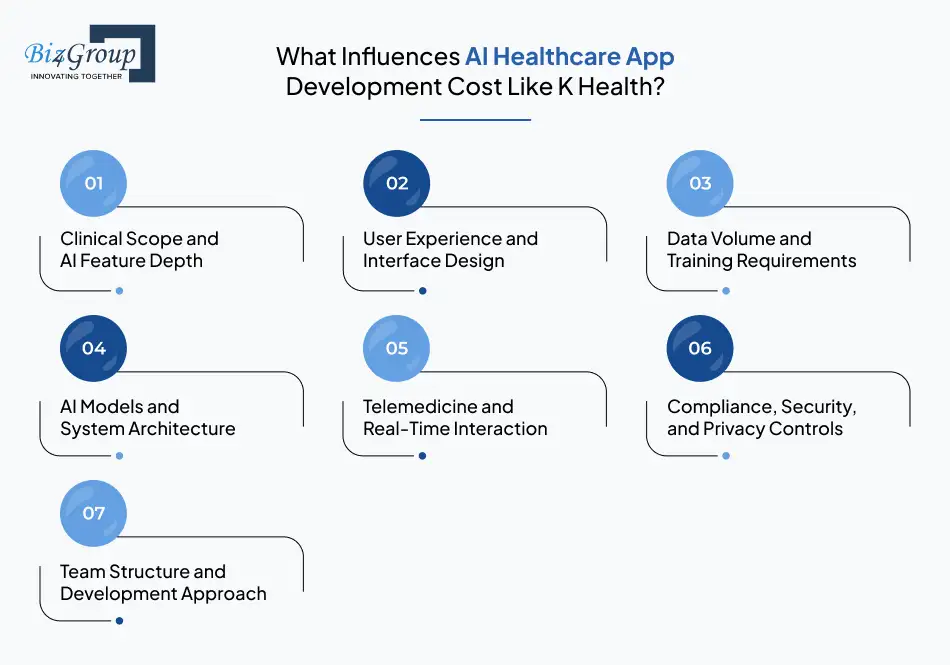
Every decision, from clinical scope to infrastructure planning, shapes the final number. When teams evaluate the cost to develop an AI healthcare app like K Health, they are really weighing how far they want the product to go in terms of intelligence, compliance, and scalability.
Below are the most important factors that influence development cost, with clear examples for each:
1. Clinical Scope and AI Feature Depth
The breadth of medical use cases your app supports has a direct impact on cost. A narrow symptom guidance tool requires less validation and logic than a system that supports ongoing care workflows.
- Example: A symptom checker limited to general conditions may stay within a $40,000 to $70,000 range, while an app supporting multi-condition triage with follow-up recommendations can exceed $120,000 as clinical logic expands.
2. User Experience and Interface Design
Healthcare UX is not just about aesthetics. It must reduce friction, prevent errors, and build trust. More complex user journeys require additional design cycles and testing.
- Example: A basic symptom input flow may take 80 to 100 design hours, while a multi-step experience that supports medical history, ongoing conversations, and care summaries can double that effort and add $6,000 to $12,000 to the budget.
3. Data Volume and Training Requirements
AI accuracy depends heavily on the quality and volume of medical data used during training. Broader coverage means more preparation, validation, and refinement.
- Example: Using limited, pre-structured datasets may cost $5,000 to $10,000, while preparing diverse datasets that support age groups, comorbidities, and regional patterns can push data preparation costs beyond $25,000.
Teams often rely on AI consulting services to design these pipelines correctly from the start.
Budget Smarter, Not Harder
Get clarity on the AI healthcare app development cost like K Health by aligning AI features with real business goals.
Break Down My AI App Budget4. AI Models and System Architecture
Choosing between adapting existing models or building custom ones affects both cost and flexibility. Custom logic usually increases development effort but allows better control.
- Example: Fine-tuning an existing model for basic symptom classification may add $8,000 to $15,000, while developing custom reasoning layers for healthcare decision paths can introduce an additional $30,000 or more.
This is where many organizations choose to hire AI developers with healthcare experience rather than general AI skill sets.
5. Telemedicine and Real-Time Interaction
Real-time communication adds complexity in performance, reliability, and security. These features often define how much does it cost to build an AI telemedicine app like K Health.
- Example: Adding asynchronous chat may cost $10,000 to $20,000, while supporting live consultations, scheduling, and clinician workflows can raise development costs by $40,000 or more.
6. Compliance, Security, and Privacy Controls
Healthcare applications must meet strict regulatory standards. Compliance impacts architecture, testing, and documentation.
- Example: Basic security measures may cost $5,000 to $10,000, but advanced compliance layers with audit logs, access controls, and encryption can push the cost to develop a HIPAA-compliant AI healthcare app like K Health significantly higher.
7. Team Structure and Development Approach
Who builds the app and how the team is structured also affects cost. Different models come with different tradeoffs in speed, control, and risk.
- Example: A small distributed team may deliver an MVP for $50,000 to $70,000, while a full-service healthcare-focused partner can take the total investment to $140,000 or more, depending on scope and support needs.
Together, these factors explain how much investment is needed to create an AI healthcare app like K Health. When evaluated early, they make cost estimation clearer and help avoid surprises later in the build process.
Hidden Costs in AI Healthcare App Development Like K Health
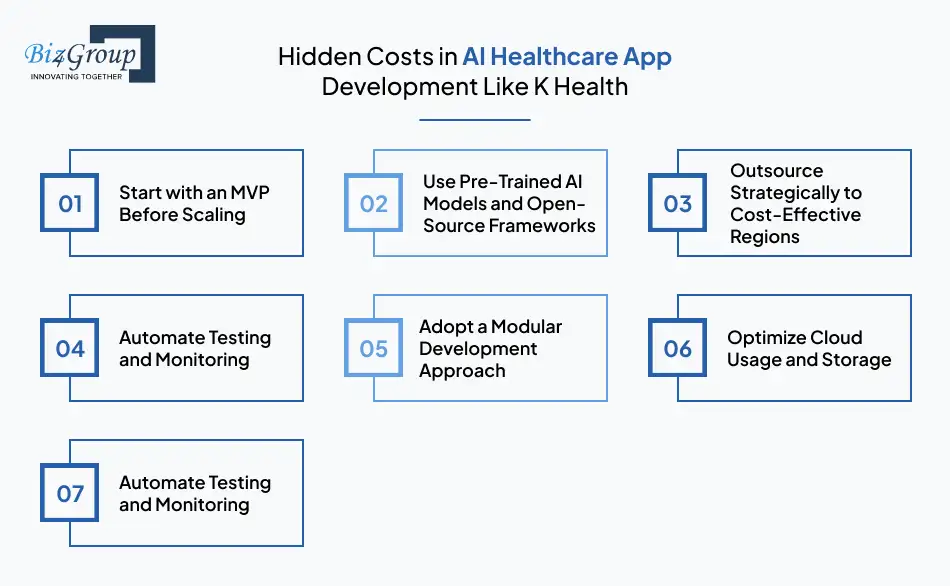
When teams estimate the cost to develop an AI healthcare app like K Health, they usually account for visible expenses such as development hours, core AI features, and interface design. What often gets overlooked are the less obvious costs tied to compliance, infrastructure, data handling, and long-term upkeep.
These hidden expenses tend to surface after development begins and can quietly reshape the budget if they are not planned upfront.
Below are the most common hidden costs that influence real-world healthcare builds:
1. Regulatory, Legal, and Compliance Overheads
Healthcare applications must meet strict regulatory standards, and compliance is rarely a one-time task. Legal reviews, documentation updates, and internal audits often evolve as features change. For many teams, initial compliance preparation alone can cost between $6,000 and $15,000, with recurring legal and regulatory updates adding another $5,000 to $10,000 annually as the product matures.
Impact: Regulatory and legal requirements can add 10 to 18 percent to the total development budget, especially when scaling to new regions.
2. Security and Patient Data Protection
Protecting patient data requires more than basic encryption. Healthcare apps typically need layered security controls, access management, monitoring systems, and incident response planning. Implementing these measures often adds $12,000 to $30,000 upfront, with an additional $6,000 to $12,000 per year to maintain ongoing protection and compliance.
Impact: Security-related costs usually contribute 8 to 14 percent to overall project spending, depending on data sensitivity.
3. Ongoing Data and API Expenses
AI healthcare platforms rely on medical datasets, third-party APIs, and supporting services that frequently operate on subscription models. Depending on usage volume and coverage, these services can cost anywhere from $800 to $3,000 per month. This recurring expense is one of the reasons founders often ask what is the cost of developing AI healthcare App like K Health when real-world data dependencies are factored in.
Impact: Data and API usage typically accounts for 6 to 10 percent of ongoing operational costs.
4. Infrastructure Scaling and Performance Management
As user adoption grows, infrastructure requirements tend to rise with it. While early-stage hosting may cost around $700 per month, scalable environments that support real-time interactions and higher traffic often reach $4,000 or more monthly. Teams that plan early to integrate AI into an app can reduce inefficiencies, but scaling remains an unavoidable cost driver.
Impact: Infrastructure and scalability usually represent 7 to 12 percent of long-term spending.
5. AI Model Monitoring and Continuous Improvement
AI systems do not remain accurate on their own. Models must be monitored, retrained, and refined as new data becomes available. Annual efforts to maintain performance often range from $6,000 to $18,000, depending on how complex the decision logic and datasets are.
Impact: Ongoing AI refinement typically adds 5 to 9 percent annually to maintenance budgets.
Validate Before You Scale
Reduce risk by understanding the AI healthcare MVP development cost for startups like K Health before committing to full builds.
Plan My Healthcare MVP6. Marketing, Adoption, and Education
Even well-designed healthcare apps require deliberate effort to build trust and awareness. Early-stage marketing, onboarding materials, and educational content frequently cost between $6,000 and $18,000 per month during launch and growth phases, particularly when explaining complex health workflows.
Impact: Marketing and adoption efforts can account for 10 to 20 percent of launch-stage spending.
7. Post-Launch Maintenance and Support
After launch, updates, bug fixes, compliance adjustments, and performance tuning become ongoing responsibilities. Annual maintenance commonly runs at 15 to 25 percent of the initial build cost, which is why many teams rely on custom healthcare software development partners for consistent long-term support.
Impact: Maintenance is a recurring cost that compounds as the product evolves.
Quick Reference: Common Hidden Cost Breakdown
|
Category |
Estimated Cost Range |
Notes |
|
Compliance & Legal |
$6K – $15K |
Regulatory reviews and documentation |
|
Security |
$12K – $30K + annual |
Data protection and monitoring |
|
Data and APIs |
$800 – $3K per month |
Medical datasets and services |
|
Infrastructure |
$700 – $4K per month |
Hosting and scalability |
|
AI Model Updates |
$6K – $18K per year |
Retraining and validation |
|
Marketing |
$6K – $18K per month |
Adoption and education |
|
Maintenance |
15% – 25% annually |
Updates and support |

Semuto is a healthcare recommendation platform built to guide users toward relevant health apps and services based on individual preferences and needs. Its emphasis on data driven personalization and intelligent matching highlights how AI logic, integrations, and evolving datasets directly influence development effort and long term cost planning in healthcare platforms.
For early-stage products, the overlooked expenses listed above play a major role in shaping AI healthcare MVP development cost for startups like K Health. When these costs are accounted for early, budgets stay predictable and product decisions remain grounded in reality.
How to Optimize the Cost to Build an AI Healthcare App Like K Health?
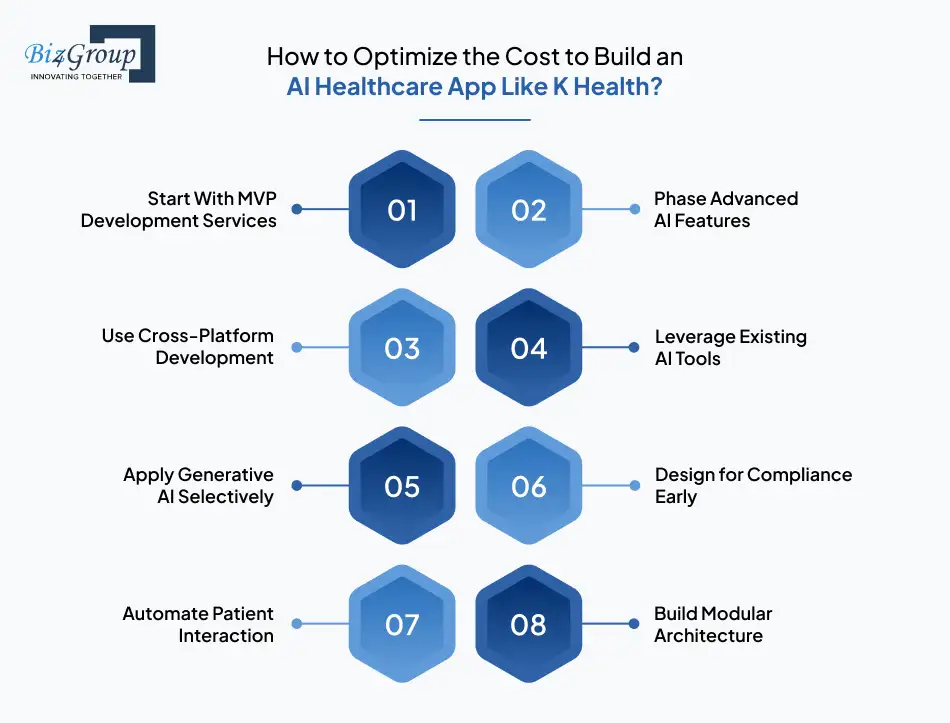
Cost overruns are common in healthcare AI projects, but they are rarely unavoidable. When teams plan early and make intentional tradeoffs, it becomes much easier to keep budgets under control without cutting corners on safety, performance, or scalability. The goal is not to build cheaply, but to build intelligently so the cost to develop an AI healthcare app like K Health stays aligned with both product goals and long-term viability.
Many of these approaches borrow from proven patterns in healthcare software, adapted carefully to the realities of AI-driven medical products.
|
Strategy |
How It Cuts Costs |
Example in AI Healthcare Apps |
|
Start With MVP Development Services |
Focusing on essential clinical flows reduces early development and validation effort |
A healthcare startup launches with basic symptom triage and guidance, postponing advanced care pathways until real usage data justifies expansion |
|
Phase Advanced AI Features |
Deferring complex AI logic prevents unnecessary early investment |
Instead of building full diagnostic reasoning upfront, a team introduces rule-based guidance first and layers AI intelligence later, reducing initial spend |
|
A shared codebase lowers build and maintenance effort |
A product team delivers iOS and Android versions simultaneously using a single framework, cutting development time by roughly 25 percent |
|
|
Leverage Existing AI Tools |
Pre-built components reduce time spent on foundational logic |
Early versions rely on established NLP services before transitioning to custom models as adoption grows |
|
Apply Generative AI Selectively |
Automating repetitive tasks reduces manual overhead |
A healthcare app uses generative AI to summarize symptom inputs and generate visit notes, lowering ongoing operational effort |
|
Design for Compliance Early |
Early compliance planning avoids costly rework |
Security and audit requirements are addressed during architecture design rather than retrofitted post-launch |
|
Automate Patient Interaction |
Reducing manual support lowers long-term costs |
A care platform introduces an AI conversation app to handle common symptom questions and follow-ups, decreasing support workload |
|
Build Modular Architecture |
Modular systems scale without full rewrites |
Teams working on K Health like AI healthcare App Development design features as independent modules, avoiding expensive refactoring later |
Optimizing the cost to building an AI healthcare App like K Health comes down to sequencing decisions wisely. Teams that delay complexity until it is justified, reuse proven components, and automate where it makes sense tend to preserve both budget and flexibility. The result is a healthcare app that grows with demand rather than forcing costly redesigns as it scales.
When done right, cost optimization allows a lot of room to evolve.
A Phase-wise Breakdown of Cost to Build an AI Healthcare App Like K Health
Building an AI healthcare platform is not a single-step effort. It unfolds across clearly defined phases, each contributing to the overall scope, quality, and reliability of the product. Understanding this phase-wise structure helps teams plan realistically, control spend, and align the development budget of AI healthcare App like K Health with real outcomes rather than assumptions.
1. Discovery and Requirement Analysis
This phase sets the foundation. Teams define clinical goals, identify user journeys, and clarify how AI will support symptom analysis or care guidance. Technical feasibility, compliance considerations, and data requirements are also mapped here. The cost for this phase usually falls between $2,000 and $6,000.
Many teams treat this as a validation step to confirm whether the product vision is feasible before committing to full-scale K Health like AI healthcare App Development.
2. Prototyping and UI/UX Design
Once requirements are locked, designers translate ideas into wireframes, user flows, and interactive prototypes. In healthcare, clarity and trust matter more than visual flair. Designing clean symptom input flows and understandable outputs often costs between $3,000 and $9,000, depending on feedback cycles and accessibility needs.
This phase frequently involves UI/UX design experts focused on AI assistant app design to ensure the interface supports both usability and safety.
3. Backend Development and Security Setup
This stage focuses on building the core infrastructure through MVP software development. Secure APIs, databases, authentication layers, and access controls are implemented to support healthcare-grade data handling. Costs typically range from $5,000 to $15,000, influenced heavily by security and scalability requirements.
Teams planning for long-term growth often architect this layer to support future enterprise AI solutions without major rewrites.
4. AI Model Integration and Frontend Development
This is where intelligence and interaction come together. AI models are trained or fine-tuned for symptom analysis, while frontend teams build patient-facing screens and workflows. Depending on model complexity and feature depth, this phase can cost between $10,000 and $45,000.
Some products at this stage also introduce AI chatbot integration to support conversational symptom collection and guidance.
5. Data Integrations and System Testing
Healthcare apps depend on reliable integrations and thorough testing. APIs, third-party services, and internal systems are connected, followed by functional, performance, and security testing. This phase usually costs $6,000 to $22,000 and plays a major role in stabilizing the price of AI healthcare app development cost like K Health.
Skipping depth here often leads to expensive fixes post-launch.
Also Read: Software Testing Companies in USA
6. Deployment and Go-Live Preparation
Once testing is complete, the app is deployed to production environments. Cloud hosting, monitoring, and go-live readiness are handled here. Depending on scale and redundancy needs, deployment costs range from $2,000 to $6,000.
Teams that treat deployment as more than a checkbox tend to avoid early performance issues.
7. Maintenance, Model Updates, and Feature Expansion
After launching, AI models require ongoing updates, retraining, and refinement as new data becomes available. Feature enhancements and compliance updates are also part of this phase. Maintenance typically accounts for 15 to 25 percent of the original build cost annually, directly impacting the long-term cost to develop an AI healthcare app like K Health.
Many organizations rely on partners experienced in AI medical web development to manage this phase efficiently.
Cost Breakdown by Phase
|
Development Phase |
Key Activities |
Estimated Cost Range |
|
Discovery & Requirements |
Clinical goals, feature mapping, validation |
$2K – $6K |
|
Prototyping & UI/UX |
Wireframes, flows, usability testing |
$3K – $9K |
|
Backend & Security |
APIs, databases, access controls |
$5K – $15K |
|
AI Integration & Frontend |
Model training, app interfaces |
$10K – $45K |
|
Integrations & Testing |
APIs, QA, performance checks |
$6K – $22K |
|
Deployment |
Hosting, monitoring, go-live |
$2K – $6K |
|
Maintenance & Updates |
Retraining, enhancements |
15–25% annually |
Dr. Ara is an AI powered athletic health platform that Biz4Group designed to deliver personalized guidance for sports and fitness focused users. The product combines AI-driven insights with user specific health data, making it a strong example of how AI healthcare apps expand in scope, architecture, and validation needs as intelligence and personalization increase.
By breaking the process into phases, teams gain clearer visibility into where money is spent and why. This structured approach reduces risk, improves planning accuracy, and makes the development cost of AI healthcare App like K Health far more predictable over time.
Design for Real-World Healthcare
Explore what shapes the cost to build an AI medical app like K Health, from compliance to AI logic and infrastructure.
Map My App Development ScopeCommon Mistakes When Estimating AI Healthcare App Development Cost Like K Health
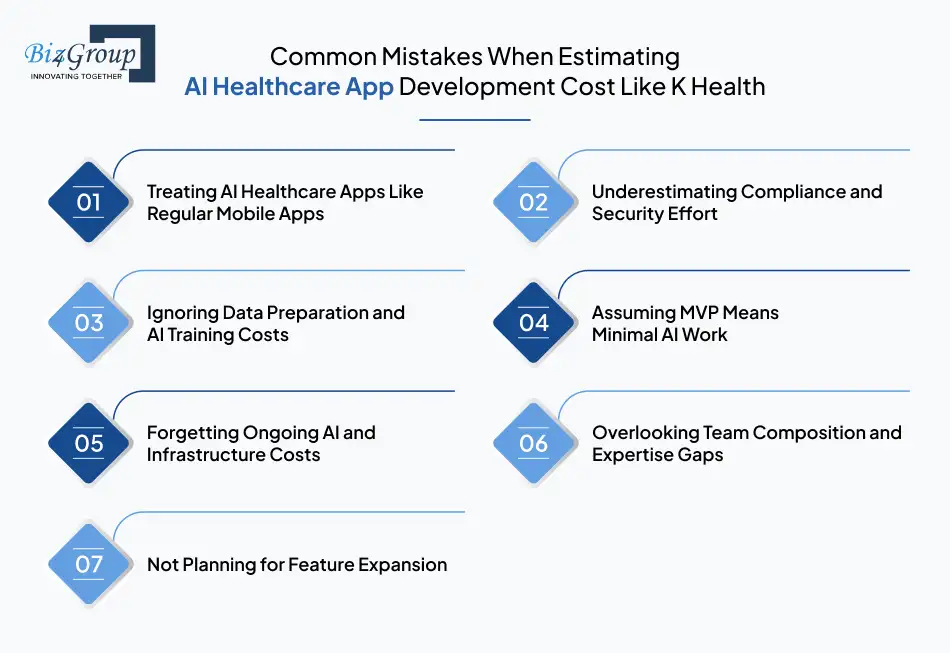
Cost estimation mistakes usually do not come from lack of effort, but from flawed assumptions made early. When teams rush planning or oversimplify complexity, budgets drift quickly. Below are the most common missteps that inflate costs later.
1. Treating AI Healthcare Apps Like Regular Mobile Apps
A frequent mistake is assuming the same estimation logic applies to consumer apps and healthcare AI products. The AI healthcare app development cost like K Health reflects added layers of clinical logic, data sensitivity, and validation that standard apps do not require.
2. Underestimating Compliance and Security Effort
Compliance is often treated as a final step rather than a continuous process. Security architecture, audits, and documentation evolve alongside the product and require sustained investment, not one-time allocation.
3. Ignoring Data Preparation and AI Training Costs
Teams often focus on AI outputs without budgeting properly for data sourcing, cleaning, and validation. These steps form the backbone of reliable AI behavior, especially in healthcare environments.
4. Assuming MVP Means Minimal AI Work
In healthcare, even an MVP must be safe and reliable. Reducing AI validation too aggressively creates technical debt and rework. This is where lessons from business app development using AI often fail to translate directly into medical contexts.
5. Forgetting Ongoing AI and Infrastructure Costs
Many estimates stop at launch. Ongoing model updates, infrastructure scaling, monitoring, and system tuning add recurring costs that should be planned from the beginning.
6. Overlooking Team Composition and Expertise Gaps
Relying on generalist teams may look efficient early on, but healthcare-specific complexity demands experience. Projects focused on the cost to build an AI medical app like K Health often benefit from teams that understand medical workflows and AI constraints.
7. Not Planning for Feature Expansion
Healthcare apps rarely stay static. New features, regulatory changes, and system integrations arrive faster than expected. Teams that skip expansion planning usually face rushed and expensive rebuilds.
Avoiding these mistakes leads to more grounded estimates and fewer surprises. When cost planning accounts for AI depth, healthcare realities, and long-term evolution, teams are better positioned to build AI software that scales without budget shock.
Revenue Models Affecting AI Healthcare App Cost Like K Health
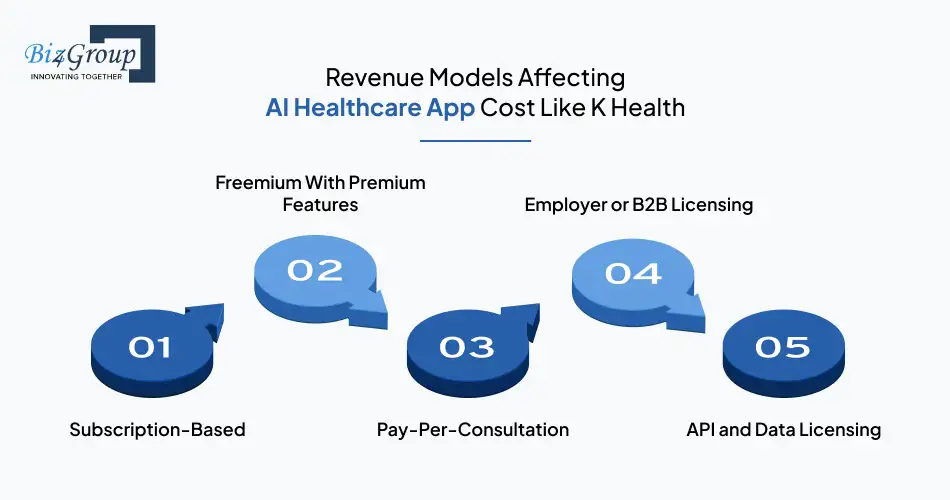
Monetization directly influences how features are built, how data flows through the system, and how much technical complexity is added. These choices shape long-term architecture and have a direct impact on the cost to develop an AI healthcare app like K Health.
Healthcare platforms that plan monetization early tend to embed billing logic, access controls, and compliance considerations directly into the product. This is especially common in solutions aligned with AI in healthcare administration automation, where workflows and revenue logic are tightly connected.
Below is a breakdown of common monetization models for AI healthcare apps and how each one affects development cost:
|
Model |
How It Works |
Best Suited For |
Development Cost Impact |
|
Subscription-Based |
Users pay monthly or annually for access to AI-driven symptom analysis, virtual care tools, or health insights |
Telehealth platforms and digital clinics |
Adds $10K to $25K for billing systems, user tiers, and compliance-ready account management |
|
Freemium With Premium Features |
Basic symptom guidance is free, advanced AI insights or reports are gated behind paid plans |
Early-stage healthcare startups |
Adds $6K to $18K for access controls, upgrade flows, and usage tracking |
|
Pay-Per-Consultation |
Users pay for individual virtual visits or AI-assisted consultations |
On-demand platforms for care |
Adds $5K to $15K for session tracking, payments, and secure interaction logs |
|
Employer or B2B Licensing |
The platform is licensed to employers, insurers, or providers |
Enterprise healthcare programs |
Adds $15K to $40K for multi-tenant architecture and reporting |
|
API and Data Licensing |
AI models or insights are exposed to third parties via secure APIs |
Health tech vendors and partners |
Adds $20K to $45K for API development, documentation, and monitoring |
Each monetization approach introduces different technical requirements. These differences directly influence how much it costs to build an AI telemedicine app like K Health as the platform scales.
Teams building clinical-facing products often factor in requirements related to AI chatbot development for medical diagnosis early, since monetization choices can affect conversational logic, session handling, and data retention policies.
Selecting the right revenue model is all about aligning technical investment with how the product is expected to grow. When monetization strategy and system design evolve together, development costs remain predictable and easier to manage.
Make AI Investment Count
Make AI Investment Count
Learn how product decisions impact how much investment is needed to create an AI healthcare app like K Health over time.
Model My AI Healthcare ROIUnderstanding Returns on AI Healthcare App Investment Like K Health
Investing in an AI healthcare platform often looks expensive at first glance, especially when budgets climb into five or six figures. But when planned strategically, the return is not just financial. The real value shows up in operational efficiency, patient engagement, and long-term scalability tied to the cost to develop an AI healthcare app like K Health.
1. Converting Development Spend into Operational Efficiency
AI-driven healthcare apps reduce manual effort across symptom intake, triage, and patient communication. Automated workflows handle repetitive tasks around the clock, allowing clinical and support teams to focus on higher value work.
- Tip: Track how many support or clinical hours are reduced each month after automation to quantify efficiency gains.
2. Improving Patient Engagement and Retention
Healthcare apps that feel intuitive and responsive tend to see higher repeat usage. When users trust symptom guidance and experience consistent interactions, engagement grows organically. This is where thoughtful chatbot development for healthcare industry applications can quietly improve retention.
- Tip: Monitor repeat usage, session duration, and active users to understand engagement-driven ROI.
3. Modeling ROI Before Development Begins
Teams that model returns early often make better feature decisions. Estimating adoption rates, usage frequency, and revenue pathways before development starts helps avoid building features that do not contribute to measurable outcomes.
- Tip: Run conservative, expected, and optimistic ROI scenarios to ground investment expectations realistically.
4. Reducing Long-Term Costs While Improving Accuracy
Once trained and deployed, AI systems can handle increasing workloads without proportional cost increases. As models improve, accuracy rises while operational expenses stabilize or even decline over time.
- Tip: Compare operational costs before and after AI implementation to identify long-term savings.
5. Scaling Care Delivery Without Linear Cost Growth
A well-architected healthcare app can expand to new services, conditions, or user segments without major rebuilds. Teams that collaborate with experienced partners like the top AI development companies in Florida, often design systems that support growth without runaway costs.
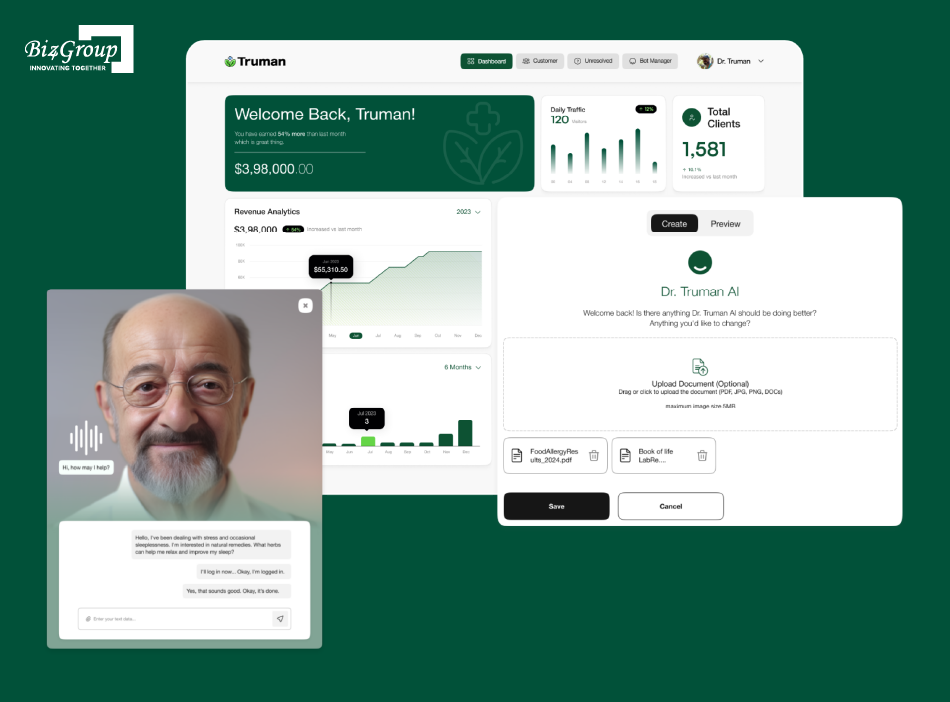
Truman is an AI-enabled wellness app that delivers personalized health advice, supplement recommendations, and ongoing user engagement through intelligent workflows. The platform demonstrates how AI powered healthcare apps can drive long term value by combining personalization, automation, and scalable user experiences that justify sustained investment beyond initial development.
In practice, returns are rarely immediate, but they compound steadily. When automation, engagement, and scalability work together, the cost to building an AI healthcare App like K Health becomes an investment that continues to deliver value well beyond launch, rather than a one-time expense.
Biz4Group's Approach to Managing AI Healthcare App Development Cost Like K Health
Building AI healthcare products requires more than technical execution. It demands clarity around scope, risk, and long-term cost control. Biz4Group approaches projects with that mindset, focusing on disciplined planning and realistic tradeoffs that keep the cost to develop an AI healthcare app like K Health aligned with business goals rather than assumptions.
Our experience building AI-driven healthcare platforms such as Dr. Ara, Semuto, and Truman informs how we structure timelines, phase features, and prioritize what actually needs to be built early versus later. Those projects reinforce a simple principle: healthcare AI products succeed when intelligence, compliance, and scalability are designed together, not bolted on later.
What shapes our approach:
- Clear phase-wise planning to prevent budget surprises
- AI architecture decisions made with future scale in mind
- Compliance and security considered from day one
- Modular feature design to support gradual expansion
We're an AI development company with deep healthcare exposure, Biz4Group focuses on building systems that evolve without forcing expensive rebuilds. Our teams work closely with stakeholders to ensure that every development decision supports sustainable K Health like AI healthcare App Development, rather than short-term delivery at the cost of long-term stability.
Operating as a software development company in Florida, we bring a balanced perspective on regulatory awareness, technical depth, and execution discipline. The result is healthcare AI products that are thoughtfully built, cost-aware, and ready to grow without friction.
Build with Cost Awareness
Build with Cost Awareness
Approach K Health like AI healthcare App Development with clarity on pricing, phases, and long-term scalability.
Start My AI Healthcare RoadmapFinal Takeaways on AI Healthcare App Development Cost Like K Health
Building an AI healthcare app is rarely about a single number. It is about understanding where the money goes, why certain choices cost more, and which decisions quietly save you six months and a few gray hairs later. From AI logic and compliance to infrastructure and long-term maintenance, every layer contributes to the overall investment.
The real takeaway is this. When scope, data, and scalability are planned early, costs stay predictable and outcomes improve. Teams that treat AI healthcare as a long-term product, not a quick build, tend to see stronger returns and fewer surprises. That is where working with an experienced AI product development company makes a practical difference, not by cutting corners, but by building the right ones first.
In short, the cost question matters, but the clarity behind it matters more. Get that right, and everything else becomes easier to manage.
Want a realistic cost estimate for your AI healthcare idea? Let’s talk through the details.
FAQs About the Cost to Build an AI Healthcare App Like K Health
1. How much does it realistically cost to build an AI healthcare app like K Health?
The development cost of AI healthcare App like K Health usually ranges between 30,000 USD and 250,000+ USD, depending on factors such as AI sophistication, regulatory scope, and long-term scalability. Early MVPs fall on the lower end, while full-featured platforms with advanced intelligence and integrations reach higher budgets.
2. What drives AI healthcare app costs up faster than expected?
The AI healthcare app development cost like K Health often increases due to underestimated compliance work, data preparation for AI models, and infrastructure scaling. These elements compound quickly when added later instead of being planned during early architecture decisions.
3. Can an AI healthcare app be built without full HIPAA compliance initially?
Yes, but only if the product avoids storing or processing protected health information. Once PHI is involved, the cost to develop a HIPAA-compliant AI healthcare app like K Health becomes unavoidable due to security controls, audits, and documentation requirements.
4. Is it better to start with a rule-based system before adding AI?
For many teams, yes. Starting with structured logic helps validate workflows and user behavior early. This approach often reduces the AI healthcare MVP development cost for startups like K Health by delaying complex model training until real usage data is available.
5. How long does it usually take to develop an AI healthcare app?
Timelines vary based on scope but understanding how much investment is needed to create an AI healthcare app like K Health also means factoring in time. MVPs typically take three to four months, while advanced platforms with AI, security, and integrations can take six to nine months or more.
6. Does AI accuracy improve after launch, or is it fixed at release?
AI systems evolve post-launch through retraining and new data inputs. This ongoing refinement is a key reason the price of AI healthcare app development cost like K Health should include long-term AI maintenance rather than treating launch as the finish line.
