Location :
Orlando, FL, USA
Location :
Orlando, FL, USA +1 (407) 714-1616
 info@biz4group.com


















Imagine a digital system that doesn’t wait for instructions but instead, understands your business goals, learns from real-time feedback, and takes independent actions to get the job done.
Read More

What does it actually take, in dollars and decisions, to bring an intelligent sports betting idea to life today? The cost to develop an AI sports betting software typically ranges from $20,000 to $150,000+, depending on feature depth, AI sophistication, compliance requirements, and scalability goals. This is not a rough guess. It is the realistic investment range for platforms designed to operate in regulated markets and scale with demand.
The timing makes this question critical. The global sports betting market is projected to reach over $153.44 billion in 2030, driven largely by online platforms and technology innovation. As the market grows, so does the financial risk of underfunded or poorly planned platforms. Budgeting mistakes made early often surface later as stalled launches, compliance gaps, or costly rebuilds.
This brings the focus to the AI sports betting software development cost itself. Artificial intelligence has shifted betting platforms from static odds engines to real-time systems that learn, adapt, and personalize. Industry research showed that over 65% of sports organizations are actively investing in AI-powered analytics and decision systems, with adoption accelerating each year.
So how do you approach the cost to build AI sports betting platform solutions without overengineering or underfunding? The answer starts with clarity.
Many businesses jump straight into development without clarity on scope, compliance needs, or data expenses. Smart planning starts with understanding what drives cost before writing the first line of code.
So, what exactly is the building cost of AI-powered sports betting software that supports growth rather than limiting it? Let’s find out.
Before features, technology stacks, or launch timelines, there is one decision that quietly determines the fate of an AI betting product. Budget clarity.
The cost to develop an AI sports betting software influences every downstream outcome, from compliance readiness to scalability and profitability.
Many betting platforms fail not because the idea lacked merit, but because the cost planning lacked realism.
Here is why this matters from day one.
When budgets are vague, scope becomes unstable. Teams overpromise features early, then cut corners later. That is risky in a regulated environment like sports betting.
Clear cost planning helps you decide:
This directly impacts the development budget of AI sports betting software and keeps decisions grounded in financial logic rather than assumptions.
AI-powered betting platforms demand more than standard app development. Live data feeds, predictive models, and continuous learning systems add layers of complexity and expense.
If these costs are ignored early, teams often face:
Understanding the AI sports betting system development cost upfront reduces the risk of expensive rebuilds later.
Sports betting platforms operate under strict legal and regulatory frameworks. Licensing, KYC, AML, and data protection are mandatory, not optional.
A realistic cost plan accounts for:
Failing to budget for compliance can halt launches or expose the business to legal risk.
Also read: Sports betting regulations across US states (2026 update)
A clear financial roadmap helps investors, founders, and product leaders align expectations. It also creates confidence when seeking funding or partnerships.
When you understand the true funding required to build AI sports betting platform solutions, you gain control over timelines, quality, and long-term returns.
Poor early cost planning inflates software budgets. A precise estimate today could save you $15,000 to $45,000 tomorrow.
Let's Talk NumbersBefore discussing features, timelines, or vendors, decision makers need a logical way to think about money. Not assumptions. Not wide ranges with no explanation. A structured approach helps you arrive at a realistic create AI sports betting platform cost estimate that aligns with business goals, funding capacity, and market ambition.
This is the same estimation logic used during early planning for most scalable betting platforms.
Total Cost = Core Platform Scope + AI Capabilities + Data Integrations + Compliance & Security + Scalability Buffer
This formula works because it mirrors how the AI sports betting system development cost is actually incurred. Each component represents a real category of spend that increases as complexity grows.
Below is a brief explanation of each element.
Consider a startup building a single-sport betting platform with basic AI insights and one market.
Estimated total: $47,000
Now compare this with a data-heavy platform offering advanced predictions, multiple sports, and deeper analytics.
Estimated total: $115,000+
These examples give directional clarity, not fixed pricing.
The purpose of this formula is alignment. It helps founders, operators, and investors understand where money goes, why costs rise, and how scope decisions affect the overall cost to build AI sports betting platform solutions.
Also read: How much does it cost to build an AI sports prediction website?
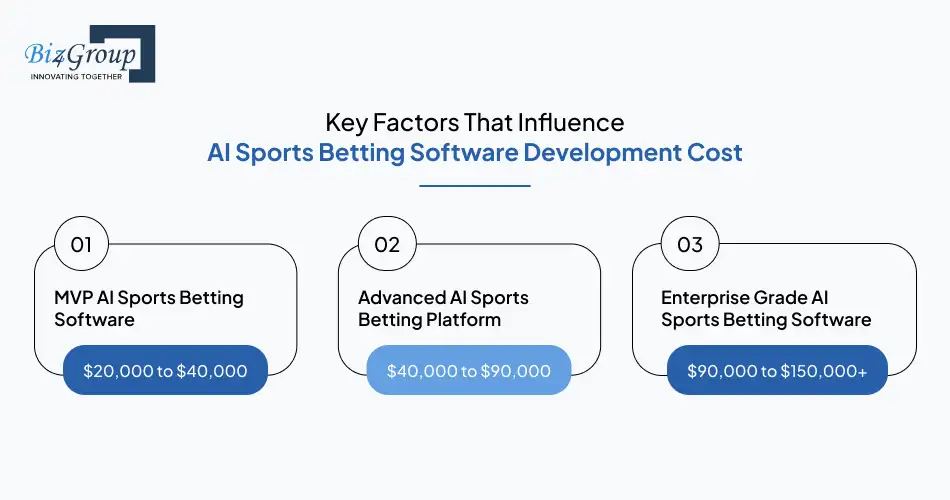
Before breaking costs into phases, it helps to understand what actually pushes budgets up or down. The AI sports betting software development cost is shaped by a combination of product ambition, technical depth, and regulatory responsibility.
To set context, here is a high-level cost snapshot.
|
Platform Type |
Estimated Cost Range |
What It Typically Includes |
|---|---|---|
|
MVP AI Sports Betting Software |
$20,000 to $40,000 |
Single sport, limited AI insights, basic admin |
|
Advanced AI Sports Betting Platform |
$40,000 to $90,000 |
Multi-sport support, predictive models, personalization |
|
Enterprise Grade AI Sports Betting Software |
$90,000 to $150,000+ |
Advanced AI automation, compliance readiness, high scalability |
These ranges offer directional clarity. The real building cost of AI-powered sports betting software depends on the factors below and how they compound.
Every feature adds logic, testing, and long-term maintenance. AI multiplies that impact.
Costs rise with:
Estimated cost impact: $8,000 to $40,000+ depending on feature depth and AI complexity
Platforms that actively use AI for sports betting gain stronger engagement and margins, but deeper intelligence directly affects the AI betting software development expenses.
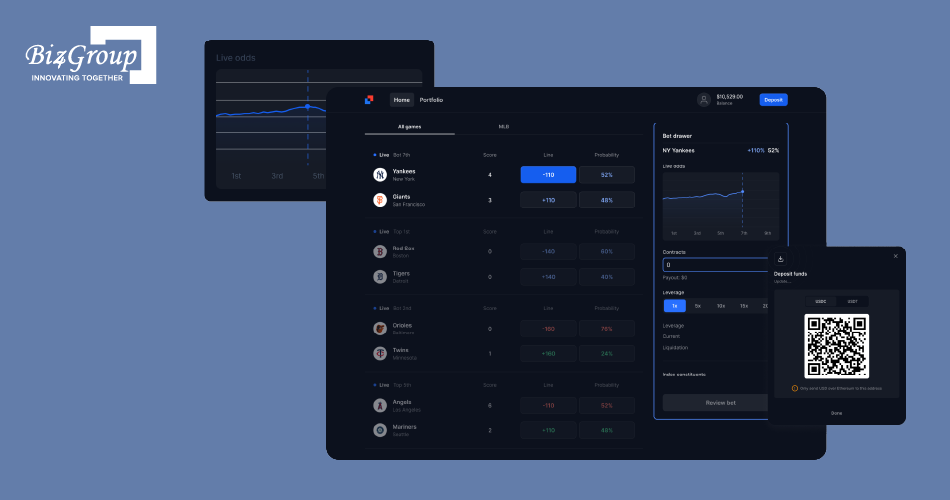
Biz4Group built a real-time sports betting platform for MLB, CFB, and NFL with predictive analysis baked into the experience.
What influenced cost here:
This type of feature depth aligns with advanced to enterprise level budgets.
Data is the heartbeat of any betting platform. The more real-time and reliable it needs to be, the higher the cost and operational complexity.
Budget impact increases with:
Estimated cost impact: $5,000 to $25,000 upfront, plus recurring data fees
Most successful platforms follow the approach where top US betting apps rely on multiple sports data providers to reduce risk and latency. This decision directly impacts the sports betting AI software development pricing.
A platform built for a small audience looks very different from one built for national or global scale.
Cost drivers include:
Estimated cost impact: $6,000 to $30,000 depending on scalability goals
Teams planning growth similar to building a sports betting platform like BetDEX often invest early in architecture to avoid costly rebuilds later. This planning affects the cost to scale AI sports betting platform globally.
User trust and engagement live in the interface. Poor design increases churn. Overdesigned flows slow adoption and confuse users.
Design costs vary based on:
Estimated cost impact: $3,000 to $15,000 based on design depth
Strong UI/UX design balances usability with betting intensity and directly influences the development budget of AI sports betting software.
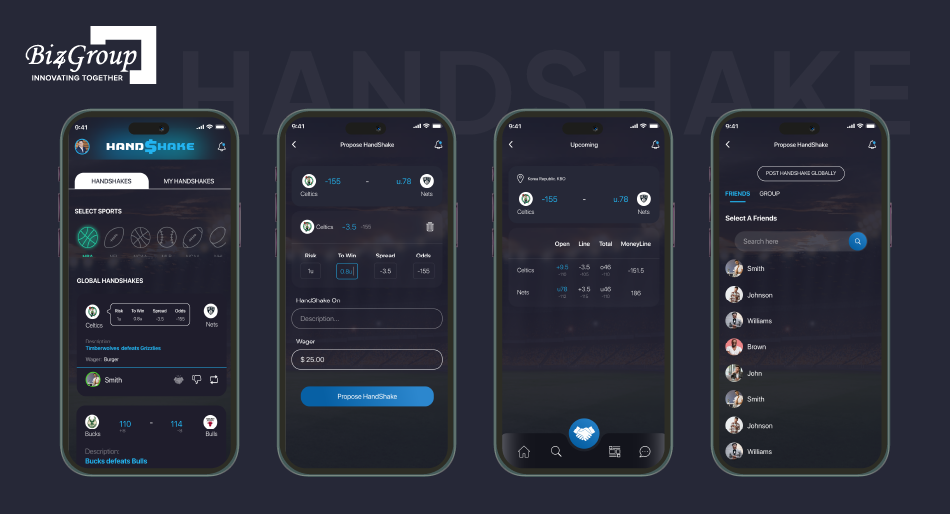
Biz4Group developed a betting app for sports enthusiasts. It focused on social betting with chat, group wagers, and flexible outcomes.
Design cost considerations included:
These elements improved engagement without bloating development costs.
AI-related costs depend on how intelligent and autonomous the system needs to be. As platforms move beyond basic predictions into adaptive intelligence, cost rises sharply.
Factors that increase cost:
Estimated cost impact: $6,000 to $35,000+ based on model sophistication
Solutions involving AI automation require deeper engineering and testing.
Sports betting platforms operate under scrutiny. Compliance work is detailed, ongoing, and non-negotiable.
Cost factors include:
Estimated cost impact: $4,000 to $20,000 initially, with ongoing annual expenses
These elements are mandatory when calculating the cost to make AI-powered sports betting software with compliance.
Advanced platforms go beyond betting and focus on insight. Analytics improve retention, decision-making, and long-term profitability.
This includes:
Estimated cost impact: $5,000 to $25,000 depending on analytics depth
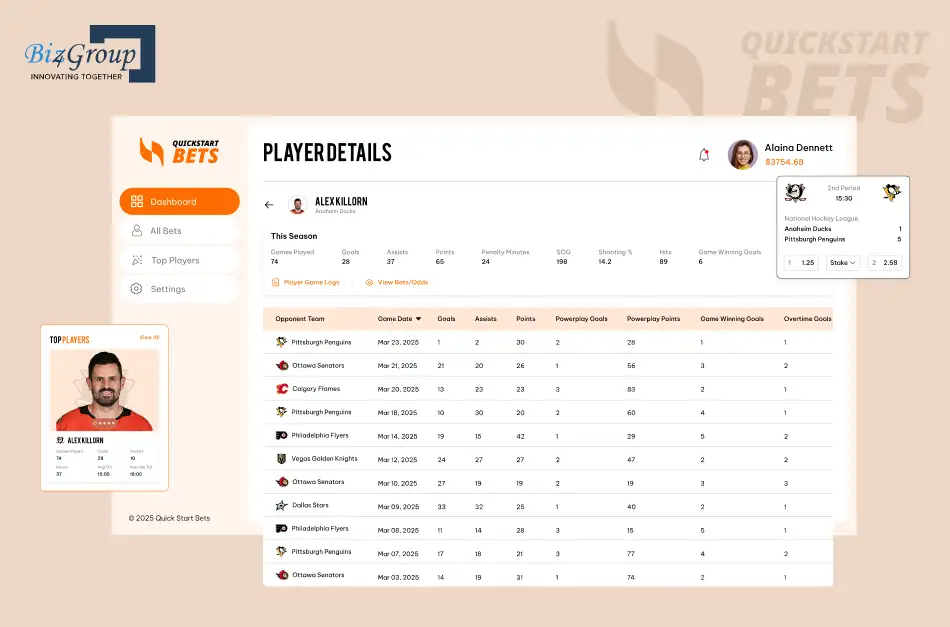
Quick Start Bets delivers real-time NHL analytics with dashboards for bets, player stats, and historical trends.
Cost influencing elements:
These analytics capabilities directly support ROI driven platforms similar to a sports betting platform like Outlier.Bet.
When you zoom out, the cost conversation becomes clearer. Every decision you make around features, data, AI depth, and compliance adds weight to the final number. None of these factors exist in isolation. They compound. That is why understanding what drives the building cost of AI-powered sports betting software gives you leverage.
Now it is time to get concrete. Let us break down where the money actually goes during development and how the cost to build AI sports betting platform solutions spreads across each phase.
Also read: Top 14 sports betting software development companies in the USA
Only strategic features improve margins by 10% to 15%. Know the difference before you build.
Book a Strategy Call NowBreaking development into phases brings clarity and control to budgeting. Instead of viewing expenses as one large figure, this approach shows how the development budget of AI sports betting software is distributed across the full product lifecycle. It also helps decision makers identify where costs concentrate and where early choices influence long-term spend.
Below is a realistic phase-wise breakdown based on common builds ranging from $20,000 to $150,000+.
|
Development Phase |
What Happens in This Phase |
Estimated Cost Range |
|---|---|---|
|
Discovery and Planning |
Product strategy, feature scoping, technical architecture, compliance feasibility |
$2,000 to $8,000 |
|
UI and UX Design |
Wireframes, user flows, betting journeys, dashboards, interaction design |
$3,000 to $12,000 |
|
Core Platform Development |
Betting engine, user accounts, wallets, admin panel, APIs |
$8,000 to $40,000 |
|
Predictions, recommendations, risk logic, analytics pipelines |
$6,000 to $35,000 |
|
|
Data Integration |
Live odds, match feeds, historical data, redundancy layers |
$4,000 to $20,000 |
|
Testing and Quality Assurance |
Functional testing, performance testing, security checks |
$2,000 to $10,000 |
|
Deployment and Launch |
Cloud setup, monitoring, production release |
$1,000 to $5,000 |
These ranges vary depending on scope and ambition, but they reflect how the building cost of AI-powered sports betting software is typically structured.
For example, a custom platform would naturally allocate more budget to AI logic and analytics. A simpler betting model or even a sports betting affiliate website would significantly reduce development depth and cost.
In the next section, we will look beyond visible development phases and uncover the hidden and ongoing costs that quietly impact the true AI sports betting system development cost over time.
Also read: How much does it cost to develop an AI sports betting app like Rithmm?
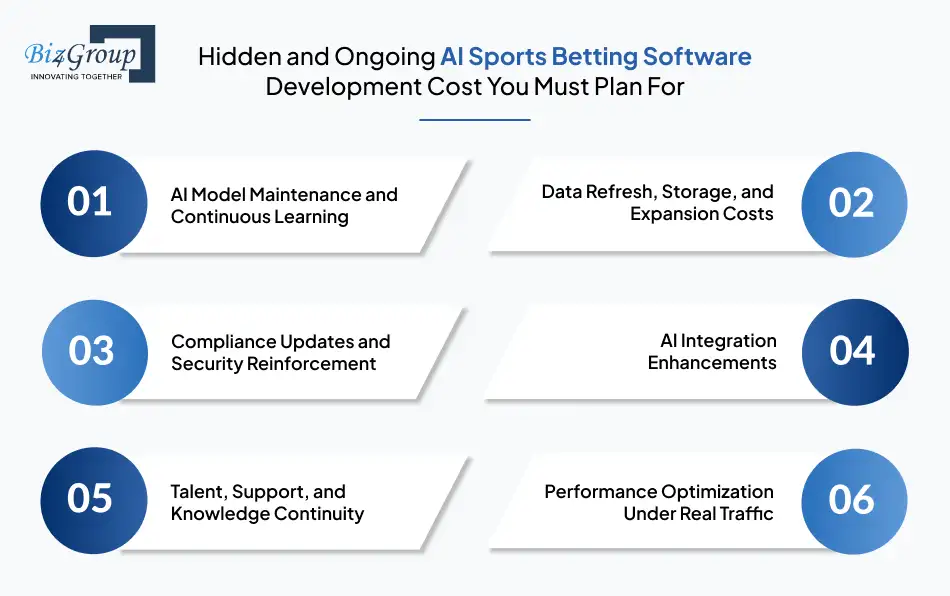
Hidden costs are rarely visible during kickoff meetings. They surface months after launch, usually when the platform starts gaining traction. These expenses do not feel dramatic individually, but together they quietly inflate the AI sports betting software development cost over time.
On average, these ongoing and hidden expenses can add $10,000 to $60,000+ annually, depending on scale, user volume, and AI complexity. Ignoring them distorts the real AI betting software development expenses and weakens long-term budget planning.
Here are the ones that deserve early attention.
AI models evolve as user behavior, betting patterns, and market conditions change. Performance declines without active maintenance.
This includes:
Platforms that use advanced intelligence such as a sports betting AI agent or adaptive prediction engines allocate recurring budgets here. This is a core part of the long-term AI betting software development expenses.
Estimated annual cost impact: $3,000 to $20,000+
Live betting platforms generate data continuously. Match history, odds movement, user behavior, and transaction logs accumulate fast.
Ongoing costs come from:
As platforms mature from a basic sports betting website into analytics heavy systems, data expenses often double without careful planning.
Estimated annual cost impact: $2,000 to $15,000+
Regulatory environments change. Security expectations rise. Both require continuous investment.
Hidden costs include:
These updates are mandatory for any platform aiming to scale or align with broader enterprise AI solutions.
Estimated annual cost impact: $2,000 to $10,000+
As platforms grow, AI often expands beyond predictions into personalization, automation, and decision support.
This leads to:
Each enhancement adds incremental cost tied to deeper AI integration, which directly affects the cost to build AI sports betting platform systems at scale.
Estimated annual cost impact: $1,500 to $8,000+
AI-driven betting platforms require ongoing expertise. Whether internal or external, talent continuity carries cost.
This includes:
Many businesses plan for this by budgeting to hire AI developers or by partnering for continuous improvement through structured AI product development models.
Estimated annual cost impact: $3,000 to $25,000+
User behavior in production environments differs sharply from testing scenarios. Live games expose performance bottlenecks fast.
Hidden costs surface in:
These optimizations are essential to protect user trust and platform stability.
Estimated annual cost impact: $1,500 to $12,000+
Hidden expenses define the true custom AI sports betting software development cost. Ignoring them leads to rushed fixes, emergency spending, and compromised user experience.
Planning for these costs early keeps growth controlled and predictable.
Next, we move to strategies that help reduce and optimize these expenses without sacrificing performance, intelligence, or compliance.
AI retraining, compliance updates, and data expansion quietly increase operating costs each year.
Talk to Biz4Group's Experts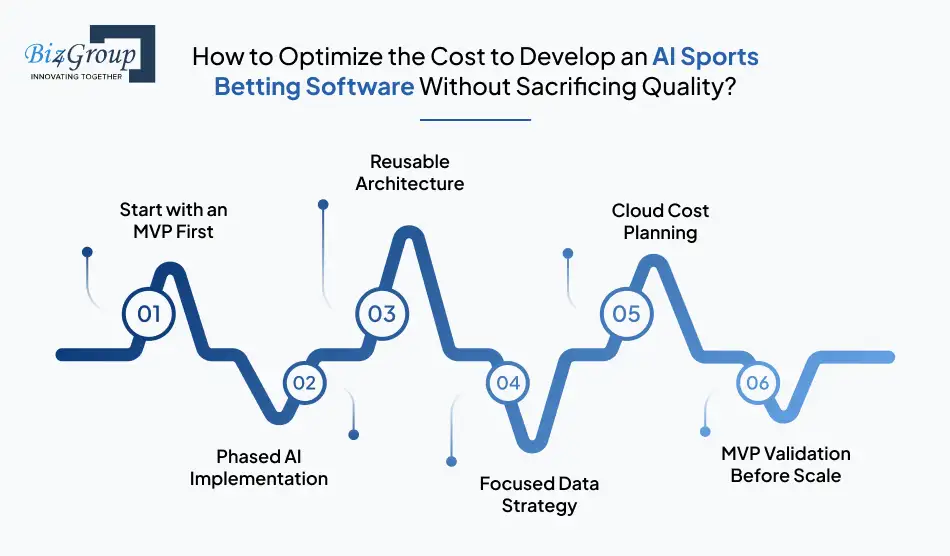
Cost optimization does not mean cutting corners. It means spending in the right places, at the right time, with a clear growth plan. When done correctly, optimization protects performance, compliance, and scalability while keeping the cost to develop an AI sports betting software under control.
The goal is simple. Build what creates value now. Defer what can wait. Avoid rebuilding later.
The table below outlines proven strategies that consistently reduce the development budget of AI sports betting software without weakening the product.
|
Cost Optimization Strategy |
How It Reduces Cost |
Estimated Savings or Impact |
|---|---|---|
|
Start with an MVP First |
Limits initial scope to core betting and basic AI insights, reducing early complexity |
25% to 40% lower upfront cost |
|
Phased AI Implementation |
Introduces predictions and automation gradually instead of all at once |
15% to 30% cost deferral |
|
Reusable Architecture |
Builds modular components that support future features without rewrites |
10% to 20% long-term savings |
|
Focused Data Strategy |
Prioritizes essential sports and data feeds before expansion |
10% to 25% reduction in data expenses |
|
Cloud Cost Planning |
Matches infrastructure to real usage instead of peak assumptions |
15% to 35% infrastructure savings |
|
MVP Validation Before Scale |
Confirms demand before expanding features or regions |
Reduces risk of wasted spend |
Also read: Sports betting website MVP development guide
This approach is commonly applied in sports betting website MVP development, where early validation prevents unnecessary investment in features users may not adopt.
Cost optimization keeps budgets disciplined. It shortens time to market and reduces unpleasant surprises after launch. More importantly, it creates financial breathing room to invest where it matters most.
But controlling spend during development is only part of the equation. The real question is what happens next. How quickly can the platform recover its investment and turn intelligence into revenue? That is where monetization enters the picture.
Profitability is where the development budget meets reality. When built correctly, AI-powered betting platforms can recover the cost to develop an AI sports betting software faster than traditional sportsbooks due to smarter risk control and higher user engagement.
Here is how revenue typically unfolds.
AI models help adjust odds dynamically and identify risk patterns early. This improves margin control and reduces exposure to unexpected losses.
Platforms using predictive analytics often see margin improvements ranging from 5%-15% compared to static odds systems. Over time, this directly impacts the return on the AI sports betting system development cost.
Personalized recommendations increase session duration and repeat betting behavior. AI-driven suggestions guide users toward relevant markets based on behavior and history.
Even a modest increase in retention of 10% can boost lifetime value by 20%-30%, improving how quickly the cost to build AI sports betting platform investments are recovered.
Smarter interfaces powered by AI insights encourage more informed decisions. Users place bets with greater confidence when data feels relevant and timely.
Many platforms report a 15%-25% increase in bet frequency once AI assisted insights are introduced.
Advanced platforms unlock additional revenue through premium analytics, subscription-based insights, and data driven experiences.
These features are often layered after launch and significantly improve profitability without raising the initial development budget of AI sports betting software.
For startups operating in a single sport or region, break even often occurs within 12-18 months when AI is used efficiently. Enterprise platforms with higher upfront AI betting software development expenses may take longer but benefit from stronger long-term margins and scalability.
AI does not guarantee profit on its own. Profitability depends on how well intelligence aligns with user behavior, market selection, and risk strategy. When these elements work together, the platform becomes a revenue engine rather than a cost center.
Also read: How do AI sports betting apps like FanDuel make money?
AI-powered sportsbooks that optimize retention and margin control can improve lifetime value by 20% to 30%. The right monetization model changes everything.
Schedule a Quick Call TodayChoosing between white label and custom development shapes far more than your launch timeline. It defines ownership, flexibility, scalability, and how much control you have over intelligence and data. From a budgeting perspective, this decision directly impacts the in-house vs outsourced AI betting software development cost over both the short and long-term.
The table below highlights how costs and tradeoffs compare.
|
Cost and Capability Area |
White Label AI Sports Betting Software |
Custom AI Sports Betting Software |
|---|---|---|
|
Initial Development Cost |
Lower upfront spend, typically $20,000 to $40,000 |
Higher upfront cost, usually $40,000 to $150,000+ |
|
Time to Market |
Fast launch due to pre-built modules |
Longer timeline due to custom architecture |
|
AI Flexibility |
Limited to vendor defined logic |
Full control over AI models and data |
|
Customization Scope |
Restricted UI, features, and workflows |
Tailored features aligned to business strategy |
|
In House vs Outsourced Cost Impact |
Lower initial outsourced cost but higher long-term dependency |
Higher early investment with better long-term cost control |
|
Scalability |
Constrained by vendor architecture |
Designed for growth and expansion |
|
Data Ownership |
Often shared or restricted |
Full ownership of user and betting data |
|
Long-Term Operating Cost |
License fees and recurring platform charges |
Predictable maintenance and optimization costs |
|
Advanced AI Expansion |
Limited ability to adopt new models |
Easier adoption of advanced capabilities such as generative AI |
White label platforms appeal to businesses focused on speed and lower entry cost. However, recurring fees and limited AI control often increase the total AI sports betting software development cost over time.
Custom development demands a higher initial investment, but it offers long-term efficiency. Businesses that outsource development strategically while retaining ownership avoid repeated licensing costs and gain the freedom to evolve AI capabilities at their own pace.
From a profitability lens, custom platforms tend to perform better when AI plays a central role in differentiation. White label solutions work best for validation or short-term market entry.
The right choice depends on how much control, intelligence, and scalability you want your platform to own from day one.
Also read: How to develop a white-label sports betting platform?
Biz4Group LLC is a USA-based technology partner that helps businesses turn complex ideas into scalable digital platforms. Our work spans regulated industries, data heavy platforms, and AI-driven products where precision matters and shortcuts fail fast.
As a trusted software development company, we understand that building AI sports betting software is not a typical development project. It blends compliance, real-time data, performance engineering, and business strategy into one tightly connected system.
That is where our strength lies.
We do not approach sports betting platforms as feature checklists. We approach them as long-term products that must earn trust, scale under pressure, and deliver measurable returns.
Our teams help clients manage the true cost to develop an AI sports betting software without sacrificing performance or future flexibility. Businesses partner with us not because we promise speed alone, but because we plan for sustainability from day one.
Many of our clients come to us after struggling with vague estimates or overengineered builds. They stay because we bring clarity to complexity and confidence to decision making.
If you are evaluating partners to build or scale an AI sports betting platform, the conversation should start right. Let us help you plan your investment, avoid costly missteps, and build a platform designed for long-term success.
Understanding the cost to develop an AI sports betting software starts with asking the right questions early. From core platform features and AI depth to data integrations, compliance, and scalability, every decision shapes the final budget. For most businesses, the realistic investment falls between $20,000 and $150,000+, depending on how advanced and future ready the platform needs to be. Planning these costs upfront protects both timelines and long-term profitability.
AI-powered sports betting platforms reward thoughtful execution. When budgets are aligned with business goals, AI improves margins, enhances user engagement, and creates opportunities for faster break even. Ignoring hidden costs or overengineering too early often leads to financial strain. Smart platforms grow in phases, validate demand, and invest deeper in intelligence as traction builds.
This is where Biz4Group LLC brings value. As a USA-based AI development company with deep experience in AI and sports betting platforms, we help businesses make informed decisions at every stage. Our focus stays on building scalable, compliant, and revenue-ready solutions while keeping development costs controlled and predictable.
Have an idea for an AI sports betting platform or planning to scale an existing one? Let us turn your vision into a platform that performs, scales, and earns. Start the conversation with Biz4Group today.
Annual maintenance typically ranges between 15%-25% of the initial development cost. For example, if your platform required a $100,000 investment, you should expect $15,000 to $25,000 per year for infrastructure, updates, monitoring, and optimization. The exact figure depends on user traffic, AI complexity, and regulatory obligations.
AI components usually account for 20%-40% of the overall project budget. Basic predictive tools fall toward the lower end, while adaptive learning systems, automated risk engines, and advanced analytics increase that percentage significantly.
Yes. Live betting requires real-time data processing, lower latency infrastructure, and dynamic odds adjustments. Adding live functionality can increase the total cost by 25%-50% compared to a pre-match only platform.
Launching in multiple states increases costs due to licensing, compliance updates, and operational adjustments. Businesses should budget an additional $10,000 to $50,000+ depending on the number of states and regulatory complexity involved.
Marketing is often underestimated. Many startups allocate 20%-50% of their development budget toward user acquisition, branding, and promotional campaigns during the first year. Without this allocation, even well-built platforms may struggle to gain traction.
Yes. Adding crypto payment gateways introduces additional security, compliance, and wallet management requirements. This can increase development expenses by $5,000 to $20,000 depending on the number of supported currencies and security protocols.
Cloud hosting costs vary based on traffic and data processing needs. Early-stage platforms may spend $500 to $2,000 per month, while high traffic systems can exceed $5,000 to $15,000 per month during peak seasons.
In many cases, retrofitting AI into an older architecture increases costs by 20%-35% compared to building with AI in mind from the beginning. Legacy systems often require restructuring, data cleaning, and integration adjustments that add unexpected expense.

with Biz4Group today!
Our website require some cookies to function properly. Read our privacy policy to know more.