 Location :
Orlando, FL, USA
 +1 (407) 714-1616
 info@biz4group.com


 AI Summary Powered by Biz4AI
- Custom AI IVR vs off-the-shelf comes down to how unusual your calls are, how many systems the phone has to update, and who needs to own the data.
- Most small teams with common calls (listing questions, viewings, office hours) should start with an off-the-shelf platform.
- A custom build pays off when your call flows are unusual, the IVR has to sit inside your own systems, or volume and data rules make a managed platform a poor fit.
- Many teams end up in the middle: rent the commodity parts, build the logic that is yours.
- The eight-question scorecard sends you to buy, mix or build, and the checklist covers what to ask before signing with either side.
Custom AI IVR vs off-the-shelf comes down to three things: how unusual your calls are, how many systems the phone has to update, and who needs to own the data. Whichever route you take, the system does the same job on every call (the five stages covered in real estate IVR system development), so the choice is really about who builds it, who runs it and who owns what it records. If your calls are the usual ones (listing questions, viewing requests, office hours), buying a platform is the faster, lower-risk start. If your calls or systems are unusual, a custom build starts to make sense.
People who've tried both say much the same. At HousingWire's AI Summit in Dallas, as reported in August 2026, broker-owner Tyler Morton of REMAX Victory + Affiliates said that when everyone has the same need, "it's probably already been built and better than you can build it." He also raised the question to ask any vendor: what happens to your data if they discontinue the product? Both points show up in the scorecard below.
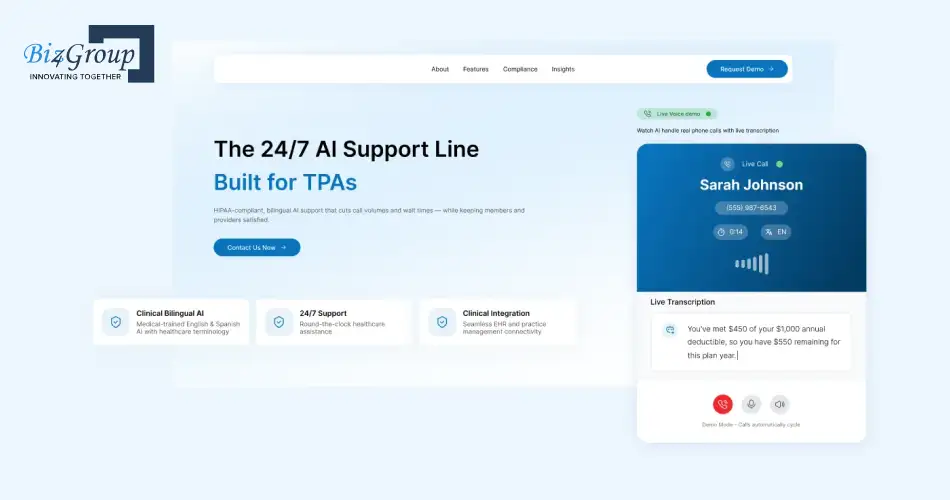
Biz4Group builds custom AI systems, including a voice-based AI IVR platform for healthcare third-party administrators, so it has a stake in this question. That's why the scorecard is built to send you to a platform when a platform is the better answer.
What are your real options: buy, build or mix?
Three: buy an off-the-shelf platform, build a fully custom system, or mix the two by building your own logic on top of a rented voice layer. The real difference is how much of the stack you own.
|
Path |
What it means |
Time to launch |
Fits best |
|---|---|---|---|
|
Off-the-shelf platform |
You configure a ready-made product: pick a voice, set the call flows, connect your CRM through the vendor's options |
Days to weeks |
Teams with common calls and nobody to maintain code |
|
Mix: platform plus custom work |
You build your own call logic and integrations on top of a hosted platform or a voice layer |
2 to 3 months |
Teams with a few unusual flows or systems |
|
Fully custom |
You own the call logic, the integrations and most of the stack, built by a partner or an in-house team |
4 to 12 months |
Large or unusual operations |
The time figures are published agency estimates for voice AI projects in general, not real estate numbers. The middle row is where Twilio's ConversationRelay sits. Twilio says it handles speech-to-text, text-to-speech, session management and interruptions, so you build the parts that are yours.
When does buying an off-the-shelf platform make sense?
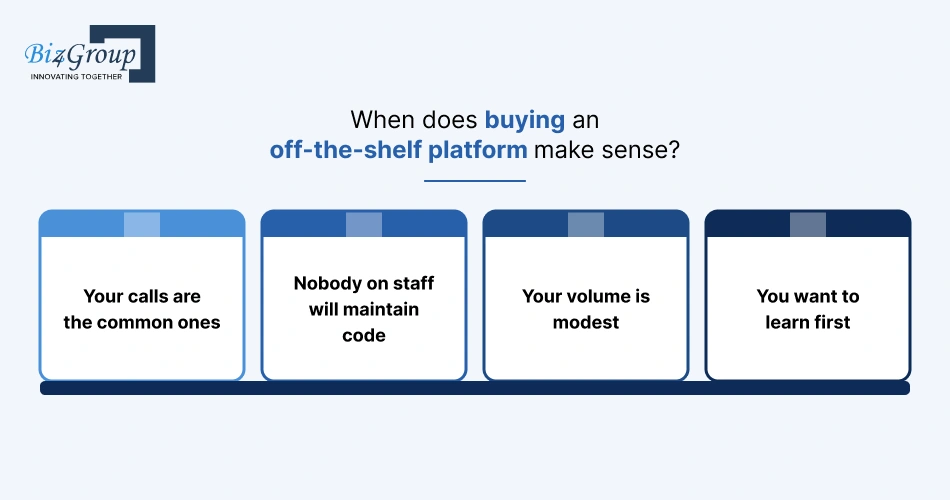
When your calls are common ones, your volume is modest, and you'd rather be live in weeks than months. That describes most solo agents and small teams.
Buying is usually the right call if:
- Your calls are the common ones. Listing questions, office hours and viewing requests are what platforms are built for, and so are the lead qualification and scheduling calls most teams start with.
- Nobody on staff will maintain code. Updates, hosting and fixes become the vendor's job.
- Your volume is modest. A company that sells voice platforms says buying is the better deal for most production workloads under 1 million calls a month. That's a seller's claim, but almost no real estate team gets near that number.
- You want to learn first. A platform is a low-risk way to find out which calls people actually make before you design anything custom.
Check four things before you sign:
- Data export. Can you take recordings, transcripts and call logs with you in a usable format?
- Longevity. What happens to your setup if the vendor changes the product or shuts it down?
- CRM record. Does it write a complete record into your CRM, or just email you a summary?
- Consent and disclosure. Does it support the recording notice and AI disclosure rules your states expect, with wording you can change by state?
When does a custom build pay off?
When your calls are unusual, the IVR has to live inside your own systems, or your data rules rule out a managed platform. Custom doesn't mean fancier. It means the system fits your operation instead of the other way around.
|
Situation |
Why it pushes toward custom |
|---|---|
|
Unusual call flows |
A brokerage that routes calls by territory, license or listing team, or a property manager sending maintenance and tenant calls into a work-order system, outgrows templates quickly |
|
Deep CRM and back-office links |
If the IVR has to read your pipeline, assign leads by your own rules and write details back, you're into custom integration with your CRM |
|
Market-specific language |
Running a multilingual IVR for a bilingual market, with local street and neighborhood names, can call for tuning beyond what a template offers |
|
Data that has to stay with you |
If your policies require recordings and transcripts to live in your own environment, a managed platform may not allow it |
|
High volume |
One published estimate puts the point where self-hosting speech models pays off at roughly 500 voice hours a month, or about 30,000 minutes. Below that, renting is usually the better trade |
A build also needs people to keep it running: a development partner, or engineers on your own payroll. Biz4Group's voice-based AI IVR platform for healthcare administrators was a custom build too, so the situations in the table above are the ones we look at first when scoping one.
Is mixing the smarter middle path?
Often, yes. Build the parts that are yours (call logic, qualification rules, CRM sync) and rent the commodity parts (phone lines, speech recognition, voices). Most custom builds already work this way, so the real choice is how much of the stack you want to own.
The mix also gives you a safe way to start. One agency that sells custom builds advises running an off-the-shelf pilot first and building only if the pilot shows a gap. That's a notable thing to hear from a company on the building side. After a few weeks of real calls, read the logs and note where the platform misheard a name, dropped a detail or fumbled a handoff. That list is your custom build scope, or proof that you don't need one.
Should you build, buy or mix? An eight-question scorecard
Score each row 0, 1 or 2, then add them up. Be honest about the rows where you're guessing, because those are the ones to test in a pilot.
|
Question |
0 points |
1 point |
2 points |
|---|---|---|---|
|
How unusual are your calls? |
Common ones: listings, viewings, office hours |
Mostly common, a few special flows |
Many special flows, such as territory routing or maintenance triage |
|
How many systems must it update? |
None beyond text or email |
One CRM or calendar |
CRM, calendar and a back-office or property management system |
|
Who has to hold the call data? |
A vendor is fine if I can export it |
I want copies in my own storage |
It must stay in my own environment |
|
How heavy is your call volume? |
A few calls a day |
Steady all week |
High and still growing |
|
How many languages? |
English only |
English plus one more |
Several, with market-specific wording |
|
How tight are your compliance needs? |
Inbound only, and a vendor's consent tools cover it after counsel review |
I need custom consent wording by state |
Outbound calling or strict retention rules |
|
How soon do you need it? |
In weeks |
A few months is fine |
I can wait for a longer project |
|
Who can maintain it? |
Nobody technical |
Someone can manage vendors and integrations |
Engineers, or a partner on a maintenance contract |
|
Your total |
Where it points |
|---|---|
|
0 to 5 |
Buy an off-the-shelf platform |
|
6 to 10 |
Mix: a platform or voice layer plus custom logic and integrations |
|
11 to 16 |
Build a custom system |
The rows follow the criteria that came up across the sources used for this page, from data ownership to volume to time. The scoring itself is a rule of thumb, not an industry standard. If you land on a boundary, run a pilot before you decide, then price the two routes side by side using the cost to build an AI real estate IVR system breakdown.
Got Your Score?
Send your eight answers and get a straight read on buy, mix or build, even if the answer is a platform.
Check My ScoreWhat should you ask before signing with either side?
Ask for the same few things in writing, whichever way you lean. The answers matter more than the demo, and they make it much easier to narrow a long list of AI IVR development companies down to two or three.
|
Asking a platform vendor |
Asking a development partner |
|---|---|
|
Can I export every recording, transcript and call log, and in what format? |
Who owns the code, the call flows and the transcripts? |
|
What happens to my setup and data if you discontinue the product? |
What does maintenance cover, and for how long? |
|
What exactly gets written to my CRM, and when? |
How will you test on real calls, with accents and background noise? |
|
Which languages and voices work today, not on the roadmap? |
Which parts are rented, such as telephony and speech, and whose accounts are they under? |
|
How are minimums and overages charged? |
What is the plan if I want to move to another provider later? |
|
What details travel with the call on a handoff to a person? |
Can you show a similar voice project and say honestly what it did and didn't cover? |
Still Torn Between Buy and Build?
Walk through your scorecard with a team that has built a voice-based AI IVR platform, and leave with a clear next step.
Talk Through My ScoreSo, rent the kitchen or build the restaurant?
Think of it as renting a kitchen versus building a restaurant. If you're serving the usual menu to a few tables, rent the kitchen and spend your energy on the food. If your menu is unusual, your tables multiply or your rules are strict, build, and keep a spare key to the rented parts. Not sure which one you are? Score the eight questions, run a pilot, and let a few weeks of real calls settle the argument no blog post can.
FAQs
1. Can you start with an off-the-shelf tool and move to custom later?
Yes, and it's the safest order. Keep the call flows, the transcripts and a running list of calls the tool got wrong, because that list becomes your custom scope. Confirm in the contract that you can export all of it, or the move will cost you the history.
2. How long should a pilot run, and what counts as a pass?
One agency suggests about two weeks of real calls. Set the pass marks before you start: names and phone numbers captured correctly, handoffs reaching a person with the details, and a complete record landing in your CRM. If one of the three keeps failing, that's the gap to fix or the reason to build.
3. Who runs the system day to day, whichever route you pick?
Someone on your side. They read the call logs, fix wording the AI trips on and keep the handoff rules current. Plan on a few hours a week in the first month, whether the system is bought or built.
4. Does going custom make compliance easier?
No. A custom build lets you design consent and retention exactly how you want, and it also makes you responsible for getting that design right. A platform may ship built-in notices. Either way, have an attorney review the final call flow before it goes live.
5. What if the platform you like doesn't connect to your CRM?
You have three options: use an automation tool to pass the details across, add a small custom connector (which makes it a mix), or pick a different platform. Decide before you sign, because a phone system that doesn't update your CRM leaves your team retyping calls.
Sources
- Build vs Buy Voice AI Agents: A Decision Framework for Engineering Leaders in 2026, published May 12, 2026
- Voice AI Development Costs in 2026: What It Really Takes to Build, Run, and Scale, updated September 14, 2026
- Build vs. Buy for AI Automation: Why It's the Wrong Question, updated July 2026
The three sources above come from companies that sell voice platforms or custom builds, so their figures and advice are treated as their own claims. The HousingWire and Twilio links appear where they are used. All sources were checked on October 28, 2026.
