 Location :
Orlando, FL, USA
Location :
Orlando, FL, USA +1 (407) 714-1616
 info@biz4group.com

- Develop an AI automotive ERP software to unify manufacturing, inventory, sales, finance, and after sales operations into one intelligent system that supports faster, data driven decisions.
- AI automotive ERP software development enables smarter forecasting, predictive maintenance, supply chain optimization, and dealer performance visibility, helping enterprises reduce costs and improve efficiency.
- A successful platform includes AI driven analytics, automation, scalable architecture, strong integrations, and user-friendly design built specifically for automotive workflows.
- The cost to develop AI automotive ERP software typically ranges from $40,000 to $300,000+, depending on features, AI depth, integrations, and enterprise scale, with ROI driven by efficiency and risk reduction.
- Choosing the best company to develop AI automotive ERP software, like Biz4Group LLC, ensures domain expertise, enterprise grade execution, and long term scalability aligned with automotive business growth.
Have you ever felt stuck because your systems do not talk to each other? Inventory data sits in one tool, production plans in another, and forecasts arrive when it is already too late. You are not alone.
In 2025, 88% of large organizations are actively using AI automation in core business functions, showing how quickly enterprises are moving toward smarter, data driven operations.
For automotive enterprises, this shift is changing what ERP is expected to deliver. Traditional platforms recorded transactions. Today, leaders want systems that surface patterns, highlight risks early, and support faster decisions. That is why many companies are choosing to develop an AI automotive ERP software rather than stretching legacy systems further.
Ask yourself:
- Why do forecasts still feel reactive?
- Why does it take days or weeks to align data across teams?
- Why are supply chain issues spotted after they already impact revenue?
When you develop AI powered automotive ERP systems, your ERP becomes an active decision support system. Visibility improves. Planning becomes sharper. Teams operate with shared confidence in the data.
This is where AI automation services help bring fragmented workflows together and turn operational data into something your teams can actually act on.
Understanding what makes AI driven ERP different starts with understanding the role ERP plays inside automotive businesses today.
Still managing automotive operations with disconnected systems?
If your ERP only tells you what already happened, it might be time to build one that helps you act sooner, not later.
Talk to Our AI ERP ExpertsWhat Is AI Automotive ERP Software and Why ERP Is the Backbone of Automotive Operations
AI automotive ERP software is a centralized Enterprise Resource Planning (ERP) platform enhanced with artificial intelligence to help automotive businesses plan, operate, and decide more effectively. Traditional ERP systems focus on recording transactions across departments. When AI is added, the system starts analyzing patterns, predicting outcomes, and supporting decisions using both historical and real time data.
When you invest in AI automotive ERP software development, you are building a single system that connects inventory, manufacturing, procurement, sales, finance, and after sales service, while also learning from how your business operates. This is why many enterprises choose to develop AI powered automotive ERP systems rather than relying on rigid platforms that only tell them what already happened.
ERP acts as the backbone of automotive operations because it:
- Connects production planning, inventory control, supplier coordination, and financial reporting in one place
- Maintains consistent data across manufacturing units, dealer networks, and service operations
- Supports compliance, traceability, and audit requirements across regions
- Gives leadership teams a single source of truth for operational and financial performance
When you create automotive ERP software with AI, these core responsibilities do not change, but the system becomes far more responsive and insightful. Forecasts improve. Risks surface earlier. Teams spend less time reconciling data and more time acting on it.
Many enterprises strengthen this foundation by aligning ERP with broader enterprise AI solutions that enable intelligent automation, predictive analytics, and connected decision making across the organization.
Once ERP is understood as the operational backbone, the role of AI becomes clear. It strengthens the system you already rely on and helps it keep up with the speed and complexity of modern automotive operations.
Core Business Benefits of Developing an AI Powered Automotive ERP System
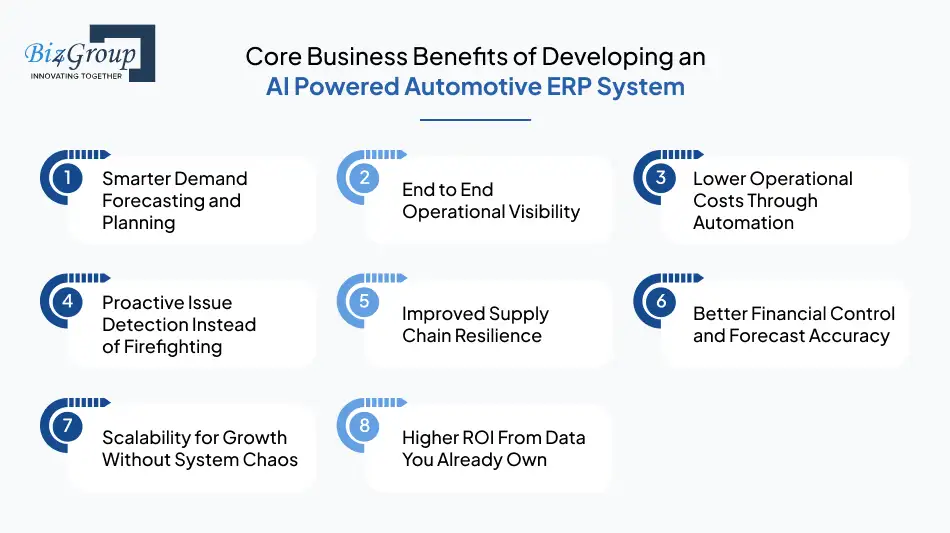
When you decide to develop an AI powered automotive ERP system, the goal is not just better software. The real win is how your business runs day to day. Below are the most important benefits automotive leaders see, explained in practical terms.
1. Smarter Demand Forecasting and Planning
With AI automotive ERP software development, forecasting is no longer based only on past sales. The system analyzes seasonality, dealer trends, supplier data, and market signals together. This helps you plan production and inventory with far more confidence and fewer last-minute adjustments.
2. End to End Operational Visibility
One of the biggest reasons enterprises develop an AI automotive ERP software is visibility. AI brings data from inventory, manufacturing, sales, and finance into a single view. You stop chasing reports and start seeing the full picture of how your business is performing in real time.
3. Lower Operational Costs Through Automation
When you build ERP software for auto enterprises using AI, repetitive tasks become automated. Purchase approvals, inventory reordering, exception alerts, and reconciliations happen with less manual effort. This reduces overhead, limits human error, and frees your teams to focus on higher value work.
4. Proactive Issue Detection Instead of Firefighting
Traditional ERP systems flag problems after damage is done. When you create AI driven automotive ERP systems, AI detects anomalies early. Whether it is supplier delays, quality issues, or demand shifts, your teams get alerts before problems escalate.
5. Improved Supply Chain Resilience
Automotive supply chains are complex and fragile. With AI enabled automotive ERP software development, your system continuously evaluates supplier performance, lead times, and risk patterns. This allows faster responses to disruptions and smarter sourcing decisions.
6. Better Financial Control and Forecast Accuracy
Finance teams benefit heavily when you develop intelligent automotive ERP platforms. AI improves cash flow forecasting, margin analysis, and cost tracking across plants and dealer networks. Leaders gain clarity without waiting for month end closes.
7. Scalability for Growth Without System Chaos
As your business grows, systems often break under pressure. When you create scalable AI automotive ERP platforms, the architecture adapts to new plants, dealerships, products, and markets without constant rework. Growth feels structured instead of chaotic.
8. Higher ROI From Data You Already Own
Many enterprises sit on years of unused data. By choosing to develop AI powered ERP software for automotive business growth, you turn that data into insights that improve planning, reduce waste, and support smarter decisions. This is where the long-term ROI of AI automotive ERP systems truly shows up.
These benefits explain why AI powered ERP is no longer a nice to have for automotive enterprises. It directly impacts efficiency, cost control, resilience, and growth across the organization.
High Impact Use Cases of AI Automotive ERP Solutions for Modern Auto Enterprises
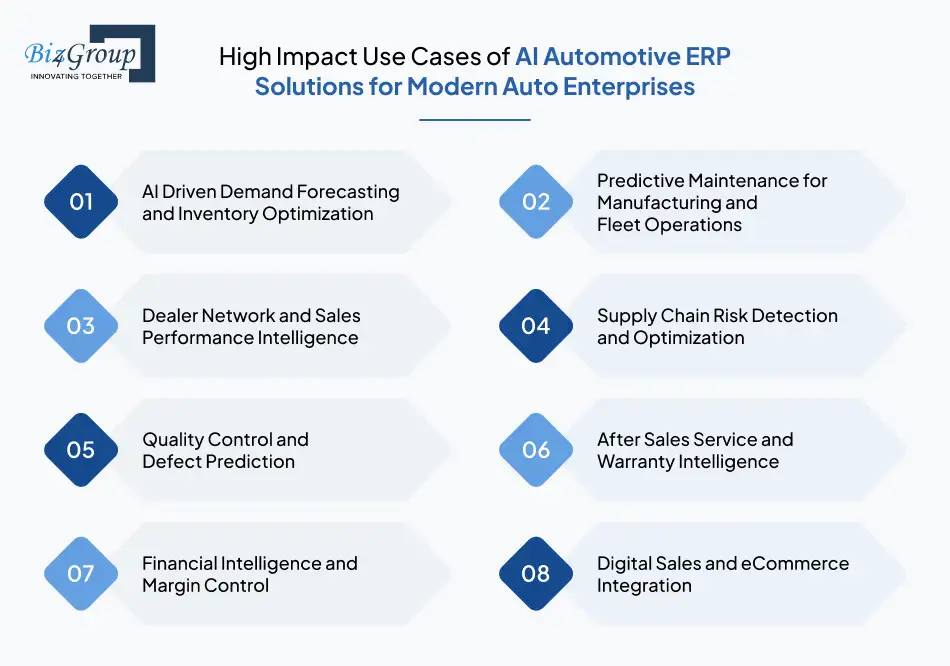
When you build AI automotive ERP solutions, the real value shows up in how clearly everyday problems get solved across manufacturing, dealerships, finance, and after sales operations.
1. AI Driven Demand Forecasting and Inventory Optimization
Demand in automotive businesses shifts constantly due to seasonality, regional preferences, and market conditions. With AI automotive ERP software development, forecasting models learn from sales history, dealer movement, and market signals, allowing inventory levels to adjust dynamically instead of following static rules.
Key benefits
- Reduced stockouts and excess inventory
- Better production and procurement planning
- Lower inventory carrying costs
For example, a nationwide auto parts distributor used AI powered forecasting inside its ERP to rebalance inventory across regions. High demand locations saw better availability, while slow moving stock declined without increasing total inventory spend.
2. Predictive Maintenance for Manufacturing and Fleet Operations
Unexpected equipment failures lead to downtime and lost revenue. When enterprises develop AI powered ERP for auto manufacturing and dealerships, machine data and maintenance logs are analyzed to predict failures early.
Key benefits
- Reduced unplanned downtime
- Longer equipment life
- Lower repair and maintenance costs
For instance, an automotive manufacturer applied intelligence similar to AI automotive diagnostic and repair within its ERP to identify early warning signs in production equipment before breakdowns occurred.
3. Dealer Network and Sales Performance Intelligence
Managing multiple dealerships creates blind spots in performance and inventory movement. With AI automotive ERP solutions for large and mid-sized auto enterprises, sales trends, stock turnover, and customer behavior are analyzed together.
Key benefits
- Clear dealer level performance insights
- Smarter inventory allocation
- More accurate sales forecasting
For example, a dealer group implemented ERP intelligence aligned with AI automotive dealership management to identify underperforming locations and adjust pricing and inventory faster.
4. Supply Chain Risk Detection and Optimization
Automotive supply chains involve complex supplier networks and long lead times. When you create AI automotive ERP systems for modern auto enterprises, AI continuously evaluates supplier reliability and delay patterns.
Key benefits
- Faster response to supplier disruptions
- Reduced production delays
- Better supplier performance management
For instance, a global OEM used ERP insights connected with custom manufacturing software to flag suppliers showing rising delay risks before production schedules were affected.
5. Quality Control and Defect Prediction
Quality issues often surface too late, leading to recalls and warranty costs. With AI enabled automotive ERP software development, production data, inspection results, and warranty claims are analyzed together to spot defect patterns early.
Key benefits
- Lower recall risk
- Improved production consistency
- Reduced warranty expenses
For example, a manufacturer leveraged techniques similar to AI model development detect recurring defects at specific production stages and take corrective action sooner.
6. After Sales Service and Warranty Intelligence
Service operations generate valuable data that often remains underused. When enterprises develop intelligent automotive ERP platforms, service history and parts usage are analyzed to improve service efficiency.
Key benefits
- Faster service resolution
- Better spare parts planning
- Reduced warranty leakage
For instance, an auto service network used ERP driven insights to identify repeat repair patterns, helping technicians resolve root causes instead of recurring symptoms.
7. Financial Intelligence and Margin Control
Finance teams need visibility across plants, dealers, and regions. When you develop AI-powered automotive ERP systems, AI analyzes costs, margins, and cash flow patterns continuously.
Key benefits
- Improved cost control
- Early detection of margin leakage
- More accurate financial forecasts
For example, a multi-plant automotive group used ERP driven financial intelligence to identify rising costs at specific facilities before quarterly results were impacted.
8. Digital Sales and eCommerce Integration
As automotive sales move online, ERP becomes the backbone for digital channels. When you create automotive ERP software with AI, inventory, pricing, and order fulfillment remain synchronized.
Key benefits
- Real-time inventory visibility
- Consistent pricing across channels
- Improved customer experience
For instance, an enterprise connected its ERP with an AI automotive eCommerce platform to ensure online vehicle and parts availability always reflected real-time stock.
Seeing the use cases and wondering which one fits your business first?
You do not need to solve everything at once. We help you prioritize the AI ERP use cases that deliver impact fastest.
Let's TalkMust Have Features When You Create Automotive ERP Software with AI
When you create automotive ERP software with AI, features decide whether the platform actually delivers value or becomes another underused system. Automotive enterprises need ERP features that solve real operational problems, scale with growth, and work smoothly with existing systems.
Below is a clear, decision-friendly table outlining the core features every AI automotive ERP software must include, along with why each one matters.
|
Core Feature |
What It Does for Your Business |
|---|---|
|
AI Driven Forecasting Engine |
Analyzes sales history, dealer demand, seasonality, and market signals to improve demand planning, inventory optimization, and production scheduling. |
|
Unified Data Management Layer |
Brings inventory, manufacturing, sales, finance, and after-sales data into a single source of truth, reducing mismatches and reporting delays. |
|
Predictive Analytics and Alerts |
Identifies risks such as supplier delays, cost overruns, quality issues, or demand drops early, allowing teams to act before problems escalate. |
|
Workflow Automation Engine |
Automates approvals, reordering, reconciliation, and exception handling using rules and intelligence powered by AI automation services. |
|
Dealer and Channel Performance Intelligence |
Tracks dealer level sales, inventory movement, and customer behavior to support smarter allocation and performance management. |
|
Financial Intelligence Module |
Improves margin tracking, cost analysis, and cash flow forecasting using AI-driven insights instead of static financial reports. |
|
Scalable System Architecture |
Supports new plants, dealerships, regions, and product lines without constant rework, which is critical when you create scalable AI automotive ERP platforms. |
|
Integration Layer for Enterprise Systems |
Connects ERP with CRM, IoT platforms, supplier systems, and legacy tools through robust AI integration services. |
|
Custom AI Models and Intelligence Layer |
Enables tailored forecasting, quality control, and risk analysis using business-specific intelligence rather than generic algorithms. |
|
Human-Friendly Interface and Dashboards |
Makes complex data easy to understand through intuitive dashboards and workflows supported by thoughtful UI/UX design. |
|
Security, Compliance, and Access Control |
Protects sensitive operational and financial data while supporting industry compliance and role-based access across teams. |
|
Agent-Based Decision Support |
Use intelligent assistants powered by AI agent technology to guide users, surface insights, and recommend actions. |
These features ensure your ERP does more than store data. They turn it into a system that supports smarter planning, faster decisions, and better control across automotive operations.
The next step is understanding how these features come together during development and what stages are involved to avoid rework, delays, and budget overruns.
Stages to Develop an AI Automotive ERP Software Without Costly Rework
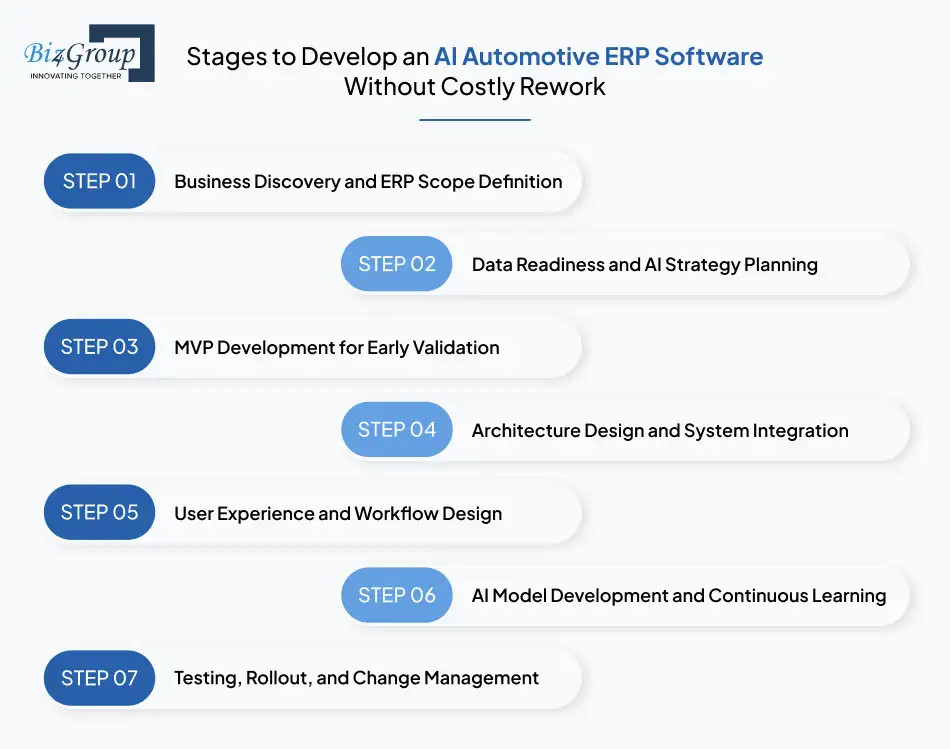
When you plan to develop an AI automotive ERP software, success depends less on speed and more on structure. Automotive enterprises that rush often end up rebuilding later. A staged approach keeps costs predictable and outcomes aligned with real business needs.
1. Business Discovery and ERP Scope Definition
This is where automotive ERP application development truly begins. You map current workflows across manufacturing, inventory, sales, finance, and after-sales service to identify gaps and priorities. The goal is to define what the ERP must solve, not just what it could include.
What this stage delivers
- Clear roadmap to build AI automotive ERP solutions
- Defined KPIs tied to operational outcomes
- Reduced risk of scope creep
2. Data Readiness and AI Strategy Planning
AI success depends on data quality and availability. This stage assesses data sources and defines how intelligence will be applied across ERP modules. It sets the foundation to develop AI-powered automotive ERP systems that deliver real value.
What this stage delivers
- Clean and usable data pipelines
- Prioritized AI use cases for ERP
- Foundation for AI-enabled automotive ERP software development
3. MVP Development for Early Validation
Rather than building everything at once, teams validate ideas through MVP development. This approach allows you to test critical workflows before committing to a full-scale build.
What this stage delivers
- Faster path for modern auto enterprises
- Real user feedback from operations teams
- Early proof of value before scaling
4. Architecture Design and System Integration
This step focuses on designing a modular, secure, and scalable foundation. The architecture must support growth as you create scalable AI automotive ERP platforms and integrate with existing enterprise systems.
What this stage delivers
- Flexible architecture for auto enterprises using AI
- Secure integrations with legacy tools
- Long-term scalability without rework
5. User Experience and Workflow Design
ERP adoption depends on usability. This stage ensures workflows are intuitive and dashboards are easy to understand through thoughtful UI/UX design aligned with real user roles.
What this stage delivers
- Higher adoption across departments
- Reduced training and resistance
- Smoother daily operations
6. AI Model Development and Continuous Learning
Custom AI models are built and refined using operational data. This is where teams develop intelligent automotive ERP platforms that improve over time instead of remaining static.
What this stage delivers
- Business-specific intelligence
- Continuous improvement in forecasts and alerts
- Stronger decision support across ERP
7. Testing, Rollout, and Change Management
Before full deployment, the system is tested for accuracy, performance, and security. A structured rollout ensures teams adopt the system smoothly while minimizing disruption.
What this stage delivers
- Stable launch of large and mid-sized auto enterprises
- Confident user adoption
- Faster realization of business value
Following these stages allows you to develop AI-powered ERP software for automotive business growth with clarity, control, and measurable outcomes instead of costly rebuilds later.
Cost to Develop an AI Automotive ERP Software and What Drives the Investment
When leaders ask about the cost to develop AI automotive ERP software, the short answer is this. Most projects fall between $40,000 to $300,000+, depending on scope, intelligence level, integrations, and scale. The range exists because no two automotive enterprises build the same system. A dealership-focused ERP will look very different from a multi-plant manufacturing ERP with predictive intelligence.
If you plan to develop an AI automotive ERP software for long-term growth, understanding where the money goes helps you make smarter tradeoffs instead of cutting the wrong corners.
Feature-Wise Cost Breakdown for AI Automotive ERP Software Development
Below is a practical view of how costs typically break down when you develop AI-powered automotive ERP systems.
|
Feature or Module |
Estimated Cost Range |
Why It Impacts Cost |
|---|---|---|
|
Core ERP Modules (inventory, sales, finance, procurement) |
$15,000 to $40,000 |
Forms the foundation of automotive ERP application development |
|
AI-Driven Forecasting and Analytics |
$10,000 to $35,000 |
Requires data pipelines, training logic, and validation |
|
Predictive Maintenance and Quality Intelligence |
$15,000 to $40,000 |
Involves advanced models and manufacturing data |
|
Dealer and Supply Chain Intelligence |
$10,000 to $30,000 |
Depends on data complexity and number of locations |
|
Integrations with Existing Systems |
$5,000 to $25,000 |
ERP, CRM, IoT, and supplier systems increase effort |
|
UI and Dashboard Design |
$5,000 to $15,000 |
Impacts adoption and daily usability |
|
Security, Compliance, and Access Control |
$5,000 to $15,000 |
Critical for enterprise readiness and data protection |
These numbers are indicative and vary based on whether you build AI automotive ERP solutions from scratch or modernize existing platforms.
Key Factors That Affect the Cost to Develop AI Automotive ERP Software
Several factors directly influence how much you invest when you create automotive ERP software with AI.
- Number of ERP modules and business workflows
- Depth of AI capabilities such as forecasting, automation, and prediction
- Data quality and readiness across departments
- Integration complexity with legacy systems
- Level of customization required for automotive-specific workflows
Enterprises that work with an experienced custom software development company often control these factors better by designing only what delivers measurable value.
Hidden Costs Enterprises Often Miss
Many teams underestimate costs not because of development, but because of what surrounds it. When you develop intelligent automotive ERP platforms, watch out for these often overlooked areas.
- Data cleaning and preparation before AI can work effectively
- Change management and internal training
- Ongoing model tuning and performance monitoring
- Infrastructure scaling as data volume grows
Ignoring these can inflate long-term ownership costs even if initial development looks affordable.
How to Optimize Cost Without Sacrificing Value
Cost control does not mean cutting intelligence. It means building in the right order. Enterprises that develop AI-powered ERP software for automotive business growth usually follow these strategies.
- Start with high-impact modules and expand gradually
- Validate ideas early instead of building everything at once
- Use phased AI adoption instead of full-scale intelligence on day one
- Partner with the right AI development company that understands automotive workflows
Many teams also reduce risk and cost by choosing to hire AI developers with automotive domain experience instead of experimenting internally.
Understanding cost at this level helps you plan realistically, justify investment internally, and build an ERP platform that delivers real ROI instead of surprise expenses later.
Worried about ERP costs getting out of control?
The right architecture and phased approach can keep your AI automotive ERP investment predictable and ROI driven.
Get a Cost BreakdownChallenges in Developing AI Automotive ERP Software and How to Solve Them
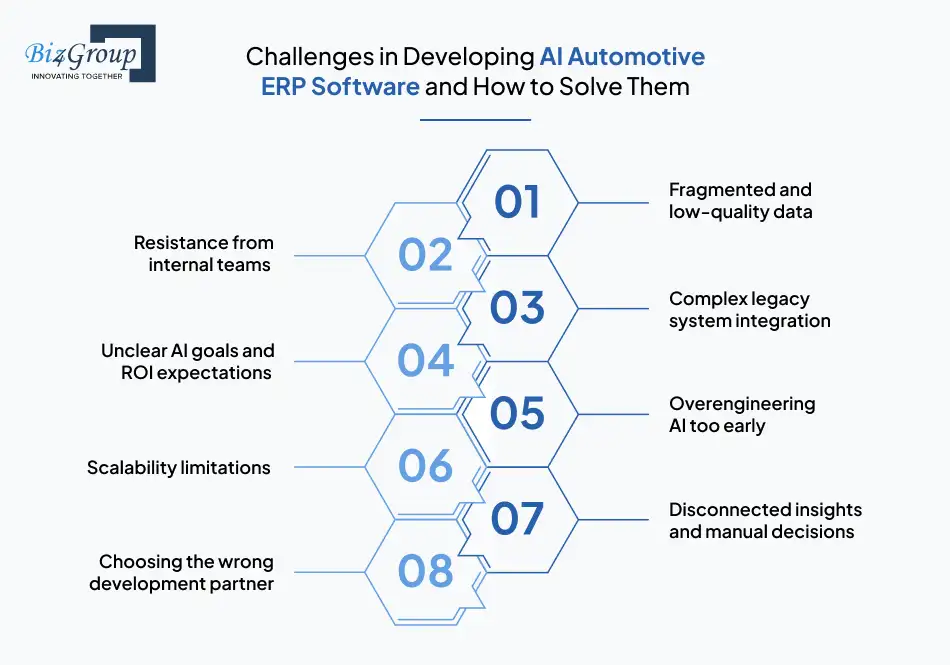
When enterprises set out to develop an AI automotive ERP software, challenges usually appear around data readiness, adoption, scalability, and execution clarity. Addressing these early helps teams build AI automotive ERP solutions that deliver measurable value instead of operational friction.
|
Challenge |
Why It Happens in AI Automotive ERP Projects |
How to Solve It Effectively |
|---|---|---|
|
Fragmented and low-quality data |
Automotive data lives across manufacturing, dealerships, suppliers, and finance, making AI automotive ERP software development difficult |
Create a unified data foundation before adding intelligence so you can develop AI-powered automotive ERP systems with reliable insights |
|
Resistance from internal teams |
ERP changes daily workflows and creates fear of disruption |
Design role-based workflows and training plans so teams clearly see how AI automotive ERP solutions for large and mid-sized auto enterprises improve their work |
|
Complex legacy system integration |
Most enterprises already rely on older ERP and operational tools |
Use modular architecture to create automotive ERP software with AI without breaking existing systems |
|
Unclear AI goals and ROI expectations |
AI is added without clear business outcomes |
Start with focused objectives like forecasting accuracy or cost control to justify the ROI of AI automotive ERP systems |
|
Overengineering AI too early |
Teams try to apply intelligence across all modules at once |
Roll out intelligence in phases to develop intelligent automotive ERP platforms that mature with data availability |
|
Scalability limitations |
Systems are built only for current plants or dealer networks |
Design flexible architecture to create scalable AI automotive ERP platforms that support future growth |
|
Disconnected insights and manual decisions |
Data insights exist but actions remain manual |
Coordinate insights and actions using agentic AI development so ERP modules work together instead of in silos |
|
Choosing the wrong development partner |
Automotive ERP requires both AI and industry expertise |
Compare experience and delivery approach when selecting from the top AI automotive software development companies in USA |
Solving these challenges the right way allows you to develop AI-powered ERP software for automotive business growth while keeping systems flexible, teams aligned, and long-term costs under control.
Why Choose Biz4Group LLC to Develop an AI Automotive ERP Software
When you decide to develop an AI automotive ERP software, the partner you choose directly impacts adoption, scalability, and long-term ROI. At Biz4Group, we focus on building systems that go beyond basic automation and truly support automotive business growth.
We bring hands-on experience across manufacturing, dealership operations, supply chains, and enterprise platforms. This allows us to build AI automotive ERP solutions that match real operational workflows. Our approach to custom AI automotive ERP development ensures the platform fits your processes instead of forcing teams to change how they work.
Our team takes end-to-end ownership of AI automotive ERP software development, from strategy and architecture to deployment and optimization. Clients trust our proven enterprise AI solutions to help them develop intelligent automotive ERP platforms that remain flexible, secure, and scalable as operations expand.
Integration is another critical strength. Through our expertise in AI integration services, we help enterprises create scalable AI automotive ERP platforms that connect smoothly with legacy ERP systems, manufacturing tools, dealer software, and analytics platforms.
Most importantly, we take a business-first view of AI. Every feature is tied to measurable outcomes such as better forecasting, stronger cost control, and clearer visibility. This ensures your investment to develop AI-powered automotive ERP systems delivers real results, not unused complexity.
If you are evaluating the best company to develop AI automotive ERP software, Biz4Group brings the right balance of automotive domain knowledge, enterprise engineering, and applied AI expertise to support long-term success.
Looking for a partner who actually understands automotive ERP and AI?
Let's build an AI automotive ERP that your teams trust, adopt, and rely on every day.
Get in TouchWrapping Up!
Choosing to develop an AI automotive ERP software is no longer just a technology decision. It is a business move that shapes how efficiently your automotive enterprise operates, adapts, and grows. From manufacturing and supply chain coordination to dealership performance and financial control, AI-powered ERP creates clarity where complexity once slowed decisions.
The difference between success and frustration comes down to execution. When ERP is built with a clear strategy, the right features, and practical AI intelligence, it becomes a system your teams rely on daily, not avoid. That is where experience matters.
Biz4Group brings proven expertise in AI automotive ERP software development, enterprise-scale systems, and real-world automotive workflows. Our focus stays on building platforms that deliver measurable outcomes, scale with your operations, and support long-term business growth.
FAQ
1. What is AI automotive ERP software and how is it different from traditional ERP?
AI automotive ERP software is an Enterprise Resource Planning system enhanced with artificial intelligence to support prediction, automation, and intelligent decision making. Traditional ERP systems record transactions and generate reports. AI driven systems analyze patterns, forecast outcomes, and surface risks early. This makes them far more effective for modern automotive operations.
2. How long does it take to develop an AI automotive ERP software?
The timeline to develop AI automotive ERP software typically ranges from 4 to 9 months. It depends on the number of ERP modules, depth of AI capabilities, integrations, and whether you start with an MVP or a full scale build. A phased approach often delivers faster value with lower risk.
3. What is the cost to develop AI automotive ERP software?
The cost to develop AI automotive ERP software usually falls between $40,000 to $300,000+. The final cost depends on customization level, AI features, data readiness, and integration complexity. Manufacturing focused platforms with predictive maintenance and analytics typically sit at the higher end of the range.
4. What are the main benefits of developing AI powered automotive ERP systems?
When you develop AI powered automotive ERP systems, you gain better demand forecasting, real time operational visibility, reduced downtime, lower costs, and stronger financial control. AI also improves supply chain resilience and helps leadership teams make faster, more confident decisions using reliable data.
5. Can AI automotive ERP solutions integrate with existing systems?
Yes. Most enterprises build AI automotive ERP solutions to work alongside existing ERP, CRM, manufacturing, and dealer systems. With the right architecture, AI powered ERP platforms integrate smoothly without disrupting ongoing operations, which is critical for large and mid sized auto enterprises.
6. Is AI automotive ERP suitable for both manufacturers and dealerships?
Absolutely. AI automotive ERP solutions for large and mid sized auto enterprises are designed to support manufacturers, dealership groups, suppliers, and service networks. The modules and intelligence layers can be tailored to fit production planning, dealer performance tracking, after-sales service, and financial operations.
7. How do I choose the best company to develop AI automotive ERP software?
To select the best company to develop AI automotive ERP software, look for experience in automotive workflows, enterprise ERP systems, and applied AI. The right partner should offer end-to-end ownership, strong integration capabilities, and a business first approach that focuses on ROI instead of experimental features.
