 Location :
Orlando, FL, USA
Location :
Orlando, FL, USA +1 (407) 714-1616
 info@biz4group.com

- AI automotive diagnostic and repair app development helps auto businesses reduce repeat inspections and improve first time fix rates across business structure.
- Auto businesses use AI to develop intelligent automotive diagnostic systems to analyze vehicle data, symptoms, and repair history to deliver faster, more consistent services.
- The automotive diagnostics and AI in automotive segments are growing rapidly as connected vehicles become standard across the industry.
- Cost typically ranges between $30,000 and $200,000+, depending on whether you build an MVP, mid-level production app, or an enterprise platform.
- Businesses can build AI vehicle diagnostic and repair tools in phases, starting with core diagnostics and expanding into predictive insights over time.
- Long term success depends on execution. Teams that create AI automotive repair software aligned with real workshop workflows see better adoption, ROI, and scalability.
Every auto business knows this moment. A vehicle comes in with a complaint that sounds familiar, but the root cause hides deeper than expected. Technicians scan codes, test components, explain delays to customers, and hope the fix sticks the first time. That growing gap between modern vehicles and traditional diagnostics is exactly why AI automotive diagnostic and repair app development is a must-have.
It has got every business leader in the industry diving into AI search engines like Grok and ChatGPT, putting in queries such as:
- AI automotive diagnostic app development
- can AI diagnose car problems from symptoms
- AI app for vehicle repair guidance
- how to build AI car diagnostic software
- AI based automotive repair assistant app
The market signals are hard to ignore:
- Statista estimates that global automotive intelligence market is going to reach the size of approx 74.5 billion U.S. dollars by 2030.
For many auto businesses, real frustration is not a lack of tools, but a lack of clarity. Technicians juggle disconnected systems, managers rely on gut instinct, and customers want answers faster than ever. This is where AI automotive diagnostic app development starts to feel like a relief, because it replaces all the guesswork.
If you're someone who owns a repair shop, dealership, or happen to be a fleet operator, this shift is not about chasing trends. When you develop AI automotive repair applications, you move from reactive troubleshooting to data driven decisions that shorten repair cycles, improve customer trust, and support long term scalability.
For those exploring solutions built by the top AI development companies in Florida or evaluating whether AI fits their service model, this guide will explain how these systems work and what it takes to build them right.
What Is an AI Automotive Diagnostic and Repair App?
AI automotive diagnostic and repair app development refers to building intelligent software that analyzes vehicle data to identify issues, recommend fixes, and guide repair decisions faster than traditional diagnostic approaches used in auto service operations.
- Uses live data from OBD systems, sensors, and vehicle ECUs
- Applies machine learning to connect symptoms with root causes
- Helps technicians diagnose problems with more confidence
- Supports faster workflows through AI automotive diagnostic app development
- Integrates seamlessly with existing systems using AI integration services
At its core, the development of AI automotive diagnostic and repair app turns raw vehicle data into actionable insights that technicians and service managers can actually rely on.
How AI Automotive Diagnostic and Repair Apps Work?
AI automotive diagnostic and repair app development blends live vehicle data with intelligent systems that learn from real outcomes, not assumptions. It converts raw signals into practical guidance, which brings us to how the process actually works on the ground.
1. Vehicle Data Collection and Normalization
Vehicle data is captured from OBD systems, ECUs, and onboard sensors and then standardized across different makes and models. This step ensures consistency in diagnostics. Many teams leverage business app development using AI to connect vehicle data streams reliably.
2. Symptom Mapping and Fault Correlation
The app analyzes reported symptoms by comparing them with historical repair data and known failure patterns. AI model development plays a key role in identifying meaningful correlations. This allows technicians to move from symptom guessing to cause driven diagnosis.
3. Predictive Diagnostics and Repair Guidance
Instead of reacting after failures occur, the system predicts likely issues based on usage patterns and early indicators. Repair actions are ranked by probability and urgency. This significantly reduces diagnosis time and unnecessary part replacements.
4. Continuous Learning from Repair Outcomes
Each completed repair feeds new information back into the system to refine future predictions. Accuracy improves as more vehicles are diagnosed over time. This feedback loop is critical when building an AI automotive diagnostic and repair app that scales reliably.
| Stage | What Happens | Business Impact |
|---|---|---|
|
Data Intake |
Vehicle data captured and standardized |
Faster diagnostics |
|
AI Analysis |
Fault patterns and predictions generated |
Higher accuracy |
|
Repair Guidance |
Recommended fixes prioritized |
Reduced service time |
|
Learning Loop |
System improves from outcomes |
Long term efficiency |
Once this workflow is in place, businesses start to see why many teams choose to build AI powered car diagnostic apps as a foundation for smarter, more efficient service operations.
Still Diagnosing the Old Way?
See how AI automotive diagnostic and repair app development replaces guesswork with real vehicle intelligence.
Explore AI DiagnosticsAI Automotive Diagnostics vs Traditional Vehicle Inspection
AI automotive diagnostic and repair app development is changing how vehicle issues are identified, validated, and resolved. Traditional inspections still have their place, but modern AI driven diagnostics reshape speed, accuracy, and decision making, which becomes clearer when you compare both approaches side by side.
| Aspect | Traditional Vehicle Inspection | AI Automotive Diagnostics |
|---|---|---|
|
Diagnostic Approach |
Manual checks and rule based scanning |
Data driven analysis using historical and real time inputs |
|
Speed of Diagnosis |
Time consuming and technician dependent |
Faster insights generated within minutes |
|
Accuracy |
Varies based on experience and assumptions |
Improves continuously as data accumulates |
|
Predictive Capability |
Mostly reactive after failure occurs |
Predicts issues before breakdowns |
|
Scalability |
Hard to standardize across locations |
Easily scales across fleets and service centers |
|
Data Utilization |
Limited to current vehicle state |
Learns from large datasets and enterprise AI solutions |
For auto businesses, this comparison highlights a clear shift in expectations. When you create AI automotive repair software, diagnostics stop being reactive checkpoints and start becoming proactive service intelligence.
Now let's find out what's making businesses across the world invest in this cutting-edge technology.
Why Businesses are Investing in AI Automotive Diagnostic App Development?
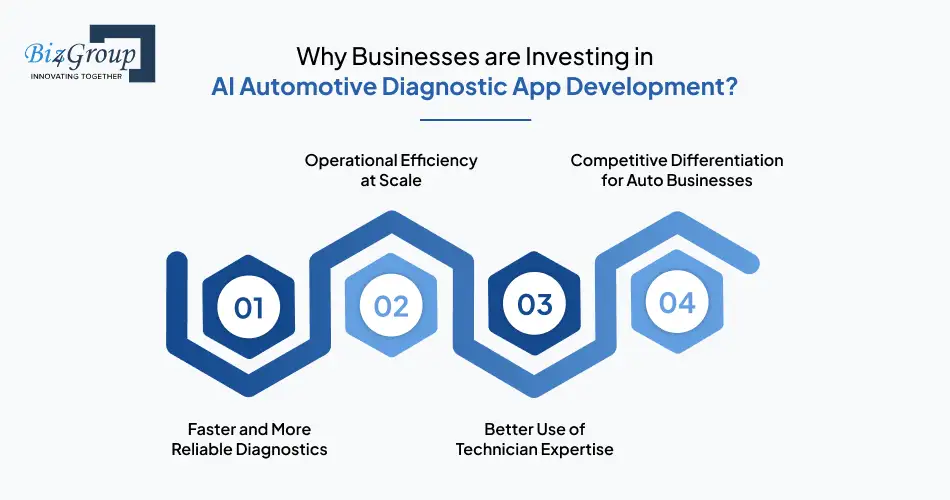
AI automotive diagnostic and repair app development is gaining momentum because auto businesses need faster answers, better accuracy, and scalable service models. What once felt optional now feels practical, especially when you look at the operational pressure points below:
1. Faster and More Reliable Diagnostics
Traditional diagnostics slow down when symptoms are unclear or intermittent. With automotive diagnostic software development with AI, systems analyze patterns instantly instead of relying only on manual checks. This helps shops reduce idle time and improve first time fix rates.
2. Operational Efficiency at Scale
As vehicle volumes grow, consistency becomes harder to maintain. When businesses build AI vehicle diagnostic and repair tools, workflows become standardized across technicians and locations. That consistency directly impacts service turnaround time and customer satisfaction.
3. Better Use of Technician Expertise
AI does not replace skilled technicians, it supports them. Insights surface faster, letting teams focus on complex decisions instead of repetitive troubleshooting. Many businesses lean on AI consulting services to ensure these systems align with real workshop processes.
4. Competitive Differentiation for Auto Businesses
Customers now expect transparency and speed from service providers. Investing in custom AI automotive app development helps businesses offer clearer diagnostics and smarter repair guidance. That difference is often what keeps customers coming back.
As these benefits stack up, it becomes easier to see why leaders choose to build AI vehicle diagnostic and repair tools as a foundation for growth, which naturally brings us to how these solutions are being applied in real world use cases.
Wondering How Smart Diagnostics Actually Work?
Learn how auto businesses develop intelligent automotive diagnostic systems that technicians trust on the shop floor.
See How AI Diagnostics WorkReal World Use Cases for AI Automotive Diagnostic App Solutions
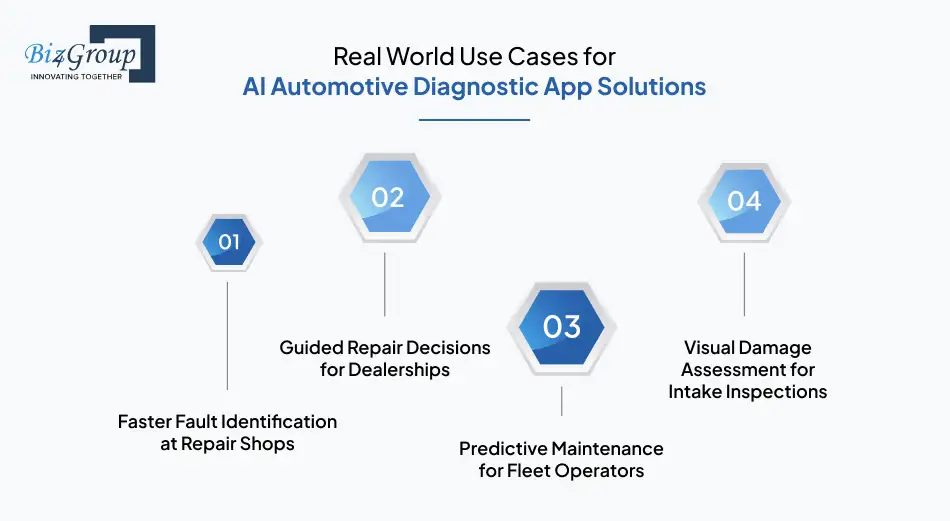
AI automotive diagnostic and repair app development comes alive when it solves everyday problems inside workshops, dealerships, and fleet operations. These apps are not theoretical tools. They are built to handle real vehicles, real timelines, and real customer expectations, which is best understood through the use cases below:
1. Faster Fault Identification at Repair Shops
Repair shops use AI to analyze symptoms, fault codes, and historical repair data in one place. This helps develop intelligent automotive diagnostic systems that shorten diagnosis cycles. Technicians spend less time testing and more time fixing.
- Example: A mid-sized workshop reduced repeat inspections by using AI to pinpoint root causes on the first scan, especially for intermittent engine issues.
2. Guided Repair Decisions for Dealerships
Dealerships rely on structured repair guidance to maintain service consistency across teams. By choosing to create AI-driven auto repair applications, service advisors receive clear recommendations tied to actual vehicle data. Many teams also integrate AI into an app to connect diagnostics directly with service intake and customer communication.
- Example: A dealership service center used AI guided diagnostics to explain repair urgency during vehicle intake, which increased approval rates without pressure selling.
3. Predictive Maintenance for Fleet Operators
Fleet managers need visibility before breakdowns disrupt operations. AI vehicle repair app development enables predictive alerts based on usage patterns and early warning signals. Maintenance becomes planned instead of reactive.
- Example: A delivery fleet flagged transmission issues days in advance, avoiding roadside failures and missed delivery schedules.
4. Visual Damage Assessment for Intake Inspections
Some businesses use AI to assess visible damage during inspections. This approach complements diagnostics and speeds up service intake decisions, which is exactly what AI vehicle damage detection software development is all about.
- Example: A service center used image-based analysis to document exterior damage before diagnostics began, reducing disputes and saving inspection time.
| Use Case | Primary User | Business Outcome |
|---|---|---|
|
Fault Diagnosis |
Repair Shops |
Faster first time fixes |
|
Repair Guidance |
Dealerships |
Higher service approval |
|
Predictive Maintenance |
Fleet Operators |
Reduced downtime |
|
Visual Inspection |
Service Centers |
Quicker vehicle intake |
As more businesses create AI driven vehicle repair app for auto businesses, these use cases naturally expand into feature expectations, which makes it important to understand what capabilities these apps must include at a minimum.
Core Features in AI Automotive Diagnostic and Repair App Development
AI automotive diagnostic and repair app development succeeds when the basics are done right. These core features form the operational backbone of any reliable diagnostic platform and set expectations for accuracy, speed, and usability, which becomes clearer when you look at them closely.
| Core Feature | What It Does | Why It Matters |
|---|---|---|
|
OBD and ECU Data Ingestion |
Collects live and historical vehicle data from onboard systems |
Ensures diagnostics are based on real signals |
|
Fault Code Interpretation |
Translates raw fault codes into understandable issues |
Reduces manual lookup and confusion |
|
Symptom Based Diagnosis |
Links driver complaints with probable root causes |
Improves first time fix accuracy |
|
Flags early warning signs before failures occur |
Prevents breakdowns and downtime |
|
|
Repair Recommendation Engine |
Suggests likely fixes ranked by probability |
Saves technician time and effort |
|
Vehicle History Tracking |
Maintains a complete service and diagnostic record |
Supports consistent long term decisions |
|
Technician Workflow Support |
Guides step by step diagnostic processes |
Standardizes service quality |
|
Customer Friendly Reports |
Converts diagnostics into clear explanations |
Builds trust and transparency |
|
Conversational Assistance |
Uses a conversational AI agent to answer diagnostic questions |
Speeds up understanding at intake |
|
Multi Vehicle Compatibility |
Works across models, makes, and years |
Enables scalable deployment |
Biz4Group developed an advanced IoT based car sharing and parking solution that enables real-time vehicle access, smart parking discovery, and usage tracking through connected sensors and mobile workflows. Platforms like this generate continuous vehicle health and usage data, which becomes highly valuable when layered into AI automotive diagnostic and repair app development for proactive maintenance and smarter service decisions.
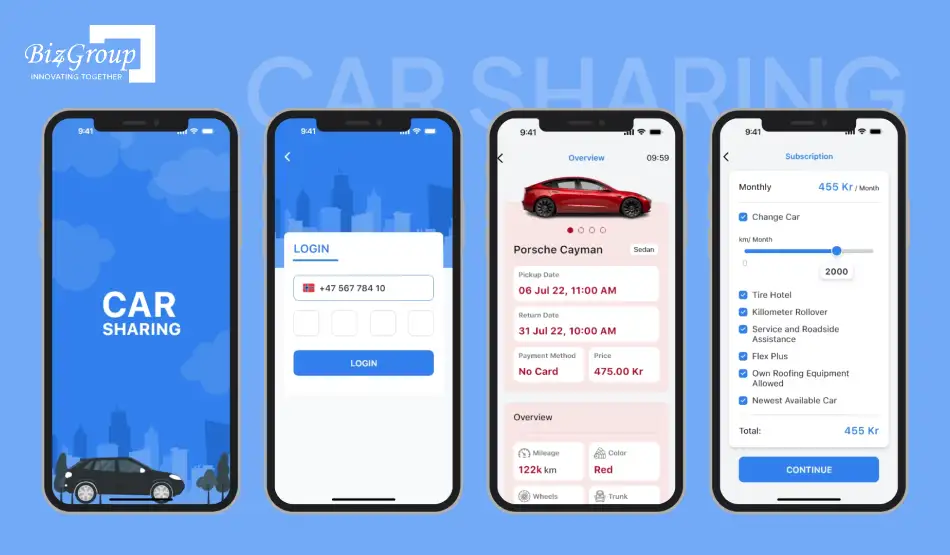
When these features are implemented well, businesses can develop scalable AI automotive repair application foundations that are ready to support more advanced capabilities, which is where AI driven enhancements start to come into play next.
Advanced Features in AI Automotive Diagnostic App Development
AI automotive diagnostic and repair app development moves into advanced territory when systems start anticipating. These capabilities push diagnostics beyond basic accuracy and into strategic intelligence, which becomes clearer when you look at what separates modern platforms from traditional ones.
1. Predictive Failure Modeling at System Level
Advanced models analyze long term usage, driving patterns, and environmental data together. This helps develop AI powered automotive diagnostic solutions that forecast failures weeks in advance. The result is fewer surprises and better maintenance planning.
2. Adaptive Learning Across Vehicle Populations
The system learns from every completed repair across similar vehicles. Insights improve continuously as datasets grow. This is where generative AI helps surface patterns humans would miss.
3. Fleet Wide Intelligence and Optimization
For large operations, diagnostics shift from individual vehicles to the entire fleet. Apps can create AI automotive repair app development for fleet management by spotting trends that affect cost, uptime, and scheduling. Decisions become data driven instead of reactive.
4. Context Aware Diagnostic Explanations
Advanced apps explain findings differently for technicians, managers, and customers. Insights adapt based on role and context. Many teams design this layer as part of broader product development services to improve adoption.
5. Benchmarking Against Traditional Inspection Models
These systems continuously measure performance improvements using AI automotive diagnostics vs traditional vehicle inspection metrics. Businesses see tangible gains in speed, accuracy, and consistency. That comparison helps justify deeper investment.
Once these advanced capabilities are in place, attention naturally turns to how such systems are actually built, which brings the development process into focus next.
Step by Step Process for Building an AI Automotive Diagnostic and Repair App
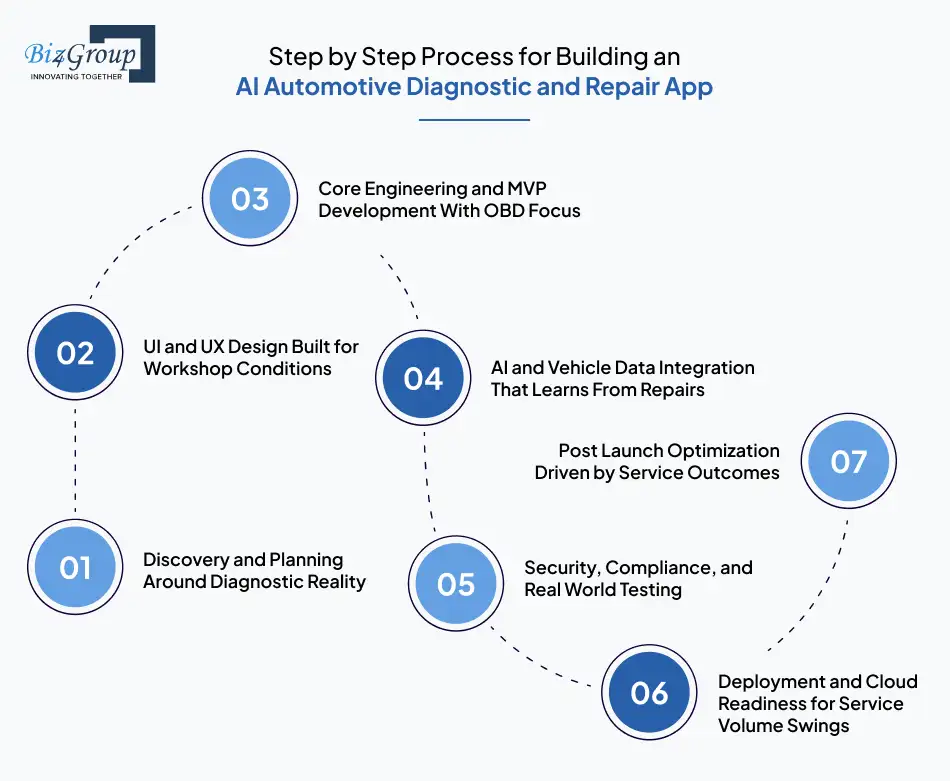
AI automotive diagnostic and repair app development succeeds when auto businesses design around real service bay challenges rather than abstract AI ideas. From inconsistent fault diagnosis to delayed repairs, this process focuses on building systems that technicians, managers, and customers can actually rely on.
1. Discovery and Planning Around Diagnostic Reality
The starting point is identifying where diagnostics break down in daily operations. For many shops and dealerships, the issue is not lack of tools, but fragmented insights and inconsistent outcomes across technicians.
- Study vehicle intake, inspection, and diagnosis flows in live environments
- Identify gaps where AI automotive diagnostic app solutions for repair shops and dealerships can reduce manual effort
- Validate access to OBD data, historical repair logs, and service records
Define KPIs like reduced diagnosis time, improved first visit resolution, and fewer repeat jobs
2. UI and UX Design Built for Workshop Conditions
Auto technicians work under time pressure, noise, and physical constraints. If the app slows them down, it gets ignored. The UI/UX design company that you partner with, must support fast decisions and minimal friction.
- Design interfaces optimized for tablets and hands on usage
- Align screens with steps like scanning, diagnosis, and repair validation
- Reduce typing and navigation during inspections
- Test usability with technicians and service advisors.
Strong UI and UX design often determines whether AI automotive diagnostic app development succeeds beyond pilot stage
Also read: Top UI/UX design companies in USA
3. Core Engineering and MVP Development With OBD Focus
Launching everything at once delays value. Auto businesses benefit from MVP development services that solves one diagnostic problem deeply before expanding. Start with AI automotive repair app development with OBD integration to ensure accurate vehicle data capture
- Implement fault code interpretation and symptom correlation
- Ensure real time performance during active diagnostics
- Design backend architecture for future scalability
- Structured MVP development helps validate diagnostic accuracy early
Also read: Top 12+ MVP Development Companies to Launch Your Startup in 2026
4. AI and Vehicle Data Integration That Learns From Repairs
Diagnostics improve when AI learns from confirmed outcomes, not assumptions. This phase focuses on turning completed repairs into smarter predictions.
- Train AI models using real repair resolutions and service outcomes
- Balance pre trained models with custom automotive logic
- Create feedback loops after each confirmed fix
- Continuously refine predictions as vehicle models evolve
This stage defines the long-term quality of the development of AI automotive diagnostic and repair app.
5. Security, Compliance, and Real World Testing
Vehicle diagnostics involve customer data, VINs, and service history. Trust depends on how well this data is protected and validated.
- Apply data protection controls across regions
- Stress test the app during peak service hours
- Simulate real diagnostic edge cases
- Maintain clear access logs and permissions
Also Read: Software Testing Companies in USA
6. Deployment and Cloud Readiness for Service Volume Swings
Service demand fluctuates with seasons, recalls, and fleet schedules. Deployment must support reliability without disruption.
- Use cloud infrastructure that scales with vehicle volume
- Enable continuous updates without halting operations
- Monitor diagnostic accuracy and system health
- Provide onboarding for technicians and managers
7. Post Launch Optimization Driven by Service Outcomes
The strongest platforms evolve with vehicle technology and service expectations. Continuous improvement keeps diagnostics relevant and profitable.
- Collect technician feedback after every diagnostic cycle
- Expand capabilities as confidence in predictions grows
- Retrain models using fresh service data
- Measure ROI through efficiency gains and customer satisfaction
As businesses mature their approach to diagnostics, many look for the best company to develop AI automotive diagnostic app solutions that can support scale, reliability, and long-term innovation, which leads us to one of the most important aspects – the technology stack required.
Thinking About Building, Not Just Reading?
Understand what it takes to build AI vehicle diagnostic and repair tools that scale without breaking operations.
Plan My BuildIdeal Tech Stack for AI Automotive Diagnostic and Repair App Development
A diagnostic app lives or dies by how well its components talk to each other, vehicles, and existing business systems. This stack covers all critical layers needed for production grade automotive diagnostics:
| Label | Preferred Technologies | Why It Matters |
|---|---|---|
|
Frontend Framework |
ReactJS, VueJS |
Technicians need fast, distraction free interfaces during diagnostics. ReactJS development supports highly responsive UIs, while VueJS keeps complex diagnostic views clean and usable. |
|
Server-Side Rendering & SEO |
NextJS, NuxtJS |
Service dashboards and reporting portals load faster and scale better. NextJS development helps balance performance with structured access for managers and service teams. |
|
Backend Framework |
NodeJS, Python |
NodeJS development manages concurrent data streams, while Python development powers diagnostic intelligence and data processing. |
|
API Development & Integration |
REST APIs, GraphQL |
APIs connect vehicle data, mobile apps, service tools, and third party systems. Well designed APIs make diagnostics reusable across workshops and platforms. |
|
AI & Data Processing |
TensorFlow, PyTorch |
These frameworks support predictive diagnostics and continuous learning from real repair outcomes as vehicle systems evolve. |
|
OBD and Vehicle Data Layer |
OBD II APIs, CAN bus interfaces |
Accurate diagnostics depend on stable access to vehicle signals. This layer ensures fault codes and sensor data flow without delay or corruption. |
|
Database and Storage |
PostgreSQL, MongoDB, Time series databases |
Diagnostic apps manage structured service data and high frequency sensor logs, both of which need efficient storage and retrieval. |
|
Cloud Infrastructure |
AWS, Azure |
Cloud platforms support peak service loads, fleet wide diagnostics, and future feature expansion without downtime. |
|
Security and Compliance |
OAuth 2.0, Role based access control |
Protects customer data, VINs, and diagnostic records while enforcing technician and manager level permissions. |
|
Monitoring & Observability |
Prometheus, CloudWatch |
Continuous monitoring helps detect performance issues in diagnostics before they impact service operations. |
When these technology layers are aligned, decision makers gain clarity on build scope, scalability, and performance expectations. This foundation makes cost planning far more accurate and sets the stage for evaluating investment levels across MVP, mid-scale, and enterprise AI automotive diagnostic and repair app development builds.
What's the Cost to Build AI Vehicle Diagnostic and Repair Tools?
AI automotive diagnostic and repair app development typically falls in the $30,000 to $200,000+ range, depending on scope, data complexity, and scale. This is a ballpark figure, not a fixed price, because diagnostic depth, AI maturity, and deployment size change the effort significantly.
| Build Level | Estimated Cost Range | What's Included | Best Fit For |
|---|---|---|---|
|
MVP Diagnostic App |
$30,000 to $60,000 |
OBD data ingestion, basic fault code interpretation, limited AI logic, simple dashboards |
Small repair shops testing AI driven diagnostics |
|
Mid-Level Production App |
$60,000 to $120,000 |
Advanced symptom analysis, predictive alerts, technician workflows, secure APIs |
Growing repair shops and dealership service centers |
|
Enterprise-Grade Platform |
$120,000 to $200,000+ |
Fleet scale diagnostics, continuous learning models, integrations, compliance and monitoring |
Large dealerships and fleet operators |
|
AI Model Training and Tuning |
Included or Add on |
Model refinement using real repair outcomes |
Businesses seeking higher diagnostic accuracy |
|
Ongoing Maintenance and Optimization |
Annual allocation |
Model retraining, performance tuning, feature updates |
Long term operational stability |
Several factors influence where your project lands in this range. Vehicle data diversity, OBD integration depth, AI model complexity, and security requirements all matter. Teams that hire AI developers with automotive experience often reduce rework and hidden costs during later stages.
For most businesses, the goal is not to overspend upfront, but to invest wisely based on real service needs. When teams build AI-powered car diagnostic apps in phases, they gain flexibility to monetize, scale, and refine features over time, which naturally opens the door to exploring revenue opportunities next.
Numbers Matter. So Does ROI.
See how businesses create AI automotive repair software that pays for itself over time.
Estimate Cost & ROIRevenue Opportunities in AI Vehicle Repair App Development
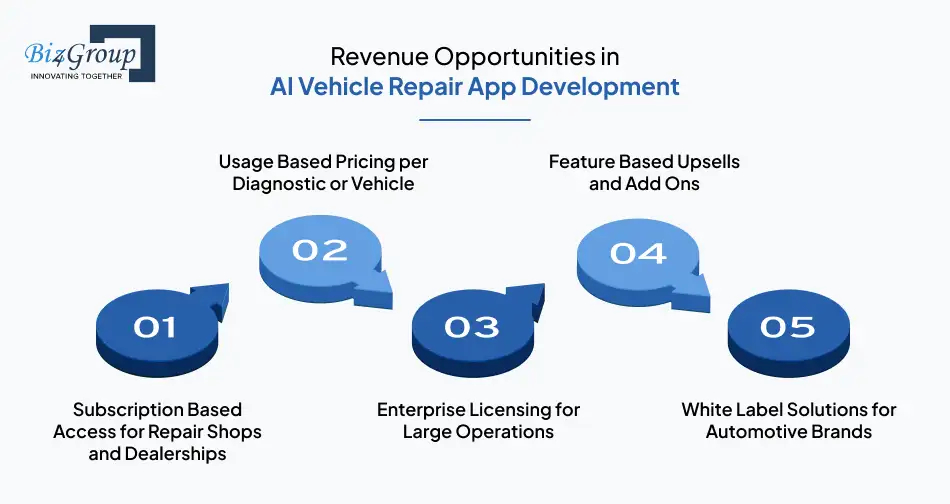
AI automotive diagnostic and repair app development opens up multiple revenue paths beyond one time software fees. When diagnostics become smarter and faster, businesses can monetize insights, access, and efficiency in ways that align naturally with how auto services already operate.
1. Subscription Based Access for Repair Shops and Dealerships
Many businesses prefer predictable monthly pricing instead of upfront costs. Subscription models work well when you create AI automotive repair software that delivers ongoing diagnostic accuracy, updates, and support. This approach often pairs well with AI automation services that reduce manual diagnostic effort over time.
- Example: A multi-location service chain pays a monthly fee per workshop to access diagnostics, reports, and predictive alerts.
2. Usage Based Pricing per Diagnostic or Vehicle
Some businesses prefer paying only when value is delivered. This model fits platforms built through automotive diagnostic software development with AI, where each scan or diagnosis carries measurable benefit. It also lowers entry barriers for smaller shops.
- Example: An independent garage pays per completed diagnostic scan during peak service months instead of committing year round.
3. Enterprise Licensing for Large Operations
Larger dealerships and fleets often want full platform ownership and deeper customization. Licensing models work best when businesses build AI vehicle diagnostic and repair tools designed for scale, integration, and long term use.
- Example: A fleet operator licenses the platform annually to run diagnostics across hundreds of vehicles with centralized reporting.
4. Feature Based Upsells and Add Ons
Advanced capabilities can be monetized separately once core diagnostics are in place. This is common in custom AI automotive app development, where different users value different features. In some cases, generative AI agents power advanced insights and recommendations as premium add ons.
- Example: A dealership unlocks advanced reporting modules after seeing strong ROI from core diagnostics.
5. White Label Solutions for Automotive Brands
Some companies package diagnostics as their own branded offering. This approach appeals to businesses exploring AI automotive dealership management software development as part of a broader digital ecosystem.
- Example: A regional automotive brand launches a branded diagnostic app powered by the same underlying platform.
Across these models, successful platforms focus on flexibility rather than forcing a single pricing structure. As more businesses create AI automotive repair software tailored to their operations, the conversation shifts to the challenges involved in building and scaling these systems reliably.
Challenges in AI Automotive Diagnostic App Development and Solutions
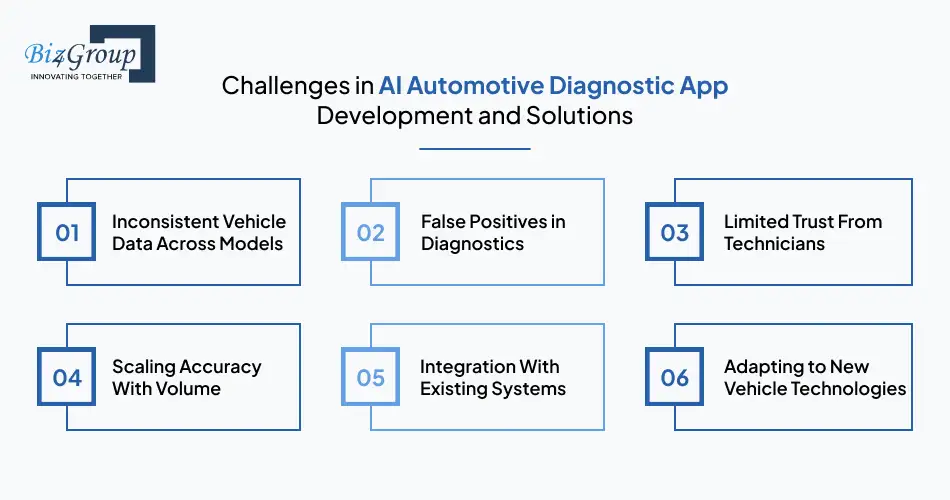
AI automotive diagnostic and repair app development comes with clear rewards, but the road to reliable diagnostics is not always smooth. Most challenges surface only after real vehicles, real data, and real technicians enter the picture, which is why it helps to address them head on.
| Top Challenges | How to Solve Them |
|---|---|
|
Inconsistent Vehicle Data Across Models |
Normalize OBD and ECU data early and validate it across multiple vehicle makes to avoid misinterpretation. |
|
False Positives in Diagnostics |
Train models using verified repair outcomes and continuously refine logic instead of relying only on fault codes. |
|
Limited Trust From Technicians |
Pair AI insights with explainable outputs so technicians understand why a diagnosis is suggested. |
|
Scaling Accuracy With Volume |
Introduce controlled learning cycles so predictions improve as more vehicles are diagnosed, especially when using generative AI responsibly. |
|
Integration With Existing Systems |
Design APIs that connect diagnostics with service management and inventory tools without disrupting workflows. |
|
Adapting to New Vehicle Technologies |
Update models regularly as vehicle electronics, sensors, and architectures evolve. |
When these hurdles are handled thoughtfully, teams are better positioned to develop intelligent automotive diagnostic systems that technicians trust and businesses can scale confidently.
Avoid the Costly Mistakes Others Make
Learn how teams succeed with AI automotive diagnostic app development by getting execution right the first time.
Talk Through the RisksBest Practices for AI Automotive Diagnostic and Repair App Development
AI automotive diagnostic and repair app development delivers consistent results only when best practices reflect real workshop behavior and vehicle data realities. These principles help teams avoid common pitfalls and build systems that earn long term trust, which becomes clearer in the practices below.
1. Design Around Technician Workflows
Successful diagnostic apps mirror how technicians actually inspect, scan, and repair vehicles under time pressure. Interfaces should reduce cognitive load and guide actions logically. This practical alignment matters more than adding complex features.
2. Prioritize Explainable Diagnostics
Technicians are more likely to trust AI when they understand why a recommendation appears. Showing symptom links, data points, and historical context makes insights usable. This transparency reduces resistance and improves adoption.
3. Build Continuous Learning into the System
Every completed repair is an opportunity to improve future diagnostics. Feedback loops should be planned from the start so models evolve naturally. This is essential to develop intelligent automotive diagnostic systems that stay accurate over time.
4. Use Conversational Assistance with Restraint
Chat based features should support diagnostics, not distract from them. An AI conversation app works best when it answers focused questions and clarifies next steps. Overuse can slow technicians instead of helping them.
5. Validate Under Real Service Conditions
Testing must happen during peak hours with real vehicles and mixed data quality. Insights gathered here outperform lab benchmarks. Many teams collaborate with a software development company in Florida experienced in automotive environments to shorten this learning curve.
When these practices are followed consistently, diagnostic platforms remain reliable as vehicles and expectations evolve, naturally shifting attention toward future trends shaping AI driven automotive diagnostics.
Future Trends in AI Powered Automotive Diagnostic Solutions
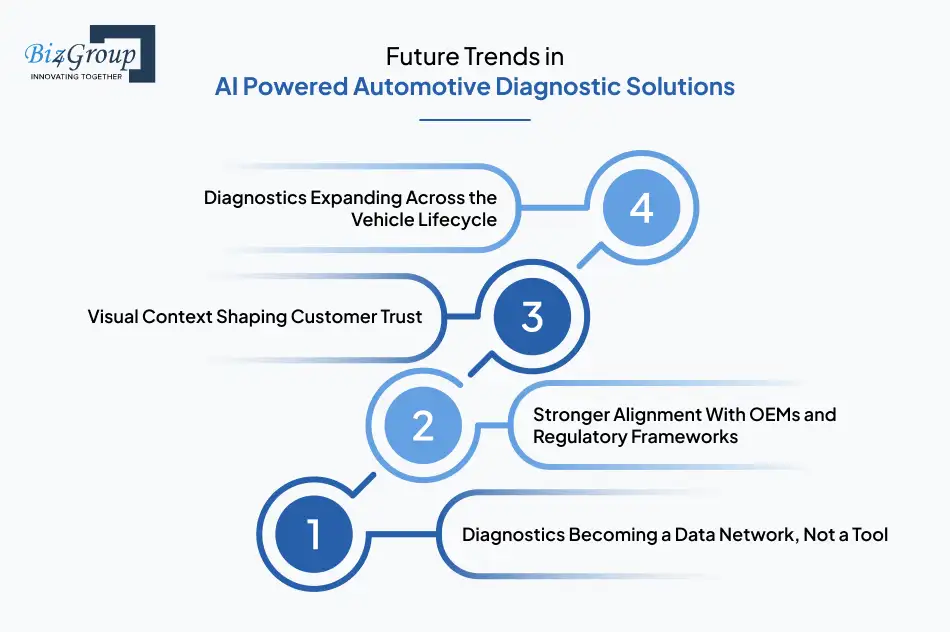
AI automotive diagnostic and repair app development is entering a phase where technology decisions are shaped as much by industry shifts as by innovation. The future is less about adding features and more about how diagnostics fit into the broader automotive ecosystem.
1. Diagnostics Becoming a Data Network, Not a Tool
Future platforms will connect insights across vehicles, locations, and service partners. Data sharing will move beyond single shops into wider networks. This will redefine how businesses approach AI vehicle repair app development at scale.
2. Stronger Alignment With OEMs and Regulatory Frameworks
As vehicles become software defined, diagnostics will need closer alignment with OEM standards and compliance rules. Auto businesses will rely on trusted partners, often top AI development companies in Florida, to navigate evolving data access and regulatory expectations.
3. Visual Context Shaping Customer Trust
Customers will expect to see what is wrong, not just hear it explained. The next phase focuses on presentation and proof, where teams build visual AI agent experiences to support service transparency rather than technician workflows.
4. Diagnostics Expanding Across the Vehicle Lifecycle
AI-driven insights will influence more than repairs, from maintenance planning to adjacent services. Trends seen in AI car wash app development hint at diagnostics shaping decisions far beyond the repair bay.
As these shifts take hold, businesses aiming to create AI driven auto repair applications will need to think beyond features and focus on adaptability, partnerships, and long-term relevance, which naturally leads into choosing the right development partner next.
Why Choose Biz4Group for AI Automotive Diagnostic and Repair App Development?
Building an AI automotive diagnostic platform requires more than strong AI skills. It demands experience with real vehicle data, connected systems, and products that operate reliably at scale. Biz4Group brings that balance of engineering depth and automotive context.
We have built AI-driven automotive platforms that handle live vehicle interactions, usage tracking, and connected workflows. Our work on intelligent car sharing and parking solutions is a clear example. These platforms generate continuous vehicle and behavior data, which aligns naturally with the data foundations needed for diagnostic and repair intelligence.
What sets Biz4Group apart
- Proven experience delivering production ready automotive and mobility platforms
- Deep understanding of how vehicle data flows across apps, sensors, and services
- Strong capability in building scalable AI driven systems from MVP to enterprise
- A product first mindset focused on reliability, accuracy, and long term growth
As an AI development company, Biz4Group approaches automotive diagnostics with a practical lens. We focus on building systems that technicians trust, managers rely on, and businesses can scale with confidence.
If you are planning to move from experimentation to execution, partnering with a team that has already built real automotive platforms can make that transition far smoother.
Ready to Move From Idea to Execution?
Start your AI vehicle repair app development journey with clarity, not assumptions.
Launch My AI ProjectFinal Thoughts on AI Automotive Diagnostic and Repair App Development
Every auto business reaches a point where experience alone stops being enough. Vehicles get smarter, issues get subtler, and customers expect answers faster than ever. AI driven diagnostics step in quietly here, to remove the fog. Less second guessing. Fewer comebacks. Clear conversations at the service desk.
The real win is the confidence it creates across your operation. When diagnostics are consistent, data backed, and scalable, decisions get easier. That is where working with a custom software development company that understands both AI and automotive systems stops being a choice and starts feeling like common sense.
Planning to turn diagnostics into a competitive advantage? Reach out to our experts!
FAQs on AI Automotive Diagnostic and Repair App Development
1. Can AI automotive diagnostic apps work across different vehicle brands and models?
Yes, modern platforms are designed to handle multi brand data by normalizing inputs from different ECUs and OBD protocols. When businesses develop intelligent automotive diagnostic systems, they focus on adaptability so diagnostics remain accurate even as vehicle models and technologies vary.
2. Do AI diagnostic apps replace technicians or reduce the need for skilled labor?
No, these apps support technicians rather than replace them. AI highlights likely issues faster, while technicians apply judgment and expertise to confirm and repair. This is why AI automotive diagnostic app solutions for repair shops and dealerships are positioned as productivity tools, not workforce replacements.
3. How accurate are AI based vehicle diagnostics compared to manual inspection?
Accuracy improves over time as AI systems learn from confirmed repair outcomes. Unlike static tools, AI adapts to patterns across vehicles and environments. That learning curve is what makes AI automotive diagnostics vs traditional vehicle inspection a practical upgrade rather than a risky experiment.
4. Can small repair shops benefit from AI vehicle repair app development, or is it only for large fleets?
Small and mid sized shops often see faster ROI because AI reduces repeat inspections and diagnosis time. Scaled features can be added later. This flexibility makes AI vehicle repair app development viable even for businesses without enterprise budgets.
5. How long does it typically take to build an AI automotive diagnostic and repair app?
Timelines vary based on scope, integrations, and data readiness. MVP builds often take a few months, while advanced platforms take longer. Planning phases are critical when teams build AI vehicle diagnostic and repair tools that need to perform reliably in real workshops.
6. How much does it cost to develop an AI automotive diagnostic and repair app?
The cost usually ranges between $30,000 and $200,000+, depending on features, AI depth, and scale. This is a ballpark estimate, as complexity increases when teams create AI automotive repair software with predictive intelligence, integrations, and long term scalability.
