 Location :
Orlando, FL, USA
Location :
Orlando, FL, USA +1 (407) 714-1616
 info@biz4group.com

- AI clinical decision support system development helps hospitals turn complex data into real-time clinical decisions, improving accuracy and reducing errors.
- To develop AI clinical decision support software, you need the right mix of data integration, AI models, compliance (HIPAA, FDA), and clinical workflow alignment.
- High-impact use cases include diagnostics support, predictive analytics, treatment recommendations, and workflow optimization, driving better patient outcomes.
- The cost of AI clinical decision support software development ranges from $40,000 to $300,000+, depending on features, integrations, and scalability.
- Success depends on choosing the right approach to build AI-powered clinical decision support systems, addressing challenges early, and partnering with experts like Biz4Group for reliable development and deployment.
What if your clinical team is sitting on critical patient insights right now but missing them simply because your systems can't connect the dots fast enough?
That's the reality many healthcare organizations are facing today.
You're surrounded by patient records, diagnostics, imaging, and real-time data. But are your systems actually helping clinicians make faster, more accurate decisions when it matters most?
This is exactly why AI clinical decision support system development is becoming a priority across modern healthcare.
The urgency is real. According to a report, the global CDSS market have already surpassed $2.5 billion in 2025, driven by the need to reduce medical errors and improve care quality. At the same time, research shows that clinical decision support tools significantly improve diagnostic accuracy and treatment efficiency.
So, the real question is, are you using your data to its full potential or leaving critical decisions to chance?
Most healthcare systems today are built to store and organize information. But they don't guide real-time decisions. That gap is where AI clinical decision support software development is creating real impact.
If you're already exploring broader solutions like AI healthcare app initiatives, you'll notice that decision intelligence is quickly becoming the core layer that drives real clinical value.
If you're planning to develop AI clinical decision support software, you need to start with one thing first - a clear understanding of what you're actually building and why it matters now more than ever.
What Is an AI Clinical Decision Support System and Why Is It Mission-Critical for Hospitals Today?
An AI clinical decision support system is a software solution that analyzes patient data and provides evidence-based recommendations to assist clinicians in diagnosis, treatment planning, and risk prediction. It uses machine learning, clinical data, and medical knowledge to support decision-making at the point of care.
This is the foundation of AI clinical decision support system development.
Why is it critical for healthcare organizations today?
- Growing data volume across EHRs, imaging, labs, and devices makes manual analysis inefficient
- Rising pressure to reduce diagnostic errors and improve patient outcomes
- Increasing demand for faster clinical decisions without compromising accuracy
- Shortage of clinical staff and rising burnout levels
- Need for standardized, data-driven treatment recommendations across care teams
- Shift toward predictive and preventive healthcare models
Healthcare systems today manage data well but struggle to turn it into timely decisions. This is where AI clinical decision support software development plays a key role.
Organizations looking to develop AI clinical decision support software are focusing on systems that assist doctors in diagnostics and treatment recommendations while integrating with existing workflows.
For example, solutions like a clinical decision support app for mental health using AI show how targeted AI CDSS can improve early detection and clinical intervention in specific domains.
If these systems can turn complex patient data into clear clinical actions, how do they actually work behind the scenes?
Still guessing with your clinical data?
Your systems have the data, but are they helping you make the right decisions at the right time?
Talk to ExpertsHow Does an AI Clinical Decision Support System Work?

An AI CDSS processes large volumes of clinical data and turns them into actionable recommendations at the point of care. It connects data sources, applies AI models, and delivers insights directly within clinical workflows. This is how AI clinical decision support system development translates into real-world functionality.
1. Data Collection and Integration
The system gathers data from multiple sources such as EHRs, lab systems, imaging platforms, and medical devices. This data is often fragmented and needs to be unified before it can be used effectively. To build AI-powered clinical decision support systems, strong data integration is the first requirement.
- Integrate Electronic Health Records (EHR/EMR)
- Lab results and diagnostic reports
- Medical imaging data
- Wearables and remote monitoring devices
2. Data Processing and Standardization
Raw healthcare data is inconsistent and unstructured. The system cleans, normalizes, and formats this data into a usable structure for AI models. This step is critical in AI clinical decision support software development to ensure accuracy.
- Removing duplicates and errors
- Structuring unstructured clinical notes
- Standardizing formats using FHIR and HL7
- Mapping data across systems
3. AI Model Training and Analysis
AI models analyze historical and real-time data to identify patterns, risks, and correlations. These models are trained on clinical datasets to support diagnostics and treatment decisions. Organizations that develop AI clinical decision support software focus heavily on this layer.
- Machine learning for prediction
- NLP for clinical notes
- Deep learning for imaging data
- Risk scoring and outcome prediction
4. Decision Support and Recommendation Engine
The system generates actionable insights based on analyzed data. These outputs support clinicians in making informed decisions quickly. This is where systems truly assist doctors in diagnostics and treatment recommendations.
- Diagnosis suggestions
- Treatment recommendations
- Drug interaction alerts
- Risk alerts for critical conditions
5. Real-Time Delivery and Clinical Integration
Insights are delivered directly within existing clinical workflows. The goal is to support decisions without disrupting how clinicians work. To build scalable AI clinical decision support system solutions, seamless integration is essential.
- Integration with EHR dashboards
- Real-time alerts and notifications
- Minimal disruption to workflows
- Context-aware recommendations
6. Continuous Learning and Optimization
The system improves over time by learning from new data and outcomes. This ensures that recommendations remain accurate and relevant. This is a key advantage in the development of AI clinical decision support system solutions.
- AI Model retraining with new data
- Feedback from clinicians
- Performance monitoring
- Continuous improvement of accuracy
If these systems can process data and deliver insights in real time, what types of AI clinical decision support systems can you actually build today?
What Types of AI Clinical Decision Support Systems Can You Build Today?
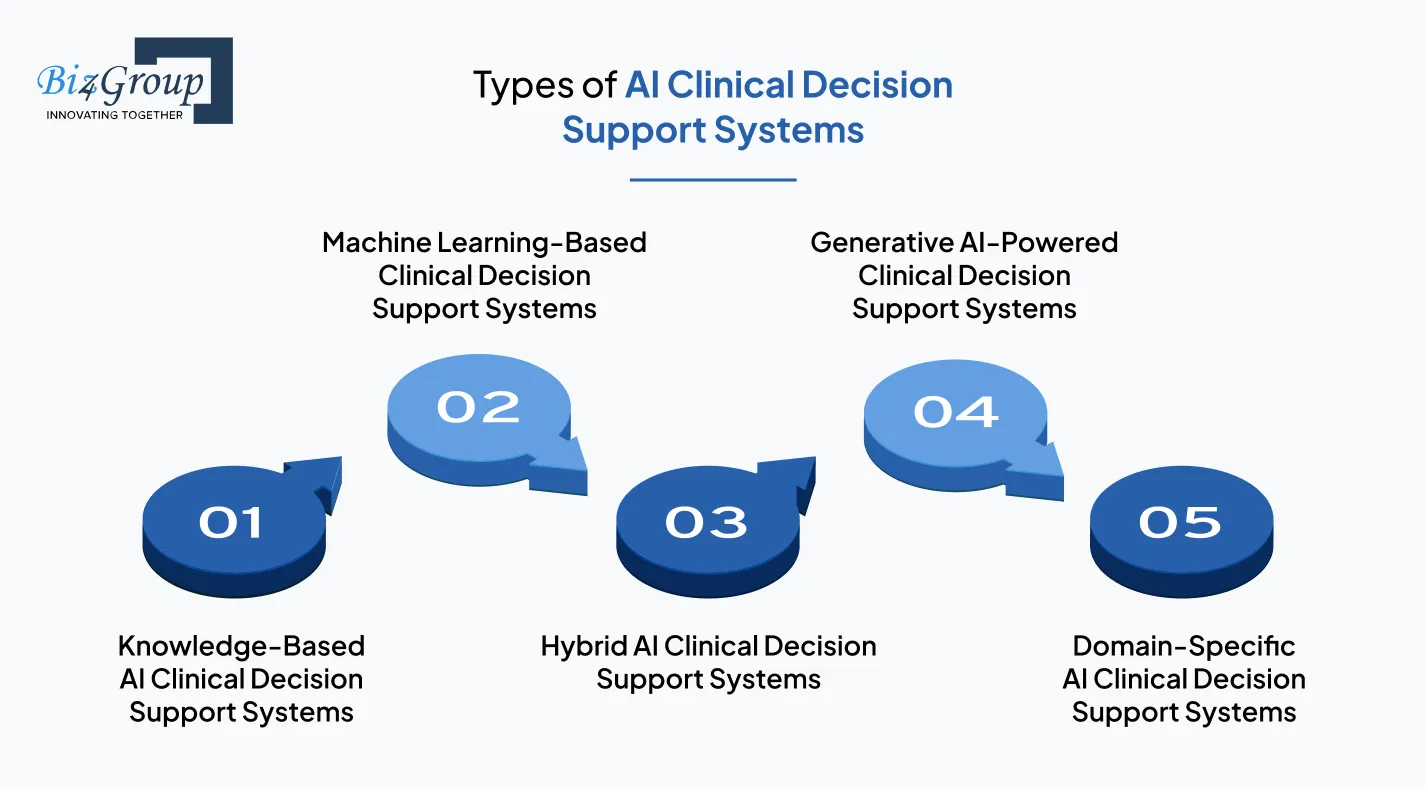
Not all systems work the same way. The type of system you build depends on your clinical goals, data maturity, and the level of intelligence you want to achieve. When you plan to build AI-powered clinical decision support systems, choosing the right type directly impacts performance, scalability, and clinical adoption.
1. Knowledge-Based AI Clinical Decision Support Systems
These systems rely on predefined clinical rules, guidelines, and medical knowledge bases. They match patient data against structured rules to generate recommendations. They are widely used in early-stage AI clinical decision support software development where explainability and compliance are critical.
- Rule-based logic using clinical guidelines
- Alerts for drug interactions and contraindications
- Standardized treatment recommendations
- Easier validation and regulatory alignment
2. Machine Learning-Based Clinical Decision Support Systems
These systems learn from historical data instead of relying only on fixed rules. They identify patterns and predict outcomes based on past clinical cases. Organizations looking to develop AI clinical decision support software for predictive analytics often choose this approach.
- Predictive modeling for disease risk
- Pattern recognition across large datasets
- Personalized treatment suggestions
- Continuous improvement with new data
3. Hybrid AI Clinical Decision Support Systems
Hybrid systems combine rule-based logic with machine learning models. They balance reliability with adaptability, making them suitable for complex clinical environments. This approach is common when organizations want to build custom AI clinical decision support systems for data-driven medical decision-making.
- Combines clinical guidelines with predictive models
- Improved accuracy and flexibility
- Supports both standard and complex cases
- Better trust among clinicians due to explainability
4. Generative AI-Powered Clinical Decision Support Systems
These systems use advanced generative AI development models to generate insights, summaries, and recommendations from unstructured data such as clinical notes and reports. They are becoming important in modern AI CDSS development solutions for healthcare organizations to optimize patient care.
- Summarization of patient records
- Clinical documentation assistance
- Context-aware recommendations
- Support for conversational interfaces
5. Domain-Specific AI Clinical Decision Support Systems
These systems are designed for specific medical areas such as cardiology, oncology, or mental health. They focus on specialized datasets and workflows. If you plan to make AI CDSS for hospitals and clinics, domain-specific solutions often deliver faster ROI.
- Tailored models for specific conditions
- Higher accuracy within a focused domain
- Faster deployment and adoption
- Easier integration with specialized workflows
As you explore these types, the next question is clear - where can these systems create the most impact in real clinical settings?
Where Can You Create the Most Impact with AI Clinical Decision Support System (CDSS)? High-Value Use Cases in Healthcare
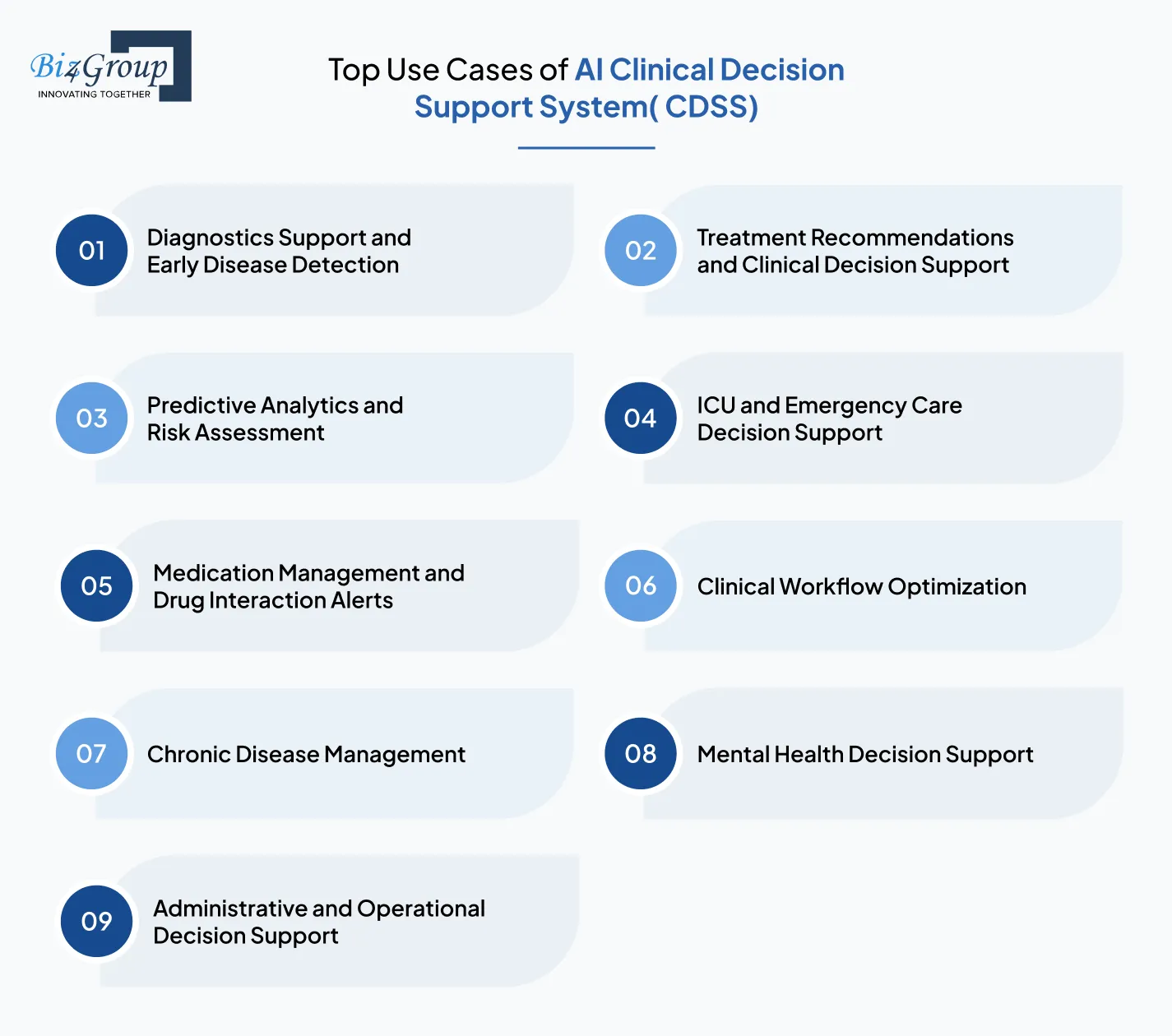
The real value of AI clinical decision support system development comes from how it performs in real clinical environments. The goal is clear. Better decisions, faster outcomes, and improved patient care.
Healthcare organizations looking to develop AI clinical decision support software are focusing on use cases that directly impact clinical accuracy, efficiency, and patient safety.
1. Diagnostics Support and Early Disease Detection
AI CDSS analyzes patient history, symptoms, lab results, and imaging data to detect diseases at an early stage. It identifies patterns that are difficult to detect manually, helping clinicians make more accurate diagnoses. This is a key area where teams build AI solutions to assist doctors in diagnostics and treatment recommendations.
Example:
A patient reports mild fatigue and chest discomfort. Individually, these symptoms may not indicate a serious issue. The system analyzes ECG trends, cholesterol levels, past visits, and family history. It detects a pattern linked to early cardiac risk and alerts the clinician. This enables timely testing and early treatment, reducing the risk of a major cardiac event.
2. Treatment Recommendations and Clinical Decision Support
AI CDSS provides personalized treatment recommendations based on patient data, clinical guidelines, and outcomes from similar cases. It helps maintain consistency while adapting to individual patient conditions. Many organizations create AI healthcare decision support solutions to improve treatment quality.
Example:
A cancer patient requires a treatment plan. The system evaluates tumor characteristics, genetic markers, and prior responses to therapies. It suggests treatment options that have shown better outcomes in similar cases. The clinician reviews these insights and selects the most suitable approach with greater confidence.
3. Predictive Analytics and Risk Assessment
AI CDSS predicts potential health risks by analyzing historical and real-time data. It allows clinicians to act early and prevent complications. This is critical for teams exploring how to create AI CDSS software for predictive analytics in healthcare.
Example:
A patient in the hospital shows small changes in heart rate and oxygen levels. These changes may not raise concern individually. The system identifies a pattern associated with early sepsis risk and alerts the care team. Early intervention helps prevent the condition from becoming critical.
4. ICU and Emergency Care Decision Support
AI CDSS supports real-time decision-making in critical care environments. It helps clinicians prioritize patients and respond quickly to life-threatening conditions. Many teams make intelligent AI clinical decision support systems for doctors and medical staff for these scenarios.
Example:
In an emergency room, multiple patients arrive at once. The system evaluates vitals, symptoms, and medical history in real time. It flags patients with high-risk conditions such as stroke or internal bleeding. This helps clinicians prioritize treatment and improve response time.
5. Medication Management and Drug Interaction Alerts
AI CDSS improves medication safety by identifying harmful drug interactions, incorrect dosages, and allergy risks. It reduces prescription errors and enhances patient safety. This is essential when organizations build custom AI clinical decision support systems for data-driven medical decision-making.
Example:
A patient is prescribed a new medication while already taking multiple drugs. The system checks for interactions and detects a potential adverse reaction. It alerts the clinician immediately, allowing them to adjust the prescription and avoid complications.
6. Clinical Workflow Optimization
AI CDSS streamlines workflows by reducing manual tasks and improving efficiency. It helps clinicians focus more on patient care and less on administrative processes. Organizations aiming to build scalable AI clinical decision support system solutions often prioritize this use case.
Example:
A hospital handles a large number of patients daily. The system categorizes cases based on urgency and suggests next steps. It reduces manual triage efforts and ensures that critical patients are treated first, improving overall efficiency.
7. Chronic Disease Management
AI CDSS supports ongoing monitoring and management of chronic conditions. It enables continuous care by analyzing patient data over time. This is useful for organizations planning to make AI CDSS for hospitals and clinics focused on long-term patient care.
Example:
A patient with hypertension is monitored using connected devices. The system tracks blood pressure trends and medication adherence. It detects irregular patterns and suggests timely adjustments, helping prevent complications and hospital visits.
8. Mental Health Decision Support
AI CDSS helps analyze behavioral data and patient history to support mental health diagnosis and treatment. It enables early detection of risks and improves intervention strategies.
Example:
A patient undergoing therapy shows gradual changes in mood and engagement. The system detects patterns associated with worsening depression. It alerts the clinician, allowing early intervention and better treatment outcomes.
9. Administrative and Operational Decision Support
AI CDSS also supports operational decisions such as staffing, resource allocation, and patient flow management. It helps healthcare organizations run more efficiently.
Example:
A hospital experiences fluctuating patient admissions. The system analyzes historical trends and predicts peak hours. It recommends staffing adjustments in advance, helping reduce wait times and improve patient experience.
Solutions like AI driven multi-specialty patient portal further enhance this by connecting patient engagement with operational intelligence.
Now that you've seen where these systems deliver real impact, the next step is clear.
What compliance and regulatory requirements do you need to meet before you build AI-powered clinical decision support systems for real-world healthcare environments?
Ready to turn these use cases into real outcomes?
It’s one thing to understand the potential, but building a system that delivers results is where it matters.
Get Started TodayWhat Compliance and Regulatory Requirements Must You Meet for AI Clinical Decision Support Software Development in the US?
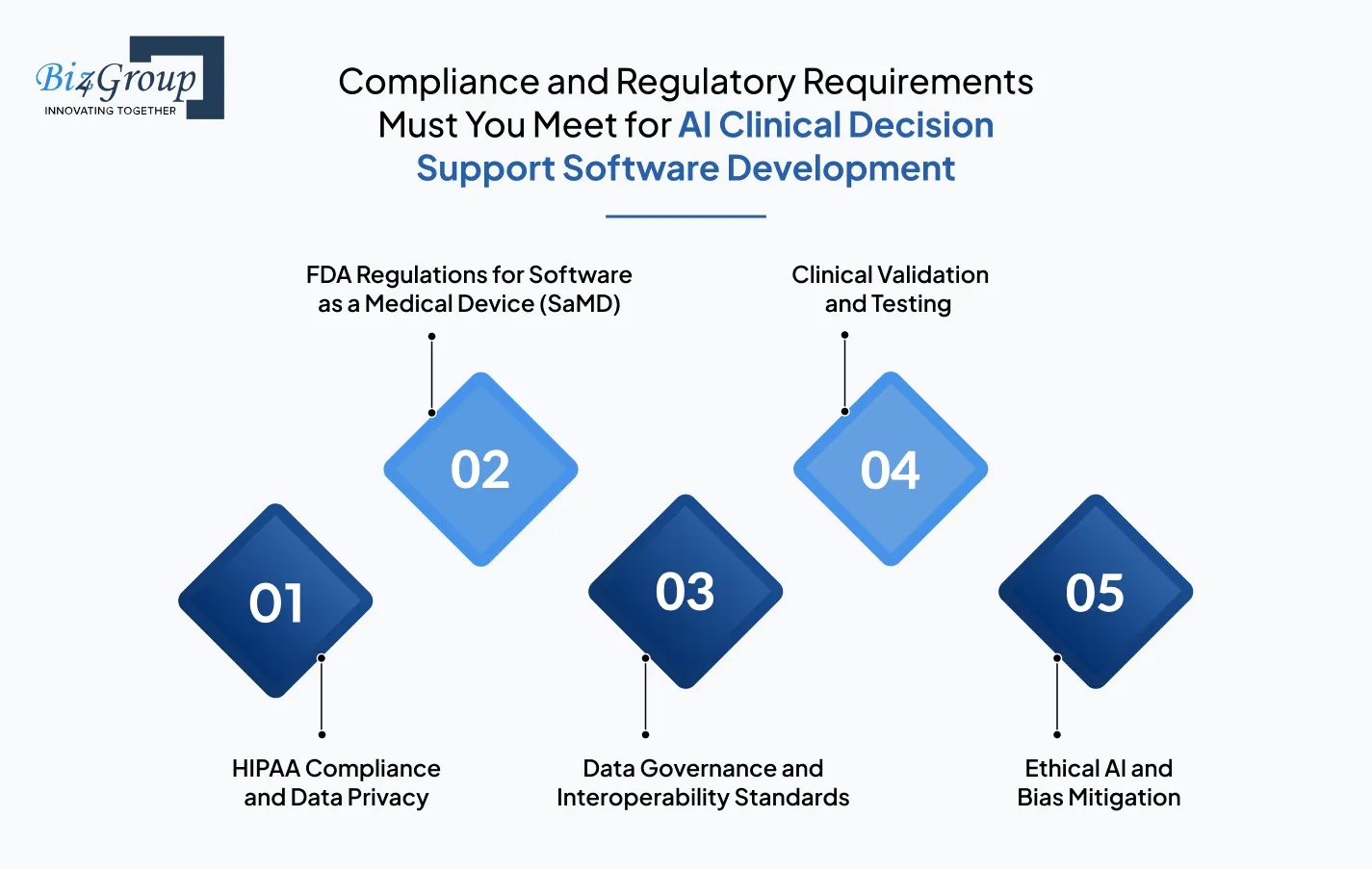
Building a system is one part. Getting it approved, trusted, and usable in real clinical environments is another. If you plan to develop AI clinical decision support software, compliance is not optional. It directly impacts deployment, adoption, and long-term scalability.
Healthcare organizations investing in AI clinical decision support system development must align with strict regulatory, privacy, and safety standards from the start.
1. HIPAA Compliance and Data Privacy
Any system handling patient data must follow strict data privacy regulations under HIPAA. This includes how data is collected, stored, processed, and shared across systems. You need to ensure encryption, secure access controls, and audit trails to protect sensitive health information.
If your system is not HIPAA compliant, it cannot be used in real healthcare environments. This makes privacy and security a foundational requirement, not an afterthought.
2. FDA Regulations for Software as a Medical Device (SaMD)
If your AI CDSS provides clinical recommendations that influence diagnosis or treatment, it may fall under FDA regulations as Software as a Medical Device. This requires validation, risk assessment, and clinical evaluation before deployment.
Organizations planning to build AI-powered clinical decision support systems must determine early whether FDA approval is required. Ignoring this can delay product launch and create legal risks.
3. Data Governance and Interoperability Standards
Healthcare data comes from multiple systems, and it needs to be consistent and interoperable. Standards like FHIR and HL7 ensure that your system can exchange data seamlessly across platforms.
Strong data governance is essential in the development of AI clinical decision support system solutions to maintain accuracy, consistency, and traceability across all data sources.
4. Clinical Validation and Testing
Before deployment, your system must be tested in real clinical scenarios to ensure accuracy and reliability. Clinical validation proves that your AI models provide safe and effective recommendations.
Organizations that develop AI clinical decision support software must invest in rigorous testing, including pilot programs and validation studies, to build trust among clinicians and regulators.
5. Ethical AI and Bias Mitigation
AI systems can inherit bias from training data, which can lead to unfair or inaccurate recommendations. Addressing bias is critical to ensure equitable patient care.
Teams working on AI CDSS development solutions for healthcare organizations to optimize patient care must implement transparency, explainability, and continuous monitoring to reduce bias and maintain fairness.
Meeting these requirements ensures your system is not only functional but also safe, trusted, and ready for real-world healthcare use.
So now the next question is - what features should you include to make your AI clinical decision support system actually effective in clinical practice?
What Features Make AI Clinical Decision Support Software Truly Effective for Hospitals and Clinics?
To make AI CDSS for hospitals and clinics effective, the system must deliver accurate insights, fit into clinical workflows, and support real-time decision-making without slowing teams down.
When you invest in AI clinical decision support system development, these are the features that actually drive adoption and outcomes.
Feature |
Description |
|---|---|
Real-Time Clinical Decision Support |
The system must analyze live patient data and deliver insights instantly at the point of care. This ensures clinicians can act immediately during critical situations rather than waiting for delayed reports. It plays a key role when organizations build AI solutions to assist doctors in diagnostics and treatment recommendations in time-sensitive environments. |
Predictive Analytics and Risk Scoring |
The system should identify potential risks before they become critical by analyzing historical and real-time data. It helps clinicians take preventive action, reduce complications, and improve outcomes. This is essential for teams planning to create AI healthcare decision support solutions focused on proactive care. |
Explainability and Clinical Transparency |
Every recommendation must be supported with clear reasoning. Clinicians need to understand how the system arrived at a conclusion to trust and use it in practice. Explainability is critical in AI clinical decision support system development to ensure adoption and regulatory acceptance. |
Seamless EHR/EMR Integration |
The system must integrate with existing platforms to access patient data without duplication or manual input. This ensures smooth workflows and better data utilization when working alongside systems like AI EMR/EHR software. |
Clinical Workflow Integration |
The solution should deliver insights within existing clinical interfaces instead of forcing clinicians to switch tools. This improves usability and ensures that decision support becomes a natural part of daily operations. |
Advanced Data Integration Capabilities |
The system must collect and unify data from multiple sources such as labs, imaging systems, and connected devices. Strong integration is critical when organizations develop AI clinical decision support software that relies on complete patient context. |
Natural Language Processing (NLP) |
NLP enables the system to extract meaningful insights from unstructured data such as clinical notes and reports. This expands the system's ability to support decisions beyond structured datasets. |
Alert Optimization and Prioritization |
The system should filter and prioritize alerts based on severity and relevance. This prevents alert fatigue and ensures clinicians focus only on high-impact notifications. |
Personalized Treatment Recommendations |
The system should generate tailored recommendations based on patient history, conditions, and clinical guidelines. This supports consistent and data-driven treatment decisions across care teams. |
Scalability and Performance |
The system must handle increasing patient data, users, and workloads without performance issues. This is critical for organizations aiming to build scalable AI clinical decision support system solutions across multiple facilities. |
Security and Data Protection |
The system must ensure strong encryption, access control, and monitoring to protect sensitive health data. Security is a core requirement in any AI clinical decision support software development initiative. |
Interoperability (FHIR, HL7 Standards) |
The system should communicate seamlessly with other healthcare platforms using standard protocols. This ensures smooth data exchange and system compatibility. |
Continuous Learning and Model Updates |
The system should continuously improve by learning from new data and clinical feedback. This ensures long-term accuracy and relevance in evolving healthcare environments. |
Multi-Device Accessibility |
Clinicians should be able to access the system across devices such as desktops, tablets, and mobile platforms. This ensures flexibility and usability across different care settings. |
Automation of Clinical and Operational Tasks |
The system should automate repetitive tasks such as data entry, reporting, and basic analysis. This reduces workload and improves efficiency, especially when combined with solutions like AI automation services. |
Integration with Broader Healthcare Ecosystem |
The system should connect with other healthcare solutions such as patient portals, billing systems, and medical devices. This enables a unified ecosystem, often supported through AI integration services for seamless deployment. |
When you develop AI clinical decision support software, these features determine whether your system will deliver real clinical value or remain underutilized.
Now that you know what to build, the next step is understanding how to build it step by step.
How to Develop an AI Clinical Decision Support System for Hospitals and Healthcare Providers (Step-by-Step Guide)?
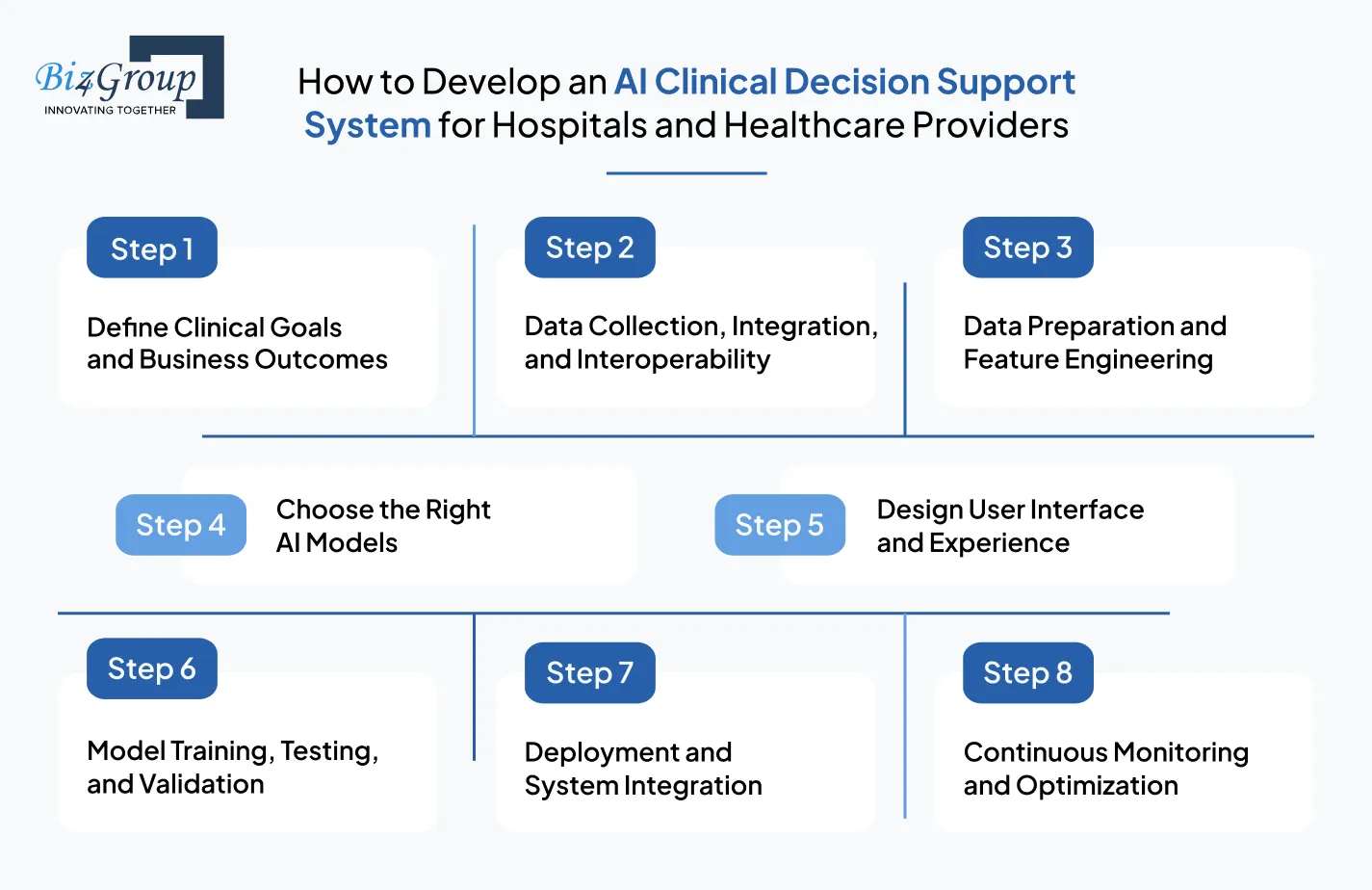
Building a reliable system requires a structured approach where each step contributes to accuracy, scalability, and clinical usability. If you're planning to develop AI clinical decision support software, this process helps you move from concept to deployment with clarity and control.
Step 1: Define Clinical Goals and Business Outcomes
Every successful system starts with a clearly defined problem. You need to identify what clinical or operational gap you are solving, whether it is improving diagnosis accuracy, reducing readmissions, or optimizing workflows. Clear goals help align stakeholders and ensure that your system delivers measurable value instead of becoming another unused tool.
Many organizations start with a focused version of the product using MVP development to validate feasibility before scaling further.
- Identify target use cases
- Define measurable success metrics
- Align clinical and business objectives
Step 2: Data Collection, Integration, and Interoperability
Data is the foundation of any AI system. You need to collect data from multiple sources such as EHRs, lab systems, imaging platforms, and connected devices. The challenge is not just collecting data but ensuring it is unified, accessible, and interoperable across systems.
This step is critical in AI clinical decision support system development because poor data integration directly impacts model accuracy and system reliability.
- Integrate EHR, lab, and imaging systems
- Use standards like FHIR and HL7
- Ensure consistent data flow across platforms
Step 3: Data Preparation and Feature Engineering
Healthcare data is often incomplete, unstructured, and inconsistent. Before using it for model training, it must be cleaned, standardized, and transformed into a usable format. Feature engineering helps extract meaningful variables that improve model performance.
Organizations that develop AI clinical decision support software treat this step as a priority because the quality of input data directly determines the quality of output.
- Remove duplicates and inconsistencies
- Structure unstructured clinical data
- Create meaningful features for AI models
Step 4: Choose the Right AI Models
The choice of AI models depends on the problem you are solving. Different use cases require different approaches, such as machine learning for prediction, NLP for clinical text, or deep learning for imaging.
Selecting the right models is essential when you build AI-powered clinical decision support systems that need to perform accurately in real clinical environments.
- Machine learning for predictive analytics
- NLP for clinical documentation
- Deep learning for imaging and diagnostics
Step 5: Design User Interface and Experience
Even the most advanced system will fail if clinicians find it difficult to use. The interface must be simple, intuitive, and aligned with clinical workflows so that users can quickly understand and act on insights.
A well-structured interface supported by strong UI/UX design improves adoption and ensures the system becomes part of daily operations rather than a separate tool.
- Simple and intuitive dashboards
- Clear visualization of insights
- Minimal disruption to existing workflows
Step 6: Model Training, Testing, and Validation
Once data is ready and models are selected, the system must be trained using historical datasets and tested in controlled environments. Validation ensures that the system produces accurate and reliable recommendations before real-world deployment.
This step is essential in AI CDSS development solutions for healthcare organizations to optimize patient care, as it directly impacts trust and clinical acceptance.
- Train models using clinical datasets
- Validate with real-world scenarios
- Measure accuracy and performance
Step 7: Deployment and System Integration
Deployment involves integrating the system into existing healthcare infrastructure. It should work seamlessly with current tools without requiring major workflow changes. Integration ensures that clinicians can access insights within the systems they already use.
This is a key requirement when you build scalable AI clinical decision support system solutions for large healthcare environments.
- Integrate with EHR and hospital systems
- Enable real-time data exchange
- Ensure system stability and performance
Step 8: Continuous Monitoring and Optimization
After deployment, the system must be continuously monitored and improved. Healthcare data evolves, and the system needs to adapt to maintain accuracy and relevance. Regular updates and feedback loops ensure long-term success.
This ongoing process is critical in the development of AI clinical decision support system solutions that remain effective over time.
- Monitor system performance
- Update models with new data
- Incorporate clinician feedback
Have the idea but not sure how to execute it right?
From planning to deployment, we help you avoid costly mistakes and build it the right way from day one.
Schedule a Free ConsultationWhat Is the Best Tech Stack to Build Scalable AI Clinical Decision Support Systems?
Choosing the right technology stack directly impacts how well your system performs, scales, and integrates with existing healthcare infrastructure.
If you plan to build scalable AI clinical decision support system solutions, your tech stack must support real-time processing, secure data handling, and seamless interoperability. Organizations investing in AI clinical decision support software development focus on technologies that ensure reliability, AI compliance, and long-term scalability.
Layer |
Technologies |
Description |
|---|---|---|
Frontend (User Interface) |
React, Angular, Vue.js |
The frontend layer is responsible for how clinicians interact with the system. It should provide clear dashboards, real-time insights, and easy navigation to support quick decision-making without disrupting workflows. |
Backend (Application Logic) |
The backend handles business logic, API management, and communication between different system components. It ensures smooth data processing and system performance when you develop AI clinical decision support software. |
|
AI/ML Frameworks |
TensorFlow, PyTorch, Scikit-learn |
These frameworks are used to build, train, and deploy machine learning models. They power predictive analytics, diagnostics support, and treatment recommendations in AI clinical decision support system development. |
Data Processing & Engineering |
Apache Spark, Hadoop, Pandas |
These tools handle large-scale data processing, transformation, and analysis. They ensure that data from multiple sources is prepared and ready for AI model training. |
NLP (Natural Language Processing) |
spaCy, NLTK, Hugging Face Transformers |
NLP tools help extract insights from unstructured clinical data such as notes, reports, and discharge summaries. This expands the system's ability to support real-world clinical decisions. |
Database Management |
PostgreSQL, MongoDB, MySQL |
Databases store structured and unstructured healthcare data securely. Choosing the right database ensures fast retrieval and scalability for large datasets. |
Cloud Platforms |
AWS, Microsoft Azure, Google Cloud |
Cloud infrastructure provides scalability, storage, and computing power. It enables organizations to deploy and scale systems efficiently while maintaining high availability. |
Interoperability Standards |
FHIR, HL7 |
These standards ensure seamless data exchange between healthcare systems. They are essential when integrating with EHRs and other clinical platforms. |
Security & Compliance |
OAuth 2.0, SSL/TLS, Role-Based Access Control |
Security technologies protect sensitive patient data and ensure compliance with healthcare regulations. This is critical in any AI clinical decision support software development initiative. |
DevOps & Deployment |
Docker, Kubernetes, CI/CD pipelines |
These tools support automated deployment, scaling, and system monitoring. They help maintain performance and reliability in production environments. |
Integration Layer |
REST APIs, GraphQL |
APIs enable communication between different systems and services. Strong integration capabilities are required when you build AI-powered clinical decision support systems that connect with multiple healthcare platforms. |
Medical Imaging & Data Tools |
DICOM, OpenCV |
These tools support processing and analysis of medical imaging data such as X-rays, MRIs, and CT scans, enabling advanced diagnostic capabilities. |
Automation & Workflow Tools |
RPA tools, custom automation engines |
Automation tools help streamline repetitive clinical and administrative tasks. Many organizations enhance efficiency using solutions alongside AI CDSS. |
A well-chosen tech stack ensures your system is not only functional but also scalable, secure, and ready for real-world healthcare use.
Now the next question is practical - how much does it actually cost to build an AI clinical decision support system?
Also Read: React JS Development Services
How Much Does AI Clinical Decision Support System Development Cost and What Drives the Investment?
The cost of AI clinical decision support system development typically ranges from $40,000 to $300,000+. This range depends on multiple factors such as feature complexity, data readiness, compliance requirements, and system scalability. If you are planning to develop AI clinical decision support software, your final investment will vary based on how advanced and customized your solution needs to be.
Organizations looking to build AI-powered clinical decision support systems should treat cost as a strategic investment tied directly to outcomes, not just development effort.
Cost Breakdown of AI Clinical Decision Support Software Development by Features
The total cost is largely driven by the features you choose to include. Each feature adds complexity, development time, and infrastructure requirements.
Feature |
Estimated Cost Range |
Description |
|---|---|---|
Basic Decision Support System |
$40,000 – $80,000 |
Entry-level system with rule-based logic and basic recommendations. Suitable for early-stage development of AI clinical decision support system solutions. |
Data Integration & Interoperability |
$20,000 – $50,000 |
Integration with EHRs, labs, and imaging systems using FHIR/HL7. Essential when you build scalable AI clinical decision support system platforms. |
Predictive Analytics & Risk Modeling |
$30,000 – $80,000 |
Enables forecasting of patient risks and disease progression. Important for organizations planning to create AI healthcare decision support solutions. |
NLP for Clinical Data |
$20,000 – $60,000 |
Extracts insights from unstructured clinical notes and reports, improving decision accuracy. |
Real-Time Decision Engine |
$25,000 – $70,000 |
Supports instant clinical insights, especially useful when you build AI solutions to assist doctors in diagnostics and treatment recommendations. |
Personalized Treatment Engine |
$30,000 – $90,000 |
Provides tailored recommendations based on patient-specific data and clinical guidelines. |
UI/UX and Dashboard |
$15,000 – $40,000 |
Interfaces for clinicians to interact with insights and recommendations effectively. |
Security & Compliance |
$15,000 – $50,000 |
Covers encryption, access control, and regulatory compliance requirements. |
Cloud & Deployment Infrastructure |
$10,000 – $40,000 |
Hosting, scaling, and system deployment for production environments. |
Key Factors Affecting AI Clinical Decision Support System Development Cost
Several factors influence how much it costs to develop AI clinical decision support software. Understanding these helps you plan budgets more accurately.
1. Data Availability and Quality
Incomplete or unstructured data increases preprocessing effort. This directly impacts the cost of AI clinical decision support software development.
2. Feature Complexity
Basic systems cost less, but advanced capabilities like predictive analytics and personalization increase investment when you build AI-powered clinical decision support systems.
3. Compliance and Security Requirements
Strict healthcare regulations require additional validation, testing, and security layers.
4. Integration Requirements
Connecting multiple systems such as EHRs, labs, and devices increases development complexity.
5. Development Team and Expertise
Working with an experienced AI development company helps reduce long-term risks but may increase upfront costs.
Hidden Costs in AI Clinical Decision Support Software Development
When organizations plan to build custom AI clinical decision support systems for data-driven medical decision-making, they often overlook these costs.
1. Data Preparation and Labeling
Cleaning and structuring healthcare data requires significant time and resources.
2. Model Maintenance and Updates
AI models need continuous retraining to maintain accuracy.
3. Infrastructure Scaling
As usage increases, cloud and storage costs grow.
4. Compliance and Audit Costs
Ongoing audits and certifications add recurring expenses.
5. User Training and Adoption
Training clinicians and staff is essential for system success.
Cost Optimization Strategies to Build AI Clinical Decision Support Systems Efficiently
You can reduce costs while maintaining quality by following a structured approach when you develop AI clinical decision support software.
1. Start with an MVP Approach
Focus on core features first before expanding into a full-scale system.
2. Prioritize High-Impact Features
Avoid overbuilding. Focus on features that deliver immediate clinical value.
3. Use Pre-Built Frameworks
Leverage existing AI tools to reduce development time.
4. Partner with Experts
Working with experienced teams helps avoid costly mistakes and delays.
5. Plan for Scalability Early
Design your system to scale from the beginning to avoid rework.
Now that you understand the investment required, the next question is critical - what challenges will you face while building AI clinical decision support systems, and how can you solve them effectively?
Worried about cost or unsure where to start?
We’ll help you break down the investment and build a solution that aligns with your goals and budget.
Request a Cost EstimateWhat Are the Biggest Challenges in AI Clinical Decision Support System Development and How Can You Solve Them Effectively?
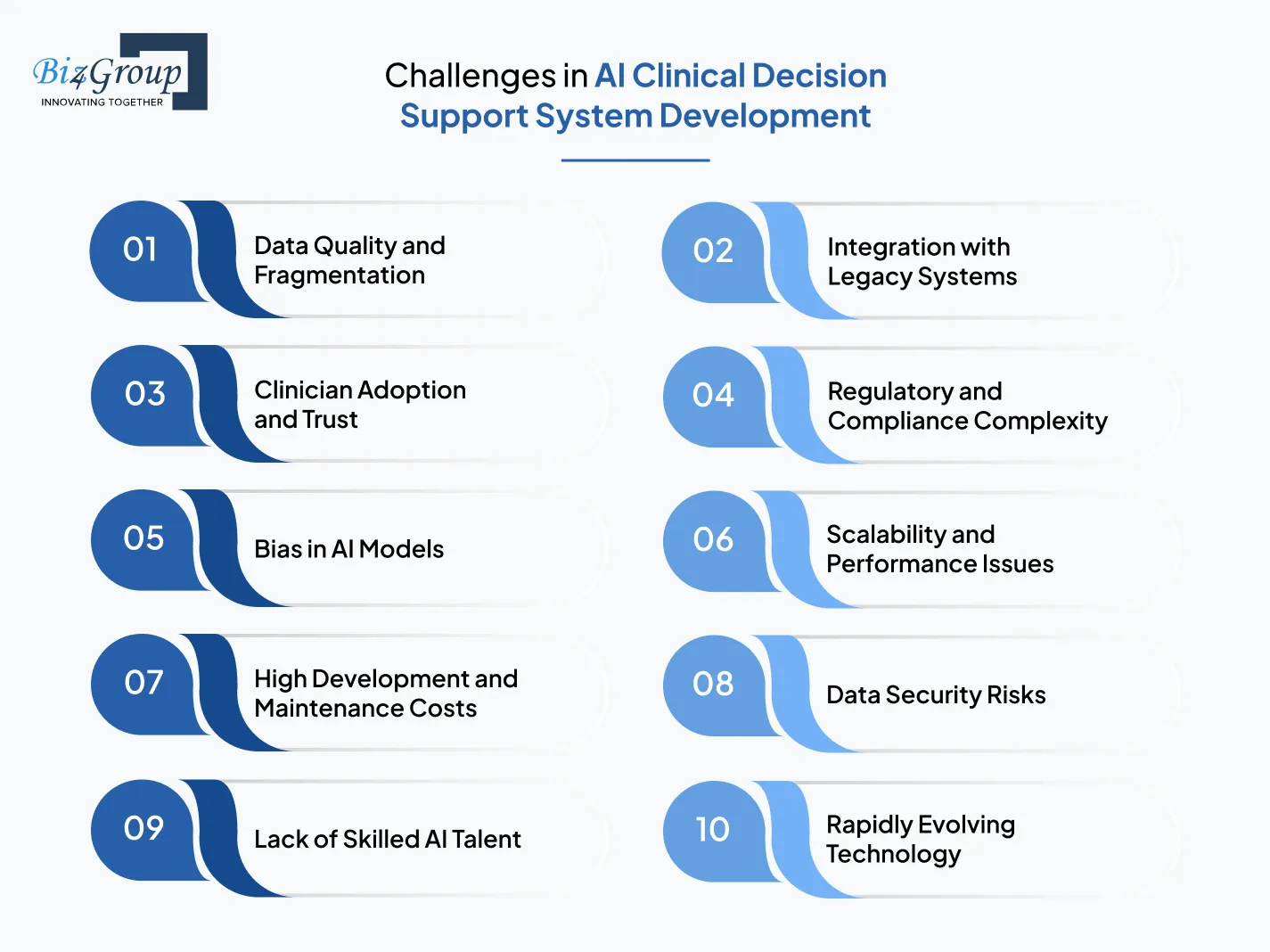
Building a system is one part. Making it work in real clinical environments is where most organizations struggle. When you develop AI clinical decision support software, you face challenges across data, technology, compliance, and adoption. If not addressed early, these issues can delay deployment or reduce system effectiveness.
Here are the most common challenges in AI clinical decision support system development and how you can solve them.
Challenge |
Description |
Solution |
|---|---|---|
Data Quality and Fragmentation |
Healthcare data is often incomplete, inconsistent, and spread across multiple systems. Poor data quality leads to inaccurate predictions and unreliable recommendations. |
Establish strong data pipelines, standardize formats using FHIR/HL7, and invest in data cleaning before model training. |
Integration with Legacy Systems |
Many hospitals rely on outdated systems that are difficult to integrate with modern AI solutions. This creates delays and limits system functionality. |
Use APIs and middleware to enable smooth integration. Plan interoperability early when you build scalable AI clinical decision support system solutions. |
Clinician Adoption and Trust |
Clinicians may hesitate to rely on AI if they do not trust the system or understand how it works. Low adoption can make even a well-built system ineffective. |
Focus on explainability, provide clear insights, and involve clinicians during development and testing phases. |
Regulatory and Compliance Complexity |
Meeting HIPAA, FDA, and other regulatory requirements can slow down development and increase costs. |
Build compliance into the system from day one and follow structured validation and documentation processes. |
Bias in AI Models |
AI models can produce biased outcomes if trained on unbalanced datasets. This can impact fairness and accuracy in patient care. |
Use diverse datasets, regularly audit models, and implement bias detection and correction mechanisms. |
Scalability and Performance Issues |
Systems may perform well in small environments but struggle when scaled across hospitals or large datasets. |
Design scalable architecture using cloud infrastructure and optimize models for performance early in development. |
High Development and Maintenance Costs |
Building and maintaining AI systems requires continuous investment in infrastructure, updates, and monitoring. |
Start with a focused MVP, prioritize high-impact features, and scale gradually based on results. |
Data Security Risks |
Handling sensitive patient data increases the risk of breaches and unauthorized access. |
Implement strong encryption, access controls, and monitoring systems to ensure data protection. |
Lack of Skilled AI Talent |
Finding experienced professionals who understand both AI and healthcare can be challenging. |
Work with experts or teams that specialize in healthcare-focused AI medical software to reduce risk and improve development speed. |
Rapidly Evolving Technology |
AI technologies are evolving quickly, making it difficult to keep systems updated and future ready. |
Stay aligned with emerging trends such as agentic AI in healthcare and design systems that can adapt to new advancements. |
Addressing these challenges early helps you build AI-powered clinical decision support systems that are reliable, scalable, and ready for real-world healthcare use.
Now the final step is choosing the right partner who can help you bring this entire system to life effectively.
How Can Biz4Group Help You Build AI Clinical Decision Support Systems That Actually Work?
Building a system is one thing. Building a system that works in real clinical environments, integrates seamlessly, and delivers measurable outcomes is another.
That is where Biz4Group stands out. As an experienced AI healthcare software development company with strong expertise in healthcare, we help organizations build AI-powered clinical decision support systems that are scalable, compliant, and aligned with real clinical workflows.
We are one of the top AI healthcare software development companies in USA who understands that AI clinical decision support system development is not just about models. It is about solving real problems like delayed diagnoses, inefficient workflows, and inconsistent treatment decisions.
Our approach focuses on delivering systems that clinicians actually use and trust.
What makes Biz4Group a strong partner for AI CDSS development?
- Deep experience in healthcare-focused AI clinical decision support software development and digital health solutions
- Strong understanding of US healthcare compliance requirements including HIPAA and regulatory standards
- Proven expertise in building scalable and secure systems for hospitals, startups, and healthcare enterprises
- Ability to develop AI clinical decision support software tailored to specific clinical use cases and business goals
- End-to-end capabilities from strategy and MVP to full-scale deployment and optimization
How we help you succeed
- Define the right use cases and development roadmap
- Build intelligent systems that assist doctors in diagnostics and treatment recommendations
- Ensure seamless integration with your existing healthcare ecosystem
- Deliver scalable solutions designed for long-term growth
- Support continuous improvement and system optimization
If you are planning to build custom AI clinical decision support systems for data-driven medical decision-making, working with the right partner can reduce risks, speed up development, and ensure real-world success.
Biz4Group helps you move from idea to implementation with clarity, confidence, and results.
Looking for a partner who actually understands healthcare AI?
You need more than developers. You need a team that understands clinical workflows and builds solutions that work.
Contact UsWrapping Up!
Healthcare is no longer limited by data availability. It is limited by how effectively you use that data to make decisions.
That is where AI clinical decision support system development creates real impact.
If you plan to develop AI clinical decision support software, the opportunity is clear. You can reduce errors, improve outcomes, and support clinicians with faster, more accurate decisions. But success depends on how well you design, build, and integrate the system into real clinical workflows.
This is not just about technology. It is about building systems that are trusted, scalable, and aligned with how healthcare actually operates.
With deep experience in AI clinical decision support software development and experience in AI product development, Biz4Group helps healthcare organizations build AI-powered clinical decision support systems that deliver measurable results. From strategy to deployment, the focus remains on creating solutions that work in real-world environments, not just in theory.
If you are ready to move forward, the next step is simple.
FAQ
1. How can I develop an AI clinical decision support system for my hospital?
To develop AI clinical decision support software, you need to start with a clear use case such as diagnostics support or risk prediction. Then focus on data integration, model selection, compliance, and workflow integration. Many healthcare organizations begin with an MVP and scale gradually based on results.
2. What is the best way to build AI-powered clinical decision support systems?
The best way to build AI-powered clinical decision support systems is to follow a structured approach. Start with high-impact features, ensure strong data quality, and design the system around clinical workflows. Choosing the right tech stack and ensuring compliance are equally important for long-term success.
3. How much does AI clinical decision support system development cost?
The cost of AI clinical decision support system development typically ranges from $40,000 to $300,000 or more. The final cost depends on system complexity, features, integrations, and compliance requirements. Advanced systems with predictive analytics and real-time capabilities require higher investment.
4. How long does it take to develop AI clinical decision support software?
The timeline to develop AI clinical decision support software usually ranges from 2 to 8 weeks. A basic system can be built faster, like in 2 to 4 weeks, while a fully scalable and compliant solution may take 6 to 8 weeks depending on data readiness, integrations, and validation requirements.
5. What technologies are used in AI clinical decision support system development?
AI clinical decision support system development typically uses machine learning, natural language processing, and deep learning. Technologies include Python, TensorFlow, PyTorch, cloud platforms like AWS or Azure, and interoperability standards such as FHIR and HL7.
6. What are the biggest challenges in building AI clinical decision support systems?
Common challenges include poor data quality, integration with legacy systems, compliance requirements, and clinician adoption. Organizations that build custom AI clinical decision support systems for data-driven medical decision-making need to address these early to ensure successful implementation.
7. Are there companies that build AI clinical decision support systems for hospitals and clinics?
Yes, several companies specialize in clinical decision support system AI development services. These companies help healthcare organizations design, develop, and deploy scalable solutions that improve patient care and operational efficiency. Choosing a partner with healthcare domain expertise is critical for success.
