 Location :
Orlando, FL, USA
Location :
Orlando, FL, USA +1 (407) 714-1616
 info@biz4group.com

- Understanding the right approach to develop AI patient waitlist management software that supports real time updates and smoother patient flow.
- Strong AI patient waitlist management software development foundations use automation, clean interfaces, and reliable AI logic to reduce manual work, especially when teams focus on .
- Advanced capabilities help you create automated patient waitlist and scheduling systems using AI, improving communication, and multi-location coordination.
- The market for AI scheduling and waitlist tools is growing fast, backed by strong adoption across clinics, hospitals, and expanding healthcare networks.
- Development costs typically range from 30,000 to 300,000 USD, depending on scope, integrations, and AI complexity.Organizations that plan early for security, scale, and data structure get the most value, especially when preparing long term operational improvements.
If you’re running a hospital, clinic, urgent care, or telehealth network, you already know the pressure that comes with juggling unpredictable patient volumes, frustrated callers, and staff burnout.
That quiet moment when you realize your waitlist is now a full-blown operational risk is exactly when you should develop AI patient waitlist management software so the whole system finally runs itself instead of running everyone ragged.
But before you do, you will find yourself searching for the answers to hundreds of questions online, like:
- How do I get AI to manage my patient waitlist so people aren’t calling our front desk nonstop?
- Can AI tell patients their wait time updates automatically instead of my staff doing it?
- Is there a way for AI to help fill last-minute cancellations with patients already waiting?
- Can AI sort the waitlist by urgency or care priority instead of just first-come-first-serve?
- How do I connect an AI waitlist system to my booking software so it updates in real time?
Here’s what the market has to offer to you:
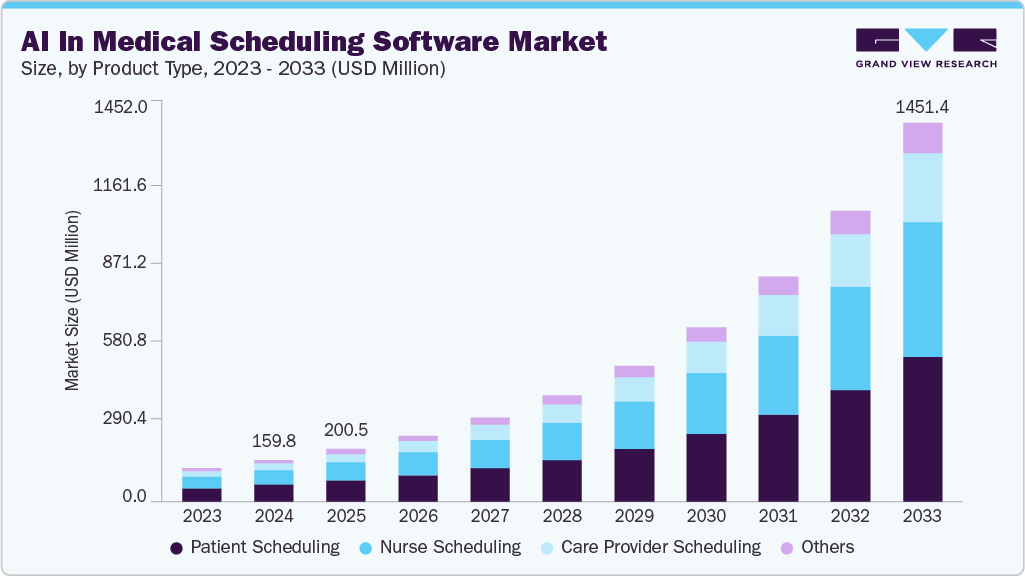
- The demand for AI patient waitlist management software development is projected to reach USD 1,451.41 million by 2033.
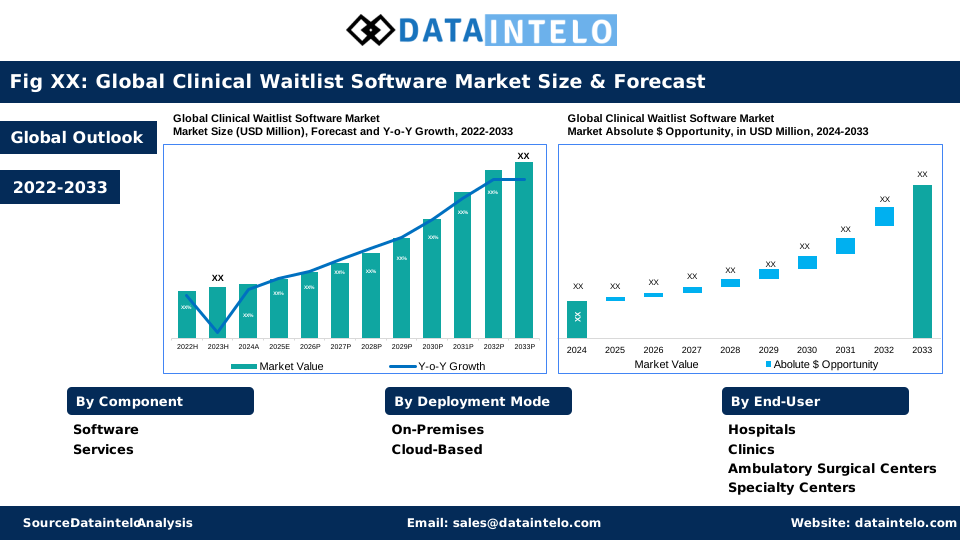
- On top of that, the clinical waitlist software space is expected to hit about USD 1.2 billion by 2032.
Many organizations choose to build early workflow prototypes with an AI app development company or fold optimized scheduling improvements into AI healthcare solutions as part of their operational planning.
If you’re considering how to create something that genuinely eases the load on your teams, you’re in the right place to understand exactly how these systems come together.
What Is AI Patient Waitlist Management Software?
AI patient waitlist management software is a system that helps clinics and hospitals keep patient queues organized, predictable, and easier to control. When you develop AI patient waitlist management software, you create an intelligent layer that automates updates, prioritization, and communication so your team stops juggling chaotic lists all day.
- It analyzes wait-time patterns and adjusts queues automatically
- It tracks openings, cancellations, and shifting availability without manual oversight
- It supports priority-based sorting using urgency, care protocols, or resource availability
- It keeps patient communication consistent and timely across channels
- It fits into existing systems using integrations supported by AI integration services
In short, it becomes the operational backbone that keeps your waitlist stable, your staff less overwhelmed, and your workflow ready for real patient volume.
How AI Waitlist Management Software Development for Patients Works?
AI waitlist automation works by studying how your queues behave, predicting what will happen next, and adjusting every moving part before your staff even notices. When you develop AI patient waitlist management software, the system becomes an active operational partner rather than another tool your team needs to babysit.
1. Data Intake and Interpretation
The system continuously gathers appointment activity, cancellations, and capacity signals so it can understand real time patient flow and respond accordingly.
2. Pattern Recognition and Behavioral Analysis
Machine learning identifies peak patterns, delay trends, and no show behaviors using methods that teams often refine with a custom software development company.
3. Queue Recalculation Based on Events
Every new change triggers an updated calculation of who should move where, guided by operational logic shaped through AI consulting services.
4. Intelligent Decision Logic Execution
The AI evaluates urgency, visit type, and moment to moment availability to decide which patient moves up or shifts within the list.
5. Automated Operational Response
Once decisions are made, the system pushes scheduling updates, patient notifications, and workflow adjustments without manual staff involvement.
|
Step |
What Happens |
Result |
|
Data Intake |
Software gathers live scheduling changes |
AI sees the full operational picture |
|
Pattern Analysis |
System detects real flow trends |
Predictions improve over time |
|
Queue Recalculation |
AI updates ordering after each event |
Staff avoid constant reshuffling |
|
Decision Logic |
AI decides patient movement |
Flow stays consistent and fair |
|
System Response |
Updates and alerts are triggered |
Communication remains smooth |
Once the inner workings make sense, it becomes much clearer why many organizations choose to create AI patient queue management software to stabilize daily scheduling and reduce operational pressure.
Transform Patient Flow Into Predictable Operations
Why Invest in Creating AI Patient Queue Management Software?
Every clinic eventually realizes that manual waitlist management is the silent bottleneck no one budgets for but everyone feels. When you develop AI patient waitlist management software, you’re not just adding another digital tool. You’re removing the daily friction your team has been quietly tolerating for years, which opens the door to real stability in your patient flow.
Why It Makes Sense to Invest
1. You Finally Control the Chaos Instead of Reacting to It
Most scheduling systems were built for yesterday’s patient volume and today’s unpredictable demand makes them crack fast. AI steps in to interpret patterns your staff cannot possibly catch, something teams often refine with AI automation services to keep operations smoother.
2. You Turn Waitlists Into a Predictable Operational Asset
With AI recalculating your queue constantly, your care delivery becomes steadier and less vulnerable to single points of failure. Many healthcare groups reference insights shaped in AI in healthcare administration automation to stabilize patient flow.
3. You Create Consistency Across Multiple Locations Without Extra Overhead
If your organization operates several clinics or urgent care sites, AI helps unify scheduling logic so one location isn’t drowning while another sits idle.
4. You Recover Lost Appointments and Reduce Wasted Capacity
Last-minute no shows and cancellations quietly drain revenue. AI spots openings the moment they appear and matches them with the right patient, often using logic improved through AI model development to keep accuracy high.
5. You Improve Patient Trust Without More Phone Lines or Staff Hours
Clear, timely updates reduce uncertainty, ease frustration, and make your care experience feel more human even though the heavy lifting happens behind the scenes.
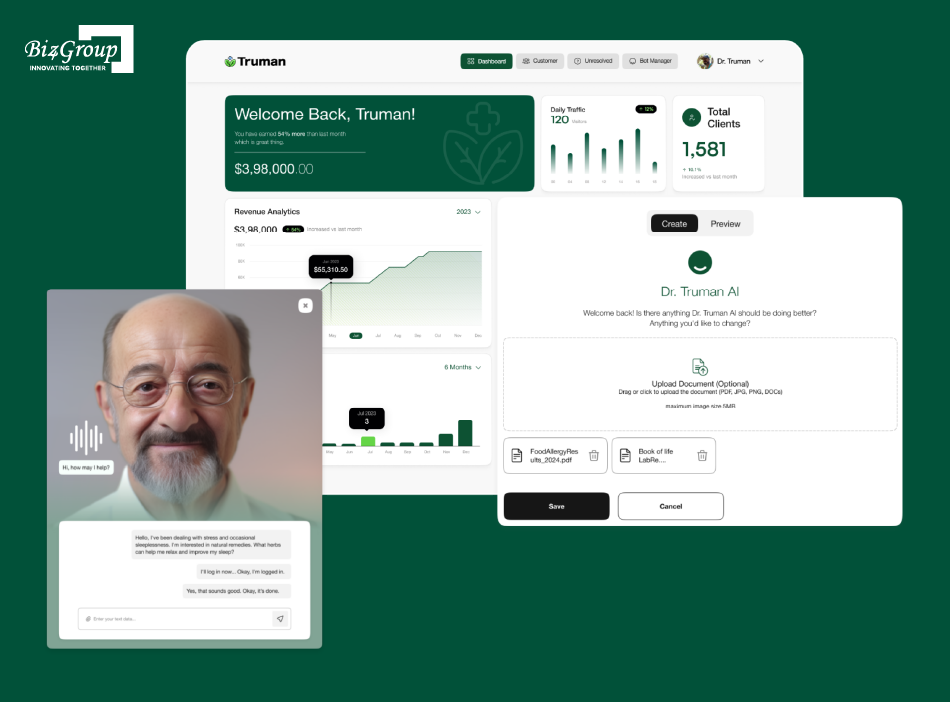
Truman is an AI-enabled wellness companion that delivers personalized supplement recommendations, guided tracking, and tailored health insights, built to support users with real-time decision intelligence. Its adaptive health-profiling logic mirrors the precision needed in AI patient waitlist management, proving how smart personalization can significantly improve patient engagement and care continuity.
When these benefits start showing up in your day-to-day operations, the next natural thing you’ll want to explore is the set of core features that make all of this possible.
Core Features to Include When You Develop AI Patient Waitlist Management Software
The right feature set is what turns a simple digital waitlist into an actually reliable operational system. When you develop AI patient waitlist management software, these core components become the backbone of a smoother, calmer, more predictable workflow that your team can trust every day.
|
Core Feature |
What It Does |
Why It Matters |
|
Centralized Waitlist Dashboard |
Displays all waiting patients in one place |
Gives staff a clear, single source of truth |
|
Real Time Queue Updates |
Reflects every check in, delay, or change instantly |
Keeps the list accurate without manual tracking |
|
Basic Patient Notification Tools |
Sends standard wait-time or status alerts |
Reduces phone calls and patient uncertainty |
|
Manual Override Controls |
Lets staff adjust positions or timing when needed |
Supports clinical judgment and flexibility |
|
Integration with EHR/EMR systems |
Aligns patient info with existing systems |
Prevents duplicate entry and data mismatch |
|
User Roles and Access Permissions |
Defines who can view or modify the waitlist |
Protects sensitive information and ensures control |
|
Audit Trail and Activity Logs |
Records every update and action taken |
Provides transparency and accountability |
|
Department or Provider Based Filters |
Lets staff view separate queues easily |
Helps teams manage workload by care type |
|
Basic Reporting and Queue Metrics |
Shows wait times, volume, and daily trends |
Supports operational planning and staffing needs |
|
Staff Alerts and Queue Status Indicators |
Highlights when a waitlist needs attention |
Keeps teams responsive and informed |
Many teams anchor these fundamentals into workflows supported by AI integration services or pair AI communication tools shaped by an AI chatbot development company to maintain smooth coordination across departments.
Advanced Features for AI Patient Waitlist Management Software Development
Once your essentials are in place, the real magic comes from capabilities that help your system think ahead. When you develop AI patient waitlist management software, these advanced features let your operations adapt quickly instead of waiting for staff to react.
1. Predictive No Show Scoring
AI reviews behavior patterns to estimate the likelihood of missed appointments. This helps teams reduce empty slots long before they turn into gaps in the schedule.
2. Dynamic Priority Optimization
The system evaluates urgency, care requirements, and availability in real time. Many organizations weave these rules into planning workflows that sit alongside enterprise AI solutions to keep decision logic aligned.
3. Automated Cancellation Routing
When a spot opens, the software identifies the right waiting patient automatically. Some teams run this routing logic in environments where they need to hire AI developers to shape workflows to support consistency across departments.
4. Intelligent Communication Automations
The system decides when to notify patients, what to send, and how frequently to follow up. These decisions adjust based on real time movement in the queue and historically observed communication patterns.
5. Cross Location Load Balancing
AI identifies when one clinic is overloaded and another has capacity. Multi site groups often place this decision engine next to strategies informed by AI chatbot integration to maintain smooth communication during redistribution.
Advanced features like these give your platform the flexibility to behave more like a proactive coordinator than a static tool. Once you understand the intelligence layer, the development process starts becoming much easier to map out.
Give Patients Faster, Clearer Scheduling Experiences
Build smarter systems that support AI patient waitlist management software development for real time queue updates and fewer bottlenecks.
Plan My AI Scheduling SystemHow to Build AI Patient Waitlist Management Software: Step-by-Step Process
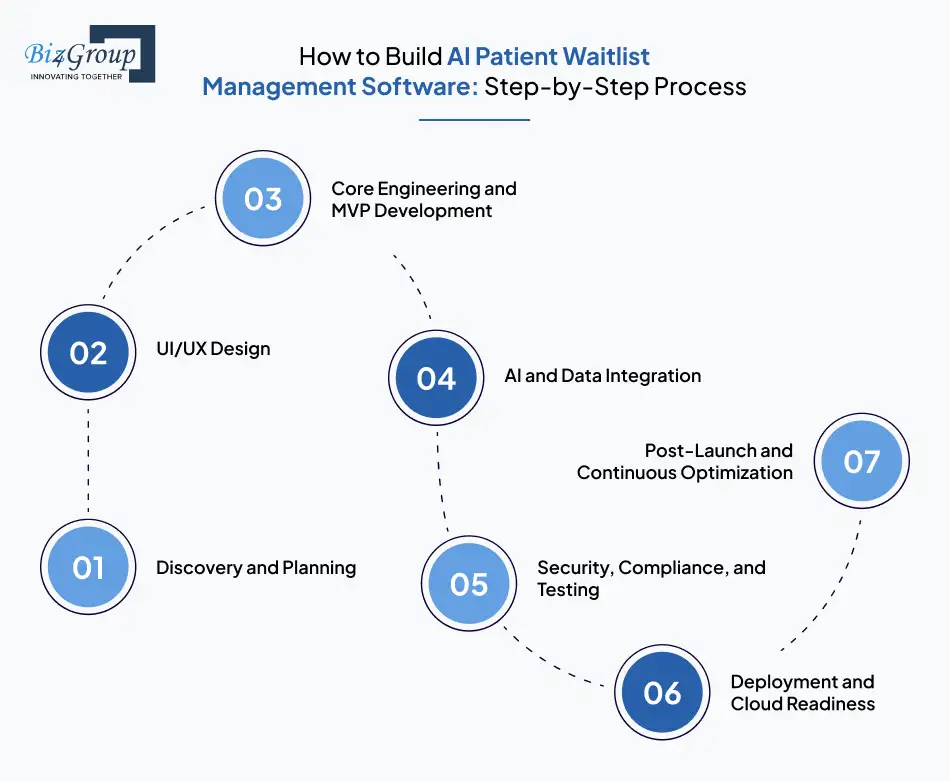
Building an AI waitlist system is not just a technical project. It is a direct response to the daily pressure your teams feel when patient flow becomes unpredictable. When you develop AI patient waitlist management software, the process needs to reflect real clinical operations instead of assuming ideal scenarios. Here is how teams move from messy waitlists to dependable automation.
1. Discovery and Planning
This stage exposes the exact friction points that slow down your scheduling teams. Before anything else, you identify what is breaking your current system. Are delays piling up because staff cannot update waitlists fast enough? Are clinics working in silos? These realities shape how your AI patient waitlist management software development roadmap begins.
- Interview scheduling staff and clinical teams to uncover hidden workflow gaps
- Map out which waitlist tasks to automate first, such as status updates or reshuffling
- Validate HIPAA alignment for all data handling and patient communication
- Define KPIs such as reduced patient calls, fewer bottlenecks, or improved throughput
This step ensures you solve the right problems before any development starts.
2. UI/UX Design
Your staff will not adopt tools that feel complicated. A waitlist dashboard must reduce cognitive load, not add to it. A seasoned UI/UX design company helps your team navigate waitlists quickly, especially during peak volume.
- Build clickable prototypes modeled after real clinic workflows
- Gather feedback from schedulers, nurses, and multi-site operators
- Add accessibility-focused visual clarity for fast, low-stress scanning
- Ensure consistent layouts across desktops, tablets, and mobile devices
Also read: Top UI/UX design companies in USA
3. Core Engineering and MVP Development
Launching everything at once is unnecessary and risky. Start with MVP development services that validate your foundation inside real clinical operations before scaling. This is where you establish the structural base for AI waitlist management software development for patients.
- Build the real time waitlist engine that reflects live movements instantly
- Connect EHR and scheduling feeds for unified patient data
- Implement foundational communication flows like alerts and status messages
- Architect the backend so advanced AI capabilities can be added later
Also read: Top 12+ MVP Development Companies in USA
4. AI and Data Integration
This is where your system transitions from reactive to proactive. Clean data pipelines and trained AI models help your software anticipate what your staff cannot. This is essential when you create automated patient waitlist and scheduling systems using AI.
- Train AI models using diverse appointment behaviors to avoid skewed predictions
- Build engines that forecast no shows, delays, and bottlenecks
- Add continuous learning loops to refine queue decisions over time
- Combine pre-trained models with organization-specific logic for accuracy
AI integration is what ultimately upgrades your waitlist from manual to intelligent.
5. Security, Compliance, and Testing
Patient data deserves maximum protection. Your system must perform well under load while respecting every compliance requirement. This step is fundamental to the development of AI patient waitlist management software in real healthcare environments.
- Conduct HIPAA-first audits across workflows and communication channels
- Stress test your system under heavy volume and multi-location surges
- Simulate patient journeys to uncover UX blind spots
- Maintain end-to-end logging for transparency and accountability
Testing protects both your teams and your patients.
Also Read: Software Testing Companies in USA
6. Deployment and Cloud Readiness
Healthcare volume is unpredictable. Seasonal spikes, flu waves, or urgent care surges can crash systems that are not cloud-ready. Deployment needs to be smooth, scalable, and reliable.
- Use cloud platforms that expand automatically during high patient load
- Implement CI and CD pipelines to ship updates without friction
- Monitor live dashboards that display real queue and throughput behavior
- Provide onboarding materials so teams can adopt the system quickly
A thoughtful deployment helps the system feel natural from day one.
7. Post-Launch and Continuous Optimization
Once the system goes live, the real transformation begins. Patient flow evolves, and your solution must evolve with it. Continuous refinement turns a functioning system into an exceptional one.
- Capture staff feedback to identify priorities for new releases
- Add advanced capabilities like multi-site balancing or predictive flow modeling
- Retrain AI models with fresh patient and scheduling data
- Track performance indicators such as fill rates, wait time trends, and call reduction
This stage ensures your solution grows with your operations.
Each of these steps helps you move from unpredictable waitlists to a system your teams can actually trust during busy clinic hours. Once the groundwork is clear, the next thing most organizations want to understand is what kind of tech stack can support all this without creating new headaches.
Ideal Tech Stack for the Development of AI Patient Waitlist Management Software
A dependable tech stack is the backbone of any waitlist system that has to survive busy clinic hours, high call volume, and unpredictable patient flow. When you develop AI patient waitlist management software, each layer of the stack needs to keep pace with real time decision-making, fast interfaces, and secure data exchange across multiple locations.
|
Label |
Preferred Technologies |
Why It Matters |
|
Frontend Framework |
ReactJS, Vue.js |
ReactJS development supports fast, low-friction dashboards for staff, often shaped with UI patterns. |
|
Server-Side Rendering & Routing |
NextJS, Nuxt.js |
NextJS development keeps dashboards responsive during heavy scheduling, aligned with routing behavior. |
|
Backend Framework |
NodeJS, Python |
NodeJS development and Python development handles patient flow logic and AI decisions reliably, with workflows often built on and model execution. |
|
AI & Data Processing |
TensorFlow, PyTorch |
Powers predictions, no-show scoring, and automated prioritization without slowing operations. |
|
API Development Layer |
REST, GraphQL |
Enables seamless communication with EHRs, scheduling tools, patient messaging, and multi-location systems. |
|
Database |
PostgreSQL, MongoDB |
Stores patient queue data, history, communication logs, and operational insights securely. |
|
Real Time Communication Layer |
Socket.io, WebSockets |
Delivers instant waitlist updates and status changes to staff dashboards. |
|
Cloud Infrastructure |
AWS, GCP |
Scales automatically when multiple clinics or urgent care centers experience spikes in patient volume. |
|
Containerization & Deployment |
Docker, Kubernetes |
Ensures reliable deployments and consistent behavior across all locations. |
|
Identity & Access Management |
OAuth2, Keycloak |
Protects PHI and ensures staff permissions stay controlled across systems. |
|
Monitoring & Analytics |
Grafana, Prometheus |
Tracks queue performance, delays, throughput, and operational bottlenecks in real time. |
|
Integration Layer |
HL7, FHIR |
Connects seamlessly to EHRs and existing healthcare systems without adding manual work. |
A tech stack that supports real time decisions, stable performance, and clean integrations ensures your waitlist system actually works the way your teams need it to. Once you have the stack outlined, the next thing decision makers usually want to understand is how the cost breaks down across MVP, mid-level, and enterprise builds.
Turn waitlist chaos into smart, automated coordination
Use machine intelligence to create automated patient waitlist and scheduling systems using AI that adapt to daily demand.
Automate My Patient WaitlistCost Breakdown for AI Patient Waitlist Management Software Development
The cost to develop AI patient waitlist management software generally falls between 150,000 and 600,000 plus, depending on how complex your workflows are, how many locations you operate, and how deeply AI is involved. Treat this as a ballpark range to help you frame your investment before moving into detailed planning.
Cost Breakdown Table
|
Build Level |
What You Get |
Estimated Cost (in USD) |
|
MVP Build |
Core waitlist engine, essential communication tools, basic integrations, and a foundational structure to validate workflow during MVP software development. |
150,000 to 220,000 |
|
Mid Level Build |
Smarter automation, improved scheduling flow, multi-site readiness, stronger communication capabilities, and a sturdier backend that supports future AI upgrades. |
250,000 to 380,000 |
|
Enterprise Build |
High scale automation, predictive modeling features, multi-location coordination, custom workflows, advanced analytics, and full readiness for AI patient waitlist management software development at a network level. |
400,000 to 600,000 plus |
Understanding these tiers helps you match your budget to your operational goals without over- or under-building your system. Now that you have clarity on cost of AI medical scheduling software, the next step is exploring how this platform can open new monetization paths for your organization.
Monetization Models for AI Waitlist Management Software Development for Patients
A strong waitlist platform can pay for itself when monetization is designed intentionally. When you develop AI patient waitlist management software, these models turn operational efficiency into steady revenue while staying aligned with how healthcare teams actually buy and use technology.
1. Subscription Based Licensing
A subscription model keeps revenue predictable while giving clinics uninterrupted access to core functionality, updates, and support. Healthcare teams appreciate knowing the monthly cost up front, especially when scaling across multiple sites or departments.
- A small practice may subscribe per provider or per location
- A network might scale from a base plan upward as demand grows
2. Usage Based Billing
Some organizations prefer paying only for what they use. This model works especially well for clinics with fluctuating patient volume, seasonal rush periods, or urgent care centers with unpredictable daily counts.
- A clinic might pay based on the number of automated queue adjustments
- A multi-site group could be billed per processed waitlist event
3. Enterprise Customization Packages
Larger health systems often need unique queue logic, specialized approval workflows, and tailored departmental views. Offering customization packages that align with these needs creates meaningful revenue and supports deeper client relationships. Teams sometimes coordinate these customizations alongside processes shaped by custom healthcare software development.
- A hospital might request a custom wait-time prediction framework
- A surgical center may pay for specialized routing logic for high-priority cases
4. AI Driven Add On Modules
Once organizations use the core system, premium AI capabilities become natural expansions. Demand forecasting, multi-location load balancing, or advanced patient routing often get packaged as paid add-ons. Some teams build these capabilities using structural approaches similar to those used to build AI software, especially when scaling beyond an MVP.
- A clinic might purchase a predictive no-show scoring module
- A network may add automated location-based redistribution logic
5. Integration Based Revenue Streams
Integrations often turn into significant revenue opportunities. Whether it is syncing with EHRs, specialty systems, or telehealth tools, organizations often pay for custom integration work. These integrations sometimes sit alongside frameworks inspired by AI medical web development, especially when creating unified workflows. Other teams plan these rollouts when they integrate AI into an app to maintain consistency across platforms.
- A clinic may pay for an integration with its legacy scheduling tool
- A health network might invest in API connectors for remote care systems
Strategic monetization ensures your platform grows sustainably while supporting evolving clinical operations. With revenue models in place, it becomes easier to move into the best practices that make development smoother from the start.
Scale Scheduling Across Clinics With Confidence
Strengthen multi-site operations by choosing the right approach to make an AI tool that manages patient waitlists across multiple locations.
Build My Multi-Location AI ToolBest Practices for AI Patient Waitlist Management Software Development
When you develop AI patient waitlist management software, the way you shape the system determines how well it performs in real clinical environments. These best practices help ensure your platform supports real patient flow instead of idealized scenarios.
1. Build Around Actual Waitlist Behavior
Your AI logic needs to reflect how staff actually manage delays, reshuffling, and sudden demand shifts. This grounding is essential for any AI patient waitlist management software development process that aims to reduce daily scheduling friction. Many teams keep align these capabilities with the structure of an AI conversation app.
2. Keep the Experience Simple for Staff
Staff adoption depends on clarity and ease. Quick actions, readable layouts, and intuitive navigation help reduce training time and keep the system lightweight during busy hours. These choices are often found parallel to existing design workflows shaped with AI assistant app design in the ecosystem.
3. Retrain and Refresh Your AI Models Regularly
Patterns change quickly in healthcare. To stay useful, your recommendations need regular updates based on fresh data and clinical feedback. Some groups place this ongoing tuning within broader AI initiatives where generative AI already has a presence.
4. Build for Multi Location Scaling Before You Need It
If your goal is to make an AI tool that manages patient waitlists across multiple locations, your architecture must support scalability from day one. This prevents future rebuilds and keeps expansion manageable. Organizations sometimes place this planning for projects aligned with a software development company in Florida.
5. Treat Communication as Part of the Workflow, Not an Extra
Clear patient updates reduce call volume and keep teams aligned. Integrating communication early prevents the system from feeling disconnected. These flows often sit beside existing tools that are similar to chatbot development for healthcare industry within internal operations.

Semuto is a unique healthcare recommendation platform designed to guide users with curated medical app suggestions based on their personal needs and preferred care areas. Its personalized navigation approach aligns closely with how AI patient waitlist management can deliver more tailored experiences that support faster access to appropriate care.
Following these practices creates a stronger foundation for everything that comes next. With the basics in place, the natural next challenge is navigating the obstacles that tend to appear during development.
Common Obstacles in the Development of AI Patient Waitlist Management Software
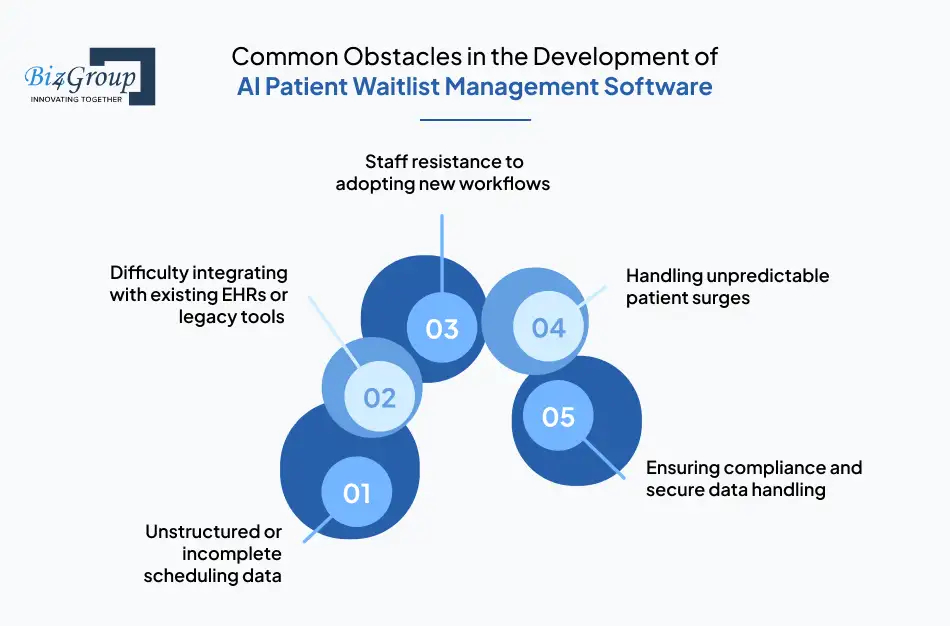
Even the strongest teams hit roadblocks when they develop AI patient waitlist management software, mostly because real patient flow is unpredictable and data rarely behaves the way you expect. Knowing these hurdles makes it easier to plan for what comes next.
|
Top Challenges |
How to Solve Them |
|
Unstructured or incomplete scheduling data |
Start with data cleanup and create clear intake rules so your AI patient waitlist management software development foundation stays reliable. |
|
Difficulty integrating with existing EHRs or legacy tools |
Use modular APIs and staged integration to reduce disruptions for staff during daily scheduling work. |
|
Staff resistance to adopting new workflows |
Build simple interfaces, offer quick onboarding, and gather early feedback so the system feels familiar from day one. |
|
Handling unpredictable patient surges |
Architect the platform for scale and plan systems that can make an AI tool that manages patient waitlists across multiple locations smoothly via predictive analytics. |
|
Ensuring compliance and secure data handling |
Implement strict access controls, auditing, and encryption across the entire workflow to protect PHI at every touchpoint. |
Understanding these hurdles gives you a clearer path toward building a system that supports real world clinical pressure, making it easier to see which development partner can guide the process effectively.
Also Read: 50+ Questions to Ask Before AI Adoption in Healthcare
Design a Future Ready Patient Flow Platform
Use data driven workflows to support the development of AI patient waitlist management software that grows with your organization.
Build My AI Platform RoadmapWhat's Next for AI Patient Waitlist Management Software Development?
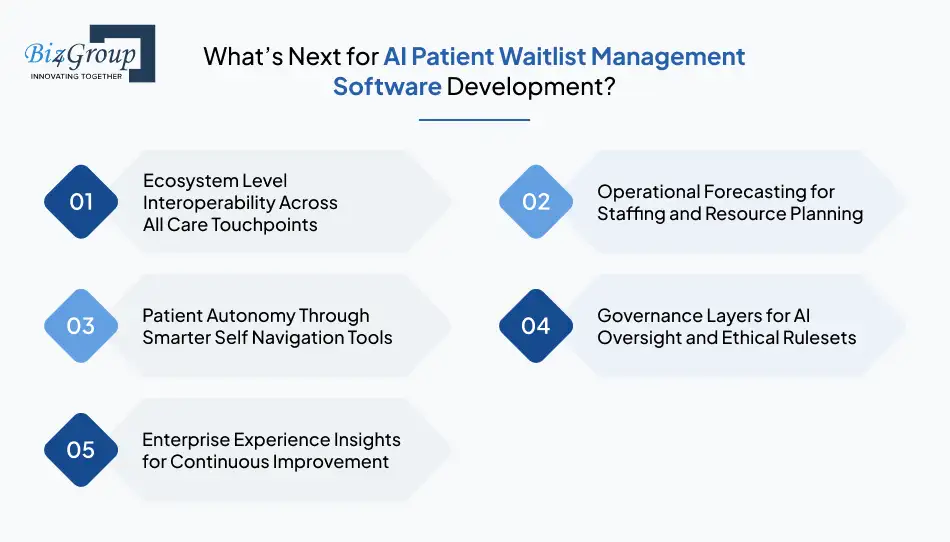
The future of waitlist automation goes far beyond reorganizing queues. When you develop AI patient waitlist management software, the next evolution focuses on organizational intelligence, patient empowerment, and long term operational strategy.
1. Ecosystem Level Interoperability Across All Care Touchpoints
Future platforms will integrate effortlessly with telehealth tools, remote monitoring systems, and specialty-care workflows. This ecosystem connectivity becomes easier for teams already coordinating digital efforts alongside business app development using AI within their environment.
2. Operational Forecasting for Staffing and Resource Planning
Next generation systems will help leaders anticipate staffing needs, room utilization, and equipment demand weeks ahead. This moves scheduling intelligence into organizational planning rather than daily reaction mode.
3. Patient Autonomy Through Smarter Self Navigation Tools
Patients will manage more of their waitlist experience independently, from virtual queue adjustments to real time rescheduling. This shift aligns with rising expectations for transparency and convenience in modern care.
4. Governance Layers for AI Oversight and Ethical Rulesets
As AI influences operational flow, future platforms will include built in governance panels that let organizations review decisions, refine fairness rules, and maintain clarity around how AI behaves.
5. Enterprise Experience Insights for Continuous Improvement
Beyond throughput metrics, systems will track long term behavior patterns across clinics to support experience design and service quality improvements. These insights often exist alongside digital transformation frameworks that involve entities similar to top AI development companies in Florida.
These forward looking capabilities help shape how teams prepare for the next stage of automation, setting the tone for choosing a partner who can support this trajectory effectively.
Why Biz4Group Is a Trusted Partner to Develop AI Patient Waitlist Management Software?
When you develop AI patient waitlist management software, you need a partner that understands real clinical workflow pressure, can architect dependable AI systems, and has already delivered healthcare platforms that perform in the real world. Biz4Group brings that blend of technical depth and healthcare awareness.
Our work on platforms like Truman and Semuto demonstrates how intelligently built AI solutions can guide users, support decisions, and adapt to complex care scenarios. The same approach strengthens the development of AI patient waitlist management software, where reliability and patient flow responsiveness matter just as much as accuracy.
What Makes Biz4Group a Strong Fit
- A track record of building AI healthcare platforms that operate smoothly under real clinical demand
- User centered workflow design that teams adopt quickly during high volume hours
- Robust backend and AI engineering to support prediction, automation, and long term growth
- Experience aligned with the capabilities of an AI development company, ensuring tailored solutions rather than one size fits all builds
- A focus on compliance, clarity, and performance so systems stay dependable every day
Biz4Group combines practical healthcare insight with sharp engineering, giving organizations a partner equipped to build systems that ease operational strain instead of adding to it.
Bring Predictable Efficiency to Every Care Setting
Build flexible AI systems that streamline capacity planning with strong AI waitlist management software development for patients foundations.
Create My AI-Driven Waitlist SystemConclusion: Moving Forward With AI Patient Waitlist Management Software Development
If your scheduling team feels like they are running a never-ending obstacle course, you are not imagining it. Modern patient flow is messy, unpredictable, and way too dependent on manual triage. When you develop AI patient waitlist management software, you finally give your operations the calm, predictable rhythm they have been missing while helping patients feel informed instead of forgotten.
With the right strategy, the right tech, and the right partner, this becomes less of a dream and more of a very doable next step supported by an AI product development company that understands how healthcare actually works.
Get a roadmap for your AI-powered waitlist platform
FAQs About How to Develop AI Patient Waitlist Management Software
1. How long does it take to build an AI-driven waitlist system?
Most organizations can expect development to take 4 to 9 months, depending on complexity, integrations, and testing needs. Timelines are shorter when the early foundation for AI patient queue management software is clearly defined from the start.
2. What kind of data is required for the system to work accurately?
Clean appointment histories, wait-time patterns, and provider schedules help the AI behave more reliably. These inputs are essential for effective AI waitlist management software development for patients, especially when creating logic that adapts to real clinical flow.
3. How much does it cost to build AI waitlist software?
Budgets generally fall between 30,000 and 300,000 depending on scope, features, and AI complexity. Costs rise when teams require deeper automation such as patient waitlist management software integrating AI to support multi-location operations.
4. Can the system support hospitals and urgent care centers?
Yes. Modern architectures can handle diverse workflows across high-volume settings. This becomes especially valuable when teams want to develop AI patient flow automation system for hospitals and urgent care to manage surges without overwhelming staff.
5. What should teams prepare before starting development?
You’ll need clarity on workflows, data access, and internal approvals. This preparation ensures smoother progress when planning how to build AI patient waitlist management software with the right rules and logic.
6. Are there technical requirements for building an AI-powered waitlist platform?
Yes. Scalable architecture, structured data pipelines, and strong compliance practices are essential. These elements support the broader development requirements for AI-powered waitlist management platform used in real clinical environments.
