Location :
Orlando, FL, USA
Location :
Orlando, FL, USA +1 (407) 714-1616
 info@biz4group.com


















Imagine a digital system that doesn’t wait for instructions but instead, understands your business goals, learns from real-time feedback, and takes independent actions to get the job done.
Read More

Real estate businesses manage a high volume of property listings, and writing each one manually can slow down operations and create inconsistency. To solve this, many companies are starting to develop an AI property listing generation tool that can generate property descriptions quickly using structured data.
In AI property listing tool development, the goal is not just to generate text, but to build a system that turns property data into clear and consistent listings. This reduces manual work and helps teams maintain the same quality across all listings. It also allows businesses to standardize how information is presented across platforms.
From a real estate AI software development perspective, accuracy is important. The generated content must match the actual property details and avoid incorrect or unclear descriptions. This requires clean input data, defined rules for generation, and validation steps to keep the output reliable.
Many companies also work with an AI development company when they need to build systems that can scale and integrate with existing tools. This is especially useful when listing generation needs to connect with CRMs, listing platforms, or marketing systems.
Businesses that develop AI property listing generation tool for real estate are usually focused on improving speed, maintaining consistency, and handling more listings without increasing effort. This guide explains how to build such a system, including the key components and decisions involved in AI property listing tool development.
An AI property listing generation tool is a system that converts structured property data into clear listing content. The tool takes inputs such as location, price, features, and amenities, and generates descriptions that can be used across platforms.
When companies build AI property listing generator for real estate businesses, they are setting up a workflow that connects data, generation, and output. This usually includes handling property data, generating content, checking accuracy, and sending the output to platforms like CRMs or listing portals. The focus is on consistent and repeatable results.
This type of system is often part of AI automation services, where repetitive tasks are handled automatically while keeping control over accuracy. It helps reduce manual work and keeps listings aligned with actual property details.
An AI property listing tool is often confused with basic automation. In reality, it works differently and handles more than simple text generation.
An AI property listing tool fits into different stages of real estate operations and supports existing processes rather than replacing them.
Businesses that create AI property listing generation software use it to make listing creation faster and more consistent. It connects data and content within existing workflows without adding extra manual effort.
When you plan to develop an AI property listing generation tool, it’s important that you understand the defined workflow that converts property data into listing content. Instead of relying on a single step, the process is divided into layers, where each stage handles a specific function and passes the output to the next.
|
Layer |
Component |
What It Does |
Why It Matters |
|---|---|---|---|
|
Input Layer: Structured Property Data |
Property Attributes |
Captures details like location, price, size, amenities |
Ensures the system has accurate data |
|
Data Standardization |
Organizes inputs into a fixed schema |
Prevents inconsistency across listings |
|
|
Data Cleaning |
Removes incomplete or duplicate data |
Reduces errors in output |
|
|
Generation Layer: Controlled Content Creation |
Instruction Logic |
Defines how content should be generated |
Keeps output structured and predictable |
|
Content Generation Engine |
Converts data into listing descriptions |
Produces readable content |
|
|
Tone and Style Control |
Maintains consistent language |
Ensures uniform listing quality |
|
|
Validation Layer: Accuracy and Compliance |
Data Verification |
Matches output with input data |
Prevents incorrect property details |
|
Rule-Based Checks |
Applies predefined rules |
Ensures compliance and clarity |
|
|
Review Flags |
Marks outputs needing manual review |
Adds control where needed |
|
|
Output Layer: Multi-Channel Formatting |
Format Conversion |
Adapts content for different platforms |
Makes listings usable across channels |
|
Channel Customization |
Adjusts content for platform needs |
Improves relevance |
|
|
API Integration |
Sends content to CRMs or listing platforms |
Enables automation |
|
|
Bulk Processing |
Handles multiple listings at once |
Supports scaling |
This layered approach is commonly used when teams implement generative AI in real estate, as it allows better control over how data is transformed into listing content. Businesses that make AI property listing tool for real estate agents focus on building this workflow so that listings can be generated quickly, remain accurate, and be used directly across platforms.
Portfolio Spotlight

Biz4Group developed Facilitor, an AI-powered real estate platform that helps users explore properties and receive guided assistance throughout the buying process. It combines structured data, intelligent recommendations, and user-friendly workflows. This kind of system reflects how AI can support listing generation, personalization, and decision-making within real estate platforms.
See how to develop an AI property listing generation tool that handles descriptions for you, without losing control over quality.
Automate My Listings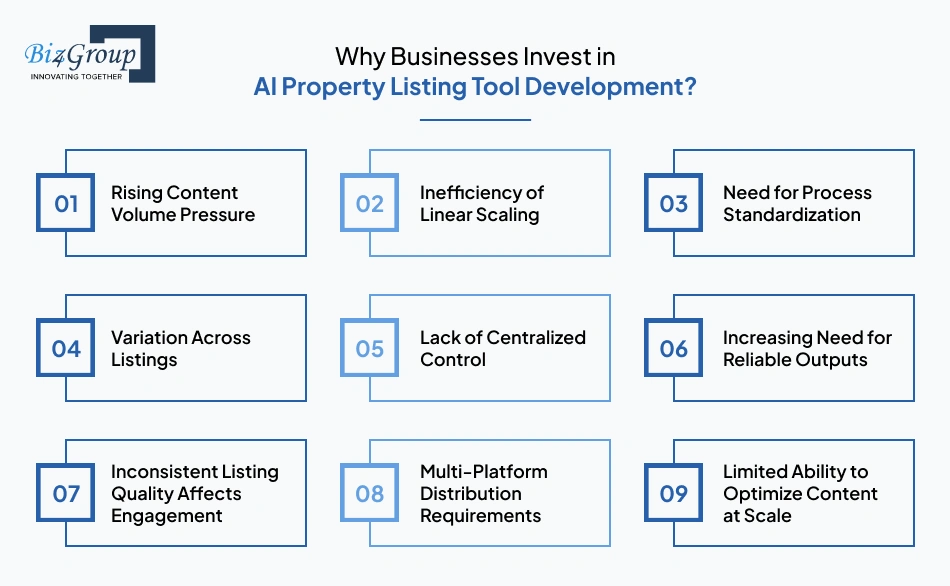
Businesses invest to develop an AI property listing generation tool when listing creation starts affecting operations directly. This usually happens when teams spend too much time writing listings, outputs vary across properties, or content needs to be created faster than manual workflows allow. Instead of managing these issues case by case, companies invest in a system that can handle listing generation in a consistent and controlled way.
As the number of properties increases, the demand for listing content grows quickly. Manual teams struggle to keep up without delays or shortcuts. This leads businesses to look for systems that can handle higher output efficiently.
Hiring more people increases cost but does not always improve consistency or speed. Output depends on individual effort, which can vary. This makes scaling through hiring less reliable over time.
Without a system, listing creation depends on how individuals work. This leads to uneven results and gaps in quality. Businesses invest to create a consistent and repeatable process.
Different people write listings in different ways, leading to inconsistent tone and structure. This affects how properties are presented. A system helps standardize content across all listings.
Manual workflows make it difficult to enforce rules for formatting and data usage. This increases the risk of unclear or incorrect content. Many companies use AI for real estate agents to maintain better control.
Listings must reflect actual property details without errors. Inconsistent or incorrect information can affect trust. Businesses invest in systems that generate content directly from structured data.
Listings that are unclear or incomplete reduce user interest. Poor structure makes it harder for buyers to understand key details. Businesses invest to improve clarity and presentation.
Listings are published across multiple platforms, each with different requirements. Adapting content manually takes time and effort. This drives the need for systems that can adjust content automatically.
Manual processes make it difficult to improve listings based on performance data. Businesses need a way to refine content consistently. This is one of the reasons behind AI real estate listing generator development.
Companies that develop AI powered property listing tool are addressing operational limits rather than just adding automation. The goal is to create a system that supports consistent, scalable, and controlled listing generation across platforms.
Portfolio Spotlight

Renters Book is a platform focused on rental transparency through reviews and ratings, helping users make informed decisions before leasing properties. It addresses trust and reliability issues in rental ecosystems. Such platforms show the importance of accurate, consistent listing content in improving user trust and engagement.
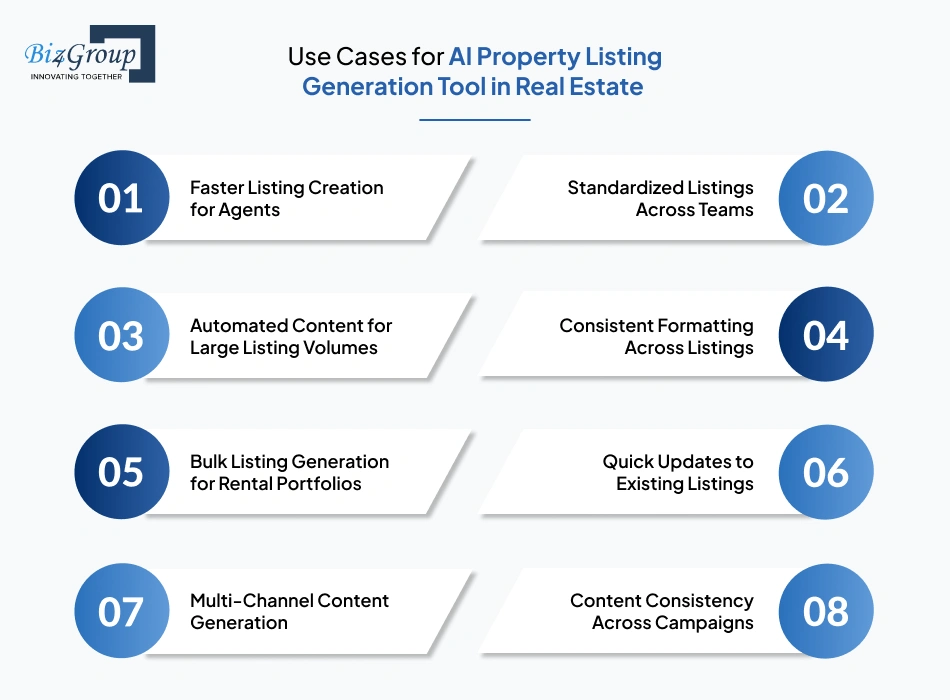
Businesses explore use cases before they develop an AI property listing generation tool because the value of the system depends on where it is applied. In real estate, listing content is created by different teams for different purposes, and each workflow has its own requirements. Understanding these use cases helps define what the system should generate, how it should behave, and where it should integrate.
Agents often handle multiple properties at once, and writing each listing manually takes time. A system can generate descriptions from property data, reducing effort and speeding up the process. This allows agents to focus more on client work instead of content creation.
Different agents may write listings in different styles, which creates inconsistency. A shared system ensures all listings follow the same structure and tone. This improves how properties are presented to buyers.
Platforms receive listings from multiple sources, often in different formats. Systems that make AI listing generation platform for property websites help convert this data into consistent descriptions automatically. This reduces the need for manual editing and is a common approach in AI in real estate development.
Listings from different sources may vary in quality and structure. A system helps standardize how information is presented across all properties. This improves usability and makes listings easier to compare.
Property managers often handle multiple units that need similar listings. Systems that build AI property description generator for real estate allow bulk content generation while keeping each listing accurate. This saves time and effort.
Rental listings change frequently based on availability or pricing. Manual updates can be slow and error-prone. A system updates the content automatically when the data changes.
Marketing teams need listing content for different platforms like websites, ads, and emails. A system can generate versions of the same listing for each channel. This supports faster campaign execution.
Marketing teams need consistent messaging across all listings. Systems built using generative AI help maintain the same tone and structure. This keeps communication clear and uniform.
|
Business Type |
Key Use Case |
What the System Does |
Outcome |
|---|---|---|---|
|
Real Estate Agencies |
Listing creation for agents |
Generates listings from property data |
Saves time and improves consistency |
|
Property Listing Platforms |
Handling large listing volumes |
Standardizes and generates content automatically |
Reduces manual effort and improves uniformity |
|
Property Management Companies |
Managing multiple units |
Generates and updates listings in bulk |
Supports scale and reduces manual updates |
|
Marketing Teams |
Multi-channel content creation |
Adapts listings for different platforms |
Enables faster and consistent campaigns |
Across these use cases, businesses rely on AI model development to build systems that connect data and content generation. Companies that create AI real estate content generation tool aim to support different teams with one system, making listing creation faster and more consistent.
Portfolio Spotlight
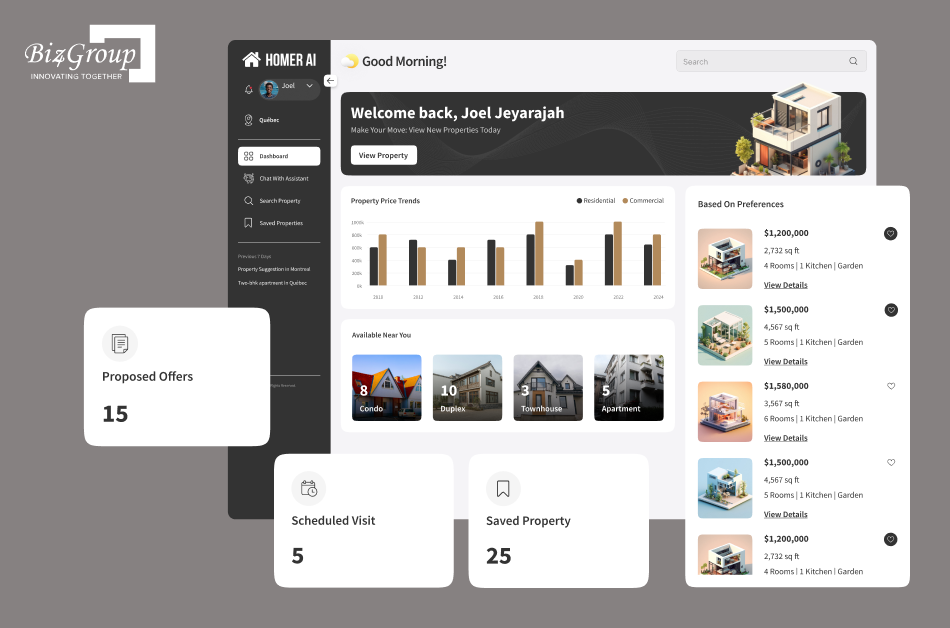
Homer AI is a conversational platform that connects buyers and sellers in one place, using AI to guide interactions and streamline property discovery. It focuses on simplifying communication and improving user engagement across the buying journey. Such systems highlight how AI-generated content and interactions can improve listing visibility and user experience.
Tired of delays and inconsistencies? Learn how to develop AI property listing generation tool for real estate that fits your existing process.
Streamline My WorkflowWhen building an AI property listing tool, businesses quickly realize that not all features are equally important. Some capabilities are essential for the system to work reliably from day one, while others can be added later as the tool scales. Identifying these must-have features helps teams focus on what makes the tool functional, consistent, and accurate, rather than getting distracted by optional bells and whistles.
|
Feature |
What It Does |
Why It Matters |
|---|---|---|
|
Structured Input Handling |
Captures and organizes property data into a defined format |
Provides a reliable data foundation; without structured inputs, outputs can be inaccurate |
|
Controlled Content Generation |
Applies rules or templates to generate property listings |
Ensures listings are consistent and aligned with business requirements |
|
Validation and Error Checks |
Verifies generated content against input data |
Reduces errors and prevents misleading or incorrect information |
|
Basic Editing Interface |
Allows users to review and make minor adjustments |
Adds human oversight for accuracy before publishing |
These features form the foundation of any functional AI listing system. Many businesses implement them as part of AI integration services to connect data, generation, and workflow processes. Companies investing in AI property marketing tool development prioritize these core capabilities first, ensuring listings are accurate, consistent, and ready for scale before adding advanced features or multi-channel outputs.
After businesses develop an AI property listing generation tool, they often add advanced features to handle more listings, different channels, and varied audiences. These features help companies scale efficiently and make the system work for larger teams or enterprise workflows.
Enterprise systems often need listings in multiple languages to reach wider audiences. Multi-language support ensures content is correct and clear in every language.
Different listings may need different styles, from casual rental ads to formal luxury property descriptions. Customizing tone helps maintain brand consistency while adapting to the property type.
Listings need to fit websites, apps, emails, or social media. Channel-specific formatting makes sure the content works for each platform without extra editing.
Large enterprises manage many properties at once. Bulk generation creates multiple listings quickly while keeping them accurate. This often uses generative AI to produce consistent descriptions at scale.
Advanced tools can connect to CRMs, listing platforms, and other systems via APIs. This makes generated content flow directly into business workflows and supports enterprise AI solutions.
Businesses that develop AI listing automation tool for real estate often add these advanced capabilities after setting up core features. Those learning how to build an AI property listing generation tool for real estate agents use these features to handle more listings, multiple channels, and flexible content styles efficiently.
Not sure what your tool should include? Break down features, scope, and approach before you start building.
Define My AI Tool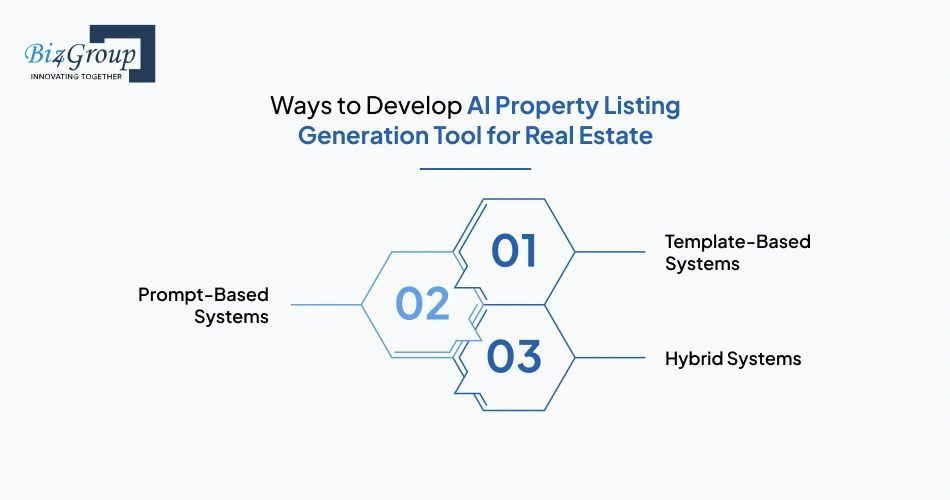
When businesses plan to develop an AI property listing generation tool, they need to choose how the system will create listing content. This decision affects how consistent the output is and how much flexibility the system allows. The approach also decides how easy it is to scale the tool over time.
Template-based systems use fixed formats where property details are added into predefined sentences. This keeps the output consistent and easy to control, especially when listings follow a similar structure. It is often used in early stages when teams build AI software with simple and predictable outputs.
Prompt-based systems use instructions to generate listing content through an AI model. This allows more variation in how descriptions are written and works well for different property types. It is commonly used when building an AI Property Listing Generation Tool that needs flexible and natural-sounding content.
Hybrid systems combine templates and AI generation to balance control and flexibility. Templates handle the structure, while AI generates parts of the content where variation is needed. This approach is widely used in enterprise AI property listing generation tool development for proptech companies and when teams integrate AI into an app for better scalability.
Each approach has its own use case, and the choice depends on how much control or flexibility is required. Businesses involved in enterprise AI property listing generation tool development for proptech companies often move to hybrid systems as they scale building an AI Property Listing Generation Tool.
Avoid rework by understanding how to build AI property listing generator for real estate businesses with the right structure from day one.
Plan My BuildWhen businesses develop an AI property listing generation tool, choosing the right approach depends on what matters most: control, speed, or cost. Each approach works well in a specific situation, and the decision should be based on how the tool will be used in real workflows.
|
Situation |
What It Means |
Suitable Approach |
|---|---|---|
|
Strict formatting needed |
Listings must follow a fixed structure |
Template-based or hybrid systems |
|
High accuracy required |
No room for incorrect or vague content |
Controlled generation with validation |
|
Brand consistency is critical |
Tone and format must remain uniform |
Rule-driven or template-supported systems |
In such cases, businesses focus on predictable outputs rather than variation. This is common in regulated or large-scale environments where consistency is more important than creativity.
In some workflows, the priority is to generate listings quickly rather than customize each one in detail. This is common when teams are handling large volumes or working with tight timelines.
In these situations, prompt-based systems are often preferred because they generate content quickly. This approach works well for teams exploring how to create scalable AI property listing tool for real estate platforms, where speed and output volume are key priorities.
When budget is limited, the development approach needs to balance cost with functionality. This usually means starting with simpler systems and expanding later.
Common decisions under cost constraints:
Many teams also build real estate AI software in phases to manage costs and reduce risk. This approach aligns with the process to develop enterprise AI property listing generation tool, where systems evolve over time instead of being built all at once.
The right approach depends on business priorities and constraints. Companies working on process to develop enterprise AI property listing generation tool often adjust their approach as they scale, balancing control, speed, and cost based on changing needs.
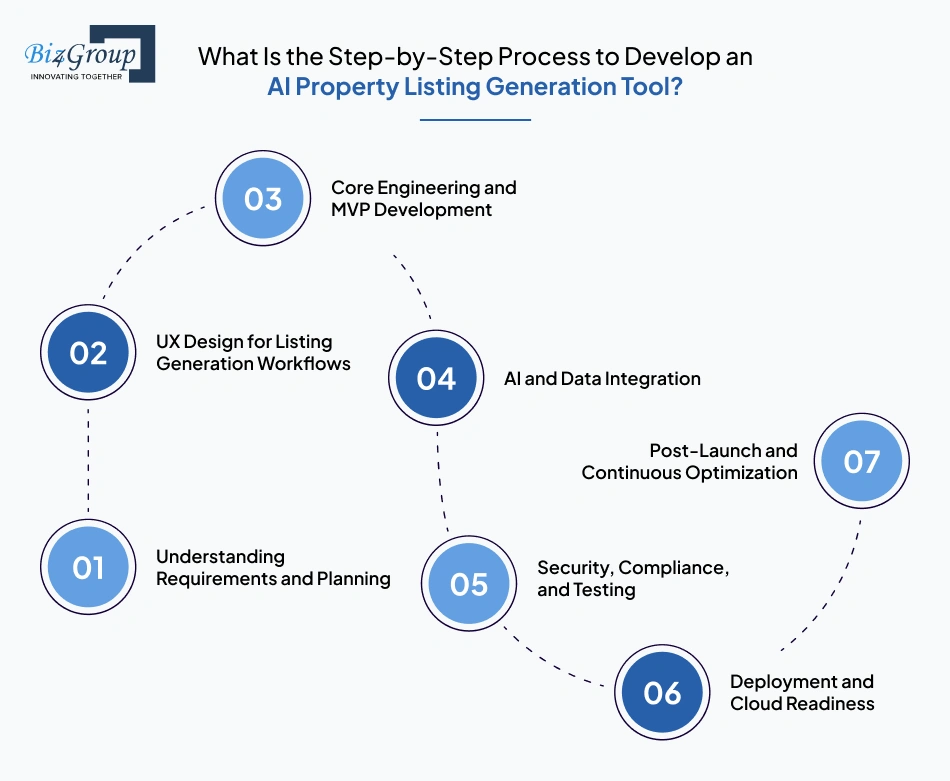
To develop an AI property listing generation tool, businesses need a clear process that connects property data, content generation, and real workflows. Each step focuses on solving a specific problem so the system is easy to use and works reliably at scale.
Start by understanding where listing creation slows down or causes issues. This helps define what the tool should do first and avoids building unnecessary features.
This step helps answer how can we develop an AI property listing generation tool for our real estate business by aligning the tool with real needs.
The tool should be simple to use for agents and teams. A clear UI/UX design helps users enter data, generate listings, and review content without confusion.
For better usability, many businesses invest in .
Also read: Top 15 UI/UX Design Companies in USA (2026 Edition)
Start with a basic version of the tool instead of building everything at once. This helps test if the system works before adding more features.
Many teams start with MVP development services to validate the core functionality before scaling.
Also read: Top 12+ MVP Development Companies to Launch Your Startup in 2026
The system needs clean data to generate accurate listings. This step focuses on connecting data with the generation process.
This is where teams often decide who can build an AI property listing generator for real estate platforms if they need external support.
Listings must be accurate and safe to use. Testing ensures the system does not generate incorrect or incomplete content.
Also Read: 15+ Software Testing Companies in USA in 2026
The tool should handle both small and large workloads. A stable setup ensures it works smoothly as usage grows.
This step supports teams planning how to launch an AI property listing generation tool for my platform.
After launch, the tool needs regular updates to stay useful. This helps improve quality and adapt to changing needs.
This step-by-step process helps businesses build a system that works in real listing workflows. By focusing on clear steps, clean data, and gradual improvements, teams can avoid unnecessary complexity. This is how businesses approach how to create scalable AI property listing tool for real estate platforms, making sure the tool can handle more listings as their needs grow.
Choosing the right tech stack is important when building an AI property listing generation system. The stack should support structured property data, controlled content generation, and smooth integration with real estate platforms. It should also make it easy to scale listing creation as usage grows.
|
Label |
Preferred Technologies |
Why It Matters |
|---|---|---|
|
Frontend Framework |
React.js, Vue.js |
Used to build dashboards where agents input data and generate listings; many teams rely on ReactJS development for fast interfaces |
|
Server-Side Rendering & SEO |
Next.js, Nuxt.js |
NextJS development helps render listing pages quickly and improves visibility |
|
Backend Framework |
Node.js, Python |
Python development and NodeJS development manage APIs, workflows, and AI logic, supporting scalable processing |
|
API Development Layer |
REST APIs, GraphQL |
Connects listing generation with CRMs, websites, and apps; ensures smooth data flow between systems |
|
AI & Data Processing |
NLP libraries, OpenAI APIs |
Converts structured property data into listing content; ensures consistent and usable outputs |
|
Data Storage |
PostgreSQL, MongoDB |
Stores property details and generated listings; keeps data organized and easy to retrieve |
|
Prompt & Logic Management |
Prompt templates, rule engines |
Controls how listings are generated; helps maintain consistency across outputs |
|
Validation Layer |
Rule engines, custom scripts |
Checks generated listings against input data; reduces incorrect or misleading content |
|
Integration Layer |
Webhooks, third-party APIs |
Pushes listings to property platforms and marketing tools automatically |
|
Cloud & Deployment |
AWS, Azure, GCP |
Handles bulk listing generation and scaling; ensures stable performance during peak usage |
|
Monitoring & Logging |
ELK Stack, Datadog |
Tracks errors, usage, and performance; helps improve system reliability over time |
A good tech stack helps keep listing generation simple, accurate, and consistent as usage grows. It also makes it easier to add new features later without changing the core system. This is important when teams develop an AI property listing generation tool, so the system can support current needs and handle more listings over time.
Move beyond one-off descriptions and create AI real estate content generation tool that supports growth.
Make It ScalableThe cost to develop an AI property listing generation tool depends on how complex the system is and what features are included. In most cases, the cost falls between $20,000 to $200,000+ (ballpark estimate). A simple version costs less, while systems with more features and integrations cost more.
|
Category |
What It Includes |
Estimated Cost |
|---|---|---|
|
MVP-level AI Property Listing Generator for Real Estate |
Basic listing generation, structured input, simple validation, basic interface |
$20,000 – $50,000 |
|
Advanced AI Property Listing Generator for Real Estate |
Better generation logic, editing features, multi-format output, some integrations |
$50,000 – $120,000 |
|
Enterprise-grade AI Property Listing Generator for Real Estate |
Bulk generation, full integrations, multi-channel output, scalability and monitoring |
$120,000 – $200,000+ |
The total cost depends on what you build and how you build it. Businesses can control cost by starting simple and adding features later.
The final cost depends on your goals and how you plan the system. Businessmen putting in prompts like ‘where can I hire developers to build an AI property listing generator’ on AI platforms should consider both upfront cost and ongoing expenses before making a decision.
When businesses plan to develop an AI property listing generation tool, they need to decide whether to build a custom system or use an existing solution. This decision affects cost, control, and how well the tool fits into real estate workflows.
|
Factor |
Build In-House |
Buy Existing Solution |
|---|---|---|
|
Control Over System |
Full control over data, generation logic, and workflows |
Limited control based on vendor features and restrictions |
|
Customization Level |
Can match exact business needs and listing formats |
Limited to predefined templates and settings |
|
Time to Launch |
Longer development time due to planning and testing |
Faster setup with ready-to-use features |
|
Cost Structure |
Higher upfront cost, lower long-term dependency |
Lower upfront cost but ongoing subscription fees |
|
Integration Capability |
Can connect deeply with CRM, MLS, and internal systems |
Limited integrations or additional costs for custom connections |
|
Scalability |
Designed based on business growth and listing volume |
Depends on vendor limits and infrastructure |
|
Data Ownership |
Full ownership of listing data and generated content |
Data may be stored or processed by third-party systems |
|
Flexibility Over Time |
Easy to modify and improve based on business needs |
Changes depend on vendor roadmap and updates |
|
Use Case Fit |
Suitable for complex workflows and large-scale operations |
Suitable for simple and standardized use cases |
|
Maintenance Responsibility |
Managed internally or by development partner |
Handled by the vendor |
The right choice depends on how much control and flexibility the business needs. Companies exploring how to use AI for real estate often choose to build when their workflows are complex, and buy when they need a quick and simple solution. Businesses focused on creating an AI property listing generator for real estate agents follow this approach to match the tool with their operational needs.
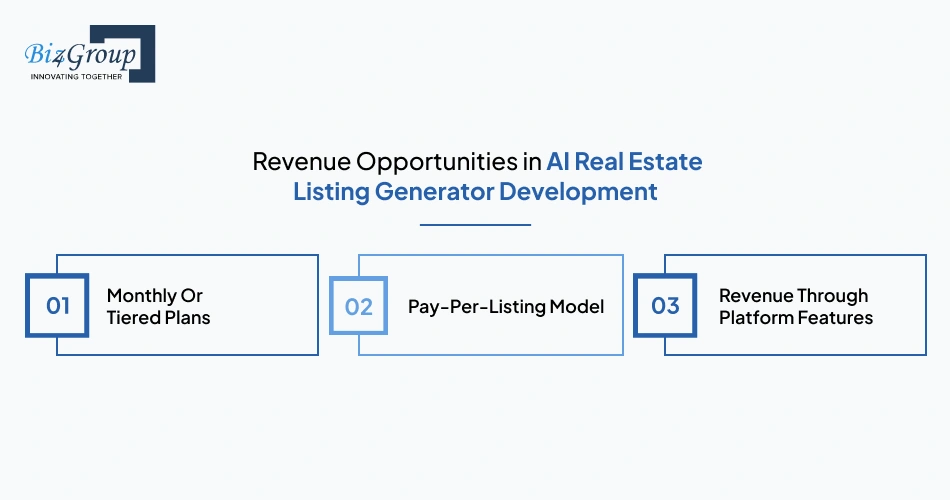
Once the tool is built, the next step is deciding how it will generate revenue. Different users such as agents, agencies, and platforms use the tool in different ways, so pricing models need to match their usage patterns. Choosing the right model helps make the product sustainable and easier to scale.
Users pay a fixed fee every month or year to use the tool. Plans can be based on features, number of listings, or team size. This model gives stable and predictable revenue.
... rest of the code remains the same ...Users pay only when they generate listings. This works well for businesses that do not need the tool every day. It gives flexibility and keeps costs tied to usage.
The tool can be added to platforms like CRMs or listing websites and offered as a paid feature. Revenue comes from upgrades or feature access. This is one of the real estate AI apps ideas often used when companies build AI property listing generator for real estate businesses as part of a larger system.
The right model depends on how the tool is used and who the target users are. Businesses that develop AI property listing generation tool for real estate often combine these options to create a pricing setup that fits different user needs and supports long-term growth.
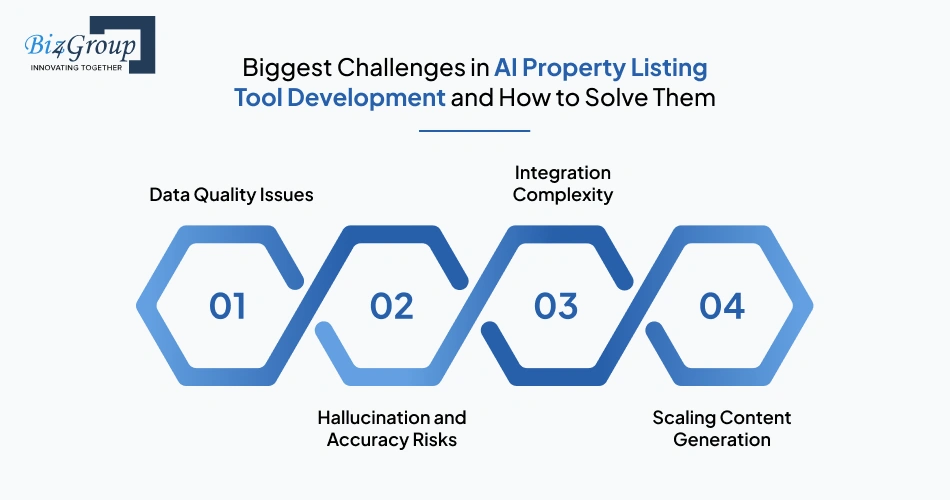
When businesses develop an AI property listing generation tool, they often face challenges that affect output quality and system reliability. These challenges usually come from data issues, system design, or scaling limitations. Addressing them early helps avoid errors and ensures the tool works well in real workflows.
|
Challenge |
What It Means |
How to Solve It |
|---|---|---|
|
Data Quality Issues |
Incomplete or inconsistent property data leads to poor listings |
Use structured data formats, enforce required fields, and clean inputs before generation |
|
Hallucination and Accuracy Risks |
The system may generate incorrect or unclear property details |
Add validation rules and match outputs with input data before publishing |
|
Integration Complexity |
Connecting with CRMs, listing platforms, and APIs can be difficult |
Use well-defined APIs and standard data formats to simplify integration |
|
Scaling Content Generation |
Generating large volumes of listings can slow down the system |
Use scalable infrastructure and batch processing for bulk listing generation |
These challenges are common when businesses create AI property listing generation software, especially as the system grows. Teams working on business app development using AI often focus on structured data, validation, and scalable design to keep the tool accurate and reliable over time.
Portfolio Spotlight
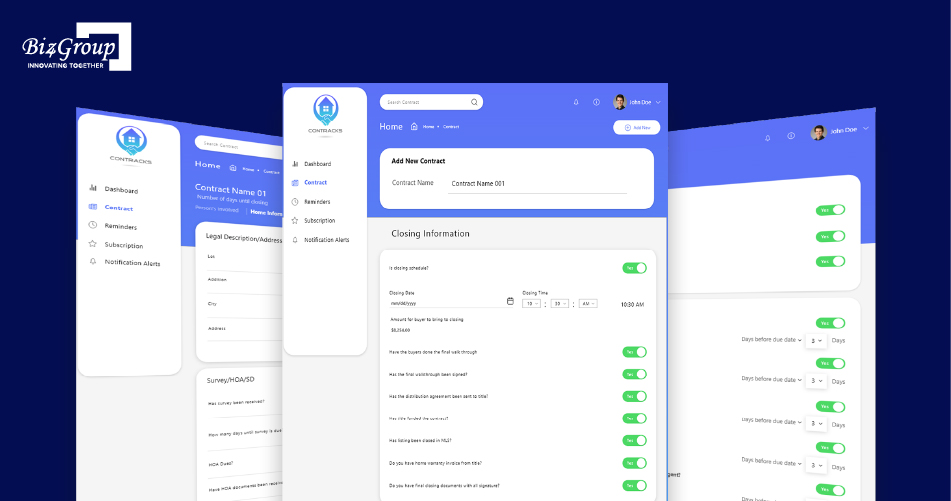
Contracks is a real estate contract management platform designed to simplify documentation, track progress, and manage transaction workflows. It helps users stay updated with alerts and ensures smoother handling of property-related processes. This shows how structured data systems can support accurate and compliant listing-related operations.
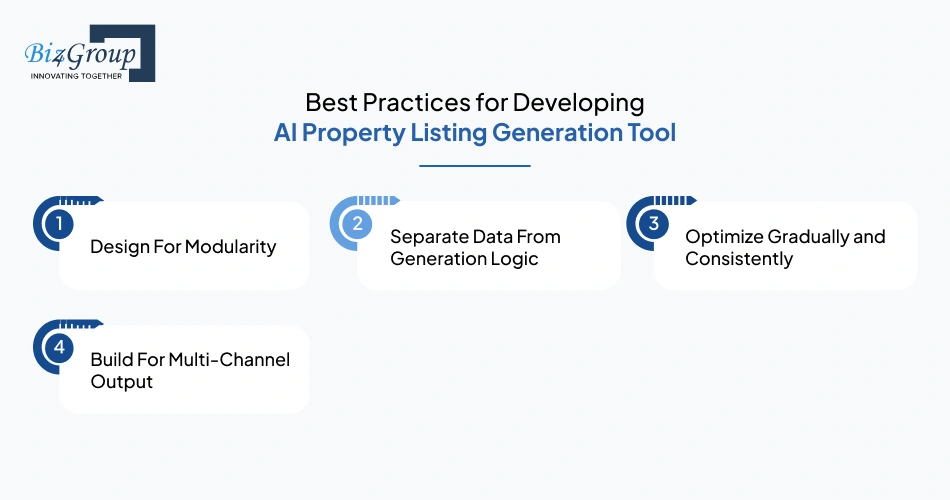
If you’re planning to develop an AI property listing generation tool, you need to keep the system simple, reliable, and easy to update. Following a few basic practices helps avoid common issues and makes the tool easier to manage as it grows.
Build the system in smaller parts instead of one large system. This makes it easier to update or fix one part without affecting everything else. It also helps when adding new features later. This is useful in AI real estate listing generator development where systems keep evolving.
Keep property data separate from how listings are generated. This makes it easier to update data or change how content is created without breaking the system. It also helps keep outputs accurate and consistent.
Start with a simple version and improve it over time. This allows teams to test the tool in real workflows and fix issues early. This approach is common in businesses that build AI real estate app MVP, with systems that are improved step by step.
Design the system so listings can be used across websites, apps, and marketing channels. This avoids rewriting content for each platform. It also helps teams make AI property listing tool for real estate agents more useful in daily workflows.
Following these practices helps keep the system easy to manage and improve. Teams working on AI real estate listing generator development use these steps to make sure the tool works well as their needs grow.
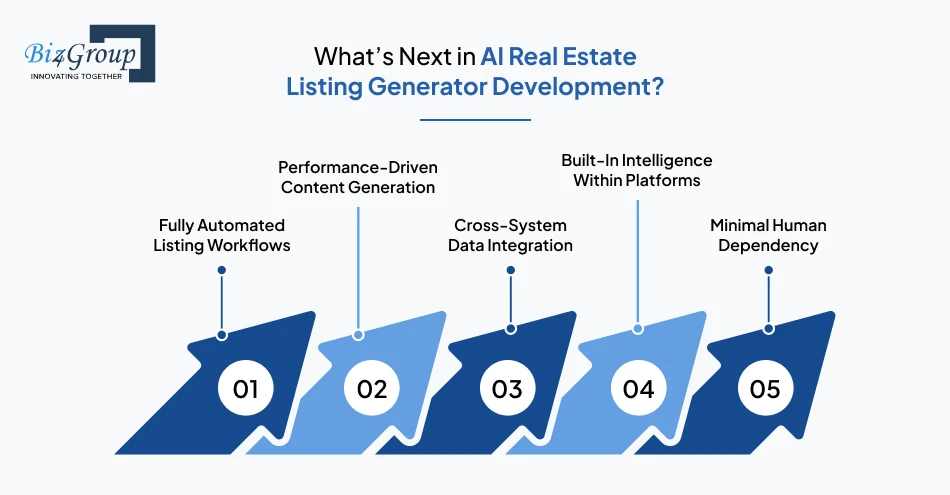
As businesses continue to develop an AI property listing generation tool, the focus is moving toward systems that reduce manual work and make listing creation more automatic and connected.
Future systems will handle more than just writing descriptions. They will manage the full process from creating to publishing listings. This reduces the need for multiple tools and manual steps.
Listings will be created based on what works better, not just property data. Systems will use past results to improve how listings are written. This helps make content more effective over time.
Future tools will connect with systems like CRMs and listing platforms. This allows listing content to update based on real-time data. It helps keep listings relevant and consistent.
Listing generation will become part of real estate platforms instead of a separate tool. Users will create and manage listings in one place. This makes the workflow simpler.
Future systems will need less manual editing and review. With better data and validation, listings can be used directly with more confidence. This is similar to how an AI conversation app reduces manual effort in other workflows.
As these changes continue, businesses that build AI property description generator for real estate will focus on making systems more automatic and easier to use. This is where companies that develop AI powered property listing tool can improve efficiency and reduce manual work.
Already have a system? Improve it with AI without rebuilding your entire platform.
Improve My Existing ToolIf you're planning to develop an AI property listing generation tool, the challenge is making sure it actually works with your listing workflows. That’s where Biz4Group LLC focuses as a custom software development company, building systems that fit how listings are actually created and managed.
Projects like Facilitor and Homer AI show how AI fits into property discovery and user interaction, while Contracks and Renters Book handle workflows and data consistency. This ensures the tool is designed around real listing processes, not just content generation in isolation.
Instead of building a standalone tool, Biz4Group LLC focuses on how listings are created, edited, and published in your business. This helps the system fit naturally into daily operations, whether you're managing a few listings or handling large volumes.
The process stays simple, build what is needed first, test it in real use, and then expand. This avoids unnecessary complexity and helps teams start using the tool early while keeping it ready to scale.
As an AI app development company, Biz4Group LLC focuses on applying AI in ways that support real workflows. Businesses planning to create AI real estate content generation tool can use this approach to build solutions that are practical, scalable, and easy to use.
Building an AI listing tool goes beyond writing better descriptions, it’s about fixing how listings are created, managed, and published. When businesses develop an AI property listing generation tool, the real value comes from reducing manual work, keeping content consistent, and fitting into existing workflows without adding extra steps.
The key is to start simple, focus on structured data, and improve the system over time instead of trying to build everything at once. A clear development approach helps avoid unnecessary complexity and ensures the tool works in real-world conditions, not just in theory.
This is where product development services play an important role, helping turn ideas into working systems that are stable and scalable.
With the right planning, guidance, and support by AI consulting services, businesses can build tools that not only generate listings but also improve how their entire listing process runs over time.
Looking to build a listing tool that actually fits your workflow? Let’s map out what your system should do before writing a single line of code.
AI-generated listings are accurate when they are based on clean, structured property data and proper validation rules. Without these, the system may generate incomplete or incorrect details. Accuracy improves over time as the system learns from edits and feedback.
Yes, these tools can handle different property types such as residential, commercial, or rentals. This depends on how the input data is structured and how the generation logic is designed. More detailed data allows better adaptation across property categories.
AI tools rely on predefined rules and validation layers to ensure compliance. They can be configured to include required legal terms and avoid restricted language. However, businesses still need to define compliance rules clearly within the system.
The system needs structured property data such as location, size, amenities, pricing, and property type. The quality and completeness of this data directly affect the output. Missing or inconsistent data can lead to weak or inaccurate listings.
The cost typically ranges between $20,000 to $200,000+, depending on features, integrations, and system complexity. A basic version costs less, while advanced or enterprise systems with automation and scalability require higher investment.
Development time usually ranges from a few weeks to several months. A basic system can be built faster, while systems with integrations, validation layers, and scalability take longer. The timeline depends on scope and development approach.

with Biz4Group today!
Our website require some cookies to function properly. Read our privacy policy to know more.