 Location :
Orlando, FL, USA
Location :
Orlando, FL, USA +1 (407) 714-1616
 info@biz4group.com

- This guide breaks down how to develop an Insurtech SaaS Product, focusing on policy, pricing, claims, compliance, and long-term scalability.
- Learn what it takes to build Insurtech SaaS software solutions that work for startups, MGAs, and large insurers without fragmenting the product or codebase.
- Get insights into real-world Insurtech SaaS product development decisions, including workflows, tech stack choices, revenue models, and execution tradeoffs.
- Market momentum supports the shift, with global insurtech investment and SaaS adoption accelerating as insurers modernize legacy operations and reduce manual overhead.
- Building an Insurtech SaaS Product typically ranges from USD 25,000 to USD 400,000+, depending on scope, compliance depth, and scalability needs.
Insurance leaders today are juggling legacy systems, rising customer expectations, regulatory pressure, and a growing push toward automation. Policy lifecycle delays, fragmented data, and manual underwriting still eat into margins. That is why many teams are now looking to develop an Insurtech SaaS Product that replaces patchwork workflows with one scalable platform, which naturally makes your browser history look like:
- develop an insurtech saas product
- how to build an insurance saas platform
- insurtech saas product development steps
- features needed in an insurtech saas solution
- cost to develop an insurtech saas product
The market signals are hard to ignore:
The global insurtech market is projected to grow to USD 152 billion by 2030, driven largely by SaaS based platforms modernizing insurance operations
Inside most insurance organizations, the pressure feels very personal. Leaders want faster underwriting cycles, clearer risk signals, and fewer handoffs during claims, yet every change carries regulatory weight. This is where thoughtful Insurtech SaaS product development shifts from a technology project to a long term operational decision.
For founders and product leaders, this shift is less about chasing trends and more about replacing friction with control. Working with an experienced AI app development company often becomes part of the conversation once teams decide to develop Insurtech SaaS platforms that can scale without breaking compliance.
What follows breaks down how to approach this build with clarity, covering product structure, execution decisions, and tradeoffs that matter when planning the cost to develop an insurtech SaaS product, especially when insurance automation software development becomes central to long term efficiency and resilience.
What Is an Insurtech SaaS Product?
An Insurtech SaaS Product is a cloud based insurance platform that helps carriers, MGAs, and brokers manage core operations through a single system. It brings underwriting, policy management, claims, and compliance into one scalable environment built for ongoing evolution.
- Centralizes policy, claims, billing, and customer data
- Supports configurable workflows for different insurance products
- Enables automation across underwriting and claims processes
- Integrates securely with third party data and tools
- Often enhanced via AI automation in insurance to reduce manual effort
For teams planning to modernize operations, choosing to develop an Insurtech SaaS Product is about building a foundation that stays flexible as regulations, products, and customer expectations continue to change.
How Insurtech SaaS Platforms Work Across Insurance Operations
At its core, this product exists to make insurance operations feel less scattered and more predictable. When teams decide to develop an Insurtech SaaS Product, the goal is not fancy tech, but a steady system that supports daily work without getting in the way.
1. One Shared System for Daily Insurance Work
All policy, customer, claims, and billing information lives in one place instead of across spreadsheets and tools. Teams stop chasing data and start working from the same view. This shared setup removes confusion and shortens decision cycles.
2. Configurable Logic That Matches Real Insurance Rules
Insurance rarely follows one fixed process. The platform allows rules to change by product, geography, or risk type without rewriting code. This flexibility is essential when companies build Insurtech SaaS software solutions meant to grow and adapt.
3. Connected Tools With Light Intelligence
The system connects with payment providers, data sources, and internal tools through secure connections. Some teams integrate AI into an app to assist with document handling, while others rely on AI automation services to reduce manual back office work.
|
Platform Area |
What Happens |
Why It Helps |
|---|---|---|
|
Core Data |
Policies and claims stored centrally |
Fewer errors and rework |
|
Business Rules |
Logic adapts to insurance needs |
Faster product changes |
|
Integrations |
External systems stay connected |
Smoother operations |
|
Automation |
Repetitive tasks handled quietly |
Better team efficiency |
Once this foundation is in place, the platform starts to fade into the background. That is usually the point where leaders looking to create insurance SaaS products begin focusing less on how it works and more on why it makes business sense to invest further.
Turn Insurtech Ideas into Scalable Platforms
Plan, validate, and develop an Insurtech SaaS Product that supports underwriting, claims, compliance, and growth without disrupting existing insurance operations.
Build an Insurtech SaaS PlatformWhy Companies Invest in Insurtech SaaS Product Development?
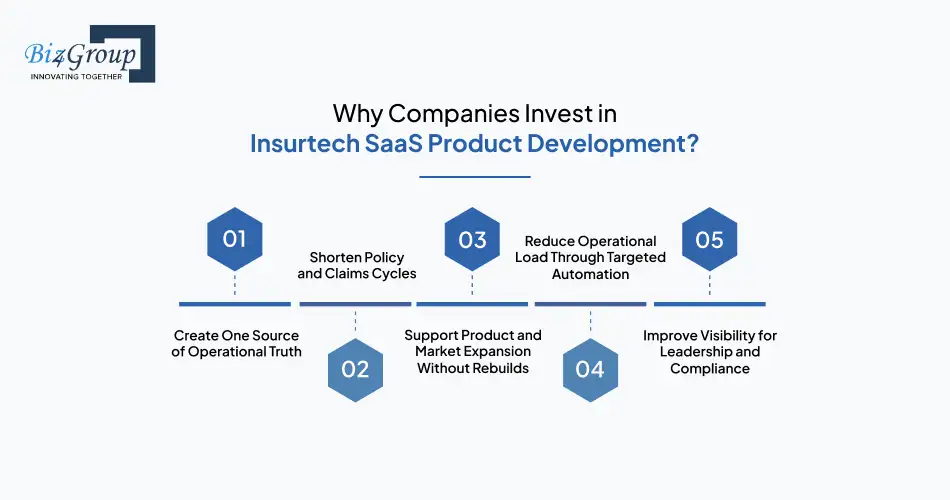
Most insurance teams arrive here after years of working around limitations rather than fixing them. When leaders decide to develop an Insurtech SaaS Product, it is usually driven by operational pain that can no longer be patched or ignored.
1. Create One Source of Operational Truth
Policy data, claims status, billing, and customer records often live in different systems. Focused insurance technology SaaS development brings these streams together so teams stop reconciling data and start making decisions with confidence.
2. Shorten Policy and Claims Cycles
Manual reviews and handoffs slow everything down. A purpose-built platform removes unnecessary steps and keeps work moving forward. This becomes critical when organizations aim to build digital insurance SaaS platforms that support faster underwriting and cleaner claims resolution.
3. Support Product and Market Expansion Without Rebuilds
New insurance products, regions, or regulations should not force system rewrites. Flexible SaaS architecture allows rules and workflows to evolve. Many teams rely on a custom software development company\ to design this adaptability from the start.
4. Reduce Operational Load Through Targeted Automation
Insurance teams want fewer repetitive tasks, not abstract innovation. A SaaS foundation makes it easier to introduce focused automation later, including AI insurance app development where it genuinely reduces workload across underwriting or claims.
5. Improve Visibility for Leadership and Compliance
Fragmented tools make it hard to see what is really happening. A unified platform offers real time insight into operations, risk exposure, and performance without manual reporting or delayed data.
When these advantages come together, the investment conversation shifts from tools to outcomes. That is usually when teams begin evaluating custom Insurtech SaaS development services based on how well they align with long term operational goals.
Practical Use Cases of Insurance SaaS Application Development
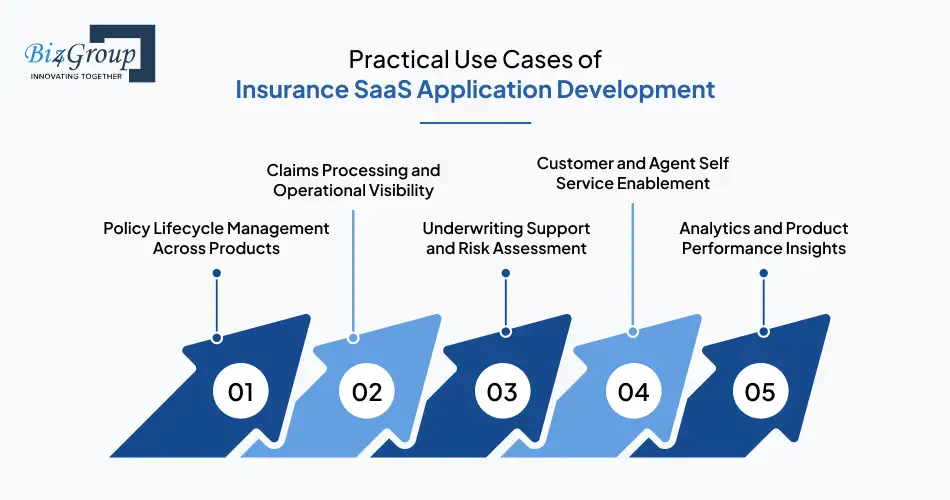
When teams decide to develop an Insurtech SaaS Product, the real value shows up in everyday insurance operations rather than abstract features. These use cases reflect where SaaS platforms consistently remove friction and deliver clarity across insurance workflows.
1. Policy Lifecycle Management Across Products
Insurance products vary widely, yet many teams still rely on rigid systems. Modern platforms support flexible policy creation, renewals, and endorsements through scalable insurance SaaS application development that adapts as product lines evolve.
- Example: A multi line insurer manages motor, health, and property policies from a single platform with configurable rules per product.
2. Claims Processing and Operational Visibility
Claims are where delays become visible to customers. SaaS platforms streamline intake, validation, and resolution while keeping teams aligned. Some insurers add AI integration services to reduce manual checks without changing approval authority.
- Example: Claims data flows from submission to settlement with fewer handoffs and real time status visibility.
3. Underwriting Support and Risk Assessment
Underwriting decisions depend on consistent data and timely insights. Platforms built to develop cloud based insurance SaaS products centralize risk data and support structured evaluation. Select teams introduce AI model development to surface patterns without replacing human judgment.
- Example: Underwriters review standardized risk profiles generated from integrated data sources.
4. Customer and Agent Self Service Enablement
SaaS platforms increasingly support agents and customers alongside internal teams. This includes portals and assisted workflows often paired with insurance chatbot development for faster responses and reduced support load.
- Example: Agents track policy status and endorsements without contacting back office teams.
5. Analytics and Product Performance Insights
Leadership needs insight without manual reporting delays. Platforms designed to create AI driven Insurtech SaaS solutions offer aggregated views into performance, loss ratios, and operational bottlenecks.
- Example: Executives monitor claims turnaround and policy growth trends from a unified dashboard.
|
Use Case Area |
Primary Benefit |
Business Impact |
|---|---|---|
|
Policy Management |
Unified product control |
Faster product changes |
|
Claims Operations |
Reduced processing time |
Improved customer trust |
|
Underwriting Support |
Consistent risk review |
Better pricing decisions |
|
Self Service |
Lower support dependency |
Operational efficiency |
|
Analytics |
Real time visibility |
Smarter leadership decisions |
As these use cases mature, attention naturally shifts toward what the platform must include to support them reliably. That transition sets the stage for defining the core features that make it all work day after day.
From Insurance Vision to SaaS Execution
Explore how teams build insurance SaaS platforms with the right features, roadmap, and cost clarity from day one.
Start Insurtech SaaS Product DevelopmentCore Features Required to Build an Insurtech SaaS Platform
When teams decide to develop an Insurtech SaaS Product, the foundation matters more than anything flashy. These core features are what make the platform function as a true insurance system:
|
Core Feature |
Why It Is Truly Core |
|---|---|
|
Policy Administration |
Manages policy creation, updates, renewals, and cancellations across products |
|
Claims Processing Workflow |
Moves claims from intake to settlement with clear ownership and status |
|
Underwriting Rules Engine |
Applies pricing, eligibility, and risk logic consistently |
|
Billing and Premium Management |
Handles invoicing, payments, refunds, and adjustments |
|
Role Based Access Control |
Ensures users only access data relevant to their responsibilities |
|
Audit Logging |
Tracks all system activity for compliance and traceability |
|
Product Configuration |
Supports multiple insurance products without code changes |
|
Integration Framework |
Connects third party data sources and internal systems |
|
Basic Reporting |
Provides essential operational visibility without manual exports |
|
Data Readiness Layer |
Structures data cleanly to support use cases of generative AI in insurance without rework |
These capabilities form the minimum structure required for a reliable platform. With this base in place, teams can plan what comes next more confidently, using the Insurtech SaaS product development cost and roadmap to guide decisions around scalability, intelligence, and long-term growth without destabilizing core operations.
Advanced Features for Modern Insurtech SaaS Platforms
Once the foundation is stable, advanced capabilities are what push the platform from operational to strategic. When teams develop an Insurtech SaaS Product, these features help unlock scale and intelligence without disrupting day to day insurance work.
1. AI Assisted Underwriting Intelligence
Advanced underwriting support helps teams evaluate risk faster while keeping humans in control. Pattern based insights improve consistency across products and regions. This capability is often introduced gradually using generative AI to avoid abrupt workflow changes.
2. Smart Claims Triage and Resolution Support
As claim volumes fluctuate, prioritization becomes harder to manage manually. Intelligent triage routes claims by complexity or urgency, reducing backlogs. Many organizations rely on AI consulting services to introduce this layer carefully and responsibly.
3. Conversational Access for Internal Teams
Instead of navigating complex dashboards, internal users can query data in plain language. These tools are designed for staff efficiency, not customer interaction. This is where thoughtful AI assistant app design reduces friction without changing core processes.
4. Regulatory and Compliance Intelligence
Growing across regions increases regulatory complexity. Advanced platforms track changes and flag impacted workflows automatically. This layer supports teams looking to develop compliant Insurtech SaaS platforms without constant manual audits.
5. Scalable Architecture for Startup Growth
High growth teams need flexibility without rebuilds. Modular architecture supports performance tuning and feature expansion over time. This is critical when teams aim to create scalable insurance SaaS products for startups, often with help from a software development company in Florida.
As these capabilities come online, the platform begins to differentiate rather than simply function. That shift naturally brings focus to the execution approach and the steps required to build these features in the right order.
Proof That Insurtech SaaS Can Work in the Real World
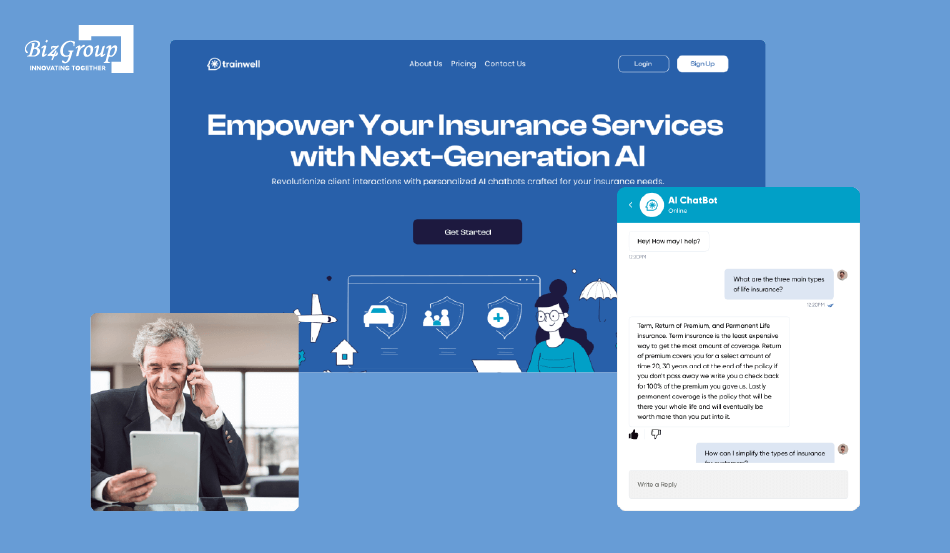
Insurance AI platform was built by Biz4Group to modernize how insurance agents learn, adapt, and respond in real time. Designed as an AI driven training and support system, it helps agents access policy knowledge, compliance guidance, and operational answers instantly through conversational workflows. The platform demonstrates how intelligent insurance systems can scale expertise across distributed teams, a capability that becomes increasingly relevant when building Insurtech SaaS products focused on operational consistency and growth.
Design Insurance SaaS Products That Actually Scale
Use proven Insurtech SaaS product development steps to move from idea to launch with confidence and control.
Create an Insurtech SaaS ProductHow to Build Insurtech SaaS Software Solutions from Scratch: Step-by-Step Process
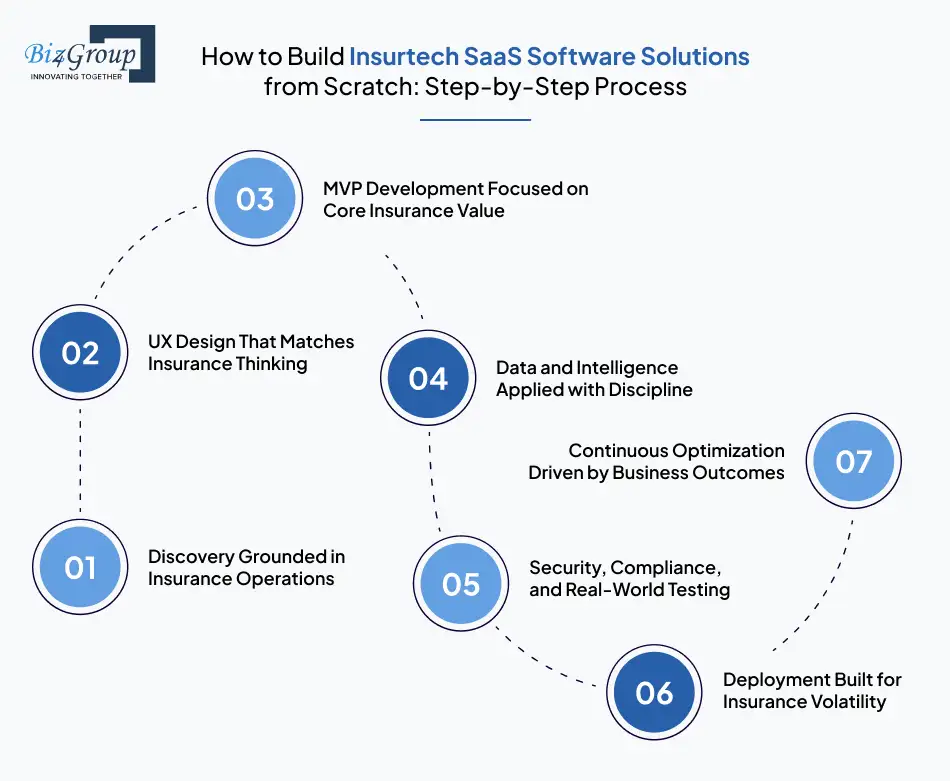
Insurance platforms are rarely built for innovation’s sake. They are built to regain control over operations that have outgrown legacy systems. When teams decide to develop an Insurtech SaaS Product, each step below reflects how real insurance businesses move from operational pain to scalable platforms.
1. Discovery Grounded in Insurance Operations
This step starts by identifying where insurance work slows or breaks entirely. The focus is on policy issuance delays, pricing inconsistencies, claims backlogs, and reporting blind spots that directly affect revenue and compliance.
- Shadow underwriting and claims teams during real workflows
- Identify where manual steps still control policy or pricing decisions
- Prioritize areas to build Insurtech SaaS products for policy management and pricing
- Define KPIs tied to cycle time, accuracy, and operational cost
2. UX Design That Matches Insurance Thinking
Insurance users deal with dense information under time pressure. An ideal UI/UX design company shall help you reduce cognitive load while preserving context. If screens feel unclear or inconsistent, adoption collapses quickly.
- Design interfaces around policy context, not generic dashboards
- Keep underwriting and claims workflows linear and predictable
- Test usability with agents, underwriters, and operations staff
- Maintain consistency across devices used in insurance operations
Also read: Top UI/UX design companies in USA
3. MVP Development Focused on Core Insurance Value
For insurance, MVP development services mean minimum operational risk, not minimum features. The first release must prove that critical insurance workflows function end to end without workarounds.
- Build policy creation, endorsements, and renewals first
- Implement core underwriting logic without hard coding rules
- Enable claims intake and structured processing
- Design architecture to support future expansion
This phase often determines whether teams can create Insurtech SaaS systems for digital insurance operations without rebuilding later.
Also read: Top 12+ MVP Development Companies to Launch Your Startup in 2026
4. Data and Intelligence Applied with Discipline
Insurance data is fragmented and regulated. This step focuses on cleaning and structuring data before layering intelligence. Automation should assist decisions, not override them.
- Normalize policy, pricing, and claims data across products
- Integrate external risk to train AI models via actuarial data sources
- Introduce intelligence for pattern visibility, not auto approvals
- Validate outputs with underwriting and compliance teams
This discipline supports long-term efforts to develop Insurtech SaaS products for business growth without eroding trust.
5. Security, Compliance, and Real-World Testing
Insurance platforms are tested under audits and disputes, not demos. Compliance and security must hold up under real operational pressure.
- Validate role-based access across internal and external users
- Simulate audit trails for underwriting and claims decisions
- Stress test systems during high claim volume scenarios
- Maintain logs aligned with regulatory review requirements
Also Read: Software Testing Companies in USA
6. Deployment Built for Insurance Volatility
Insurance usage spikes during renewals, catastrophes, or new product launches. Deployment must absorb demand without slowing operations or risking data integrity.
- Deploy on scalable cloud infrastructure
- Release updates in controlled phases
- Monitor system behavior during peak usage
- Prepare onboarding for agents and internal teams
7. Continuous Optimization Driven by Business Outcomes
Once live, the platform becomes part of daily insurance operations. Evolution must support growth without disrupting workflows.
- Collect feedback during live underwriting and claims work
- Refine workflows based on operational patterns
- Introduce advanced capabilities gradually
- Track outcomes tied to efficiency and cost reduction
At this stage, leadership naturally begins asking tougher questions like is it profitable to build an Insurtech SaaS platform and how to measure the ROI of Insurtech SaaS product development beyond initial launch.
Ideal Tech Stack for Building Cloud Based Insurance SaaS Products
Build Insurance SaaS Products with Long-Term Clarity
Understand how teams develop Insurtech SaaS platforms with the right features, timelines, and compliance readiness built in.
Develop an Insurtech SaaS ProductWhen teams decide to develop an Insurtech SaaS Product, the tech stack quietly determines how policy management, pricing accuracy, compliance, and scalability behave under real business pressure. These layers are chosen to support insurance operations, not experimentation:
|
Label |
Preferred Technologies |
Why It Matters |
|---|---|---|
|
Frontend Framework |
ReactJS, Angular |
Insurance teams deal with dense forms and frequent state changes. Frontends built with ReactJS development, keep policy and claims workflows responsive. |
|
Server-Side Rendering & SEO |
Next.js, Nuxt.js |
Dashboards with pricing and policy data must load fast and securely. Many SaaS teams rely on NextJS development to balance performance and controlled rendering. |
|
Backend Framework |
Node.js, Python |
Core insurance logic like pricing rules and policy issuance runs here. NodeJS development supports concurrency, while structured services built through Python development handle complex workflows. |
|
REST, GraphQL |
Insurtech SaaS platforms depend on clean data exchange across modules and partners. Strong APIs prevent breakdowns as integrations and products expand. |
|
|
Pricing and Rules Engine |
Custom rules engines |
Insurance pricing and eligibility logic must change without redeployments. A dedicated rules layer protects revenue logic from hard coded constraints. |
|
AI & Data Processing |
TensorFlow, PyTorch |
Advanced analytics and future intelligence rely on clean, prepared data. These tools support modeling without forcing automation too early. |
|
Data Storage |
Relational and document databases |
Policy records, pricing history, and claims data require structured storage that supports audits and traceability. |
|
Payments and Billing |
Secure payment gateways |
Premium collection, refunds, and adjustments must stay reliable to protect cash flow and customer trust. |
|
Authentication and Access Control |
OAuth 2.0, RBAC |
Insurance data access must reflect roles clearly to protect sensitive policy and pricing information. |
|
Compliance and Audit Layer |
Logging and audit frameworks |
Regulatory readiness depends on traceable actions across underwriting, claims, and billing workflows. |
|
Cloud Infrastructure |
SOC aligned cloud services |
Renewal cycles and event driven spikes demand infrastructure that scales without manual intervention. |
|
Monitoring and Logging |
Centralized monitoring tools |
Real-time visibility into system health and usage supports operational control and compliance reviews. |
When these layers are defined intentionally, the platform feels dependable rather than fragile. That confidence makes it easier to move from architecture decisions into cost planning and rollout strategy without discovering gaps later.
Insurtech SaaS Product Development Cost and Roadmap
Cost is usually the reality check in every Insurtech conversation. To develop an Insurtech SaaS Product, most teams should expect an investment anywhere between USD 25,000 to USD 400,000+. This is a ballpark figure, not a quote, but it helps anchor planning discussions early:
|
Platform Stage |
What It Typically Covers |
Estimated Cost Range |
|---|---|---|
|
MVP-level Insurtech SaaS Product |
Core policy workflows, basic pricing rules, user roles, initial compliance setup built during MVP software development stage. |
USD 25,000 to USD 70,000 |
|
Growth-Stage Insurtech SaaS Product |
Claims processing, configurable underwriting logic, integrations, reporting |
USD 70,000 to USD 150,000 |
|
Advanced-level Insurtech SaaS Product |
Multi product support, scalability layers, analytics, automation readiness |
USD 150,000 to USD 300,000 |
|
Enterprise-Grade Insurtech SaaS Product |
High availability, complex integrations, compliance hardening, governance |
USD 300,000 to USD 400,000+ |
|
Ongoing Enhancements |
Feature expansion, performance tuning, compliance updates |
Varies by roadmap |
Where a product lands in this range depends on more than features. The number of insurance products, pricing complexity, regulatory exposure, and integration depth all matter. Teams that plan for enterprise AI solutions early often budget more thoughtfully, even if advanced intelligence is introduced later.
Once cost boundaries are clear, attention naturally shifts toward sustainability. That is where business models for Insurtech SaaS platforms start shaping not just revenue, but long term product direction and investment priorities.
Revenue Models Used in Insurance Technology SaaS Development
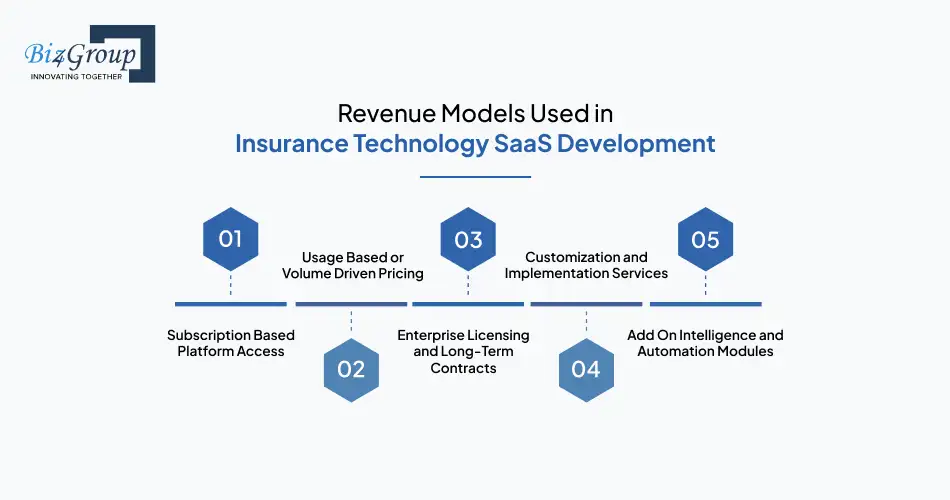
Revenue planning works best when it mirrors how insurance businesses actually operate. When founders develop an Insurtech SaaS Product, monetization decisions usually follow usage patterns, regulatory realities, and buying behavior across insurers, MGAs, and brokers, which brings these models into focus.
1. Subscription Based Platform Access
This is the most common model, where insurers pay recurring fees based on users, policies, or modules. It works well for platforms that build AI powered Insurtech SaaS solutions and evolve continuously over time. Many early stage teams pair this with careful rollout planning to manage expectations around value delivery.
- Example: An insurer pays a monthly fee based on active underwriting and claims users across departments.
2. Usage Based or Volume Driven Pricing
Some insurers prefer paying based on activity rather than seats. Pricing tied to policies issued, claims processed, or transactions aligns revenue with real operational usage. This model often appeals to high growth insurers working with business app development using AI to scale efficiently.
- Example: A carrier is billed per policy issued through the platform each month
3. Enterprise Licensing and Long-Term Contracts
Larger insurance organizations often want predictability and control. Enterprise contracts bundle platform access, support, and upgrades under fixed agreements. These deals are common when working with the best company to develop Insurtech SaaS products for complex environments.
- Example: A national insurer signs a multi year contract covering all business units and regions.
4. Customization and Implementation Services
Insurance workflows vary widely, creating demand for tailored extensions and integrations. Revenue here comes from configuration, onboarding, and enhancements delivered through custom Insurtech SaaS development services, sometimes alongside teams that hire AI developers for specialized needs.
- Example: Custom pricing rules and reporting workflows built for a regional insurance provider.
5. Add On Intelligence and Automation Modules
Advanced capabilities are often monetized separately once the core platform is stable. Features like automation or intelligent assistance are introduced gradually, sometimes supported by insurance AI agent development or AI chatbot integration without disrupting core operations.
- Example: A claims automation module offered as a paid upgrade for faster triage.
As these models mature, leadership inevitably starts asking broader execution questions, including how long does it take to build an Insurtech SaaS product and how revenue timelines align with delivery milestones and adoption curves.
Best Practices for Building an Insurtech SaaS Product
Turn Insurance Operations into SaaS-Ready Systems
See how businesses build Insurtech SaaS software solutions that support underwriting, claims, and policy management at scale.
Build an Insurtech SaaS PlatformWhen teams develop an Insurtech SaaS Product, success rarely comes from bold ideas alone. It comes from disciplined choices that respect insurance realities, long sales cycles, and regulatory pressure. The practices below reflect what consistently works in real Insurtech builds.
1. Design for Insurance Operations Before Growth
Insurance workflows are layered and sequential for a reason. Start by stabilizing underwriting, policy, and claims flows before chasing scale. This approach keeps Insurtech SaaS product development grounded in how insurers actually operate.
2. Introduce Intelligence Only Where It Reduces Work
Automation should remove friction, not create learning curves. Whether inspired by an AI conversation app or lessons from top SaaS startup app ideas, intelligence should quietly support decisions rather than dominate workflows.
3. Treat Cost Planning as a Product Input
Budget decisions shape architecture more than features do. A realistic Insurtech SaaS product development cost estimate helps teams avoid overengineering early and underbuilding critical foundations that are expensive to fix later.
4. Build One Platform for Multiple Buyer Types
Startups and large insurers often share core needs but differ in scale. Designing flexible configuration supports Insurtech SaaS solutions for startups and insurers without fragmenting the product or creating parallel code paths.
5. Choose Partners with Insurance Context
Execution matters as much as vision. Teams that work with experienced builders, sometimes even top AI development companies in Florida, tend to move faster while avoiding compliance and scalability pitfalls when they develop Insurtech SaaS platforms.
When these practices are followed consistently, teams spend less time correcting course and more time strengthening the product. That stability makes it easier to confront the challenges that inevitably surface as adoption grows and complexity increases.
Common Challenges in Insurtech SaaS Product Development and How to Overcome Them
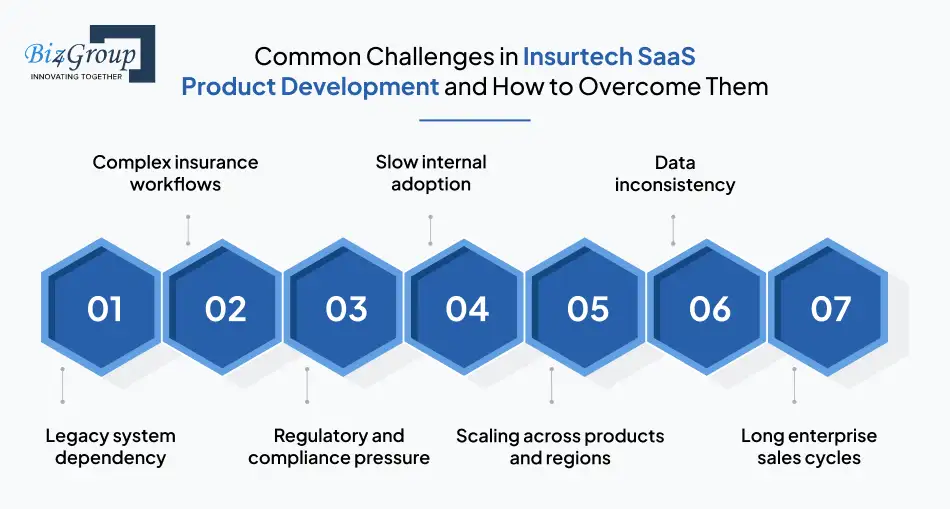
Most Insurtech products do not fail because of ideas. They struggle because execution collides with insurance complexity. When teams develop an Insurtech SaaS Product, these hurdles tend to surface early and shape whether the platform stabilizes or stalls.
|
Top Challenges |
How to Solve Them |
|---|---|
|
Legacy system dependency |
Design integration layers that coexist with existing policy and claims systems before replacing them |
|
Complex insurance workflows |
Break workflows into configurable modules instead of hard coding rules |
|
Regulatory and compliance pressure |
Embed audit trails and access controls directly into everyday operations |
|
Slow internal adoption |
Align product flows with how underwriters and claims teams already work |
|
Scaling across products and regions |
Use flexible configuration to support variation without code duplication |
|
Data inconsistency |
Normalize policy, pricing, and claims data early to avoid reporting gaps |
|
Long enterprise sales cycles |
Build early credibility through stability, security, and clear documentation |
Addressing these challenges early reduces costly rework and internal resistance. Teams that plan deliberately can build Insurtech SaaS software solutions that remain resilient as users, regulations, and product complexity grow. Now, let’s talk about what comes next as the platform matures.
What does the Future hold for Insurtech SaaS Platforms?
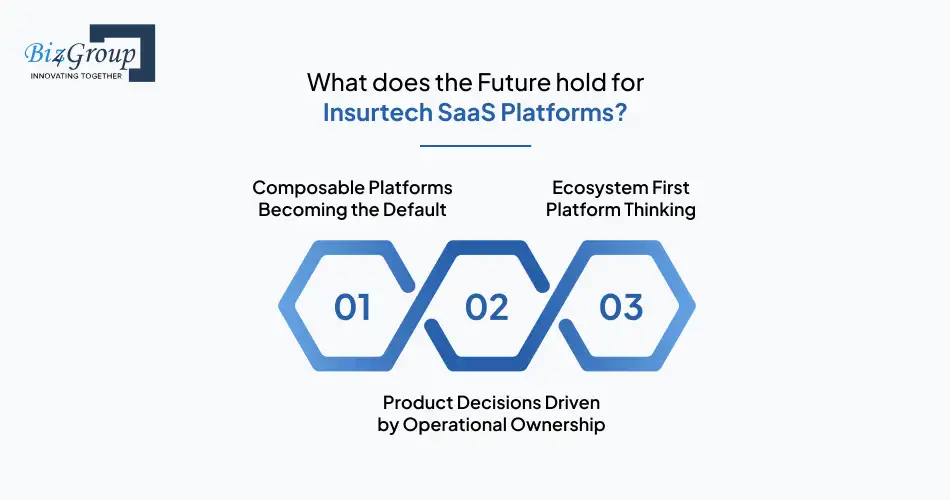
The future of insurance software is being shaped less by experimentation and more by adaptability. As teams develop an Insurtech SaaS Product, staying relevant depends on how well platforms respond to structural change across regulation, distribution, and operating models.
1. Composable Platforms Becoming the Default
Insurers are steadily moving away from rigid systems and build AI software that can evolve without disruption. This shift makes it easier to create insurance SaaS products that adjust to new products, partnerships, and regulatory demands over time, rather than forcing periodic rebuilds.
2. Product Decisions Driven by Operational Ownership
Technology decisions are increasingly influenced by underwriting, claims, and compliance leaders. This tighter ownership model is reshaping insurance technology SaaS development, with platforms expected to mirror real operational accountability rather than abstract system design.
3. Ecosystem First Platform Thinking
Future growth is less about standalone software and more about connected ecosystems. Platforms are being built to support collaboration across carriers, MGAs, agents, and partners, often with support from an AI chatbot development company to simplify interaction layers.
As these shifts take hold, long term success will depend less on what is built and more on who builds it and how closely execution aligns with insurance realities.
Plan Before You Build Your Insurance SaaS Platform
Why Businesses Choose Biz4Group for Insurtech SaaS Product Development?
Plan Before You Build Your Insurance SaaS Platform
Get clarity on Insurtech SaaS product development cost and roadmap before committing to long-term technical decisions.
Start Insurtech SaaS Product PlanningMost teams say they can build an Insurtech platform. Very few have already built something close enough to your problem that the lessons actually carry over. The Insurance AI platform you saw earlier exists because a real insurer needed a system that worked in production, not a proof of concept.
That mindset shapes how Biz4Group approaches every engagement.
- We start from insurance workflows that already hurt, not feature wishlists
- We assume real users, real audits, and real edge cases from day one
- We design platforms that can evolve without rewriting the core
- We think past launch, because insurance software lives for years
If your goal is to develop an Insurtech SaaS Product that earns trust quietly and holds up under real operational pressure, Biz4Group approaches the build like an AI app development company that has learned where insurance platforms actually fail and how to avoid that.
Bringing an Insurtech SaaS Platform from Concept to Market
Insurtech SaaS usually starts with a simple thought. There has to be a better way to run this. Then reality kicks in. Regulations, edge cases, legacy data, long sales cycles. This guide exists to help you navigate that gap. If your goal is to develop an Insurtech SaaS Product that insurers actually adopt, the winning formula is less hype and more clarity. The right mix of product discipline, insurance context, AI consulting services, and AI product development services is what turns ambition into something that survives real usage.
FAQs on Insurtech SaaS Product Development
1. How long does it typically take to build an Insurtech SaaS Product?
Timelines vary based on scope, compliance needs, and integration depth. A focused MVP can take a few months, while full scale platforms take longer. Most delays come from regulatory reviews and workflow validation during Insurtech SaaS product development rather than coding alone.
2. Is it profitable to build an Insurtech SaaS platform today?
Profitability depends on targeting the right insurance workflows and buyer segment. Platforms that reduce operational cost or speed up underwriting often see stronger returns. Many founders evaluate this early when deciding how to develop Insurtech SaaS products for business growth.
3. What is the cost to develop an Insurtech SaaS Product?
The cost usually ranges between USD 25,000 to USD 400,000+, depending on features, scalability, and compliance complexity. MVP builds sit at the lower end, while enterprise platforms cost more. Budgeting becomes clearer once teams define Insurtech SaaS product development cost estimate upfront.
4. Can an Insurtech SaaS Product work for both startups and large insurers?
Yes, if the platform is designed with configuration and modularity in mind. The same core system can serve different scales without duplication. This flexibility is critical when building Insurtech SaaS solutions for startups and insurers on a single codebase.
5. How important is compliance when building an Insurtech SaaS Product?
Compliance is foundational, not optional. Insurance platforms must embed audit trails, access control, and regulatory alignment from day one. Teams that ignore this early struggle later when trying to develop compliant Insurtech SaaS platforms at scale.
6. Can AI be added later to an Insurtech SaaS Product?
Yes, but only if the data and architecture are prepared early. Adding intelligence later is smoother when workflows and data are structured properly. This approach works well for teams planning to build AI powered Insurtech SaaS solutions without disrupting operations.
