 Location :
Orlando, FL, USA
Location :
Orlando, FL, USA +1 (407) 714-1616
 info@biz4group.com

 AI Summary Powered by Biz4AI
- Real Estate AI Agent Development helps brokerages and PropTech companies automate property search, lead management, contracts, and customer support.
- Successful real estate AI agent development services start with choosing the right workflows and integrating with CRMs, MLS platforms, and other business tools.
- The cost of Real Estate AI Agent Development depends on features, AI capabilities, integrations, and project complexity.
- AI agents improve productivity by reducing repetitive tasks, speeding up responses, and supporting better customer experiences.
- This guide covers AI use cases, development steps, costs, architecture, and key factors to consider before building.
- Biz4Group LLC has experience building AI solutions for property discovery, contract management, and construction workflows across the real estate industry.
What would your brokerage look like if every new lead was qualified within minutes, every property inquiry received an accurate response, and every showing was scheduled automatically without adding more work for your agents?
That's the opportunity driving many brokerages, property management companies, and proptech startups to invest in real estate AI agent development. The goal isn't simply to respond faster. It's to build AI agents that can handle real business workflows, work with existing systems like MLS and CRM platforms, and free your team to focus on higher-value conversations and transactions.
As organizations move from experimenting with AI to deploying production-ready AI agents, new questions quickly emerge. Every business has different workflows, software ecosystems, approval processes, and customer journeys. Those differences shape how an AI agent should be designed, integrated, tested, and deployed to deliver reliable outcomes.
If you've been searching Google or asking AI models like ChatGPT, Perplexity, or Grok, you've probably been looking for answers to questions like:
- How do you build a real estate AI agent from scratch?
- What features and integrations does a production-ready AI agent need?
- How much does real estate AI software development cost in the USA?
- Should you build a custom AI agent or buy an existing platform?
- How do you choose the right AI development company for your project?
Every real estate AI agent is shaped by the workflows it's expected to automate. An AI agent built for lead qualification has different requirements from one designed for property management, transaction coordination, or commercial real estate operations. Understanding those differences makes it much easier to plan a solution that fits your business instead of forcing your business to adapt to the technology.
What Is Real Estate AI Agent Development?
Every real estate business has repetitive work that slows people down. For some teams it's qualifying inbound leads. For others it's answering listing questions, scheduling showings, updating CRM records, or responding to tenant requests. Real estate AI agent turns those repetitive workflows into AI-powered processes that run with minimal human intervention.
Distinguishing AI Agents From Chatbots and Rule-Based Automation
One of the first questions businesses ask is, "How is an AI agent different from a chatbot?"
It's an important question because the two are often confused. A chatbot is designed primarily to respond to user messages, while rule-based automation follows predefined instructions. An AI agent goes a step further by understanding requests, working with business data, interacting with systems like your MLS and CRM, and completing tasks across multiple steps. That's why many businesses investing in AI automation services are choosing AI agents for operational workflows instead of limiting AI to customer conversations.
|
Capability |
AI Agent |
Chatbot |
Rule-Based Automation |
|---|---|---|---|
|
Primary purpose |
Completes business tasks and supports decision-making |
Answers questions and holds conversations |
Executes predefined workflows |
|
Understands context |
Yes, including conversation history and business context |
Limited to the current conversation |
No |
|
Accesses MLS, CRM, and other business systems |
Yes |
Sometimes, with limited integrations |
Yes, if explicitly configured |
|
Handles multi-step workflows |
Yes |
Limited |
Only for predefined sequences |
|
Adapts to different user requests |
Yes |
Limited |
No |
|
Maintains memory across interactions |
Yes, depending on implementation |
Usually no |
No |
|
Typical real estate use cases |
Lead qualification, showing scheduling, transaction support, tenant support |
Website FAQs, basic customer support |
Lead routing, notifications, status updates |
If your goal is simply to answer frequently asked questions, a chatbot may meet your needs. If you're looking for software that can qualify leads, retrieve listing information, coordinate business processes, and work across your existing systems, a real estate AI agent is designed for that level of responsibility.
How Does a Real Estate AI Agent Work?
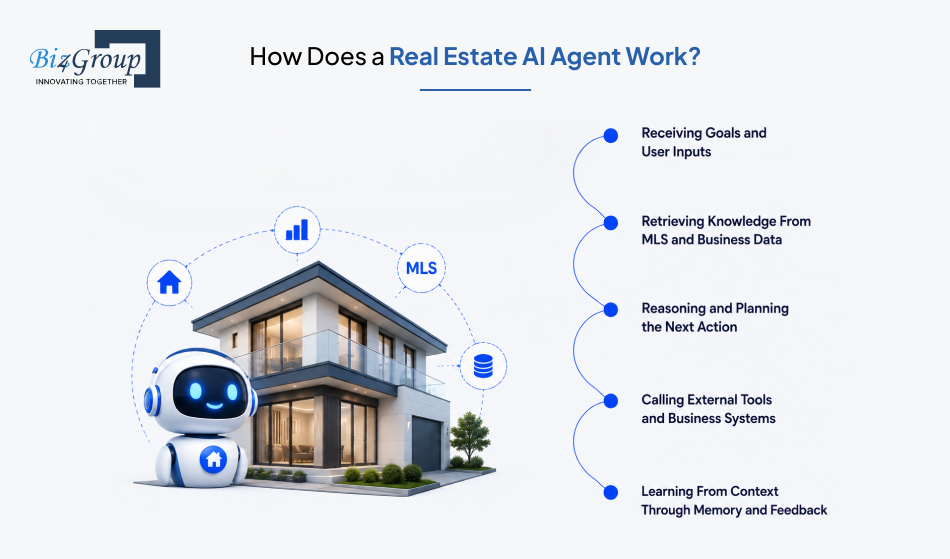
A real estate AI agent works by following a series of connected steps that allow it to understand a request, gather the right information, decide what to do next, and complete the task. Whether someone is asking about a property, requesting a showing, or checking the status of a transaction, the AI agent follows a structured workflow behind the scenes. If you've ever wondered, "how AI agents automate real estate workflows?", the answer lies in how it combines business data, reasoning, and system integrations to complete each task.
We often come across real estate professionals asking:
"Our real estate team spends too much time manually updating leads, sending follow-ups, and scheduling property tours. Can a custom AI agent automate these workflows while integrating with our CRM and calendar?"
Yes. A custom AI agent can automatically create or update lead records in your CRM, trigger personalized follow-up messages based on customer interactions, and schedule property tours by integrating with your calendar system. This reduces manual effort, keeps lead information up to date, and allows agents to spend more time building relationships instead of handling routine administrative tasks.
|
Step |
What Happens |
Example in a Real Estate Workflow |
|---|---|---|
|
Receiving Goals and User Inputs |
The AI agent receives a request from a customer, agent, or employee through a website, mobile app, email, SMS, or another communication channel. |
A buyer asks for three-bedroom homes within a specific budget and school district. |
|
Retrieving Knowledge From MLS and Business Data |
The AI agent gathers relevant information from MLS databases, CRM platforms, property management systems, knowledge bases, and internal documents. |
It retrieves matching listings, property details, pricing, and the buyer's previous interactions. |
|
Reasoning and Planning the Next Action |
The AI agent analyzes the available information and determines the most appropriate response or next step based on the business workflow. |
It identifies the best matching properties and decides whether to answer additional questions or recommend scheduling a showing. |
|
Calling External Tools and Business Systems |
The AI agent interacts with connected applications to complete actions instead of only generating text responses. This is where AI integration services help connect the agent with existing business systems. |
It schedules a property showing, updates the CRM, sends a follow-up email, or creates a task for a sales agent. |
|
Learning From Context Through Memory and Feedback |
The AI agent remembers relevant information from previous interactions and uses feedback to improve future conversations and workflow decisions. |
It remembers a buyer's preferred neighborhoods and property preferences during future conversations. |
A production-ready real estate AI agent repeats this workflow every time it receives a new request. The difference between a basic AI assistant and an effective AI agent is its ability to combine business context with real actions. Instead of only answering questions, it can support lead qualification, property search, showing coordination, transaction management, and other real estate workflows by working with the systems your business already uses.
Which Real Estate Workflows Benefit Most From AI Agent Development?
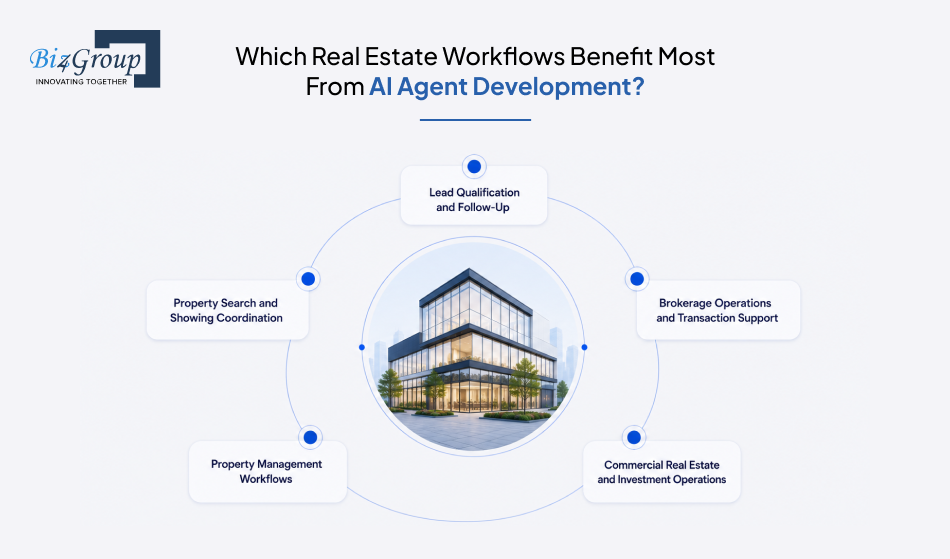
Lead qualification, property search, transaction support, property management, and commercial real estate operations are some of the workflows where AI agents deliver the most value. These processes involve repetitive conversations, routine decisions, and constant interaction with business data, making them well suited for automation while keeping your team focused on work that requires human expertise.
For those asking "how to use real estate AI agent?", here's all that you need to know:
1. Lead Qualification and Follow-Up
Where do most brokerages usually start? Lead qualification is often the first workflow they choose to automate because every delayed response increases the risk of losing a potential client. An autonomous AI agent for real estate can engage with prospects, ask qualifying questions, answer listing-related queries, score leads, and pass sales-ready opportunities to your team. That's one of the most practical applications of AI for real estate agents.
Where do most brokerages usually start? Lead qualification is often the first workflow they choose to automate because every delayed response increases the risk of losing a potential client. If you're thinking:
"Our brokerage is losing potential clients because follow-ups are inconsistent and leads are not prioritized correctly. How can an AI agent score buyer intent, personalize communication, and help our team focus on qualified opportunities?"
It typically involves connecting the AI agent to your MLS, CRM, and communication channels, giving it access to your listing data and business rules, and enabling it to qualify leads, answer property-specific questions, coordinate follow-ups, and transfer qualified buyers to the right agent. The investment depends on the scope, integrations, and deployment requirements, which we'll cover later in this guide.
2. Property Search and Showing Coordination
What usually slows buyers down during a property search? In many cases, it's waiting for answers or coordinating schedules. An AI agent for real estate businesses can recommend relevant listings, answer property-specific questions, arrange showings, send confirmations, and keep buyers informed throughout the process, creating a smoother experience from the first inquiry.
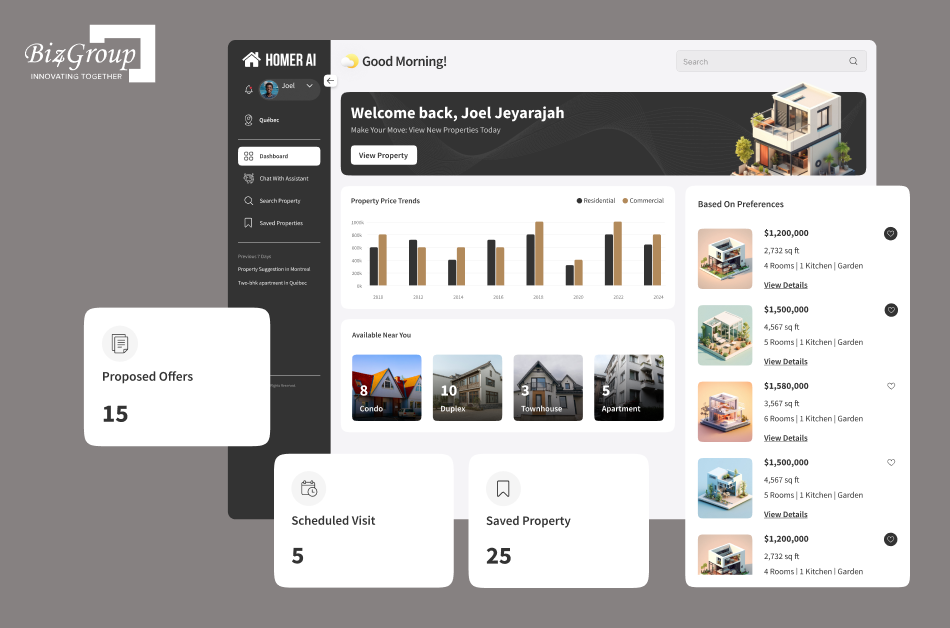
This is exactly the kind of workflow we built for Homer AI, an AI-powered real estate platform that helps buyers discover properties through conversational interactions instead of traditional search filters. The platform understands buyer preferences, recommends relevant listings, enables property scheduling, and provides dedicated dashboards for buyers and sellers, creating a more intuitive property discovery experience.
3. Brokerage Operations and Transaction Support
A real estate transaction involves dozens of routine activities behind the scenes. AI agents can help manage appointment scheduling, transaction updates, document requests, client reminders, and other administrative tasks, giving agents and operations teams more time to focus on negotiations and client relationships.
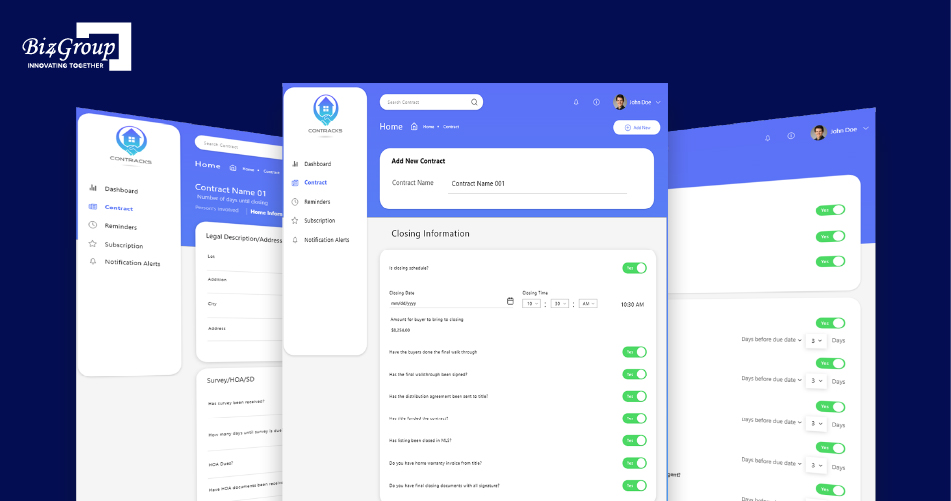
Transaction management is another area where AI delivers measurable value. We built Contracks, a real estate contract management platform that helps professionals track deadlines, milestones, approvals, and documentation from one place. AI further improves the experience by summarizing lengthy contracts and extracting important information, helping teams review documents faster and stay on top of critical obligations.
4. Property Management Workflows
Property management teams handle a steady stream of tenant conversations every day. Maintenance requests, lease renewals, rent reminders, move-in questions, and policy-related inquiries can all be managed by an AI agent, while more complex situations are directed to the appropriate team members.
5. Commercial Real Estate and Investment Operations
Commercial real estate workflows often involve multiple stakeholders, larger volumes of information, and longer decision cycles. AI agents can support property research, investor communication, document retrieval, opportunity tracking, and market intelligence, helping teams stay organized and respond more efficiently.
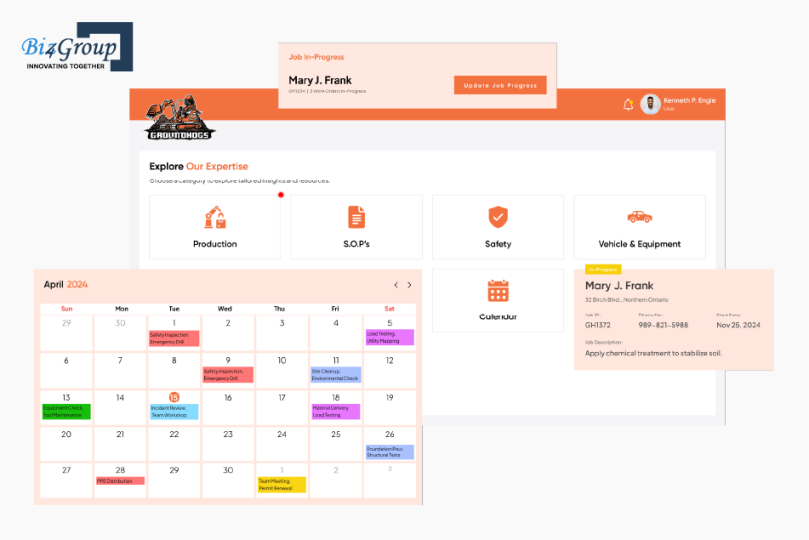
AI agents aren't limited to residential real estate. We also built Ground Hogs, a centralized platform that helps construction teams record site activities, manage safety checklists, upload project documentation, and monitor job progress in real time. It demonstrates how AI-powered workflow automation can extend across the broader real estate and construction ecosystem.
The best place to introduce a real estate AI agent is usually the workflow that consumes the most time today. Once that process is running efficiently, it becomes much easier to expand AI agents into other parts of your brokerage, property management, or commercial real estate operations.
What Does the Architecture of a Production-Ready Real Estate AI Agent Include?
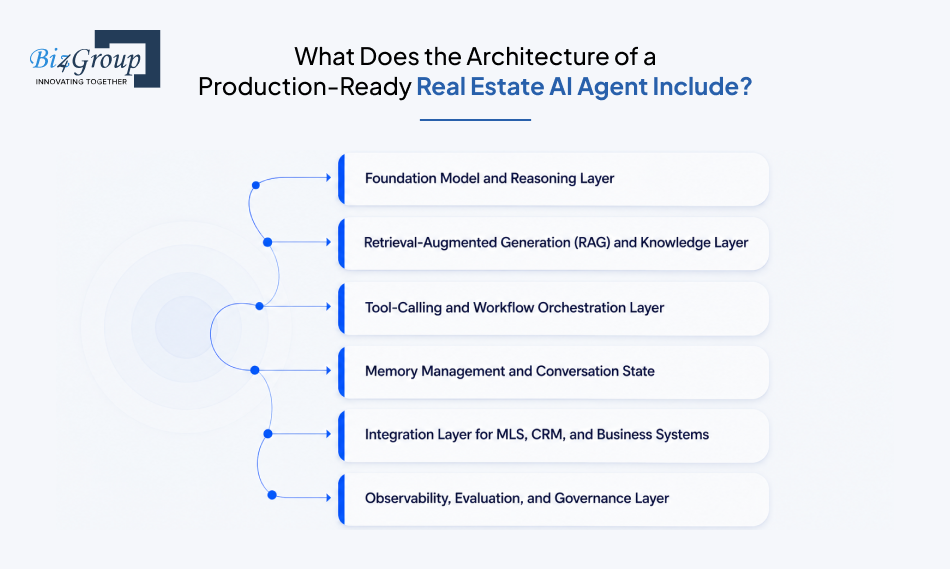
A production-ready real estate AI agent isn't built around a single AI model. It relies on several components working together so the agent can answer property questions accurately, access your MLS and CRM, complete business tasks, and remember conversations when it should. If any of these pieces are missing, you'll usually notice it in the quality of the customer experience.
An AI agent can only recommend properties as accurately as the data it has access to. That's why businesses evaluating production-ready AI solutions often ask:
"We want to build an AI agent that uses our MLS listings and property data to recommend relevant properties, but we are concerned about inaccurate or outdated information. What architecture and data integrations are required?"
The answer lies in the architecture rather than the AI model alone. A production-ready AI agent should retrieve information directly from your MLS, IDX feed, or internal property database before generating a response. Combined with integrations to your CRM and other business systems, this approach helps ensure property recommendations are based on the latest listing information instead of outdated or incomplete data.
|
Component |
What It Does |
Why It Matters for Real Estate |
|---|---|---|
|
Foundation Model and Reasoning Layer |
Understands user requests, interprets intent, and decides the next action based on the conversation. |
Helps the AI agent answer buyer and seller questions, qualify leads, and manage multi-step workflows without losing context. |
|
Retrieval-Augmented Generation (RAG) and Knowledge Layer |
Retrieves up-to-date information from MLS databases, property listings, company documents, FAQs, and internal knowledge instead of relying only on model training. |
Ensures responses reflect your latest listings, pricing, policies, and market information. |
|
Tool-Calling and Workflow Orchestration Layer |
Connects the AI agent with external tools so it can perform actions such as scheduling showings, creating CRM records, sending emails, or updating transactions. |
Turns conversations into completed tasks instead of stopping at answers. |
|
Memory Management and Conversation State |
Remembers relevant details throughout a conversation and across future interactions when appropriate. |
Buyers don't have to repeat their preferred location, budget, property type, or previous inquiries every time they return. |
|
Integration Layer for MLS, CRM, and Business Systems |
Connects the real estate AI agent platform with MLS, CRMs, marketing systems, calendars, documents, and property management software. |
Keeps information synchronized across your existing technology stack and reduces manual data entry. |
|
Observability, Evaluation, and Governance Layer |
Tracks conversations, measures performance, monitors accuracy, and applies security and compliance controls. |
Gives your team confidence that the AI agent is producing reliable responses while meeting business and regulatory requirements. |
You don't need to build every layer from scratch, but you do need all of them working together for a production deployment. Missing integrations, outdated knowledge, or limited monitoring often create more problems than the AI model itself, which is why architecture plays such a critical role in successful real estate AI agent development services.
Which Features Should a Production-Ready Real Estate AI Agent Include?
The right features depend on the workflows you want to automate, but every production-ready AI agent for real estate businesses should be able to understand customer requests, access accurate business data, complete actions across your existing systems, and hand conversations to your team when needed. If you're planning to build real estate AI software, choosing the right feature set from the beginning will save time, reduce rework, and make future expansion much easier.
So if you're in the real estate tech space and thinking "What features should a real estate AI agent include?" - Here's what you need to know.
Core Features for a Real Estate AI Agent MVP
What should you build first? Focus on the features that solve a real business problem without adding unnecessary complexity. A well-planned MVP helps you validate the AI agent with real users before expanding it into additional real estate workflows.
|
Feature |
Why It Matters |
|---|---|
|
Natural Language Conversations |
Lets buyers, sellers, tenants, and property owners interact naturally without following rigid scripts. |
|
Lead Qualification |
Collects buyer requirements, budget, location preferences, and purchase timelines before routing qualified leads to an agent. |
|
MLS and Listing Search |
Retrieves relevant properties using your latest listing data and answers listing-specific questions accurately. |
|
Showing Scheduling |
Coordinates available time slots and confirms appointments with buyers and agents. |
|
CRM Integration |
Creates or updates contacts, activities, and lead records automatically. |
|
Conversation History |
Maintains context during ongoing conversations for a smoother customer experience. |
|
Human Handoff |
Transfers complex conversations to the right team member without losing context. |
|
Analytics Dashboard |
Tracks conversations, lead volume, response quality, and overall AI agent performance. |
A successful MVP should solve one or two high-impact workflows exceptionally well. Once your team sees faster response times, better lead qualification, and measurable operational improvements, you'll have a solid foundation for adding more advanced capabilities.
Advanced Features for Enterprise Deployments
As your AI agent becomes part of everyday operations, you'll naturally find more opportunities to automate complex workflows. When does it make sense to expand? Usually when your core workflows are delivering consistent results and your team is ready to support multiple departments, larger customer volumes, or more sophisticated business processes.
Here are the top features required to build a real estate AI agent:
- Personalized property recommendations based on customer preferences and previous conversations.
- Multi-agent workflows for sales, support, marketing, and transaction coordination.
- Automated document collection and transaction status updates.
- Property management automation for maintenance requests, lease renewals, and tenant communication.
- Voice support for inbound and outbound customer interactions.
- Multilingual conversations for buyers, sellers, and tenants.
- Role-based permissions for agents, brokers, administrators, and support teams.
- Performance monitoring, audit logs, and compliance reporting.
- Predictive analytics for lead prioritization and customer engagement.
Enterprise features should support business growth without making the system harder to manage. The most successful enterprise AI solutions evolve in phases, allowing you to validate each capability, measure business impact, and confidently expand your real estate AI agent across additional workflows.
What Technology Stack Is Required for Real Estate AI Agent Development?
A production-ready real estate AI agent runs on a combination of AI models, backend services, data infrastructure, integrations, and monitoring tools. Do you need the biggest technology stack to get started? No. So, what technologies are used to develop a real estate AI agent?
The right stack is the one that supports your business goals, works with your existing systems, and can scale as your brokerage or PropTech platform grows. If you're planning to build AI software, choosing proven technologies usually delivers better long-term results than chasing every new AI release.
|
Technology Layer |
Common Technologies |
Purpose in Real Estate AI Agent Development |
|---|---|---|
|
Foundation Models |
GPT, Claude, Gemini, Llama, Mistral |
Power conversations, reasoning, lead qualification, and property-related question answering. |
|
Embedding Models |
OpenAI Embeddings, Voyage AI, Cohere, BGE |
Convert MLS listings, property documents, FAQs, and business knowledge into searchable vectors for accurate retrieval. |
|
AI Agent Frameworks |
LangGraph, LangChain, CrewAI, AutoGen |
Coordinate planning, tool calling, multi-step workflows, and decision-making. |
|
Vector Databases |
Pinecone, Weaviate, Qdrant, Milvus |
Retrieve relevant property information, listing data, and internal knowledge during conversations. |
|
Backend Services & APIs |
Python, FastAPI, Node.js |
Manage business logic, APIs, authentication, and workflow orchestration. |
|
Operational Databases & Cache |
PostgreSQL, MongoDB, Redis |
Store customer records, transactions, conversation history, user preferences, and session data. |
|
Frontend Channels |
React, Next.js, Flutter, iOS, Android, Web Chat |
Deliver the AI agent through brokerage websites, customer portals, and mobile applications. |
|
MLS, CRM & Business Integrations |
MLS/IDX, Salesforce, HubSpot, Follow Up Boss, DocuSign, Calendly, Microsoft 365, Google Workspace |
Connect the AI agent to the systems your team already uses every day. |
|
Cloud Infrastructure |
AWS, Microsoft Azure, Google Cloud, Docker, Kubernetes |
Deploy, scale, secure, and manage production AI workloads. |
|
Monitoring & Evaluation |
Langfuse, LangSmith, OpenTelemetry, Grafana |
Measure response quality, monitor conversations, identify issues, and improve performance over time. |
|
Security & Compliance |
OAuth, SSO, role-based access control, encryption, audit logs |
Protect customer data, control system access, and support security and compliance requirements. |
Every company won't use the same tools, and that's perfectly normal. The goal is to build a technology stack that supports your current workflows while giving you room to add new AI capabilities, integrations, and business processes as your real estate operations continue to evolve.
Close More Deals with AI-Powered Automation
Businesses using AI agent application development for real estate can reduce manual work by up to 60% and improve lead response times by 80% with the right workflows.
See What's PossibleWhat's the Step by Step Process to Develop a Real Estate AI Agent?
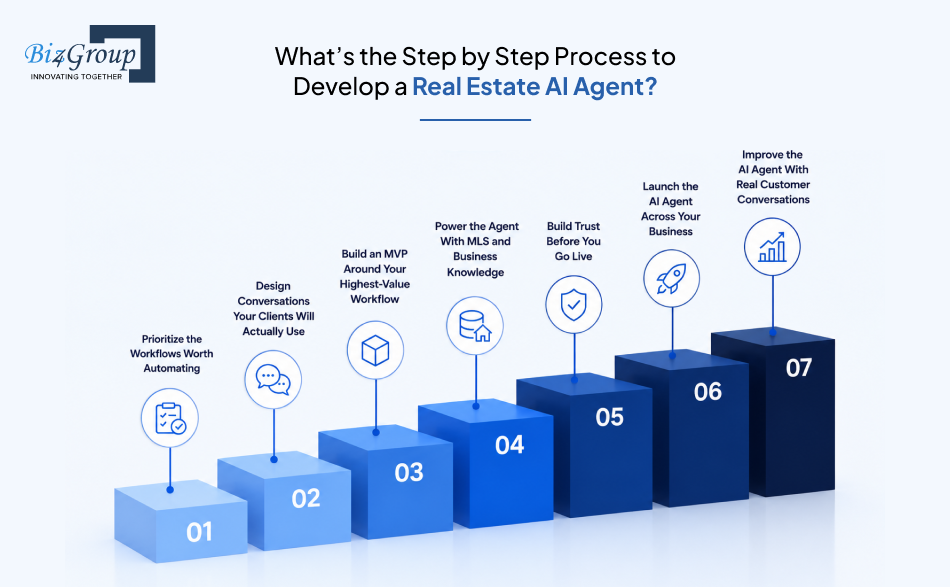
Building a real estate AI agent isn't about connecting an LLM to your website and calling it a day. The development process starts with understanding how your brokerage, property management company, or PropTech platform operates today, then building an AI agent that fits those workflows, integrates with your existing systems, and improves over time.
1. Prioritize the Workflows Worth Automating
The first step is deciding which business problem the AI agent should solve first. Where will it create the biggest impact? For most real estate businesses, that's usually lead qualification, property search, showing coordination, transaction support, or tenant communication. Defining these priorities early helps avoid unnecessary development costs and keeps the project focused on measurable outcomes.
- Identify high-volume workflows that consume your team's time.
- Map how leads, buyers, sellers, tenants, or investors move through those workflows.
- Define success metrics such as faster response times, higher lead-to-agent conversion, reduced manual work, or improved customer satisfaction.
- Review MLS access requirements, CRM workflows, Fair Housing considerations, and data privacy requirements before development begins.
2. Design Conversations Your Clients Will Actually Use
Even the most capable AI agent won't be adopted if people find it difficult to use. Buyers expect natural conversations, agents need quick access to relevant information, and administrators want simple controls for managing the system. Working with an experienced UI/UX design company helps create an experience that's intuitive for every type of user.
- Design conversation flows for buyers, sellers, tenants, and internal teams.
- Build clickable prototypes for web and mobile experiences before development starts.
- Test common scenarios such as property searches, showing requests, and lead qualification.
- Create consistent interfaces across customer portals, websites, and internal dashboards.
Also read: Top UI/UX Design Companies in USA
3. Build an MVP Around Your Highest-Value Workflow
Launching with every feature at once usually slows the project down. A better approach is to start with an MVP development roadmap that focuses on one or two high-impact workflows, validates business value, and provides a foundation for future expansion.
- Build the AI agent for one primary workflow, such as lead qualification or property search.
- Connect essential systems including your MLS, CRM, calendar, and communication tools.
- Enable property search, listing questions, appointment scheduling, and human handoff.
- Design the backend so additional workflows can be added without rebuilding the real estate AI agent platform.
Also read: 12+ MVP Development Companies in USA to Launch Your Startup in 2026
4. Power the Agent With MLS and Business Knowledge
An AI agent is only as reliable as the information it can access. How does it answer questions about your properties instead of generic real estate advice? What data does a real estate AI agent need? By connecting it to your MLS, listing database, CRM, internal documents, and business knowledge so every response is based on current information.
- Connect MLS, IDX, CRM, and property management platforms.
- Build a knowledge base using listing data, policies, FAQs, and internal documentation.
- Configure retrieval so responses reflect your latest business information.
- Continuously train AI models using customer interactions and team feedback.
5. Build Trust Before You Go Live
Before your AI agent starts talking to customers, it should be tested just like any other business-critical application. That means checking response quality, validating integrations, protecting customer data, and confirming the agent follows your operational policies.
- Test conversations across buying, selling, renting, and property management scenarios.
- Validate MLS data accuracy and CRM synchronization.
- Apply role-based access controls, encryption, and audit logging.
- Review Fair Housing compliance, privacy requirements, and escalation rules for sensitive situations.
Also Read: 15+ Software Testing Companies in USA in 2026
6. Launch the AI Agent Across Your Business
Deployment is where your AI agent moves from testing to real customer interactions. The infrastructure should support growing conversation volumes, reliable integrations, and seamless software updates without interrupting your business operations.
- Deploy on scalable cloud infrastructure.
- Set up CI/CD pipelines for faster releases and improvements.
- Monitor system performance, response times, and service availability.
- Train agents, administrators, and support teams before rolling the solution out across the business.
7. Improve the AI Agent With Real Customer Conversations
Your AI agent should improve as your business grows. Customer questions change, listings are updated, and new workflows emerge throughout the year, so ongoing optimization is part of every successful deployment.
- Analyze conversation quality and identify opportunities for improvement.
- Expand into additional workflows such as transaction coordination or property management.
- Refresh the knowledge base as listings, policies, and business processes evolve.
- Track KPIs such as qualified leads, response times, customer satisfaction, operational efficiency, and overall ROI.
Building a production-ready real estate AI agent is an iterative process. Teams that begin with a focused MVP, validate results with real users, and expand capabilities based on business priorities typically achieve faster adoption and stronger long-term returns than those trying to automate every workflow from the start.
How Much Does it Cost to Build a Real Estate AI agent?
The cost to develop a custom real estate AI agent in the US ranges around $20,000 to $60,000. That said, this is only a starting point. The final cost depends on factors such as the number of workflows you want to automate, MLS and CRM integrations, AI capabilities, deployment requirements, security and compliance needs, and whether you're building an MVP or a production-grade platform. If you're exploring AI in real estate development, understanding these cost drivers early makes budgeting much more realistic.
|
Deployment Level |
Typical Cost (USD) |
Best Suited For |
Typical Capabilities |
|---|---|---|---|
|
MVP-level Real Estate AI Agent |
$20,000–$30,000 |
Startups, independent brokerages, proof of concept |
Lead qualification, basic property search, CRM integration, scheduling, human handoff |
|
Mid-Range Real Estate AI Agent |
$30,000–$45,000 |
Growing brokerages and PropTech companies |
Multiple workflows, MLS integration, RAG, advanced automations, analytics, multi-channel support |
|
Enterprise-Grade Real Estate AI Agent |
$45,000–$60,000+ |
Large brokerages, MLS platforms, property management companies |
Multi-agent workflows, enterprise integrations, advanced security, compliance, monitoring, custom dashboards, scalability |
Top Factors That Affect Real Estate AI Agent Development Cost
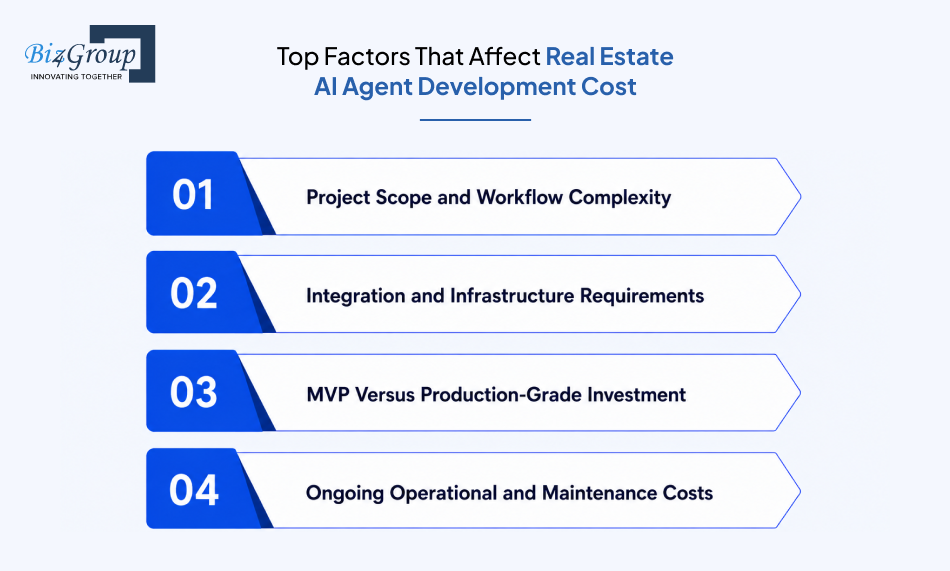
The technology itself is only one part of the budget. What usually has the biggest impact on cost? The amount of custom development needed to support your workflows, integrate with your existing systems, and deliver a reliable production experience plays the biggest role.
1. Project Scope and Workflow Complexity
An AI agent that qualifies leads requires far less development than one that also schedules showings, manages transactions, supports property managers, and assists commercial real estate teams. Every additional workflow adds business logic, testing, integrations, and ongoing optimization, which increases the overall investment.
2. Integration and Infrastructure Requirements
Most real estate businesses already rely on MLS platforms, CRMs, calendars, document management systems, and communication tools. Connecting the AI agent to these systems and keeping data synchronized often represents a significant portion of the project cost. If you plan to implement generative AI in real estate, these integrations become just as important as the AI model itself.
3. MVP Versus Production-Grade Investment
An MVP focuses on solving one or two business problems and helps validate your idea with real users before expanding further. A production-grade AI agent includes advanced monitoring, security, compliance, scalability, performance optimization, and support for multiple workflows. Those additional capabilities naturally require a larger investment.
4. Ongoing Operational and Maintenance Costs
Launching the AI agent for real estate is only the beginning. You'll also need to budget for AI model usage, cloud infrastructure, monitoring, software updates, security improvements, knowledge base maintenance, and continuous optimization as your listings, workflows, and business processes evolve.
What about development timelines? Most MVPs can be delivered in 8 to 12 weeks, while production-grade implementations with multiple integrations and enterprise capabilities typically take 4 to 8 months, depending on project scope and team availability.
You may also be asking yourself, "what is the realistic development cost and timeline for building a production-grade real estate AI agent in the US in 2026, i have seen estimates ranging from 50k to 500k and i cannot tell what drives that range, i need a breakdown by component so i can build a realistic budget before i approach investors or a development partner for our proptech startup."
That's a fair question because those estimates often describe very different projects. The biggest cost drivers include workflow complexity, MLS and third-party integrations, custom AI capabilities, security and compliance requirements, user experience, infrastructure, testing, and post-launch support. A brokerage building an AI agent for real estate lead qualification and follow-ups will have a very different budget from a PropTech platform developing a multi-agent system that supports transactions, property management, analytics, and enterprise-scale operations.
The most accurate cost estimate always starts with your business goals, not the AI model you choose. Once you've identified the workflows that deliver the highest business value, it's much easier to define a realistic budget, prioritize features, and plan a phased rollout that aligns with your growth strategy.
Turn Everyday Tasks into Competitive Advantages
From lead qualification to transaction support, AI agent development for real estate helps teams save time, improve efficiency, and deliver better client experiences.
Explore AI agent solutions for real estateShould You Build, Buy, or Customize a Real Estate AI Agent?
The right approach depends on your business goals, existing workflows, and long-term plans. Should every brokerage build a custom AI agent? Not necessarily. Off-the-shelf platforms work well for common use cases, while custom development makes more sense when your workflows, integrations, or customer experience require greater flexibility. If you're planning business app development using AI, choosing the right approach at the beginning can save both time and budget.
|
Approach |
Best Suited For |
Advantages |
Limitations |
|---|---|---|---|
|
Buy an Off-the-Shelf Solution |
Small brokerages, early-stage adoption |
Fast deployment, lower upfront cost, minimal setup |
Limited customization, fixed workflows, restricted integrations, less control over AI behavior |
|
Customize an Existing Platform |
Growing brokerages with specific requirements |
Faster than building from scratch, supports selected custom workflows, lower cost than full custom development |
Platform limitations still apply, advanced customization may be restricted |
|
Build a Custom AI Agent |
Large brokerages, PropTech companies, enterprise real estate businesses |
Complete control over workflows, MLS and CRM integrations, branding, scalability, security, and future enhancements |
Higher initial investment, longer development timeline, requires experienced AI engineering expertise |
One question comes up frequently:
"we have been using off-the-shelf real estate AI tools and none of them work the way our brokerage actually operates, they all feel like generic chatbots that got a real estate skin on top, we want to commission a custom real estate AI agent development project that is built around our specific workflows, our market, and our team structure, how do we find the right development company for this and what should the development process look like from discovery to launch."
If that sounds familiar, a custom AI agent is probably the right direction. The process typically begins with discovery workshops to understand your workflows, followed by solution architecture, UI/UX design, MVP development, AI agent integration with real estate CRM and MLS, testing, deployment, and continuous optimization. When evaluating partners, look for experience in real estate AI, strong integration capabilities, production deployments, and a clear development roadmap. If you plan to hire AI developers, make sure they understand both AI engineering and the day-to-day operations of brokerages, property management companies, or PropTech platforms.
The decision isn't about choosing the most advanced option. It's about choosing the solution that fits your business today while giving you room to grow tomorrow. For many organizations, real estate AI agent development cost and timeline means starting with a focused MVP and expanding the AI agent as new workflows and business needs emerge.
How Can You Monetize a Real Estate AI Agent?
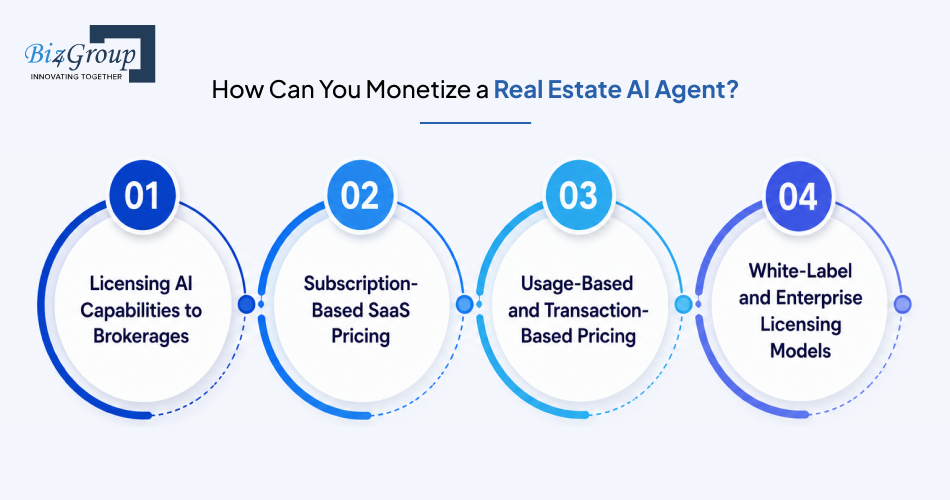
A real estate AI agent can generate revenue in several ways, depending on who you're building it for and how it's delivered. Which monetization model works best? That depends on your target customers, pricing strategy, and the business problems your AI agent solves. If you're exploring real estate AI apps ideas, these are the models most commonly used by successful PropTech companies and AI software providers.
1. Licensing AI Capabilities to Brokerages
Many brokerages prefer licensing software over building it themselves. You can charge an annual or multi-year licensing fee for AI-powered lead qualification, property search, transaction support, or property management workflows, along with implementation and support services.
- Example: A regional brokerage licenses your AI agent for all its offices to automate lead qualification and showing coordination. The brokerage pays an annual licensing fee while your team provides updates, support, and feature enhancements.
2. Subscription-Based SaaS Pricing
A SaaS model works well when you want recurring revenue and predictable cash flow. Customers typically pay a monthly or annual subscription based on the number of users, AI conversations, or available features. This approach also makes it easier to introduce new capabilities over time through AI model development without requiring customers to purchase a new product.
- Example: An independent brokerage subscribes to your AI platform for a monthly fee that includes CRM integration, MLS search, analytics, and AI-powered customer conversations for up to 20 agents.
3. Usage-Based and Transaction-Based Pricing
Some businesses prefer paying only for what they use. You can charge based on the number of AI conversations, qualified leads, completed property searches, scheduled showings, or successful transactions, making this model attractive for seasonal or rapidly growing real estate businesses.
- Example: A PropTech marketplace pays a fixed fee for every qualified lead the AI agent delivers or every showing successfully scheduled through the platform, allowing costs to scale alongside business growth.
4. White-Label and Enterprise Licensing Models
If your intelligent agent for real estate is designed for multiple organizations, a white-label offering can significantly expand your market. Brokerages, franchises, and enterprise real estate companies can brand the platform as their own while using the same underlying technology and integrations.
- Example: A national real estate franchise deploys your AI agent across hundreds of offices under its own brand, giving every franchise location a consistent customer experience while you manage the platform behind the scenes.
|
Monetization Model |
Best For |
Revenue Model |
|---|---|---|
|
Licensing to Brokerages |
AI vendors serving individual brokerages |
Annual or multi-year licensing fees |
|
Subscription-Based SaaS |
PropTech startups and SaaS platforms |
Monthly or annual recurring subscriptions |
|
Usage- or Transaction-Based Pricing |
High-volume platforms and marketplaces |
Pay per AI conversation, qualified lead, showing, or completed transaction |
|
White-Label & Enterprise Licensing |
Franchises, MLS providers, and enterprise real estate companies |
Enterprise contracts, white-label licensing, and custom implementation fees |
The strongest monetization strategy depends on the value your AI agent delivers to customers. Many companies begin with a subscription model, then add enterprise licensing, white-label offerings, or usage-based pricing as their customer base grows and new market opportunities emerge.
What Technical and Compliance Challenges Should You Prepare For?
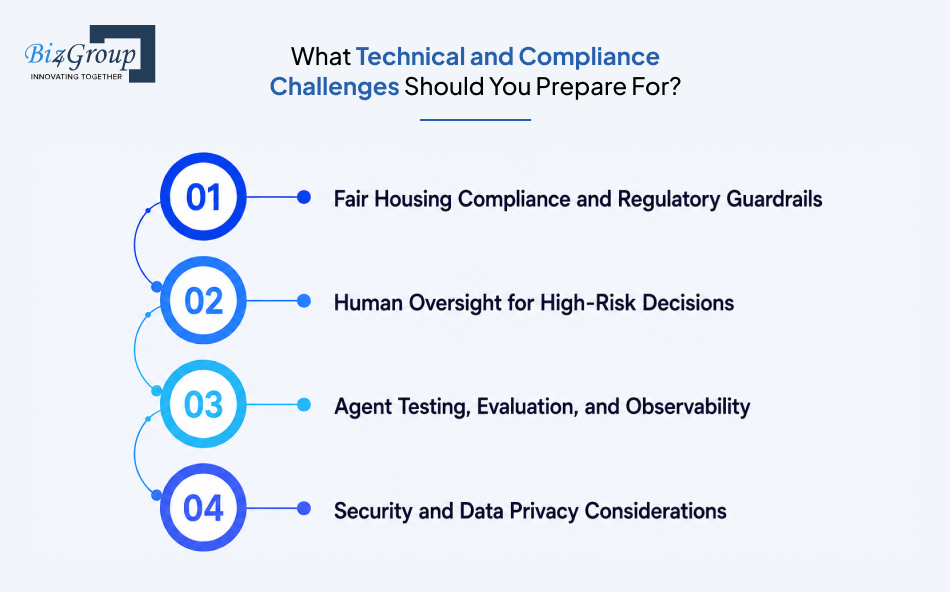
Building a real estate consultant AI agent involves more than choosing the right AI model. You'll also need to think about compliance, human oversight, testing, security, and the quality of the data your agent relies on. Addressing these areas early helps you launch a solution that's accurate, reliable, and ready for real-world customer interactions.
1. Fair Housing Compliance and Regulatory Guardrails
Real estate AI agents should follow Fair Housing regulations in every customer interaction. That means avoiding discriminatory responses, treating comparable customer requests consistently, and applying clear guardrails when answering questions about neighborhoods, demographics, or protected characteristics. If you're using generative AI, these safeguards should be built into the system from the beginning, not added after launch.
2. Human Oversight for High-Risk Decisions
Can an AI agent make every decision on its own? No. High-impact situations such as legal questions, contract interpretation, disputes, pricing recommendations, or complaints should always be routed to a qualified team member. So, how can businesses prevent inaccurate AI agent responses? The answer: Human oversight.
3. Agent Testing, Evaluation, and Observability
Testing shouldn't stop once development is complete. Your AI agent should be evaluated regularly for response quality, workflow accuracy, integration performance, and business outcomes. Monitoring conversations and reviewing failed interactions helps identify opportunities to improve both the AI agent and the customer experience.
4. Security and Data Privacy Considerations
Real estate AI agents often process customer contact details, financial information, property records, and internal business data. Protecting this information requires secure authentication, role-based access, encrypted data storage, audit logs, and regular security reviews across every connected system.
You may also be asking yourself:
"i am a software development agency that has been asked by a real estate client to build them a custom AI agent for lead qualification and showing scheduling, we have general AI development experience but not a lot of real estate domain knowledge, what are all the domain-specific things we need to understand before we start building, what data sources and integrations are mandatory, and what are the compliance and fair housing requirements we need to build into the system from day one."
The answer starts with understanding how real estate businesses actually operate. Your team should become familiar with MLS and IDX data, CRM workflows, lead routing rules, showing coordination, transaction lifecycles, property management processes where applicable, and Fair Housing requirements. From a technical perspective, MLS, CRM, calendar, and communication platform integrations are usually essential, while compliance guardrails, audit logging, human escalation paths, and security controls should be treated as core product requirements from the very beginning.
The most successful real estate consultant AI agent combine strong engineering with a solid understanding of the industry's operational and regulatory requirements. When both pieces come together, the result is an AI agent that businesses can trust in everyday operations.
Which Development Mistakes Cause Real Estate AI Agent Projects to Fail?
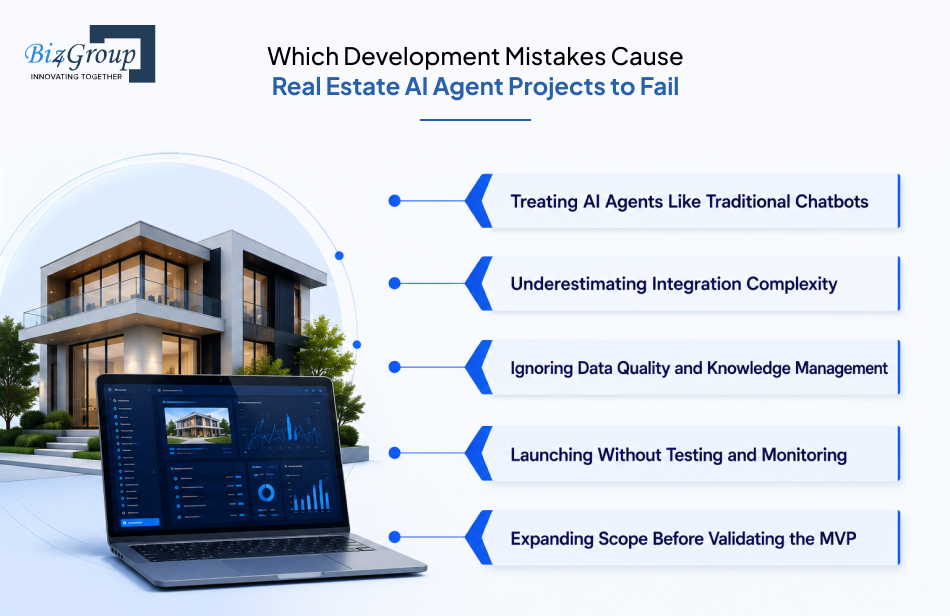
Most real estate AI agent projects don't struggle because of the AI model. They run into problems when business workflows, data, integrations, or rollout strategies aren't planned properly. What's the best way to avoid these issues? Start with a focused business objective, validate the AI agent in real-world scenarios, and expand only after you've proven it delivers measurable value. Whether you're building an internal assistant or planning to integrate AI into an app, avoiding these common mistakes can save months of rework.
|
Common Mistake |
Why It Becomes a Problem |
Better Approach |
|---|---|---|
|
Treating AI Agents Like Traditional Chatbots |
The agent answers questions but can't complete business tasks or use company data effectively. |
Design the AI agent around workflows such as lead qualification, showing coordination, and transaction support. |
|
Underestimating Integration Complexity |
Disconnected MLS, CRM, calendar, and communication systems create inconsistent experiences and manual work. |
Plan integrations early and test data synchronization throughout development. |
|
Ignoring Data Quality and Knowledge Management |
Outdated listings, inaccurate documents, and incomplete business information reduce response quality. |
Build a reliable knowledge base and keep MLS data, policies, and documentation updated. |
|
Launching Without Testing and Monitoring |
Errors go unnoticed, customer experience suffers, and performance declines over time. |
Continuously evaluate conversations, monitor AI performance, and improve workflows based on real usage. |
|
Expanding Scope Before Validating the MVP |
Development slows down, budgets increase, and teams struggle to measure business impact. |
Launch with one or two high-value workflows, validate results, and expand in phases. |
Every successful AI project starts by solving a specific business problem well. Once your team understands how to use AI for real estate in everyday operations and has validated the results with real users, expanding into additional workflows becomes a much lower-risk investment.
How Do You Choose the Right Real Estate AI Agent Development Company?
You should choose a real estate AI agent development company that understands both AI and the way real estate businesses operate. The best real estate AI agent development company will spend as much time learning about your brokerage, property management, or PropTech platform as they do discussing technology, because your workflows ultimately determine how successful the AI agent will be.
1. Technical Expertise and AI Engineering Capabilities
One of the first things I'd ask is whether they've already built AI agents that complete real business tasks. Can the AI agent qualify leads, retrieve listing information, update a CRM, schedule showings, and work across multiple systems? Those examples tell you much more than a polished demo of an AI conversation app answering property questions.
- Example: A brokerage asks two vendors to demonstrate a lead inquiry from start to finish. One shows the AI agent qualifying the buyer, creating a CRM record, and booking a showing. The other only demonstrates a chat interface, making the difference easy to spot.
2. Real Estate Domain Knowledge and Integration Experience
Pay close attention to the questions they ask during discovery. Are they interested in how leads are assigned, which MLS and CRM you use, how transactions move through your business, or how your agents manage their day? Those conversations usually reveal whether the team understands real estate or is trying to fit your business into a standard AI template.
- Example: Before proposing a solution, the development team maps the brokerage's lead routing rules, MLS workflow, CRM process, and showing approvals. That information shapes how the AI agent behaves from day one.
3. Security, Compliance, and Delivery Practices
What happens if the AI agent gives an incorrect answer after launch? How do real estate AI agents protect customer data? These are questions worth asking before you sign a contract. A good development partner should be able to explain how they test conversations, monitor performance, review failed interactions, protect customer data, and apply Fair Housing guardrails throughout the project.
- Example: Before going live, the vendor walks the brokerage through conversation testing, security reviews, rollout planning, and monitoring dashboards, giving the team confidence before customers begin using the AI agent.
4. Vendor Evaluation Criteria and Selection Checklist
Once you've shortlisted a few companies, ask them all the same questions. Which MLS and CRM platforms have you integrated before? How do you measure AI agent performance after launch? Who owns the source code and prompts? What happens when the AI agent can't complete a task? Clear answers backed by real examples are usually a strong indicator of experience.
- Example: A PropTech startup compares three vendors using the same evaluation checklist. One team backs every answer with previous projects and implementation examples, making the final decision much easier.
After a few conversations, you'll usually know which company understands your business and which one is still learning the industry. The strongest partners spend more time understanding your workflows than talking about AI models, because that's what leads to an AI agent your team will actually use and your customers will trust.
At Biz4Group LLC, we've worked on AI solutions across different parts of the real estate industry. We've built a conversational platform that helps buyers discover properties more naturally, a system that keeps complex real estate contracts organized, and a platform that helps construction teams manage day-to-day site operations. Those projects have given us firsthand experience with the workflows, data, and integrations that shape successful real estate AI products.
Ready to Build Your Real Estate AI Agent?
Get expert guidance on planning, designing, and scaling a Real Estate AI Agent Development solution that fits your business goals.
Talk to Our AI ExpertsDon't Start With AI. Start With Tomorrow Morning.
Think about what happens when your team logs in tomorrow morning. Which tasks will they repeat for the hundredth time? Which customer questions will they answer again? Which follow-up emails will still need to be sent?
Those everyday activities are often the strongest candidates for automation. Solve those first, measure the results, and let the AI agent grow alongside your business. A development partner like Biz4Group LLC with proven product development services can help you turn those daily operational challenges into a practical AI solution that keeps delivering value as your brokerage or PropTech business expands.
If you're exploring what an AI agent could look like for your brokerage or PropTech platform, our team is always happy to discuss your ideas, evaluate your use case, and help you identify the best place to start.
Frequently Asked Questions About Real Estate AI Agent Development
1. What Is the Difference Between a Real Estate AI Agent and a Real Estate Chatbot?
A real estate chatbot mainly answers questions using predefined responses or an AI model. A real estate AI agent goes further by qualifying leads, searching MLS data, scheduling showings, updating your CRM, sending follow-ups, and completing business tasks across multiple systems.
2. How Much Does It Cost to Build a Custom Real Estate AI Agent?
Most custom real estate AI agent projects in the US start between $20,000 and $60,000. The final cost depends on the number of workflows, MLS and CRM integrations, AI capabilities, security requirements, and whether you're building an MVP or a production-grade solution.
3. How Long Does Real Estate AI Agent Development Take?
An MVP typically takes 8 to 12 weeks, while a production-ready AI agent usually takes 4 to 8 months. The timeline depends on workflow complexity, integrations, testing, and deployment requirements.
4. Can a Real Estate AI Agent Access MLS Listings?
Yes, provided your MLS supports data access and your business has the required permissions. Most production deployments retrieve listing information through MLS or IDX integrations so the AI agent can answer property-specific questions using current data.
5. Which Real Estate Workflows Are Best to Automate First?
Lead qualification is usually the best starting point because it has a direct impact on response times and conversion rates. Property search, showing scheduling, transaction updates, tenant communication, and customer support are also common first-phase use cases.
6. Can a Real Estate AI Agent Replace Human Agents?
No. AI agents are designed to handle repetitive work such as answering questions, qualifying leads, scheduling appointments, and retrieving information. Negotiations, relationship building, legal guidance, and complex decision-making should remain with experienced real estate professionals.
7. What Integrations Does a Real Estate AI Agent Need?
Most businesses integrate their AI agent with an MLS or IDX feed, CRM, calendar, email platform, document management software, and communication tools. The exact AI agent integration for real estate depends on your existing technology stack and the workflows you want the AI agent to automate.
8. How Do I Know If My Business Is Ready for a Real Estate AI Agent?
If your team spends significant time on repetitive conversations, manual follow-ups, appointment scheduling, lead qualification, or updating multiple systems, you're likely ready. The best first step is identifying one high-impact workflow, validating it with an MVP, and expanding from there once you've measured the business results.
