Location :
Orlando, FL, USA
Location :
Orlando, FL, USA +1 (407) 714-1616
 info@biz4group.com

- Enterprise grade sports APIs for betting app platforms are the backbone of $10M+ valuation sportsbooks, driving real-time accuracy, stability, and investor confidence.
- Enterprise sports data APIs for betting apps reduce settlement disputes, improve user trust, and support consistent revenue during live betting.
- Premium sports data APIs for sportsbooks unlock high-revenue opportunities like in-play betting, micro markets, and player props.
- Enterprise sports API solutions for betting apps strengthen compliance posture and reduce regulatory and audit risk.
- Sports analytics APIs for betting app growth support personalization, smarter engagement, and future AI-powered features.
- Biz4Group LLC helps founders and operators build investor-ready betting platforms using enterprise-grade sports APIs, scalable architecture, and proven sports betting expertise.
Why do some betting apps feel unstoppable while others fade out after launch hype?
Same sport.
Same users.
Same markets.
Yet only a few platforms break into eight-figure valuations.
The sports betting industry is not slowing down either. Global online sports betting revenue is expected to cross $153.44 billion in 2030, driven by live betting and mobile platforms.
Behind every high performing platform sits a quiet hero... The enterprise grade sports APIs for betting app infrastructure. Not flashy. Not visible to users. Yet absolutely decisive. These APIs decide whether odds update on time, bets settle correctly, and users trust the app enough to return every weekend. When data lags or crashes, revenue leaks instantly.
That’s why serious founders invest early in enterprise sports data APIs for betting apps. They enable speed without chaos. Scale without panic. Growth without breaking compliance rules. Strong APIs help teams launch faster, expand into new markets confidently, and handle traffic spikes during playoff nights without melting servers.
Look at the apps investors love backing. Most rely on sports APIs for high valuation betting platforms to power live odds, analytics, and in-play betting.
Clean data builds trust. Trust builds engagement. Engagement builds revenue. And revenue builds valuation.
Let’s unpack how enterprise-level sports APIs quietly turn betting ideas into $10M plus businesses.
What Makes Enterprise Sports Data APIs for Betting Apps Different from Standard Sports APIs
Before we talk valuation, growth, or funding, let’s get one thing straight. Not all sports APIs are created equal.
Many early betting apps start with basic feeds. Scores update. Odds refresh. Things look fine... until traffic spikes, or a live game hits overtime, or regulators start asking questions.
That’s when the cracks show.
Enterprise sports data APIs for betting apps are built for pressure. They handle speed, scale, and scrutiny without breaking a sweat.
What are Enterprise-Grade Sports APIs for Betting Apps?
Enterprise grade sports APIs for betting apps are high-performance data infrastructure systems that deliver real-time sports data, verified odds, compliance-ready logs, and scalable architecture to support high-traffic, regulated betting platforms.
How Enterprise Sports APIs Actually Work Behind the Scenes?
Here’s a simplified breakdown of what happens every time a user opens a betting app during a live game.
- Official league and match data is collected from verified sources
- Data is validated, normalized, and timestamped
- Odds, scores, and stats are pushed through redundant pipelines
- Real-time updates are delivered to apps with low latency
- Historical data is stored for audits, analytics, and compliance
All of this happens in milliseconds. Every single time.
Key Differences Between Standard APIs and Enterprise APIs
|
Feature |
Standard Sports APIs |
Enterprise Sports APIs |
|---|---|---|
|
Data accuracy |
Aggregated or delayed |
Verified and official |
|
Latency |
Seconds or minutes |
Real-time updates |
|
Uptime guarantees |
Best effort |
SLA backed reliability |
|
Scalability |
Limited |
Built for peak traffic |
|
Compliance support |
Minimal |
Audit and regulation ready |
|
Investor confidence |
Low |
High |
This difference directly affects trust, retention, and revenue.
Where Enterprise Providers Fit into the Ecosystem
Leading platforms often rely on established enterprise providers such as Sportradar and Genius Sports for official league data, integrity services, and compliance readiness. Some teams also use flexible data sources like API-Sports for broader coverage and faster experimentation during early expansion phases.
Most mature sportsbooks do not depend on a single source. In fact, many top US betting apps rely on multiple sports data providers to reduce risk and improve uptime during high-stakes events.
Why This Matters for Betting Businesses
When APIs fail, everything else follows.
- Bets get delayed
- Odds disputes increase
- Users lose confidence
- Regulators take notice
That’s why serious platforms invest early in enterprise sports API infrastructure for betting apps and work with experienced teams to design reliable, scalable architectures from day one.
Enterprise APIs may feel invisible to users. But to founders, operators, and investors, they are the backbone of a betting business built to last.
Up next, we’ll connect this infrastructure directly to valuation and investor confidence.
Still Running Your Betting App on "Good Enough" Data?
Live betting errors can cost sportsbooks up to 8–12% of event revenue. Why risk it when enterprise-grade APIs exist?
Build Smart with Biz4GroupSports Data APIs for Investor-Ready Betting Platforms and Their Direct Impact on Valuation
Here’s a simple question investors always ask... If this app doubles its user base next quarter, will the backend survive without chaos?
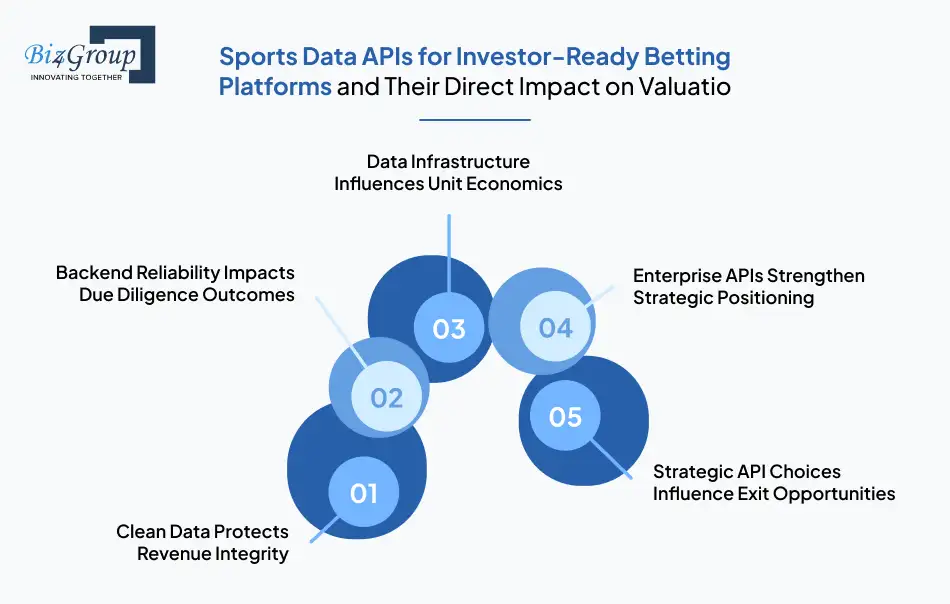
Valuation is not about features alone. It is about confidence. Sports data APIs for investor-ready betting platforms play a decisive role in that confidence. They shape how stable, predictable, and defensible a sportsbook appears during funding conversations.
Let’s break this down clearly.
1. Clean Data Protects Revenue Integrity
Revenue projections mean nothing if settlements are inconsistent.
When odds change incorrectly or match data updates late, operators face refunds, manual corrections, and unhappy users. Over time, this erodes credibility. Enterprise grade sports APIs for betting app ecosystems eliminate these inconsistencies by delivering verified feeds, synchronized timestamps, and structured data pipelines.
For investors, clean settlement history equals financial discipline. And financial discipline strengthens valuation multiples.
2. Backend Reliability Impacts Due Diligence Outcomes
Technical audits during funding rounds are thorough. Infrastructure gets inspected line by line. Dependency chains are mapped. Failover systems are evaluated.
A platform built on fragmented or unstable APIs struggles under scrutiny. In contrast, apps powered by sports APIs for high valuation betting platforms present documented uptime metrics, structured data logs, and redundancy models that reassure stakeholders.
Strong API architecture reduces perceived operational risk. Reduced risk increases deal confidence.
3. Data Infrastructure Influences Unit Economics
User acquisition costs are rising. Retention has become the real battleground.
When live scores update instantly and odds reflect real-time action without lag, users stay longer and place more bets. That consistency improves lifetime value. Enterprise sports API infrastructure for betting apps directly supports this retention loop.
Investors care deeply about LTV to CAC ratios. Reliable data improves those ratios quietly but measurably.
4. Enterprise APIs Strengthen Strategic Positioning
When founders pitch institutional investors, they must demonstrate long-term durability. Enterprise APIs signal that the business was architected for growth, compliance, and operational discipline from day one.
This is especially important for platforms exploring sophisticated monetization layers such as advanced modeling or predictive analytics powered by AI integration services.
Investors see structured API ecosystems as foundations that can support innovation without destabilizing core betting operations.
Portfolio Spotlight: Real-Time Sports Betting Platform for Major Global League Games
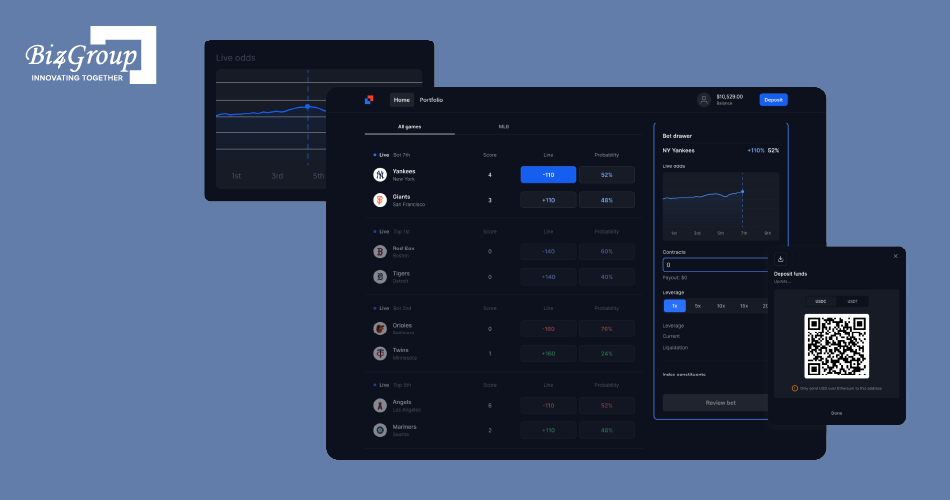
This real-time sports betting platform demonstrates how strong API foundations translate into valuation-ready infrastructure.
Designed for real-time betting across MLB, CFB, and NFL, this platform was built with performance and reliability at its core. Instead of relying on patchwork integrations, the platform leverages a carefully structured architecture designed for precision.
Key strengths include:
- Real-time socket-based integration ensuring accurate in-game updates
- Eight-layer backend architecture supporting synchronized data flow
- Market-aligned dynamic pricing built on validated feeds
- Administrative control systems enabling structured oversight
This approach reflects what enterprise grade sports APIs for $10M plus betting apps should look like in practice.
Clean data pipelines. Operational visibility. Documented reliability.
5. Strategic API Choices Influence Exit Opportunities
Acquirers analyze more than revenue. They assess technical debt, vendor dependencies, and infrastructure maturity.
Platforms that depend on fragile integrations often require expensive restructuring before acquisition. Those built on sports data APIs for investor-ready betting platforms shorten this timeline.
That efficiency can materially affect exit valuation.
In short, enterprise API decisions echo far beyond development. They influence investor trust, funding speed, and acquisition appeal.
In the next section, we will move away from valuation mechanics and focus on why betting apps need enterprise sports APIs from an operational and product perspective.
Also read: Top 12 AI sports betting app development companies in USA
Benefits of Enterprise Sports APIs for Scalable Sports Betting Platforms
Every betting app promises speed, accuracy, and a smooth experience. Few deliver it consistently.
The difference often comes down to infrastructure choices made early. Why betting apps need enterprise sports data APIs becomes obvious once platforms move beyond testing phases and face real users, real money, and real pressure.
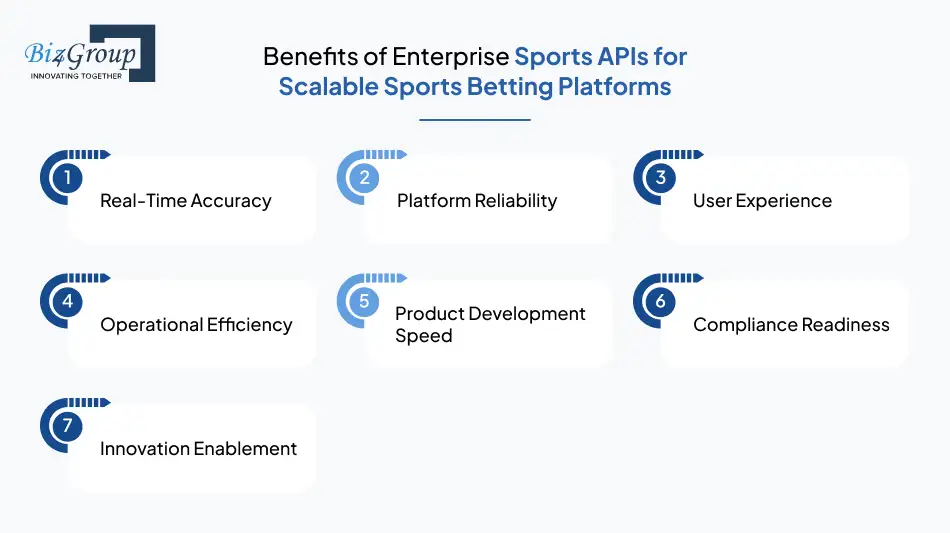
This section focuses on the operational and product-level benefits that enterprise sports APIs for scalable sports betting platforms bring to the table. These benefits directly affect user experience, team efficiency, and long-term platform health.
Core Benefits of Enterprise Grade Sports APIs for Betting App Teams
|
Benefit Category |
What Happens Without Enterprise APIs |
What Enterprise Grade Sports APIs for Betting App Deliver |
Business Impact |
|---|---|---|---|
|
Real-Time Accuracy |
Delayed score updates and mismatched odds |
Millisecond-level live updates with synchronized feeds |
Higher user trust and fewer betting disputes |
|
Platform Reliability |
Frequent downtime during high-traffic games |
SLA-backed uptime with failover mechanisms |
Stable revenue during peak betting events |
|
User Experience |
Lag during in-play betting and refresh errors |
Seamless in-play betting with instant data refresh |
Longer session time and improved retention |
|
Operational Efficiency |
Manual corrections and support overload |
Automated settlement logic with clean data logs |
Lower operational costs and faster issue resolution |
|
Product Development Speed |
Delays caused by unstable integrations |
Structured, well-documented API frameworks |
Faster launch of new features and bet types |
|
Compliance Readiness |
Limited audit trails and inconsistent reporting |
Timestamped, verifiable data records |
Stronger regulatory positioning and reduced legal risk |
|
Innovation Enablement |
Risky experimentation due to unstable data |
Clean data pipelines ready for analytics layers |
Easier integration of AI, analytics, and personalization tools |
These benefits may look operational on the surface. In practice, they shape how users perceive trust and how teams build momentum.
Why These Benefits Matter in the Real World
When APIs behave predictably, product teams move faster. New bet types launch smoothly. Live betting feels responsive. Customer support tickets drop.
More importantly, reliable sports APIs for sports betting businesses free leadership teams from daily technical distractions. That breathing room allows focus on partnerships, licensing, and user growth strategies.
This becomes especially valuable for founders building early versions such as a sports betting app MVP or launching faster through a white-label sports betting platform.
Portfolio Spotlight: Ingenious Betting App for Sports Enthusiasts
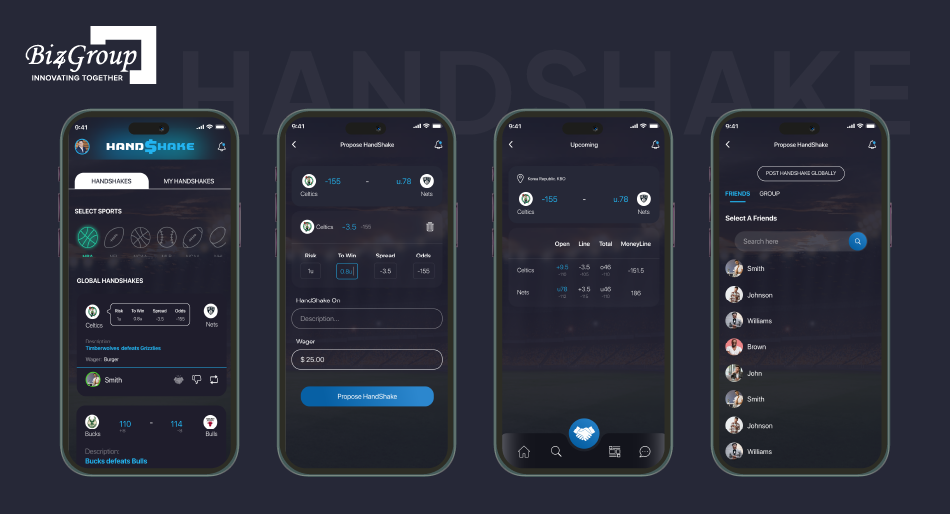
Built as a social-first betting app, this project needed live scores, instant updates, and constant synchronization across users. Any lag would break the experience.
Biz4Group engineered the platform with reliable sports data pipelines that supported interaction-heavy features.
What stood out in this project:
- Real-time live game scores across multiple leagues
- Instant betting updates during active matches
- Smooth one-on-one and group betting interactions
- Push notifications triggered by live data events
- Admin controls for operational visibility
By grounding the platform in enterprise sports API solutions for betting apps, this app delivered fast-paced social betting without performance degradation. Users stayed engaged because the data stayed accurate.
Where Enterprise APIs Unlock Advanced Capabilities
Strong API foundations also make it easier to layer intelligence on top.
Teams exploring personalization, prediction engines, or automation benefit when clean data flows reliably into models. This is where AI automation begin to add value without destabilizing core betting operations.
Enterprise APIs create the conditions where innovation feels safe instead of risky.
The benefits of enterprise grade sports APIs for betting app teams show up daily.
Faster development. Fewer disputes. Happier users.
They may not appear on marketing slides, but they quietly determine whether a betting platform runs smoothly or constantly plays catch-up.
Your Users Notice Data Quality Before You Do!
Platforms with real-time, reliable data report higher session time and fewer support tickets. Want the same advantage?
Contact Biz4Group TodayScalable Sports APIs for Betting Platforms That Enable Market Expansion
Growth sounds exciting. Expansion feels ambitious. Scaling, however, is where betting platforms either prove their maturity or expose their limits.
Scalable sports APIs for betting platforms sit at the center of this challenge. They determine whether a sportsbook can add users, leagues, and markets without rewriting its entire backend every few months.
Let’s look at how this plays out in practice.
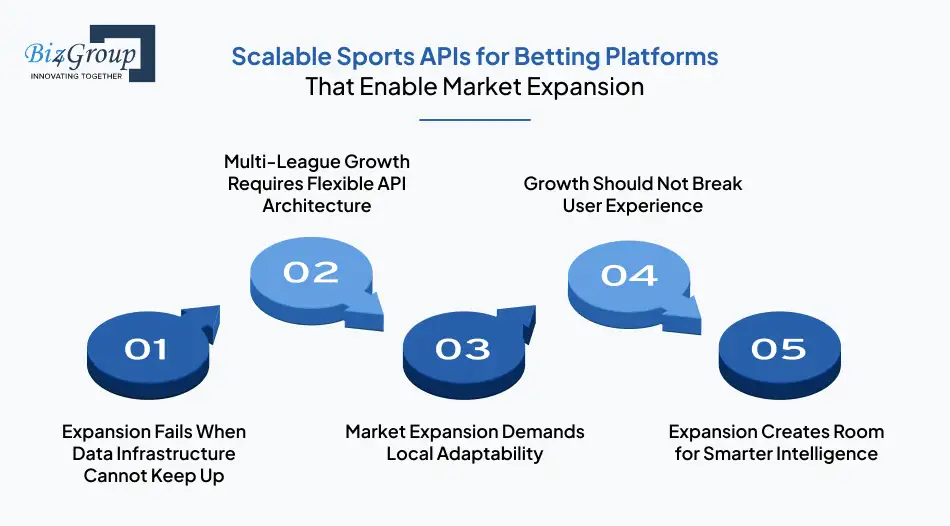
1. Expansion Fails When Data Infrastructure Cannot Keep Up
Many betting platforms plan to expand after early traction.
New leagues. New regions. New bet types.
Without enterprise sports APIs for scalable sports betting platforms, each addition increases complexity.
Data formats differ.
Latency grows.
Errors multiply.
Teams spend more time fixing issues than shipping features.
Scalable APIs standardize data across sports and regions. That consistency lets platforms expand confidently without introducing chaos into the system.
2. Multi-League Growth Requires Flexible API Architecture
A platform supporting one league behaves very differently from one supporting five.
Reliable sports APIs for sports betting businesses make it easier to onboard new leagues and events while maintaining performance. Odds calculation, live updates, and historical data remain structured even as coverage grows.
This is why platforms modeled after sports betting platform like Outlier.Bet prioritize modular data layers that allow expansion without heavy rework.
3. Market Expansion Demands Local Adaptability
Entering new markets often means navigating different betting behaviors, formats, and compliance requirements.
Enterprise sports API infrastructure for betting apps supports localization by delivering structured feeds that can adapt to regional rules and user expectations. This flexibility reduces time-to-market when launching in new territories.
Founders exploring approaches similar to building a sports betting platform like BetDEX benefit greatly from scalable API foundations that support long-term expansion plans.
4. Growth Should Not Break User Experience
Scaling is pointless if the experience degrades.
During expansion phases, user traffic becomes unpredictable. Live games overlap, betting volume spikes. Scalable sports APIs for betting platforms absorb this pressure quietly, keeping data accurate and interfaces responsive.
This stability allows teams to focus on strategy rather than crisis management.
5. Expansion Creates Room for Smarter Intelligence
Once scale is handled at the API level, platforms can safely explore advanced layers such as personalization, prediction engines, or automation. Clean data makes it easier to experiment with features powered by enterprise AI solutions without risking platform stability.
Market expansion exposes weak infrastructure quickly. Strong platforms plan for it early. Scalable sports APIs for betting platforms let betting businesses expand steadily, add coverage confidently, and keep users happy while the platform grows.
Next, we’ll look at how premium sports data unlocks stronger monetization and revenue opportunities.
Also read: How much does it cost to develop an AI sports betting app like Rithmm?
How Premium Sports APIs Improve Betting App Monetization and Revenue Growth
Monetization in sports betting rarely fails because of weak demand. It fails because platforms cannot convert attention into action at the right moment.
That moment is driven by data.
How premium sports APIs improve betting app monetization becomes clear when you look at where money actually gets made.
Live games.
Fast odds changes.
Player level markets.
Real-time insights.
All of these rely on clean, instant data delivery.
Let’s break this down.
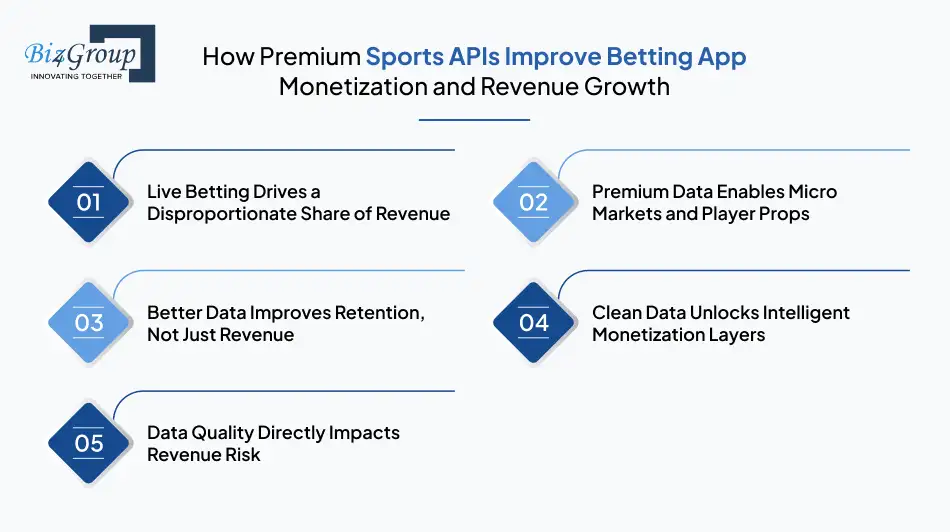
1. Live Betting Drives a Disproportionate Share of Revenue
Live or in-play betting has become the highest revenue generator for modern sportsbooks.
Over 70% of total betting handle now comes from in-play bets for mature platforms. The reason is simple. Users place more bets when action unfolds live.
This only works when sports APIs that power high revenue betting applications deliver odds updates without lag. Even a one second delay can kill conversion.
Also read: Why most betting apps fail at real-time match accuracy (and how top apps fix it)?
2. Premium Data Enables Micro Markets and Player Props
Modern bettors want options. Not just match winners.
Premium sports data APIs allow sportsbooks to offer:
- Player performance bets
- Micro markets such as next goal or next play
- Period-based and situational bets
- Historical performance comparisons
These markets significantly increase average bet count per session. Many sportsbooks report 20-35% higher ARPU after expanding into player and micro betting options powered by premium feeds.
3. Better Data Improves Retention, Not Just Revenue
Revenue spikes mean little if users do not return.
- Accurate stats
- Fast odds refresh
- Transparent settlements
... build trust. Trust builds habit. Habit builds lifetime value.
Premium sports data APIs for sportsbooks quietly improve retention by removing friction. Users stay because the platform feels reliable.
4. Clean Data Unlocks Intelligent Monetization Layers
Once premium data flows reliably, platforms can safely experiment with smarter features.
These include:
- Recommendation engines
- Prediction models
- Dynamic odds personalization
Teams that know how to use AI for sports betting gain an edge without overwhelming their systems.
Portfolio Spotlight: Quick Start Bets
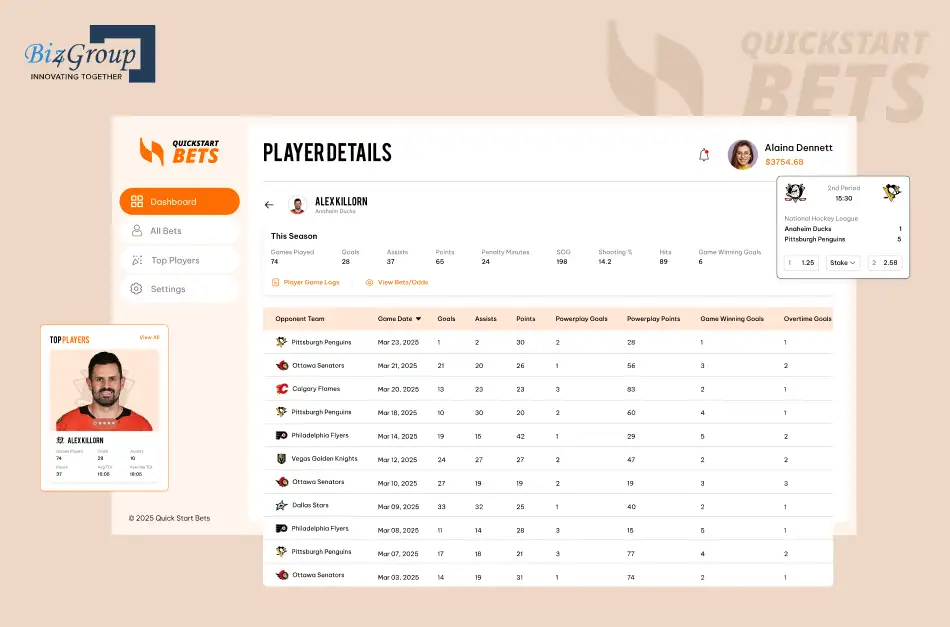
Quick Start Bets shows how premium data directly shapes revenue and engagement.
Built as a real-time analytics platform for NHL betting, the product focused on speed, clarity, and insight driven engagement.
Key monetization-enabling features included:
- Live odds updates designed for fast decision making
- Player and team level analytics supporting informed bets
- Historical data and game logs encouraging repeat usage
- Centralized dashboards that increased session time
By grounding the platform in sports APIs that power high revenue betting applications, Quick Start Bets helped users place smarter bets faster. That combination improves both engagement and monetization without aggressive promotions.
5. Data Quality Directly Impacts Revenue Risk
Incorrect odds or delayed updates can trigger refunds and disputes that wipe out profits from entire events.
This is why enterprise-level platforms invest early in premium data sources. Reliable data protects revenue as much as it grows it.
Also read: Why enterprise sports data API like Sportradar matters?
Monetization does not come from flashy features alone. It comes from delivering the right data at the right moment. Premium sports APIs for sportsbooks enable live betting, richer markets, higher engagement, and stronger retention. All of these combine to create sustainable revenue growth.
Next, we’ll explore how enterprise sports APIs reduce compliance risk and protect betting platforms from regulatory and operational setbacks.
Also read: How do AI sports betting apps like FanDuel make money?
What If Every Live Game Generated 20% More Revenue?
In-play betting and micro markets thrive on premium sports data. Is your platform monetizing every moment?
Let's Talk NumbersHow Enterprise Sports APIs Protect Betting Platforms from Audits and Penalties
Compliance is not a milestone. It is a constant state.
For betting platforms, regulatory pressure never pauses. Rules evolve. Audits happen unexpectedly. Data accuracy gets questioned when money is involved. This is where enterprise sports API solutions for betting apps quietly become one of the strongest risk management tools a business can have.
Let’s look at how.
Why Compliance Breaks Betting Platforms Faster Than Competition
Most betting apps do not fail because of poor ideas. They fail because of preventable compliance gaps.
Common triggers include:
- Inconsistent match data across users
- Missing or incomplete audit trails
- Delayed odds updates during live betting
- Inability to prove data integrity to regulators
Each of these issues increases legal exposure and operational cost. Reliable sports APIs for sports betting businesses reduce these risks at the source by ensuring data consistency and traceability.
How Enterprise Sports APIs Support Audit Readiness
Enterprise-grade APIs are built with compliance in mind. They log, timestamp, and structure data so platforms can answer regulatory questions with confidence.
Here is how enterprise APIs compare during audits:
|
Compliance Area |
Without Enterprise APIs |
With Enterprise Sports APIs for Betting Apps |
|---|---|---|
|
Data traceability |
Fragmented records |
Centralized, timestamped logs |
|
Odds verification |
Manual explanations |
Automated data validation |
|
Dispute resolution |
Case-by-case handling |
Clear event-level audit trails |
|
Regulatory reporting |
High effort |
Structured, export-ready data |
|
Risk exposure |
High |
Controlled and predictable |
For operators navigating complex markets, this structure becomes non-negotiable.
Compliance Becomes More Complex Across Regions
Expanding across jurisdictions introduces layered regulations.
Reporting formats change.
Betting rules vary.
Data requirements differ.
Enterprise sports APIs for scalable sports betting platforms help normalize these differences by providing standardized feeds that adapt to local regulatory needs.
This is especially important for teams building or upgrading a sports betting website intended for multiple regions.
Clean Data Reduces Legal and Financial Risk
Every dispute costs money. Refunds, support time, and potential fines add up quickly.
By relying on enterprise grade sports APIs for betting app infrastructure, platforms reduce disputes before they happen. Clean data keeps settlements consistent and defensible.
This stability becomes critical as betting apps layer advanced intelligence such as automation, recommendation engines, or even a sports betting AI agent. These features only remain compliant when the underlying data is accurate and verifiable.
Compliance Also Shapes Investor Confidence
Investors avoid regulatory surprises. Platforms that demonstrate strong compliance posture backed by enterprise sports API infrastructure for betting apps stand out during due diligence.
Well-documented data systems shorten legal reviews and reduce perceived exposure. This strengthens valuation discussions and speeds up funding cycles.
Compliance does not generate headlines, but it protects everything that does. Enterprise sports API solutions for betting apps turn regulation from a recurring threat into a manageable process. They safeguard revenue, reduce legal exposure, and support long-term credibility.
Up next, we will look at how to choose the right sports API strategy without locking your betting platform into inflexible or risky dependencies.
Also read: Sports betting regulations across US states
Choosing the Right Sports API Strategy for Enterprise Betting Apps
Choosing a sports API feels technical. In reality, it is a business decision with long-term consequences.
The wrong choice slows growth. The right one compounds value.
This section helps founders and operators choose enterprise grade sports APIs for betting app platforms with clarity and confidence.
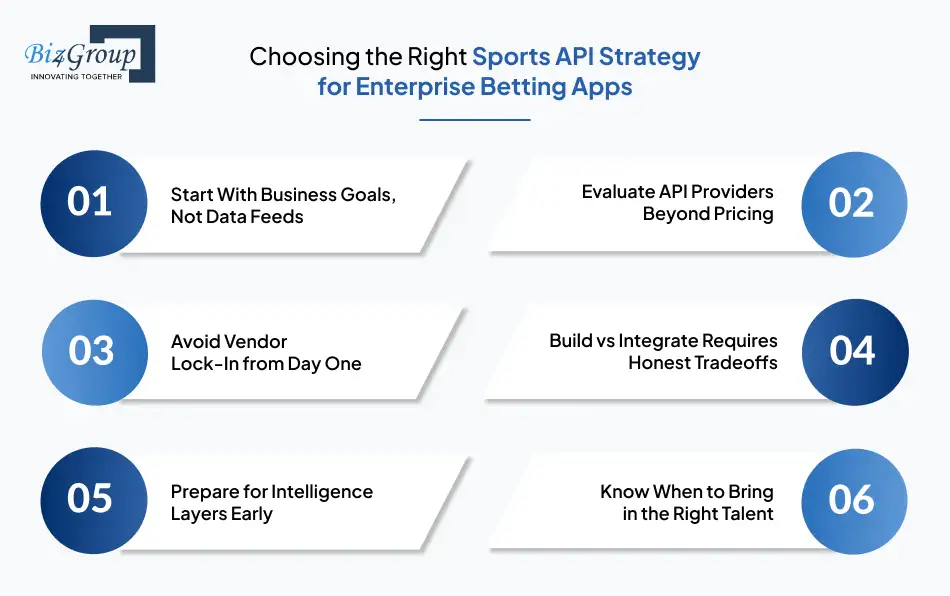
1. Start With Business Goals, Not Data Feeds
APIs should serve outcomes. Not the other way around.
Ask simple questions first.
- Are you building for one league or many?
- Will you support live betting from day one?
- Do you plan to expand across markets?
- Are investors part of the roadmap?
Enterprise sports APIs for scalable sports betting platforms must align with where the business is headed, not just where it starts.
2. Evaluate API Providers Beyond Pricing
Low-cost APIs look attractive early. They become expensive later.
Use this checklist during evaluation.
|
Evaluation Criteria |
What to Look For |
|---|---|
|
Data accuracy |
Verified and official feeds |
|
Update speed |
Real-time or near real-time delivery |
|
Uptime commitment |
SLA-backed reliability |
|
Documentation |
Clear and developer-friendly |
|
Support model |
Enterprise-level response times |
|
Scalability |
Proven performance during peak events |
This framework helps identify reliable sports APIs for sports betting businesses that scale with confidence.
3. Avoid Vendor Lock-In from Day One
Lock-in rarely happens overnight. It happens quietly.
When APIs are tightly coupled to business logic, switching becomes painful. Costs rise. Innovation slows.
Enterprise sports API infrastructure for betting apps should support modular integrations. This allows platforms to add providers, replace feeds, or expand coverage without full rewrites.
4. Build vs Integrate Requires Honest Tradeoffs
Some teams try to build everything internally. Others integrate too quickly without future-proofing.
A balanced approach works best.
- Integrate core data feeds through enterprise APIs
- Build differentiation layers internally
- Keep data abstraction clean
This strategy supports experimentation, including AI-powered features built through AI app development or custom AI product initiatives.
5. Prepare for Intelligence Layers Early
Even if AI is not on today’s roadmap, tomorrow might say otherwise.
Clean data pipelines make it easier to introduce personalization, recommendations, or analytics powered by generative AI later without disrupting the platform.
This flexibility protects long-term value.
6. Know When to Bring in the Right Talent
API strategy often fails due to execution gaps, not vision.
Founders benefit from teams that understand betting workflows, data reliability, and scalability together. Many platforms accelerate progress by choosing to hire AI developers who can work alongside backend and data teams seamlessly.
The right API strategy creates leverage. The wrong one creates friction. Enterprise grade sports APIs for betting app platforms should support growth, protect flexibility, and align with future innovation. When chosen wisely, APIs become an asset that quietly strengthens valuation and speed.
And now, here’s who can help you with all of this...
Choosing the Wrong API Costs More Than You Think!
Rebuilding a betting backend post-launch can inflate costs by 30–40%. Planning early changes everything.
Talk to Biz4Group's ExpertsHow Biz4Group LLC Builds Investor-Ready Betting Platforms with Enterprise Sports APIs
Biz4Group LLC is a USA-based technology firm, with over 20 years of experience in helping founders, operators, and enterprises turn betting ideas into platforms that scale, comply, and attract serious investment.
Our strength lies in building systems that work under pressure.
Live games.
Peak traffic.
Real money.
Real regulations.
This is the environment where betting platforms either earn trust or lose it fast. Biz4Group designs and engineers platforms that stay reliable when it matters most.
From MVPs to enterprise-grade ecosystems, we help clients architect platforms that are built for valuation, not quick launches. Our teams specialize in sports betting API integration services, ensuring real-time accuracy, redundancy, and compliance readiness across leagues and regions.
This combination of betting domain expertise, enterprise engineering discipline, and AI capability makes Biz4Group a trusted sports betting app development company for businesses that think long-term.
Why Businesses Choose Biz4Group LLC
- Proven experience building real-time, high-traffic betting platforms
- Deep understanding of enterprise-grade sports API architecture
- Strong focus on compliance, audit readiness, and risk reduction
- Ability to scale platforms from MVP to investor-grade systems
- In-house expertise across backend, frontend, data, and AI
- Clear communication and long-term partnership mindset
Clients work with Biz4Group because we think beyond feature lists.
We think about uptime during playoff nights.
We think about technical due diligence during funding rounds.
We think about how infrastructure decisions today affect valuation tomorrow.
We, an AI development company, do not chase shortcuts. We build platforms that last.
If you are building a betting platform meant to compete seriously, attract investors, or expand into regulated markets, your technology partner matters. Biz4Group brings the experience, discipline, and execution strength required to support that journey.
Build something phenomenal with us. Let’s talk.
In a Nutshell
Building a betting platform that crosses the $10M valuation mark takes more than sleek design and aggressive marketing. It demands infrastructure that performs when money, users, and regulators are all watching. Enterprise grade sports APIs for betting app ecosystems quietly power live odds, micro markets, accurate settlements, and audit-ready records. They influence revenue consistency, user trust, investor confidence, and long-term exit potential.
From monetization to compliance, from expansion to due diligence, enterprise sports APIs as foundation for investor ready betting apps shape how stable and scalable a sportsbook truly is. Platforms that invest in reliable, scalable, and premium data infrastructure early position themselves for smoother growth and stronger valuation conversations later.
This is where Biz4Group LLC makes the difference. As an experienced sports betting technology partner, we design and develop platforms built on robust API architecture, real-time integrations, and enterprise-grade systems that stand up to scale and scrutiny. We help founders move from concept to investor-ready product with clarity, speed, and technical precision.
If you are serious about building a betting platform that earns trust, drives revenue, and attracts funding, let’s build it right from day one.
Ready to turn your betting idea into a high-valuation platform? Let’s make it happen.
Get in touch.
FAQs
1. How early should a betting startup invest in enterprise grade sports APIs for betting apps?
Ideally at the MVP stage. Early decisions around enterprise grade sports APIs for betting apps shape platform stability, development speed, and long-term scalability. Startups that delay this choice often face expensive rewrites when user volume grows or investor scrutiny increases.
2. Do enterprise sports data APIs for betting apps increase time-to-market?
No. In most cases, enterprise sports data APIs for betting apps reduce time-to-market. They provide structured documentation, enterprise support, and production-ready data feeds that eliminate custom fixes and repeated rework during development.
3. Can a betting app switch to enterprise sports APIs after launch?
Yes, but it is significantly more complex and costly. Migrating live pipelines to enterprise sports API infrastructure for betting apps post-launch often disrupts operations and increases risk. Early planning helps avoid downtime and technical debt.
4. Are enterprise sports APIs necessary for niche or single-sport betting platforms?
Yes, especially if the platform aims for monetization, reliability, or funding. Even single-sport apps face traffic spikes, compliance reviews, and data accuracy expectations that reliable sports APIs for sports betting businesses are designed to handle.
5. How do sports APIs for high valuation betting platforms affect user acquisition and retention?
Accurate odds, fast updates, and consistent settlements reduce friction. When users trust platforms built on sports APIs for high valuation betting platforms, they engage more, place more bets, and return more often, improving organic growth and retention.
6. What hidden costs do betting apps face when using low-quality sports APIs?
Hidden costs include refund losses, customer support overload, regulatory exposure, and delayed feature launches. These issues often outweigh the upfront savings compared to investing in enterprise sports API solutions for betting apps.
7. Can enterprise sports APIs support advanced betting features in the future?
Yes. Premium sports data APIs for sportsbooks provide clean, structured data that supports future capabilities such as personalization, analytics, and predictive features without destabilizing the core platform.