Location :
Orlando, FL, USA
Location :
Orlando, FL, USA +1 (407) 714-1616
 info@biz4group.com









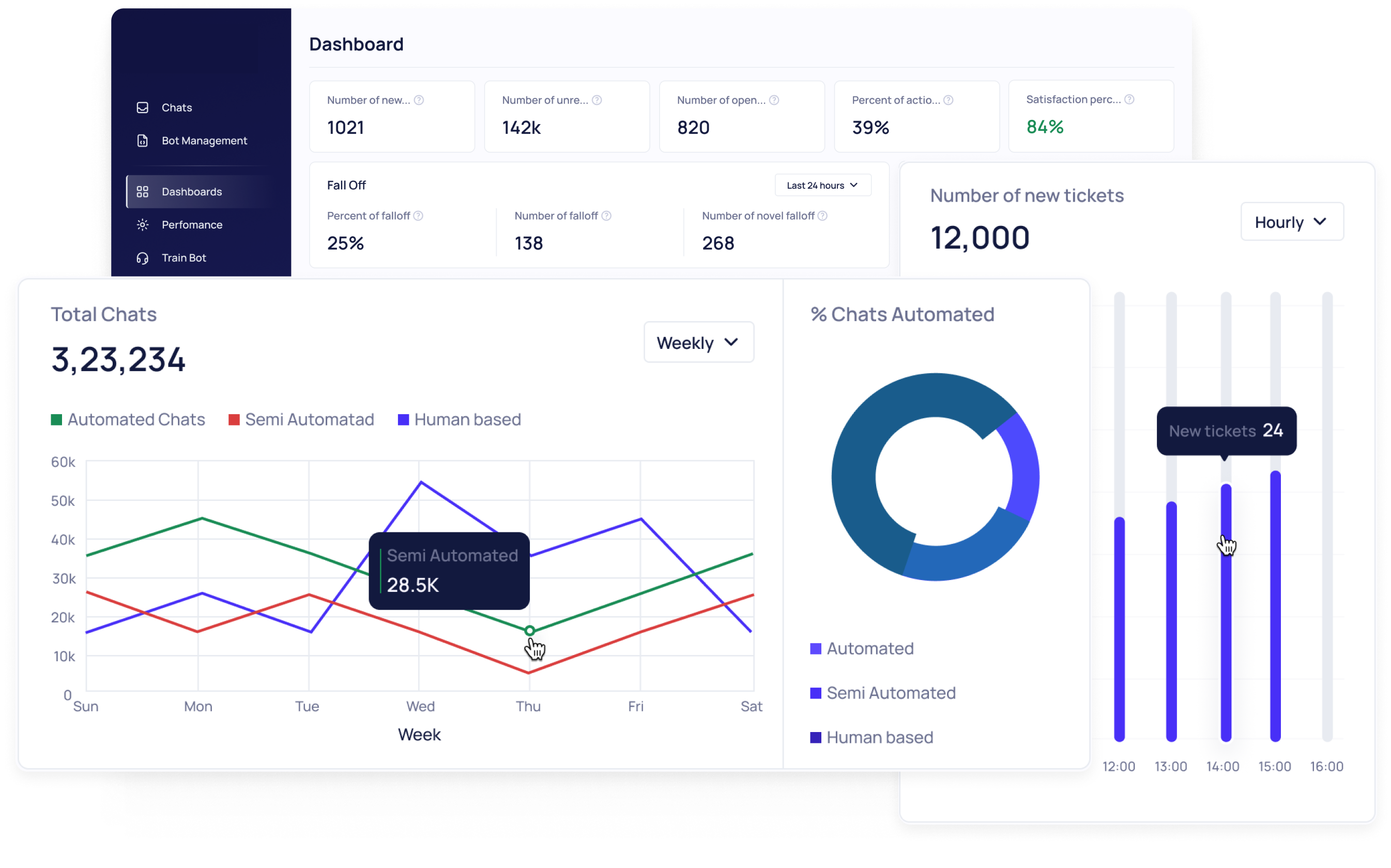









Imagine a digital system that doesn’t wait for instructions but instead, understands your business goals, learns from real-time feedback, and takes independent actions to get the job done.
Read More

Imagine walking into your hospital on a Monday morning and realizing that half your staff still complete training with paper binders and classroom slides from 2018. Meanwhile patient care standards and compliance requirements have shifted more times than anyone can count. That kind of disconnect is exactly why healthcare LMS software development matters for modern medical education systems.
You might be nodding because these questions are not hypothetical.
Healthcare teams today need a way to train staff efficiently and uniformly, track progress in real time, and ensure every clinician and support team member is up to date with the latest protocols. Whether you are exploring options internally or considering support from an AI development company, it helps to think of this as building a training ecosystem, not just deploying another application.
The marker stats support the problem statement, along with the solution channels:
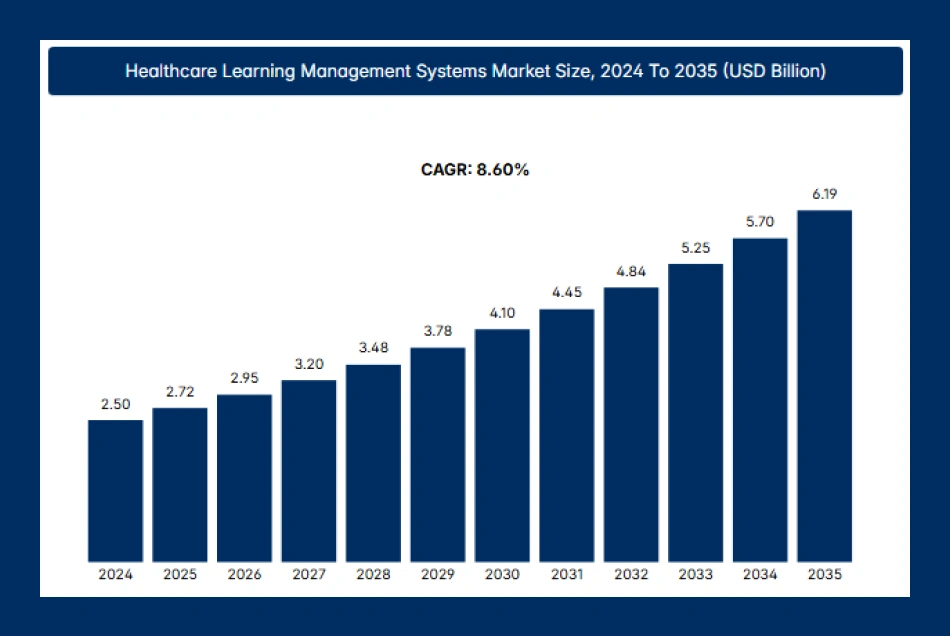
The global healthcare learning management system market is expected to grow to USD 6.19 billion by 2035 reflecting strong demand for digital learning platforms in healthcare. At the same time healthcare organizations that invest in healthcare LMS software development services are reporting faster onboarding cycles and better compliance tracking, helping reduce errors and improve patient outcomes.
From frontline clinicians to administrators and compliance officers the goal is the same improved learning outcomes that translate to better care. AI in eLearning tools are now part of the conversation too helping personalize learning paths and surface insights you would not capture otherwise. In this guide we will walk through how to make sense of all this and take confident next steps in your healthcare LMS journey.
Healthcare teams need a better way to train, track, and update staff without slowing down daily operations. A healthcare LMS is built to manage medical learning in one place while keeping training organized and easy to access.
At a basic level, healthcare LMS software development is about building a reliable system that helps healthcare organizations manage training, stay compliant, and keep education consistent as teams grow.
At its core, healthcare LMS software development is about organizing medical training so it runs smoothly without adding extra work. Once the system is in place, a few simple processes keep everything moving.
Training material is added based on roles, departments, and compliance needs. Courses and certifications are grouped into clear learning paths. This approach helps teams build healthcare LMS platforms that are easy to manage over time.
Staff members log in and see only the training that applies to them. Lessons fit around busy schedules and can be completed in short sessions. Some platforms use generative AI to keep learning more relevant and personalized.
Every course completion and assessment is recorded automatically. Administrators can quickly see who is trained and who needs follow ups. Reporting becomes faster with support from AI integration services that reduce manual work.
| Step | What Happens | Who It Helps |
|---|---|---|
|
Setup |
Training content is organized |
Training teams |
|
Learning |
Staff completes assigned courses |
Medical staff |
|
Tracking |
Progress is monitored automatically |
Compliance teams |
|
Reporting |
Insights guide decisions |
Leadership |
When these pieces work together, organizations can create healthcare LMS software solutions that feel practical and reliable. Understanding how it works makes it easier to see why investing in the right system matters next.
See how healthcare LMS software development can bring clarity to medical education and compliance.
Explore Healthcare LMS StrategyInvesting in healthcare LMS software development usually starts with one frustration. Training feels scattered, hard to track, and risky when audits or inspections come around. A centralized system brings control where uncertainty used to live.
Clinical guidelines, protocols, and regulations change often. Updating slide decks and retraining staff manually does not scale. Healthcare learning management system development allows teams to roll out updates once and know exactly who has completed them.
When compliance questions come up, guessing is not an option. Training history, certifications, and assessment results are available instantly. Many organizations strengthen this visibility using AI in healthcare administration automation to reduce reporting gaps.
Manual onboarding and retraining pull staff away from patient care. A structured platform helps organizations build healthcare training and LMS systems that reduce repetitive work. Some teams also lean on AI consulting services to design smarter workflows early on.
Over time, these benefits compound. With the right foundation, medical LMS software development eventually becomes all about long term readiness across the organization.
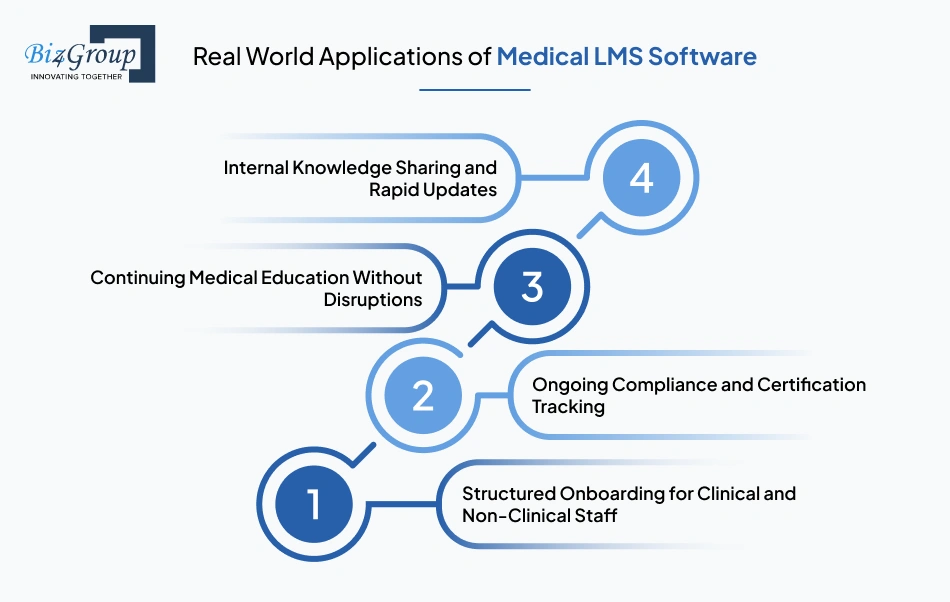
In everyday healthcare operations, healthcare LMS software development becomes relevant the moment training starts affecting patient care, compliance, or staff efficiency. These systems quietly support critical workflows across hospitals, institutes, and medical organizations in the following ways.
New hires enter healthcare environments with very different backgrounds and responsibilities. An LMS helps assign training based on role, department, and experience level, so learning feels relevant from day one. This is where thoughtful custom healthcare LMS development often replaces scattered onboarding efforts.
Healthcare teams deal with constant certification renewals and regulatory requirements. An LMS centralizes this process and removes guesswork by tracking completion and deadlines automatically. Some organizations reduce manual follow ups using AI automation services tied into reporting workflows.
Clinicians need to keep learning without stepping away from patient care. LMS platforms support self-paced education that fits into real schedules. Many providers develop digital learning platforms for healthcare with help from a custom software development company to meet these needs.
When protocols change, speed matters. An LMS allows updates to reach every team at the same time, reducing outdated practices. Some systems improve access through AI chatbot integration so staff can quickly find the right information.
| Use Case | Primary Focus | Teams Involved |
|---|---|---|
|
Onboarding |
Role readiness |
New staff |
|
Compliance |
Audit preparedness |
Admin and compliance |
|
Continuing education |
Skill continuity |
Clinicians |
|
Knowledge updates |
Operational consistency |
Organization wide |
Together, these use cases show how LMS platforms blend into daily operations instead of sitting on the sidelines. As organizations continue to create healthcare education management systems, the next focus naturally turns toward the features that make all of this work smoothly.
Strong platforms are not built by accident. Healthcare LMS software development works best when core features are designed around real clinical workflows, compliance needs, and everyday training realities. These foundational capabilities shape how the system performs in practice:
| Core Feature | What It Supports | Why It Matters |
|---|---|---|
|
Role Based Access |
Personalized learning paths |
Ensures staff see only relevant training |
|
Course And Content Management |
Centralized training materials |
Keeps education consistent and up to date |
|
Compliance Tracking |
Mandatory training oversight |
Reduces audit risk and manual follow ups |
|
Certification Management |
License and credential monitoring |
Prevents lapses in required qualifications |
|
Assessment And Testing |
Knowledge validation |
Confirms learning outcomes |
|
Reporting And Analytics |
Training visibility |
Helps leaders spot gaps early |
|
Mobile Access |
On the go learning |
Fits training into real schedules |
|
System Integrations |
HR and internal tools |
Avoids duplicate data entry |
|
Scalable Architecture |
Long term growth |
Supports expansion without rework |
Some organizations enhance usability further by working with a software development company in Florida to align features with internal systems and workflows.
When these features work together, it becomes easier to build a healthcare learning management system for medical education that teams actually use. From here, the conversation naturally moves toward advanced capabilities that go beyond the basics.
After the fundamentals are in place, advanced features push healthcare LMS software development beyond basic training delivery. These capabilities introduce intelligence, automation, and scale to support more complex healthcare education needs.
The system analyzes roles, performance, and learning history to suggest relevant courses. This reduces redundant training and keeps learning focused on actual skill gaps. Many teams choose to integrate AI into an app to support this logic.
Compliance rules are configured once and enforced automatically across the platform. Renewal cycles, expiry alerts, and escalation paths run without manual follow ups. This makes it easier to make healthcare learning management system software for compliance training that stays audit ready.
Users can search courses, certifications, and policies using simple language. This reduces time spent navigating menus and improves access to information. Some platforms model this experience after an AI conversation app.
The LMS tracks credits by specialty, region, and renewal period in one place. Certificates are generated and stored automatically for future reference. This feature supports organizations that build healthcare LMS systems for continuing medical education.
A single system supports multiple hospitals or institutes with isolated data and shared infrastructure. This approach is essential to create scalable healthcare LMS platforms for hospitals and institutes. Teams often plan this stage before deciding to hire AI developers for expansion.
These advanced features define how the platform grows with the organization. Once they are identified, attention naturally shifts toward how the system is planned, designed, and built step by step.
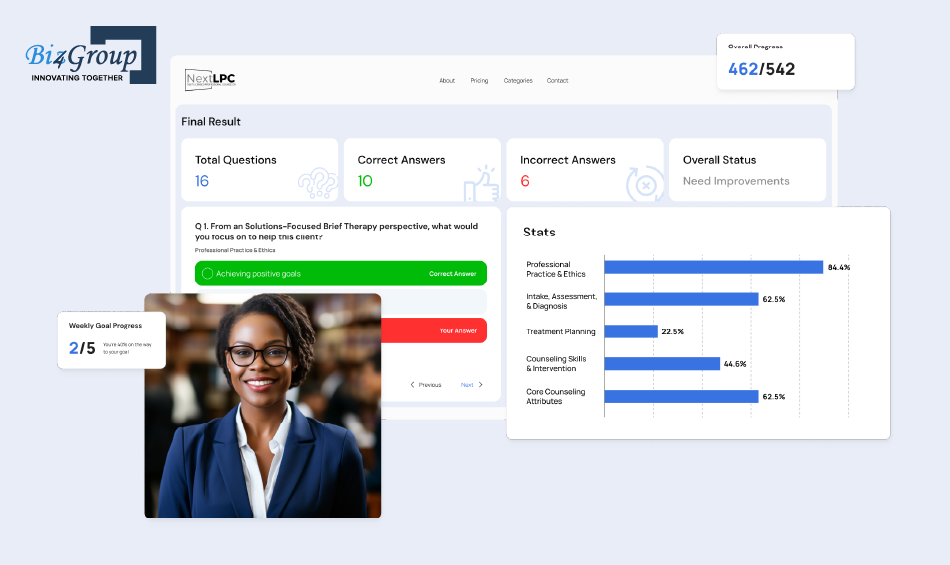
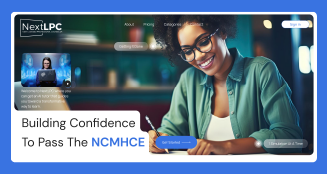
NextLPC is an AI-powered eLearning platform built with interactive AI avatars that act like virtual tutors, guiding learners through complex case studies and assessments with human-like engagement and personalized feedback. Its design demonstrates how intelligent learning experiences can improve retention and performance in training systems.
Design platforms that align with real clinical workflows and regulations through healthcare learning management system development.
Plan My Healthcare LMS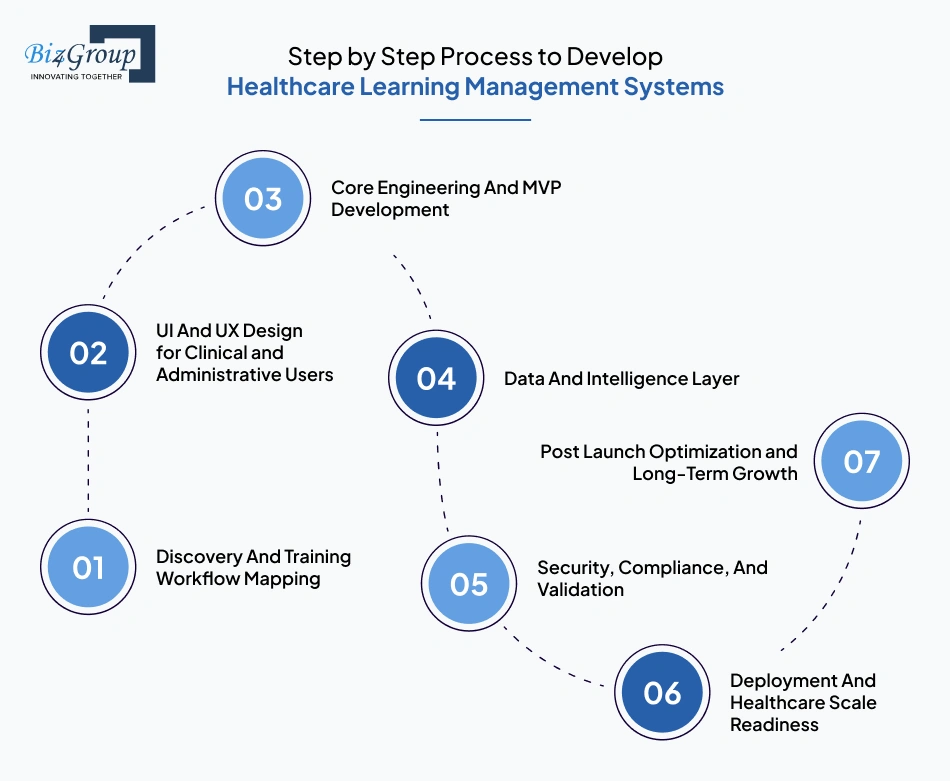
Successful healthcare LMS software development starts by grounding every decision in how medical training actually works across hospitals, institutes, and healthcare organizations. This process focuses on reducing risk, supporting compliance, and delivering learning systems that fit real clinical environments.
This step looks closely at how training flows through the organization today. From onboarding to certifications and continuing education, the goal is to understand what works, what breaks, and where gaps create compliance or operational risk.
Healthcare professionals have limited time and little patience for complex tools. A great UI/UX design clarity and speed ensures adoption across clinicians, educators, and administrators without disrupting daily workflows.
Also read: Top UI/UX design companies in USA
Instead of building everything upfront, teams focus on an MVP that delivers essential value. MVP development services often answer questions like how to build a healthcare learning management system without overengineering too early.
Also read: Top 12+ MVP Development Companies to Launch Your Startup in 2026
Training data becomes more valuable when it informs decisions. This phase focuses on structuring data so learning gaps, risks, and trends are visible without manual reporting, supporting efforts to develop healthcare LMS software for modern medical education.
Healthcare LMS platforms must withstand audits and inspections. This step ensures the system protects data, maintains traceability, and performs reliably during peak training periods.
Also Read: Software Testing Companies in USA
Training demand is rarely steady in healthcare. Deployment planning ensures the LMS remains stable during onboarding waves, policy updates, and compliance cycles.
After launch, the LMS evolves based on real usage. Feedback and data guide improvements, helping organizations decide when to expand features or engage custom healthcare LMS software development services.
Following this approach helps organizations move from planning to execution with confidence. For teams evaluating partners and support models, healthcare LMS software development services play a key role in sustaining and scaling the platform over time.
Healthcare LMS software development happens in the middle of training systems, HR tools, reporting workflows, and compliance processes. The tech stack must support secure integrations, consistent performance, and long-term scalability without overengineering.
| Label | Preferred Technologies | Why It Matters |
|---|---|---|
|
Frontend Framework |
ReactJS, Angular |
Clean and responsive interfaces help clinicians complete training quickly, which is why many LMS platforms adopt ReactJS development for learning dashboards. |
|
Server Side Rendering And SEO |
NextJS, NuxtJS |
Faster initial loads and predictable routing improve accessibility across devices, making NextJS development a practical choice for healthcare LMS platforms. |
|
Backend Framework |
NodeJS, Python |
User management, course logic, and reporting workflows scale better when NodeJS development is paired with Python development for data intensive processing. |
|
REST, GraphQL |
APIs connect the LMS with HR, credentialing, and internal systems, making API stability critical for accurate training and compliance data flow. |
|
|
AI And Data Processing |
TensorFlow, Scikit learn |
Learning insights and personalization features depend on reliable data processing as training programs mature. |
|
Database Layer |
PostgreSQL, MongoDB |
Healthcare LMS platforms must manage structured certifications alongside flexible learning records without performance loss. |
|
Cloud Infrastructure |
AWS, Azure |
Training demand spikes during onboarding and audits, requiring infrastructure that scales without downtime. |
|
Security And Access Control |
OAuth 2.0, RBAC |
Role based security ensures training records and certifications remain protected and audit ready. |
|
Analytics And Reporting |
ELK Stack, Power BI |
Clear reporting helps administrators track completion, gaps, and compliance status in real time. |
|
DevOps And Deployment |
Docker, CI CD Pipelines |
Reliable releases and environment consistency reduce operational risk during updates. |
When these components come together, the LMS is better equipped to support real world healthcare training demands without friction. Well-planned HIPAA compliant app development reduces rework, supports growth, and strengthens the LMS platform from early adoption to enterprise scale.
Understand what it takes to develop healthcare learning management systems that scale across teams and locations.
Map My LMS Roadmap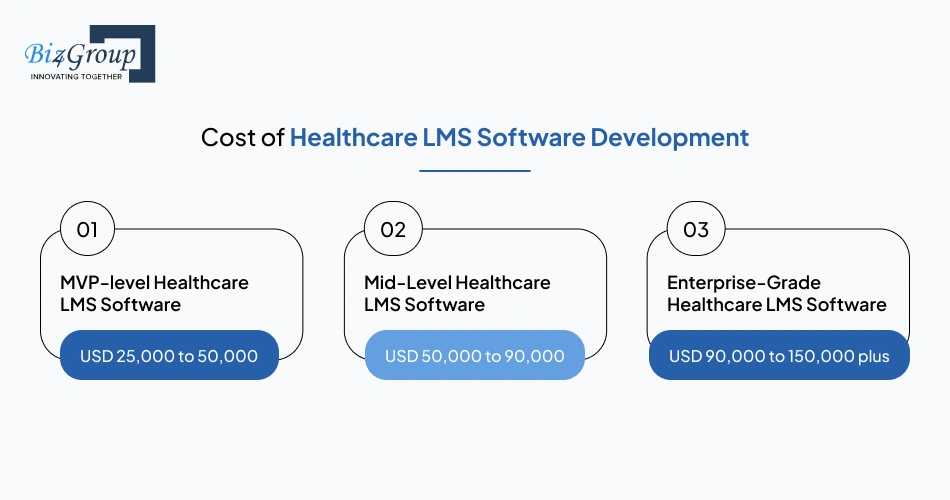
The cost of healthcare LMS software development typically falls between USD 25,000 and USD 150,000 plus, depending on scope, scale, and compliance needs. This is a ballpark figure meant to guide early planning, not a fixed quote, since requirements vary widely across organizations.
| Project Stage | What’s Included | Typical Cost Range |
|---|---|---|
|
MVP-level Healthcare LMS Software |
Core training workflows, basic compliance tracking, reporting built during MVP software development |
USD 25,000 to 50,000 |
|
Mid-Level Healthcare LMS Software |
Role based learning, certifications, integrations, analytics |
USD 50,000 to 90,000 |
|
Enterprise-Grade Healthcare LMS Software |
Advanced compliance, scalability, multi tenant setup, security |
USD 90,000 to 150,000 plus |
|
Custom Enhancements |
Specialized workflows, intelligence layers, automation |
Varies by requirement |
Costs usually increase when platforms need deeper integrations, stricter compliance handling, or advanced intelligence features. Some organizations also factor in future capabilities like AI model development during early planning to avoid expensive rework later.
Understanding these ranges helps decision makers budget realistically as they plan to develop healthcare learning management systems that can grow with organizational needs. With cost clarity in place, it's time to see how these platforms can create long term value beyond initial deployment.
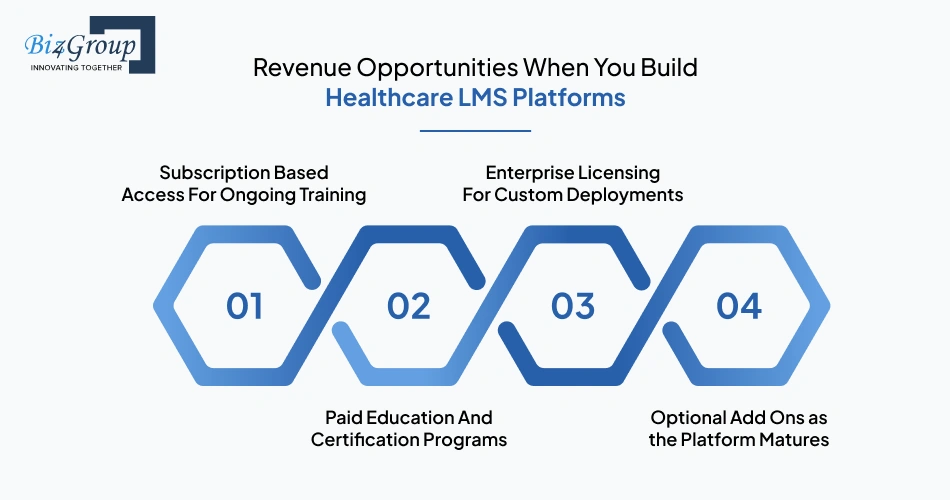
Revenue models matter once a platform moves beyond internal enablement and starts serving multiple teams, institutes, or external learners. Healthcare LMS software development supports flexible monetization approaches that evolve with how training is delivered and who ultimately uses the system.
For hospitals and healthcare networks, training is not a one time activity. A subscription model fits naturally when learning is continuous and tied to staff size or departments. This approach works especially well as organizations build healthcare LMS platforms that support recurring compliance and skill updates.
When LMS platforms extend beyond internal teams, courses and certifications become a clear revenue stream. Training institutes and medical educators often use this model when they create healthcare LMS software solutions aimed at professional growth.
Larger healthcare organizations often prefer full control over their training environment. Enterprise licensing supports deep customization, branding, and long term support under healthcare learning management system development engagements.
As usage grows, advanced capabilities can be introduced without forcing complexity upfront. Add ons allow organizations to expand functionality only when it aligns with real needs.
Most successful platforms do not rely on a single model. They adapt monetization as usage expands and audiences change. With revenue considerations in place, the next step is understanding the practices that keep development efficient and sustainable over time.
Move beyond generic tools and build healthcare LMS platforms designed for adoption, tracking, and growth.
Design My Healthcare LMS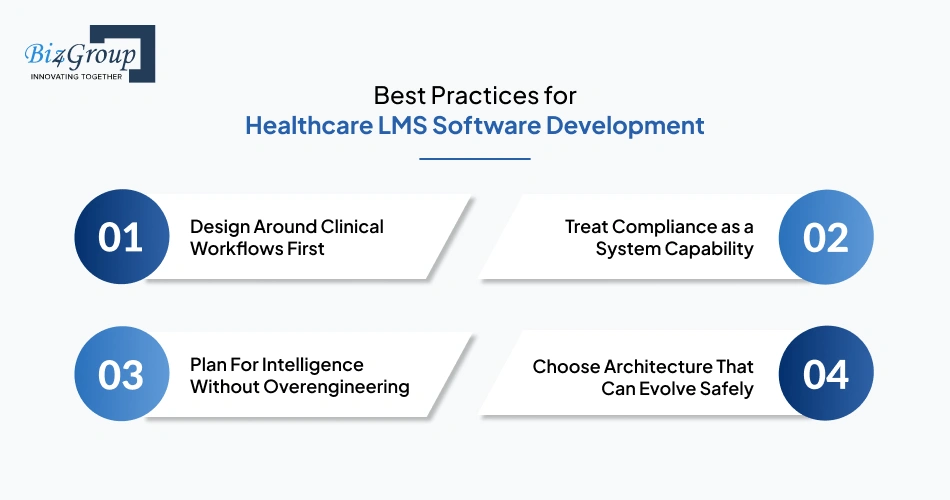
Strong platforms are built with intention, not shortcuts. Healthcare LMS software development succeeds when technical decisions stay aligned with real training workflows, compliance pressure, and the day to day realities of healthcare teams. The following practices consistently make the difference.
Training should fit naturally into how clinicians and staff already work. When systems reflect shift patterns, roles, and certification cycles, adoption improves without forcing behavior change. This mindset is foundational to effective medical LMS software development.
Compliance should be embedded into the platform, not handled as an afterthought. Automated tracking, clear reporting, and audit ready logs reduce last minute stress for administrators. Teams that build healthcare training and LMS systems often prioritize this early to avoid costly rework.
Advanced capabilities should enhance learning, not complicate it. Many organizations map future enhancements early, whether that means planning to build an AI app or working with an AI chatbot development company later. This keeps the platform flexible without inflating initial scope.
Healthcare training needs change as organizations grow and regulations shift. Modular architecture allows features to evolve without disrupting core workflows. This approach aligns well with custom healthcare LMS development led by teams experienced in AI medical web development.
Following these practices helps teams avoid common pitfalls and build systems that last. With best practices in place, the next challenge is understanding where development obstacles typically appear and how to address them early.
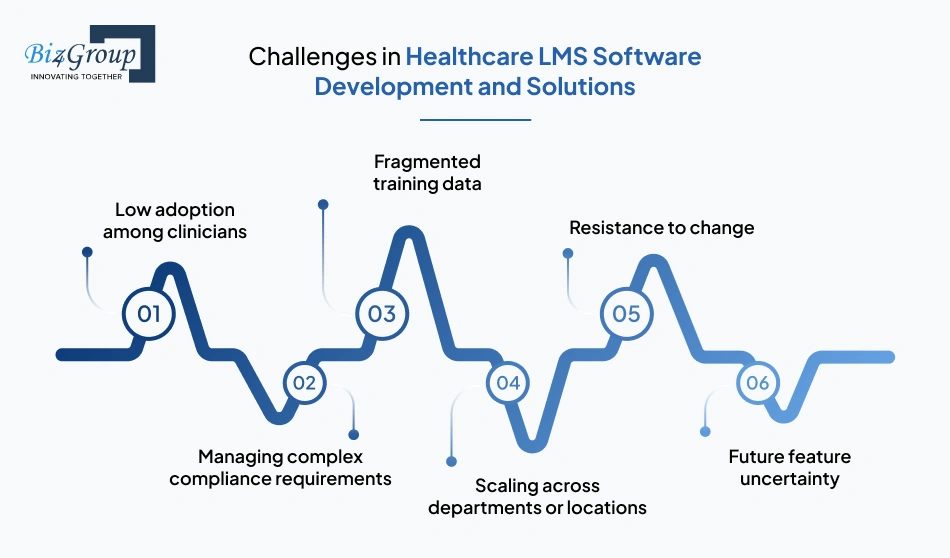
Every LMS project looks straightforward on paper, but healthcare adds layers of complexity that surface quickly during execution. Healthcare LMS software development often runs into predictable hurdles, and understanding them early makes the difference between smooth delivery and constant rework.
| Top Challenges | How To Solve Them |
|---|---|
|
Low adoption among clinicians |
Design training flows around real shift patterns and time constraints so learning fits into daily routines. |
|
Managing complex compliance requirements |
Build compliance logic into the system from day one with automated tracking and audit ready reporting. |
|
Fragmented training data |
Centralize learning records and certifications to avoid spreadsheets and disconnected systems. |
|
Scaling across departments or locations |
Use modular architecture that supports gradual expansion without breaking existing workflows. |
|
Resistance to change |
Involve educators and administrators early so the platform reflects how training already happens. |
|
Future feature uncertainty |
Plan extensibility early, especially when teams expect to build AI software later for analytics or personalization. |
These challenges are common, but none are blockers when addressed with the right approach. As organizations continue to develop digital learning platforms for healthcare, attention naturally turns toward how these systems will evolve alongside changing technology and training expectations.
Learn how to create healthcare LMS software solutions that support compliance today and flexibility tomorrow.
Evaluate My LMS Approach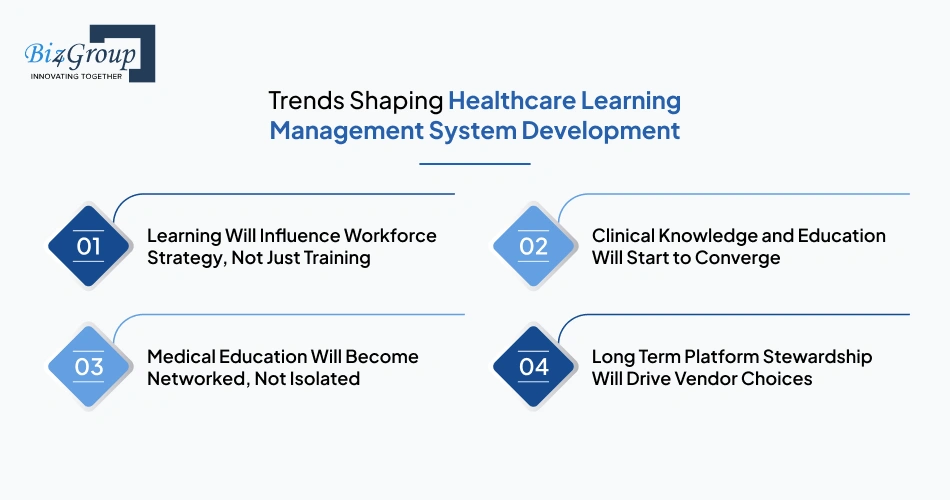
The future of healthcare learning platforms will be shaped by decisions being made today, not by feature lists. As healthcare LMS software development matures, its role shifts from delivering courses to shaping how medical organizations prepare their workforce for what comes next.
Education systems will begin to inform long range planning around staffing, specialization, and preparedness. Training data will quietly guide decisions well beyond onboarding. This evolution naturally expands how organizations think about education management at scale.
Over time, the line between learning platforms and clinical knowledge systems will blur. Educational content may increasingly align with decision support research, including areas influenced by AI chatbot development for medical diagnosis, without becoming clinical tools themselves.
Future learning environments will support collaboration across hospitals, institutes, and external partners. Knowledge will flow across organizational boundaries instead of staying locked inside one system. This changes how leaders approach building learning systems for medical education.
Decision makers will prioritize platforms that can evolve over many years with minimal disruption. Governance, reliability, and continuity will outweigh short term innovation. In that context, long standing partnerships and regional expertise, including top AI development companies in Florida, will play a larger role.
As these shifts come into focus, the conversation moves beyond technology choices. It naturally turns toward who can responsibly build, guide, and sustain a learning platform over its full lifecycle.
Building a healthcare LMS is rarely just about shipping software. It is about getting training right in environments where accuracy, consistency, and accountability actually matter. That is where healthcare LMS software development needs a team that has already built and scaled learning platforms in the real world.
Biz4Group brings hands on experience from AI driven LMS platforms, including products built around interactive learning, adaptive flows, and measurable outcomes. Those projects shape how we think about healthcare education, not as static content delivery, but as a system people rely on every day.
Why teams work with Biz4Group
If you are looking for a partner that treats your LMS like a long term product rather than a one time build, Biz4Group fits naturally into that role. Our approach to custom healthcare software development stays practical and grounded in how organizations actually operate.
Get clarity on scope, tech, and cost before you commit to custom healthcare LMS development.
Talk Through My LMS IdeaHealthcare training has quietly become one of the most complex systems inside modern medical organizations. From compliance to continuing education, the margin for error is small and the expectations keep rising. That is why thoughtful healthcare LMS software development is no longer optional.
When done right, it brings structure, clarity, and confidence to medical education without slowing teams down. And as learning systems continue to evolve, working with an experienced AI app development company can make the difference between a platform that simply exists and one that actually works.
Schedule a call with us and explore how a custom healthcare LMS can scale with your organization.
Timelines depend on scope, compliance needs, and integrations. A basic platform may take a few months, while larger systems take longer. Teams that develop healthcare learning management systems often plan phased releases to reduce risk and accelerate early adoption.
Yes, modern platforms are designed to handle varied roles and learning paths within one system. With proper architecture, organizations can build healthcare training and LMS systems that serve clinicians, administrators, and support staff without overlapping or confusion.
Healthcare LMS platforms are not limited to large enterprises. Scalable design allows smaller organizations to start lean and grow over time. Many teams choose custom healthcare LMS development to match current needs without overbuilding upfront.
Compliance support is built through structured workflows, audit trails, and automated tracking. When organizations make healthcare learning management system software for compliance training, the system becomes a reliable source of truth during inspections and reviews.
Yes, most platforms are built to integrate with HR systems, credentialing tools, and internal databases. This is a common focus when teams develop digital learning platforms for healthcare to avoid duplicate data entry and manual updates.
Development costs usually range from USD 25,000 to USD 150,000 plus, depending on features, scale, and compliance needs. This range reflects typical investments required to build healthcare LMS platforms that are secure, scalable, and fit for medical education.

with Biz4Group today!
Our website require some cookies to function properly. Read our privacy policy to know more.