 Location :
Orlando, FL, USA
Location :
Orlando, FL, USA +1 (407) 714-1616
 info@biz4group.com

- Primary care physician portal development helps clinics organize allergy workflows, improve diagnostic accuracy, and strengthen patient follow-up.
- Clinics can develop primary care physician portal solutions that streamline testing, treatment planning, symptom tracking, and communication.
- Practices that create a doctor portal for managing allergy patients gain clearer workflows, faster decisions, and better treatment visibility.
- The end-to-end development process for physician portals in primary care includes discovery, UI and UX design, MVP creation, enhancement cycles, testing, and launch.
- Biz4Group LLC delivers high performing physician portals with strong clinical insight, fast MVP turnaround, and proven expertise in healthcare technology.
Ever walked into peak allergy season and felt your entire clinic shift into survival mode? Patients show up with the same symptoms but completely different triggers, phone lines overflow, and every chart feels like a puzzle missing a few pieces.
Allergy cases affect more than 50 million Americans according to the Asthma and Allergy Foundation of America. In a world where demand keeps rising, primary care physician portal development has quietly become the secret advantage of clinics that stay ahead.
Many healthcare teams are now exploring how to develop primary care physician portal solutions that ease the daily load. They want a digital home where allergy histories, test results, medications, and follow ups live together without the usual clutter. This shift gives physicians room to focus on patient conversations instead of toggling between screens.
As clinics prepare to create a physician portal for allergy treatment, they find that patients enjoy the change as much as providers do. People want clarity about their triggers and treatment plans. When a portal delivers that clarity in simple steps, it strengthens trust.
The race to make a physician portal with allergy diagnosis and tracking tools is really a race toward accuracy. Allergy care depends on details that are easy to lose in manual processes. Let's talk about those details here.
How Primary Care Physician Portal Development Shapes Allergy Management?
A good starting point for any digital transformation is understanding what the tool actually does. A primary care physician portal for allergy management brings every piece of patient data into one organized system.
Allergies are often unpredictable, and physicians need a place where information flows smoothly from intake to diagnosis to long term care. This type of portal helps teams deliver consistent experiences for both new and returning patients.
Core Purpose of the Portal
Clinics use these portals to replace scattered tools with a single digital workspace. The goal is simple. Physicians need faster access to patient information and less time spent searching for previous results or treatment notes.
When you begin to develop primary care physician portal systems with this mindset, you set the stage for better accuracy and fewer workflow disruptions.
Here is what these portals usually aim to support.
- Centralized patient allergy histories
- Quick access to diagnostic test results
- Structured immunotherapy planning
- Actionable reminders for upcoming visits
- Consistent communication between staff and patients
Key Differences from General Clinical Portals
Allergy care follows a unique rhythm, and general clinical portals rarely match that rhythm well. Clinics soon discover this when they try to customize generic software to track immunotherapy schedules or trigger patterns.
Here's how they differ from each other:
|
Aspect |
General Clinical Portal |
Allergy Focused Physician Portal |
|
Diagnostic workflows |
Basic templates |
Tailored flow for skin tests and IgE tests |
|
Treatment plans |
Generic medication tracking |
Step based immunotherapy and avoidance strategies |
|
Patient monitoring |
Standard visit reminders |
Symptom logs tied to triggers and seasonal patterns |
|
Data depth |
Broad overviews |
Granular allergy specific insights |
How It Works at a Foundational Level
Behind the scenes, the portal behaves like a connected ecosystem.
- Every interaction feeds useful information back to the physician.
- Intake forms update patient histories.
- Diagnostic modules store results and tag patterns.
- Treatment templates guide long term care.
All of this happens quietly so physicians can stay focused on conversations with patients instead of operating multiple systems.
This structure becomes even more valuable when clinics prepare to develop primary care physician portal solutions that scale across multiple locations. Standardized workflows create predictable outcomes, which reduces errors and supports stronger patient relationships.
Once you understand how these systems support the daily rhythm of allergy care, the next step is to explore why clinics feel an increasing urgency to adopt them.
Why You Should Invest in the Development of Allergy Treatment Portals for Clinics Now?
Every allergy season brings its own wave of uncertainty for clinics. New patients arrive with unstructured histories. Returning patients come back with questions, symptoms, and treatment progress that may not be documented in a clean path. This makes physicians work harder than they should.
The decision to build allergy treatment management portal systems often comes from a need to simplify, organize, and accelerate this daily flow.
The Pain Points That Push Clinics Toward Digital Portals
The daily challenges in allergy care tend to follow the same patterns. Here are some of the most common issues that drive clinics to build a digital physician portal for coordinated allergy care.
- Test results spread across multiple platforms
- Missed follow ups due to manual reminders
- Limited visibility into patient triggers and patterns
- Time consuming documentation tasks
- Patients who feel uninformed or disconnected between visits
When clinics invest in allergy treatment workflow automation software development, they begin replacing repetitive tasks with streamlined paths that guide physicians step by step.
The Benefits Clinics Gain After Implementing These Portals
Once teams create a doctor portal for managing allergy patients, something interesting happens. They realize how much time they regain.
Here is a quick look at the impact many practices report.
|
Improvement Area |
Practical Benefit |
Result for the Clinic |
|
Diagnostic process |
Faster access to allergens, triggers, and test data |
Better accuracy and fewer repeat tests |
|
Treatment planning |
Structured immunotherapy pathways |
More predictable outcomes |
|
Patient engagement |
Secure messaging and symptom reporting |
Fewer unnecessary calls and clearer communication |
|
Operational load |
Automated reminders and follow ups |
Lower administrative stress |
These benefits help clinics deliver care that feels smoother and more trustworthy for both staff and patients.
The Role of Automation in Allergy Care
Automation does not replace clinical judgment. It strengthens it. When you develop allergy treatment portals for clinics, you begin automating areas that traditionally weigh down the workflow.
Automation services supports physicians in the following ways.
- Flags unusual patterns for quick review
- Sends consistent follow up reminders
- Updates immunotherapy dose progressions
- Keeps patient records aligned across every visit
The goal is to create calm in a process that often feels chaotic. When physicians experience this shift, the value becomes immediately clear.
Clinics build allergy treatment management portal solutions because they want to operate with intention instead of reaction. The next step is exploring the specific features that bring these transformations to life.
Also read: AI patient portal development guide
Still Thinking About That Portal Upgrade?
Clinics that modernize earlier save themselves from the annual scramble. Why wait for another hectic month to prove the point?
Contact Biz4Group NowKey Features to Include When You Build Allergy Treatment Dashboard for Primary Care Doctors
When clinics create a doctor portal for managing allergy patients, the right foundation makes everything else easier to expand later. The table below highlights the essential features that bring structure and clarity to allergy care inside a digital portal.
|
Feature |
What It Is |
What It Does |
|
Patient Allergy Profiles |
A structured record of allergies, triggers, reactions, and past treatments |
Keeps physicians informed at every visit and eliminates guesswork |
|
Diagnostic Workflow Tools |
Modules for skin tests, IgE tests, and symptom assessments |
Standardizes evaluations and simplifies follow up decisions |
|
Immunotherapy Tracking |
A tool to document dose progressions, reactions, and schedules |
Ensures safe and consistent treatment plans for long term care |
|
Medication Management |
Centralized view of current and past medications |
Helps physicians adjust medication plans with confidence |
|
Automated Reminders |
System generated alerts for follow ups, shots, expirations, and tasks |
Reduces missed appointments and improves patient adherence |
|
Patient Communication Tools |
Secure messaging and symptom reporting |
Supports ongoing engagement and reduces unnecessary calls |
|
EHR and Lab Integrations |
Connections with external systems for data sharing |
Prevents duplicate entry and keeps records up to date in real time |
|
Provider Dashboards |
Summaries of tasks, patient activity, and treatment progress |
Gives physicians a clear overview of priorities for the day |
These features create the baseline for a strong, reliable, and scalable portal. Once these essentials are in place, clinics can confidently explore advanced capabilities that elevate allergy care even further.
Also read: Medication reminder app development guide
Advanced Features When You Make a Physician Portal With Allergy Diagnosis and Tracking Tools
These advanced capabilities transform a basic portal into a smart clinical companion that keeps physicians informed, patients engaged, and operations efficient. When you create a doctor portal for managing allergy patients, these higher-level features help differentiate your practice and give your team a digital system that works as hard as they do.
1. Intelligent Pattern Recognition for Allergy Trends
One of the most impactful upgrades is the ability to detect symptom patterns that may not be visible at a glance. As clinics document reactions, exposure dates, and medications over time, the system learns how to group these data points into meaningful insights.
Physicians gain a clearer understanding of what triggers flare ups and how seasonal patterns affect each patient.
2. Personalized Treatment Pathway Guidance
A strong allergy portal helps physicians choose the right direction based on the unique profile of each patient. When clinics create a physician portal for allergy immunotherapy and follow up care, they often add structured pathways that guide dose adjustments, monitor tolerance, and compare treatment progress against expected benchmarks.
Project Highlight: AI Avatar for Personalized Wellness Guidance
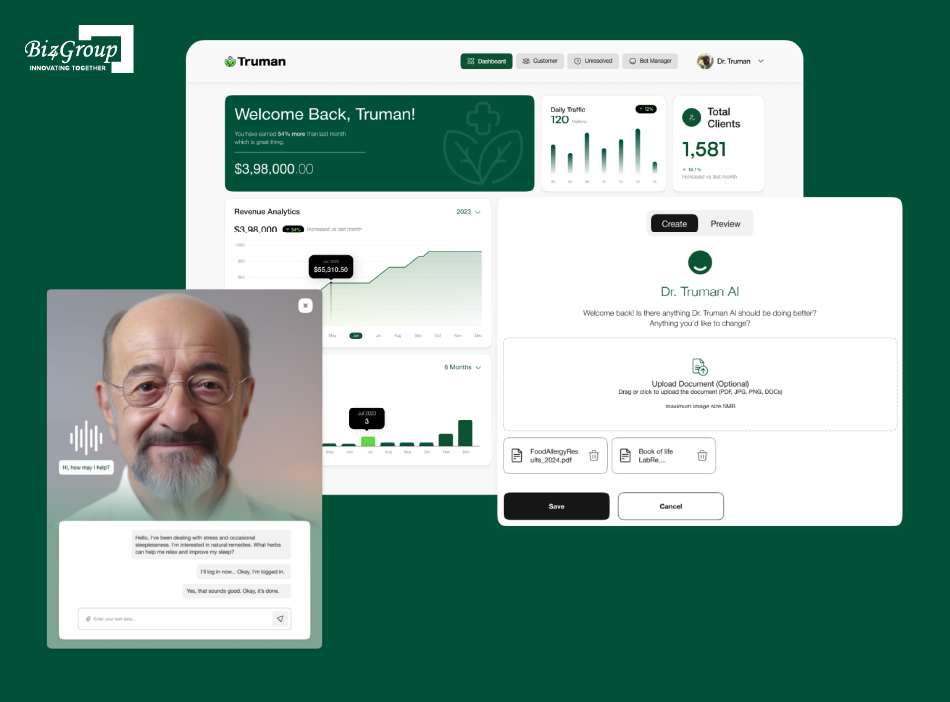
Using our AI avatar development skills, our team created an AI avatar offering wellness insights and health recommendations based on user inputs. The system supports real-time interactions and provides relevant suggestions grounded in each user's health history.
Key strengths that align with allergy care portals include:
- Ability to deliver personalized advice based on detailed data points
- A modern, human like interface that makes health guidance feel natural
- Smart mapping between user conditions and treatment suggestions
- A seamless experience that moves from insight to action
These qualities make the avatar a strong example of how digital tools can support individualized care plans inside an allergy focused physician portal.
3. Real-Time Product or Medication Matching Engines
When physicians select symptoms or treatment goals, the portal can surface recommended medication categories, dosing considerations, or complementary therapies. This helps staff maintain consistency, especially when several clinicians share responsibility for the same patient.
Project Highlight: AI Chatbot for Personalized Supplement Recommendations
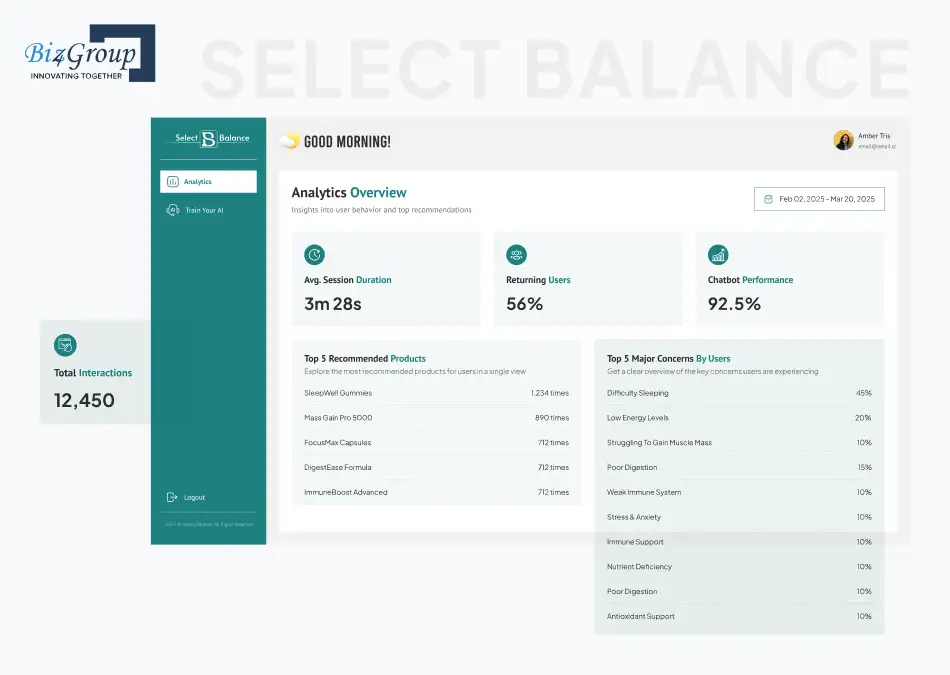
With our AI chatbot development expertise, we designed an AI chatbot that analyzes user input and retrieves the most suitable supplement recommendations from a connected database.
The project showcases:
- Real time matching of patient needs to the correct health products
- Smooth conversational guidance that extracts key symptom details
- A structured database layer that keeps recommendations accurate
- Smart adaptation between quiz driven and conversational user modes
The matching logic built for this project can translate seamlessly into allergy treatment environments, where precise medication or therapy suggestions support safer care.
4. Centralized Reaction Tracking with Integrated Alerts
Reaction logs become valuable when they connect to automated alerts. Physicians receive notifications when a patient enters information that indicates risk or deviation from expected improvement.
This creates a more responsive care model that supports early intervention.
5. Environmental and Allergen Data Connectivity
Integrating environmental data into the portal helps clinics personalize care even further. When the system pulls updates on pollen levels, regional air quality, and specific allergen spikes, physicians can connect these external conditions with patient symptom logs.
This supports more accurate diagnoses and gives patients context behind their discomfort.
6. Unified Communication Planner for Physicians and Patients
A powerful upgrade in a portal is a communication center that organizes conversations, follow-ups, education materials, and care notes. Instead of scattered interactions, the portal creates a single line of communication tied directly to the patient record.
This supports clarity and ensures that every message or update lives in a traceable path.
When clinics adopt these capabilities while building their allergy treatment portals for physicians, the result is a system that supports the patient journey at every angle. The next section will explore the technology stack that brings these capabilities to life.
Your Future Portal Can Do More Than You Think
Most teams use less than 40% of the digital tools they already have. Imagine what happens when a portal is actually built around how your clinic works.
Build Smart with Biz4GroupRecommended Tech Stack to Build a Digital Physician Portal for Coordinated Allergy Care
When practices begin to build a digital physician portal for coordinated allergy care, they often look for a balance of flexibility, scalability, and smooth performance across both desktop and mobile environments. The right tools make ongoing enhancements easier and support long term growth without unnecessary rewrites.
|
Layer |
Purpose |
Tools and Frameworks |
|
Frontend |
Builds the user interface physicians and patients interact with |
React, Angular, Vue, Tailwind, Material UI |
|
Backend |
Manages logic, workflows, treatment calculations, and portal operations |
Python, Django, Ruby on Rails, Java Spring |
|
Databases |
Stores patient details, treatment records, tests, and tracking information |
PostgreSQL, MySQL, MongoDB |
|
Mobile Frameworks |
Supports responsive mobile experiences or standalone mobile apps |
React Native, Flutter |
|
API Layer |
Connects features, supports modular design, and links external services |
REST APIs, GraphQL |
|
Analytics Layer |
Processes usage trends, treatment patterns, and system level insights |
Power BI, Tableau, Elastic Stack |
|
Cloud Hosting |
Ensures smooth performance, scalability, and easy deployment paths |
AWS, Azure, Google Cloud |
|
DevOps Tools |
Supports versioning, testing, automation, and deployment |
Docker, Kubernetes, GitHub Actions |
Clinics that invest in the right tools from the start experience fewer constraints as their portal evolves. With this foundation in place, the next step is understanding how these components come together through a structured development process.
Also read: Guide to develop AI veterinary clinical management software
End-to-End Development Process for Physician Portals in Primary Care
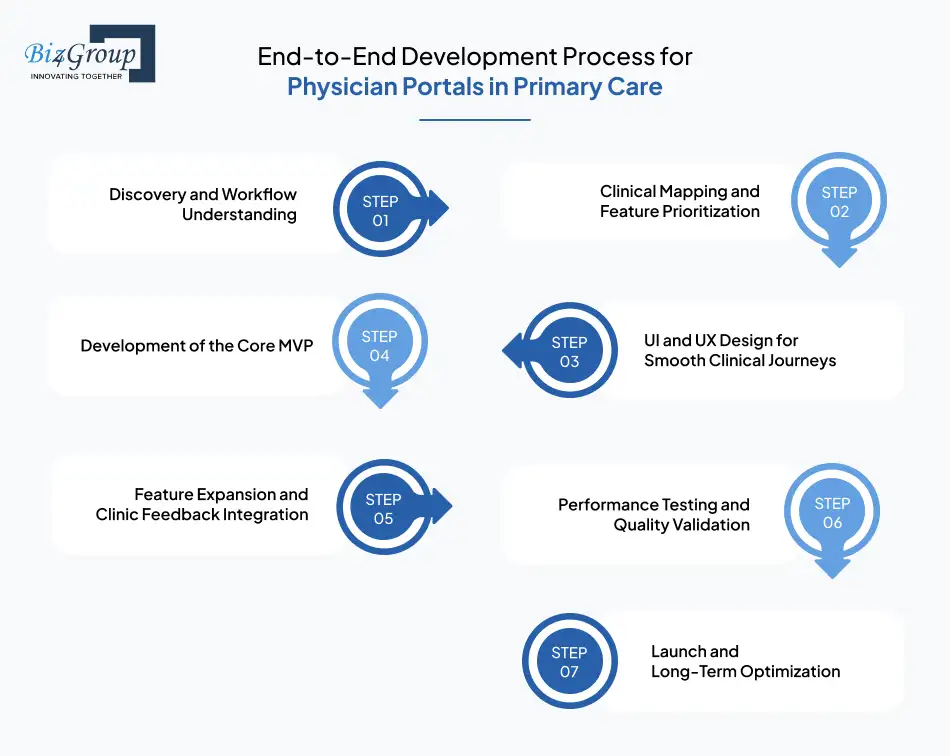
Clinics that follow a clear path during development avoid costly rework and create solutions that support both physicians and patients from day one.
The end-to-end development process for physician portals in primary care combines methodical steps with collaborative thinking so every feature feels intentional and aligned with real clinical workflows.
Step 1. Discovery and Workflow Understanding
Every build starts with conversation. Clinics outline their challenges, list their goals, and walk through their allergy workflows step by step. This helps the development team understand what physicians experience in the exam room, what staff handle at the front desk, and what patients expect during follow up.
Step 2. Clinical Mapping and Feature Prioritization
Once the workflows are understood, the next step is to break them into manageable features. Teams identify what the portal must handle daily, what can be added later, and which areas require more structure. This protects clinics from overbuilding early in the project and ensures every feature has purpose.
Step 3. UI and UX Design for Smooth Clinical Journeys
Great clinical portals succeed because they feel natural to use. The design process focuses on how physicians move through screens, how quickly they reach allergy histories, and how patients navigate symptom reporting.
Visual layouts stay clean so information never overwhelms the user. The UI/UX design team creates wireframes and prototypes that allow clinics to test the flow before any development begins.
Also read: Top 15 UI/UX design companies in USA
Step 4. Development of the Core MVP
Creating a minimum viable product gives clinics a working version of their portal without waiting for every advanced feature to be built. The MVP centers on must-haves like patient profiles, diagnostic tools, treatment tracking, follow up scheduling, and communication features. This helps clinics test the portal in real settings, gather feedback from staff, and shape the next round of improvements based on real usage.
Also read: Top 12+ MVP development companies in USA
Step 5. Feature Expansion and Clinic Feedback Integration
After the MVP runs smoothly, the development team begins adding more capabilities. This may include treatment pathway guidance, structured immunotherapy tracking, refined dashboards, or automation tools. The portal evolves with direct input from clinicians who use it daily.
Step 6. Performance Testing and Quality Validation
Every workflow is tested to ensure accuracy, speed, and reliability. Physicians rely on clean data and smooth transitions between tasks. Testing covers functionality, load performance, responsiveness, and clinical accuracy. Any friction discovered during this stage is resolved before live rollout.
Step 7. Launch and Long-Term Optimization
Once the portal is ready, clinics begin onboarding their teams. Physicians learn how to navigate the portal and staff become familiar with daily operations. After launch, the portal continues to evolve. New ideas emerge as clinics grow, new allergy treatments appear, and patient expectations shift. Continuous optimization keeps the system fresh and ready for use.
A clear and structured development process ensures that every feature serves a purpose and every workflow supports real clinical needs. Clinics that follow this sequence see smoother adoption and better outcomes for both staff and patients.
You Have the Roadmap. Now You Need the Crew.
Clinics that move from idea to MVP within a few weeks gain clarity that planning alone can never deliver.
Launch Your MVP in 3 Weeks with UsCore Standards Required to Make a HIPAA Compliant Primary Care Physician Portal
Creating a reliable physician portal begins with strong compliance practices. Clinics that plan to make a HIPAA compliant primary care physician portal must follow clear guidelines to protect patient data and maintain trust.
- HIPAA rules shape how sensitive patient information is stored, accessed, and exchanged. Every feature that handles patient data must follow these standards.
- Data encryption helps protect information during storage and when it moves between systems.
- Role-based access control limits who can view or update patient details.
- Audit logs record activity inside the portal, helping clinics review access patterns, track changes, and investigate unusual behavior.
- Secure authentication methods help verify that only authorized users enter the portal. Multi-factor verification strengthens this process.
- Backup and recovery planning keeps patient information safe even when unexpected disruptions occur.
- Interoperability with EHR systems requires careful handling so data exchanges remain compliant and accurate.
- Regular reviews and updates help clinics stay aligned with evolving regulations and technology standards.
These fundamentals create a strong compliance foundation for any physician portal. In the next section, we will look at cost considerations as clinics move from MVP plans to full scale solutions.
Also read: HIPAA compliant AI app development guide for healthcare providers
How Much Does It Cost to Create a Physician Portal for Allergy Immunotherapy and Follow Up Care
Building a physician portal involves a wide range of decisions, and those decisions shape the overall development budget. Most clinics fall within an average investment range of $25,000-$150,000+ depending on complexity, integrations, and goals.
To give you a quick visual snapshot, here is how budget ranges typically fall across three stages of growth.
|
Stage |
What It Includes |
Typical Range |
|
MVP Portal |
Core features such as patient profiles, diagnostics, communication tools, and scheduling |
$25,000-$45,000 |
|
Advanced Level Portal |
Additional features such as treatment pathways, automation, dashboards, and integrations |
$50,000-$90,000 |
|
Enterprise Level Portal |
Multi location support, advanced analytics, customization, long term scalability |
$100,000-$150,000+ |
Cost Drivers When Creating a Physician Portal
Before diving into advanced builds, it helps to understand the core drivers that influence your investment.
|
Cost Driver |
How It Affects the Project |
Estimated Impact |
|
Feature scope |
More capabilities require extended planning and coding |
$5,000-$40,000 depending on depth |
|
Custom workflow mapping |
Tailoring flows for allergy care increases setup time |
$3,000-$12,000 based on complexity |
|
Integrations |
EHRs, labs, pharmacies, and external APIs add development layers |
$4,000-$25,000 depending on number |
|
Automation features |
Automated reminders, tracking, and treatment suggestions increase effort |
$5,000-$20,000 |
|
UI and UX customization |
More refined and unique portal designs add design hours |
$2,500-$10,000 |
|
Multi location scalability |
Expanding to several sites increases logic and infrastructure planning |
$8,000-$25,000 |
|
Analytics and dashboards |
Trend analysis, reporting, and visualization tools raise complexity |
$4,000-$18,000 |
These cost drivers help you predict where your portal investment might land. The more clarity you have about your goals, the more accurate your range becomes.
Hidden Costs Clinics Should Plan for Primary Care Physician Portal Development
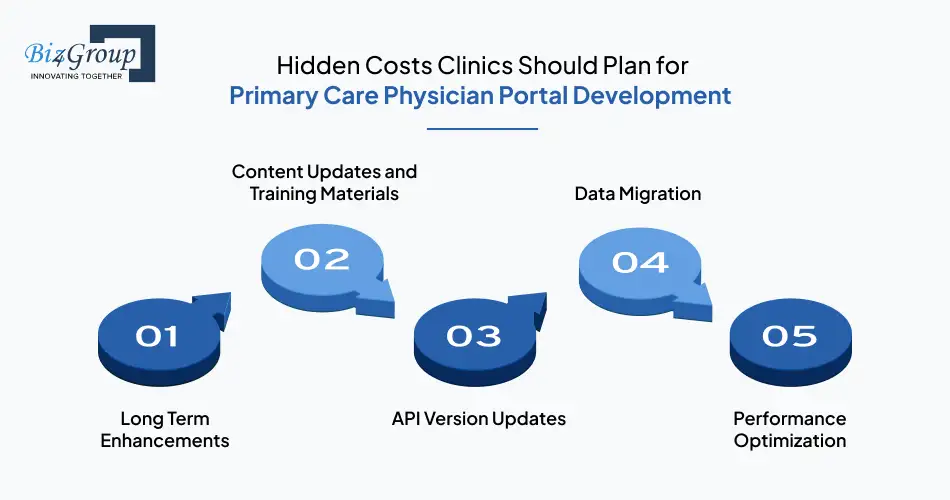
Even with careful planning, certain expenses can surprise teams. These hidden costs are not complicated, but they tend to slip under the radar. A clear view of these areas helps clinics allocate budgets more confidently.
1. Long Term Enhancements
After the first rollout, clinics discover new ideas that improve usability and performance. Enhancements may cost $1,000-$7,000 depending on the feature and timing.
2. Content Updates and Training Materials
Clinics often request patient education content, onboarding videos, or quick start guides. These pieces usually cost $500-$3,500 depending on volume and format.
3. API Version Updates
External systems update their endpoints over time. Maintaining compatibility may require adjustments costing $1,000-$6,000.
4. Data Migration
When clinics move from older systems, transferring patient records into the new portal can take careful handling. Migration can cost $1,500-$12,000 depending on how structured the previous data was.
5. Performance Optimization
As patient traffic grows, fine tuning becomes important. Optimization efforts may cost $1,000-$5,000 at various growth stages.
These hidden expenses are manageable with planning and prevent unexpected disruptions that can slow down clinical operations.
Understanding costs helps clinics make confident decisions. Once you know what shapes your budget and where hidden expenses appear, you can plan a development approach that fits your goals and timeline.
Before You Assume It's Expensive, Let's Run the Numbers
Some clinics overspend by 30% simply because they do not know which features actually move the needle.
Get a Custom QuoteShould You Buy or Build a Digital Physician Portal for Coordinated Allergy Care?
Clinics often reach a crossroads when planning the development of allergy treatment portals for clinics. Some want complete creative control through a custom build, while others prefer a faster path with ready-made solutions.
The table below breaks down these two approaches so you can compare them without hassle.
|
Factors |
Build |
Buy |
|
Control |
Full control over every feature, design element, and workflow |
Limited to whatever the platform offers with optional add-ons |
|
Customization |
High flexibility for allergy specific flows, immunotherapy rules, and patient journeys |
Moderate customization but usually within fixed templates |
|
Timeline |
Longer timeline due to planning, design, development, and testing |
Faster onboarding with minimal configuration delays |
|
Cost |
Higher upfront cost, predictable long-term ROI when scaling |
Lower upfront cost but recurring subscription fees |
|
Scalability |
Easy to scale for multi-location needs and growing patient volume |
Scaling often depends on vendor packages and tier upgrades |
|
Integrations |
Integration services for labs, EHRs, pharmacies, or analytics tools |
Limited integration options defined by the vendor |
|
Ownership |
Clinics own the product and intellectual property created |
Vendor owns platform infrastructure and core features |
|
Long Term Adaptation |
Simple to refresh, expand, or modernize as needs evolve |
Dependent on vendor roadmap and release cycles |
|
Support |
Requires dedicated technical support or a development partner |
Vendor provides support but may have fixed response windows |
Quick Summary for Decision Making
Build when
You need a portal shaped around allergy workflows, custom decision tools, or complex immunotherapy paths.
Buy when
You want a quicker launch, have straightforward needs, or prefer predictable subscription pricing without early development effort.
Hybrid when
You want the speed of a base platform with custom modules layered on top. This helps clinics experiment without committing fully to custom development.
This structure gives clinics enough clarity to choose a direction that fits their goals and growth timeline.
Challenges, Risks, and Mitigation in Allergy Treatment Management Software Development
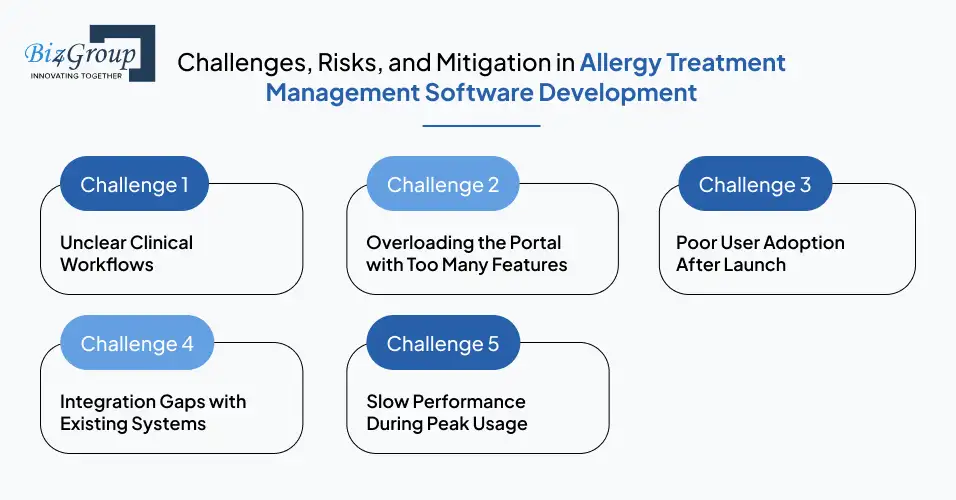
Every clinic planning allergy treatment management software development eventually meets a few hurdles. These challenges are not roadblocks but areas that require clear planning and communication.
Also read: Pharmacy management software development guide
Challenge 1: Unclear Clinical Workflows
Clinics sometimes begin projects without fully mapping how their teams diagnose, treat, and follow up with allergy patients. This creates confusion during development.
Solutions
- Conduct workflow interviews with physicians and staff
- Document each step from intake to immunotherapy review
- Confirm workflow expectations before development begins
Challenge 2: Overloading the Portal with Too Many Features
Teams often rush to include every possible feature early in the project. This leads to delays and a complicated user experience.
Solutions
- Start with an MVP focused on essentials
- Expand features in phases after real user feedback
- Keep the interface simple and focused
Challenge 3: Poor User Adoption After Launch
Even strong portals fail when physicians and staff feel overwhelmed or unsure of how to use them.
Solutions
- Offer guided training with real case scenarios
- Create short reference materials for daily tasks
- Collect feedback in the first weeks and refine quickly
Challenge 4: Integration Gaps with Existing Systems
Missed or incomplete integrations create double work and break the continuity of patient data.
Solutions
- Identify all required systems early
- Test data flow in real scenarios before launch
- Maintain documentation on integration behavior
Challenge 5: Slow Performance During Peak Usage
Allergy seasons bring high traffic. A poorly optimized system may slow down, creating frustration during busy hours.
Solutions
- Test performance with simulated traffic
- Monitor load patterns and optimize queries
- Prepare the system for seasonal spikes
When clinics approach allergy treatment management software development with awareness of these potential risks, they build portals that feel dependable and ready for real clinical environments.
Every Clinic Has Challenges. But Not Every Clinic Solves Them Early.
Workflows age fast. Why push the same problems into next quarter?
Talk to Our ExpertsFuture Trends in Allergy Clinic Management Portal Development
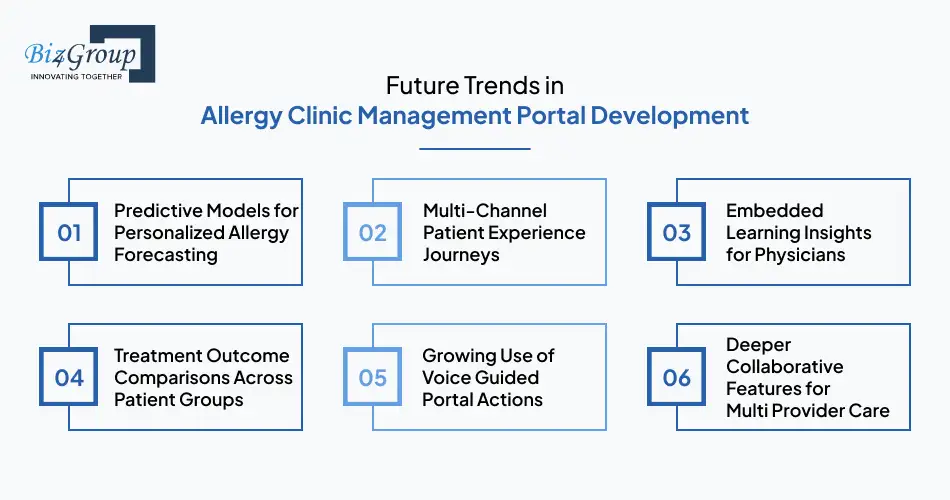
The digital landscape in healthcare evolves quickly, and allergy focused portals are following that momentum. Clinics that stay aware of upcoming advancements are at an advantage as patient expectations and clinical demands continue to grow.
The trends below offer a glimpse into what practices can expect as allergy clinic management portal development matures in the coming years.
1. Predictive Models for Personalized Allergy Forecasting
Portals are moving toward tools that help physicians anticipate patient reactions before they occur. These models blend historical symptom data with environmental conditions to estimate potential flare ups. Physicians use these forecasts to personalize follow-up schedules, improve preventive care, and guide patients with more timely instructions.
2. Multi-Channel Patient Experience Journeys
Clinics are beginning to design portals that stretch beyond basic communication. Patients will interact through mobile apps, smart wearables, and guided digital journeys connected to lifestyle patterns. This extended experience strengthens patient involvement and keeps allergy management active between office visits.
3. Embedded Learning Insights for Physicians
Future portals will include quiet learning tools that help physicians sharpen their decisions without distracting from care. These insights emerge as physicians navigate allergy histories, treatment plans, and symptom logs over time. The result is a personalized clinical learning loop that supports stronger outcomes across cases.
4. Treatment Outcome Comparisons Across Patient Groups
New analytics capabilities will allow clinics to compare outcomes between similar patient groups. Trends become easier to spot, such as which age groups respond better to certain immunotherapy schedules or which environmental triggers cause the longest flare durations. These insights help refine treatment strategies.
5. Growing Use of Voice Guided Portal Actions
Voice input is expected to become a practical part of physician workflows. Instead of typing updates or searching through menus, physicians speak natural commands that update records or open key features. This reduces time spent on manual steps and keeps attention on the patient during consultations.
Also read: A guide to AI voice agent development for dental and medical offices
6. Deeper Collaborative Features for Multi Provider Care
As more clinics coordinate care across multiple specialists, allergy portals will add collaboration elements. These tools support shared notes, joint treatment planning, and unified patient review sessions. This creates a stronger care network for patients with complex allergy profiles.
These future trends show where the industry is heading and how clinics can prepare for long term growth. Forward thinking practices that plan for these advancements now will move into the next era of allergy care with confidence and clarity.
Why Biz4Group LLC Leads Primary Care Physician Portal Development in the USA?
Clinics that invest in a physician portal want a partner who understands healthcare workflows, anticipates risks, and builds technology that feels natural to use in a busy clinical environment.
Biz4Group LLC has earned that confidence from healthcare practices.
Our team has spent years creating healthcare AI solutions that streamline diagnostics, improve treatment continuity, and support physicians with tools that reflect how care actually unfolds in primary settings.
We are a USA-based software development company, focused on designing solutions that feel purposeful. Nothing is created in isolation. Every feature connects to real clinical needs. This mindset allows us to build portals that fit naturally into clinical routines while still offering strong performance and scalability.
Clinics hire AI developers from Biz4Group because we study each workflow, listen carefully, and create enterprise AI solutions that elevate care delivery. Our designers think about clean movement between tasks. Our engineers think about long-term reliability. Our strategists think about the clinical outcomes our work will support.
This combination has helped Biz4Group LLC build a reputation for delivering healthcare technology that feels polished, intuitive, and ready for real world use.
Why Businesses Choose Biz4Group LLC
Clinics often tell us that choosing a development partner was stressful until they spoke with our team. They see the difference in how we plan, how we communicate, and how we build. Here are the qualities that clients appreciate most.
- A clear understanding of primary care workflows, including allergy diagnostics, follow up cycles, and treatment patterns
- A history of delivering digital health solutions that combine precision, usability, and long-term value
- A collaborative approach that keeps clinics involved in design and decision making
- A disciplined build process that reduces risk and shortens development time
- A forward-thinking mindset that allows our solutions to scale with clinics as their needs evolve
Our portfolio speaks for itself. Our team believes that great technology should support clarity and confidence, not complexity. This belief guides every decision we make throughout the development journey.
As clinics across the USA continue to modernize their allergy management workflows, the teams that choose Biz4Group LLC position themselves ahead of the curve.
It's time you take the lead. Let's talk.
Final Thoughts
Allergy care grows more complex every year and clinics feel the pressure to stay organized, responsive, and efficient. This is why the shift toward digital portals continues to accelerate. A well-structured system supports faster decisions, stronger communication, and more predictable outcomes for patients who depend on reliable guidance throughout allergy seasons.
The development of a primary care physician portal brings order to what is often a fragmented workflow. Clinics gain tools that shape cleaner data paths, clear documentation, and smoother patient engagement.
Biz4Group LLC stands beside healthcare organizations as they move toward this digital future. We build technology that helps physicians work with clarity and patients feel informed at every visit. Clinics that partner with us gain a development team that understands their challenges and rises to meet them with precision and creativity.
If your clinic is ready to elevate allergy care with a portal that feels modern, intuitive, and clinically aligned, reach out to Biz4Group LLC. Let's create something powerful for your practice.
FAQs
How long does it usually take to launch a physician portal for allergy management?
Most clinics see an early version in a few months. Biz4Group can deliver an MVP in 2-3 weeks by using reusable components that cut development time and cost.
Do clinics need internal technical staff to maintain the portal?
Not always. Many practices partner with external teams for long term upkeep. This keeps clinics focused on patient care while developers handle adjustments, updates, and enhancements.
Can portals help track patient adherence to allergy treatments?
They can. Portals often include appointment reminders, medication updates, and progress logs that help clinics understand whether patients are following their treatment plans consistently.
How flexible are portals when new allergy testing methods become available?
Most modern systems can be expanded with new workflows or testing modules. This helps clinics keep pace with new diagnostic approaches without replacing their entire platform.
Can these portals support multiple roles and permission levels for clinic staff?
They can. Clinics can assign permissions based on responsibilities, allowing physicians, nurses, and administrative teams to access only what fits their roles.
What happens if a clinic wants to expand the portal after launch?
Expansion is common. New modules and workflows can be added as the clinic grows. A well-structured foundation makes enhancements easier in the future.
