Location :
Orlando, FL, USA
Location :
Orlando, FL, USA +1 (407) 714-1616
 info@biz4group.com


















Imagine a digital system that doesn’t wait for instructions but instead, understands your business goals, learns from real-time feedback, and takes independent actions to get the job done.
Read More

 AI Summary Powered by Biz4AI
Can a pricing mistake on a single vacant unit quietly cost thousands of dollars over a lease term?
Yes. And when that mistake happens across dozens or hundreds of units, the impact becomes hard to ignore.
Many property managers still rely on periodic market reviews, spreadsheets, and manual rent adjustments. The problem is that rental markets rarely sit still. Demand shifts, occupancy levels fluctuate, seasonal trends come and go, and pricing decisions that made sense a month ago may no longer fit today's market conditions.
That is why agentic AI for property management is gaining attention across the real estate industry. Property owners, investors, and multifamily operators are looking for smarter ways to make pricing decisions without spending hours analyzing reports and market data. Instead of relying solely on recommendations, agentic AI can evaluate information, identify pricing opportunities, and support dynamic rent pricing strategies across entire portfolios.
The momentum behind this shift is clear. According to a 2026 report by Mordor Intelligence, the global property management software market is expected to reach $6.53 billion in 2026 and grow to $9.93 billion by 2031, fueled by increasing demand for automation, predictive analytics, and modern property technologies.
If you are a property management company managing hundreds of units and want to implement agentic AI for dynamic rent pricing to reduce vacancies and maximize revenue, this guide is for you. We'll explore how to use agentic AI for dynamic rent pricing in property management, how autonomous pricing systems work, and what it takes to build, integrate, and scale them successfully.
Agentic AI for property management refers to AI systems that can analyze information, make decisions based on predefined goals, and take actions with limited human intervention.
In a property management environment, these systems can monitor rental data, track market movements, evaluate pricing opportunities, and recommend the next best action based on business objectives.
The easiest way to understand agentic AI is to compare it with the technologies that came before it.
Many real estate businesses assume all AI solutions work the same way. They don't.
Each category serves a different purpose.
Capability |
Traditional AI |
Generative AI |
Agentic AI |
|---|---|---|---|
Analyzes data |
✓ |
Limited |
✓ |
Generates content |
✕ |
✓ |
✓ |
Follows predefined rules |
✓ |
✓ |
✓ |
Makes independent decisions |
✕ |
Limited |
✓ |
Executes actions |
✕ |
✕ |
✓ |
Learns from outcomes |
Limited |
Limited |
✓ |
Suitable for autonomous rent pricing systems |
✕ |
✕ |
✓ |
Think of it this way:
That distinction matters when managing hundreds or thousands of rental units where pricing decisions need to happen continuously rather than once every few weeks.
Most AI rent pricing software can identify patterns and generate recommendations. Agentic AI takes things a step further.
Instead of stopping at a recommendation, it can evaluate multiple options against business goals such as:
This makes agentic AI particularly valuable for organizations asking, "We are a multifamily housing operator struggling with manual rent setting and want to understand how agentic AI can automate and optimize our pricing strategy."
The answer lies in the technology's ability to continuously evaluate thousands of variables without requiring constant manual oversight.
While the user may only see a pricing recommendation on a dashboard, several specialized components work together behind the scenes.
A simplified workflow looks like this:
Stage |
What Happens |
|---|---|
Data Collection |
Rental, occupancy, leasing, and market data are gathered |
Analysis |
Patterns, anomalies, and trends are identified |
Reasoning |
Multiple pricing scenarios are evaluated |
Decision Making |
The most suitable action is selected |
Action |
Pricing recommendations are delivered to users or connected systems |
Feedback |
Results are measured and used to improve future decisions |
In advanced environments, multiple AI agents can collaborate to perform these tasks simultaneously.
For example:
Together, these agents create a coordinated decision-making process that can respond much faster than traditional workflows.
Organizations looking to develop a multi agent AI system for real estate often use this architecture to manage increasingly complex pricing and portfolio management requirements.
Property management teams already use software for leasing, maintenance, accounting, and tenant communication. Agentic AI acts as an intelligence layer across those systems. Rather than replacing existing platforms, it works alongside them by analyzing information and supporting better decisions.
This is why many firms exploring enterprise AI solutions are increasingly focusing on agentic AI capabilities that can scale across large property portfolios.
As the volume of rental data continues to grow, property managers need systems that can process information, identify opportunities, and respond quickly.
Agentic AI was built for exactly that purpose.
In the next section, we'll look at dynamic rent pricing itself and understand why traditional pricing methods often struggle to keep pace with modern rental markets.
Dynamic rent pricing is a pricing strategy that adjusts rental rates based on changing market conditions, property performance, demand levels, and leasing activity instead of relying on fixed rates for extended periods.
In simple terms, it helps property managers charge the right rent at the right time for the right unit.
For years, rental pricing was largely a manual process. Property managers reviewed market reports, analyzed occupancy trends, and adjusted rents periodically. While that approach worked in slower-moving markets, today's rental landscape demands greater responsiveness.
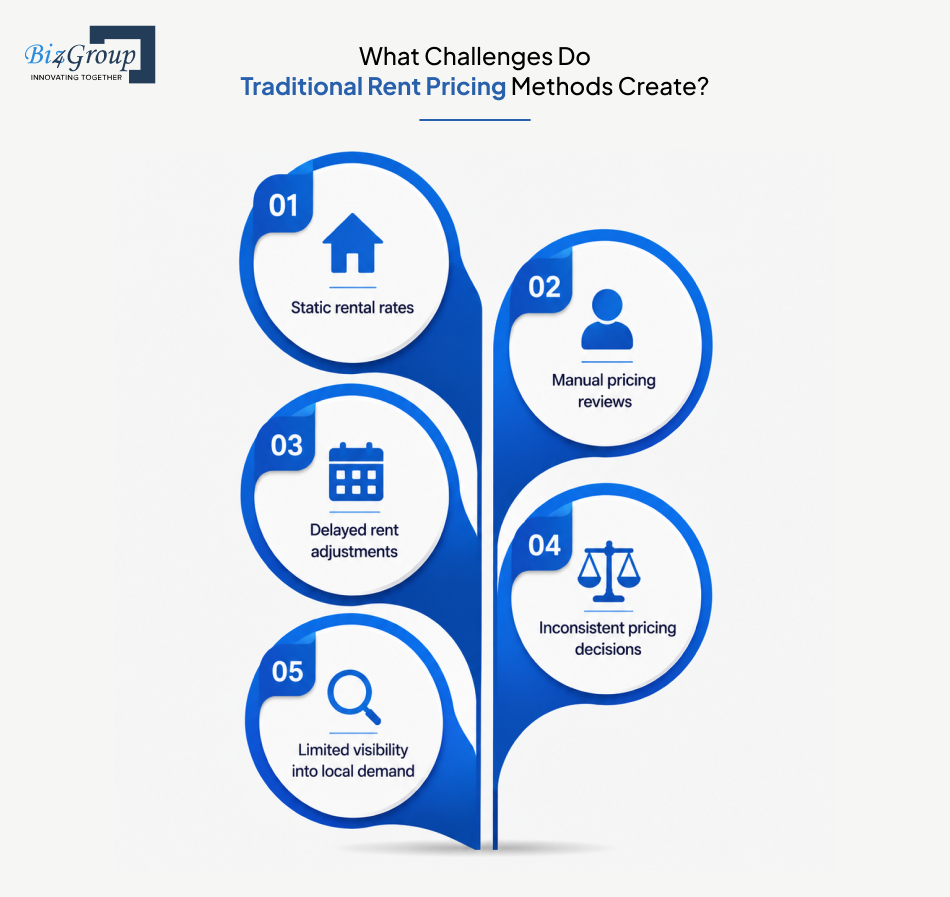
Traditional pricing methods often struggle because they rely heavily on historical data and manual reviews. As portfolios grow, pricing decisions become increasingly difficult to manage consistently.
Common challenges include:
Challenge |
Impact on Property Performance |
|---|---|
Static rental rates |
Missed revenue opportunities |
Manual pricing reviews |
Slower response to market changes |
Delayed rent adjustments |
Reduced leasing momentum |
Inconsistent pricing decisions |
Portfolio-wide pricing gaps |
Limited visibility into local demand |
Difficulty forecasting rental performance |
A pricing review conducted every few months may overlook important market shifts occurring between those review cycles.
For organizations managing large portfolios, those missed adjustments can add up quickly. This is particularly relevant for teams saying, "I own multiple rental properties and want to use AI to automatically adjust rent prices based on seasonality, local market trends, and occupancy rates."
Dynamic pricing was designed to solve exactly that challenge.
Dynamic rent pricing works by continuously evaluating market and property-specific variables to determine an appropriate rental rate for each unit. Instead of using a one-size-fits-all approach, pricing decisions are based on current conditions.
A typical pricing workflow includes:
The result is a more responsive pricing model that reflects real-world market activity.
Every rental market behaves differently. Several variables commonly influence pricing decisions.
Factor |
Why It Matters |
|---|---|
Occupancy levels |
Indicates leasing performance |
Lease expiration schedules |
Impacts upcoming inventory availability |
Local housing supply |
Affects renter options |
Seasonal demand patterns |
Influences renter activity |
Property amenities |
Impacts perceived value |
Unit type and size |
Determines market positioning |
Historical leasing trends |
Supports pricing forecasts |
These inputs help create a more accurate pricing framework for rental properties.
Property managers are adopting dynamic pricing because it provides a structured way to align rental rates with changing market conditions. The benefits often extend beyond pricing itself.
The shift is accelerating across the industry. According to Deloitte's 2025 Commercial Real Estate Outlook, 97% of surveyed real estate organizations are committed to AI-enabled solutions, while 40% are already in the early stages of implementation, up from 28% the previous year.
Property teams gain:
For multifamily operators, investors, and property management companies, dynamic pricing has become an important component of modern revenue management.
Consider this real-world scenario, "I am a real estate investor looking for an AI pricing tool that can predict the optimal rent for each unit across my portfolio without manual intervention."
A traditional spreadsheet-based process would require constant monitoring and analysis. A dynamic pricing framework provides a repeatable method for evaluating opportunities across an entire portfolio.
As property technology continues to evolve, dynamic pricing is increasingly becoming a foundational capability within modern rental management platforms and AI property management software development initiatives.
The next question becomes even more important... How can agentic AI take dynamic pricing from periodic recommendations to continuous, goal-oriented decision making?
Agentic AI transforms dynamic rent pricing by shifting pricing decisions from periodic reviews to continuous evaluation. Instead of waiting for a manager to review reports and approve updates, the system can monitor changing conditions and recommend pricing actions aligned with predefined business goals.
This approach helps property managers move from reactive pricing to proactive pricing.
Agentic AI enables real-time rent adjustment using AI by continuously evaluating new information as it becomes available. Rather than relying on scheduled pricing reviews, rental rates can be reassessed whenever meaningful changes occur.
Examples include:
For organizations managing hundreds of units, this creates a much more responsive pricing environment.
Agentic AI improves pricing accuracy by evaluating multiple variables simultaneously rather than relying on isolated metrics. One of the biggest challenges in rental pricing is balancing occupancy goals with revenue objectives.
Traditional Pricing Approach |
Agentic AI Approach |
|---|---|
Reviews limited data points |
Evaluates multiple market signals |
Relies on manual interpretation |
Uses structured decision logic |
Periodic updates |
Continuous evaluation |
Portfolio-level assumptions |
Unit-level recommendations |
Reactive pricing adjustments |
Forward-looking pricing decisions |
The result is more precise AI pricing for rental properties across different asset types and markets.
Vacancies often occur when rental rates fail to align with market demand. Agentic AI can identify situations where pricing may be discouraging prospective tenants or slowing lease activity.
Benefits include:
This is particularly relevant for organizations asking, "We are a vacation rental company facing revenue losses due to static pricing and want to implement real-time AI-driven rent adjustments across our listings."
In these scenarios, pricing responsiveness becomes a critical factor in maintaining occupancy levels throughout the year.
Property revenue optimization involves more than increasing rent. The objective is to maximize long-term portfolio performance while maintaining healthy occupancy.
Agentic AI supports this by evaluating trade-offs that are difficult to identify manually. For example:
Objective |
Possible Pricing Action |
|---|---|
Fill vacant units faster |
Adjust pricing for targeted inventory |
Improve lease conversion rates |
Optimize pricing by unit type |
Increase portfolio revenue |
Prioritize high-demand inventory |
Improve occupancy stability |
Balance pricing across locations |
This creates a more balanced approach to AI-driven rental revenue optimization.
Large portfolios create complexity. Different properties, lease cycles, unit types, and markets require constant attention. As a result, many operators are exploring intelligent rent optimization platforms capable of supporting large-scale pricing decisions.
A common question from the industry is, "We manage a large multifamily portfolio and need an autonomous rent pricing system that can react to market changes instantly without requiring manual approval at every step."
Agentic AI addresses this need by providing structured decision support across large portfolios while maintaining alignment with business rules and operational objectives.
The shift toward intelligent pricing is already underway.
Build Smart with Biz4Group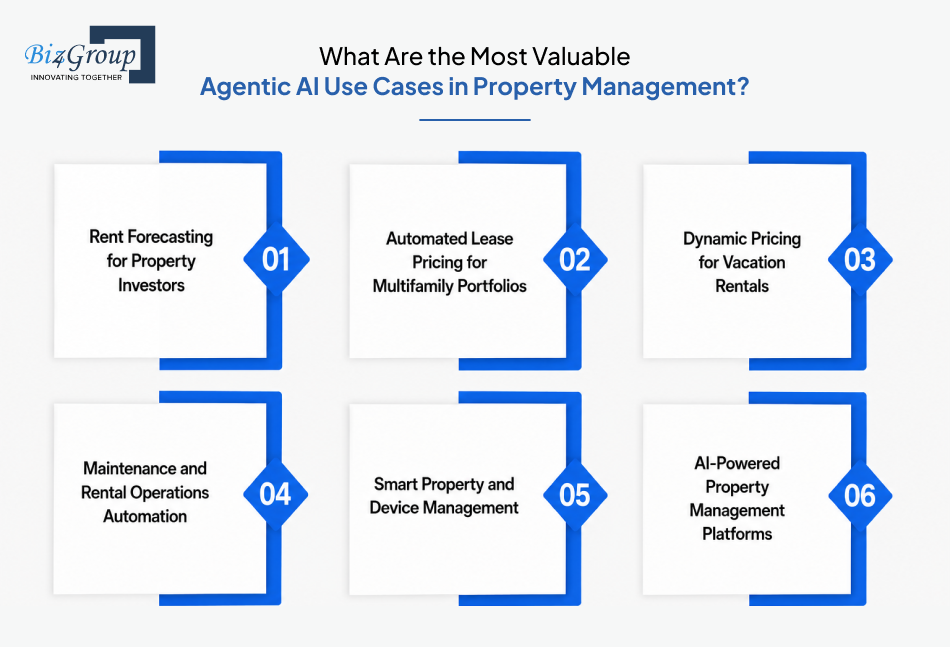
Agentic AI can support far more than rent pricing. Property management companies, real estate investors, multifamily operators, and PropTech startups are increasingly using intelligent systems to automate decision-making across various operational areas.
Here are some of the most valuable use cases emerging today.
Property investors often struggle to estimate future rental performance across multiple assets. Agentic AI can analyze leasing trends, occupancy patterns, and market indicators to improve rent forecasting AI for property investors.
This is especially useful for firms saying, "We are exploring real estate AI solutions for rent forecasting and want to understand how predictive pricing models are trained and maintained over time."
Large multifamily portfolios often contain hundreds of units with varying lease cycles. Agentic AI can support automated lease pricing software for property managers by evaluating unit-specific conditions and recommending pricing adjustments at scale.
This allows multifamily operators to make pricing decisions faster while maintaining portfolio-wide consistency.
Vacation rental markets are heavily influenced by seasonality, local events, and booking behavior. Agentic AI can power a dynamic pricing engine for vacation rentals by continuously assessing booking demand and pricing opportunities across listings.
For vacation rental businesses, this creates a more adaptive pricing strategy throughout the year.
Property management extends far beyond pricing. Maintenance requests, inspections, scheduling, repairs, and property readiness often require significant administrative effort.
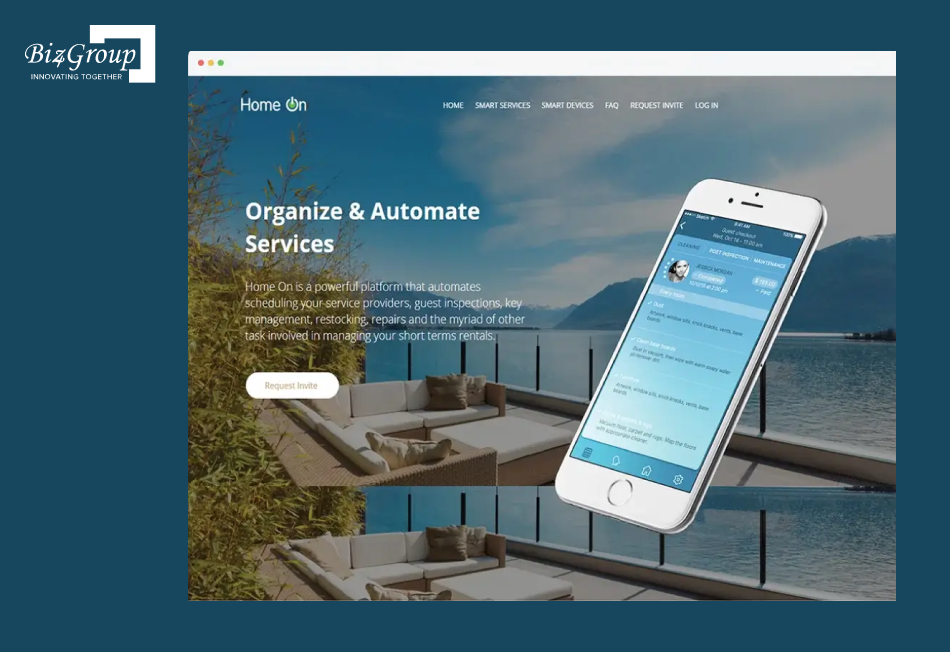
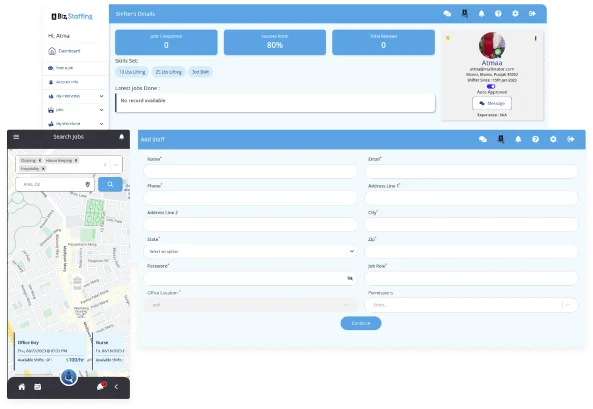
Biz4Group helped address this challenge through an advanced web application designed for automated maintenance and rental operations.
Key capabilities included:
The platform enabled property managers to centralize activities, automate repetitive tasks, and maintain visibility across rental operations through a single system.
This type of solution demonstrates how AI automation services can streamline property management processes beyond leasing and revenue management.
As connected buildings become more common, property managers need better ways to monitor and control smart devices across properties.
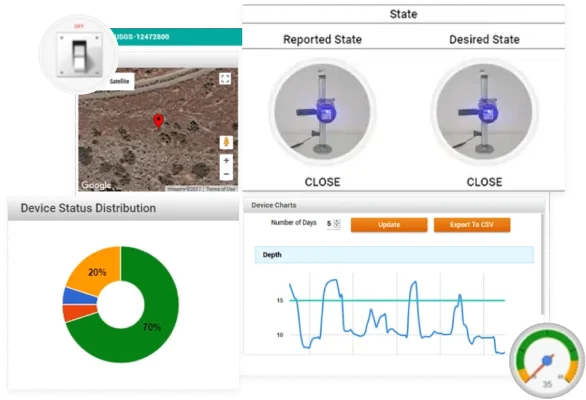
Biz4Group developed a smart home management platform for a leading device manufacturer that enabled centralized property and device management.
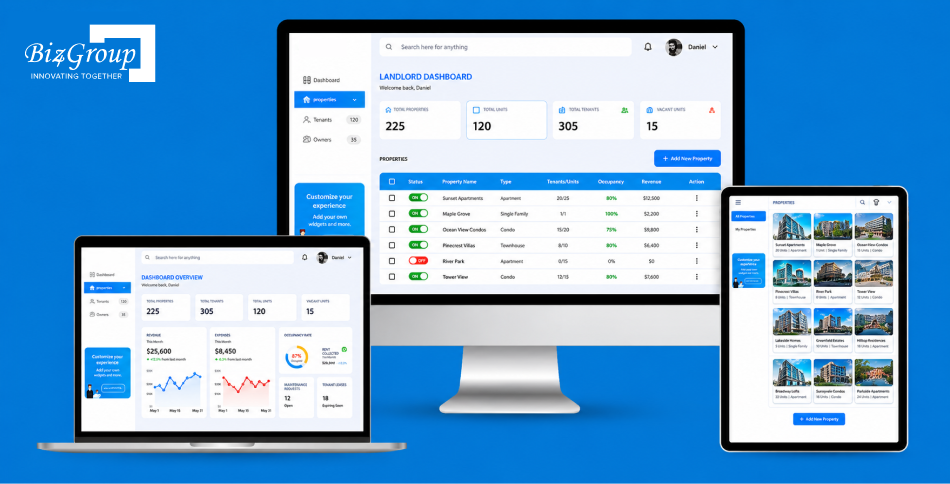
Project highlights included:
The platform allowed users to manage smart locks, thermostats, switches, and connected devices from a unified dashboard.
For organizations building next-generation PropTech ecosystems, solutions like these showcase how intelligent automation can support both property operations and resident experiences.
Many PropTech companies are moving beyond standalone tools and investing in connected platforms.
A common industry request today is, "We are a PropTech startup building a SaaS platform for landlords and want to integrate dynamic rent pricing powered by agentic AI into our product."
In these scenarios, agentic AI becomes part of a broader property management ecosystem that supports leasing, maintenance, resident engagement, and portfolio oversight from a single platform.
These use cases highlight an important reality. The value of agentic AI grows significantly when it is tailored to a business's specific workflows, data ecosystem, and operational goals. That makes the development approach just as important as the technology itself.
The right AI rent pricing software should support accurate pricing decisions, adapt to changing portfolio conditions, and fit seamlessly into existing property management workflows.
If you're asking, "I am looking for a development partner to build a custom agentic AI solution for rent pricing that connects with our existing property management software," the following capabilities should be on your evaluation checklist.
Feature |
Why It Matters |
Business Value |
|---|---|---|
Demand Forecasting |
Anticipates future leasing activity and rental demand |
Supports predictive pricing for real estate |
Unit-Level Pricing Intelligence |
Evaluates pricing opportunities for individual units |
Improves pricing precision across portfolios |
Portfolio Performance Monitoring |
Tracks pricing performance across properties |
Helps optimize large rental portfolios |
Occupancy Goal Alignment |
Aligns pricing recommendations with occupancy targets |
Supports balanced revenue and leasing outcomes |
Market Signal Analysis |
Interprets changing rental market conditions |
Enables informed pricing decisions |
Scenario Planning Tools |
Tests different pricing approaches before implementation |
Reduces pricing uncertainty |
Automated Recommendation Engine |
Generates pricing recommendations at scale |
Saves time for property management teams |
Lease Expiration Analysis |
Evaluates upcoming lease renewals and vacancies |
Supports better inventory planning |
Revenue Opportunity Identification |
Highlights units with pricing improvement potential |
Strengthens property revenue optimization |
Audit Trails and Decision Logs |
Records pricing recommendations and changes |
Improves transparency and governance |
Multi-Property Support |
Manages pricing across multiple locations and asset types |
Essential for multifamily rent pricing software |
Workflow Customization |
Adapts pricing processes to business requirements |
Supports operational flexibility |
User Role Management |
Controls access for different teams and stakeholders |
Improves platform administration |
Reporting and Analytics Dashboards |
Provides visibility into pricing outcomes |
Enables data-backed decision making |
API Connectivity |
Connects with existing business systems |
Supports future expansion and automation |
Not every property management company requires every feature on day one. A vacation rental operator may prioritize demand monitoring and seasonal pricing capabilities, while a multifamily housing provider may focus on portfolio analytics and occupancy management.
The key is selecting software that aligns with your portfolio structure, pricing objectives, and long-term growth plans.
Organizations evaluating advanced AI rent pricing software often begin by identifying the capabilities they need today while ensuring the platform can support future expansion as pricing requirements become more sophisticated.
Choose a platform built around your business, not generic workflows.
See Custom Feature Options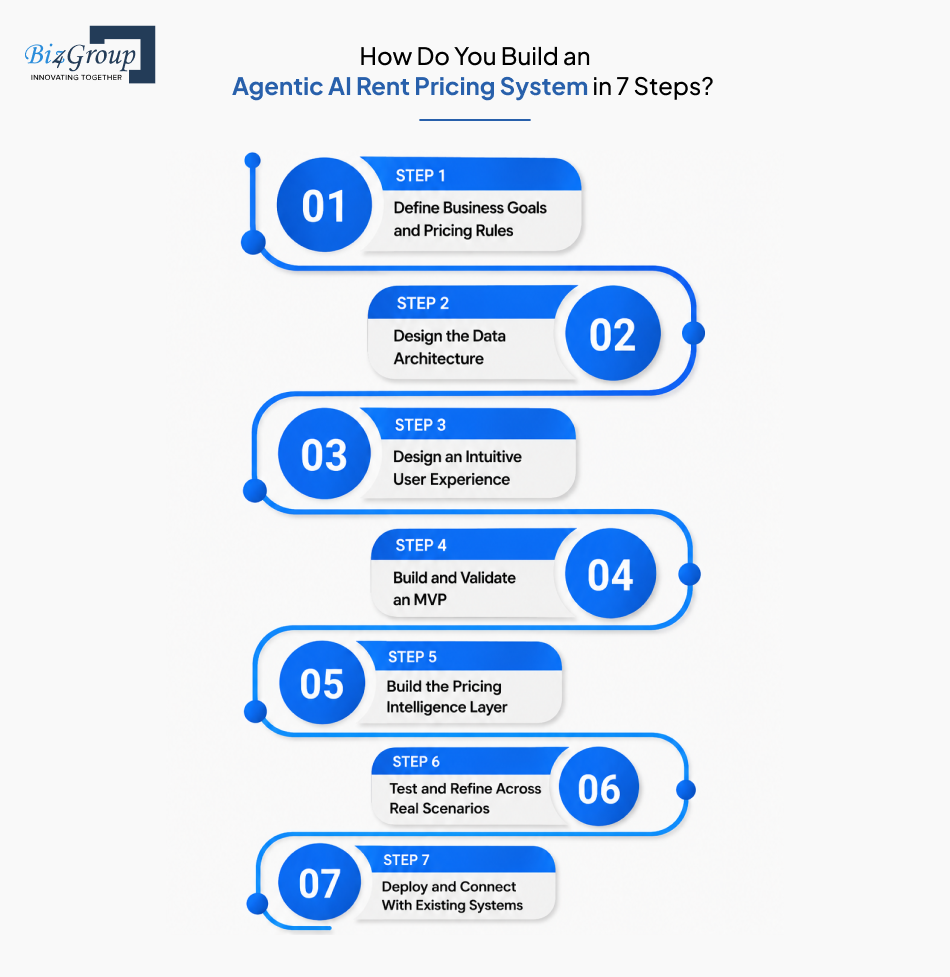
Building an agentic AI rent pricing system starts with defining business objectives, identifying the right data sources, and developing an intelligent pricing platform that can support rental decision-making at scale.
For many organizations, the goal is not simply to deploy software. The goal is to create a system that aligns with portfolio performance targets, leasing strategies, and long-term growth plans.
A common request we hear is, "We are a real estate investment firm looking to build a custom AI pricing engine that can autonomously adjust rents based on market data, demand signals, and competitor pricing."
Achieving that requires a structured development process.
Every successful project begins with clarity. Before writing code, property managers and stakeholders must establish:
These inputs become the foundation of the pricing system.
The quality of pricing outcomes depends heavily on the quality of available data. This stage focuses on identifying:
The objective is to create a reliable data foundation that supports accurate decision-making.
A pricing engine is only valuable if teams can confidently use it. Property managers, leasing teams, and asset managers need a dashboard that presents pricing recommendations clearly and supports fast decision-making.
The UI/UX phase should focus on:
Many real estate businesses work with a specialized UI/UX design company to ensure the platform remains user-friendly as pricing workflows become more sophisticated.
Also read: Top 15 UI/UX design companies in USA
Launching a fully featured platform from day one often leads to unnecessary costs and longer development cycles. A smarter approach is to begin with a Minimum Viable Product (MVP) focused on core pricing capabilities.
An MVP typically helps teams:
Organizations investing in custom agentic AI solutions for real estate frequently leverage professional MVP development services to accelerate validation while minimizing development risk.
Also read: Top 12+ MVP development companies in USA
This stage focuses on developing the core pricing engine. The system should be capable of:
Companies investing in agentic AI platform development often spend the majority of development effort within this layer because it directly influences pricing quality and business outcomes.
Before deployment, the system should be evaluated using historical and live portfolio data. Testing helps answer questions such as:
This stage reduces surprises after launch.
Deployment should focus on making the pricing engine a seamless part of daily operations. At this stage, the platform is connected with:
This is where AI integration services become essential, helping organizations ensure data flows reliably across systems while maintaining a consistent user experience.
For organizations saying, "I want to build a dynamic pricing engine for my property management business that uses machine learning to forecast demand and set competitive rents," a phased development approach typically produces stronger results than attempting to build every capability at once.
The next challenge is determining which integrations are required to make that pricing system work effectively within an existing property management technology stack.
Agentic AI integrates with property management software through APIs, data connectors, and workflow orchestration layers that allow information to move between systems in real time.
The goal is not to replace existing platforms. The goal is to extend their capabilities with intelligent decision-making.
This is one of the most common questions from enterprise teams, "How do real estate AI solutions integrate with property management platforms?"
The answer depends on the technology ecosystem already in place.
System |
Integration Purpose |
|---|---|
Property Management Software |
Access unit, occupancy, and lease data |
CRM Platforms |
Connect prospect and leasing information |
Accounting Systems |
Sync financial and revenue metrics |
Business Intelligence Tools |
Support reporting and performance analysis |
Communication Platforms |
Deliver pricing alerts and recommendations |
For organizations asking, "I am a CTO at a real estate company exploring agentic AI adoption for pricing automation and want to understand the technical architecture and integration requirements," the most important consideration is interoperability.
An effective solution should exchange data securely, maintain synchronization across systems, and support future expansion without requiring major infrastructure changes.
Many PropTech businesses also choose to build an agentic AI workflow automation system that connects pricing, leasing, and operational workflows through a unified architecture.
So basically, seamless integration often determines how quickly teams can begin generating value from the platform, irrespective of whether you're implementing AI-powered rent pricing software for property management companies or building custom real estate AI solutions.
The cost of developing agentic AI for property management typically ranges from $40,000-$250,000+, depending on the platform's complexity, data ecosystem, integrations, automation requirements, and deployment scale.
For example, a startup building an MVP for rent pricing will have a very different budget than a multifamily operator creating an enterprise-wide autonomous rent pricing system.
The table below provides a realistic starting point.
Development Stage |
Estimated Cost |
Typical Scope |
|---|---|---|
MVP Solution |
$40,000-$80,000+ |
Core pricing engine, dashboard, basic integrations |
Advanced Platform |
$80,000-$150,000+ |
Multiple AI agents, analytics, workflow automation, custom reporting |
Enterprise Solution |
$150,000-$250,000+ |
Portfolio-wide automation, enterprise integrations, governance, advanced AI capabilities |
This is often the first question decision-makers ask, "What is the cost and ROI of implementing agentic AI for property management?"
The answer depends on several cost drivers that directly influence development effort.
Several components contribute to the final project budget. Some influence development complexity, while others affect long-term scalability.
Cost Driver |
Typical Cost Impact |
|---|---|
Product Discovery and Planning |
$5,000-$15,000 |
UI/UX Design |
$5,000-$20,000 |
AI Model Development |
$15,000-$60,000 |
Agent Architecture Development |
$15,000-$50,000 |
Dashboard and Frontend Development |
$10,000-$40,000 |
Backend Infrastructure |
$10,000-$50,000 |
Third-Party Integrations |
$5,000-$40,000 |
Security and Compliance Features |
$5,000-$30,000 |
Testing and Quality Assurance |
$5,000-$20,000 |
For organizations building custom agentic AI solutions for real estate, the pricing engine itself is often only one part of the overall investment. The surrounding infrastructure, user experience, and integrations frequently account for a significant share of development costs.
Many businesses focus exclusively on development budgets and overlook ongoing expenses. These costs can affect long-term project success.
Common hidden costs include:
Understanding these expenses early helps prevent budget overruns after launch.
A larger budget does not automatically guarantee better results. The strongest returns usually come from focusing development efforts on the highest-value business problems first.
Many successful projects follow this approach:
This is particularly relevant for businesses saying, "We are a PropTech founder building an AI-first property management tool and want guidance on how to develop an autonomous rent optimization engine from the ground up."
Starting small often produces faster learning cycles and more predictable investment outcomes.
In many cases, a carefully planned $60,000-$100,000 MVP can deliver far greater returns than a rushed enterprise deployment that exceeds $250,000 before proving market fit.
Get a realistic estimate before making budget decisions.
Calculate My AI Project Cost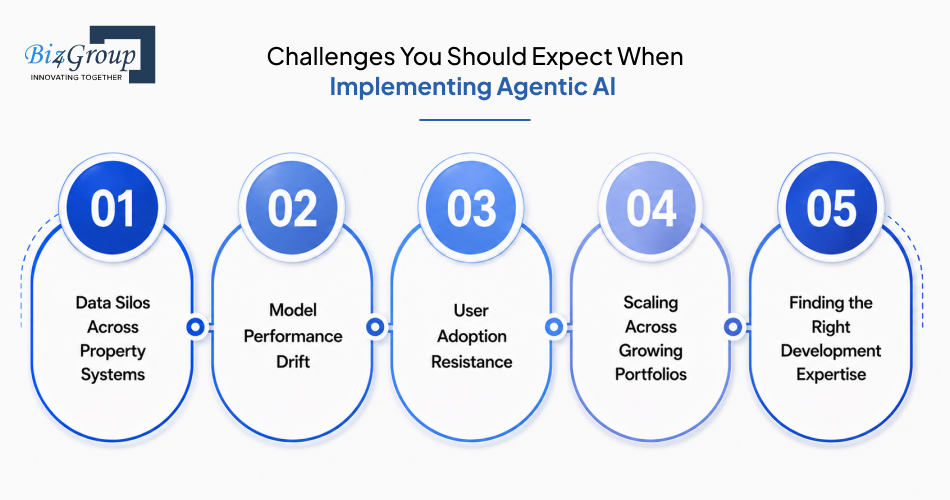
Implementing agentic AI for property management can unlock significant value, but success depends on addressing a few practical challenges early in the project.
The good news is that most of these challenges are predictable and can be mitigated with proper planning.
Many property management companies store information across multiple platforms, making it difficult to establish a consistent data flow.
This challenge is common among organizations saying, "We are a property management company managing hundreds of units and want to implement agentic AI for dynamic rent pricing to reduce vacancies and maximize revenue."
Solutions
Rental markets evolve over time. A model that performs well today may gradually lose effectiveness if market conditions, renter behavior, or business objectives change.
Solutions
Even highly capable systems can face resistance if users are unfamiliar with AI-powered workflows. Property managers often want visibility into how recommendations are generated before relying on them.
Solutions
What works for 50 units may not work for 5,000 units. As portfolios expand, infrastructure and system requirements often become more demanding.
Solutions
Organizations investing in agentic AI platform development often prioritize scalability early to avoid costly rework later.
Agentic AI projects require expertise in AI, real estate workflows, product development, and platform architecture. Building the wrong team can significantly delay implementation.
Solutions
Many organizations choose to hire AI developers with experience in real estate and intelligent automation to reduce implementation risks.
While these challenges are important to address, they should not discourage adoption. With the right planning, development approach, and technology partner, most implementation obstacles can be resolved long before they impact business outcomes.
Property managers should ensure that agentic AI pricing decisions remain transparent, auditable, and aligned with applicable housing, privacy, and consumer protection regulations. Compliance should be built into the platform from the beginning rather than treated as an afterthought.
This is especially important for organizations asking, "We are evaluating AI rent pricing software for our vacation rental business and want to understand the difference between rule-based tools and agentic AI solutions."
Greater automation often requires stronger governance.
AI-powered rent pricing software for property management companies should avoid practices that could result in discriminatory outcomes.
Key considerations include:
Property managers should be able to understand why a pricing recommendation was generated.
Important safeguards include:
Agentic AI for property management often relies on large volumes of operational and tenant-related data.
Organizations should prioritize:
Even autonomous rent pricing systems should include human supervision for high-impact decisions.
Best practices include:
As real estate AI solutions continue to evolve, the organizations that balance automation with accountability will be better positioned to build trust among stakeholders, regulators, and residents alike.
Build trust, transparency, and accountability from day one.
Talk to an AI ExpertThe right choice depends on your portfolio size, business goals, customization requirements, and long-term technology strategy.
Many organizations asking, "We are looking for a development partner to build a custom agentic AI solution for rent pricing that connects with our existing property management software," often reach a point where off-the-shelf software no longer meets their requirements.
The comparison below can help simplify the decision.
Evaluation Factor |
Buy AI Rent Pricing Software |
Build a Custom Solution |
|---|---|---|
Time to Launch |
Faster deployment |
Longer implementation timeline |
Initial Investment |
Lower upfront cost |
Higher upfront investment |
Custom Workflows |
Limited customization |
Fully tailored to business processes |
Ownership of Technology |
Vendor-owned platform |
Full ownership and control |
Feature Flexibility |
Restricted by vendor roadmap |
Features developed around business needs |
Integration Freedom |
Depends on vendor capabilities |
Designed around existing systems |
Unique Pricing Strategies |
Limited support |
Fully configurable |
Scalability Requirements |
Suitable for standard growth |
Suitable for evolving enterprise needs |
Data Ownership |
Shared within vendor ecosystem |
Complete ownership and control |
Long-Term Adaptability |
Vendor dependent |
Business controlled |
Buy when
Build when
Choose a hybrid approach when
For organizations evaluating long-term development partners, reviewing the top agentic AI development companies for the real estate industry in the USA can provide useful insights into available expertise, delivery models, and industry experience.
Ultimately, the best decision is the one that aligns with your growth plans, portfolio complexity, and vision for future property management technology.
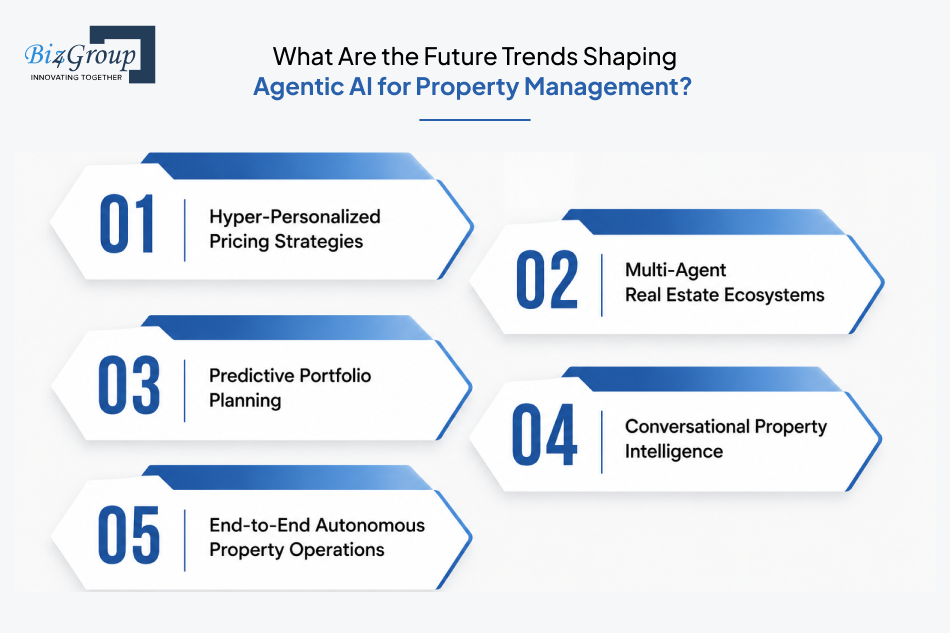
The next phase of agentic AI for property management will focus on greater autonomy, deeper intelligence, and broader adoption across the real estate ecosystem.
For property owners, investors, and PropTech leaders, the conversation is gradually shifting from "Can AI support pricing decisions?" to "What other decisions can AI handle responsibly and at scale?"
Future AI pricing for rental properties will move beyond market-level recommendations and become increasingly tailored at the unit level. Factors such as lease timing, renter behavior patterns, property preferences, and localized demand signals will contribute to more individualized pricing strategies.
This evolution will help support more sophisticated approaches to AI-driven rental revenue optimization across diverse portfolios.
Today's AI tools typically operate within a limited scope. The next generation of systems will involve multiple specialized agents working together across leasing, pricing, maintenance, finance, and resident engagement functions.
This trend is particularly relevant for organizations asking, "We are a PropTech founder building an AI-first property management tool and want guidance on how to develop an autonomous rent optimization engine from the ground up."
As adoption grows, businesses will increasingly connect multiple agents within a unified property management environment.
Property managers have traditionally focused on current portfolio performance. Future systems will place greater emphasis on forecasting future outcomes.
Agentic AI will help organizations evaluate expansion opportunities, identify underperforming assets, and support long-term investment planning using predictive pricing for real estate and portfolio intelligence models.
As natural language interfaces continue to mature, property managers will increasingly interact with AI systems through conversations rather than dashboards alone. Instead of searching through reports, users may simply ask, "Which properties are likely to experience leasing slowdowns next quarter?"
Many organizations exploring these experiences already partner with a specialized generative AI development company to build conversational interfaces that simplify access to operational insights.
The long-term vision extends beyond autonomous rent pricing systems. Future platforms will coordinate pricing, leasing, maintenance, communication, and operational workflows through connected decision-making frameworks.
For businesses evaluating real estate AI solutions today, this represents one of the most significant opportunities on the horizon.
The companies investing in agentic AI now are not simply preparing for better pricing decisions. They are laying the foundation for a more intelligent and connected property management ecosystem over the next decade.
By this point, one thing should be clear... Building agentic AI for property management is not a software project. It is a business transformation project.
The opportunity extends far beyond pricing. Morgan Stanley's 2025 AI Adopter Survey estimates that 37% of tasks across commercial real estate and REIT-related functions can be automated through AI technologies, creating significant opportunities for organizations willing to modernize their operations.
The technology has to understand pricing logic, leasing operations, property workflows, business objectives, user behavior, and future growth plans. Missing any one of these pieces often results in an expensive platform that looks impressive during a demo but struggles to deliver meaningful results after launch.
That is why businesses across the USA partner with Biz4Group.
As a leading AI development company, we don't approach projects with prebuilt templates or universal solutions.
Every property portfolio operates differently.
Every business has different goals.
The solution should reflect that reality.
Our experience spans rental operations platforms, smart property ecosystems, workflow automation systems, enterprise software, and advanced AI applications. This combination of real estate knowledge and product engineering expertise allows us to solve challenges that generic software vendors often cannot address.
Many of the companies reach out to us saying, "We are a real estate investment firm looking to build a custom AI pricing engine that can autonomously adjust rents based on market data, demand signals, and competitor pricing."
These organizations are not looking for another software subscription. They are looking for a platform built around their business model.
That is where Biz4Group delivers value.
As an established agentic AI development company, we help businesses transform complex ideas into scalable products that are designed for real-world adoption, long-term growth, and measurable business impact.
The real question is not whether agentic AI can improve your pricing strategy. The real question is how much revenue, occupancy, and growth you're leaving on the table while waiting to implement it.
Let's build something your portfolio can benefit from for years, not months.
The property management industry has entered a new phase where pricing decisions can no longer rely solely on periodic reviews and manual analysis. Rental markets move quickly, tenant demand shifts constantly, and portfolio performance depends on making informed decisions at the right time.
This is where agentic AI for property management creates meaningful value.
By combining intelligent decision-making with dynamic rent pricing, property managers, multifamily operators, real estate investors, and PropTech companies can move toward more adaptive pricing strategies that support occupancy goals, revenue growth, and portfolio performance.
The opportunity is particularly compelling for businesses asking, "How to implement AI pricing for rental properties at scale?"
The answer often lies in building solutions tailored to specific business objectives rather than relying on rigid, one-size-fits-all systems.
As a leading USA-based software development company, Biz4Group helps real estate businesses design and develop custom agentic AI platforms, intelligent rent optimization solutions, autonomous pricing systems, and advanced PropTech products built for long-term growth.
The market is already moving toward AI-powered pricing. The bigger question is whether your business will lead that shift or spend the next few years trying to catch up. If you're ready to build a smarter, more profitable property management ecosystem, let's start the conversation.
Yes. Two units in the same property may have different pricing recommendations based on factors such as floor level, view, renovation status, lease expiration timing, historical leasing performance, and current renter interest. Agentic AI evaluates each unit individually rather than applying a blanket pricing strategy across an entire building.
Agentic AI is not limited to enterprise portfolios. Owners managing a handful of rental properties can also benefit from automated pricing recommendations, rent forecasting, and market analysis. The difference is usually the scale of implementation rather than the value it delivers.
Most custom platforms take anywhere from 3-9 months depending on complexity, integrations, and feature requirements. Biz4Group, however, can deliver a functional MVP in as little as 2-4 weeks by leveraging reusable components and proven development frameworks that reduce both development time and overall project costs.
There is no universal schedule. Some businesses update models quarterly, while others retrain them monthly or whenever significant market changes occur. The ideal frequency depends on portfolio size, market volatility, and the volume of new leasing data available.
Yes. Agentic AI can analyze trends across a portfolio and highlight properties that consistently underperform against occupancy, leasing, or revenue benchmarks. This allows asset managers to investigate potential issues before they become larger business problems.
The most effective systems combine internal property data with external market intelligence. Examples include lease history, occupancy records, unit attributes, renter demand signals, local market trends, demographic insights, and economic indicators relevant to the target market.
Before development begins, property managers should define clear business objectives, identify key stakeholders, review existing software systems, assess data availability, and establish success metrics. Projects typically move faster when these foundational requirements are documented early.

Our website require some cookies to function properly. Read our privacy policy to know more.