Location :
Orlando, FL, USA
Location :
Orlando, FL, USA +1 (407) 714-1616
 info@biz4group.com


















Imagine a digital system that doesn’t wait for instructions but instead, understands your business goals, learns from real-time feedback, and takes independent actions to get the job done.
Read More

Every entrepreneur reaches a moment where excitement meets uncertainty. The idea feels strong, but the questions pile up fast. Is this business viable? Do the numbers make sense? Will investors take it seriously?
This is exactly where an AI business plan generator platform steps in - not to write for founders, but to guide them through structured thinking.
Instead of starting from a blank page or rigid templates, these platforms help entrepreneurs turn raw ideas into clear, investor-ready business plans through guided inputs, built-in logic, and real-world business context. That shift is not theoretical. It is already showing up in market behavior.
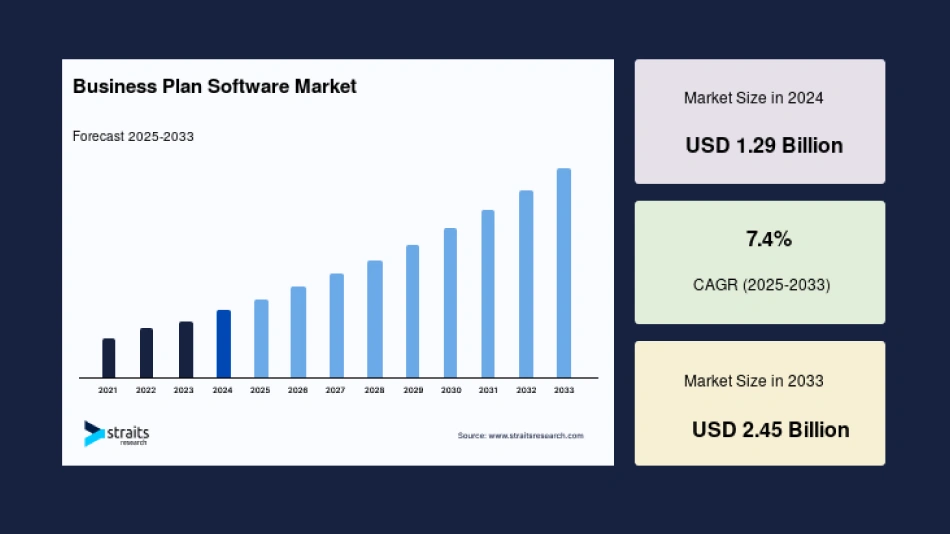
The broader business plan software market is projected to grow from $1.38 billion in 2025 to $2.45 billion by 2033, reflecting a steady move away from manual planning toward intelligent, automated platforms. Within this space, AI-powered planning tools are becoming the preferred choice for founders who value speed, clarity, and confidence over guesswork.
What’s driving this adoption is simple:
As a result, AI business plan generator platform development is no longer just a product idea. It is becoming a strategic opportunity for companies building tools for startups, SaaS businesses, incubators, and financial institutions.
But building the right platform requires more than developing AI models. It requires thoughtful design, business reasoning, and the right AI consulting services to shape a system that actually supports decision-making, not just document creation.
That is the foundation this guide is built on.
An AI business plan generator platform is a guided system designed to help users structure, validate, and formalize business ideas into complete business plans. At its core, this platform asks the right questions in the right order. It captures business inputs, applies structured reasoning, and converts those inputs into a coherent business plan that follows accepted investor and lender formats.
When companies focus on AI business plan generator platform development, the goal is to build a system that understands how businesses are planned, not just how content is written. That is why these platforms combine guided workflows, planning frameworks, and intelligent AI business process automation into a single experience.
Most platforms built through custom AI business plan generator development services follow a consistent working AI model. The intelligence sits behind the flow, while the user experience remains simple and conversational.
The working of these platforms can be understood as a clear sequence of steps:
From a build perspective, this type of platform is usually part of broader AI product development services, where planning logic, user experience, and automation work together as one system. The strength of the platform depends on how well these elements stay aligned with real-world business planning needs.
Also Read: Top Trends in AI Product Development
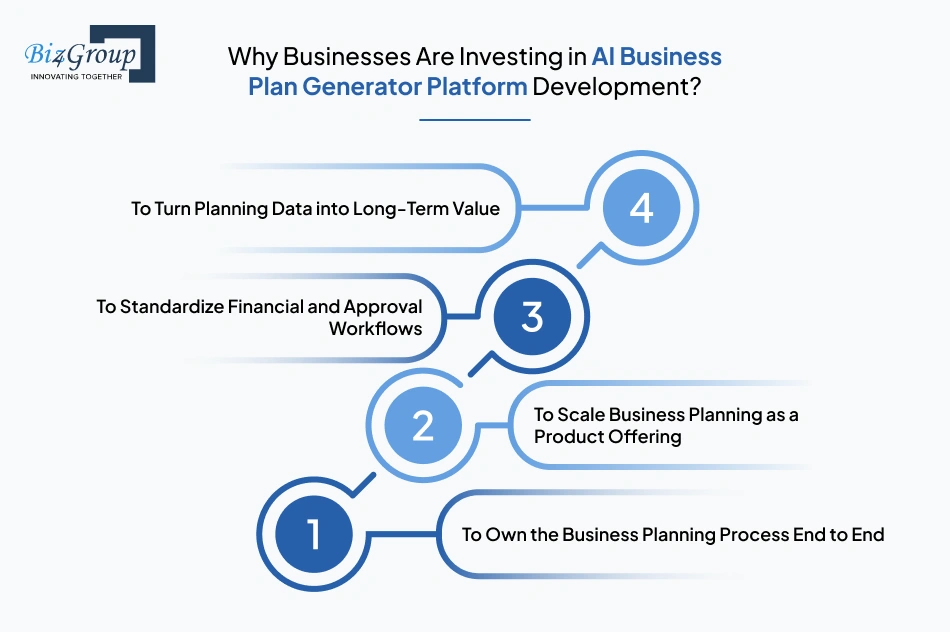
Companies are investing in AI business plan generator platform development because there’s a lot that needs to be done in a loop. Plans are created, revised, reviewed, and reused across funding rounds, internal approvals, partnerships, and new market evaluations. Relying on external tools limits control over this process. Building the AI platform gives businesses ownership over how planning decisions are produced and evaluated.
When businesses build their own platforms, they control how inputs are collected, how assumptions are structured, and how outputs are evaluated. This allows planning logic to match internal decision standards rather than adapting to third-party tools.
Organizations that develop intelligent business planning platform solutions ensure every plan follows the same logic, review structure, and financial framing, even as use cases vary across teams, industries, or markets.
Businesses invest in AI business plan generator platform development to deliver business planning as a scalable product, not a manual service. Incubators, advisory firms, and fintech platforms generate plans repeatedly across startups, funding stages, and markets. Manual execution limits growth and profitability.
A dedicated AI platform centralizes planning logic into a reusable system, enabling consistent, multi-user delivery and commercial scale without reliance on consultant-driven or analyst-led execution.
In environments tied to finance, lending, or investment decisions, inconsistency in planning creates risk. Different formats, assumptions, or financial structures slow approvals and weaken confidence.
By investing in AI platform development, businesses enforce standardized financial models, validation checks, and review workflows. This is especially important in contexts influenced by fintech software development, where planning outputs often feed directly into credit evaluation, funding decisions, or risk assessment processes.
Each business plan contains structured insights about assumptions, markets, costs, and outcomes. When planning lives inside a platform, this data compounds over time. Businesses can identify which assumptions fail, which models perform better, and where decision patterns repeat.
This long-term accumulation aligns with how companies build durable systems through enterprise AI solutions, where platforms evolve into core decision infrastructure rather than temporary tools.
The business planning directly influences capital allocation and strategic direction. Owning the platform means owning the decision logic behind those outcomes, enabling scalability, consistency, and long-term operational value.
Own your planning logic, workflows, and assumptions instead of relying on generic tools.
Explore AI Platform Strategy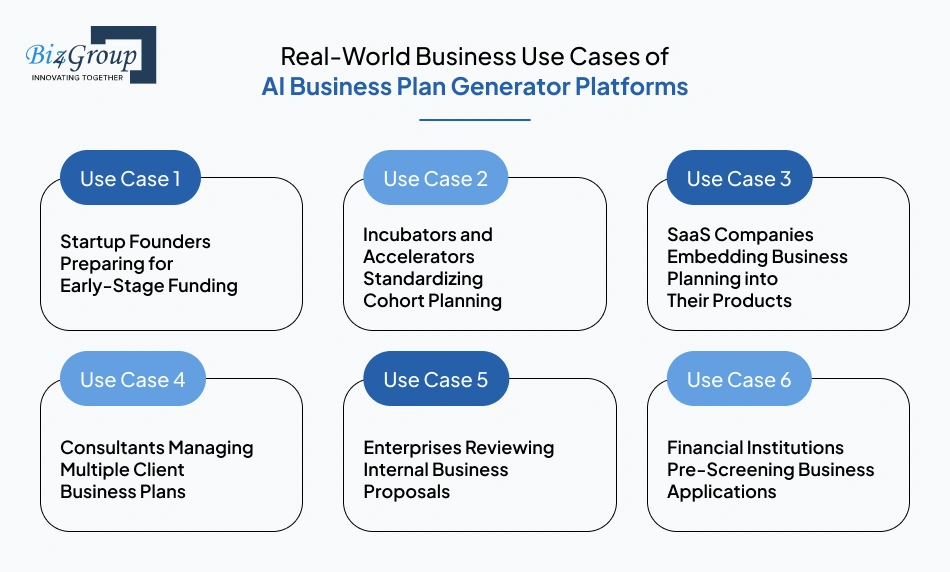
AI business plan generator platforms are used in very specific business situations where planning must be structured, repeatable, and decision ready. Each use case below reflects a clear scenario where a particular group relies on the platform to complete a defined planning task.
Startup founders use the AI business plan generator platform when they need to convert an early idea into a structured business plan for investor review. The AI platform is used to guide founders through required planning sections, so their submission follows an expected format before it reaches investors, helping startups scale faster with AI as a service.
In this scenario, the custom AI business plan generator platform replaces informal documents and inconsistent planning approaches with a single, structured planning workflow.
Incubators and accelerators use the platform when managing multiple startups at the same time. Each startup is required to submit a business plan using the same structure, so mentors and reviewers can evaluate ideas consistently.
The AI business planning software becomes the standard planning environment used across the entire cohort, ensuring uniformity in how plans are created and reviewed.
SaaS companies use the platform when business planning needs to be part of the product experience. The platform is embedded so users can create structured business plans without leaving the application.
In this scenario, companies often create AI driven business plan software as a native feature to support user onboarding, validation, or monetization flows, a decision that is typically reviewed during broader AI SaaS product development cost planning.
Consultants and advisory firms use the AI business plan generator platform when guiding multiple clients through business planning engagements. The AI platform ensures that each client follows the same planning structure, regardless of industry or idea stage.
The approach aligns well with how planning workflows are structured in AI consulting for small businesses.This allows consultants to focus on review and guidance while the platform handles plan structure and consistency.
Enterprises use the AI business plan generator platform when internal teams submit business proposals for approval. Every proposal must follow the same planning format so leadership can compare ideas objectively.
In this scenario, the AI platform acts as a controlled submission system that standardizes how internal business cases are presented and reviewed.
Financial institutions use the AI business plan generator platform during early-stage evaluation of business proposals. Applicants submit plans through the platform, so each submission meets baseline planning requirements before human review.
This structured intake ensures that all submitted business plans meet predefined completeness and formatting requirements before the review. As a result, reviewers receive consistent, evaluation-ready plans, while assessment decisions remain fully human-led.
AI business plan generator platforms are used where structured planning truly matters. Different business groups rely on them to create consistent, review-ready plans that support real decisions, not assumptions, across funding, internal reviews, and institutional evaluations.
When businesses invest in AI business plan generator platform development, the focus is not surface-level automation. The objective is to encode planning logic that structures inputs, enforces internal consistency, and adapts plans based on business context. AI is applied selectively to validate assumptions, adjust structure, and generate sections within controlled boundaries.
Below are the core capabilities an AI business plan generator platform must include to support reliable business planning workflows.
|
Capability |
What This Capability Enables |
|---|---|
|
Guided business input flow |
Helps users answer the right planning questions in the right order |
|
Standard business plan structure |
Ensures every plan follows accepted investor and lender formats |
|
Assumption consistency logic |
Keeps numbers, market claims, and strategy aligned across sections using AI document analysis tools |
|
Trained AI models for finances |
Converts inputs into basic revenue, cost, and projection models |
|
Industry-aware plan adaptation |
Adjusts structure based on business type and sector |
|
Editable plan sections |
Allows users to review and refine content without breaking structure |
|
Export-ready plan formats |
Generates documents suitable for investors, lenders, and internal teams |
|
Multi-plan AI document management |
Supports handling multiple plans within one platform account |
|
Version control and updates |
Enables users to revise plans without starting from scratch |
When teams build AI powered business plan generator software; these capabilities form the foundation of a reliable platform. They also define the scope of effective AI business planning software development, where structured guidance matters more than surface-level AI automation.
Once the core planning foundation is in place, advanced capabilities are what separates a basic tool from a truly intelligent system. In AI business plan generator platform development, these capabilities are not about adding flashy AI layers, rather they help users think better, test assumptions, and make informed decisions.
This is especially important when teams aim to develop scalable AI business plan generator platform solutions that must perform reliably across many users and business types.
|
Advanced Capability |
What This Capability Improves |
|---|---|
|
Assumption stress testing |
Automatically checks how changes in pricing, costs, or demand impact the plan |
|
Scenario-based financial simulation |
Let's users compare best-case, realistic, and worst-case outcomes within the same plan |
|
Market benchmark comparison |
Compares user assumptions against industry norms to flag outliers |
|
Cross-section reasoning |
Ensures market size, revenue logic, and financial projections remain logically connected |
|
Investor feedback learning loops |
Improves plan quality over time using anonymized review patterns and feedback signals |
|
Regulatory and compliance checks |
Highlights missing or inconsistent information for regulated industries |
|
Explainable planning logic |
Shows users why certain assumptions or outputs were generated |
|
Context-aware refinement |
Adjusts recommendations based on business stage and sector |
Advanced capabilities matter when platforms are expected to guide real decisions. For teams that want to create AI business plan generator software for startups, these enhancements help move beyond plan creation and support deeper validation, clarity, and confidence at scale.
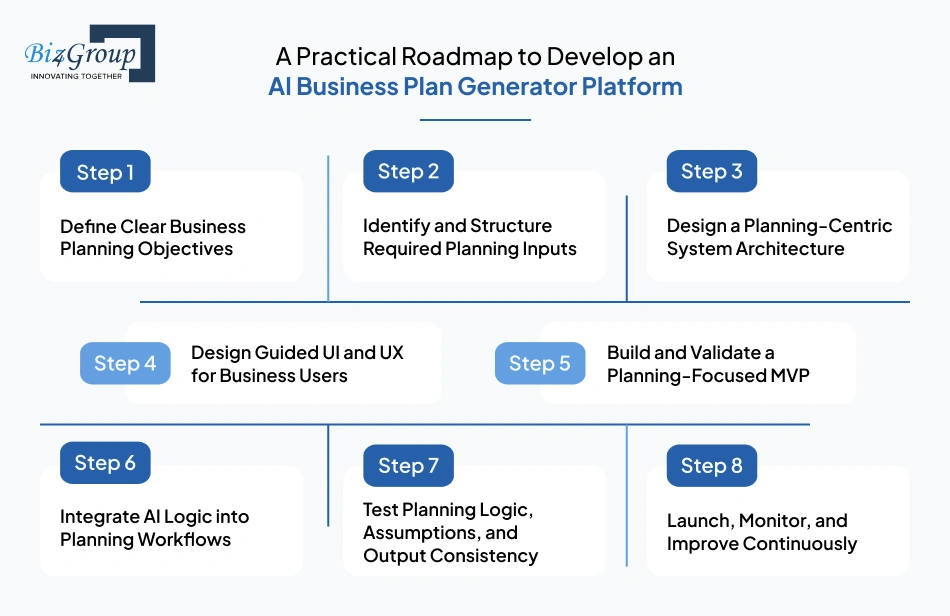
Building an AI business plan generator platform is not about assembling AI features. It is about creating a system that supports real planning decisions, keeps assumptions consistent, and works reliably as usage grows. This step-by-step roadmap focuses on how such a platform should be developed in practice, without abstract AI concepts.
Start by defining what kind of business planning the platform is meant to support, such as startup validation, investor readiness, internal approvals, or institutional screening.
This step ensures that the platform is built around real planning outcomes, not generic content generation.
An AI business plan generator platform depends on structured inputs across markets, financials, operations, and strategy.
Without well-defined inputs, planning logic becomes inconsistent and unreliable.
The platform architecture must support structured planning flows while allowing AI components to scale as usage increases.
This stage ensures the platform remains stable as more users, plans, and planning scenarios are added.
Business planning platforms must guide users calmly through complex decisions without creating confusion.
Strong UI/UX design helps users focus on planning decisions instead of learning how the platform works.
Also Read: Top 15 UI/UX Design Companies in USA
An MVP helps confirm whether the platform genuinely improves planning clarity before full-scale development.
This approach aligns with how teams use MVP development services to validate assumptions early and reduce development risk.
Also Read: AI-based Custom MVP Software Development
AI must be embedded directly into planning workflows, so guidance leads to better decisions, not static output.
Reliable AI integrations ensure planning intelligence flows smoothly from inputs to outputs without breaking the user experience.
Before launch, the platform must be tested as a planning system, not just as software. The goal is to verify that inputs, assumptions, and outputs remain consistent across all sections of a business plan.
This step ensures the platform produces plans that hold up under real review conditions, not just technically correct output.
Also Read: Software Testing Companies in USA
Post launch, the platform must evolve as planning needs, data patterns, and user expectations change.
Many teams work with a custom software development company at this stage to support ongoing refinement and ensure the platform remains reliable as planning complexity grows.
Following a structured development process helps teams build AI business plan generator platforms that work in real decision environments. Each step keeps the platform focused on clarity, consistency, and long-term usability.
Also Read: How To Build AI Software: A Comprehensive Guide for Founders
Translate business logic, financial reasoning, and AI guidance into a platform that works in real planning environments.
Discuss my Development Approach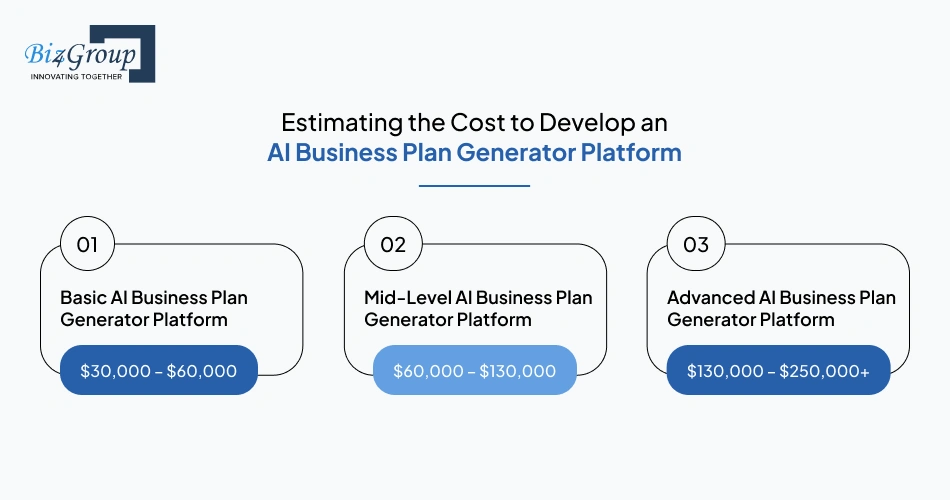
When planning AI business plan generator platform development, cost is driven by how much planning responsibility the platform takes on. A simple system that helps users structure a plan costs far less than a platform designed to validate assumptions, test scenarios, and support decision-making at scale.
In real-world projects, an AI business plan generator development cost estimate typically ranges from $30,000 to $250,000+, depending on planning depth, intelligence level, and long-term scalability.
|
Development Level |
Estimated Cost Range |
What This Typically Covers |
|---|---|---|
|
Basic AI Business Plan Generator Platform |
$30,000 – $60,000 |
Guided plan creation, standard business plan sections, simple financial inputs, and basic AI logic to help early-stage founders organize ideas into a structured plan. |
|
Mid-Level AI Business Plan Generator Platform |
$60,000 – $130,000 |
Deeper financial planning, limited scenario comparisons, early-stage predictive analytics to test assumptions, industry-aware guidance, and support for managing multiple plans and users. |
|
Advanced AI Business Plan Generator Platform |
$130,000 – $250,000+ |
Supports detailed assumption testing and allows comparison of multiple financial scenarios. |
The cost to develop an AI business plan generator platform increases as the system moves from helping users write plans to helping them evaluate decisions.
The most effective approach is to start with core planning workflows, validate how users interact with them, and expand intelligence only where it improves decision quality. Cost should always reflect how much responsibility the platform takes in guiding business planning decisions.
Also Read: AI Software Development Cost
Understand how planning depth, AI intelligence, and scalability influence development cost and timelines.
Request Cost InsightsIn AI Business Plan Generator Platform Development, the technology stack determines how reliably planning workflows run, how smoothly AI logic processes inputs, and how easily the platform scales as more users and plans are added. This stack focuses only on what is realistically required to support structured business planning across web and optional mobile environments, without unnecessary complexity.
|
Layer |
Technology Used |
Purpose |
|---|---|---|
|
Web Frontend |
React.js |
Builds responsive dashboards and guided planning interfaces through ReactJS development for browser-based business planning workflows. |
|
Mobile Frontend |
React Native / Flutter |
Enables optional cross-platform access for reviewing and updating plans using mobile application development when mobile usage is required. |
|
Web Application Layer |
Next.js |
Supports routing, server-side rendering, and performance optimization through NextJS development for scalable planning applications. |
|
Backend Application Layer |
Node.js |
Manages planning workflows, validation logic, user management, and system coordination using NodeJS development. |
|
API Layer |
REST / GraphQL |
Enables secure data exchange between frontend, backend, and AI services, supporting structured AI API development for planning logic and validation. |
|
AI & Data Processing Layer |
Python |
Handles financial modeling, assumption validation, and planning intelligence using Python development. |
|
AI Model Framework |
TensorFlow / PyTorch |
Trains and runs machine learning models used for scenario analysis, prediction, and consistency checks within planning workflows. |
|
Database Layer |
PostgreSQL / MongoDB |
Stores business plans, financial inputs, assumptions, user data, and historical planning records. |
|
AI Integration Layer |
Financial APIs, Document Tools, Export Services |
Connects external data sources, document generation, and reporting tools required for business planning output. |
|
Cloud Infrastructure |
AWS / Azure / GCP |
Supports scalability, availability, and secure deployment as platform usage grows. |
|
Security Layer |
OAuth 2.0 / JWT |
Manages authentication, authorization, and secure access to sensitive planning and financial data. |
A well-structured stack across web development and backend services ensures the platform remains stable as planning complexity grows. When mobile access is required, careful mobile application development complements the core system without duplicating logic. Selecting each layer with intent helps teams avoid rework and build a planning platform that performs reliably in real business environments.
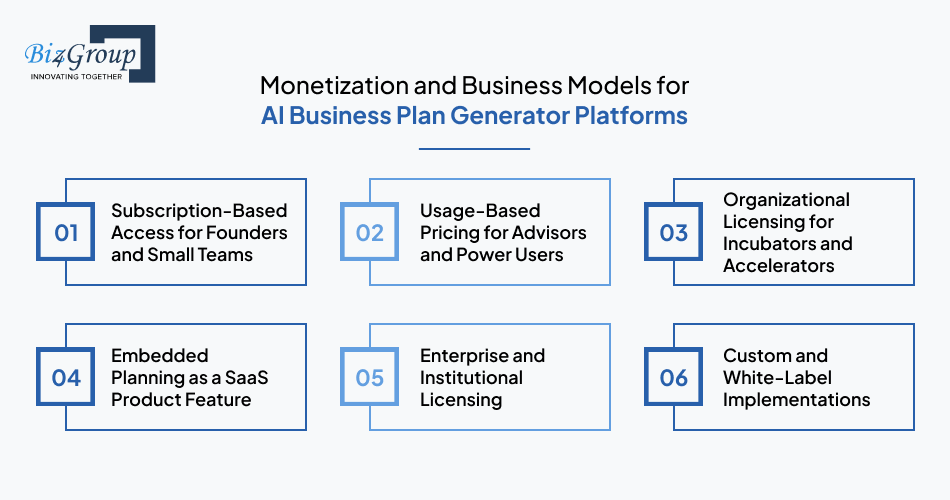
When businesses invest in AI business plan generator platform development, monetization needs to reflect how planning is used. Business plans are revised, reviewed, and reused across different stages, which means revenue models work best when they align with ongoing planning activity rather than one-time usage.
Below are the most practical and proven ways AI business plan generator platforms generate revenue today.
Many platforms start with subscriptions, especially when they build AI powered business ideas generator for entrepreneurs. Users pay monthly or annually to access structured planning workflows and keep updating their plans as ideas evolve.
Subscription pricing is usually shaped by:
This approach mirrors how successful SaaS products build predictable revenue by aligning pricing with ongoing usage.
Some platforms charge based on how much the system is used rather than a flat subscription. This model fits well when teams develop AI business plan generator platform solutions for consultants, advisors, or internal strategy teams.
Revenue grows through:
Usage-based pricing keeps entry costs low while scaling revenue with actual planning volume.
When organizations create AI business plan platforms for incubators and accelerators, licensing becomes the most practical model. Instead of charging individual startups, the platform is licensed to the program managing the cohort.
Licensing is typically based on:
This aligns well with how incubators and accelerators structure budgets and planning workflows.
In some cases, business planning is not sold as a standalone tool. Companies develop AI business plan generator software for SaaS businesses and embed planning directly into an existing product.
Revenue is generated indirectly through:
Here, planning strengthens the core product rather than acting as a separate revenue line.
Larger organizations use AI business plan generator platforms to standardize internal proposals, investment reviews, or business case submissions. Monetization in these scenarios follows enterprise licensing models.
Pricing usually depends on:
This model supports long-term, high-volume planning use cases inside structured organizations.
Some platforms monetize by offering tailored or white-label versions for specific industries or internal use cases. In these scenarios, clients want to build AI app that fits their planning workflows rather than relying on a generic off-the-shelf tool.
Revenue comes from:
This model suits niche, regulated, or enterprise-specific planning requirements.
AI business plan generator platforms monetize successfully when pricing reflects planning frequency, decision depth, and organizational scale. Sustainable revenue comes from aligning business models with how planning is done, not from generic software pricing assumptions.
Also Read: 65+ Software Ideas for Entrepreneurs and Small Businesses
Design monetization strategies that match planning frequency, decision depth, and organizational scale.
Review Monetization Options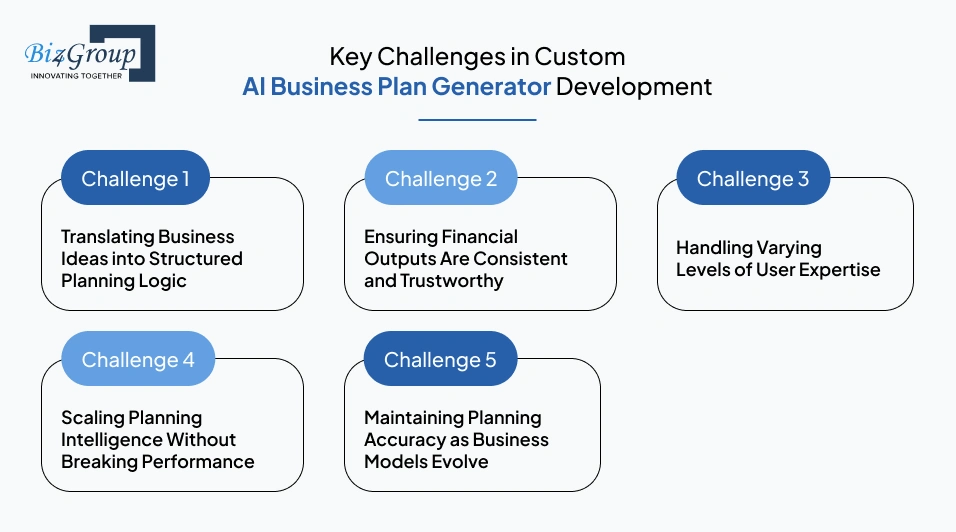
When teams move into AI business plan generator platform development, the biggest risks are not about writing code faster. The real challenges come from making planning intelligence practical, reliable, and usable for real business decisions.
One of the first challenges is converting unstructured business ideas into a clear, step-by-step planning flow. Founders and teams think in different ways, which makes it difficult to standardize planning without over-simplifying it.
Solution: Design the platform around guided planning workflows that break the process into logical sections. Each step should prompt users for specific inputs instead of open-ended descriptions, helping them move forward without confusion.
Business plans often fail when financial projections feel disconnected from the rest of the plan. Inconsistent assumptions reduce credibility and make investor review difficult.
Solution: Build shared data logic across all financial sections, so assumptions flow consistently through revenue, cost, and cash flow models. This approach is essential when teams create AI business plan creation platform solutions meant for serious planning and review.
Some users are first-time founders, while others are experienced operators. Designing a single platform that works for both without overwhelming one group is a common challenge.
Solution: Use adaptive guidance that adjusts based on user inputs and experience levels. This allows platforms to support simple planning without blocking deeper analysis when users need it.
As usage grows, platforms must support more users, more plans, and more revisions without slowing down or producing inconsistent outputs.
Solution: Architect the system with modular services and clearly defined AI components. Reliable scaling often depends on thoughtful AI integration services that allow planning intelligence to grow without disrupting core workflows.
Business models change, and static planning logic quickly becomes outdated. This limits the platform’s long-term value.
Solution: Design the system so planning rules and assumptions can be updated without rebuilding the platform.
Successful AI business plan generator platforms overcome challenges by focusing on structured logic, consistent financial modeling, scalable architecture, and flexible planning workflows. Solving these challenges early ensures the platform remains reliable as planning needs evolve.
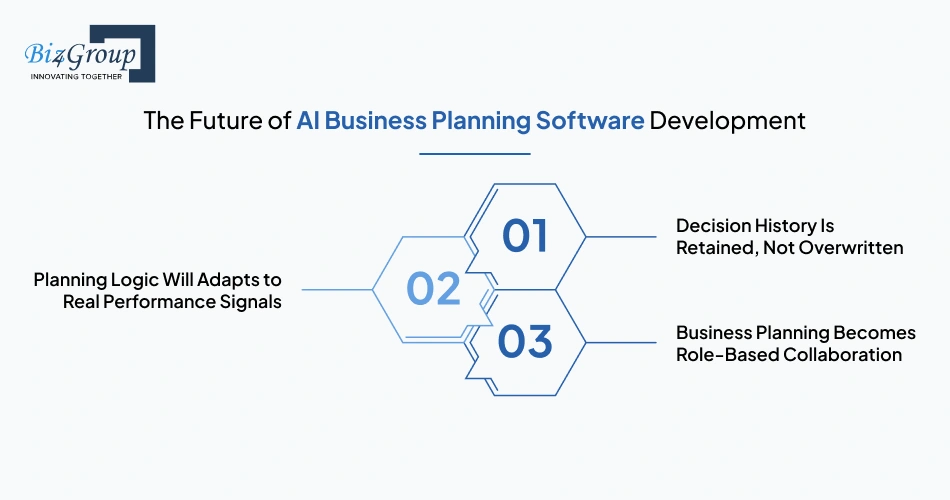
As advances in generative AI continue to shape how AI business plan generator platforms understand context, adapts guidance, and supports decision-making over time, business planning platforms will increasingly focus on ongoing relevance rather than one-time plan creation.
Here’s where AI business plan generator platforms are headed next.
Future platforms will track how key assumptions, financial models, and strategic choices change over time. Instead of replacing older versions, they will preserve decision history allowing teams, investors, and reviewers to understand why decisions were made, not just what the latest plan shows.
Rather than relying only on user inputs, future platforms will adapt guidance using actual performance data. Assumptions that consistently fail or projections that repeatedly miss targets will influence how the system prompts future planning. This will move business planning from static guidance to learning-driven decision support.
AI business planning platforms in the near future will operate as collaborative environments. Founders, finance teams, advisors, and investors will work within the same system using defined roles and permissions. Reviews, feedback, and approvals will happen inside the platform instead of across disconnected documents and tools.
The future of AI business planning lies in adaptability and clarity. Platforms that evolve with the business and guide decisions over time will define the next generation of business planning software.
Also Read: AI Contract Management Software Development
When businesses plan to build an AI business plan generator platform, the real challenge is not defining features or picking technology. It is working with a partner who understands how business planning logic, financial modeling, and AI-driven guidance come together in real decision-making environments. That is exactly how Biz4Group LLC approach AI product development.
As one of the top AI development companies in Florida we focus on building planning platforms that are practical, scalable, and aligned with how businesses make decisions.
Although AI business plan generator platforms are specialized, they rely on core capabilities such as structured document processing, contextual analysis, and validation logic that we have delivered across other AI-driven platforms.
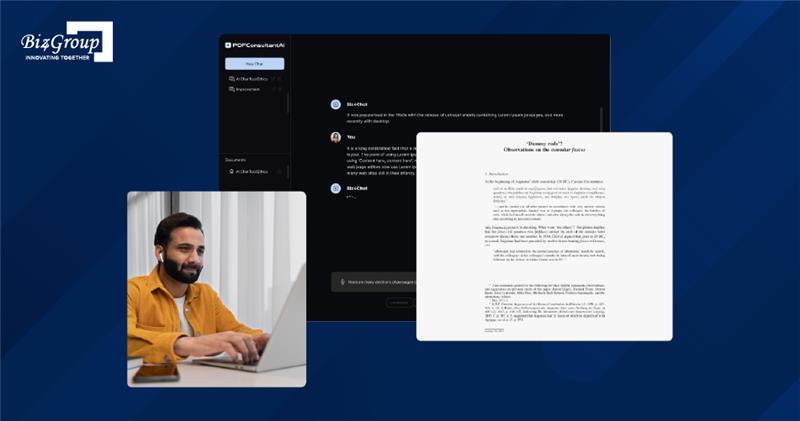
PDF Consultant AI Platform: We developed an AI system designed to ingest unstructured business documents, apply contextual analysis, and convert inputs into structured, decision-ready outputs. The platform includes document ingestion workflows, contextual reasoning layers, and validation logic to ensure outputs remain consistent and reliable across evaluation scenarios.
This experience reflects the same architectural discipline required when building AI business plan generator platforms, where structure, consistency, and decision-readiness are critical.
Therefore, at Biz4Group LLC, we support the development of AI business planning platforms in the same way businesses plan their futures carefully, realistically, and with long-term impact in mind.
Partner with engineers who understand business reasoning, financial logic, and scalable AI systems.
Start a ConversationBuilding an AI business plan generator platform is about putting structure around how decisions are made, reviewed, and updated over time. When planning logic, financial inputs, and revisions are handled inside a single system, teams stop fixing documents and start focusing on decisions.
The AI business plan generator platform becomes useful not just at launch, but every time assumptions change or plans need revisiting. That only works when the software is built with clarity and discipline from the start. Working with a software development company in Florida that understands planning workflows, validation logic, and long-term scalability helps avoid rework later.
At the end of the day, a good AI business plan generator platform should feel like something that does the thinking part for you – so that you get the strategies in a snap. Build it right, and your plans evolve as fast as your business does.
Are you thinking of building an AI business plan generator? Talk to our AI experts and get it right the first time!
It involves building a planning system that converts business inputs into structured, decision-ready plans. The focus is on planning logic, financial consistency, and AI-driven guidance rather than simple content generation.
AI-based platforms guide users through planning workflows, validate assumptions, and keep sections aligned as inputs change. Template tools only format content without adapting to business context.
The platforms are commonly used by startup founders, SaaS companies, incubators, consultants, enterprises, and financial institutions that need structured, repeatable planning workflows.
Cost depends on planning depth, AI model complexity, financial logic, integrations, scalability requirements, and long-term maintenance needs rather than just the number of screens or features.
Yes. Many teams choose custom AI business plan generator development to tailor planning workflows for startups, SaaS businesses, incubators, or enterprise use cases.
Building a reliable platform requires experience with structured decision workflows, AI integration, and scalable software architecture. Teams with real AI platform delivery experience reduce risk and long-term rework.

with Biz4Group today!
Our website require some cookies to function properly. Read our privacy policy to know more.