 Location :
Orlando, FL, USA
Location :
Orlando, FL, USA +1 (407) 714-1616
 info@biz4group.com

 AI Summary Powered by Biz4AI
- Cannabis quality control often relies on manual inspections, resulting in inconsistent grading, pricing disputes, compliance risks, and slower operations.
- AI-powered cannabis quality control uses computer vision to automate inspections, standardize grading, and deliver objective, data-driven quality assessments.
- Computer vision for cannabis quality control detects trichome maturity, mold, pests, trim defects, and other visual issues, enabling faster and more accurate automated cannabis inspection.
- Modern cannabis quality assessment software improves consistency, creates image-backed audit trails, supports regulatory compliance, and provides actionable quality analytics.
- Leveraging deep expertise in AI and computer vision, Biz4Group develops custom cannabis quality control solutions called Kalix QC that help businesses scale inspections, reduce disputes, and improve operational efficiency.
Every cannabis grower has been there. You send the same batch to two experienced inspectors and somehow end up with two different grades. One calls it top-shelf, and another says it's mid-tier. Sound familiar?
The flower hasn't changed, trichomes haven't changed, even the jar hasn't changed. The only thing that's different is the person evaluating it.
That's one of the biggest challenges in cannabis quality control today. It isn't because inspectors lack experience or expertise. It's because manual grading relies on human judgment, and no two people interpret visual quality in exactly the same way. Bud structure, trichome maturity, trim quality, and color consistency can all be viewed differently, especially as inspection volumes increase.
The impact goes far beyond the grade itself. A small difference in quality assessment can influence product pricing, delay transactions, spark disputes between buyers and sellers, and gradually erode trust in the grading process. When quality determines value, consistency isn't optional, it's essential.
The need for more reliable quality assessment is growing just as fast as the industry itself. According to a report, the global cannabis testing services market reached $2.4 billion in 2025 and is projected to grow to $7.2 billion by 2033. It is driven by stricter quality regulations, expanding legalization, and increasing demand for safe, consistent cannabis products. The report also notes that cannabis cultivators accounted for 61% of the market's end-use share in 2025, which highlights how quality control has become a critical operational priority for growers.
Bringing consistency to cannabis quality control requires more than AI alone. It takes a deep understanding of computer vision, workflow automation, and the operational realities of cannabis cultivation and processing.
Biz4Group has spent years building AI computer vision and intelligent automation solutions for quality-driven industries. That experience has given us a firsthand understanding of where manual inspection processes break down, what makes AI successful in real-world operations, and how businesses can transition to more objective, scalable quality control.
It all begins with understanding where traditional cannabis quality control falls short, and why AI-powered computer vision is redefining the way cannabis quality is assessed.
What Is Cannabis Quality Control, and Why Does It Matter?
Cannabis quality control is the process of evaluating cannabis flower, concentrates, and finished products before they reach processors, distributors, retailers, or consumers. It ensures that every batch meets predefined standards for potency, purity, appearance, consistency, and safety.
It takes place at multiple stages of the production cycle, which includes post-harvest, processing, and pre-packaging, combining visual inspections with laboratory testing to verify that every batch meets quality and regulatory requirements.
In many cannabis operations, quality control still relies heavily on manual visual inspections. A trained inspector evaluates a sample against internal grading guidelines. They assess factors such as bud structure, color, trim quality, and overall appearance before assigning a grade. That grade often influences product pricing, inventory decisions, compliance documentation, and if a batch moves forward in the supply chain.
It's also important to distinguish quality control (QC) from quality assurance (QA). While QA focuses on creating standardized processes to maintain product quality, QC verifies that each individual batch actually meets those standards through inspection and testing.
Why Is Quality Control Critical for Cannabis Businesses?
Cannabis quality control is critical because it directly affects product value, regulatory compliance, operational efficiency, and customer trust. Consistent quality assessments help businesses maximize revenue, reduce disputes, maintain compliance, and deliver reliable products across every stage of the supply chain.
As cannabis markets continue to mature and regulations become more stringent, consistent cannabis quality control is not just an operational best practice. It's a competitive advantage that helps businesses protect margins while building long-term confidence among buyers and regulators.
Recognizing these industry-wide challenges, Biz4Group developed Kalix QC, an AI-powered cannabis quality assessment platform that uses computer vision and intelligent automation to simplify quality inspections and standardize grading across the cannabis supply chain.

With Kalix QC, cannabis businesses can:
- Standardize cannabis quality grading across batches and facilities.
- Evaluate flower using AI-powered computer vision instead of manual visual inspections.
- Generate data-backed quality scores for more informed pricing decisions.
- Detect visual defects earlier to reduce waste and improve product consistency.
- Maintain digital inspection records to support traceability and compliance.
- Accelerate quality inspections without compromising accuracy.
- Scale quality control as production volumes grow.
- Give growers, buyers, and QA teams a shared framework for evaluating product quality.
As cannabis quality standards continue to evolve, businesses need inspection processes that are as consistent as the products they produce. Kalix QC delivers that consistency by combining AI-powered computer vision with standardized, data-driven quality assessments.
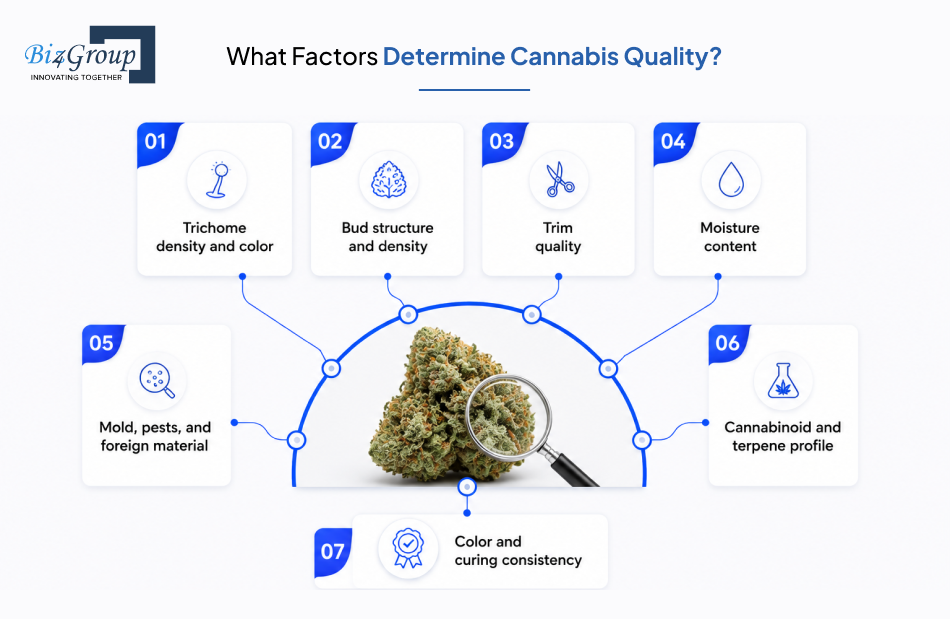
What Factors Determine Cannabis Quality?
A cannabis product's quality is evaluated using a combination of visual, structural, and laboratory-tested attributes. Together, these factors determine its market value, safety, and consistency.
|
Quality Factor |
Why It Matters |
|---|---|
|
Trichome density and color |
Indicates cannabinoid maturity and harvest readiness. |
|
Bud structure and density |
Influences flower grade, visual appeal, and market value. |
|
Trim quality |
Reflects post-harvest handling and product presentation. |
|
Moisture content |
Affects shelf life, product weight, and the risk of mold growth. |
|
Mold, pests, and foreign material |
Critical for consumer safety and regulatory compliance. |
|
Cannabinoid and terpene profile |
Confirms potency, aroma, and product consistency through laboratory testing. |
|
Color and curing consistency |
Indicates proper drying, curing, and overall product quality. |
Laboratory testing provides objective data on potency and contaminants. However, many visual quality attributes, such as bud structure, trim quality, color consistency, and trichome maturity, still rely heavily on human judgment. And that's exactly where the biggest challenge begins. When grading relies on subjective visual assessments rather than standardized criteria, inconsistent decisions become inevitable.
To better understand it, let’s explore why traditional cannabis quality control is struggling to keep up with the demands of today's fast-growing industry.
Still Relying on Subjective Cannabis Quality Control?
Replace inconsistent grading with AI-powered computer vision built around your workflows, quality standards, and business goals.
Talk to Our AI ExpertsWhy Is Traditional Cannabis Quality Control Failing Growers?
Traditional cannabis quality control is failing growers because it relies heavily on manual inspections that are difficult to standardize, scale, and audit consistently. As cannabis businesses grow, this approach struggles to keep up with higher production volumes, stricter compliance requirements, and the need for consistent product grading across batches and facilities.
The result is inconsistent grading, pricing disputes, slower workflows, compliance challenges, and limited scalability. Here's where traditional cannabis quality control starts to fall short.
Unlike laboratory testing, which follows standardized analytical methods, cannabis quality assessment often depends on visual inspections. Experienced inspectors evaluate factors such as bud structure, trim quality, color, and trichome maturity before assigning a grade. While this expertise is invaluable, visual grading still depends on individual interpretation.
The challenge isn't a lack of expertise. It's that manual inspections become increasingly difficult to keep consistent as operations scale.
How Does Manual Cannabis Inspection Affect Product Pricing?
In the cannabis industry, quality and pricing go hand in hand. A flower graded as premium commands a significantly higher price than one classified as mid-grade, making accurate and consistent grading essential for both buyers and sellers.
When comparable batches receive different grades, the consequences extend far beyond quality scores. They can directly impact revenue, buyer trust, and day-to-day operations.
- Revenue loss: Premium-quality flower may be undervalued, while lower-quality batches may be priced higher than they deserve.
- Pricing disputes: Different grading standards between cultivators, processors, and distributors often lead to disagreements during transactions.
- Reduced buyer confidence: A flower considered premium by one producer may be classified as mid-tier by another, making it difficult for buyers to trust product quality.
- Longer sales cycles: Inconsistent grading can delay negotiations as buyers and sellers spend more time validating product quality.
- Inconsistent product valuation: Without standardized grading criteria, assigning fair and repeatable market value becomes increasingly difficult.
As production volumes grow, these inconsistencies become more frequent, making standardized cannabis quality control essential for protecting profitability and building buyer confidence.
What Are the Biggest Challenges in Manual Cannabis Quality Control?
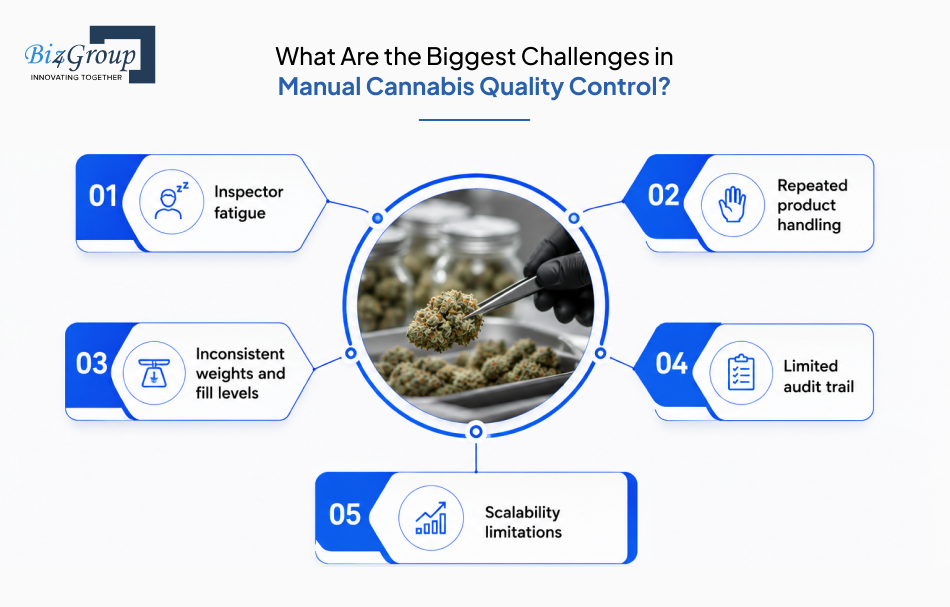
Beyond inconsistent grading, manual cannabis inspection creates operational challenges that become harder to manage as production grows.
Some of the most common challenges include:
- Inspector fatigue: Long, repetitive inspection shifts can reduce attention to detail and increase the likelihood of inconsistent grading.
- Repeated product handling: Every additional touchpoint increases the risk of damaging delicate flowers, which results in avoidable product loss.
- Inconsistent weights and fill levels: Manual verification can lead to overfilled packages that reduce margins or underfilled products that create compliance concerns.
- Limited audit trail: Inspection decisions often rely on individual observations rather than standardized digital records, making them difficult to validate later.
- Scalability limitations: Higher production volumes typically require more inspectors, increasing labor costs while introducing greater grading variability.
Many of these costs don't appear as a single expense on a balance sheet. Instead, they're absorbed through waste, rework, slower operations, and reduced profitability over time. Now, we’ll see how AI is bringing change in the industry.
How Can AI Improve Cannabis Quality Control?
AI is changing cannabis quality control by bringing consistency and data-driven decision-making into the inspection process. Instead of relying solely on visual assessments, AI-powered cannabis quality control uses computer vision to evaluate every flower against predefined quality standards, which helps businesses inspect products faster and more consistently.
AI-powered computer vision is trained on thousands of labeled cannabis images, which allows it to recognize the same visual characteristics experienced graders evaluate. It includes trichome maturity, bud structure, trim quality, color consistency, mold, pest damage, and other visible defects. Instead of replacing human expertise, AI helps apply that expertise more consistently across every inspection.
The real advantage lies in standardization. Every batch is evaluated using the same grading logic, regardless of the inspector, facility, or production volume. But achieving that level of consistency isn't possible with a single AI model development alone. It relies on a combination of advanced technologies working together behind the scenes to capture, analyze, and interpret quality data with precision.
Also Read: A Step-by-Step Guide to Computer Vision App Development for Startups
What Technologies Power AI-Powered Cannabis Quality Control?
AI-powered cannabis quality control is built on a combination of imaging technologies, artificial intelligence, laboratory analytics, and automation. While custom AI computer vision evaluates the visual quality of cannabis flower, complementary technologies analyze chemical composition, detect contaminants, and transform inspection data into actionable insights. Together, they create a faster, more accurate, and standardized quality control process.
Here is a table that explores the role of AI in cannabis quality control.
|
Technology |
Role in Cannabis Quality Control |
|---|---|
|
Computer Vision |
Analyzes cannabis flower images to evaluate bud structure, trim quality, trichomes, color consistency, and visible defects. |
|
Hyperspectral Imaging |
Detects moisture variations, mold, contaminants, and internal defects that may not be visible to the human eye. |
|
Multispectral Imaging |
Assesses plant health, maturity, discoloration, and stress using multiple light wavelengths. |
|
Machine Learning |
Learns quality patterns from labeled datasets to automate grading and improve inspection accuracy. |
|
Deep Learning |
Identifies complex visual features and continuously improves defect detection through advanced neural networks. |
|
Convolutional Neural Networks (CNNs) |
Powers image recognition by detecting trichomes, bud morphology, mold, pest damage, and other quality indicators. |
|
Spectroscopy |
Analyzes the chemical composition of cannabis for quality verification and contaminant screening. |
|
Near-Infrared (NIR) Spectroscopy |
Estimates moisture content, cannabinoid concentration, and overall composition without damaging the sample. |
|
Raman Spectroscopy |
Identifies cannabinoids, terpenes, and contaminants through molecular fingerprinting. |
|
Fourier-Transform Infrared (FTIR) Spectroscopy |
Evaluates chemical compounds to support potency verification and quality assessment. |
|
UV-Visible Spectroscopy |
Measures cannabinoid-related compounds and supports laboratory quality analysis. |
|
Sensor Fusion |
Combines imaging, spectroscopy, and sensor data to improve inspection accuracy and decision-making. |
|
Automates grading, reporting, alerts, and quality control workflows to reduce manual effort. |
|
|
High-Performance Liquid Chromatography (HPLC) |
Laboratory method used to accurately quantify cannabinoids such as THC and CBD. |
|
Gas Chromatography-Mass Spectrometry (GC-MS) |
Detects terpenes, residual solvents, pesticides, and other chemical compounds for compliance testing. |
|
Laboratory Data Analytics |
Consolidates laboratory and inspection data to identify quality trends and support continuous improvement. |
|
Edge AI |
Performs AI inference directly on cameras or edge devices, enabling real-time inspections with low latency. |
|
Cloud Computing |
Stores inspection data, trains AI models, supports centralized analytics, and enables multi-site quality management. |
No single technology can deliver comprehensive cannabis quality control on its own. The greatest value comes from combining AI-powered computer vision with laboratory testing, intelligent automation, and advanced analytics.
Together, these technologies help cannabis businesses move from subjective inspections to a standardized, data-driven quality control process that improves consistency, compliance, and operational efficiency.
How Does AI Grade Cannabis Flower Quality?
AI breaks cannabis quality down into measurable characteristics that can be evaluated consistently.
For example, researchers recently developed a computer vision system that detects individual trichomes using an object detection model. It then classifies them as clear, milky, or amber, this is the same maturity indicators cultivators use to determine the ideal harvest window.
The model achieved 98.6% classification accuracy. Researchers also analyzed stigma color as a second maturity indicator, allowing the system to validate each assessment using two independent visual signals.
The significance isn't that AI uses different grading criteria. It uses the same criteria experienced growers already trust, but applies them with a level of precision, consistency, and repeatability that manual inspections can't reliably achieve at scale.
What Cannabis Quality Issues Can AI Detect?
Modern computer vision systems can identify a wide range of quality issues during cannabis inspection, that helps businesses detect problems earlier and make more informed quality decisions.
These include:
- Trichome maturity to support harvest timing and quality grading.
- Bud size, shape, and density for standardized flower classification.
- Trim quality to evaluate post-harvest processing consistency.
- Color variations that may indicate curing or quality inconsistencies.
- Mold and early-stage contamination, including issues that advanced imaging technologies, such as hyperspectral imaging, can detect before they're visible to the naked eye.
- Pest damage and plant stress that may affect overall product quality.
- Foreign material and physical defects that reduce product value or create compliance concerns.
- Packaging defects and labeling inconsistencies before products move through the supply chain.
By the time mold or contamination becomes obvious during a manual inspection, the problem may have already spread through the batch. AI-powered computer vision helps identify subtle warning signs much earlier, which gives cultivators and quality assurance teams a better opportunity to isolate affected products, reduce waste, and protect profitability.
The advantages of AI-powered cannabis quality control become even more evident when you look at the business outcomes it delivers.
Also Read: AI Computer Vision Software Development Cost in 2026
What If Every Cannabis Batch Was Graded the Same Way?
Discover how custom AI-powered computer vision can standardize quality assessments, reduce disputes, and improve operational efficiency.
Book a ConsultationWhat Are the Benefits of AI-Powered Cannabis Quality Control?
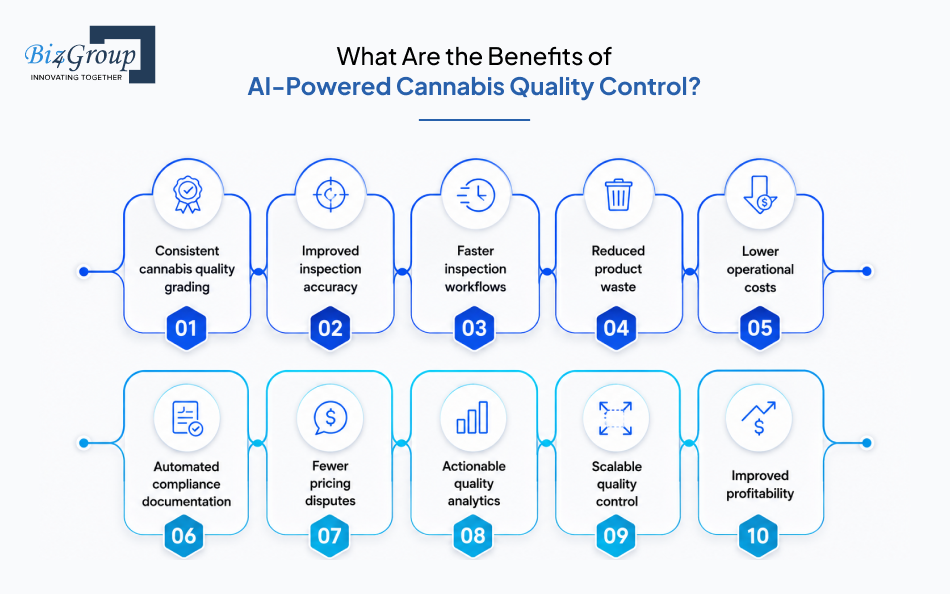
AI-powered cannabis quality control helps businesses move beyond manual inspections by making quality assessments more consistent, efficient, and data-driven. The benefits extend across cultivation, processing, quality assurance, compliance, and overall business performance.
|
Benefit |
Business Impact |
|---|---|
|
Consistent cannabis quality grading |
Applies the same grading criteria to every batch, reducing variability between inspectors, facilities, and production cycles. |
|
Improved inspection accuracy |
Uses AI-powered computer vision to detect visual quality indicators such as trichome maturity, mold, pests, and trim defects with greater consistency. |
|
Faster inspection workflows |
Automates repetitive quality checks, helping processors and manufacturers increase throughput without compromising inspection quality. |
|
Reduced product waste |
Minimizes unnecessary handling and identifies defects earlier, helping prevent rework and product loss. |
|
Lower operational costs |
Reduces manual inspection effort, allowing skilled teams to focus on higher-value quality assurance tasks. |
|
Automated compliance documentation |
Creates timestamped, image-backed inspection records that simplify audits and strengthen traceability. |
|
Fewer pricing disputes |
Supports objective, standardized grading that builds buyer confidence and improves product valuation. |
|
Actionable quality analytics |
Tracks historical inspection data to identify recurring issues, monitor trends, and support continuous process improvement. |
|
Scalable quality control |
Enables businesses to inspect larger production volumes without proportionally increasing inspection staff. |
|
Improved profitability |
Combines standardized grading, operational efficiency, and early defect detection to protect margins and support long-term growth. |
By combining AI, computer vision, and intelligent automation, cannabis businesses can build a quality control process that's more consistent, scalable, and ready to support future growth.
How Do You Choose the Best Cannabis Quality Assessment Software?
By now, it's clear that not all AI-powered cannabis quality control solutions deliver the same results. The right platform should do more than automate inspections. It should help your business standardize grading, strengthen compliance, and scale quality control with confidence.
When evaluating cannabis quality assessment software, look for capabilities that improve consistency, compliance, and operational efficiency:
- Real-time defect detection: Identify mold, pests, discoloration, and foreign material before products move further through production.
- Standardized grading criteria: Apply the same grading model across every batch, shift, and facility.
- Configurable grading rules: Customize grading parameters for different strains, products, and quality standards.
- Trichome and maturity analysis: Objectively evaluate harvest readiness using consistent visual indicators.
- Digital audit trail: Generate timestamped, image-backed inspection records for compliance and dispute resolution.
- Seamless integration: Connect with seed-to-sale platforms, ERP systems, compliance software, and existing production workflows.
- Scalable architecture: Support increasing inspection volumes without proportionally increasing manual effort.
- Reporting and analytics: Turn inspection data into insights that improve quality, productivity, and decision-making.
Once you've identified the right solution, the next step is understanding whether the investment will generate a meaningful return.
Ready to Make Cannabis Quality Control Smarter?
From custom AI models to intelligent computer vision solutions, Biz4Group helps turn complex quality challenges into scalable business advantages.
Connect with UsShould Cannabis Businesses Invest in AI-Powered Cannabis Quality Control?
Investing in AI-powered cannabis quality control is a practical decision for businesses that are facing challenges such as inconsistent grading, pricing disputes, production delays, or compliance issues. AI helps in improving operational efficiency, reducing errors, and delivering measurable financial benefits over time, by automating inspections and standardizing quality assessments.
Improving day-to-day operations is important, but it's only one part of the investment. The bigger question is whether AI can deliver measurable business value over time by reducing costs, improving productivity, and protecting profitability.
What Is the ROI of AI Cannabis Quality Control?
The return on investment comes from reducing the hidden costs of manual quality control while improving efficiency, consistency, and decision-making across the supply chain.
Businesses invest in AI-powered cannabis quality control to:
- Reduce grading inconsistencies by applying standardized, objective quality assessments across every batch.
- Minimize pricing disputes with data-backed grading that builds trust between growers, processors, and distributors.
- Increase inspection efficiency by automating repetitive quality checks and accelerating production workflows.
- Reduce product waste through earlier detection of mold, defects, and quality issues before they become costly problems.
- Strengthen compliance with automated, image-backed inspection records that simplify audits and improve traceability.
- Improve labor productivity by allowing QA teams to focus on higher-value tasks instead of repetitive manual inspections.
- Gain actionable insights from quality analytics to identify recurring issues and continuously improve cultivation and processing.
- Scale operations confidently without increasing inspection resources at the same rate as production volumes.
For businesses looking to modernize cannabis quality control, the ROI extends beyond cost savings. It delivers a more consistent grading process, stronger compliance, improved operational efficiency, and a scalable foundation for long-term growth.
How Do You Choose the Right AI Computer Vision Development Company?
Not every AI development company understands the unique challenges of cannabis quality control. Beyond technical expertise, the right partner should understand cultivation of workflows, quality grading, regulatory requirements, and how AI fits into day-to-day operations.
When evaluating a development partner, ask whether they can:
- Build custom computer vision models tailored to your products, grading standards, and business requirements.
- Demonstrate expertise in AI-powered visual inspection for manufacturing, agriculture, or other quality-driven industries.
- Integrate seamlessly with your existing ERP, seed-to-sale, compliance, or manufacturing systems.
- Develop explainable AI with image-backed inspection results that support audits and grading decisions.
- Design scalable solutions that continue performing as production volumes increase.
- Provide end-to-end support, from strategy and development to deployment, optimization, and long-term maintenance.
A strong technology partner won't simply build software. They'll help you create a quality control system that improves consistency, strengthens compliance, and supports long-term business growth.
Why Is Biz4Group the Right AI Development Partner?
Biz4Group, a leading AI computer vision software development company in USA. The firm bring together deep expertise in AI, computer vision, and custom software development to build intelligent solutions for complex, quality-driven industries. Instead of offering off-the-shelf software, we work closely with businesses to understand their operational challenges and develop AI solutions tailored to their workflows.
If you need to automate cannabis quality inspections, standardize grading, integrate AI into existing systems, or build a custom computer vision platform from the ground up, our team delivers end-to-end support, from strategy and model development to deployment and continuous optimization.
Our focus isn't just on implementing AI. It's on helping cannabis businesses turn operational challenges into scalable, data-driven solutions that improve quality, efficiency, and long-term business performance.
What Is the Future of Cannabis Quality Control?
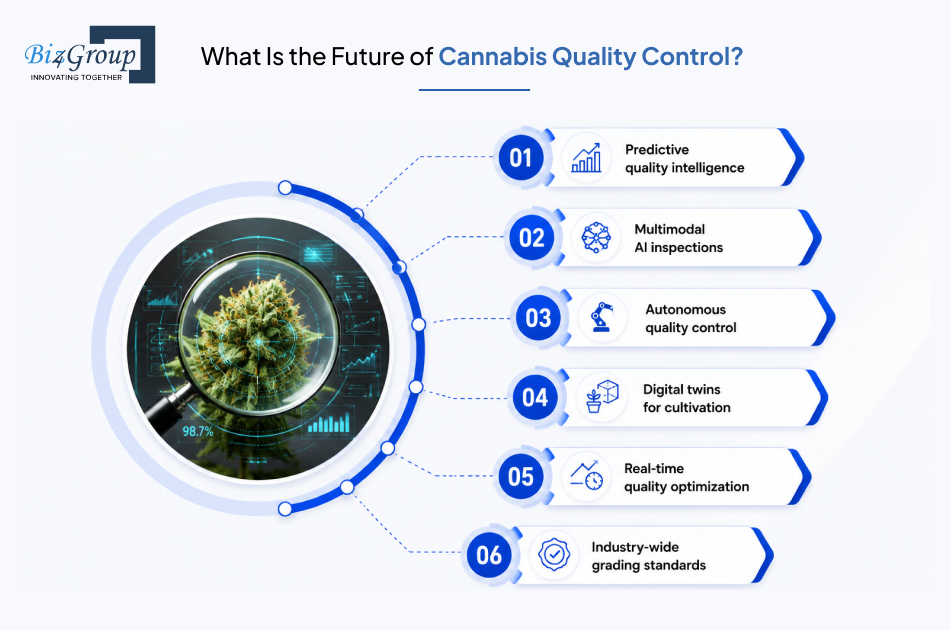
As AI continues to mature and the cannabis industry evolves, quality control is expected to become more intelligent, predictive, and connected. Here are some of the trends likely to shape the future:
- Predictive quality intelligence: AI will move beyond detecting defects to predicting quality issues before they occur using historical cultivation and processing data.
- Multimodal AI inspections: Future systems will combine computer vision with hyperspectral imaging, IoT sensors, and environmental data to provide a more complete picture of product quality.
- Autonomous quality control: Agentic
- Digital twins for cultivation: Growers may use virtual models of cultivation environments to simulate how environmental changes affect future crop quality.
- Real-time quality optimization: AI could automatically recommend adjustments to lighting, irrigation, nutrients, or post-harvest processes based on live quality insights.
- Industry-wide grading standards: As AI adoption grows, standardized digital grading frameworks may emerge, making cannabis quality assessments more consistent across growers, processors, and distributors.
While these innovations are still evolving, the direction is clear. Cannabis quality control is moving from reactive inspections toward predictive, AI-driven quality management that helps businesses prevent issues instead of simply detecting them.
Final Thoughts
With the growth of cannabis businesses, manual quality control is becoming harder to standardize, audit, and maintain consistently. AI-powered computer vision addresses these challenges by making inspections more objective, repeatable, and data-driven, helping businesses improve grading consistency, strengthen compliance, reduce disputes, and operate more efficiently.
That's the approachBacked by deep expertise in AI, computer vision, and custom software development, we've developed solutions like Kalix QC to help cultivators, processors, manufacturers, and QA teams replace subjective quality inspections with standardized, data-driven grading. The result is a more consistent, scalable, and transparent approach to cannabis quality control.
If manual grading is creating inconsistent quality, pricing disputes, or compliance challenges, it's time to rethink your approach. Connect with us to discover how a custom AI-powered cannabis quality control solution can help you build a more consistent, scalable, and future-ready operation.
Frequently Asked Questions
1. Can AI-powered cannabis quality control replace laboratory testing?
No. AI-powered cannabis quality control complements laboratory testing by automating visual inspections such as trichome maturity, bud structure, color consistency, and defect detection. Laboratory testing is still required to measure cannabinoid potency, terpene profiles, pesticides, heavy metals, and microbial contaminants.
2. How accurate is computer vision for cannabis quality control?
The accuracy of computer vision depends on the quality of the training data, imaging hardware, and AI models. When properly trained, AI can deliver highly consistent quality assessments and reduce the variability commonly associated with manual inspections.
3. Can AI-powered cannabis quality control be customized for different cannabis strains?
Yes, custom AI models can be trained using images and grading criteria specific to different strains, cultivation methods, and business-defined quality standards, allowing businesses to maintain consistent evaluations across diverse product lines.
4. Does cannabis quality assessment software integrate with seed-to-sale systems?
Many modern cannabis quality assessment software solutions can integrate with seed-to-sale platforms, ERP systems, manufacturing software, and compliance tools to streamline data management and improve operational visibility.
5. What hardware is required for AI-powered cannabis quality control?
Most solutions use high-resolution industrial cameras or mobile imaging devices. Depending on the application, businesses may also incorporate specialized imaging technologies, controlled lighting, or other sensors to improve inspection accuracy.
6. Can automated cannabis inspection detect mold before it's visible?
Advanced computer vision combined with imaging technologies such as hyperspectral imaging may identify early signs of mold or contamination before they become obvious during manual inspections. The capabilities depend on the imaging technology and AI model being used.
7. Is AI-powered cannabis quality control suitable for small and mid-sized growers?
Yes, AI solutions can be tailored for businesses of different sizes. Many growers begin by automating specific quality control tasks and expand the system as production volumes and operational needs grow.
8. How long does it take to implement cannabis quality assessment software?
Implementation timelines vary from 2-8 weeks based on project complexity, custom AI model training, hardware setup, and system integrations. A proof of concept can often be developed much faster than a fully customized enterprise deployment.
9. What data is needed to train an AI model for cannabis quality control?
AI models are typically trained using large collections of labeled cannabis images representing different quality grades, defects, trichome maturity stages, and other visual characteristics. High-quality training data is essential for building reliable inspection models.
10. Why should businesses choose a custom AI cannabis quality control solution instead of an off-the-shelf platform?
A custom solution can be designed around your grading standards, operational workflows, compliance requirements, and product types. This provides greater flexibility, better integration with existing systems, and AI models that align with your specific quality control objectives.
