Location :
Orlando, FL, USA
Location :
Orlando, FL, USA +1 (407) 714-1616
 info@biz4group.com


















Imagine a digital system that doesn’t wait for instructions but instead, understands your business goals, learns from real-time feedback, and takes independent actions to get the job done.
Read More

Businesses today are not experimenting with computer vision anymore. They are budgeting for it. Leaders want systems that can read visual data and support real operational decisions across quality control, safety monitoring, and customer analytics. This shift has turned cost planning into the first serious discussion around adoption.
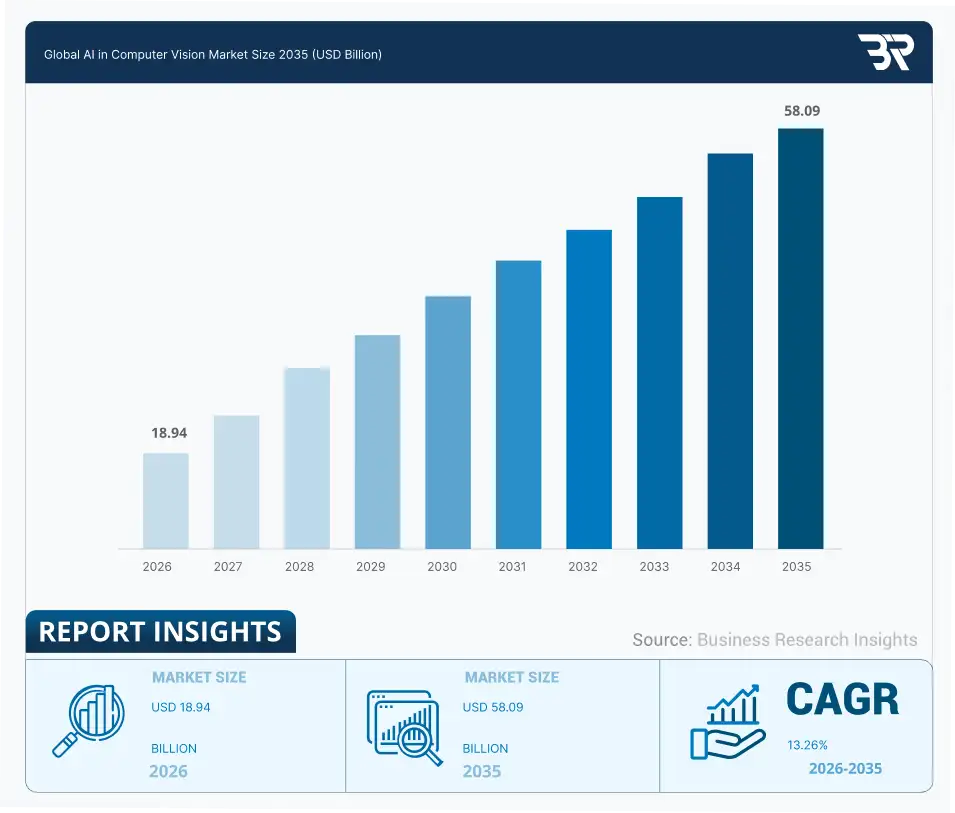
As momentum grows, understanding the AI computer vision software development cost becomes essential before committing resources. The cost to develop AI computer vision software typically ranges from $30,000 to $2,50,000+, depending on deployment scale, data maturity, and operational expectations. Many teams approach a custom software development company once they realize that vision systems require structured planning rather than isolated experimentation.
Before estimating budgets, it is important for decision-makers to understand what shapes spending. Here take a look at it:
Early architectural clarity defines the total investment to build scalable AI computer vision software solutions, especially when AI integration must align with existing enterprise systems.
This guide will break down cost drivers, planning logic, risks, and practical budgeting decisions for you. Why wait? Let's dive in.
Estimating project budgets becomes easier when you break costs into predictable components instead of vague assumptions. Most organizations struggle because vision projects include multiple moving parts. A structured formula helps you understand spending early and creates clarity around real investment expectations.
Total Cost = (Development Hours × Hourly Rate) + AI Model Fees + AI Integration Costs + Security + Testing + Post-Launch Support
This formula reflects how real projects are priced. Development effort forms the foundation, while expenses related to AI model development, deployment readiness, and AI integration costs gradually shape the final budget. It provides a practical starting point when evaluating the overall AI computer vision software development cost.
Sample Calculation (Illustrative)
Estimated Initial Build Cost = (1,200 × 60) + 25,000 + 18,000 + 7,000 + 5,000 = $127,000
Post-launch support is calculated separately because it covers ongoing work after release, such as updates, performance tuning, and fixes. These costs repeat over time and depend on usage growth, not just initial development.
Many decision-makers asking how much it costs to develop AI computer vision software in 2026 benefit from using this formula early. It converts abstract planning into measurable financial expectations and helps teams align technical ambition with sustainable investment planning before development begins.
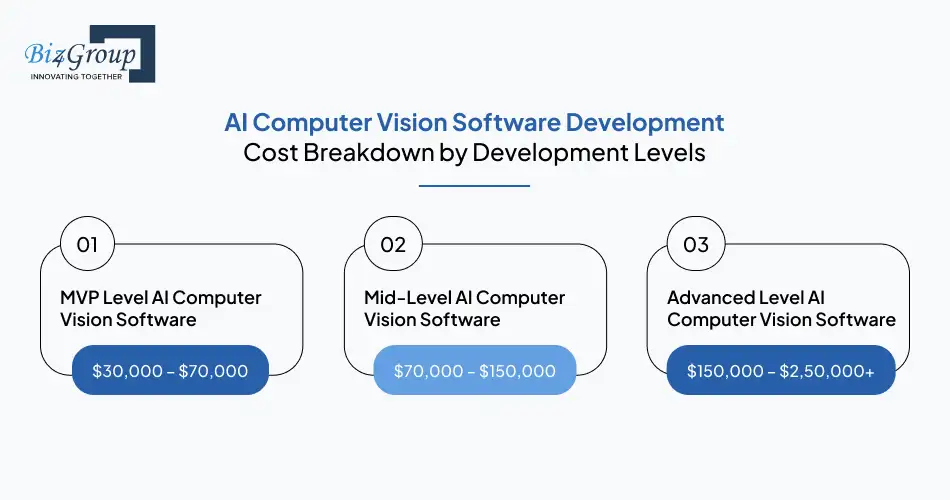
When organizations begin planning budgets, computer vision projects rarely fall under a single fixed estimate. Costs evolve based on how mature the system needs to become and how deeply it integrates into daily operations. Understanding development stages helps you connect technical scope with realistic financial expectations before scaling investment decisions.
Below is a high-level view showing how development maturity typically aligns with investment levels.
|
Development Level |
Scope |
Estimated Cost Range |
|---|---|---|
|
MVP Level AI Computer Vision Software |
Focused feature development solving one operational problem, limited dataset training, basic analytics dashboard, and controlled deployment used for validation and early adoption. |
$30,000 – $70,000 |
|
Mid-Level AI Computer Vision Software |
Expanded workflows, improved accuracy tuning, integration with existing business systems, scalable backend setup, and production-ready deployment supporting multiple operational use cases. |
$70,000 – $150,000 |
|
Advanced Level AI Computer Vision Software |
Enterprise-scale deployment with real-time processing, complex integrations, continuous model improvement, monitoring systems, and infrastructure designed for large operational environments. |
$150,000 – $2,50,000+ |
Early validation stages help teams confirm whether visual intelligence delivers measurable results before scaling infrastructure investments. This phase often defines an initial AI computer vision MVP development cost estimate and reduces uncertainty before committing to broader implementation efforts.
To understand how investment builds over time, costs must also be viewed across individual development stages rather than maturity levels alone.
|
Development Stage |
Typical Range |
Cost Focus |
|---|---|---|
|
Discovery and Planning |
$3,000 – $8,000 |
Defining use cases, data availability assessment, and early cost alignment. |
|
Data Preparation & Annotation |
$8,000 – $25,000 |
Image collection, labeling, cleaning, and dataset structuring required for model training. |
|
Model Development |
$12,000 – $40,000 |
Training, tuning, and improving detection or recognition accuracy. |
|
Frontend Development |
$6,000 – $20,000 |
Dashboards and interfaces used to visualize outputs and manage workflows. |
|
Backend & Processing Logic |
$10,000 – $35,000 |
System workflows, processing pipelines, and performance handling. |
|
Integrations |
$5,000 – $18,000 |
Connecting vision systems with enterprise software and operational tools. |
|
Testing & QA |
$4,000 – $12,000 |
Accuracy validation, reliability testing, and performance checks before deployment. |
|
Post-Launch Support |
10–20% annually |
Ongoing monitoring, updates, and optimization as usage scales. |
This layered perspective creates a clearer cost breakdown of AI computer vision software, showing how investment grows alongside system maturity and operational complexity. Long-term spending is often shaped more by architectural decisions than surface functionality, much like teams realize when analyzing the cost to develop an AI app during early planning stages. Understanding these phases helps you anticipate the real AI computer vision software development cost with greater budgeting confidence.
Let's align your vision scope with realistic investment before costs quietly expand
Contact Our Experts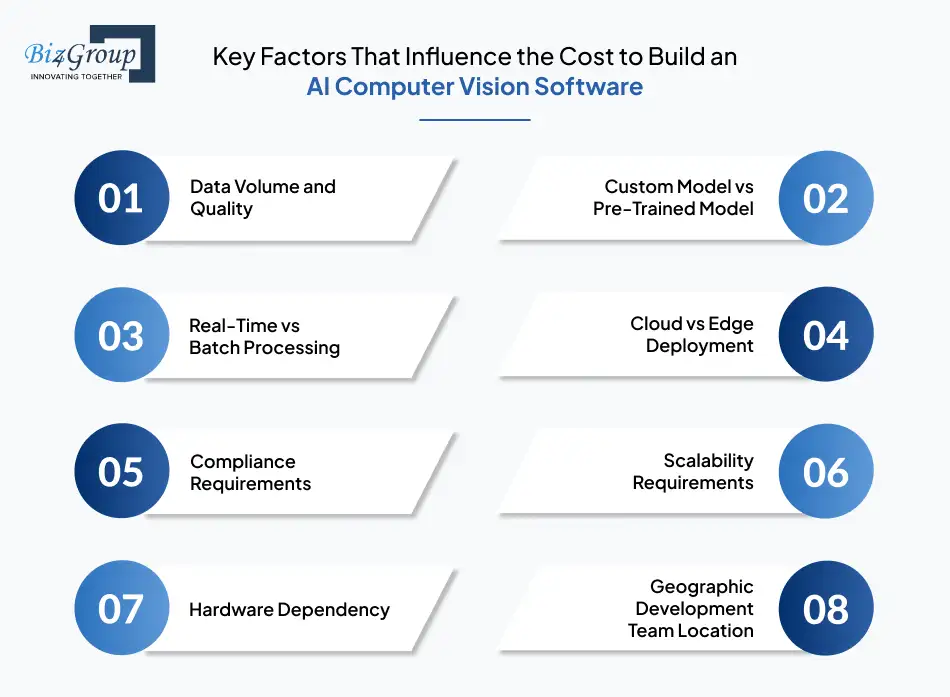
Project budgets change significantly depending on technical and operational decisions made early in planning. Instead of one fixed estimate, multiple practical variables shape investment levels. Understanding these factors helps you predict enterprise AI computer vision development expenses with greater accuracy before development begins.
Data preparation often becomes the largest hidden effort in computer vision projects because models depend entirely on visual data quality.
Estimated Cost Impact: +15% to +35% depending on dataset readiness
Also Read: How to Develop an AI Face Recognition App
Model strategy directly influences development timelines and experimentation effort.
Estimated Cost Impact: +20% to +50% for fully custom model development
Processing speed expectations significantly influence infrastructure and engineering design.
Estimated Cost Impact: +25% to +60% for real-time processing capabilities
Deployment location determines infrastructure investment and maintenance complexity.
Estimated Cost Impact: +10% to +40% depending on deployment architecture
Regulatory obligations introduce additional validation and documentation work during development.
Estimated Cost Impact: +10% to +30% depending on regulatory scope
Also Read: Generative AI Software Development Cost
Systems designed for growth require additional planning before deployment begins.
Estimated Cost Impact: +15% to +45% for scalable architecture readiness
Certain use cases depend heavily on specialized devices or processing units.
Estimated Cost Impact: +20% to +55% depending on hardware intensity
Development rates vary globally due to talent availability and operational expenses.
Estimated Cost Impact: ±20% to ±50% based on regional hourly rates
Understanding these variables helps you interpret the real AI computer vision software development cost beyond surface estimates. Each factor adjusts investment differently and evaluating them early enables clearer budgeting decisions while reducing financial surprises during implementation.
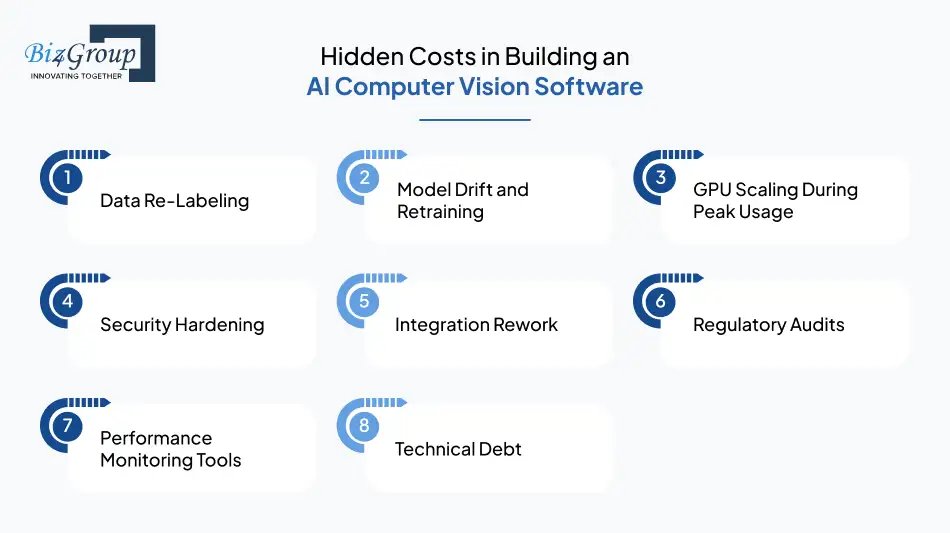
Initial budgets usually focus on visible development activities, yet several expenses emerge only after systems move into testing and production environments. These overlooked areas quietly expand the development budget of AI computer vision platform initiatives and influence long-term investment planning.
Datasets rarely remain accurate once models start processing real operational data. New object variations, lighting conditions, or unexpected scenarios expose labeling gaps that require correction.
Estimated Cost: $3,000–$15,000 per relabeling cycle, depending on dataset volume
AI Model use cases and accuracy changes gradually as environments evolve, making periodic retraining unavoidable. As systems become part of ongoing AI automation workflows, maintaining performance requires scheduled updates rather than one-time model deployment.
Estimated Cost: $2,000–$8,000 per retraining cycle
Infrastructure assumptions often break during high processing demand, especially with video analytics workloads.
Estimated Cost: $1,500–$6,000 per month during peak usage periods
Security work typically expands late in development when systems prepare for real deployment.
Estimated Cost: $5,000–$20,000 depending on security scope
Integrations frequently require revision once software connects with live operational systems.
Estimated Cost: $4,000–$18,000 per integration revision
Compliance costs usually appear close to deployment when verification becomes mandatory.
Estimated Cost: $7,000–$25,000 per audit cycl
Once deployed, systems require continuous tracking to maintain accuracy and stability.
Estimated Cost: $500–$3,000 per month depending on deployment scale
Fast delivery decisions often postpone optimization work, creating future correction costs.
Estimated Cost: $10,000–$40,000 for refactoring during scaling phases
Hidden expenses rarely appear in early estimates proposals but significantly affect the AI computer vision software development cost over time. Accounting for these risks early helps maintain predictable budgets and prevents unexpected financial pressure as systems grow into long-term operational solutions.
Identify hidden expenses early and keep your development budget predictable from the start
Discuss Your ProjectDevelopment investment changes significantly depending on where computer vision is applied. Each industry introduces different accuracy expectations, operational risks, and deployment environments. Understanding these differences helps you estimate the AI computer vision software development cost based on real business context rather than generalized assumptions.
Healthcare applications demand extremely high accuracy because outcomes directly affect patient decisions. Systems must process medical images reliably while meeting strict validation and HIPPA compliance requirements.
Estimated Development Cost Range: $80,000 – $250,000+
Complexity Drivers: regulatory compliance, high accuracy thresholds, sensitive data handling, extended testing timelines.
Retail vision systems focus on monitoring shelves, tracking products, and improving inventory visibility across stores. These systems prioritize scalability over extreme precision.
Estimated Development Cost Range: $40,000 – $150,000+
Complexity Drivers: multi-location deployment, product diversity, integration with retail systems.
Manufacturing environments rely on visual inspection to identify defects during production. Accuracy and processing speed both influence development complexity.
Estimated Development Cost Range: $50,000 – $180,000+
Complexity Drivers: real-time processing, industrial hardware setup, precision detection requirements.
Surveillance solutions analyze live video streams to detect activities, safety risks, or operational events. Continuous monitoring increases infrastructure and optimization effort.
Estimated Development Cost Range: $60,000 – $200,000+
Complexity Drivers: continuous video processing, scalability requirements, infrastructure usage.
Autonomous environments require computer vision systems that interpret surroundings instantly and reliably. These projects involve the highest engineering complexity due to safety and response requirements.
Estimated Development Cost Range: $70,000 – $250,000+
Complexity Drivers: real-time decision making, sensor fusion, safety validation, advanced system testing.
Industry context plays a major role in determining the cost to build AI computer vision software because complexity grows with operational responsibility. Evaluating development through industry requirements provides clearer expectations and prevents underestimating investment during early planning stages.
When organizations plan computer vision adoption, the real decision is not only about speed of deployment but about ownership and long-term spending behavior. The path you choose directly shapes the AI computer vision software development cost as systems scale and operational dependence increases.
|
Factor |
Custom Build |
SaaS Platform |
|---|---|---|
|
Initial Cost |
Higher upfront investment, typically $60,000–$250,000+, covering design, development, integrations, and infrastructure setup aligned with specific business requirements. |
Lower entry cost with subscription pricing, usually $500–$5,000 per month, plus optional setup fees of $2,000–$15,000 for onboarding and configuration. |
|
Control |
Full ownership over models, workflows, and data handling policies tailored to operational needs, with no recurring licensing dependency. |
Limited customization since platform features follow vendor-defined capabilities and constraints, often tied to subscription tiers ranging from $1,000–$10,000/month. |
|
Scalability |
Designed specifically for expected growth, allowing architecture adjustments as usage expands, with scaling upgrades typically costing $10,000–$50,000 per expansion phase. |
Scaling depends on provider limits and pricing tiers, with enterprise usage commonly increasing costs to $8,000–$20,000+ per month. |
|
Maintenance |
Internal or partnered teams manage updates, optimization, and system improvements, usually costing 15–25% of initial development annually. |
Vendor manages maintenance, updates, and infrastructure reliability as part of subscription services, with premium support costing $1,000–$3,000 monthly if required. |
|
Long-Term ROI |
Higher initial investment but stronger financial returns when systems become core operational infrastructure, often reducing total ownership cost after 24–36 months of continuous usage. |
Faster short-term value, but recurring subscription fees can accumulate to $250,000–$400,000+ over 4–5 years for large-scale deployments. |
Custom development becomes practical when computer vision supports core operations or requires deep integration with internal systems. SaaS platforms work well for faster experimentation or limited deployments. Evaluating both approaches carefully helps you understand how the cost to build custom AI computer vision software compares with long-term subscription commitments as usage grows.
Also Read: SaaS MVP Development: Build, Validate, and Scale Smarter
Get clarity on ownership costs and scalability before committing to the wrong approach
Get Expert Guidance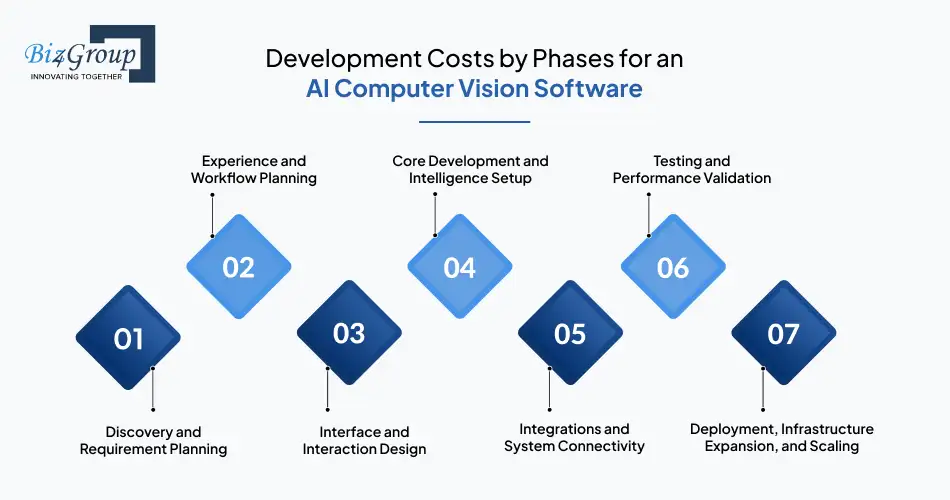
The investment required to build computer vision software grows gradually across development stages rather than appearing as one large expense. The cost to develop an AI computer vision software increases as infrastructure, teams, and system reliability requirements expand over time.
Early investment focuses on defining realistic scope and preventing expensive corrections later. This phase shapes the budget required to create AI computer vision applications by aligning technical goals with operational expectations.
Estimated Cost Range: $3,000–$8,000
Planning workflows early reduces redesign effort once the system interacts with real users or operators. AI computer vision platforms still require structured interaction planning even when automation runs in the background.
Estimated Cost Range: $4,000–$10,000
Clear interfaces prevent repeated changes after deployment. Investment here ensures users can interpret visual outputs quickly across devices and operational environments.
Estimated Cost Range: $5,000–$15,000
Also read: Top 15 UI/UX design companies in USA
This phase represents the largest share of spending because it establishes processing logic and scalable architecture. Costs increase rapidly as teams move from planning into MVP software development, where the first working version of the AI computer vision system is built and validated under real operating conditions.
Estimated Cost Range: $15,000–$80,000
Also Read: Top 12+ MVP Development Companies in USA
Costs increase as systems connect with existing enterprise tools and operational platforms. Integration depth directly influences maintenance effort later.
Estimated Cost Range: $6,000–$20,000
Testing ensures reliability before large-scale deployment. Higher accuracy expectations increase validation effort and infrastructure testing needs.
Estimated Cost Range: $5,000–$18,000
Costs shift from building features to sustaining performance once systems go live. Infrastructure usage and team support needs grow alongside adoption.
Estimated Cost Range: 15–25% of initial build cost annually
Viewing development through lifecycle phases clarifies how investment increases logically rather than unpredictably. Understanding this progression helps you estimate the AI computer vision software development cost more accurately while aligning infrastructure growth and team expansion with real operational demand.
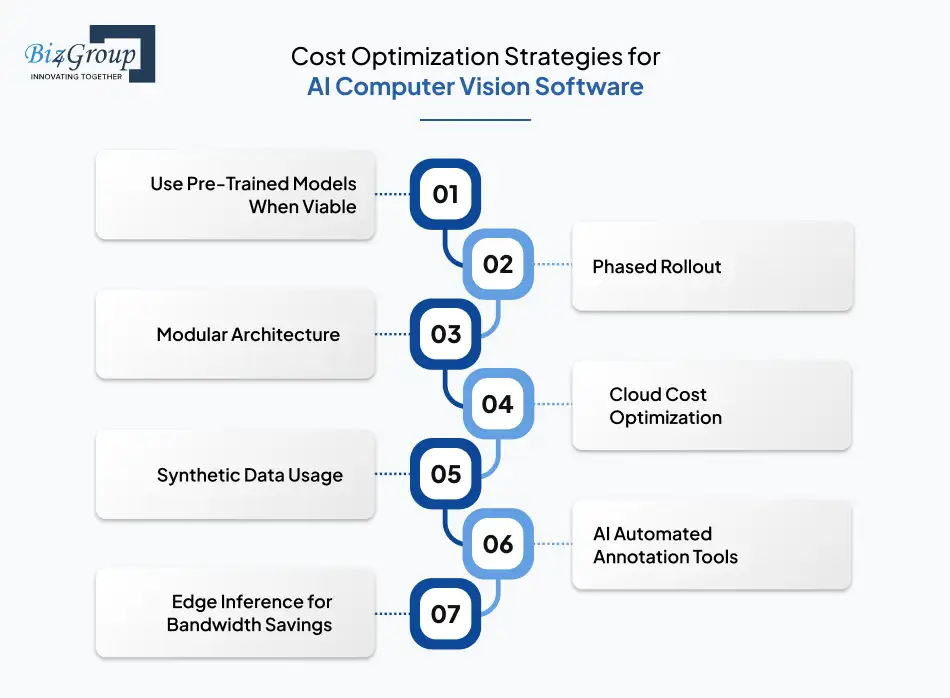
AI computer vision projects can range from $30,000 to $250,000+, yet smart planning decisions can significantly reduce unnecessary spending. Cost optimization focuses on controlling engineering effort, infrastructure usage, and long-term maintenance without compromising system performance or scalability.
Starting from existing trained AI models reduces early experimentation and shortens development timelines. Many AI computer vision use cases already benefit from established learning patterns that only require adjustment instead of full model creation.
Estimated Cost Savings: 20%–40% reduction in model development expenses
Launching in controlled stages prevents overspending before validating real operational value. Teams should begin with MVP development to confirm outcomes before expanding infrastructure or integrations.
Estimated Cost Savings: 15%–30% reduction in initial investment risk
Also Read: Much Does It Cost to Build an MVP for AI Application?
Designing systems as independent modules allows updates without rebuilding the entire platform. This approach is common in enterprise AI solutions where systems evolve gradually alongside operational requirements.
Estimated Cost Savings: 10%–25% reduction in long-term development costs
Infrastructure spending often becomes the largest recurring expense. Optimizing compute usage prevents unnecessary cloud billing growth.
Estimated Cost Savings: 15%–35% reduction in cloud infrastructure costs
Generating artificial training images reduces dependency on expensive real-world data collection.
Estimated Cost Savings: 20%–50% reduction in data preparation costs
Manual labeling quickly becomes expensive as datasets grow. AI Automation tools reduce repetitive annotation work while improving consistency.
Estimated Cost Savings: 25%–45% reduction in annotation expenses
Processing data closer to devices lowers cloud transfer costs and improves response speed. This strategy becomes valuable when organizations integrate AI into an app or operational system handling continuous visual input.
Estimated Cost Savings: 10%–30% reduction in operational bandwidth costs
Cost optimization in computer vision is less about cutting features and more about making smarter architectural decisions early. Applying these strategies helps control the AI vision software product development cost while keeping systems scalable, reliable, and aligned with long-term operational growth.
Discover smarter optimization strategies aligned with your workload and long-term growth plans
Optimize My Project Cost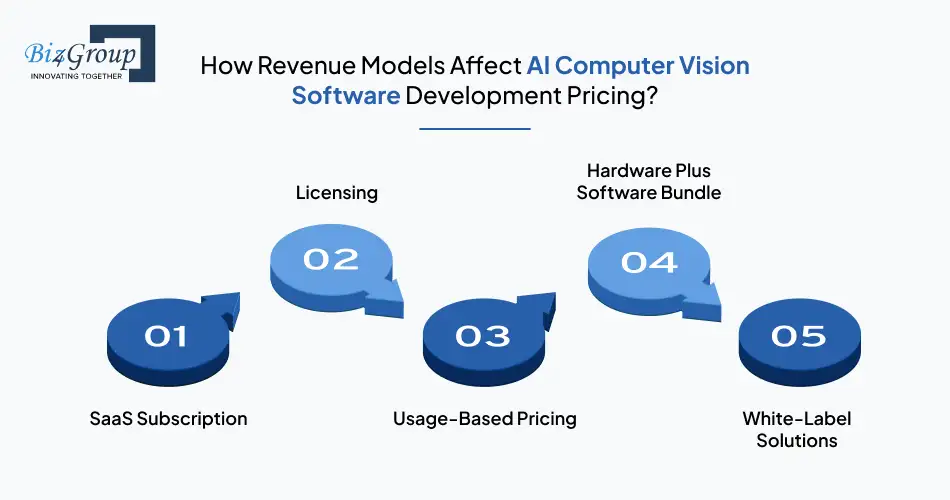
Revenue models influence software pricing long before the product reaches customers. They decide how visual data is measured, how access is controlled, and how infrastructure usage is tracked. These requirements shape engineering decisions early and directly affect the AI computer vision software development cost.
Below is how different revenue strategies change development effort and pricing structure for computer vision software.
|
Revenue Model |
How It Changes Development Work |
Development Cost Impact |
|---|---|---|
|
SaaS Subscription |
Requires account management, subscription tiers, usage limits, automated billing workflows, and continuous uptime monitoring across multiple customers. |
Adds $10,000–$30,000 for billing systems, tenant management, and subscription infrastructure. Break-even commonly reached in 18–28 months with steady customer onboarding. |
|
Licensing |
Requires deployable software packages, license validation controls, and configurable installations for different client environments. |
Adds $8,000–$22,000 for licensing logic and deployment configuration. Organizations often recover investment within 12–20 months through upfront licensing revenue. |
|
Usage-Based Pricing |
Demands accurate tracking of processed images, video duration, or detection events along with reporting dashboards and billing validation systems. |
Adds $15,000–$35,000 due to metering systems and reporting infrastructure. |
|
Hardware Plus Software Bundle |
Requires device compatibility layers, edge processing support, and remote monitoring tools tied to physical deployments. |
Adds $20,000–$55,000 for hardware integration and testing. Reduces cloud spending by $2,000–$7,000 per month through local processing efficiencies. |
|
White-Label Solutions |
Requires configurable branding, client-specific dashboards, and isolated deployments supporting multiple resellers or partners. |
Adds $12,000–$30,000 for customization frameworks. |
Each revenue model shifts development priorities in a different way. Subscription systems increase infrastructure planning, usage-based pricing increases tracking complexity, and licensing models focus effort on deployment flexibility. These decisions directly influence the custom AI computer vision software development cost even when the visible functionality remains similar.
Planning revenue logic early helps align pricing with architecture from the beginning. When added later, the same requirements often require redesign work that increases the budget required to create AI computer vision applications and delays revenue realization.
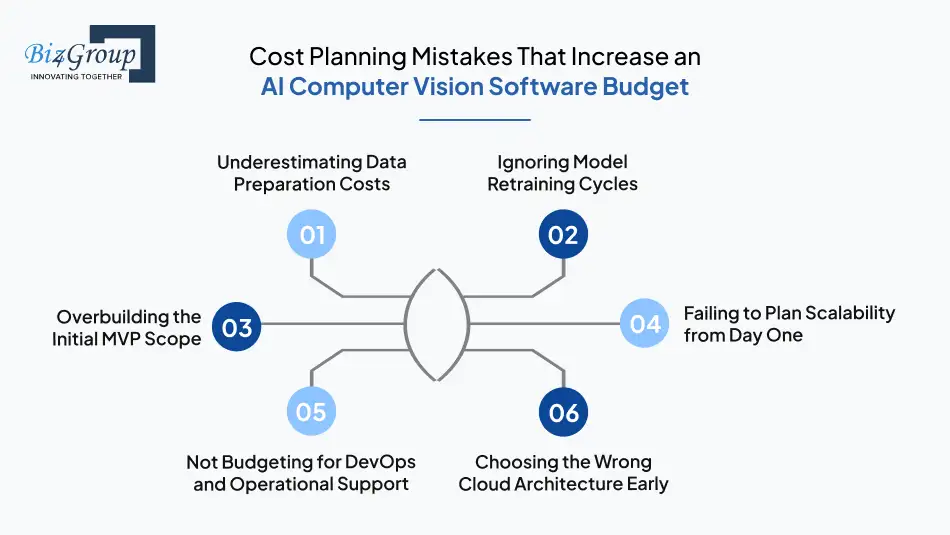
Most AI computer vision initiatives begin with clear budgets, yet projects commonly expand beyond expectations due to preventable planning errors. With development investments typically ranging between $30,000 and $250,000+, avoiding early missteps becomes critical to controlling long-term spending.
Mistake: Teams often assume image datasets are usable once collected. In AI computer vision software development, real environments quickly expose missing object variations, inconsistent labeling, or insufficient training samples. This leads to repeated annotation cycles, additional vendor costs, and delayed testing phases.
Solution: Plan data preparation as an ongoing workflow instead of a one-time setup activity. Organizations that engage AI consulting services during early planning typically define realistic dataset scope, annotation effort, and validation timelines before development begins.
Mistake: Many projects treat model training as a one-time expense. After deployment, accuracy declines due to lighting changes, new product types, or operational environment shifts, forcing unexpected retraining work.
Solution: Include scheduled retraining cycles within the AI computer vision software development cost planning. Reserving computer vision resources and engineering time every 3–6 months prevents sudden operational spending increases.
Mistake: Teams frequently attempt to deliver advanced analytics, AI automation workflows, and large integrations in the first release. Overengineering early stages increases development time without validating whether visual detection solves the core problem.
Solution: Start with a focused implementation that validates detection accuracy and workflow value first. Expanding capabilities after validation stabilizes the AI computer vision software development cost for enterprises and reduces redesign effort.
Mistake: Architecture designed for small datasets often struggles when image volume grows. Scaling later requires infrastructure redesign, pipeline restructuring, and database migration, which significantly increases costs.
Solution: Design scalable processing pipelines early, even for smaller deployments. This approach becomes essential when computer vision supports business app development using AI, where adoption can accelerate quickly after deployment.
Mistake: Budgets frequently focus on development while ignoring monitoring, logging, and deployment management. Once systems go live, teams must urgently add operational support resources.
Solution: Include DevOps planning alongside engineering work. Continuous monitoring and automated deployment pipelines reduce downtime and prevent reactive spending after launch.
Mistake: Cloud environments are sometimes selected without estimating processing volume or workload patterns. Overprovisioned infrastructure wastes monthly spending, while under provisioning causes emergency scaling costs.
Solution: Model expected image processing volume before infrastructure decisions. Aligning computer vision resources with realistic workloads keeps long-term operational spending predictable and prevents budget instability.
Cost overruns in AI computer vision software development rarely result from technology limitations. They usually originate from planning decisions made too late or without operational context. Addressing these risks early helps maintain financial control while building scalable and sustainable computer vision systems.
Review your development plan and eliminate risks that silently inflate project costs
Request Cost ReviewAt Biz4Group LLC, managing the AI computer vision software development cost starts by identifying where projects typically overspend and addressing those risks before development begins. As a US based AI computer vision development company, we evaluate real processing needs, data readiness, and deployment scale early. This helps us to reflect on actual usage instead of assumptions for AI computer vision software development pricing
We prevent unnecessary development effort by defining clear operational boundaries first.
Cost stability depends on aligning architecture with expected workloads.
This structured execution keeps the cost to build AI powered computer vision systems predictable and contributes to Biz4Group’s recognition among the top computer vision software development companies in USA.
Working with computer vision is less about technology selection and more about understanding how costs evolve as systems move from experimentation to real operations. As an AI development company, we often see that the AI computer vision software development cost becomes predictable only when data preparation, infrastructure usage, and long-term optimization are planned together instead of treated as separate decisions. Small architectural choices made early quietly determine whether expenses remain stable or grow with usage.
The real challenge is not estimating the initial budget but managing how the cost to develop an AI computer vision software behaves over time. Projects succeed financially when development aligns with actual processing demand; validation happens before scaling, and infrastructure grows only after measurable outcomes appear. Treating computer vision as an operational system rather than a one-time build helps organizations avoid unexpected spending while maintaining performance and reliability.
If you’re planning AI computer vision adoption, contact us as our team can help you estimate costs realistically and move forward with confidence.
The AI Computer Vision Software Development Cost typically ranges from $30,000 to $250,000+ depending on deployment scale, data complexity, and integration requirements. Pilot systems stay at the lower end, while enterprise deployments with real-time analytics and automation workflows require higher investment.
Accurate estimation depends on dataset readiness, expected processing volume, and deployment environment. Defining these early allows organizations to forecast the development budget of AI computer vision platform initiatives with realistic financial planning instead of broad assumptions.
The largest cost drivers include data preparation effort, real-time processing requirements, infrastructure scaling, and enterprise integrations. These elements impact the cost of building AI-powered computer vision systems more than feature quantity or interface complexity.
Once an MVP proves value, investment shifts toward scalability, monitoring, and reliability. The AI computer vision MVP development cost estimate mainly validates feasibility, while production systems require optimization and operational safeguards.
Organizations typically invest beyond initial development to support retraining, monitoring, and infrastructure expansion. Over three years, the total investment to build scalable AI computer vision software solutions often reaches 1.5–2× the original build cost.
Post-launch spending usually covers cloud infrastructure, performance monitoring, and model updates. Enterprises commonly reserve 15–25% of the initial build cost annually to maintain accuracy and system reliability.

with Biz4Group today!
Our website require some cookies to function properly. Read our privacy policy to know more.