 Location :
Orlando, FL, USA
Location :
Orlando, FL, USA +1 (407) 714-1616
 info@biz4group.com
- AI computer vision software enables enterprises to automate visual inspections, monitor operations continuously, and turn camera data into actionable operational insights across facilities.
- Many organizations build custom AI computer vision software for enterprises to align systems with workflows, infrastructure, and operational monitoring requirements.
- Successful projects require structured data collection, model training, system integration, and scalable infrastructure that supports real-time visual analysis across enterprise environments.
- The cost to develop custom AI computer vision software for enterprises typically ranges from $30,000 to $250,000+ depending on complexity, features, and deployment scale.
- Companies can create enterprise grade AI computer vision software for automation to improve quality control, safety monitoring, and operational decision support.
- Biz4Group LLC a leading computer vision software development company, helps organizations design scalable vision systems that support automation, monitoring, and long-term enterprise adoption.
What if the cameras already running inside your facilities could start identifying defects, tracking movement, and flagging risks on their own?
Enterprises capture enormous volumes of visual data every day through security cameras, production line monitoring systems, and warehouse surveillance feeds. The challenge is not collecting images. The real challenge is turning those images into usable operational insights. AI computer vision software helps organizations analyze visual data automatically and convert it into real-time intelligence for daily operations.
Here’s what the market has to say: the global computer vision market is projected to reach USD 58.29 billion by 2030, expanding at a 19.8% CAGR between 2025 and 2030. Adoption is increasing across enterprise environments where visual monitoring plays a direct role in operational efficiency.
Let's take a quick look at factors pushing enterprises to adopt AI computer vision systems:
- Rising demand for AI automation across manufacturing, logistics, retail, and healthcare operations
- Continuous improvements in image recognition capabilities
- Strong growth in autonomous systems that rely on real-time visual interpretation
- Expanding enterprise deployments across North America, with the United States holding a dominant market position
- Widespread adoption of camera-based computer vision systems across industrial environments.
- Innovations such as generative AI are enhancing how visual patterns are interpreted, and contextual insights are produced from large image datasets.
As adoption grows, many business owners now build custom AI computer vision software for their enterprises that are designed to align with their operational workflows and data pipelines.
In this guide, we’ll walk you through the development of custom AI computer vision solutions for enterprise operations from features to challenges, and how a custom software development company supports the implementation.
What Is AI Computer Vision Software and How Does It Work?
Computer vision software is a technology that enables computers to understand and interpret images and videos in a way similar to human visual perception. It:
- analyzes visual inputs from cameras or stored media
- identifies patterns or objects
- converts visual information into actionable data
Businesses use computer vision software to automate observation-based tasks, improve monitoring accuracy, and gain insights without relying on constant human supervision.
In real-world environments, computer vision software works through AI integration with existing systems such as surveillance cameras, mobile devices, or enterprise platforms. This allows organizations to introduce intelligent visual analysis into daily operations without disrupting established workflows or requiring deep technical expertise.
How Does AI Computer Vision Software Works?
- Visual Data Capture: The process starts when cameras or sensors capture images or video streams. These visual inputs provide the raw data that computer vision system analyzes to understand what is happening in the environment.
- Image Pre-Processing: Before analysis begins, the system prepares the captured images. It adjusts brightness, removes visual noise, and standardizes image formats so the software can interpret visual details more accurately.
- Model Inference and Pattern Recognition: A trained AI model analyzes the processed images to identify patterns or objects. Teams that build AI software design these models to recognize specific visual signals relevant to operations.
- Object Detection and Scene Understanding: The system scans each frame to detect objects, track movements, or identify visual changes. This allows businesses to monitor equipment conditions, product quality, or safety events.
- Result Generation and System Response: Once analysis is complete, the system generates outputs such as alerts, labels, or visual reports. These results help operational teams react quickly when unusual activity or defects appear.
Also Read: Top 12 Computer Vision Software Development Companies in USA
Why Enterprises Are Investing in Custom AI Computer Vision Software
Organizations across industries are steadily adopting systems that can understand visual data within daily operations. Many teams build custom AI computer vision software for enterprises to align visual intelligence with operational workflows, existing infrastructure, and real business environments.
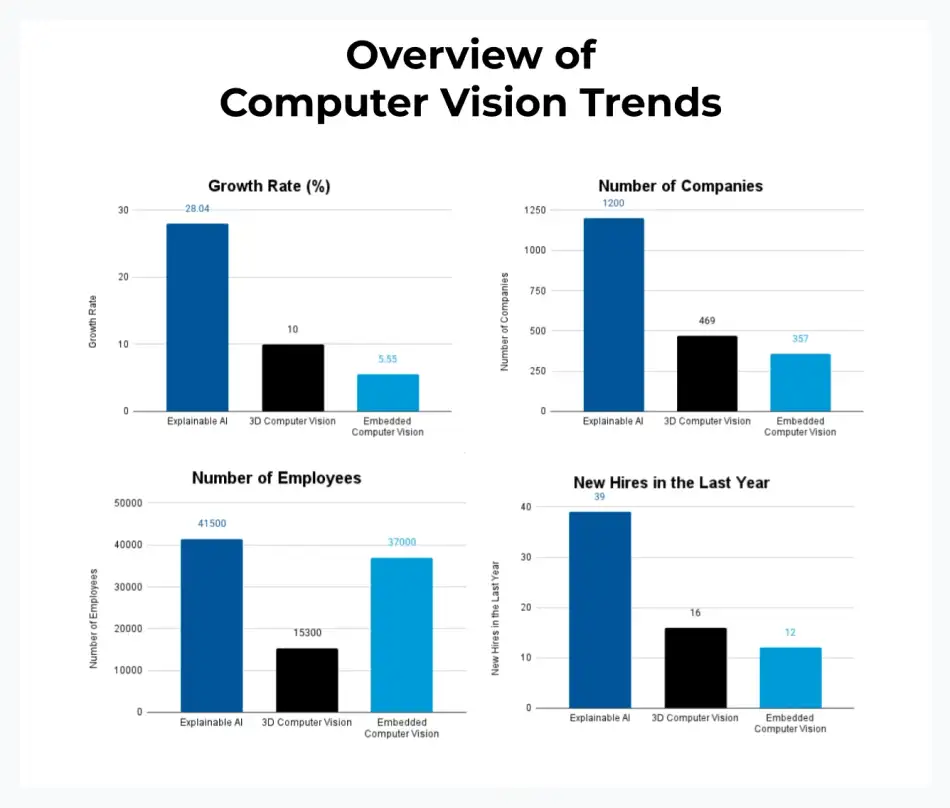
These shifts are also visible in how the computer vision trends are evolving.
- Explainable AI Growth: Around 1,200 companies are now working on explainable AI in computer vision. The segment employs over 41,500 professionals and is growing at 28.04% annually as enterprises demand transparent and accountable AI decisions.
- 3D Computer Vision Adoption: More than 465 companies are building solutions around 3D vision. Adoption continues to grow at 10% annually, driven by robotics, spatial mapping, and technologies like LiDAR and 3D reconstruction.
- Embedded Computer Vision Expansion: Over 350 companies are developing embedded vision systems that run directly on cameras and edge hardware. The segment supports about 37,000 professionals as organizations deploy faster, low-latency vision processing.
Let us now look at why businesses are investing in custom AI computer vision software development:
1. Operational Automation Across Business Workflows
Many enterprise processes still depend on people watching screens, checking products, or reviewing camera footage. These activities take time and often slow down operations. Computer vision allows businesses to automate these tasks directly within their existing workflows.
- Monitor production lines and automatically detect defects
- Track warehouse activity without manual supervision
- Verify packaging, labeling, or product placement in real time
When companies build AI software for these processes, visual monitoring becomes continuous rather than manual. This improves operational efficiency and allows teams to focus on higher-value responsibilities instead of repetitive inspection work.
2. Improving Accuracy in Operational Decisions
Manual inspection can vary depending on attention levels, workload, or human error. AI computer vision systems analyze images using trained AI models that apply the same evaluation rules every time.
This improves accuracy in several operational areas.
- Detect small defects that may be missed during manual inspection
- Identify safety risks across factory floors or industrial sites
- Monitor quality standards across large production batches
More consistent inspection results help organizations maintain product quality while reducing operational risk.
3. Reduced Operational Costs
Visual inspections and monitoring often require large teams working across shifts. Computer vision systems reduce these ongoing operational expenses by automating monitoring tasks.
Businesses can lower costs in multiple areas by:
- Reducing labor required for repetitive inspection work
- Preventing defective products from reaching later production stages
- Detecting operational issues early before they cause major losses
Many organizations adopting enterprise AI solutions see computer vision as a way to optimize operational spending while maintaining strong oversight across facilities.
4. Scaling Operations Across Multiple Facilities
Enterprises often operate across many factories, warehouses, or retail locations. Maintaining consistent monitoring and inspection standards across these sites can be difficult.
Computer vision systems make it easier to scale operational visibility.
- Deploy the same inspection model across multiple production lines
- Monitor safety compliance across distributed facilities
- Track operational performance across different locations
As adoption grows, many organizations create custom AI computer vision platform capabilities that allow them to replicate successful systems across their infrastructure.
5. Meeting Industry-Specific Operational Requirements
Different industries face unique operational challenges. Manufacturing requires strict product quality control whereas logistics depends on efficient inventory tracking and retail focuses on store activity and product availability.
Computer vision systems can be designed around these specific needs.
- Manufacturing companies monitor product quality and equipment conditions
- Logistics providers track package movement and warehouse activity
- Retail businesses analyze store traffic and shelf availability
These targeted implementations allow enterprises to adapt computer vision to their operational environment and gradually build enterprise grade AI computer vision system infrastructure that supports long-term business growth.
Is AI Computer Vision Software Worth It for You
Discuss operational impact cost savings and automation potential with our enterprise computer vision specialists
Schedule a Strategy CallTypes of AI Computer Vision Systems Used by Enterprises
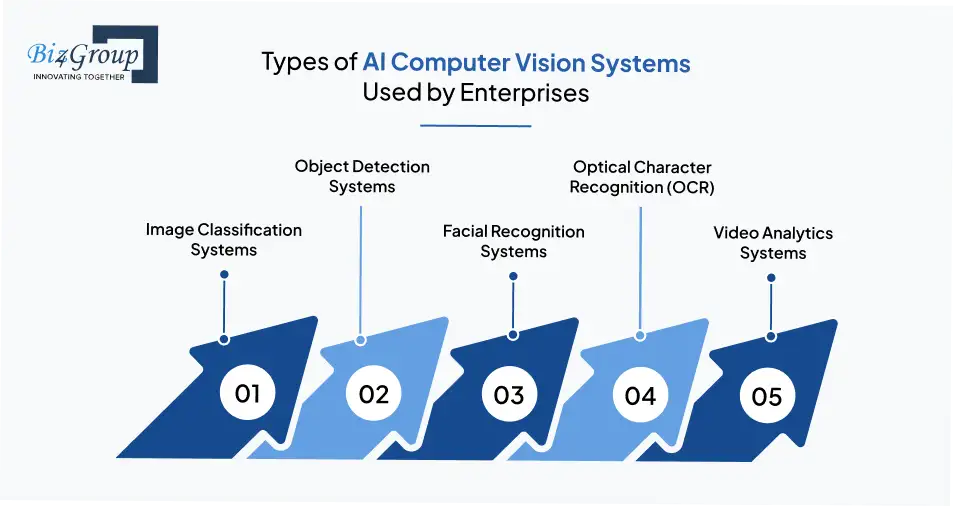
Enterprises adopt computer vision in different ways depending on the operational problem they want to solve. Many teams build custom AI computer vision software for enterprises that support specific inspection, monitoring, or data analysis needs inside their existing operational environments.
1. Image Classification Systems
Image classification systems analyze an image and assign it to a specific category. The software studies visual patterns and determines what the image represents. Businesses often use this system when the goal is to identify the overall content of an image rather than detect individual objects.
Common enterprise applications include:
- Sorting products into categories during manufacturing or packaging
- Classifying product images for large eCommerce catalogs
- Identifying damaged or defective goods during quality checks
This approach helps organizations quickly organize visual data and automate tasks that would normally require manual review.
2. Object Detection Systems
Object detection systems go a step further by identifying and locating specific objects inside an image or video frame. Instead of labeling the entire image, the system highlights multiple items within the scene.
Enterprises use object detection for several operational activities.
- Monitoring products moving along manufacturing lines
- Detecting vehicles, equipment, or people in logistics facilities
- Tracking items inside warehouses or distribution centers
These systems allow businesses to monitor operational environments more effectively and respond quickly when unexpected activity appears.
3. Facial Recognition Systems
Facial recognition systems analyze facial features captured by cameras and match them against stored profiles. Enterprises often use these systems for identity verification and controlled access to restricted environments.
Common applications include:
- Securing entry points in corporate facilities
- Managing employee attendance through automated identification
- Enhancing security monitoring across office campuses
When deployed responsibly, facial recognition systems help organizations strengthen security while reducing manual identity verification processes.
4. Optical Character Recognition (OCR)
OCR systems extract written text from images or scanned documents and convert it into digital data that software can process. This capability allows businesses to automate document-heavy processes.
Enterprises commonly apply OCR to tasks such as:
- Processing invoices, receipts, or forms
- Reading product labels and serial numbers in warehouses
- Extracting information from shipping documents or delivery notes
Automating these activities improves operational efficiency and reduces manual data entry errors.
5. Video Analytics Systems
Video analytics systems process continuous video streams rather than individual images. The software analyzes movement, activity patterns, and events occurring in real time across monitored environments.
Enterprises apply video analytics in many operational scenarios.
- Monitoring activity across manufacturing floors
- Detecting unusual movement patterns in warehouses
- Analyzing customer behavior inside retail stores
These systems help businesses turn everyday camera footage into operational insights that support better decision making.
Organizations typically combine multiple computer vision approaches depending on their operational goals. By integrating these capabilities into business systems, enterprises gradually create enterprise AI vision analytics software that improves monitoring, automation, and data driven decision making across operations.
Real-World Use Cases of AI Computer Vision Software Across Industries
Many organizations across industries now rely on visual intelligence to solve real operational problems. As adoption grows, companies build custom AI computer vision software for enterprises that fit specific workflows, equipment environments, and operational data pipelines.
The following examples show how different sectors apply computer vision in practical business scenarios.
1. Manufacturing: Automated Quality Inspection
- In manufacturing industry production lines operate at high speed, which makes manual inspection difficult. Workers may miss small defects or misaligned components when thousands of products move through the line every hour.
- AI computer vision systems monitor products directly on assembly lines. Cameras capture images while AI models check for defects such as cracks, missing parts, or packaging errors.
- Manufacturers reduce defective shipments, lower quality control costs, and maintain consistent product standards across large production volumes.
Also Read: AI Use Cases in Manufacturing
2. Retail: Smart Shelf Monitoring and Checkout Automation
- Retail stores often struggle with empty shelves, misplaced products, and long checkout queues. These issues directly affect customer experience and lead to missed sales opportunities.
- AI computer vision systems monitor shelves through in-store cameras and track product placement or availability. Checkout systems can also recognize items automatically during billing.
- Retailers gain real-time visibility into shelf inventory, improve store efficiency, and increase product availability that directly supports revenue growth.
Also Read: Generative AI in Retail Business
3. Healthcare: Medical Imaging Analysis
- Healthcare and medical professionals review large volumes of imaging scans every day. Detecting small abnormalities within thousands of images can be time-consuming and sometimes inconsistent.
- AI computer vision systems analyze scans such as X-rays, MRIs, or CT images and highlight areas that require medical attention.
- Hospitals process imaging data faster and assist doctors in identifying potential conditions earlier, which improves diagnostic accuracy and patient outcomes.
Also Read: Healthcare Software Product Development
4. Logistics: Warehouse Automation and Package Tracking
- Warehouses manage large volumes of packages that move through conveyor belts and storage zones. Manual tracking can lead to misplaced shipments and operational delays.
- AI computer vision systems track packages, monitor warehouse activity, and identify movement patterns. Many companies implementing AI in logistics also use visual tracking to improve inventory visibility.
- Organizations that develop enterprise AI computer vision solutions for warehouse environments improve shipment accuracy, reduce operational delays, and maintain better control over inventory movement.
Also Read: Developing a Courier and Logistics App: Your Ultimate Guide
5. Security: Surveillance and Threat Detection
- Large campuses and industrial sites rely on extensive surveillance networks. Security teams cannot monitor every camera feed continuously.
- AI computer vision systems analyze video streams and detect unusual behavior such as unauthorized access, restricted area entry, or suspicious movement patterns.
- Businesses strengthen security coverage, reduce monitoring workload, and respond to potential threats faster across facilities.
Enterprises across industries are no longer experimenting with isolated vision tools. Many organizations integrate these capabilities directly into operations and gradually build high performance enterprise AI computer vision applications that support automation, monitoring, and data-driven decision making across complex business environments.
See These Use Cases in Your Operations
Let us map computer vision opportunities inside your workflows and identify automation potential across your facilities
Talk to Our ExpertsCore Features Required in Enterprise AI Computer Vision Software
Enterprises deploying computer vision systems look for capabilities that support real operational workflows rather than experimental features. During custom AI computer vision software development for enterprises, teams prioritize functions that help monitor operations, manage visual data, and automate decision making.
|
Core Feature |
Purpose in Enterprise Software |
|---|---|
|
Image Processing |
Prepares captured images so the system can analyze them correctly. This feature improves image quality and removes distortions that may affect visual analysis. |
|
Video Stream Processing |
Allows the system to process continuous video feeds from cameras. This helps enterprises monitor production lines, warehouses, and facilities without relying on manual observation. |
|
Object Detection |
Identifies important objects such as products, equipment, vehicles, or people inside visual scenes. This enables organizations to monitor operational activity across environments. |
|
Object Tracking |
Tracks the movement of detected objects across multiple video frames. Enterprises use this feature to follow product flow, monitor warehouse operations, or observe movement patterns. |
|
Pattern Recognition |
Helps the system identify recurring visual patterns that indicate defects, operational changes, or unusual behavior. Teams select AI model configurations that match the patterns they want to monitor. |
|
Real-Time Monitoring |
Enables continuous observation of visual environments. The system processes incoming images instantly so operational teams receive timely insights about events occurring across facilities. |
|
Automated Alerts |
Sends notifications when the system detects predefined visual events such as safety violations, product defects, or unauthorized activity. This helps teams respond quickly to operational issues. |
|
Workflow Integration |
Connects the computer vision platform with operational software and AI automation tools so detected events can trigger actions like inspection tasks, alerts, or operational reports. |
|
Image and Video Storage |
Stores captured images and processed visual data securely. Enterprises maintain these records for audits, compliance reviews, and operational analysis. |
|
Data Organization and Retrieval |
Organizes visual data so teams can easily search, retrieve, and review stored images when investigating operational incidents or analyzing trends. |
|
Reporting and Visual Dashboards |
Provides operational visibility through reports and dashboards that summarize detected events, system activity, and performance trends. |
|
Scalable System Architecture |
Allows the software to support growing camera networks, users, and data volumes as enterprises expand operations across facilities. |
Enterprises rely on these capabilities to build reliable monitoring systems that support operational visibility and automation. These features form the foundation organizations need to build custom AI computer vision software for enterprises that perform reliably across complex environments.
Advanced Capabilities That Differentiate Modern Computer Vision Systems
Enterprise deployments often require more than basic detection or monitoring functions. Organizations looking to create enterprise grade AI computer vision software for automation focus on advanced capabilities that improve operational responsiveness, enable intelligent automation, and support large-scale deployment across complex environments.
|
Advanced Capability |
Why It Matters in Enterprise Computer Vision Systems |
|---|---|
|
Edge AI Processing |
Visual data can be analyzed directly on cameras or nearby devices instead of sending every frame to centralized infrastructure. This reduces processing delays and allows faster operational responses in environments such as production floors or warehouses. |
|
Multi-Camera Video Analytics |
Multi-camera analytics connects multiple video streams so the system can understand activity across different zones, which improves monitoring coverage and operational visibility. |
|
Predictive Visual Intelligence |
Visual data often contains patterns that signal upcoming operational issues. Systems that apply predictive analysis can identify gradual changes in equipment conditions, workflow congestion, or abnormal activity trends before they escalate. |
|
IoT Device Integration |
Computer vision systems often operate alongside connected equipment and sensors. When teams integrate AI model capabilities with IoT infrastructure, visual events can trigger monitoring alerts or operational responses within connected systems. |
|
Visual Workflow Automation |
Computer vision becomes more useful when visual insights trigger operational actions. AI business process automation allows detected events to automatically initiate alerts, inspection tasks, or workflow updates. |
|
Cross-System Data Integration |
This allows visual detections to be used alongside operational data for reporting, alerts, and automated responses. |
|
Scalable Deployment Architecture |
Scalable architecture allows the software to handle increasing video streams, processing workloads, and users without affecting system performance or monitoring reliability. |
Advanced capabilities like these allow organizations to move beyond simple visual monitoring and build intelligent operational systems. With the right architecture in place, enterprises can gradually build custom AI computer vision software for enterprises that supports automation, predictive insights, and scalable deployment across complex environments.
Step-by-Step Process to Build AI Powered Computer Vision Software
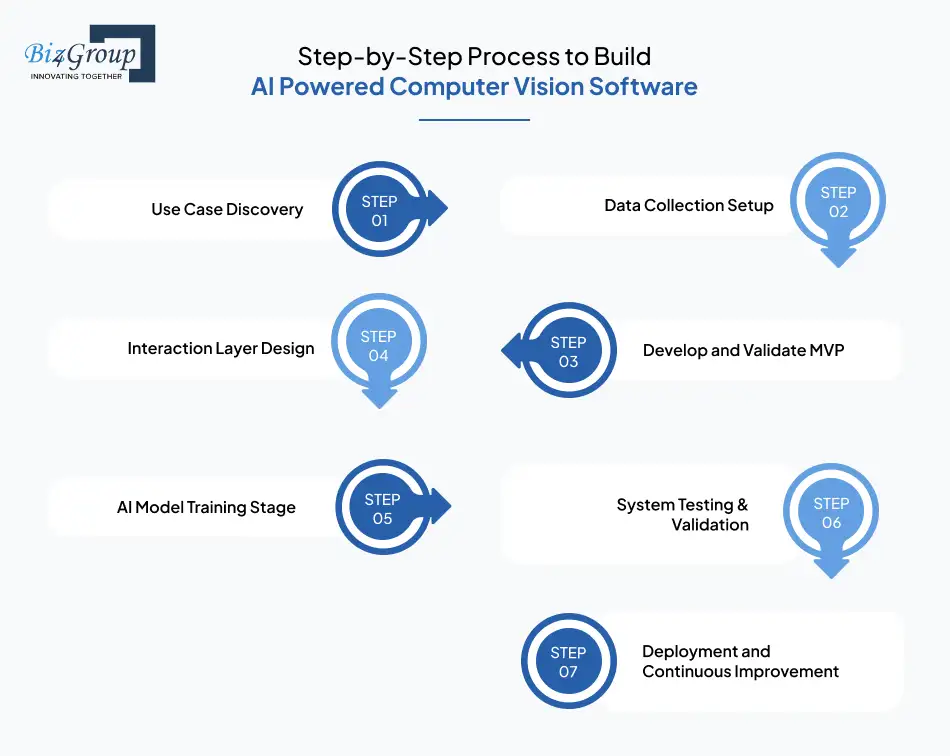
Enterprises developing visual intelligence systems usually follow a structured lifecycle that moves from problem discovery to operational deployment. Teams that build scalable AI computer vision software for enterprises focus on practical steps that ensure the solution aligns with real operational workflows.
Step 1: Use Case Discovery
The process begins with identifying the operational problem the system must solve. Computer vision projects succeed when the use case is clearly defined.
- Identify the visual task that requires automation
- Understand operational workflows where cameras capture data
- Define success metrics such as defect detection rate or monitoring accuracy
A clearly defined use case helps development teams focus on solving a specific operational challenge rather than building a generic system.
Step 2: Data Collection Setup
Computer vision systems depend on high-quality visual data. Teams collect images or video streams from operational environments where the system will eventually run.
- Capture images from production lines, warehouses, or surveillance cameras
- Organize data into structured datasets
- Label images so the system understands objects, actions, or conditions
Well-prepared datasets help ensure that the system learns patterns that match real operational scenarios.
Step 3: Develop and Validate MVP
Once data preparation begins, development teams start building an initial prototype. During MVP development, engineers focus on validating whether the system can detect the required visual signals.
- Develop a functional prototype that processes visual data
- Train early detection models using available datasets
- Evaluate whether the system can solve the identified problem
Many organizations approach this stage through MVP software development, which helps validate feasibility before investing in full-scale system deployment.
Also Read: Top 12+ MVP Development Companies
Step 4: Interaction Layer Design
Operational teams must interact with the computer vision platform through dashboards or monitoring interfaces. Designing a clear interaction layer helps users interpret visual insights easily.
- Design dashboards for monitoring alerts or detected events
- Create interfaces for reviewing captured images or system outputs
- Enable operational teams to respond to alerts efficiently
Development teams often collaborate with a UI/UX design company to ensure the platform is intuitive for daily operational use.
Also Read: Top UI/UX design companies in USA
Step 5: AI Model Training Stage
Once the prototype proves viable, teams expand the training process using larger datasets. This step focuses on improving detection accuracy and preparing the model for real operational environments.
- Train AI models using expanded datasets from operational scenarios
- Improve detection reliability across different lighting conditions or camera angles
- Adjust AI models to handle new visual patterns that appear during testing
This stage ensures that the system can handle real-world operational complexity.
Step 6: System Testing & Validation
Before the system moves into real operations, it must perform reliably across different scenarios. Teams evaluate how accurately the system detects objects, patterns, or events under varying conditions.
- Test the system with new image datasets and real camera feeds
- Identify cases where detections fail or produce false alerts
- Improve model accuracy through retraining and parameter adjustments
Many enterprises collaborate with a specialized software testing company to ensure the system performs consistently before operational deployment.
Step 7: Deployment and Continuous Improvement
Once testing confirms the system performs reliably, the software moves into live operational environments. Cameras begin sending real-time visual data to the platform for analysis.
- Connect the system to live camera infrastructure
- Monitor performance across operational workflows
- Continuously collect new visual data to improve system accuracy
Continuous updates allow the system to adapt as operational environments evolve.
Developing enterprise AI computer vision platforms requires structured planning, reliable data preparation, and careful system validation. Organizations that follow a disciplined development lifecycle gradually build custom AI computer vision software for enterprises that delivers reliable automation and long-term operational value.
Ready To Build Your AI Computer Vision System
Work with our engineers to turn your use case into a production ready computer vision platform
Start Your ProjectTechnology Stack Considerations to Develop AI Computer Vision Software
Enterprise computer vision systems combine several technologies that work together across data processing, model training, and application interfaces. When organizations build custom AI computer vision software for enterprises, they usually connect vision models with dashboards, analytics tools, and operational platforms built through mobile and web application development.
|
Architecture Layer |
Recommended Technology |
Purpose |
|---|---|---|
|
Frontend Interface |
React.js |
Enables interactive operational dashboards where teams can monitor detections, alerts, and visual insights through modern ReactJS development environments. |
|
Server-Side Rendering Layer |
Next.js |
Supports high-performance user interfaces and scalable system architecture, implemented through NextJS development for enterprise monitoring platforms. |
|
Backend Services |
Node.js |
NodeJS development handles application logic, user requests, and communication between system components through scalable backend services. |
|
AI Model Development |
Python |
Provides the primary environment for model training, visual data processing, and system logic through widely used frameworks within python development ecosystems. |
|
API Integration Layer |
REST / GraphQL APIs |
Connects computer vision models with enterprise platforms, dashboards, and external systems through structured API development workflows. |
|
AI Frameworks |
TensorFlow, PyTorch, OpenCV |
These frameworks support image processing, object detection, and model training within computer vision pipelines. |
|
Data Processing Layer |
Apache Kafka, Apache Spark |
Manages high-volume visual data streams from cameras and ensures reliable data processing across enterprise environments. |
|
Cloud Infrastructure |
AWS, Google Cloud, Azure |
Provides scalable infrastructure for storage, model deployment, and distributed processing across large operational systems. |
|
Data Storage |
PostgreSQL, MongoDB, Data Lakes |
Stores visual metadata, system outputs, and operational insights generated by computer vision systems. |
|
Containerization |
Docker, Kubernetes |
Ensures reliable deployment and scaling of computer vision services across multiple environments and operational locations. |
Enterprise vision platforms rely on coordinated infrastructure that connects models, applications, and operational systems. Teams that combine strong AI engineering with scalable full stack development practices can build AI powered computer vision platform for large organizations capable of supporting complex enterprise operations.
Compliance, Privacy, and Ethical Considerations in AI Computer Vision Software Development
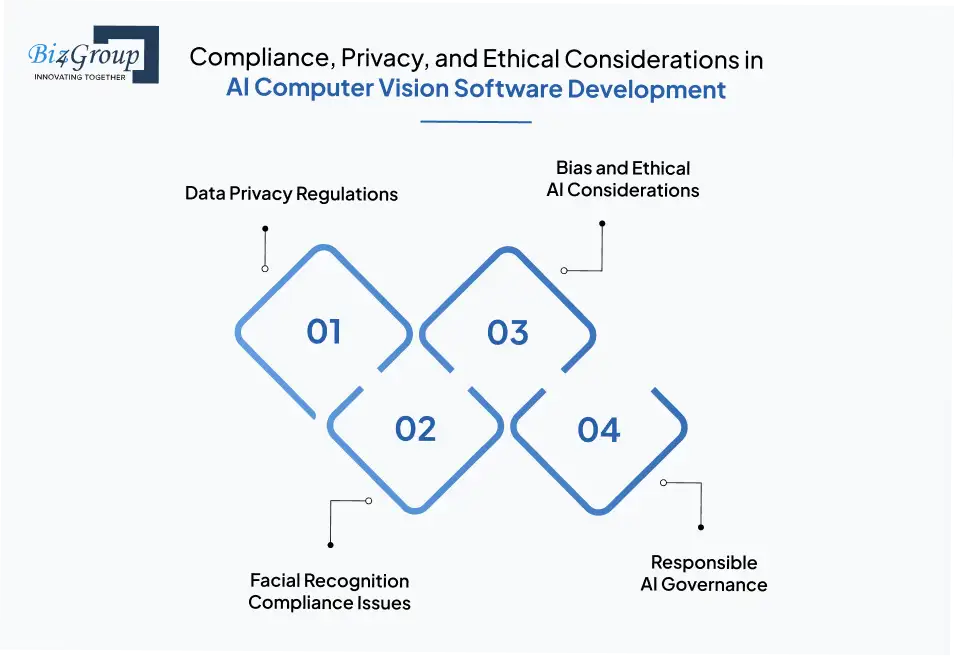
Organizations deploying visual intelligence systems must also address regulatory and ethical responsibilities. When companies build custom AI computer vision software for enterprises, they must ensure the system respects privacy requirements, regulatory frameworks, and responsible technology practices from the beginning.
1. Data Privacy Regulations
- User Data Protection: AI Computer vision systems process images or video that may contain personal information. Businesses must ensure that captured data is stored securely, access is restricted, and sensitive information is handled responsibly.
- Regional Compliance Requirements: Different regions enforce strict privacy laws regarding image data collection and storage. Teams implementing AI image recognition systems must align their platforms with applicable regulations such as GDPR or similar data protection policies.
2. Facial Recognition Compliance Issues
- Consent and Identification Rules: Facial recognition features require strict governance because they involve biometric identification. Organizations must clearly define when and where facial recognition is used and obtain appropriate consent where required.
- Usage Restrictions Across Industries: Many industries restrict facial recognition usage in public or sensitive environments. Enterprises that deploy these capabilities often rely on guidance from AI consulting services to ensure deployments align with regulatory expectations.
3. Bias and Ethical AI Considerations
- Balanced Training Data: AI computer vision models trained on limited datasets may produce biased results. Development teams must ensure datasets represent diverse conditions, environments, and populations to reduce bias in system outcomes.
- Fair System Behavior: Ethical design ensures computer vision systems treat similar visual inputs consistently. Organizations hiring AI developers for enterprise systems should include fairness checks during AI model training and evaluation.
4. Responsible AI Governance
- Clear Internal Policies: Enterprises should establish internal policies that define how computer vision systems are developed, deployed, and monitored. These policies help ensure responsible use of visual data across operations.
- Continuous Monitoring and Auditing: Responsible governance also includes regular system audits to ensure compliance with privacy regulations and ethical guidelines. Ongoing monitoring helps organizations identify potential risks before they affect operations.
Enterprises adopting computer vision must balance innovation with responsible deployment. Organizations that integrate privacy safeguards and governance practices early can build secure enterprise AI computer vision system with compliance while maintaining trust with users, customers, and regulatory authorities.
Cost to Develop Custom AI Computer Vision Software for Enterprises
The cost to develop custom AI computer vision software for enterprises depends on system scope, data preparation needs, infrastructure, and deployment scale. Enterprise projects typically range between $30,000 and $250,000+, depending on the complexity of visual processing, automation features, and operational integrations required.
|
Development Level |
Scope |
Estimated Cost Range |
|---|---|---|
|
MVP Level AI Computer Vision Software |
Focuses on validating a specific use case such as defect detection, object recognition, or basic monitoring. Development includes dataset preparation, model training, and a simple interface for testing system performance. |
$30,000 – $70,000 |
|
Mid-Level AI Computer Vision Software |
Expands the system to support multiple operational features such as real-time monitoring, alert generation, and integration with operational platforms. Development also includes infrastructure setup and evaluation of AI integration costs. |
$70,000 – $150,000 |
|
Advanced Enterprise AI Computer Vision Software |
Designed for large-scale deployments across multiple facilities. The platform includes multi-camera processing, automated workflows, advanced analytics, and infrastructure capable of handling high volumes of visual data. |
$150,000 – $250,000+ |
Organizations planning computer vision projects usually begin with a focused use case and expand the system as operational value becomes clear. This approach allows enterprises to control investment while gradually build custom AI computer vision software for enterprises that scales with operational needs.
Planning Budget for AI Computer Vision Deployment
Get a realistic cost estimate tailored to your infrastructure data requirements and deployment scale
Discuss Cost BreakdownTurning AI Computer Vision Software into Revenue: Business and Monetization Models
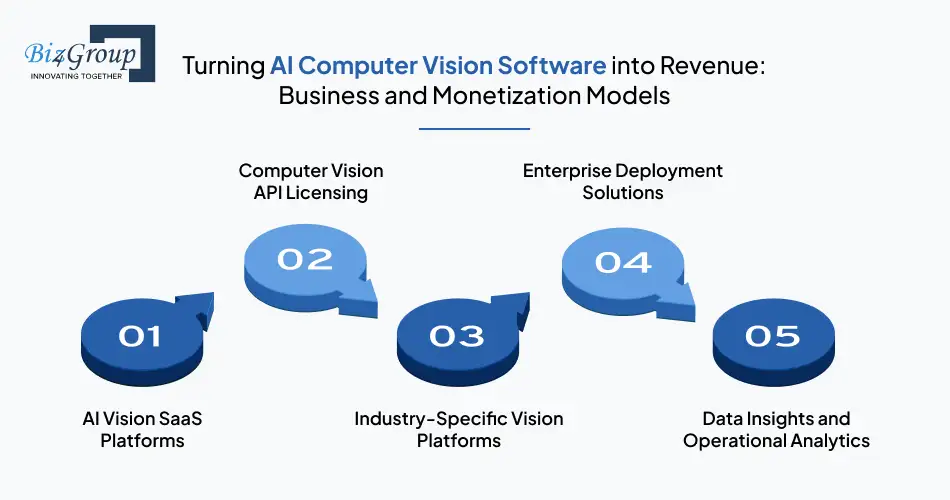
As computer vision adoption grows, many organizations look beyond internal automation and begin to develop scalable AI computer vision platform for large enterprises that can also generate commercial value. Companies investing in enterprise AI computer vision application development often monetize these systems through structured business models designed for industry use.
1. AI Vision SaaS Platforms
Many companies offer computer vision capabilities through subscription-based platforms. Businesses access visual intelligence tools through cloud dashboards without building their own infrastructure.
Typical offerings include:
- Image recognition tools for retail monitoring
- Video analytics platforms for security operations
- Visual inspection platforms for manufacturing environments
This model allows providers to generate recurring revenue while customers pay monthly or annual subscription fees.
2. Computer Vision API Licensing
Some companies monetize their technology by licensing computer vision capabilities through APIs that developers integrate into applications. In this model the provider charges are based on usage.
Typical pricing approaches include:
- Charging per image processed
- Charging per video analysis request
- Usage tiers for enterprise developers
This allows software vendors to embed visual intelligence directly into their platforms without building models internally.
3. Industry-Specific Vision Platforms
Another commercialization strategy focuses on building vertical software platforms designed for a specific industry. Instead of offering general vision tools, the platform solves targeted operational problems.
Examples include:
- Automated inspection platforms for manufacturing companies
- Shelf monitoring software for retail chains
- Warehouse monitoring platforms for logistics providers
Companies working in enterprise AI computer vision application development often pursue this strategy because industry-specific products are easier to sell.
4. Enterprise Deployment Solutions
Large enterprises often require customized computer vision systems that integrate with internal infrastructure. Companies monetizing this opportunity provide tailored deployments and charge for implementation, customization, and long-term support.
Revenue usually comes from:
- Project-based deployment fees
- Annual support contracts
- System expansion across additional facilities
This model is common when enterprises require highly customized visual intelligence systems.
5. Data Insights and Operational Analytics
Computer vision platforms generate large volumes of operational data from images and video streams. Some companies monetize this data by offering analytics and reporting services. Businesses pay for insights that help improve operations.
This includes:
- Production performance insights for manufacturing
- Customer movement analysis for retail stores
- Warehouse efficiency metrics for logistics operations
This approach allows companies to generate recurring revenue from data insights rather than only from software access.
Organizations exploring these business models often begin with a focused operational platform and expand into commercial offerings as adoption grows. Over time many companies build custom AI computer vision software for enterprises that supports both operational automation and scalable revenue opportunities.
Also Read: 65+ Software Ideas for Entrepreneurs and Small Businesses
Challenges Businesses Face When Developing Custom AI Computer Vision Software
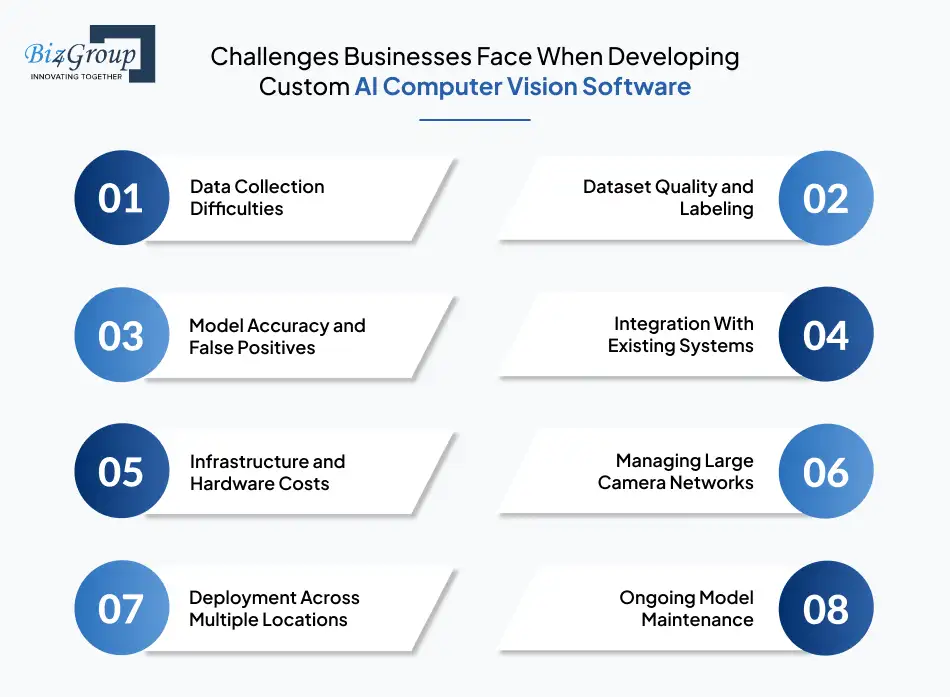
Many organizations start computer vision initiatives to improve operational visibility and automation. However, teams that develop AI computer vision software for enterprise process optimization often encounter practical challenges related to data, infrastructure, and deployment across complex environments.
|
Challenge |
Practical Solution |
|---|---|
|
Data Collection Difficulties |
Capture images directly from operational cameras and expand datasets through continuous data collection pipelines. |
|
Dataset Quality and Labeling |
Use annotation tools and structured labeling workflows to create consistent training datasets. |
|
Model Accuracy and False Positives |
Expand training datasets, retrain models regularly, and validate models using diverse test images. |
|
Integration With Existing Systems |
Use standardized APIs and middleware to connect the vision system with enterprise platforms and operational dashboards. |
|
Infrastructure and Hardware Costs |
Start with limited camera deployments and scale infrastructure gradually based on operational demand. |
|
Managing Large Camera Networks |
Organize cameras into monitoring zones and use centralized video management systems. |
|
Deployment Across Multiple Locations |
Use standardized deployment templates and automated configuration across facilities. |
|
Ongoing Model Maintenance |
Implement periodic model retraining using new operational image datasets. |
Organizations implementing computer vision systems often face both technical and operational hurdles. Many enterprises collaborate with an experienced AI development company to address these challenges and design reliable solutions that scale effectively. Over time, these efforts help organizations successfully build custom AI computer vision software for enterprises that support long-term operational improvement.
Why Is Biz4Group the Right Technology Partner for Custom AI Computer Vision Software Development?
When enterprises plan to deploy production-grade computer vision systems, the choice of technology partner matters as much as the technology itself. At Biz4Group LLC, we work with business owners who wish to build custom AI computer vision software for enterprises and use visual intelligence in real operational environments. As an AI computer vision development company in US, we help enterprises translate visual data into practical automation, monitoring, and decision-support systems.
1. Enterprise AI Computer Vision Engineering Approach
Our work focuses on helping organizations build custom AI computer vision software that fits real workflows. We design solutions that automate inspections, monitor environments, and improve operational visibility.
2. Custom AI Computer Vision Product Development
We support custom enterprise computer vision product development by designing systems around specific business processes. This approach helps enterprises deploy solutions that integrate naturally with their operations.
3. AI Models Built for Real Environments
Reliable computer vision systems depend on models trained with operational data. Our engineering approach focuses on accuracy and long-term usability while continuously building generative AI solutions that adapt to evolving enterprise environments.
4. Scalable Architecture for Enterprise Systems
Enterprise deployments often involve multiple facilities and large camera networks. Our architecture strategy ensures computer vision systems scale reliably as organizations expand their monitoring infrastructure and data volumes.
5. Intelligent AI Automation Across Operations
Computer vision becomes valuable when it connects with operational systems. We help organizations develop AI driven computer vision tools for enterprises that support enterprise AI integration and expand practical AI automation use cases across operations.
Working with us means collaborating with a team that focuses on practical implementation and measurable outcomes. This approach helps organizations confidently deploy production systems while continuing to build custom AI computer vision software for enterprises that evolves with operational needs.
Design Your AI CV Software Development Strategy
Share your operational challenge and we will outline the right architecture models and deployment roadmap
Contact Our TeamCustom AI Computer Vision Software for Enterprises: Final Thoughts
Enterprise teams are no longer looking at computer vision as a future technology. Many are already using it to improve inspections, monitor operations, and reduce manual review work. Working with the right AI product development company often helps organizations move from small experiments to systems that operate reliably in real environments.
When companies build custom AI computer vision software for enterprises, the system reflects how their operations actually function. Cameras, workflows, and monitoring processes already exist, and custom development simply allows the technology to fit into those environments without disrupting daily operations.
As adoption grows, more organizations are starting to create enterprise grade AI computer vision software for automation that supports long term operational intelligence. Visual data that once went unused can now help teams detect issues earlier, monitor activity continuously, and improve decision making across facilities.
If you are exploring computer vision for your operations, we would be happy to discuss your goals and potential implementation approaches together.
FAQ's
1. How do enterprises approach building custom AI computer vision software for real operational environments?
Enterprises usually start by identifying a clear operational use case such as automated inspection, facility monitoring, or warehouse tracking. The next steps involve collecting visual datasets, training models, and integrating the system with existing enterprise platforms. Most organizations that build custom AI computer vision software for enterprises focus on solutions that align with real workflows rather than experimental prototypes.
2. What factors determine the cost to develop custom AI computer vision software for enterprises?
The cost to develop custom AI computer vision software for enterprises depends on system scope, model complexity, infrastructure requirements, and deployment scale across locations. Most enterprise projects typically range between $30,000 and $250,000+, depending on features, automation requirements, and integration needs.
3. What capabilities are required to build an enterprise grade AI computer vision system?
A reliable enterprise system usually includes image and video processing, object detection, pattern recognition, and real-time monitoring capabilities. It also requires scalable infrastructure, operational dashboards, and secure data handling, so organizations can build enterprise grade AI computer vision system deployments that operate reliably across facilities.
4. How do companies create scalable AI computer vision platforms for large enterprises?
Organizations that develop scalable AI computer vision platform for large enterprises focus on architecture that supports high camera volumes, distributed infrastructure, and continuous model improvement. This ensures the system can expand across multiple facilities without affecting performance or monitoring accuracy.
5. What industries benefit most from enterprise AI computer vision application development?
Industries that rely heavily on visual monitoring gain the most value. Manufacturing uses computer vision for automated quality inspection. Logistics applies it to package tracking and warehouse monitoring. Retail uses it for shelf monitoring and store analytics. Healthcare also uses visual analysis for medical imaging workflows.
6. What challenges should enterprises expect when developing AI driven computer vision tools for operations?
Organizations that develop AI driven computer vision tools for enterprises often face challenges related to dataset quality, model accuracy, infrastructure requirements, and system integration. Successful deployments usually require structured data collection, careful model validation, and strong integration with operational platforms.
