 Location :
Orlando, FL, USA
Location :
Orlando, FL, USA +1 (407) 714-1616
 info@biz4group.com

- Computer Vision App Development helps startups turn visual data into automated decisions that improve operations, accuracy, and user experiences.
- Successful apps start with a clear use case, validated early through MVP development before scaling features or infrastructure.
- The cost to develop computer vision app for startups ranges between $40,000 and $250,000+, depending on complexity, integrations, and deployment scale requirements.
- Startups should focus on building systems that build scalable computer vision applications for business growth rather than short-term experimental solutions.
- Choosing the right architecture and data strategy early reduces redesign effort and supports long-term product stability.
- Working with Biz4Group LLC helps teams move from concept to production using structured execution and enterprise-focused development practices.
What if your app could understand what it sees and act on it instantly without human input?
Many startups are asking this question while shaping their next product idea. Visual data surrounds every business today, from cameras and mobile devices to customer interactions captured through images and videos. Turning that data into usable insight is becoming a practical product decision rather than an experimental effort. Here’s what market has to say:
- The global Computer Vision market was valued at USD 19.78 billion in 2024 and is estimated to reach USD 112.10 billion by 2035, growing at a CAGR of 17.3% between 2025 and 2035.
- This momentum shows how strongly businesses are investing in applications that can interpret visual information in real time.
Startups entering computer vision app development often focus on solving clear operational challenges instead of building technology for its own sake. The goal is simple: create applications that recognize patterns, automate decisions, and improve everyday workflows without adding complexity for users.
Product teams usually move faster when guided by an experienced AI app development company that understands how to align technical execution with startup timelines and market expectations. Early clarity around architecture and data strategy helps prevent costly rework later.
Startups typically pursue computer vision apps to:
- Automate repetitive visual tasks
- Improve accuracy in operations
- Create data-driven product experiences
Unlock new revenue opportunities through intelligent features
This guide will walk you through how startups can plan and build scalable computer vision applications for business growth from idea to deployment.
What Is a Computer Vision App and Why Is It in High Demand Today?
A computer vision app is software that enables systems to interpret and understand visual inputs such as images or videos using artificial intelligence. It analyzes visual data, identifies patterns, and converts observations into structured outputs that help applications perform automated actions or support informed decisions.
Uses AI to analyze visual data
- Processes images and video in real time
- Automates detection and classification
- Learns from training datasets
- Produces outputs such as object detection, facial recognition, and OCR
Why Is Computer Vision in High Demand Today?
Organizations pursuing computer vision app development often aim to create measurable efficiency gains while building products that process large volumes of visual data reliably. Many startups also seek to create computer vision AI product solutions that address practical business problems instead of experimental use cases.
Key drivers behind this demand include:
- AI Automation: Businesses automate inspection, monitoring, and workflow validation to reduce manual intervention and improve consistency.
- Data Explosion: The rapid increase in image and video data requires intelligent systems capable of processing visual information at a scale.
- AI Infrastructure Maturity: Accessible cloud platforms and pretrained AI models allow faster deployment and lower barriers for startups and enterprises adopting computer vision.
How Does a Computer Vision App Work?
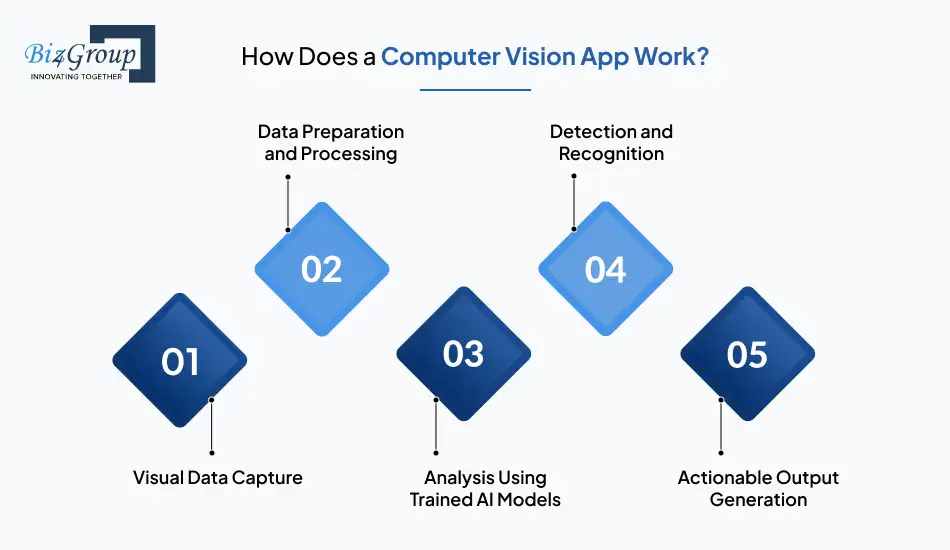
A computer vision app follows a structured flow that allows software to interpret visual inputs and respond intelligently. Understanding this process helps you plan better when you build AI app experiences powered by visual understanding.
- Visual Data Capture: The application collects images or videos through cameras, mobile devices, or uploads. This visual input becomes the foundation on which the entire analysis process operates.
- Data Preparation and Processing: Captured visuals are cleaned and formatted so the system can read them correctly. Proper preparation improves accuracy and ensures reliable performance across different real-world conditions.
- Analysis Using Trained AI Models: The system evaluates visual patterns using trained AI models that recognize shapes, movements, or objects based on prior learning from curated datasets.
- Detection and Recognition: The app identifies elements within visuals such as products, people, or AI facial recognition patterns. Detection allows the system to understand context and trigger predefined application responses.
- Actionable Output Generation: After analysis, results are converted into usable outputs like alerts, analytics insights, or automated workflows that support real-time decision-making within the application environment.
During computer vision app development, teams focus on designing workflows that remain stable as usage grows. This approach helps startups create AI powered computer vision app solutions that deliver consistent performance while supporting real operational needs.
Why Should Businesses Invest in the Development of Computer Vision App
Businesses are investing in visual intelligence because market momentum now reflects measurable commercial value, not experimentation. Strong adoption across advanced economies shows how organizations are prioritizing structured digital investments that translate visual data into scalable business outcomes.
1. Cost Reduction
Investing in computer vision app development helps reduce recurring operational expenses tied to manual monitoring and validation tasks.
- AI business process automated inspection lowers dependency on large review teams
- Reduced human error minimizes financial losses
- Operational spending becomes more predictable at scale
2. Operational Efficiency
Companies that develop computer vision solutions for businesses improve workflow speed and execution consistency across operations.
- Faster processing of visual inputs improves turnaround time
- Teams handle higher workloads with AI automation tools without expanding resources
- Processes run continuously without manual intervention
3. Real-Time Decision Making
When organizations integrate AI into an app, visual insights become immediately usable for operational actions.
- Live monitoring enables instant alerts
- Faster responses reduce delays in critical workflows
- Decision cycles move from reactive to proactive execution
4. New Revenue Streams
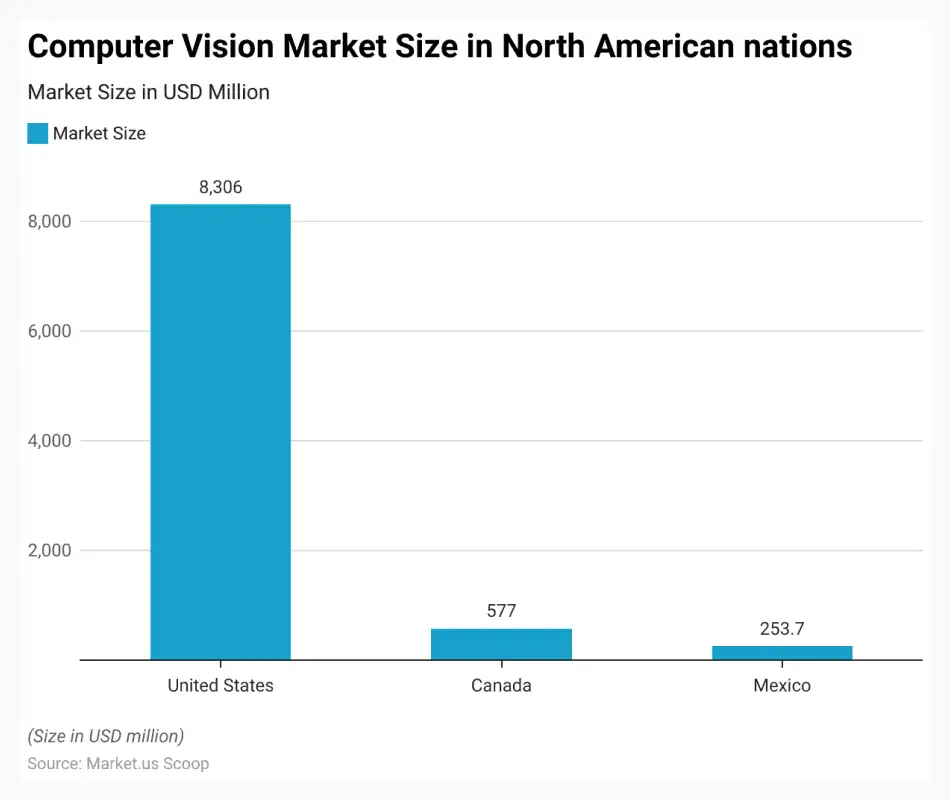
Market investment patterns highlight commercial opportunities. The United States contributes over USD 8,306 million within the North American computer vision market, reflecting strong enterprise adoption. Image recognition alone accounts for USD 7.15 billion, while facial recognition contributes to USD 3.26 billion, showing how visual technologies translate directly into monetizable digital capabilities.
- AI-powered analytics subscriptions
- Intelligent feature upgrades within products
- Data-driven service offerings for enterprise clients
Competitive Differentiation
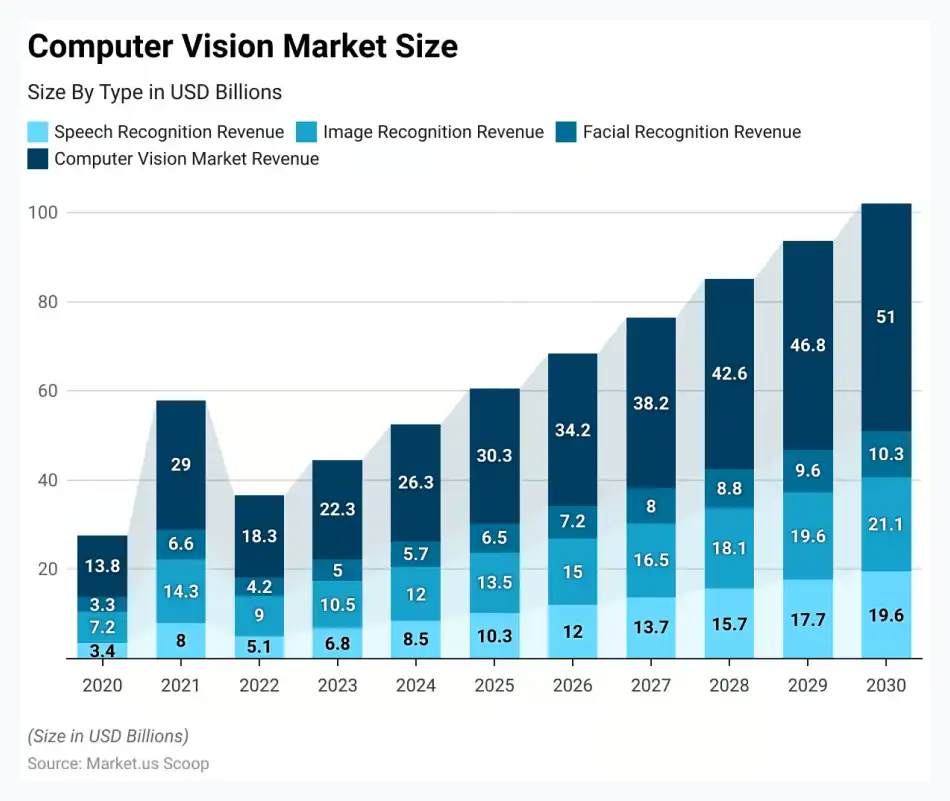
Expanding recognition technologies continue shaping digital ecosystems, with speech recognition contributing USD 3.43 billion in market value. Businesses adopting computer vision position themselves as providers of advanced enterprise AI solution capabilities that strengthen innovation credibility and market relevance.
Businesses investing strategically are building long-term advantages through smarter digital infrastructure. Computer vision adoption strengthens operational resilience, supports scalable innovation, and enables sustainable growth through intelligent product capabilities.
Still wondering if computer vision fits?
See how visual intelligence can unlock measurable efficiency and revenue opportunities for your business
Talk to Our ExpertsIndustry Use Cases of Computer Vision Applications
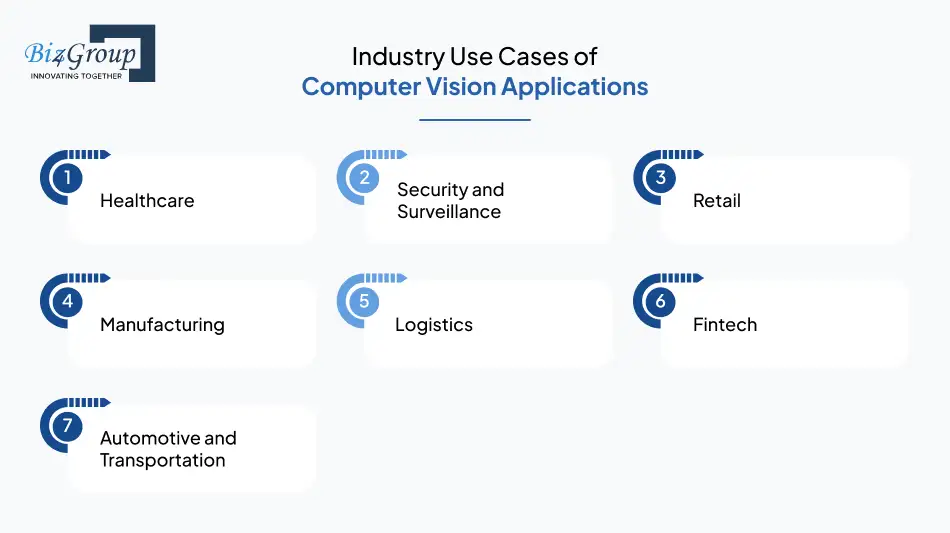
Computer vision adoption becomes clearer when viewed through industry problems it actively solves. Businesses invest where visual intelligence delivers measurable outcomes. The following sectors show how organizations make computer vision software for real world use cases that directly impact operations and revenue.
1. Healthcare
Healthcare providers use visual intelligence to improve diagnostic workflows and patient monitoring.
- Medical image analysis helps detect abnormalities early
- Patient monitoring systems track movement and safety in real time
- Document digitization extracts medical records automatically
Business outcome: Faster diagnosis and reduced administrative workload
Technology involved: Image recognition models, OCR systems, AI-assisted analysis supported by generative AI workflows
Also Read: Healthcare Software Product Development
2. Security and Surveillance
Security operations rely on automated monitoring to improve response speed and situational awareness.
- Smart surveillance detects unusual activity instantly
- Identity verification through facial analysis improves access control
- Crowd monitoring enhances public safety management
Business outcome: Reduced security risks and faster incident response
Technology involved: Object detection, facial analysis, real-time video analytics
3. Retail
Retail businesses apply visual intelligence to optimize store operations and customer engagement.
- Smart checkout systems recognize products automatically
- Shelf monitoring detects stock gaps
- Customer behavior tracking improves store layouts
Business outcome: Increased sales efficiency and reduced operational losses
Technology involved: Object recognition, behavioral analytics, video processing models
Also Read: Generative AI in Retail Business
4. Manufacturing
In the manufacturing section, factories use visual automation to maintain production quality and efficiency.
- Automated defect detection during production
- Equipment monitoring through visual inspection
- Worker safety compliance monitoring
Business outcome: Improved product quality and reduced downtime
Technology involved: Industrial vision systems, anomaly detection models
Also Read: AI Use Cases in Manufacturing
5. Logistics
Logistics companies depend on visual tracking to manage large-scale operations.
- AI in logistics help in package recognition and automated sorting
- Warehouse inventory tracking through cameras
- Damage detection during shipment handling
Business outcome: Faster fulfillment and fewer operational errors
Technology involved: Barcode recognition, object tracking, real-time analytics
Also Read: Developing a Courier and Logistics App: Your Ultimate Guide
6. Fintech
Financial services use visual intelligence to strengthen verification and compliance processes.
- Identity verification using document scanning
- Automated KYC validation workflows
- Fraud detection through behavioral image analysis
Business outcome: Faster onboarding and reduced fraud risk
Technology involved: OCR, identity verification models, document recognition systems
Also Read: AI Fintech App Development Cost & Key Pricing Factors
7. Automotive and Transportation
Automotive and transportation systems rely on visual awareness to improve safety and efficiency.
- Driver monitoring detects fatigue or distraction
- Traffic analysis supports smart mobility planning
- Autonomous navigation interprets road environments
Business outcome: Safer transportation systems and optimized traffic flow
Technology involved: Object detection, motion tracking, environmental perception models
Also Read: Auto Parts Inventory Software Development for Dealerships
Across industries, computer vision app development focuses on solving operational challenges rather than introducing complexity. Organizations that adopt visual intelligence strategically build systems that scale across departments while delivering measurable value in real-world environments.
Core Features Required to Build a Computer Vision App
Successful computer vision app development depends on designing features that support real operational workflows instead of experimental capabilities. Each feature should directly contribute to accuracy, usability, and scalability so your application performs reliably in real-world environments.
|
Core Feature |
Purpose in the Application |
Business Value |
|---|---|---|
|
Real-Time Image Processing Engine |
Processes visual input instantly from cameras or uploads |
Enables immediate operational responses |
|
AI Image Recognition Module |
Identifies objects, patterns, or activities within visuals |
Automates analysis without manual review |
|
Custom AI Model for Use Case |
Tailors detection logic based on specific business needs |
Improves accuracy aligned with workflows |
|
Data Annotation & Training Interface |
Allows teams to label and refine datasets |
Enhances model learning over time |
|
Video Stream Analysis |
Continuously analyzes live video feeds |
Supports monitoring and surveillance operations |
|
Edge Processing Capability |
Runs analysis closer to devices or cameras |
Reduces latency and improves performance |
|
Automated Alert System |
Triggers notifications based on detected events |
Enables faster operational decisions |
|
Visual Data Management Dashboard |
Organizes images, results, and analytics centrally |
Improves operational visibility |
|
API Integration Layer |
Connects vision capabilities with existing software systems |
Simplifies AI integration across platforms |
|
Model Performance Monitoring |
Tracks prediction accuracy and system behavior |
Maintains reliability after deployment |
|
Multi-Device Compatibility |
Supports mobile, web, and more via hybrid app development |
Expands application accessibility |
|
Security & Access Controls |
Protects visual data and user permissions |
Ensures compliance and data safety |
|
Analytics & Reporting Engine |
Converts visual outputs into measurable insights |
Supports data-driven decisions |
|
Continuous Learning Pipeline |
Updates models using new visual data automatically |
Keeps the system adaptive and scalable |
Building these capabilities thoughtfully helps teams create computer vision mobile app with AI integration that delivers consistent performance, adapts to evolving datasets, and supports long-term product growth without adding unnecessary complexity.
Building features or building future readiness?
Let's define the right feature architecture before development decisions become expensive to change
Plan My App FeaturesAdvanced Capabilities to Build Scalable Computer Vision Applications for Business Growth
Modern computer vision app development moves beyond basic detection features and focuses on building systems that scale reliably under real operational pressure. Advanced capabilities help startups and enterprises prepare applications for long-term growth, complex environments, and evolving data demands.
|
Advanced Capability |
How It Works |
Business Impact |
|---|---|---|
|
Edge AI Deployment |
Processes visual data directly on devices instead of relying only on cloud servers |
Reduces latency and supports faster decision making in field operations |
|
Federated Learning |
Models learn from distributed datasets without moving sensitive data centrally |
Improves privacy while continuously enhancing system accuracy |
|
Multi Model Orchestration |
Multiple AI models operate together for detection, tracking, and analysis tasks |
Supports complex AI automation use cases across departments |
|
Cloud Native Auto Scaling |
Infrastructure automatically adjusts resources based on workload demand |
Maintains performance during traffic spikes without manual intervention |
|
Real Time Streaming Analytics |
Continuous analysis of live video or image streams |
Enables instant insights for monitoring and operational control |
|
Explainable AI Dashboards |
Visual dashboards show why decisions were made by the system |
Builds trust for leadership, compliance teams, and investors |
|
IoT Vision Integration |
Connects cameras and sensors within an IoT application ecosystem |
Expands automation across physical environments |
|
Adaptive Model Updating |
Models improve using new operational data without full redevelopment |
Keeps applications accurate as business conditions evolve |
|
Uses historical visual data patterns to forecast future events or outcomes |
Enables proactive planning and reduces operational risks before issues occur |
Advanced capabilities transform computer vision from a feature into a scalable infrastructure layer. Organizations that adopt these approaches can develop enterprise-ready computer vision apps for scaling businesses while delivering a reliable market ready app that supports long-term operational expansion and innovation.
Step-by-Step Process: How to Develop a Computer Vision App for Startups
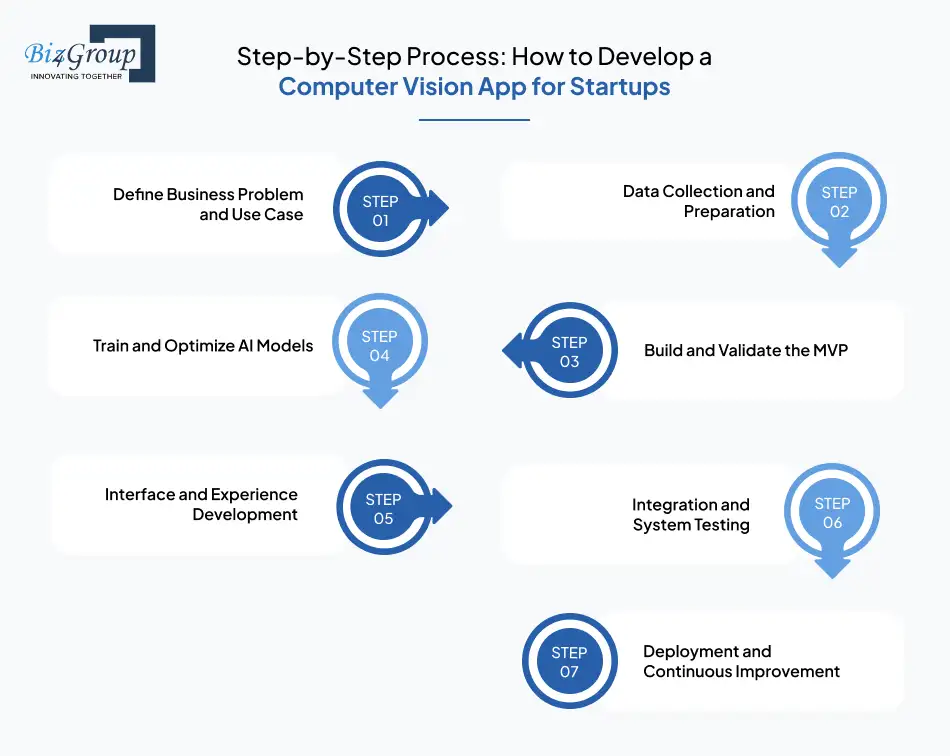
The computer vision app development requires structured execution where business validation, data readiness, and engineering decisions progress together. Each phase builds technical stability while ensuring the application solves a real operational problem from day one.
Step 1: Define Business Problem and Use Case
Development starts with operational clarity rather than technology selection. Teams identify where visual intelligence creates measurable value inside existing workflows.
- Map current manual processes that rely on visual inspection or monitoring
- Define measurable KPIs such as detection accuracy or response time improvement
- Identify camera sources, environments, and real usage conditions
- Validate feasibility through small dataset sampling before development begins
Clear use-case definition prevents overengineering and keeps development aligned with business outcomes.
Step 2: Data Collection and Preparation
Data strategy determines long-term model reliability. Real-world environments introduce lighting variation, motion blur, and inconsistent inputs that must be accounted for early.
- Capture diverse datasets reflecting real operating conditions
- Establish annotation guidelines for consistent labeling quality
- Remove unusable or biased samples during preprocessing
- Prepare pipelines that seamlessly integrate AI Models once training begins
Strong data preparation reduces retraining cycles and improves deployment readiness.
Step 3: Build and Validate the MVP
Initial releases focus on validating workflow accuracy rather than feature expansion. Many startups collaborate with top MVP development companies to minimize early investment risk.
- Implement core detection or recognition functionality only
- Deploy controlled pilot environments using limited users
- Measure real-world performance instead of lab accuracy
- Collect operational feedback to refine workflows quickly
An effective MVP development confirms whether the solution solves a real business problem.
Also Read: AI-based Custom MVP Software Development
Step 4: Train and Optimize AI Models
Model training begins after stable workflows exist. Iterative refinement ensures predictions align with operational scenarios.
- Train AI models using domain-specific datasets
- Test accuracy against edge cases such as poor lighting or partial visibility
- Optimize inference speed for real-time performance
- Continuously retrain models using newly collected production data
Optimization ensures consistent performance outside controlled environments.
Step 5: Interface and Experience Development
Adoption depends heavily on usability. Collaboration with a UI/UX design company ensures complex visual outputs become actionable insights, often inspired by practical AI assistant app design approaches that simplify interaction.
- Design dashboards showing alerts and analytics clearly
- Reduce cognitive load through visual prioritization
- Enable role-based access for operational teams
- Optimize interfaces for mobile and desktop environments
Well-designed interfaces improve daily usage and operational adoption.
Also Read: Top UI/UX design companies in USA
Step 6: Integration and System Testing
Before launch, the application must function reliably within existing digital ecosystems.
- Integrate APIs with enterprise systems or IoT devices
- Validate performance under real traffic conditions
- Test latency across different network environments
- Conduct security and data handling validation
Integration testing ensures the system performs reliably beyond isolated testing environments.
Also Read: 15+ Software Testing Companies in USA
Step 7: Deployment and Continuous Improvement
Deployment introduces monitoring mechanisms that guide long-term evolution.
- Roll out gradually across selected operational environments
- Track model accuracy and user engagement metrics
- Identify data drift and retrain models periodically
- Expand capabilities based on validated AI automation opportunities
Following these steps enables teams to develop computer vision app for retail healthcare and security environments with confidence. A disciplined process also supports startups aiming to develop computer vision mobile app solutions that scale into production-ready platforms built for sustained growth.
Technology Stack Used in Computer Vision App Development Services
Successful computer vision app development depends on selecting technologies that support real deployment conditions instead of experimental setups. A balanced stack connects AI intelligence with reliable web/mobile application development so visual processing integrates smoothly into everyday business workflows.
|
Architecture Layer |
Recommended Technology |
Purpose |
|---|---|---|
|
Frontend Interface Layer |
React.js |
Enables responsive dashboards and monitoring panels through ReactJS development for real-time visual insights |
|
Server-Side Rendering Layer |
Next.js |
Improves performance and SEO readiness using NextJS development for scalable application interfaces |
|
Backend Application Layer |
Node.js |
Manages real-time data processing and system communication supported by NodeJS development |
|
AI & Model Processing Layer |
Python |
Handles training pipelines, inference logic, and automation workflows through python development |
|
Computer Vision Frameworks |
OpenCV, TensorFlow, PyTorch |
Supports image processing, object detection, and model execution workflows |
|
Data Pipeline Layer |
Apache Kafka, Redis Streams |
Processes continuous visual data streams reliably at scale |
|
API Communication Layer |
REST & GraphQL APIs |
Enables system connectivity and third-party integrations through structured API development |
|
Cloud Infrastructure |
AWS SageMaker, Google Vertex AI |
Provides scalable environments for training and deploying vision models |
|
Edge Deployment Layer |
NVIDIA Jetson, TensorRT |
Supports low-latency processing directly on edge devices |
|
Data Storage Layer |
PostgreSQL, Object Storage (S3) |
Stores metadata, visual assets, and model outputs securely |
|
Monitoring & Observability |
Prometheus, Grafana |
Tracks performance metrics and model behavior after deployment |
A carefully planned stack enables end to end computer vision app development that remains maintainable as products grow. Teams that understand how to develop a computer vision app for startups typically combine AI engineering with strong full stack development practices to ensure scalability, stability, and long-term product evolution.
Also Read: Why to Choose the Full Stack Development for Modern Business
Your tech stack decides long-term success
Validate your architecture choices early to avoid scalability limits and costly technical rebuilds later
Review My Tech StackCompliance and Ethical Considerations When You Develop Computer Vision Solutions for Businesses
The responsible computer vision app development requires more than technical accuracy. Organizations must design systems that respect privacy, maintain regulatory compliance, and build user trust from the beginning, especially when visual data includes sensitive or personally identifiable information.
1. GDPR Compliance and Data Privacy Protection
- Ensure explicit user consent before collecting or processing visual data within European markets
- Provide data access, correction, and deletion controls aligned with GDPR rights
- Store only necessary visual information to reduce regulatory exposure
2. HIPAA Readiness for Healthcare Applications
- HIPAA compliant AI app protects patient-related visual data through encrypted storage and secure transmission
- Restrict access using role-based permissions for authorized personnel only
- Maintain audit trails that track how healthcare data is accessed or processed
Also Read: How to Build a HIPAA Compliant Provider to Provider Telehealth Platform
3. SOC 2 Security and Operational Trust
- Implement monitoring controls that verify system reliability and data protection practices
- Maintain documented security policies reviewed during compliance audits
- Strengthen enterprise credibility when delivering custom computer vision app development solutions
4. Bias Mitigation in Visual Intelligence
- Train models using diverse datasets to reduce unfair outcomes across demographics
- Continuously test prediction accuracy across real-world scenarios
- Monitor outputs to identify unintended bias patterns early
- Governance teams often collaborate with specialists offering AI consulting services to review fairness practices
5. Data Anonymization and Privacy Preservation
- Blur faces or sensitive identifiers when full identity recognition is unnecessary
- Use tokenization or masking techniques before storing visual data
- Reduce risk exposure while enabling organizations to build computer vision-based application workflows safely
6. Responsible AI Governance and Accountability
- Establish internal review processes for ethical AI deployment decisions
- Define accountability for how automated decisions affect users
- You can hire AI developers experienced in ethical deployment practices to ensure compliance from early development stages
Ignoring compliance introduces serious risks, including regulatory penalties, reputational damage, and operational shutdowns. Ethical governance ensures visual intelligence systems remain trusted, scalable, and legally sustainable as adoption expands across industries.
Computer Vision App Development Cost for Startups
Understanding the cost of developing a computer vision app early helps founders plan investments realistically during computer vision app development. The computer vision AI app development cost for startups varies based on how intelligently the product evolves from MVP to production readiness typically ranging between $40,000 and $250,000+.
|
Development Level |
Estimated Cost Range |
What It Involves |
|---|---|---|
|
MVP Level Computer Vision App |
$40,000 – $80,000 |
Core detection features, limited dataset training, basic dashboard, controlled deployment for validation |
|
Mid-Level Computer Vision App |
$80,000 – $150,000 |
Improved model accuracy, real-time processing, integrations with business systems, scalable backend infrastructure |
|
Advanced Computer Vision App |
$150,000 – $250,000+ |
Multi-model workflows, automation pipelines, enterprise integrations, large-scale deployment environments |
Key Factors Driving Cost to Develop Computer Vision App
Cost planning becomes clearer when you understand what actually drives investment decisions.
- Data Volume: Larger datasets require more preparation, labeling effort, and storage infrastructure. Projects handling continuous video streams or industry-specific imagery increase development timelines and operational setup costs significantly.
- Model Complexity: Applications requiring high accuracy, multi-object detection, or predictive analysis demand deeper experimentation cycles. Teams often invest additional resources to build AI software capable of stable performance in real environments.
- Integration Needs: Connecting vision capabilities with existing enterprise tools increases engineering effort. Integration with industry systems such as retail analytics or legal tech platforms introduces additional validation and testing requirements.
- Deployment Scale: Applications deployed across multiple locations or devices require stronger infrastructure planning. Costs increase when startups prepare systems that later evolve to build computer vision SaaS platform capabilities serving large user bases.
Beyond development expenses, founders should also evaluate AI integration cost expectations tied to long-term maintenance and scaling. Clear cost planning helps startups invest strategically while building solutions that remain sustainable as adoption grows and operational demands expand.
Know the real investment before building
Get a realistic cost breakdown aligned with your use case, scale goals, and timeline expectations
Estimate My Project CostCustom Development vs Pre-Built APIs for Computer Vision App development
When planning a computer vision application, one of the earliest decisions involves whether to build a custom solution or rely on pre-built APIs. Each approach serves different business goals depending on scalability needs, budget, and long-term product vision.
|
Factor |
Custom Development |
Pre-Built APIs |
|---|---|---|
|
Cost |
Higher initial investment due to tailored development and model training |
Lower upfront cost with pay-as-you-use pricing models |
|
Control |
Full control over models, data handling, and system behavior |
Limited control since functionality depends on provider capabilities |
|
Customization |
Built specifically for business workflows and unique use cases |
Restricted customization options based on predefined features |
|
Speed to Market |
Longer development timeline due to design, training, and testing phases |
Faster launch using ready-made vision capabilities |
|
Scalability |
Designed to scale according to business growth and infrastructure planning |
Scaling depends on vendor limits and pricing structures |
|
Long-Term ROI |
Higher ROI over time through ownership, optimization, and reduced dependency |
Ongoing usage fees can increase costs as adoption grows |
If your goal is early validation or testing a concept quickly, prebuilt APIs can help you launch faster with limited investment. However, when your application becomes central to business operations or competitive differentiation, custom development usually delivers stronger long-term value.
At Biz4Group LLC, we generally guide startups to begin with focused validation, then transition toward custom architecture once usage patterns stabilize. This approach balances speed with ownership while preparing the product for sustainable growth and scalability.
Monetization Strategies for a Computer Vision App
Once your product reaches stability, revenue planning becomes as important as feature development. During computer vision app development, startups must align monetization with how customers actually use visual intelligence, so revenue grows alongside product adoption.
1. SaaS Subscription Model
Subscription pricing works well when your application delivers continuous value through automation or monitoring. Businesses pay a recurring monthly or annual fee to access features and analytics dashboards.
- Predictable recurring revenue supports long-term growth
- Suitable for surveillance analytics, retail monitoring, or compliance tracking apps
- Example: A retail analytics app charging $99 per store per month for real-time shelf monitoring insights
This model helps startups monetize AI app offerings while maintaining stable cash flow.
2. Usage-Based Pricing Model
Revenue scales according to how frequently customers use the application. Pricing may depend on processed images, analyzed videos, or detection requests completed each month.
- Attractive for customers with fluctuating workloads
- Encourages adoption without heavy upfront commitment
- Example: Charging $0.002 per analyzed image for quality inspection workflows
Usage pricing aligns revenue directly with platform value delivery.
3. API Licensing Model
Startups expose computer vision capabilities through APIs so other applications integrate visual intelligence into their systems. This model expands reach without building full user interfaces.
- Ideal for developers or SaaS platforms needing vision features
- Scales quickly across multiple clients
- Example: Logistics software integrating object detection APIs to automate package verification
Many computer vision app development services adopt API licensing to extend ecosystem adoption.
4. Enterprise Contract Model
Large organizations prefer customized agreements tailored to operational scale and compliance needs. Contracts usually include onboarding, dedicated support, and infrastructure customization.
- Higher contract value with long-term commitments
- Suitable for healthcare, manufacturing, or smart city deployments
- Example: A manufacturing enterprise signing a yearly $250,000 contract for automated defect detection systems
Enterprise contracts provide predictable high-value revenue streams.
5. White Label Licensing Model
Startups license their technology to other companies that rebrand the application as their own product. This accelerates distribution without expanding direct sales teams.
- Partners handle customer acquisition
- Startup earns licensing fees or revenue share
- Example: A security company offering branded surveillance analytics powered by your vision platform
White labeling helps scale market presence faster through partnerships.
6. Transaction-Based Revenue Model
Revenue is generated each time a specific action or verification occurs within the application. This works well when computer vision directly enables business transactions.
- Suitable for identity verification or automated checkout solutions
- Customers pay per successful verification or completed action
- Example: Charging $0.10 per identity verification processed during onboarding workflows
Strong monetization strategies ensure technology investment translates into measurable revenue. Startups that align pricing with customer value create sustainable growth paths while transforming computer vision capabilities into scalable commercial products.
Also Read: 65+ Software Ideas for Entrepreneurs
Great product built now, what next?
Design revenue models that turn computer vision capabilities into predictable and scalable business growth
Discuss Monetization StrategyKPIs to Measure ROI When You Create Computer Vision AI Product
To understand whether your investment is working, you need clear performance indicators. During computer vision app development, tracking the right KPIs helps you see business impact after you build MVP in computer vision app development and start real usage.
1. Financial KPIs
- Revenue Growth: Track how much additional revenue your app generates after launch. For example, measure monthly or yearly income increase linked directly to AI-powered features.
- Cost Reduction Percentage: Measure how much operational cost decreases after automation. This may include reduced manual inspection effort or fewer processing hours needed for daily tasks.
- Customer Acquisition Cost (CAC): Calculate how much you spend to gain one new customer. Lower acquisition cost usually shows that your product delivers clear value to users.
2. Operational KPIs
- Model Accuracy: Check how often the system makes correct predictions when analyzing images or videos. Higher accuracy means fewer corrections are required from human teams.
- Inference Latency: Measure how fast the app responds after receiving an image or video input. Faster response improves user experience and supports real-time workflows.
- False Positive Rate: Monitor how often the system gives incorrect alerts or detections. Keeping this number low helps maintain user trust in automated decisions.
3. Strategic KPIs
- Market Share Growth: Observe whether more businesses in your target industry start adopting your solution over time. The growth here shows competitive progress.
- Product Adoption Rate: Track how frequently users actively use the application. Consistent usage indicates that the product fits naturally into daily operations.
Tracking these KPIs regularly helps you understand what is working and what needs improvement. Clear measurement allows startups to make practical decisions, improve performance gradually, and grow their computer vision product with confidence.
Challenges When You Make Computer Vision Software for Real World Use Cases and Their Solutions
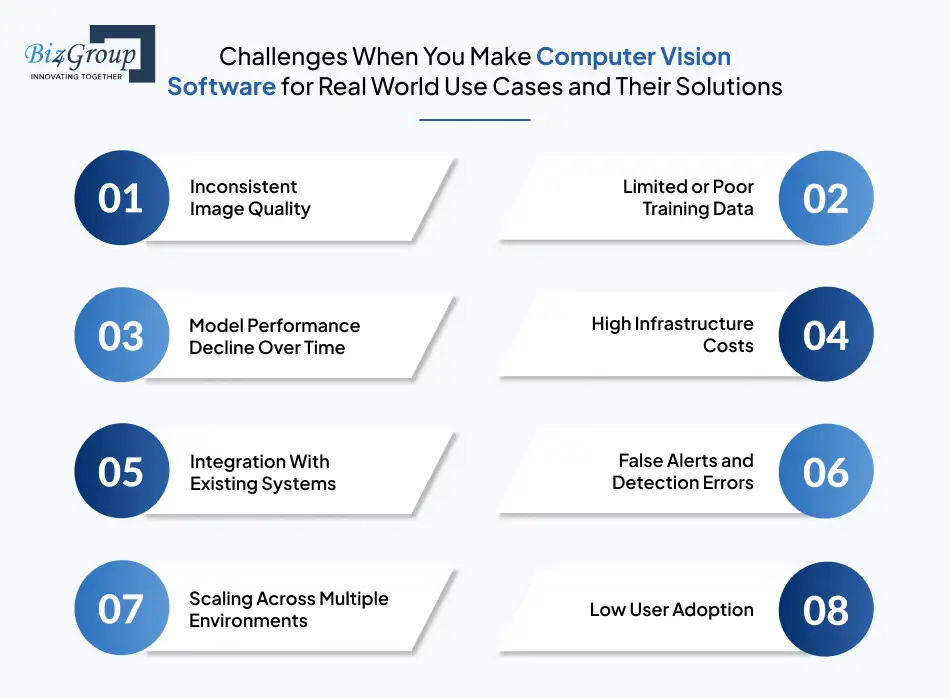
Every stage of computer vision app development brings practical challenges once applications move from controlled testing into real environments. Real-world usage introduces variability, so understanding common obstacles helps you prepare solutions before they affect performance or adoption.
1. Inconsistent Image Quality
Cause: Real environments introduce lighting variation, motion blur, camera misalignment, or low-resolution inputs that models were not fully trained on.
Solution: Train models using diverse datasets collected from actual operating environments and include edge cases during validation to improve reliability.
2. Limited or Poor Training Data
Cause: Startups often begin with small or unbalanced datasets, which reduces prediction accuracy during early deployment stages.
Solution: Start with focused datasets aligned to the use case, then continuously expand and refine data through ongoing collection and annotation processes.
3. Model Performance Decline Over Time
Cause: Operational environments change gradually, creating data drift that reduces model accuracy after deployment.
Solution: Establish scheduled retraining cycles using newly generated data so models adapt to evolving real-world conditions.
4. High Infrastructure Costs
Cause: Continuous image or video processing requires substantial computing resources, especially during scaling phases.
Solution: Combine cloud processing with edge deployment strategies to balance performance needs while controlling operational expenses.
5. Integration With Existing Systems
Cause: Legacy platforms often lack compatibility with modern AI workflows and data pipelines.
Solution: Implement modular APIs that allow phased integration without disrupting existing business systems.
6. False Alerts and Detection Errors
Cause: Models may misinterpret unfamiliar objects or rare scenarios not included in training data.
Solution: Introduce human validation during early deployment to refine predictions and improve model learning accuracy.
7. Scaling Across Multiple Environments
Cause: Different locations introduce variations in layout, lighting, and operational conditions that impact consistency.
Solution: Standardize deployment settings and recalibrate models based on each environment’s characteristics.
8. Low User Adoption
Cause: Complex outputs make it difficult for teams to understand or trust automated decisions.
Solution: Design interfaces that present results clearly, helping users translate visual insights into actionable decisions quickly.
Addressing these challenges early helps teams move from experimentation to dependable deployment. Careful planning ensures computer vision applications remain stable, usable, and capable of delivering consistent business value as adoption grows.
Why Choose Biz4Group LLC for End-to-End Computer Vision App Development
At Biz4Group LLC, we approach computer vision app development with a practical mindset focused on real business outcomes. As a US-based AI computer vision development company, we work closely with teams to transform visual data into solutions that operate reliably in everyday environments.
1. Building Around Real Business Workflows
- We begin by understanding how your operations actually function before designing any solution. Our goal is to support automation without disrupting existing processes.
- By aligning technology with workflows, we help businesses and founders working on computer vision app development for startups move from early concepts toward production-ready applications with confidence.
2. Designing for Scalability from the Start
- We focus on systems that grow alongside your business rather than requiring redesign later.
- Architecture decisions are made with long-term performance in mind, so organizations can build scalable computer vision applications for business growth without operational friction.
3. Focused AI Engineering and Continuous Improvement
- Our team trains and refines models using real operational datasets.
- We continuously optimize performance, so applications remain accurate as environments change and usage expands over time.
4. Seamless Integration and Usable Experiences
- We ensure solutions integrate smoothly with existing platforms and devices while keeping usability central to adoption.
- Our approach emphasizes creating an AI app with great UI/UX so teams can confidently rely on automated insights during daily operations.
5. End-to-End Collaboration and Proven Delivery
- From strategy to deployment and optimization, we stay involved throughout the journey.
- Organizations evaluating an experienced AI development company can review our portfolio to understand how we deliver consistent results across industries and evolving business needs.
Working together allows us to turn complex ideas into dependable solutions. Our focus remains on guiding you toward scalable implementation, so your computer vision application delivers measurable value long after launch.
Ready to build something that actually scales?
Let's turn your computer vision idea into a production-ready solution built for real business impact
Book a Strategy CallConclusion
Computer vision app development succeeds when businesses focus on solving real operational problems instead of simply adopting new technology. To develop enterprise ready computer vision app for scaling businesses, teams must plan beyond initial deployment and build systems that remain reliable as data volume, users, and use cases expand.
Working with an experienced AI product development company helps ensure applications are designed with scalability, performance, and long-term usability in mind from the start.
As organizations increasingly adopt business app development using AI, computer vision is becoming a practical tool for automation, accuracy, and smarter decision-making across industries. The strongest results come from solutions built with clear objectives and structured execution rather than experimentation alone.
Schedule a quick consultation with Biz4Group LLC to discuss how your computer vision app idea can move forward.
FAQ's
1. How do founders validate Computer Vision App Development for startups before building a full product?
Most startups begin by identifying a narrow operational use case and build MVP in computer vision app development to test real adoption. Early validation focuses on workflow improvement rather than advanced automation features.
2. What is the typical computer vision app development cost for startups and what drives pricing differences?
Computer vision app development cost for startups typically ranges between $40,000 and $250,000+, depending on dataset preparation, model complexity, integrations, and deployment scale required for the application.
3. How can teams develop computer vision mobile app solutions that perform reliably in real-world environments?
Teams focus on diverse training data, iterative testing, and continuous optimization to create computer vision mobile app with AI integration that handles lighting changes, motion variations, and unpredictable operational conditions.
4. When should businesses choose custom computer vision app development instead of using ready-made APIs?
Custom computer vision app development becomes important when companies need proprietary workflows, higher accuracy, or the ability to build scalable computer vision applications for business growth without long-term vendor dependency.
5. What does end-to-end computer vision app development actually include for SaaS startups?
End to end computer vision app development covers use-case discovery, data strategy, model training, application development, integrations, deployment, and continuous improvement required to develop enterprise ready computer vision app for scaling businesses.
6. How do companies build computer vision-based application platforms that can evolve into a SaaS product?
Organizations design modular architectures and APIs so they can later build computer vision SaaS platform capabilities while expanding features without rebuilding the entire system.
7. How do enterprises develop computer vision solutions for businesses across industries like retail, healthcare, and security?
Companies create AI powered computer vision app systems using adaptable models and industry-specific datasets, allowing them to develop computer vision app for retail healthcare and security use cases within a unified platform.
