Location :
Orlando, FL, USA
Location :
Orlando, FL, USA +1 (407) 714-1616
 info@biz4group.com

















Imagine a digital system that doesn’t wait for instructions but instead, understands your business goals, learns from real-time feedback, and takes independent actions to get the job done.
Read More

Hiring today often starts with a familiar scene. An inbox full of resumes, calendars that never seem to align, and recruiters spending hours on early conversations that blur together by the end of the week. For HR leaders and founders, this is where curiosity kicks in about AI interviewer software development and whether technology can take some weight off the process. That curiosity naturally leads to a set of questions that keep coming up.
That curiosity is shared among leaders like you across the globe:
What often breaks the hiring flow is inconsistency. Different interviewers hear different things. Strong candidates drop off due to slow follow ups. Early decisions rely more on mood than structure. Leaders know hiring should feel repeatable and defensible, yet the first interview round often feels like the least controlled part of the process. This is often the point where AI interviewer software development services and conversations with an HR software development company start entering internal discussions.
For founders, CTOs, and people operations leaders, this shift is not about removing humans from hiring. It is about designing smarter first touchpoints. Many teams begin this journey with a custom software development company to reduce recruiter overload, create structure in early interviews, and build hiring systems that scale without losing judgment.
This guide is written to help you think clearly through every decision that comes with AI interviewer software development. If you are responsible for hiring outcomes and technology choices, this will likely save you weeks of research and second guessing.
AI interviewer software is a system that handles early job interviews in a more organized way. Instead of repeating the same screening calls, teams use software to manage first round interviews with clarity and consistency.
This approach is part of the growing role of AI in HR, where teams focus on better structure rather than more effort. AI interviewer software development helps hiring feel calmer, fairer, and easier to manage at scale.
At a high level, AI driven interviewer systems follow a clear flow that mirrors how recruiters think, just without the calendar chaos. The system moves step by step from candidate entry to structured evaluation, which sets the stage for the core mechanics below.
Candidates enter the process through a simple link or portal connected to the role they applied for. Questions are predefined based on job requirements, making it easier to build AI powered interview software that stays focused on skills rather than gut feel. This setup often benefits from early AI consulting services to align hiring goals with interview logic.
The system conducts interviews through text, audio, or video prompts, capturing responses in a consistent format. These interactions are powered by language models and conversational flows similar to a conversational AI agent, ensuring candidates receive clear instructions and equal time to respond.
Responses are processed using scoring rules and behavioral signals tied to the role. Teams can create AI interviewer tools for hiring that surface insights recruiters actually use, while backend AI model development keeps improving accuracy as more interviews are completed.
|
Stage |
What Happens |
Outcome for Hiring Teams |
|
Interview setup |
Role based questions are configured |
Consistent screening criteria |
|
Candidate interaction |
Responses collected via AI driven prompts |
Fair and repeatable interviews |
|
Evaluation |
Structured scoring and summaries |
Faster shortlisting decisions |
Once teams see this flow in action, the mental shift is immediate. Interviews stop feeling like a scheduling problem and start feeling like a system that actually works. That moment of clarity is where AI interviewer software development earns its place in modern hiring conversations - as a practical reset for how early interviews are run.
AI interviewer software development helps hiring teams replace chaos with consistency at scale.
Start My AI Interviewer Software Project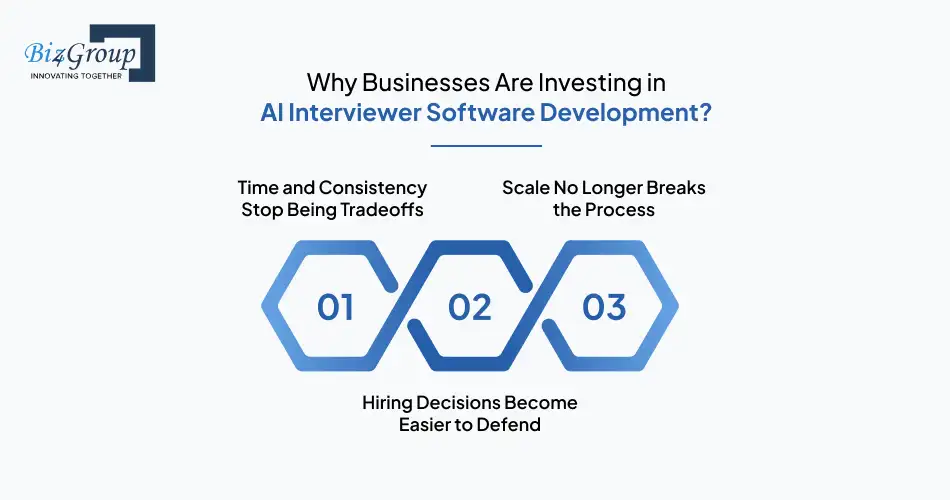
When hiring volume grows and speed starts to slip, leaders begin looking for systems instead of fixes. AI interviewer software development enters the picture as a way to bring structure, consistency, and calm back into early hiring decisions.
Recruiters no longer repeat the same conversations across dozens of candidates. Interviews follow a defined structure that stays consistent regardless of who applies. This makes it easier to automate recruitment process without losing clarity or control.
Every candidate is evaluated using the same criteria and flow. Patterns and insights are visible instead of buried in notes. This is often where automated interview software development with AI reinforces the importance of AI in HR by bringing objectivity into early screening.
Hiring spikes do not overwhelm recruiters or delay candidates. Systems adjust to volume without adding headcount. Teams that build virtual AI interviewer systems benefit from enterprise AI solutions that support growth quietly in the background.
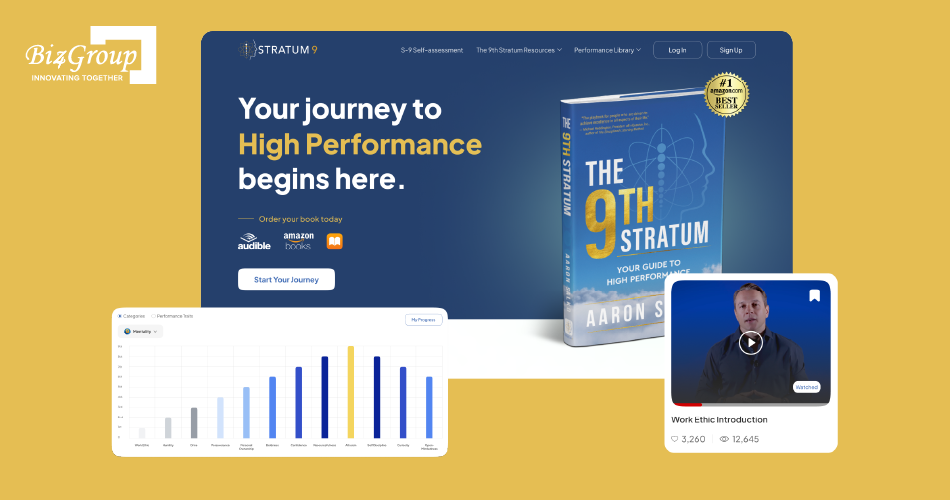
Stratum 9 InnerView is an AI driven hiring platform built by Biz4Group, focused on behavioral insight and adaptive interview guidance. It combines structured evaluation with human context, helping recruiters understand how candidates think, respond, and adapt. This approach closely mirrors how modern AI interviewer systems move beyond static questions toward more nuanced, decision-ready screening.
As teams mature, the focus shifts from experimenting to refining. That is when custom AI interviewer software development becomes part of broader conversations around how hiring workflows connect to real world use cases.
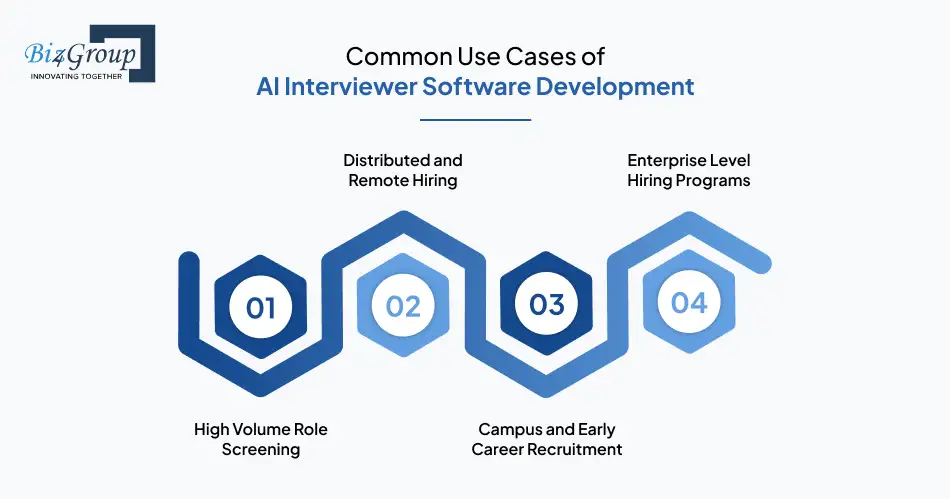
Hiring challenges look different across teams, but the pressure is familiar everywhere. As roles multiply and timelines tighten, AI interviewer software development shows up in practical ways that support real hiring needs. The most common use cases below reflect where teams see immediate value.
When applications arrive in the hundreds, early interviews become repetitive and slow. Teams use AI systems to run structured first round interviews that apply the same criteria to every candidate. This is often where companies begin to develop intelligent interview automation platforms with support from AI automation services.
Remote teams struggle with time zones, scheduling gaps, and inconsistent interviewer availability. AI interviewers allow candidates to complete interviews on their schedule while keeping evaluation standards intact. Some teams use this approach to create AI driven hiring interview software while others explore how to integrate AI into an app that already exists.
Graduate hiring requires speed and fairness at scale. AI interviewers help standardize early assessments while giving recruiters clean data to compare candidates. This is a common entry point into AI recruitment interview software development, especially when timelines are compressed.
Large organizations often manage hiring across departments, roles, and locations. AI interviewers bring consistency where manual processes fall apart. These scenarios typically require teams to develop scalable AI interviewer solutions for enterprises and plan for long term enterprise AI agent development.
|
Use Case |
Hiring Challenge |
Outcome |
|
High volume roles |
Recruiter overload |
Faster shortlisting |
|
Remote hiring |
Scheduling delays |
Flexible interviews |
|
Campus recruitment |
Scale and fairness |
Consistent evaluations |
|
Enterprise hiring |
Process fragmentation |
Unified screening |
Across these scenarios, teams often experiment with generative AI in HR as they move from basic automation to more thoughtful hiring systems. As adoption deepens, attention naturally shifts toward the features that turn early screening into meaningful evaluation.
Once teams move past the idea stage, the real question becomes practical. What actually needs to exist inside the system for it to work in real hiring scenarios? AI interviewer software development succeeds when the core features support recruiters without getting in their way, starting with the fundamentals below:
|
Core Feature |
Why It Matters in Hiring |
|
Role based question configuration |
Keeps interviews aligned with job requirements instead of generic screening |
|
Automated interview scheduling |
Removes back and forth coordination with candidates |
|
Text, audio, and video interview support |
Gives flexibility based on role and hiring volume |
|
Structured response capture |
Ensures every candidate is evaluated using the same format |
|
Candidate progress tracking |
Helps recruiters see where each applicant stands at a glance |
|
Interview scoring and summaries |
Turns raw responses into usable hiring insights |
|
Bias control rules |
Maintains fairness across early stage evaluations |
|
ATS and HR system integration |
Fits naturally into existing hiring workflows |
|
Recruiter review dashboard |
Centralizes interview data for faster decisions |
|
Secure data handling |
Protects candidate information and interview records |
Behind the scenes, these features often rely on conversational flows similar to an AI conversation app, keeping candidate interactions clear and predictable without feeling robotic.
When these basics are done right, teams can confidently develop AI interviewer software for HR teams that handles volume, consistency, and structure. Now, let's explore the advanced capabilities that add deeper insight without complicating the experience.
Learn how teams build AI powered interview software that handles volume without burning recruiters out.
Design My AI Interview PlatformOnce the basics are stable, teams start asking sharper questions about insight and differentiation. This is where AI interviewer software development moves beyond efficiency and into intelligence, shaping how hiring decisions improve over time through the advanced capabilities below.
Advanced systems look beyond individual answers and surface patterns across interviews. These insights help teams anticipate candidate success instead of reacting after the fact. This layer often relies on generative AI models trained on hiring outcomes.
Questions adjust in real time based on how candidates respond. The interview feels more natural while still staying structured. This is a common ask within custom AI interviewer software development services and is influenced by how use cases of AI chatbot in HR evolve.
Advanced features flag potential bias patterns across interviews and scoring. Recruiters can see why decisions were suggested rather than accepting opaque outputs. This capability becomes critical during AI agent implementation in regulated hiring environments.
Different roles demand different signals, and advanced systems account for that. Models are tuned to role expectations rather than generic benchmarks. Teams building AI interviewer solutions for startups and enterprises often prioritize this depth early.
The system improves as more interviews are completed and reviewed. Feedback loops help refine scoring logic without disrupting hiring workflows. This is where collaboration with a software development company in Florida often supports long term tuning.
At this stage, conversations naturally shift toward who can support this level of complexity and scale. Choosing the best company to develop AI interviewer software becomes less about features and more about execution depth and partnership fit.
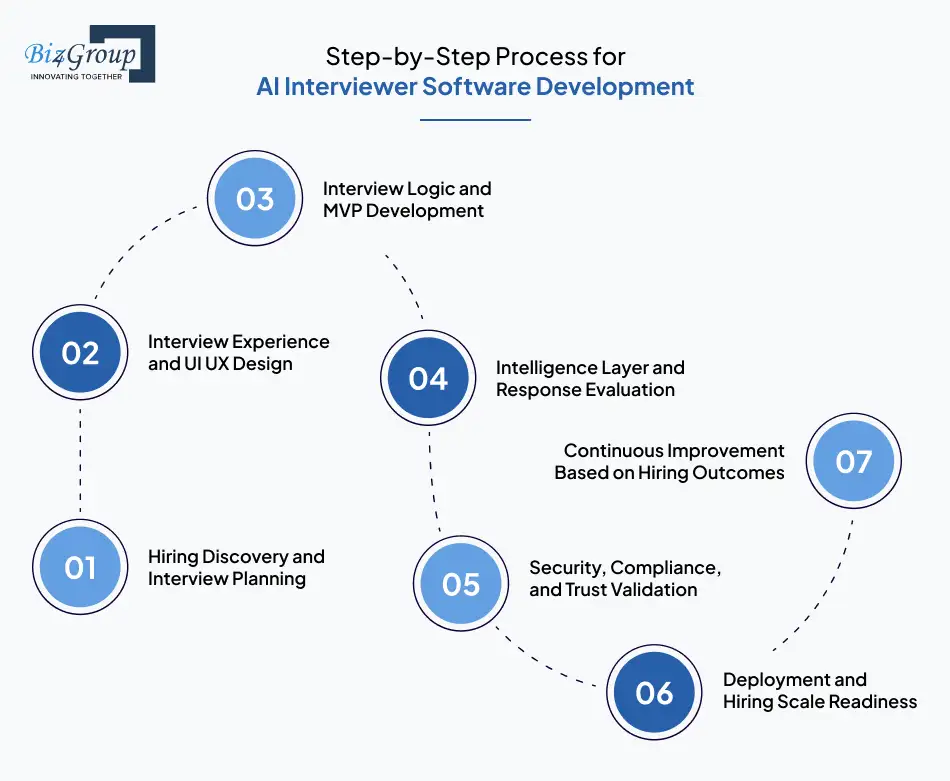
Building an AI interviewer is less about technology choices and more about correcting what breaks in early hiring conversations. AI interviewer software development starts by turning scattered interviews into a system that behaves the same way every time, regardless of volume or interviewer availability.
This phase begins by looking honestly at how first round interviews happen today. Which roles suffer from rushed conversations? Where do interviewers improvise? Where do candidates disengage? Teams use this step to define how interviews should run before attempting to design anything.
This clarity is what allows teams to develop AI interviewer platforms that mirror real hiring behavior instead of theoretical workflows.
Candidates do not separate the interview experience from the brand. If instructions feel unclear or interactions feel robotic, trust erodes quickly. This step focuses on making interviews feel structured yet human, while giving recruiters views that surface decisions, not raw data.
Thoughtful design made by a reputed UI/UX design company here directly impacts completion rates.
Also read: Top UI/UX design companies in USA
An AI interviewer earns trust by working reliably before becoming intelligent. MVP development services help in proving that structured interviews improve early hiring decisions. This is where teams start to build AI powered interview software that replaces repetition with consistency.
Also read: Top 12+ MVP Development Companies to Launch Your Startup in 2026
Once interviews run smoothly, intelligence is introduced carefully. The goal is not prediction for its own sake, but support for better judgment. At this stage, teams create AI interviewer tools for hiring that highlight patterns while keeping humans in control.
This is where automated interview software development with AI starts to add meaning, not just speed.
Interview data includes personal stories, voice recordings, and video. Mishandling it breaks trust immediately. This step ensures the system is safe to use at scale.
Security here supports credibility, not just risk management.
Also Read: Software Testing Companies in USA
Hiring demand is uneven by nature. One campaign can multiply interview volume overnight. Deployment decisions here determine whether the system supports growth or becomes fragile.
This is how teams build virtual AI interviewer systems that stay reliable under pressure.
An AI interviewer should evolve alongside hiring strategy. Roles change, signals mature, and expectations shift. This step keeps the system relevant long after launch.
At this stage, the platform becomes part of a broader AI interviewer software development services approach rather than a standalone tool.
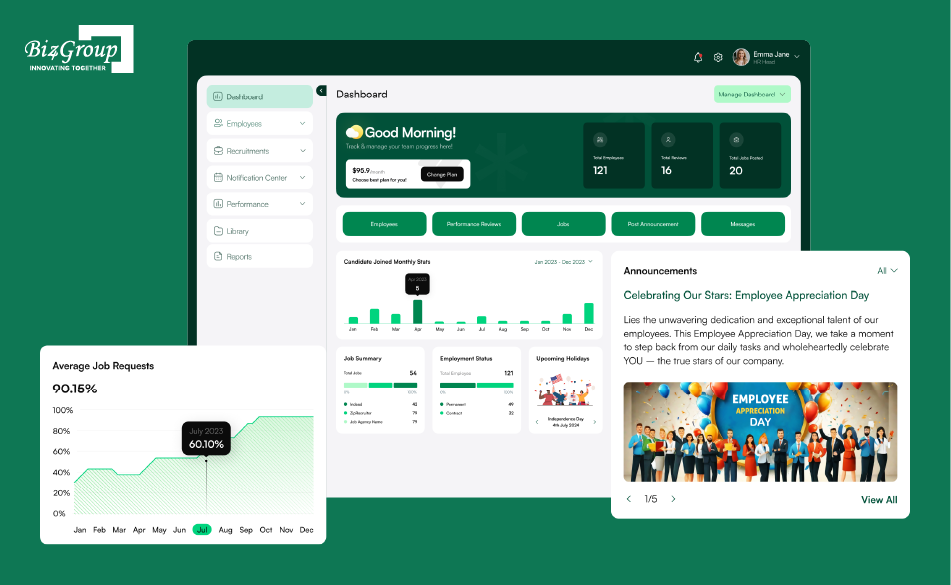
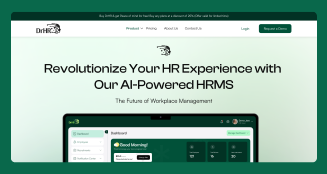
DrHR is an AI based HRMS platform designed by Biz4Group to centralize employee management, performance tracking, and HR workflows inside a single system. Built to reduce manual HR overhead, it demonstrates how intelligent automation can standardize people operations, laying the groundwork for extending similar intelligence into interview screening and early hiring decisions.
When these steps are followed with intention, the result is not just a working product but a hiring system teams actually trust. That is the difference thoughtful AI interviewer software development makes. It turns early interviews into a repeatable process that improves with every hiring cycle.
See how companies develop AI interviewer platforms that stay reliable under pressure.
Plan My AI Interviewer PlatformThe tech stack behind an AI interviewer decides whether the product feels smooth or frustrating, scalable or fragile. For hiring teams, this is less about trendy tools and more about choosing technologies that support real interview flows, real users, and real growth.
|
Label |
Preferred Technologies |
Why It Matters |
|
Frontend Framework |
ReactJS, VueJS |
Candidate interview screens must be fast and intuitive to avoid drop offs. Many teams rely on ReactJS development to build interactive interview flows that feel natural. |
|
Server-Side Rendering & SEO |
NextJS, NuxtJS |
Recruiter dashboards and candidate portals benefit from faster load times and stability. NextJS development helps during high traffic hiring campaigns. |
|
Backend Framework |
NodeJS, Python |
This layer manages interview orchestration and evaluation logic. NodeJS development supports real time interview flows, while Python development handles AI driven processing. |
|
REST APIs, GraphQL |
APIs connect interview flows with ATS, calendars, and analytics tools. Clean API design ensures the interviewer fits naturally into existing hiring ecosystems. |
|
|
AI & Data Processing |
ML frameworks, NLP libraries |
This layer interprets candidate responses and applies scoring logic aligned to role requirements. Strong data processing keeps evaluations structured and consistent. |
|
Interview Media Handling |
WebRTC, Cloud media services |
Video and audio interviews must work reliably across devices. This stack minimizes technical failures that disrupt candidate experience. |
|
Authentication & Access Control |
OAuth, JWT, Role based access |
Hiring data is sensitive. Proper authentication ensures only authorized recruiters and admins access interviews and evaluations. |
|
Data Storage |
PostgreSQL, Secure object storage |
Structured databases support interview scoring and metadata, while object storage safely handles audio and video files. |
|
Integration Layer |
Webhooks, Third party connectors |
Hiring tools rarely operate in isolation. This layer keeps the interviewer synced with HR and recruitment systems already in use. |
|
Cloud Infrastructure |
AWS, Azure, or GCP |
Hiring demand fluctuates sharply. Cloud platforms ensure the system scales smoothly during hiring spikes. |
|
Monitoring & Reliability |
Logs, Alerts, Performance dashboards |
Teams need visibility into interview completion rates, failures, and system health to maintain trust in the platform. |
By covering API development, access control, and reliability alongside core technologies, this stack reflects what AI interviewer software actually needs in production. From here, the natural next question is how this stack translates into real costs at MVP, mid level, and enterprise stages of AI interviewer software development.
The cost of building an AI interviewer depends on how deep you want to go and how fast you want to scale. For most teams, AI interviewer software development typically falls in the $30,000 to $200,000 plus range. This is a ballpark figure, shaped by scope, complexity, and long-term goals.
|
Build Level |
Typical Cost Range |
What You Get |
|
MVP-level AI Interviewer Software |
$30,000 to $60,000 |
Basic first round interviews, role based questions, structured responses, recruiter review dashboard, built during MVP software development phase. |
|
Mid Level AI Interviewer Software |
$60,000 to $120,000 |
Multiple interview formats, smarter evaluation logic, ATS integrations, better analytics and reporting |
|
Enterprise-grade AI Interviewer Software |
$120,000 to $200,000 plus |
Advanced intelligence layers, scalability for high volume hiring, compliance controls, deeper customization |
What usually drives cost up or down is not just features, but decisions around scale, security, and intelligence depth. Teams often underestimate how much effort goes into making interviews feel consistent and fair at volume. This is why budgeting for custom HR software development cost upfront helps avoid surprises later.
As hiring needs mature, many organizations move beyond one size fits all tools and invest in custom AI interviewer software development that fits their workflows precisely. At that point, the conversation naturally shifts toward how such platforms can create long-term value and revenue opportunities rather than just operational savings.
Custom AI interviewer software development creates workflows that recruiters actually trust.
Customize My AI Interview SystemOnce teams move past building and adoption, monetization becomes the next real question. AI interviewer software development opens up flexible revenue paths depending on who the product serves and how deeply it fits into hiring workflows. The models below reflect how teams actually pay for hiring value.
This model works when the platform becomes part of everyday hiring operations. Pricing is usually tiered by interview volume, active roles, or recruiter seats. It aligns well with products designed to automate recruitment process at scale.
Some organizations prefer costs that move with demand. This model lowers adoption friction and suits seasonal or project driven hiring. It is common when teams develop intelligent interview automation platforms that serve fluctuating workloads.
Large companies often want predictable pricing and deeper control. Enterprise licenses usually cover unlimited interviews, departments, and regions. These models frequently involve AI integration services to align with existing hiring systems.
Some founders and agencies monetize by offering the platform under their own brand. This approach fits teams focused on business app development using AI and often supported by product development services for long term client delivery.
As revenue models settle, product decisions become more deliberate. Teams working on AI recruitment interview software development often refine pricing alongside scale and performance goals, which naturally brings best practices into focus next.
Strong outcomes come from discipline, not shortcuts. AI interviewer software development works best when teams treat it as a hiring system first and a technology project second, which makes the following practices especially important.
Start with what recruiters actually decide after first round interviews. Structure questions, scoring, and summaries around those decisions instead of raw data. This mindset helps teams develop AI interviewer software for HR teams that recruiters trust and use consistently.
Early success often creates pressure to add intelligence too fast. Focus first on reliability, consistency, and performance before layering sophistication. This approach makes it easier to develop scalable AI interviewer solutions for enterprises without reworking core architecture later.
AI should support judgment, not replace it. Recruiters need visibility, override options, and clear reasoning behind outputs. This balance mirrors the real benefits of HR chatbots, where assistance works best alongside human context.
Interview intelligence requires both hiring expertise and technical depth. Teams often move faster when they hire AI developers who understand recruitment workflows, or partner with experienced firms from the top AI development companies in Florida ecosystem.
Over time, these practices reduce risk and increase adoption. That is usually when teams start evaluating who can support long term execution and decide what makes the best company to develop AI interviewer software for their goals.
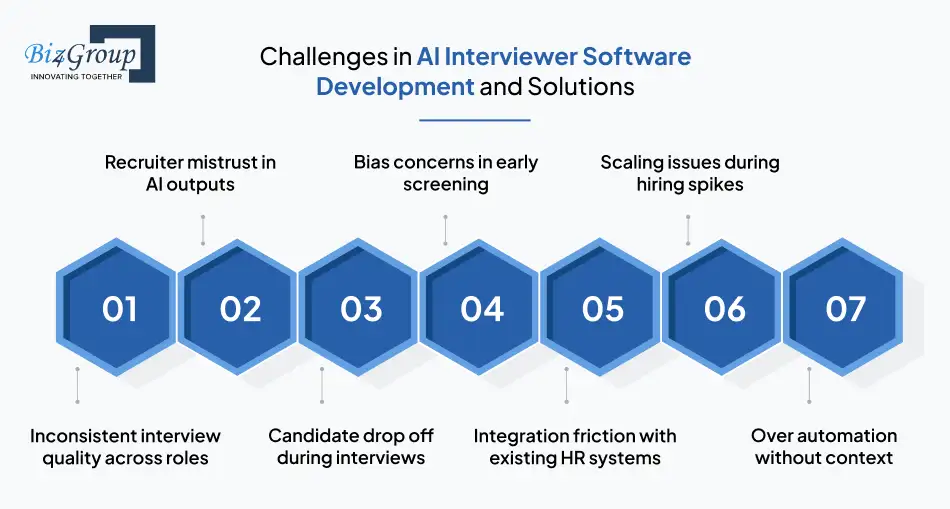
Every hiring system looks promising on paper until real candidates and recruiters start using it. AI interviewer software development delivers value only when teams plan for the friction that shows up during real hiring cycles. These are the most common hurdles and how teams address them:
|
Top Challenges |
How to Solve Them |
|
Inconsistent interview quality across roles |
Define role specific question frameworks and scoring logic early so interviews behave predictably across departments |
|
Recruiter mistrust in AI outputs |
Keep humans in the loop with clear summaries, override options, and transparent evaluation signals |
|
Candidate drop off during interviews |
Design shorter, well guided interview flows that feel conversational rather than rigid |
|
Bias concerns in early screening |
Train models on diverse datasets and review outputs regularly when working with generative AI agents |
|
Integration friction with existing HR systems |
Use clean APIs and phased rollouts so the interviewer fits naturally into current hiring tools |
|
Scaling issues during hiring spikes |
Plan infrastructure for peak loads before launch to avoid failures during large recruitment drives |
|
Over automation without context |
Decide clearly where AI supports judgment instead of trying to replace it end to end |
When these challenges are addressed early, adoption becomes smoother and trust builds faster. This is usually the point where organizations look beyond experiments and commit to custom AI interviewer software development services, while also thinking about what the future of AI led hiring could look like.
Automated interview software development with AI brings fairness and clarity to early hiring.
Conduct Smarter Interviews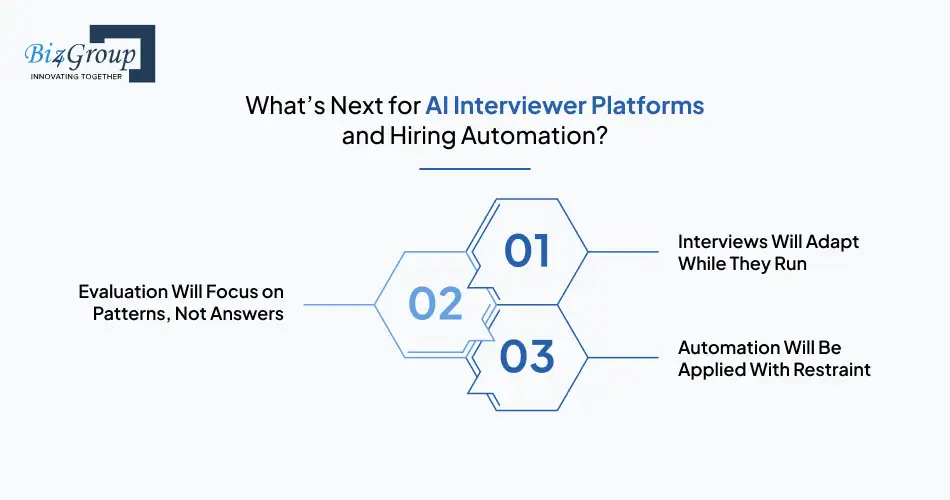
Hiring is entering a phase where systems are expected to think alongside recruiters, not just move faster. AI interviewer software development is evolving toward deeper decision support, and the next shifts will reshape how early interviews are designed and trusted.
Future interviewers will change depth and direction based on how candidates respond, not fixed scripts. This allows teams to develop AI interviewer platforms that probe deeper when answers matter and move faster when signals are clear. Interviews start feeling intentional instead of repetitive.
The next generation will look across interviews, roles, and outcomes to spot trends recruiters miss. Built by teams similar to an AI chatbot development company, these systems will surface why candidates succeed over time, not just how they answered one question.
Instead of automating everything, teams will automate recruitment process only where inconsistency hurts hiring quality. This is where AI interviewer solutions for startups and enterprises take shape, balancing structure, scale, and visible human judgment.
As this direction becomes clearer, leaders start planning beyond features and tools. That is when thoughtful AI interviewer software development services begin shaping long-term hiring strategy rather than short term fixes.
An AI interviewer touches hiring bias, candidate trust, recruiter judgment, and system reliability all at once. That combination is exactly where most teams get stuck.
Biz4Group has already been in those rooms.
While building AI driven HR platforms like DrHR, the team has worked through the realities that matter here. Structured evaluations. Sensitive people data. HR workflows that break when automation goes too far. These are the same pressure points that show up when AI starts conducting interviews instead of just supporting them.
As an experienced AI development company, Biz4Group does not treat AI interviewers as standalone tools. They are designed as extensions of hiring systems that already exist, with clear boundaries on what AI should do and where humans stay in control. That perspective only comes from building production HR platforms, not demos.
What clients usually notice first is how practical the conversations are. Instead of leading with models or buzzwords, discussions start with questions like how recruiters will actually review interviews, where bias can creep in, and what happens when hiring volume spikes overnight. Those answers shape the product long before code is written.
If you are looking to build an AI interviewer that feels calm, fair, and explainable instead of clever but fragile, this is the kind of experience that shows up quietly in the final product.
Discover how thoughtful AI interview systems support judgment instead of replacing it.
Start My AI Interviewer JourneyHiring will probably never be easy, but it does not have to be chaotic. AI interviewer software development is really about bringing calm to the noisiest part of recruitment. When done right, it replaces rushed first rounds with structure, gives candidates a fair shot, and lets recruiters focus on judgment instead of logistics.
The real win is not speed alone, but clarity at scale. For teams ready to build AI software that fits how hiring actually works, it's no longer an experiment- it's is a practical shift.
Are you planning to move from ideas to execution with a team that knows HR systems inside out? Let’s Build Your AI Interviewer Software
Yes. Modern platforms are designed so interview logic, question depth, and evaluation criteria can change by role. This flexibility is why many organizations invest in custom AI interviewer software development, allowing interviews to reflect real job expectations instead of generic screening.
It is, but implementation differs. Smaller teams focus on speed and simplicity, while larger organizations prioritize governance and scale. Well designed AI interviewer solutions for startups and enterprises account for these differences without forcing one hiring model onto everyone.
Timelines vary based on scope. A focused MVP may take a few months, while enterprise ready systems take longer. Teams that plan properly and develop AI interviewer platforms in phases usually see faster adoption and fewer rebuilds.
Accuracy depends on structure, training data, and human oversight. Systems built thoughtfully for AI recruitment interview software development emphasize consistency and signal detection rather than trying to replace recruiter judgment entirely.
Yes. Integration is a core requirement, not an add on. Most modern systems are designed so companies can develop scalable AI interviewer solutions for enterprises that connect cleanly with ATS, calendars, and internal hiring workflows.
Costs usually fall between $30,000 and $200,000+, depending on complexity, scale, and intelligence depth. Organizations investing in automated interview software development with AI often start lean and expand features as hiring needs mature.

with Biz4Group today!
Our website require some cookies to function properly. Read our privacy policy to know more.