 Location :
Orlando, FL, USA
Location :
Orlando, FL, USA +1 (407) 714-1616
 info@biz4group.com

- AI marketplace workflow automation software development organizes how tasks move across the platform, ensuring structured execution without manual coordination across marketplace operations
- The software defines how workflows are triggered, routed, and completed, helping marketplaces maintain consistent execution across vendors, orders, and system interactions
- To create AI workflow automation software for marketplaces, focus on workflow structure, data flow, and system-level execution control instead of isolated task automation
- Platforms differ based on business needs, whether SaaS-based, custom-built, or enterprise systems designed for multi-layer workflow coordination and system connectivity
- The cost to develop AI marketplace workflow automation software typically ranges from $30,000 to $200,000+, depending on workflow complexity, integrations, and how deeply automation is embedded into operations
- At Biz4Group LLC, we help businesses make AI marketplace automation software for businesses that aligns with real workflows and supports scalable execution across evolving marketplace environments
Why do marketplace operations start breaking down even when demand is growing?
As more vendors join and transactions increase, the challenge shifts to managing how work actually moves across the platform. Vendor approvals, order routing, inventory updates, and payment handling begin to depend on multiple systems working together.
What starts as manageable workflows quickly turns into operational complexity when execution is not structured. In order to address the issue, businesses have started adopting AI marketplace workflow automation software that brings structure to workflows across the marketplace. It helps standardize execution across systems and maintain consistency as operations scale.
However, implementing this kind of structured execution across a marketplace is not plug-and-play. It requires building workflow logic that aligns with your platform’s transaction flows, vendor interactions, and operational dependencies. This is where AI marketplace workflow automation software development becomes critical, ensuring that automation is designed around how your marketplace actually operates.
But before we walk you through what the software automates or how it’s built, here’s something you should know:
- Around 42% of business leaders claim workflow automation helps reduce time spent on repetitive operational tasks, directly impacting how efficiently teams handle growing workloads.
- The workflow automation market is projected to grow from USD 26.01 billion in 2026 to USD 40.77 billion by 2031, showing how execution-focused systems are becoming essential.
- About 57% of IT leaders report 10–50% of cost savings in processes linked to manual handling, especially in transaction-heavy environments.
Businesses that develop intelligent workflow automation software for AI marketplaces gain better control over execution and costs and working with the right software development company helps structure this early. Now, let’s look at what this software is and how it is actually built.
What Is AI Marketplace Workflow Automation Software?
AI marketplace workflow automation software is an AI-powered system that manages how tasks move and get executed across a marketplace platform. It acts as a structured layer that controls how workflows are initiated, processed, and completed without relying on manual coordination. The system:
- Defines how tasks flow between different parts of the marketplace
- Uses AI to guide decisions within workflow execution
- Ensures tasks follow a predefined sequence of actions
- Maintains continuity across interconnected processes
The system focuses on organizing execution rather than performing individual tasks, allowing marketplace operations to run through a controlled and system-driven workflow structure.
But how does this system actually operate once it’s in place? Let us look at how workflows are structured and executed across different stages of the marketplace:
1. Vendor Onboarding and Verification Workflows
Vendor onboarding workflows manage how sellers enter the marketplace system. This includes handling vendor registration, validating submitted documents for compliance and KYC requirements, and routing approval decisions through predefined verification stages before activation.
2. Order Processing and Fulfillment
Order workflows define how transactions move from placement to completion. This includes routing orders to the right vendor or system, coordinating fulfillment steps, and updating order status as it progresses through different execution stages.
3. Inventory and Catalog Management
This process manages how product data is maintained across the marketplace. This includes updating product listings, synchronizing inventory across multiple vendors, and tracking availability status to ensure accurate representation of items.
4. Pricing and Commission Management
AI automation software controls how pricing rules are applied within the system. This includes executing predefined pricing logic, calculating commissions for each transaction, and applying discount structures based on defined marketplace conditions.
5. Customer Support and Ticketing
Support workflows manage how customer queries are handled across the platform. This includes creating support tickets, routing them based on query type, classifying incoming requests, and managing escalation paths for unresolved issues.
6. Payment, Billing, and Settlement
This process defines how financial transactions are processed within the marketplace. This includes managing vendor payouts, generating invoices for transactions, and handling reconciliation processes to ensure records are aligned across systems.
AI marketplace workflow automation software brings structure to how tasks move across the platform by defining clear execution paths. It ensures workflows are handled in a consistent and controlled manner, allowing marketplace operations to run through a unified system-driven approach.
What Key Operational Benefits Does the AI Marketplace Workflow Automation Software Offers?
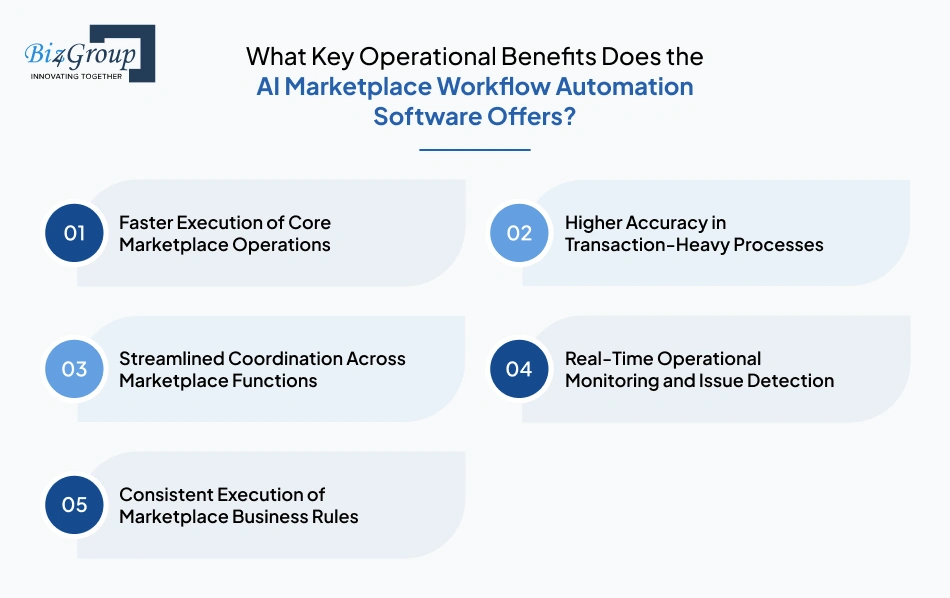
The operational performance defines how smoothly a marketplace runs on a daily basis. AI marketplace operations automation software development focuses on improving execution quality, so workflows move faster, remain consistent, and stay manageable across increasing transaction volumes.
1. Faster Execution of Core Marketplace Operations
AI marketplace workflow automation software improves execution speed as workflows no longer depend on manual triggers. Actions are initiated automatically based on defined conditions across the platform and it:
- Lessen the time required to complete core workflows across the platform
- Speeds up task transitions between different stages of execution
- Ensures faster completion of repetitive processes without delays
- Improves overall workflow turnaround across high-volume operations
- AI automation tools help trigger actions instantly based on predefined conditions
2. Higher Accuracy in Transaction-Heavy Processes
AI marketplace operations automation software development ensures that high-volume transactions are handled with consistent logic. Each action follows the same predefined rules without variation and:
- Reduces inconsistencies in handling large volumes of transactions
- Ensures actions are performed in a uniform manner across workflows
- Maintains consistency in execution across repeated operations
- Minimizes variations in output across similar transaction types
- AI business process automation supports consistent handling of structured data inputs
3. Streamlined Coordination Across Marketplace Functions
AI-driven workflow automation connects different marketplace functions through structured execution paths. This ensures tasks move smoothly across systems and teams by:
- Aligning workflows across vendor management, orders, and support functions
- Ensuring smooth handoff of tasks between different teams and systems
- Reducing friction in multi-step workflow execution
- Maintaining continuity across interconnected marketplace processes
- Enabling better synchronization across different operational functions
4. Real-Time Operational Monitoring and Issue Detection
The marketplace automation software provides continuous visibility into how workflows are progressing. This allows teams to track execution as it happens and it:
- Provides visibility into workflow status across different stages
- Enables quick identification of process interruptions
- Tracks ongoing activities in real time across the platform
- Helps detect workflow delays as they occur
- Supports faster response to operational issues through continuous monitoring
5. Consistent Execution of Marketplace Business Rules
The system ensures that business rules are applied uniformly across all workflows. Every process follows the same defined logic.
- Applies predefined rules uniformly across all workflows
- Ensures standardization in how processes are executed
- Maintains consistency across different transaction scenarios
- Reduces variation in workflow outcomes
- Supports structured execution aligned with defined business logic
AI marketplace workflow automation software development helps bring structure and consistency to marketplace execution. With the right automation approach, businesses can maintain smooth operations even as transaction volume and system complexity continue to grow.
Also Read: AI Automation Use Cases for Enterprises to Scale Faster
Why Should Marketplace Businesses Invest in AI Workflow Automation Software Development?
Marketplace growth often increases costs faster than revenue, making financial efficiency a priority. Many businesses now make AI marketplace automation software for eCommerce platforms to control costs, protect margins, and maintain consistent revenue as transaction volumes scale. Here take a look at the reasons to invest:
1. Lower Cost Per Transaction Across Marketplace Operations
Reducing the cost per transaction directly improves profitability, especially in high-volume environments where small savings compound quickly over time.
- Reduces the cost associated with processing each order or vendor transaction
- Improves margin per transaction as volume increases
- In many cases, cost per transaction can decrease by around 20–40% as systems stabilize
Lower transaction cost creates a stronger financial base and allows marketplaces to remain competitive while handling increasing demand.
2. Reduced Hiring and Operational Expansion Costs
As marketplaces grow, expanding teams becomes one of the largest cost drivers. Controlling workforce-related expenses is critical to maintaining financial balance and AI marketplace workflow automation software helps:
- Limit the need to increase workforce in direct proportion to growth
- Reduce spending on support and operational roles
- Many businesses reduce hiring growth by around 25–50% in structured environments
This ensures that scaling the platform does not result in uncontrolled labor costs, helping maintain a more predictable and sustainable cost structure.
3. Increased Revenue Through Better Process Efficiency
Revenue depends on how effectively demand converts into completed transactions. Improving consistency in execution ensures more of that demand results in actual earnings. AI marketplace workflow automation software:
- Increases the number of successfully completed transactions
- Reduces missed revenue opportunities across the platform
- Many marketplaces see a 10–25% improvement in revenue capture
This leads to stronger revenue realization, where a higher percentage of platform activity converts into measurable financial output.
4. Improved Vendor Retention and Marketplace Participation
Vendor stability has a direct impact on revenue continuity and marketplace consistency. When vendors remain active, transaction volume stays stable and predictable. It
- Encourages long-term participation from active vendors
- Reduces vendor drop-offs that affect overall marketplace supply
- Many platforms see retention improvements of around 15–30% with stable systems
A consistent vendor base ensures steady transaction flow, which directly supports reliable revenue generation and reduces fluctuations in marketplace performance over time.
5. Scalable Growth Without Proportional Cost Increase
Sustainable AI marketplace growth depends on increasing revenue without matching increases in cost. This balance is critical for long-term profitability as it:
- Supports higher transaction volumes without equivalent cost increase
- Improves cost-to-revenue ratio as the platform expands
- Many marketplaces achieve 2x–3x growth without proportional cost expansion
This creates a more efficient financial structure where growth contributes to higher profitability instead of increasing overall cost pressure.
6. Reduced Revenue Leakage and Margin Losses
As transaction volume grows, small financial gaps can impact overall margins if not controlled properly. Retaining revenue becomes a key financial priority and AI marketplace workflow automation software:
- Reduces loss of revenue across transactions and settlements
- Strengthens consistency in margin performance
- Many businesses reduce revenue leakage by around 10–20%
This ensures that more of the generated revenue is retained within the system, improving profitability, and maintaining stronger financial stability across marketplace operations.
7. Better Utilization of Existing Resources and Infrastructure
Improving how existing systems are used can significantly increase return on investment without requiring additional spending. By automating AI marketplace workflow businesses can:
- Increase output from current infrastructure and deployed systems
- Improve return on existing technology investments
- Also, resource utilization can improve by around 20–35%
This allows businesses to support growth using available resources, reducing the need for continuous capital investment while maintaining strong financial efficiency when supported by reliable AI automation services.
Now that the financial impact is clear, it helps to see how outcomes differ when moving from traditional rule-based systems to AI-driven marketplace workflow automation.
Table: Rule-Based Systems vs AI Marketplace Workflow Automation Software
|
Parameter |
Rule-Based / Traditional Systems |
AI Marketplace Workflow Automation Software |
|---|---|---|
|
Cost Per Transaction |
Higher due to manual involvement and fixed rules |
Lower as automation reduces per-transaction cost over time |
|
Hiring Costs |
Requires continuous team expansion with growth |
Controlled workforce growth with reduced dependency on hiring |
|
Revenue Capture |
Revenue loss due to missed or incomplete transactions |
Higher revenue realization through consistent transaction completion |
|
Vendor Retention |
Higher drop-offs due to inconsistent system performance |
Improved vendor stability and long-term participation |
|
Scalability |
Costs increase proportionally with growth |
Growth achieved without matching cost increase |
|
Revenue Leakage |
Financial gaps due to inefficiencies in transactions |
Reduced leakage with better financial control |
|
Resource Utilization |
Underutilization of existing systems and infrastructure |
Improved utilization and higher return on existing investments |
AI marketplace workflow automation software development brings stronger financial control by aligning cost structures with revenue flow and growth plans. With well-planned AI integration aligned with enterprise AI solutions, marketplace businesses can scale with greater predictability and stability.
Still Running High-Cost Marketplace Operations?
Margins shrink when execution stays manual while volume keeps increasing
Fix My Cost StructureTypes of AI Marketplace Workflow Automation Platforms Based on Business Needs
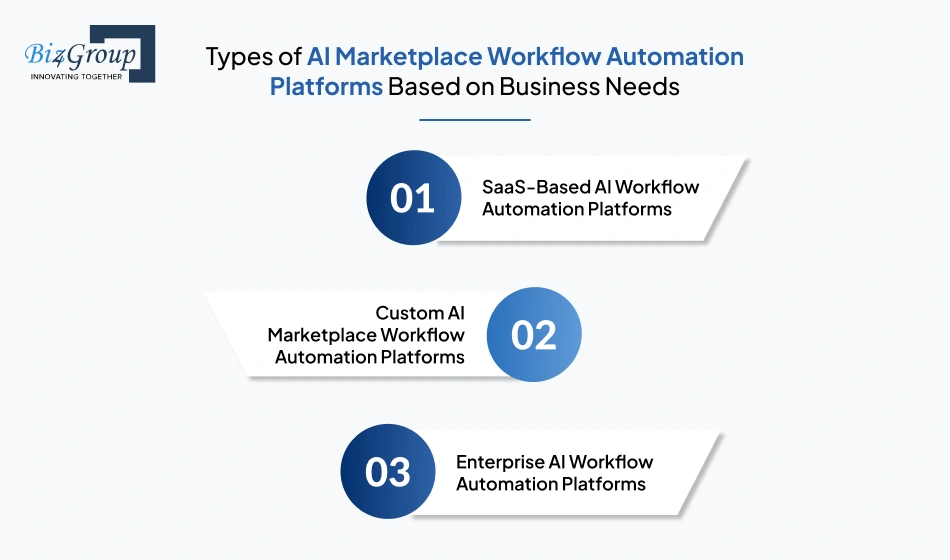
The different marketplace businesses approach workflow automation in different ways depending on their scale, operational structure, and long-term plans. AI marketplace workflow automation software development is not limited to one format, and the approach you take depends on how much control and flexibility you need. We have listed some of the top AI workflow automation for marketplaces:
1. SaaS-Based AI Workflow Automation Platforms
- When it fits – Suitable for early-stage or growing marketplaces that need quick setup without long development cycles. It works well when speed of implementation matters more than deep customization.
- How it is used – Businesses rely on ready-to-use systems managed by external providers. Most operational logic is handled within predefined system boundaries.
- Level of control – Limited control over workflow logic and system behavior. Custom changes are often restricted to available configuration options
- Who typically chooses it – Teams working with AI automation companies to get started quickly without building from scratch. This approach helps teams launch faster without investing in full-scale development
2. Custom AI Marketplace Workflow Automation Platforms
- When it fits: Ideal for businesses with unique workflows that cannot fit into predefined systems. It suits marketplaces with specific operational requirements and process flows
- How it is used: The platform is built around specific marketplace operations and execution patterns. Workflow logic is defined based on how the business actually operates.
- Level of control: Full control over how workflows are structured and managed. Businesses can modify and extend workflows as their operations evolve
- Who typically chooses it: Businesses that plan to build AI marketplace workflow automation platform tailored to their operational model. This approach is preferred when long-term flexibility is a priority for marketplace owners.
3. Enterprise AI Workflow Automation Platforms
- When it fits: Suitable for large marketplaces with complex operations and multiple system dependencies. It supports environments where workflows span across multiple interconnected systems
- How it is used: Designed to handle high-volume workflows across multiple layers and systems. It manages execution across different departments and operational layers
- Level of control: High control with structured governance across workflows. Control mechanisms are defined to manage large-scale workflow execution consistently
- Who typically chooses it: Organizations that require strong AI integration services to connect automation across enterprise systems. This approach is used when coordination across systems becomes a core requirement.
Each approach depends on how your marketplace operates and how much flexibility you need in managing workflows. The right platform type aligns with your operational structure rather than forcing your processes into a fixed system.
Must Have Features to Develop Intelligent Workflow Automation Software for AI Marketplaces
The effectiveness of any automation system depends on how its core capabilities are structured and connected. When businesses create AI workflow automation platform for multi-vendor marketplaces, these capabilities define how workflows are executed and controlled.
|
Feature |
Description |
|---|---|
|
Workflow Orchestration Engine |
Manages how tasks move across different stages and ensures workflows follow a defined execution path. It maintains continuity between interconnected processes across the marketplace. |
|
Rule-Based Execution Layer |
Defines conditions under which actions are triggered and executed across workflows. It ensures that actions are initiated only when specific criteria are met within the system. |
|
AI Decision Engine |
Applies predictive analysis to guide decisions within workflows based on data inputs. It supports decision-making by interpreting patterns from ongoing marketplace activity. |
|
Multi-Vendor Coordination Layer |
Handles interactions between multiple vendors within the same system environment. It ensures that actions across different vendors remain synchronized within workflows. |
|
Real-Time Data Processing |
Processes incoming data continuously to support ongoing workflow execution. It keeps workflow execution aligned with the latest system inputs at all times. |
|
Integration Layer |
Connects external systems such as CRM platforms and payment systems for seamless workflow execution. It enables consistent data flow between internal workflows and external services. |
|
Configurable Workflow Builder |
Allows teams to define and adjust workflows based on operational requirements. It provides flexibility to modify execution paths without restructuring the entire system. |
|
Monitoring and Tracking System |
Provides visibility into how workflows are progressing across the platform. It helps track execution flow at each stage without interrupting ongoing processes. |
|
Generative Response Layer |
Uses generative AI to handle dynamic content generation within workflow execution. It supports automated responses where content needs to be created during workflow steps. |
|
Autonomous Workflow Execution |
Supports agentic AI workflow automation where workflows can operate with minimal manual input. It allows workflows to continue execution independently once triggered. |
|
Data Management Layer |
Maintains structured and unstructured data required for workflow execution. It ensures that data is organized and accessible for different workflow stages. |
|
Access and Control Management |
Defines roles and permissions to manage how workflows are accessed and controlled. It ensures only authorized actions are performed within the system. |
To make AI marketplace automation software for businesses, the focus should remain on how these capabilities support workflow execution at scale. Clear structure and adaptability ensure the system remains consistent as marketplace operations expand.
Now let us take a look at how these features work together in a real marketplace system
Real World Implementation: Keep Watching- ECommerce Product Listing Automation
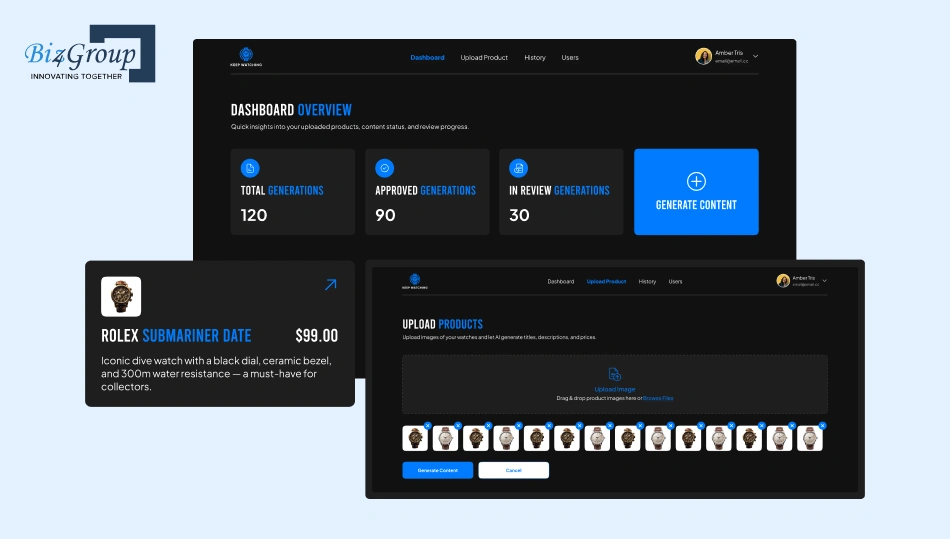
Keep Watching is built for watch sellers to generate marketplace-ready listings directly from product images. The system analyzes uploaded images to identify brand, model details, condition, and visual attributes, then converts this data into structured listings optimized for eBay without manual input.
- Image upload initiates the workflow
- AI models extract and structure product attributes
- Decision logic maps data to marketplace categories
- Generative layer creates titles and descriptions
- Workflow engine maintains consistent listing output
This reflects how marketplace workflows move from input to structured execution without manual coordination.
Missing Core Pieces in Your Automation System?
Incomplete systems create friction that slows down how workflows actually move
Show Me What's MissingHow to Develop Enterprise AI Workflow Automation Software for Marketplaces: Step-By-Step Process
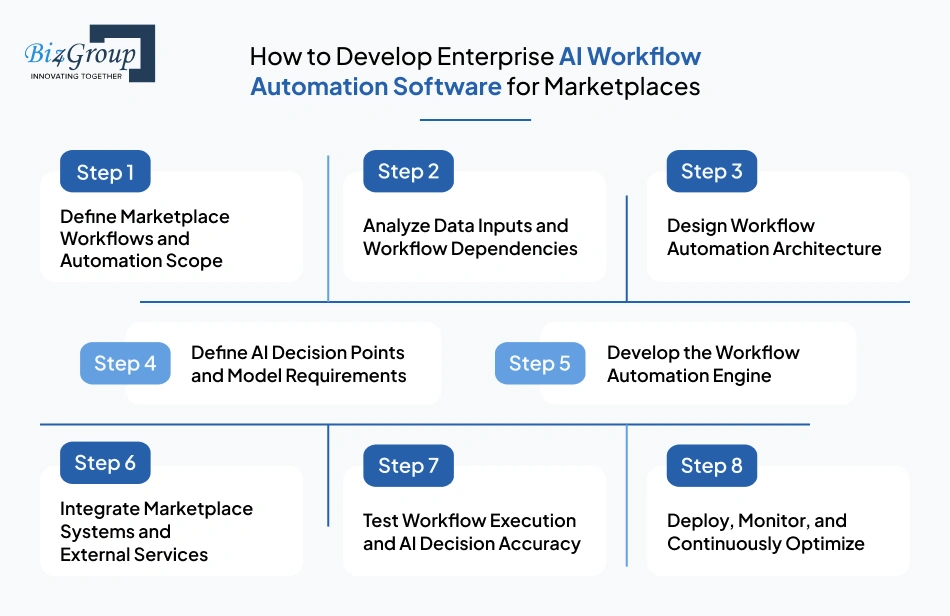
A structured approach to make AI driven workflow automation platform for marketplaces keeps automation aligned with real operations instead of abstract system design. Each step below focuses on how workflows, data, and automation logic come together to support scalable execution across marketplace environments.
Step 1: Define Marketplace Workflows and Automation Scope
Every marketplace runs on multiple interconnected workflows. The first step is to clearly identify and structure them before introducing automation.
- Identify core workflows such as vendor onboarding, order handling, payments, and support
- Map how each process currently flows across systems and teams
- Define where automation should replace manual steps and where human intervention is still required
This step ensures that the system is built around real operational needs instead of assumptions.
Step 2: Analyze Data Inputs and Workflow Dependencies
Automation decisions depend on how data moves across the platform. Without understanding inputs and dependencies, workflows cannot function reliably.
- Identify key data sources such as vendor records, transactions, and user actions
- Define what inputs are required at each workflow stage
- Validate data consistency across systems to avoid broken automation logic
This creates a stable data foundation that supports accurate workflow execution.
Step 3: Design Workflow Automation Architecture
A well-structured architecture defines how workflows interact and scale. It should support flexibility without creating unnecessary complexity.
- Choose an architecture style such as microservices or event-driven systems
- Define a central orchestration layer to manage workflow execution
- Map how systems communicate across different marketplace functions
Involving a reliable UI/UX design company at this stage helps shape clear interaction flows and control interfaces for managing automation effectively.
Also Read: Top UI/UX Design Companies in USA
Step 4: Define AI Decision Points and Model Requirements
Not every workflow needs an AI. This step focuses on identifying where intelligence adds value, and how it should be applied along with AI model selection.
- Identify decision points such as classification, prediction, or routing
- Define how each decision impacts workflow execution
- Select appropriate AI approaches and train AI models using relevant marketplace data
Careful planning at this stage ensures the system can make meaningful decisions instead of adding unnecessary complexity.
Step 5: Develop the Workflow Automation Engine
This is where the core system starts taking shape. The goal is to build a flexible engine that can manage multiple workflows without rigid dependencies.
- Build a rule engine and workflow orchestration layer
- Enable condition-based execution for different workflow paths
- Support configurable workflows that can adapt over time
Many teams work with focused MVP development services providers to implement a limited set of workflows and integrate AI models into execution logic before expanding further.
Step 6: Integrate Marketplace Systems and External Services
Marketplace automation depends on seamless connectivity between multiple systems. Integration ensures workflows can operate across the entire ecosystem.
- Connect systems such as payment gateways, CRM tools, inventory platforms, and logistics services
- Enable real-time data exchange through API connection layers
- Handle dependencies between internal modules and external services
At this stage, MVP software development focuses on essential integrations required to make the platform operational in real scenarios.
Also Read: Top MVP Development Companies in USA
Step 7: Test Workflow Execution and AI Decision Accuracy
Before scaling, workflows must be validated under realistic conditions. This step ensures both logic and decision-making perform as expected.
- Test workflow execution across different scenarios and edge cases
- Validate AI decision outputs to ensure they align with expected outcomes
- Identify failures, delays, or incorrect routing
Working with experienced software testing companies helps uncover issues early and ensures the automation system behaves reliably under operational pressure.
Step 8: Deploy, Monitor, and Continuously Optimize
Once validated, the system is deployed and observed under real usage conditions. Continuous improvement becomes part of the process.
- Deploy on scalable infrastructure that supports marketplace growth
- Monitor workflow performance and system behavior in real time
- Continuously refine automation logic and improve AI models based on live data
This step ensures the platform evolves with changing marketplace demands instead of remaining static.
An executed development process ensures that AI marketplace workflow automation software delivers reliable, scalable, and adaptable systems. Each step contributes to building a platform that supports real operational complexity without introducing unnecessary friction.
Technology Stack Required to Develop AI Marketplace Workflow Automation Software
A clear technology foundation ensures that automation systems work reliably across complex marketplace environments. AI workflow automation platform development for marketplaces depends on selecting tools that support workflow execution, data handling, and system connectivity without adding unnecessary complexity.
The exact technology stack may vary based on business requirements, but most marketplace automation systems follow a similar architectural structure.
|
Architecture Layer |
Recommended Technology |
Purpose |
|---|---|---|
|
Frontend Interface |
React.js, Vue.js |
Build dashboards and interfaces for managing workflows, monitoring operations, and controlling automation actions in web development |
|
Backend Framework |
Handle business logic, process workflows, manage data flow, and coordinate interactions between system components |
|
|
Workflow Engine |
Apache Airflow, Temporal |
Define, schedule, and execute workflows while managing dependencies, task sequencing, and retries |
|
AI/ML Layer |
TensorFlow, PyTorch, OpenAI API |
Train models, run predictions, and enable AI-driven decisions such as classification, routing, and anomaly detection |
|
Data Processing |
Apache Kafka, Apache Spark |
Process real-time event streams and batch data required for workflow execution and decision-making |
|
Database (Transactional) |
PostgreSQL, MySQL |
Store structured data including orders, transactions, vendor records, and workflow states |
|
Database (NoSQL) |
MongoDB, Cassandra |
Handle large-scale, flexible, and unstructured data generated across multiple workflows |
|
API Layer |
REST, GraphQL |
Enable communication between internal services and external systems while supporting data exchange and workflow triggers |
|
Cloud Platform |
AWS, Azure, Google Cloud |
Provide scalable infrastructure, manage compute resources, and support high availability of the platform |
|
Containerization |
Docker |
Package applications and services into consistent environments for deployment across systems |
|
Orchestration |
Kubernetes |
Manage containerized services, handle scaling, and ensure system availability under varying workloads |
|
Monitoring Tools |
Prometheus, Grafana |
Track system performance, monitor workflow execution, and detect failures or bottlenecks in real time |
|
Security Layer |
OAuth 2.0, JWT |
Manage authentication, control access permissions, and secure interactions across system components |
A well-defined stack helps ensure AI marketplace workflow automation software development remains stable, scalable, and adaptable as operations grow. Working with a reliable full stack development company allows teams to maintain control over workflows while supporting long-term system evolution.
Also Read: Why to Choose the Full Stack Development for Modern Business
Cost of AI Marketplace Workflow Automation Software Development
Costs vary based on workflow complexity, AI depth, and integration requirements. The cost to develop AI powered workflow automation for marketplace platforms typically ranges between $30,000 and $200,000+, depending on scope, system scale, and level of automation required.
|
Development Level |
Estimated Cost Range |
Scope |
|---|---|---|
|
MVP Level AI Marketplace Workflow Automation Software |
$30,000 – $60,000 |
Focused automation for 1–2 core workflows such as vendor onboarding or order processing, basic rule-based logic, limited AI usage, and essential integrations required to run initial operations |
|
Mid-Level AI Marketplace Workflow Automation Software |
$60,000 – $120,000 |
Automation across multiple workflows including orders, payments, and support, integrated AI decision points, standard third-party integrations, and improved workflow orchestration with better system control |
|
Advanced Level AI Marketplace Workflow Automation Software |
$120,000 – $200,000+ |
End-to-end marketplace automation with advanced AI-driven decision-making, multiple system integrations, scalable architecture, real-time processing, and support for high-volume multi-vendor operations |
Cost Drivers in AI Marketplace Workflow Automation Software Development
1. Workflow Complexity
More workflows increase development effort, especially when workflows depend on each other. Complex routing and multi-step execution logic raise both time and overall development cost.
Estimated Cost Range: $10,000–$40,000
2. AI Model Development and Integration
The level of intelligence required impacts cost. AI integrations costs increase when models need training, tuning, and real-time decision handling across workflows.
Estimated Cost Range: $15,000–$50,000
3. System Integration Requirements
Connecting payment systems, CRMs, and logistics platforms adds effort. More external systems increase dependency management and raise the AI software development cost significantly.
Estimated Cost Range: $10,000–$30,000
4. Architecture and Infrastructure Setup
Scalable systems require strong architecture. Cloud setup, orchestration layers, and workflow engines add to cost depending on expected system load and performance requirements.
Estimated Cost Range: $10,000–$35,000
5. Data Processing and Storage
Handling structured and unstructured data requires proper storage and processing layers. Costs increase with data volume and real-time processing needs.
Estimated Cost Range: $5,000–$20,000
6. Testing and Quality Assurance
Ensuring workflow accuracy and system stability requires detailed testing. Costs depend on system complexity and number of workflows being validated.
Estimated Cost Range: $5,000–$15,000
Hidden Costs in AI Marketplace Workflow Automation Software Development
Even with a well-planned budget, certain costs tend to appear during or after development. These are often overlooked in early estimates but can impact overall investment if not accounted for in advance.
|
Hidden Cost |
Estimated Cost Impact |
|---|---|
|
Data Cleaning and Preparation |
$5,000 – $15,000 |
|
API Maintenance and Updates |
$3,000 – $10,000 annually |
|
AI Model Retraining and Optimization |
$5,000 – $20,000 annually |
|
Infrastructure Scaling |
$5,000 – $25,000 annually |
|
Security and Compliance |
$3,000 – $12,000 |
|
Workflow Adjustments Post-Deployment |
$5,000 – $15,000 |
How to Optimize the Cost to Develop AI Marketplace Workflow Automation Software
1. Start with a Focused MVP Scope
Limiting initial workflows can reduce development costs by around 20–30%. It helps validate system logic early before scaling automation across the entire marketplace.
2. Use Pre-Trained AI Models Where Possible
Using pre-trained models can lower costs by nearly 15–25%. This reduces the need for extensive training while still supporting common workflow automation decisions.
3. Prioritize High-Impact Workflows First
Focusing on critical workflows can cut unnecessary spending by 10–20%, ensuring resources are used where automation delivers the most immediate operational value.
4. Adopt Scalable Architecture Early
Planning a scalable architecture early can reduce future rework costs by 10–15% and avoid expensive system restructuring as marketplace operations grow.
5. Plan Integration Strategy Carefully
A well-defined enterprise AI integration approach can help reduce costs by 10–20%. As this avoids redundant API connections and minimizes unnecessary system complexity.
6. Work with Experienced Development Teams
Working with teams that know how to build AI software can lower development costs by 15–25%. As it helps in reducing inefficiencies and improving execution across the project lifecycle.
A clear understanding of cost components helps businesses plan investments effectively. AI marketplace workflow automation software development requires balancing scope, automation depth, and system complexity to ensure long-term value without unnecessary overspending.
Also Read: Cost to Hire an AI Software Developer
Worried About Overpaying for Automation Systems?
Most businesses overspend because they build without clear scope or structure
Get My Cost BreakdownChallenges in Developing AI Marketplace Workflow Automation Software and Their Solutions
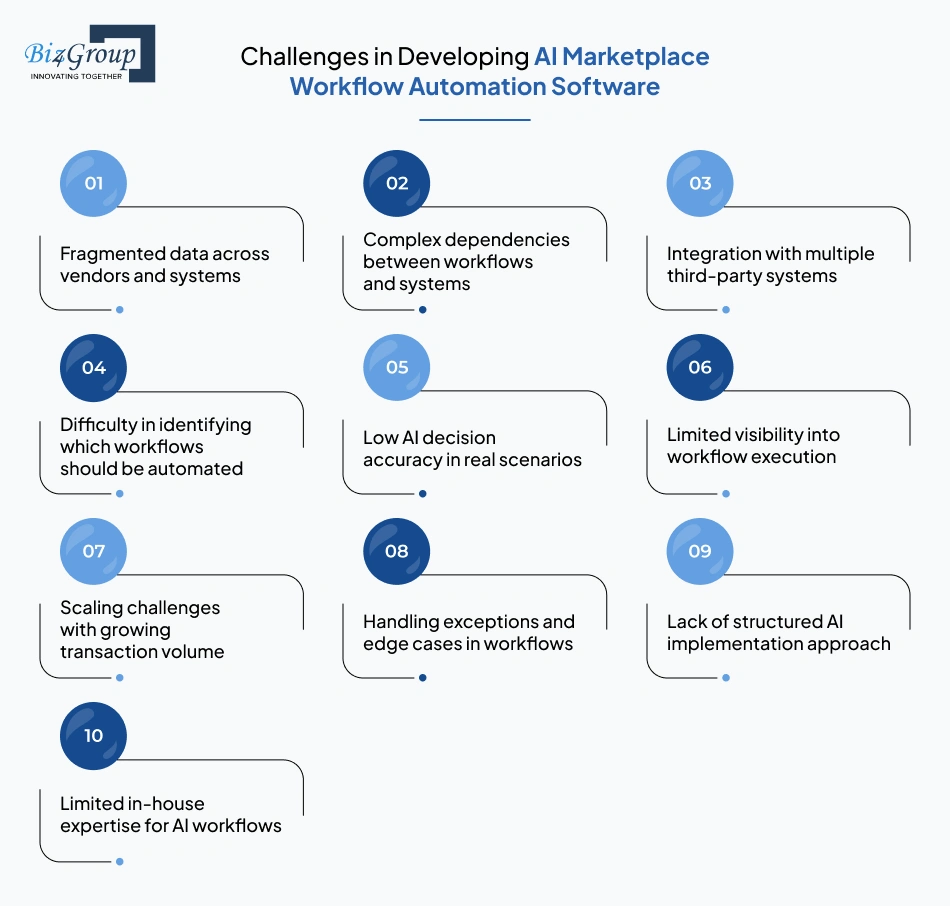
Managing automation across a marketplace involves more than connecting tools and workflows. To create scalable AI workflow automation software for marketplaces, teams must address real execution challenges that directly affect how reliably the system performs in real-world conditions.
|
Challenge |
Solution |
|---|---|
|
Fragmented data across vendors and systems |
Establish centralized data pipelines with validation rules to ensure consistent inputs for workflows |
|
Complex dependencies between workflows and systems |
Break workflows into modular units and manage dependencies through a structured workflow engine |
|
Integration with multiple third-party systems |
Use API-driven architecture to ensure stable communication across payment, logistics, and external services |
|
Difficulty in identifying which workflows should be automated |
Map workflows clearly and define automation boundaries based on operational needs |
|
Low AI decision accuracy in real scenarios |
Use clean training data and continuously refine models based on actual workflow outcomes |
|
Limited visibility into workflow execution |
Implement monitoring tools to track execution status and identify failures early |
|
Scaling challenges with growing transaction volume |
Use cloud infrastructure and distributed processing to support increasing workload |
|
Handling exceptions and edge cases in workflows |
Design fallback mechanisms and allow manual overrides for critical workflow steps |
|
Lack of structured AI implementation approach |
Work with an experienced AI development company to align automation with real marketplace workflows |
|
Limited in-house expertise for AI workflows |
Teams often need to hire AI developers who understand marketplace systems and workflow automation logic |
Addressing these challenges early helps avoid delays and rework during implementation. A structured approach ensures AI marketplace workflow automation software development delivers systems that remain reliable, adaptable, and capable of supporting long-term marketplace growth.
Also Read: AI Automation Pitfalls Every Business Leader Must Know
Best Practices for Building Scalable AI Workflow Automation Software for Marketplaces
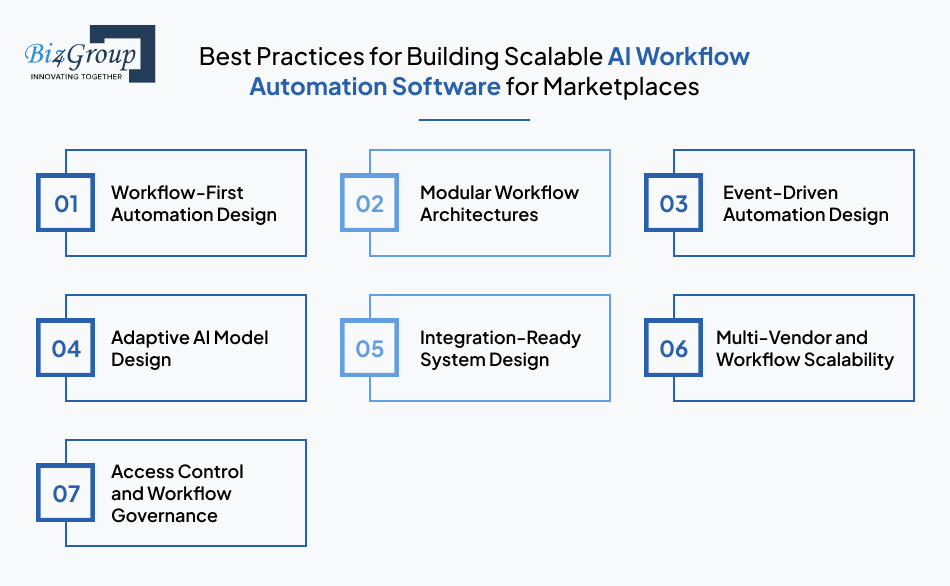
A strong system foundation shapes how automation performs as marketplaces grow and evolve. To build AI automation software for digital marketplace operations, early design decisions should focus on flexibility, clarity, and long-term adaptability across workflows.
1. Workflow-First Automation Design
Clear marketplace workflow definitions should guide how automation logic is structured across the system. Mapping real marketplace operations first ensures the system reflects actual execution patterns instead of forcing workflows into predefined technical structures.
2. Modular Workflow Architectures
Marketplace workflows should be structured as independent components that can operate and evolve separately. This allows changes in one part of the system without affecting others while maintaining flexibility across different marketplace operations.
3. Event-Driven Automation Design
AI marketplace workflow automation systems should respond to events such as orders, payments, or updates as they occur. This approach enables workflows to trigger actions dynamically and supports continuous execution across interconnected marketplace processes.
4. Adaptive AI Model Design
Automation systems should be designed to evolve with changing marketplace behavior. A well-planned AI model development approach ensures models remain adaptable and continue improving as new data becomes available over time.
5. Integration-Ready System Design
AI marketplace workflow automation platforms should be structured to connect smoothly with external systems like CRM platforms and payment services. An API-first mindset helps maintain consistency across integrations and supports seamless communication between systems.
6. Multi-Vendor and Workflow Scalability
Marketplace platforms should support multiple vendors and workflows from the beginning. A flexible structure allows the system to handle increasing operational layers without requiring major structural changes.
7. Access Control and Workflow Governance
Clearly defined roles and permissions ensure workflows operate under controlled conditions. Assigning ownership and access levels across the system helps maintain structured execution and consistent workflow management.
A well-planned approach ensures AI marketplace workflow automation software development remains scalable, adaptable, and aligned with real operational needs, allowing businesses to grow their platforms without unnecessary structural limitations.
Planning To Scale but System Says Otherwise?
Poor structure today turns into rigid systems that break under real growth
Make My System ScalableWhy is Biz4Group LLC Considered the Best Company for AI Marketplace Workflow Automation Software Development
At Biz4Group LLC, we focus on building systems that align with how marketplace operations actually run. Our experience across complex platforms helps us understand how workflows need to be structured and executed in real environments, not just at a conceptual level.
As a custom software development company, our approach is centered on designing solutions that reflect real operational needs. Instead of forcing standard frameworks, we shape systems around how your marketplace functions, ensuring flexibility as your platform evolves. Here’s why marketplace businesses choose us:
- Deep experience in structuring workflow-driven systems across multi-vendor marketplaces
- We offer AI consulting services to define how automation fits into your business model
- Capability to design systems that support customer service automation within broader workflows
- Practical understanding of how to make AI automation software for marketplace operations without overcomplicating execution
- Ability to develop AI marketplace workflow automation platform aligned with your operational structure
- Experience working across integrations, ensuring workflows connect smoothly with existing systems
Our work is grounded in real-world execution, not theoretical models as reflected in our AI portfolio. This hands-on experience has placed us among the top AI development companies, where the focus remains on delivering systems that perform reliably as marketplace complexity grows.
Conclusion
AI marketplace workflow automation software development brings structure to how tasks move across a marketplace. It ensures workflows are executed in a defined sequence, creating consistency in how operations are handled across vendors, transactions, and system interactions.
From an operational standpoint, this structured execution improves how reliably processes run without constant manual coordination. From a business perspective, it directly impacts how costs are controlled and how revenue is realized over time. Working with an experienced AI product development company helps ensure that the system is aligned with real marketplace requirements instead of generic implementations.
If your goal is to create AI workflow automation software for marketplaces that supports both execution and financial control, the approach needs to stay aligned with how your platform operates. At Biz4Group LLC, we focus on building systems that reflect real workflows and long-term scalability. If you are planning to move forward, you can always talk to us.
FAQ's
1. Who can develop AI marketplace workflow automation platform tailored to specific business models?
Businesses typically work with specialized AI product teams that understand marketplace operations. The right partner should be able to align automation logic with your platform’s structure instead of relying on prebuilt templates.
2. What is the average cost to develop AI powered workflow automation for marketplace platforms?
The cost to develop AI powered workflow automation for marketplace platforms typically ranges from $30,000 to $200,000+, depending on workflow complexity, system integrations, and the level of automation required across the platform.
3. How long does it take to develop AI marketplace workflow automation software for a scalable marketplace?
The timeline to develop AI marketplace workflow automation software generally ranges from 3 to 9 months, depending on the number of workflows, integration requirements, and whether the system is built as an MVP or a full-scale platform.
4. How do you decide whether to build or buy an AI marketplace workflow automation platform?
This decision depends on how unique your marketplace workflows are. If your operations follow standard patterns, ready platforms may work. If workflows are tightly tied to your business logic, custom development becomes necessary.
5. What are the key risks when trying to build AI marketplace workflow automation platform internally?
Internal builds often struggle with workflow structuring, integration handling, and long-term maintainability. Without clear execution design, systems become difficult to scale and manage over time.
6. How do you ensure AI workflow automation does not lock your marketplace into rigid processes?
Automation systems should allow workflow edits without system-level changes. Businesses need configurable logic layers, so workflows can evolve as marketplace operations change over time.
