Location :
Orlando, FL, USA
Location :
Orlando, FL, USA +1 (407) 714-1616
 info@biz4group.com


















Imagine a digital system that doesn’t wait for instructions but instead, understands your business goals, learns from real-time feedback, and takes independent actions to get the job done.
Read More

 AI Summary Powered by Biz4AI
Ever had a fund report that looked fine until an investor asked why their distribution didn't match the previous quarter? Or discovered that an ownership update in one record hadn't made it into another? Those are the moments when spreadsheets and disconnected tools start showing their limits.
An AI real estate syndication & fund management platform can bring investor records, deal activity, fund economics, documents, and reporting into connected workflows. AI may help review documents, retrieve information, flag inconsistencies, or prepare routine communications. But the important question is... what should it handle on its own, and where should a person still check the work?
That's not just a theoretical concern. In NAREIM's 2026 survey of 72 professionals across 38 firms, respondents rated AI maturity at 5.7 out of 10, data quality at 6.2, and AI governance readiness at 5.1. The numbers put a spotlight on a practical reality: AI features need reliable data and clear oversight to be useful.
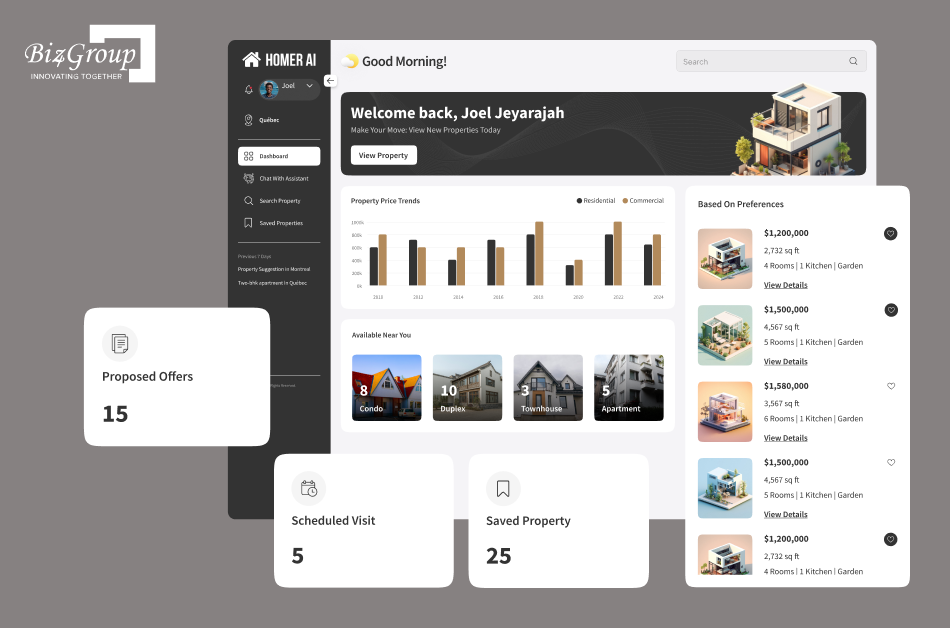
A related example is Homer AI, a Biz4Group LLC project. Its conversational assistant gathers buyer preferences, helps narrow property options, and supports visit scheduling. The takeaway? Collecting information is only the beginning, a useful workflow connects it to an action. Investor and fund operations need their own specialized controls.
So, what does implementation actually involve? Let's dive in to understand.
An AI real estate syndication and fund management platform connects investor records, fund structures, deal information, and reporting, while using AI to assist with selected tasks such as document review and information retrieval. Custom development becomes relevant when a firm's investment and administration processes no longer fit its existing tools without repeated workarounds.
The main risk isn't having too many spreadsheets. It's having different versions of important information.
For example, an investor's commitment may be updated in one file while the distribution team still uses an older ownership schedule. Before money can be allocated, someone has to establish which record is correct.
That creates three recurring problems:
A connected real estate fund management platform can reduce duplication by maintaining linked records and controlled workflows. The value is not simply putting spreadsheets on a screen, it is reducing the effort required to keep critical information consistent.
Each fund or special purpose vehicle (SPV) can have different investors, ownership interests, governing documents, and economic terms. An investor may also participate in several vehicles, which makes it important to distinguish their overall relationship with the sponsor from their position in each investment.
Imagine an investor who holds interests in two SPVs and one fund. A single investor profile may help staff see the relationship, but each investment still needs its own commitment, ownership, documents, and financial records. Combining those details into one undifferentiated record can lead to mistakes.
A real estate syndication platform should reflect both sides of that relationship, the investor across the firm and the investor's separate interests within each vehicle.
Consider custom real estate investment technology when existing tools repeatedly force your team to work around the way your funds operate.
Useful signals include:
The decision should follow the workflow, not the hype. Map a process that causes recurring friction, identify exactly where the current setup breaks down, and determine whether configuration or integration can address it before committing to custom development.
Fund economics should reflect each investment's structure, governing terms, and investor-specific arrangements. The platform needs to connect these elements so ownership, fees, returns, and distributions are calculated using the right rules.
The structure layer defines how sponsors, investment vehicles, and investors are connected.
An investor may hold interests in several vehicles, so each investment's ownership and terms should remain distinct.
A distribution waterfall determines how available cash is allocated among investors and the GP. Since terms vary by deal, waterfall rules should be configurable rather than hardcoded.
Key components include:
The platform should support fund- or deal-specific hurdles, splits, and calculation rules, while preserving the inputs and calculations for review.
Fees should have a defined calculation basis, rate or amount, timing, and recipient. Common types include:
The applicable terms should determine how each fee is calculated and recorded.
The return metrics engine should calculate performance at both the fund and investor levels, using the relevant cash flows and assumptions.
Common metrics and tools include:
Reports should identify whether returns are actual or projected, gross or net, and fund-level or investor-level.
These workflows should distinguish committed capital from amounts called, received, deployed, and returned.
The platform should track:
This helps ensure that commitments are not mistaken for funded capital and that distributions use the appropriate records and terms.
Investor-level accounting connects each investor to their ownership, transactions, and applicable economic terms.
It should support:
The platform should preserve which approved terms and calculation rules were used for each result, particularly when amendments or investor-specific arrangements change the economics.
The goal is traceability, ownership, fees, returns, and distributions should connect to the relevant investor, investment vehicle, cash flows, and governing terms.
From investor portals to waterfall calculations, every component needs to earn its place. Let's turn your must-haves into a platform built for the way your funds run.
Talk Through Your Ideas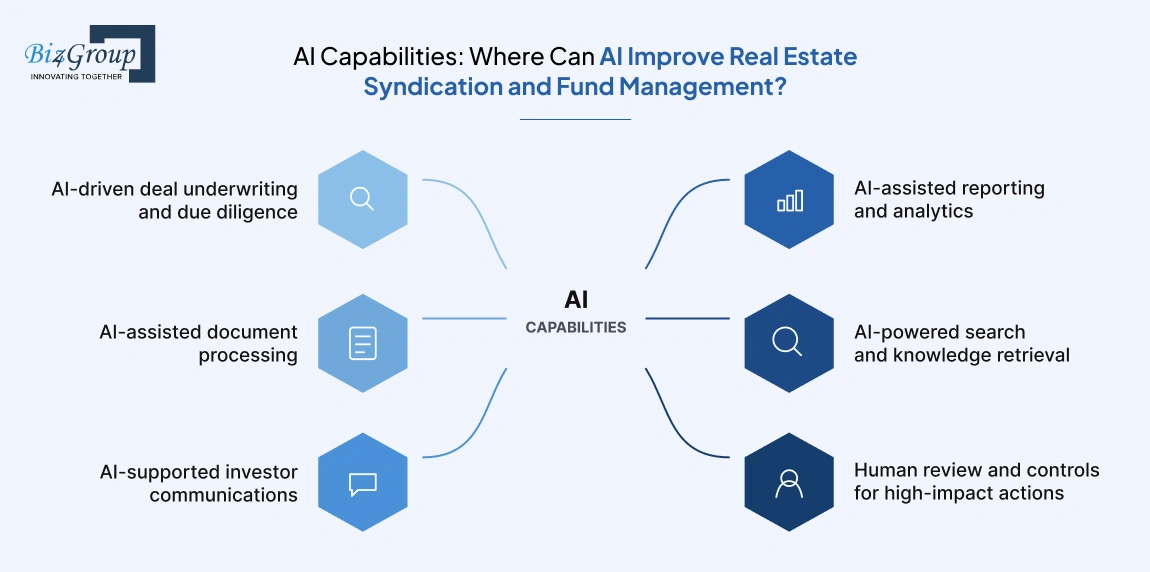
AI can help syndication teams review deal materials, process documents, assist investor communications, summarize performance, and search fund records. The key is knowing where it can assist and where verified data, fixed rules, and human approval must remain in control.
AI can extract and summarize information from offering memorandums, rent rolls, operating statements, and market reports.
It can help analysts:
Example: If a rent roll and operating statement show different rental income, AI can flag the discrepancy for an analyst to investigate. It should not decide which figure is correct without verification.
AI can classify documents, extract selected fields, and flag missing information across offering materials, subscription agreements, and financial records.
For example, it could extract an investor's commitment amount from a subscription document and compare it with the investor record. If the values differ, it can route the mismatch for review rather than automatically overwriting either value.
AI can help teams draft replies, summarize previous conversations, categorize inquiries, and prepare follow-up tasks using approved information.
If an investor asks about an upcoming distribution, AI might locate the latest approved update and draft a response. It should not invent a payment date or promise a return that the records do not confirm.
AI can summarize performance changes and flag unusual movements in approved financial data.
For instance, it might highlight an increase in property expenses compared with the previous quarter and identify the categories contributing to it. The asset manager can then determine whether the change reflects timing, a one-time cost, or a continuing trend.
AI knowledge retrieval lets staff ask questions in everyday language and find relevant information across authorized fund, property, and investor documents.
A team member could ask, "Where is the latest approved distribution schedule for this fund?" The system should return the relevant record and source, while respecting permissions and keeping confidential investor information restricted.
AI should assist with preparation and interpretation, but consequential financial and compliance actions need validated rules and authorized review.
|
Activity |
AI's role |
Essential control |
|---|---|---|
|
Extracting fund terms |
Find and summarize clauses |
Verify against executed documents |
|
Waterfall calculations |
Help locate terms or explain results |
Validated calculation logic and review |
|
Investor eligibility |
Organize information and flag gaps |
Authorized eligibility determination |
|
Investor responses |
Draft from approved records |
Review sensitive or uncertain replies |
|
Distributions and payments |
Prepare information and flag discrepancies |
Approval and controlled execution |
The practical rule is to use AI to help people find, understand, and prepare information; use verified records, defined calculations, and accountable approval for decisions that affect investor rights or money.
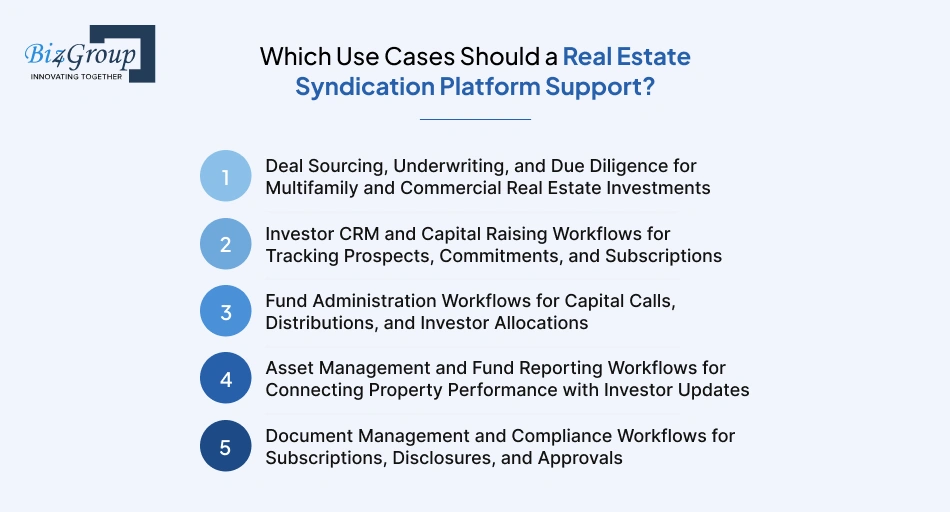
A real estate syndication platform should support the investment lifecycle from evaluating a deal to managing investor capital and reporting property performance. The important thing is that each stage passes accurate, usable information to the next, rather than leaving staff to rebuild the picture manually.
The platform should help teams move an opportunity from initial review to an informed investment decision, while keeping assumptions and supporting documents easy to trace.
For example, if a multifamily deal's projected rental income depends on planned rent increases, the team should be able to connect that assumption to its source and see whether it has been validated. AI can help extract or compare the figures, but the investment team remains responsible for assessing the assumptions.
The investor CRM should track both the relationship and the investor's progress through a specific offering, from initial interest to completed subscription.
It should make it easy to see:
For example, a prospect may express interest in two offerings but subscribe to only one. Keeping those stages separate prevents early interest from being mistaken for committed capital.
Fund administration should maintain a clear record of what each investor owes, contributes, and receives, based on the applicable fund terms and approved records.
Core workflows include:
A practical example: if an investor has made only part of a required contribution, the system should show the outstanding amount and its status rather than treating the full commitment as received. Distribution calculations should use validated fund terms and be reviewed before payments are released.
The platform should connect property-level operating results with fund-level financial information so teams can explain how an investment is performing and what that means for investors.
That means tracking relevant information such as occupancy, rental income, operating expenses, capital improvements, debt, and budget-versus-actual performance, then linking it to the appropriate property and fund.
For example, if a property's expenses rise above budget, an asset manager should be able to investigate the variance and use verified figures when preparing an investor update. A polished summary is not enough if the underlying numbers cannot be traced back to their records.
Document workflows should keep important records organized, connected to the correct investor or entity, and easy to retrieve when needed.
A useful setup supports:
For instance, a subscription marked as complete should be distinguishable from one that has been signed but is still awaiting review. That simple status distinction helps prevent an unfinished process from being treated as approved.
The common thread across these use cases is continuity of information. Deal assumptions, investor commitments, fund transactions, property results, and signed documents should remain connected to the right investment and entity. That gives the team a consistent record to work from as an opportunity becomes an investment and the investment moves into ongoing management.
A real estate syndication and fund management platform should bring everything together in one place, from investor relationships and deal records to fund administration, property performance, and reporting.
The goal is to make day-to-day operations easier by connecting these areas and giving teams a clear, coordinated view of what's happening across the business. The features below focus on how each capability should actually work in practice, rather than simply listing features.
|
Core feature |
What it should support |
Why it matters in practice |
|---|---|---|
|
Investor portal |
Investor account access, investment summaries, notices, statements, and document access |
Investors can find their own information without every request becoming a staff task. |
|
Investor CRM and commitment tracking |
Investor profiles, offering interest, communication history, commitments, and subscription status |
The team can distinguish a prospect, an interested investor, and an investor with an accepted commitment. |
|
Fund, SPV, and ownership management |
Fund and entity records, property relationships, ownership interests, and investor-specific terms |
Keeps each investor's position tied to the correct investment vehicle rather than mixing records across funds. |
|
Fund accounting and distribution workflows |
Contributions, capital calls, allocations, distribution calculations, reconciliation, and transaction history |
Helps staff track what is due, received, allocated, and paid, with review before financial actions are finalized. |
|
Property and asset management |
Property operating data, budgets, actual results, debt details, business plans, and asset-level updates |
Connects property performance to the fund and gives the team a basis for investor reporting. |
|
Investor reporting and analytics |
Periodic statements, fund and property performance summaries, variance reporting, and report history |
Makes it easier to explain results using consistent figures and traceable records. |
|
Document management and e-signature |
Offering materials, subscription agreements, disclosures, signed documents, versions, and completion status |
Helps teams identify missing paperwork and distinguish signed documents from reviewed or approved ones. |
|
Roles, permissions, and audit history |
Role-based access, investor data restrictions, approval records, and logs of significant changes |
Limits access appropriately and helps establish who viewed, changed, or approved important information. |
|
Integrations and data exchange |
Connections to CRM, accounting, banking, e-signature, and document services, with synchronization status |
Reduces repeated data entry while making failed or incomplete transfers visible to staff. |
|
AI-assisted operations |
Document extraction, natural-language search, draft communications, summaries, and discrepancy flags |
Can reduce manual review effort, provided outputs are checked against source records and sensitive actions remain controlled. |
Feature selection should follow the firm's actual fund structure. A sponsor managing a few single-asset SPVs may need different workflows from a manager operating several funds with overlapping investors. The platform should reflect those differences without making staff maintain separate, conflicting versions of the same information.
Advanced features go beyond the day-to-day management of investors, funds, and properties. They give teams more ways to model complex scenarios, identify potential risks early, make better-informed decisions, and support more sophisticated investment strategies. The focus should be on adding capabilities that address real operational or analytical needs, rather than just repeating what the core platform already does.
|
Advanced feature |
What it adds |
Example of practical use |
|---|---|---|
|
Scenario modeling and stress testing |
Tests how changes in rents, vacancy, interest rates, expenses, or exit assumptions could affect projected returns. |
Compare a refinance scenario with a sale scenario under different interest-rate assumptions. |
|
Portfolio optimization tools |
Helps evaluate concentration, exposure, and allocation across properties, markets, and investment strategies. |
Identify how adding another multifamily property could change the portfolio's geographic or asset-type concentration. |
|
AI Predictive maintenance and property risk signals |
Uses available operating and maintenance data to identify patterns that may indicate emerging property issues. |
Flag recurring equipment problems that could warrant inspection before they cause larger disruptions. |
|
Market intelligence and location analysis |
Combines property, demographic, economic, and market information to support location and acquisition research. |
Compare candidate markets using selected indicators such as rent trends, employment, and new supply. |
|
Anomaly detection across financial and operational data |
Looks for unusual patterns that may deserve investigation, beyond simple rule-based checks. |
Flag an unexpected expense movement or an unusual transaction pattern for the finance team to review. |
|
Investment scenario comparison |
Makes it easier to compare alternative business plans using consistent assumptions and outputs. |
Assess how different renovation schedules or lease-up assumptions could affect projected cash flow. |
|
Advanced natural-language analysis |
Lets authorized users explore complex fund and property information through questions, with answers linked to source data where possible. |
Ask which assets have operating costs above budget and inspect the records behind the result. |
|
Configurable workflow orchestration |
Coordinates multi-step processes across teams and connected systems, including routing exceptions to the right reviewer. |
Route a due diligence issue to the acquisitions team, track its resolution, and notify the designated approver. |
These capabilities are extensions, not substitutes for accurate records or sound investment judgment. Before adding one, define the decision it is meant to support, the data it needs, and how users will verify its output. A sophisticated feature is only useful if it helps the team make a clearer decision or handle a meaningful task more effectively.
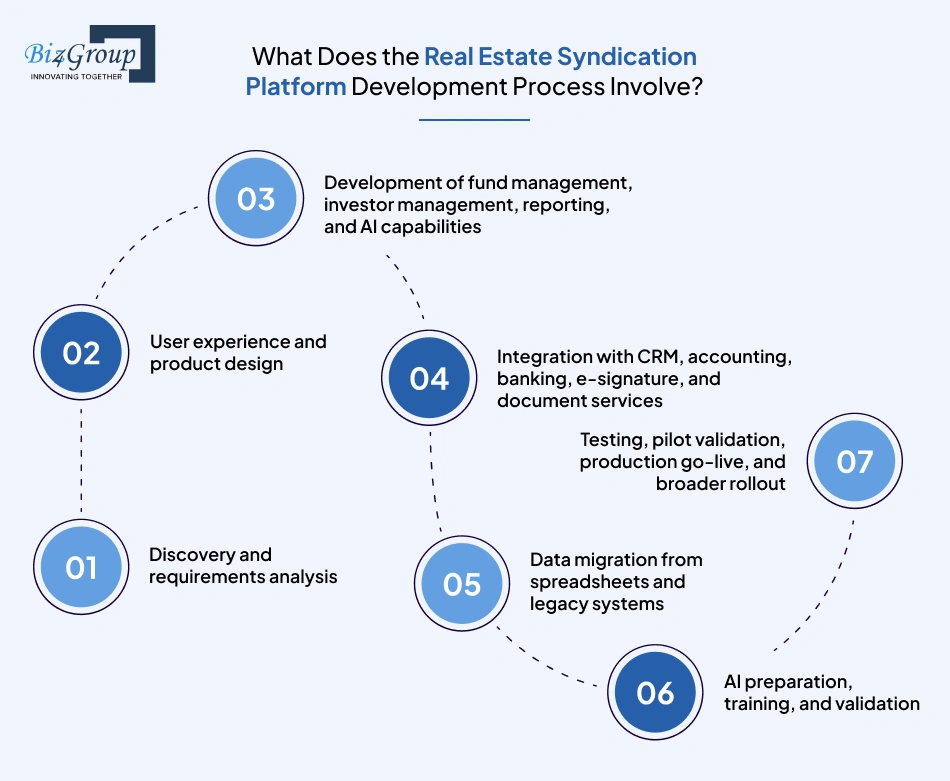
Real estate syndication platform development usually moves through six stages, from defining requirements to launch and ongoing monitoring. These stages often overlap: integration work can shape design, migration may reveal data issues, and testing can send features back for revision.
This step-by-step approach applies to other operational platforms, too. For example, Ground Hogs, developed by Biz4Group, brings activity logging, document uploads, compliance tracking, and administrative oversight into one platform. Its offline data capture and synchronization also highlight why development and testing need to account for real-world working conditions.
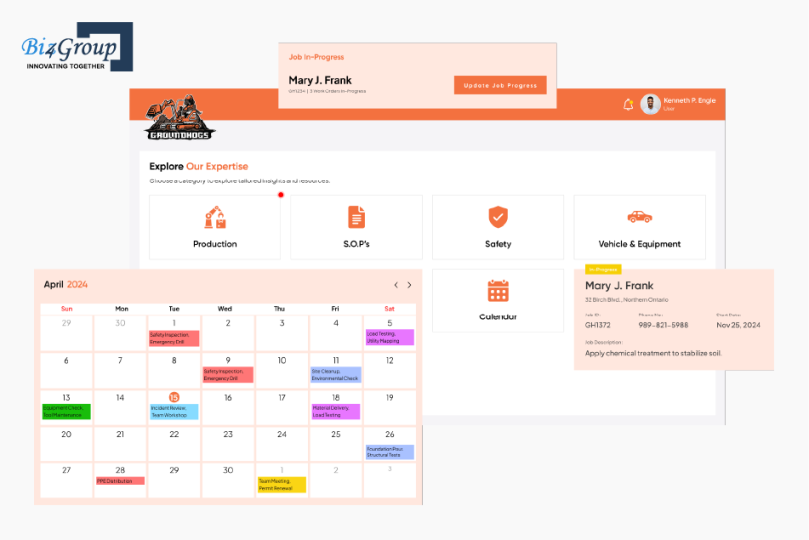
Although Ground Hogs serves a different use case, it demonstrates an important principle: build workflows around how teams actually work, not just how the system is expected to work.
This stage defines who will use the platform, how the firm operates, and what the system needs to support.
The team maps:
Example: If an investor participates in multiple SPVs, discovery should establish how each investment's documents, ownership, and reporting will remain distinct.
Deliverable: An agreed scope, workflow map, and set of functional and control requirements.
Design and UI/UX services turn those requirements into clear experiences for investors and internal teams. It should account for routine tasks as well as exceptions, such as incomplete subscriptions or records that need correction.
Example: An investor can find their own statements and documents, while an administrator can review outstanding subscriptions across offerings without exposing one investor's private information to another.
Deliverable: User flows, screen designs, and agreed behavior for key tasks and exceptions.
Also Read: Top 15 UI/UX Design Companies in USA
Developers build the workflows and features defined during discovery and design. AI should be developed alongside the workflows it supports, rather than treated as a separate add-on.
Example: AI extracts a commitment amount from a subscription document. The platform compares it with the investor record and flags a mismatch for review instead of silently changing the amount.
Deliverable: Working modules with defined permissions, validation rules, and review steps for AI-assisted tasks.
Integrations connect the platform to the systems the firm already uses. The team defines which system owns each type of information, how updates move between systems, and how errors are surfaced.
Example: After an agreement is signed through an e-signature service, the platform receives the document and updates the subscription status. If the update fails, staff can see that it still needs attention.
Deliverable: Tested data exchanges, clear ownership rules, and visible handling of synchronization failures.
Migration transfers existing investor, fund, property, and transaction records into the new platform. Before importing, the team identifies duplicates, missing fields, inconsistent values, and records that need clarification.
Example: If two spreadsheets show different commitment amounts for the same investor, the team resolves the discrepancy against the appropriate source documents before treating a value as confirmed.
Deliverable: Imported records with key balances and totals reconciled against trusted source data.
AI preparation defines the tasks the models need to perform, prepares relevant data, and configures or trains models for those tasks. This may include document extraction, underwriting support, investor queries, forecasting, and compliance flagging.
Example: If an AI model extracts different commitment amounts from an offering document and an investor record, the discrepancy should be flagged for review rather than automatically accepted.
Deliverable: Validated AI capabilities with documented data sources, defined review controls, and a process for monitoring and improvement.
Testing checks whether the platform works correctly, including unusual cases and failed operations. A pilot gives a limited group of users the chance to validate real workflows before the rollout expands.
Testing should cover:
After issues are resolved, the team can launch, train users, and expand access. Go-live is not the end of validation... monitor system reliability, integration health, AI output quality, and user feedback after launch so problems can be identified and addressed.
Security and governance should be part of the platform from the beginning, rather than something added right before launch. Investor data, financial records, legal documents, and AI-assisted workflows all need clear access controls, reliable audit trails, and well-defined approval processes.
|
Area |
What the platform should include |
Why it matters |
|---|---|---|
|
Role-based access control |
Set permissions for GPs, fund administrators, asset managers, investors, and other users. Restrict access to the funds, entities, and records each user is authorized to see. |
Helps prevent unauthorized access to confidential investor and fund information. |
|
Data protection |
Encrypt sensitive information in transit and at rest, and apply appropriate safeguards to stored documents, financial records, and personal data. |
Reduces the risk of sensitive information being exposed or misused. |
|
Authentication and account security |
Use strong authentication, with multi-factor authentication for sensitive accounts and privileged users. Apply session controls and account recovery safeguards. |
Helps protect investor accounts and administrative access. |
|
Audit trails and change history |
Record significant actions, including changes to investor details, ownership, financial entries, permissions, and approvals. Preserve who made a change and when. |
Makes it easier to investigate discrepancies and establish how records changed. |
|
Financial controls and approvals |
Use validated calculation rules, separation of duties, and approval steps for actions such as distribution processing and changes to fund economics. |
Reduces the chance of unreviewed changes or incorrect financial actions. |
|
Document and compliance management |
Control access to governing documents, track versions and completion status, and record relevant reviews and approvals. |
Helps teams use the appropriate documents and maintain a clear record of important decisions. |
|
Define which tasks AI may assist with, restrict the data it can access, and require review for consequential or uncertain outputs. Keep outputs traceable to their sources where possible. |
Helps prevent unsupported AI-generated information from being treated as verified fund or investor data. |
|
|
Backups and recovery |
Maintain protected backups, define recovery procedures, and test whether records and services can be restored. |
Supports continuity if data is lost, corrupted, or affected by an incident. |
Security also depends on how the platform is managed. Define who controls permissions, reviews sensitive changes, handles incidents, and removes access when roles change. Since requirements vary by jurisdiction, fund structure, and investor data, controls should align with the firm's specific obligations.
The guiding principle is to protect sensitive information, keep key actions traceable, and ensure financial or investor-impacting changes follow authorized approvals.
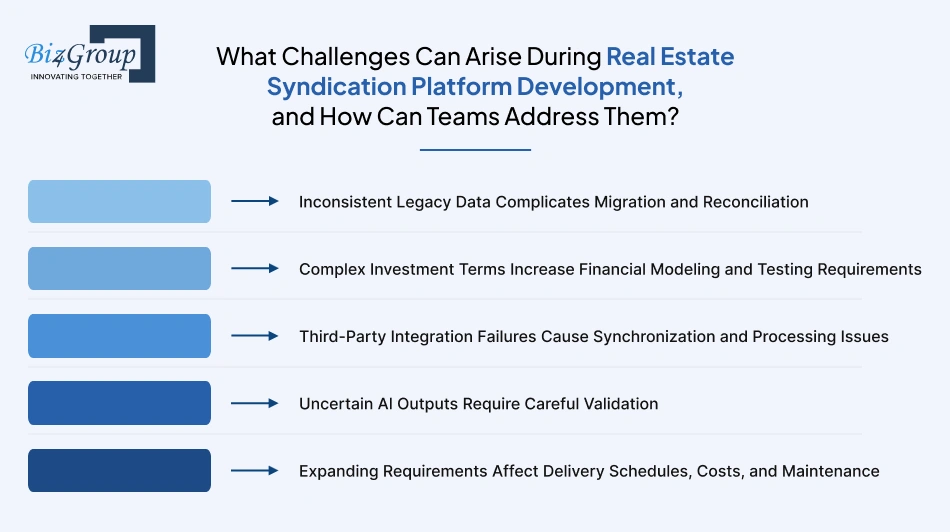
Real estate syndication platforms face challenges with data quality, complex financial rules, system integrations, AI reliability, and changing requirements. Identifying the root causes early helps teams build more accurate and efficient workflows.
Take Contracks developed by Biz4group, for example. This real estate contract management platform centralizes contract details, deadlines, stakeholder roles, and financial responsibilities. Its AI capabilities also summarize contracts and extract key information, reducing manual document handling.
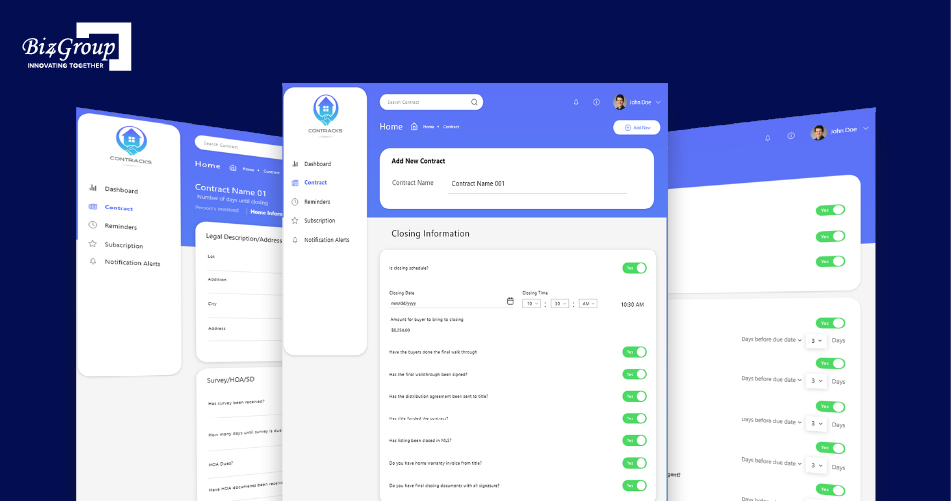
What can syndication platforms learn from this? Centralizing documents and automating information extraction can reduce repetitive work and improve consistency. However, fund accounting, investor distributions, and waterfall calculations still require purpose-built financial logic and rigorous validation. The table below outlines the key challenges and how to address them.
|
Challenges |
Why it occurs |
How to solve it |
|---|---|---|
|
Inconsistent legacy data complicates migration and reconciliation |
Records may be duplicated, incomplete, outdated, or inconsistent across spreadsheets and existing systems. |
Audit and clean records before migration. Reconcile conflicting values against trusted documents, then validate key balances and totals. |
|
Complex investment terms increase financial modeling and testing requirements |
Funds and deals can have different waterfalls, fee arrangements, and investor-specific terms that affect calculations. |
Define the rules for each investment, test calculations against documented scenarios, and require authorized review before financial actions. |
|
Third-party integration failures cause synchronization and processing issues |
Connected systems may use different data formats, update schedules, or validation rules. Transfers can also fail or arrive incomplete. |
Define which system is authoritative for each data type. Add error handling, synchronization monitoring, retry procedures, and reconciliation checks. |
|
Uncertain AI outputs require careful validation |
AI may misinterpret documents, miss context, or generate inaccurate summaries and responses. |
Test outputs against source records, restrict AI permissions, require human review for consequential or uncertain results, and establish escalation procedures. |
|
Expanding requirements affect delivery schedules, costs, and maintenance |
New features, changing workflows, and additional integrations can increase development and support demands beyond the original scope. |
Set priorities and agree on scope early. Assess changes for their impact on cost, timelines, integrations, and maintenance before approving them. |
The practical approach is to identify risks early, assign clear ownership, and validate important workflows before relying on them. This helps teams resolve issues while they are still manageable rather than after they affect fund operations or investor records.
The cost of developing a real estate syndication platform really depends on how complex you want the platform to be. As a rough estimate, an MVP could cost around $25,000–$60,000+, while a mid-level platform may range from $60,000–$120,000+. For a more advanced, enterprise-level platform, the cost can go up to $120,000–$250,000+.
In terms of development time, an MVP typically takes about 2–4 weeks, a mid-level platform around 4–6 weeks, and a full-scale enterprise platform can take 6–8 weeks or more.
|
Platform level |
Estimated cost |
Platform scope |
Indicative timeline |
|---|---|---|---|
|
MVP |
$25,000-$60,000+ |
Investor records, basic fund workflows, document access, and reporting |
2-4 weeks |
|
Mid-level platform |
$60,000-$120,000+ |
Multiple fund structures, accounting workflows, integrations, and selected AI capabilities |
4-6 weeks |
|
Enterprise platform |
$120,000-$250,000+ |
Sophisticated waterfalls, extensive integrations, advanced analytics, and complex governance requirements |
6-8+ weeks |
These timelines are rough estimates and can vary with scope, team size, and review cycles.
The main cost drivers are the complexity of fund operations, the features included, and the amount of integration and validation required. The ranges below are rough portions of the total project budget, not fixed industry benchmarks, and may overlap.
|
Cost factor |
How it affects cost |
Indicative budget range |
|---|---|---|
|
Core features and UX design |
More user roles, dashboards, investor portals, and complex workflows require additional design and development effort. |
15-25% |
|
Fund structures and waterfall calculations |
Multiple entities, distribution tiers, preferred returns, and investor-specific terms increase modeling and testing complexity. |
15-30% |
|
Integrations and data migration |
Connecting external systems, cleaning legacy records, and reconciling transferred data add implementation and validation work. |
10-20% |
|
Security, permissions, and testing |
Detailed access controls, audit trails, financial approvals, and security testing require additional engineering and verification. |
10-20% |
|
AI capabilities and validation |
Document extraction, AI search, summaries, and output validation add development, integration, and testing effort. |
10-25% |
A simpler MVP may use fewer integrations and basic workflows, while a platform with multiple entities, complex waterfalls, and advanced AI may require more design, engineering, and testing.
Beyond the build, plan for recurring services and unexpected work. A 10–20% contingency reserve can be a useful starting allowance, adjusted after discovery and a review of existing data.
These are budgeting estimates, not guaranteed prices. Confirm service fees and obtain project-specific estimates before setting the final budget.
Cost optimization works best when teams reduce unnecessary scope while keeping financial accuracy, security, and investor protections intact.
A focused MVP development can establish core workflows, while broader functionality and more complex fund economics can move the project into higher budget tiers. Set the scope first, then validate the cost and timeline against the actual requirements.
Also Read: 12+ MVP Development Companies in USA
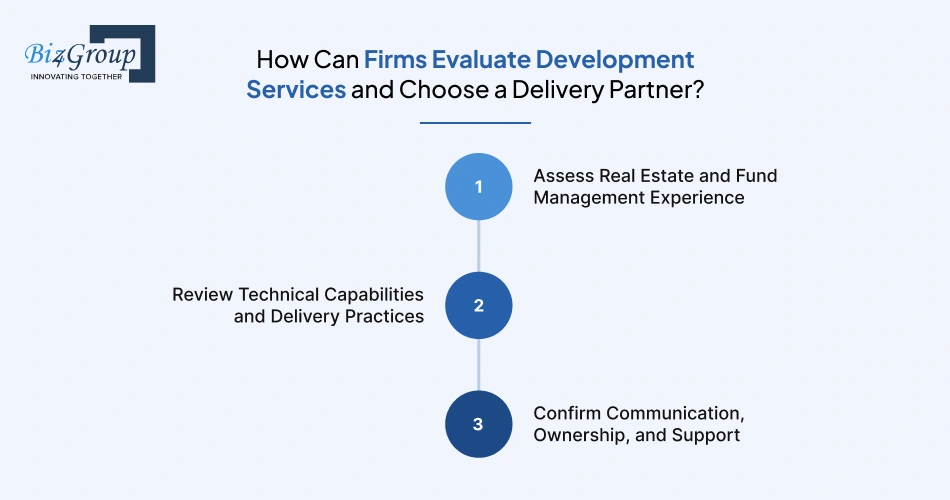
Choose a development partner based on its understanding of fund operations, technical capabilities, security practices, and ability to deliver within a clearly defined scope.
Look for experience with investor onboarding, fund and SPV structures, capital calls, distributions, waterfall calculations, and investor reporting. Ask for relevant examples and clarify what the team actually built. Property listing experience alone doesn't demonstrate expertise in fund administration.
Ask how the partner will handle:
Clarify who will manage the project, how progress and risks will be communicated, and what support is included after launch. Confirm ownership of the code, documentation, and data, along with ongoing maintenance costs.
Building a real estate syndication platform requires more than connecting investor records and financial workflows, it requires a strong understanding of how the entire investment lifecycle works. Biz4Group brings experience in AI-powered real estate platform development and AI integration services, helping businesses turn complex requirements into secure, connected, and scalable solutions.
Our work on real estate platforms such as Homer AI, Contracks, Ground Hog, and more reflects our ability to apply AI to property discovery, contract management, and other real estate workflows. For syndication platforms, we can help build the core capabilities that matter most, including investor management, fund structures, waterfall calculations, capital calls, distributions, reporting, security, and automated workflows. With the right technology architecture and validation processes in place, we can help transform complex syndication operations into a streamlined digital platform.
Ultimately, choose a partner that can explain how it will meet your requirements, demonstrate relevant experience, and clearly define deliverables, costs, ownership, and support.
The right choice depends on your fund structure, workflows, and growth plans. Let's talk through the options before your budget starts sweating.
Contact UsThe next phase of AI real estate syndication and fund management platforms may move beyond assisting individual tasks toward coordinating more of the investment lifecycle. Future capabilities could include systems that anticipate fund needs, simulate decisions across portfolios, and coordinate workflows under clearly defined human oversight. These are emerging possibilities, not capabilities every platform offers today.
The direction is toward more predictive and coordinated operations, but adoption will depend on data quality, reliable validation, security, and appropriate human oversight.
Managing real estate syndications becomes more demanding when investors hold interests across multiple SPVs, each with distinct terms, cash flows, and reporting requirements. A purpose-built platform can bring these operations together, helping teams track commitments, apply waterfall rules, reconcile transactions, and maintain a clear record of how distributions are calculated.
AI can speed up document reviews, information retrieval, and financial analysis, but reliable results still depend on accurate data, validated calculations, and appropriate controls. The goal is to use AI where it adds value while keeping critical financial workflows transparent and accountable.
With experience in real estate technology and AI-enabled solutions, Biz4Group LLC can help develop a platform tailored to your fund structures and workflows, from investor management and fund administration to integrations and AI-assisted document processing.
Ready to discuss your project? Talk with us about your requirements and explore how a custom platform can support your syndication operations.
A first-time sponsor may need investor onboarding, commitment tracking, document management, fund-level records, distribution workflows, and investor reporting. The initial scope should reflect the sponsor's fund structure and operating needs, with more advanced features added as complexity grows.
Yes. It can be designed to manage multiple funds and SPVs while keeping each vehicle's investors, ownership interests, documents, transactions, and economic terms distinct. Authorized users can also have a consolidated view across investments.
AI can assist by extracting information from submitted documents, identifying missing fields, summarizing investor inquiries, and preparing follow-up tasks. Identity checks, eligibility decisions, and acceptance of subscriptions should follow the firm's approved procedures and applicable requirements.
AI can help analyze historical data and model possible outcomes, but it cannot guarantee returns or eliminate uncertainty. Forecasts depend on data quality, assumptions, and market conditions, so teams should treat them as decision-support tools rather than promises of performance.
Common integrations include accounting platforms, CRM systems, e-signature services, banking or payment providers, and document management tools. The right combination depends on the firm's existing systems and which records need to be synchronized.
A real estate fund management platform can store approved investor-specific terms and connect them to the relevant investment, calculations, and reporting workflows. It should also preserve the supporting documents, approval history, and applicable rule versions.
An indicative timeline is 2-4 months for an MVP, 4-8 months for a mid-level platform, and 8-12 months or longer for an enterprise platform. Complex fund structures, integrations, data migration, and validation requirements can extend delivery.
A planning estimate is $25,000-$60,000+ for an MVP, $60,000-$120,000+ for a mid-level platform, and $120,000-$250,000+ for an enterprise platform. The final cost depends on features, fund economics, integrations, security requirements, and AI scope. Hosting, third-party services, and ongoing maintenance should be budgeted separately.
Firms should gather investor records, fund and SPV details, ownership schedules, transaction histories, governing documents, and reporting data. Reviewing these records for duplicates, missing information, and conflicting values before migration can help reduce implementation issues.
Biz4Group offers experience in custom real estate platforms and AI-enabled workflows. Its Homer AI project features conversational property discovery and visit scheduling. For syndication projects, evaluate its proposed approach to fund accounting, waterfall calculations, investor management, and security.

Our website require some cookies to function properly. Read our privacy policy to know more.