 Location :
Orlando, FL, USA
Location :
Orlando, FL, USA +1 (407) 714-1616
 info@biz4group.com
- AI telehealth chatbot PoC development helps healthcare organizations validate ideas early, reduce risk, and avoid costly full-scale builds.
- A focused PoC development for AI telehealth chatbot tests real use cases like symptom intake, scheduling, and patient engagement.
- Core features, compliance readiness, and the right tech stack determine whether a PoC can scale into production.
- Costs typically range from $5K to $20K+, with PoC helping control long-term telehealth AI chatbot development expenses.
- With Biz4Group as your technology partner, validated PoCs can move faster from proof to scalable, HIPAA compliant AI telehealth chatbot solutions built for real-world healthcare.
If you are responsible for digital strategy in healthcare, this probably sounds familiar.
You want to improve patient access.
You want to reduce staff overload.
You want to modernize telehealth without putting compliance or budgets at risk.
You may already be exploring AI telehealth chatbot PoC development, but the hesitation is real. Building the wrong solution or moving too fast can cost far more than waiting.
So how do you move forward without guessing? Let’s look at what the data is telling us.
In 2025, nearly 20 percent of US medical practices are already using chatbots or virtual assistants to handle patient communication, scheduling, and basic support.
At the same time, the global healthcare chatbot market has crossed the $1 billion mark, driven by rising demand for always-on, digital-first care experiences.
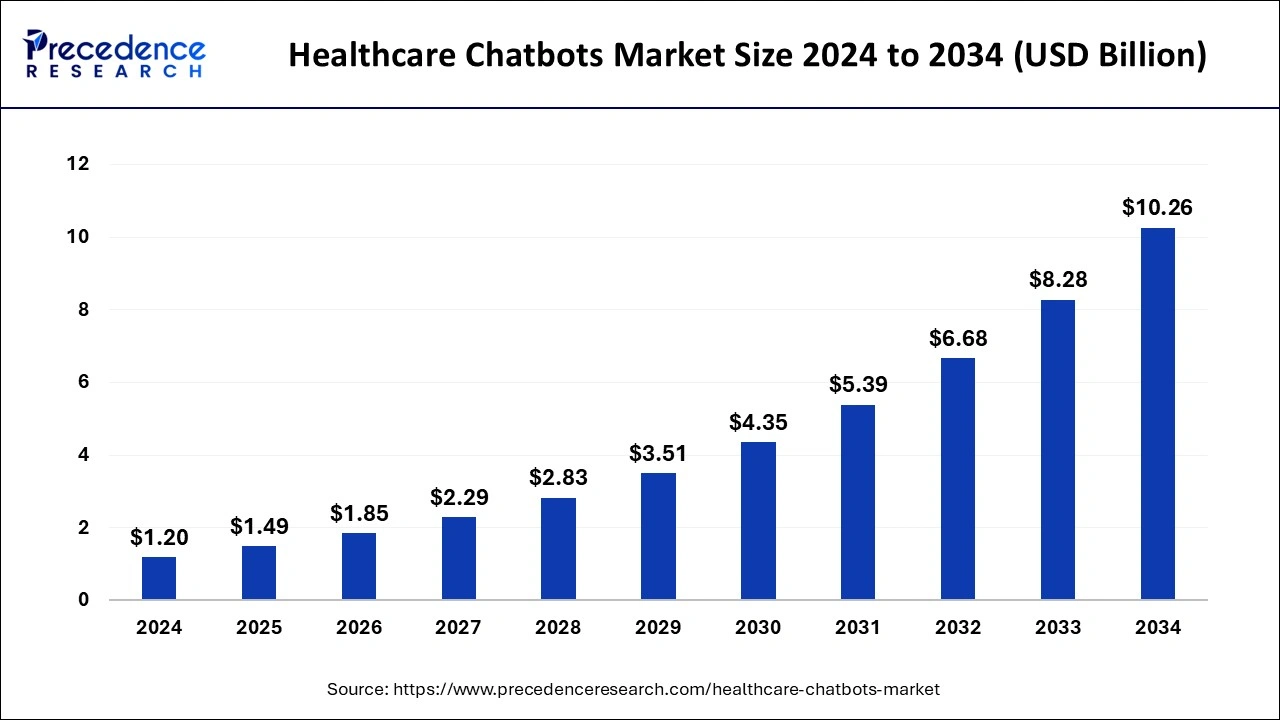
These numbers reflect a broader shift shaped by the top trends in AI product development. Healthcare leaders are no longer asking whether AI belongs in telehealth. They are asking how to adopt it responsibly.
That is where a proof of concept comes in.
AI telehealth chatbot PoC development gives you a safe, controlled way to validate ideas before committing to full-scale deployment. You can test real workflows, understand patient behavior, and evaluate technical feasibility without betting everything on day one.
Instead of assumptions, you get clarity.
Instead of risk, you get evidence.
Working with an experienced AI product development company helps you approach this phase with structure and intent. You are not just building a chatbot. You are validating a solution that needs to work for patients, clinicians, and your business.
In the sections ahead, we will walk through what an AI telehealth chatbot really is, why PoC development matters so much in healthcare, and how you can move from idea to validation with confidence.
Let’s start with the basics and build from there.
Is AI Telehealth Worth It for You Right Now?
In 2025, nearly 20% of US medical practices already use chatbots, and the healthcare chatbot market has crossed $1B. The real question is whether it fits your workflows and patients.
Validate Your AI Telehealth IdeaWhat Is an AI Telehealth Chatbot and Why Healthcare Organizations Should Invest in PoC Development?
You have probably heard the term AI telehealth chatbot used in many different ways. Sometimes it sounds like a basic chat interface. Other times it is positioned as a fully autonomous virtual assistant.
So, what does it really mean for your organization?
An AI telehealth chatbot is a conversational system designed to support patients within digital care environments. It can answer routine questions, guide users through symptom intake, assist with scheduling, and help patients navigate telehealth services. When built thoughtfully, it becomes a practical extension of your care team.
This is where AI telehealth chatbot PoC development becomes essential.
A proof of concept allows you to validate the development of PoC for AI telehealth chatbot use cases before making long-term commitments. Instead of guessing how a solution will perform, you can observe how it behaves with real users and real workflows.
From a business perspective, PoC development for AI telehealth chatbot initiatives helps you answer critical questions early.
- Will this chatbot actually reduce administrative workload?
- Does it improve patient engagement without increasing operational risk?
- Can it integrate smoothly with your existing telehealth systems?
- Is the solution scalable enough to support future growth?
These insights are difficult to uncover once a full product is already live.
That is why many healthcare leaders choose to create AI chatbot PoC for telehealth validation before moving forward with production builds. It gives decision makers data instead of assumptions and reduces friction between clinical, technical, and executive teams.
This approach is especially valuable in chatbot development for healthcare industry projects, where patient trust and clinical accuracy directly influence adoption. A PoC highlights usability gaps early, when they are easier and less costly to fix.
From a strategic standpoint, AI telehealth chatbot PoC development services also support stronger internal alignment. Stakeholders can see real interactions, review outcomes, and make informed decisions based on evidence rather than projections.
Working with an experienced AI chatbot development company during this phase helps ensure the PoC reflects real-world healthcare constraints. You are not just testing technology. You are validating a solution that must work for patients, clinicians, and operations teams alike.
In short, investing in PoC development for AI telehealth chatbot projects is about reducing risk while accelerating smart innovation.
Building Trust from Day One: Compliance and Regulatory Considerations for AI Telehealth Chatbot PoC Development
If there is one reason healthcare leaders hesitate to move forward with AI, it is compliance. And honestly, that hesitation makes sense.
When you are dealing with patient data, even a small mistake can have serious consequences. That is why compliance cannot be an afterthought, even during AI telehealth chatbot PoC development.
A common misconception is that proof of concept work does not need the same level of regulatory attention as production systems. In healthcare, that assumption can quickly derail progress. A well-designed PoC development for AI telehealth chatbot must treat compliance as a foundation, not a future task.
Why compliance matters even at the PoC stage
During the development of PoC for AI telehealth chatbot, you are already handling sensitive workflows. Even limited testing may involve protected health information, clinical logic, or patient-facing interactions.
Ignoring compliance early creates risk later. Here is what healthcare organizations typically need to consider from day one:
- HIPAA compliance for data storage, access control, and transmission
- Secure authentication and role-based access
- Clear boundaries on medical advice versus informational guidance
- Auditability and traceability of chatbot interactions
Addressing these early allows you to develop HIPAA compliant AI telehealth chatbot PoC solutions that can transition smoothly into full deployment.
Compliance supports business goals too
Beyond regulation, compliance plays a direct role in business success. When compliance is built into your healthcare AI chatbot PoC development, you gain:
- Faster internal approvals from legal and compliance teams
- Higher trust from clinicians and administrators
- Fewer reworks during scale-up
- Stronger confidence from investors and partners
This is where enterprise-grade thinking becomes important. Leveraging approaches aligned with enterprise AI solutions ensures your PoC follows the same governance mindset used in large healthcare systems, even if the scope is limited.
Choosing the right technical approach
Compliance is not just about policies. It is also about how the system is designed and implemented.
Secure architecture, data isolation, logging, and encryption must be part of your AI-driven telehealth chatbot PoC systems strategy. These decisions are much harder to retrofit later.
That is why many healthcare organizations rely on experienced partners during this phase. A capable AI development company understands how to balance innovation with regulatory responsibility, even in early validation stages.
When compliance is handled correctly during PoC, it stops being a blocker. Instead, it becomes an enabler that speeds up adoption and builds long-term trust.
Where AI Telehealth Chatbot PoC Development Delivers Real Value: High-Impact Healthcare Use Cases

When healthcare leaders think about AI telehealth chatbot PoC development, the biggest question is usually very practical.
What will it actually do inside my organization?
Use cases help answer that clearly. A proof of concept allows you to test these scenarios with real users, real workflows, and real constraints before committing to scale. Below are the most impactful use cases, explained in a way that reflects how healthcare teams actually work.
1. Patient Symptom Intake and Pre-Visit Triage
Symptom intake is often the first point of friction in telehealth. Patients rush through forms, provide incomplete information, or feel unsure about what details matter.
Example:
A virtual care provider uses a chatbot PoC to guide patients through symptom intake before a telehealth appointment. The chatbot asks structured, easy-to-understand questions and captures details like symptom duration, severity, and related conditions. That information is summarized and shared with the clinician ahead of the visit.
During AI telehealth chatbot PoC development, you can closely evaluate:
- Whether patients complete the intake without frustration
- How clear and clinically useful the summaries are
- Whether clinicians spend less time gathering basic information
This use case often becomes the backbone of a broader AI-based telehealth automation system, where intake, routing, and follow-ups are connected into one seamless workflow.
2. Appointment Scheduling and Care Navigation
Scheduling seems simple, but in healthcare it is a major operational challenge. Patients often call multiple times just to find the right appointment type or provider.
Example:
A multi-location clinic tests a chatbot PoC that helps patients' book, reschedule, or cancel appointments. The chatbot also guides patients to the right department based on their needs, without requiring staff intervention.
With PoC development for AI telehealth chatbot, you can measure:
- Reduction in front-desk and call center workload
- Improvements in appointment adherence
- Patient satisfaction with self-service access
This use case often delivers quick wins and builds internal confidence in chatbot adoption.
Also Read: How to Build AI Scheduling Assistant App
3. Post-Visit Follow-Ups and Patient Engagement
Many care gaps happen after the visit ends. Patients forget instructions, miss follow-ups, or feel unsure about next steps.
Example:
After a telehealth consultation, a chatbot checks in with patients to remind them about medications, answer common follow-up questions, and provide educational content related to their condition.
Through healthcare AI chatbot PoC development, you can validate:
- How often patients engage after visits
- Whether follow-up interactions reduce inbound queries
- If care teams spend less time on repetitive questions
This approach is especially effective when organizations aim to develop AI patient software that supports ongoing engagement without increasing staff burden.
4. Mental Health and Wellness Support
Mental health services face high demand and limited provider availability, making them well suited for careful PoC testing.
Example:
A behavioral health startup pilots a chatbot that conducts daily mood check-ins, provides guided self-help prompts, and escalates conversations to human support when risk indicators appear.
During AI telehealth chatbot PoC development, teams can assess:
- Patient comfort and trust when interacting with AI
- Effectiveness of conversation flows over time
- Accuracy and safety of escalation logic
A PoC-first approach is critical here, allowing ethical, clinical, and user experience concerns to be addressed early.
5. Administrative Support for Care Teams
Not all valuable chatbot use cases are patient-facing. Internal inefficiencies often slow down care delivery just as much.
Example:
A hospital tests a chatbot PoC that answers staff questions about policies, onboarding steps, scheduling, or internal tools. Instead of emailing or calling support teams, staff get instant answers.
With build AI powered telehealth chatbot PoC initiatives like this, organizations can validate:
- Time saved across departments
- Consistency and accuracy of information
- Adoption among non-technical users
This often becomes a stepping stone toward broader automation across clinical and administrative operations.
Each of these examples points to the same insight - AI telehealth chatbot PoC development is not about rolling out AI everywhere at once. It is about testing one meaningful problem, learning from real behavior, and deciding what is worth scaling.
Features That Matter Most in AI Telehealth Chatbot PoC Development
When you plan AI telehealth chatbot PoC development, features are not about building a full product. They are about proving that the solution works in real healthcare conditions.
The table below covers the core features you must validate when you build or test AI telehealth chatbot PoC solutions.
|
Feature |
How It Works in a PoC |
Why It Is Critical for Validation |
|---|---|---|
|
Natural Language Understanding |
Enables the chatbot to understand patient queries written in everyday language rather than predefined commands |
Validates whether patients can interact comfortably without training or confusion |
|
Context-Aware Conversations |
Maintains conversation history during a session to respond intelligently to follow-up questions |
Confirms the chatbot can handle real multi-step healthcare interactions |
|
Symptom Intake and Clinical Logic |
Guides patients through structured questions based on symptoms and responses |
Helps assess whether the PoC can support safe and useful pre-visit triage |
|
Human Escalation Mechanism |
Transfers conversations to clinicians or staff when thresholds or risks are detected |
Ensures safety and builds trust during healthcare AI chatbot PoC development |
|
Secure Data Handling |
Encrypts patient data and controls access even during testing |
Supports early validation of HIPAA-aware chatbot workflows |
|
Integration Readiness |
Connects with scheduling tools, EHRs, or telehealth platforms in a limited scope |
Confirms feasibility before full PoC development for AI telehealth chatbot scaling |
|
Analytics and Performance Metrics |
Tracks completion rates, engagement, and error points |
Provides measurable outcomes to evaluate PoC success |
|
Multichannel Accessibility |
Allows patients to access the chatbot via web or patient portals |
Tests reach and usability across different patient groups |
|
Interaction Design Quality |
Uses intuitive conversation flow, clear prompts, and accessible layouts |
Validates adoption and usability through thoughtful UI/UX design |
|
Intelligent Task Handling |
Performs actions like routing, reminders, or follow-ups with minimal manual input |
Helps test limited autonomy similar to an AI agent without full automation risk |
This feature set gives you enough insight to decide whether to build scalable AI telehealth chatbot PoC solutions or refine the concept further.
Do These Features Actually Solve Your Problem?
Features look good on paper, but only a PoC shows what patients use and what clinicians trust. We help you test the features that truly matter.
Build a Focused AI Telehealth PoCFrom Idea to Validation: Step-by-Step Guide to Build AI Telehealth Chatbot PoC Solutions
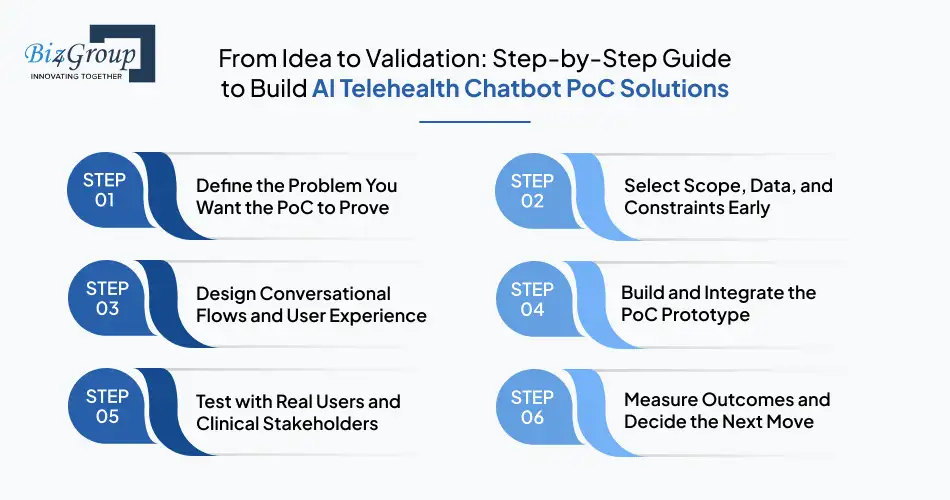
Once you decide to move forward with AI telehealth chatbot PoC development, the next challenge is execution. A PoC should be structured enough to deliver answers but lean enough to avoid overinvestment.
Below is a clear, practical process that many healthcare teams follow to build AI telehealth chatbot PoC solutions that are easy to evaluate and scale later.
Step 1: Define the Problem You Want the PoC to Prove
Every successful PoC starts with clarity. You are not building a chatbot for everything. You are validating one specific problem. At this stage, focus on the outcome you want to test, not the technology itself.
- Identify a single high-impact use case
- Define what success looks like for patients and staff
- Decide what questions the PoC must answer
This step sets the direction for the entire development of PoC for AI telehealth chatbot initiatives.
Step 2: Select Scope, Data, and Constraints Early
A PoC should be intentionally limited. The goal is learning, not perfection. You decide what data the chatbot can access, which workflows it supports, and where boundaries exist. This is especially important in healthcare environments.
- Choose limited and safe data sources
- Define clinical and compliance boundaries
- Avoid features that are not needed for validation
Clear scope helps teams create AI telehealth chatbot PoC platforms faster and with fewer risks.
Step 3: Design Conversational Flows and User Experience
This step determines whether people will actually use the chatbot. You map how patients interact with the chatbot, what questions it asks, and how responses flow. Clarity and simplicity matter more than sophistication.
- Design patient-friendly conversation paths
- Define fallback responses for unclear input
- Plan escalation paths to human support
Strong interaction design is critical when you build AI powered telehealth chatbot PoC systems meant for real users.
Also Read: Next JS Development Company
Step 4: Build and Integrate the PoC Prototype
Now the actual build begins. The focus is on assembling just enough functionality to test real interactions. This is where teams typically build AI PoC using modular components that can evolve later.
- Implement core chatbot logic and NLP
- Integrate with one or two key systems
- Apply basic security and access controls
At this stage, speed and stability matter more than polish.
Step 5: Test with Real Users and Clinical Stakeholders
A PoC only has value if it is tested with the people who will use it. You gather feedback from patients, clinicians, and operations teams to understand what works and what needs adjustment.
- Observe real patient interactions
- Collect clinician feedback on usefulness
- Identify gaps in accuracy or flow
This step often determines whether you refine the idea or move forward.
Step 6: Measure Outcomes and Decide the Next Move
Finally, you evaluate results against the goals defined at the start. This is where leadership decides whether to scale, pivot, or stop.
- Review engagement and completion metrics
- Assess operational impact
- Determine readiness for broader rollout
Many organizations move from PoC into structured MVP development once validation is complete and confidence is high.
Choosing the Right Foundation: Tech Stack for AI Telehealth Chatbot PoC Development
For AI telehealth chatbot PoC development, the tech stack is not about picking the most complex tools. It is about choosing the right layers and technologies that help you validate performance, usability, and integration without slowing progress.
The table below breaks the stack into clear layers, lists commonly used tools or technologies, and explains how each supports PoC development for AI telehealth chatbot initiatives.
|
Layer |
Tools / Technologies |
How It Supports PoC Development |
|---|---|---|
|
Frontend Layer |
Web interfaces, patient portals, lightweight mobile views |
Enables patients to interact with the chatbot in familiar digital environments |
|
Frontend Engineering |
React, Angular, Vue.js |
Supports fast iteration and testing through teams experienced in an AI app development company setup |
|
UI and Interaction Design |
Conversational wireframes, accessibility-first layouts |
Helps validate usability and adoption early through thoughtful UI/UX decisions |
|
Backend Services |
Powers chatbot logic and integrations using patterns common in a Custom software development company environment |
|
|
AI and NLP Engine |
Large language models, intent classification, rule-based logic |
Enables natural language understanding and controlled responses in healthcare contexts |
|
Conversation Orchestration |
Dialog managers, workflow engines |
Manages conversation flows, escalation logic, and safety boundaries |
|
Integration Layer |
API gateways, middleware, FHIR connectors |
Validates interoperability with EHRs and telehealth platforms |
|
Data Security Layer |
Encryption, secure storage, access controls |
Supports HIPAA-aligned data handling even during PoC testing |
|
Cloud Infrastructure |
AWS, Azure, GCP sandbox environments |
Allows rapid deployment, testing, and teardown of PoC environments |
|
Analytics and Monitoring |
Logs, dashboards, performance metrics |
Measures engagement, errors, and completion rates to evaluate PoC success |
|
Automation Layer |
Event triggers, workflow automation logic |
Tests limited operational automation without full production complexity |
This layered approach ensures your AI telehealth chatbot PoC development remains flexible, secure, and scalable without overengineering.
Also Read: React JS Development Services
What Does AI Telehealth Chatbot PoC Development Cost? A Practical Breakdown for Healthcare Leaders
When you plan AI telehealth chatbot PoC development, budget clarity matters early. Most healthcare organizations want a realistic range before moving forward.
For 2025, the estimated cost of PoC development for AI telehealth chatbot usually falls between $5K to $20K+. The exact number varies based on scope, compliance depth, integrations, and how advanced you want the AI behavior to be. A focused validation PoC costs far less than a compliance-heavy, multi-workflow prototype.
Below is a feature-level breakdown so you can clearly see where the budget goes.
AI Telehealth Chatbot PoC Development Cost Breakdown by Feature
|
Feature Area |
What Is Included |
Estimated Cost Range |
|---|---|---|
|
Conversational Design |
Patient flows, prompts, fallback responses, basic personalization |
$500 to $2,000 |
|
NLP and AI Logic |
Model setup, intent handling, prompt tuning, guardrails |
$1,000 to $4,000 |
|
Symptom Intake and Triage |
Clinical question logic, validation rules, summaries |
$1,000 to $3,000 |
|
Backend Development |
APIs, session handling, data processing |
$1,000 to $3,500 |
|
Frontend Interface |
Web or portal-based chatbot UI |
$500 to $2,000 |
|
System Integrations |
Scheduling tools, EHR connectors, telehealth platforms |
$1,500 to $4,500 |
|
Security and Compliance |
Encryption, access control, audit readiness |
$800 to $2,500 |
|
Analytics and Reporting |
Usage metrics, dashboards, logs |
$500 to $1,500 |
|
Testing and Refinement |
User testing, clinician feedback, iterations |
$700 to $2,000 |
These ranges reflect PoC development for AI telehealth chatbot projects focused on validation, not production-grade builds.
Key Factors That Affect AI Telehealth Chatbot PoC Development Cost
Several variables influence the final cost when you build AI telehealth chatbot PoC solutions.
- Number of use cases included in the PoC
- Depth of HIPAA and data security requirements
- Level of customization in AI behavior
- Integration complexity with existing systems
- Involvement of clinicians in validation
Organizations planning to build scalable AI telehealth chatbot PoC solutions may invest closer to the higher end to reduce future rework.
Hidden Costs to Watch During PoC Development for AI Telehealth Chatbot
Some expenses do not appear in initial estimates but can impact timelines.
- Late-stage compliance reviews
- Rework due to unclear success metrics
- Data preparation and cleaning
- Internal coordination across IT, legal, and clinical teams
Addressing these early helps keep healthcare AI chatbot PoC development on budget.
Cost Optimization Tips for AI Telehealth Chatbot PoC Development
You can control cost without sacrificing insight by planning intentionally.
- Focus on one high-impact validation use case
- Limit integrations to what is necessary for testing
- Reuse existing data sources and workflows
- Avoid production-level UI polish during PoC
Many healthcare organizations also choose to outsource AI chatbot development manage cost and access experienced teams. Reviewing benchmarks around software PoC development cost also helps set realistic expectations.
At its core, AI telehealth chatbot PoC development is an investment in clarity. Done right; it prevents far larger costs later by validating ideas before full-scale deployment.
Want Clarity Before You Spend Money?
A well-scoped AI telehealth chatbot PoC development project helps you understand cost, value, and risk before committing to full-scale investment.
Get a PoC Cost EstimateFrom AI Telehealth Chatbot PoC Development to Full-Scale Deployment: Step-by-Step Execution Guide
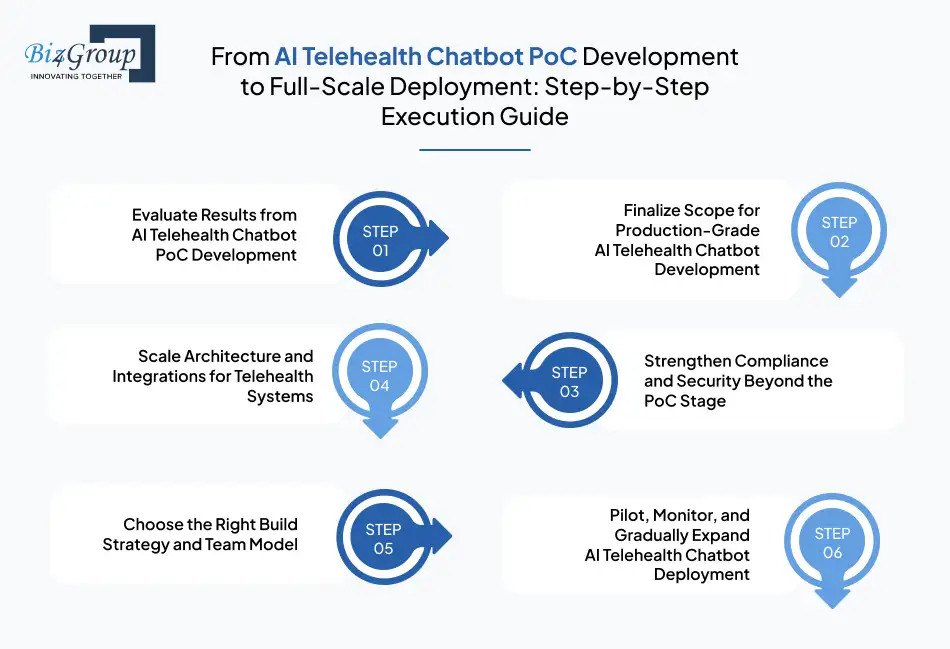
Completing AI telehealth chatbot PoC development is a major milestone. But real value comes from what you do next.
Scaling should be intentional, structured, and aligned with business and clinical priorities. Below is a proven step-by-step path to move from PoC development for AI telehealth chatbot to a production-ready solution without losing control, compliance, or momentum.
Step 1: Evaluate Results from AI Telehealth Chatbot PoC Development
Start by reviewing what the PoC actually proved. This step helps you decide whether the concept is viable enough to justify further investment and expansion.
- Review patient engagement, completion rates, and drop-offs
- Measure operational impact such as reduced call volume or admin workload
- Validate clinical usefulness of chatbot interactions
- Confirm compliance readiness from the PoC stage
These insights guide whether to refine, pause, or proceed with telehealth AI chatbot PoC product development.
Step 2: Finalize Scope for Production-Grade AI Telehealth Chatbot Development
Scaling does not mean expanding blindly. You should clearly define which validated workflows, features, and use cases move forward from the PoC into production.
- Select use cases that delivered measurable outcomes
- Prioritize features validated during PoC testing
- Define KPIs for full-scale rollout
This approach ensures that build AI telehealth chatbot PoC models evolve into focused, high-impact production systems.
Step 3: Strengthen Compliance and Security Beyond the PoC Stage
A PoC validates feasibility. Production demands robustness. At this stage, you enhance compliance, governance, and security controls to meet enterprise healthcare standards.
- Expand HIPAA safeguards and audit mechanisms
- Implement full access control and role-based permissions
- Finalize data governance and retention policies
Organizations that develop HIPAA compliant AI telehealth chatbot PoC solutions early find this transition smoother and faster.
Step 4: Scale Architecture and Integrations for Telehealth Systems
Production environments introduce higher usage, performance expectations, and integration complexity. This step focuses on turning PoC infrastructure into scalable systems.
- Upgrade cloud infrastructure for reliability and load handling
- Optimize AI models for accuracy and response time
- Expand integrations with EHRs, scheduling, and telehealth platforms
This is where teams build scalable AI telehealth chatbot PoC solutions that can support long-term growth.
Step 5: Choose the Right Build Strategy and Team Model
As scope increases, so do technical and operational demands. Healthcare organizations must decide how to resource ongoing development and support.
- Assess internal engineering capacity and expertise
- Decide whether to extend the PoC team or engage external specialists
- Plan long-term maintenance and optimization
Many teams accelerate growth by choosing to outsource AI chatbot development or hire AI developers to support scaling efficiently.
Step 6: Pilot, Monitor, and Gradually Expand AI Telehealth Chatbot Deployment
Even after validation, rollout should be phased. Controlled pilots reduce risk and allow fine-tuning before full adoption.
- Launch with a limited patient or clinic group
- Monitor real-world performance and issues
- Iterate based on feedback before wider deployment
This measured approach ensures that develop telehealth chatbot PoC software transitions into a reliable, production-ready solution.
Scaling after AI telehealth chatbot PoC development is not about rushing to launch. It is about turning validated insights into sustainable digital health solutions.
Key Considerations for Successful AI Telehealth Chatbot PoC Development
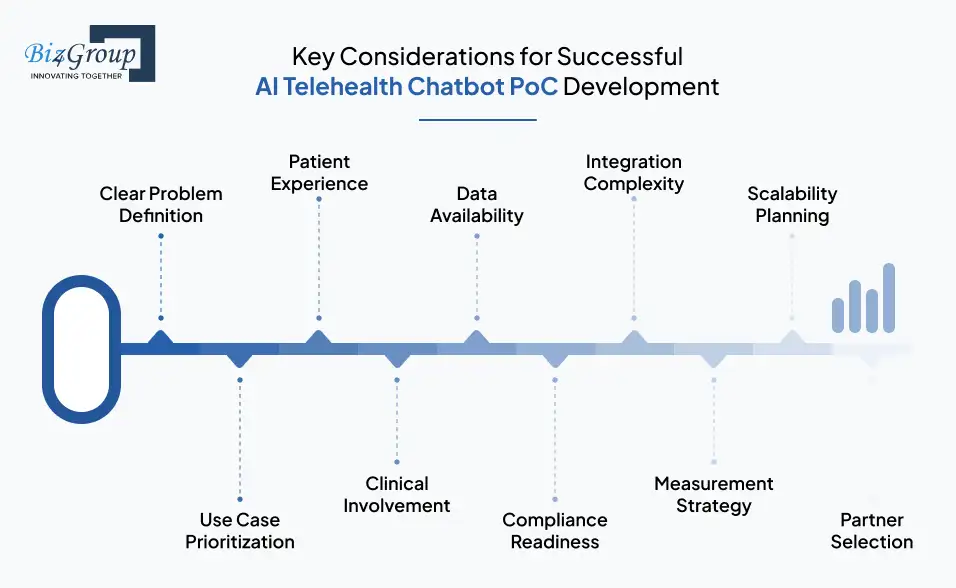
By the time you reach AI telehealth chatbot PoC development, most failures do not happen because of technology. They happen because of overlooked decisions early in the process.
To help you avoid common pitfalls, the table below outlines key considerations you should evaluate before and during PoC development for AI telehealth chatbot, along with why each one matters to your business and care delivery goals.
|
Key Consideration |
What You Should Think About |
Why It Matters for PoC Success |
|---|---|---|
|
Clear Problem Definition |
Are you solving one specific, high-impact problem or trying to do too much? |
Keeps the PoC focused and prevents scope creep |
|
Use Case Prioritization |
Which telehealth workflow delivers the most immediate value? |
Ensures PoC validation is tied to measurable outcomes |
|
Patient Experience |
Is the chatbot easy to use for all age groups and tech comfort levels? |
Directly impacts adoption and engagement |
|
Clinical Involvement |
Are clinicians involved in defining and reviewing chatbot behavior? |
Improves trust, safety, and clinical relevance |
|
Data Availability |
Do you have access to clean, usable data for testing? |
Poor data limits the effectiveness of AI-driven PoC systems |
|
Compliance Readiness |
Are HIPAA and privacy considerations built into the PoC design? |
Avoids rework and approval delays later |
|
Integration Complexity |
How many systems need to connect during PoC? |
Reduces technical risk during validation |
|
Measurement Strategy |
Do you know how success will be measured? |
Provides clarity for go or no-go decisions |
|
Scalability Planning |
Can this PoC evolve into a full product later? |
Protects long-term investment |
|
Partner Selection |
Does your development partner understand healthcare AI constraints? |
Impacts speed, quality, and compliance |
These considerations help ensure your healthcare AI chatbot PoC development effort delivers insights that leadership can trust.
Many healthcare teams also compare vendors early by reviewing insights on the top chatbot development companies in USA to understand market benchmarks and capabilities before committing to a partner.
With these fundamentals in place, you are better positioned to make informed decisions and move forward with confidence.
Real Impact in Action: AI Telehealth Chatbot & AI-Driven PoC Development Projects by Biz4Group
Seeing how advanced technologies play out in real projects helps you understand how AI telehealth chatbot PoC development and broader AI innovation can deliver measurable results.
Below are three standout projects from Biz4Group’s portfolio. Each one shows how exploration, prototyping, and strategic PoC-like development unlocked real value for clients from different industries.
1. NextLPC – AI Therapy Tutors for Education and Engagement
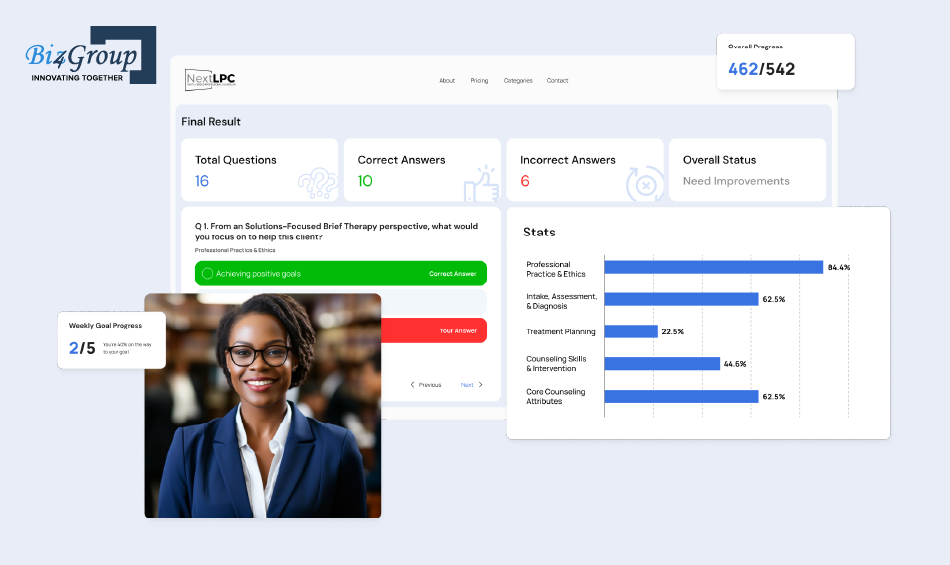
Overview
NextLPC is an AI-powered e-learning platform tailored for psychotherapy students. It uses intelligent avatars to simulate real therapy tutors, enabling learners to interact with realistic case discussions and get feedback on assessments. The platform supports students through intuitive AI guidance and boosting learning outcomes.
Key Highlights
- AI-based virtual avatars designed to feel like real therapy tutors
- Interactive sessions with adaptive case studies
- Central dashboard tracking student progress and engagement
- Voice-assisted learning capability for accessibility
- AI feedback loops that personalize learning pathways
How We Built Its PoC
- User-Centered Concept Validation: Defined expectations from both learners and educators before implementation
- AI Avatar Prototyping: Developed early avatar interaction models to test natural language and facial expression capabilities
- Dashboard Testing: Created quick-feedback dashboards to help track user progress and retention
- Real World Simulations: Tested AI tutor responses with real case studies to refine accuracy and conversational quality
This project is a strong example of how you can create AI telehealth chatbot PoC platforms that extend beyond healthcare into other knowledge-intensive domains while validating real user outcome improvements.
2. DrHR – AI-Driven HRMS Platform for Smarter Workforce Management
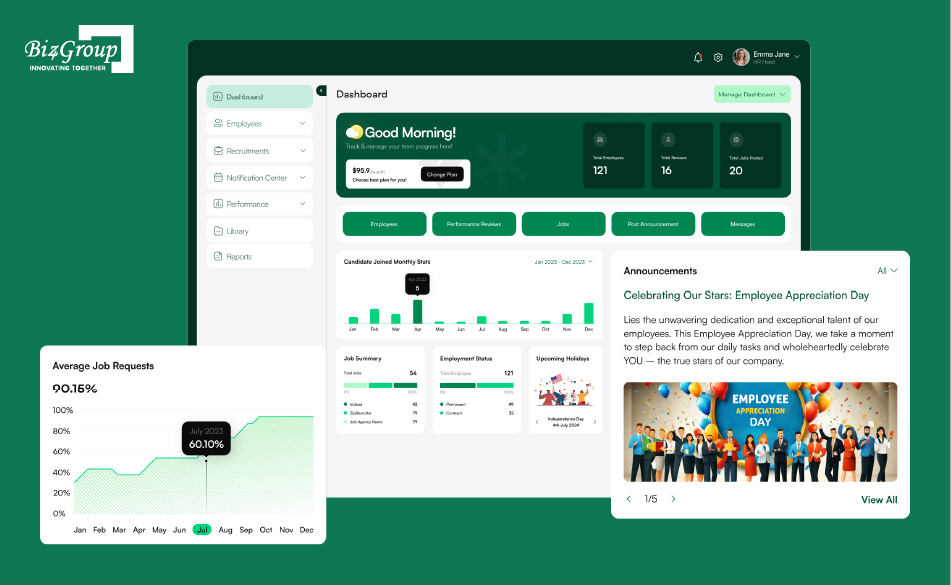
Overview
DrHR is an AI-powered human resource management system that automates key HR workflows while delivering real-time insights. It elevates onboarding, performance reviews, payroll management, and employee engagement through AI logic and integration.
Key Highlights
- Automated recruitment process with AI resume parsing
- AI-assisted performance reviews and analytics
- Centralized leave and compliance tracking
- Role-based dashboards for HR and teams
- Integration with tools like Slack, Zoom, DocuSign, and ZipRecruiter
How We Built Its PoC
- Workflow Prioritization: Identified core HR tasks that could benefit most from automation and AI
- Prototype Integration: Connected initial AI agent logic to HR data systems to validate impact
- Real-Time Analytics: Built test dashboards to show immediate insights and inform design decisions
- Feedback Loop: Collaborated closely with HR teams during early trials to refine behavior and outputs
The DrHR project illustrates how foundational PoC thinking (start small, test key automations, measure impact) can evolve into a fully featured enterprise-ready solution.
3. AI Workout App – Personalized Fitness with Intelligent AI Coaching
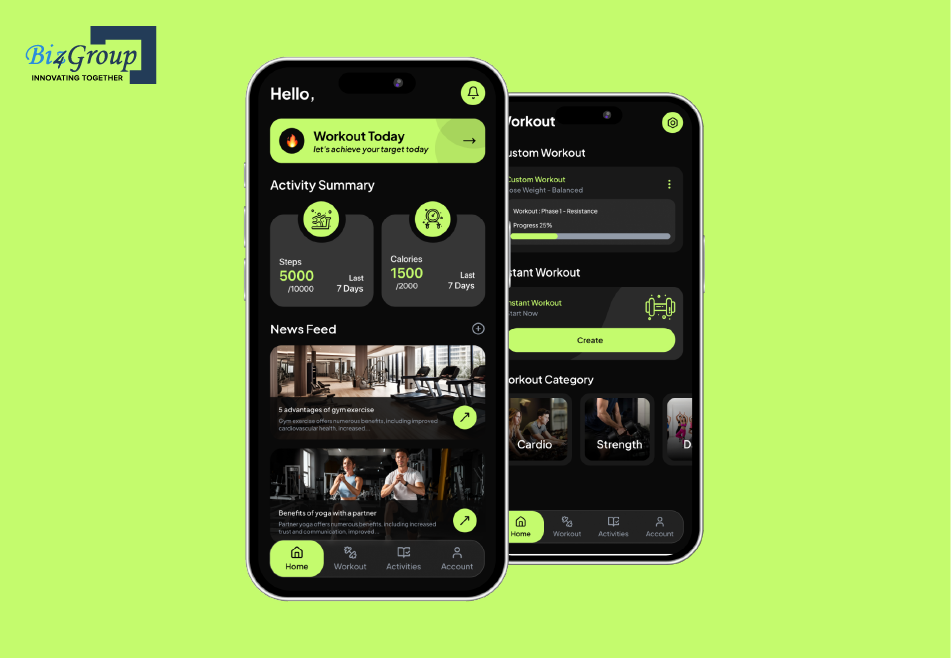
Overview
AI Workout App is a fitness app that uses AI to assess body composition and generate personalized workout plans. It merges computer vision, adaptive models, and dynamic coaching recommendations to offer tailored fitness guidance through a mobile interface.
Key Highlights
- AI-driven body analysis using computer vision
- Vision-Language Models (VLMs) for nuanced workout guidance
- Personalized plans adapting to user performance
- Real-time progress tracking and seamless mobile experiences
- Engaging UI/UX designed for retention and motivation
How We Built Its PoC
- Prototype Core AI Features: Tested body assessment and recommendation models early to validate accuracy
- UI Experiments: Developed lightweight interfaces to gather user feedback quickly
- Feedback-Driven Refinement: Used real user insights to adjust how routines adapt over time
- Scalability Bridge: Ensured the initial PoC used modular architecture so features could scale smoothly into full product builds
This project is a great example of how to develop telehealth chatbot PoC software principles applied in a related domain (health and wellness), where real-time user feedback, adaptive models, and iterative refinement are key.
Why These Projects Matter for Your AI Journey
These case studies show how Biz4Group helps teams go from idea to validation to scalable product strategy. Whether you are building AI telehealth chatbot PoC models or broader intelligent systems, the pattern remains the same:
- Define high-impact use cases
- Prototype core AI logic and user flows
- Validate with real data, users, and feedback
- Iterate before scaling
- Design for integration and future growth
Seeing how these successful projects came together can help you shape your own PoC strategy with focus, evidence, and measurable outcomes.
Ready to Prove Your AI Telehealth Vision Works?
Biz4Group builds PoCs that healthcare leaders can trust, validate, and scale. No guesswork. Just clear outcomes and confident next steps.
Talk to Biz4Group ExpertsConclusion: Turning AI Telehealth Chatbot PoC Development into Confident Healthcare Innovation
If there is one takeaway from this guide, it is this.
AI telehealth chatbot PoC development is not about chasing trends. It is about making smart, low-risk decisions before you scale.
Healthcare leaders like you are under constant pressure to modernize patient engagement, reduce operational strain, and adopt AI responsibly. A well-planned PoC gives you clarity where assumptions usually live. It helps you validate use cases, uncover technical and compliance gaps early, and align stakeholders around real data instead of promises.
This is where experience truly matters.
At Biz4Group, we do not treat PoC as a throwaway experiment. We approach PoC development for AI telehealth chatbot initiatives with the same rigor we apply to enterprise systems. Our teams combine healthcare domain understanding, AI engineering depth, and scalable architecture thinking, so your PoC is not just validated, but future ready.
Whether you plan to expand into patient engagement, care navigation, or intelligent automation, we help you design PoCs that naturally evolve into production-grade platforms. We also help leadership teams understand what scaling will really look like, including long-term considerations like enterprise AI chatbot development cost and operational impact.
From AI-driven workflows to secure integrations and automation-ready foundations, our work consistently supports organizations building reliable AI-driven telehealth chatbot PoC systems with confidence.
Because in healthcare, innovation should never feel like a gamble.
It should feel like a well-calculated next step, backed by proof, precision, and the right partner.
FAQ
1. What is AI telehealth chatbot PoC development and why is it important for healthcare organizations?
AI telehealth chatbot PoC development is the process of building a focused proof of concept to validate whether an AI powered telehealth chatbot can solve a real healthcare problem. It helps you test patient engagement, clinical workflows, integrations, and compliance readiness before investing in full-scale development. For healthcare organizations, PoC development for AI telehealth chatbot reduces risk, shortens decision cycles, and provides evidence-based clarity.
2. How is PoC development for AI telehealth chatbot different from MVP or full product development?
PoC development for AI telehealth chatbot focuses on validation, not completeness. It proves feasibility, usability, and value using limited scope and features. MVP development adds more functionality and polish, while full product development focuses on scalability, enterprise security, and long-term operations. Many teams start by creating AI chatbot PoC for telehealth validation before moving to MVP or production.
3. What are the most common use cases for healthcare AI chatbot PoC development?
Healthcare AI chatbot PoC development is commonly used for symptom intake, pre-visit triage, appointment scheduling, post-visit follow-ups, mental health check-ins, and administrative support. These use cases help organizations build AI powered telehealth chatbot PoC systems that improve efficiency without compromising patient trust or clinical safety.
4. How long does it take to develop an AI telehealth chatbot PoC?
The timeline for development of PoC for AI telehealth chatbot typically ranges from one to four weeks depending on scope, integrations, and compliance needs. For focused use cases, Biz4Group can build AI telehealth chatbot PoC solutions in as little as 1 week, helping healthcare teams validate ideas quickly and move forward with confidence.
5. What does AI telehealth chatbot PoC development cost?
The cost of AI telehealth chatbot PoC development usually falls between $5K to $20K+. The final cost depends on factors such as use case complexity, level of AI intelligence, system integrations, and HIPAA compliance requirements. Investing in PoC development for AI telehealth chatbot helps avoid far higher costs later by validating feasibility early.
6. How do healthcare organizations measure success for AI telehealth chatbot PoC development?
Success is measured using clear metrics such as patient engagement rates, task completion, reduction in administrative workload, clinician feedback, and compliance readiness. Defining these metrics early helps organizations decide whether to refine, scale, or stop AI-driven telehealth chatbot PoC systems.
7. Can AI telehealth chatbots replace clinicians or provide medical advice on their own?
No. AI telehealth chatbots are designed to support healthcare teams, not replace them. They handle routine interactions, guide patients, and automate workflows while escalating to human clinicians when needed. Responsible PoC development for AI telehealth chatbot always includes clear boundaries, transparency, and human oversight.
