Location :
Orlando, FL, USA
Location :
Orlando, FL, USA +1 (407) 714-1616
 info@biz4group.com









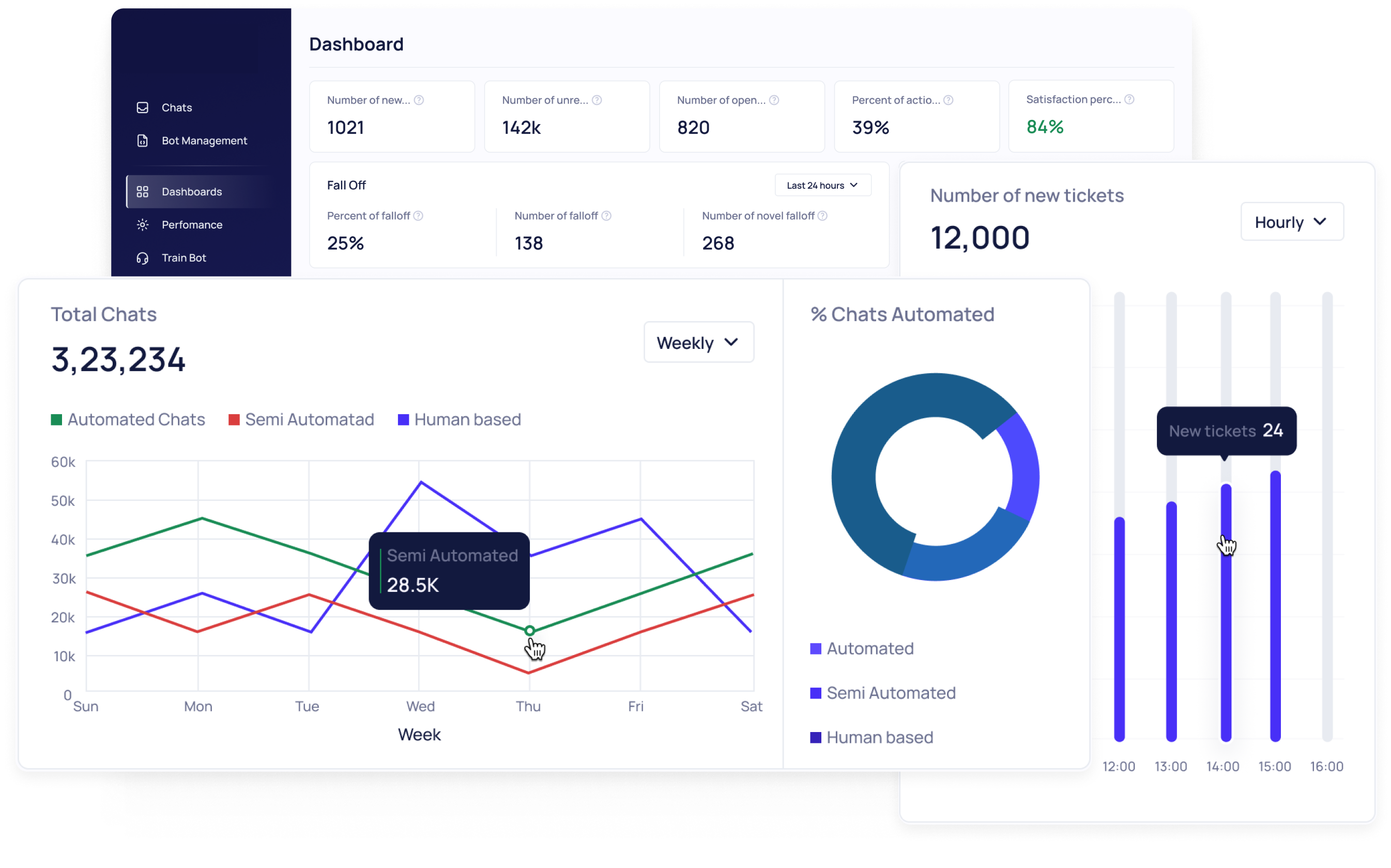









Imagine a digital system that doesn’t wait for instructions but instead, understands your business goals, learns from real-time feedback, and takes independent actions to get the job done.
Read More

Picture this: it is 8:03 PM, the front desk is closed, the voicemail light is blinking like it is training for a marathon, and patients are still calling to book tomorrow’s appointments. Clinics know this pain well and it is exactly why AI voice assistant development for medical appointment scheduling has become a serious conversation in healthcare IT circles.
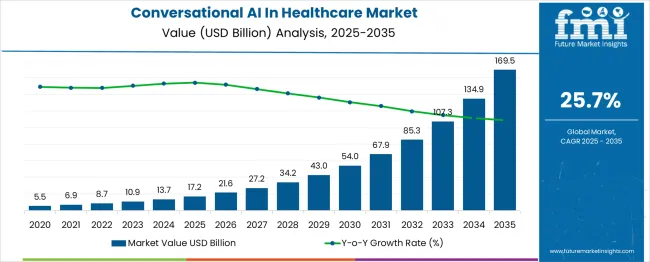
These questions are popping up for every clinic, telehealth provider and hospital exploring automation. The market momentum is hard to ignore:
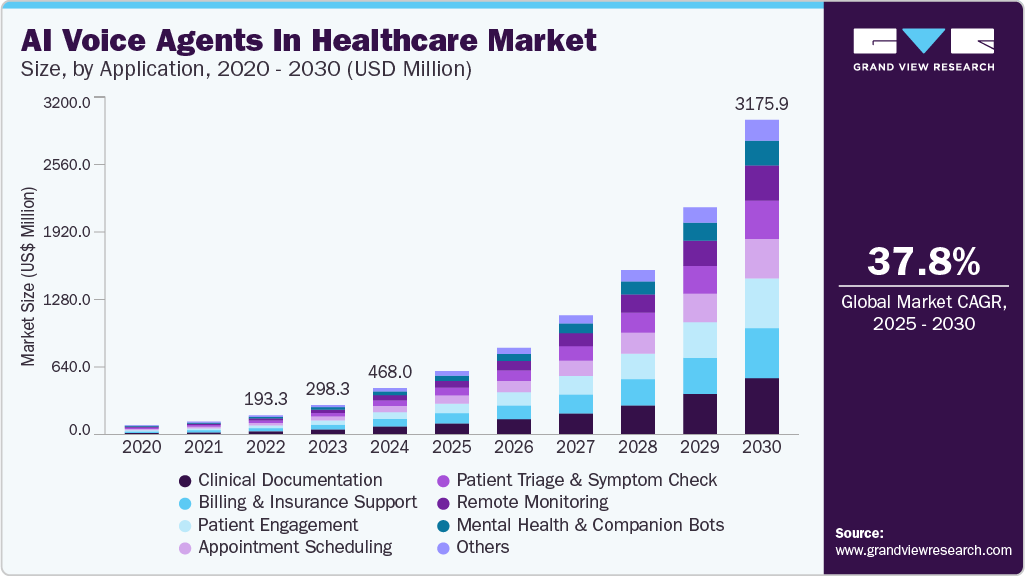
Many healthcare teams admit the current scheduling chaos is not about effort but about limits. Staff cannot answer every call, patients do not want to wait on hold, and missed appointments stack up faster than anyone can control.
This is often the moment leaders realize they must develop AI voice assistant for medical scheduling to keep operations under control.
Modern systems can build AI Voice Assistant for Medical Appointment Scheduling with natural speech, accurate intent recognition and seamless scheduling logic. Many organizations are also moving toward architectures that can build AI chatbot voice assistant functionality and support broader AI healthcare solutions without adding complexity to existing patient workflows.
So with all that on the table, it is time to jump in and explore how this truly comes together.
AI voice assistants for healthcare are purpose built tools that use speech recognition and intelligent dialog flow to manage appointment calls smoothly. At the core, AI voice assistant development for medical appointment scheduling creates a reliable digital front desk that never clocks out.
In many clinics, these assistants work alongside existing operations and benefit from modern AI integration services to ensure smooth scheduling experiences.
AI voice assistants reshape how appointments are managed by keeping communication simple and consistently available, especially when organizations aim to create healthcare voice assistant for appointments that streamline daily patient interactions.
AI voice assistants run a layered system that listens, understands and schedules appointments with precision. At a high level, AI voice assistant development for medical appointment scheduling follows a predictable flow that turns patient speech into confirmed bookings, and it all starts with understanding how the engine works.
This layer converts patient speech into text using a trained speech recognition system. It identifies accents, pacing and phrasing without losing meaning. Its job is to give the assistant clean input so scheduling logic never misses a detail.
Here the assistant interprets intent, extracts needed data and confirms what the patient wants. It learns phrasing quirks and common appointment patterns. This makes it reliable enough to build medical voice assistant for patient scheduling that handles real conversations.
Also Read: NLP vs LLM: Choosing the Right Approach for Your AI Strategy
This module checks provider availability, validates appointment types and processes confirmations. It enforces rules like visit length or provider constraints. Its structured logic ensures that requests are processed without confusion or double booking.
This layer connects with calendars, EHR systems and internal tools securely. It handles real time updates and sends data where it should go. Its job is to keep the workflow aligned with AI voice assistant development for clinics and hospital requirements.
|
Component |
What It Does |
Why It Matters |
|
Speech to Text |
Converts voice into structured text |
Ensures accurate intent detection |
|
NLU |
Interprets meaning and extracts details |
Makes conversations feel natural |
|
Scheduling Logic |
Books and validates appointments |
Prevents errors and double entries |
|
Integration Layer |
Connects with clinic systems smoothly |
Keeps data synced and up to date |
Behind the curtain, these layers operate together with practical guidance offered by a trusted custom software development company, giving teams a clear path toward smoother scheduling. With the foundation in place, the next part of the journey becomes understanding why healthcare providers are increasingly investing in these systems.
Use AI voice assistant development for medical appointment scheduling to simplify patient calls and boost efficiency.
Start Building My Voice Assistant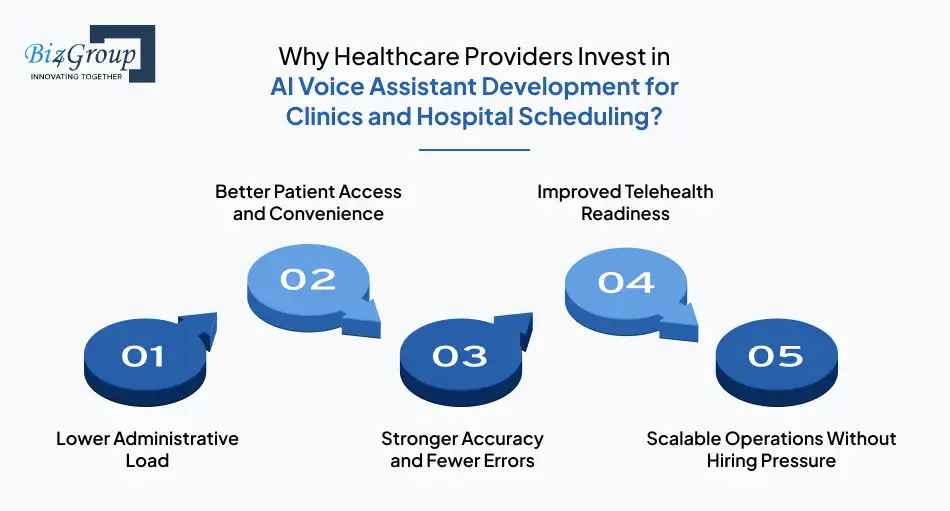
Rising patient call volumes and shrinking staff bandwidth make scheduling harder to manage each year. Choosing AI voice assistant development for medical appointment scheduling gives clinics a path to reduce strain while keeping patient communication predictable, which opens the door to the real reasons organizations commit to these systems.
Automation takes over repetitive scheduling calls that drain frontline teams. This frees staff to focus on higher value patient tasks. Many clinics lean on this advantage as they begin to develop voice-driven appointment management system workflows that keep operations steady.
Patients want instant scheduling without navigating long hold queues. Always available voice assistants offer fast access that reduces friction and increases appointment completion rates. This improves patient experience without increasing manual workload.
Automated scheduling logic checks appointment types, time slots and provider rules with consistent precision. This reduces mismatched bookings, missed notes and costly workflow disruptions. Support from AI consulting services helps clinics implement reliable assistant logic tailored to their workflows.
Hybrid care depends on seamless scheduling. Systems that build intelligent voice assistant for telehealth scheduling support faster virtual visit coordination and smoother intake flows. Clinics preparing for long term digital care models find this especially valuable.
As call volume grows, automation expands without adding new staff. Backed by modern enterprise AI solutions, clinics gain a cost efficient way to scale scheduling capacity while maintaining control over workload and operational flow.
For many healthcare teams, these advantages create a clear path toward smoother scheduling performance, setting up the natural move into understanding where these assistants deliver the most impact in daily operations.
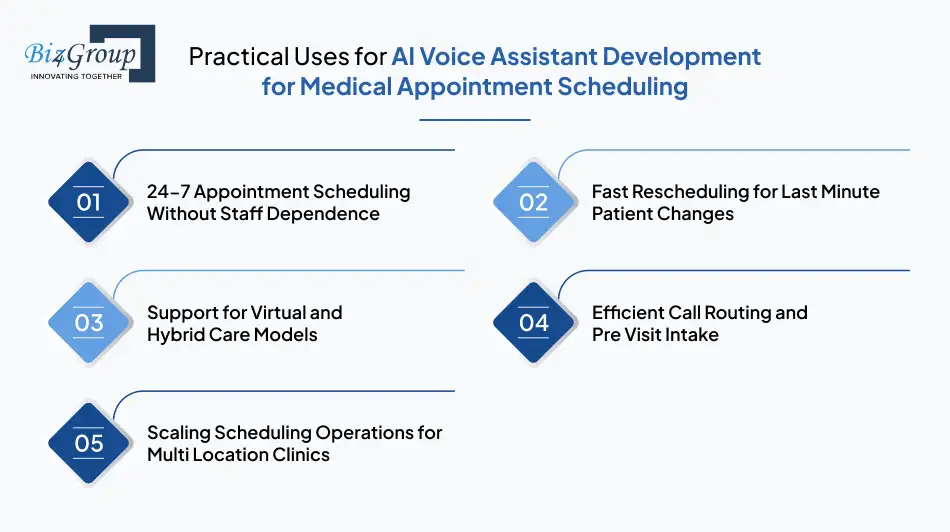
Clinics and hospitals deal with nonstop scheduling requests, uneven call patterns and patient demands for faster access. Using AI voice assistant development for medical appointment scheduling helps steady those moments and makes everyday operations more manageable, especially across the situations below.
A voice assistant stays available long after the front desk closes. It checks calendars, confirms bookings and frees teams from late evening call surges. Stable performance depends on solid AI model development that helps the system interpret patient speech accurately.
Changes happen often and usually at inconvenient times. Automated flows capture details, verify alternatives and complete rescheduling in seconds. Many teams lean on AI chatbot integration to keep these conversations clear and uninterrupted.
Telehealth runs smoothly when scheduling does not slow things down. Smart workflows can build intelligent voice assistant for telehealth scheduling that align virtual visit types correctly. Practices using custom healthcare software development often see cleaner coordination across virtual and in person care.
The assistant collects initial details, identifies visit types and routes sensitive or complex calls to staff at the right moment. This strengthens AI voice assistant development for clinics and hospital operations, especially when supported by thoughtful AI assistant app design that keeps prompts clear and intuitive.
Growing healthcare networks need consistent scheduling across all sites. medical appointment voice assistant development services help unify processes without expanding headcount, and many organizations reinforce this with speech recognition system with AI that keeps accuracy high across varied patient voices.
|
Use Case |
What It Solves |
Practical Value |
|
24-7 Scheduling |
After hours and peak load calls |
Reduces missed bookings |
|
Rescheduling |
Last minute patient changes |
Cuts manual phone work |
|
Telehealth Coordination |
Virtual visit booking |
Supports hybrid care models |
|
Pre Visit Intake |
Routing and data capture |
Improves accuracy and flow |
|
Multi Location Scaling |
Consistency across sites |
Keeps operations uniform |
Dr. Ara is a conversational AI wellness companion built to offer personalized recommendations through intuitive voice interactions. It shows how smart health assistants can simplify complex decisions for everyday users. This platform built by Biz4Group shows how voice driven tools can also streamline medical appointment scheduling with the same clarity and ease.

These use cases highlight how AI voice assistant development for medical appointment scheduling fits naturally into everyday workflows, and they set the stage for exploring the core features that make these assistants reliable for real clinical environments.
Use automation to develop AI voice assistant for medical scheduling that handles booking without long wait times.
Improve My Scheduling WorkflowClinics need dependable systems that handle scheduling without slipping under pressure. Strong AI voice assistant development for medical appointment scheduling starts with features that keep conversations accurate, compliant and easy for patients to follow, which becomes clear once the essentials are laid out.
|
Feature |
What It Does |
Why It Matters |
|
Advanced Speech Recognition |
Converts patient speech into accurate text |
Ensures the assistant understands callers reliably |
|
Intent and Entity Detection |
Identifies patient needs and extracts key details |
Prevents confusion during scheduling requests |
|
Natural Conversation Design |
Maintains smooth, patient friendly dialogue |
Helps interactions feel clear and predictable |
|
Real Time Availability Lookup |
Pulls provider schedules instantly |
Speeds up bookings and reduces manual checks |
|
Appointment Validation Rules |
Confirms visit types, durations and provider requirements |
Avoids mismatched or incorrect bookings |
|
Calendar and EHR Integration |
Syncs confirmed appointments with clinic systems |
Keeps records current without extra staff input |
|
Secure Data Handling |
Helps make a HIPAA-compliant voice assistant for patient appointment management |
Protects sensitive patient information |
|
Dialog Error Recovery |
Handles unclear speech or missing details gracefully |
Prevents failed calls and improves completion rates |
|
Confirmation and Notification Logic |
Sends automated confirmations and reminders |
Reduces no shows and follow up workload |
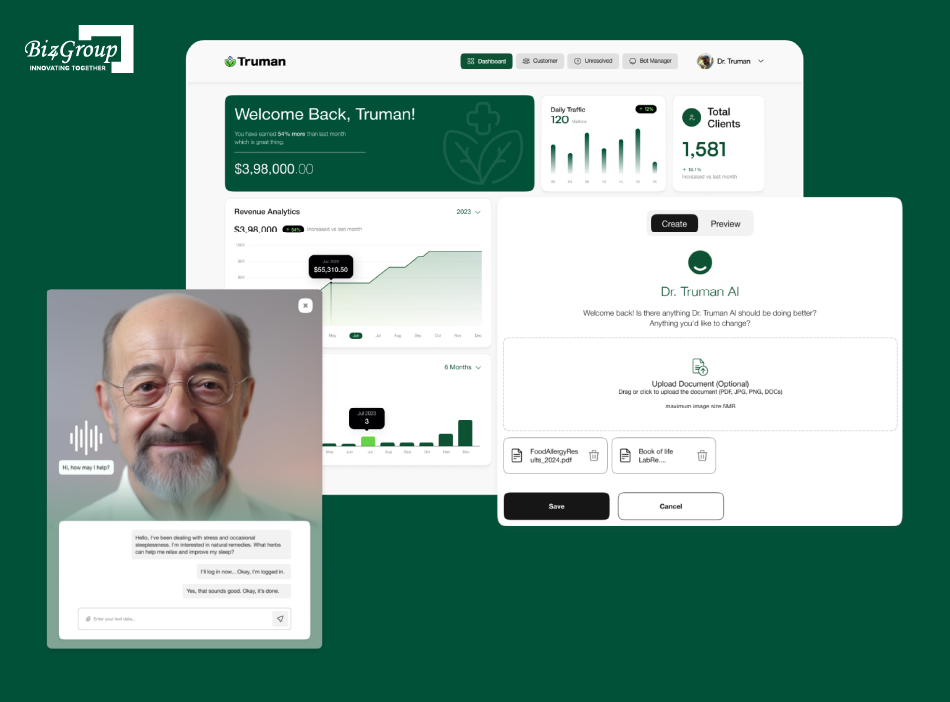
Truman is an AI powered wellness platform that personalizes supplements, tracks routines, and adapts to user habits with smooth conversational intelligence. It adaptability mirrors how a scheduling focused voice assistant can learn patient preferences, reduce friction in booking, and elevate clinic workflows with quiet precision.
Reliable core functionality becomes even more effective when practices use structured support of an AI development company or teams that understand business app development using AI, giving clinics a steadier path toward scalable scheduling automation. Once these fundamentals are in place, the next focus naturally shifts to the advanced capabilities that elevate the assistant beyond basic scheduling.
Once core functionality is in place, clinics often look to elevate performance with smarter capabilities. These enhancements push AI voice assistant development for medical appointment scheduling into a level that handles more complexity with less friction, setting up the advanced features that follow.
The assistant improves its understanding as it recognizes common phrasing and caller behavior. This helps it respond more accurately during fast paced scheduling conversations. These refinements often evolve alongside internal upgrades powered by everyday AI medical web development practices.
Large clinics need intelligent routing that moves callers to the correct specialty without slowing down scheduling. This added logic works well when teams aim to build medical voice assistant for patient scheduling systems that fit real operational structures refined by AI automation services.
By identifying visit reasons early, the assistant maps patients to the right appointment category with fewer errors. This supports smoother experiences for AI voice assistant development for clinics and hospital where accuracy has daily impact. Clinics often tune this capability through flexible tools common in broader AI conversation app environments.
Patterns in call volume help forecast high demand windows and improve planning. This makes it easier to allocate staff and resources when scheduling spikes. These insights often take shape as part of the internal systems clinics use when they develop voice-driven appointment management system solutions supported by ongoing efforts to build AI software.
Fine tuned tone and pacing create smoother interactions and reduce caller frustration. These voice adjustments help clinics make AI appointment scheduling voice bot experiences feel more natural. They are usually addressed during routine enhancements connected to everyday AI in healthcare administration automation needs.
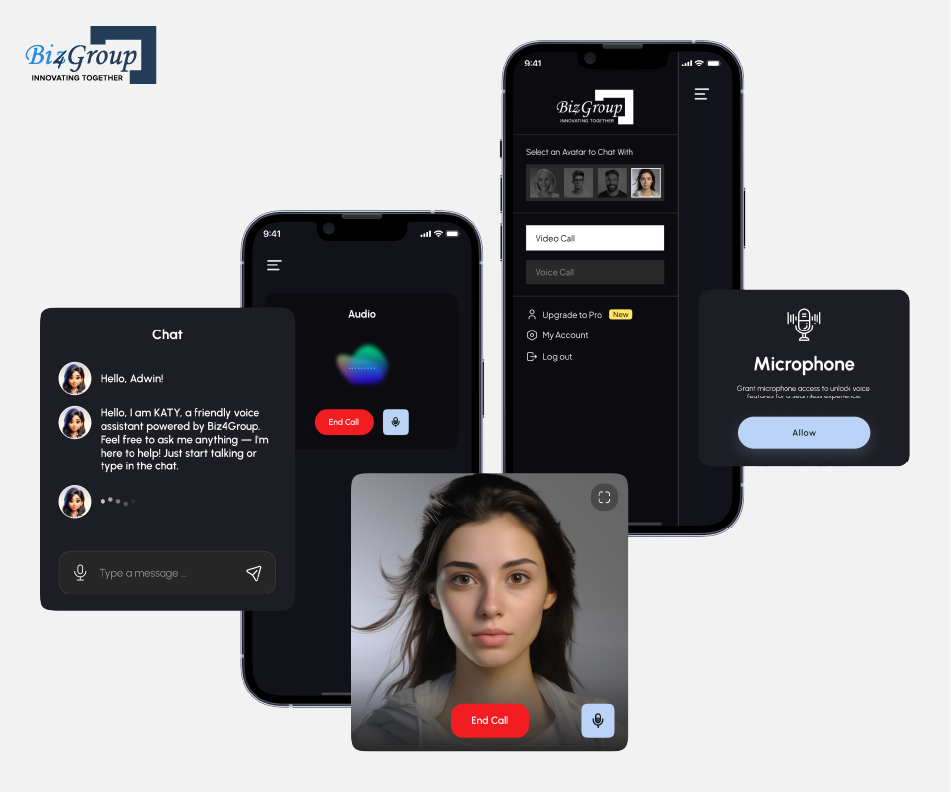
Wizard blends voice, video, and avatar interactions to create an engaging virtual companion experience. Its advanced real time conversational abilities highlight how robust voice tech can be used beyond companionship, including healthcare scheduling where natural dialogue, emotional tone, and instant responses improve patient engagement.
These advanced capabilities strengthen how a scheduling assistant performs under real conditions, creating a clear path toward understanding the full development process that brings these systems to life.
Developing a reliable scheduling assistant starts long before any code is written. Strong AI voice assistant development for medical appointment scheduling begins with intentional planning that aligns with real clinic workflows, leading into a structured process that keeps teams focused on what actually matters.
This phase identifies where scheduling friction drains staff time and patient trust. Teams using AI voice assistant development for medical appointment scheduling often find the biggest pain points are inconsistent call handling, unclear patient requests and bottlenecks caused by manual verification.
With clarity on real problems, clinics avoid overbuilding and prioritize features that matter.
A voice assistant still requires thoughtful design which can be built by partnering with a seasoned UI/UX development company. The way it greets callers, collects details and responds to confusion determines whether patients trust it. Clinics shaping AI voice assistant development for medical appointment scheduling focus heavily on conversation clarity.
Also read: Top UI/UX design companies in USA
MVP development services give clinics real value early without overwhelming staff. A focused build helps teams develop AI voice assistant for medical scheduling while ensuring the system feels useful from day one.
Reference MVP development strategically, and use MVP software development resources to shape the first usable release.
Also Read: Top 12+ MVP Development Companies in USA
The assistant must interpret patient speech and retrieve accurate availability in real time. Clean integrations are key to AI voice assistant development for medical appointment scheduling, especially for multi provider clinics.
Integration flows improve when teams already know how to integrate AI into an app within their existing ecosystem.
A medical scheduling assistant handles sensitive information, so trust is non negotiable. This step ensures security aligns with patient expectations and regulatory requirements.
A secure base allows clinics to confidently make AI appointment scheduling voice bot systems part of their patient communication strategy.
Also Read: Software Testing Companies in USA
Scheduling demand swings dramatically. The cloud ensures scalability when morning spikes or seasonal surges flood phone lines.
This step ensures the assistant stays reliable no matter the call load.
A voice assistant grows stronger the more it interacts with patients. Continuous updates help clinics refine flows, maintain accuracy and keep up with changes in appointment patterns.
This ongoing optimization makes AI voice assistant development for medical appointment scheduling an evolving asset rather than a static tool.
A structured development path builds a system that feels intuitive for patients and dependable for staff, naturally opening space to explore the ideal tech stack behind a high performing assistant.
Design smarter voice flows and build AI Voice Assistant for Medical Appointment Scheduling that patients actually enjoy using.
Upgrade My Patient Interaction SystemBuilding a dependable system for AI voice assistant development for medical appointment scheduling requires choosing technologies that keep conversations smooth, availability accurate and clinic integrations reliable. The right tech stack ensures the assistant performs consistently, even when patient call volume spikes.
|
Label |
Preferred Technologies |
Why It Matters |
|
Frontend Framework |
ReactJS, Vue.js |
Supports clean operator dashboards and admin tooling, strengthened by approaches used in ReactJS development. |
|
Server-Side Rendering & SEO |
NextJS, Nuxt.js |
Helps build unified internal tools and monitoring views, aided by the structure seen in NextJS development. |
|
Backend Framework |
NodeJS, Python |
Python development and NodeJS development run the scheduling engine and integrates clinic rules reliably. |
|
AI & Data Processing |
TensorFlow, PyTorch |
Enables intent detection, NLU and call pattern learning for accurate scheduling decisions. |
|
Speech Recognition Pipeline |
Whisper, DeepSpeech |
Converts real caller speech into clean text for processing. |
|
VoIP and Telephony Layer |
Twilio, Amazon Connect |
Ensures stable call flow, routing and patient interaction handling. |
|
API Development Layer |
FastAPI, Express |
Manages custom scheduling endpoints and secure EHR data exchanges. |
|
Integration Layer (EHR/EMR) |
HL7, FHIR APIs |
Syncs appointment availability and updates with clinical systems. |
|
Authentication & Access Control |
OAuth2, JWT |
Protects PHI and preserves HIPAA compliant communication. |
|
Event Queueing & Messaging |
RabbitMQ, Kafka |
Handles scheduling updates, retries and async call events smoothly. |
|
Caching Layer |
Redis, Memcached |
Speeds up availability checks and reduces database load. |
|
Database |
PostgreSQL, MongoDB |
Stores appointment rules, logs and workflow metadata securely. |
|
Cloud Infrastructure |
AWS, GCP |
Maintains performance even when call volume spikes unexpectedly. |
|
Monitoring & Observability |
Prometheus, Grafana |
Tracks scheduling performance, call patterns and system health. |
|
Logging & Audit Layer |
ELK Stack, CloudWatch |
Maintains traceability required for HIPAA compliance. |
A well aligned tech stack makes it easier to develop AI voice assistant for medical scheduling with the stability clinics need, naturally setting the stage for understanding how these choices influence the overall cost.
The cost of AI voice assistant development for medical appointment scheduling typically ranges from 15,000 to 100,000 plus, depending on scope, integrations and security needs. This is a ballpark estimate, but it helps clinics predict how much they may invest before moving forward with deeper planning.
|
Tier |
Estimated Range (in USD) |
What You Get |
|
MVP AI Voice Assistant |
15,000 to 35,000 |
Core scheduling engine, basic voice flows, essential NLP, limited routing and early patient testing. Often shaped with simple internal tools that teams use to integrate AI into an app without heavy customization. |
|
Mid Level AI Voice Assistant |
35,000 to 70,000 |
Full scheduling automation, stronger NLU, availability logic, EHR sync, real world accuracy tuning and the ability to make a HIPAA-compliant voice assistant for patient appointment management. |
|
Enterprise AI Voice Assistant |
70,000 to 100,000 plus |
Multiclinic routing, advanced triage, predictive insights, real time reporting, deep integrations and higher concurrency, often influenced by the engineering standards of a capable AI app development company. |
A well planned budget makes scaling easier, especially when teams hire AI developers to handle complex workflows and compliance heavy tasks. With cost considerations clear, the next focus becomes recognizing how clinics can generate value beyond operational efficiency.
Use AI driven tools to create healthcare voice assistant for appointments that reduces manual tasks and frees staff time.
Start My Healthcare Voice SolutionAutomation should support clinical operations while also opening new revenue paths. With AI voice assistant development for medical appointment scheduling, clinics can build predictable returns and reduce operational drag, which becomes clearer when exploring the monetization options below.
A monthly subscription lets clinics rely on consistent automation without large upfront costs. This model is predictable, easy to budget for and keeps improvements flowing without operational downtime. It pairs naturally with medical appointment voice assistant development services that evolve over time.
Enhancements like predictive scheduling, multilingual flows or smart triage can be bundled as premium add ons. These upgrades let clinics strengthen automation without rebuilding the core assistant.
Usage based pricing works well for clinics with fluctuating call traffic. They only pay when the assistant actually completes a booking or resolves a caller’s request, which aligns cleanly with clinics that want to make a HIPAA-compliant voice assistant for patient appointment management without committing to a fixed monthly plan.
Some organizations need deeper integration work to support specific workflows. Offering integration packages creates one time or recurring revenue while improving long term clinic adoption.
Health networks can license their voice assistant to affiliated practices, creating a unified scheduling experience while generating recurring revenue. This model supports groups wanting to create voice-based healthcare automation tools for appointment workflows that scale across multiple locations.
Ongoing tuning ensures the assistant stays aligned with changing patient behavior and clinic operations. Support plans turn continuous optimization into a recurring revenue engine.
Specialty clinics often need unique logic for triage, visit types and scheduling rules. Modular add ons create new revenue opportunities and help expand automation reach.
Development teams can partner with local IT providers or medical software consultants who install and maintain the assistant for their clinics. This multiplies reach and creates implementation revenue.
These revenue models help clinics treat automation as both an operational boost and a financial asset, creating a smooth lead in to the best practices that ensure each assistant delivers long term value.
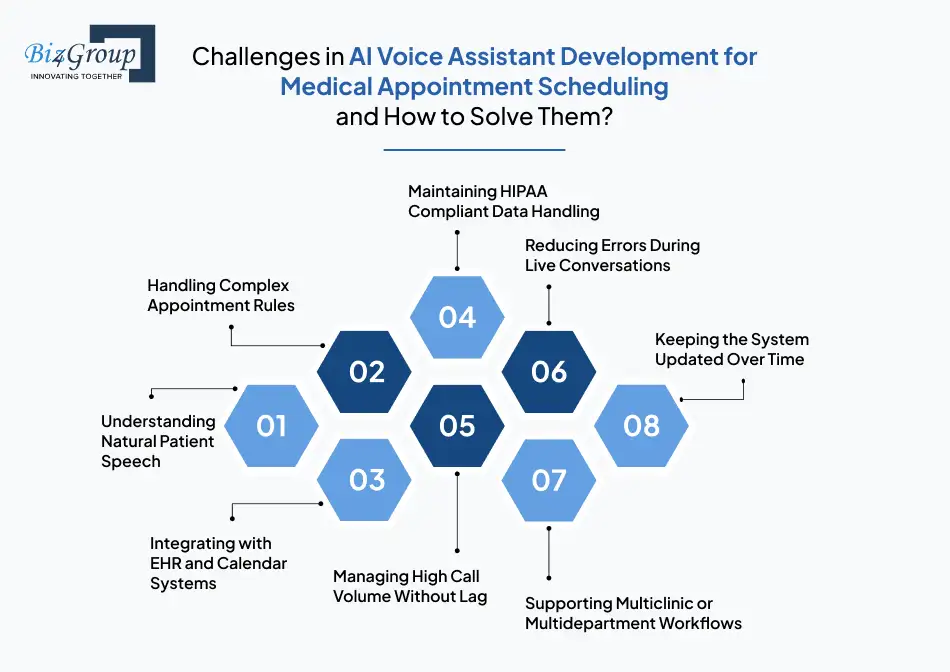
Every clinic wants smoother scheduling, but building strong AI voice assistant development for medical appointment scheduling comes with challenges that need thoughtful solutions.
Understanding these hurdles early makes it easier to plan a system that performs well under real patient pressure, which becomes clear in the breakdown below:
|
Top Challenges |
How to Solve Them |
|
Understanding Natural Patient Speech |
Train models with real patient recordings, adjust for accents, and use continuous learning loops to keep recognition accurate. |
|
Handling Complex Appointment Rules |
Map provider preferences, visit types and clinic policies into clear logic so the system can make a voice-enabled scheduling assistant for hospitals and clinics that stays accurate. |
|
Integrating with EHR and Calendar Systems |
Use HL7 or FHIR based connections, test sync flows repeatedly and validate availability updates with real clinic data. |
|
Maintaining HIPAA Compliant Data Handling |
Encrypt every data touchpoint, limit access permissions and run routine audits to ensure privacy remains intact. |
|
Managing High Call Volume Without Lag |
Deploy scalable cloud infrastructure and use caching layers to handle bursts during peak clinic hours. |
|
Reducing Errors During Live Conversations |
Add fallback prompts, recovery paths and context retention to keep interactions smooth even when speech is unclear. |
|
Supporting Multiclinic or Multidepartment Workflows |
Build routing logic early and test it with both staff and patients to ensure the assistant adapts cleanly across departments. |
|
Keeping the System Updated Over Time |
Use monitoring dashboards, capture real usage trends and schedule regular optimization cycles to refine the experience. |
Addressing these challenges early makes development faster and helps clinics build assistants that perform reliably in the real world. Now let’s talk about the future trends shaping this space.
Launch accurate, reliable automation that can make AI appointment scheduling voice bot interactions feel effortless for every patient.
Begin My Scheduling AutomationStrong AI voice assistant development for medical appointment scheduling succeeds when clinics follow practices that keep automation accurate, compliant and natural for real patients. These principles guide the assistant’s long term reliability, which becomes clear in the recommendations below.
Use real phrasing, slang and tone variations gathered from actual calls when training your models. This makes interactions more natural and reduces friction. It prepares teams to develop AI voice assistant for medical scheduling that patients instantly understand.
Analyze appointment types, provider rules and clinic policies before automating anything. This ensures accuracy even in high complexity workflows. It also supports teams aiming to build AI Voice Assistant for Medical Appointment Scheduling with reliable decision paths.
Voice tone and pacing influence how comfortable patients feel. Keep prompts short, guiding and calm to avoid confusion. Techniques often refine on insights picked from projects based on AI chatbot development for medical diagnosis.
Connect your voice assistant with calendars, EHRs and routing tools early in the build. This avoids bottlenecks later and keeps data consistent. Many clinics lean on lessons learned from a seasoned software development company in Florida for smooth implementation.
Expect higher call volume as patients grow comfortable with automation. Use flexible architecture to adapt without performance loss. This keeps your plan to create healthcare voice assistant for appointments future ready as needs evolve.
Using these practices gives clinics a dependable structure as they refine their automation strategy. Now let’s check out the larger trends that are supposed to be shaping the future of voice driven scheduling.
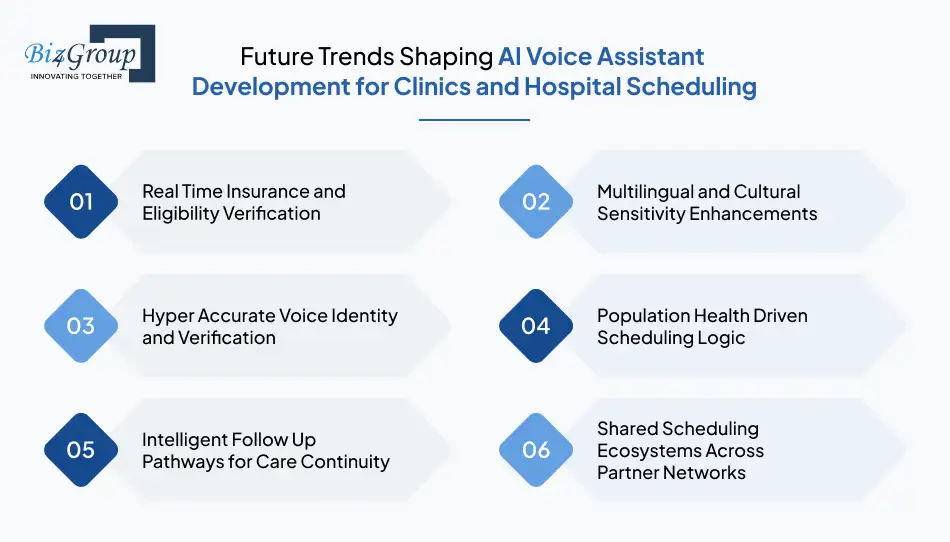
The future of AI voice assistant development for medical appointment scheduling is shifting toward smarter patient communication and deeper operational intelligence. These changes are already forming, which becomes clearer in the forward looking trends below.
Voice assistants will verify coverage, copays and referral requirements instantly as patients speak. This reduces last minute surprises and prevents scheduling gaps caused by insurance issues. It also helps teams make AI appointment scheduling voice bot solutions that feel more complete at the point of booking.
Assistants will adapt to patient language preferences and cultural communication styles automatically. This improves accessibility for diverse populations and boosts patient comfort. These capabilities strengthen how clinics build medical voice assistant for patient scheduling for broader communities.
Voice biometrics will streamline patient verification without relying on repetitive security questions. This creates faster, more secure authentication and reduces friction during the first few seconds of a call. Progress here will be influenced by improvements in generative AI and identity modeling.
Future assistants will incorporate risk scores, chronic condition insights and care gap reminders to guide patients toward the right appointments. This creates scheduling that supports long term health outcomes instead of only booking time slots.
Voice systems will automatically recommend follow ups based on visit type, provider recommendations and care plans. This supports proactive care and reduces forgotten appointments, strengthening AI voice assistant development for clinics and hospital at an operational level.
Large provider networks will link assistants together to manage cross location referrals, specialist routing and regional availability. Development standards will increasingly reflect enterprise structures seen among top AI development companies in Florida.
With shifts like these taking hold, the future of scheduling is starting to look a lot more intuitive. Which makes it worth looking at the kind of partner who can turn these possibilities into something real.
Building the right solution starts with choosing a team that understands real clinical workflows. Biz4Group has already delivered healthcare automation products referenced earlier in this guide, and that experience directly shapes how we approach AI voice assistant development for medical appointment scheduling.
Biz4Group stands out because:
Biz4Group helps clinics deploy voice automation that feels trustworthy, practical and ready for real world patient interactions.
Enhance accuracy and reduce call pressure with a smarter voice system built for real medical workflows.
Plan My Voice Assistant ProjectModern scheduling doesn’t need more phone tag or overwhelmed front desk teams. A well built voice assistant steps in, handles the routine chaos and keeps patients moving through your system without friction. And with the right AI product development company behind it, the entire experience feels less like futuristic tech and more like common sense finally catching up to healthcare.
From core features to advanced capabilities, tech stacks to revenue models, the real takeaway is simple: clinics that embrace intelligent scheduling today set themselves up for smoother operations tomorrow. Patients get faster access, staff get their time back and your workflow finally starts behaving the way you always hoped it would.
Ready to bring your AI voice assistant for scheduling to life? Let’s build it together.
Accuracy improves when the assistant is trained on real patient conversations, allowing it to interpret natural phrasing and accents. Clinics using AI voice assistant development for medical appointment scheduling often see accuracy improve continuously through model refinement.
Yes, the assistant can prioritize urgent needs by checking updated availability and adjusting schedules quickly. This works well for clinics aiming to develop AI voice assistant for medical scheduling that responds reliably during time sensitive calls.
It usually requires anonymized call samples, clinic specific rules and examples of how patients request visits. These elements help developers build AI Voice Assistant for Medical Appointment Scheduling that communicates naturally during real patient interactions.
Most builds take 8 to 16 weeks depending on integrations and testing. This timeline supports clinics wanting to create healthcare voice assistant for appointments that fits smoothly into existing workflows.
Costs usually range from 15,000 to 100,000 plus depending on complexity, integrations and compliance needs. This aligns with clinics planning to make AI appointment scheduling voice bot solutions that scale over time.
Yes, the assistant can distinguish visit types, gather required details and route calls accordingly. Many clinics integrate this feature when they build medical voice assistant for patient scheduling that supports hybrid care models.

with Biz4Group today!
Our website require some cookies to function properly. Read our privacy policy to know more.