 Location :
Orlando, FL, USA
Location :
Orlando, FL, USA +1 (407) 714-1616
 info@biz4group.com
- AR and VR are reshaping clinical training, diagnostics, and patient care, making AR-VR healthcare app development a practical investment for modern healthcare teams.
- Market growth stats for AR and VR in Healthcare shows rising demand for simulation, remote care, and interactive training tools.
- Hospitals can develop AR-VR healthcare app solutions to enhance surgical rehearsal, improve rehab outcomes, and support real time procedure guidance.
- Teams also use immersive tools to make AR-VR medical simulation app experiences that train staff safely without risking patient outcomes.
- Development costs range from 20,000 to 300,000+ USD, depending on scope, integrations, 3D assets, compliance needs, and clinical complexity.
- AI driven recommendations and data powered workflows can create virtual reality healthcare app solutions for pain management and therapy.
Imagine a healthcare team trying to improve training, patient care, and everyday workflows without adding more strain to clinicians or IT. Now imagine using immersive tools that feel intuitive, helpful, and actually solve problems instead of creating new ones.
If you’re exploring AR-VR healthcare app development for your organization, chances are you’re looking for clear, practical answers to questions like these:
- How do I build an AR-VR app that helps doctors train on surgeries without a real patient?
- Can VR be used for patient rehab at home and track their progress for the doctor?
- Is it possible to use AR in hospitals so staff can see patient data while treating them?
- What does it cost to make a VR app for pain distraction or anxiety therapy?
- How do I make sure AR-VR healthcare apps are safe and approved for clinical use?
And if you’re like most leaders in hospitals, clinics, med-tech teams, or digital health companies, you’re probably juggling multiple priorities at once: improving outcomes, reducing burnout, tightening budgets, modernizing workflows, and keeping compliance airtight.
You need technology that fits into your world. That’s exactly where AR-VR healthcare app development starts becoming a practical path, especially when aligned with an AI app development company as part of broader digital strategy.
Here's what the market says about it:
- The U.S. AR-VR healthcare market is projected to grow to 2.3 billion at 15.4 percent CAGR through 2030.
- Globally, augmented reality in healthcare is expected to reach USD 11.31 billion by 2033.

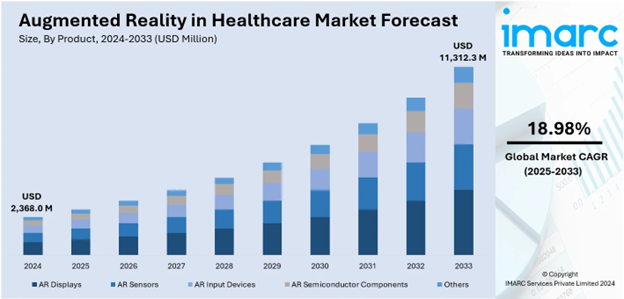
Whether your goal is to develop AR-VR healthcare app solutions, create AR healthcare application experiences, or build VR healthcare training app platforms, this guide walks you through the essentials in a friendly, grounded way without the fluff, which naturally complements digital tools commonly used alongside AI healthcare solutions.
What Are AR-VR Healthcare Apps?
AR-VR healthcare apps are digital tools that use augmented reality and virtual reality to support clinical training, patient care, and everyday medical workflows. They blend interactive environments with real-world tasks to make AR-VR healthcare app development practical and relevant for healthcare teams.
- They create virtual spaces where clinicians can learn, practice, and improve skills safely.
- They place digital information into real clinical settings to guide staff during procedures.
- They support patient therapy and rehab through structured immersive activities.
- They help teams communicate and collaborate with more clarity.
- They fit naturally into ecosystems that already use AI integration services.
In short, these apps give healthcare organizations a modern, easy-to-adopt way to enhance training, treatment, and everyday care.
How do AR-VR Healthcare Apps Work?
AR-VR healthcare apps work by blending real medical environments with interactive digital elements that help clinicians, patients, and staff learn or act with more clarity. It all comes together through the core flow below:
1. Capturing the Real Environment
AR uses a device camera to scan surroundings, map surfaces, and recognize objects so the app can place digital details exactly where users need them. The process becomes even smoother in systems that already use AI consulting services for structured data workflows.
2. Delivering Immersive Simulations
VR creates a fully virtual environment where users interact with realistic medical scenarios, allowing teams to practice procedures or therapy sessions safely and repeatedly without risk to real patients.
3. Syncing Clinical Data and Inputs
The app connects to approved data sources or devices to bring in vitals, imaging, notes, or sensor readings so every AR or VR interaction stays clinically relevant and supports develop AR-VR healthcare app workflows.
4. Guiding Actions Through Visual Cues
Digital overlays or simulated objects appear at the right time to guide decisions, reinforce steps, or help users understand context that might be missed in real environments during AR-VR healthcare app development tasks.
|
Process Stage |
What Happens |
Why It Matters |
|
Environment Capture |
The app scans surroundings or loads virtual spaces |
Ensures experiences look accurate and natural |
|
Simulation Delivery |
Users enter interactive 3D medical scenarios |
Allows safe practice and therapeutic engagement |
|
Data Integration |
Clinical data flows into AR or VR views |
Keeps every interaction grounded in real care needs |
|
Visual Guidance |
Overlays or cues assist users step by step |
Improves confidence and reduces errors |
Understanding the workflow helps, but what usually drives decisions is the impact these apps can create, and that is where things start getting genuinely compelling.
Bring Immersive Care to Life
Build AR-VR healthcare app development solutions that enhance training, treatment, and patient experience without disrupting your workflows.
Start My AR VR Healthcare AppWhy Should Businesses Invest in AR-VR Healthcare Apps?
Healthcare teams are under pressure to deliver safer training, better patient outcomes, and smoother workflows without increasing operational load. Investing in AR-VR healthcare app development gives organizations a practical way to upgrade care while also aligning with a fast-growing market that shows no signs of slowing down.
1. Better Training Without Real-World Risk
Clinicians can rehearse complex procedures in realistic virtual setups, repeat steps safely, and reduce dependence on costly training resources. This supports organizations planning to develop AR-VR healthcare app solutions that lower training overhead while improving accuracy.
2. More Engaging Patient Rehab and Therapy
Immersive therapy keeps patients involved longer, improves adherence, and gives providers clearer visibility into progress. When connected with digital ecosystems managed through AI automation services, it also strengthens long-term care continuity.
3. Reduced Operational Bottlenecks
Immersive tools streamline onboarding, reduce the need for physical training inventory, and shorten learning curves. Hospitals save time, move staff through training cycles faster, and minimize downtime.
4. Stronger Long-Term Digital Strategy
AR-VR readily integrates with predictive analytics, AI, and future tech changes, giving organizations a pathway they can scale without heavy reinvestment. It sets hospitals up for the next wave of digital health rather than forcing rushed catch-up later.
5. Faster Decision Making with Contextual Data
AR can display vital signs, imaging, or procedural cues directly in front of clinicians, helping them act faster and with more confidence. Teams can align this with the internal systems they manage using a custom software development company to keep data flow consistent.
6. Growing Market Momentum and Lower Adoption Barriers
Hardware costs continue to drop, software ecosystems are maturing, and regulatory clarity is gradually improving. For investors and healthcare leaders, this reduces risk and widens the window for early advantage.

Semuto, an AI platform developed by Biz4Group, is a personalized healthcare recommendation platform that helps users discover the right wellness and medical apps tailored to their needs. It brings structure, clarity, and guided health decision making into one place. Projects like Semuto show how digital health ecosystems evolve when built with precision, which translates naturally into robust AR-VR healthcare app development.
As these benefits stack up, AR-VR starts feeling less like an experimental add-on and more like a strategic step forward, especially once you see where it is already making an impact in real healthcare scenarios.
Turn Clinical Challenges Into Immersive Tools
Create AR-VR healthcare app modules that help your team practice safely, work faster, and deliver better care.
Build My AR VR Healthcare SolutionReal-World Use Cases of AR-VR App Development for Hospitals
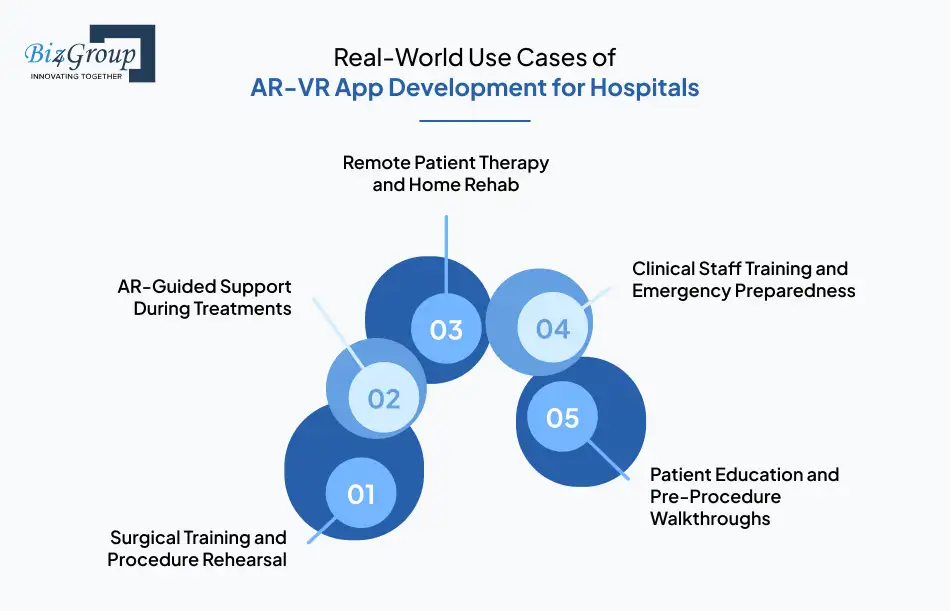
Hospitals are turning to immersive tech because it solves real problems quickly, without disrupting clinical flow. These use cases show how AR-VR healthcare app development becomes genuinely valuable once it is woven into everyday care.
1. Surgical Training and Procedure Rehearsal
Teams can practice complex surgeries inside realistic VR environments, repeat techniques safely, and refine coordination long before entering an operating room. This is especially useful for organizations planning to develop AR-VR healthcare app modules that build clinical confidence.
- Example: A VR simulation where surgeons rehearse endoscopic procedures with real-time motion feedback.
2. AR-Guided Support During Treatments
Augmented reality can display vitals, imaging, or reference cues inside a clinician’s field of view, helping them stay focused while reducing screen switching. Many workflows already using AI consulting services find AR layers easier to personalize because the underlying data is structured and accessible.
- Example: AR overlays showing vein pathways during IV insertion.
3. Remote Patient Therapy and Home Rehab
VR turns rehab and therapy into interactive sessions that keep patients engaged, while clinicians monitor progress remotely. Some care networks link these sessions with enterprise AI solutions to track patterns and adjust treatment plans more intelligently.
- Example: A VR balance training routine that uploads progress to a therapist dashboard.
4. Clinical Staff Training and Emergency Preparedness
Hospitals can simulate emergency codes, safety drills, or equipment training in digital replicas of their own facilities, helping new staff adapt faster without disrupting real operations.
- Example: A VR code blue simulation that walks nurses through step-by-step response actions.
5. Patient Education and Pre-Procedure Walkthroughs
Immersive 3D visuals help patients understand their condition and upcoming procedures in a way that feels less intimidating. In some patient-facing workflows, tools shaped through AI chatbot integration keep instructions clear while VR provides a deeper visual explanation.
- Example: A VR walkthrough showing how a hip replacement is performed and what recovery looks like.
|
Use Case |
What It Does |
Clinical Impact |
|
Surgical Training |
Builds skill through safe virtual practice |
Improves technique and reduces early-stage errors |
|
AR-Guided Procedures |
Places key data in the clinician’s view |
Speeds decisions and boosts accuracy |
|
Home Rehab and Therapy |
Makes rehab more engaging and trackable |
Improves adherence and remote monitoring |
|
Staff Training and Drills |
Simulates hospital-specific environments |
Strengthens onboarding and readiness |
|
Patient Education |
Visualizes procedures and diagnoses |
Reduces anxiety and improves cooperation |
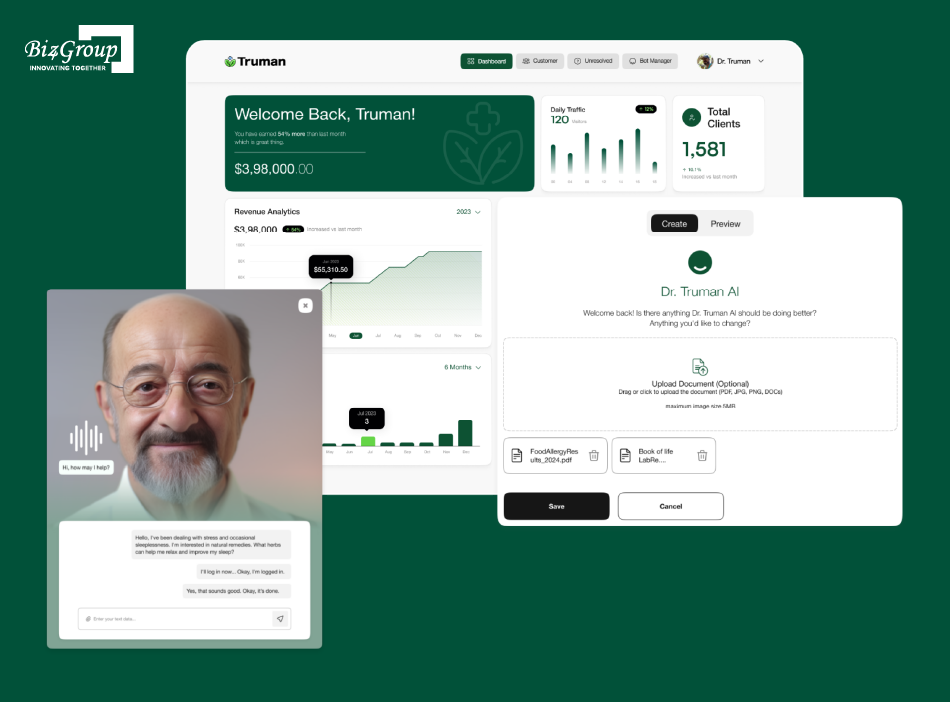
Truman is an AI-powered wellness platform built by Biz4Group, that delivers personalized supplement insights, health tracking, and exclusive member benefits. It blends data models, user profiles, and smart automation to create a tailored wellness journey. That same engineering mindset supports immersive AR-VR healthcare app development, where accuracy, responsiveness, and intuitive UX define clinical value.
Hospitals that explore these use cases often start seeing patterns in what features matter most for their teams, which makes the next step of defining core capabilities feel a lot more straightforward.
Essential Features When You Develop AR-VR Healthcare App Solutions
A strong AR-VR healthcare app is more than immersive visuals. It needs practical features that help clinicians, patients, and staff actually get things done. These core capabilities form the foundation of AR-VR healthcare app development and shape how useful your product will feel in real clinical settings:
|
Core Feature |
What It Does |
Why It Matters |
|
High Fidelity 3D Simulations |
Recreates anatomy, procedures, & environments |
Boosts clinical accuracy and learning realism |
|
Real-Time Data Overlays |
Shows vitals, imaging, and notes in AR |
Reduces screen switching and improves focus |
|
Motion Tracking and Gesture Control |
Detects hands, tools, and body movement |
Supports surgical rehearsal and rehab exercises |
|
Multi-User Collaboration |
Enables shared VR sessions for teams |
Enhances remote training and team coordination |
|
Clinical Workflow Integration |
Integrates with EHR or internal systems |
Keeps experiences relevant to real patient care |
|
Interactive Learning Modules |
Guides users through step-by-step processes |
Ideal for onboarding, drills, and repeated practice |
|
Voice and Chat Interaction |
Supports AI voice chatbot guided communication |
Easy to pair with tools built using AI conversation app frameworks |
|
Secure User Authentication |
Protects data with role-based access |
Ensures compliance with healthcare standards |
|
Analytics and Performance Tracking |
Logs usage, progress, and outcomes |
Helps clinicians monitor training and patient rehab |
|
Device Flexibility |
Works across headsets, mobile AR, and tablets |
Makes adoption easier for hospitals at any scale |
A well-rounded feature set like this gives your AR-VR solution enough structure to support clinical demands while staying flexible for future enhancements, which naturally leads into exploring the more advanced capabilities that push the experience even further.
Advanced Features to Make Immersive AR-VR App for Medical Procedure Simulation
Once the core features are set, advanced capabilities begin shaping how well your solution supports the realities of clinical practice. These additions help AR-VR healthcare app development reach a level of precision and realism that professionals can trust.
1. Haptic and Force-Feedback Simulation
Haptic responses recreate pressure, resistance, and tactile sensations so clinicians can feel procedural details rather than just observe them. This is essential for anyone aiming to make immersive AR-VR app for medical procedure simulation that accurately mirrors real surgical conditions.
2. AI-Driven Adaptive Learning Paths
Training scenarios can adjust automatically based on a clinician’s performance and learning patterns. Many hospitals already experimenting with AI model development find it easier to enable adaptive learning because their data pipelines are structured for dynamic updates.
3. Real-Time Multiuser Collaboration With Spatial Anchoring
Teams can join the same virtual environment from different locations with objects anchored consistently across devices. Communication flows more naturally in organizations familiar with frameworks influenced by AI assistant app design projects.
5. Predictive Insights and Smart AR Overlays
AR views can display context-aware cues, recommendations, or warnings by interpreting real-time information. These enhancements also strengthen the overall effectiveness of any healthcare simulation App Using AR-VR built for complex clinical scenarios, especially in systems where teams already know how to integrate AI into an app.
With features like these, the experience moves from useful to truly immersive, and it becomes clearer why understanding the step by step build process matters just as much as the features themselves.
Upgrade Your Care Ecosystem With Precision
Make an AR-VR medical simulation app that blends accuracy, adaptability, and real world workflow alignment.
Start My Medical Simulation AppStep-by-Step Process to Develop AR-VR Healthcare App Solutions
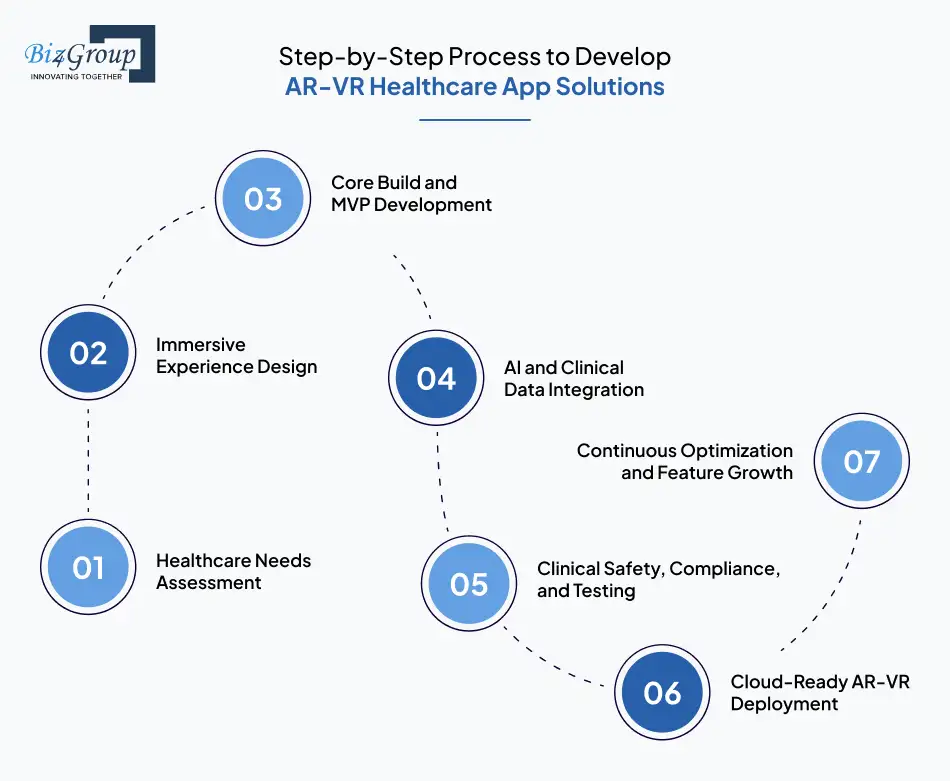
Building an AR-VR healthcare product is unlike creating a general consumer app. You are designing something clinicians will rely on during real procedures, patient care moments, and high-pressure training scenarios.
Each step has to be intentional, clinically aligned, and grounded in how AR-VR healthcare app development actually works inside a hospital environment.
1. Healthcare Needs Assessment
This stage defines the purpose behind the solution and clarifies where immersive technology can make a measurable difference. Hospitals often look at gaps in training, procedure support, patient engagement, or therapy adherence before choosing whether to develop AR-VR healthcare app modules. The goal is to understand real challenges, not idealized ones.
- Conduct interviews with clinicians, educators, therapists, and operational leaders
- Identify which clinical tasks benefit most from immersive support
- Validate imaging access, data flow requirements, and compliance constraints
- Establish KPIs such as training accuracy, onboarding time reduction, or therapy progress rates
Discovery ensures the product starts with clinical truth, not assumptions.
2. Immersive Experience Design
In healthcare, design quality directly affects adoption. A VR interface that feels clumsy, or an AR overlay that’s visually overwhelming, will be rejected immediately. Designing for clinicians means designing for precision, clarity, and calm. It's recommended that you partner with a UI/UX design company to create AR healthcare application interfaces used during active care.
- Build workflow-based prototypes for surgical simulations, AR-guided tasks, or rehab modules
- Test with clinicians to map movement patterns, visibility needs, and comfort thresholds
- Ensure consistency across menus, overlays, and dashboards
- Prioritize accessibility, gloves-on interaction, and minimal cognitive load
Strong UX makes the difference between “interesting technology” and something clinicians actually use.
Also read: Top UI/UX design companies in USA
3. Core Build and MVP Development
Launching everything at once should never be the goal. The smarter path is to opt for MVP development services with one or two high-value modules that demonstrate immediate clinical usefulness. It could be a surgical rehearsal, an AR data overlay for nurses, or a basic build VR healthcare training app scenario. Hospitals want to see real value before expanding the solution.
- Build the foundational simulation or AR workflow first
- Add essential VR interactions such as navigation, object manipulation, or gesture tracking
- Integrate initial analytics to track usage, accuracy, or therapy progress
- Architect a scalable backend for future modules like advanced simulations or predictive features
Also read: Top 12+ MVP Development Companies in USA
4. AI and Clinical Data Integration
Immersive tech becomes exponentially more valuable when paired with accurate data and adaptive intelligence. Whether the goal is building adaptive rehab routines, generating patient-specific simulations, or powering AR overlays, AI is the engine behind deeper clinical insight in any healthcare Simulation App Using AR-VR.
- Train AI models using diverse patient datasets and procedure records
- Connect imaging, vitals, and EHR inputs to enrich AR and VR interactions
- Build adaptive learning paths based on user performance and clinical outcomes
- Balance generic AI models with custom clinical datasets for higher accuracy
Smart AI integration turns AR-VR from a visual tool into a decision-support system.
5. Clinical Safety, Compliance, and Testing
Healthcare demands engineering discipline. Your app must withstand testing for reliability, accuracy, safety, and patient privacy. AR-VR products handle movement data, clinical information, and treatment interactions, so compliance cannot be an afterthought.
- Validate compliance with HIPAA, HITECH, FDA requirements, and hospital IT rules
- Test comfort, spatial accuracy, and motion stability in real clinical conditions
- Simulate workflows to uncover friction before deployment
- Review authentication, audit logs, and encryption methods
This step ensures the solution can be trusted in real treatment and training settings.
Also Read: Software Testing Companies in USA
6. Cloud-Ready AR-VR Deployment
Hospitals operate round the clock, and AR-VR usage patterns vary by department. Deployment needs to be stable and seamless. Cloud readiness ensures simulations load quickly, AR guidance stays accurate, and updates roll out without disrupting clinical schedules.
- Use scalable cloud infrastructure to handle high activity from training sessions or rehab cycles
- Implement CI/CD pipelines for continuous improvement
- Monitor performance dashboards focused on clinician interaction and therapy usage
- Provide onboarding guides that clinicians can follow with minimal support
Reliable deployment ensures the experience feels dependable from day one.
7. Continuous Optimization and Feature Growth
Healthcare changes constantly, and your AR-VR solution needs to evolve with it. New procedures, updated protocols, and different hardware all shape how the experience should adapt. Continuous optimization strengthens both value and adoption.
- Collect ongoing feedback from clinicians and patients
- Add new simulations, advanced AR overlays, or deeper data integrations
- Retrain AI models with updated datasets and performance logs
- Track training outcomes, therapy adherence, and real-world ROI
This stage keeps your product aligned with real-world clinical needs long after launch.
By the time teams move through these steps, their product has a clear purpose, a smart architecture, and real clinical relevance. The next thing worth exploring is the tech foundation that supports all of it.
Ideal Tech Stack for Modern AR-VR Healthcare App Development
The right technology stack determines how realistic your simulations feel, how responsive your AR guidance becomes, and how reliably the system performs during real clinical workflows. For AR-VR healthcare app development, your stack needs to support visual performance, data accuracy, and medical-grade reliability. Here’s all you need to know:
|
Label |
Preferred Technologies |
Why It Matters |
|
Frontend Framework |
React, React Native, Vue.js |
ReactJS development helps Interfaces stay clean and responsive for clinicians. |
|
Server-Side Rendering and SEO |
Next.js, Nuxt.js |
NextJS development allows stable rendering, improves load times and data visibility. |
|
Backend Framework |
Node.js, Express, Python |
NodeJS Development and Python development handle imaging intake, session syncing, and heavy data processing. |
|
API Development and Integrations |
REST, GraphQL, FHIR APIs |
Supports secure interoperability with EHRs, PACS, wearables, and hospital systems to deliver clinically relevant data inside AR and VR modules. |
|
AI and Data Processing |
TensorFlow, PyTorch, Scikit-Learn |
Enables adaptive training, motion interpretation, and imaging insights without affecting AR-VR simulation performance. |
|
3D Simulation Engine |
Unity, Unreal Engine |
Powers high-fidelity visuals essential for surgical simulations, digital twins, and VR-based therapy. |
|
AR Development Frameworks |
ARCore, ARKit |
Ensures accurate spatial anchoring and stable overlays for procedural guidance and workflow enhancement. |
|
VR Interaction Layer |
OpenXR, Oculus SDK |
Creates consistent VR experiences across headsets used for training, therapy, and clinical preparedness. |
|
Cloud Infrastructure |
AWS, Azure |
Manages multiuser sessions, concurrency, and real-time collaborative simulations reliably in large clinical settings. |
|
Database |
PostgreSQL, MongoDB |
Stores simulation logs, clinician performance data, therapy progress records, and user analytics securely. |
|
Security and Compliance Tools |
OAuth 2.0, JWT, HIPAA-ready configs |
Protects sensitive medical data and aligns the immersive system with healthcare compliance requirements. |
|
Testing and QA |
Jest, Cypress, XR Simulation Tools |
Verifies VR comfort, AR accuracy, session stability, and device compatibility before clinical deployment. |
|
DevOps and Deployment |
Docker, Kubernetes, CI/CD Pipelines |
Ensures scalable hosting, automated updates, and minimal downtime for busy clinical environments. |
|
Device Compatibility Layer |
Mobile AR, VR Headsets, Tablets |
Allows hospitals to deploy the solution across existing devices without major hardware investments. |
With the right tech stack and supporting layers in place, the immersive solution becomes more stable, scalable, and clinically dependable, making it easier to understand what it realistically costs to build a healthcare-ready AR-VR application from MVP to full enterprise scale.
Scale Innovation Without Slowing Care
Develop virtual reality healthcare app solutions that improve surgical rehearsal, therapy, and remote patient engagement.
Build My Virtual Reality Healthcare AppWhat Is the Cost to Develop AR-VR Healthcare App? (MVP to Enterprise)
Budgets for immersive healthcare solutions vary widely, but most projects fall somewhere between 10,000 and 200,000 plus dollars, depending on scope and clinical complexity. This is a ballpark estimate, but it gives hospitals and health-tech teams a realistic starting point when planning AR-VR healthcare app development.
The table below breaks down typical ranges based on what you choose to build:
|
Build Level |
Estimated Range (in USD) |
What You Get |
|
MVP AR-VR Healthcare App |
20,000 to 60,000 |
A focused module like a basic VR training scenario or a simple AR-guided workflow. Includes core interactions, foundational UI, limited 3D assets, and essential analytics for early validation. |
|
Mid-Level AR-VR Healthcare App |
60,000 to 150,000 |
Multiple training modules, deeper AR overlays, moderate 3D complexity, clinician dashboards, secure integrations, and data-driven insights. Ideal for hospitals expanding business. |
|
Enterprise-Grade AR-VR Healthcare Platform |
150,000 to 300,000+ |
A full ecosystem with multiuser collaboration, patient-specific digital twins, predictive insights, advanced analytics, AI-assisted workflows, and integrations across EHR, PACS, and clinical systems. Built for large hospital networks or specialized medical institutions. |
Understanding costs makes it easier to plan your roadmap, especially once you know how different features shape long-term value. From here, looking at monetization opportunities naturally helps clarify where immersive healthcare apps create the strongest return.
Also Read: Cost of Implementing AI in Healthcare
Monetization Opportunities in AR-VR Medical App Development Services
A strong immersive healthcare app can generate revenue in several dependable ways, especially as hospitals look for tools that blend smoothly into training, therapy, and daily clinical tasks. These models show how AR-VR healthcare app development supports sustainable growth while staying aligned with real healthcare needs.
1. Subscription Licensing for Hospitals and Training Centers
Subscriptions work well because hospitals prefer predictable pricing and regular content updates. This model is especially useful when organizations develop AR-VR healthcare app solutions that multiple departments plan to use at different times.
- Makes it easy for hospitals to adopt new modules throughout the year
- Admin workflows often run alongside digital systems shaped by the healthcare conversational AI guide
2. Per Module or Per Simulation Pricing
Some departments only need specific immersive experiences, such as cardiology simulations or AR-guided IV procedures. Selling modules individually lets teams adopt exactly what fits their specialty without paying for features they will not use.
- Specialty units can make targeted purchases and expand later
- This approach fits organizations improving internal tools through custom healthcare software development
3. Enterprise Deployments With Custom Integrations
Large hospital systems often require deeper technical integrations with PACS, EHR platforms, or device networks. Enterprise deployments support custom architecture and long-term collaboration, making them a strong revenue stream for immersive medical platforms.
- Ideal for healthcare networks rolling out simulations across multiple facilities
- Some organizations collaborate with a software development company in Florida for region-specific infrastructure needs
4. Professional Services and Ongoing Feature Expansion
Hospitals frequently request new surgical simulations, refined AR overlays, or updated rehab routines. These expansion projects create ongoing revenue and keep the platform clinically relevant as protocols evolve.
- Encourages long-term partnerships with clinical teams
- Many organizations bring in specialists by choosing to hire AI developers for analytics or adaptive training features
5. White Labeling for Medtech and Education Organizations
Training institutes and medtech companies often want immersive modules under their own branding. White labeling gives them a ready-to-use platform while giving you access to a broader market.
- Supports certification programs, training academies, and device education
- This model pairs well with strategies observed in AI medical web development
6. Freemium Access for Student and Wellness-Focused Applications
Freemium is ideal when the audience is large and early-stage, such as students or wellness users. Free access to a basic build VR healthcare training app module can encourage early adoption and create a natural upgrade path.
- Helps users explore introductory simulations before investing in advanced ones
- Freemium models often align with digital learning ecosystems inspired by business app development using AI
A thoughtful monetization strategy keeps your immersive healthcare platform sustainable and scalable, which makes it easier to follow the best practices that ensure smooth performance in real clinical environments.
Move from ideas to impact
create AR-VR healthcare app development experiences that feel practical, intuitive, and clinic ready from day one.
Start My AR VR Healthcare ProjectBest Practices for AR-VR Healthcare App Development
Creating an immersive healthcare solution means balancing realism, usability, and clinical accuracy. These principles help your AR-VR healthcare app development process stay aligned with real medical environments instead of feeling like a tech experiment.
1. Build Around Real Clinical Workflows
The simplest way to make an immersive module effective is to design it around how clinicians already work. A quick mapping session with surgeons or nurses can reveal more than a dozen hours of guessing ever could, and teams often base the structures on healthcare conversational AI to organize these insights cleanly.
2. Prioritize Comfort, Accessibility, and Ease of Use
Comfort determines whether someone keeps using an AR or VR tool. That is why navigation should feel effortless, even for clinicians who are not tech-forward. Some developers borrow the simplicity they rely on during chatbot development for healthcare industry to keep the user experience light and welcoming.
3. Invest in High Fidelity Assets and Clear Interaction Logic
Training scenarios depend on accuracy, especially when you develop AR-VR healthcare app modules for procedures or movement-based assessments. Many teams refine their asset pipelines by applying the same attention to detail they use when they build AI software, where precision directly affects performance.
4. Embed Compliance and Data Protection From Day One
HIPAA readiness cannot be an afterthought. Permissions, encryption, and data flows should be designed early so hospitals can trust the platform instantly. It helps that clinical teams are familiar with structured processes like those in AI in healthcare administration automation, which makes secure workflows easier to adopt.
5. Test Inside Actual Clinical Environments
Lighting, noise, and device availability change from unit to unit in a hospital, and these conditions can affect how AR and VR behave. Many teams approach product validation just like the top AI development companies in Florida, where real environment testing is considered a nonnegotiable.
When these practices guide development, immersive healthcare apps become smoother to use and easier to trust, setting the stage for understanding the challenges that may appear along the way and how to handle them with confidence.
Challenges in AR-VR Healthcare App Development and How to Overcome Them?
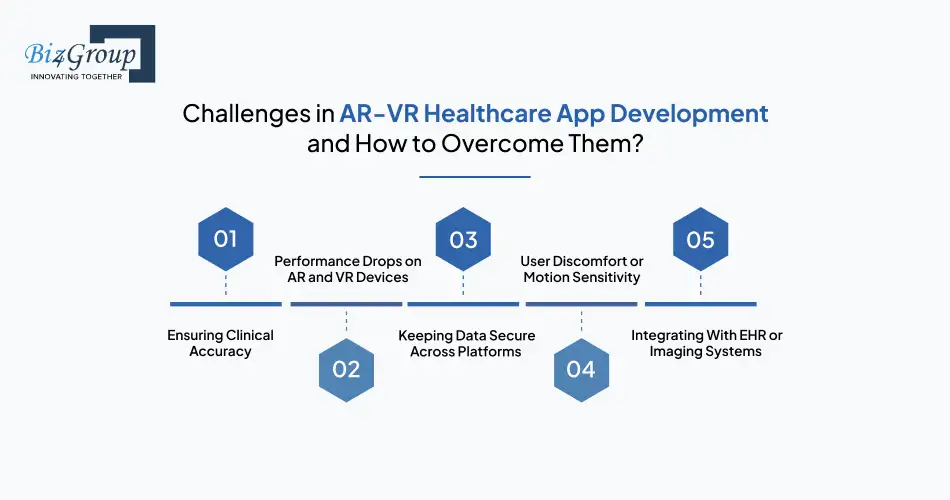
Every immersive healthcare project hits a few bumps along the way, especially when clinical accuracy, data security, and device performance all need to align. Here are the hurdles most teams face during AR-VR healthcare app development, along with practical ways to move through them:
|
Top Challenges |
How to Solve Them |
|
Ensuring Clinical Accuracy |
Work directly with clinicians from the start and validate every interaction through early prototypes. |
|
Performance Drops on AR and VR Devices |
Optimize 3D assets, reduce unnecessary animations, and streamline rendering logic so the experience stays responsive. These adjustments help when you develop AR-VR healthcare app workflows that need smooth real time feedback. |
|
Keeping Data Secure Across Platforms |
Use encryption, permission based access, and secure pipelines to handle clinical data responsibly. Early planning helps ensure the app remains HIPAA friendly from the ground up. |
|
User Discomfort or Motion Sensitivity |
Design short sessions, limit rapid movement, and keep controls simple to reduce strain for clinicians and patients. Comfort directly affects adoption and long term engagement. |
|
Integrating With EHR or Imaging Systems |
Plan for integration early and map out data flows clearly. Simple API layers and modular architecture make it easier to scale connections to hospital systems, imaging tools, or analytics platforms. |
Understanding these hurdles makes planning far easier, and once the major challenges are accounted for, it becomes clearer how the future of immersive healthcare is shaping up and where the biggest opportunities are headed.
Also Read: Augmented Reality Development and Its Challenges
The Future of AR-VR Healthcare App Development
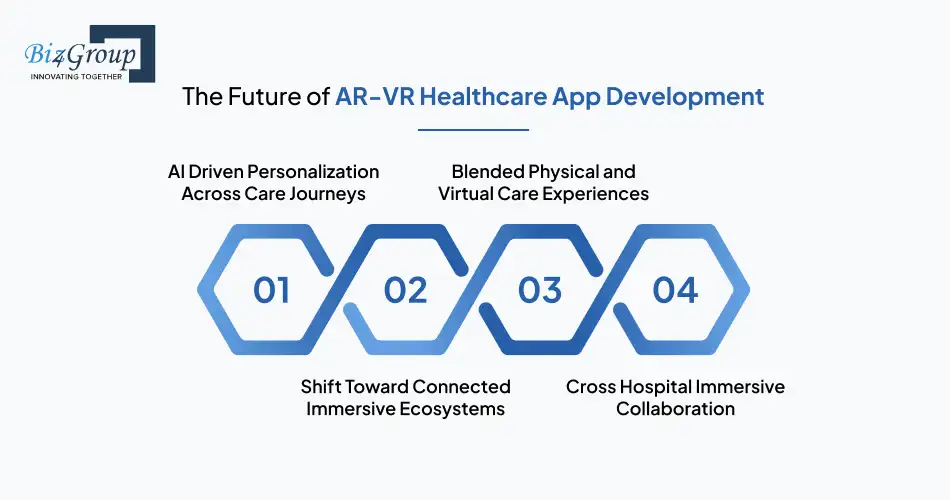
Immersive healthcare is entering a phase where impact matters more than novelty. As hospitals look for tools that simplify work and improve outcomes, the future of AR-VR healthcare app development will revolve around smarter intelligence, better continuity, and broader access.
1. AI Driven Personalization Across Care Journeys
Immersive tools will get better at adjusting to each user in real time, whether it is a clinician learning a skill or a patient following a therapy routine. This evolution will rely on intelligence similar to how generative AI adapts content based on user behavior.
2. Shift Toward Connected Immersive Ecosystems
Hospitals will gradually move away from isolated training apps and adopt connected platforms that multiple departments can share. As you develop AR-VR healthcare app solutions for this future, the emphasis will shift toward continuity across training, therapy, and workflow support.
3. Blended Physical and Virtual Care Experiences
Immersive components will become part of everyday care, showing up before appointments, during recovery, and throughout long term monitoring. Conversational layers similar to those built by an AI chatbot development company will help tie these experiences together.
4. Cross Hospital Immersive Collaboration
Specialists in different cities will join the same virtual environment to practice, review cases, or support complex decision making. These shared spaces will make expertise more accessible and training more consistent across institutions.
With these shifts underway, choosing the right development partner becomes essential, especially when long term scalability and clinical reliability matter just as much as innovation.
Why Biz4Group Is a Trusted Partner for Healthcare App Development With AR-VR?
When hospitals and health-tech founders choose a development partner, they want someone who understands both the clinical landscape and the engineering discipline behind immersive technology. Biz4Group brings that balance, combining deep healthcare experience with the precision of an AI development company.
Our work on platforms like Semuto and Truman shows how we build healthcare ecosystems that are structured, intuitive, and data driven. Those same strengths translate directly into AR and VR projects where accuracy, user trust, and workflow alignment matter just as much as visual impact.
What Makes Biz4Group a Strong Fit:
- A proven track record in building healthcare platforms that require real clinical understanding
- Engineering workflows tailored for AR, VR, and data-powered healthcare applications
- Cross-functional teams skilled in product strategy, AI modeling, UI-UX, and immersive interaction design
- Development practices shaped around compliance, security, and interoperability
- Experience translating complex medical needs into simple, usable digital experiences
Biz4Group focuses on building solutions that feel practical and ready for the real world, which is exactly what healthcare teams expect when they invest in AR-VR innovation.
Transform Training and Treatment With Immersive Tech
Build an AR-VR medical simulation app designed for better accuracy, safer practice, and stronger patient outcomes.
Launch My AR VR Medical AppConclusion: Moving Forward With AR-VR Healthcare App Development
Healthcare may not always move fast, but AR and VR are giving it a very real nudge. Training feels less theoretical, procedures feel more supported, and patient care feels a little more human when technology actually understands what clinicians need. The best part is that none of this is out of reach anymore.
With the right vision and the right build partner, immersive healthcare stops being a futuristic idea and starts becoming something teams actually use. And if you ever want a crew that treats complex innovation like a craft, working with an experienced AI product development company is a solid place to begin.
Curious what AR and VR could actually fix in your workflow? Let’s map it out together.
FAQs for Healthcare App Development With AR-VR
1. What type of healthcare workflows benefit the most from AR-VR apps?
Workflows that require repetition, precision, and a visual understanding of procedures benefit most from immersive tools. Teams often explore how they might develop virtual reality healthcare app solutions for surgery prep, rehab progression, or step by step learning that traditional software cannot deliver.
2. How do hospitals ensure AR-VR apps integrate smoothly with existing systems?
Hospitals typically use HL7 or FHIR standards to connect immersive tools to their EHRs, imaging platforms, and scheduling systems. Clear data mapping helps avoid complexity, especially when planning to make AR-VR medical simulation app modules that need accurate information flow.
3. Is AR-VR safe for clinicians and patients during extended sessions?
Safety depends on proper comfort-focused design. Shorter sessions, clean visual transitions, and stable motion handling help prevent fatigue or discomfort. This is especially important when teams plan to build VR therapy app for mental health and physical rehabilitation that may require regular, guided use.
4. What is the typical cost of building an AR-VR healthcare app?
Most immersive builds fall between 20,000 and 300,000 or more, depending on simulation complexity, clinical accuracy, and integrations. Costs vary widely whether the goal is to create virtual reality healthcare app solutions for pain management and therapy or build multi scenario training platforms.
5. Do AR-VR healthcare apps require special hardware?
Yes, depending on the experience. VR modules may use standalone headsets, while AR experiences might run on mobile devices or smart glasses. Hardware planning becomes important when you develop augmented reality apps for clinical workflow enhancement, where reliability and mobility matter.
6. How long does an AR-VR healthcare app take to develop?
Timelines usually range from 3 to 9 months, depending on scope, 3D asset needs, testing cycles, and clinical validation. Larger projects using AR-VR medical app development services often take longer because they involve multi department requirements and broader feature sets.
