 Location :
Orlando, FL, USA
Location :
Orlando, FL, USA +1 (407) 714-1616
 info@biz4group.com

- AI eDiscovery platforms organize massive legal data into structured workflows, helping litigation and investigation teams move from evidence collection to decision-making faster.
- AI eDiscovery platform development like Everlaw focuses on scalable architecture, defensible workflows, and collaboration environments built around real legal operations.
- Successful platforms combine document review automation, audit transparency, and secure cloud infrastructure to support enterprise legal teams handling complex investigations.
- Typical development investment ranges from $30,000–$150,000+, depending on automation depth, compliance requirements, and scalability goals across enterprise use cases.
- Organizations that develop AI eDiscovery platform like Everlaw gain long-term operational efficiency by reducing manual review effort and improving case preparation timelines.
- Biz4Group LLC helps enterprises translate legal workflows into scalable platforms through structured delivery, usability-focused design, and enterprise-grade implementation expertise.
Legal teams are dealing with evidence volumes that grow faster than case timelines. Emails, chat records, contracts, cloud documents, and internal communications now form the backbone of litigation and investigations. What once required months of manual review is becoming a data orchestration challenge that demands smarter systems and structured workflows.

Across global eDiscovery markets, digital evidence continues expanding at an enterprise scale as the market is projected to grow $16.68 billion in 2026 to $25.2 billion in 2030.
North America continues to lead adoption due to heavy litigation activity, where enterprises digitize legal workflows and cross-border investigations increase.
An AI eDiscovery platform development like Everlaw focuses on solving this operational complexity rather than adding another legal tool.
Key shifts driving this transition include:
- Rising cross-border investigations requiring centralized evidence management
- Shorter litigation timelines with higher expectations for review accuracy
- Growing reliance on remote collaboration among legal teams and external counsel
- Increased scrutiny around defensible workflows and audit transparency
When organizations plan to develop AI eDiscovery platform like Everlaw, the goal extends beyond AI automation. It becomes about building a system that helps legal professionals move confidently from data ingestion to case strategy.
Working with a reliable custom software development company ensures workflows align with real legal operations, while thoughtful AI integration enables faster document understanding without overwhelming users with technical complexity.
This guide walks you through how to build AI powered eDiscovery software like Everlaw with clarity, scalability, and enterprise readiness in mind. Why wait? Let’s dive in.
Understanding AI-Powered eDiscovery Platform Everlaw and Its End-to-End Workflow
Modern litigation depends on how efficiently legal teams move from raw data to usable evidence. Understanding the workflow behind an AI-driven eDiscovery platform helps you see how technology supports real legal decision-making without disrupting familiar processes.
What is Everlaw?
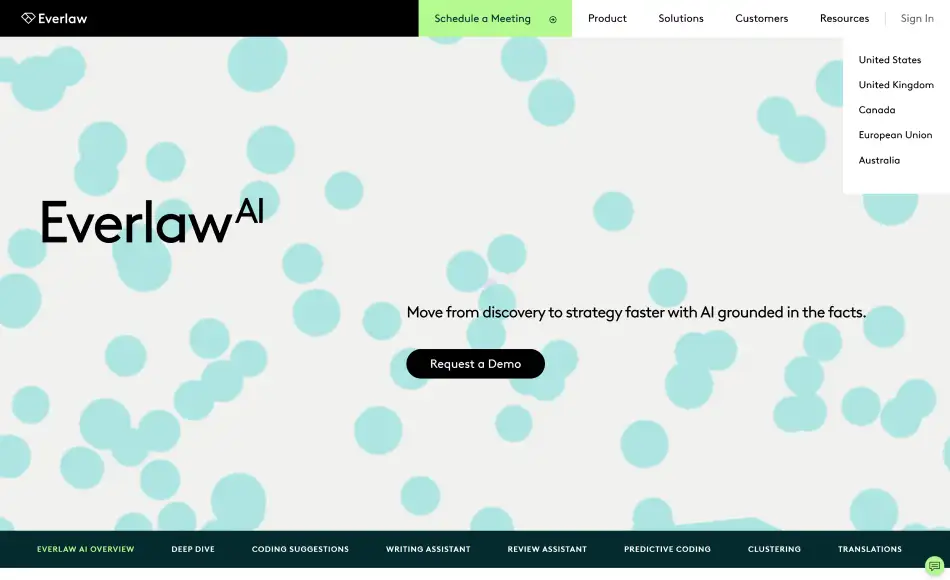
Everlaw is a cloud-based legal AI eDiscovery platform designed to help teams manage large volumes of digital evidence during litigation and investigations. It brings document collection, review, analysis, and collaboration into a single workspace, so legal professionals can work from shared, organized information. Instead of handling disconnected tools, teams review evidence, tag documents, and build case narratives within one environment.
Now let’s walk through how the workflow actually functions in practice.
1. Data Collection and Ingestion
The workflow begins by gathering data from multiple enterprise sources and preparing it for legal review.
- Files are imported from emails, cloud drives, messaging tools, and internal systems
- Duplicate data is identified early to reduce review workload
- Metadata such as timestamps and authorship remains preserved for legal defensibility
This stage ensures evidence enters the system in a structured and reliable format.
2. Processing and Organization
Once collected, the platform prepares documents so reviewers can navigate information easily.
- Documents are automatically categorized based on content patterns
- AI model helps group related files to reveal hidden connections
- Searchable indexes allow teams to locate relevant material quickly
Legal teams spend less time sorting files and more time understanding context.
3. Review and Case Analysis
Review becomes collaborative rather than isolated manual work.
- Reviewers tag documents, add notes, and flag sensitive information
- Generative AI assists in summarizing lengthy records for faster understanding
- Teams prioritize high-value evidence using relevance scoring
Legal eDiscovery software development using AI focuses on guiding reviewers toward meaningful insights instead of overwhelming them with data.
4. Production and Reporting
The final stage prepares validated evidence for courts or investigations.
- Selected documents are exported in legally accepted formats
- Audit trails track every action performed during review
- Reports help demonstrate transparent and defensible workflows
Each step ensures outcomes remain organized and legally reliable.
A well-designed workflow transforms eDiscovery from a document-heavy task into a structured investigative process. Understanding this lifecycle helps organizations plan platforms that align technology with real litigation execution rather than adding unnecessary operational complexity.
Seeing The Workflow Is One Thing, but Building It Is Another.
If your legal teams need discovery workflows that actually reduce review chaos, it starts with translating process into platform architecture.
Talk to Discovery Platform ExpertsWhy Businesses Should Invest in AI eDiscovery Platforms Like Everlaw
Legal operations today are closely tied to how organizations manage digital evidence at a scale. Investment decisions around AI eDiscovery platforms are increasingly driven by efficiency, risk control, and the need for structured legal workflows that support faster outcomes.
Market Snapshot:
Before discussing investment reasons, let's understand where the market is heading.
The growth of digital investigations and regulatory oversight is accelerating demand for intelligent eDiscovery platforms across industries. Enterprises are shifting budgets toward platforms that help legal teams manage growing evidence volumes without increasing operational pressure.
- The United States eDiscovery market alone is projected to reach $5.68B by 2026, showing strong enterprise adoption momentum.
- Government and public sector organizations across North America are expanding electronic eDiscovery usage as sensitive databases face rising cybersecurity threats.
- Legal teams increasingly rely on automation to reduce manual review and improve defensibility during investigations.
Current usage trends show how organizations apply intelligent eDiscovery capabilities in real legal workflows:
- Document review leads adoption at 2%, reflecting the scale of data analysis challenges
- Document summarization follows closely at 8%, helping teams understand large evidence sets faster
- Early case assessment supports strategy planning in 4% of matters
- Privilege and PII identification appears in 9% of workflows to reduce compliance risks
- Timeline reconstruction is used in 0% of investigations for event clarity
- Translation capabilities support cross-border matters at 0%
- Deposition preparation and summaries account for 8% of usage
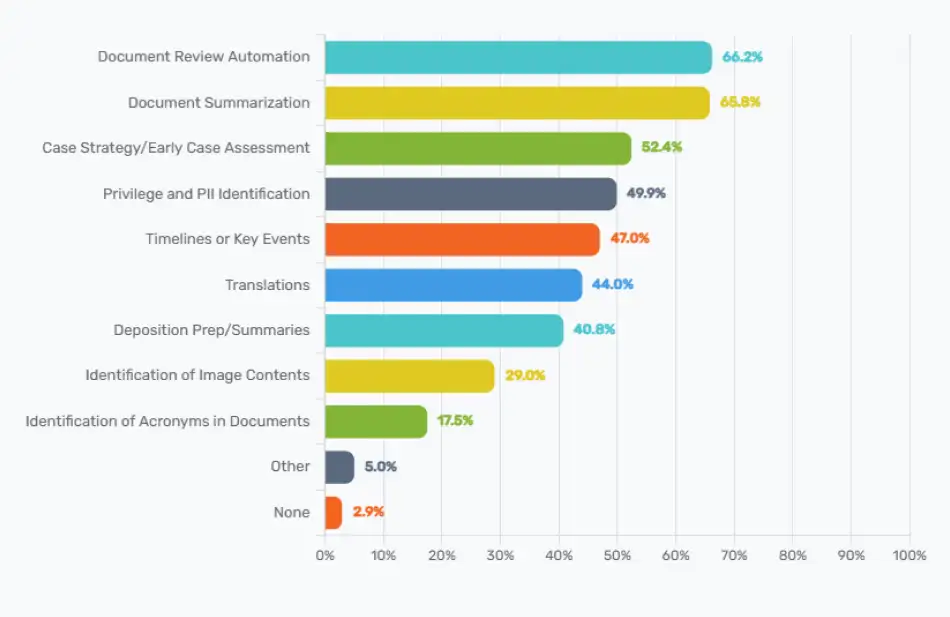
These trends show how AI eDiscovery platform development like Everlaw aligns directly with operational legal needs rather than experimental technology adoption.
With this market context in mind, let’s now look at why businesses should actively start investing now.
1. Predictable Legal Cost Control
Legal discovery spending often grows unpredictably because manual review scales with data volume. Investment in AI eDiscovery platform development like Everlaw introduces structured automation that stabilizes operational costs over time.
- Reduces dependency on large temporary review teams
- Minimizes repeated processing across multiple cases
- Lowers outside counsel review expenses through faster filtering
Organizations gain financial predictability, which directly improves long-term litigation budgeting.
2. Faster Case Resolution Improves Financial Outcomes
Extended litigation timelines increase legal fees, operational distraction, and settlement pressure. Investing in intelligent AI eDiscovery infrastructure shortens evidence review cycles and enables earlier strategic decisions.
- Accelerates early case assessment and risk evaluation
- Helps legal teams identify critical evidence sooner
- Supports faster negotiation or resolution timelines
Shorter case durations directly translate into measurable financial savings.
3. Scalable Infrastructure Supports Growing Data Volumes
Enterprise data continues expanding across communication tools and cloud platforms. Businesses that create enterprise AI eDiscovery systems like Everlaw invest once in scalable infrastructure instead of repeatedly upgrading fragmented tools.
- Handles increasing data loads without proportional cost increases
- Supports multiple investigations within a single platform
- Eliminates repeated technology onboarding expenses
Scalability protects future budgets as data complexity grows.
4. Reduced Regulatory and Compliance Exposure
Investigations and audits carry financial risk when evidence handling lacks transparency. Investment in structured AI eDiscovery systems strengthens defensible workflows and reduces potential penalties.
- Maintains audit-ready documentation trails
- Improves accuracy in privilege and sensitive data handling
- Reduces compliance violations caused by manual errors
Lower regulatory exposure protects both financial and reputational capital when you create AI eDiscovery software solutions for litigation like Everlaw
5. Operational Efficiency Across Legal Teams
Legal departments often operate across internal teams, external counsel, and investigators. Investing in a unified legal AI app environment centralizes collaboration and reduces duplicated effort.
- Shared workspaces prevent repeated document reviews
- Standardized workflows improve team productivity
- Knowledge reuse lowers effort across similar cases
Efficiency gains compound financially across multiple matters each year.
6. Long-Term Competitive Advantage Through Intelligent Automation
Organizations investing early in enterprise AI solutions position legal operations as strategic business functions rather than reactive cost centers. A well-trained AI model continuously improves review accuracy as more cases are processed.
- Institutional knowledge remains within the organization
- Decision-making improves with accumulated data insights
- Legal operations become faster without increasing headcount
Strategic investment turns eDiscovery capabilities into a long-term operational asset rather than a recurring expense.
Litigation vs Investigation Use Cases of Everlaw like AI eDiscovery Platform
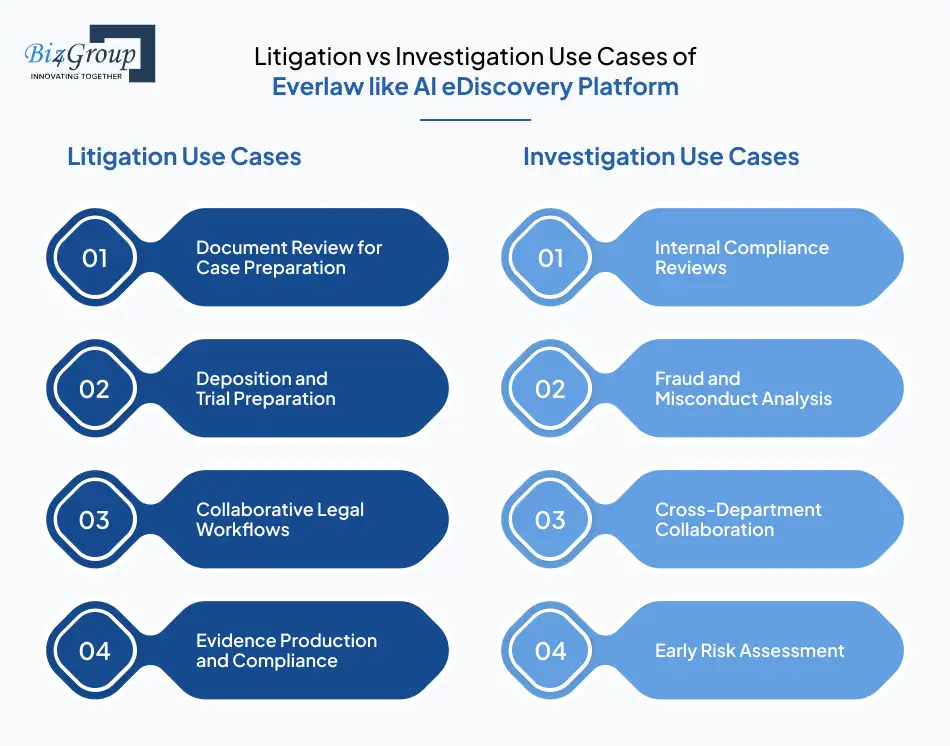
Legal AI eDiscovery does not follow a single workflow. Litigation and investigations demand different priorities, timelines, and decision paths. Understanding these distinctions helps you design AI eDiscovery platform development like Everlaw around how legal teams actually operate day to day.
Litigation Use Cases
Litigation workflows revolve around preparing defensible evidence for court proceedings. The objective is clarity, accuracy, and structured collaboration so attorneys can confidently build arguments supported by verified information. Organizations that build AI eDiscovery software like Everlaw for litigation focus on enabling controlled review and trial readiness.
- Document Review for Case Preparation
- Attorneys review large document sets using structured tagging and categorization
- Relevant evidence surfaces faster, helping teams meet strict court deadlines
- Deposition and Trial Preparation
- Key conversations and documents are organized into timelines for legal arguments
- Case narratives develop directly from reviewed evidence rather than manual compilation
- Collaborative Legal Workflows
- Internal counsel and external firms work within shared environments
- Insights from eDiscovery connect with tools such as a legal AI chatbot that helps attorneys retrieve case context quickly during preparation
Also Read: How Much Does It Cost to Build a Legal AI Chatbot?
- Evidence Production and Compliance
- Documents are exported in approved formats with full activity tracking
- Audit trails support defensibility throughout litigation stages
Investigation Use Cases
Investigations prioritize uncovering facts early and managing organizational risk before legal escalation occurs. Teams that build AI driven eDiscovery platform for investigations design workflows that help decision-makers understand situations quickly and act responsibly.
- Internal Compliance Reviews
- Communication records are analyzed to identify policy violations or irregular behavior
- Sensitive information is flagged early to prevent exposure risks
- Fraud and Misconduct Analysis
- Patterns across emails or shared files help investigators detect unusual activity
- Teams integrate AI into workflows to surface hidden relationships across datasets
- Cross-Department Collaboration
- Legal, HR, and compliance teams review findings within controlled access environments
- Investigation effort tracking aligns with operational system such as law firm timekeeping software to maintain accountability.
- Early Risk Assessment
- Decision-makers receive structured summaries that support faster internal actions
- Issues can be resolved before evolving into formal litigation matters
Designing an AI eDiscovery platform around both litigation and investigation realities ensures technology supports legal strategy across the entire case lifecycle. This alignment turns AI eDiscovery systems into operational tools that guide decisions rather than simply storing evidence.
Litigation Today, Investigations Tomorrow. One Platform or Two Problems?
Discovery systems should adapt across legal scenarios without rebuilding workflows every time a new case appears.
Design Your Use-Case StrategyCore Capabilities Required to Build AI-Powered eDiscovery Software Like Everlaw
The development of an AI eDiscovery platform requires more than adding automation to document review. Legal teams depend on structured workflows that support investigations, collaboration, and defensible outcomes. AI eDiscovery platform development like Everlaw succeeds when core capabilities align with how legal professionals actually handle evidence from intake to resolution.
|
Core Capability |
Why It Matters in Real Legal Workflows |
|---|---|
|
Unified Data Ingestion |
Collects evidence from emails, cloud storage, messaging tools, and enterprise systems into one controlled environment. |
|
Intelligent Data Processing |
AI automation tools remove duplicates, organize files, and prepare documents for faster legal review. |
|
Advanced Search and Filtering |
Enables attorneys to locate critical evidence quickly using contextual search instead of manual scanning. |
|
AI-Assisted Document Review |
Prioritizes relevant documents, so reviewers focus effort where it impacts case outcomes most. |
|
Early Case Assessment (ECA) |
Helps legal teams understand risks and evidence patterns before committing large review budgets. |
|
Collaborative Review Workspace |
Allows internal counsel, investigators, and external firms to work together securely in real time. |
|
Timeline and Event Reconstruction |
Builds chronological views of communications and documents to simplify case understanding. |
|
Privilege and Sensitive Data Detection |
Identifies confidential or regulated information to reduce compliance and disclosure risks. |
|
Audit Trails and Defensible Workflows |
Tracks every user action to support legal defensibility during court or regulatory review. |
|
Cloud-Based Scalability |
Supports growing datasets without infrastructure upgrades when organizations develop cloud-based AI eDiscovery platforms like Everlaw. |
|
Integration Ecosystem |
Connects with enterprise tools and adjacent systems such as an AI legal consultation platform where eDiscovery insights inform broader legal strategy. |
|
Flexible AI Model Architecture |
Enables teams to seamlessly integrate AI models that adapt to different case types and organizational policies. |
|
Automated Reporting and Production |
Prepares court-ready document sets and reports while maintaining formatting and metadata accuracy. |
|
Proactive Investigation Intelligence |
Surfaces behavioral or communication patterns early, a realistic enhancement needed in custom AI eDiscovery platform development like Everlaw for modern investigations. |
Strong AI eDiscovery platforms succeed because each capability supports practical legal action rather than isolated functionality. When these capabilities work together, organizations build systems that scale with litigation complexity while remaining usable for everyday legal operations.
Advanced Features That Differentiate Enterprise AI eDiscovery Systems like Everlaw
Once core eDiscovery capabilities are established, differentiation comes from how intelligently the platform supports decision-making at scale. AI eDiscovery platform development like Everlaw moves beyond document handling and focuses on advanced intelligence that improves legal outcomes and operational efficiency.
|
Advanced Feature |
How It Elevates Enterprise AI eDiscovery Workflows |
|---|---|
|
Predictive Case Insight Engine |
Uses predictive analysis to evaluate historical review patterns, forecast case risks, and highlight potential legal exposure early in the workflow. |
|
Contextual Relationship Mapping |
Visually connects people, conversations, and documents to reveal communication networks investigators may otherwise miss. |
|
AI-Powered Narrative Summarization |
Automatically builds structured summaries of evidence collections to help attorneys understand case direction faster. |
|
Continuous Learning Review System |
Learns reviewer decisions over time and refines prioritization logic during active matters without disrupting workflows. |
|
Cross-Matter Knowledge Reuse |
Allows organizations to reuse tagging logic and review intelligence across multiple cases, improving long-term efficiency. |
|
Natural Language Legal Query Interface |
Enables teams to ask plain-language questions and retrieve evidence insights without complex search syntax, supporting organizations that deploy a chatbot within eDiscovery environments for guided interaction. |
|
Autonomous Legal Workflow Assistance |
A legal AI agent can recommend next review actions, highlight gaps in evidence coverage, and assist teams during large investigations. |
|
Enterprise System Intelligence Layer |
Supports AI integration for enterprises by connecting eDiscovery insights with compliance, risk, and internal governance platforms. |
|
Multi-Jurisdiction Compliance Automation |
Automatically adapts workflows based on regional legal requirements, helping global teams manage investigations across regulatory boundaries. |
|
Proactive Investigation Monitoring |
Continuously scans incoming datasets for unusual activity patterns, an enhancement often required when organizations build scalable AI eDiscovery systems like Everlaw for modern enterprise environments. |
Advanced capabilities transform AI eDiscovery platforms into decision-support systems rather than passive review tools. Organizations that develop enterprise grade AI eDiscovery platforms like Everlaw gain long-term value by enabling faster insights, smarter collaboration, and scalable legal intelligence across matters.
Advanced Features Sound Impressive but Operational Impact Matters More.
The real question isn't what AI can do, it's what your legal teams can confidently rely on during active matters.
Plan Enterprise-Ready CapabilitiesBuilding Enterprise-Grade AI Legal Discovery Platforms like Everlaw : From Concept to Deployment
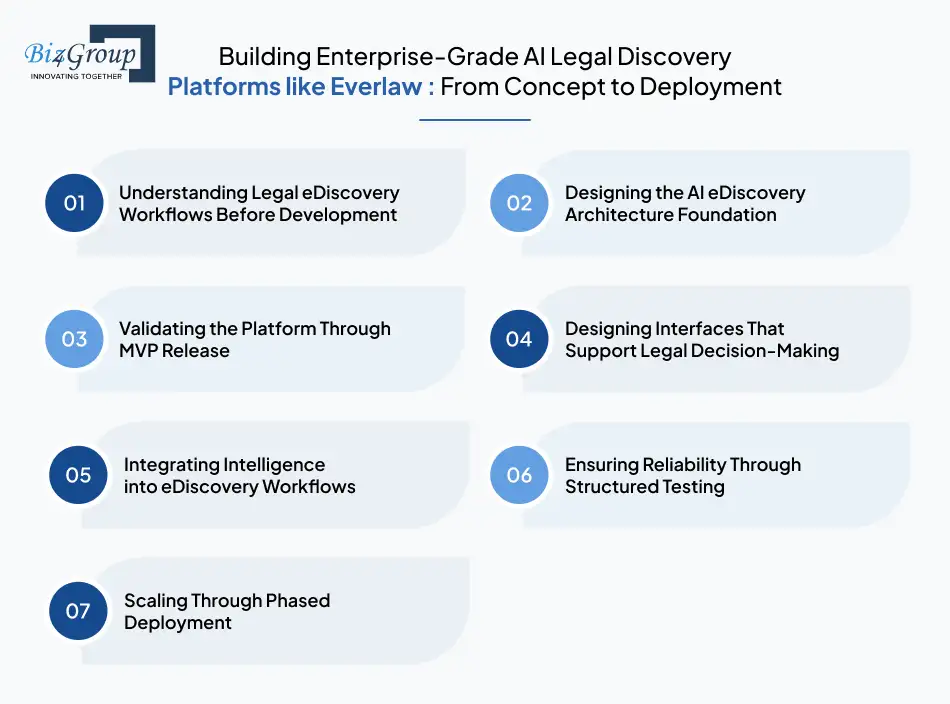
The development of a legal AI eDiscovery platform requires careful alignment between legal workflows, scalable technology, and user adoption. AI eDiscovery platform development like Everlaw succeeds when each stage validates real legal usage before expanding system complexity.
1. Understanding Legal eDiscovery Workflows Before Development
Every successful platform begins by studying how legal teams actually handle eDiscovery. This step prevents building features that appear impressive but fail during active cases.
- Map how corporate legal teams collect, review, and collaborate on evidence daily
- Identify bottlenecks in document review, approvals, and investigation workflows
- Align legal, compliance, and operational stakeholders around shared expectations
Clear workflow understanding helps organizations create AI eDiscovery platforms for corporate legal teams that reflect practical legal execution rather than theoretical design.
2. Designing the AI eDiscovery Architecture Foundation
A strong structural foundation determines whether the platform scales smoothly as data grows. Planning early avoids expensive restructuring later.
- Organize documents, metadata, and case relationships into structured data layers
- Define permission controls to protect sensitive legal information
- Prepare infrastructure that supports growing evidence volumes across multiple matters
Teams planning Everlaw alternative AI eDiscovery platform development often prioritize architecture stability before feature expansion.
3. Validating the Platform Through MVP Release
Early releases focus on proving usability instead of delivering full automation immediately. MVP software development allows legal teams to experience workflows in controlled environments.
- Launch core capabilities such as data ingestion, tagging, and review workflows
- Gather feedback from real reviewers handling active matters
- Improve usability through iterative MVP development cycles
This stage ensures investment decisions rely on real adoption patterns.
Also Read: Top 12+ MVP Development Companies
4. Designing Interfaces That Support Legal Decision-Making
Legal professionals need clarity, not complex dashboards. Interface design must support focus during high-pressure reviews.
- Simple layouts reduce training requirements for non-technical users
- Workflows mirror familiar eDiscovery review processes
- Visual dashboards highlight risks, timelines, and document priorities
Working with an experienced UI/UX design company helps ensure reviewers concentrate on legal judgment rather than navigation challenges.
Also Read: Top UI/UX design companies in USA
5. Integrating Intelligence into eDiscovery Workflows
Automation should assist legal reasoning rather than interrupt it. Teams build an AI app carefully by embedding intelligence where it genuinely improves outcomes.
- Systems seamlessly integrate AI models into document review stages
- AI chatbot integration can assist reviewers by retrieving evidence context during analysis
- Models learn continuously from reviewer actions to improve prioritization accuracy
Balanced intelligence keeps human decision-making at the center of eDiscovery workflows.
6. Ensuring Reliability Through Structured Testing
Legal software must perform consistently under pressure. Testing validates accuracy, stability, and data protection before large-scale deployment.
- Simulate real litigation and investigation scenarios during validation
- Evaluate performance across concurrent users and large datasets
- Collaborate with a trusted software testing company to verify reliability and security readiness
Thorough testing reduces operational risks after launch.
7.Scaling Through Phased Deployment
Enterprise adoption grows gradually when teams gain confidence through real usage. Controlled scaling helps organizations build AI eDiscovery software with document review automation that evolves alongside legal needs.
- Roll out features in phases across departments or regions
- Monitor performance insights to refine workflows continuously
- Introduce enhancements based on real operational feedback
A structured deployment journey transforms AI eDiscovery platforms into dependable legal infrastructure. Organizations that follow disciplined execution stages build scalable systems that support investigations, litigation, and collaboration without disrupting established legal processes.
Technology Stack Required to Develop Enterprise AI Legal Discovery Systems
Enterprise AI eDiscovery platforms rely on carefully selected technologies that balance performance, scalability, and usability. During AI eDiscovery platform development like Everlaw, architecture decisions must support large datasets, collaborative review, and secure web/mobile application development environments used by distributed legal teams.
|
Technology Layer |
Recommended Technologies |
Purpose in Enterprise AI eDiscovery Systems |
|---|---|---|
|
Frontend Framework |
React, TypeScript |
Supports responsive reviewer dashboards where ReactJS development enables fast document navigation and real-time interaction during large evidence reviews. |
|
Server-Side Rendering |
Next.js |
Improves performance and structured page delivery; NextJS development helps manage secure session handling for legal workflows and heavy data interfaces. |
|
Backend Runtime |
Node.js |
Handles concurrent user activity and workflow orchestration; NodeJS development supports scalable processing across multiple legal matters. |
|
AI & Data Processing |
Python, TensorFlow, PyTorch |
Powers document classification, clustering, and analysis workflows; Python development enables intelligent document review automation. |
|
Search & Indexing Engine |
Elasticsearch, OpenSearch |
Enables near-instant search across millions of documents and metadata fields required for eDiscovery workflows. |
|
Database Layer |
PostgreSQL + NoSQL (MongoDB) |
Stores structured case data alongside flexible document metadata for scalable evidence management. |
|
Cloud Infrastructure |
AWS (S3, EC2, Lambda), Kubernetes |
Supports secure storage, elastic compute scaling, and containerized deployments for enterprise reliability. |
|
Data Processing Pipeline |
Apache Kafka, Apache Spark |
Manages ingestion and processing of massive evidence datasets without slowing review workflows. |
|
Security & Access Control |
OAuth 2.0, Role-Based Access Control, Encryption Services |
Protects sensitive legal data and ensures controlled access across teams and jurisdictions. |
|
API Layer |
REST & GraphQL Services |
Enables API development that connect eDiscovery workflows with enterprise legal tools and external integrations. |
|
Document Processing Tools |
OCR Engines, File Parsers, Metadata Extractors |
Converts scanned and native documents into searchable and review-ready formats. |
|
Monitoring & Observability |
Prometheus, Grafana, CloudWatch |
Tracks performance, usage patterns, and system health across enterprise deployments. |
A realistic stack for Everlaw like AI eDiscovery platform development prioritizes performance, security, and scalability over experimental tools. Strong full stack development ensures every layer works together to support high-volume legal discovery without disrupting reviewer productivity or operational reliability.
Technology Choices Decide Scalability Before Development Even Starts.
A discovery platform's performance depends on architecture decisions made long before the first feature launches.
Discuss Your Tech StackAI eDiscovery Platform Development like Everlaw: Data Privacy, Compliance, and Security Requirements
Legal AI eDiscovery platforms manage confidential conversations, internal investigations, and privileged records that organizations cannot afford to expose. During AI eDiscovery platform development like Everlaw, privacy and security must guide architectural decisions from the beginning so legal teams can operate with confidence across sensitive matters.
1. Secure Data Handling Across the Evidence Lifecycle
Enterprise AI eDiscovery systems protect information from the moment data enters the platform until final production. Evidence must remain secure without slowing legal workflows or reviewer productivity.
- Documents stay encrypted during upload, storage, and sharing activities
- Secure processing environments prevent unauthorized access during analysis
- Case data remains isolated so multiple investigations can run safely at the same time
These protections help organizations make AI eDiscovery solutions like Everlaw for document review while maintaining strict confidentiality expectations.
2. Granular Access Control and User Governance
Legal teams work across departments, external counsel, and investigators. Access governance ensures every participant interacts only with relevant information.
- Role-based permissions limit document visibility based on responsibility
- Admin controls manage downloading, editing, and exporting privileges
- Activity tracking records user actions to maintain defensible workflows
Structured access reduces internal risk while preserving collaboration efficiency.
3. Compliance Alignment for Multi-Jurisdiction Legal Operations
Enterprise eDiscovery platforms must support regulatory requirements across regions where investigations take place. Compliance readiness becomes essential for organizations learning how to enhance your eDiscovery operations with AI responsibly.
- Support for standards such as SOC 2 Type II and GDPR data protection expectations
- Data residency controls to manage regional storage requirements
- Automated identification of sensitive or personal information during review
These measures allow legal teams to operate confidently across global matters.
4. Auditability and Evidence Integrity
Courts and regulators expect transparency in how evidence is handled. AI eDiscovery platforms therefore maintain detailed visibility across every workflow stage.
- Complete audit trails track document review, tagging, and production steps
- Version preservation ensures original evidence remains unchanged
- Reporting tools generate defensible records for legal validation
Audit integrity ensures eDiscovery processes withstand scrutiny during litigation.
5. Responsible AI Governance Within eDiscovery Systems
Intelligence features must operate within strict legal boundaries. Teams that hire AI developers must design governance rules before they build AI software handling regulated legal datasets.
- AI outputs remain reviewable and editable by legal professionals
- Training data stays restricted within approved organizational environments
- Continuous monitoring ensures automated insights remain accurate and reliable
Strong governance ensures automation assists legal judgment without replacing accountability.
Security, privacy, and compliance together determine whether organizations trust an AI eDiscovery platform during critical cases. When protection mechanisms align with real legal workflows, the platform becomes dependable infrastructure supporting investigations, litigation readiness, and long-term operational confidence.
Investment Estimates for Building Scalable AI eDiscovery Systems like Everlaw
Investment planning plays a critical role in AI eDiscovery platform development like Everlaw because legal eDiscovery systems must balance scalability, security, and usability from the start. Most enterprise implementations fall within an overall development range of $30,000–$150,000+, depending on scope maturity and automation depth.
|
Development Level |
Estimated Cost Range |
What This Typically Covers |
|---|---|---|
|
MVP Level AI eDiscovery Platform |
$30,000 – $50,000 |
Core document ingestion, basic review workflows, secure storage, early automation validation, and limited user collaboration features. |
|
Mid-Level AI eDiscovery Platform |
$50,000 – $100,000 |
Advanced document review automation, collaboration tools, analytics dashboards, workflow permissions, and expanded integrations for corporate legal operations. |
|
Advanced Level AI eDiscovery Platform |
$100,000 – $150,000+ |
Enterprise scalability, intelligent review systems, compliance automation, performance optimization, and infrastructure required for AI powered Legal Technology and eDiscovery solution deployments. |
Factors Influencing Cost to Develop AI eDiscovery Platform Like Everlaw
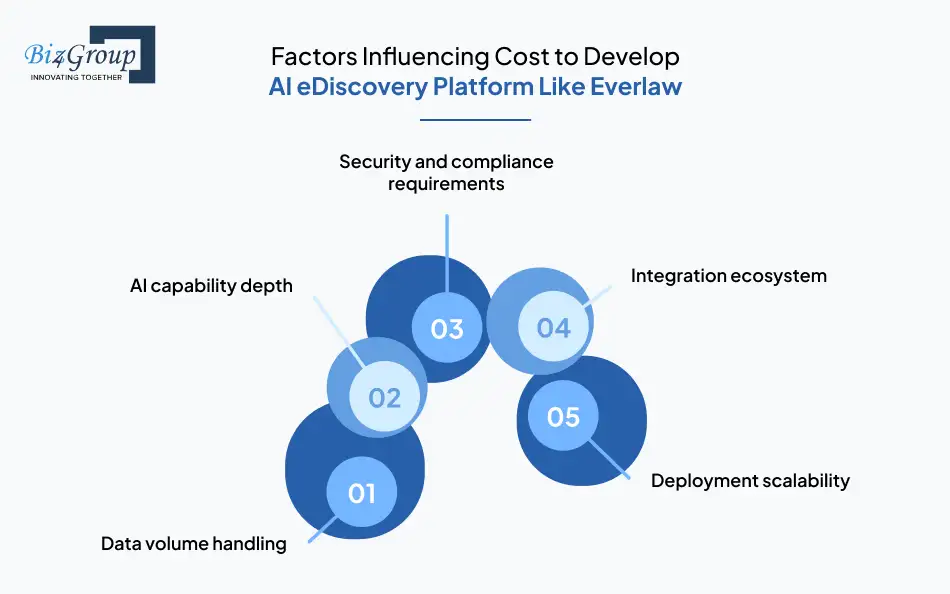
- Data volume handling: Larger datasets require stronger infrastructure and optimized processing pipelines, which directly increase development effort and hosting complexity.
- AI capability depth: Advanced intelligence features and automation workflows significantly affect AI integration costs due to training, testing, and refinement requirements.
- Security and compliance requirements: Enterprise-grade encryption, audit tracking, and regulatory alignment increase implementation effort but remain essential for legal environments.
- Integration ecosystem: Connecting eDiscovery workflows with enterprise tools or external legal systems expands development scope and testing timelines.
- Deployment scalability: Platforms designed for multi-organization or multi-matter usage require additional architecture planning compared to single-use deployments.
Now let’s look at practical ways organizations can control investment without limiting long-term scalability.
How to Optimize the Cost to Develop AI eDiscovery Platform Like Everlaw
- Start with focused MVP scope: Defining essential workflows first allows teams learning how to develop an AI eDiscovery platform like Everlaw to validate adoption early. This helps them avoid investing heavily in features that legal teams may not immediately require.
- Prioritize reusable architecture: Modular system design reduces future redevelopment costs and supports gradual expansion as eDiscovery workloads grow across departments or jurisdictions.
- Phase AI capability rollout: Introducing automation gradually helps control Cost to build AI software while allowing legal teams to adapt comfortably to intelligent workflows over time.
- Leverage cloud-native infrastructure: Scalable cloud environments reduce upfront infrastructure spending and align expenses with real platform usage rather than projected demand.
- Align development with business outcomes: Treating AI eDiscovery systems as business app development using AI ensures investment decisions remain tied to operational efficiency and measurable legal performance improvements.
Investment planning for AI eDiscovery platforms works best when cost aligns with adoption maturity. Organizations that approach development strategically build scalable systems that grow with legal operations while maintaining predictable budgets and long-term technological sustainability.
Not Every Dollar Builds Value, Some Just Build Complexity.
Understand where investment truly drives scalability before committing resources to platform development.
Estimate Your Platform InvestmentHow AI eDiscovery Platforms Like Everlaw Generate Revenue and Scale
Is AI eDiscovery platform profitable for legal tech startups? Yes, enterprise AI eDiscovery platforms succeed financially when revenue models align with how legal teams actually consume technology. AI eDiscovery platform development like Everlaw focuses on recurring usage, scalable infrastructure, and value tied directly to active legal matters rather than one-time software sales.
1. Recurring Revenue Through Platform Licensing
Most enterprise AI eDiscovery platforms operate on subscription licensing that provides predictable recurring revenue. Organizations pay for ongoing platform access instead of purchasing software outright.
- Law firms and corporate legal teams subscribe based on user seats or organizational usage
- Continuous platform updates increase retention without requiring new purchases
- Long-term contracts stabilize revenue and support operational forecasting
This model allows providers to scale revenue as client adoption expands across departments.
2. Monetizing Data Processing at Scale
AI eDiscovery platforms generate significant revenue through secure data hosting and processing services. Since investigations involve large evidence volumes, storage becomes a natural monetization layer.
- Clients pay based on data volume uploaded or processed during matters
- Pricing scales automatically with litigation activity and investigation size
- Secure hosting creates recurring income tied to platform usage
AI legal eDiscovery platform development solutions like Everlaw often rely heavily on this structure because data growth directly drives revenue expansion.
3. Upselling Intelligence as a Premium Layer
Advanced capabilities are frequently offered as paid upgrades within enterprise plans. These features increase platform value while creating additional revenue streams.
- Intelligent review acceleration tools offered as premium modules
- Advanced analytics dashboards priced separately from core access
- Specialized workflows tailored for regulatory investigations or compliance teams
Organizations frequently engage AI consulting services to configure these advanced capabilities according to internal legal processes.
4. Enterprise Customization as a Growth Lever
Large organizations require tailored workflows that align with internal systems. Custom integrations create additional monetization opportunities beyond standard subscriptions.
- Integration with enterprise compliance or document management systems
- Custom workflow automation for specific industries or legal functions
- Dedicated onboarding and configuration services
Customization strengthens client dependency on the platform, improving long-term retention.
5. Scaling Revenue Through Organizational Adoption
Scaling occurs when AI eDiscovery platforms move beyond single cases and become part of everyday legal execution. Organizations begin relying on the system across different legal scenarios, which naturally increases platform usage over time.
- Law firms extend platform use from litigation matters into investigations and regulatory reviews
- Corporate legal teams onboard additional practice groups as internal confidence grows
- Shared workflows reduce onboarding effort for new matters and new users
As adoption spreads across departments and case types, platform usage expands organically, creating sustainable growth driven by operational dependence rather than aggressive sales efforts.
Revenue growth in AI eDiscovery platforms comes from sustained usage rather than aggressive selling. When pricing aligns with real legal workflows, providers build predictable income streams while scaling alongside their clients’ litigation and investigation needs.
Also Read: 65+ Software Ideas for Entrepreneurs and Small Businesses
Overcoming Technical, Legal, and Operational Barriers When Building AI-Driven eDiscovery Systems
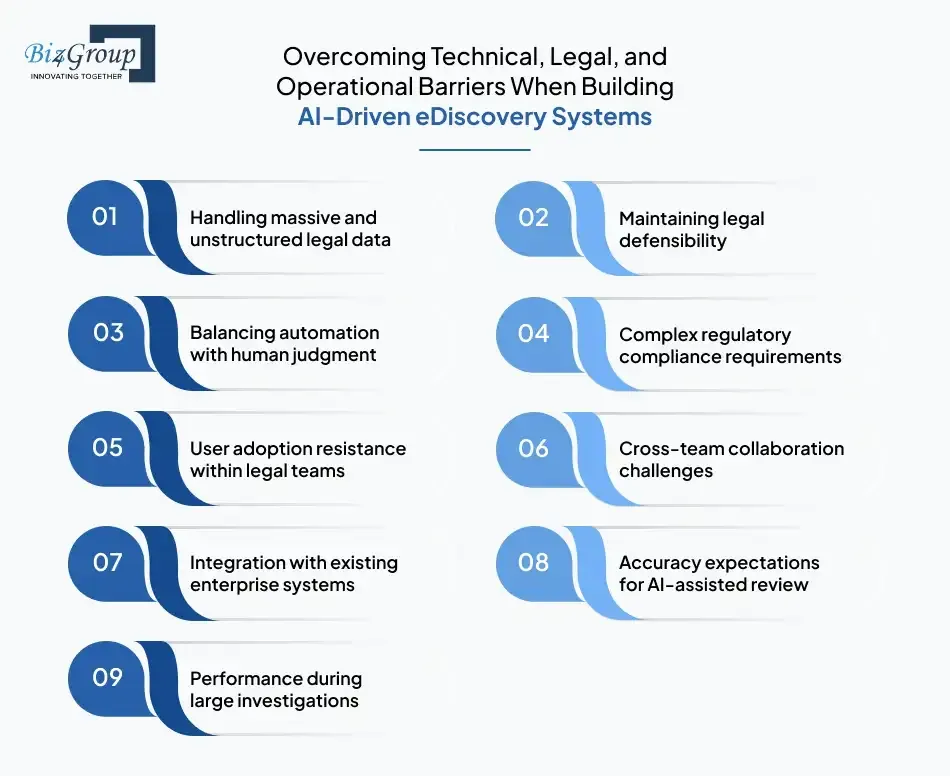
The development of AI eDiscovery platforms involves more than technology implementation. Legal environments introduce strict accuracy expectations, regulatory obligations, and operational realities that influence every development decision. AI eDiscovery platform development like Everlaw requires anticipating these barriers early to ensure long-term adoption and reliability.
| Challenge | Practical Solution |
|---|---|
|
Handling massive and unstructured legal data |
Design scalable ingestion pipelines that organize emails, files, and communications into structured review workflows before analysis begins. This prevents performance slowdowns as evidence volumes grow. |
|
Maintaining legal defensibility |
Build transparent workflows with audit trails and activity tracking, so every review decision remains traceable during litigation or regulatory review. |
|
Balancing automation with human judgment |
Introduce AI assistance gradually while keeping reviewers in control of final decisions, ensuring trust among legal professionals using the platform daily. |
|
Complex regulatory compliance requirements |
Embed compliance rules directly into workflows, including access governance and regional data controls, instead of treating compliance as a later enhancement. |
|
User adoption resistance within legal teams |
Design interfaces that mirror familiar review processes, allowing attorneys to transition naturally without needing technical expertise. |
|
Cross-team collaboration challenges |
Create centralized workspaces where internal counsel, investigators, and external firms collaborate securely without duplicating work. |
|
Integration with existing enterprise systems |
Develop flexible APIs that connect discovery workflows with document management and compliance tools already used by organizations. |
|
Accuracy expectations for AI-assisted review |
Continuously refine models using reviewer feedback loops, so results improve with real usage rather than static training datasets. |
|
Performance during large investigations |
Implement distributed processing and cloud scaling strategies to maintain consistent speed even during peak workloads. |
Overcoming these barriers requires aligning legal realities with thoughtful engineering decisions. Organizations investing in AI eDiscovery platform development services like Everlaw succeed when challenges are addressed proactively, allowing platforms to scale confidently while maintaining trust among legal teams and stakeholders.
Why Choose Biz4Group LLC to Build scalable AI eDiscovery systems like Everlaw
Enterprise legal teams do not adopt discovery platforms because of features alone. They invest in systems that fit real litigation workflows, maintain compliance confidence, and scale without disrupting legal operations. As a legal software development company, Biz4Group LLC works with organizations pursuing AI eDiscovery platform development like Everlaw by translating complex discovery processes into practical, usable platforms.
Our experience across legal tech platforms comes from solving operational challenges similar to modern discovery environments. These include managing large evidence volumes, supporting collaborative review, and ensuring defensible workflows that legal professionals can rely on during active matters.
Biz4Group LLC approaches development with a product-first mindset focused on usability and long-term scalability.
- Designing structured onboarding and review workflows aligned with attorney behavior
- Creating secure cloud architectures that support expanding investigation datasets
- Developing collaboration environments for internal counsel and external law firms
- Implementing analytics visibility that helps teams track review progress and outcomes
- Ensuring compliance-ready infrastructure built for enterprise legal environments
Rather than treating discovery platforms as standalone tools, our teams help organizations create AI eDiscovery platforms for corporate legal teams that evolve alongside operational needs. This structured approach enables clients to build scalable AI eDiscovery systems like Everlaw while maintaining performance, usability, and governance standards expected in enterprise legal environments.
Organizations evaluating partners among top AI development companies in Florida often prioritize delivery consistency. We focus on long-term platform success, helping legal teams launch confidently and expand capabilities as adoption grows.
Conclusion
Legal discovery is evolving into a data-driven discipline where efficiency, accuracy, and trust determine outcomes. Organizations working with an experienced AI development company recognize that success depends on building systems aligned with real legal workflows rather than adding isolated automation layers. AI eDiscovery platform development like Everlaw requires thoughtful planning, strong governance, and platforms designed for everyday legal execution.
As enterprises modernize litigation and investigation processes, the focus shifts toward platforms that help teams act faster while maintaining defensible decision-making. Organizations planning to develop enterprise grade AI eDiscovery platforms like Everlaw should approach development as a long-term operational investment.
The right platform becomes part of how legal teams work, collaborate, and make strategic decisions. If you are evaluating how such a system could fit your legal operations, a structured discussion around goals and workflows is often the best next step.
FAQ's
1. How does AI eDiscovery platform development like Everlaw improve litigation and investigation workflows?
Platforms built around intelligent discovery workflows help legal teams organize evidence faster, prioritize relevant documents, and maintain defensible audit trails. This improves decision speed while reducing manual review effort across litigation and investigations.
2. What steps are involved when organizations develop AI eDiscovery platform like Everlaw for enterprise use?
The process typically includes workflow analysis, scalable architecture planning, MVP validation, AI-assisted review implementation, compliance configuration, and phased deployment. Each stage ensures the platform aligns with real legal operations before scaling organization-wide.
3. What capabilities are essential to build AI powered eDiscovery software like Everlaw for document review automation?
Key capabilities include secure data ingestion, intelligent document classification, collaboration tools, audit tracking, and analytics dashboards. These components allow organizations to make AI eDiscovery solutions like Everlaw for document review that remain reliable under large data volumes.
4. How do AI eDiscovery platform development services like Everlaw support corporate legal teams and investigations?
Enterprise platforms centralize evidence management and enable cross-team collaboration. Organizations often build AI driven eDiscovery platform for investigations to accelerate internal reviews while maintaining compliance and controlled access to sensitive information.
5. What investment considerations matter when planning custom AI eDiscovery platform development like Everlaw?
Costs depend on automation depth, data scalability, compliance requirements, and integrations. Businesses developing cloud-based AI eDiscovery platforms like Everlaw usually start with core workflows and expand capabilities as adoption increases.
6. Is AI eDiscovery platform profitable for legal tech startups and enterprises entering Legal Technology markets?
Revenue typically comes from subscriptions, data hosting, and premium analytics features. AI legal discovery platform development solutions like Everlaw scale effectively because usage grows alongside litigation activity and enterprise adoption.
