 Location :
Orlando, FL, USA
Location :
Orlando, FL, USA +1 (407) 714-1616
 info@biz4group.com

- AI health management app development like Noom succeeds when AI, personalization, and behavior science work together to drive long term habit change.
- Compliance and trust are non-negotiable. Building HIPAA compliant AI health apps like Noom early protects users and supports scale.
- Core features such as adaptive tracking, nutrition intelligence, behavior coaching, and progress insights are essential for retention.
- The development process and technology stack must support scalability, automation, and real time personalization without overengineering.
- Cost matters. AI health management app development like Noom typically ranges from $30,000 to $250,000+, and Biz4Group helps optimize cost while delivering scalable, compliant solutions.
If you are building digital health today, you can feel the shift. Users no longer stick with basic trackers, or one size fits all wellness apps. They expect guidance that adapts, learns, and feels personal. That is exactly why AI health management app development like Noom is getting serious attention from founders, CTOs, and wellness leaders.
The numbers back this up. The global digital health market is projected to reach USD 420.08 billion in 2025, driven largely by AI powered personalization and behavior focused platforms.
At the same time, the wellness app market is expected to cross USD 12.8 billion in 2025, fueled by rising demand for habit change, nutrition, and mental wellness experiences, as reported by Hotelag.io.
This is where AI digital health app development like Noom stands apart. Noom did not succeed because it tracked calories better. It succeeded because it combined behavioral science with AI to guide users through long term habit change.
If you are considering AI health management app development services like Noom, you are likely facing practical questions already. How smart does the system really need to be? What makes personalization feel supportive instead of intrusive? How do you build trust early?
We work closely with product teams as an AI development company helping businesses design intelligent, scalable health platforms. One common mistake we see is rushing into features without understanding the system that makes Noom effective.
This guide breaks down how to build an AI health management app like Noom with clarity and realism. Whether you plan to partner with an experienced AI app development company or take a long-term approach with a product first mindset from an AI product development company, this walkthrough will help you evaluate feasibility before making major investments.
Next, let’s clarify what an AI-based health management app really is and why Noom’s model continues to outperform so many alternatives.
What Is an AI Based Health Management App and Why AI health management app development like Noom Actually Works
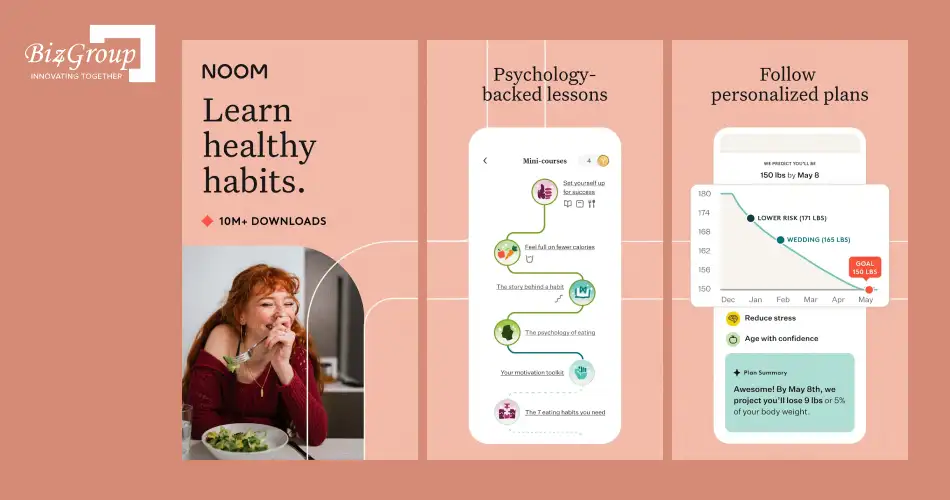
You have likely seen dozens of wellness apps that promise results but lose users after a few weeks. The difference with AI health management app development like Noom is not the interface. It is how intelligence is built into experience.
At its core, an AI-based health management app does more than track data. It observes patterns, learns from user behavior, and adjusts guidance over time. Think of it less as a static app and more as an adaptive system powered by an AI agent that responds to how real people actually live.
This is where AI digital health app development like Noom stands out. Instead of relying on fixed rules, Noom applies behavioral psychology with machine learning to personalize content, pacing, and nudges. When a user struggles, the app adapts. When habits improve, guidance evolves. That adaptability is what keeps users engaged long term.
From a technology perspective, this approach aligns closely with modern agentic AI development. These systems are designed to make decisions, take actions, and improve outcomes with minimal manual intervention. For wellness platforms, that means smarter coaching without adding operational overhead.
To users, this experience feels similar to working with a personal AI assistant that understands their goals, setbacks, and motivations. The app does not just react. It guides. That guidance is what turns short term curiosity into sustained behavior change.
Why AI Health Management Apps Like Noom Actually Work
Apps built on this model succeed because they solve real behavior change problems, not just technical ones.
- They personalize guidance in real time instead of relying on generic plans
- They adapt to user setbacks rather than penalizing inconsistency
- They combine behavioral science with data driven insights
- They feel supportive, not judgmental or overwhelming
- They scale coaching through intelligence, not human dependency
From a business lens, this model is powerful. It enables companies to develop AI health management app like Noom that scale personalization across thousands or millions of users. When implemented correctly, the platform functions as an intelligent AI health assistant app rather than a simple wellness tracker.
If you are exploring custom AI health app development like Noom, this distinction matters. Success does not come from adding AI as a feature. It comes from designing the entire product around adaptive intelligence. In the next section, we will look at why trust and compliance are the foundation that makes this kind of AI driven experience possible.
Thinking About AI Health Management App Development Like Noom but Unsure If It's Worth It?
The digital health market is projected to cross $420B in 2025, and wellness apps alone are expected to exceed $12.8B. The opportunity is real. The question is whether your idea is built to compete.
Talk to Our AI Health ExpertsTrust Is the Product: Building HIPAA compliant AI health app like Noom from Day One
In AI health management app development like Noom, trust is not optional. The moment users share health data, expectations change. You are no longer building a simple wellness app. You are building a system that must protect privacy, explain AI-driven decisions, and operate within strict regulatory boundaries.
For companies planning AI digital health app development like Noom, compliance is what separates scalable platforms from risky experiments. Getting it right early saves time, money, and reputation later.
1. Why Compliance Is Non-Negotiable in AI health management app development like Noom
When you develop AI health management app like Noom, you become responsible for sensitive data flows across AI models, analytics engines, and user interfaces. Any weakness can slow partnerships or halt growth. Compliance ensures your custom AI health app development like Noom remains credible, secure, and enterprise ready.
2. Understanding HIPAA Requirements for AI Driven Wellness Apps
HIPAA applies even when apps position themselves as wellness or lifestyle tools. Following HIPAA compliant AI app development for healthcare providers means securing user data at rest and in transit, restricting access, and maintaining audit trails. These safeguards are essential when building AI health management app development services like Noom that rely on predictive insights.
3. How AI Architecture Impacts Data Privacy and Security
AI models process large volumes of behavioral and health related signals. Without the right structure, this creates unnecessary risk. A secure AI healthcare software foundation limits data exposure, separates AI logic from raw data, and supports explainable outcomes. This is especially important when you build AI powered health management application like Noom for regulated markets.
4. Compliance as a Growth Enabler for AI Health Platforms
Compliance does more than reduce risk. It enables scale. Organizations that invest early in compliant AI healthcare solutions unlock partnerships with providers, employers, and insurers. For teams planning Noom like AI health management app development, compliance becomes a competitive advantage, not a slowdown.
5. Best Practices to Stay Compliant While You Build and Scale
Strong compliance does not require slowing innovation. Start with privacy by design, minimize unnecessary data collection, and document AI decision paths early. Regular reviews keep health management app development like Noom integrating AI aligned with regulations while allowing rapid iteration and improvement.
Once trust and compliance are in place, features start to matter. In the next section, we will break down the features that actually drive behavior change and explain what your product must include to succeed in AI health management app development like Noom.
Features That Drive Behavior Change in AI health management app development like Noom
When you look closely at why Noom works, it is not because of a single feature. It works because every capability supports long-term behavior change. In AI health management app development like Noom, features must guide, adapt, and respond to users instead of simply recording data.
If you plan to build AI powered health management app like Noom, these are the core features your product cannot function without.
|
Feature |
Description |
|---|---|
|
Personalized User Onboarding |
Collects goals, habits, lifestyle details, and readiness levels to tailor the experience from the first session. This sets the foundation for meaningful personalization. |
|
Adaptive Health Tracking |
Tracks habits, progress, and daily behaviors while learning from user patterns. This capability forms the backbone of any intelligent AI health tracking app. |
|
Nutrition Intelligence |
Analyzes meals and eating behavior to provide context-aware guidance. This feature is essential when building an AI nutrition app that feels supportive rather than restrictive. |
|
Behavior Change Coaching |
Delivers short lessons, nudges, and reflections grounded in behavioral science. This is the core differentiator in AI digital health app development like Noom. |
|
Dynamic Goal Management |
Adjusts goals based on consistency, setbacks, and progress. This prevents burnout and helps users stay engaged longer. |
|
Activity and Movement Tracking |
Monitors steps, workouts, and movement trends without pressuring users. Often implemented with experience from an AI fitness software development company. |
|
Progress Visualization |
Converts raw data into simple charts and insights so users can understand progress at a glance and stay motivated. |
|
Habit Reinforcement System |
Use reminders, streaks, and positive feedback to support routine building instead of guilt driven motivation. |
|
Mental and Emotional Wellness Support |
Addresses mindset, motivation, and stress. This aligns closely with features seen in an AI personal development app. |
|
Continuous Feedback Loop |
Learn from user interactions and outcomes to refine recommendations over time. This keeps the app relevant and effective. |
What many teams miss is how these features work together. In successful health management app development like Noom integrating AI, features share data and adapt collectively. That system level design matters more than adding extra tools.
With features clearly defined, the next step is execution. In the following section, we will break down the step-by-step development process and show how teams move from concept to launch when building an AI-driven health platform like Noom.
How We Built CogniHelp to Turn Personalization into Daily Support
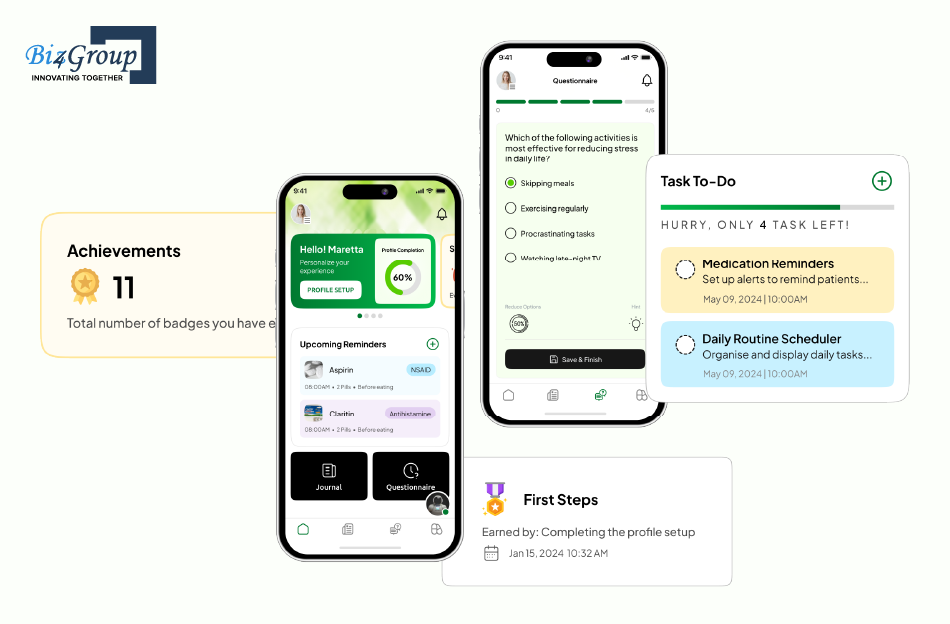
CogniHelp is a cognitive wellness mobile application built by Biz4Group to support people in the early and mid stages of dementia. The goal was simple but meaningful. Help users stay oriented, engaged, and confident in their daily routines through personalized digital support.
This project closely reflects the principles behind AI health management app development like Noom, where personalization and behavior support matter more than raw data tracking.
CogniHelp focuses on memory assistance, daily engagement, and cognitive stimulation. The app adapts to each user by using personal information and daily interactions to create familiarity and reduce confusion.
Key highlights
- Personalized user profiles to tailor daily interactions
- Daily quizzes designed to stimulate memory and mental activity
- Journaling with voice to text support to encourage expression
- Reminder system to support routine and consistency
- Cognitive performance tracking to observe changes over time
Like Noom, CogniHelp proves that apps succeed when they guide behavior gently and consistently. The focus is not just on tracking activity, but on building habits, reinforcing routines, and adapting to the user’s real life needs.
This project shows how thoughtful feature design and personalization can turn a health app into a daily companion rather than a tool users abandon.
From Idea to Impact: Step by Step AI health management app development like Noom
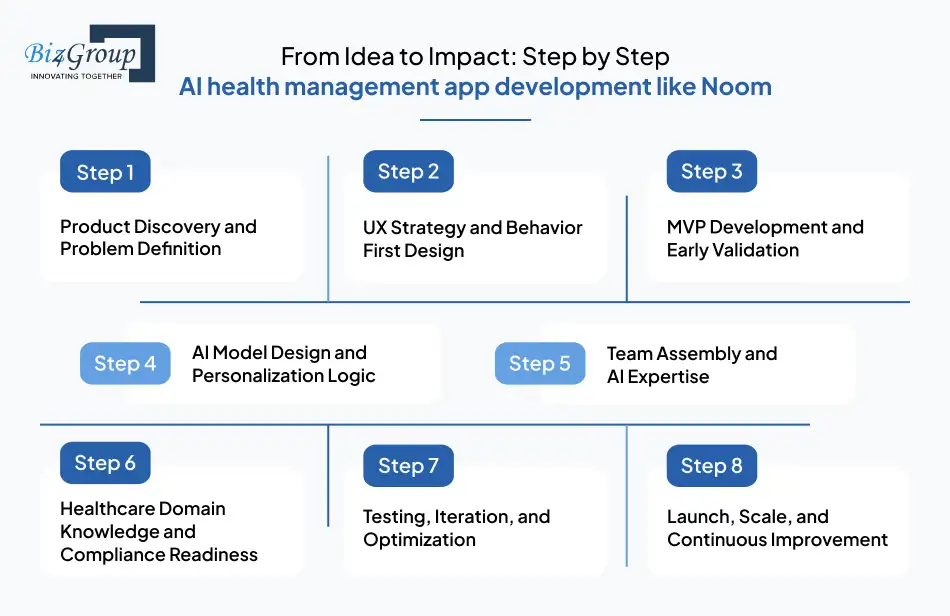
Moving from concept to launch is where most wellness apps fail. AI health management app development like Noom requires more than technical execution. It demands clarity around behavior change, personalization, and scalability from the very beginning.
If your goal is to develop AI powered health app like Noom for digital health startups, this step-by-step process helps reduce risk and improve outcomes.
Step 1: Product Discovery and Problem Definition
Every successful Noom like AI health management app development starts with clarity. This phase aligns your business goals with real user problems and defines how AI will support long term behavior change rather than short term engagement.
Key activities
- Define user personas and wellness goals
- Identify behavior change challenges
- Decide where AI creates measurable impact
Step 2: UX Strategy and Behavior First Design
Design choices directly influence habit formation. In AI digital health app development like Noom, user experience must feel supportive, simple, and nonjudgmental to keep users engaged.
Key activities
- Map user journeys and habit loops
- Reduce friction in daily interactions
- Validate flows with real users
Step 3: MVP Development and Early Validation
Before scaling, you need proof. A focused MVP helps validate assumptions quickly while controlling cost. This step is critical when planning custom AI health app development like Noom. Using a structured MVP development approach ensures you build only what matters first.
Key activities
- Build core workflows and basic AI logic
- Test engagement and retention signals
- Collect early behavioral insights
Step 4: AI Model Design and Personalization Logic
This is where intelligence becomes real. AI models analyze user behavior and adapt guidance accordingly. Teams aiming to build personalized AI health management app like Noom must focus on learning loops and explainable outputs.
Key activities
- Select appropriate machine learning models
- Define training and feedback mechanisms
- Validate accuracy and safety of recommendations
Step 5: Team Assembly and AI Expertise
AI health products require specialized talent. Many companies choose to hire AI developers support AI health management app development services like Noom while keeping strategy in house.
Key activities
- Add AI and data science expertise
- Align product, engineering, and AI teams
- Plan for long term scalability
Step 6: Healthcare Domain Knowledge and Compliance Readiness
If your app handles health related data, domain expertise is essential. Teams often hire healthcare AI app developers or hire an AI health and fitness software developers to reduce regulatory and data risks.
Key activities
- Review data handling and privacy practices
- Align AI outputs with health guidelines
- Prepare for compliance audits
Step 7: Testing, Iteration, and Optimization
Testing goes beyond functionality. You must test trust, clarity, and behavioral impact. This phase strengthens health management app development like Noom integrating AI by refining how recommendations evolve.
Key activities
- Test AI responses and edge cases
- Monitor user confidence and feedback
- Improve personalization logic
Step 8: Launch, Scale, and Continuous Improvement
Launch is only the beginning. As user data grows, AI performance improves. Many teams choose to outsource AI healthcare software development scale faster while focusing internally on growth and partnerships.
Key activities
- Track retention and engagement metrics
- Scale infrastructure and AI models
- Continuously improve based on insights
With a clear roadmap in place, technology decisions come next. In the following section, we will break down the technology stack that supports secure, scalable AI health management app development like Noom and explain what to prioritize at each layer.
Wondering How to Move from Idea to a Real Noom Like Product?
Most teams fail not because of bad ideas, but because execution gets messy. A clear roadmap, the right team, and smart AI decisions change everything.
Let's Map Your Development PlanUnder the Hood: Technology Stack for AI health management app development like Noom
The technology stack determines whether your product can truly personalize, scale, and stay compliant. In AI health management app development like Noom, every layer must support intelligence, security, and long-term growth. The right stack also makes it easier to build AI powered health management app like Noom for wellness businesses and scale across different user groups.
|
Tech Layer |
Common Tools or Approaches |
Why This Layer Matters |
|---|---|---|
|
Frontend (Web and Mobile) |
React, Flutter, Swift, Kotlin |
This is where users interact daily. Strong UI improves retention and trust in AI digital health app development like Noom. Many teams collaborate with a specialized UI/UX design partner to support behavior driven experiences. |
|
Backend and APIs |
Manage logic, data flow, and integrations securely. A scalable backend from a trusted custom software development company supports long term custom AI health app development like Noom. |
|
|
AI and Machine Learning Layer |
TensorFlow, PyTorch, custom ML models |
Powers personalization, predictions, and adaptive guidance. This layer enables teams to build personalized AI health management app like Noom that improves over time. |
|
AI Integration Layer |
Model APIs, middleware, event driven pipelines |
Connects AI models with app workflows in real time. Reliable AI integration services prevent data silos and latency issues. |
|
Automation and Workflow Engine |
Rule engines, triggers, scheduling systems |
Automates reminders, nudges, and content delivery. Using AI automation services helps scale engagement without increasing operational overhead. |
|
Conversational AI Layer |
NLP models, chat interfaces |
Enables conversational coaching and daily check ins. Many platforms rely on an experienced AI chatbot development company to support Noom like AI health management app development. |
|
Virtual Health Assistant Layer |
Context aware AI assistants |
Supports proactive guidance and personalized conversations. This capability often evolves into a full AI virtual healthcare assistant in mature platform. |
|
Data Storage and Security |
Encrypted databases, access controls |
Protects sensitive data and supports build HIPAA compliant AI health app like Noom initiatives. Security here directly impacts user trust. |
|
Cloud Infrastructure |
AWS, Azure, Google Cloud |
Scales AI workloads, storage, and traffic efficiently. Cloud flexibility is essential when teams develop AI powered health app like Noom for digital health startups. |
|
Enterprise Enablement Layer |
Reporting, integrations, governance tools |
Supports large scale deployments and partnerships. Many organizations rely on proven enterprise AI solutions to meet enterprise requirements. |
In AI health management app development like Noom, tools matter less than architecture. A well-planned stack allows faster iteration, safer AI learning, and smoother scaling without constant rework.
What Does It Really Cost? Cost Breakdown for AI health management app development like Noom
If you are evaluating AI health management app development like Noom, you are likely looking for a realistic number, not a vague estimate. In most real-world scenarios, building a Noom style AI health app costs between $30,000 to $250,000+. The final number depends on how advanced your AI is, how much personalization you want, and how strict your compliance requirements are.
This range varies because no two products are built at the same depth. A lean MVP costs far less than a fully compliant, enterprise-ready platform designed to scale.
|
Feature |
Estimated Cost Range |
Cost Drivers |
|---|---|---|
|
Personalized onboarding |
$3,000 to $8,000 |
Data inputs, logic depth, and UX flows |
|
Health and habit tracking |
$6,000 to $20,000 |
Data processing, analytics, and AI learning |
|
Nutrition intelligence |
$5,000 to $18,000 |
Food databases, AI accuracy, and logic |
|
Behavior change coaching |
$8,000 to $25,000 |
Content strategy and adaptive AI rules |
|
Goal and progress tracking |
$4,000 to $10,000 |
Visualization and feedback mechanisms |
|
Activity tracking |
$4,000 to $15,000 |
Wearable integrations and normalization |
|
Conversational AI coaching |
$7,000 to $30,000 |
NLP complexity and scalability |
|
Compliance and security |
$6,000 to $25,000 |
HIPAA safeguards and audits |
|
Admin and analytics dashboard |
$5,000 to $15,000 |
Reporting and system controls |
|
Cloud and infrastructure |
$2,000 to $10,000 |
Hosting, scaling, and monitoring |
These ranges explain why costs increase as you move from a basic product to a full-scale AI-driven health platform.
Key Factors That Influence Cost
Several decisions directly affect your budget.
- Depth of personalization and AI learning
- Compliance and data security requirements
- Number of third-party integrations
- Complexity of user experience design
- Scalability and long-term growth planning
Working with an experienced custom software development company helps align these choices with business goals rather than overengineering early.
Hidden Costs Teams Often Overlook
Initial estimates rarely include everything. Common hidden costs include:
- Ongoing AI model tuning and retraining
- Increasing cloud usage as data grows
- Compliance updates and documentation
- UX improvements based on real user behavior
- Security maintenance and monitoring
Ignoring these can strain budgets later, especially as user adoption increases.
How to Optimize Cost Without Cutting Corners
Smart planning reduces waste without sacrificing outcomes.
- Start with a focused MVP instead of a full feature set
- Roll out advanced AI features gradually
- Reuse existing integrations where possible
- Invest early in scalable architecture
- Prioritize thoughtful UI/UX design to reduce churn and rework
Teams that plan this way avoid expensive rebuilds and scale more predictably.
Once cost expectations are clear, the final step is preparation. In the next section, we will look at the common challenges in building an AI health management app like Noom and how teams successfully overcome them before they turn into costly mistakes.
How We Optimized Cost in a Real Project: Quantum Fit
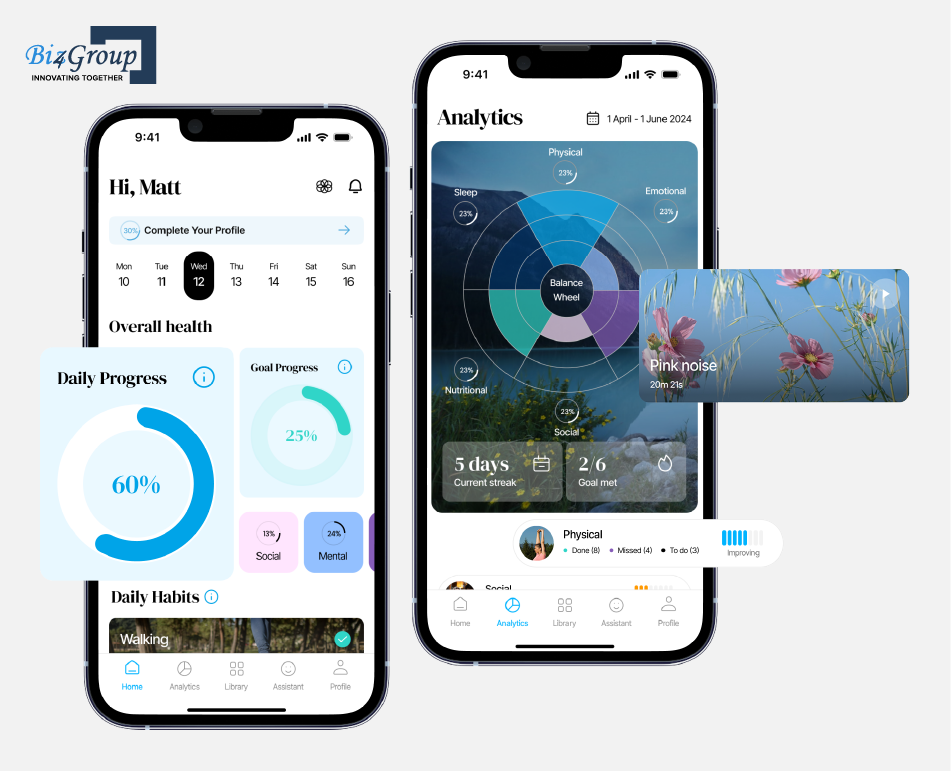
Quantum Fit is a fitness and coaching platform developed by Biz4Group with a strong focus on delivering value without unnecessary development overhead. The objective was to launch quickly, validate user engagement, and scale features only where they proved impact.
This approach closely aligns with cost conscious AI health management app development like Noom, where smart planning matters as much as technology.
How cost was optimized
- Built the product in phases, prioritizing high impact features first
- Reused core modules such as user profiles and activity tracking
- Limited custom integrations in early stages to reduce complexity
- Designed a flexible frontend to lower future update and maintenance costs
Quantum Fit shows that you can control budgets without sacrificing quality. By focusing on essentials early, teams avoid overbuilding and keep custom AI health app development like Noom financially sustainable as the product grows.
Trying to Control Cost Without Cutting Corners?
Building a Noom style app does not mean overspending. With the right architecture and phased approach, costs stay predictable while scalability stays intact.
Get a Realistic Cost EstimateCommon Challenges in AI health management app development like Noom and How to Solve Them
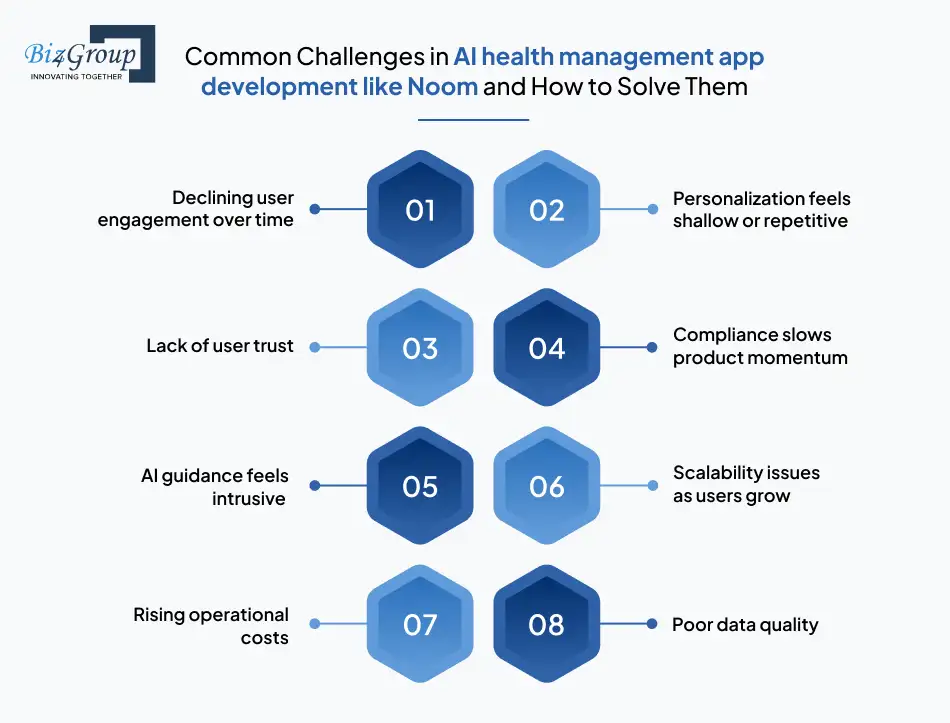
Building an AI-driven wellness product is not just a technical exercise. In AI health management app development like Noom, challenges usually emerge at the intersection of user behavior, AI accuracy, compliance, and scale. Teams that anticipate these challenges early are far more likely to succeed long term.
The table below outlines the most common issues teams face when they develop AI health management app like Noom, along with practical solutions that work in real world scenarios.
|
Challenge |
Why It Happens |
How to Solve It |
|---|---|---|
|
Declining user engagement over time |
Many apps focus on tracking instead of sustained behavior change |
Design experiences around habits, motivation, and mindset. Adaptive nudges, short learning moments, and feedback loops help maintain engagement in AI digital health app development like Noom. |
|
Personalization feels shallow or repetitive |
AI models lack enough context in early stages |
Start with rule based logic and gradually introduce learning models as data grows. This phased approach improves personalization without overwhelming users. |
|
Lack of user trust |
Health data is deeply personal and users fear misuse |
Be transparent about how data is used and why recommendations are given. Trust is critical in any serious AI healthcare app, especially when AI influences health decisions. |
|
Compliance slows product momentum |
Regulations are addressed too late |
Treat compliance as a foundation, not a final step. Early planning reduces friction and supports scalable custom AI health app development like Noom. |
|
AI guidance feels intrusive |
Notifications are poorly timed or excessive |
Use contextual signals and user preferences to control frequency and tone. Respecting boundaries improves retention and satisfaction. |
|
Scalability issues as users grow |
Architecture is not designed for expansion |
Invest early in modular systems and cloud readiness. This prevents performance bottlenecks as usage increases. |
|
Rising operational costs |
Manual coaching or support does not scale |
Automate workflows and AI-driven guidance wherever possible. This is essential when teams build AI powered health management app like Noom for wellness businesses. |
|
Poor data quality |
Users enter incomplete or inconsistent data |
Design input flows that are simple and forgiving. Normalize data and guide users gently toward accurate reporting. |
Most of these problems start small. Left unaddressed, they compound into churn, rework, and lost trust. Teams that plan for these risks early build more resilient products and protect their investment.
In successful health management app development like Noom integrating AI, challenges are treated as design constraints, not surprises.
Why Can Biz4Group LLC Build an AI Health Management App Like Noom?
Building a Noom like platform requires more than AI skills. It requires experience in personalization, behavior-focused design, compliance awareness, and cost control. This is where Biz4Group stands out.
Our work across health and wellness products shows that we know how to translate complex requirements into practical, scalable solutions.
We have delivered:
- CogniHelp, a personalized cognitive wellness app focused on daily engagement, habit support, and user centric design
- Quantum Fit, a fitness and coaching platform built with a strong emphasis on cost optimization and phased scalability
These projects reflect two critical capabilities needed for AI health management app development like Noom.
First, the ability to design features that support long term behavior change.
Second, the discipline to control cost without limiting future growth.
We approach every health product with a balance of strategy, engineering, and empathy. That allows us to build platforms that users trust, teams can scale, and businesses can sustain.
If your goal is to create a Noom like AI driven health platform that is practical, compliant, and built for real world use, Biz4Group brings the experience to execute it confidently.
Looking for a Partner Who Has Actually Done This Before?
From CogniHelp to Quantum Fit, we have built health and wellness platforms that balance personalization, compliance, and cost. You do not need guesswork. You need experience.
Build Your AI Health App with Biz4GroupConclusion: Turning AI health management app development like Noom into a Real, Scalable Product
Building a successful Noom style platform is not about copying features. It is about understanding why those features work, how AI supports behavior change, and what it takes to scale responsibly. From personalization and compliance to technology decisions, cost planning, and risk management, AI health management app development like Noom requires clarity at every stage.
Throughout this guide, one thing becomes clear. Products that succeed in AI digital health app development like Noom are built when strategy, design, AI, and execution move together. Many teams struggle to align these pieces, especially when trying to develop AI health management app like Noom without prior domain experience.
This is where experience matters.
At Biz4Group, we approach custom AI health app development like Noom with a product mindset, not a feature checklist. Our work across wellness, fitness, and cognitive health platforms shows our ability to balance personalization, compliance, and cost while building solutions that scale. We understand what decision makers expect from AI health management app development services like Noom. Lower risk. Faster validation. And long-term sustainability.
If your goal is to build AI powered health management application like Noom that users trust and businesses can grow with confidence, the next step is choosing the right foundation and the right partner.
Ready to build something smarter than a wellness app? Let’s build something users actually stick with.
FAQ
1. How much does AI health management app development like Noom cost?
Costs usually range from $30,000 to $250,000+, depending on feature depth, AI personalization, and compliance needs. A lean MVP costs less, while a fully compliant, scalable platform with advanced personalization costs more. This is common when teams pursue custom AI health app development like Noom with long term growth in mind.
2. How long does it take to build an AI health management app like Noom?
Timelines vary by scope. A basic product can launch in 2 to 4 weeks, while advanced platforms may take 6 to 8 weeksor more. Projects focused on AI digital health app development like Noom usually take longer due to AI training, testing, and compliance readiness.
3. What compliance requirements apply to build HIPAA compliant AI health app like Noom?
If your app handles health related data, HIPAA compliance is essential in the US. This affects data storage, encryption, access controls, and audit logging. Compliance is a core requirement for AI health management app development services like Noom, not an optional add on.
4. What features are essential in Noom like AI health management app development?
Core features include personalized onboarding, adaptive health tracking, nutrition intelligence, behavior change coaching, dynamic goal setting, and progress visualization. These capabilities are critical when you want to build personalized AI health management app like Noom that users stay engaged with over time.
5. Can startups develop AI powered health app like Noom for digital health startups without a large budget?
Yes. Many startups start with a focused MVP that validates behavior change and engagement before scaling. This phased approach works well for teams planning health management app development like Noom integrating AI while keeping early investment manageable.
6. What business models work best for AI health management app development like Noom?
Subscription based pricing is the most common model, often combined with premium coaching or enterprise wellness programs. These models align well with building AI powered health management app like Noom for wellness businesses that need predictable revenue and long term user relationships.
7. How do I choose the best company to develop AI health management app like Noom?
Look for a partner with experience in AI, healthcare compliance, user centric design, and scalable architecture. A proven track record in custom AI health app development like Noom reduces risk and helps you move from idea to market with confidence.
