 Location :
Orlando, FL, USA
Location :
Orlando, FL, USA +1 (407) 714-1616
 info@biz4group.com

- Voice-driven contract handling helps legal teams retrieve clauses instantly and reduce dependency on manual document search during critical reviews
- Law firms planning to build a voice-controlled AI assistant for legal contract management focus on aligning systems with real contract workflows
- A structured AI voice assistant enables context-aware queries where follow-up questions are handled without restarting the entire contract search process
- The cost to develop AI voice assistant for legal contract management ranges from $30,000 to $150,000+, depending on integrations, accuracy requirements, and contract complexity
- Legal teams working to develop voice AI assistant for legal contract workflows prioritize accuracy, data handling, and seamless integration with existing systems
- Experience across legal platforms positions Biz4Group LLC to deliver systems that align with real workflows and support scalable contract operations
How often does a contract review get delayed simply because the right clause is buried somewhere in a long document? This is a common challenge across contract management teams where accessing, reviewing, and validating contracts still depends heavily on manual effort.
- Important clauses are difficult to locate during time-sensitive reviews
- Follow-up queries often restart the same search process
- Contract validation depends on manual checks under pressure
This is where AI assistant with voice commands for contract handling starts to change how contract workflows are handled. Instead of navigating multiple documents, legal teams can directly ask questions and retrieve exact contract details in real time. Projections indicate that 40% of enterprise applications will include task-specific AI assistants in 2026, showing how quickly voice-driven systems are becoming part of everyday operations.
Not only this, reports show that law firms using AI in contract lifecycle management have reduced contract review time by 50%, while overall contract cycle times have improved by up to 40% as workflows become more structured. For legal teams wondering how to make an AI voice assistant for contract retrieval and tracking, these outcomes reflect what becomes possible when contract workflows are designed around direct, real-time interaction.
So with all that on table, the next step is to understand how to build a voice-controlled AI assistant for legal contract management and how this truly comes together.
What Is a Voice-Controlled AI Assistant for Legal Contract Management and its Key Capabilities?
A voice-controlled AI assistant for legal contract management is a system that allows legal professionals to interact with contracts using spoken commands. It processes voice inputs to retrieve, analyze, and manage contract data in real time. This type of AI legal assistant acts as an intelligent interface over contract repositories, enabling users to access specific clauses, extract insights, and perform contract-related tasks without manual navigation.
Now let us understand the key capabilities that power an AI voice assistant for legal contract management:
1. Interaction Layer
- Voice Input Processing: Captures spoken commands from users in a natural and conversational format without requiring manual input
- Speech-to-Text Conversion: Transforms voice queries into structured text so the system can process legal instructions accurately
- Language Adaptability: Handles different accents, speaking styles, and legal phrasing to ensure consistent understanding
- Command Recognition: Identifies user intent behind spoken queries to trigger the right contract-related action
- Hands-Free Accessibility: Allows legal professionals to interact with contract management systems without navigating dashboards or interfaces
2. Intelligence Layer
- Intent Interpretation: Understands the meaning behind user queries using AI models trained on legal language and context
- Clause Identification: Locates relevant clauses, obligations, or risks within contracts based on the query
- Context Mapping: Connects user input to the correct contract data across multiple documents and repositories
- Learning Capability: Improves response accuracy over time by adapting to user behavior and query patterns
- Legal Understanding Layer: Supports deeper contract analysis by functioning as a decision-support engine within legal systems
3. Workflow Layer
- Action Execution: Performs tasks such as retrieving contracts or highlighting specific clauses based on user requests
- System Integration: Connects with contract management platforms and document storage systems for seamless data access
- Task Automation: Enables actions like updating contract status or generating quick summaries through voice commands.
- Context Continuity: Maintains session context to ensure follow-up queries are understood correctly
- Process Coordination: Aligns contract-related actions without manual intervention with broader legal workflow automation.
As legal teams move toward more efficient contract operations, these layered capabilities define how modern systems are structured. Organizations planning to develop intelligent voice AI assistants for legal teams are focusing on solutions that simplify interaction, improve clarity, and support faster legal execution without adding operational complexity.
How Does a Voice-Controlled AI Assistant Work in Legal Contract Workflows?
In contract-heavy environments, speed often depends on how quickly teams can move from query to answer. Voice-driven systems streamline this interaction by turning spoken input into actionable responses.
Many organizations planning to build a voice-controlled AI assistant for legal contract management focus on creating a smooth flow where each step connects naturally, without adding complexity to existing legal processes.
Step 1: Capturing Voice Input
- Legal professionals speak a query related to a contract, such as asking about a clause or obligation
- Audio is recorded through a device microphone and prepared for processing
- Captured input is forwarded to a speech recognition engine for conversion
Step 2: Converting Speech into Text
- Spoken input is transformed into written text using speech recognition models
- Filler words and unclear fragments are cleaned during conversion
- A structured text query is prepared for further interpretation
Step 3: Interpreting the Request
- Converted text is analyzed using natural language processing to understand intent
- Key elements such as contract name, clause type, or party details are identified
- AI assistant then aligns the request with the correct contract-related action
Step 4: Retrieving Contract Information
- Relevant documents are searched based on interpreted input
- Matching sections or clauses are identified within stored contracts
- Only the most relevant data is selected for response generation
Step 5: Validating Contract Content
- Retrieved information is checked against the context of the query
- AI logic is used to validate legal contract for verifying requested details
- Validated output is prepared based on the query context
Step 6: Generating and Delivering Response
- Processed information is converted into a clear and direct answer
- Response is structured in simple language for easy understanding
- Output is delivered through voice playback or displayed as text
Step 7: Managing Follow-Up Interaction
- Context from the previous query is retained for continuity
- Follow-up questions are handled without restarting the process
- Interaction continues smoothly within the same session
As legal workflows demand faster access to contract insights, this execution flow becomes critical in practice. Law firms aiming to make voice AI assistant for contract workflows focus on maintaining accuracy at each stage, so every query leads to a reliable and consistent response.
Turn Contract Handling Into a Strength
Use voice-driven systems to simplify contract queries and bring more structure into everyday legal workflows
Start Building My AI AssistantWhat Are the Key Use Cases of Voice-Controlled AI in Legal Contract Management?
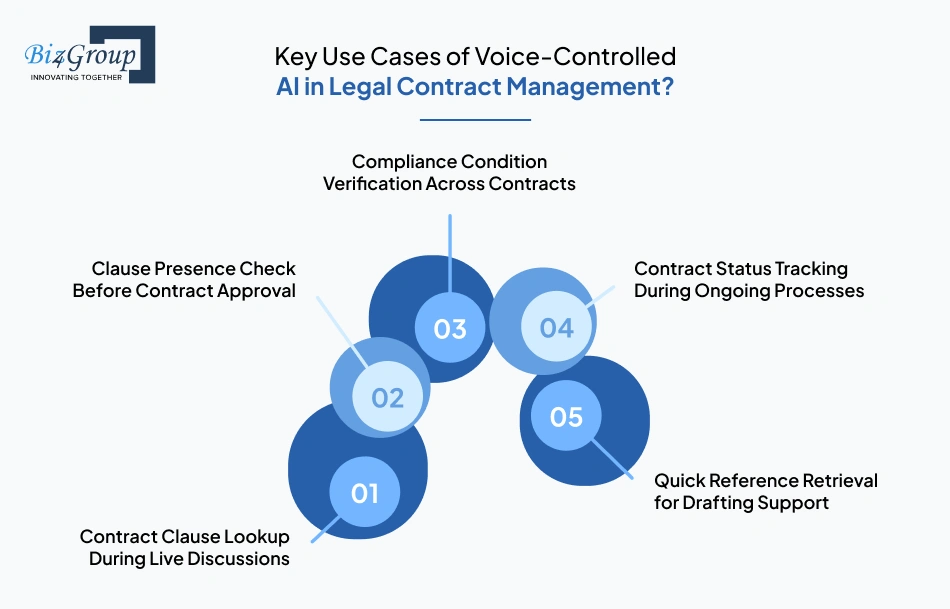
Legal teams interact with contracts in different ways depending on their role and responsibilities. Voice-driven systems fit into these workflows by simplifying how specific tasks are handled.
The following use cases show how real scenarios are executed in day-to-day legal operations and give clear insights to team planning to build a voice-controlled AI assistant for legal teams
1. Contract Clause Lookup During Live Discussions
During internal meetings or client calls, legal professionals often need to pull up specific clauses instantly. Delays usually happen when documents need to be opened and searched manually.
- Corporate legal teams use voice queries to locate clauses while discussions are ongoing
- The system fetches the exact clause based on the spoken request
- Voice interaction matters here because it supports real-time access during active legal workflow management without interrupting conversations
2. Clause Presence Check Before Contract Approval
Before approving agreements, legal reviewers need to confirm whether certain clauses exist. This task is repetitive but requires precision every time.
- Contract management teams ask voice-based questions to confirm clause presence in contracts
- The system identifies and presents the required clause for review
- Voice AI assistant for contract management removes the need to manually scan documents for simple confirmation supporting legal business process automation.
3. Compliance Condition Verification Across Contracts
Contracts often need to be checked against internal policies or regulatory requirements. This involves verifying specific conditions across documents.
- Legal operations teams use voice queries to check if certain compliance conditions are met
- The system retrieves relevant sections linked to those conditions
- AI voice assistant allows quick checks without switching between multiple files
4. Contract Status Tracking During Ongoing Processes
Contracts move through different stages such as review, approval, or execution. Keeping track of status updates is a continuous activity.
- Contract managers use voice commands to check the current stage of contracts
- The system provides the latest status based on stored data
- Voice controlled AI assistant supports quick updates during active workflow management
5. Quick Reference Retrieval for Drafting Support
While working on drafts, legal professionals often refer to existing contracts for consistency. Accessing these references quickly helps maintain alignment.
- Legal teams use voice queries to retrieve similar clauses or references from existing contracts
- The system provides relevant examples based on the request
- AI voice assistant enables quick referencing without interrupting drafting work
As these scenarios show, voice interaction fits naturally into different contract-related tasks without altering how teams operate. Organizations looking to build a voice-controlled AI assistant for legal contract management are aligning these use cases with real workflows to ensure practical adoption across legal environments.
Why Do Law Firms Need a Voice-Controlled AI Assistant for Legal Contract Management?
Legal operations are not only measured by accuracy but also how efficiently they reduce the workload. As contract workloads increase, firms are looking at creating an AI assistant with voice commands for contract handling. This improves financial efficiency in legal processes aligning with measurable business impact.
1. Reducing Contract Handling Costs
Manual contract handling consumes a large portion of legal budgets, especially in high-volume environments. Time spent on repetitive document access directly translates into operational costs.
- Reduces time spent on routine contract interactions, lowering overall labor costs
- Minimizes dependency on multiple team members for basic contract queries
- Can lower operational expenses by 20–30% in contract-heavy environments
2. Increasing Revenue Through Faster Contract Turnaround
Delays in contract access and review directly impact how quickly deals move forward. Slow legal responses can push revenue recognition further down the pipeline.
- Faster access to contract information helps close deals without unnecessary delays
- Reduces waiting time during negotiations where legal input is required
- Even a 10–15% improvement in turnaround time can accelerate revenue realization
3. Minimizing Financial Risk and Penalty Exposure
Contract misinterpretation or missed obligations can lead to financial penalties, disputes, or revenue leakage. These risks directly affect the bottom line.
- Reduces chances of overlooking clauses tied to penalties or obligations
- Helps avoid compliance-related fines or contractual breaches
- Lowers financial exposure by ensuring accurate contract referencing during decisions
4. Improving Return on Legal Resource Investment
Legal teams represent a significant cost center, and how their time is utilized directly affects business efficiency. Law firms integrating such systems through structured AI integration services are focusing on improving cost-to-output ratios across legal operations.
- Reduces time spent on low-value interactions that do not require legal expertise
- Increases output from existing teams without additional hiring costs
- Improves ROI on legal salaries by aligning effort with high-impact tasks
As legal functions shift toward measurable business contribution, the focus is no longer just on process improvement. Law firms building a voice-controlled AI assistant for legal contract management, use it to reduce operational costs, accelerate revenue timelines, and strengthen financial control across contract-driven workflows.
Give Legal Teams Faster Access to Contracts
Use automation to develop voice AI assistant for legal contract workflows that retrieves clauses without delays
Improve My Contract WorkflowEssential Features Required to Build AI Voice Assistant for Legal Contract Management?
Legal contract workflows demand precise handling of queries, context, and document relationships. Voice-driven systems must support how contracts are accessed and interpreted in real situations.
The development of voice-controlled AI assistant for legal contract management depends on selecting features that directly align with contract-level interactions rather than generic system capabilities.
|
Feature |
Purpose |
|---|---|
|
Contract Entity Recognition Engine |
Identifies key elements such as parties, dates, and obligations from spoken queries to ensure accurate mapping to contract data |
|
Clause Dependency Mapping |
Connects related clauses within a contract so responses reflect the full context instead of isolated sections |
|
Version-Aware Contract Retrieval |
Ensures responses are pulled from the latest contract version while maintaining access to historical changes when needed |
|
Obligation Timeline Extraction |
Retrieves time-bound commitments such as renewals or deadlines directly from contracts through voice queries |
|
Context Preservation Across Queries |
Maintains continuity when users ask follow-up questions related to the same contract or clause |
|
Contract Risk Pattern Detection |
Uses predictive analysis to identify patterns that may indicate potential risks or missing conditions in agreements |
|
Contract Language Interpretation Engine |
Applies sentiment analysis to understand tone and intent within clauses, helping interpret obligations more clearly |
|
Cross-System Contract Linking |
Connects contracts stored across multiple systems so queries return unified results without manual switching |
|
Voice-Triggered Contract Action Handler |
Enables execution of contract-specific actions such as marking status or retrieving summaries through spoken commands |
Law firms aiming to build a voice-controlled AI assistant for legal contract management should focus on aligning these capabilities with actual contract workflows to ensure accuracy and consistency.
How to Build a Voice Controlled AI Assistant for Legal Contract Management: From Scope Definition to Deployment
Legal contract environments operate with defined processes where even small inefficiencies can slow down decisions. A voice-driven system must align with these realities from the start.
Teams that aim to make AI powered voice assistant for legal contract operations focus on structuring development around real contract interactions rather than isolated technical components.
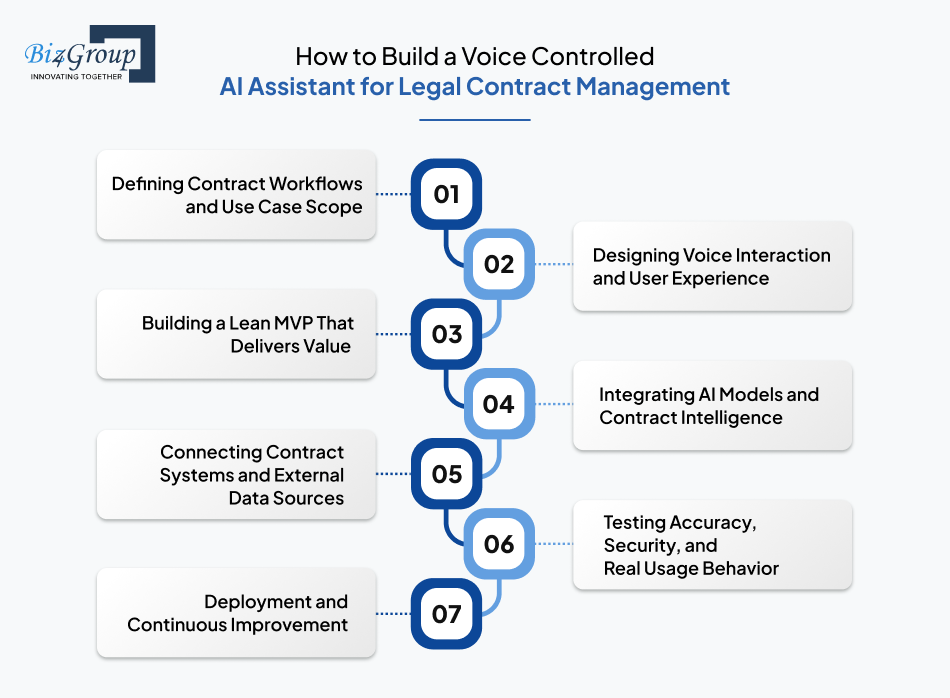
1. Defining Contract Workflows and Use Case Scope
Clarity at this stage determines whether the assistant fits into legal operations or creates friction. Instead of assuming requirements, teams need to understand how contracts are accessed, reviewed, and validated across different roles.
This step ensures that development begins with a clear focus on actual usage patterns rather than generalized assumptions.
- Identify where contract handling slows down across review, validation, or retrieval
- Map repetitive query patterns such as clause lookup or obligation checks
- Define which workflows should be handled first to create AI assistant with voice control for contracts
- Set expectations around response accuracy and contract data sensitivity
2. Designing Voice Interaction and User Experience
Voice interaction must align with how legal professionals communicate while handling contracts. The way queries are asked, and responses are delivered directly affects usability.
This stage focuses on shaping interaction flows that feel natural during real contract discussions without forcing users to adapt to rigid system behavior.
- Structure conversations based on how legal teams phrase contract-related queries
- Ensure responses remain clear even when dealing with complex clauses
- Collaborate with a UI/UX design company to refine interaction patterns
- Test usability across scenarios such as meetings or quick contract checks
Also Read: Top UI/UX Design Companies in USA
3. Building a Lean MVP That Delivers Value
A controlled initial release helps validate how the AI assistant performs in real contract workflows. Instead of covering multiple scenarios at once, teams should focus on a narrow set of use cases that reflect frequent interactions.
This approach allows early feedback while keeping development manageable and aligned with actual needs.
- Use MVP development services to build a working version around core contract queries
- Prioritize tasks such as clause retrieval or contract lookup in the first release
- Keep the system focused while ensuring it performs reliably in real usage
- Prepare the foundation for adding more capabilities without rework
Also Read: Top MVP Development Companies in USA
4. Integrating AI Models and Contract Intelligence
At this stage, the AI assistant begins to interpret queries and connect them with contract data. Accuracy depends on how well the system understands legal phrasing and context. Instead of relying only on pre-trained logic, customization becomes necessary to reflect how contracts are structured and queried in real environments.
- Train AI models using actual contract language and query patterns
- Structure the system to integrate AI models that interpret legal intent correctly
- Add rule layers to handle contract-specific conditions
- Continuously fine tune LLM’s to improve response relevance
Also Read: Top Open Source LLMs for Business Growth
5. Connecting Contract Systems and External Data Sources
A voice assistant must access contract data from existing systems without creating data silos. This stage ensures that responses are based on real-time information and remain consistent across platforms.
Proper connectivity allows the assistant to function as part of the broader contract ecosystem rather than as a standalone tool.
- Establish API connections with contract repositories and document systems
- Enable real-time access to updated contract data across platforms
- Handle multiple data sources without breaking response accuracy
- Maintain consistency between stored contracts and retrieved outputs
6. Testing Accuracy, Security, and Real Usage Behavior
Before deployment, the system must be validated against real contract scenarios. Testing should reflect how users actually interact with contracts rather than ideal conditions. This stage ensures that responses remain accurate, stable, and aligned with legal expectations even under varied usage patterns.
- Test handling of unclear or incomplete voice queries
- Validate responses against real contract data for correctness
- Simulate high usage conditions to check system stability
- Ensure access control and data handling align with legal requirements
Also Read: Software Testing Companies in USA
7. Deployment and Continuous Improvement
Once deployed, the assistant becomes part of everyday legal workflows. Continuous improvement ensures the system evolves with changing contract patterns and user behavior. Instead of treating deployment as a final step, teams should view it as the beginning of ongoing refinement.
- Deploy on scalable infrastructure to handle varying query volumes
- Monitor user interaction patterns during contract handling
- Refine responses based on real usage feedback
- Improve accuracy over time as more contract data is processed
As legal contract workflows continue to evolve, development must remain closely tied to real usage rather than static assumptions. Law firms planning to build a voice-controlled AI assistant for legal contract management focus on creating systems that adapt over time while maintaining accuracy and consistency in contract handling.
Create a Seamless Contract Interaction Experience
Design smarter voice interactions and build a voice-controlled AI assistant for legal contract management that teams actually use
Upgrade My Contract SystemWhat is the Ideal Tech Stack to Build Legal AI Voice Assistant for Contract Management?
A well-structured tech stack ensures that voice interactions, contract intelligence, and system integrations work together without friction. Each layer must support real contract workflows while keeping performance stable and responses accurate. To build a voice-controlled AI assistant for legal contract management, focus on selecting technologies that align with both voice processing and contract data handling needs.
|
Architecture Layer |
Recommended Technology |
Purpose |
|---|---|---|
|
Voice Input Processing Layer |
Google Speech-to-Text / Azure Speech Services |
Converts spoken queries into text so contract-related requests can be processed accurately |
|
Natural Language Understanding Layer |
Interprets user intent from text and maps it to contract-related actions |
|
|
Backend Processing Layer |
Node.js / Python |
Handles request processing, business logic, and contract query execution through NodeJS development and python development |
|
Frontend Interface Layer |
React.js / Next.js |
Supports user interaction and dashboard views through ReactJS development and NextJS development |
|
Contract Intelligence Layer |
Custom NLP Models / Vector Databases |
Stores and retrieves contract data based on semantic search and clause-level matching |
|
Data Storage Layer |
AWS S3 / PostgreSQL |
Stores contract documents and structured metadata for quick access and updates |
|
Integration Layer |
REST APIs / GraphQL APIs |
Enables API connections with contract management systems and external platforms |
|
Security & Access Control Layer |
OAuth 2.0 / Role-Based Access Control |
Ensures secure access to sensitive contract data based on user roles |
|
Deployment & Scalability Layer |
AWS / Azure Cloud Services |
Supports scalable deployment and maintains performance during varying usage loads |
A strong technology foundation ensures that voice interaction and contract intelligence work together without disruptions. Teams focusing on voice-controlled AI assistant development for legal contract management prioritize scalability, secure integrations, and consistent performance, so the system adapts smoothly to real contract environments.
How Much Does It Cost to Develop a Voice-Controlled AI Assistant for Legal Contract Management?
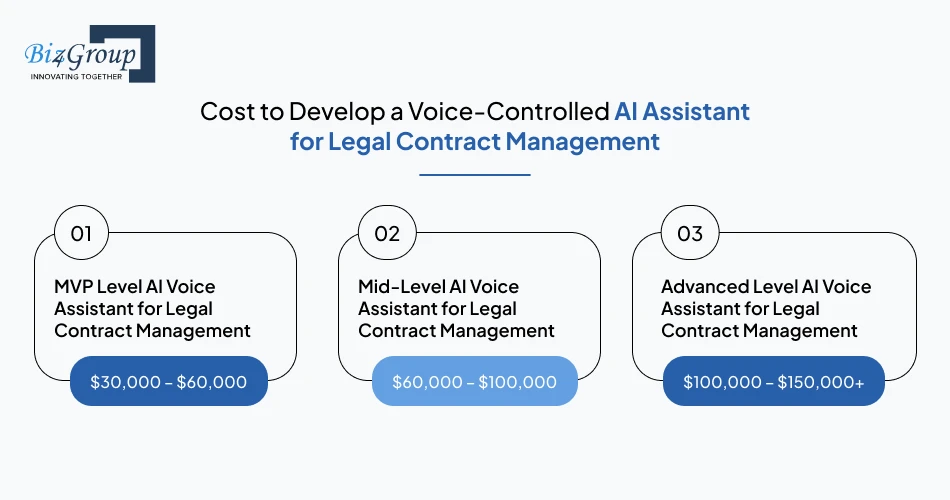
Cost planning for a voice-driven legal system depends on how deeply it integrates with contract workflows and how intelligently it handles queries. The cost of developing a scalable voice AI assistant for contract management usually ranges from $30,000 to $150,000+, depending on scope, accuracy requirements, and system complexity.
|
Development Level |
Estimated Cost Range |
Scope |
|---|---|---|
|
MVP Level AI Voice Assistant for Legal Contract Management |
$30,000 – $60,000 |
Covers basic voice query handling, limited contract retrieval, and simple response generation for a defined set of use cases |
|
Mid-Level AI Voice Assistant for Legal Contract Management |
$60,000 – $100,000 |
Supports broader contract interactions, improved accuracy, integration with contract systems, and handling of multiple query types |
|
Advanced Level AI Voice Assistant for Legal Contract Management |
$100,000 – $150,000+ |
Includes deeper contract understanding, complex query handling, multi-system integration, and higher accuracy across diverse legal workflows |
What Influences the Overall Cost of AI Voice Assistant for Legal Contract Management
The total investment is not fixed because different legal teams require different levels of capability and integration. Cost varies based on how the system is expected to perform in real contract environments. Here’s what influences the cost:
- The number of contract types supported, such as NDAs, MSAs, or vendor agreements, directly impacts system setup
- The need to recognize clause variations across different contract formats increases training effort
- Integration with existing CLM tools or document repositories adds to implementation complexity and AI integration costs.
- Handling follow-up voice queries with context requires additional system refinement adding to the cost of AI voice agent.
- Accuracy requirements for clause-level responses affect how much tuning and testing is needed
A clear understanding of requirements helps avoid unnecessary spending and keeps development focused. Teams that plan carefully are better positioned to build a voice-controlled AI assistant for legal contract management that remains practical, scalable, and aligned with real legal operations.
Modernize Your Contract Management Process
Launch reliable voice-driven automation that makes contract retrieval and validation feel more direct and efficient
Begin My AI TransformationProven Best Practices to Build Legal Voice Assistant for Contract Management
Real success with voice-driven legal systems depends on how well execution aligns with contract workflows. Every decision, from architecture to model behavior, affects reliability. Teams working on AI solutions to build voice assistants for contract management need a structured approach that keeps performance consistent without adding complexity.
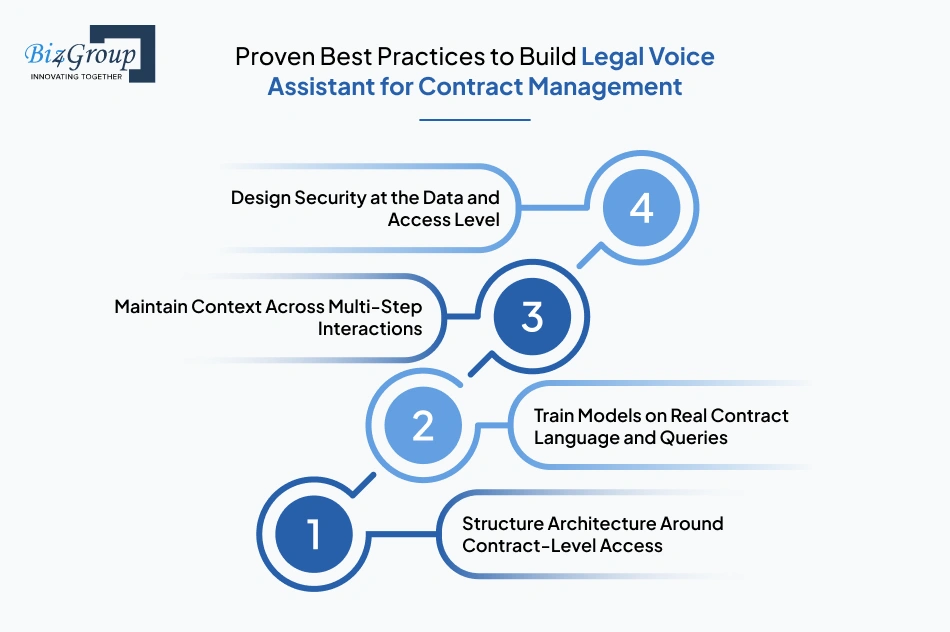
1. Structure Architecture Around Contract-Level Access
The system should be designed to work directly with clauses, obligations, and contract sections rather than entire documents. This allows faster response generation and avoids unnecessary data processing. A layered architecture where voice input, processing, and contract retrieval remain clearly separated helps maintain stability as usage grows.
2. Train Models on Real Contract Language and Queries
Model accuracy depends heavily on the data used during training. Use real contract samples and actual query patterns collected from legal workflows. When training includes variations in clause wording and legal phrasing, responses become more reliable. This also ensures that generative AI produces outputs that align with how contracts are written and interpreted.
Also Read: Generative AI Agents
3. Maintain Context Across Multi-Step Interactions
Legal queries rarely happen in isolation as follow-up questions often depend on previous responses. Design the system to retain context such as contract references and clause types, so interactions feel continuous. This reduces the need for users to repeat information and keeps the experience aligned with how legal reviews are conducted.
4. Design Security at the Data and Access Level
Security should be part of the system design from the beginning rather than an added layer. Define access controls based on user roles and restrict visibility of sensitive contract data. Ensure that every interaction is logged and traceable. This approach helps maintain trust while handling confidential legal information.
Execution quality determines how well the AI assistant performs in real legal environments. A structured approach to architecture, training, and security makes it easier to build a voice-controlled AI assistant for legal contract management that remains reliable and accurate with everyday contract workflows.
What Challenges Arise AI Voice Assistant Development for Legal Contract Management and How to Solve Them?
Voice-driven legal systems must handle real contract interactions where accuracy and reliability cannot be compromised. Challenges often appear when voice input meets complex legal data and existing systems.
Teams planning to build AI voice assistant for legal document management need to address these issues early to avoid delays during implementation and adoption.
|
Problem |
Solution |
|---|---|
|
Voice queries fail to capture legal terms accurately, especially with accents or fast speech |
Train models on real legal conversations and recorded queries from legal teams while including multiple accents and speaking styles during training. Continuously refine recognition accuracy through AI model development using contract-specific vocabulary and real usage feedback. |
|
Difficulty in interpreting complex legal language within contracts |
Use structured legal datasets that include clause variations and contract templates. Apply domain-specific tuning, so the system understands obligations, conditions, and legal phrasing instead of relying on general language patterns. |
|
Inconsistent responses when users ask follow-up questions |
Implement session-based context tracking, so previous queries are retained during interaction while ensuring the system reuses prior context instead of restarting interpretation for every query. |
|
Sensitive contract data raises privacy and confidentiality concerns |
Apply role-based access controls to restrict who can access specific contract data. Maintain activity logs and audit trails with secure AI automation services to ensure transparency and traceability. |
|
Integration with existing contract systems becomes fragmented or slow |
Map data fields clearly before integration to avoid mismatches. Test data flow across systems in real scenarios to ensure consistent and reliable retrieval. |
|
Variations in contract formats lead to incorrect clause retrieval |
Standardize contract ingestion by tagging clauses, sections, and metadata during upload. Create a unified structure so different contract formats can be interpreted consistently. This reduces dependency on document layout variations. |
|
Delays in retrieving contract data from multiple sources |
Implement indexed storage and retrieval mechanisms so frequently accessed contract data is available faster. Optimize query handling to prioritize relevant documents. |
|
Lack of alignment between system output and legal expectations |
Involve legal teams during testing to validate responses against actual contract scenarios. Work with experienced AI product development service providers to refine outputs. |
Handling these challenges early ensures the assistant performs reliably in real contract environments. Law firms that take a structured approach are better positioned to develop a voice-controlled AI assistant for legal teams that deliver accurate responses while staying aligned with legal processes.
Why is Biz4Group LLC the Ideal Company to Build a Voice-Controlled AI Assistant for Legal Contract Management?
Building the right solution starts with choosing a team that understands real clinical workflows. Working with Biz4Group LLC means partnering with a team that understands how legal workflows actually function beyond surface-level automation.
As a legal software development company, we approach every solution with a clear focus to maintain accuracy across different document formats, and support consistent query handling. To understand this better let us now look at real projects delivered by us in legal sector:
1. Court Calendar
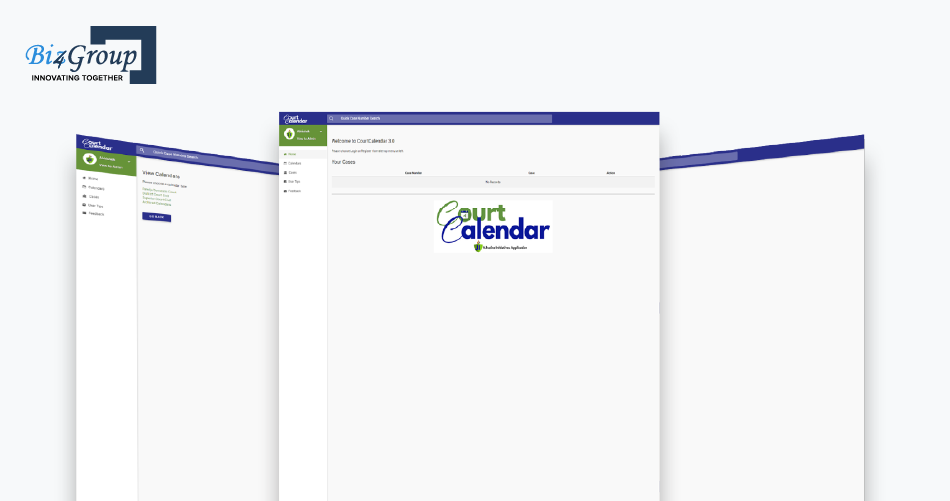
Court Calendar is a legal scheduling platform designed to help attorneys manage hearings, filings, and court deadlines across multiple cases. It centralizes case timelines and keeps legal teams aligned with upcoming court activities without relying on manual tracking systems.
- Tracks hearings, filings, and court deadlines in one place
- Supports multi-case scheduling across jurisdictions
- Provides real-time visibility into case timelines
- Helps teams stay aligned on upcoming legal obligations
2. TrialProofer
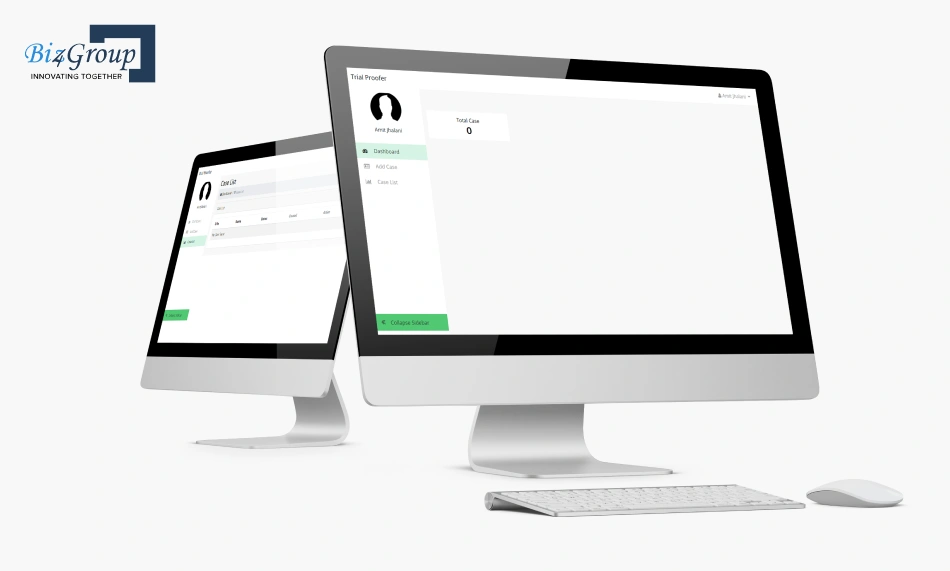
TrialProofer is a litigation preparation platform that helps legal teams organize case materials, evidence, and witness information in a structured format. It focuses on improving how attorneys prepare and present cases by connecting key elements required during trial preparation.
- Organizes evidence and witness details within case context
- Structures timelines for clear case presentation
- Centralizes trial-related documents and materials
- Supports collaborative case preparation across teams
3. Desc Legal

Desc Legal is a legal service marketplace platform that connects users with lawyers while managing the entire service flow digitally. It enables clients to request legal services, compare options, and track progress, while lawyers handle requests through a structured system that organizes tasks and communication.
- Connects clients with lawyers through a request-based system
- Allows users to post legal requirements and receive responses
- Tracks service progress and interactions within the platform
- Structures task handling and communication for both parties
These solutions show how legal systems are designed around specific workflows such as scheduling, case preparation, and service handling. Each platform focuses on structuring a particular part of legal operations instead of treating everything as a single system.
We carry this same thinking into contract-focused systems by aligning them with how contracts are actually accessed, reviewed, and validated. This helps us build a voice-controlled AI assistant for legal contract management that fits into existing workflows without disrupting how legal teams already operate.
The consistency in delivering systems that align with real legal workflows has placed us among top AI development companies. It reflects our ability to build solutions that legal teams can rely on, especially when moving toward voice-driven contract management.
Build the Assistant Your Legal Team Actually Needs
Improve accuracy and reduce manual effort with a system designed around real contract handling workflows
Plan My AI Assistant ProjectConclusion
A voice-driven system changes how legal teams interact with contracts by making everyday tasks more direct and accessible. Instead of navigating multiple tools or documents, teams can move through contract workflows with clarity and control when supported by the right AI development company.
Partnership with Biz4Group LLC means approaching this shift with a clear understanding of how legal workflows function. The focus stays on building systems that fit into real contract handling without adding unnecessary complexity, making it easier to develop voice AI assistant for legal contract workflows that remain practical over time.
If you’re exploring how this can fit into your legal operations, let’s connect and discuss how your current contract workflows can be shaped into a voice-driven system that works for your team.
FAQ’s
1. How accurate is a voice-controlled AI assistant when handling complex legal contract queries?
Accuracy depends on how well the system is trained on real contract language and clause variations. When built with domain-specific data, a voice-controlled AI assistant can handle multi-step queries and clause-level requests with high precision, even in complex agreements.
2. Can a voice AI assistant handle multiple contracts and maintain context across queries?
Yes, but only if the system is designed to track context across interactions. Advanced setups allow the assistant to reference previous queries, identify contract-specific details, and continue conversations without requiring users to repeat inputs.
3. How do legal teams ensure data confidentiality when they build AI voice assistants for legal document management?
Data confidentiality is maintained through role-based access, encrypted storage, and controlled query handling. Systems are designed to ensure that only authorized users can access specific contract data while maintaining complete traceability of interactions.
4. What is the typical timeline for development of voice-controlled AI assistants for legal contract management?
The timeline typically ranges from 6–10 weeks for an MVP focused on core contract queries, while a full-scale system with integrations, context handling, and advanced accuracy usually takes around 12–20+ weeks depending on complexity.
5. What is the overall cost range to build a voice-controlled AI assistant for legal contract management?
The cost generally ranges from $30,000 to $150,000+, depending on system scope, contract complexity, and integration requirements. The investment increases when deeper contract understanding and multi-system connectivity are required.
6. Who can develop a voice-controlled AI assistant for legal teams that align with real contract workflows?
Development requires a team that understands both AI systems and legal workflows. Biz4group LLC brings experience in contract handling, workflow structuring, and voice interaction design making it easier to create solutions that fit into real legal operations without disrupting existing processes.
