 Location :
Orlando, FL, USA
Location :
Orlando, FL, USA +1 (407) 714-1616
 info@biz4group.com

- Legal contract validation AI agent platform development helps legal teams move from manual review to structured validation with consistent outcomes.
- These platforms use AI agents to interpret contracts, identify risks early, and maintain validation flow across different contract types.
- Real-world use cases show value in high-volume environments where contracts require structured review without slowing down business decisions.
- Building such systems involves defining scope, preparing legal data, designing workflows, and ensuring validation logic fits real contract scenarios.
- The cost to develop legal contract validation AI agent platform typically ranges from $30,000 to $200,000+, depending on contract complexity, integrations, and validation depth required.
- Working with Biz4Group LLC ensures platforms align with enterprise workflows, supporting scalable validation systems that operate reliably in real environments.
Why are legal teams still spending hours reviewing contracts when most of that effort does not actually reduce risk? The real issue is not effort; it is how contracts are being handled in the first place.
Across many organizations, contract workflows are still fragmented. Teams deal with scattered documents, unclear ownership, and manual validation steps that slow everything down. That is exactly why only 11% of businesses consider their contract management process highly effective today.
At the same time, the nature of legal work itself is changing. In 2026, 75% of tasks in law firms are expected to be exposed to AI automation, reducing repetitive validation work that does not require human judgment.
This is where a legal contract validation AI agent platform starts to change how contracts are reviewed. Instead of reacting late, the system evaluates contracts in real time and highlights risks early.
- Contracts move through defined validation stages instead of scattered review cycles
- Risk signals are identified early before they impact approvals or negotiations
- Review timelines become predictable across different contract types
- Legal teams gain better visibility into validation outcomes without manual tracking
AI technologies are beginning to automate more than 57% of work hours across industries, including legal workflows. This shift is driving the need for legal contract validation AI agent platform development where validation is built directly into the system by a legal software development company.
If you are trying to figure out how to bring this into your own workflows, this guide to create AI agent platform for contract risk detection and validation will help you understand the process. Then what are we waiting for? Let's dive in.
Understanding Legal Contract Validation AI Agent Platform and its System Architecture
Handling contracts today often means working across different formats, legal terms, and approval expectations. This is where legal contract validation AI agent platform development becomes relevant, helping you bring structure and clarity into contract validation without slowing down everyday legal and business workflows.
What is Legal Contract Validation AI Agent Platform?
A legal contract validation AI agent platform helps you review, interpret, and validate contracts using systems that understand legal language and context. It supports legal teams by identifying issues, checking alignment with rules, and guiding decisions during contract evaluation.
Instead of relying only on manual review, AI agents introduce structured validation into daily workflows. This allows teams to manage growing contract volumes while maintaining consistency and control over legal standards.
- Detects deviations from standard contract clauses
- Maps contract terms against predefined compliance rules
- Flags missing or incomplete contractual elements
- Organizes contract structure for easier evaluation
- Generates context-based validation insights
This approach helps organizations create AI legal contract validation agent systems that fit naturally into existing legal processes
System Architecture of Legal Contract Validation AI Agent Platform
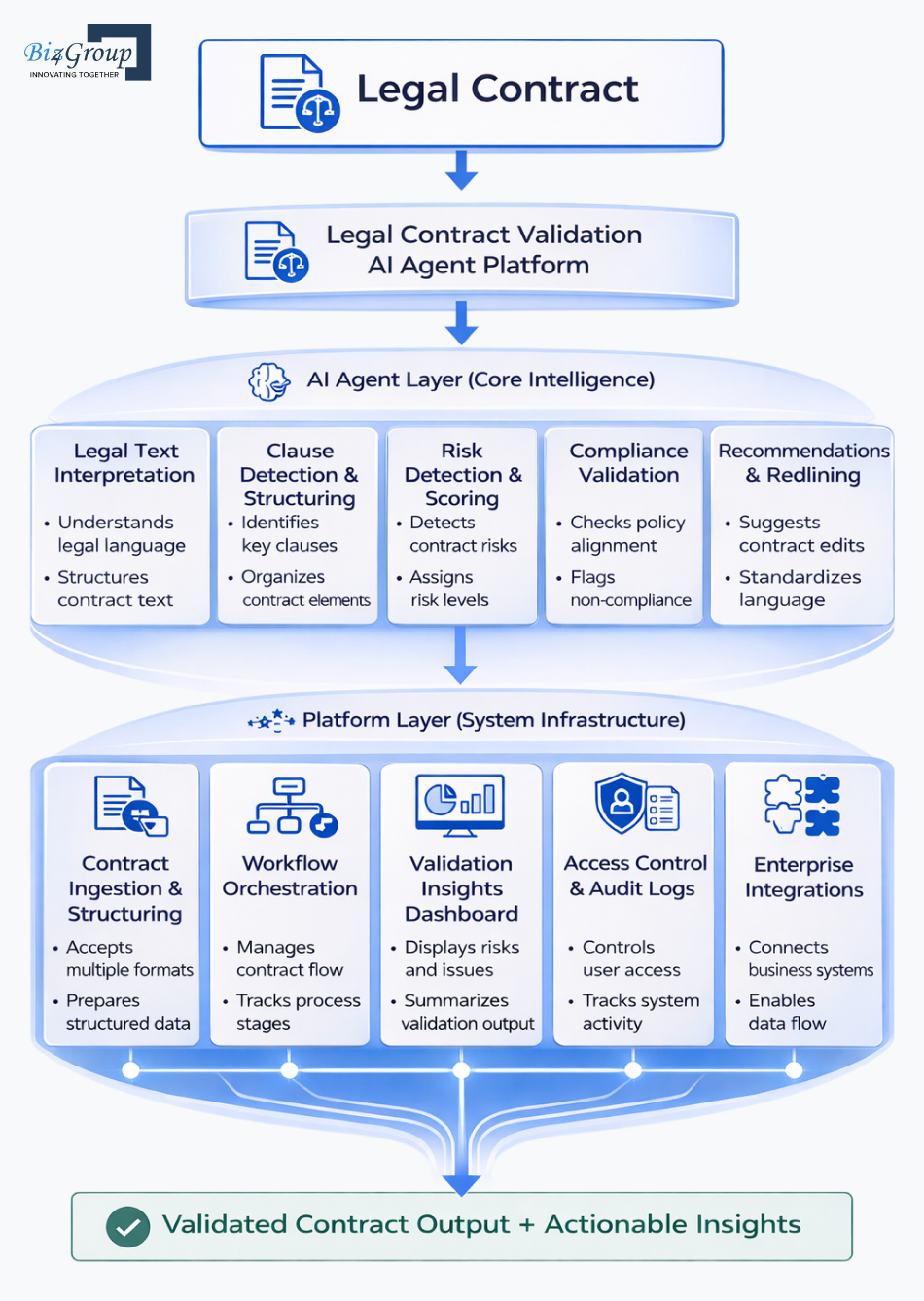
1. AI Agent Layer (Core Intelligence)
- Legal Text Interpretation (NLP): The system reads contracts in their original format and breaks them into understandable segments. It identifies legal meaning behind sentences, even when wording changes across documents, which helps maintain consistency during validation.
- Clause Identification and Structuring: It then detects clauses such as payment terms, liability limits, or termination conditions. It then organizes these clauses into structured categories so they can be reviewed, compared, and validated without manually searching through documents.
- Risk Detection and Scoring Logic: The system checks for missing clauses, unusual obligations, or non-standard language. It assigns risk levels based on predefined thresholds, so legal teams can quickly focus on contracts that need deeper review.
- Compliance Validation Mechanism: The platform evaluates contract terms against internal policies and regulatory requirements. It highlights where clauses do not meet expected standards, helping teams correct issues before contracts move forward in the workflow.
- Recommendation and Redlining Intelligence: It then suggests edits based on validated patterns from previous contracts. These suggestions help standardize contract language and improve review speed, supported by ongoing improvements through AI model development.
Also Read: A Practical Guide to the 6 Types of AI Agents for Business Leaders
2. Platform Layer (System Infrastructure)
- Contract Ingestion and Document Handling: Contracts are uploaded in different formats such as PDFs or Word files. The system converts them into structured data, so they can be processed consistently without requiring manual formatting or preparation.
- Workflow Orchestration Across Review Stages: Each contract moves through predefined stages like review, validation, and approval. The system ensures that tasks are assigned properly, and progress is tracked without relying on manual follow-ups or email coordination.
- Structured Output Visualization Dashboard: Validation results are displayed in a clear format showing flagged clauses, risks, and suggested actions. This allows legal teams to understand contract issues quickly without reading the entire document again.
- Access Control and Audit Tracking: AI agent platform for legal contract validation controls who can view or edit contracts based on roles. It also records every change or action taken, which helps maintain transparency and supports internal audits when required.
- Enterprise System Integration Layer: The system connects with tools such as CRM, ERP, and CLM platforms. This ensures contract validation fits into existing business processes, allowing data to move smoothly between legal and operational systems using reliable AI automation services.
Also Read: How to Develop ERP AI Chatbot
A clear system structure ensures contract validation is not just accurate but also practical to use. When each layer works together, legal teams can handle contracts with more control and less delay. This makes it easier to build AI agent for contract risk validation that supports real business operations at scale.
Still Relying on Fragmented Contract Workflows?
Turn scattered validation steps into a structured system that works across real legal operations
Fix Your Contract WorkflowWhere does Legal Contract Validation AI Agent Platform Delivers Real Value: High Impact Business Use Cases for Modern Legal Firms
Contracts rarely follow a single pattern, and teams often deal with different expectations across departments. This is where legal contract validation AI agent platform development starts showing real value, especially when contract handling needs to stay consistent without slowing down business decisions.
1. In-House Legal Teams Managing High Contract Volumes
In-house legal teams often deal with contracts coming from multiple business units. Each contract may follow a different structure, which makes consistent validation difficult and time-consuming.
An legal AI agent helps standardize how contracts are reviewed by identifying key clauses and flagging issues early in the process. It allows legal teams to focus on critical decisions instead of spending time on repetitive checks.
- Reduces dependency on manual contract screening
- Brings consistency across contracts from different departments
- Helps teams manage higher contract volumes without delays
2. Legal Operations Teams Standardizing Review Processes
Legal operations teams are responsible for ensuring that contract workflows remain structured and efficient. The challenge arises when review processes vary across teams or regions, leading to inconsistencies.
An AI-driven system helps enforce standard validation steps across all contracts. It ensures that every agreement follows the same review path, which improves visibility and control across operations.
- Standardizes contract validation workflows across teams
- Reduces process variation in multi-region operations
- Supports better tracking through structured AI contract management systems
3. Procurement Teams Validating Vendor Contracts
Procurement teams frequently handle vendor agreements that include pricing terms, delivery conditions, and service clauses. Missing or unclear terms can lead to operational risks later.
An AI agent reviews these contracts by identifying gaps or unclear conditions before approval. It ensures that vendor agreements align with internal expectations and reduces back-and-forth communication.
- Flags incomplete or unclear vendor terms early
- Improves alignment between procurement and legal teams
- Supports faster contract approval cycles
4. Law Firms Handling Corporate Client Agreements
Law firms managing corporate clients often deal with a high volume of agreements that require quick turnaround. Each contract needs careful validation to maintain quality and client trust.
Using a legal AI agent helps firms review contracts more efficiently by identifying important clauses and potential concerns. This allows lawyers to focus on advisory work rather than repetitive validation tasks.
- Improves contract review turnaround time
- Helps maintain consistency across client engagements
- Supports scalable contract handling for growing client demands
5. M&A Teams Reviewing Large Contract Sets
Mergers and acquisitions involve reviewing a large number of contracts within tight timelines. Missing a critical clause or obligation can impact deal outcomes.
An AI-powered system helps scan and organize contract data quickly, making it easier to identify risks across multiple agreements. It supports faster due diligence without compromising review quality, often supported by generative AI techniques.
- Speeds up contract analysis during due diligence
- Helps identify risks across large contract datasets
- Reduces manual effort in high-pressure deal timelines
Let’s look at how this kind of structured approach is actually implemented in real legal workflows.
Portfolio Spotlight: Automating Legal Services with TrialProofer
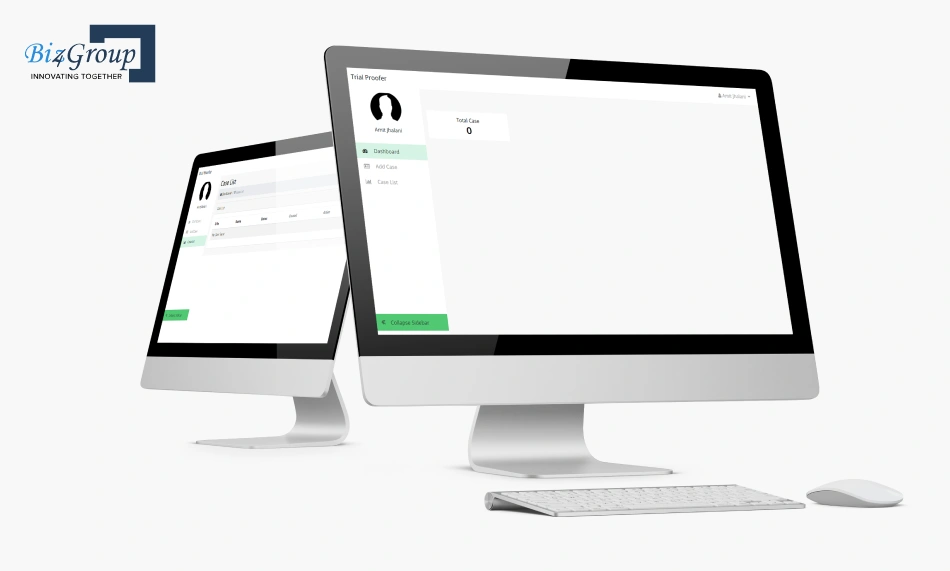
TrialProofer is a litigation-focused platform designed to structure complex legal data into connected case narratives. It brings together documents, events, and legal relationships into a single system, allowing teams to analyze how different elements relate to each other instead of reviewing them in isolation.
- Builds structured timelines that align events, filings, and related contract elements
- Connects legal entities, documents, and references into a unified analysis layer
- Enables cross-document navigation without manual back-and-forth between agreements
In M&A scenarios, where multiple contracts must be evaluated together, this structured approach helps maintain visibility across interdependent terms and obligations without losing context during review.
Each use case shows how contract validation becomes more structured when handled with the right system. As contract volumes grow, teams need clarity and consistency. If you are planning how to build an AI agent for contract validation and compliance, these scenarios help you understand where it delivers real operational value.
How Does AI Agent Platform for Legal Contract Validation Differs from Traditional Legal Contract Validation Software?
Contract validation may look similar across tools, but the way systems interpret and process contracts is very different. When you plan to build AI agent for automated contract compliance, this difference directly affects how accurately contracts are reviewed and validated in practice.
The table below shows how these approaches behave in real contract scenarios, especially when dealing with varied formats, clause structures, and evolving legal requirements.
|
Aspect |
Traditional Contract Validation Software |
AI Agent-Based Contract Validation Platform |
|---|---|---|
|
Validation Approach |
Uses fixed rules defined in advance for every contract |
Evaluates each contract based on its content and structure |
|
Clause Handling |
Identifies clauses only if wording matches predefined patterns |
Recognizes clauses even when wording or structure changes |
|
Risk Identification |
Flags risks only when exact conditions are met |
Identifies missing clauses and unusual terms based on context |
|
Decision Logic |
Follows the same validation steps for every contract |
Adjusts validation flow depending on contract type and content |
|
User Involvement |
Requires manual review to confirm most issues |
Provides clear insights so that legal teams can focus only on critical decisions |
|
Handling Variations |
Struggles with contracts that do not follow standard formats |
Handles different formats without requiring manual adjustments |
|
Learning Capability |
Does not learn from past contracts or corrections |
Improves over time based on feedback and contract patterns |
|
Workflow Flexibility |
Limited ability to adapt validation steps |
Adjusts workflows based on contract complexity or use case |
|
Integration Scope |
Often works separately from other business systems |
Connects smoothly with internal legal systems using reliable AI integration services |
|
Document Coverage |
Works best with structured templates or repeated formats |
Handles varied agreements such as vendor contracts or AI lease agreement documents |
The difference is not just technical; it changes how contract validation fits into daily operations. As systems move from static checks to adaptive validation, legal teams gain better control over contract quality. This shift is central to effective legal contract validation AI agent platform development.
Now let us understand the business impact that is driving the adoption of AI agent platforms for legal contract validation in the legal industry.
Why Modern Legal Firms Are Moving Toward AI Agent-Based Contract Validation Platform: ROI and Business Value
Contract validation is no longer just a legal task; it directly impacts how fast deals move and how much operational effort is spent on review cycles. This is why many teams are now developing an AI agent for contract auditing and compliance checks and considering it as a practical step toward improving contract-driven business outcomes.
1. Slow Contract Review and Delayed Deal Cycles
Long review cycles often delay approvals, especially when contracts move across multiple stakeholders. This creates friction in deal closures and impacts revenue timelines. When teams start to develop AI agent for contract validation, review cycles become more structured and predictable. Contracts move faster without waiting for repeated manual checks.
- Reduces contract review time by 30–50% in high-volume environments
- Minimizes delays caused by back-and-forth revisions
- Improves deal turnaround time across departments
2. Inconsistent Validation Leading to Rework Costs
Different reviewers often interpret contract terms differently. This inconsistency leads to repeated revisions, which increases effort and slows down approvals. A more structured validation approach ensures that contracts follow the same evaluation logic every time. This reduces unnecessary rework and keeps review cycles aligned.
- Cuts rework effort by up to 25–35%
- Reduces dependency on individual reviewer judgment
- Improves alignment across teams using structured legal workflow management practices
3. Legal Bottlenecks Increasing Operational Load
Legal teams often face bottlenecks when contract volumes increase. This creates pressure on resources and delays business operations. With a system that supports decision-making, legal teams can focus on critical reviews instead of routine validation steps. This helps balance workload without increasing team size.
- Reduces manual review workload by 40–60%
- Improves response time for contract approvals
- Supports better workload distribution across teams
4. Cost Pressure and Resource Optimization
Rising legal costs make it difficult to scale contract operations using only manual processes. Hiring more resources is not always a practical solution. By introducing structured validation, organizations can handle more contracts without increasing operational costs. This improves cost efficiency over time.
- Lowers cost per contract review by 20–30%
- Reduces dependency on external legal support
- Optimizes internal resource utilization
5. Faster Deal Cycles and Revenue Impact
Contract delays often affect how quickly revenue is realized. Even small delays across multiple deals can create a significant impact on business performance. A more efficient validation approach helps contracts move through approval stages faster. This directly improves deal closure timelines.
- Accelerates contract approval cycles by 25–40%
- Reduces time-to-revenue across sales-driven contracts
- Improves coordination between legal and business teams
6. Risk Reduction and Financial Protection
- Missed clauses or unclear terms can lead to financial exposure later. These risks often surface after contracts are already executed. When validation becomes more structured, risks are identified earlier. This helps prevent costly issues and supports better contract outcomes.
- Reduces risk exposure from contract gaps
- Minimizes financial losses from unclear terms
- Supports proactive contract risk management
When contract validation starts influencing cost, speed, and risk, it becomes a business decision rather than just a legal process making legal contract validation AI agent platform development a strategic decision.
Also Read: AI Legal Client Intake Automation Software Development Guide
Delay in Validation Costing Your Deals
Replace slow review cycles with structured validation that keeps contracts moving without bottlenecks
Remove Review BottlenecksCore Capabilities Required in a Legal Contract Validation AI Agent Platform
When you start thinking about how to build an AI agent for contract validation and compliance, the focus quickly shifts to what the platform must consistently handle. These capabilities shape how smoothly contract validation fits into your existing legal workflows. They also determine how reliably contracts move through the validation process without creating delays or confusion.
|
Capability |
What It Does |
Why It Matters in Workflow |
|---|---|---|
|
Contract Structure Recognition |
Identifies and organizes contract sections into a readable format, even when documents vary in layout or style. |
Ensures contracts are easy to evaluate without manual scanning, saving time during initial review. |
|
Clause Intelligence Mapping |
Detects and groups clauses based on meaning instead of fixed keywords, helping teams create AI powered legal validation agent systems that adapt to real contracts. |
Reduces missed clauses and keeps validation consistent across different contract formats. |
|
Risk Pattern Identification |
Analyzes contract language to highlight missing obligations, unusual terms, or imbalanced clauses using predictive analysis. |
Helps teams focus on critical issues early instead of reviewing entire documents line by line. |
|
Compliance Alignment Checking |
Maps contract terms against predefined policies and external regulations to ensure alignment before approval. |
Prevents contracts from moving forward with compliance gaps that could cause issues later. |
|
Context-Based Suggestion Engine |
Provides recommendations based on contract context and prior validation patterns to develop intelligent legal AI agent for contract validation workflows. |
Supports faster decision-making by reducing the need for repeated manual corrections. |
|
Contract Summary Generation |
Converts long contracts into short, structured summaries highlighting key terms and obligations using sentiment analysis where needed. |
Helps stakeholders quickly understand contract intent without reading full documents. |
|
Decision Traceability and Logs |
Tracks validation steps, changes, and approvals across the contract lifecycle to maintain transparency. |
Makes it easier to review past actions and supports internal audits without confusion. |
|
Workflow Continuity Support |
Ensures contracts move smoothly through validation stages as part of broader AI business process automation systems. |
Keeps contract handling consistent and avoids delays caused by manual coordination. |
|
Multi-System Data Sync |
Connects validation outputs with business systems to maintain data consistency across platforms. |
Reduces duplication of effort and ensures contract insights are available where needed. |
|
Adaptive Learning Capability |
Improves validation accuracy over time by learning from corrections and feedback across contracts. |
Helps the system stay aligned with changing contract standards and business needs. |
These capabilities define how well your platform performs in real contract environments. When each function works together, validation becomes more reliable and easier to manage. This is where legal contract validation AI agent platform development starts aligning closely with everyday legal operations and long-term process efficiency.
Now take a look at how these capabilities come together in a working legal system developed by Biz4Group LLC.
Portfolio Spotlight: Court Calendar- Judiciary Platform for Attorneys and Law Firms
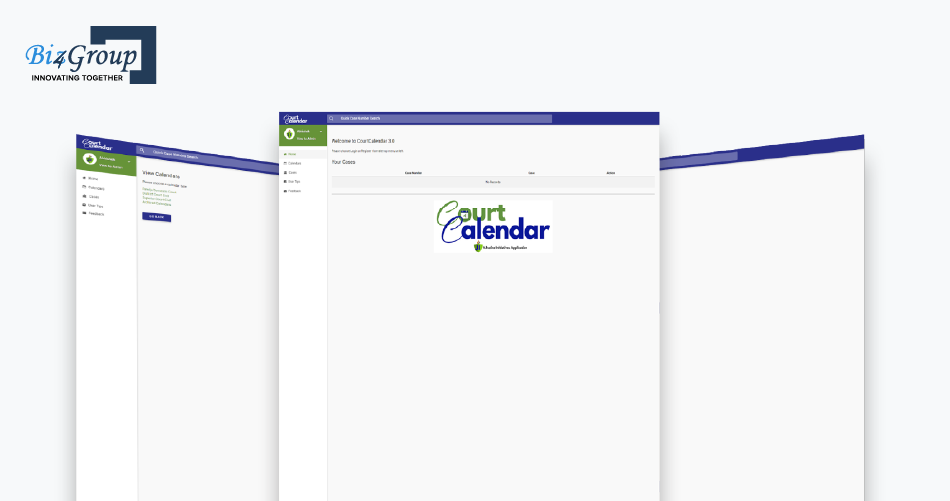
Court Calendar is a legal workflow management platform built to centralize scheduling, track case timelines, and coordinate activities across legal teams. It brings structure to how legal tasks move across stages, ensuring deadlines, responsibilities, and progress remain visible within a single system.
- Maintains continuity across workflow stages by tracking task progress and ownership in real time
- Synchronizes legal data across systems to keep schedules, updates, and actions aligned
- Records actions and changes to support traceability and audit requirements
This directly reflects how validation platforms rely on structured workflows and controlled movement of tasks instead of fragmented coordination.
Also Read: AI Contract Generator Platform Development for Legal Departments
How to Make AI Powered Contract Validation AI Agent Platform for Legal Teams: A Practical Roadmap in 7 Steps
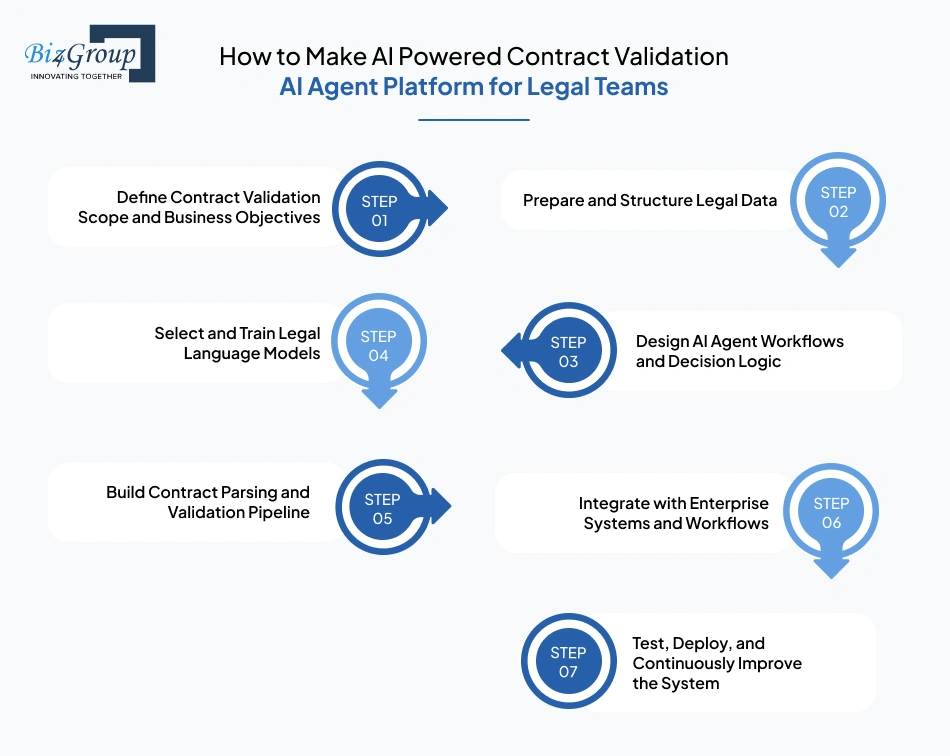
With a clear view of what the platform must deliver, the next step is figuring out how to translate those capabilities into a working system. This is where the steps to create AI agent for legal contract review and validation help you move forward in a structured and practical way.
Each step below focuses on one responsibility, so you can structure the system in a way that works in real contract environments.
Step 1: Define Contract Validation Scope and Business Objectives
Start by setting boundaries around what your system should handle. This step defines the purpose of validation and prevents unnecessary expansion later. You need clarity on the types of contracts involved as without this; the system may process contracts without delivering meaningful results.
- List contract categories that fall under validation coverage
- Define expected validation outputs such as issue detection or compliance alignment
- Set measurable targets related to processing consistency and review timelines
Step 2: Prepare and Structure Legal Data
Move your focus to preparing contract data so it becomes usable for structured processing. Raw documents often contain inconsistencies that can affect interpretation. At this stage, the goal is not analysis but organization. Contracts should be aligned into a consistent structure, so patterns can be recognized during later stages.
- Gather contracts from multiple storage locations into a single dataset
- Convert documents into a uniform structure for consistency
- Tag key legal elements to create identifiable data points
Step 3: Design AI Agent Workflows and Decision Logic
At this stage your attention shifts to defining how the system will behave once contracts enter it. This step is about flow design, not technical implementation. You need to determine how contracts progress from one stage to another and what triggers decisions at each point.
Working with an experienced UI/UX design company ensures predictable behavior across different contract scenarios and helps keep this flow intuitive for teams using the system.
- Outline contract movement from intake to final validation outcome
- Define clear evaluation checkpoints within the flow
- Establish logic for handling flagged or cleared contracts
Also Read: Top UI/UX Design Companies in USA
Step 4: Select and Train Legal Language Models
Now focus on enabling the system to interpret contract language effectively. This step ensures that contracts are understood in context rather than treated as plain text.
- Choose AI models aligned with contract complexity requirements and variation.
- Train AI models using structured datasets, so they learn how legal language is formed.
- Fine tune LLM’s to improve contextual understanding
Step 5: Build Contract Parsing and Validation Pipeline
This stage focuses on making the system operational by defining how a contract is processed from entry to final validation. The aim is to create a structured flow where each stage passes clean output forward without interruption.
At this point, teams often validate this flow early through MVP software development and rely on MVP development service providers to ensure the pipeline behaves consistently with real contract data.
- Break incoming contracts into smaller, identifiable segments so each part can be processed independently
- Transform extracted content into a consistent data structure that can be passed across validation stages
- Apply validation sequences in a fixed order to maintain predictable processing behavior
- Route processed outputs into defined checkpoints for further evaluation or final status assignment
Also Read: Top MVP Development Companies in USA
Step 6: Integrate with Enterprise Systems and Workflows
With this step, developers ensure that the platform connects with systems already used by your organization. This prevents isolation and allows validation outputs to be used in real processes. Contracts should move seamlessly between systems without requiring manual transfer. This is where continuity across operations is established.
- Connect with platforms such as AI CRM for aligned contract data usage
- Enable API connections for smooth system communication
- Integrate AI model and validation outputs into existing approval processes
Step 7: Test, Deploy, and Continuously Improve the System
This stage ensures the system performs reliably before and after it goes live. The focus here is on validating real contract outcomes, not assumptions. Many teams collaborate with software testing companies at this point to evaluate how the system behaves under different contract scenarios and edge cases.
- Run controlled testing using diverse contract samples to check how the system responds to variations
- Compare system outputs with expert-reviewed results to identify gaps or inconsistencies
- Deploy the system in a phased manner to monitor behavior in real working conditions
- Track performance over time and update validation logic based on observed patterns
A structured approach keeps development clear and reduces unnecessary complexity across stages. If you are looking for the best way to create AI agent for contract review and compliance, this roadmap supports the process with clarity and control.
Also Read: How to Build a Legal Automation Platform Like SoloSuit
Ready to Build Beyond Just Another Tool?
Turn your roadmap into a working system aligned with real contract workflows and validation needs
Start Building It RightTechnology Stack Considerations for Legal Contract Validation AI Agent Platform Development
Moving from process design to actual implementation brings the focus to how to make AI powered contract validation AI agent for legal teams using the right technologies. This stage is where your system design turns into a working platform that can handle real contract workflows reliably.
To make this clearer, let’s break down the key technology layers you will need and how each one supports the system in practice.
|
Architecture Layer |
Recommended Technology |
Purpose |
|---|---|---|
|
Language Model Layer |
OpenAI API, Anthropic Claude, LLaMA 3 |
Interprets complex legal language and supports contextual understanding required to make AI contract verification AI agent systems reliable in real contract scenarios |
|
NLP Processing Layer |
spaCy, Hugging Face Transformers, NLTK |
Processes legal text to identify entities, sentence structures, and relationships needed for contract analysis |
|
Document Parsing Layer |
Apache Tika, PDFPlumber, Docx2txt |
Extracts content from PDFs and Word files and converts them into readable text for further processing |
|
Data Structuring Layer |
Python (Pandas), JSON schema validation |
Organizes extracted data into structured formats that can be used across web development pipelines |
|
Backend Application Layer |
Node.js (Express), Python (FastAPI, Django) |
Handles business logic, request processing, and manages validation workflows across the platform |
|
Database and Storage Layer |
PostgreSQL, MongoDB, AWS S3 |
Stores structured contract data, validation outputs, and raw documents in a secure and scalable way |
|
Security Layer |
OAuth 2.0, JWT, AES encryption |
Ensures secure access control and protects sensitive legal data during storage and transmission |
|
Integration Layer |
REST APIs, GraphQL APIs |
Enables seamless communication between systems and supports external integrations using structured endpoints |
|
Workflow Orchestration Layer |
Apache Airflow, Temporal, Celery |
Manages task execution and ensures contracts move through validation stages in a controlled sequence |
|
Frontend Interface Layer |
Provides a usable interface for uploading, reviewing, and managing contracts without technical complexity |
|
|
Monitoring and Logging Layer |
ELK Stack (Elasticsearch, Logstash, Kibana), Prometheus, Grafana |
Tracks system performance, logs activities, and helps maintain reliability across operations |
Using the right technologies makes a noticeable difference in how smoothly the platform performs in real environments. Each layer should support clarity, control, and consistency.
What is The Cost to Develop AI Contract Validation AI Agent for Legal Enterprises
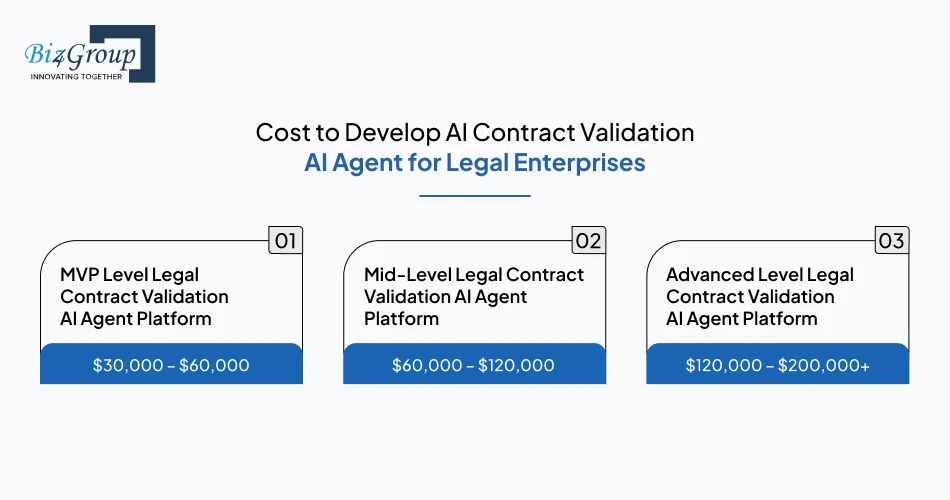
Budget planning usually becomes the turning point once you move from idea to execution. With AI agent development for legal contract validation, costs can range between $30,000 and $200,000+, depending on how much validation depth, system scale, and integration complexity you want to support from day one.
|
Development Level |
Estimated Cost Range |
Scope |
|---|---|---|
|
MVP Level Legal Contract Validation AI Agent Platform |
$30,000 – $60,000 |
Covers basic contract validation flow with limited contract types, simple validation logic, and controlled testing environment |
|
Mid-Level Legal Contract Validation AI Agent Platform |
$60,000 – $120,000 |
Supports multiple contract formats, improved validation accuracy, structured workflows, and integration with internal systems |
|
Advanced Level Legal Contract Validation AI Agent Platform |
$120,000 – $200,000+ |
Handles complex contracts, large-scale processing, advanced validation logic, and enterprise-grade integrations across systems |
Factors Affecting the Cost to Develop Legal Contract Validation AI Agent Platform
The cost ranges give you a clear starting point, but the final budget rarely stays fixed at one level. What really shapes your investment is how the system is expected to perform in real conditions. Let’s look at the key factors that actually influence the cost.
1. Contract Complexity and Data Variability
The more variation in contract formats and legal language, the more effort is required to structure and prepare data. This increases development effort by 15–25% as additional handling is needed to develop AI contract analysis agent for compliance across different contract scenarios.
2. Level of Validation Depth
Simple validation requires less effort compared to systems that evaluate multiple layers such as clause relationships and compliance checks. This directly impacts the overall legal AI agent development cost, often increasing it by 20–30% depending on depth.
3. Integration with Business Systems
Connecting the platform with existing tools increases the development scope. The cost for AI integration depends on how many systems are involved and how complex the data exchange is, typically adding 15–20% to the total cost.
4. Scalability and Performance Requirements
Systems designed for higher contract volumes require additional effort to ensure stability and performance. This can increase cost by 20–35% as more robust processing and handling capabilities are needed.
5. Testing and Validation Effort
Ensuring accuracy through extensive testing requires time and expert involvement. This phase can add 10–20% to development costs, especially when validation needs to align closely with real contract scenarios.
Cost depends on how far you want the platform to go in terms of scale and validation depth. A clear understanding of scope helps avoid unnecessary spending. This is where legal contract validation AI agent platform development becomes easier to plan with the right expectations in place.
Also Read: How Much Does AI Software Development Costs?
Planning Budget or Avoiding Cost Surprises?
Get clarity on real development scope before costs escalate with unclear validation requirements
See Real Cost ScopeCompliance and Regulatory Framework in Legal Contract Validation AI Agent Platform Development for Modern Legal Teams
Trust becomes a critical factor once contracts start flowing through automated systems. When you develop scalable AI agent for contract validation platform, the focus is not only on accuracy but also on how well the system aligns with legal expectations and regulatory standards in real-world usage.
1. Data Privacy and Legal Data Handling
Handling contracts means dealing with sensitive business and personal data. Regulations like GDPR and similar frameworks require strict control over how this data is stored, processed, and accessed.
You need to ensure that contract data is protected at every stage, from upload to validation output. This includes managing access permissions and maintaining data confidentiality without exposing sensitive information unnecessarily.
2. Legal Auditability and Traceability
Legal teams need clear visibility into how decisions are made during contract validation. Every action taken by the system should be traceable and easy to review when required.
This means maintaining records of validation steps, changes made, and decisions generated by the system. An AI legal document analyser tool helps provide this traceability so legal teams can confidently review past contract decisions without ambiguity.
Also Read: AI Legal Document Management Software Development
3. AI Explainability in Contract Decisions
When a contract is flagged or validated, the system should clearly explain why that decision was made. Without this clarity, legal teams may struggle to trust automated outputs.
Explainability ensures that each validation outcome is backed by understandable reasoning. This becomes especially important when teams make AI agent for contract review and validation systems part of everyday legal workflow automation.
4. Risk and Liability Management
Automated contract validation introduces responsibility around decision accuracy. If a system misses a critical clause or flags something incorrectly, it can lead to legal or financial consequences.
To manage this, organizations need to define clear accountability and ensure validation outputs are reviewed where necessary. This reduces exposure to risks that may arise from incorrect contract interpretation.
5. Regulatory Alignment Across Jurisdictions
Contracts often operate across regions with different legal requirements. A validation system must be able to handle these variations without applying a single standard to all contracts.
Working with an experienced AI consulting service company helps ensure the platform aligns with regional legal requirements and adapts validation logic accordingly, especially when handling contracts across multiple jurisdictions.
Compliance is not something you address later; it needs to be built into how the system operates from the beginning. As contract validation becomes more automated, maintaining trust becomes essential aligning legal contract validation AI agent platform development closely with real legal and regulatory expectations.
What Challenges Arise When You Develop Contract Validation AI Agent Platform for Legal Firms and How You Can Overcome Them
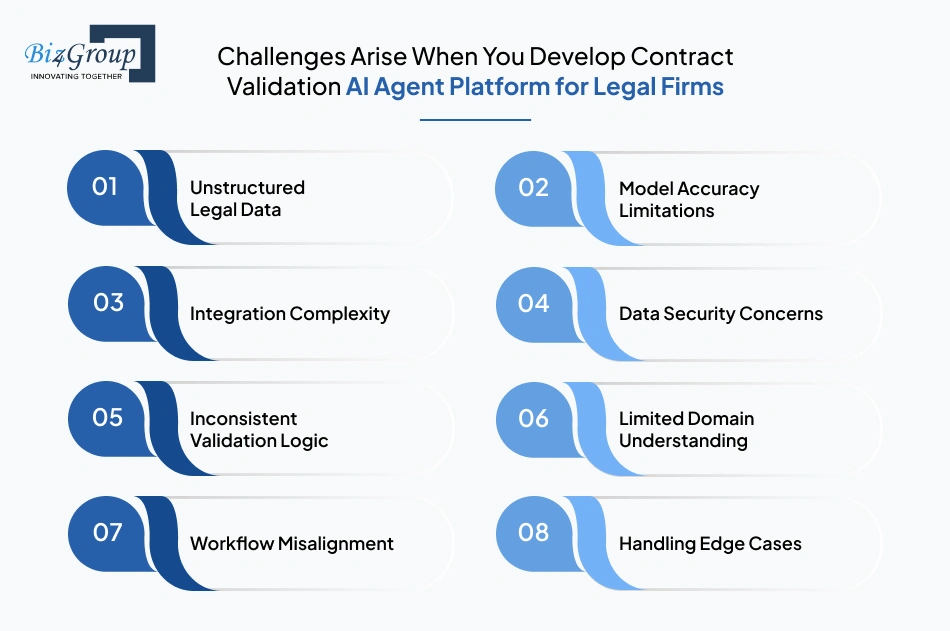
Turning a system idea into something that works in real contract environments often brings unexpected hurdles. When you develop a legal contract validation AI agent platform, these challenges usually come from how contracts are structured, how systems interact, and how decisions are interpreted in practice.
|
Challenge |
Why It Happens |
Practical Solution |
|---|---|---|
|
Unstructured Legal Data |
Contracts come in different formats, layouts, and writing styles, which makes it difficult to process them consistently. |
Standardize contract formats early and create structured datasets so the system can interpret documents without confusion. |
|
Model Accuracy Limitations |
Legal language varies widely, and small wording changes can affect interpretation, leading to inconsistent validation outcomes. |
Train models on diverse contract datasets and refine outputs continuously with expert feedback to improve accuracy over time. |
|
Integration Complexity |
Existing business systems may not follow the same data structure, making it difficult to connect validation workflows smoothly. |
Use well-defined APIs and phased integration to connect systems without disrupting current processes. |
|
Data Security Concerns |
Contract data often contains sensitive information, which increases the risk of exposure during processing and storage. |
Implement strict access controls and encryption while ensuring data handling follows secure internal policies. |
|
Inconsistent Validation Logic |
Different contract types require different validation approaches, which can create inconsistencies if not handled properly. |
Define clear validation rules for each contract category and maintain consistency through structured logic. |
|
Limited Domain Understanding |
Generic models may not fully capture legal context, especially for specialized contracts. |
Work with domain experts and hire AI developers who understand legal workflows to improve system understanding. |
|
Workflow Misalignment |
Validation outputs may not align with how legal teams actually review contracts, leading to inefficiencies. |
Align system workflows with real review processes and ensure outputs are easy to act upon in daily operations. |
|
Handling Edge Cases |
Contracts often contain exceptions or unusual clauses that standard logic may not capture. |
Continuously update validation logic and include edge case handling based on real contract scenarios. |
Challenges are a natural part of building any complex system, but addressing them early keeps development on track. With the right approach, each obstacle becomes manageable, making legal contract validation AI agent platform development more controlled, predictable, and aligned with real operational needs.
Already Facing Hidden Validation Roadblocks?
Solve structural issues early before they slow down workflows and impact contract accuracy
Eliminate Workflow GapsWhy Biz4Group LLC Is the Right Partner for Legal Contract Validation AI Agent Platform Development
When teams start evaluating which company can develop AI contract validation agents for enterprises, the focus usually shifts from features to execution capability. The real question becomes who can translate complex contract workflows into a system that actually works in real business conditions.
Working with Biz4Group LLC means working with a team that understands both AI systems and enterprise workflows. We focus on how contracts are handled in practice, not just how they should work in theory. That helps us align development with real operational expectations from the beginning.
As an AI agent development company, our approach is centered on clarity and structure rather than overcomplicating the system. We work closely with you to define how validation should behave, how decisions should flow, and how outputs should be used by your team without adding unnecessary complexity. Here’s what you should know about us:
- We design platforms that aligns with real contract workflows used across modern legal tech environments to ensure practical usability and adoption
- Validation systems are structured to support consistent decision-making without adding complexity to existing legal review processes or workflows
- Our approach to architecture design allows smooth extension into an AI legal consultation platform as contract handling requirements expand across different business functions
- Output formats are designed to be clear and actionable so legal teams can quickly interpret validation results without additional effort
- Our experience with enterprise AI Integrations ensures the system fits into existing processes without disrupting operations or requiring major changes in established workflows
- Each system is positioned as part of a broader enterprise AI solution to support long-term scalability and evolving contract validation requirements
Now let's see how this look like when applied within real enterprise environments
Portfolio Spotlight: AI for Enterprise with Privacy-Focused Data Hosting and Processing
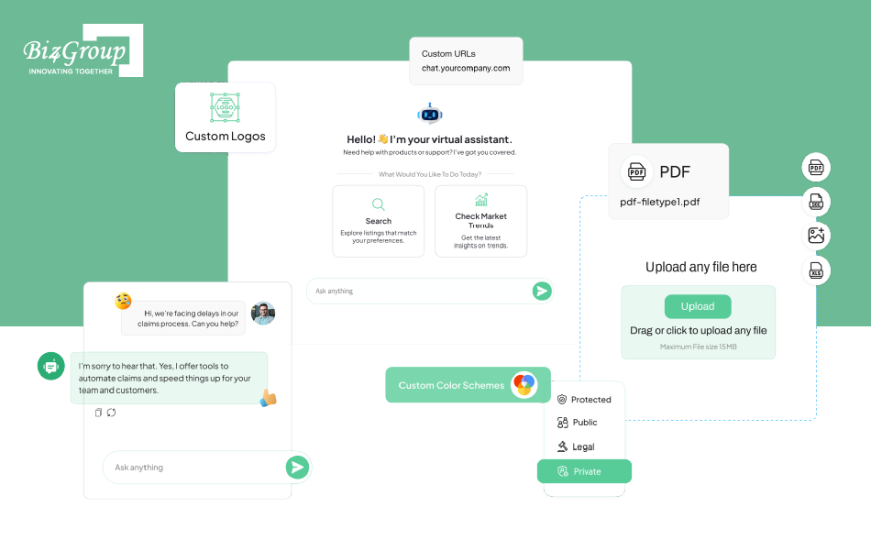
We designed a custom enterprise AI agent that automates complex business and lagl workflows by connecting data, systems, and decision logic into a unified operational layer. It handles real-time queries, retrieves contextual information, and supports process automation without disrupting existing operations. This reflects how AI agents are built to align with enterprise workflows, ensuring consistent execution across departments instead of isolated automation.
Therefore, our experience in the legal industry and expertise in AI agent development ensure everything stays aligned with real contract workflows, establishing us as a reliable partner for legal contract validation AI agent platform development.
Conclusion
Shifting from manual contract review to structured validation changes how legal teams handle complexity and volume. With the right approach, a custom software development company can help you bring consistency into processes that were earlier dependent on individual effort. This is where legal contract validation AI agent platform development starts making everyday contract handling more controlled and predictable.
As contract demands grow, the need to build AI contract validation agent for legal teams becomes more practical than optional. Over time, this shift supports better clarity in contract decisions and reduces dependency on manual review, making validation processes easier to manage as contract volume continues to increase.
Working with Biz4Group LLC helps ensure the system stays aligned with real workflows while adapting to changing contract requirements. If this is something you are considering, it may be worth taking the next step, so schedule a strategy call with us to evaluate how it fits your current setup.
FAQ’s
1. How can AI agents handle contract variations across different industries and jurisdictions?
AI agents can be trained on diverse contract datasets to recognize patterns across industries. By adapting to clause variations and legal language differences, they can handle multi-jurisdiction contracts without relying on fixed templates or rigid rule sets.
2. What level of customization is required to build AI contract validation agent for legal teams?
Customization depends on how unique your contract workflows are. Most systems require tailoring around clause structures, internal policies, and review processes to ensure the AI aligns with how your legal team actually evaluates contracts.
3. How long does it typically take to develop AI agent for contract validation in an enterprise setup?
Development timelines usually range from 3 to 6 months for initial deployment. This depends on contract complexity, data readiness, and how many workflows need to be supported during the first rollout phase.
4. What is the typical cost to develop AI contract validation AI agent for enterprises?
The overall cost usually falls between $30,000 and $200,000+, depending on system scope, contract complexity, and integration needs. More advanced validation requirements and scalability expectations can increase the total investment.
5. How do AI agents adapt to evolving legal standards and contract changes over time?
AI systems improve by learning from new contract data and feedback. As contract formats and legal requirements change, the system can be updated with new patterns, allowing it to stay aligned with evolving validation expectations.
6. What should enterprises evaluate before selecting a partner for AI contract validation agent development?
Enterprises should assess the partner’s experience with legal workflows, ability to handle contract complexity, and understanding of enterprise systems. The focus should be on practical execution rather than just technical capability.
