 Location :
Orlando, FL, USA
Location :
Orlando, FL, USA +1 (407) 714-1616
 info@biz4group.com
- Develop a clinician-ready movement assessment platform using AI to enable accurate, data-driven clinical decision-making.
- Businesses can build AI movement analysis system for clinicians to improve diagnostics, mobility tracking, and treatment planning.
- Investment to develop scalable AI movement analysis platform for healthcare typically ranges from $45,000-$200,000+.
- Emerging innovations show how to build AI digital health platform for movement analysis using predictive insights and multimodal data.
- Biz4Group LLC is a trusted partner to create AI mobility assessment solution for healthcare that is scalable, compliant, and clinically reliable.
How confident are you in a movement assessment that depends on human observation alone?
Clinicians have relied on visual evaluation for decades, yet studies continue to show variability in manual assessments across practitioners. At the same time, the demand for objective, data-backed care is accelerating. According to reports, the global digital health market is expected to surpass $660 billion by 2028, driven by the need for smarter diagnostics and remote care. This shift is pushing healthcare leaders to rethink how they develop a clinician-ready movement assessment platform using AI that delivers consistent, measurable insights.
So, what is changing on the ground? Clinics and hospitals are moving beyond basic tracking tools toward systems that can capture, interpret, and quantify human movement with precision. That is exactly why many organizations are looking to develop AI movement assessment platform for healthcare environments that can standardize evaluations and improve outcomes across teams.
There is also a business reality behind this shift. Healthcare providers are under pressure to do more with fewer resources. Manual assessments take time. They vary between clinicians. They are hard to scale. AI-powered platforms solve these gaps by offering real-time insights, automated reporting, and continuous monitoring. For decision-makers planning to build AI movement analysis system for clinicians, the opportunity opens doors to better patient engagement, remote care models, and new revenue streams.
If you are wondering how to develop a clinician ready AI movement assessment platform that is accurate, scalable, and compliant, this guide will walk you through the complete process.
Let’s begin with the basics.
Understanding The Basics of Clinician-Ready AI Movement Assessment Platform Development
Before diving into development, let us keep clarity on what an AI movement assessment platform is all about.
A clinician-ready movement assessment platform is built to measure, analyze, and interpret human movement with clinical accuracy. It replaces visual judgment with structured data that clinicians can rely on.
It is not designed for workout tracking. It is not built for engagement or gamification.
It is built for clinical evaluation and decision-making.
What Exactly Is a Clinician-Ready AI Movement Assessment Platform?
Think of it as a system that converts physical movement into measurable insights.
A patient performs a movement.
The system captures it.
AI processes it.
Clinicians receive clear, data-backed outputs.
These platforms are designed to develop AI based patient movement assessment platform capabilities that help identify mobility issues, monitor progress, and guide treatment decisions.
Core Components That Power the Platform
Every high-performing system is built on a few essential layers.
Movement Capture Layer
This is where everything starts.
- Cameras track body posture and motion
- Wearables capture joint movement and angles
- Hybrid systems combine both for higher accuracy
If your goal is to build AI solution for real time movement tracking, this layer defines how precise your data will be.
AI Processing Engine
This is where raw movement becomes meaningful data.
- Pose estimation models track body joints
- AI identifies movement patterns and deviations
- Algorithms calculate biomechanics
Data Interpretation Layer
Raw numbers alone are not useful. Interpretation is key.
- Range of motion calculations
- Joint angle measurements
- Movement symmetry analysis
This layer ensures clinicians understand what is happening, not just what was captured.
Clinical Dashboard
Data must be easy to use. Clinicians need:
- Patient-level insights
- Session comparisons
- Visual reports
This is where scalable enterprise AI solutions help deliver smooth experiences across clinics and healthcare networks.
Integration Layer
A platform works best when it connects with other systems.
- Electronic health records
- Smart wearables and external devices
- Remote care platforms
How The Platform Works in Real Scenarios
Here is a simplified flow.
|
Step |
What Happens |
Outcome |
|---|---|---|
|
1 |
Patient performs a guided movement |
Baseline captured |
|
2 |
System records motion via camera or sensors |
Raw data collected |
|
3 |
AI analyzes posture and movement patterns |
Issues detected |
|
4 |
Metrics like joint angles are calculated |
Objective insights generated |
|
5 |
Results appear on clinician dashboard |
Informed decisions made |
Each step reduces guesswork and improves consistency.
AI Based Platform Vs Traditional Assessment
The difference becomes clear when both approaches are compared.
|
Factor |
Traditional Assessment |
AI-Based Platform |
|---|---|---|
|
Accuracy |
Depends on observation |
Based on measurable data |
|
Consistency |
Varies between clinicians |
Standardized across sessions |
|
Tracking |
Manual notes |
Automated tracking |
|
Scalability |
Limited |
Easily scalable |
|
Insights |
Experience-driven |
Data-driven |
Traditional methods rely heavily on experience.
AI platforms rely on evidence.
Why This Foundation Matters
If you are planning to create AI mobility assessment solution for healthcare, the real goal is not feature development. It is building a system that clinicians trust every day.
That trust comes from:
- Accurate measurements
- Reliable performance
- Clear, actionable insights
Now that the foundation is clear, the next step is understanding what real value this platform delivers to healthcare providers and businesses.
Still Relying on Visual Assessments in a Data-Driven World?
Over 60% of healthcare decisions are moving toward AI-backed insights. Where does your system stand?
Book a Strategy Call TodayBenefits of Developing Clinician-Ready Movement Assessment Platform Using AI
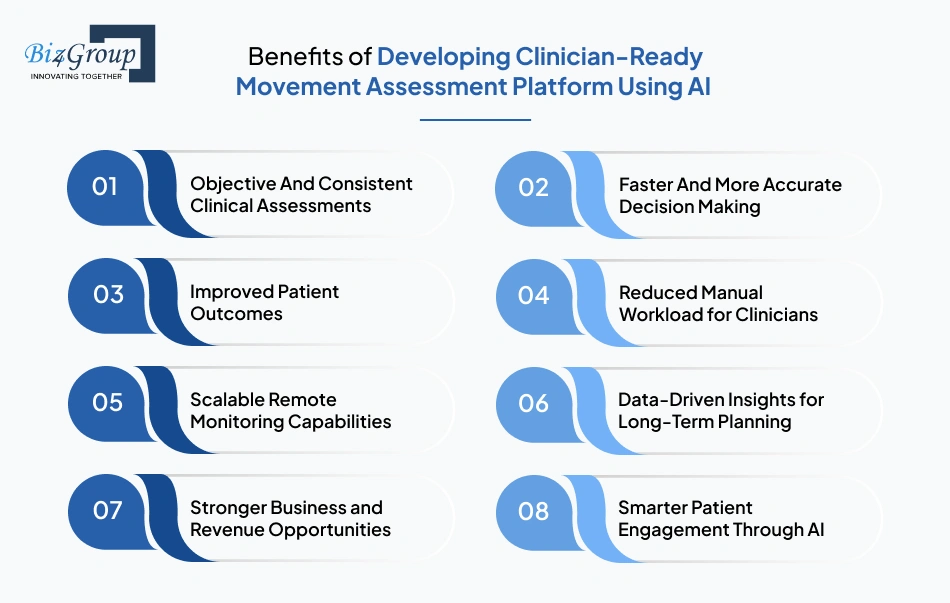
Once the foundation is clear, the next logical question comes up... What does this platform actually deliver in real-world healthcare settings?
The answer lies in measurable impact across clinical outcomes, operational efficiency, and business growth. Organizations that develop scalable AI movement analysis platform for healthcare are seeing clear advantages over traditional systems.
1. Objective And Consistent Clinical Assessments
Consistency has always been a challenge in manual evaluations. AI solves this by standardizing how movement is measured.
- Every session follows the same evaluation logic
- No dependency on individual clinician judgment
- Reduced variability across assessments
This is especially important when you make AI powered movement assessment tool for multi-location healthcare providers.
2. Faster And More Accurate Decision Making
Clinicians often work with limited time and incomplete data. AI platforms provide:
- Instant movement analysis
- Real-time joint angle calculations
- Immediate identification of abnormalities
This enables faster diagnosis and more confident treatment planning.
3. Improved Patient Outcomes
Better data leads to better care. When you develop AI posture analysis platform for clinicians, you enable:
- Early detection of mobility issues
- Continuous progress tracking
- Data-backed therapy adjustments
Patients receive more personalized and effective care.
4. Reduced Manual Workload for Clinicians
Manual tracking and documentation take time. AI platforms automate:
- Movement data capture
- Report generation
- Progress tracking
This is where AI automation becomes critical in reducing operational burden while maintaining accuracy.
5. Scalable Remote Monitoring Capabilities
Healthcare is no longer limited to clinics. AI platforms support:
- Remote assessments
- Continuous monitoring
- Hybrid care models
This aligns closely with AI remote patient monitoring app development, enabling providers to extend care beyond physical locations.
6. Data-Driven Insights for Long-Term Planning
Beyond individual patients, these platforms generate valuable data. Organizations can:
- Identify treatment trends
- Improve clinical protocols
- Support research and innovation
When you build AI digital health platform for movement analysis, data becomes a strategic asset.
7. Stronger Business and Revenue Opportunities
From a business perspective, the benefits are equally compelling.
|
Area |
Impact |
|---|---|
|
Service Expansion |
Offer advanced diagnostic capabilities |
|
Revenue Growth |
Introduce premium assessment services |
|
Differentiation |
Stand out with AI-driven care |
|
Scalability |
Serve more patients without increasing workload |
This is why many companies invest in building an AI product that supports both clinical and commercial goals.
Real-World Example: AI-Powered Athletic Health Solution
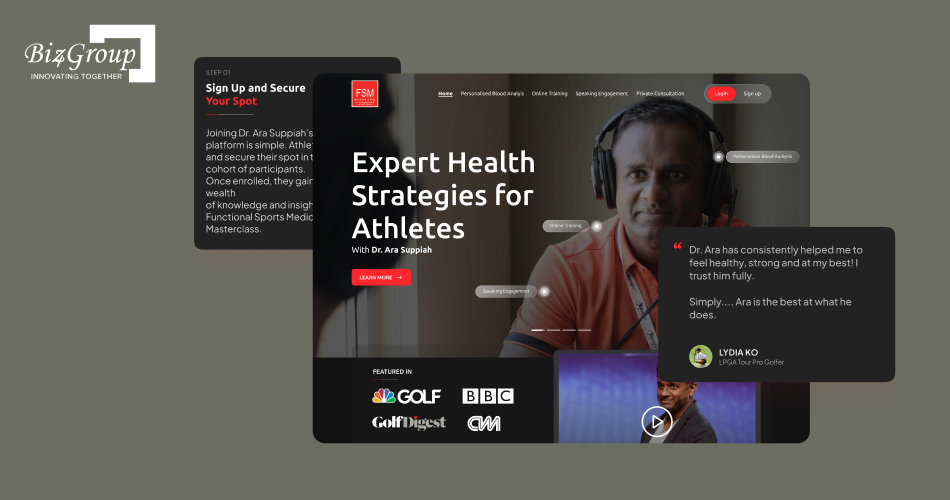
To understand how these benefits translate into real applications, consider an AI-powered athletic health solution built for performance optimization. This solution focuses on turning raw health data into actionable insights.
What it enables:
- Upload and analyze blood test reports for deeper health insights
- Generate personalized recommendations for diet, sleep, and training
- Provide one-on-one consultations based on real data
- Track performance improvements over time
How it delivers value:
- Helps athletes optimize performance using data-driven insights
- Enables continuous health monitoring and adjustment
- Supports personalized decision-making at scale
This approach mirrors how movement assessment platforms work. Both systems rely on data collection, AI-driven analysis, and personalized recommendations.
The difference lies in the type of data. One focuses on internal health metrics, while the other focuses on physical movement.
8. Smarter Patient Engagement Through AI
Engagement improves when insights are clear and actionable. Platforms can integrate:
- Conversational interfaces via AI chatbot development
- Intelligent workflows powered by agentic AI development
- Advanced insights using generative AI
This creates a more interactive and responsive healthcare experience.
What This Means for Your Business
If you are planning to develop AI movement assessment platform for healthcare, the benefits go far beyond technology.
You gain:
- Better clinical accuracy
- Higher operational efficiency
- Scalable care delivery
- Stronger competitive positioning
Now that the value is clear, the next step is understanding what features make such a platform truly clinician-ready.
Must Have Features to Build AI Movement Analysis System for Clinicians
When you build AI movement analysis system for clinicians, features are not about quantity. They are about clinical relevance, accuracy, and usability.
Each feature should answer one core question. How does this help clinicians make better decisions?
Below is a structured breakdown of essential features required to make AI movement analysis software for clinics that performs reliably in real-world healthcare environments.
|
Feature |
What It Does |
Why It Matters |
|---|---|---|
|
Real-Time Movement Tracking |
Captures body motion using cameras or sensors |
Enables instant feedback and accurate data collection |
|
AI Pose Estimation Engine |
Detects joints, posture, and movement patterns |
Forms the backbone when you build AI solution for real time movement tracking |
|
Range Of Motion Analysis |
Measures joint flexibility and movement limits |
Helps clinicians assess mobility limitations precisely |
|
Biomechanical Analysis |
Evaluates symmetry, balance, and alignment |
Identifies underlying movement issues |
|
Session-Based Analytics |
Tracks max, min, and average movement metrics |
Enables comparison across sessions |
|
Clinician Dashboard |
Displays patient insights, trends, and reports |
Supports faster and informed decision making |
|
Multi-User Access Control |
Allows clinicians, researchers, and admins to access data |
Ensures role-based workflows in healthcare setups |
|
Report Generation |
Creates downloadable clinical reports |
Useful for documentation, insurance, and audits |
|
Device And Wearable Integration |
Connects with sensors, wearables, and external systems |
Expands data sources and improves accuracy |
|
Cloud Data Management |
Stores and processes large volumes of patient data |
Essential to develop scalable AI movement analysis platform for healthcare |
|
Security And Compliance Features |
Includes encryption, authentication, and audit logs |
Protects sensitive healthcare data |
|
AI Driven Alerts And Insights |
Flags abnormal patterns or risks |
Enables proactive clinical intervention |
What Makes These Features Clinician-Ready
A platform becomes clinically reliable when:
- Data is accurate and repeatable
- Insights are easy to interpret
- Workflows align with real clinical environments
This is what differentiates a basic tool from a system designed to develop AI movement assessment platform for healthcare at scale.
Project Spotlight: AI Workout App
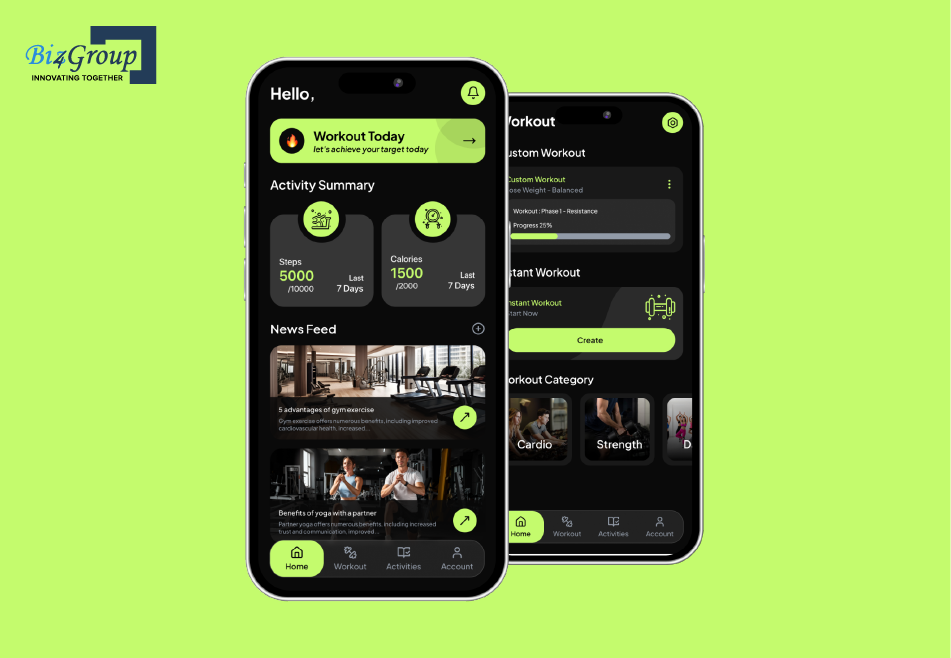
A strong example of AI-powered movement analysis can be seen in a custom-built AI workout application designed using advanced computer vision. This solution focuses on analyzing body composition and movement patterns through image-based inputs.
Key capabilities include:
- Full-body analysis using vision-language models
- Detection of body proportions and symmetry
- Score-based insights across different muscle groups
- Identification of underdeveloped areas
How it delivers value:
- Generates personalized workout plans based on body analysis
- Adapts recommendations as the user progresses
- Tracks performance trends and consistency
Why it matters in this context:
The same foundational technologies used here are applied when organizations create AI movement tracking platform for healthcare.
Instead of fitness insights, the system can be extended to:
- Clinical movement assessments
- Rehabilitation tracking
- Mobility analysis for patients
This shows how scalable AI systems can evolve from fitness applications into full-fledged healthcare platforms.
Now that the features are clear, the next step is understanding the technology and architecture required to bring all of this together into a scalable system.
Also read: Top 10 use cases of computer vision in healthcare
Great Features Don’t Win. The Right Ones Do.
Most platforms fail because they build everything, not what clinicians actually need. Let’s get yours right.
Build Smart with Biz4GroupTech Stack and Architecture Required When You Develop Clinician-Ready Movement Assessment Platform Using AI
Building a reliable system requires choosing the right technologies from day one. When you develop AI movement assessment platform for healthcare, your tech stack must support real-time processing, high accuracy, and secure data handling.
Each layer plays a specific role in ensuring performance, scalability, and clinical usability.
Recommended Tech Stack
|
Tech Layer |
Technologies |
Role In Platform |
|---|---|---|
|
Frontend (Mobile & Web) |
React Native, Flutter, Angular, Next.js |
Enables smooth user experience for clinicians and patients |
|
Backend Development |
Node.js, Django, FastAPI |
Handles APIs, business logic, and data processing |
|
Database |
PostgreSQL, MongoDB, Firebase |
Stores patient data, session logs, and analytics |
|
AI/ML Frameworks |
TensorFlow, PyTorch, OpenCV, MediaPipe |
Powers pose estimation and movement analysis |
|
Computer Vision APIs |
Vision AI tools, custom CV models |
Supports posture detection and tracking |
|
Cloud Infrastructure |
AWS, Azure, Google Cloud |
Ensures scalability and secure data storage |
|
Real-Time Communication |
WebRTC, Socket.IO |
Enables live tracking and feedback |
|
Security & Authentication |
OAuth 2.0, JWT, SSL encryption |
Protects sensitive healthcare data |
|
Wearable Integrations |
Apple HealthKit, Google Fit, BLE devices |
Syncs external health and movement data |
|
DevOps & Deployment |
Docker, Kubernetes, CI/CD pipelines |
Automates deployment and scaling |
To build AI digital health platform for movement analysis, your stack must:
- Support real-time data processing without lag
- Handle large volumes of patient data securely
- Enable seamless integration with healthcare systems
Platform Architecture Overview
The architecture defines how all components interact in real-world scenarios. A well-structured system ensures reliability, speed, and clinical accuracy. When you create AI movement tracking platform for healthcare, the architecture typically includes the following layers:
Data Acquisition Layer
- Captures movement data from cameras, sensors, or wearables
- Handles real-time input streams
- Ensures data quality before processing
Edge Processing Layer
- Performs on-device computations for faster response
- Reduces dependency on constant internet connectivity
- Improves real-time feedback capabilities
AI Processing Layer
- Runs pose estimation and motion analysis models
- Detects movement patterns and anomalies
- Generates structured outputs from raw data
Data Management Layer
- Stores patient data, session history, and analytics
- Ensures secure and compliant data handling
- Supports large-scale data processing
Application Layer
- Mobile apps for data capture and interaction
- Web dashboards for clinicians and administrators
- Interfaces designed for quick interpretation of results
Integration Layer
- Connects with EHR and healthcare systems
- Syncs wearable and external device data
- Enables interoperability across platforms
Security Layer
- Implements encryption and authentication
- Manages access control and audit logs
- Ensures compliance with healthcare regulations
Bringing It All Together
A strong architecture ensures that every component works seamlessly. It allows businesses to:
- Deliver real-time insights without delays
- Scale across multiple clinics or regions
- Maintain data security and compliance
If your goal is to develop scalable AI movement analysis platform for healthcare, the right combination of tech stack and architecture becomes the foundation for long-term success.
Next, let’s break down the actual development process and how to bring this platform from concept to reality.
How to Build a Clinician-Ready AI Movement Analysis System for Healthcare Providers?
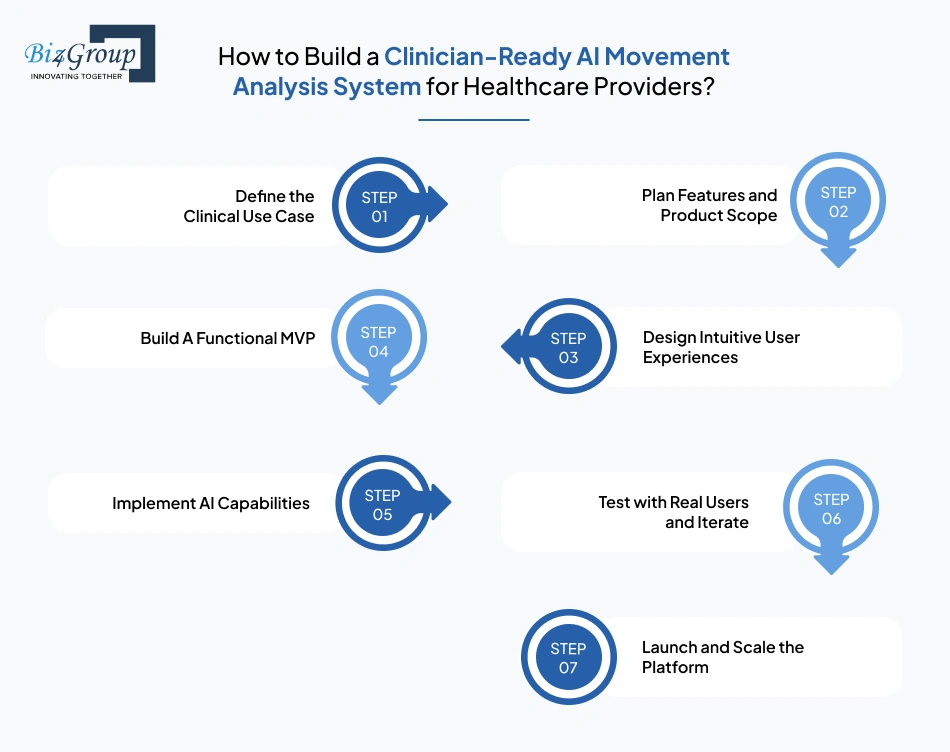
Building a clinician-ready solution requires more than technical execution. It demands clarity, planning, and alignment with real clinical workflows.
If you are planning to develop AI movement assessment platform for healthcare, the process should be structured, iterative, and focused on delivering measurable value at every stage.
Here is a step-by-step approach that works in real-world scenarios.
Step 1. Define the Clinical Use Case
Start with clarity.
- What type of movement are you assessing?
- Who will use the platform?
- What outcomes are expected?
Examples include:
- Post-surgery mobility tracking
- Sports performance analysis
- Elderly fall risk detection
This step ensures you build AI movement analysis system for clinicians with a clear purpose rather than a generic solution.
Step 2. Plan Features and Product Scope
Once the use case is defined, map out what the platform should deliver. Focus on:
- Core clinical capabilities
- User workflows
- Data outputs required by clinicians
Avoid overloading the product early. Prioritize features that directly support clinical decisions.
Step 3. Design Intuitive User Experiences
A powerful system still fails if it is difficult to use. Clinicians need clarity and speed.
- Simple dashboards with actionable insights
- Easy navigation across patient data
- Minimal learning curve
Investing in strong UI/UX design ensures the platform fits seamlessly into daily clinical routines.
Also read: Top 15 UI/UX design companies in USA
Step 4. Build A Functional MVP
Start small. Validate fast. Developing an MVP helps you test the core idea before scaling.
- Focus on one key movement assessment feature
- Validate accuracy and usability
- Gather feedback from real users
Using a structured MVP development approach helps reduce risk and optimize costs early in the process.
Also read: Top 12+ MVP development companies in USA
Step 5. Implement AI Capabilities
This is where the platform becomes intelligent. AI enables:
- Movement analysis
- Pattern detection
- Insight generation
Seamless AI integration ensures that intelligence is embedded into workflows rather than added as an afterthought.
Step 6. Test with Real Users and Iterate
Real-world validation is critical.
- Conduct pilot programs with clinicians
- Compare expected vs actual results
- Identify usability gaps
Iteration at this stage improves both accuracy and adoption.
Step 7. Launch and Scale the Platform
Once validated, move toward full deployment.
- Expand features based on feedback
- Scale across multiple users or locations
- Continuously improve performance
This is where you transition from a prototype to a system that can develop scalable AI movement analysis platform for healthcare environments.
Portfolio Spotlight: Truman
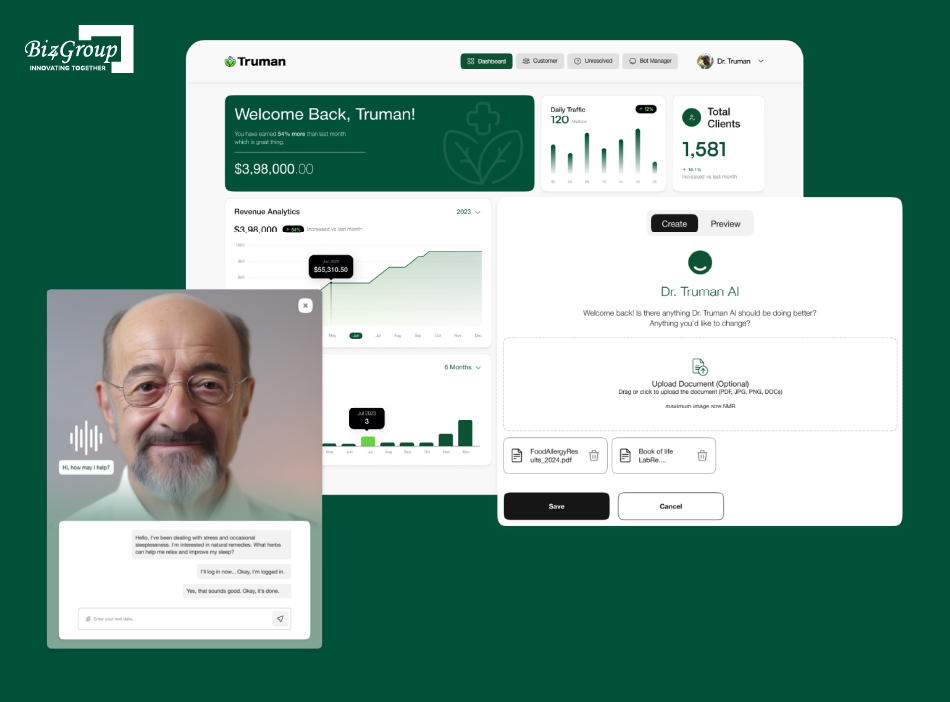
A strong example of structured development can be seen in an AI-powered health companion, AI avatar of Truman, created to deliver personalized wellness experiences. This solution focuses on combining AI with user-centric design and real-time insights.
What was built:
- An AI avatar that interacts with users for health guidance
- A smart chatbot delivering personalized recommendations
- A system to track user health history and uploaded reports
How it delivers value:
- Offers personalized health suggestions based on user data
- Enables continuous interaction through conversational AI
- Integrates health tracking with actionable insights
Why it matters here:
This project highlights how a well-planned development process can bring together personalization, AI intelligence, and user-friendly experiences.
The same structured approach is essential when you create AI mobility assessment solution for healthcare, ensuring the platform is both functional and scalable.
With a clear development roadmap in place, the next step is understanding the regulatory and compliance requirements that ensure your platform is safe, secure, and ready for clinical use.
Also read: AI physiotherapy app development guide
Got the Roadmap. Ready to Execute Faster?
Teams that launch early capture up to 3x more market share in digital health. Timing matters.
Schedule a Call NowCompliance Requirements for Clinician-Ready AI Movement Assessment Platform Development
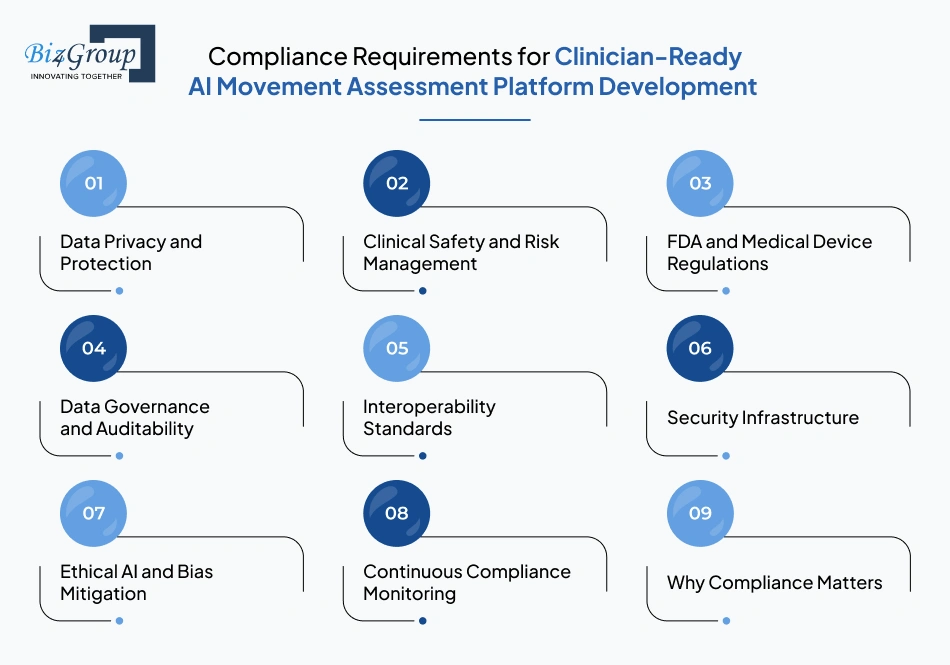
When you develop AI movement assessment platform for healthcare, compliance is not optional. It directly impacts trust, adoption, and scalability. Healthcare platforms deal with sensitive patient data and clinical decision-making. That means strict regulatory alignment from day one.
Below are the key compliance areas you must address to develop AI based patient movement assessment platform that is safe, secure, and clinically reliable.
Data Privacy and Protection
- Ensure compliance with HIPAA for handling patient health information in the US
- Follow GDPR guidelines if serving users in Europe
- Implement data encryption for storage and transmission
- Use secure authentication methods for access control
Clinical Safety and Risk Management
- Define clear safety protocols for AI outputs
- Document risk management processes
- Ensure AI recommendations are explainable and transparent
- Include clinician oversight for critical decisions
FDA and Medical Device Regulations
- Determine if your solution qualifies as Software as a Medical Device
- Prepare documentation for FDA 510(k) or equivalent pathways
- Maintain detailed records of software performance and updates
- Conduct validation studies to support clinical claims
Data Governance and Auditability
- Maintain audit logs for all user actions
- Track data access and modifications
- Enable traceability of AI decisions and outputs
- Store historical data securely for compliance checks
Interoperability Standards
- Support HL7 and FHIR standards for data exchange
- Ensure compatibility with EHR software and hospital systems
- Enable seamless integration with third-party tools
Security Infrastructure
- Use multi-factor authentication for user access
- Implement role-based access control
- Regularly test systems for vulnerabilities
- Monitor for unauthorized access or anomalies
Ethical AI and Bias Mitigation
- Train AI models on diverse datasets
- Continuously monitor for bias in outputs
- Ensure equal performance across different user groups
- Provide transparency in how AI decisions are made
Continuous Compliance Monitoring
- Conduct regular audits and security assessments
- Update systems based on changing regulations
- Monitor performance and risk factors continuously
- Maintain documentation for all compliance activities
Why Compliance Matters
If you want to build AI digital health platform for movement analysis, compliance determines whether your platform can:
- Be trusted by clinicians
- Be adopted by healthcare institutions
- Scale across regions and markets
Ignoring compliance leads to delays, legal risks, and loss of credibility.
Getting it right builds confidence and opens doors to larger opportunities.
Also read: HIPAA compliant AI app development for healthcare providers
Next, let’s look at the real challenges organizations face while building these platforms and how to overcome them effectively.
Challenges in AI Movement Assessment Platform Development and How to Solve Them
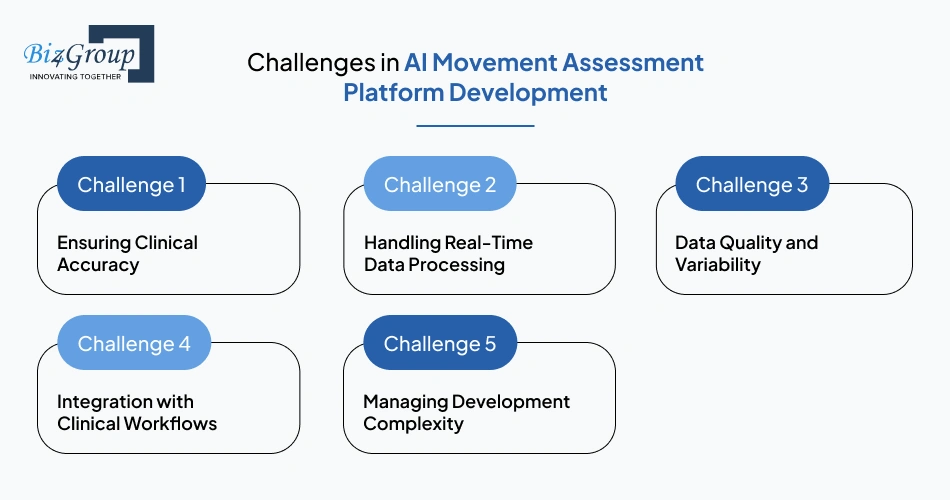
Building a clinically reliable system comes with its own set of challenges. When you develop AI movement assessment platform for healthcare, the complexity goes beyond technology. It involves accuracy, usability, and real-world adaptability.
Here are the most common challenges organizations face while trying to build AI movement analysis system for clinicians, along with practical ways to overcome them.
Challenge 1: Ensuring Clinical Accuracy
AI outputs must align with real clinical expectations. Inaccurate movement analysis can lead to poor decisions and reduced trust among clinicians.
How to solve it:
- Train models using clinically validated datasets
- Involve healthcare professionals during development
- Continuously test outputs against real-world scenarios
- Implement validation layers before final recommendations
Challenge 2: Handling Real-Time Data Processing
Movement tracking requires instant analysis. Delays in processing can impact usability and accuracy.
How to solve it:
- Optimize algorithms for faster processing
- Use efficient data pipelines to reduce latency
- Prioritize real-time feedback capabilities
- Test performance under different usage conditions
Challenge 3: Data Quality and Variability
Movement data varies across patients. Differences in body types, conditions, and environments can affect accuracy.
How to solve it:
- Train models on diverse datasets
- Include multiple movement scenarios during testing
- Continuously refine models based on new data
- Implement calibration mechanisms for better accuracy
Challenge 4: Integration with Clinical Workflows
A powerful system can still fail if it does not fit into existing workflows. Clinicians prefer tools that complement their routine, not complicate it.
How to solve it:
- Design workflows that align with clinical processes
- Keep interfaces simple and intuitive
- Ensure minimal disruption to existing systems
- Work with an experienced AI app development company to align technical and clinical needs
Challenge 5: Managing Development Complexity
Building such platforms requires multiple skill sets. From AI modeling to healthcare expertise, the scope can become overwhelming.
How to solve it:
- Break development into manageable phases
- Focus on core functionality first
- Collaborate with experts and domain specialists
- Hire AI developers with healthcare experience
Why Addressing These Challenges Matters
If you aim to develop scalable AI movement analysis platform for healthcare, overcoming these challenges is essential.
It ensures:
- Reliable performance
- Strong clinical adoption
- Long-term business success
With challenges addressed, the next step is understanding the investment required to build such a platform and what factors influence the overall cost.
Every Challenge You Saw? We’ve Already Solved It.
Why spend months figuring it out when you can build with a team that’s done it before?
Talk to Biz4Group’s ExpertsHow Much Does It Cost to Develop a Clinician-Ready Movement Assessment Platform Using AI?
Before starting development, one question always comes up... How much investment does this actually require?
On average, the cost to develop AI movement assessment platform for healthcare ranges between $45,000-$200,000+, depending on complexity, features, and clinical requirements.
Here is a quick breakdown based on platform maturity.
|
Level |
Scope |
Estimated Cost |
|---|---|---|
|
MVP |
Basic movement tracking, limited AI, single platform |
$45,000-$80,000 |
|
Advanced Level |
Real-time analytics, dashboards, integrations |
$80,000-$140,000 |
|
Enterprise Level |
Full AI capabilities, compliance, multi-platform |
$140,000-$200,000+ |
This variation exists because each platform is built differently based on business goals and clinical needs.
Let’s break down the key cost drivers and what impacts your overall investment.
Cost Drivers in AI Movement Assessment Platform Development
Every feature and decision affects cost. When you develop AI based patient movement assessment platform, understanding these drivers helps you plan better.
|
Cost Driver |
What Impacts It |
Estimated Cost Range |
|---|---|---|
|
AI Model Development |
Complexity of pose estimation, analytics, and training |
$10,000-$40,000 |
|
Movement Tracking Capabilities |
Camera-based vs sensor-based vs hybrid systems |
$8,000-$30,000 |
|
Frontend And User Experience |
Dashboards, mobile apps, clinician interfaces |
$5,000-$20,000 |
|
Backend Development |
APIs, data handling, system logic |
$8,000-$25,000 |
|
Integrations |
EHR, wearables, third-party tools |
$5,000-$15,000 |
|
Security And Compliance |
Encryption, authentication, audit logs |
$7,000-$20,000 |
|
Testing And Validation |
Clinical testing and performance optimization |
$5,000-$15,000 |
|
Deployment And Scaling |
Infrastructure setup and optimization |
$5,000-$15,000 |
Each of these components contributes to building a system that can develop scalable AI movement analysis platform for healthcare environments.
Hidden Costs You Should Not Ignore
Many businesses underestimate costs that appear later in the process. These can significantly impact your budget when you develop AI based patient movement assessment platform.
- Data collection and preparation often require additional investment, especially when working with diverse datasets. This can cost around $5,000-$15,000 depending on the scale.
- Model refinement and continuous improvements add another $5,000-$20,000 over time as new data is introduced and accuracy needs to be maintained.
- Ongoing maintenance and updates also contribute to long-term costs. Expect around $1,000-$5,000 per month for support, performance optimization, and feature updates.
- Infrastructure scaling costs increase as user adoption grows. Cloud usage and data storage can range between $500-$3,000 per month depending on traffic.
These costs are not one-time. They evolve as your platform grows.
How To Optimize Development Costs
Smart planning can significantly reduce expenses without compromising quality. When you develop scalable AI movement analysis platform for healthcare, optimization becomes a key strategy.
- Start with an MVP to validate your idea before scaling
- Focus on high-impact features instead of building everything at once
- Use pre-trained AI models where applicable to reduce development time
- Prioritize user feedback early to avoid costly redesigns
- Choose the right development partner to minimize rework and delays
Cost optimization does not mean cutting corners. It means building strategically.
Final Thoughts on Investment
The cost of building an AI movement assessment platform depends on how ambitious your vision is.
A smaller MVP helps you test the market.
A full-scale platform positions you as a leader in digital healthcare.
If your goal is to create AI mobility assessment solution for healthcare that delivers long-term value, the investment should align with both clinical impact and business growth.
Next, let’s explore where this technology is headed and what future trends will shape AI movement assessment platforms in the coming years.
Also read: How much does it cost to build an AI physiotherapy app?
Thinking About the Cost or the Opportunity You Might Miss?
The digital health market is scaling fast. Delay today could cost you market position tomorrow.
Let's Talk NumbersFuture Trends in AI Movement Assessment Platform Development
The healthcare industry is evolving fast. Platforms built today must be ready for what comes next.
If you plan to develop scalable AI movement analysis platform for healthcare, understanding future trends helps you stay ahead of competitors and build systems that remain relevant for years.
Here are the key trends shaping how organizations build AI movement analysis system for clinicians in the near future.
1. Predictive Movement Analysis
AI is moving beyond tracking what is happening now. It is starting to predict what will happen next.
Platforms are beginning to analyze historical movement data to identify early signs of injury, mobility decline, or recovery delays. This allows clinicians to intervene before issues become severe.
For businesses looking to make AI powered movement assessment tool, predictive capabilities will become a major differentiator.
Also read: The ultimate guide to predictive analytics software development
2. Digital Twins in Healthcare
Digital twins are gaining traction in healthcare systems. This involves creating a virtual representation of a patient’s body or movement patterns. Clinicians can simulate different treatment approaches and observe outcomes before applying them in real life.
When you create AI mobility assessment solution for healthcare, integrating digital twin concepts can significantly improve treatment planning and personalization.
Also read: AI-powered autobiography app development guide
3. Multimodal Data Integration
Future platforms will not rely on a single data source. They will combine movement data, wearable data, clinical reports, and environmental factors. This creates a more complete picture of patient health.
Organizations that develop AI based patient movement assessment platform with multimodal capabilities will deliver deeper and more accurate insights.
4. Integration With AR And VR Systems
Augmented and virtual reality are entering clinical workflows. These technologies will be used to guide patients during movement assessments, provide visual feedback in real-time, and enhance rehabilitation experiences.
For companies that develop AI movement assessment platform for healthcare, AR and VR integration will open new possibilities for interactive care delivery.
Also read: AR-VR healthcare app development explained
5. Explainable And Transparent AI
As AI adoption grows, so does the need for transparency. Clinicians want to understand how decisions are made. Future platforms will focus on clear explanations of AI outputs, visual representation of movement analysis, and improved trust and adoption.
This will be critical for organizations that build AI digital health platform for movement analysis and want widespread clinical acceptance.
Quick Summary of Trends
|
Trend |
What It Means |
Impact |
|---|---|---|
|
Predictive Analysis |
Forecasts injuries and recovery outcomes |
Enables early intervention |
|
Digital Twins |
Virtual patient models |
Improves treatment planning |
|
Multimodal Data |
Combines multiple data sources |
Enhances accuracy |
|
Remote Diagnostics |
Real-time remote assessments |
Expands care access |
|
AR/VR Integration |
Interactive movement guidance |
Improves engagement |
|
Explainable AI |
Transparent decision-making |
Builds clinician trust |
What This Means Going Forward
The future of movement assessment platforms is not limited to tracking. It is about intelligence, prediction, and personalization at scale.
If you are planning to develop AI movement assessment platform for healthcare, aligning with these trends will help you build a system that remains competitive, adaptable, and valuable in a rapidly changing healthcare landscape.
Next, let’s look at which company can develop AI movement assessment solutions for healthcare and make a significant difference.
Why Choose Biz4Group LLC in USA to Develop a Clinician-Ready Movement Assessment Platform Using AI
Choosing the right technology partner can define the success or failure of your product.
When you set out to develop AI movement assessment platform for healthcare, you are building a clinically reliable system that demands precision, scalability, and deep domain expertise.
This is where Biz4Group LLC stands apart.
We are a USA-based AI development company with years of experience delivering advanced, scalable digital solutions across industries, with a strong focus on healthcare innovation. Our strength lies in combining technical depth with real-world problem solving. We understand how to translate complex clinical requirements into intelligent systems that work in practice, not just on paper.
Our team has worked on AI-powered health platforms, computer vision applications, and data-driven systems that handle sensitive healthcare workflows. As an AI healthcare software development company, we bring a clear understanding of compliance, usability, and performance expectations required in clinical environments.
We do not approach projects with a one-size-fits-all mindset. Every platform we build is tailored to the client’s specific use case, whether it involves movement tracking, health analytics, or personalized care solutions. This approach ensures that businesses looking to build AI movement analysis system for clinicians get a product that aligns with both clinical and business goals.
Why Businesses Choose Biz4Group LLC
Businesses choose Biz4Group because we bring clarity, execution, and results.
- Proven experience in building AI-powered healthcare and wellness platforms
- Strong expertise in computer vision, real-time data processing, and analytics
- Deep understanding of how to develop AI based patient movement assessment platform that clinicians can trust
- End-to-end development support from concept to deployment and scaling
- Focus on building scalable systems that grow with your business
- Transparent communication and collaborative approach throughout the project lifecycle
We understand that healthcare platforms require more than innovation. They require trust. That trust comes from accuracy, reliability, and consistent performance. Every solution we build is designed with these principles at its core.
Let’s build something that sets you apart. Let’s talk.
Final Thoughts
The shift toward data-driven healthcare is already reshaping how clinicians assess, monitor, and treat patients. Organizations that develop AI movement assessment platform for healthcare are moving beyond subjective evaluations and embracing systems that deliver measurable, consistent, and actionable insights. From real-time tracking to predictive analysis, these platforms are setting a new standard for clinical accuracy and efficiency.
Building such a system requires a clear strategy, the right features, scalable architecture, and strict compliance. Businesses that build AI movement analysis system for clinicians with this holistic approach are better positioned to improve patient outcomes, reduce operational burden, and unlock new growth opportunities in digital health.
This is where Biz4Group LLC comes in. As a seasoned USA-based software development company, we help businesses turn complex ideas into high-performing, clinician-ready platforms. Our focus is on delivering solutions that are reliable, scalable, and aligned with real-world clinical needs.
If you are ready to lead in the next wave of healthcare innovation, now is the time to act. Build smarter. Move faster. Partner with Biz4Group and bring your AI-powered movement assessment platform to life.
FAQs
1. Do I need hardware to build an AI movement assessment platform?
Not always. Many platforms rely on camera-based systems using computer vision for movement tracking. However, hardware such as wearables or sensors can improve accuracy for certain use cases. The choice depends on your target audience, clinical requirements, and level of precision needed.
2. Can AI movement assessment platforms integrate with existing systems?
Yes, modern platforms are designed to work with existing healthcare and wellness ecosystems. They can connect with electronic health records, wearable devices, and third-party applications. This allows seamless data flow and helps organizations maintain a unified view of patient or user information.
3. What level of accuracy can AI movement analysis achieve?
Accuracy depends on the quality of data, the models used, and the testing process. High-quality platforms can achieve clinically reliable results when trained and validated properly. Continuous improvement through real-world data helps maintain and enhance accuracy over time.
4. How long does it take to develop an AI movement assessment platform?
Most platforms take several months to develop, depending on complexity and features. Biz4Group, however, can deliver a functional MVP in as little as 2-4 weeks by leveraging reusable components and proven development frameworks. This approach reduces both development time and cost while ensuring quality.
5. Can small clinics or startups afford to build such platforms?
Yes, starting with a focused MVP makes it accessible for smaller organizations. Instead of building a full-scale system immediately, businesses can launch with core features, validate their idea, and scale gradually based on user feedback and demand.
6. How do I choose the right development partner for this project?
Look for a partner with proven experience in AI and healthcare solutions. Evaluate their past projects, technical expertise, and understanding of clinical workflows. A reliable partner should offer strategic guidance, transparent communication, and the ability to scale your platform as your business grows.
