Location :
Orlando, FL, USA
 +1 (407) 714-1616
 info@biz4group.com

 AI Summary Powered by Biz4AI
- A white-label AI avatar for fitness brands is a digital coach under your logo, voice and programs, and you can create white-label AI avatar for fitness brands as a single-brand build, a licensed platform or a multi-tenant system for many gyms.
- Before you develop white-label AI avatar for fitness brands, plan compliance first, covering the FTC Health Breach Notification Rule, state health and biometric privacy laws, FDA wellness limits, voice consent and written ownership of the avatar, voice and member data, with HIPAA applying only when a covered entity is involved.
- To make white label AI coaching avatar for wellness brands fit your members, choose the avatar type, brand theming, voice cloning and features, then build on on-device pose tracking, a coaching brain grounded in your content, wearable connectors, safety guardrails and tenant-separated data.
- The estimated cost to create white-label AI avatar for fitness brands is $35,000 to $250,000+ and differs by avatar realism, tenant count and integrations, with an MVP in 2 to 4 weeks, an enterprise build in 6 to 8 weeks and running costs for AI usage, voice and hosting, so compare build, license and reseller paths before you commit.
- You earn from a white-label AI avatar for fitness through premium tiers, per-location licenses, reseller revenue share and add-on programs, and Biz4Group, a US-based AI development company behind avatar and wellness products such as SweatJoy and Dr. Truman, handles design, build, integration and launch.
If you run a gym, a studio or a fitness brand, you have probably watched this happen.
A member loves your classes. Then they go home, open a generic workout app and get coaching that has nothing to do with your programs, your trainers or your voice.
Your brand disappears the moment they leave the building.
That gap is why more operators now ask how to create white-label AI avatar for fitness brands. You give members a digital coach that looks, sounds and trains like your team. It lives inside your own app, and no third-party logo appears anywhere.
Is it worth doing right now? The market data says the category is growing quickly. Market.us valued the global AI in fitness and wellness market at $13.0 billion in 2025 and projects about $84.8 billion by 2035. North America holds more than 40% of that revenue.
Growth is only half the story. The Les Mills 2026 Global Fitness Report surveyed more than 10,000 people, and only about 10% of consumers worldwide prefer AI workout guidance over a human coach.
We read that number as a design brief. Your members still want your trainers’ standards. They just want them at 6 a.m., in a hotel room, or on the day your studio is closed.
A well-built white-label AI avatar for fitness brands extends your coaches. Your best trainer can show up in every session without being in every room.
Pair the avatar with an AI workout app that builds each member’s weekly plan around their body, schedule and equipment. The avatar then spends its time coaching instead of scheduling.
So, who are we to say this?
We are Biz4Group, a US-based AI development company in Orlando, Florida, with more than 20 years in software. Our team built Dr. Truman, an AI health companion with a lifelike avatar. We also built a custom workout app that studies body images to plan training.
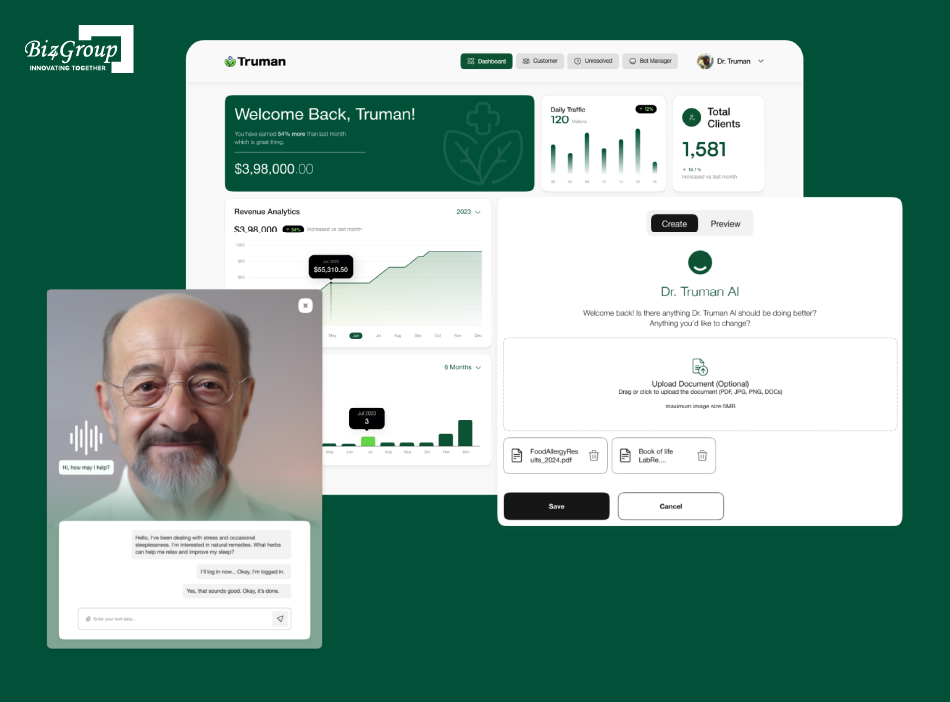
Our Technical Director, Dave Caplis, has over 40 years in IT, including 18 years at Disney managing large, complex projects.
When we delivered SweatJoy, our AI wellness and habit tracking app, Dave named the real problem in one line: “Usually, the hard part is sticking with it,” he said.
That is the lens we bring when a client asks us to make white label AI coaching avatar for wellness brands that members actually return to.
Now, a single-brand avatar is only one version of this project.
Many gym chains, franchise groups and fitness platforms ask a bigger question. Can you run one avatar platform and offer it to every location, franchise or trainer, each under their own brand?
That is a multi-tenant setup. It changes how you plan the build, the licensing and your White Label AI Avatar Development for Fitness Brands budget.
These are the questions we hear most from operators like you:
- How do I add my own branding and voice to an AI fitness avatar?
- Can one avatar run across all my locations, each with its own look?
- Do I need HIPAA compliance for a white-label AI avatar for fitness brands?
- How much does it cost to develop white-label AI avatar for fitness brands, and who owns it afterward?
You have probably felt stuck somewhere between the demo and the decision. We have been there with clients too, and it does not have to stay that way.
In this guide, we will show you how to build white-label AI avatar for fitness brands without paying for features your members will never use. We cover compliance, avatar types, brand theming and voice cloning, multi-tenant setup, licensing and reseller models, pricing and onboarding.
If your offer is yoga, recovery or mobility, a white label AI coaching avatar for wellness brand programs needs a calmer personality than a HIIT coach. Whether you run a boutique studio or a 200-location chain, a white label AI avatar for fitness only works when it fits how your members train.
So where do you start? With a clear answer to what a white-label AI avatar is, and why so many brands are building one now.
What Is a White-Label AI Avatar for Fitness, and Why Are Brands Building One Now?
Here is the short answer first.
A white-label AI avatar for fitness brands is a digital coach that runs under your brand. It uses your logo, colors, voice and training methods, talks with members in real time, and never shows the name of the company that built it. Members see your coach. You keep the relationship.
That definition sounds simple. The details are where projects go wrong, so let’s slow down.
What Does “White-Label” Mean for A Gym, Studio or Fitness Brand?
Vendors use the word loosely. Three different products often get sold under it.
|
Setup |
What you get |
Best for |
Trade-off |
|---|---|---|---|
|
Single-brand custom build |
An avatar designed and built only for you, with your own code and data |
Larger brands with a distinct method and the budget to own it |
Highest upfront cost and longest timeline |
|
Licensed white-label platform |
A vendor’s avatar engine, themed with your brand, voice and content |
Studios and mid-size brands that want to launch fast |
Less control over features and roadmap |
|
Multi-tenant reseller platform |
One avatar system that serves many brands, locations or trainers, each with its own look, voice and data |
Franchises, gym groups, and platforms that sell to other operators |
Needs careful data separation and a clear licensing model |
Before you talk to any vendor, decide which of these three you are actually buying. That choice drives ownership, cost and what you are allowed to resell later.
How is a White-Label Avatar Different from a Custom-Built One?
A custom build starts from a blank page and belongs to you. A white-label avatar starts from a working engine and takes on your brand.
Custom gives you control. White label gives you speed and a lower starting cost.
Some brands launch on a white-label engine to learn what members use, then move to a custom build once the product earns its budget. That is a sound path, as long as your contract lets you export your content, voice assets and member data.
Why are Fitness Brands Building White-Label AI Avatars Now?
Trainers are already on board. A Report found that 64% of personal trainers use AI regularly and find it helpful. Your coaches are likely ahead of your member app.
Your members train when you are closed. Classes end. Studios close. A branded coach can answer a question about a squat at 10 p.m., using your cues and not a stranger’s.
There is a fourth reason for multi-location groups. One avatar can teach one method the same way in every club, which is hard to do with a hundred different trainers.
Will an AI Avatar Replace Your Personal Trainers?
No, and you should plan the product so it does not try to.
The Les Mills 2026 finding from earlier still holds: only about one in ten consumers prefers AI guidance over a human coach. Members want your trainers’ judgment. The avatar’s job is to carry that judgment into the hours your team cannot cover.
A sensible split looks like this:
- The avatar handles: reminders, session pacing, rep counting, form cues from your approved library, program questions, and check-ins after missed workouts.
- Your human team handles: pain, injuries, medical conditions, eating concerns, goal changes, and anything that needs a real conversation.
Write that handoff into the product from day one. When a member mentions pain or a health condition, the avatar should stop coaching and route them to a person or to a clinician.
If you plan to create white-label AI avatar for fitness brands that serve many locations, that handoff rule matters even more. It protects your members, and it protects your name.
Next comes the part most vendors skip in the sales deck: the rules that apply to the data your avatar will collect.
Give Your Fitness Brand Its Own Digital Coach
Create white-label AI avatar for fitness brands that guide users with personality, precision and real coaching value.
Start My White-Label AI Avatar ProjectWhich Compliance Rules Apply Before You Develop White-Label AI Avatar for Fitness Brands?
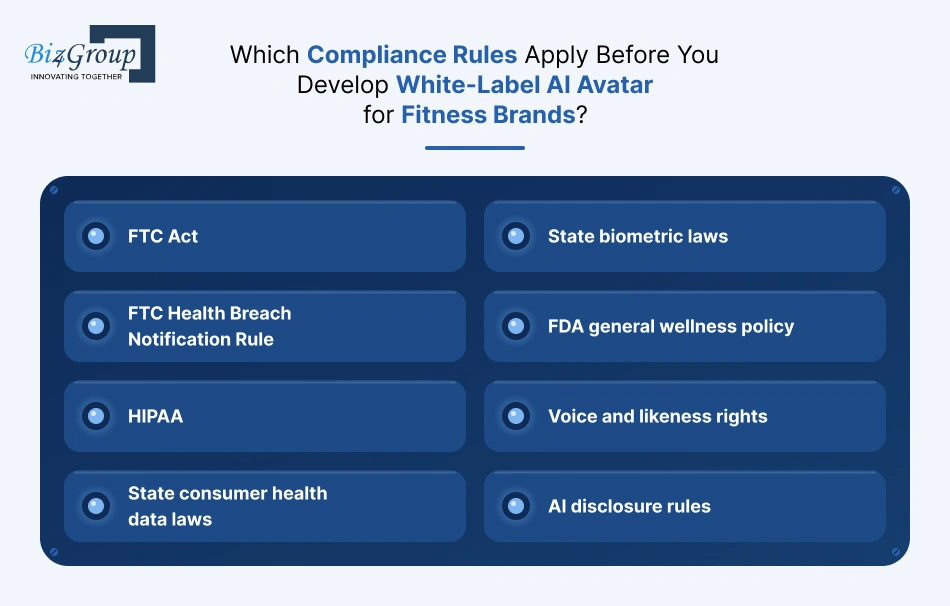
Most fitness avatars fall under the FTC Act, the FTC Health Breach Notification Rule and a growing set of state health and biometric privacy laws. HIPAA applies only when a clinic, health plan or other covered entity is part of the deal. FDA rules matter when your avatar makes claims about injuries or medical conditions.
Compliance is the topic most operators want to postpone. We understand why. The demos are exciting and the legal questions are not.
But when you develop white-label AI avatar for fitness brands, this is the work that decides whether your launch holds up under a member complaint, a partner’s security review or a regulator’s letter.
Before you design a single screen, ask one question: what data will your avatar touch?
Voice recordings, workout history, body measurements, camera feeds and wearable readings all count. Here is the map we walk clients through.
Rules at a Glance
|
Rule |
When it applies |
What to build in |
|---|---|---|
|
FTC Act (deceptive practices) |
Always, if you make privacy or AI claims |
Claims you can prove, and a privacy policy that matches real data flows |
|
FTC Health Breach Notification Rule |
Non-HIPAA apps holding identifiable health data |
A breach plan, user and FTC notice, no sharing without consent |
|
HIPAA |
Only with a covered entity such as a clinic or health plan |
Business associate agreement, PHI access controls, audit logs |
|
State consumer health data laws (for example, Washington) |
You collect health data from residents of those states |
Standalone health data policy, consent, deletion |
|
State biometric laws |
You store face, voice or body-scan data |
Written consent, retention schedule, secure storage |
|
FDA general wellness policy |
Your avatar mentions injuries, diseases or rehab |
Claims limited to general wellness |
|
Voice and likeness rights |
You clone a trainer’s voice or face |
Written, scoped consent and license |
|
AI disclosure rules (for example, the EU AI Act) |
Members interact with an AI system |
A clear notice that they are talking to an AI |
Not every row applies to you. A boutique studio serving only US members can skip some. A franchise group with a physical therapy partner will need most of them.
1. HIPAA Boundaries for Fitness Brands
HIPAA covers your avatar only when a covered entity is involved. Consumer fitness apps that members download on their own typically sit outside it.
The line moves in a few common cases:
- A physical therapy clinic offers your avatar to patients.
- An employer health plan runs your avatar as part of a wellness program.
- A provider-run service sends data into your platform.
In those cases, a business associate agreement (BAA) and tighter controls on protected health information come into play.
If you plan to sell to corporate wellness buyers or clinics, ask early whether their data will flow into your avatar. It is much cheaper to design for that on day one.
2. FTC Rules for Health Data
The FTC’s Health Breach Notification Rule requires companies to notify affected users, the FTC and, in some cases, the media when identifiable health information is breached. The FTC has said the rule reaches most health apps and similar technologies, and amendments finalized in 2024 wrote that into the rule text.
A breach is not only a hack. Sending a member’s health data to an ad platform without their permission can count too.
So, audit every SDK, analytics tag and AI vendor your avatar calls. Ask what each one receives and whether the member agreed to it.
Separately, if your privacy policy says one thing and your avatar does another, the FTC can treat that as a deceptive practice.
3. State Health and Biometric Privacy Laws
Washington’s My Health My Data Act is the one fitness brands hear about most. It has no revenue threshold, it carries a private right of action, and it treats inferences about a person’s health as consumer health data. It also expects a standalone consumer health data privacy policy, linked from your homepage and your app. Nevada and Connecticut have added consumer health data rules of their own.
Biometric laws deserve a separate look. They often require written consent, secure storage and a defined retention schedule.
Face and voice data are where these laws bite hardest. Illinois’s biometric law is the best-known example, and it allows private lawsuits. Body landmark tracking from a camera is a gray area, so ask your counsel before you store raw video or face imagery.
4. FDA Wellness Claims
Keep your avatar’s claims inside general wellness. The FDA’s January 2026 revision of its General Wellness policy says low-risk products intended only for general wellness are generally not regulated as devices. A product can fall outside that policy if it references diseases or diagnostic thresholds or prompts clinical action or treatment.
In plain terms, an avatar that guides a mobility session stays inside the line. An avatar that promises to help a member recover from a herniated disc does not.
Review every script, marketing line and onboarding screen with that test.
5. Scope of Practice Guardrails
Your avatar needs a short list of moments when it stops coaching. Build these in before launch:
- Stop and refer: chest pain, dizziness, fainting, sharp or radiating pain, recent surgery, pregnancy complications, or any mention of self-harm.
- Eating concerns: no calorie or weight targets for members who show signs of disordered eating.
- Approved content only: a certified trainer signs off on the exercise library and the cues the avatar uses.
- Clear handoff: the avatar shows a plain message and points to a clinician, your human team or emergency services.
Then log every handoff. Those logs are your best evidence that the guardrails work.
6. Voice Cloning and Likeness Consent
If your avatar uses a trainer’s voice or face, get written, scoped consent. The agreement should cover what the voice can say, where it can appear, how long the license lasts, how the trainer is paid, and what happens when they leave.
That last point matters more than most brands expect. A trainer who moves on should have a clear path to retire their avatar and voice model.
State right-of-publicity and voice likeness laws are tightening, with Tennessee’s ELVIS Act as one example. If your avatar listens to members, collect consent for recordings and store only what you need.
7. Compliance in Multi-Tenant Setups
When one platform serves many gyms, you have to decide who is the business and who is the service provider.
Each gym decides why it collects member data. The platform operator processes that data on its behalf. Put that split in writing in a data processing agreement, and build the technical side to match:
- Separate data for each tenant, with no cross-access.
- A privacy notice and consent flow for each tenant’s brand.
- Export and deletion when a tenant leaves.
- A clear breach notice chain with set timelines.
- A published list of subprocessors, such as your AI model, voice and hosting vendors.
If you plan to create white-label AI avatar for fitness brands that you then resell, this section is your contract skeleton.
We treat compliance as a build input, not a final review. Every project starts with a map of the data the product will touch and who can see it.
That habit comes from healthcare work. Our team has delivered HIPAA-compliant AI platforms for providers and telehealth networks, and secure AI voice support for healthcare administration.
One honest note. We are engineers, not lawyers. We build technical controls and documentation, and we ask your counsel to review the legal terms. Any team that tells you otherwise is overselling.
Pre-Launch Compliance Checklist
Before you launch a white-label AI avatar for fitness brands, confirm each of these:
- You have a written map of every data type the avatar collects and every vendor that receives it.
- Your privacy policy, consent screens and real data flows match.
- You know whether HIPAA applies through any partner or buyer.
- Your claims stay inside general wellness.
- Your stop-and-refer rules are built, tested and logged.
- Trainer voice and likeness agreements are signed.
- Your tenant contracts name who is the business and who is the service provider.
With the rules mapped, you can choose the type of avatar that fits your members.
What Are the Types of White Label AI Coaching Avatar for Wellness?
If you have explored how to build an AI app, you already know that different brands need different coaching personalities. The same applies when you create white-label AI avatar for fitness brands, because no two training ecosystems feel the same.
Here’s all you need to know:
|
Avatar Type |
Best For |
How It Helps Your Brand |
|---|---|---|
|
Fully Photorealistic Instructors |
High trust training environments and premium programs |
Ideal when your users expect a coach who looks close to a real person. These avatars benefit heavily from an AI product development company, which can shape realism without losing responsiveness. |
|
Stylized 3D Avatars |
Fitness apps that want character driven engagement |
A great fit for brands that want personality and friendliness over realism. These avatars bring energy and charm to workouts while keeping your training style flexible. |
|
Virtual Trainers as Brand Mascots |
Community driven fitness ecosystems |
Perfect for brands that already have a beloved mascot or character. Turning it into a coach helps users immediately feel connected and keeps your identity consistent across all workouts. |
|
Voice Only Avatars |
Audio focused programs and wearable based coaching |
A clean solution for brands that want hands free, screen free guidance. Voice avatars simplify coaching without losing the intelligence behind each cue. |
|
Multilingual Regional Avatars |
Large fitness chains and global digital platforms |
Ideal when you want one consistent coaching experience that adapts naturally to different countries or cultures. Many teams leverage AI assistant app design to maintain clarity and warmth across languages. |
Choosing the right avatar type helps set the foundation for your coaching experience, making each interaction feel intentional and aligned with your brand’s identity. As you move into customization, these styles shape how your avatar will communicate, guide and support users throughout their training journey.
How Much Can You Customize a White-Label AI Avatar for Fitness Brands?
When you create white-label AI avatar for fitness brands, the real magic happens in how deeply you can customize it. Below are the core elements fitness companies focus on when shaping an avatar that aligns with their brand identity and user expectations.
1. Avatar Look And Personality
You can choose body proportions, outfits and facial characteristics that match your style. Add a personality that feels friendly, strict or energetic depending on your users. Many brands refine these choices with support from a custom software development company.
2. Tone and Coaching Style
When you build white-label AI avatar development for fitness brands, the avatar can adopt a tone that matches your training philosophy. Whether motivating, calm or technical, the coaching remains consistent across all programs. Users quickly recognize the avatar as your voice.
3. Motion Style
Your avatar can move with intensity for HIIT, gentle flow for yoga or controlled patterns for rehabilitation. Each motion style communicates purpose and aligns with the session type. This variation helps create a meaningful and intuitive workout experience.
4. Brand Specific Workouts
The avatar can guide routines built around your program design. Difficulty, rest and progressions can follow your methodology. This reinforces your identity inside every session and keeps the coaching aligned with your curriculum.
5. Brand Aligned Voice Cloning
Your avatar can use a voice modeled on your brand tone or a real instructor. Voice cloning builds trust and familiarity. Teams that want deeper realism often integrate structured AI automation services to support this feature.
Also Read: AI Voice Cloning App Development
6. Custom Branded Scripts And Slogans
Your avatar can deliver recognizable catchphrases, reminders and motivational lines. Scripts can be aligned with different fitness levels and workout types. This keeps the coaching engaging and true to your brand culture.
7. Branded Workout Environment
Your avatar can appear in a virtual studio, gym or outdoor scene designed around your brand palette. These environments help workouts feel cohesive and visually unified across your digital platform.
Customization is ultimately how you make white label AI coaching avatar for wellness brands feel authentic and memorable, which takes us towards the next layer of your avatar’s foundation – the technology stack.
What Tech Stack Powers White Label AI Avatar Development for Fitness Brands?
A white-label fitness avatar runs on ten layers: member app and API, brand theming, a coaching brain, pose tracking, avatar rendering, voice, wearable connectors, safety and audit tools, tenant-separated data and cloud, and an admin console with billing. If you want to know how to build white-label AI avatar for fitness brands that serve many gyms, the right-hand column below matters most.
Stack at a Glance
|
Layer |
Preferred Technologies |
Why It Matters |
What Changes When You Resell It |
|---|---|---|---|
|
Member App and API |
React or React Native, Node.js, Python, REST and GraphQL |
One codebase for the member app, plus an API to booking, CRM and door-access systems |
A tenant ID travels with every request, so one deployment serves many brands |
|
Brand Theming and Tenant Config |
Design tokens, a configuration service, feature flags |
Logo, colors, avatar skin, scripts and voice change by setting, not by code fork |
Each gym launches with its own look in days |
|
Coaching Brain and Retrieval |
A large language model API or open-weight model, a vector store such as pgvector |
Answers come from your approved programs and cues |
Each tenant’s content is indexed separately, so methods never cross |
|
Pose and Movement Tracking |
MediaPipe, OpenCV, TensorFlow Lite, Core ML, PyTorch for training |
Pose runs on the member’s phone, so raw video stays on the device |
Each tenant gets its own exercise library and form thresholds |
|
Avatar Rendering and Streaming |
Unity, Unreal Engine, Three.js, WebRTC |
Low delay keeps lip-sync and animation in step with the member mid-set |
Avatar skins, outfits and studio scenes load per tenant |
|
Voice Pipeline |
Speech-to-text, neural text-to-speech, consent-tracked voice cloning |
Short response times let cues land mid-rep |
One voice per trainer or brand, with a retire-on-exit switch |
|
Wearable and Health Data Connectors |
Apple HealthKit, Android Health Connect, partner APIs for Garmin, Oura and WHOOP |
Heart rate, sleep and recovery data adjust effort and rest |
Consent screens are branded to each gym |
|
Safety, Audit and Monitoring |
Stop-and-refer rules and classifiers, red-flag test sets, append-only audit logs, dashboards |
Shows your guardrails work and keeps records for partners and regulators |
Per-tenant logs and alerts |
|
Tenant Data and Cloud |
PostgreSQL with row-level security, object storage, AWS, Google Cloud or Azure |
One brand’s records never mix with another’s, and class-time spikes do not slow the app |
Per-tenant encryption keys, cost tags, export and deletion on exit |
|
Admin Console and Billing |
Role-based access, usage metering, subscription billing such as Stripe Billing |
Managers update scripts and programs without developers |
Tenant onboarding, seat or usage pricing and reseller reporting |
On-Device Pose Tracking
Run pose tracking on the member’s phone. The phone counts reps and checks joint angles, then sends only coordinates and scores to your servers. Your platform never stores the camera feed, which reduces what you must protect.
Whether landmark data counts as biometric data varies by state, so confirm the legal view with counsel.
Retrieval From Brand Content
Retrieval means the avatar looks up your approved material before it answers. This keeps each white-label AI avatar for fitness brands on its own method and lets you update scripts in minutes with no retraining. Log which source supported each answer so a trainer can fix a bad cue at the source.
Wearable Data Sources
Build Android support on Health Connect, since Google is deprecating the Google Fit APIs in 2026. Garmin, Oura and WHOOP use their own partner APIs, and approvals can take weeks, so start those requests early.
For the member app around the avatar, the screens, workout logic and release plan are covered in the guide to building an AI avatar fitness trainer app.
Make Your Avatar Look, Move and Coach Like Your Brand
Build white-label AI avatar development for fitness brands with custom visuals, voice tone and adaptive coaching logic.
Customize My AI White-label Fitness AvatarWhat Is the Process to Make White Label AI Avatar for Fitness: An Architectural Approach
Building a white label AI avatar for fitness brands means designing a digital coach that needs to think, move, motivate and stay loyal to your brand’s personality. Below is a highly tailored step by step workflow for fitness founders, CTOs and product teams ready to create white-label AI avatar for fitness brands that actually feels like part of their coaching identity:
1. Defining the AI Avatar’s Role in Your Fitness Ecosystem
Before a single pixel of your avatar is designed, you need clarity on what your members expect from a digital coach. Do they need an avatar that corrects form in real time? One that adapts training intensity? Or a calm wellness guide? This step makes sure you build white-label AI avatar development for fitness brands that solves real user pain instead of guessing.
- Identify gaps like poor at-home form, low motivation, inconsistent training and lack of personalized coaching
- Select priority use cases for your first avatar: pose correction, guided reps, progressive overload support or meditative flow guidance
- Validate compliance for motion tracking data, voice recordings and wearable integrations
- Set KPIs: improved session completion rates, lower workout abandonment, better week-over-week consistency
This is where you decide what type of coach your brand needs the avatar to be.
2. User Experience Design for AI Avatar Led Workouts
Your avatar’s presence on screen is the coaching experience. UX determines where the avatar stands during strength sets, how it gestures during yoga transitions and how it communicates during rest periods. Smart UI and avatar placement is often supported by expert UI/UX design teams who understand hybrid digital fitness experiences.
- Build prototypes showing avatar gestures, positions and interactions during different workout types
- Test avatar visibility and clarity with real users across HIIT, Pilates, yoga and rehab style sessions
- Add accessibility features like visual cues, simplified animations and multilingual captions
- Create consistent avatar behavior across mobile, smart TV and web applications
Also read: Top UI/UX design companies in USA
3. AI Avatar MVP and Core System Development
A white label AI avatar MVP should deliver early coaching value. Do not start with complex multi-motion models. Instead, launch with a minimal avatar that can coach confidently, guide a few core workout flows and demonstrate your brand’s identity. MVP development services you test user reactions and refine the coaching experience before investing heavily.
- Build the avatar’s core expression library: idle poses, cueing gestures, encouragement animations
- Include foundational coaching modules: rep counting, timer guidance, posture reminders
- Enable simple personalization like difficulty selection and session feedback
- Architect scalable systems for future upgrades like pose estimation or multi-avatar ecosystems
Also Read: Top 12+ MVP Development Companies in USA
4. AI Intelligence and Coaching Data Integration
This is where your white-label AI avatar becomes intelligent instead of performative. AI determines how well your avatar interprets movement, adjusts workouts and communicates like a real coach. Clean data pipelines ensure the avatar doesn’t give random cues or misread motions.
- Train AI models on diverse fitness movements so the avatar understands form across different bodies
- Implement pose tracking and rep recognition tied to your avatar’s coaching logic
- Add learning loops, so avatars adapt to user consistency and workout history
- Blend pre trained AI with custom coaching rules shaped around your brand’s training philosophy
This is how you make white label AI coaching avatar for wellness brands behave like a real trainer rather than a scripted animation.
5. Security, Testing and Coaching Reliability
Your avatar will interact with user photos, motion data, voice recordings and performance logs. That means security cannot be an afterthought. Trust is everything in fitness coaching, especially when you develop branded AI avatar for digital workout platforms.
- Run compliance checks for global data regulations
- Stress test movement tracking under different lighting and camera angles
- Simulate full workouts where the avatar gives cues, adjusts pace and monitors performance
- Use encrypted logs and restricted access models for sensitive behavior tracking
Your avatar must be safe, dependable and transparent to build user confidence.
Also Read: Software Testing Companies in USA
6. Deploying Your AI Fitness Avatar at Scale
Fitness traffic spikes are unpredictable. A challenge launch, New Year season or a new HIIT program can double your user count overnight. Successful brands ensure their avatars are deployable at scale and can roll out updates seamlessly.
- Use cloud infrastructure that auto scales during peak sessions
- Set up CI/CD pipelines for smooth animation updates, new avatar scripts and upgraded pose detection
- Monitor real time dashboards tracking avatar interactions, workout success rates and user engagement
- Create onboarding tutorials showing users how to follow the avatar confidently
Where to deploy White-label AI Avatar for Fitness Brands?
A white label AI avatar can be deployed across multiple channels depending on how and where your members prefer to train:
- Mobile apps and websites remain the core touchpoints, while smart mirrors, OTT platforms and in gym kiosks create immersive coaching experiences.
- Wearables allow quick form cues during movement, while VR or AR environments give your avatar a more interactive presence.
- Enterprise portals are also common for corporate wellness programs that need centralized coaching access for large teams.
Also Read: Augmented Reality Development and Its Challenges
7. Ongoing Avatar Improvements and Enhancements
A great avatar evolves. The more your users train with it, the smarter and more personalized it should become. Post launch optimization turns your avatar into a long term coaching asset, not a one time feature.
- Collect feedback on avatar voice, pacing, gesture clarity and encouragement style
- Add advanced capabilities such as micro corrections, fatigue analysis or contextual coaching
- Retrain models as new exercises, formats and wellness routines are added
- Track long term metrics like weekly active minutes, adherence, program completion and overall retention
Bringing all these steps together turns your avatar from a concept into a fully functioning digital coach that feels natural inside your ecosystem. Once this foundation is in place, fitness brands can confidently move into evaluating how to begin their own white label AI avatar journey with clarity and direction.
Turn Your Workout Experience Into an Intelligent Coaching System
Make white label AI coaching avatar for wellness brands that deliver real-time feedback and personalized training paths.
Build My Coaching AvatarWhich Features Help You Make a White Label AI Coaching Avatar for Wellness Brands That Users Trust?
The right set of features are what truly shape a powerful AI avatar coaching experience for users. Below are the core capabilities fitness brands prioritize when they create white-label AI avatar for fitness brands, leading directly into what matters most:
|
Feature |
Why It Matters |
|---|---|
|
Human Like Motion Guidance |
Your avatar needs more than animations. It must demonstrate exercises clearly and adjust visually for pace and form. Smooth motion signaling builds trust during strength sets, yoga flows and mobility work. |
|
Real Time Form Interpretation |
Real time corrections help your avatar guide posture and angles accurately, inspired by how a custom software development company handles in complex movement systems. |
|
Adaptive Coaching Intelligence |
Adaptive logic allows your avatar to change intensity, cues and encouragement based on user effort, fatigue or consistency, much like systems used in generative AI. |
|
Brand Tuned Visual Identity |
From outfit colors to lighting style, every detail should look like your brand designed it. This keeps the avatar recognizable across all workout types, especially in multi program ecosystems. |
|
Authentic Voice and Tone Mapping |
Your avatar should sound like your brand, whether that is friendly, firm, calm or high energy. Voice cloning + custom scripts help your coach feel familiar from the very first session. |
|
Dynamic Coaching Dialogue |
Instead of repeating the same canned phrases, the avatar can pull from a curated library and mix it with flexible phrasing similar to what powers an AI conversation app, making sessions feel natural. |
|
Progression and Workout Logic Engine |
Users improve over time, so the avatar should too. This engine helps the avatar build week over week progression, modify difficulty and guide users through multi week plans. |
|
Users might switch between phone, smart mirror, web or VR. Your avatar needs to behave consistently everywhere so the coaching experience feels smooth regardless of where they train. |
|
|
Goal Driven Personalization Layer |
The avatar should consider user goals like weight loss, endurance, strength or flexibility to tailor cues and sessions. |
|
Wearable Enhanced Feedback |
When connected to wearables, the avatar can detect heart rate spikes, tempo changes or fatigue cues, leading to smarter guidance and better pacing. |
AI Wizard, developed by Biz4Group, is a lifelike AI companion designed for deep emotional engagement through expressive avatars, voice interactions and adaptive conversational intelligence. Its ability to build human-style rapport shows how digital coaches can feel personal and trustworthy, which is exactly what fitness brands need when building white-label AI avatar experiences that feel genuinely supportive.
When you make white label AI coaching avatar for wellness brands, a strong feature set is what makes your avatar feel like a real coach your users can rely on daily. And once you know the capabilities that matter most, the next question is what it costs to bring a polished avatar to life.
Bring Tomorrow’s Coaching Experience Into Your Product Today
Develop white-label AI avatar for fitness with secure data pipelines, emotion-aware coaching and next-gen interaction design.
Start My Future Ready AI AvatarHow Much Does It Cost to Create White-Label AI Avatar for Fitness Brands?
Expect to spend roughly $35,000 to $250,000+ to create white-label AI avatar for fitness brands. This is an estimate, and your actual cost will differ based on avatar realism, the number of gyms or trainers you serve, how deep the form tracking goes and which integrations you need.
A single-brand white-label AI avatar for fitness brands with a stylized coach and a few tracked exercises sits near the low end. A multi-tenant platform with many brands, photoreal avatars and detailed form scoring sits at the top and can pass it.
In our projects, avatar realism and tenant count move the number more than any other choice. This section shows where the money goes in white label AI avatar development for fitness brands, what pushes the price up, which costs appear after launch and how to keep spend in check.
Cost Breakdown to Create White-Label AI Avatar for Fitness Brands
Use these ranges for planning, not as a quote.
|
Feature |
What It Includes |
Estimated Cost |
|---|---|---|
|
Brand Persona and UX Design |
Coach personality, script style, screen flows, brand theming rules |
$3,000 to $15,000 |
|
Avatar Modeling and Animation |
Stylized or photorealistic 3D coach, gestures, lip-sync, outfits |
$5,000 to $35,000 |
|
Coaching Brain and Retrieval |
Language model setup, ingestion of your programs and cues, answer logging |
$5,000 to $30,000 |
|
Pose and Movement Tracking |
On-device rep counting, joint angles, form feedback for chosen exercises |
$5,000 to $30,000 |
|
Voice Pipeline and Cloning |
Speech recognition, text-to-speech, trainer voice model, consent records |
$3,000 to $20,000 |
|
Wearable and Health Data Connectors |
Apple HealthKit, Android Health Connect, partner APIs for Garmin, Oura and WHOOP |
$2,000 to $15,000 |
|
Safety Guardrails and Audit Logs |
Stop-and-refer rules, red-flag tests, append-only logs, dashboards |
$3,000 to $20,000 |
|
Brand Theming and Multi-Tenant Setup |
Per-brand themes, tenant data separation, encryption keys, onboarding templates |
$4,000 to $30,000 |
|
Admin Console and Billing |
Role-based access, script and program editor, usage metering, subscriptions |
$3,000 to $20,000 |
|
QA, Security Testing and Launch |
Device testing, security review, load tests, store release |
$2,000 to $15,000 |
|
Extended Scope (the “+”) |
Extra languages, extra avatars, more tenants, added channels such as smart mirrors |
$0 to $20,000+ |
|
Total Estimated Build |
Sum of the eleven lines above |
$35,000 to $250,000+ |
Factors That Affect White Label AI Avatar Development for Fitness Brands Cost
Ten choices drive most of the swing between the low and high ends:
- Avatar realism: a stylized coach costs far less than a photorealistic one.
- Number of avatars and voices: each extra character or trainer voice adds modeling, recording and testing.
- Pose tracking depth: counting reps on three exercises is a different job from scoring form across fifty.
- Number of tenants: one brand is simple. Many brands need data separation, per-brand themes and onboarding tools.
- Language support: every new language adds voice, scripts and testing.
- Wellness scope: to make white label AI coaching avatar for wellness brands covering yoga, recovery or mobility, you need new movement libraries and a calmer coaching style.
- Wearable count: each partner API has its own approval process and data quirks.
- Deployment channels: mobile, web, smart TV, smart mirror and wearables each add testing.
- Compliance scope: a clinic or employer health plan partner can add HIPAA controls and agreements.
- Gym system integrations: booking, CRM and door-access links add API work.
Hidden Costs to Develop White-Label AI Avatar for Fitness Brands
Many teams budget for the build and miss what comes after:
- AI usage fees: language model calls cost money every time a member asks a question.
- Voice generation: text-to-speech and speech recognition are billed by usage.
- Streaming and hosting: real-time avatars use more bandwidth and computing than a standard app.
- Content production: recording trainers, capturing motion and writing scripts take real hours.
- Legal work: counsel review, data processing agreements and trainer likeness contracts.
- Security upkeep: penetration tests, vulnerability fixes and audit reviews.
- Human review: someone must handle stop-and-refer handoffs and check flagged answers.
- Partner API changes: wearable platforms and AI vendors change terms and pricing.
- Tenant onboarding labor: each new gym needs setup, training and support time.
- App store fees on member subscriptions.
Before you sign, ask any vendor for a monthly run-cost estimate per 1,000 active members.
How to Build White-Label AI Avatar for Fitness Brands Without Overspending
These moves cut cost without cutting the member experience:
- Launch with one avatar, one voice and one workout category, then add more once members use it.
- Choose a stylized 3D coach before a photoreal one. Members care more about useful cues than skin texture.
- Track your highest-volume exercises first, not the full library.
- Start with a hosted language model API and move to self-hosting only if usage justifies it.
- Pre-record fixed cues such as warm-ups and countdowns instead of generating them live.
- Build one tenant onboarding template and reuse it for every new gym.
- Phase wearable integrations, starting with Apple HealthKit and Health Connect.
- Set usage caps per member so one heavy user cannot inflate your AI bill.
- Reuse your existing member app, so you only pay to add the avatar.
Buy vs Build for a White Label AI Avatar for Fitness
You can reach a white label AI avatar for fitness through three paths. Each trades control for speed.
|
Factor |
Build Custom |
License a White-Label Platform |
Multi-Tenant Reseller Platform |
|---|---|---|---|
|
Upfront cost |
$35,000 to $250,000+ |
Setup fee set by the vendor |
Upper end of the build range, since tenant setup and data separation add scope |
|
Running cost |
Hosting, AI usage and maintenance |
Monthly or per-member platform fees |
Platform costs plus support for every tenant |
|
Time to launch |
2 to 4 weeks for an MVP, 6 to 8 weeks for an enterprise build |
Usually weeks once brand assets and content are ready |
6 to 8 weeks for an enterprise build, since tenant setup and data separation are part of the scope |
|
Ownership |
You own the code, models and content |
Vendor owns the engine, you own your brand content |
Depends on the contract, so settle tenant data ownership early |
|
Exit and data |
Full control |
Confirm export of content, voice assets and member data |
Needs tenant export and a data processing agreement |
|
Best for |
Brands with a distinct method and budget |
Studios and mid-size brands launching fast |
Franchises, gym groups and platforms serving other operators |
Many brands start on a licensed platform to learn what members use, then move to a custom build. That works if your contract lets you take your content, voice assets and member data with you.
If you are weighing a fully custom character, the cost to develop a custom AI avatar shows why modeling and animation drive most of the difference.
For a white label AI coaching avatar for wellness brand programs such as yoga or recovery, price the movement library and voice style early, since both shape the build.
With a cost range in hand, the next question is how the avatar earns it back.
Ready to Launch Your Branded AI Fitness Avatar?
Create an avatar that matches your training style, supports your users and evolves with your platform.
Begin My AI Avatar BuildHow Do You Monetize a White-Label AI Avatar for Fitness Brands?
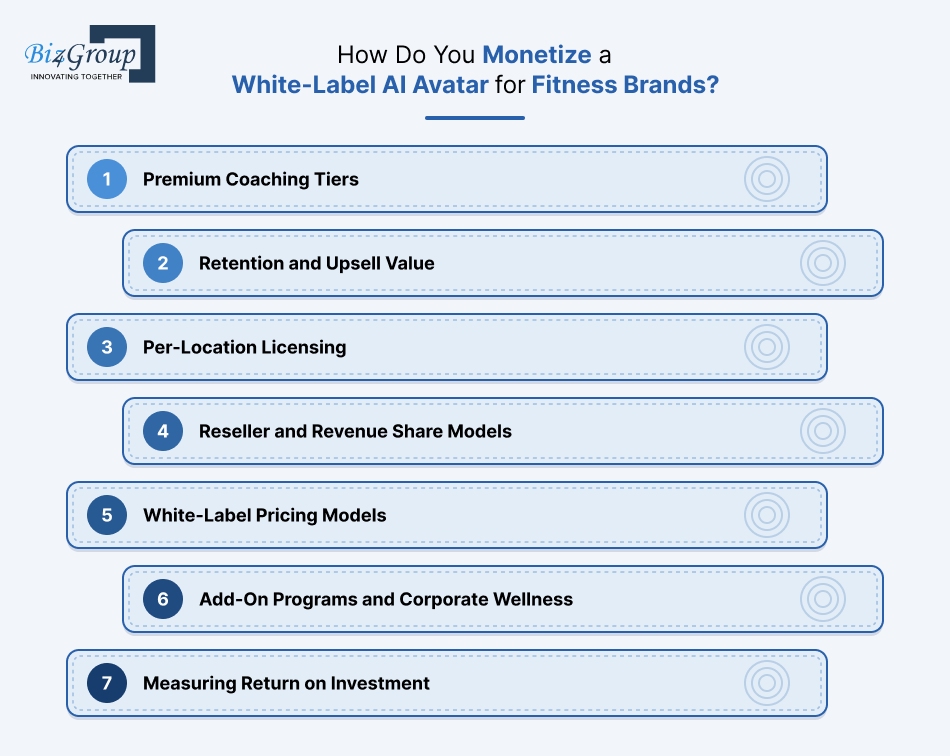
You can earn from a white-label AI avatar for fitness brands in five ways: paid coaching tiers for members, per-location licenses for gyms, reseller or revenue-share deals, add-on programs, and the retention value of members who keep training. Pick the model that matches who pays you: the member, the gym or the reseller.
Plan revenue and cost together. Every active member costs you AI usage, voice and hosting each month, so your price has to clear that number first.
Settle pricing before you lock in how to build white-label AI avatar for fitness brands, because the model you choose shapes the scope. If you plan to create white-label AI avatar for fitness brands that other operators will buy, build tenant billing in from day one.
1. Premium Coaching Tiers
Offer the avatar as a paid upgrade over your standard membership or app plan. A white label AI avatar for fitness can give free members class content, while paid members get live cues, form feedback and weekly plan changes. Keep the free tier useful enough to show the value, and cap avatar minutes so your costs stay predictable.
2. Retention and Upsell Value
The avatar can protect revenue you already earn, if it keeps members training between visits. Record 30-day retention, classes per week and cancellation rate before launch, then compare them after. Link avatar sessions to upsells such as personal training slots, workshops and challenges.
3. Per-Location Licensing
If you develop white-label AI avatar for fitness brands for many sites, charge each gym, studio or franchise location a monthly license to use the avatar under its own brand. Price tiers by member count or active avatars, so a small studio and a large club both fit. State what the fee covers, such as setup, theming and support, and what it excludes, such as new exercise libraries.
4. Reseller and Revenue Share Models
In white label AI avatar development for fitness brands, partners such as trainers, equipment makers and software platforms can sell your avatar under their own name. Revenue share works when the partner brings the audience and you run the platform, so write down who handles billing, support and refunds. When you compare vendors for a reseller platform, shortlist from the top AI avatar development companies in USA, then ask each one how it separates tenant data and handles export rights.
5. White-Label Pricing Models
Common structures are a setup fee plus a monthly platform fee, per-member pricing, per-location pricing and usage-based billing for heavy features like voice. Price above your cost per active member, which is AI usage plus voice, hosting and support, with a margin that survives growth. The same principle runs through how to monetize AI app effectively: price against the value delivered, then cap what each user can cost you.
6. Add-On Programs and Corporate Wellness
To make white label AI coaching avatar for wellness brands earn more, sell extras on top of the base avatar, such as recovery plans, sport-specific programs, extra languages and branded challenges. Corporate wellness buyers pay for group access, so offer company-wide licenses with simple reports for HR teams. Check the compliance section first, since employer and clinic partners can bring HIPAA into the deal.
7. Measuring Return on Investment
Track revenue per member, cost per active member, avatar adoption, session completion and churn. For a quick payback estimate, subtract your cost per active member from the extra revenue or saved cancellations per member, then divide your build cost by that net gain across your active members. A white label AI coaching avatar for wellness brand program should be reviewed monthly for the first quarter, then quarterly.
Revenue starts when a gym or member is live, so next comes onboarding.
Why Choose Biz4Group as Your White Label AI Avatar Development Company in USA for Fitness Brands?
Choosing a partner to create white-label AI avatar for fitness brands comes down to proof: have they built avatars, handled health data and shipped products people keep using? Biz4Group is a US-based AI development company in Orlando, Florida, with more than 20 years in software. Here is the evidence.
|
Proof |
What it shows |
|---|---|
|
Avatar products |
AI Wizard (voice and chat avatar companion), Dr. Truman (health companion with a lifelike avatar) and NextLPC (avatar-based therapy tutors) |
|
Fitness and wellness builds |
SweatJoy (habit and wellness app), a custom workout app with full-body image analysis, and Dr. Ara (athlete blood analysis) |
|
Coach replica experience |
An AI agent for coaches and educators that includes a replica bot of the coach |
|
Health data discipline |
HIPAA-compliant AI platforms for providers, plus role-based access, append-only audit trails and upload scanning on RevIntegrity |
|
Client ratings |
4.9 out of 5 across 28 Clutch reviews and 4.8 out of 5 across 120+ Upwork reviews |
|
Leadership depth |
Technical Director Dave Caplis brings 40+ years in IT, including 18 years at Disney running large, complex projects |
SweatJoy is the closest match to what you are planning. It combines mood, sleep, hydration and activity tracking with coach-created mindful sessions and meal planning, all designed to help people build routines that last. The hardest part of any fitness product is getting members to come back, and that lesson shapes how we design every avatar.
The same thinking runs through Dr. Truman. Dave Caplis said the team kept returning to one point: people don’t want to feel like they’re filling out forms all day. So the avatar leads a conversation instead of presenting a form. Dr. Truman’s CEO praised the team’s flexibility and proactive communication.
If you want a white label AI avatar development company in USA that can also develop white-label AI avatar for fitness brands with the member app around it, look for one team that owns both. Fitness brands that need the avatar and the app built together often start with an AI fitness app development company that already handles health data responsibly.
We are engineers, not lawyers. We build technical controls and share documentation, and your counsel reviews the legal terms. Every project starts under NDA, with a fast reply and no sales pressure.
Ready to scope yours? Book a call with our team.
Your Digital Coach Is One Decision Away
Shape an AI avatar that blends intelligence, personality and brand identity into every workout.
Let’s Build My AI AvatarWrapping Up!
A well-planned white-label AI avatar for fitness brands carries your coaches into the hours your team cannot cover. It works when you choose the right setup, settle compliance first and price against what each active member costs you.
Here is what to take with you:
- Decide early whether you need a single-brand build, a licensed platform or a multi-tenant system.
- Treat health data, voice rights and scope-of-practice rules as day-one work.
- Budget $35,000 to $250,000+ for the build, then add running costs for AI usage, voice and hosting.
Teams that create white-label AI avatar for fitness brands this way launch with fewer surprises and a clearer path to revenue.
We have built avatar and wellness products for years, and we are glad to look at yours. Send us your brand, your locations and the features you cannot do without, and we will map the scope and a cost range against your plan, under NDA.
Book a free consultation with Biz4Group
FAQ
1. What is a white-label AI avatar for fitness brands, and how is it different from a white-label fitness app?
A white-label AI avatar for fitness brands is a digital coach that carries your name, face, voice and programs. It talks with members, demonstrates moves and adjusts workouts, with no vendor branding in sight.
A white-label fitness app is a ready-made app you rebrand with your logo and colors. The avatar can run inside that app or your own.
It also differs from AI video tools, which produce marketing clips instead of live coaching.
2. How much does it cost to create white-label AI avatar for fitness brands?
Plan on roughly $35,000 to $250,000+ to create white-label AI avatar for fitness brands. Your figure will differ with avatar realism, the number of gyms or trainers, how deep the form tracking goes and which integrations you need.
Add monthly running costs for AI usage, voice and hosting. Ask every vendor for a run-cost estimate per 1,000 active members before you sign.
3. How long does it take to develop white-label AI avatar for fitness brands, and what do I need to provide?
A focused MVP usually takes 6 to 12 weeks, and a full build takes 3 to 6 months. Multi-tenant platforms take longer, since data separation comes first.
To develop white-label AI avatar for fitness brands, bring your logo and colors, program content and coaching cues, an exercise list, trainer voice samples with written consent, and access to your app or gym systems.
The development team handles design, build, integrations, testing and launch.
4. Can a white-label AI avatar coach safely, or will I still need human trainers?
You still need human trainers. A white label AI coaching avatar for wellness brand programs works best as an extension of your team.
Camera form feedback needs good lighting and a clear angle, so add a “tap to confirm” step for moments when the system is unsure. Add stop-and-refer rules for pain, dizziness and other red flags.
Les Mills’ 2026 report found only about 10% of consumers prefer AI guidance to a human coach.
5. Who owns the avatar, my trainer’s cloned voice and the member data?
It depends on your contract, so settle it before the build starts. In white label AI avatar development for fitness brands, list who owns the code, trained models, avatar assets, scripts, voice models and member data.
Custom builds usually transfer these to you, while licensed platforms often keep the engine and leave you your content and data.
Get written, scoped consent from every trainer whose voice or likeness is used, and an export clause for the day you leave.
6. Can one white-label AI avatar serve all my gym locations or franchisees?
Yes, if it is built multi-tenant. Each location gets its own theme, voice, scripts, data and billing, while you keep control of the core method.
When you plan how to build white-label AI avatar for fitness brands for many sites, add tenant billing and per-location onboarding from day one. You can then license the avatar per location or resell it to other operators.
7. Do I need HIPAA compliance for a white label AI avatar for fitness?
Usually not, unless a covered entity such as a clinic, health plan or provider-run wellness program is involved. Then you need a business associate agreement and tighter controls on health data.
A white label AI avatar for fitness still falls under the FTC Act, the FTC Health Breach Notification Rule and state health and biometric privacy laws.
Keep claims to general wellness, and have counsel review your setup.