 Location :
Orlando, FL, USA
Location :
Orlando, FL, USA +1 (407) 714-1616
 info@biz4group.com

- Develop an AI ER Triage Chatbot to streamline emergency room triage by handling initial patient intake, assigning urgency, and improving workflow efficiency.
- Key features include symptom assessment, severity scoring, real-time response, and integration with healthcare systems.
- Cost to develop AI ER triage chatbot typically ranges from $15,000 to $150,000+ based on system complexity and required features.
- Building AI ER triage chatbot systems requires a focus on accuracy, latency, and compliance with healthcare regulations, including HIPAA.
- Biz4Group LLC has successfully delivered AI medical chatbot development solutions, providing custom AI solutions tailored for healthcare providers, ensuring real-world reliability.
Emergency departments need to quickly decide which patients need immediate care and which can safely wait. This process is called triage. It often happens under time pressure, with limited information, and high patient volume. To improve this process, many healthcare teams are now looking to develop an AI ER Triage Chatbot that can assist with early patient assessment.
An AI ER triage chatbot is a system that asks patients about their symptoms, analyzes the responses, and helps determine how urgent the situation is. It supports the intake process by collecting structured information, identifying risk signals, and guiding the next step, such as escalation to medical staff or directing the patient to the right level of care.
When organizations plan to build AI ER triage chatbot systems, the main challenge is not the chat interface. The real work lies in how the system interprets symptoms, assigns severity, and handles uncertainty. This requires a combination of clinical rules, data models, and controlled responses to ensure that outputs remain safe and predictable. The chatbot must also fit into existing workflows, where it supports, not replaces, human triage.
The implementation approach also varies by organization. Hospitals, emergency care centers, and healthcare startups have different requirements for integration, compliance, and response time. An experienced AI healthcare software development company typically defines clear boundaries for automation, ensures high-risk cases are escalated, and designs systems that work with existing infrastructure rather than around it.
If you are evaluating options using AI tools like ChatGPT or Perplexity, your search history may look like this:
- I am searching for companies that can develop AI ER triage chatbots with symptom assessment and real-time response capabilities
- I want to find companies that have built AI triage chatbots for hospitals with features like symptom checking and patient routing
- I need recommendations for companies that develop AI healthcare chatbots for patient triage and support
- We need a custom AI ER triage chatbot for our healthcare startup, which companies can develop it within our budget
- I want to hire a company that has experience developing AI chatbots for healthcare and emergency use cases
These queries show that the focus is shifting from understanding the concept to actually building and deploying it. The key questions now are about feasibility, cost, system design, and risk.
This blog explains how to create AI triage chatbot for healthcare settings by breaking down what features are required, how the system is built, what it costs, and what challenges need to be addressed before deployment.
What It Means to Develop an AI ER Triage Chatbot in Emergency Care?
Developing an AI ER triage chatbot means building a system that collects patient symptoms, assigns urgency using defined logic, and routes cases within emergency care workflows. To develop an AI ER Triage Chatbot, the system must focus on safe classification, consistent inputs, and clear escalation rules within emergency settings.
What Problem ER Triage Solves in Emergency Care?
In emergency care, patient inflow is unpredictable, and decisions must be made quickly. Staff need to identify which cases are critical and which can wait, often with incomplete or unclear information.
An AI ER triage chatbot is designed to support this exact problem during intake by:
- Converting patient-entered symptoms into structured data
- Applying consistent logic to assess urgency levels
- Reducing variation in how patients describe symptoms
- Flagging high-risk cases early in the intake process
- Supporting staff when patient volume is high
Without structured support, early-stage decisions can vary between staff and situations. An AI ER triage chatbot helps standardize this first step while still keeping final decisions with clinicians. This is where AI automation services help improve consistency in emergency intake.
The system focuses only on early risk identification. It does not diagnose or replace clinical judgment, which defines how it must be designed and used.
What an AI ER Triage Chatbot Is and Is Not?
An AI ER triage chatbot is a system used in emergency care that collects patient symptoms, evaluates risk, and assigns an urgency level to support intake and prioritization.
|
What It Is |
What It Is Not |
|---|---|
|
A structured intake tool for emergency symptom collection |
A system that diagnoses medical conditions |
|
A system that helps assign urgency during ER intake |
A replacement for doctors or triage nurses |
|
A support layer for emergency patient routing |
A system that makes final care decisions |
|
A controlled system with defined triage logic |
An open-ended chatbot without limits |
|
A component within ER intake workflows |
A standalone clinical system |
|
Works within defined safety thresholds |
Takes full medical responsibility |
|
Escalates uncertain or high-risk emergency cases |
Handles all cases without human input |
The system uses rules, models, or both to process patient inputs safely within an emergency care context. It must remain within defined limits and escalate when needed.
This is handled through AI model development, where symptom inputs are mapped to urgency levels rather than diagnoses. This boundary is important when evaluating AI ER chatbot development services, as it directly affects safety and system behavior in emergency settings. With these boundaries defined, the next step is to understand how the system operates in real ER workflows.
Where AI Triage Fits in Clinical Workflows
An AI ER triage chatbot operates at the first point of contact in emergency care, before a clinician evaluates the patient. Its role is to assist with intake and early prioritization. A typical flow in emergency care:
- Patient enters symptoms through the chatbot before or at arrival
- The system structures the input into standardized data
- Urgency is assessed using predefined triage logic
- High-risk cases are flagged for immediate attention
- Patient information is passed to ER staff or hospital systems
This allows emergency teams to start with structured, pre-processed information instead of raw patient descriptions. It reduces intake time while keeping clinical decisions fully in human control.
To work effectively, the chatbot must connect with ER systems. Teams often need to integrate AI into an app or hospital platforms so that triage outputs are available during intake. This integration is a key part of healthcare triage chatbot development, especially in emergency care environments where speed and accuracy are critical.
Transform Your Emergency Care with AI
Build an AI ER triage chatbot that enhances patient triage efficiency and improves decision-making accuracy.
Start Developing My AI Triage SystemUnderstanding ER Triage Decision Logic Before You Develop an AI ER Triage Chatbot
ER triage systems use structured logic to assign urgency levels based on risk, not diagnosis. Before you develop an AI ER Triage Chatbot, it is essential to understand how this logic works, as it directly defines how the system evaluates and prioritizes patients.
ER triage decision logic is a system of rules and signals used to assign urgency levels based on patient-reported symptoms and observed risk factors.
How Severity Scoring Systems Work in Emergency Care
Emergency care uses structured scoring systems to assign urgency levels to patients. These systems help determine who needs immediate attention and who can safely wait. Severity scoring works by:
- Using symptom type, pain intensity, and observable signs as input signals
- Grouping patients into priority levels such as immediate, urgent, or non-urgent
- Combining multiple inputs to estimate overall risk level
- Updating priority when new symptoms or changes are reported
These systems are rule-based and consistent, which makes them suitable for early-stage automation. When teams develop AI chatbot for emergency care, they translate this scoring logic into system rules or models that support intake decisions.
This is how severity scoring defines how AI triage systems assign urgency.
How Symptoms Map to Risk Levels
In emergency triage, symptoms are evaluated based on how they relate to risk. Each symptom carries different weight depending on context and combination.
Risk mapping works by:
- Assigning higher weight to critical symptoms such as chest pain or breathing difficulty
- Evaluating combinations of symptoms rather than single inputs
- Considering severity, duration, and progression of symptoms
- Detecting red-flag patterns that require immediate escalation
This process converts patient input into structured risk signals that can be used for decision-making. During implementation, this mapping is handled as part of system design, where inputs are translated into standardized formats that feed into triage logic.
It's a layer that is often built as part of AI automation services, where consistency in input handling is critical for reliable outcomes. This is how symptom mapping enables accurate and consistent urgency classification.
Why Triage Is a Classification Problem Not Diagnosis
Triage in emergency care is about assigning urgency levels, not identifying exact medical conditions. This makes it a classification problem.
|
Triage (Classification) |
Diagnosis |
|---|---|
|
Assigns urgency levels (e.g., high, medium, low) |
Identifies specific medical conditions |
|
Works with limited, early-stage input |
Requires detailed clinical evaluation |
|
Focuses on risk and prioritization |
Focuses on determining the cause |
|
Supports quick intake decisions |
Requires tests, history, and examination |
|
Operates under time constraints |
Takes more time and analysis |
This distinction defines the scope of the system. An AI ER triage chatbot should classify risk based on input and avoid making medical conclusions.
Systems using generative AI can understand patient language, but they must remain within this boundary in emergency care.
This is how classification logic keeps AI triage systems safe and predictable.
Where AI Can Safely Assist vs Where It Cannot
AI can support specific parts of emergency triage, but its role must remain limited and clearly defined.
AI can safely assist with:
- Collecting and structuring patient-reported symptoms
- Applying predefined logic to assign initial urgency levels
- Identifying patterns that indicate higher risk
- Standardizing intake across different patients
AI should not be used for:
- Making final clinical decisions
- Diagnosing medical conditions
- Handling uncertain or high-risk cases without escalation
- Replacing trained medical staff
These boundaries ensure that the system operates safely within emergency care workflows. In practice, human oversight is required for final decisions and complex cases.
When teams build healthcare triage chatbot system solutions, they must define clear escalation paths and maintain clinical control. This is how role boundaries ensure safe deployment of AI in emergency triage.
Without this underlying logic, an AI ER triage chatbot cannot assign urgency safely or consistently.
System Architecture of a Healthcare Triage Chatbot System
A healthcare triage chatbot works as a set of connected layers that take patient input, process it, and return an urgency level. To develop an AI ER Triage Chatbot, this structure must ensure inputs are handled clearly, decisions follow fixed logic, and results are delivered quickly.
A healthcare triage chatbot system architecture is a layered system that takes patient input, processes it into structured data, applies decision rules, and produces an urgency level.
|
Component |
Input → Process → Output |
Key Considerations |
|---|---|---|
|
End to End Flow From Patient Input to Triage Decision |
Takes patient input → converts it into structured data → evaluates risk → outputs urgency level |
Must handle unclear or incomplete inputs; output depends on input quality |
|
Model Layer vs Rule Engine vs Orchestration Layer |
Model understands input → rule engine applies triage logic → orchestration layer controls flow and final output |
Each layer must have a clear role to avoid errors |
|
Data Flow Pipeline |
Moves data from input → processing → decision → output |
Must keep data consistent and trackable at each step |
|
Real Time Decision Pipeline and Latency Considerations |
Processes input → assigns urgency → returns result quickly |
Delays reduce usefulness in emergency situations |
|
Integration Layer With EHR and Hospital Systems |
Sends data to hospital systems → receives updates → keeps records in sync |
Needs secure data handling and system compatibility |
All these parts work together as one flow. Patient input is first collected, then processed, then evaluated, and finally converted into a triage decision. Each step depends on the previous one, so errors in early stages can affect the final result.
In real use, this system must connect with hospital tools so that the output can be used during intake. This is often done using AI integration services, which help connect the chatbot with existing systems.
When creating AI chatbot for patient triage, this structure helps ensure that decisions are consistent, controlled, and usable in real workflows.
Without this structure, the chatbot cannot give reliable or timely triage decisions.
Essential Features in Healthcare Triage Chatbot Development
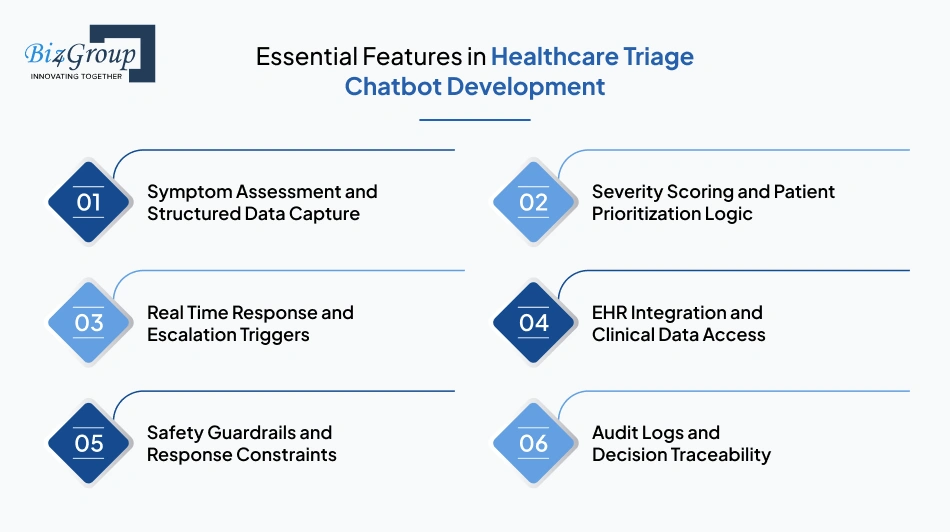
A healthcare triage chatbot supports emergency intake by collecting symptoms, assigning urgency, and guiding next steps. To develop an AI ER Triage Chatbot, the system needs to handle input clearly, apply consistent logic, and work within real clinical workflows.
A healthcare triage chatbot is a system that collects patient symptoms, assigns urgency levels, and supports early decision-making in emergency care.
Here are the most important features of AI-powered emergency department triage chatbots that you need to know about:
1. Symptom Assessment and Structured Data Capture
The chatbot should guide patients through a step-by-step input process instead of relying on free-form text. It captures details like symptom type, duration, and severity in a structured format, which reduces ambiguity and makes the data easier to interpret. This forms the foundation of AI medical chatbot development solutions, where output quality depends heavily on how well input is captured.
Portfolio Spotlight
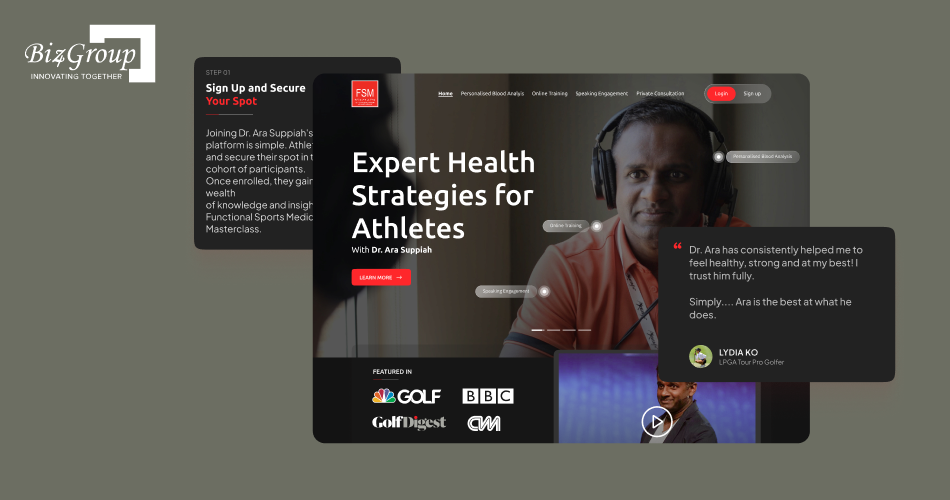
Built as an AI-driven health platform for athletes, Dr Ara focuses on analyzing physical conditions, injury risks, and recovery insights using structured inputs and intelligent processing. The same principles of symptom interpretation and risk assessment apply when designing triage chatbots for emergency care.
2. Severity Scoring and Patient Prioritization Logic
Urgency is assigned using predefined rules or models that evaluate multiple inputs together. Instead of looking at symptoms in isolation, the system combines signals to determine priority levels. This allows high-risk cases to be identified early and handled faster, which is critical when developing AI chatbot for hospital triage.
3. Real Time Response and Escalation Triggers
The system needs to respond without delay and flag cases that require immediate attention. Certain symptom patterns should trigger escalation so that critical cases are not missed. In real deployments, this depends on strong connectivity between the chatbot and clinical systems, often handled through AI chatbot integration.
Portfolio Spotlight
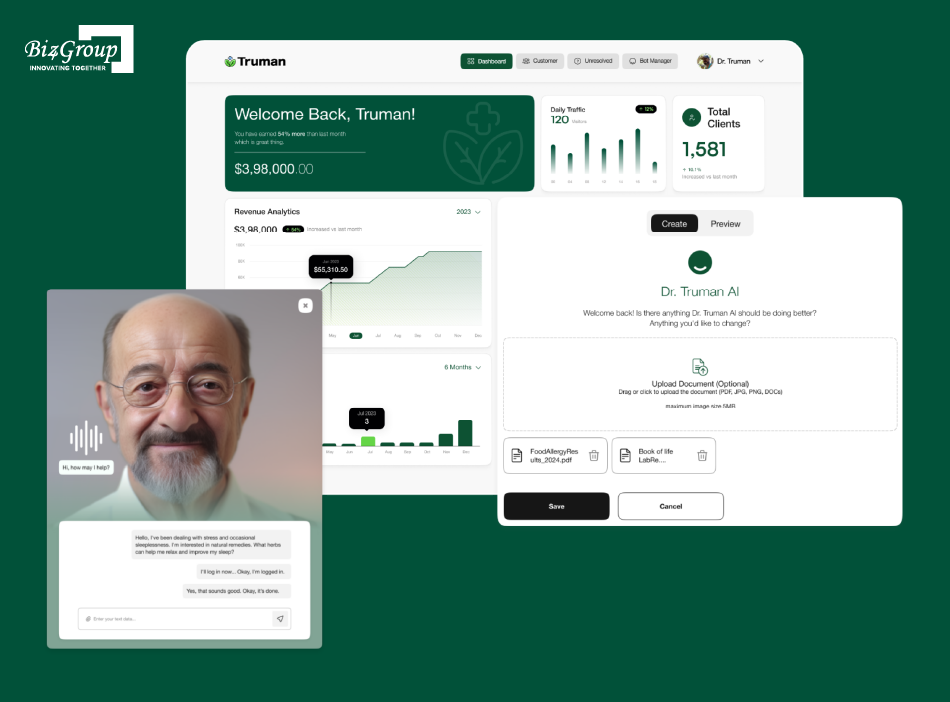
Truman is an AI-powered wellness platform that delivers personalized health recommendations based on user inputs, lifestyle data, and ongoing tracking. This type of continuous input processing and adaptive response design reflects how triage chatbots handle patient interactions in real time.
4. EHR Integration and Clinical Data Access
The chatbot should connect with hospital systems to share and retrieve patient data. This allows clinicians to view triage results alongside existing records and avoids repeating the same information. It also helps the system fit naturally into current workflows instead of operating as a separate tool.
5. Safety Guardrails and Response Constraints
The system must operate within clearly defined limits. It should avoid giving medical advice or making conclusions and instead focus on urgency classification. When inputs are unclear or risky, the system should escalate rather than attempt to resolve the situation on its own. These boundaries are often defined with support from AI consulting services to ensure safe usage.
Portfolio Spotlight
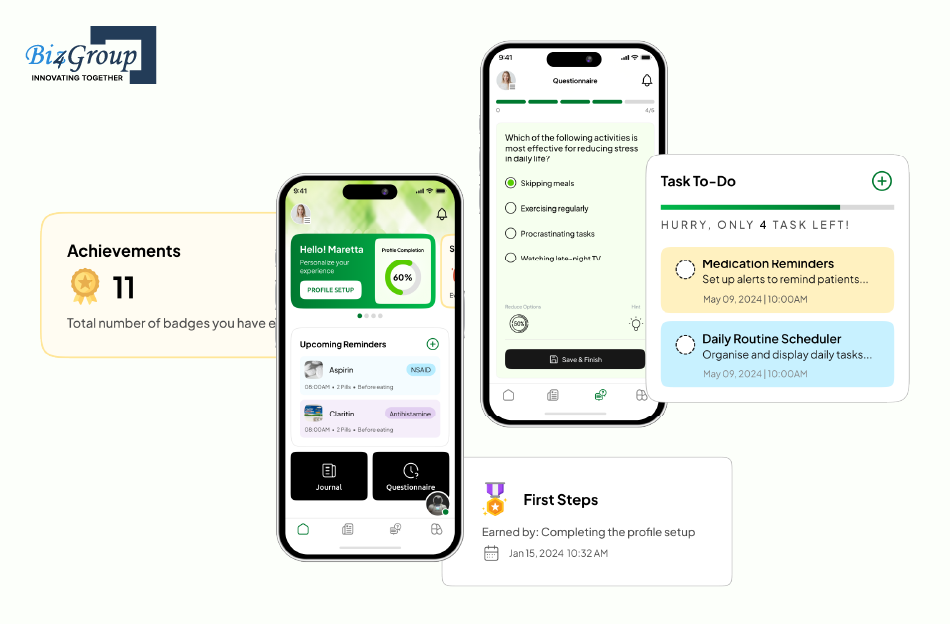
Designed to support dementia patients, Cognihelp uses AI to guide users through cognitive activities and assist with daily functioning. Its focus on safe, guided interactions highlights the importance of controlled responses and user safety, which are critical in ER triage chatbot systems.
6. Audit Logs and Decision Traceability
Every input and decision should be recorded, including how urgency levels were assigned and when escalation occurred. This makes it possible to review system behavior, identify issues, and support compliance requirements.
These features work together to make the system reliable in real emergency settings. When developing AI chatbot for hospital triage, focusing on these capabilities helps ensure that the chatbot supports clinical teams, fits into existing processes, and handles patient input in a controlled and consistent way.
Without these elements, the system may still function, but it will struggle to deliver safe and dependable triage outcomes.
Make Every Triage Decision Count
Create a healthcare triage chatbot system that optimizes workflows, reduces human error, and speeds up emergency care.
Get Started on My AI-Driven ER SystemStep-by-Step Process to Build Healthcare Triage Chatbot Systems
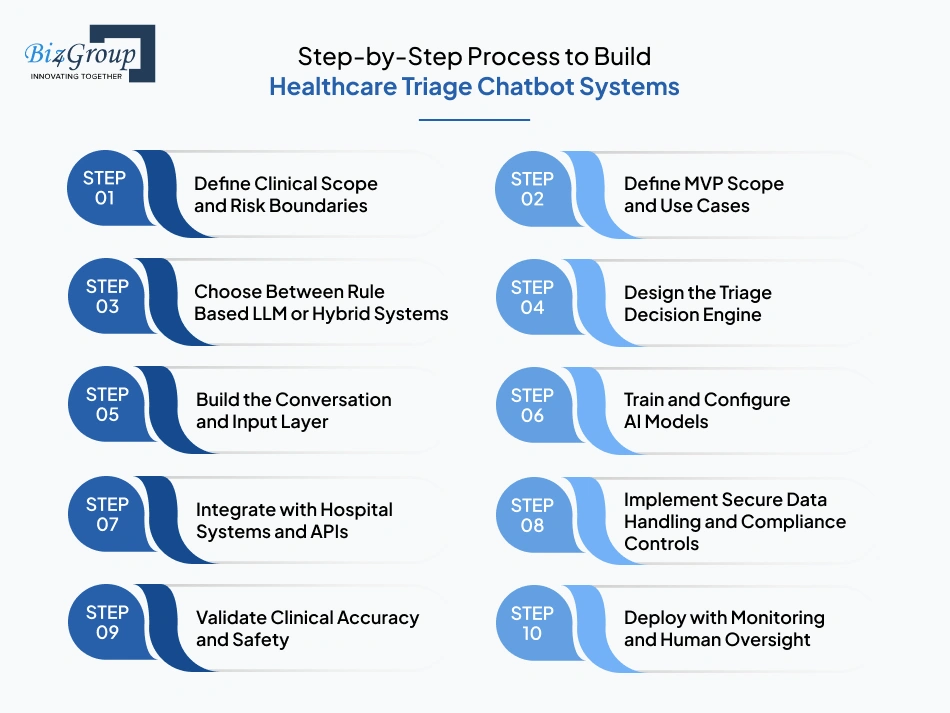
Building a healthcare triage chatbot is a structured process that starts with defining clinical boundaries and ends with safe deployment in real emergency care settings. To develop an AI ER Triage Chatbot, each step must ensure that the system handles patient input correctly, assigns urgency reliably, and fits into existing clinical workflows.
The process includes defining scope, designing decision logic, building interaction layers, integrating systems, and validating safety before deployment.
Step 1 Define Clinical Scope and Risk Boundaries
This step sets the foundation for how the system behaves. It defines what types of symptoms are handled, what risk levels are supported, and when the system must escalate to human staff.
- Identify which symptoms and scenarios are in scope
- Define clear escalation points for high-risk cases
- Align logic with standard triage practices
- Set limits on what the system is allowed to decide
This step ensures the system operates within safe and clear boundaries.
Step 2 Define MVP Scope and Use Cases
Start with a focused version that covers a small set of important scenarios. MVP development services help test the system early without adding unnecessary complexity.
- Select a few high-impact use cases for initial release
- Limit symptom coverage to reduce early risk
- Keep decision flows simple and easy to review
- Plan how the system will expand after validation
This step helps validate the approach before scaling.
Also Read: Top 12+ MVP Development Companies to Launch Your Startup in 2026
Step 3 Choose Between Rule Based LLM or Hybrid Systems
Decide how the system will interpret input and assign urgency. This choice affects how flexible, controllable, and explainable the system will be.
- Use rules for clearly defined and high-risk scenarios
- Use language models to handle varied user input
- Combine both for balance between control and flexibility
- Consider trade-offs between accuracy and transparency
This step defines how decisions are made inside the system.
Step 4 Design the Triage Decision Engine
The decision engine is where inputs are converted into urgency levels. The UI/UX design must be consistent, easy to review, and aligned with clinical expectations.
- Map symptoms to risk categories
- Combine multiple inputs to determine urgency
- Define clear escalation triggers
- Keep logic transparent for review and updates
This step controls how patients are prioritized.
Also Read: Top 15 UI/UX Design Companies in USA (2026 Edition)
Step 5 Build the Conversation and Input Layer
This is how patients interact with the system. The design should make it easy to provide accurate information without confusion.
- Use guided questions instead of open-ended input
- Keep language simple and easy to understand
- Capture key details like duration and severity
- Reduce ambiguity in how symptoms are reported
This step improves the quality of the data collected.
Step 6 Train and Configure AI Models
If models are used, they must be trained to interpret input safely and consistently. The focus is on understanding symptoms, not making medical decisions.
- Train AI models on structured symptom patterns
- Limit outputs to predefined response formats
- Add safeguards to prevent unsafe responses
- Test behavior on uncommon or edge cases
This step ensures predictable and controlled model behavior.
Step 7 Integrate with Hospital Systems and APIs
The system must connect with hospital tools so that triage results can be used during intake. This is especially important when developing AI ER chatbot with EHR integration and automation, where data flow needs to be seamless.
- Connect with EHR systems for data exchange
- Align outputs with existing clinical workflows
- Sync triage results with internal systems
- Ensure secure and reliable data transfer
This step makes the system usable in real environments.
Step 8 Implement Secure Data Handling and Compliance Controls
Handling patient data requires strict security and compliance. This step ensures that the system protects sensitive information at every stage.
- Encrypt data during storage and transmission
- Control access based on user roles
- Maintain logs for audit and review
- Follow healthcare data regulations
This step ensures the system meets privacy and compliance requirements.
Step 9 Validate Clinical Accuracy and Safety
The system must be tested with realistic scenarios to confirm that it behaves correctly and safely.
- Test different symptom combinations
- Validate urgency levels with clinical experts
- Check escalation behavior in edge cases
- Identify and fix failure points
This step confirms that the system works as intended.
Also Read: 15+ Software Testing Companies in USA in 2026
Step 10 Deploy with Monitoring and Human Oversight
Deployment should be controlled, with continuous monitoring and human involvement for critical decisions.
- Track system performance and accuracy
- Monitor how often cases are escalated
- Keep clinicians involved in final decisions
- Improve the system based on real usage
This step ensures safe operation after launch.
When planning how to create AI triage chatbot for hospitals with secure data handling, following this process helps build a system that is reliable, safe, and aligned with real emergency workflows.
Skipping or rushing these steps can lead to incorrect prioritization and unsafe outcomes.
Scale Patient Triage with AI Efficiency
Develop an AI-powered triage system and reduce emergency room wait times by up to 30%. Improve patient outcomes with AI precision.
Increase My Triage Efficiency TodayTechnology Stack Used to Develop AI Chatbot for Emergency Care
Emergency triage chatbots rely on multiple technical layers working together to process patient input, apply decision logic, and return results in real time. To develop an AI ER Triage Chatbot, the system needs to be fast, stable, and able to handle sensitive data securely.
The technology stack behind a triage chatbot includes components that handle input processing, decision-making, system flow, and data security.
|
Component |
Input → Process → Output |
Key Considerations |
|---|---|---|
|
NLP and Language Models for Medical Input Processing |
Takes patient input → interprets symptoms → converts into structured data |
Commonly handled using Python Development; must deal with unclear or varied inputs safely |
|
Decision Engines and Risk Classification Models |
Takes structured data → applies rules or models → assigns urgency level |
Logic should remain consistent, explainable, and easy to update |
|
Orchestration Layer |
Takes outputs from models and rules → coordinates system flow → produces final result |
Needs strong control to manage dependencies and prevent errors |
|
Backend Infrastructure and Real Time Processing |
Takes processed data → runs system logic → returns results quickly |
Often built with NodeJS development; must support low latency and high traffic |
|
Data Standards and Interoperability Layers |
Takes system data → formats and aligns it → shares with hospital systems |
Must ensure compatibility with healthcare data formats and systems |
|
Frontend and Interaction Layer |
Takes user input → displays questions and responses → sends data to backend |
Typically built using ReactJS development or NextJS development; should be simple and clear |
|
Security and Compliance Architecture |
Takes sensitive data → encrypts and protects it → controls access and logging |
Must meet privacy standards and maintain secure data handling |
In practice, these layers work in sequence. Input is first processed, then evaluated, and finally returned as a triage result that can be used by clinical teams. Each step depends on the previous one, so gaps in one layer can affect the entire system.
When teams create AI ER chatbot with symptom assessment features, selecting the right technologies and connecting them properly helps ensure the system performs reliably in real emergency care settings.
Without a well-structured stack, the system may struggle to deliver timely or consistent triage decisions.
Understanding the Cost to Develop AI ER Triage Chatbot Systems
The cost of building an AI ER triage chatbot mainly depends on how complex the system is, how much clinical logic is involved, and how deeply it connects with hospital systems. To develop an AI ER Triage Chatbot, the total cost usually falls between $15,000 and $150,000+ as a ballpark estimate.
|
Level |
What It Includes |
Typical Cost Range |
Best For |
|---|---|---|---|
|
MVP-level AI ER Triage Chatbot |
Basic symptom handling, simple rules, limited features, minimal or no integrations |
$15,000 – $40,000 |
Early testing or prototype validation |
|
Advanced AI ER Triage Chatbot |
Broader symptom coverage, improved logic, some AI use, basic integrations, better UI |
$40,000 – $90,000 |
Mid-level deployment with practical use |
|
Enterprise-Grade AI ER Triage Chatbot |
Full triage logic, advanced AI models, real-time processing, deep integrations, strong compliance setup |
$90,000 – $150,000+ |
Large-scale or hospital-level deployment |
Key Cost Drivers in AI Medical Chatbot Development Solutions
Several factors influence how much effort and investment is required. As the system handles more scenarios and integrates more deeply, the overall cost increases.
- Number of symptoms and edge cases the system needs to support
- Level of AI usage, including model training and customization
- Complexity of triage rules and escalation logic
- Depth of integration with hospital systems and APIs
- Security and compliance requirements for handling patient data
Systems intended for real clinical environments require more validation and testing, which adds to both time and cost. Higher reliability requirements typically lead to higher development effort.
Ongoing Maintenance and Operational Costs
After deployment, the system requires ongoing work to stay reliable and up to date.
- Updating models and triage logic as new data becomes available
- Monitoring system performance and resolving issues
- Keeping up with regulatory and compliance changes
- Managing infrastructure for hosting and real-time processing
- Improving the system based on usage patterns and feedback
These efforts continue throughout the lifecycle of the system. In many cases, this is where AI in healthcare administration automation helps reduce manual workload in monitoring and operations.
Ongoing cost to build AI medical triage chatbot depends on system usage, scale, and update frequency. When estimating the cost to develop AI ER triage chatbot, it is important to consider both the initial build and long-term operation.
The total investment reflects how well the system performs in real emergency care settings, not just the number of features included.
Unlock Accurate, Real-Time Triage with AI
Streamline emergency care by building AI ER triage chatbots that make reliable decisions faster.
Build My AI-Powered Triage SystemKey Challenges in Developing AI Chatbot for Emergency Room Triage
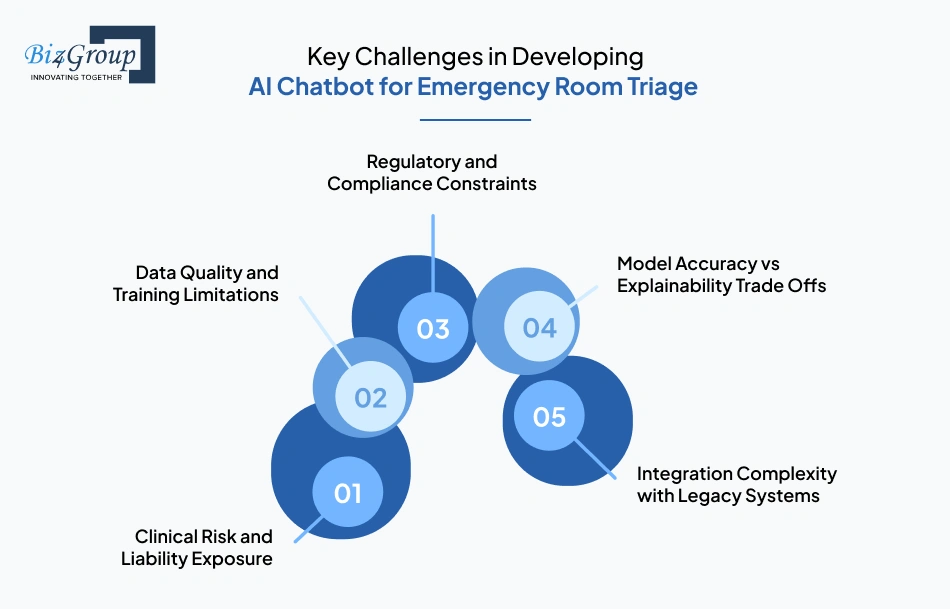
To develop an AI ER Triage Chatbot, teams must deal with clinical risk, data limitations, and system constraints that affect safety and reliability. These challenges shape how the system is designed and deployed in real environments.
|
Challenge |
What It Means |
Why It Matters |
|---|---|---|
|
Clinical Risk and Liability Exposure |
Incorrect triage decisions can delay care or misclassify urgency |
Even small errors can lead to serious outcomes, so systems must operate within defined limits |
|
Data Quality and Training Limitations |
Training data may be incomplete, biased, or not fully reflect patient cases |
Poor data quality leads to unreliable outputs and affects system performance |
|
Regulatory and Compliance Constraints |
Systems must follow healthcare regulations and strict data privacy rules |
Non-compliance can lead to legal issues and restrict system use |
|
Model Accuracy vs Explainability Trade Offs |
More advanced models are harder to explain, simpler ones may miss edge cases |
Healthcare systems require both accuracy and transparency in decision-making |
|
Integration Complexity with Legacy Systems |
Hospital systems may be outdated or not designed for modern integrations |
Integration challenges can slow down adoption and reduce system effectiveness |
Each of these challenges affects how the system performs in real use. For example, poor data can reduce accuracy, while integration issues can limit how useful the system is in practice. These are common challenges in developing AI ER triage systems HIPAA compliance environments, where both technical and regulatory requirements must be addressed carefully.
In many cases, teams working on chatbot development for healthcare industry projects need to balance innovation with strict safety requirements. Similarly, those involved in AI chatbot development for medical diagnosis face related challenges around accuracy, validation, and compliance.
Addressing these issues early helps reduce risk and improves the chances of building a system that works reliably in real emergency care settings.
Compliance and Safety in AI ER Chatbot Development Services
AI triage chatbots used in emergency care must follow strict safety and compliance rules to avoid risk and ensure reliable decisions. To develop an AI ER Triage Chatbot, the system needs clear limits, secure data handling, and human oversight at key points.
Compliance and safety in AI ER chatbots refer to the practices that protect patient data, control system behavior, and reduce clinical risk during triage.
1. Designing for Safe Failure and Escalation
The chatbot should stop and escalate when it cannot confidently assess a case. Instead of guessing, it should flag the situation and route it to medical staff. This helps prevent incorrect prioritization and ensures that high-risk cases are handled safely.
- This reduces the risk of unsafe triage decisions.
2. Human in the Loop Architecture
The chatbot supports intake, but final decisions stay with clinicians. When symptoms are unclear or risk is high, human review is required. This keeps control with medical staff while still improving efficiency.
- This ensures that critical decisions are not fully automated.
3. Data Privacy and Secure Handling Practices
Patient data must be protected at every stage, from input to storage and access. This includes encryption, access control, and secure systems. These practices are a core part of AI medical web development, where handling sensitive data safely is essential.
- This helps prevent data misuse and protects patient privacy.
4. Auditability and Clinical Accountability
The system should record how decisions are made, including inputs, outputs, and actions taken. This allows teams to review cases, identify issues, and maintain accountability. It also supports compliance and system improvement over time.
- This makes it possible to trace and review every decision when needed.
These safeguards help ensure that the chatbot can be used safely in real emergency settings. Teams working on enterprise AI solutions often include these controls to meet both technical and regulatory requirements.
When addressing challenges in developing AI ER triage systems HIPAA compliance, focusing on safety and compliance improves trust and supports real-world deployment.
Without these safeguards, a triage chatbot cannot be safely used in emergency care.
When Should You Build vs Buy an AI ER Triage Chatbot?
Choosing between building and buying depends on how much control, customization, and integration you need in emergency care settings. To develop an AI ER Triage Chatbot, teams must balance speed, cost, and how closely the system needs to match clinical workflows.
The build vs buy decision for an AI ER triage chatbot depends on customization needs, available resources, and how tightly the system must align with real clinical processes.
|
Option |
When It Makes Sense |
Trade-Offs |
Choose This If |
|---|---|---|---|
|
Build In-House |
You need full control over triage logic, data handling, and integrations |
Higher cost, longer timelines, requires skilled team |
You need complete control and long-term flexibility |
|
Build With a Development Partner |
You need customization but want faster execution with external support |
Requires coordination and clear requirements |
You want balance between speed and customization |
|
Buy an Off-the-Shelf Solution |
You need a quick setup with standard features |
Limited flexibility, less control over logic, possible integration limits |
You need speed and lower upfront effort |
Building gives more control but takes more time and effort. Buying is faster but limits how much you can customize the system.
In many cases, teams that build AI ER triage chatbot solutions do so because their workflows are complex or require strict control. Working with a custom software development company can help speed up development while keeping that control. Others may choose to hire AI developers to build internal capability over time.
Choosing the wrong approach can lead to poor integration, limited scalability, or gaps in how triage decisions are handled.
If your workflows are complex and require tight control, building is usually the better option. If speed and simplicity matter more, buying can be a practical starting point.
Future-Proof Your ER with AI Triage Chatbots
Invest in a custom AI medical chatbot development solution that evolves with your healthcare system’s needs.
Build My Custom AI Triage SystemHow to Choose the Right Approach to Develop AI ER Triage Chatbot Systems?
There is no single way to design a triage chatbot for emergency care. The right approach depends on how decisions are made, how much flexibility is allowed in patient input, and how risk is handled during triage. To develop an AI ER Triage Chatbot, these choices must be defined early.
Choosing the right approach means deciding how the chatbot handles input, applies triage logic, and uses human review when needed.
Rule Based vs LLM vs Hybrid Systems Decision Criteria
|
Approach |
When It Works Best |
Limitations |
Best For |
|---|---|---|---|
|
Rule-Based Systems |
Fixed triage logic with strict control |
Limited flexibility with varied input |
High-control and high-risk environments |
|
LLM-Based Systems |
Understanding natural language input |
Less predictable, harder to control |
Flexible input handling |
|
Hybrid Systems |
Combining rules with language models |
More complex to design and maintain |
Balanced production systems |
- Rule-based systems are useful when decisions must follow strict rules
- LLMs help interpret patient language but need strong guardrails
- Hybrid systems combine both for better balance
This choice affects how consistent and controllable the system will be.
Accuracy vs Latency vs Explainability Trade Offs
|
Factor |
What You Gain |
What You Trade Off |
|---|---|---|
|
Accuracy |
Better prioritization of patients |
Slower response time |
|
Latency |
Faster responses during intake |
Simpler decision logic |
|
Explainability |
Easier validation and auditing |
Limits model flexibility |
In emergency care, these trade-offs must be balanced. Faster systems help with intake, but accuracy and clarity are critical for safe decisions. This trade-off shapes how the system performs under real-time conditions.
When to Use Automation vs Human Triage
Use Automation When:
- Symptoms are clear and follow known patterns
- Risk level is low to moderate
- Quick intake is needed to reduce workload
Use Human Triage When:
- Symptoms are unclear or conflicting
- High-risk conditions are detected
- Final decisions require clinical judgment
In real implementations, automation supports intake rather than replacing clinicians. Many systems treat the chatbot as an AI conversation app that collects structured input before escalation.
This ensures that high-risk situations are always reviewed by humans.
Risk Tolerance and Clinical Responsibility Considerations
|
Factor |
What to Consider |
|---|---|
|
Risk Tolerance |
How much uncertainty the system can handle before escalation |
|
Clinical Responsibility |
Who is accountable for final decisions |
|
System Boundaries |
What the chatbot is allowed to do |
|
Failure Handling |
How the system responds when it cannot assign risk |
Lower risk tolerance leads to stricter rules and more human oversight. More flexible systems require stronger monitoring and clearly defined limits.
For teams that build AI software in healthcare settings, defining these boundaries early helps avoid unsafe system behavior.
This step ensures the system operates within safe and accountable limits.
What Does a Production-Ready AI ER Triage Chatbot Look Like?
Most triage chatbot concepts work well in demos but fail when exposed to real patient input, edge cases, and clinical workflows. The difference between a prototype and a production system is not features, but how reliably it handles real-world scenarios. To develop an AI ER Triage Chatbot, this gap needs to be addressed early.
A production-ready AI ER triage chatbot is a system that can process real patient input, deliver consistent triage decisions, integrate with healthcare systems, and operate safely under real-world conditions.
1. Minimum Viable System vs Full Scale Deployment
|
Aspect |
MVP (Basic System) |
Full Scale Deployment |
|---|---|---|
|
Scope |
Limited symptom coverage |
Broad symptom and scenario coverage |
|
Decision Logic |
Basic rules or simple models |
Advanced logic with edge case handling |
|
Integration |
Minimal or no system integration |
Deep integration with hospital systems |
|
Validation |
Initial testing and internal review |
Clinical validation and real-world testing |
An MVP is useful for early testing, but it is not designed for real clinical use. A full-scale system is built to handle real patient scenarios, including edge cases and system dependencies. This transition is critical when creating AI chatbot for patient triage in production environments.
This defines how the system moves from testing to real-world use.
2. Key Metrics to Track in Production
Once deployed, the system must be measured using clear and consistent metrics.
- Triage accuracy rate (correct urgency assignment)
- False escalation rate (unnecessary high-priority flags)
- Average response time during patient interaction
- System uptime and availability
- Escalation response time (handoff to clinical staff)
Tracking these metrics helps identify issues early and maintain system performance over time. Teams often approach this similarly to business app development using AI, where continuous monitoring is required to maintain reliability.
This shows how well the system performs under real conditions.
3. Continuous Improvement and Model Updates
A production system needs ongoing updates to remain accurate and relevant. Real-world usage reveals gaps that are not visible during testing.
- Update triage logic based on new clinical patterns
- Retrain or fine-tune models with new data
- Improve workflows based on user behavior
- Fix issues identified through monitoring
In many cases, teams treat this as an ongoing cycle rather than a one-time setup. Organizations working with a software development company in Florida or similar partners often plan for continuous updates as part of long-term system management. This keeps the system aligned with real-world use over time.
A system is production-ready only when it can handle real patient scenarios consistently without increasing clinical risk. Systems that are not fully validated can lead to incorrect triage decisions in real emergency care settings.
When teams build healthcare triage chatbot system solutions, focusing on reliability, monitoring, and continuous improvement is what makes the system usable in practice.
What to Know Before You Develop AI ER Triage Chatbot
Most triage chatbot designs look correct on paper but break when faced with incomplete symptoms, unclear patient input, and real emergency workflows. The gap is not in features, but in how decisions are handled under uncertainty. To develop an AI ER Triage Chatbot, these constraints need to be addressed upfront.
Before building a triage chatbot, teams need to define scope, validate decision logic, and ensure the system can operate safely in real clinical workflows.
1. What Determines Success or Failure
Success depends on how consistently the system can interpret patient input and assign urgency under real conditions. Clear triage logic, structured inputs, and reliable escalation paths are critical. Systems that skip validation often fail when exposed to edge cases and unpredictable inputs. This is a key focus in AI medical chatbot development solutions, where consistency matters more than feature depth.
This is what separates a working prototype from a reliable system.
2. Common Mistakes to Avoid
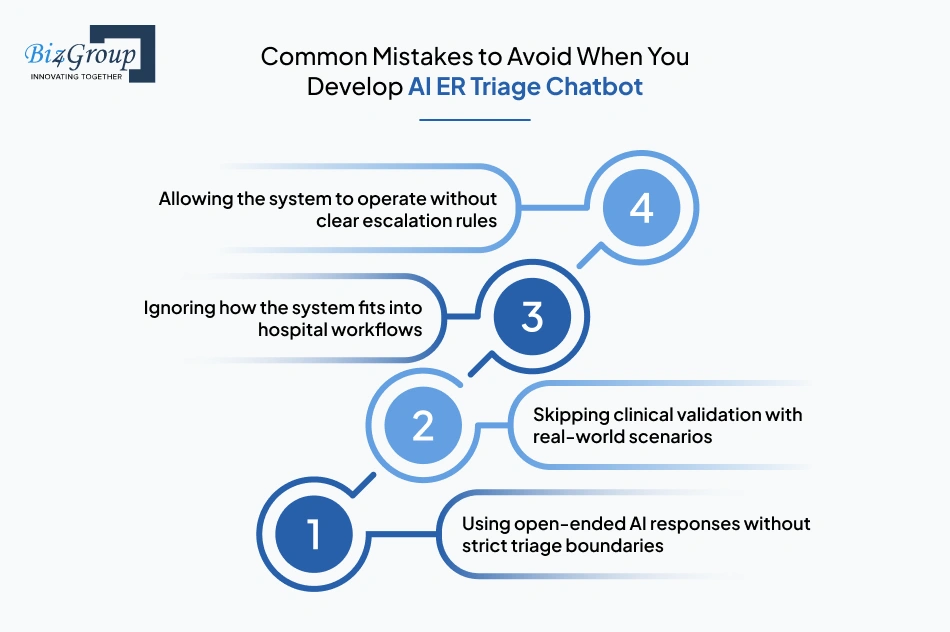
Many failures come from treating triage as a general chatbot problem instead of a controlled decision system.
- Using open-ended AI responses without strict triage boundaries
- Skipping clinical validation with real-world scenarios
- Ignoring how the system fits into hospital workflows
- Allowing the system to operate without clear escalation rules
In practice, teams working with an AI chatbot development company often address these risks early to avoid major rework.
This is where most early-stage systems break down.
3. Strategic Approach to Implementation
A phased approach helps reduce risk and improve system reliability. Instead of building everything at once, teams should validate each layer before scaling.
- Start with limited scope and clearly defined use cases
- Test with real scenarios before expanding coverage
- Introduce automation gradually with control points
- Keep human oversight in all high-risk decisions
This approach is common when developing AI chatbot for hospital triage, where safety and consistency are critical from the start. Teams that build an AI app in healthcare settings often follow phased rollouts to manage risk.
This approach helps maintain control as the system scales.
In most cases, systems that start small, validate early, and expand gradually are more likely to succeed.
Also Read: AI in Healthcare Explained: 130+ Questions Answered for Healthcare Providers and Innovators
Achieve Reliable Triage Decisions Faster
Increase decision speed and accuracy by developing AI chatbot for emergency care that integrates seamlessly into your ER workflows.
Accelerate My Triage Chatbot DevelopmentWhy Choose Biz4Group LLC to Develop an AI ER Triage Chatbot?
Building a triage chatbot for emergency care requires more than technical capability. It requires experience in handling real healthcare inputs, designing controlled decision systems, and ensuring safety under uncertain conditions. To develop an AI ER Triage Chatbot, teams need both engineering depth and healthcare context.
Biz4Group LLC brings this through hands-on work across AI-driven healthcare platforms like Dr Ara, Truman, and CogniHelp, where structured input handling, real-time response systems, and safety-focused interactions were core to the solution design.
What this means in practice:
- Experience with structured health data and symptom-based input systems
- Ability to design controlled decision logic with clear escalation paths
- Focus on safety, guardrails, and predictable system behavior
- Integration with real-world workflows, not isolated prototypes
- Continuous improvement approach based on real usage patterns
As a custom healthcare software development partner, Biz4Group LLC focuses on building systems that are usable in real environments, not just functional in demos.
Wrapping up AI ER Triage Chatbot Development
ER triage is messy. Patients describe symptoms differently, inputs are incomplete, and decisions often need to be made fast. That is exactly where most systems break.
A triage chatbot only works if it can handle that mess without losing control. That means clear decision logic, defined boundaries, and knowing when to stop and hand off.
If you are planning to develop an AI ER triage chatbot, the focus should not be on adding more intelligence, but on making decisions predictable, traceable, and safe to use in real situations.
In practice, the systems that hold up are the ones that start small, validate early, and expand with control, not complexity. Teams working with an AI app development company often take this approach to reduce risk and improve real-world reliability.
Get a practical plan for your AI ER triage chatbot.
FAQs
1. How Accurate Can an AI ER Triage Chatbot Be in Real Use?
Accuracy depends on how well the system is designed, trained, and validated. In controlled scenarios, accuracy can be high, but real-world performance depends on handling incomplete or unclear patient input. Systems that combine structured logic with validation processes tend to perform more reliably.
2. What Data Is Required to Train an AI ER Triage Chatbot?
Training typically requires clinical guidelines, symptom datasets, triage protocols, and historical patient interaction data. The quality and structure of this data are more important than volume, as inconsistent or unverified data can reduce system reliability.
3. How Long Does It Take to Build an AI ER Triage Chatbot?
Development timelines vary based on scope and complexity. A basic version can take a few months, while a fully integrated and validated system may take longer. Time is often spent on testing, validation, and integration rather than just building features.
4. What Is the Cost to Develop an AI ER Triage Chatbot?
The cost to develop an AI ER triage chatbot typically ranges from $15,000 to $150,000+, depending on features, integrations, and complexity. Basic systems with limited functionality fall on the lower end, while advanced, fully integrated solutions with compliance and validation requirements fall on the higher end.
5. Can AI ER Triage Chatbots Replace Human Triage Staff?
No, these systems are designed to assist, not replace, clinical staff. They can handle initial intake, organize patient data, and support prioritization, but final decisions should remain with healthcare professionals, especially in high-risk cases.
6. What Are the Risks of Using AI in Emergency Room Triage?
The main risks include incorrect prioritization, handling of incomplete input, and over-reliance on automation. These risks can be reduced through clear system boundaries, human oversight, and continuous monitoring after deployment.
