 Location :
Orlando, FL, USA
Location :
Orlando, FL, USA +1 (407) 714-1616
 info@biz4group.com

- Developing a virtual nurse app like Sensely means solving real care gaps like pre visit confusion, post visit follow ups, staff overload, and more.
- Healthcare organizations pursue virtual nurse app development like Sensely to improve patient engagement and reduce operational pressure without adding headcount.
- Market signals are strong. Adoption of AI driven virtual care and conversational health tools continues to grow across hospitals, clinics, and digital health platforms.
- Cost typically falls in the USD 20,000 to 150,000 plus range, depending on whether teams start with an MVP or aim for enterprise scale from day one.
- Success depends on clear clinical boundaries, thoughtful conversation design, and long term ownership, especially for live care environments.
- The biggest wins come from steady execution, not feature overload, with teams prioritizing safety, trust, and workflow fit over speed.
The waiting room is packed. Nurses are stretched thin. Patients expect answers now, not tomorrow. If you are leading a healthcare product or digital initiative, this pressure probably feels familiar. That is why more teams are quietly exploring whether developing a virtual nurse app like Sensely could help take the edge off while still giving patients a calm, friendly way to interact with care. It often starts with leaders typing prompts into ChatGPT like:
- virtual nurse app that talks to patients like Sensely
- can an ai nurse guide patients before doctor visit
- ai avatar nurse for hospitals does it actually work
- virtual nurse app for symptom check and follow ups
- how hospitals use ai nurse avatars with patients
This curiosity is not random, it’s backed by market stats:
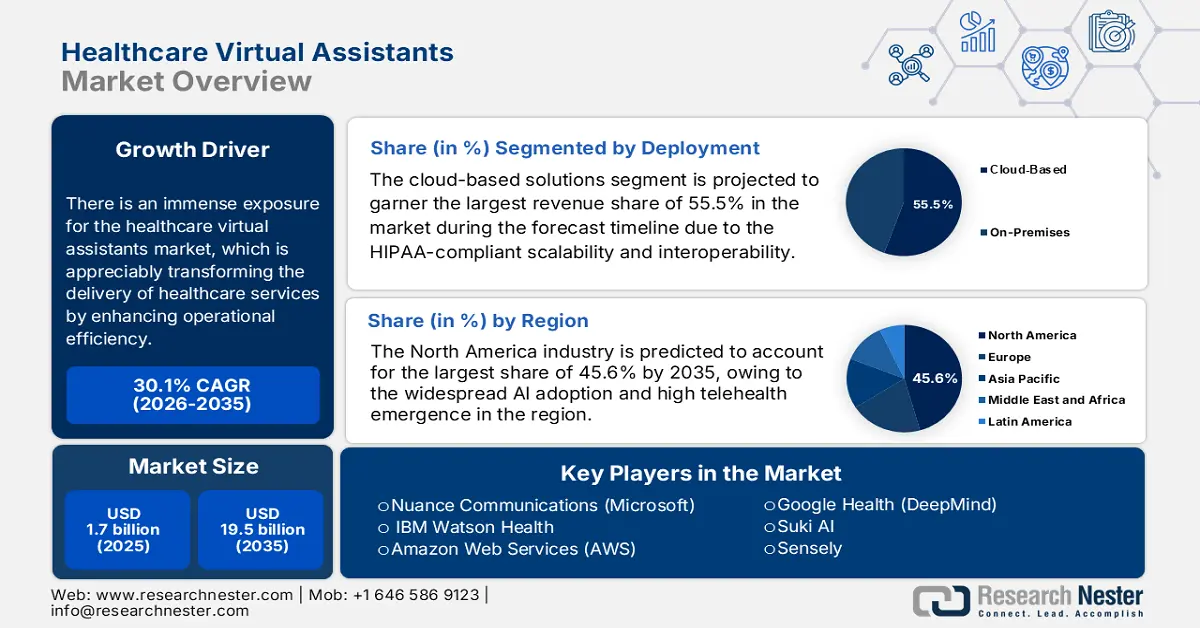
- The healthcare virtual assistants market is projected to grow to nearly USD 19.5 billion by 2035 as providers look for smarter ways to engage patients at scale.
For many decision makers, this is not about replacing nurses or chasing shiny tech. It is about reducing repetitive work, giving patients guidance before they panic, and making care feel more accessible. This is where plans to build AI software often meet the reality of staffing shortages, patient trust, and the need to develop a virtual nurse application like Sensely that actually fits into daily clinical workflows.
If you are exploring virtual nurse app development like Sensely, this guide is meant to help you think clearly about what it takes, what to expect, and what to avoid. We will also cover how AI healthcare solutions fit into long-term care delivery without making things more complicated than they need to be.
What is Sensely and What Makes it So Famous?
A Virtual Nurse App Like Sensely is a digital nurse interface that uses conversational AI and avatars to guide patients through symptoms, care instructions, and follow ups without replacing clinical teams.
- Acts as a first touchpoint before clinical visits
- Supports symptom checks and care guidance
- Uses conversational AI and visual avatars
- Connects patients with immersive care workflows
- Created under AI medical web development standards
Here’s what makes it so popular among heathcare leaders:
- Patients are willing to engage as it feels less clinical and more conversational
- Healthcare teams see fewer repetitive questions before appointments
- The avatar creates familiarity, which improves follow up adherence
- It supports care continuity even outside hospital hours
At its core, developing a virtual nurse app like Sensely is about giving patients timely guidance while easing pressure on care teams and keeping clinical decision making exactly where it belongs.
How Does a Virtual Nurse App Like Sensely Work?
At a glance it looks simple, but under the hood developing a virtual nurse app like Sensely follows a carefully layered flow that balances patient interaction, clinical logic, and system integration. Here is how those pieces come together.
1. Patient Starts the Conversation
The app greets patients through a friendly avatar and natural language chat that feels approachable rather than clinical. This interaction is shaped as an AI conversation app, helping patients open up without feeling like they are filling out a form.
2. Symptoms and Context Are Captured
Patients describe symptoms, concerns, or follow up needs in plain language without feeling rushed. The system structures this input quietly in the background, reflecting proven patterns from chatbot development for healthcare industry workflows.
3. AI Processes and Guides Next Steps
Clinical logic evaluates patient inputs against predefined care pathways to offer guidance or escalation. This is where virtual nurse app development like Sensely puts accuracy, safety, and consistency first.
4. Care Systems Stay in the Loop
Relevant summaries move into existing care systems without flooding teams with raw conversations. Care teams stay informed, and patients experience continuity without extra steps.
|
Layer |
What Happens |
Why It Matters |
|
Interaction |
Avatar led conversation |
Builds patient comfort |
|
Intelligence |
Symptom logic and guidance |
Reduces uncertainty |
|
Integration |
Data flows to care systems |
Keeps teams aligned |
|
Continuity |
Follow ups and reminders |
Improves adherence |
When you look beyond the interface, this approach shows how teams can develop a virtual nurse application like Sensely without disrupting care delivery. It also sets the stage for understanding why organizations are investing in this model now.
Why Invest in Developing a Virtual Nurse App Like Sensely?
Healthcare leaders are being asked to improve access and experience while controlling costs. Developing a virtual nurse app like Sensely often enters the conversation when patient demand grows faster than clinical capacity. The interest is not theoretical. It is operational.
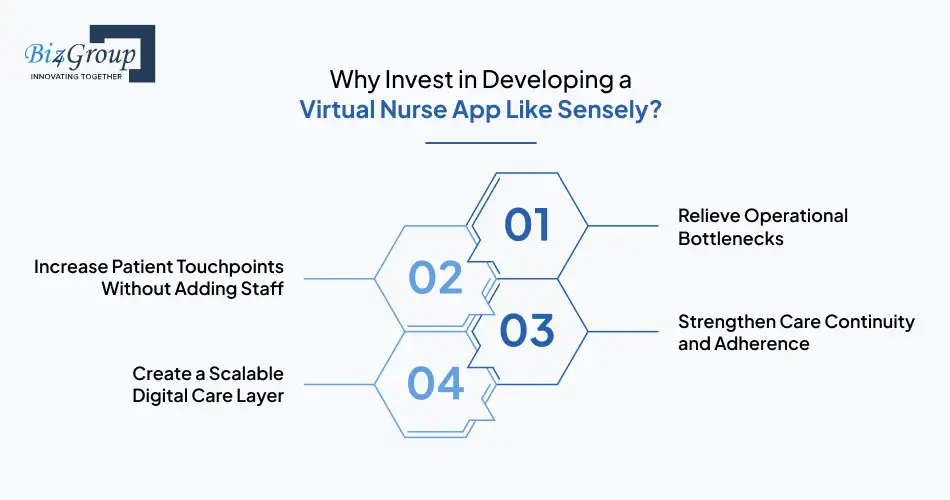
1. Relieve Operational Bottlenecks
Virtual nurse apps absorb repetitive patient questions and early guidance. This reduces inbound calls and pre visit back and forth. Many organizations see this as a practical step toward AI in healthcare administration automation, not a futuristic experiment.
2. Increase Patient Touchpoints Without Adding Staff
Patients interact more frequently when support is always available. When teams build virtual nurse app solutions like Sensely, they create consistent engagement before and after visits. This improves follow through without expanding headcount.
3. Strengthen Care Continuity and Adherence
Guided interactions help patients understand what to do next and when. That clarity reduces missed steps and unnecessary escalation. The experience depends on thoughtful AI assistant app design, not automation for its own sake.
4. Create a Scalable Digital Care Layer
As volumes grow, the app scales while workflows stay stable. Many teams choose to build a virtual nurse app similar to Sensely because it becomes embedded into daily operations rather than acting as a bolt on tool.
Over time, this foundation makes it easier to create AI powered virtual nurse apps for patient care like Sensely that deliver measurable value across multiple patient journeys. From there, the focus naturally shifts to where these apps fit best in real clinical use cases.
Turn Care Conversations into Scalable Systems
See what it really takes to move from concept to execution when developing a virtual nurse app like Sensely for real healthcare workflows.
Explore the Build Approach[Practical Applications of Developing a Virtual Nurse App Like Sensely
When healthcare teams look to scale patient support, the conversation quickly becomes practical. Developing a virtual nurse app like Sensely is not about abstract innovation but about real moments where patients need guidance and teams need support, which becomes clear across these use cases.
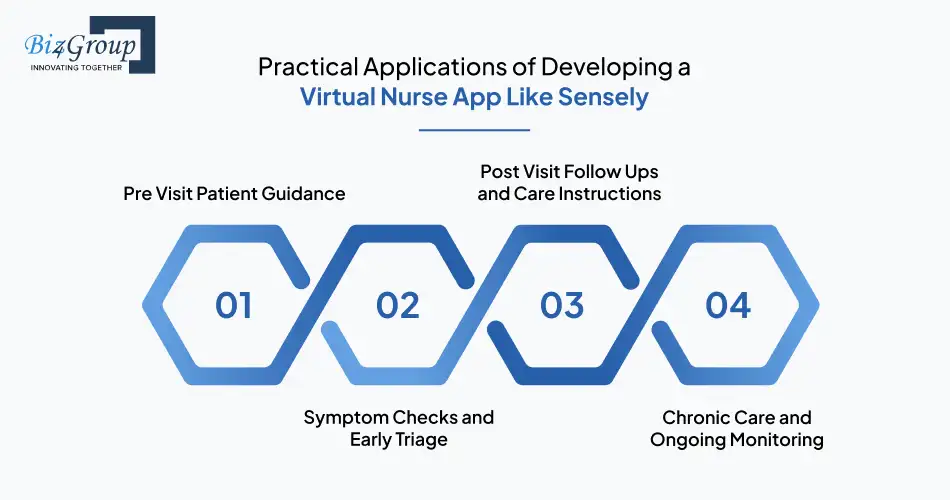
1. Pre Visit Patient Guidance
Patients often arrive unsure about symptoms, paperwork, or next steps. A virtual nurse app steps in early to reduce anxiety and help visits start smoothly. Many organizations rely on AI chatbot integration here alongside custom virtual nurse app development services to shape patient onboarding.
- Example: guiding patients on what symptoms or medical history to prepare before an appointment
2. Symptom Checks and Early Triage
When something feels wrong, patients want quick direction. The app provides structured guidance that helps patients decide what to do next safely. This capability plays a central role in the development of virtual nurse app like Sensely strategies supported by careful AI model development.
- Example: helping patients decide whether to monitor symptoms at home or schedule a visit
3. Post Visit Follow Ups and Care Instructions
Details shared during visits are easy to forget. Virtual nurses reinforce instructions and timelines in a consistent, calm manner. These workflows are commonly part of build HIPAA compliant virtual nurse app solutions like Sensely, often delivered through custom healthcare software development.
- Example: reminding patients about medication schedules or follow up appointments
4. Chronic Care and Ongoing Monitoring
Managing chronic conditions requires steady guidance. Virtual nurse apps maintain engagement and surface issues early. This use case is often prioritized when teams evaluate the best company to develop a virtual nurse app like Sensely as part of broader enterprise AI solutions.
- Example: daily check ins for patients managing diabetes or hypertension.

Dr Ara is an AI powered health platform designed to guide users through injury prevention, recovery, and performance readiness using intelligent assessments and conversational inputs. It demonstrates how AI driven health guidance can scale personalized care, a foundation that closely aligns with patient facing virtual nurse experiences in broader healthcare settings.
Taken together, these scenarios show how virtual nursing fits into daily care delivery. From here, it becomes important to look closer at the features that make these use cases reliable and scalable across different healthcare environments.
Essential Features for Building a Virtual Nurse App Similar to Sensely
Before outcomes and ROI come into focus, the foundation matters. Developing a virtual nurse app like Sensely depends on getting a small set of core features right, because these are what quietly shape trust, usability, and day to day adoption:
|
Core Feature |
What It Does |
Why It Matters |
|
Conversational Interface |
Enables human-like chat with patients |
Lowers friction and increases engagement |
|
Virtual Nurse Avatar |
Provides a visual, human like presence |
Makes interactions feel approachable |
|
Symptom Intake Engine |
Collects structured symptom data |
Supports safe and consistent guidance |
|
Clinical Decision Logic |
Maps inputs to care pathways |
Keeps responses aligned with care standards |
|
Pre Visit Guidance |
Prepares patients before appointments |
Saves time during intake |
|
Post Visit Follow Ups |
Reinforces care instructions |
Improves adherence and outcomes |
|
Escalation Triggers |
Flags when human care is needed |
Maintains clinical safety |
|
Syncs summaries with care systems |
Keeps teams informed without overload |
|
|
Security and Compliance Layer |
Protects patient data |
Builds long term trust |
|
Analytics and Reporting |
Tracks usage and engagement |
Helps teams refine workflows |
The core feature setup is often the difference between pilot projects and platforms that scale. From here, it becomes easier to see how sensely like virtual nurse app development expands through more advanced capabilities that build on this core foundation.
Advanced Features in Developing a Virtual Nurse App Like Sensely
Once the basics are working well, advanced capabilities decide whether the experience actually feels intelligent. Developing a virtual nurse app like Sensely at this level is less about adding features and more about how the system thinks, reacts, and evolves.
1. Adaptive Clinical Intelligence
Patient guidance changes based on history, prior interactions, and care outcomes. Over time, the app stops repeating itself and starts responding with context. Teams often revisit what is the process of creating a virtual nurse app at this stage to support long term learning.
2. Predictive Risk and Escalation Logic
Patterns across interactions can signal risk before symptoms escalate. The app quietly flags concerns and adjusts guidance without alarming patients using predictive analytics. Designing this layer usually benefits from targeted AI consulting services rather than off the shelf logic.
3. Emotion Aware Conversations
Patients do not always say exactly what they feel. Subtle language cues can indicate stress, confusion, or hesitation. This kind of responsiveness relies on generative AI working behind the scenes, leveraging sentiment analysis tools.
4. Personalized Care Pathways
Two patients with the same condition rarely need identical guidance. Content evolves based on adherence, preferences, and past behavior. This is often where teams refine how to develop a virtual nurse app like Sensely for real world diversity.
5. Connected Care Intelligence
Insights gathered during conversations become more valuable when shared at the right moment. Summaries flow into care systems in ways teams can actually use. Making this work smoothly depends on thoughtful AI integration services, not just technical connectors.

Truman is an AI-enabled wellness platform that delivers personalized health recommendations through continuous interaction and user-driven insights. Its focus on engagement, personalization, and ongoing guidance mirrors the behavioral layer required in a Virtual Nurse App Like Sensely, especially for long term patient interaction beyond episodic care.
As these capabilities come together, they begin to shape timelines, scope, and expectations for developing a virtual nurse app like Sensely beyond an initial rollout. From here, the focus naturally shifts toward the practical steps required to turn planning into execution.
From Idea to Patient Ready Experience
Planning to develop a virtual nurse application like Sensely without overengineering or underdelivering? Get clarity before writing a single line of code.
Talk Through Your Use CaseStep by Step Process of Developing a Virtual Nurse App Like Sensely
For healthcare leaders, building a virtual nurse is not about copying features. It is about sequencing decisions correctly so patient trust, clinical safety, and scalability grow together. Developing a virtual nurse app like Sensely works best when each phase is treated as a deliberate checkpoint rather than a rushed milestone.
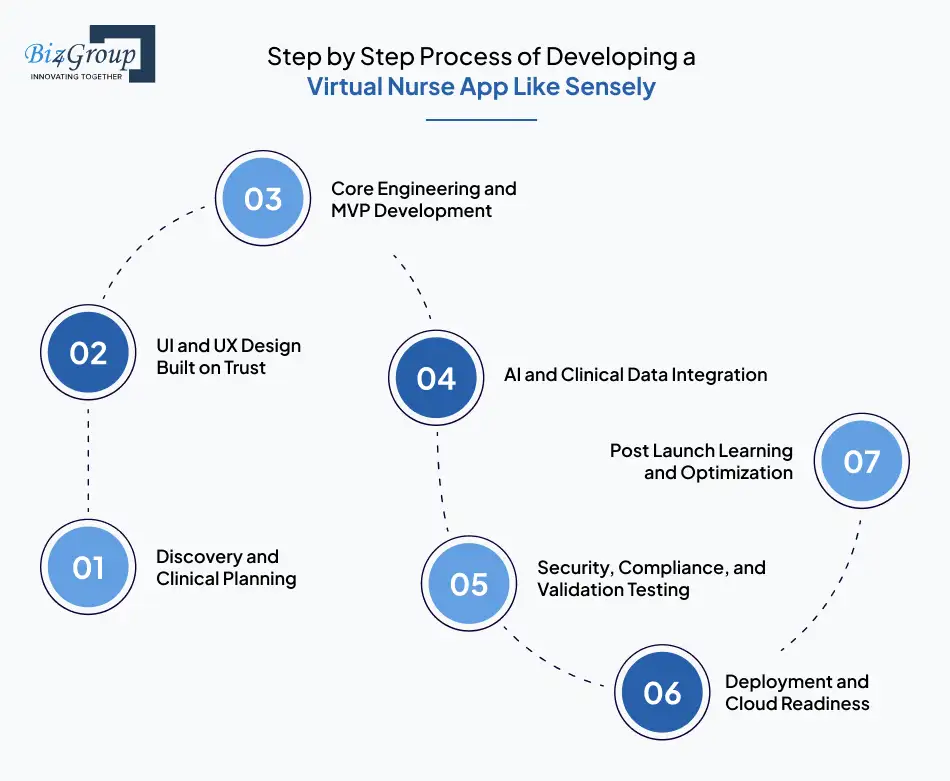
1. Discovery and Clinical Planning
This phase focuses on understanding where a virtual nurse can genuinely support care without increasing risk. During virtual nurse app development like Sensely, teams examine patient journeys to identify moments where guidance is helpful and moments where human intervention must remain central.
- Identify patient friction points across care stages
- Define boundaries for virtual versus human guidance
- Align early with compliance and clinical stakeholders
- Set outcome driven success metrics
2. UI and UX Design Built on Trust
Design is where intention becomes experience. When teams develop a virtual nurse application like Sensely, the interface must feel calm, intuitive, and respectful of patient emotions, especially during moments of uncertainty or stress.
This phase often benefits from experienced healthcare-focused UI/UX design partners.
- Prototype realistic patient conversations
- Prioritize accessibility and clarity
- Test designs with diverse patient groups
- Maintain consistency across devices
Also read: Top UI/UX design companies in USA
3. Core Engineering and MVP Development
Most successful teams avoid building everything at once. Instead, they build virtual nurse app solutions like Sensely by starting with focused MVP development services that prove value through safe, high impact interactions before expanding functionality.
This approach reduces risk and accelerates learning.
- Implement symptom intake and guidance flows
- Create escalation paths to care teams
- Design scalable backend architecture
- Capture early usage insights
Also read: Top 12+ MVP Development Companies to Launch Your Startup in 2026
4. AI and Clinical Data Integration
Intelligence is only valuable when it is reliable. While teams build a virtual nurse app similar to Sensely, they focus on aligning AI behavior with clinical expectations so responses feel consistent, cautious, and context aware.
- Combine pre trained models with clinical logic
- Reduce bias through diverse datasets
- Create clinician feedback loops
- Optimize response clarity
This stage emphasizes relevance over experimentation and training of AI models.
5. Security, Compliance, and Validation Testing
Trust depends on how well patient data is protected. When building a virtual nurse app like Sensely, security and compliance are treated as design constraints rather than afterthoughts.
- Testing here validates safety under real world conditions.
- Validate HIPAA compliance
- Test edge cases in patient conversations
- Perform load and stress testing
- Implement audit and access controls
Also Read: Software Testing Companies in USA
6. Deployment and Cloud Readiness
Once validated, the app must operate reliably at scale. During developing a virtual nurse app like Sensely, teams prepare infrastructure that supports unpredictable usage without compromising performance or availability.
Cloud readiness enables smooth evolution post launch.
- Deploy scalable cloud environments
- Set up monitoring and alerts
- Enable continuous delivery pipelines
- Prepare internal rollout processes
7. Post Launch Learning and Optimization
After launch, real patient behavior becomes the most valuable input. Teams observe how the app performs in live settings and adjust carefully without disrupting trust or familiarity.
This phase ensures long term relevance and safety.
- Track engagement and drop offs
- Collect patient and clinician feedback
- Update logic as guidelines evolve
- Plan incremental enhancements
Together, these steps outline a practical path teams follow to reduce risk and build confidence. With the process clear, the conversation naturally moves toward understanding the technologies required to support developing a virtual nurse app like Sensely at scale and over time.
Build What Patients Actually Use
Strong adoption starts with the right foundation. Learn how teams build virtual nurse app solutions like Sensely that feel helpful, not intrusive.
Validate Your App StrategyTechnology Stack for Virtual Nurse App Development Like Sensely
A Sensely like virtual nurse is only as strong as the systems it connects and the conversations it sustains. This stack reflects what teams typically use when building patient facing AI experiences that must be reliable, secure, and deeply integrated with healthcare operations.
|
Label |
Preferred Technologies |
Why It Matters |
|
Frontend Framework |
ReactJS, VueJS |
Patients interact frequently and expect smooth conversations. Many teams rely on ReactJS development to manage dynamic conversational interfaces without lag. |
|
Server Side Rendering & SEO |
NextJS, NuxtJS |
Performance impacts trust, even in healthcare apps. NextJS development improves load speed and accessibility across devices and patient portals. |
|
Backend Framework |
NodeJS, Python |
This layer handles real time conversations and clinical logic together. NodeJS development supports concurrent sessions, while Python development powers AI driven workflows. |
|
RESTful APIs, GraphQL |
APIs connect the virtual nurse to EHRs, scheduling systems, and care platforms. Clean APIs keep integrations stable as the app scales. |
|
|
AI & Data Processing |
NLP frameworks, ML pipelines |
This is where patient language becomes structured insight. It directly affects how safe, relevant, and human responses feel. |
|
Conversational Engine |
LLM orchestration, dialogue managers |
Keeps conversations guided without feeling scripted. This is critical for avatar based interactions in Sensely like apps. |
|
Integration Layer |
HL7, FHIR, secure middleware |
Healthcare data must move accurately and securely. Strong integration prevents fragmented workflows for care teams. |
|
Data Storage |
HIPAA compliant databases |
Patient conversations and summaries must be stored safely. Storage decisions here directly impact compliance and audit readiness. |
|
Security & Compliance |
Encryption, access controls, audit logs |
Trust is non negotiable in healthcare. These layers protect PHI across every interaction point. |
|
Analytics & Monitoring |
Usage analytics, logging tools |
Understanding how patients actually use the app guides refinement and risk management. |
|
Cloud Infrastructure |
AWS, Azure, GCP |
Patient demand fluctuates. Cloud infrastructure ensures availability during peaks without service disruption. |
This stack reflects the reality of building a Virtual Nurse App Like Sensely, where conversation quality, system integration, and clinical safety must work together without friction. With technology choices mapped clearly, teams can better evaluate timelines, risks, and budgets involved in developing a virtual nurse app like Sensely as it moves from concept to scale.
Development Cost of Virtual Nurse App Like Sensely: MVP to Enterprise
Budget is often the first reality check. For most teams, the cost of a Virtual Nurse App Like Sensely typically falls in the USD 20,000 to 150,000 plus range, depending on scope and maturity. This is a ballpark figure, but it helps frame expectations when developing a virtual nurse app like Sensely.
|
Stage |
Typical Scope |
Estimated Cost Range |
What You Are Paying For |
|
MVP Virtual Nurse App |
Basic symptom intake, simple guidance, safe escalation |
20,000 to 40,000 USD |
Validation of core idea, early patient feedback |
|
Mid-Level Virtual Nurse App |
Avatar interaction, integrations, follow ups |
40,000 to 80,000 USD |
Stronger engagement and workflow alignment |
|
Advanced Virtual Nurse App |
Smarter logic, analytics, scalability |
80,000 to 120,000 USD |
Operational efficiency and reliability |
|
Enterprise-Grade Virtual Nurse App |
Advanced AI, deep integrations, compliance layers |
120,000 to 150,000+ USD |
Scale, security, and long-term sustainability |
What drives cost is not just features, but decisions around safety, integration depth, and future readiness. Teams building a virtual nurse app like Sensely often discover that investing a bit more early reduces rework and risk later.
Now that the cost picture is clearer, let's talk about how these investments can create sustainable revenue.
Also Read: AI App Development Cost in 2026 – Know How Much Your App Will Cost
Monetization Strategies for Developing a Virtual Nurse App Like Sensely
Revenue planning usually starts once value is proven. Developing a virtual nurse app like Sensely opens multiple monetization paths that align with how healthcare organizations actually buy, deploy, and scale digital care tools. Below are the models teams explore most often.
1. Enterprise Licensing for Healthcare Organizations
Hospitals and large health systems prefer predictable pricing that scales with deployment. Licensing allows them to roll out a virtual nurse across departments without managing per patient charges. This approach is common when teams develop a virtual nurse application like Sensely as an operational platform.
- Example: annual licensing tied to number of facilities or active patient conversations, bundled with onboarding and support.
2. Subscription Based SaaS Model
Clinics and telehealth providers often favor subscriptions that grow with usage. Tiered plans give flexibility while keeping costs aligned with value delivered. This model frequently appears in virtual nurse app development like Sensely initiatives targeting mid sized providers.
- Example: monthly plans based on interaction volume with optional upgrades for analytics or integrations.
3. White Label Solutions for Digital Health Partners
Some organizations want a virtual nurse under their own brand. White labeling enables faster market entry without internal build out. This path is often chosen when working with a custom software development company experienced in healthcare platforms.
- Example: branded deployments for digital health startups with setup fees and recurring contracts.
4. Customization and Integration Revenue
Healthcare environments vary widely, and customization becomes a revenue stream over time. Teams that build virtual nurse app solutions like Sensely often charge for workflow adjustments and system integrations.
- Example: custom EHR connectivity or condition specific care flows priced by scope.
5. Insights and Care Optimization Services
Beyond conversations, aggregated interaction data can support operational insight. Offered carefully, this positions the app as a healthcare conversational AI guide rather than a simple interface.
- Example: premium dashboards showing engagement patterns and follow up adherence trends.
Most of these models rely on thoughtful business app development using AI and collaboration with an AI app development company that understands healthcare realities.
Make Cost and Scope Work Together
Whether you are starting lean or planning enterprise scale, understand what building a virtual nurse app like Sensely really involves from a cost and effort perspective.
Estimate My App Build[Challenges in Developing a Virtual Nurse App Like Sensely and Solutions
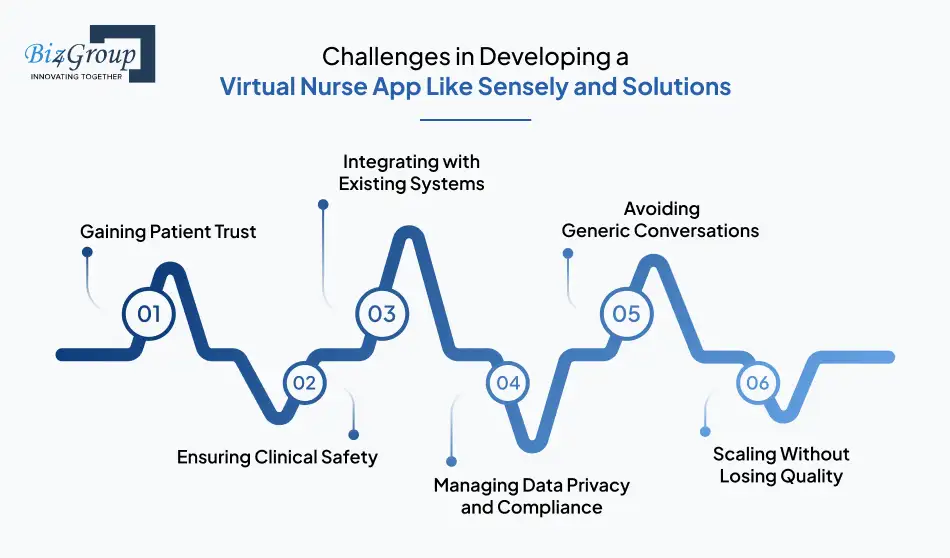
Even with clear value, execution is rarely straightforward. Developing a virtual nurse app like sensely brings together clinical risk, patient expectations, and technical complexity, which means certain hurdles show up consistently once teams move past the idea stage.
Here are the top challenges and how you can solve them:
|
Top Challenges |
How to Solve Them |
|
Gaining Patient Trust |
Use clear language, transparent guidance, and a consistent avatar experience, so interactions feel supportive instead of clinical or automated. |
|
Ensuring Clinical Safety |
Define strict boundaries for guidance and escalation, with clinicians involved in validating every care pathway from day one. |
|
Integrating with Existing Systems |
Plan integrations early so the app fits current workflows instead of forcing teams to change how they work. |
|
Managing Data Privacy and Compliance |
Build privacy into architecture choices and workflows, not as an afterthought. This often shapes early design decisions. |
|
Avoiding Generic Conversations |
Invest in contextual logic so responses feel relevant to the patient and situation. This is where teams rely on an AI chatbot development company with healthcare experience. |
|
Scaling Without Losing Quality |
Design for gradual expansion so performance and response quality stay consistent as usage grows. |
Teams that approach these issues deliberately tend to move faster and with fewer setbacks. Solving challenges related to virtual nurse app development like Sensely is one thing, inculcating best development practices is another – which is exactly what we’re going to cover in the next section.
Best Practices for Developing a Virtual Nurse App Like Sensely
In healthcare, polish never compensates for poor judgment. Developing a virtual nurse app like Sensely succeeds when teams slow down early, make deliberate choices, and respect how patients and clinicians actually behave. These practices show up consistently in products that earn trust:
1. Ground Every Decision in Clinical Reality
Virtual nurses should reflect how care is delivered, not how diagrams imagine it. Teams that spend time with clinicians early tend to avoid overpromising features that later become liabilities. This grounding is often what separates rushed builds from teams that successfully build a virtual nurse app similar to Sensely and keep it in use.
2. Treat Conversation Design as Product Design
Patients experience the app through words, pacing, and tone long before they notice features. Mapping conversations first changes how the entire product comes together. This approach becomes especially important when navigating AI chatbot development for medical diagnosis, where clarity and restraint matter more than sophistication.
3. Apply Automation With Intent, Not Enthusiasm
Automation is powerful, but in healthcare it should support understanding, not replace reasoning. Virtual nurses work best when automation removes friction without taking control away from clinicians or patients. Many teams learn this the hard way when leaning too early on AI automation services.
4. Think About Integration as a Workflow Choice
How information flows affects adoption as much as what information flows. When data fits naturally into existing systems, teams trust it faster. Projects that plan early to integrate AI into an app usually see smoother clinical acceptance and fewer internal objections.
5. Plan for Ownership After Launch
A virtual nurse is never finished. Guidelines change, patient expectations shift, and usage reveals gaps no roadmap predicted. Whether teams partner with an AI company or decide to hire AI developers internally, long term stewardship matters more than speed to launch.
When these practices guide execution, it becomes far easier to build virtual nurse app solutions like Sensely that feel dependable rather than experimental. Now, let’s explore how this space is evolving and what future capabilities may soon become expected.
Turn AI into a Reliable Care Layer
Virtual nurses succeed when they fit real workflows. Discover how virtual nurse app development like Sensely balances safety, integration, and growth.
Design My Virtual Nurse AppThe Future of Virtual Nurse App Development Like Sensely
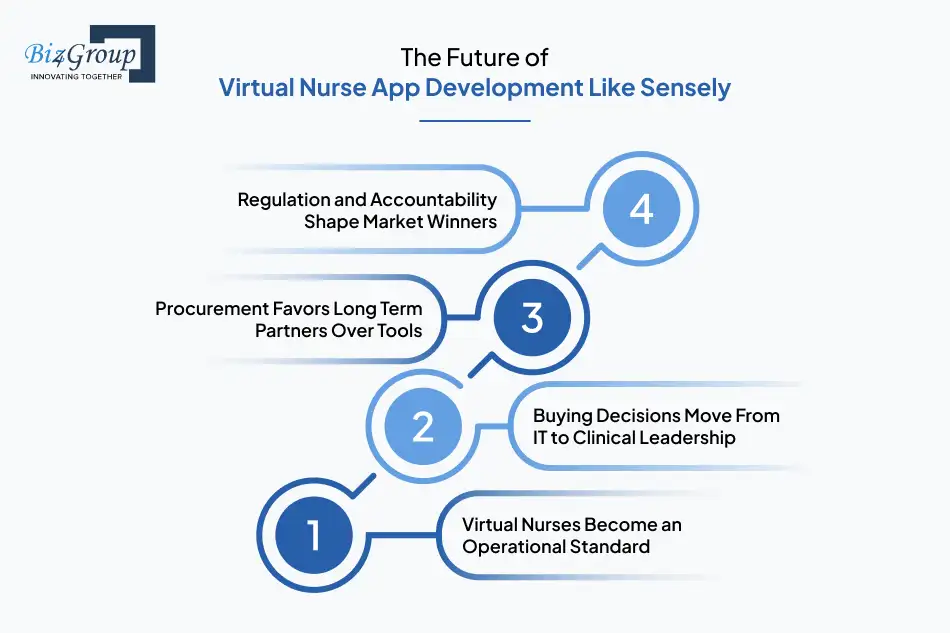
The conversation around virtual nurses is shifting from experimentation to expectation. Developing a virtual nurse app like Sensely is increasingly shaped by how healthcare systems buy, regulate, and operationalize digital care, which points clearly to what the next phase looks like.
1. Virtual Nurses Become an Operational Standard
Virtual nurses are moving into baseline care operations rather than innovation pilots. Hospitals will treat them as part of intake, discharge, and continuity planning. This shift raises the bar for teams that want to build HIPAA compliant virtual nurse app solutions like Sensely that can stand up to daily clinical use.
2. Buying Decisions Move From IT to Clinical Leadership
Early adoption was often IT driven. Future investments will be led by clinical and operations teams focused on outcomes and workflow fit. Organizations working with a software development company in Florida are already adjusting product strategy to reflect this change in buyer mindset.
3. Procurement Favors Long Term Partners Over Tools
Healthcare buyers are becoming cautious of point solutions. Preference is shifting toward vendors who can support evolution, compliance, and scale over time. This trend increases demand for custom virtual nurse app development services rather than off the shelf platforms.
4. Regulation and Accountability Shape Market Winners
Clearer regulatory expectations will reduce ambiguity and raise entry barriers. Companies that proactively design for governance will move faster later. This is where experience from the top AI development companies in Florida starts to matter more than feature breadth.
As these forces take hold, success will depend less on novelty and more on execution maturity. That is why many organizations evaluating next steps naturally begin asking about the best company to develop a virtual nurse app like Sensely that understands healthcare realities beyond the product itself.
Why Choose Biz4Group for Developing a Virtual Nurse App Like Sensely?
Building a virtual nurse is not just a technical exercise. It requires judgment, healthcare context, and experience translating AI into products that people actually use. Biz4Group approaches this work with a product mindset shaped by real deployments in AI driven healthcare platforms.
Our experience building platforms like Dr Ara and Truman reflects a deep understanding of patient engagement, conversational guidance, and long term interaction design. These projects demonstrate how AI can support health decisions responsibly, which directly informs how we approach Virtual Nurse App Like Sensely development.
What sets Biz4Group apart
- Proven experience delivering AI driven healthcare platforms, not prototypes
- Strong product thinking that balances patient trust with technical execution
- Hands on expertise in conversational flows, clinical logic, and system integration
- A delivery approach shaped by real world usage and iteration
As an AI product development company, Biz4Group focuses on building solutions that hold up beyond launch. We help organizations move from concept to a dependable virtual nurse experience.
Build with Confidence, Not Guesswork
If you are evaluating partners to execute responsibly, align early with teams experienced in developing a virtual nurse app like Sensely at scale.
Discuss My ProjectConclusion
If you zoom out, a Virtual Nurse App Like Sensely is really about one thing: stopping preventable chaos. Fewer confused patients, fewer unnecessary calls, fewer moments where staff are doing work a screen could have handled first. That is the real value.
Everything in this guide points to the same truth. This is not a race to build the smartest AI. It is a discipline problem. Do the basics well, respect clinical boundaries, and design for real humans on both sides of the screen. With the right AI development company, the app does not try to be impressive. It just quietly does its job, which in healthcare is exactly what you want.
FAQs
1. Is a Virtual Nurse App Like Sensely meant to replace nurses or clinicians?
No. These apps are designed to reduce cognitive and administrative load, not clinical responsibility. When teams build virtual nurse app solutions like Sensely, the goal is to support nurses with early guidance and follow ups, not remove human judgment from care delivery.
2. How long does it usually take to build a Virtual Nurse App Like Sensely?
Timelines depend on scope and readiness, but most teams begin with a focused MVP before expanding. Organizations that develop a virtual nurse application like Sensely often prioritize speed to learning rather than speed to full rollout.
3. Can a Virtual Nurse App Like Sensely be customized for specific conditions or specialties?
Yes. Most implementations start narrow and expand over time. During sensely like virtual nurse app development, customization is usually aligned to specific care pathways, specialties, or patient populations rather than building everything upfront.
4. How do hospitals measure success after launching a Virtual Nurse App?
Success is rarely about raw usage. Teams look at operational outcomes like fewer inbound calls, smoother intake, and better follow through. These metrics become clearer as virtual nurse app development like Sensely matures inside an organization.
5. What kind of patient adoption challenges should be expected early on?
Early hesitation is common, especially among patients unfamiliar with digital care tools. Clear language and predictable behavior help build comfort. Teams building a virtual nurse app like Sensely often plan adoption in phases rather than expecting instant acceptance.
6. How much does it cost to develop a Virtual Nurse App Like Sensely?
The cost typically falls between USD 20,000 to 150,000 plus, depending on scope, integrations, and compliance needs. This is a ballpark range and varies widely across the development of Virtual Nurse App Like Sensely projects.
