Location :
Orlando, FL, USA
Location :
Orlando, FL, USA +1 (407) 714-1616
 info@biz4group.com

 AI Summary Powered by Biz4AI
- Building an agentic AI workflow automation system helps enterprises replace manual routing, and repetitive tasks with scalable and efficient workflows.
- Companies can develop AI agents for business workflow automation to handle decisions, coordinate multi step processes, and reduce operational drag across departments.
- Teams looking to build intelligent workflow automation using agentic AI can streamline healthcare workflows while maintaining accuracy and compliance.
- Research shows 70 percent of organizations adopting AI driven workflow systems report measurable efficiency improvements and reduced operational bottlenecks.
- Costs typically range from $10,000 to $150,000, depending on workflow complexity, number of integrations, security requirements, and customization needs.
- As AI automation ecosystems expand, businesses can create scalable AI workflow orchestration system to unify tools, and support long term operational growth.
Juggling a prescription because insurance rejected it or a pharmacy flagged a dosage issue is the type of friction that still shows up in far too many clinics. Now imagine replacing that chaos with a streamlined platform that sends accurate prescriptions instantly, checks for errors automatically, and keeps providers moving. This is the real-world problem e-prescription (eRx) software development is meant to solve, and it naturally raises some important questions worth answering.
- How to build e prescription software that doctors can use without slowing down their workflow?
- Can eRx software check drug interactions and allergies for providers?
- Top features to make e prescription tools compliant with healthcare regulations?
- How to integrate eRx software with existing EHR systems in clinics or hospitals?
- What’s the cost to develop secure e prescription software for healthcare providers?
Here’s why these questions matter:
- About 30 million prescribers active use e-prescribing, with roughly 2.5 billion electronic prescriptions processed annually across the U.S. healthcare system.
- 94 percent of all prescriptions in the United States are now filled electronically, according to National Association of Boards of Pharmacy.
Adoption at this scale explains why more organizations are choosing to build eRx solutions for clinics and hospitals rather than relying on disconnected or outdated workflows.
If you’re responsible for healthcare technology decisions, this probably feels familiar. You are balancing clinician burnout, aging infrastructure, regulatory pressure, and rising patient expectations, all while trying not to introduce tools that slow people down. Prescribing workflows sit right in the middle of that tension, where even small inefficiencies quickly turn into daily frustration for providers and operational pain for leadership.
Behind many modern prescribing platforms sits an experienced AI app development company, helping healthcare organizations translate complex clinical requirements into intuitive digital products.
At the same time, forward-looking providers increasingly expect prescribing tools to work alongside broader AI healthcare solutions that support smarter decisions without adding cognitive load.
If you’re a founder, CTO, or healthcare IT leader evaluating whether to develop e-prescription software for healthcare, the sections ahead walk through how this technology works, where the real challenges live, and what it takes to build it right in today’s healthcare environment.
What Is an E-prescription (eRx) software and How Does it Work?
Electronic prescription software is a healthcare solution that enables providers to create and manage prescriptions digitally instead of relying on handwritten or printed prescriptions. It validates prescription details, securely transmits prescriptions to pharmacies, and keeps every prescribing activity recorded within a centralized system.
Digital prescription software also connects with EHR/EMR platforms, pharmacy networks, and insurance systems to support accurate prescription management, medication history, prescription renewals, and clinical validation throughout the prescribing process.
How Does E-Prescription (eRx) Software Work?
Every prescription moves through a predefined workflow before medication reaches the patient. Each stage performs a specific function to ensure prescriptions remain accurate, secure, and compliant throughout the process.
Step 1: Patient Information is Retrieved
- The software retrieves patient demographics, allergies, diagnoses, and medication history from connected healthcare records.
- Existing prescriptions are reviewed to provide complete clinical context before prescribing begins.
- Insurance and pharmacy preferences are loaded when integrated with external systems.
- The patient's information becomes the reference point for every validation performed in later stages.
Step 2: Prescription Details are Created
- The provider selects the required medication, dosage, frequency, and treatment duration.
- Clinical instructions are attached to guide pharmacy dispensing.
- Mandatory prescription information is verified before submission.
- Controlled medications trigger additional verification requirements where applicable.
Step 3: Clinical Validation Runs Automatically
- Every prescription is evaluated against allergy records, medication history, and clinical rules.
- Drug interactions, duplicate therapies, and contraindications are identified automatically.
- Dosage accuracy is checked against available patient information.
- If a risk is detected, the workflow pauses until the prescription is reviewed.
Step 4: The Prescription is Authorized and Transmitted
- Authorized providers digitally approve the prescription before transmission.
- Prescription data is encrypted throughout electronic exchange.
- The software routes the prescription directly to the selected pharmacy.
- Every transaction is recorded to support regulatory audits and future reference.
Step 5: The Pharmacy Reviews and Processes the Prescription
- Pharmacy systems receive the prescription electronically without manual data entry.
- Pharmacists review medication details before dispensing.
- Clarification requests are exchanged digitally whenever prescription updates are required.
- Dispensing status is synchronized with connected healthcare systems.
Step 6: Prescription Records Remain Connected
- Every prescribing activity is stored within the patient's medication history.
- Renewal requests follow the same digital workflow instead of restarting the process.
- Providers can monitor prescription status until fulfillment is complete.
- Historical prescription records remain available for future consultations and compliance reporting.
Understanding this workflow helps organizations plan prescription management software development around secure clinical processes, connected healthcare systems, and reliable prescription management from creation to fulfillment.
Rebuild Your Operations for the Future
Start building an agentic AI workflow automation system that eliminates bottlenecks and helps your team work smarter every day.
Start My AI Workflow SystemWhy Invest in E-Prescription (eRx) Software Development?
If the goal is simply to replace paper prescriptions, the return on investment will always seem limited. The real value of e-prescription (eRx) software development comes from solving the operational challenges that healthcare teams deal with every day; manual prescribing, fragmented systems, compliance pressure, and growing patient volumes.
It's one of the reasons the global e-prescribing market, valued at USD 4.02 billion in 2026, is expected to reach USD 14.68 billion by 2034, growing at a 17.59% CAGR. Healthcare organizations aren't investing because it's a trend; they're investing because digital prescribing has become a business necessity.
1. Spend Less Time Managing Prescriptions
Every manual step in the prescribing process adds time that clinicians could spend on patient care. Pharmacy callbacks, prescription corrections, refill coordination, and incomplete documentation create unnecessary administrative work. A well-designed eRx platform automates these workflows, helping clinical teams work faster without disrupting existing processes.
2. Reduce Clinical and Financial Risk
A prescribing mistake doesn't just affect patient safety it can also lead to compliance issues, financial losses, and operational delays. The same applies to prescription fraud, which costs the United States an estimated USD 250 billion every year. Investing in digital prescribing helps organizations strengthen prescription validation, improve traceability, and reduce avoidable risks before they become costly problems.
3. Keep Pace with Changing Compliance Requirements
Compliance requirements continue to evolve, and electronic prescribing is quickly becoming the standard rather than the exception. Today, 82% of prescribers and nearly all pharmacies are EPCS-enabled, driven by federal mandates for electronically prescribing controlled substances. Building compliance into the platform from day one is far more practical than adapting legacy workflows later.
4. Connect Every System Involved in Prescribing
A prescription rarely stays within one system. It moves between providers, pharmacies, EHRs, insurance platforms, and sometimes laboratories before medication reaches the patient. Investing in e-prescription software creates a connected workflow where prescription data flows securely between systems instead of being re-entered, verified, or corrected at every stage.
5. Build for Today's Operations and Tomorrow's Requirements
Healthcare technology changes continuously, whether it's new regulations, AI-driven clinical support, or expanding care models. A scalable eRx platform makes it easier to introduce new capabilities without rebuilding the prescribing workflow every time the business evolves, protecting both the initial investment and future development budgets.
The strongest business case for creating electronic prescription software isn't replacing paper, it's building a prescribing ecosystem that reduces operational complexity, supports compliance, and continues delivering value as healthcare requirements evolve.
Key Use Cases of Developing E-prescription Software for Healthcare
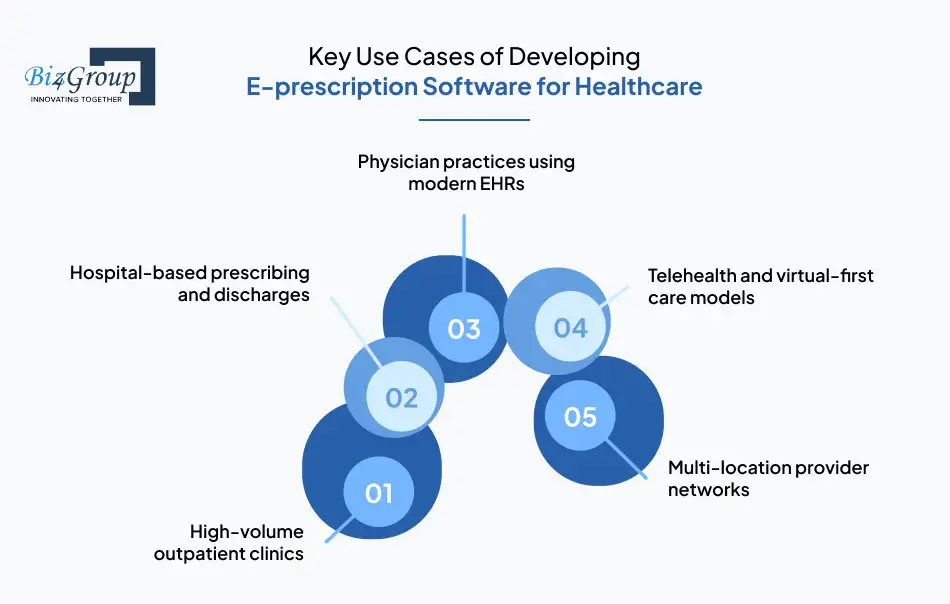
As digital care scales, real value shows up when prescribing adapts to how care is actually delivered. e-prescription (eRx) software development comes into focus across settings where accuracy, speed, and coordination matter most, including the practical scenarios below.
1. High-volume outpatient clinics
Busy clinics depend on speed without losing safety, especially during peak appointment hours. Streamlined prescribing helps clinicians complete visits without follow-up calls or rewrites. Many platforms here are built with support from an AI chatbot development company to keep workflows fast and intuitive.
- Example: Multi-provider clinics handling same-day medication starts for chronic patients
2. Hospital-based prescribing and discharges
Hospitals need consistency across departments, shifts, and discharge planning. Prescriptions created during inpatient care must align cleanly with outpatient follow-ups. Organizations often build integrated e-prescription systems to maintain continuity and reduce handoff risks.
- Example: Discharge prescriptions synced with outpatient pharmacy fulfillment
3. Physician practices using modern EHRs
Standalone practices benefit when prescribing feels native to tools clinicians already trust. Embedded experiences reduce friction and boost adoption. This is where e-prescription software development for doctors intersects with efforts to create eRx modules for EHR platforms supported by AI integration services.
- Example: Prescriptions written directly within existing charting screens
4. Telehealth and virtual-first care models
Remote care requires prescribing that works immediately after a visit ends. Clear digital flows prevent delays and confusion for patients. Some teams develop digital prescribing tools using AI conversation app interfaces to support virtual encounters.
- Example: Instant prescription delivery after video consultations
5. Multi-location provider networks
Distributed organizations need consistency without micromanaging every clinic. Centralized prescribing logic reduces variance while allowing local flexibility. Many systems rely on AI model development to support this balance.
- Example: Unified prescribing policies enforced across multiple regions.
|
Healthcare Setting |
Primary Need |
Outcome |
|---|---|---|
|
Outpatient clinics |
Speed and volume |
Faster visits |
|
Hospitals |
Care continuity |
Safer discharges |
|
Physician practices |
EHR alignment |
Higher adoption |
|
Telehealth |
Instant delivery |
Better patient access |
|
Provider networks |
Standardization |
Operational clarity |

Dr. Ara is a HIPAA compliant AI health companion built by Biz4Group, that guides athletes with personalized insights, injury support suggestions, and real time recommendations, backed by secure data processing. Solutions like this show how structured health data and autonomous decisioning can power agentic workflows in enterprise grade automation systems.
Across these scenarios, organizations lean on e-prescription (eRx) software development services to meet clinical demands without reshaping how clinicians work. That naturally brings attention to how well these prescribing systems connect with the platforms around them.
Interoperability Considerations in E-prescription (eRx) Software Development
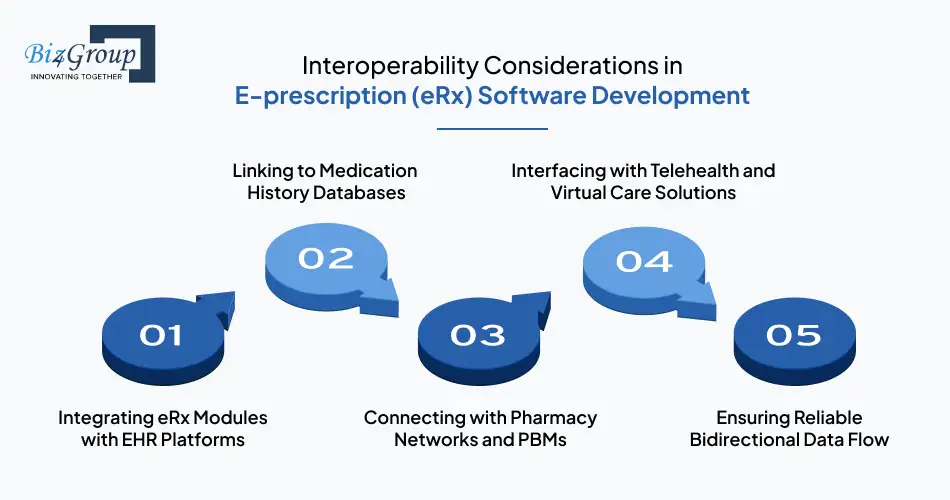
Smooth prescribing depends on how well systems talk to each other, not just how polished they look. e-prescription (eRx) software development only works at scale when data moves cleanly across platforms, which brings these interoperability considerations into focus.
1. Integrating eRx Modules with EHR Platforms
Prescribing must fit naturally inside existing clinical workflows rather than sit beside them. Medication lists, allergies, and clinical history need consistent access. This is central to the broader development of e-prescription applications in real care environments.
2. Linking to Medication History Databases
Accurate prescribing requires visibility into what patients are already taking. Shared medication history reduces duplication and adverse interactions. Many teams hire AI developers to help manage these complex data relationships.
3. Connecting with Pharmacy Networks and PBMs
Electronic medication prescribing software rely on standardized messaging to reach the right destination. Formulary checks and benefit data influence decisions in real time. Pharmacy management system integration are essential to make prescription automation software reliable and predictable.
4. Interfacing with Telehealth and Virtual Care Solutions
Remote care demands prescriptions that sync instantly after a visit. Refills and updates must stay aligned without extra steps. Some platforms introduce AI chatbot integration to support continuity between visits.
Also Read: How to Develop an AI-Based Telehealth Automation System: Step-by-Step Guide
5. Ensuring Reliable Bidirectional Data Flow
Prescribing is not a one-way transaction. Acknowledgements, cancellations, and renewals all need to return cleanly to the source system. Without this feedback loop, trust in the workflow erodes quickly.
When done well, interoperability quietly supports everything else the erx prescription software development promises. It also shapes the thinking behind how to develop e-prescription (eRx) software for healthcare providers before features and functionality come into play.
What Key Features Are Required to Build E-prescription (eRx) Software for Healthcare Organizations
Modern e prescription software development isn't just about enabling digital prescriptions. The real value comes from building a platform that simplifies prescribing, connects with healthcare systems, meets regulatory requirements, and supports day-to-day clinical workflows. While feature priorities differ across healthcare organizations, the following capabilities form the foundation of scalable eRx software development.
1. Clinical Prescribing & Medication Management
Clinical prescribing capabilities manage prescription creation, medication validation, and refill workflows while helping providers reduce prescribing errors and improve treatment accuracy.
|
Feature |
Purpose |
|---|---|
|
Electronic Prescription Creation |
Create, sign, and transmit prescriptions electronically across connected pharmacy networks. |
|
Medication History |
Access complete medication records for accurate and informed prescribing decisions. |
|
Drug Interaction Checks |
Identify harmful drug interactions before prescription approval. |
|
Allergy Verification |
Prevent prescriptions that conflict with documented patient allergies. |
|
Dosage Validation |
Verify dosage recommendations based on patient and medication data. |
|
Prescription Renewal Management |
Automate refill requests and physician approval workflows. |
|
Electronic Prescription Cancellation |
Cancel or modify transmitted prescriptions before dispensing. |
|
Controlled Substance Prescribing (EPCS) |
Enable secure electronic prescribing of controlled medications with regulatory compliance. |
2. Patient & Care Coordination
Connected patient and provider workflows reduce administrative delays, improve treatment continuity, and simplify communication throughout the prescribing process.
|
Feature |
Purpose |
|---|---|
|
Patient Profile Management |
Maintain centralized demographics, medical history, allergies, and medication records. |
|
Provider Dashboard |
Manage prescriptions, approvals, renewals, and patient requests from one interface. |
|
Prescription Status Tracking |
Monitor prescription progress from creation to pharmacy fulfillment. |
|
Medication Adherence Tracking |
Monitor refill behavior and medication compliance trends. |
|
Automated Patient Notifications |
Send prescriptions, refills, and medication reminders automatically. |
|
Digital Prescription Archive |
Store prescription records for future reference and compliance. |
|
Multi-Provider Collaboration |
Share medication information securely across authorized care teams. |
3. Healthcare Integrations & Interoperability
Integrated healthcare systems eliminate duplicate data entry, improve clinical coordination, and enable secure information exchange across the healthcare ecosystem.
|
Feature |
Purpose |
|---|---|
|
Synchronize patient records, diagnoses, and medication information automatically. |
|
|
Pharmacy Network Integration |
Send prescriptions directly to connected retail and specialty pharmacies. |
|
Prescription Drug Monitoring Program (PDMP) Integration |
Review controlled substance history before prescribing medications. |
|
Exchange standardized healthcare data across connected clinical systems. |
|
|
Electronic Prior Authorization system (ePA) |
Automate insurance approval requests for prescribed medications. |
|
Insurance Eligibility Verification |
Verify medication coverage before prescription submission. |
|
Laboratory Integration |
Use diagnostic results to support medication decisions. |
Also Read: A Complete Guide to AI EMR/EHR Software Development
4. AI Automation & Clinical Intelligence
AI capabilities strengthen e-rx software development by supporting intelligent prescribing and predictability, automating routine clinical tasks, and improving medication safety through data-driven recommendations.
|
Feature |
Purpose |
|---|---|
|
Intelligent Prescribing and Predictability |
Recommend safer medications using patient history and clinical risk analysis. |
|
AI Clinical Decision Support |
Deliver evidence-based prescribing recommendations during consultations. |
|
Predictive Medication Risk Analysis |
Identify potential adverse medication events before prescription approval. |
|
AI Dosage Optimization |
Recommend personalized dosage adjustments using patient-specific clinical data. |
|
Duplicate Therapy Detection |
Detect medications with overlapping therapeutic effects. |
|
AI Refill Prioritization |
Prioritize refill requests based on treatment urgency. |
|
Prescription Fraud Detection |
Identify suspicious prescribing and refill patterns automatically. |
|
Prescribing Analytics |
Analyze prescribing trends across providers, medications, and patient populations. |
5. Compliance, Security & Administration
Compliance and governance capabilities protect patient information, strengthen platform security, and support regulatory requirements across healthcare organizations.
|
Feature |
Purpose |
|---|---|
|
HIPAA Compliance Controls |
Protect electronic health information through privacy and security safeguards. |
|
Role-Based Access Control |
Restrict system access based on authorized user roles. |
|
Multi-Factor Authentication |
Strengthen user authentication for secure platform access. |
|
Audit Trails |
Record prescribing activities for compliance and investigations. |
|
End-to-End Data Encryption |
Secure prescription data during storage and transmission. |
|
Provider Identity Verification |
Validate prescriber’s credentials before granting prescribing access. |
|
Multi-Facility Management |
Manage users, permissions, and workflows across multiple locations. |
|
Regulatory Reporting |
Generate compliance reports for healthcare authorities and administrators. |
Choosing the right features early makes every stage of eRx software development more efficient, from implementation and integration to future upgrades. A well-planned feature roadmap also helps e-prescribing software stay aligned with evolving clinical workflows, compliance requirements, and organizational goals.
Automate What Slows Your Team Down
Use AI workflow automation system development to streamline tasks, reduce manual load, and upgrade mission critical workflows.
Optimize My Workflows
Step-by-Step Process to Develop E-prescription Software for Healthcare
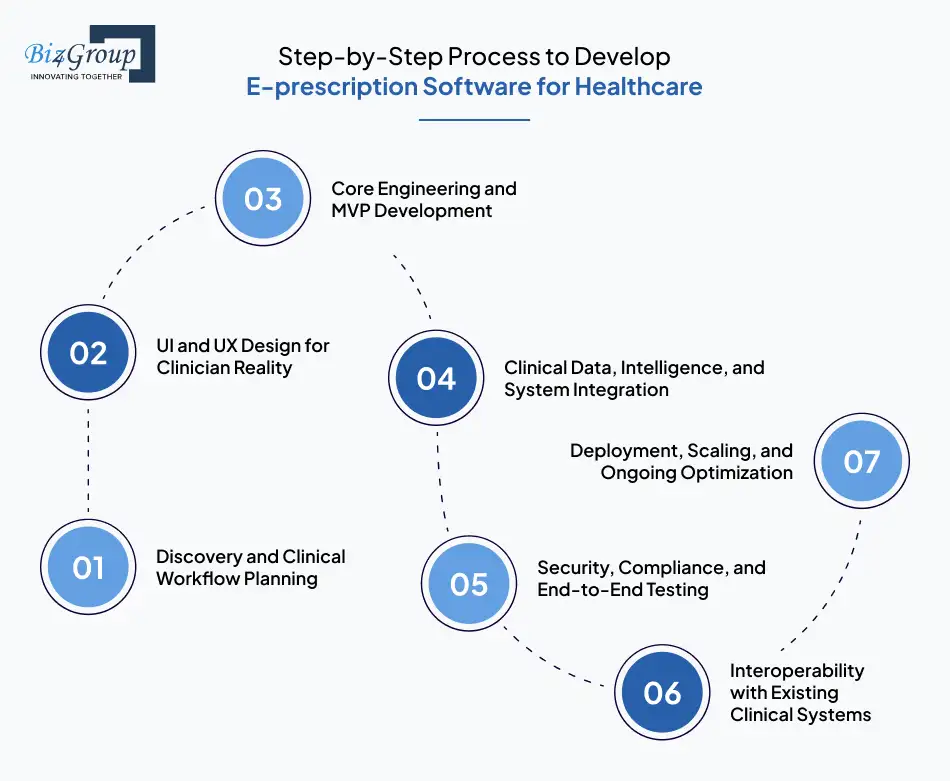
Building eRx software is not about racing to features. e-prescription (eRx) software development starts by respecting clinical realities, regulatory pressure, and limited provider attention. When done right, each phase builds confidence before complexity enters the picture.
1. Discovery and Clinical Workflow Planning
Before writing code, teams need to understand how prescribing actually happens. Real problems often surface during refills, pharmacy callbacks, or prior authorizations rather than initial prescriptions. These insights shape sustainable product decisions.
- Identify prescribing bottlenecks across clinics, hospitals, and virtual care
- Document where providers lose time or accuracy during medication workflows
- Align early requirements with the practical realities of doctors and staff
This phase defines the scope for the development of e-prescription (eRx) software for doctors
2. UI and UX Design for Clinician Reality
Doctors interact with prescribing tools dozens of times a day. If workflows feel unnatural, adoption quietly fades. Design should reflect muscle memory rather than novelty or visual trends.
- Prototype real prescribing steps with realistic data
- Test screens with clinicians from different specialties and experience levels
- Keep alerts meaningful and avoid unnecessary interruptions
This is where teams often create electronic prescription software that actually fits daily practice
Partnering with a dedicated UI/UX design team helps balance safety and speed in erx system development
Also read: Top UI/UX design companies in USA
3. Core Engineering and MVP Development
An MVP allows healthcare organizations to validate the most critical prescribing workflows before investing in advanced capabilities. Instead of building a feature-heavy platform from day one, the focus stays on delivering a stable, functional product that supports real clinical needs and provides a clear direction for future development. It helps you:
- Prioritize prescription creation, clinical validation, and pharmacy transmission in the first release.
- Include high-frequency workflows such as prescription renewals and cancellations from the beginning.
- Build a flexible backend that supports new clinical rules, integrations, and future enhancements without major redevelopment.
Reliable MVP development services help translate this approach into a structured roadmap by prioritizing high-impact functionality without adding unnecessary complexity in the initial release.
Also read: Top 12+ MVP Development Companies in USA
4. Clinical Data, Intelligence, and System Integration
As usage grows, integration determines whether the system scales or struggles. Drug data, medication history, and external systems must work together without introducing noise.
- Align drug databases and medication history sources by training AI models
- Apply smarter validation logic based on real prescribing behavior
- Prepare systems to build integrated e-prescription systems across environments
This step ensures continuity rather than fragmentation
5. Security, Compliance, and End-to-End Testing
Prescribing software touches sensitive patient data and controlled substances. Security and compliance are embedded, not added later. Trust is built through predictability and transparency.
- Apply HIPAA and controlled-substance safeguards early
- Test edge cases such as pharmacy rejections and partial fills
- Validate audit logs, permissions, and traceability
These controls are essential to make secure e-prescription platforms
Also Read: Software Testing Companies in USA
6. Interoperability with Existing Clinical Systems
Prescribing rarely lives in isolation. It must fit into EHR workflows clinicians already trust.
- Embed prescribing within charting and ordering flows
- Ensure medication lists and histories stay synchronized
- Architect the system to create eRx modules for EHR platforms without disruption
7. Deployment, Scaling, and Ongoing Optimization
Prescribing demand fluctuates. Systems must hold steady during peak clinical hours and expand easily across locations as adoption grows.
- Deploy on infrastructure that supports variable loads
- Monitor real-world usage and prescribing patterns
- Continuously refine workflows based on clinician feedback
When teams approach this process methodically, e-prescription (eRx) software development services become a long-term asset rather than a short-term implementation.
Ideal Tech Stack to Build E-prescription (eRx) Software
Selecting a tech stack for e-prescription (eRx) software development means focusing on reliability, auditability, and seamless interoperability - so prescribing workflows stay fast, compliant, and predictable in real clinical environments.
|
Label |
Preferred Technologies |
Why It Matters |
|---|---|---|
|
Frontend Framework |
ReactJS, Angular |
Prescribing screens are used constantly under time pressure, so UI stability is critical. Many teams rely on ReactJS development to keep clinician-facing workflows responsive and consistent. |
|
Server-Side Rendering & SEO |
NextJS, Nuxt.js |
Faster initial loads improve usability during peak hours. This is where NextJS development fits naturally into performance-sensitive eRx platforms. |
|
Backend Framework |
NodeJS, Python |
Prescription validation requires real-time handling alongside complex business rules. Teams often pair NodeJS development for concurrency with Python development for rule-driven logic. |
|
API Development Layer |
REST, GraphQL |
Prescriptions move through APIs first, not interfaces. Clear, versioned APIs are essential for scaling safely across systems and partners. |
|
AI & Data Processing |
TensorFlow, scikit-learn |
Used selectively for pattern recognition and logic support, not autonomous prescribing decisions. |
|
Interoperability Layer |
FHIR, HL7 |
Standards-based exchange ensures prescriptions move cleanly between EHRs, pharmacies, and external systems. |
|
Messaging & Event Handling |
Kafka, RabbitMQ |
Prescribing is event-driven, and queues handle retries, acknowledgements, and failures reliably. |
|
Database Layer |
PostgreSQL, MongoDB |
Structured prescription records and flexible audit logs require different storage models working together. |
|
Compliance & Audit Infrastructure |
Immutable logs, encryption services |
Controlled prescribing demands traceability, tamper resistance, and long-term record integrity. |
|
Cloud Infrastructure |
AWS, Azure |
Elastic scaling supports daily usage spikes without risking delayed transmissions or downtime. |
|
Monitoring & Observability |
ELK stack, cloud-native monitoring |
Real-time visibility helps resolve issues before clinicians or pharmacies feel the impact. |
When these layers are aligned correctly, technical decisions fade into the background and clinical workflows stay uninterrupted. That foundation makes budgeting, scaling, and long-term planning far more predictable for any organization investing in e-prescription (eRx) software development.
Transform Complex Processes Into Self-Running Systems
Begin developing an AI workflow automation system that adapts to your tools, data, and operational realities.
Build My AI SystemCost to Build E-prescription (eRx) Software: MVP to Enterprise
Every healthcare organization approaches eRx development with different operational goals, so the budget naturally varies with the product's scope. While a streamlined platform can be launched with a focused investment, enterprise-grade solutions require a broader technology roadmap.
In most cases, e-prescription (eRx) software development costs range between $30,000 and $200,000+, depending on functionality, integrations, compliance, and long-term scalability.
The quickest way to estimate your budget is by deciding the level of product you want to launch. The table below outlines the typical investment range and what each development stage generally includes.
|
Development Level |
Estimated Cost Range |
Project Scope |
|---|---|---|
|
MVP level E-prescription (eRx) Software |
$30,000–$60,000 |
Covers core prescribing workflows, patient management, prescription validation, and an administrative dashboard for early product validation. |
|
Mid-Level E-prescription (eRx) Software |
$60,000–$100,000 |
Includes advanced prescribing workflows, third-party integrations, analytics, enhanced security, erx support, and workflow automation for growing healthcare organizations. |
|
Enterprise level E-prescription (eRx) Software |
$100,000–$200,000+ |
Fully scalable platform with AI capabilities, multi-location support, enterprise reporting, advanced compliance, custom workflows and extensive integrations |
What Factors Have the Biggest Impact on E-Prescription (eRx) Software Development Cost?
1. Product Scope and Feature Complexity
Estimated Cost Impact: $10,000–$70,000+
The largest cost difference comes from what the platform is expected to deliver. A basic prescribing solution requires significantly less investment than an AI automated electronic prescription workflow system development project that includes clinical decision support, workflow automation, predictive analytics, and enterprise reporting.
2. UI/UX Design and User Experience
Estimated Cost Impact: $5,000–$20,000+
An intuitive interface reduces training time and improves clinical adoption. The UI/UX design cost increases when the platform supports multiple user roles, customized dashboards, accessibility requirements, and complex prescribing workflows.
3. Healthcare Integrations
Estimated Cost Impact: $8,000–$35,000+
Connecting with pharmacy networks, EHR/EMR platforms, insurance systems, and healthcare standards adds substantial development effort. Requirements such as FHIR ePrescription integration, HL7 ePrescription integration, and erx support require additional API development, testing, and long-term maintenance.
4. Regulatory Compliance and Security
Estimated Cost Impact: $10,000–$40,000+
Compliance is built throughout development rather than added later. Supporting HIPAA requirements, EPCS software, controlled substance ePrescribing, audit logging, encryption, and secure identity verification increases both implementation effort and validation time.
5. AI Capabilities and Intelligent Automation
Estimated Cost Impact: $15,000–$60,000+
AI increases development costs based on the level of automation required. Features such as prescribing recommendations, medication risk analysis, and workflow optimization require model integration, training, and ongoing AI integration cost planning before deployment.
Hidden Costs to Consider During E-Prescription (eRx) Software Development
|
Hidden Cost |
Estimated Cost Impact |
|---|---|
|
Third-party API licensing |
$2,000–$15,000+/year |
|
Cloud hosting and infrastructure |
$3,000–$20,000+/year |
|
Security audits and penetration testing |
$5,000–$15,000 |
|
Regulatory certification and compliance updates |
$5,000–$20,000+ |
|
Data migration from legacy prescribing systems |
$4,000–$25,000+ |
|
Staff onboarding and user training |
$2,000–$10,000 |
|
Ongoing maintenance and product updates |
15–20% of the initial development cost annually |
|
AI model monitoring and performance optimization |
$5,000–$30,000+/year |
Strategies to Optimize E-Prescription (eRx) Software Development Cost
- Start with AI MVP software development to validate core prescribing workflows before expanding functionality, reducing initial development costs by 25–40%.
- Prioritize integrations that support immediate business requirements and schedule secondary integrations in later releases, lowering the first-phase budget by 10–20%.
- Reuse proven healthcare components and standardized APIs wherever practical to reduce custom development effort by 15–30%.
- Plan compliance requirements during discovery instead of adding them after development begins, helping avoid 10–15% in rework costs.
- Introduce AI automation services only where they deliver measurable operational value, allowing AI investments to be phased while reducing upfront implementation costs by 20–35%.
- Define a phased product roadmap with clear release milestones, so development budgets remain predictable and unnecessary feature expansion is controlled, improving overall cost efficiency by 15–25%.
Budgeting for electronic prescribing software becomes far more predictable when development scope, integrations, compliance, and future expansion are planned together. Understanding where costs originate and where they can be optimized helps organizations invest with greater confidence while avoiding unnecessary development expenses.
Revenue Models for Businesses That Create Electronic Prescription Software
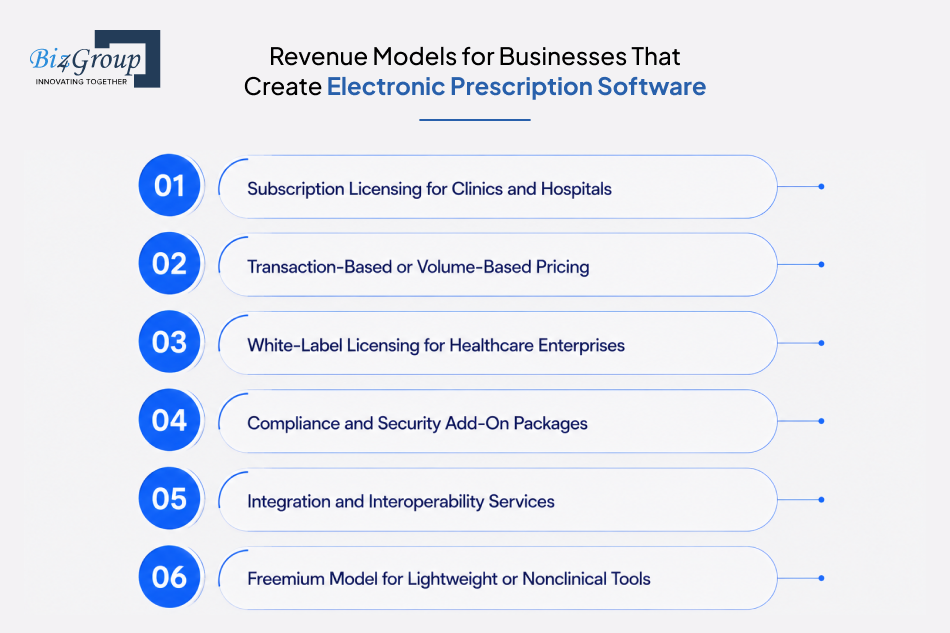
Healthcare organizations exploring e-prescription (eRx) software development often want clarity on monetization early, since revenue strategy shapes product scope and long-term sustainability. The models below reflect what typically works for prescribing platforms in real clinical environments.
1. Subscription Licensing for Clinics and Hospitals
This model charges providers a recurring fee for access, updates, and support. It works well when you create electronic prescription software that delivers obvious daily value to clinicians. Pricing often reflects prescribing volume, feature depth, or number of users.
- Example: Clinics may subscribe to simplify prescribing across teams, and small networks often scale predictably by moving into monthly tiered plans. This creates a clear cost structure without complicating operational workflows.
2. Transaction-Based or Volume-Based Pricing
This model aligns revenue with real prescribing activity, which suits platforms that develop digital prescribing tools used across variable clinical workloads. It supports organizations with seasonal or specialty-driven spikes.
- Example: Urgent care centers may rely on per-prescription pricing during high-traffic periods, while telehealth groups use it to manage variable virtual visit demand. Some teams also explore chatbot development for healthcare industry to streamline support during prescribing surges.
3. White-Label Licensing for Healthcare Enterprises
Large systems sometimes prefer branded versions tailored to internal workflows. White-label offerings supported through e-prescription (eRx) software development services bring upfront revenue plus long-term support and update contracts.
- Example: Health systems may adopt a branded prescribing solution across multiple sites, while vendors gain predictable service revenue over time This model works well when organizations want consistency across distributed teams.
4. Compliance and Security Add-On Packages
Teams that make secure e-prescription platforms can monetize specialized compliance modules. These may include enhanced audit trails, PDMP connections, controlled-substance workflows, and privilege-based access controls.
- Example: Enterprises may add advanced audit features for risk mitigation, while smaller clinics use PDMP integrations to standardize safe prescribing. Add-ons typically appeal to high-liability environments with strict oversight.
5. Integration and Interoperability Services
Prescribing rarely functions in isolation. Integrations with EHRs, telehealth platforms, and pharmacy networks create ongoing service revenue, especially when supported by an AI product development company for automation or intelligent routing.
- Example: Mid-size provider groups may pay for EHR synchronization, while telehealth platforms purchase pharmacy network connectors for faster prescription fulfillment These services become recurring revenue as organizations grow or diversify.
6. Freemium Model for Lightweight or Nonclinical Tools
A freemium tier works when restricted to safe, non-prescribing capabilities such as medication lookup, formulary visibility, or basic patient profiles. Paid tiers then unlock prescribing, compliance, and integrations.
- Example: Small practices may use a free tier to explore workflow fit before upgrading, while startups may test limited prescribing volumes. This model expands reach without exposing clinical or regulatory risk
A strong monetization strategy ensures the product remains sustainable as it evolves. It also guides how teams build AI software that supports safe, scalable prescribing across different care environments.
Scale Automation Without Scaling Headcount
Create a make autonomous AI workflow automation software that completes work consistently, intelligently, and around the clock.
Upgrade My Automation
Best Practices for E-prescription (eRx) Software Development
Strong prescribing software succeeds when it respects clinical realities rather than forcing new habits. e-prescription (eRx) software development benefits from a few guiding principles that keep clinicians confident and workflows predictable, especially as systems grow in complexity.
1. Design for Clinical Flow First
Prescribing tools must feel natural within daily routines instead of becoming another task. Screen layouts, alert timing, and data visibility all influence adoption. This mindset is essential when teams begin to build integrated e-prescription systems that serve multiple care settings.
2. Integrate Thoughtfully with Existing EHR Workflows
Prescribers prefer not to switch contexts repeatedly during patient visits. Embedding functionality inside familiar interfaces prevents cognitive overload. This is where teams choose to create eRx modules for EHR platforms that blend into charting screens rather than compete with them.
3. Prioritize Medication Safety and Decision Support
Safety checks must be timely, meaningful, and quietly accurate. Over-alerting can erode trust, while under-alerting introduces risk. Many teams reference a healthcare conversational AI guide to design contextual prompts that support clinicians without slowing them down.
4. Build for Real Interoperability from Day One
Pharmacies, PBMs, and EHRs all behave differently in the real world. Designing around standards while planning for variability ensures smoother deployments. This matters even more when focusing on e-prescription software development for doctors across diverse environments.
5. Automate the Administrative Friction Clinicians Feel Most
Renewals, cancellations, and pharmacy follow-ups create silent frustration in busy environments. Reducing this load requires thoughtful automation logic. Some systems partner with chatbot development for healthcare industry teams to streamline repetitive communication.
6. Ensure Scalability for Growth and Regulatory Change
Prescribing requirements evolve, and systems must adapt without large rebuilds. Modular design supports updates while keeping performance stable. This approach protects long-term flexibility when designing tools that make prescription automation software dependable.
Strong best practices protect clinician trust and smooth daily operations, which becomes even more important as organizations explore advanced capabilities and broader system integration.
Challenges in E-prescription (eRx) Software Development and How to Solve Them
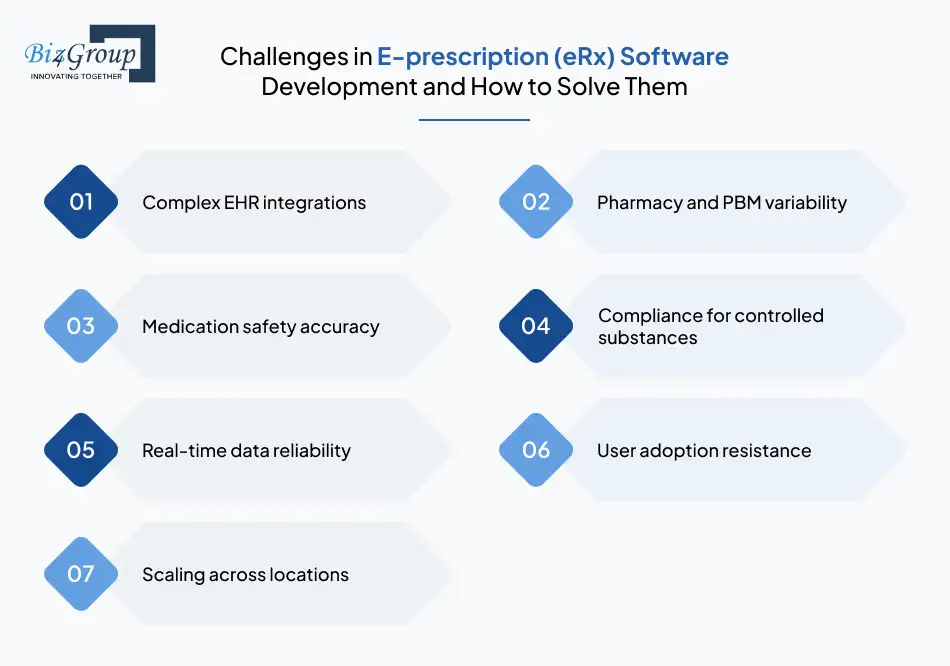
Even well-planned projects hit roadblocks, especially in healthcare where regulations, workflows, and legacy systems collide. E-prescription (eRx) software development faces predictable hurdles that become manageable once you understand how to address them effectively.
|
Top Challenges |
How to Solve Them |
|---|---|
|
Complex EHR integrations |
Start with standards like FHIR and HL7, then adapt to each vendor’s quirks through phased testing. |
|
Pharmacy and PBM variability |
Build flexible APIs that handle different SCRIPT implementations without breaking core logic. |
|
Medication safety accuracy |
Use validated drug databases and design alerts that support clinicians instead of overwhelming them. |
|
Compliance for controlled substances |
Implement strong identity proofing, detailed audit logs, and role-based permissions early in the build. |
|
Real-time data reliability |
Add retry logic, error monitoring, and queueing to stabilize transmission across clinical environments. |
|
User adoption resistance |
Keep workflows familiar, reduce unnecessary alerts, and refine design through provider feedback loops. |
|
Scaling across locations |
Use modular architecture so updates roll out cleanly without disrupting clinical operations. |
Addressing these challenges upfront strengthens long-term stability and trust, especially for teams aiming to create electronic prescription software that performs consistently across varied healthcare settings.
Future-Proof Your Enterprise Workflows
Build intelligent workflow automation using agentic AI to stay ahead of operational demands and industry shifts.
Start My AI TransformationWhat the Future Looks Like for Digital Prescribing and E-prescription Applications
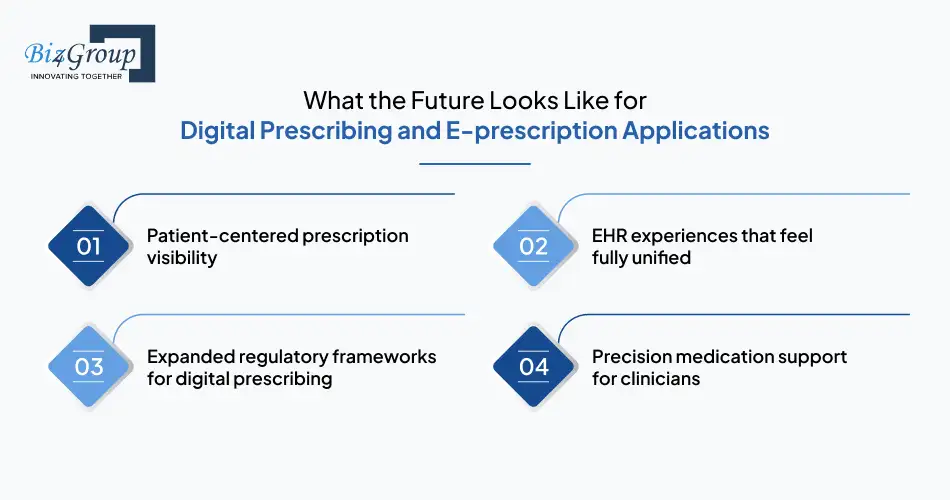
The future of prescribing is shifting from simple electronic workflows to coordinated networks that support clinicians, pharmacies, and patients with equal precision. e-prescription (eRx) software development will evolve in ways that reflect broader changes in care delivery and data movement.
1. Patient-centered prescription visibility
Patients will gain clearer insight into medication costs, alternatives, and fill status without calling providers. Through business app development using AI this empowers them to manage treatment plans confidently and reduces avoidable clinic inquiries.
2. EHR experiences that feel fully unified
Prescribing will become more seamless inside primary clinical systems, eliminating disjointed interfaces and redundant steps. Rather than bolt-on tools, teams will create eRx modules for EHR platforms that blend tightly with charting, messaging, and care plans.
3. Expanded regulatory frameworks for digital prescribing
As virtual care grows, policymakers will refine rules around tele-prescribing, controlled substances, and state-level reporting. These evolving requirements will shape how vendors structure compliance, documentation, and data integrity across eRx environments. Guidance from groups like top AI development companies in Florida may help modernize architecture in response.
4. Precision medication support for clinicians
Data from population health, genomics, and real-world outcomes will help refine prescribing choices at both the individual and organizational levels. As this evidence base matures, many organizations will explore advanced analytics without overwhelming the workflow to support e-prescription software development for doctors in more nuanced scenarios.
Digital prescribing will steadily shift toward systems that feel lighter for clinicians, more transparent for patients, and more connected across the clinical ecosystem.
Why Partner with Biz4Group to Build Intelligent Workflow Automation Using Agentic AI?
Biz4Group brings hands-on experience in designing secure, scalable, and industry-ready automation ecosystems. As an AI development company, we have built enterprise-grade AI platforms that handle sensitive data, deliver contextual intelligence, and automate complex workflows with precision.
What Sets Biz4Group Apart
- Deep AI Engineering Expertise: Skilled teams experienced in AI agent design, workflow orchestration, and scalable automation architecture.
- Security First Approach: HIPAA, GDPR, and enterprise compliance built into every solution, ensuring safe data handling.
- Custom Workflow Automation: Tailored systems that integrate with your existing tools and evolve with your business processes.
- Fast, Reliable Delivery: Proven processes that shorten development cycles without compromising quality.
- Cross Industry Experience: From healthcare to finance and operations, our portfolio reflects the versatility required for agentic workflows.
Biz4Group ensures your automation strategy is future-ready, efficient, and built to grow alongside your organization’s evolving needs.
Bring All Your Tools Into One Intelligent Flow
Start building a scalable AI workflow orchestration system that unifies data, decisions, and tasks across platforms.
Unify My WorkflowsWrapping Up AI Workflow Automation System Development Insights
The real value in building an agentic AI workflow automation system shows up the moment teams stop treating automation as a convenience and start using it as operational infrastructure. The businesses getting ahead are not simply using AI to speed up tasks. They are redesigning how work flows, how decisions move, and how teams function without constant supervision.
This shift is especially visible in sectors embracing custom healthcare software development, where accuracy, compliance, and repeatability matter more than speed alone. The same mindset applies across industries. When companies commit to systems that adapt, self-correct, and carry context across workflows, they are not just improving efficiency. They are changing the culture of how work gets done.
If your next step is to build intelligent workflow automation using agentic AI that actually reshapes day-to-day operations instead of just decorating them with technology, you are already thinking in the right direction.
Plan your AI Workflow Pilot with us.
Frequently Asked Questions About Building an Agentic AI Workflow Automation System
1. What types of workflows should I automate first with an agentic AI system?
Most organizations begin with processes that drain team bandwidth but follow predictable logic. Approval chains, routing steps, and cross-platform syncing are strong starting points, especially when teams are focused on AI workflow automation system development to create immediate operational lift.
2. Does an agentic AI workflow automation system need large amounts of historical data to work well?
Not always. Many teams start small using structured rules and gradually enrich the system as data grows. This incremental approach works well when developing an AI workflow automation system that learns progressively from real usage instead of needing massive datasets upfront.
3. How does an agentic AI system communicate when something goes wrong in a workflow?
Escalation logic allows the system to flag missing data, conflicting instructions, or stalled tasks. Alerts are routed instantly to the right person, which becomes especially valuable as organizations begin to create agentic AI workflow management tools that reduce dependence on manual oversight.
4. What is the expected cost of building an agentic AI workflow automation system?
Depending on integrations, agent complexity, and security requirements, costs typically fall between $10,000 and $150,000. The range expands as companies make autonomous AI workflow automation software that handles multi step decision making and broader operational responsibilities.
5. Can an agentic AI workflow system operate alongside my existing automation tools?
Yes. Many platforms are designed to complement RPA, BPM, CRM, or internal systems rather than replace them. This interoperability becomes essential when businesses focus on agentic AI workflow automation system development that supports diverse tech stacks.
6. How do I measure whether my agentic AI workflow system is actually improving operations?
Meaningful metrics include reduction in handoffs, improved cycle times, accuracy gains, and fewer interruptions. These indicators help validate whether you can eventually develop AI agents for business workflow automation that learn and optimize beyond basic rule-based automation.