 Location :
Orlando, FL, USA
Location :
Orlando, FL, USA +1 (407) 714-1616
 info@biz4group.com
- Forex trading AI agent development aims at building data-driven systems that trade currency markets with risk limits, continuous monitoring, and human oversight.
- Businesses develop AI agents for forex trading to handle 24 hour markets, reduce execution latency, and apply consistent risk rules across multiple time zones.
- Companies build AI powered forex trading agent systems mainly for proprietary trading, SaaS platforms, licensing, and managed trading services, depending on risk tolerance.
- Global forex trading runs nearly 24/5, processes trillions in daily volume, and reacts to macroeconomic data within seconds, making automation a practical necessity.
- A realistic ballpark for development ranges from $20,000 to $60,000+, depending on whether the goal is an MVP, scaled system, or enterprise-grade deployment.
- Long-term success depends less on advanced models and more on clean data, strict risk controls, phased deployment, and continuous performance monitoring.
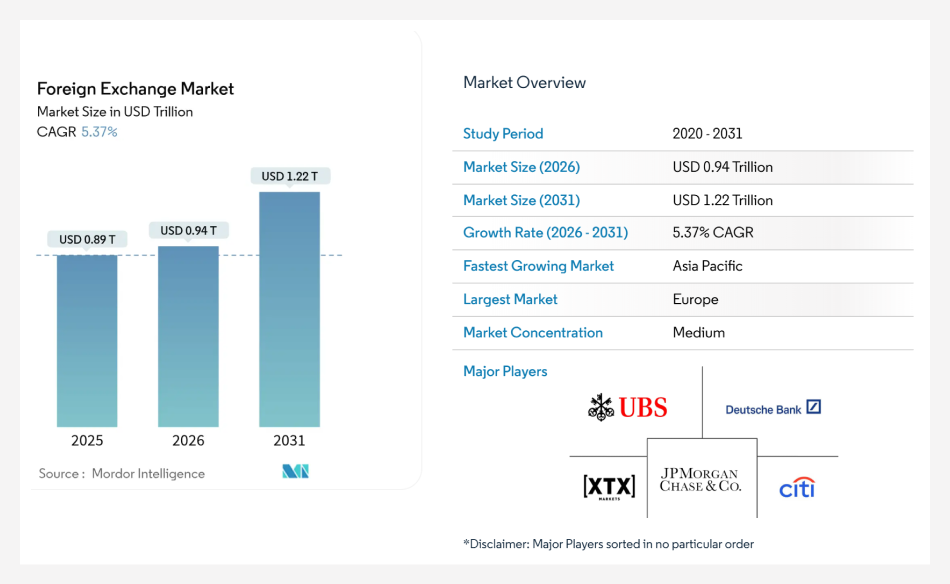
Forex trading AI agent development means building autonomous systems that analyze currency markets and place trades using machine learning models within fixed risk limits. These systems are designed for forex trading, a market expected to exceed USD 1.2 trillion in annual traded value globally by the early 2030s, driven by digital platforms and institutional participation.
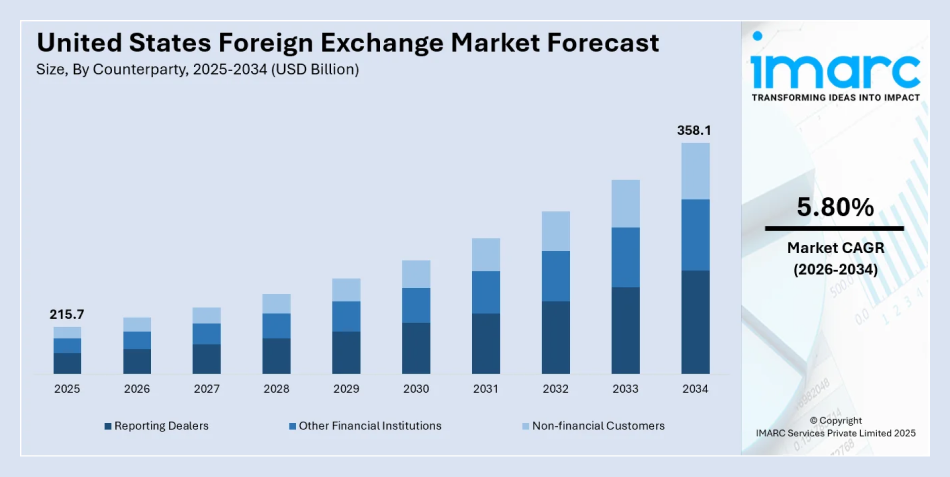
In the United States, forex trading activity is expanding rapidly. Market forecasts estimate growth to more than USD 350 billion by 2033, as hedge funds, fintech firms, and regulated brokers increase algorithmic participation. At this scale, manual trading and static automation struggle to keep up with speed, volume, and consistency.
An AI trading agent watches the market, evaluates probabilities, and acts based on predefined rules. It consumes live price data and economic signals, then decides when to enter, exit, or stay out of trades. Organizations that develop AI agents for forex trading usually aim to improve execution speed, apply risk controls consistently, and run strategies across many currency pairs without human intervention.
Building these systems requires stable data pipelines, reliable execution logic, and continuous monitoring. Many firms work with a specialized trading software development company to ensure these parts function correctly in live market conditions.
Forex trading systems rely on different types of AI agents, such as predictive models, reinforcement learning agents, or hybrid approaches. Each has limits. Forex markets change, patterns fade, and volatility shifts.
This guide explains how these systems are designed, evaluated, and managed, and when using professional forex trading AI agent development services from an experienced AI development company is the right choice.
What Are Forex Trading AI Agents?
Forex trading AI agents are software systems that can make trading decisions in the foreign exchange market without manual input. These systems are designed to decide when to trade currencies based on data, while staying within fixed risk limits and operating rules.
These AI trading agents are used to support consistent and repeatable trading decisions across many currency pairs and time zones. Instead of relying on constant human judgment, firms use them to reduce bias and improve discipline. Many organizations choose to build AI powered forex trading agent solutions so trading decisions remain structured, scalable, and controlled.
How Forex Trading AI Agent Development Works in Live Markets
Forex trading AI agent development in live markets follows a continuous decision cycle. Once deployed, the AI agent monitors live currency prices, liquidity levels, and economic releases in real time.
The system performs three core actions:
- Observes market data
- Evaluates signals using trained models
- Executes or avoids trades within preset risk limits
These steps repeat throughout market hours. In major currency pairs, updates may occur every few seconds.
Live environments add complexity. Data delays, volatility spikes, and slippage must be handled without violating exposure limits. That is why production systems rely on structured AI agent software development for forex trading to ensure execution, monitoring, and risk layers work together.
In enterprise settings, firms often collaborate with an AI app development company to connect the agent to trading platforms, reporting systems, and compliance tools without disrupting existing workflows.
AI Techniques Used in Forex Trading AI Agent Development
Forex trading AI agents typically use the following techniques that include but are not limited to:
- Supervised learning for price direction or probability estimation
- Reinforcement learning for policy-based decision making
- Hybrid models that combine prediction and execution logic
The goal is to create intelligent forex trading agent systems that stay stable under changing market conditions.
Models are monitored continuously for drift, drawdowns, and abnormal behavior. In larger environments, this monitoring is often supported through structured AI integration services that connect models, execution engines, and risk controls.
In live markets, success depends on consistency, risk control, and system reliability, not short-term signal strength.
From Idea to Execution
Turn concepts into production-ready systems with Forex trading AI agent development built for real markets, real risk, and real scale.
Plan My AI Trading AgentWhy Companies Invest in Forex Trading AI Agent Development?
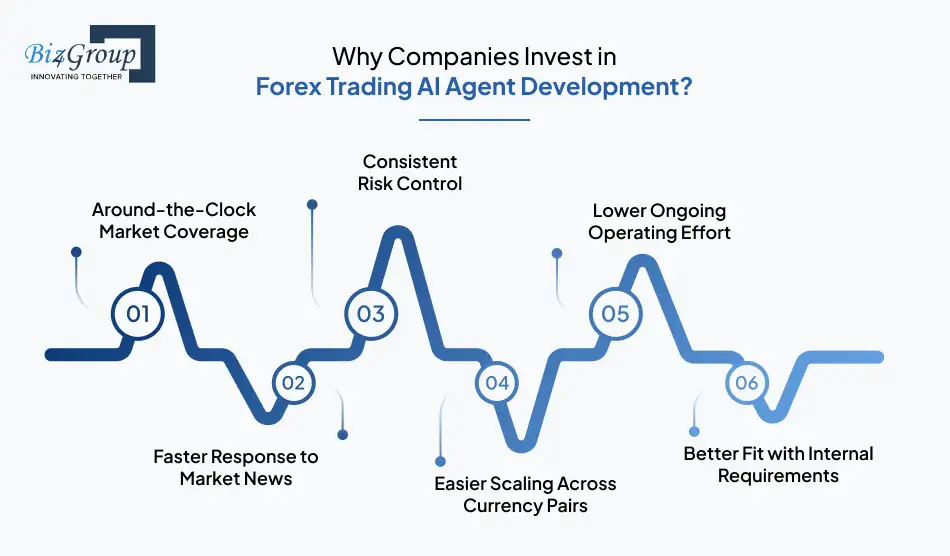
Forex trading AI agent development is driven by how the forex market works. Currency trading runs 24 hours a day, moves quickly after economic news, and uses leverage that increases risk. At this scale and speed, manual trading and fixed-rule systems are hard to manage consistently.
1. Around-the-Clock Market Coverage
Forex markets move across global time zones without stopping. Companies invest in AI agents so markets can be monitored continuously without relying on human traders to cover every session.
2. Faster Response to Market News
Interest rate decisions and economic data can move prices within seconds. Firms build automated forex trading agent with AI systems to react quickly and reduce delays that can impact execution quality.
3. Consistent Risk Control
AI agents apply the same risk rules every time. Position limits, stop losses, and exposure caps are enforced automatically, even during high volatility, reducing errors caused by stress or delayed decisions.
4. Easier Scaling Across Currency Pairs
Managing more currency pairs manually increases complexity. AI agents allow companies to scale trading activity without increasing staff, especially when combined with broader enterprise AI solutions.
5. Lower Ongoing Operating Effort
Once deployed, automated systems reduce the need for constant monitoring and manual execution. Over time, this lowers operational effort and improves efficiency as trading volume grows.
6. Better Fit with Internal Requirements
Standard platforms may not match internal risk or compliance needs. Many firms choose custom forex trading AI agent development so the system aligns with their strategy, reporting, and governance models, often supported by AI automation services.
Companies invest in these systems to gain control, consistency, and scalability. For organizations trading at meaningful volume, custom forex trading AI agent development becomes a practical step toward disciplined and repeatable trading operations.
How Intelligent Forex Trading Agents Deliver Value: Top Use Cases
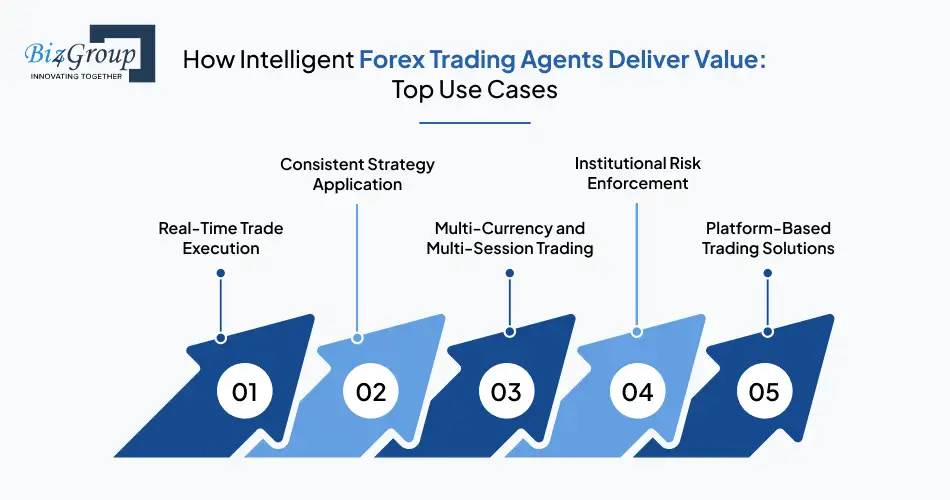
Forex trading AI agent development delivers value by automating decision making in a market that operates 24 hours a day and reacts to economic events within seconds. Intelligent forex trading agents are adopted where speed, consistency, and risk control have a direct impact on trading outcomes.
1. Real-Time Trade Execution
Forex prices often move within seconds of interest rate announcements and macroeconomic releases. Firms build AI powered forex trading agent for real time markets to monitor prices continuously and place trades without manual delay.
2. Consistent Strategy Application
Manual trading introduces variation under pressure. Companies develop AI driven currency trading agent systems to apply the same entry, exit, and position-sizing rules across all trades, improving consistency over time.
3. Multi-Currency and Multi-Session Trading
Trading across several currency pairs and global sessions increases operational complexity. AI agents help manage this scale efficiently, which is a common goal in AI forex trading system development focused on repeatable execution rather than discretionary decisions.
4. Institutional Risk Enforcement
Banks, hedge funds, and fintech platforms use AI agents to enforce exposure limits and stop-loss rules automatically. This often involves formal AI agent implementation processes to ensure systems behave predictably under volatile conditions.
5. Platform-Based Trading Solutions
Some firms create forex trading bot and AI agent platforms to support multiple users or strategies within a single system. These platforms are frequently built as part of broader forex trading app development initiatives that combine execution, monitoring, and reporting.
Common Use Cases and Value Drivers of Intelligent Forex Trading AI Agents
|
Use Case Area |
Primary Objective |
Key Value Delivered |
|---|---|---|
|
Real-Time Trade Execution |
Reduce reaction time to market events |
Faster order placement and fewer missed trades during high volatility |
|
Strategy Standardization |
Apply the same rules consistently |
Lower decision variance and reduced human error |
|
Multi-Currency Trading |
Manage many currency pairs simultaneously |
Scalable trading without proportional staffing increase |
|
Institutional Risk Control |
Enforce predefined exposure limits |
Controlled drawdowns and predictable risk behavior |
|
Platform-Based Trading |
Support multiple users or strategies |
Centralized execution, monitoring, and reporting |
Intelligent forex trading agents create value when they improve execution speed, reduce inconsistency, and enforce risk discipline. For firms scaling operations, create forex trading bot and AI agent platforms becomes a practical way to standardize trading while maintaining control.
Build for Markets That Never Sleep
Design and develop AI agents for forex trading that operate across time zones with enforced risk controls and live monitoring.
Talk to an AI Trading ArchitectTrade-Offs in Forex Trading AI Agent Development Decisions
Forex trading AI agent development involves trade-offs that directly impact feasibility, risk, and long-term outcomes. These decisions are less about model choice and more about readiness, measurement, ownership, and organizational fit.
Readiness and Capability Assessment
Are you ready to build a forex trading AI agent based on your data, team, and infrastructure?
This decision is binary. Either the foundation exists or it does not. Most teams are ready only if they already have:
- Reliable historical and live forex market data
- Existing execution and basic risk control systems
- Clear technical ownership inside the organization
When one or more of these are missing, progress slows quickly. Many firms begin by working with an AI product development company to validate readiness before attempting to create intelligent AI agent for automated forex trading.
Go or No Go Decision Criteria
What criteria should determine whether you proceed with forex trading AI agent development or stop?
- A clear go decision requires answers to a small set of questions:
- What trading objective is the system optimizing for?
- What is the maximum acceptable drawdown?
- How will failure be detected early in live markets?
If these cannot be answered upfront, stopping is often the safer and cheaper option. Larger firms typically formalize this stage using enterprise AI agent development.
Risk and Return Measurement Framework
How should risk and returns be measured for an AI driven forex trading agent in live markets?
|
Measurement Area |
What Is Evaluated |
Why It Matters |
|---|---|---|
|
Drawdowns |
Peak-to-trough losses |
Indicates capital risk |
|
Return Volatility |
Stability of outcomes |
Signals consistency |
|
Execution Slippage |
Gap between expected & filled price |
Reflects market impact |
|
Win-Loss Distribution |
Frequency vs size of gains or losses |
Reveals hidden risk |
Systems designed to make forex trading AI agent for risk management focus on these controls rather than raw profitability. This approach depends on disciplined AI model development and continuous monitoring.
Build or Buy Decision Criteria
Should you build an AI powered forex trading agent in house or buy an existing solution?
This decision usually comes down to control versus speed.
- Building in house offers full ownership and customization
- Buying reduces setup time and operational overhead
Firms planning to build AI forex trading agent with market prediction models often prefer internal development. Others choose vendor platforms to avoid long build cycles and the need to hire AI developers.
Organizational and Budget Alignment
Do your budget, timeline, and internal capabilities align with forex trading AI agent development?
AI trading systems are ongoing commitments, not one-time projects.
You should expect:
- Continuous infrastructure and data costs
- Ongoing monitoring and compliance effort
- Periodic model updates and retraining
Organizations that develop forex trading AI agent for hedge funds and fintech often use phased rollouts to manage cost, limit exposure, and validate performance before scaling further.
Trade-offs are unavoidable. The goal is not maximum automation, but a balance between control, cost, and measurable outcomes. For many firms, the final decision depends on whether develop forex trading AI agent for hedge funds and fintech fits their risk tolerance, operating maturity, and long-term trading strategy.
Core Features to Build AI Forex Trading Agent Safely
Forex trading AI agent development is considered safe only when the system includes controls that limit losses, detect failures early, and prevent uncontrolled behavior. In leveraged forex markets, a single faulty decision can amplify losses within minutes, which is why core features are treated as mandatory infrastructure, not optional enhancements.
|
Feature |
What It Controls |
Practical Impact |
|---|---|---|
|
Position and Exposure Limits |
Caps trade size, leverage, and currency exposure |
Prevents outsized losses from a single trade |
|
Automated Stop-Loss Rules |
Closes positions when losses exceed thresholds |
Limits downside during sudden market moves |
|
System Kill Switch |
Halts trading during abnormal behavior |
Stops cascading failures during outages or model errors |
|
Real-Time Performance Monitoring |
Tracks drawdowns, volatility, and execution quality |
Flags degradation before capital loss escalates |
|
Market Data Validation |
Checks for missing or abnormal price inputs |
Avoids trades based on faulty or delayed data |
|
Execution Quality Tracking |
Measures slippage and fill rates |
Identifies hidden costs in fast-moving markets |
|
Audit Logs and Traceability |
Records decisions and trade actions |
Supports compliance and internal review |
In practice, firms build AI software with risk controls isolated from trading logic so that safety rules remain active even if models fail. Visibility layers are commonly added during Forex trading app development to allow teams to monitor exposure and system health in real time.
For organizations planning to create AI driven currency trading system for businesses, these features determine whether the system can survive real market conditions. Safety is not measured by profit potential, but by how predictably the system behaves when markets move against it.
Move Beyond Bots
Upgrade from basic automation and build AI powered forex trading agent systems designed for consistency, control, and long-term use.
Start My AI Trading MVPAdvanced Features in Intelligent Forex Trading Agent With AI
Forex trading AI agent development includes advanced features when systems are designed to adapt to changing market conditions while staying controlled. In live forex markets, these features help agents react to volatility, reduce risk during unstable periods, and maintain consistent behavior over time.
1. Adaptive Model Updates
Advanced agents refresh their models using recent market data instead of relying only on old patterns. This helps reduce performance drop when market behavior changes, which is common in forex trading.
2. Market Condition Detection
These systems monitor volatility and liquidity levels. When markets become unstable, the agent can reduce activity or pause trading to avoid unnecessary losses during sudden price swings.
3. Multi-Agent Structure
Some systems separate tasks across multiple agents, such as one for signals and another for risk control. This setup follows ideas from how to build a multi-agent AI system and helps prevent single-point failures.
4. Dynamic Risk Adjustment
Advanced agents adjust position size based on current risk levels. Exposure is lowered during high volatility and increased only when conditions stabilize, keeping risk within defined limits.
5. Performance Drift Monitoring
Agents track whether live results deviate from expected behavior. If performance worsens for a sustained period, trading can slow down or stop, reflecting current AI agent development trends focused on control.
6. Human Oversight Controls
Even advanced systems allow manual intervention. Teams can pause trading, change limits, or investigate issues using monitoring dashboards when behavior appears abnormal.
Advanced features support better control, not full autonomy. For firms aiming to create AI driven currency trading system for businesses, these capabilities help manage changing markets while keeping risk visible and measurable.
Process to Create Intelligent AI Agent for Automated Forex Trading
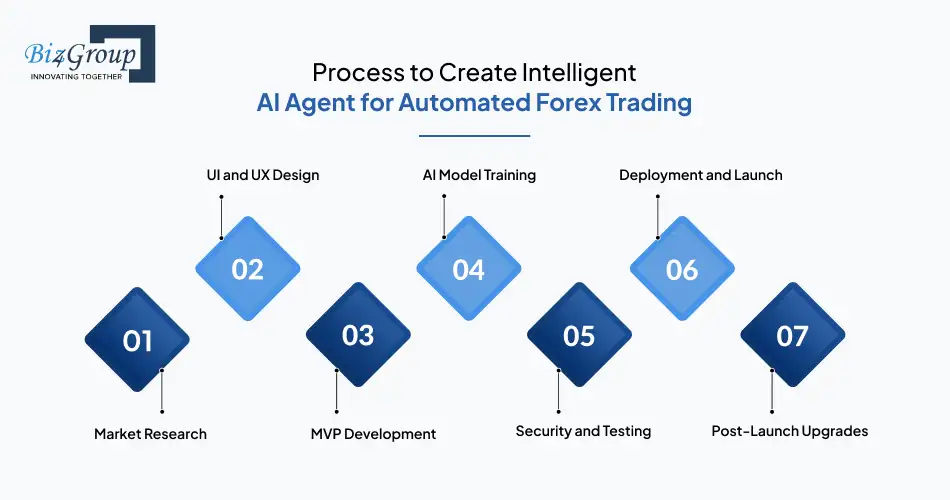
Forex trading AI agent development follows a clear, step-by-step process. Each step exists to reduce risk, control cost, and avoid failure in live markets. Teams that follow this sequence are more likely to launch stable systems that can be monitored and improved over time.
1. Market Research
This step defines what the system is meant to do and where it will operate. Teams study trading goals, target users, and basic compliance needs. This is critical when building Forex trading AI agent solutions for fintech companies, where rules and reporting matter early.
- Choose target currency pairs and timeframes
- Define risk limits and loss tolerance
- Identify regulatory and compliance requirements
2. UI and UX Design
Design focuses on visibility and control. The UI/UX design must clearly show trades, exposure, and system status. This helps teams supervise behavior as they create intelligent forex trading agent with AI for real trading use.
- Show open trades and total exposure clearly
- Display alerts and system health status
- Allow manual pause or intervention when needed
Also Read: Top 15 UI/UX Design Companies in USA: 2026 Guide
3. MVP Development
MVP development services include only what is necessary to trade safely. This stage proves the idea without adding complexity. Many teams use custom forex trading AI agent development services to validate feasibility before scaling.
- Enable basic trade execution
- Apply simple risk limits
- Test the full trading flow end to end
Also Read: Top 12+ MVP Development Companies to Launch Your Startup in 2026
4. AI Model Training
AI models are trained using historical forex data that matches the trading strategy. The focus is on stable behavior, not perfect predictions. Teams often work with AI agent development partners for forex trading firms to avoid common mistakes.
- Use clean and relevant historical data
- Test across different market conditions
- Measure results using risk-based metrics
5. Security and Testing
This step checks how the system behaves when things go wrong. Testing ensures trades stop safely during errors or extreme market moves.
- Simulate missing or delayed data
- Test high volatility scenarios
- Confirm stop-loss and shutdown controls
Also Read: 15+ Software Testing Companies in USA in 2026
6. Deployment and Launch
Launch is gradual, not immediate. Most teams start small to limit risk. Many compare their setup with the best companies for forex trading AI agent development to ensure stability.
- Start with paper trading or low capital
- Monitor execution and latency closely
- Verify logs and reporting accuracy
Also Read: AI Paper Trading Bot Development
7. Post-Launch Upgrades
After launch, changes are made slowly and carefully. The goal is steady improvement, not frequent redesign.
- Track live performance over time
- Adjust risk limits when needed
- Update models in controlled cycles
This process helps teams move from idea to live trading without unnecessary risk. For organizations planning to create AI driven currency trading system for businesses, following these steps keeps development practical, controlled, and aligned with real market behavior.
Validate Before You Scale
Test assumptions, costs, and risk early with a structured approach to Forex trading AI agent development that avoids expensive rebuilds.
Request a Feasibility ReviewIdeal Tech Stack for AI Agent Software Development for Forex Trading
An ideal tech stack for Forex trading AI agent development must support continuous market operation, fast execution, and strict risk control. Forex markets run nearly 24 hours a day, so the stack must be reliable, modular, and observable under live trading conditions.
|
Layer |
What It Handles |
Why It Matters in Forex |
Typical Technologies |
|---|---|---|---|
|
Market Data Ingestion |
Live prices, ticks, historical data |
Forex reacts within seconds to news |
Python development, broker APIs, WebSockets, FIX |
|
Data Processing |
Cleaning and feature preparation |
Poor data leads to bad trades |
Python development, pandas, NumPy |
|
AI and Modeling |
Signal generation and prediction |
Core trading intelligence |
Python development, ML frameworks |
|
Strategy and Decision Logic |
Converts signals into actions |
Prevents unsafe trades from raw signals |
NodeJS development, rule engines |
|
Risk Management Layer |
Exposure limits and stop rules |
Protects capital in leveraged markets |
Policy engines, backend services |
|
Order Execution |
Sends and manages orders |
Latency and slippage affect returns |
NodeJS development, broker execution APIs |
|
State Management |
Tracks positions and orders |
Avoids duplicate or conflicting trades |
Databases, in-memory stores |
|
Data Storage |
Trade history and audit logs |
Required for analysis and review |
PostgreSQL, MongoDB, time-series databases |
|
Monitoring and Alerts |
System health and drift detection |
Catches failures early |
Metrics dashboards, alerting tools |
|
User Interface |
Oversight and manual controls |
Enables supervision |
|
|
Security |
Keys and access control |
Prevents unauthorized trading |
Encryption, secrets management |
|
Infrastructure |
Scaling and uptime |
Systems must run continuously |
Cloud platforms, containers |
A key design rule is to keep parts separate. Trading decisions, risk limits, and system monitoring should run independently. This way, if one part fails, it does not cause uncontrolled trading or wider system issues.
There is no single tech stack that works for everyone. The right setup depends on how often you trade, how fast decisions must be made, and what compliance rules apply. Teams reviewing Forex trading AI agent development services usually focus on stable, well-tested components that are easier to maintain in live markets.
Cost of Forex Trading AI Agent Development: MVP to Enterprise
Forex trading AI agent development costs vary widely based on scope, data needs, and operational requirements. As a general ballpark, teams should expect an initial investment in the range of $20,000 to $60,000+, depending on whether the goal is a basic MVP or a production-ready enterprise system. These figures are indicative, not fixed quotes, and actual costs depend on complexity and risk controls.
Typical Cost Breakdown by Development Stage
|
Stage |
What Is Included |
Estimated Cost Range |
|---|---|---|
|
MVP-level Forex Trading AI Agent |
Basic execution logic, simple risk limits, limited monitoring |
$20,000 – $30,000 |
|
Mid-Level Forex Trading AI Agent |
Live data integration, model training, dashboards, testing |
$30,000 – $45,000 |
|
Advanced Forex Trading AI Agent |
Multiple strategies, stronger risk controls, monitoring |
$45,000 – $60,000 |
|
Enterprise-grade Forex Trading AI Agent |
Compliance features, audits, redundancy, scaling |
$60,000+ |
Cost drivers are not limited to coding. Data access fees, cloud infrastructure, testing time, and ongoing maintenance all contribute. Teams that ask how to create an AI trading bot often underestimate the effort needed to make it stable and safe in live markets.
Lower-cost builds usually focus on proof of concept, while higher-cost systems emphasize reliability, monitoring, and governance. The jump from MVP to enterprise is driven less by features and more by operational safeguards and compliance readiness.
For organizations planning to develop AI agents for forex trading, understanding these cost layers early helps set realistic expectations and avoid underfunded deployments that fail in live conditions.
How Businesses Monetize AI Forex Trading System Development
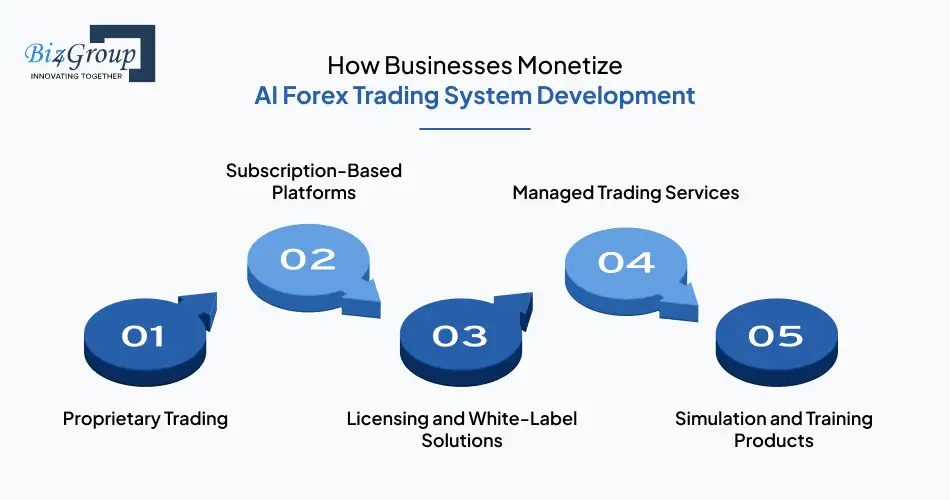
Forex trading AI agent development is monetized when trading systems are used to generate repeatable revenue, either by trading capital, licensing technology, or offering managed access to AI-driven tools. Most monetization models fall into a small number of proven categories used across fintech and trading firms.
1. Proprietary Trading
Some businesses build AI powered forex trading agent systems to trade their own capital. Revenue comes directly from trading profits. This model requires strong risk controls because losses are borne entirely by the business.
2. Subscription-Based Platforms
Companies create intelligent forex trading agent platforms that users access through monthly or annual subscriptions. Customers pay for automated execution, dashboards, and monitoring tools. This model focuses on scale and predictable recurring revenue.
3. Licensing and White-Label Solutions
Trading engines can be licensed to brokers or fintech platforms. In AI agent software development for forex trading, the same core system is reused while interfaces and controls are customized per client. Revenue is generated through licensing or usage fees.
4. Managed Trading Services
Some firms offer managed accounts powered by AI agents. Clients pay management or performance fees while the system executes trades on their behalf. This approach involves higher regulatory and reporting requirements.
5. Simulation and Training Products
AI systems are also used in paper trading and learning environments. Businesses offer simulations and analytics tools to users who want to test strategies without risking capital. This expands reach with lower regulatory exposure.
Many companies combine these models rather than relying on one. Implementation is often supported by top custom trading software development companies in USA, or by teams that integrate AI into an app to reach users faster and reduce time to market.
Choosing the right monetization approach depends on capital availability, regulatory constraints, and target customers. For teams planning to AI agent software development for forex trading, defining monetization early helps guide system design, compliance planning, and long-term growth.
Engineer for Control, Not Guesswork
Create systems that prioritize risk discipline and transparency with AI agent software development for forex trading.
Design My Trading SystemBest Practices for Forex Trading AI Agent Development
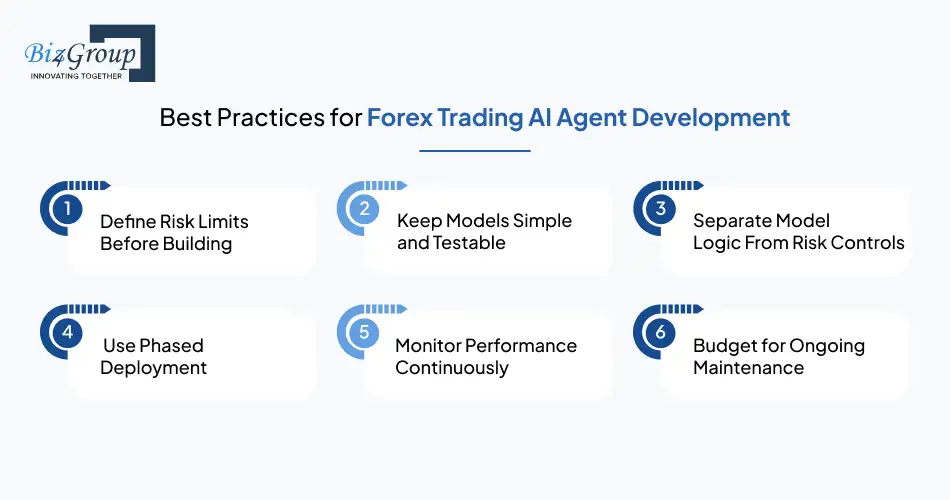
When systems are built with strict risk controls, phased testing, and ongoing monitoring, Forex trading AI agent development succeeds. In leveraged forex markets, small model errors can create large losses, so best practices focus on reducing preventable risk rather than increasing prediction complexity.
1. Define Risk Limits Before Building
Set maximum drawdown, leverage caps, and exposure limits before writing code. Teams that build automated forex trading agent with AI without predefined risk boundaries often struggle to measure success or stop losses early.
2. Keep Models Simple and Testable
Start with clear, explainable models. Complex systems increase debugging time and operational risk. Even techniques related to generative AI should only be introduced after baseline stability is proven.
3. Separate Model Logic From Risk Controls
Trading signals should not directly control exposure. Risk rules must operate independently so that even if a model behaves unexpectedly, capital limits remain enforced. This approach is essential when teams develop AI driven currency trading agent systems for live trading.
4. Use Phased Deployment
Move from back testing to paper trading, then to limited capital deployment. Structured validation, similar to AI paper trading app development, reduces the chance of large early losses caused by untested behavior.
Strong trading systems are built on discipline, not complexity. For firms planning custom forex trading AI agent development, consistent testing, monitoring, and risk control are more important than advanced algorithms.
Challenges in Forex Trading AI Agent Development and Solutions
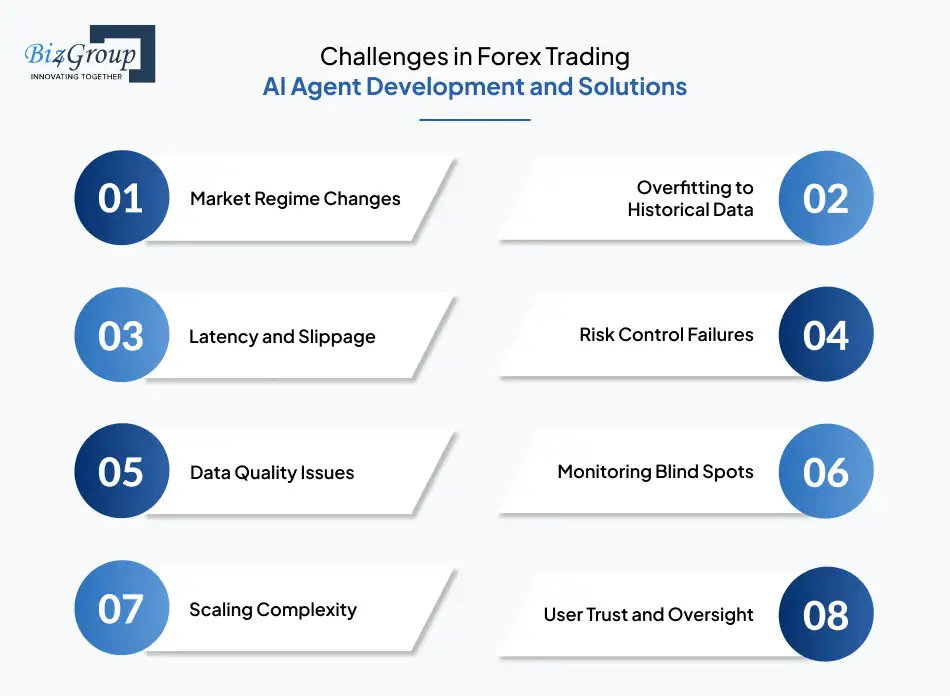
Forex trading AI agent development faces practical challenges because currency markets are fast, leveraged, and constantly changing. Most issues are caused by data quality, risk control, and live system behavior. Addressing these challenges early improves stability and reduces costly failures.
|
Challenge |
Why It Happens |
Practical Solution |
|---|---|---|
|
Market Regime Changes |
Forex patterns shift due to macro events and policy changes |
Use rolling validation and conservative retraining cycles |
|
Overfitting to Historical Data |
Models learn noise instead of durable signals |
Limit features and test across multiple market periods |
|
Latency and Slippage |
Delays between signal and execution affect outcomes |
Optimize execution paths and monitor fill quality |
|
Risk Control Failures |
Models act without enforced limits |
Separate risk rules from model logic |
|
Data Quality Issues |
Missing or delayed price feeds |
Validate data streams and halt trading on anomalies |
|
Monitoring Blind Spots |
Failures go unnoticed in live trading |
Add real-time alerts and performance thresholds |
|
Scaling Complexity |
More pairs and strategies increase load |
Design modular systems early, similar to an approach used for multi asset trading platform development |
|
User Trust and Oversight |
Operators lack visibility into decisions |
Provide clear dashboards, not opaque logic, even with advanced generative AI agents |
Many of these challenges also appear in adjacent areas such as AI crypto trading bot development, but forex adds stricter timing and risk constraints due to leverage and liquidity.
The most reliable systems treat challenges as design inputs instead of afterthoughts. For teams planning to create forex trading bot and AI agent platforms, solving these issues upfront leads to safer deployments, clearer oversight, and more predictable long-term performance.
Forex Trading AI Agent Development Decision Checklist
Forex trading AI agent development should begin only when basic technical, risk, and operational conditions are met. In live forex markets, skipping readiness checks often leads to unstable systems, uncontrolled losses, or abandoned projects. This checklist is designed to support a fast, practical go or no-go decision.
Decision Checklist for Forex Trading AI Agent Development
|
Decision Area |
Key Question |
Ready If True |
|---|---|---|
|
Trading Scope |
Is the trading objective clearly defined? |
Currency pairs, time horizon, and drawdown limits are documented |
|
Data Readiness |
Is reliable forex data available? |
Clean historical data and low-latency live feeds are accessible |
|
Risk Controls |
Are losses strictly limited? |
Exposure caps, stop-loss rules, and a kill switch are in place |
|
Execution Stability |
Can trades execute during volatility? |
Slippage and latency are monitored in real time |
|
Monitoring |
Is system behavior visible? |
Dashboards and alerts track performance and failures |
|
Team Ownership |
Is responsibility clearly assigned? |
Technical owners can respond quickly to issues |
|
Budget Coverage |
Is funding realistic? |
Budget covers build, testing, and ongoing maintenance |
|
Human Oversight |
Can humans intervene if needed? |
Manual pause and override controls exist |
If most rows indicate readiness, know that moving forward is a controlled decision instead of a speculative one. If several areas are weak, delaying the build usually prevents larger losses later.
This approach mirrors how AI agents transforming small businesses are evaluated in other high-risk, automation-driven domains. For teams that meet these criteria, proceeding with AI forex trading system development becomes a structured and defensible next step.
Turn Strategy Into a Working Platform
Bring your trading logic to life and build AI powered forex trading agent solutions aligned with your capital, compliance, and growth plans.
Build My AI Trading PlatformThe Future of Forex Trading AI Agent Development
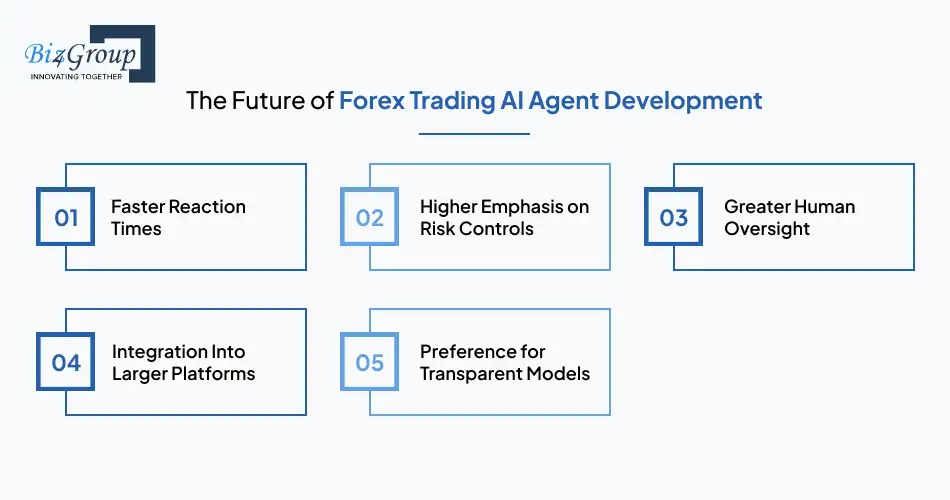
Forex trading AI agent development is moving toward systems that operate continuously, respond faster to market events, and remain tightly controlled. As forex trading becomes more automated, future AI agents are being designed to support real-time execution, stricter risk oversight, and easier human supervision.
Here’s what is changing:
1. Faster Reaction Times
Future systems are designed to build AI powered forex trading agent for real time markets, where price changes and economic releases require decisions within seconds rather than minutes.
2. Higher Emphasis on Risk Controls
Drawdown limits, exposure caps, and automated shutdown rules are becoming standard requirements rather than optional features in production systems.
3. Greater Human Oversight
AI agents are being deployed with clearer monitoring and manual control paths. Interfaces are becoming simpler, similar to an AI conversation app, so operators can quickly understand system status and intervene when needed.
4. Integration Into Larger Platforms
Instead of running in isolation, trading agents are being embedded into broader workflows, following patterns common in business app development using AI, where trading, reporting, and compliance systems are connected.
5. Preference for Transparent Models
Firms are favoring explainable behavior over complex black-box logic. This improves trust, auditability, and long-term maintainability.
The future favors control over novelty. Organizations that create intelligent AI agent for automated forex trading with real-time responsiveness, strong risk limits, and clear oversight will be better prepared as market speed and regulatory expectations continue to increase.
Why Choose Biz4Group LLC for Forex Trading AI Agent Development?
Forex trading AI agent development requires disciplined engineering, strict risk controls, and systems that remain stable in live markets. Biz4Group LLC focuses on building trading agents that are structured, testable, and ready for production, not experimental prototypes.
Here’s Why Teams Work With Biz4Group
1. Risk-First System Design
Every trading system is built with exposure limits, stop rules, and monitoring layers at the core. The focus is to help clients make forex trading AI agent for risk management, not uncontrolled automation.
2. Production-Ready Engineering
As a custom software development company, Biz4Group builds modular systems where model logic, execution, and risk controls are separated to reduce failure impact.
3. Specialized AI Agent Expertise
As an AI agent development company, the team designs systems that process live data, enforce constraints, and remain observable under real trading conditions.
4. Clear Collaboration Model
Clients receive structured planning, milestone-based delivery, and transparent documentation. This reduces ambiguity and long-term maintenance risk.
If you are looking for a partner that prioritizes control, stability, and accountability over hype, Biz4Group LLC offers a practical path to make forex trading AI agent for risk management with measurable safeguards in place.
Wrapping Up Forex Trading AI Agent Development
Forex trading AI agent development is all about creating systems that can operate in fast, leveraged markets with discipline, control, and visibility. Throughout this guide, the focus has been consistent: define clear objectives, respect risk, build in stages, and measure performance in ways that matter in live trading.
As adoption grows, more firms are combining trading intelligence with broader AI consulting services, aligning strategy, engineering, and governance from the start. Others look to partners among top trading app development companies to reduce build risk and speed up delivery. In both cases, success depends on making deliberate choices, not rushing automation.
If you are planning to build a trading platform, the takeaway is simple. Start with control, grow with evidence, and scale only when the system proves it can behave well under pressure. AI can amplify good discipline just as easily as it can amplify mistakes.
Discuss your trading goals, risk constraints, and technical readiness with a team that builds production-grade AI systems.
FAQs on Forex Trading AI Agent Development
What Is Forex Trading AI Agent Development?
Forex trading AI agent development is the process of building software systems that analyze currency markets and make trading decisions using data-driven models. These agents operate within predefined risk limits and are designed to function consistently in live forex markets.
How Is an AI Trading Agent Different From a Forex Trading Bot?
A traditional forex trading bot usually follows fixed rules. An AI trading agent uses statistical or machine learning models that can adapt to changing market conditions. The difference is not autonomy alone, but how decisions are generated and evaluated.
Can AI Trading Agents Guarantee Profits?
No. Forex markets are volatile and non-stationary. AI trading agents are designed to manage risk and improve consistency, not to guarantee returns. Performance depends on data quality, strategy design, risk controls, and ongoing monitoring.
How Long Does It Take to Build a Forex Trading AI Agent?
Timelines vary by scope. A basic MVP can take a few weeks, while a production-ready system with testing and monitoring often takes several months. Time is usually driven more by validation and risk testing than by coding.
Is Forex Trading AI Agent Development Suitable for Small Teams?
It can be, but only if scope is controlled. Smaller teams often start with limited currency pairs, simple strategies, and paper trading. Scaling too quickly without infrastructure and monitoring increases risk.
Do AI Trading Agents Require Ongoing Maintenance?
Yes. Models degrade over time, data sources change, and market behavior shifts. Successful systems require regular performance review, controlled updates, and continuous monitoring to remain reliable.
Is Human Oversight Still Required for AI Trading Agents?
Yes. Even advanced AI trading agents should allow human supervision. Manual pause controls, alerts, and transparency are essential for safe operation in live trading environments.
