 Location :
Orlando, FL, USA
Location :
Orlando, FL, USA +1 (407) 714-1616
 info@biz4group.com

- Healthcare SaaS solutions development helps clinics, hospitals, and startups modernize workflows, improve patient experiences, and create scalable digital platforms.
- Teams that develop healthcare SaaS platforms gain streamlined scheduling, stronger operational visibility, and smoother patient engagement.
- Organizations that build healthcare SaaS solutions can support remote care, diagnostics, ecommerce, and multisite coordination with ease.
- Advanced capabilities like real-time monitoring, intelligent logistics, and personalized digital experiences strengthen healthcare SaaS application development.
- Planning an accurate budget requires clarity on cost drivers, hidden expenses, and the right strategy for healthcare SaaS solutions development for startups and providers.
- Biz4Group LLC is a trusted USA-based partner with proven experience in designing and building powerful healthcare SaaS platforms that support business growth.
Digital care is growing rapidly. McKinsey reported that telehealth adoption surged to nearly 38 times its pre-pandemic levels during the industry's digital pivot, and that momentum continues to shape how providers are looking at healthcare SaaS solutions development.
Many clinics and hospitals want smarter ways to streamline daily tasks without adding more strain to their teams. Leaders are exploring cloud-based platforms that support faster workflows and fewer technical headaches.
It becomes easier to develop healthcare SaaS platforms when you have a clear understanding of the challenges and opportunities ahead.
Healthcare teams prefer systems that grow with them instead of holding them back. Cloud based tools create room for innovation and better financial performance. With the right planning, you can build healthcare SaaS solutions that reduce operational complexity.
If you find yourself weighing digital upgrades or planning your next healthcare product, this guide offers grounded insights that help you move forward with clarity. It highlights how to develop healthcare SaaS solutions for clinics that want reliability, efficiency, and a practical roadmap.
So without further ado, let's begin with the basics.
Understanding the Basics of Healthcare SaaS Solutions Development
Healthcare teams across clinics, hospitals, and startups often search for technology that delivers speed, accuracy, and reliability without increasing operational strain. That search usually leads to healthcare SaaS solutions development because cloud-based tools fit naturally into environments that need consistency and scalability.
How Healthcare SaaS Works in Simple Terms
Healthcare SaaS platforms run on cloud environments instead of local servers. Users access them through a browser or mobile device. This structure creates room for rapid updates, universal access, and far lighter maintenance for internal IT teams.
It becomes easier to develop healthcare SaaS platforms that match the needs of clinics and hospitals when the foundation is this flexible.
Core Components of Modern Healthcare SaaS
These systems usually include layers that work together to support clinical and administrative workflows. Key components include:
- Secure cloud hosting with high availability
- Backend services that manage PHI, workflows, and access
- Frontend interfaces built for medical teams and patients
- API layers for interoperability
- Compliance and audit modules
- Analytics and reporting tools
These elements serve as the building blocks when you create healthcare SaaS products that must perform reliably across different locations and teams.
Why Healthcare Leaders Prefer SaaS Over Traditional On-Premise Systems
Healthcare organizations often reach a point where on-premise systems begin to limit growth. SaaS platforms remove many of these constraints.
|
Factor |
Traditional On-Premise Systems |
Healthcare SaaS Platforms |
|
Upfront cost |
High hardware and setup cost |
Subscription based with flexible scaling |
|
Updates |
Slow and resource heavy |
Automatic with no downtime for users |
|
Maintenance |
Requires large internal IT investment |
Vendor managed with lower overhead |
|
Accessibility |
Limited unless custom configured |
Access from any secure device |
|
Scalability |
Difficult to expand |
Designed to scale rapidly |
When teams build healthcare SaaS solutions that match their daily needs, they gain reliable performance without carrying the weight of legacy infrastructure. Healthcare SaaS solutions development offers a strategic path for leaders who want reliability, lower operational hurdles, and technology that evolves with patient expectations.
Also read: Pros and cons of software as a service
Use Cases for Healthcare SaaS Solutions Development Across Clinics, Hospitals, and Startups
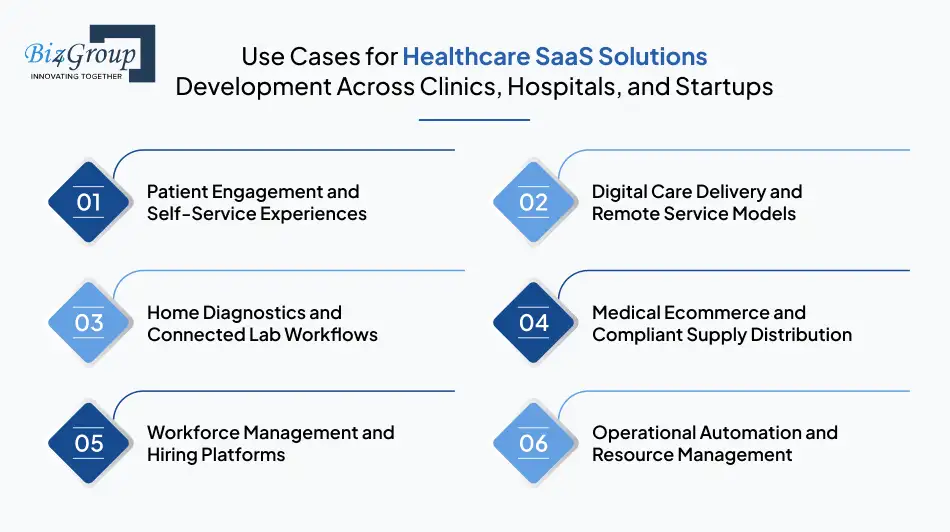
Healthcare leaders explore cloud platforms because they want steady workflows, accurate data, and simpler digital experiences for both patients and staff. Healthcare SaaS solutions development supports this shift by giving teams a way to manage tasks across clinical, administrative, and operational environments.
1. Patient Engagement and Self-Service Experiences
Many organizations want care journeys that feel smoother and less stressful. SaaS platforms introduce tools that help patients manage basic tasks without calling the front desk. When teams develop healthcare SaaS platforms with a focus on patient experience, satisfaction rates rise and staff workloads drop.
Portfolio Spotlight: Healthcare Platform for Medical Services and Jobs

Biz4Group built a healthcare platform that supports a patient-friendly experience with secure access to appointments, programs, and key resources. It also includes a job portal for healthcare hiring.
Key Capabilities:
- HIPAA compliant patient portal
- Appointment scheduling
- Program enrollment
- Healthcare job listing and application tools
2. Digital Care Delivery and Remote Service Models
Healthcare providers have increased their use of digital care solutions because patients appreciate flexible appointment formats and faster access to treatment. Platforms built with healthcare software as a service development for clinics give care teams the structure needed to offer remote consultations, follow ups, or hybrid models.
Also read: How to develop AI remote patient monitoring software?
3. Home Diagnostics and Connected Lab Workflows
Patients value options that save time and reduce unnecessary visits. SaaS-based diagnostic platforms support these needs by integrating test kit ordering, sample tracking, lab reporting, and automated notifications.
Portfolio Spotlight: eCommerce Web Application for Health Test Kits
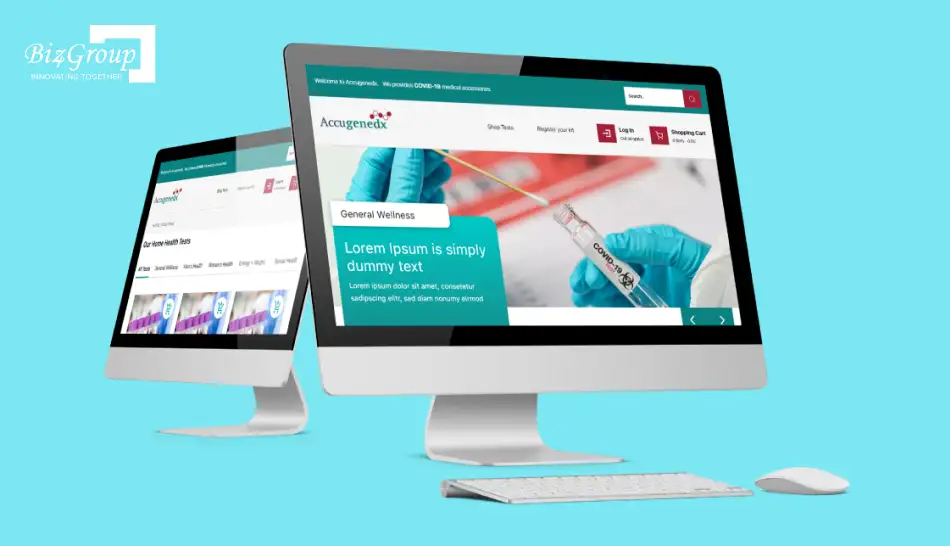
With our eCommerce web & app development skills, we built a full ecommerce and diagnostic management system centered on at-home test kits. This platform makes it possible for users to order test kits, register them, and receive secure lab results through an intuitive interface.
Key Capabilities:
- Intuitive ecommerce experience
- Test kit registration
- Lab data mapping for accurate results
- Secure result delivery
- Subscription model for routine testing
4. Medical Ecommerce and Compliant Supply Distribution
Healthcare organizations often require a structured way to manage supplies, prescriptions, or regulated products. SaaS platforms help streamline procurement, order tracking, and controlled substance management.
Portfolio Spotlight: eCommerce Store for Selling Medical Products

We built a regulated ecommerce platform for medical products and dispensary supply chains. This platform offers a secure shopping experience that meets FDA and federal guidelines for medical cannabis distribution. It supports both B2B and B2C models and helps clinics manage supply flow with accuracy and compliance.
Key Capabilities:
- Smart product search and recommendations
- HIPAA aware data processes
- Medical card application flow
- Deal creation and personalized offers
5. Workforce Management and Hiring Platforms
Clinics and hospitals often experience staffing challenges. SaaS applications support better hiring decisions, role tracking, credential monitoring, and job marketplace activity. Healthcare SaaS development for hospitals helps streamline these processes so teams spend less time coordinating and more time delivering care.
Also read: Guide to develop healthcare workforce management software
6. Operational Automation and Resource Management
Many healthcare workflows depend on coordinated tasks and predictable scheduling. SaaS tools support automation for billing, scheduling, referrals, claims tracking, and inventory management. These systems help reduce errors and improve visibility for decision makers.
When organizations commit to custom healthcare SaaS development, they anchor their operations to platforms that evolve with their needs. These real-world examples show how Biz4Group brings structure, creativity, and industry depth to every healthcare product.
7. Enterprise Level Scalability and Multi Facility Administration
Hospitals and large care networks need platforms that grow with them. Advanced scalability ensures performance stays consistent even as user volume increases. Multi facility administration offers support for role hierarchies, shared data structures, and standardized workflows.
Portfolio Spotlight: A documentary AI

We built a conversational AI platform centered on storytelling and digital memory preservation. It captures personal experiences and converts them into interactive digital replicas that communicate naturally. While the product focuses on legacy preservation, many of the underlying principles support next generation healthcare interactions.
Key Capabilities:
- Digital twin creation using advanced modeling
- Natural voice based interaction
- Real-time conversational flow
- Secure storage architecture
- Multi-device accessibility
When leaders partner with a qualified development team, they gain access to practical innovation that aligns with real world healthcare challenges. Biz4Group's experience across intelligence, logistics, and conversational design demonstrates how advanced features become meaningful solutions for clinics, hospitals, and digital health startups.
Businesses Are Upgrading Their Tech. Are You?
If advanced features are the new standard, staying basic becomes the most expensive decision you can make.
Book a Strategy Call NowImportant Features to Include in Healthcare SaaS Solutions Development
Healthcare leaders often explore new platforms because they want systems that reduce manual effort and improve reliability. The strongest products start with a focused set of features that support clinical workflows, patient needs, and secure data operations.
|
Feature |
What It Is |
What It Does |
|
Role Based Access Control |
A permissions model that defines what each user type can see or do |
Protects sensitive information and supports HIPAA compliance by ensuring only authorized users can access PHI |
|
Audit Logging |
A record of system activity across users and data points |
Tracks access and changes for compliance and security investigation needs |
|
Secure User Authentication |
A protected login flow that verifies user identity |
Strengthens platform security and prevents unauthorized access |
|
Interoperability Layer |
A set of APIs built for HL7, FHIR, and EHR integrations |
Connects clinics and hospitals with external systems to ensure smooth data exchange |
|
Appointment and Workflow Management |
Tools that support scheduling, reminders, and clinical task tracking |
Reduces administrative load and improves patient experience with predictable workflows |
|
Patient Portal |
A secure digital space where patients manage forms, results, appointments, and messages |
Improves engagement and reduces front desk pressure |
|
Billing and Revenue Cycle Features |
Modules for claims, invoicing, payments, and insurance verification |
Supports financial stability by improving cash flow accuracy and speed |
|
Reporting and Analytics |
Dashboards that visualize clinical, operational, and financial data |
Helps leaders make informed decisions and track outcomes with clarity |
|
Mobile Responsive Interface |
A layout that adapts smoothly to phones and tablets |
Improves accessibility for patients and teams working in different environments |
|
Compliance and Data Encryption Framework |
Built in rules and encryption for PHI and sensitive records |
Supports regulatory commitments and keeps patient data protected at all times |
These features serve as the foundation of reliable healthcare SaaS solutions development. They support early-stage MVP projects as well as more complex enterprise systems, creating a strong starting point for growth and future innovation.
Also read: How to build an AI medical billing software?
Advanced Capabilities That Strengthen Healthcare SaaS Solutions Development
Many clinics and hospitals start with core features, but advanced capabilities help them move into a higher level of performance and patient satisfaction. These enhancements create real competitive advantage and support long term digital strategy.
1. Real-Time Monitoring and Decision Support
Healthcare teams appreciate platforms that react quickly to changing conditions. Real-time monitoring helps decision makers view activity across regions, facilities, or patient populations. It becomes a practical way to improve response time and track trends that need attention.
Portfolio Spotlight: Real-Time Disease Tracking Platform
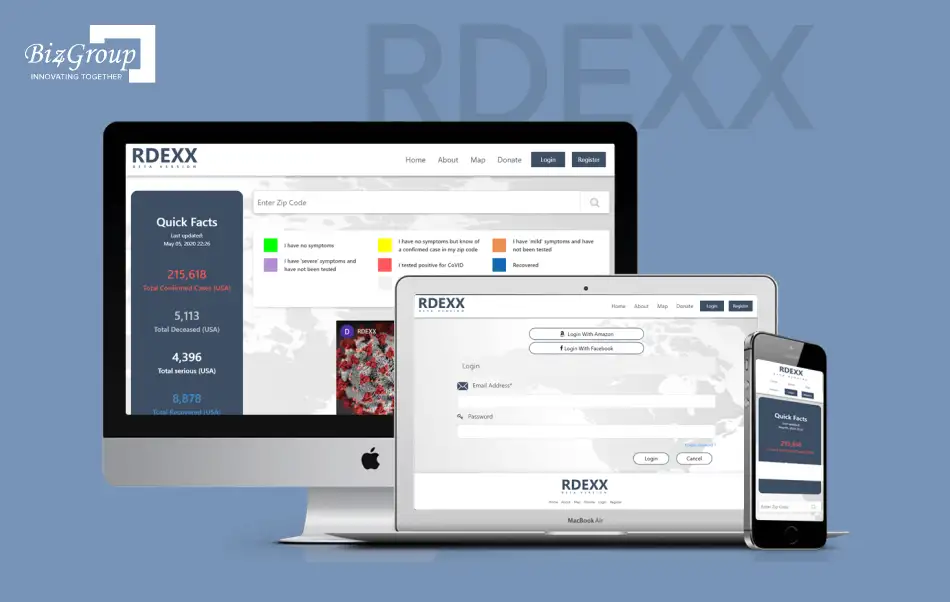
Biz4Group built a real-time disease tracking platform created for public health readiness. It offers a dynamic view of disease activity and geographic risk using live data and advanced visualization.
Key Capabilities:
- Real time case tracking across regions
- Color coded risk indicators
- Smart mapping with Google Maps API
- Community driven reporting for stronger public health insight
2. Integrated Logistics and Intelligent Fulfillment
Healthcare operations often rely on timely delivery, especially when dealing with medication, supplies, or last mile care. Advanced logistics features bring automation, route optimization, and live tracking into one place. This level of control improves accuracy and reduces delays.
Portfolio Spotlight: On-Demand Healthcare Delivery App
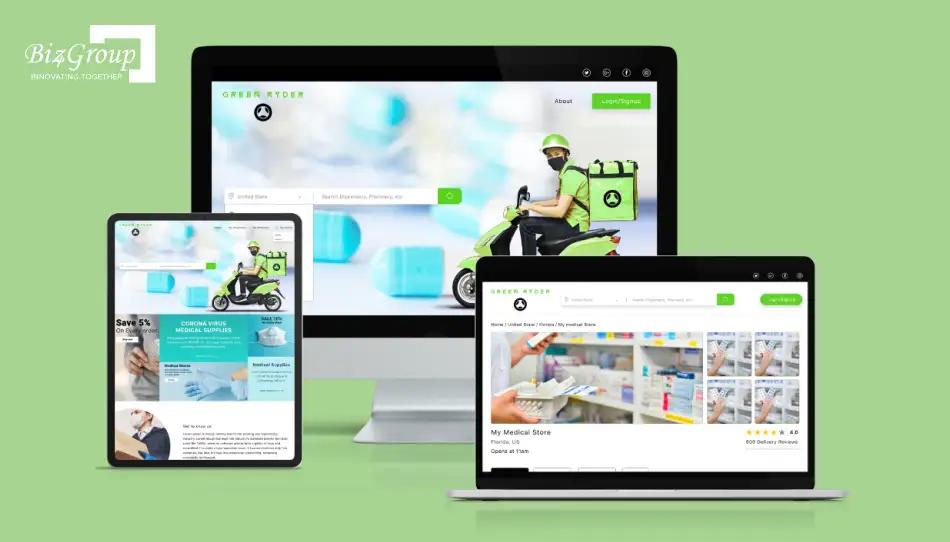
We developed a unified healthcare delivery app. It combines ecommerce, delivery management, and teleconsultation into a cohesive system for modern healthcare services.
Key Capabilities:
- Live order tracking with clear status updates
- Secure payment flows
- Prescription upload and validation
- Smart routing for delivery partners
- Real-time communication between patients, pharmacies, and riders
3. Personalized Digital Experiences
As healthcare moves toward more patient centered care, personalization becomes an essential part of custom healthcare SaaS development. These features help patients receive recommendations, reminders, educational content, and guided pathways that match their needs.
4. Intelligent Automation for Frequent Workflows
Healthcare teams handle many repetitive tasks. AI automation services supports faster execution and fewer errors across billing, scheduling, follow ups, form processing, and inventory management. When platforms include advanced automation, staff members can shift their attention to higher value tasks and patient interactions.
5. Conversational Interfaces and Knowledge Retention
Healthcare leaders increasingly explore technologies that support human like interaction. Conversational systems help users find information quickly, complete tasks with minimal steps, and store valuable knowledge in formats that feel natural and accessible. It is one of the most innovative areas within healthcare software product development.
Recommended Technology Stack for Healthcare SaaS Solutions Development
A strong healthcare platform begins with a reliable set of technologies that keep the product flexible, scalable, and easy to maintain. Many teams explore full stack development approaches because they want the freedom to adjust features over time while keeping performance steady.
|
Layer |
Purpose |
Frameworks and Tools |
|
Frontend |
Delivers the user interface for patients, providers, and admins |
React, Angular, Vue, Next.js |
|
Backend |
Manages logic, workflows, user roles, and system operations |
|
|
Mobile Apps |
Supports care teams and patients on mobile devices |
React Native, Flutter, Swift, Kotlin |
|
Databases |
Stores structured and unstructured healthcare data |
PostgreSQL, MySQL, MongoDB, Redis |
|
Cloud Hosting |
Deploys applications with flexible scaling |
AWS, Google Cloud, Microsoft Azure |
|
DevOps and Automation |
Improves deployment and update cycles |
Docker, Kubernetes, GitHub Actions, Jenkins |
|
API and Integration Layer |
Connects third party systems and internal modules |
REST APIs, GraphQL, gRPC |
|
Data Processing and Analytics |
Supports reporting and analytical insights |
Apache Kafka, Apache Spark, Amazon Redshift |
This tech stack supports systems of all sizes, from early-stage MVPs to enterprise platforms used across large provider networks. It also offers flexibility for future enhancements, giving teams the freedom to grow without major rework.
Also read: How to outsource AI healthcare software development?
How to Build Healthcare SaaS Solutions for Healthcare Organizations in 7 Steps
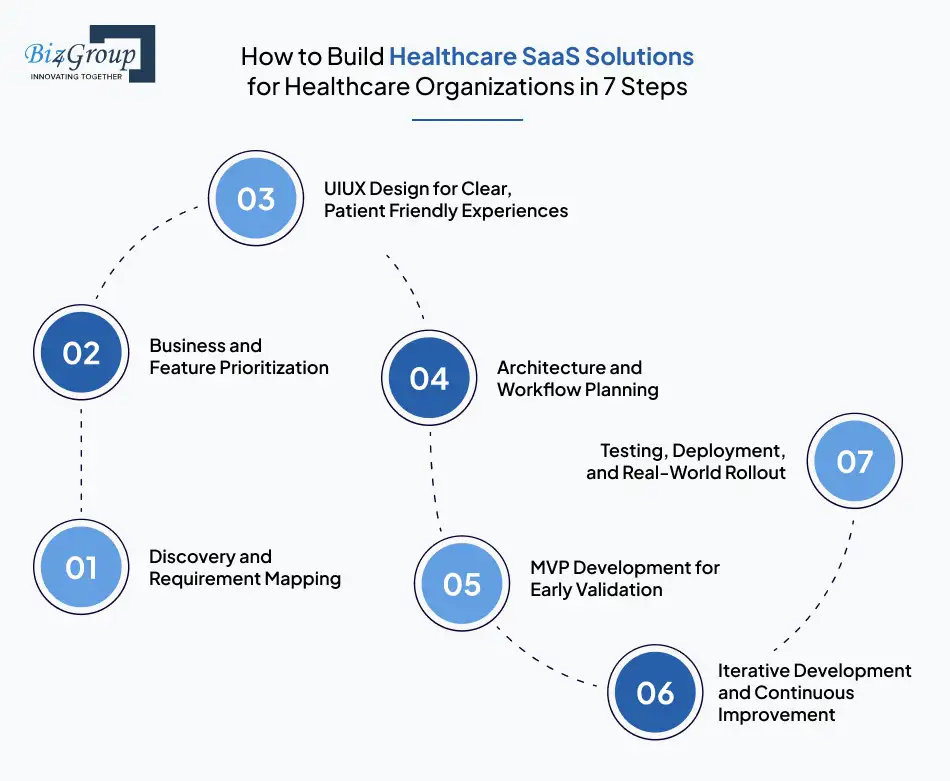
Healthcare leaders appreciate clarity when planning new digital products. A predictable process helps shape the vision, set expectations, and reduce the stress that often comes with technology projects. The following steps outline a practical path for developing healthcare SaaS platforms that support real life clinical and operational needs.
Step 1. Discovery and Requirement Mapping
Every strong product begins with understanding the people who will rely on it. This step focuses on conversations with clinical teams, administrators, patients, and support staff. The goal is to gather pain points, workflows, and expectations.
When teams start with meaningful research, they gain a roadmap that feels grounded in daily realities instead of guesswork.
Step 2. Business and Feature Prioritization
Healthcare organizations usually have more ideas than resources. Prioritization helps identify which features have the most value at launch and which can follow later.
This careful sorting shapes the direction of the product and ensures that healthcare SaaS solutions development stays aligned with measurable business outcomes.
Step 3. UI/UX Design for Clear, Patient Friendly Experiences
Design plays a major role in how quickly teams adopt a new system. An experienced UI/UX design team creates intuitive layouts, smooth navigation paths, and predictable interactions.
Clinics and hospitals benefit from designs that reduce training time and lower the cognitive load on staff. Patients appreciate interfaces that help them complete tasks without confusion or frustration.
Also read: Top 15 UI/UX design companies in USA
Step 4. Architecture and Workflow Planning
Once the direction and design are clear, the workflow structure comes next. Teams outline how each feature interacts with others, how data moves across the platform, and how users complete their daily actions. This planning helps avoid later rework and gives the entire project a strong foundation.
Step 5. MVP Development for Early Validation
Developing an MVP helps healthcare teams see their platform in action with only the most important features. This step creates a test ready version that brings early feedback and sharper understanding. Leaders use MVP insights to refine the vision, avoid unnecessary spending, and build stronger versions of the product.
Also read: Top 12+ MVP development companies in USA
Step 6. Iterative Development and Continuous Improvement
Once the MVP shows value, the next phase involves steady enhancements. New features are added, existing ones are improved, and user feedback shapes upcoming updates. This flexible approach keeps the product aligned with real world needs and supports long-term success.
Step 7. Testing, Deployment, and Real-World Rollout
A smooth rollout matters for every healthcare environment. The final step prepares the product for daily use and includes functional testing, stability checks, and user onboarding plans. Clinics and hospitals benefit from thoughtful launches that reduce disruption and help teams feel confident with their new platform.
This process gives healthcare organizations a predictable way to move from idea to working product. Each step builds momentum and prevents common challenges. When followed with care, it helps leaders create SaaS products that deliver value from the very first release and continue improving as the organization grows.
Imagine This Process Working for Your Team
You already know the steps. What you need now is a partner who delivers them without stress or surprises.
Contact Biz4Group TodaySecurity and Governance Requirements in Development of Healthcare SaaS Solutions

Healthcare organizations rely on trust. Patients trust their providers with sensitive information, and providers trust their digital systems to protect that information at every step. Strong security and ethical governance create the foundation that allows teams to develop healthcare SaaS platforms without unnecessary risk.
Protecting Patient Data with Strong Ethical Practices
- Clear policies for data access
- Transparent communication about how information is used
- Structured processes for handling sensitive requests
- Ethical data retention planning
- User focused consent and preference management
HIPAA and Core Healthcare Regulations
- Privacy rules that limit who can access identifiable health information
- Security rules that define administrative and technical safeguards
- Clear documentation for policies and procedures
- Reliable methods for ongoing audit and oversight
Also read: HIPAA compliant AI app development guide for healthcare providers
Interoperability and Data Governance Standards
- Standardized exchange formats with EHR systems
- Structured terminology use for consistent records
- Versioning rules for shared interfaces
- Data lineage tracking for accuracy and accountability
- Routine reviews to ensure clean, organized datasets
Ethical Governance for Fair and Responsible Use
- Fair access to digital services
- Non-discriminatory system behavior
- Review committees for product decisions that affect patient well being
- Responsible handling of any analytical insights
- Guardrails for features that could influence medical judgment
Operational Policies That Support Strong Compliance
- Training for staff who interact with patient information
- Incident response plans
- Documentation for product decisions
- Regular internal audits
- Vendor assessments for third party tools
When the foundation is solid, leaders gain freedom to innovate without compromising safety or trust. This is how to build healthcare SaaS solutions for healthcare organizations that perform with consistency, meet regulatory expectations, and support growth.
How Much Does It Cost to Build Healthcare SaaS Systems?
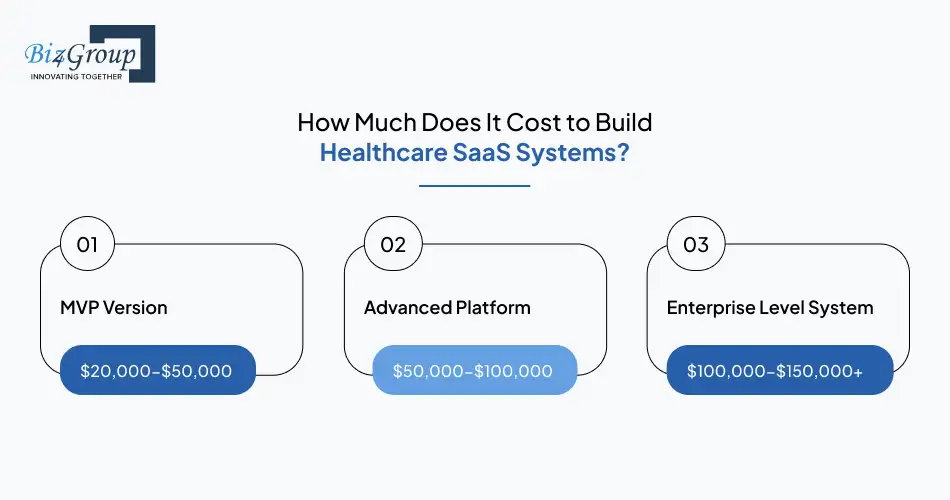
Healthcare leaders often begin their digital journey with one important question. How much will it cost to create healthcare SaaS products that deliver consistent value? This section brings clarity with realistic numbers based on industry standards and project complexity. Most platforms range between $20,000-$150,000+ depending on features, scalability needs, integrations, and product goals.
To offer a quick overview, here is a simple comparison of MVP, advanced, and enterprise level builds before we explore the deeper breakdown.
|
Build Stage |
What It Includes |
Estimated Cost Range |
|
MVP Version |
Core features that validate the idea and support early user adoption |
$20,000-$50,000 |
|
Advanced Platform |
Enhanced workflows, integrations, analytics, better UI, and specialty modules |
$50,000-$100,000 |
|
Enterprise Level System |
Multi facility management, complex workflows, deep interoperability, high volume usage |
$100,000-$150,000+ |
These numbers give leaders a starting point.
Cost Drivers That Shape Healthcare SaaS Solutions Development
Every project has unique requirements, but several common factors influence overall investment. These drivers help organizations understand why certain platforms fall at the lower end of the range and why others reach enterprise scale pricing.
|
Cost Driver |
What It Means |
Typical Cost Impact |
|
Feature Scope |
Number of modules, user roles, and workflow complexity |
$5,000-$60,000 depending on depth |
|
UI/UX Complexity |
Level of customization and user flow modeling |
$3,000-$20,000 based on detail |
|
Integrations |
EHR, pharmacy systems, payment gateways, or lab systems |
$4,000-$40,000 depending on count and difficulty |
|
Data Handling |
Volume, structure, and transformation requirements |
$2,000-$15,000 depending on size |
|
Deployment Scale |
Startup level or multi facility hospital networks |
$5,000-$50,000+ depending on reach |
|
Performance Requirements |
Speed, concurrency, and reliability needs |
$2,000-$20,000 based on optimization |
|
Maintenance Planning |
Updates, monitoring, and ongoing improvements |
$500-$5,000 per month depending on service level |
These drivers influence whether you are building a lean early-stage product or a platform that supports high volume clinical operations.
Hidden Costs Healthcare Teams Should Expect
Hidden costs often surprise first time founders and clinic administrators. When leaders understand these early, they make more confident decisions and build healthcare SaaS systems that scale without stress.
1. Ongoing Optimization Needs
Every live system requires tuning. As user numbers grow, the product benefits from refinement to keep the experience smooth. Typical impact ranges from $2,000-$10,000 across initial cycles.
2. User Training and Onboarding
Training costs appear once new staff members begin using the system. Even user-friendly platforms require orientation. Most teams set aside $1,000-$8,000 depending on staff size.
3. Version Upgrades and Feature Enhancements
Healthcare organizations request updates to match workflow changes or strategic goals. Enhancements can range from $3,000-$25,000 depending on scope.
4. Data Migration from Older Systems
Many clinics and hospitals move from legacy tools. Cleaning, formatting, and transferring data requires planning. Migration efforts can range between $2,000-$15,000.
5. Infrastructure Scaling
As the product grows, the supporting environment grows with it. Scaling typically adds $500-$3,000 each cycle depending on usage patterns.
By understanding these costs early, leaders improve decision making and plan the development path with more stability.
ROI Models That Support Smart Investment Decisions
A strong healthcare SaaS platform pays for itself over time. Clinics and hospitals often see measurable gains after the first release, especially once workflows stabilize and patient engagement improves. Here are the most common ROI indicators that executives track.
1. Operational Efficiency Returns
Improved scheduling, automated tasks, and smoother patient communication often reduce staff strain. These improvements typically lower operational expenses by 10%-30% depending on workflow complexity.
2. Higher Patient Throughput
Streamlined processes allow teams to support more patients each day. Platforms that reduce administrative overhead often increase daily capacity by 5%-20%.
3. Revenue Growth Through New Service Models
Digital tools introduce new revenue channels such as remote care, virtual programs, ecommerce modules, and subscription offerings. These add meaningful returns that can grow 10%-40% over a period of product maturity.
4. Reduction in Technical Debt
Replacing legacy systems decreases maintenance and repair spending. Savings often fall between $5,000-$20,000 annually depending on the size of the old infrastructure.
5. Stronger Patient Retention
Better digital experiences lead to repeat visits, improved adherence, and fewer missed appointments. Retention gains often contribute an additional 5%-15% in annual value.
Understanding costs early helps healthcare organizations make sound decisions about healthcare SaaS solutions development for startups, clinics, and hospitals. When leaders connect these costs with clear ROI models, the investment becomes easier to justify and far more rewarding in the long run.
Also read: What is the cost of implementing AI in healthcare?
You Have the Budget Numbers. Time for the Smart Decisions!
A well-planned build can save up to 30% in long term costs. Want to put those savings to work for you?
Get a Custom EstimateChallenges and Risks in Healthcare SaaS Application Development

Every healthcare organization wants smooth digital adoption. In reality, teams encounter obstacles that slow momentum or create uncertainty. Addressing these challenges early helps leaders build healthcare SaaS solutions with more confidence and fewer delays.
Challenge 1: Poor Integration Planning
Clinics and hospitals rely on multiple digital systems. Missing integration details often causes delays or rework.
How to move forward
- Identify all systems that need to exchange information
- Review data formats and transfer points early
- Build flexible API plans that allow future updates
- Test each integration with small datasets before full rollouts
Pro tip: Use exceptional AI integration services and rest assured.
Challenge 2: Limited User Adoption
Even well-designed products face adoption challenges if teams do not feel supported.
How to move forward
- Involve end users early in feature discussions
- Offer practical training sessions
- Provide quick reference guides for daily tasks
- Collect feedback during the first few weeks to refine confusing areas
Challenge 3: Misaligned Expectations Between Stakeholders
Leaders, developers, clinicians, and patients often view the product through different lenses. Misalignment can slow progress.
How to move forward
- Hold regular check ins with a shared project dashboard
- Document decisions to keep everyone aligned
- Review timelines together during each milestone
- Keep communication simple and focused
Challenge 4: Lack of Scalable Planning for Growth
Some platforms handle early use well but struggle with larger user demands.
How to move forward
- Plan long term user volume estimates
- Decide which features need elasticity in performance
- Review data growth patterns
- Build a roadmap that supports expansion without disruption
Challenge 5: Insufficient Testing Across Real Scenarios
Healthcare environments create unique pressures. Skipping detailed testing leads to unexpected issues after launch.
How to move forward
- Create test scenarios that mimic real clinic or hospital workflows
- Include edge cases based on past operational challenges
- Run tests with different user roles
- Invite a small pilot group to try the platform in live conditions
Practical problem solving helps teams build healthcare SaaS platforms that feel stable, intuitive, and aligned with daily patient care. These insights make the path smoother whether you manage a clinic, hospital, or ambitious startup.
Why Biz4Group LLC Leads Healthcare SaaS Solutions Development in the USA?
Healthcare organizations across the USA often look for partners who can guide them through the complex, high stakes world of digital transformation. Biz4Group LLC brings that clarity.
We are a USA-based software development company and our clients include medical practices, enterprise healthcare networks, and growing digital health innovators who rely on us to turn their ideas into dependable products.
We build healthcare AI solutions as end-to-end partners who stay aligned with business goals, operational realities, and patient expectations. Our team brings experience in patient engagement systems, digital diagnostics, AI development, and connected care models.
Our portfolio reflects the depth of our work. Every project shows our ability to design and build digital experiences that feel modern, intuitive, and ready for scale. When healthcare leaders want a partner who understands both the technology and the industry, Biz4Group is often the first team they call.
Why Businesses Choose Us
Organizations choose Biz4Group LLC because they want a partner who brings more than development skills. They want reliability, strategy, creativity, and execution. They want someone who sees the long view.
- We shape ideas into solutions that make clinical and administrative life easier
- We design experiences that reduce training time and improve adoption
- We build platforms that grow with the business instead of limiting it
- We focus on clear communication and thoughtful planning throughout the project
- We bring industry insight that strengthens decision making from day one
- We deliver on time with predictable workflows and consistent accountability
Our clients value the way we work because the experience feels structured, transparent, and collaborative. Healthcare leaders respect our ability to build platforms with long-term vision.
With each project, we support innovation that feels practical. We guide our partners through strategic decisions, product evolution, and operational readiness. This consistency builds trust and helps healthcare teams create digital products that perform with stability in real environments.
If your organization plans to explore new platforms or refine existing systems, our team is ready to help you move ahead with clarity and strong execution.
Final Thoughts
Healthcare SaaS solutions development continues to reshape how clinics, hospitals, and startups operate in a world that demands speed, precision, and dependable digital experiences. From patient engagement to diagnostics, logistics, enterprise AI solutions, and multisite coordination, cloud-based platforms give organizations the power to evolve without the weight of outdated systems.
As leaders look ahead, the focus stays on creating solutions that help teams work smarter, support patients with care, and grow sustainably. The right platform strengthens operational reliability while opening doors to new service models and long-term innovation. Investments in these systems set the stage for better patient journeys and healthier organizational performance.
Biz4Group LLC helps bring that vision to life for healthcare organizations across the USA. Our experience building AI apps with strategic planning and user-centered design allows us to deliver platforms that feel intuitive, dependable, and ready for scale. Clients rely on us because we understand both the technical landscape and the healthcare ecosystem with equal strength.
If you are ready to transform your next idea into a product that performs with clarity and confidence, partner with Biz4Group and let our experts guide you toward the next stage of your digital growth.
FAQs
Can healthcare SaaS platforms support multiple service lines under one system?
Yes. Many products are structured to manage various service categories in a coordinated manner. This approach helps teams unify patient experiences and streamline internal operations without juggling several separate tools.
What type of analytics do healthcare teams usually find most useful in a SaaS product?
Healthcare teams often value trend insights tied to patient behavior, program performance, appointment patterns, and operational volume. These analytics support planning and highlight areas where small improvements can produce strong outcomes.
Can a healthcare SaaS product continue evolving after launch?
Yes. Most digital products grow through scheduled improvements. Leaders often review performance, gather user input, and adjust priorities based on new goals. This steady evolution keeps the system aligned with real world needs.
Are healthcare SaaS tools suitable for organizations with minimal technical staff?
Many providers with small internal teams use SaaS platforms without difficulty. Clear instructions, guided onboarding, and ongoing support help keep the experience smooth while reducing the need for heavy technical oversight.
What makes a healthcare SaaS product attractive to investors?
Investors look for strong value propositions, clear user demand, and growth potential. Demonstrating how the product supports real problems and can expand across markets makes the opportunity more appealing during funding conversations.
