 Location :
Orlando, FL, USA
Location :
Orlando, FL, USA +1 (407) 714-1616
 info@biz4group.com

- Mental health software revamp services help clinics and teletherapy platforms modernize outdated systems and improve digital care performance.
- Revamp mental health software platforms to deliver smoother workflows, better engagement and stronger operational stability.
- Rebuild legacy mental health software systems to support new features, higher traffic and long-term scalability.
- Learn how to modernize and revamp mental health software through structured processes, UI upgrades, integrations and data improvements.
- Cost to revamp mental health software platform falls around $20,000-$100,000 based on scope, features, integrations and long-term growth plans.
- Biz4Group LLC is the trusted USA partner for successful mental health software revamps with proven healthcare expertise.
Have you ever felt that your clinic’s digital tools are a bit behind what patients expect today? Many providers feel that way, especially now that teletherapy use keeps rising. In fact, about 37% of adults used telehealth for mental health support in recent data from the National Center for Health Statistics.
With more people seeking care online, more clinics are starting to explore mental health software revamp services to keep up with that shift.
As expectations grow, leaders begin to notice signs that their systems need attention. Slow interfaces, limited engagement features and outdated workflows often reveal deeper performance issues. This is usually the moment they start looking for ways to revamp mental health software platforms in a structured and sustainable way.
Some healthcare teams reach a point where their platform cannot keep up with clinician demand or patient load. This often sparks a conversation about how to revamp existing mental health software without interrupting operations.
Others want clarity on how to modernize and revamp mental health software so they can offer a smoother experience for patients who are already familiar with intuitive digital products in other parts of their lives. A thoughtful revamp allows them to evolve at the same pace as the people they want to serve.
And what’s a thoughtful revamp? Read on to find out.
Why Read When You Can Get Answers Straight from Experts
Talk to people who have rebuilt mental health systems across the USA.
Get in TouchSigns Your Platform Needs Mental Health Software Revamp Services
When clinics and teletherapy startups reach growth milestones, their software often shows early signs of stress. These signs can be subtle at first. A slower dashboard here. An incomplete workflow there.
Over time, these issues stack up and start affecting care delivery. Understanding them early helps leaders plan the right type of revamp before the platform becomes harder to maintain.
Common Problems Clinics Face Before a Revamp
Often, platforms experience a mix of technical and operational challenges. These become clearer when patient volume increases or clinicians request new features.
Typical issues include:
- Long load times that frustrate both patients and providers
- Limited scheduling and billing automation
- Fragmented tools that require too many manual steps
- Outdated design that reduces engagement\
- Difficulty integrating with EHR, insurance systems or teletherapy tools
- Security gaps that make compliance tasks harder\
- Rising maintenance costs because of legacy code
Below is a simple snapshot. It helps leaders identify where their challenges sit.
| Problem Category | What It Looks Like in Daily Operations | Why It Matters |
|---|---|---|
|
Performance issues |
Slow dashboards, stalled video calls |
Lower patient satisfaction |
|
Outdated workflows |
Too much manual data entry |
Higher admin load |
|
Weak integrations |
Systems do not talk to each other |
Lost time and increased errors |
|
Legacy architecture |
Difficult to scale or update |
Higher long-term costs |
These hurdles often push organizations to assess revamp options that keep them competitive in a fast-moving digital care market.
Business Value of Planning a Software Revamp
A thoughtful revamp turns scattered processes into a stable, scalable system that supports growth. This is where leaders begin to feel the difference. Operations sharpen. Clinicians save time. Patients stay more engaged.
With better performance and cleaner data, decision making becomes easier across the entire practice.
Teams often report value in these areas:
- Higher patient retention because the experience feels smoother
- More accurate billing with AI automation services
- Predictable compliance management
- Stronger scalability for multi-location care
- Lower bug fixing and maintenance costs
- Better insights through organized data and reporting
The shift from reactive problem solving to proactive growth planning is what motivates many organizations to move forward.
What Revamp Services Usually Include
Revamp solutions cover a full spectrum of upgrades. They aim to improve structure, usability and reliability without interrupting care delivery. The work goes far beyond surface design changes. It strengthens the foundation of the platform.
Most revamp packages include
- Product audits to identify what needs repair
- UX improvements that raise patient engagement
- Backend upgrades for speed and flexibility
- Cloud migration for better performance
- Strengthened security controls
- Integration setup with EHR, billing or teletherapy tools
- Better reporting dashboards
- Support for future growth
These upgrades help teams move from scattered processes to organized workflows. The result is a platform that performs better, supports clinicians more easily and stays aligned with rising patient expectations.
Features to Prioritize When You Revamp Mental Health Software Platforms
Every growing clinic or teletherapy startup eventually reaches a point where feature gaps begin to limit patient engagement and clinician productivity. A thoughtful revamp brings an opportunity to decide which features matter most for long term stability and patient centered care.
Below is a breakdown of high value features to consider. Together, they help teams plan a strong upgrade strategy.
|
Feature Priority |
What It Means |
Why It Matters |
Impact on Growth |
|---|---|---|---|
|
Enhanced teletherapy experience |
Clear video, stable sessions, message based care |
Creates a smooth care channel for all users |
Higher appointment completion rates |
|
Automated scheduling and billing |
Smart calendars, reminders, payment flows |
Reduces manual work for staff |
Faster operations and fewer errors |
|
AI supported insights and journaling features |
Mood tracking, guided journaling, smart prompts |
Helps clinicians monitor patient progress |
Better continuity of care |
|
Accessibility focused UX |
Large fonts, high contrast, screen reader support |
Makes care inclusive for all patients |
Wider reach and improved engagement |
|
Advanced dashboards for clinicians |
Activity logs, treatment progress, reporting |
Gives actionable insights for better decisions |
Stronger care outcomes |
|
EHR and insurance integrations |
Unified access to patient data and verification |
Cuts down duplicate entry |
Faster onboarding and reduced admin time |
|
Cloud optimized performance |
Stable uptime and reliable speed |
Handles growing user volume |
Supports scale without disruption |
|
Mobile experience upgrade |
Responsive views and intuitive flows |
Matches patient expectations for mobile first care |
Expands usage across age groups |
When teams select the right features, they strengthen the platform in a way that supports both present needs and future plans. A well prioritized upgrade turns everyday tasks into streamlined experiences and sets the stage for long term platform evolution. For reference, you can check out the top mental health app features you need for your product.
Ready for Features Your Patients Will Actually Enjoy?
Nearly 74% of patients say ease of use shapes their loyalty. Why let outdated features chase them away?
Book a Strategy Call NowIdeal Tech Stack to Rebuild Legacy Mental Health Software Systems
Rebuilding older platforms often starts with choosing the right tools. A suitable tech stack brings stability, speed and flexibility, especially when legacy builds limit performance. Since many clinics want platforms that grow with their services, selecting the stack early helps avoid costly adjustments later.
|
Tech Category |
Purpose in the Revamp |
Tools and Frameworks |
Best Fit For |
|---|---|---|---|
|
Frontend frameworks |
Create smooth patient and clinician interfaces |
React, Angular, Vue, Flutter |
Mobile friendly and responsive experiences |
|
Backend frameworks |
Power core workflows and handle business logic |
Node, Python Django, Java Spring |
Scalable and reliable operations |
|
Databases |
Manage structured and unstructured health data |
PostgreSQL, MongoDB |
High volume patient records and activity logs |
|
Cloud hosting platforms |
Improve speed, availability and storage |
AWS, Azure, Google Cloud |
Clinics that expect growth across locations |
|
Integration tools |
Connect the platform with billing, EHR and teletherapy modules |
Rest APIs, GraphQL, FHIR based connectors |
Unified workflows and reduced manual work |
|
Analytics and reporting tools |
Help clinicians track performance and outcomes |
Metabase, Power BI, custom dashboards |
Better visibility into patient progress |
|
Communication modules |
Support secure calls, messaging and reminders |
WebRTC, Twilio, Vonage |
Strong teletherapy experiences |
|
DevOps and deployment tools |
Maintain smooth releases and updates |
Docker, Kubernetes, GitHub Actions |
Continuous improvement and reliability |
A well-chosen tech stack gives teams the structure they need to move from legacy constraints to a stable, modern system that grows with patient demand. Each tool plays a part in making sure the rebuilt platform performs well even when traffic rises or new features need to be added.
Also read: How to develop a mental health app like BetterHelp?
How to Rebuild Legacy Mental Health Software Through a Structured Process?
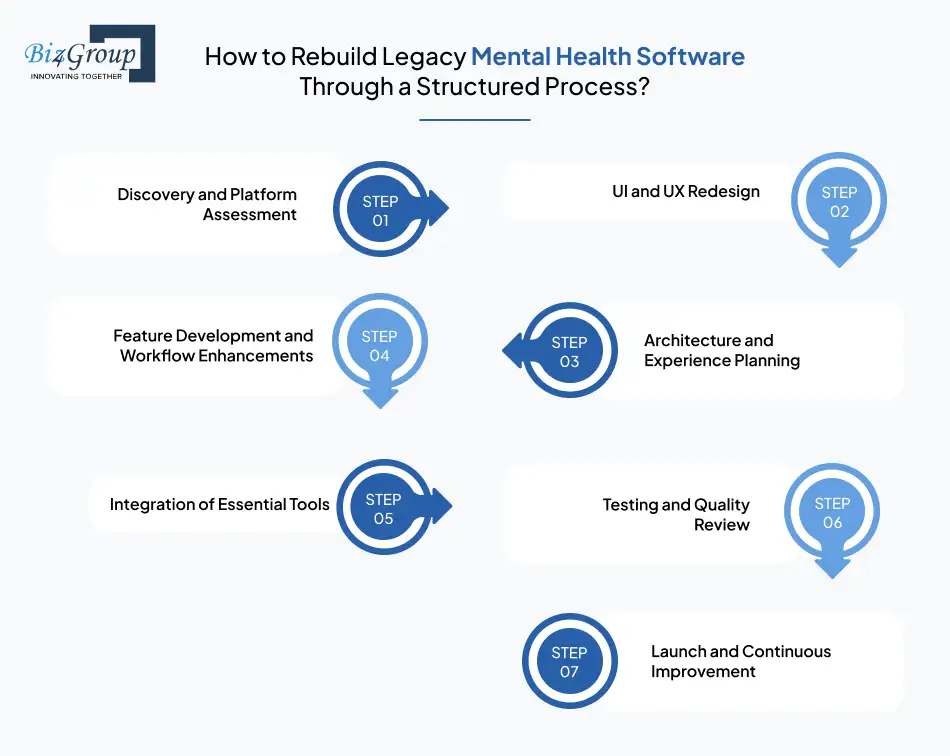
Every revamp succeeds when the process feels organized and predictable. Clinics and teletherapy platforms often worry about disruptions, which is why a clear roadmap builds confidence from the start. This roadmap helps teams understand how each stage connects to real outcomes.
Step 1. Discovery and Platform Assessment
This step sets the tone for the entire project. Teams examine pain points, workflows and patient journeys to understand what slows things down. The assessment also helps identify gaps in engagement, performance or feature alignment.
With this clarity, leaders can shape a plan that supports both immediate fixes and growth.
Step 2. UI and UX Redesign
This is one of the most visible parts of any revamp. The right UI/UX development company helps create a patient friendly and clinician friendly experience. A stronger flow helps people spend less time figuring out the platform and more time engaging with care. Highlights include:
- Simplified navigation
- Clean layouts
- Mobile friendly behavior
- Reduced cognitive load
A thoughtful redesign has a direct influence on satisfaction and reduces friction in daily use.
Also read: Top 15 UI/UX design companies in USA
Step 3. Architecture and Experience Planning
This stage focuses on reorganizing how the platform works behind the scenes without going into technical frameworks or security. Teams map out how modules interact, how data should flow and which features support engagement goals.
The goal is to remove unnecessary complexity and prepare the system for future enhancements.
Step 4. Feature Development and Workflow Enhancements
Once priorities are set, development teams begin refining or adding key features. Leaders often focus on scheduling improvements, better messaging flows, stronger patient onboarding or clinician dashboards. Each feature is shaped to reduce manual tasks and create a smoother operational rhythm for clinics of all sizes.
Step 5. Integration of Essential Tools
Features become more powerful when they communicate with the tools clinics already use. This may include EHR systems, billing platforms or teletherapy modules. AI integration services helps bring scattered tasks into one place, which reduces context switching for both staff and providers.
Step 6. Testing and Quality Review
A full review ensures the platform works as planned. Usability tests help confirm whether the new flows feel intuitive. Load and functional checks help clinics trust that the upgraded system can support regular traffic without interruptions.
This step is often the moment when teams gain confidence that their investment is ready for real use.
Step 7. Launch and Continuous Improvement
The rollout phase is carefully paced to avoid disruption. After release, teams gather feedback from clinicians and patients to fine tune the experience.
A revamp does more than fix old problems. It opens the door to ongoing improvements, which keeps the platform aligned with the fast moving world of digital mental health care.
A well guided process allows organizations to rethink digital care through mental health software revamp services and move forward with confidence. Next up, we’ll talk about the ideal tech stack recommended to revamp mental health software platforms.
Also read: MVP development guide for AI mental health app
Wondering How Smooth Your Revamp Journey Could Be?
A clear roadmap can cut project delays by more than 30%. Want to see what yours would look like?
Talk to Our ExpertsThe Role of Compliance and Security in Mental Health Software Revamp Services
A strong revamp is not complete without revisiting compliance and security. Clinics handle sensitive patient stories every day, which means every upgrade must protect both data and trust.
As platforms evolve, new workflows, new integrations and new features can introduce new risks. Addressing those risks early keeps the revamp smooth and predictable.
Key Compliance Areas to Review During a Revamp
A revamp offers a chance to refresh outdated practices and align the platform with modern privacy expectations. Focus areas typically include:
- HIPAA aligned data handling
- Access controls for clinicians, admins and billing teams
- Secure storage for assessments, journals and session notes
- Activity trails to track who performed specific actions
- Valid consent records for communication and data sharing
- Verification of how data moves between modules
- Clarity on retention periods and deletion workflows
These updates help clinics avoid future issues and maintain integrity as their digital footprint expands.
Also read: HIPAA compliant AI app development guide for healthcare providers
Strengthening Patient Trust Through Consistent Safeguards
Patients rely on digital systems to hold deeply personal information. Platforms that show care in how they protect data often see better adoption from both clinicians and patients.
Elements that support trust:
- Simple authentication that still stays secure
- Clear privacy messaging in onboarding flows
- Reduced friction when accessing sensitive features
- Accurate logs that support internal audits
- Predictable handling of user requests or changes
These steps connect directly to platform loyalty and long-term patient relationships.
A secure platform helps clinics scale without worry. As organizations expand locations, hire more clinicians or increase patient load, compliance acts as a stabilizing force. A sound compliance strategy builds the foundation that the rest of the platform depends on.
Also read: How to build AI mental health app for corporate wellness programs?
How Much Does It Cost to Revamp Mental Health Software Platform?
Most clinics and teletherapy platforms begin cost discussions long before they finalize their revamp plan. A modernization project usually ranges from $20,000-$100,000+ depending on scope, integrations, legacy cleanup and long-term goals.
This range helps teams understand that their investment aligns with the depth of changes they want to achieve.
Key Cost Drivers in a Mental Health Software Revamp
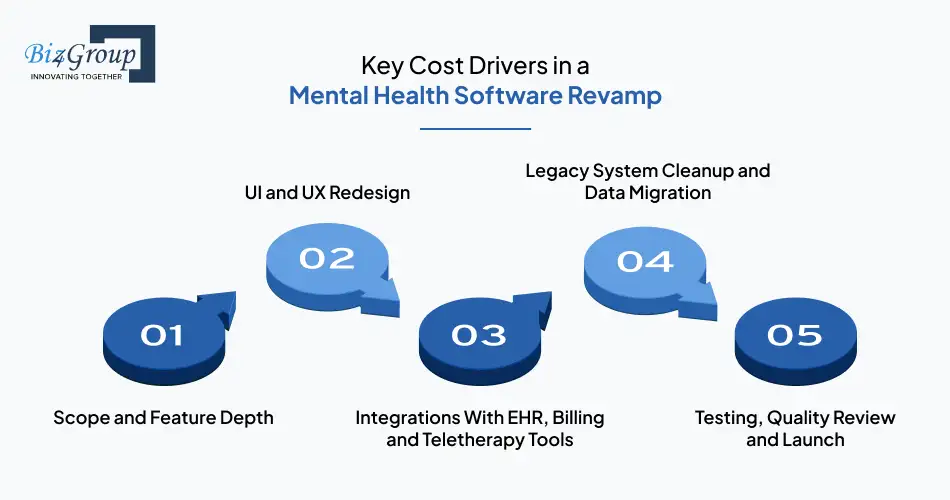
Every revamp involves several moving parts. Each part influences both the budget and the timeline. A detailed understanding of these drivers helps clinics plan more confidently and avoid surprises.
- Scope and Feature Depth
When the platform needs new features or refinements, the scope grows. A larger scope increases cost, while a lighter update remains closer to the lower end of the range.
- Enhancing teletherapy flows: $6,000-$20,000
- Upgrading dashboards for clinicians: $3,500-$12,000
- Redesigning patient onboarding and journaling features: $5,000-$18,000
- Adding automated scheduling or billing: $4,000-$15,000
The clearer the scope, the easier it becomes to budget. Fuzzy feature lists lead to rising expenses, which is why careful planning matters from the start.
- UI and UX Redesign
User experience is one of the most influential cost factors. Improving layouts, navigation and patient journeys requires thoughtful design that aligns with clinical needs.
- Full UI redesign across all screens: $8,000-$25,000
- UX journey mapping for patients and clinicians: $3,000-$10,000
- Mobile optimization for phones and tablets: $4,000-$12,000
These redesign efforts reduce friction and support stronger engagement.
Also read: Best practices in mental health app design
- Integrations With EHR, Billing and Teletherapy Tools
Integrations streamline workflows, but they require precise planning because different tools rely on different data structures.
- EHR integrations: $6,000-$20,000
- Billing and insurance verification integrations: $5,000-$15,000
- Communication modules like messaging or video: $4,000-$14,000
These integrations reduce manual work and bring scattered tasks together in one place.
- Legacy System Cleanup and Data Migration
Older systems usually need a cleanup step before any modernization can happen. This process helps prepare the platform for performance improvements and new features.
- Code cleanup and refactoring: $5,000-$18,000
- Data restructuring: $3,000-$12,000
- Migration of journals, notes and patient records: $4,000-$20,000
Legacy cleanup may feel invisible, but it strengthens long term reliability.
- Testing, Quality Review and Launch
Testing keeps the revamp safe and predictable. It reduces downtime and ensures the platform feels polished before release.
- Functional testing: $2,000-$8,000
- Load and performance testing: $2,500-$10,000
- Usability reviews with clinicians: $1,500-$7,000
These rounds ensure the updated platform behaves as expected once patient traffic returns.
Partial Refurbish vs Full Modernization
Below is a simple comparison to help decision makers understand how cost differs between the two paths.
|
Type of Revamp |
What It Includes |
Estimated Range |
Best For |
|---|---|---|---|
|
Partial refurbish |
UI tuning, light feature updates, simple refactoring |
$20,000-$45,000 |
Clinics needing quicker improvements |
|
Mid level revamp |
UX redesign, new components, stronger integrations |
$45,000-$70,000 |
Platforms with growing patient volume |
|
Full modernization |
Deep rebuild, migrations, major features, scalability enhancements |
$70,000-$100,000+ |
Clinics preparing for long term expansion |
A partial refurbish helps teams improve their platform sooner, while full modernization supports long range stability.
Budget Mistakes to Avoid During a Revamp
Budget planning shapes how smoothly a revamp unfolds. A few common mistakes can add unexpected costs and extend delivery times. Here are the most important ones to avoid:
- Planning features without measuring their real usage
This often raises the bill because unnecessary screens are redesigned. - Ignoring data cleanup at the start
Delays become expensive once development has already begun. - Forgetting mobile optimization
Many patients access care through phones, so skipping this step often leads to redesigning again later. - Adding too many features at once
This inflates scope and pushes the project into higher cost tiers quickly. - Underestimating testing
Minimal testing might look cheaper at first, but bugs can create higher expenses during launch.
Staying aware of these mistakes helps clinics protect their budget. A well-planned revamp aligns cost with value so teams gain a platform that performs better without financial strain.
Curious Where Your Revamp Budget Delivers the Most Value?
Smart clinics invest where returns last the longest. Want a tailored estimate for your platform?
Get Your Cost and ROI EstimateMeasuring ROI in Custom Mental Health Software Revamp Solutions
A software revamp becomes most valuable when leaders can track the outcomes that matter to their organization. Many clinics enter this stage wondering how to measure improvements beyond the initial refresh.
The truth is that a revamp influences both the experience and the operations behind it. When measured correctly, ROI provides clarity on the value of the investment and guides decisions for future enhancements.
Key Areas That Shape ROI
Each upgrade contributes to long term value in its own way. Measuring these areas offers a fuller picture of how well the platform performs after a revamp.
You will see impact across:
- Patient engagement and satisfaction
- Workflow speed for clinicians and staff
- Accuracy of billing and documentation
- Platform stability
- Ability to scale without downtime
- Cost savings from fewer fixes and maintenance tasks
These categories help decision makers understand the return on both financial and operational levels.
ROI Breakdown in Practical Metrics
Many leaders prefer clear, measurable indicators. The table below outlines common ROI metrics clinics track after a revamp.
|
ROI Category |
What to Measure |
Why It Matters |
Post Revamp Indicator |
|---|---|---|---|
|
Patient engagement |
Appointment completion, session attendance, active users |
Strong engagement often reflects smoother digital experiences |
Higher weekly activity and reduced dropouts |
|
Operational efficiency |
Time spent on tasks, number of manual steps, workflow duration |
Leaner workflows help teams work faster with fewer errors |
Faster onboarding and task completion |
|
Financial performance |
Billing accuracy, reimbursement timing, cost reduction |
Refined billing flows support stable revenue cycles |
Fewer disputes and increased accuracy |
|
Product stability |
Uptime, bug frequency, performance speed |
Stable platforms improve trust and reduce support tickets |
Better load times and consistent reliability |
|
Scalability |
User capacity, traffic handling, ease of adding new features |
Growing clinics need systems that expand without disruption |
Ability to support more users and locations |
These metrics provide a simple way to quantify progress once the revamp goes live.
Long Term ROI That Builds Over Time
A revamp supports ongoing improvements. It gives teams a more reliable base to build future features and integrations. Clinics that focus on long term ROI often revisit these areas every few months to evaluate progress.
Long term gains often appear in:
- Higher patient retention throughout the year
- Better clinician satisfaction with digital tools
- Support for multi-location expansion
- Clearer roadmaps for future development
- Lower maintenance costs
These benefits grow steadily as the platform continues to evolve.
A clear ROI view helps leaders understand whether the revamp aligns with strategic goals. Most importantly, it provides confidence for future upgrades or expansions, helping teams grow in a structured and predictable way.
Common Mistakes to Avoid in Mental Health Software Revamp Services
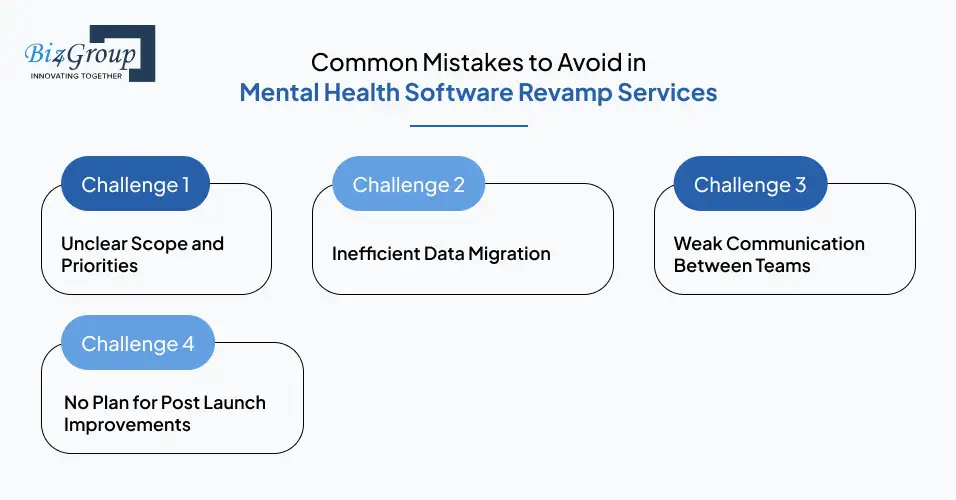
Every revamp brings exciting possibilities, but it also comes with challenges that teams should spot early. The more clearly leaders understand these roadblocks, the smoother their modernization journey becomes.
Below are the most common challenges clinics face, followed by practical solutions that keep the project on track.
Challenge 1: Unclear Scope and Priorities
A revamp can drift off course when teams work with vague goals. This slows progress and increases costs because everyone has a different interpretation of what needs improvement.
Solutions:
- Create a detailed feature list before the project starts
- Prioritize upgrades based on daily workflows
- Review the scope with all stakeholders to ensure alignment
- Track changes so the project stays lean and predictable
Challenge 2: Inefficient Data Migration
Data may be stored in scattered formats or outdated structures. If migration is rushed, clinics risk losing valuable records.
Solutions:
- Map all datasets before migration begins
- Clean duplicates and errors at the start
- Test the migrated data in stages
- Keep backups accessible throughout the process
Challenge 3: Weak Communication Between Teams
Miscommunication can lead to misaligned goals, incorrect features or repeated work.
Solutions:
- Schedule regular check in meetings
- Document requirements clearly
- Share prototypes for feedback
- Maintain shared dashboards for progress visibility
Challenge 4: No Plan for Post Launch Improvements
Some clinics complete the revamp but fail to maintain the upgraded system. Over time, the platform begins to show gaps again.
Solutions:
- Build a maintenance schedule
- Track user feedback after launch
- Plan minor updates every few months
- Keep a feature backlog for future enhancements
A revamp becomes far more successful when these challenges are addressed early. Each solution helps the platform evolve in a steady and predictable way, creating room for stronger experiences and future growth.
Avoid Challenges Like A Pro
A well-guided revamp reduces rework by nearly half. Want expert help steering yours the right way?
Schedule A Free Call NowWhy Biz4Group Is the Best Company in the USA to Revamp Mental Health Software?
Choosing the right development partner shapes the entire outcome of a mental health software revamp. This is where Biz4Group LLC makes a difference.
As a USA-based software development company, we focus on building powerful healthcare AI solutions that improve patient care, streamline operations and help clinics grow confidently. We work closely with mental health leaders, founders and clinical teams, helping them turn their product challenges into high performance platforms that patients trust.
We understand the weight of responsibility carried by mental health solutions. Our team builds with empathy, industry experience and a careful process shaped by years of working in healthcare innovation.
One of our strongest advantages is our ability to combine AI product thinking with bespoke AI development skills. Clinics often come to us with fragmented systems, outdated experiences or overwhelming maintenance issues. We help them stabilize the foundation, improve performance and design experiences that feel natural for users at every stage of care delivery.
Our team brings clarity where clients often feel stuck and offers solutions shaped by technical skill, clinical understanding, and strategy.
Portfolio Spotlight: AI-based Solution for Dementia Patients
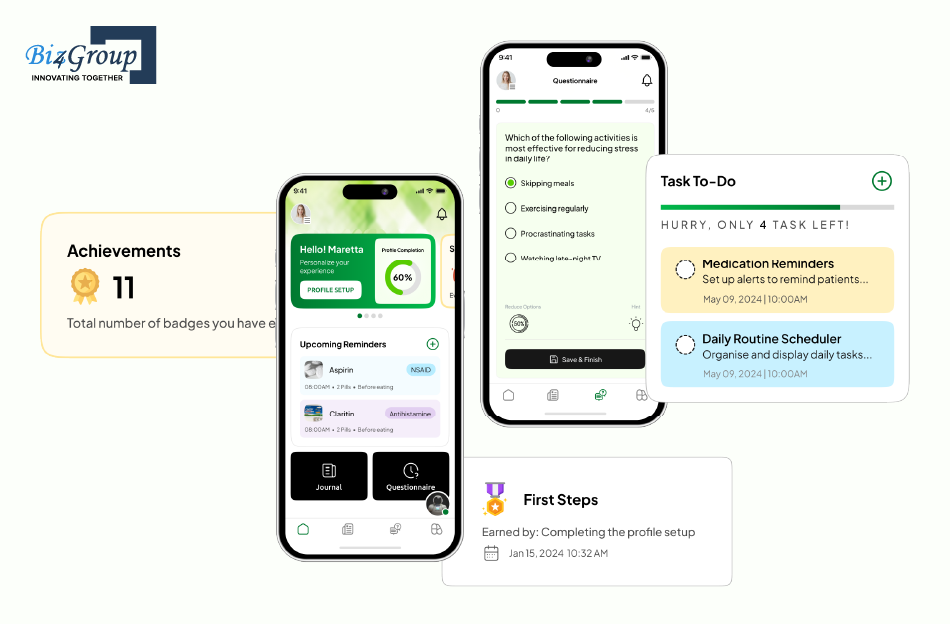
Our experience shines through one of our standout projects that we created for early-to-mid stage dementia patients. It demonstrates what thoughtful engineering and human centered design can accomplish in the mental health space.
Key highlights of the project:
- Personalized quizzes that help patients stay mentally active
- Daily journaling features designed to support routine thought processes
- Smart reminders that guide patients through their medication and daily tasks
- Voice-to-text journaling for patients who prefer speaking over typing
- A performance analyzer that tracks cognitive patterns over time
- Emotional checkpoints powered by NLP to help caregivers understand patient wellbeing
- A secure and scalable PostgreSQL database to support large volumes of patient history
- Smooth data handling designed for sensitive information and easy retrieval
This project demanded a blend of medical insight, advanced engineering and mindful design. Our team solved challenges related to cognitive performance modeling, emotional signal interpretation and large scale patient data management.
Biz4Group LLC continues to stand out because of our commitment to quality, speed and transparency. Our enterprise AI solutions are shaped by real clinical workflows, not assumptions. We build platforms that feel natural, run fast and stand strong as organizations grow.
For clinics and teletherapy startups looking to compete in a rapidly transforming digital care landscape, choosing the right partner can change everything. With Biz4Group, hire mental health app developers that take your goals seriously and support you from planning to launch and beyond.
So, without delaying any further, contact Biz4Group today!
Wrapping Up
Mental health platforms play a major role in how clinics and teletherapy providers deliver care, so a thoughtful revamp carries real weight. When outdated workflows, slow performance or rising patient expectations start to create noticeable gaps, a modernization effort helps your platform evolve with the industry. From smoother experiences to stronger engagement, the right upgrades turn routine interactions into reliable digital care moments that patients trust.
A revamp also prepares organizations for the future. With better features, improved usability, scalability and data clarity, clinics gain the structure they need to grow without friction. Every improvement adds long term value. The process protects your investment, extends your platform’s lifespan and supports a more confident digital care strategy.
Biz4Group LLC brings the insight, technical skill and healthcare understanding needed to guide this transformation. Our team focuses on reliability, strong execution and user centered thinking. With experience across complex mental health projects, we help organizations upgrade their platforms without losing momentum.
If you want your platform to feel modern, smooth and ready for growth, now is the time to start. Reach out to Biz4Group today and get a revamp plan shaped around your goals and your market.
FAQs
Can a revamp help improve provider adoption inside a clinic?
Yes. When workflows feel faster and clearer, providers tend to use the platform more consistently. A revamp often strengthens the internal experience through cleaner navigation, reduced steps and better alignment with daily clinical routines.
How long does a typical revamp project stay live before it needs more upgrades?
Most modernized platforms run comfortably for several years before needing major changes. Small feature enhancements or usability improvements may happen more often, but a full revamp usually supports long term stability.
Do clinics need a dedicated internal tech team to maintain the platform after a revamp?
Not always. Many organizations choose maintenance plans with their development partner. Others work with a small internal team that handles minor updates while outsourcing bigger enhancements.
Can a revamp support multi-specialty expansion for growing clinics?
Yes. A revamp can prepare the platform to host new specialties by creating modular structures that accommodate varied assessment types, session formats and documentation needs. This helps clinics widen their service offerings without rebuilding systems.
Does a revamp affect existing patient accounts or appointments?
A well-planned revamp keeps ongoing care uninterrupted. Most upgrades happen in controlled environments. User accounts, booked sessions and historical data remain intact once the updated version is deployed.
Are custom reporting tools included in all revamp projects?
Not necessarily. Some clinics request advanced analytics, while others prefer simpler dashboards. Reporting tools are often tailored to the clinic’s operational style, regulatory needs and preferred decision-making approach.
Can a revamp help prepare my platform for future integrations like wearable devices or wellness tools?
Yes. A strong revamp builds flexibility into the platform so new data sources and interactions can be added with fewer complications. This helps clinics stay open to innovation and partner ecosystems as digital care grows.
