Location :
Orlando, FL, USA
Location :
Orlando, FL, USA +1 (407) 714-1616
 info@biz4group.com


















Imagine a digital system that doesn’t wait for instructions but instead, understands your business goals, learns from real-time feedback, and takes independent actions to get the job done.
Read More

More than 500 million people experience mental health challenges every year and digital solutions have become their first line of support according to the WHO. If your organization has been exploring MVP development for AI mental health app ideas, this may be the time that decides who leads and who follows.
Many founders and wellness leaders want to build something meaningful but feel overwhelmed. They want a clear mental health app MVP strategy that helps them take an idea from spark to launch without overbuilding. They want an approach that supports real users and creates trust. This is exactly where AI mental health app MVP development becomes essential.
Organizations that begin early-stage MVP development for AI mental health app concepts validate
their ideas faster and learn what users truly value.
A minimum viable product helps you
place a small controlled version of your idea into real hands. You learn what to keep. You learn
what to refine. You also learn what never needed to be built at all.
If your goal is to deliver AI mental wellness support that feels personal and useful then you are at the right place. This guide will walk you through what you need to build a successful MVP for an AI mental health app and how to move from idea to pilot launch with confidence.
If you’re considering an MVP development for AI mental health app, now really is a pivotal moment. Demand is surging, technology is ready, and organizations are actively seeking scalable emotional-wellness tools.
The global mental health apps market size is projected to reach USD 17.52 billion by 2030. This means that there is a large and growing market for digital mental wellness and a real window of opportunity for building an MVP for AI mental health therapy app before saturation hits.
You’re not building the app for the sake of it. You’re solving specific problems. If you can clearly address these pain points, your MVP will stand out.
These challenges are well-documented across every AI mental health app development guide and show why an MVP-focused approach is the smartest starting point.
Instead of building full-featured from day one, an MVP for AI mental health app helps you:
In short, you don’t wait until everything is perfect. You build the minimum viable product, you learn, and you scale.
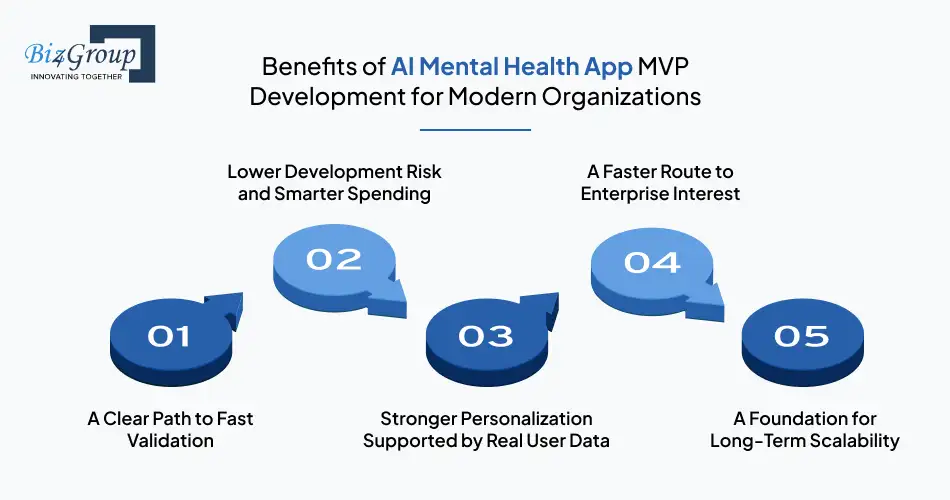
Building an AI mental health solution can feel overwhelming when you look at the full vision in one go. An MVP gives you a practical way to enter the market with confidence. Here are some of its benefits:
A long development cycle slows momentum. An MVP helps you gather real behavioral data in weeks instead of months. This approach supports early-stage MVP development for AI mental health app concepts by showing what works and what needs attention, instead of guessing.
A minimum viable product development for personalized AI mental health app ideas ensures you spend intelligently. You focus on features that matter and avoid adding layers of complexity in the beginning. When your team understands what users value, you can invest with purpose.
Personalization is at the heart of emotional wellness solutions. It is also something a full product should not guess. A practical learning process supports AI mental health app MVP development that feels grounded in reality.
Organizations that purchase mental wellness solutions want proof of value. An MVP gives you something functional to demonstrate. If you want to know how businesses can validate an AI mental health app idea with an MVP, this is the most effective path. It shows the idea works, which encourages larger clients to pay attention.
An MVP is not the final product. It is the starting point that reveals the smartest way to grow. Like a guidebook for the product your audience truly needs, it helps you create a reliable vision for your full AI mental wellness platform.
Now, the next section explores the most important features to include in an MVP for AI-driven mental health tracking app. This will help you understand what to prioritize so you can build a strong and focused first release.
The global mental health app market is heading toward $17.52B by 2030. Your MVP deserves to be part of that wave.
Build with Biz4GroupA focused MVP helps you validate the idea without overwhelming users or stretching your budget. The goal is to deliver meaningful support while observing authentic user behavior. The table below highlights the essential features every early-stage MVP development for AI mental health app should include.
|
Feature |
Why It Matters |
How It Supports MVP Goals |
|---|---|---|
|
Helps users reflect on daily emotional patterns using simple prompts. |
Offers early behavioral data for refining recommendations and wellness insights. |
|
|
AI Chat Support with Boundaries |
Provides conversational guidance while maintaining safe limits and clear disclaimers. |
Reveals what topics users seek most, which helps shape the next phase of content and AI training. |
|
CBT Inspired Micro Lessons |
Offers users short, easy to understand exercises that support emotional regulation. |
Measures which lessons create the highest engagement, allowing better content prioritization. |
|
Personalized Daily Wellness Plan |
Gives users a simple plan with reminders for journaling, breathing sessions or reflection. |
Shows which recommendations users follow, which supports long-term personalization strategy. |
|
Guided Journaling |
Encourages reflection through text or voice entries. |
Generates valuable qualitative data that helps shape your personalization engine. |
|
Crisis and Escalation Pathway |
Directs users to hotlines or professional help when distress signals appear in their inputs. |
Builds user trust and supports safe early adoption while validating risk-detection flow. |
|
User Profile and Onboarding Flow |
Collects demographic and preference information that shapes early recommendations. |
Helps you test different onboarding paths and see which user groups respond best. |
|
Basic Analytics Dashboard for Admins |
Gives organizations or pilot partners insight into engagement patterns. |
Helps demonstrate progress and supports how businesses can validate an AI mental health app idea with an MVP. |
|
Secure Login and Data Protection Layer |
Protects personal and emotional data through encryption and access controls. |
Builds credibility and trust from the start which is needed in wellness and clinical environments. |
These features form the backbone of minimum viable product development for personalized AI mental health app ideas. They let users experience meaningful emotional support while giving your business the data and insights it needs to refine and scale the solution well.
A dependable tech stack sets the tone for how your MVP performs, how fast it loads and how well it supports the core mental wellness experience. The goal at this stage is to pick a stack that is secure, flexible and efficient so your team can experiment, iterate and prepare for pilot testing without friction.
|
Layer |
Recommended Options |
Why This Works for an MVP |
|---|---|---|
|
Frontend Framework |
React Native or Flutter |
Helps you create one codebase for both iOS and Android which accelerates your launch timeline. |
|
Backend Framework |
Supports fast development cycles and easy integration with AI services and data workflows. |
|
|
AI and NLP Services |
OpenAI APIs, custom sentiment models or vector databases |
Helps you test conversations and emotional understanding without training heavy models in the early stage. |
|
Database |
PostgreSQL or MongoDB |
Handles structured and semi-structured data which suits mood logs, chat interactions and lesson progress records. |
|
Cloud Hosting |
AWS, Azure or Google Cloud |
Offers simple deployment tools and helps you scale as engagement increases during the pilot stage. |
|
Notifications and Scheduling |
Firebase Cloud Messaging or OneSignal |
Supports reminders for journaling, lessons and wellness plans which influence daily engagement. |
|
Analytics and Logging |
Mixpanel, Amplitude or custom dashboards |
Helps you track feature usage, understand drop-off points and shape your next feature sprint. |
|
Authentication |
OAuth or custom email login |
Supports smooth onboarding while keeping user management simple for the MVP phase. |
This combination gives your AI product a stable foundation while keeping development cycles efficient. It also helps you create an MVP for AI mental health mobile app that can adapt as your understanding of real user behavior becomes clearer.
Also read: Advantages of hiring a full stack developer to develop MVP
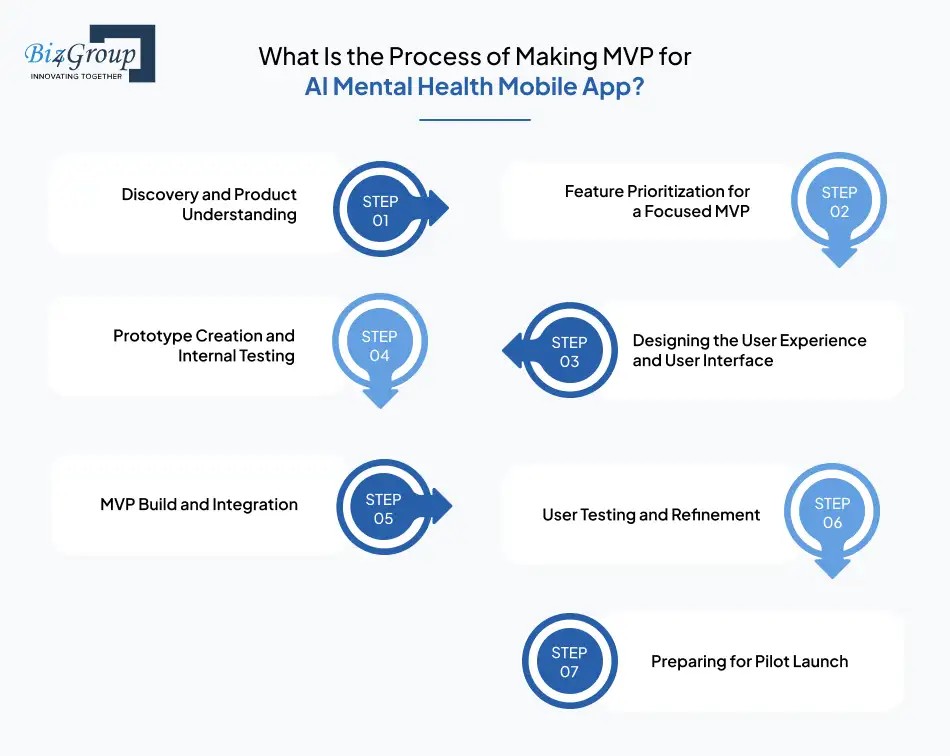
Creating a usable and effective MVP takes structure and clarity. A good process keeps the team aligned, protects the budget and ensures you learn continuously from every early interaction.
Every strong MVP begins with clarity. This stage helps you define the purpose of your mental wellness product and the people it will support. Key actions in this stage:
This step sets a steady foundation for all that follows.
This stage brings sharpened focus to the project. You decide which features truly belong in the MVP and which can wait until later stages. During this step you determine:
This clarity prevents scope creep and supports lean execution.
In mental wellness products, UI and UX influence user trust and comfort. A good UI/UX design company respects the emotional state of the user and avoids cognitive overload. Important design activities include:
This stage shapes the human experience that connects users to your MVP.
Also read: Top 15 UI/UX design companies in USA
A prototype allows your team to experience the concept in a semi-interactive form. You test how the product feels and how intuitive the main interactions are. You focus on:
A good prototype saves time and improves the quality of your MVP.
This is where the MVP development team builds the essential features, connects data flows and prepares the experience for real-world interaction. During this step you:
The goal is a functioning MVP that introduces your value without trying to be the final product.
Also read: Top 12+ MVP development companies in USA
While most teams need months to launch an MVP, we do it in 2–3 weeks.
Schedule a Strategy Call TodayIn this step, you observe how users behave, where they hesitate and which features they return to often. Their interactions guide meaningful improvements. You learn about:
This feedback loop prepares your product for controlled real-world use.
This final step helps you plan, organize and shape the experience for a chosen group of real users. Activities include:
This stage completes the journey from idea to MVP ready for pilot testing with clarity and confidence.
With the process now outlined, the next section will guide you through important security and regulatory factors you should consider while refining your solution into something both dependable and trusted by users.
Also read: How to develop a mental health app like BetterHelp?
A mental health product handles sensitive information and emotional conversations. Users expect safety when they share their thoughts, moods and daily struggles. Even in early-stage MVP development for AI mental health app ideas, you need to build the right guardrails. These measures protect your users, strengthen trust and prepare you for enterprise partnerships.
A reliable security foundation helps users feel safe from their first session. Here are the must-have security measures:
These practices support user confidence and reduce risk during early usage.
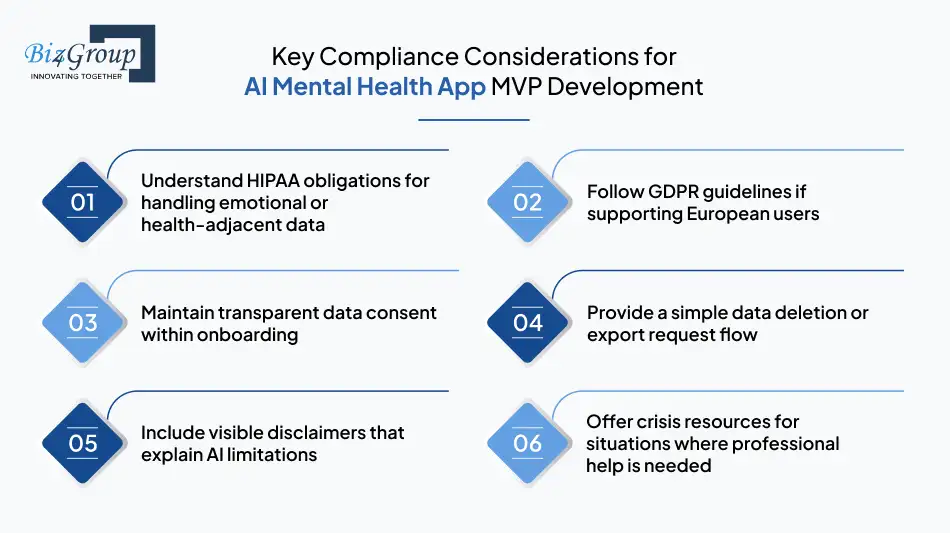
Mental wellness products serve many industries including healthcare, education, corporate wellness and senior care. These are the essential compliance points to begin with:
These measures help build responsible MVPs that respect privacy, ethics and user safety.
Security and compliance are not optional in this category. They shape trust, increase user adoption and influence how businesses can validate an AI mental health app idea with an MVP.
Also read: HIPAA compliant AI app development guide
Over 80% of users abandon apps that feel unsafe. Your MVP can launch with the kind of security that keeps people coming back.
Talk to Our ExpertsPlanning your budget early helps you move with confidence. Most MVPs in this category fall in the
$10,000-$100,000+ range depending on scope, features, content needs and
complexity.
This estimate covers design, development, AI integration and the essential
workflows needed for a meaningful first release.
More advanced versions can move toward the $100,000-$250,000+ range and enterprise-ready AI solutions with deeper personalization and analytics may reach $250,000-$1M+, although these phases come after the MVP stage.
The focus here is the MVP itself because that is the product that allows you to validate your idea before deciding how far you want to scale.
Every MVP carries a few factors that directly shape the total investment. When you understand these drivers, you can plan your scope in a way that fits your goals and budget.
These factors influence where your MVP lands in the range.
These items often surprise teams. They become relevant during MVP development for AI mental health app products and should be planned upfront.
These items are not heavy but they do add up when launching your first version.
An informed budget lets you make confident decisions and supports how businesses can validate an AI mental health app idea with an MVP because you can align the investment with the value you want to prove.
Also read: How much does it cost to build an MVP for AI application?
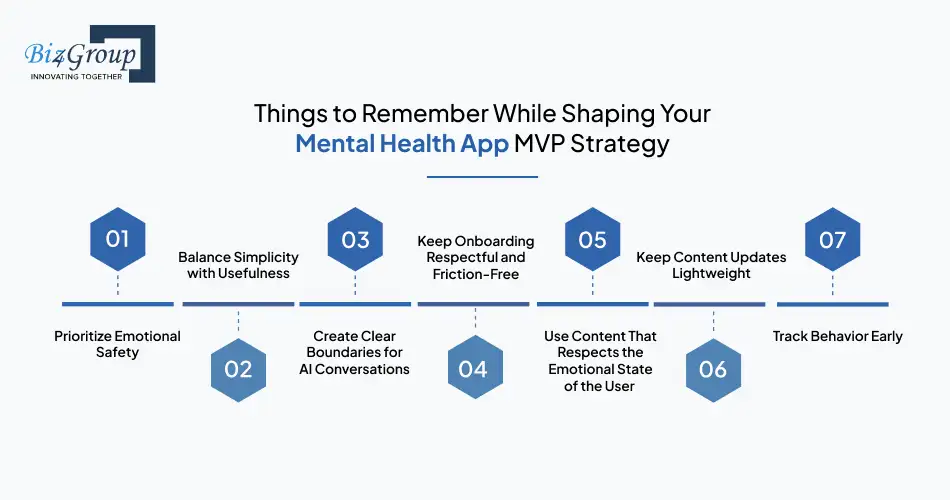
Building an MVP for emotional wellness is not the same as building a regular mobile product. Users arrive with stress, uncertainty and personal thoughts. The experience must feel safe, simple and helpful from the very first interaction.
The points below highlight what to keep in mind so your MVP reflects trust, clarity and purpose.
A mental health product earns trust through tone, flow and sensitivity. Your MVP must feel supportive, not clinical.
Important practices to adopt:
A grounded, emotional tone helps people return to the app when they need it most.
An MVP is not meant to feel crowded. Users only need the features that help them take meaningful steps.
This invites consistent engagement which fuels better insights.
Users should always know the scope of the AI guidance. Your MVP needs clarity regarding what the AI explains and where it redirects users to real-world professionals.
Here is what helps:
The goal is to support users, not overwhelm them.
Onboarding sets the tone for your entire experience. Users share emotional information, so the process must feel gentle.
Helpful elements include:
Good onboarding reduces drop-offs during the first three minutes.
Content is the backbone of emotional support. Inconsistent tone or complex therapeutic language reduces trust. Your MVP should stay grounded in calm and relatable guidance. Tips:
Your content becomes a subtle emotional companion rather than a lecture.
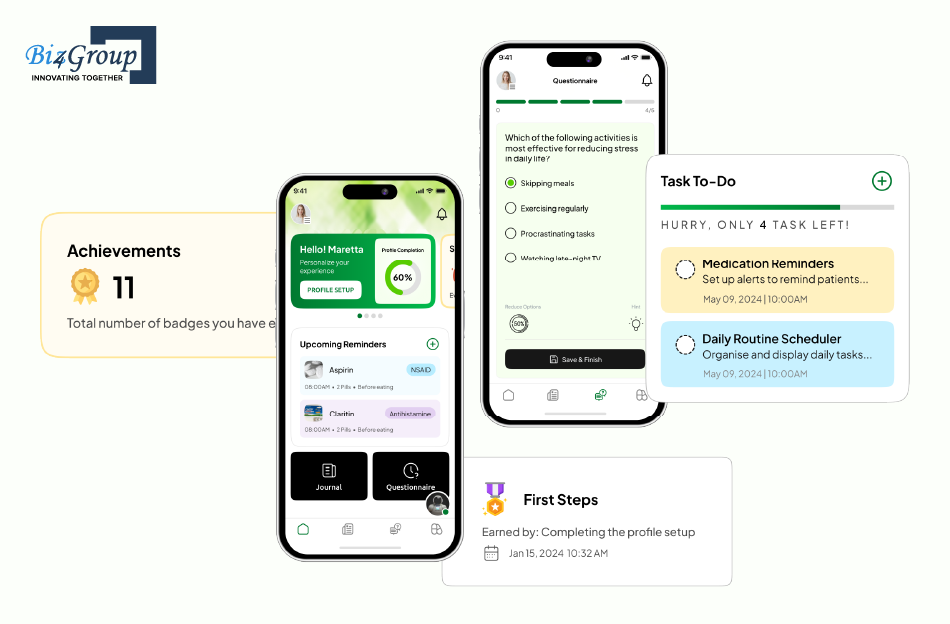
It is an AI-supported cognitive wellness app created to help early to mid-stage dementia patients stay oriented, reflect on their days and engage with familiar information. The product’s structure was shaped around emotional comfort, simplicity and gentle daily habits.
Key aspects that align with MVP best practices
This project demonstrates how an MVP can be useful, empathetic and grounded in real needs while staying focused on a small set of core features. It shows how simplicity and emotional clarity can create trust even in sensitive situations.
If we can build tech that supports dementia patients daily, imagine what we can craft for your mental wellness vision.
Get in TouchYour MVP will evolve based on user input. Plan for soft content updates rather than redesigning everything. Like:
Small tweaks often produce strong improvements.
A simple analytics setup helps you understand what to improve first. Track:
Early behavior guides your roadmap long before you build complex features.
These points help support how businesses can validate an AI mental health app idea with an MVP because you end up reviewing authentic insights rather than assumptions.
Also read: How to build an MVP for your AI agent?
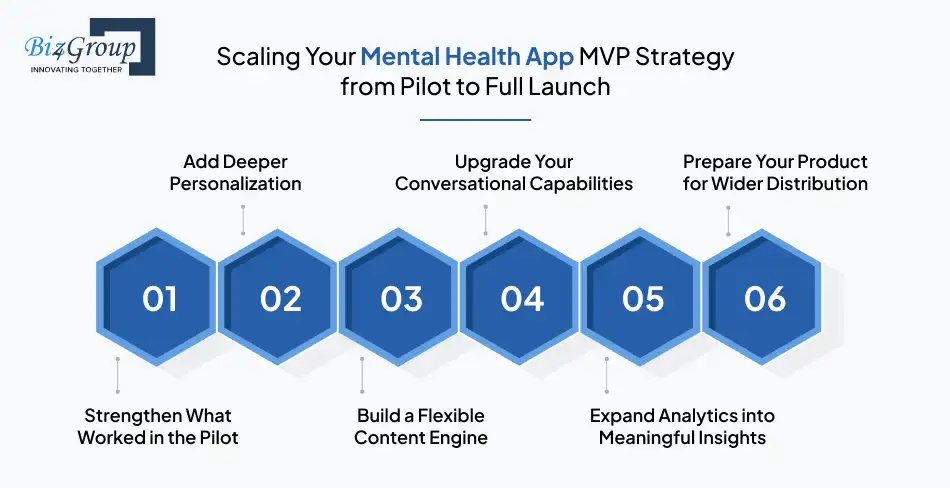
Once your MVP enters a pilot and users begin interacting with it, you step into a new chapter. You
now have real behavior patterns, feedback and usage metrics.
Scaling is about expanding in a
thoughtful, measured way that strengthens your core experience and prepares the product for a wider
audience.
Below are the key areas to focus on while moving from pilot to a full-scale AI mental wellness platform.
The pilot teaches you which features resonate. Your first step is to refine those experiences and
make them more efficient. You scale by improving what users already enjoy.
Focus on removing
friction in journaling and mood flows, enhancing conversational clarity in the AI chats, improving
the pace of micro lessons, and adjusting reminders based on user drop-offs.
When moving beyond the MVP, personalization becomes your growth engine. You use early insights to shape smarter recommendations.
Areas to expand:
Personalization turns a basic tool into something people rely on.
Scaling needs steady, fresh content. The goal is to expand value without overwhelming users. Build a structure that lets you add new CBT-inspired lessons, create themed journaling prompts, expand daily routines into weekly journeys, and add companion educational content.
Your AI chat will evolve as you learn from real user language. Scaling involves refining tone, improving understanding and tailoring responses. Enhancements may include better multi-turn handling, scenario-based prompts, emotional nuance improvements, and category-specific guidance such as stress, sleep or anxiety.
A full-scale product benefits from richer dashboards. Organizations want measurable outcomes. Add capabilities such as engagement heatmaps, lesson completion insights, emotional trend summaries, and basic progress snapshots for users and partners.
Scaling means your app will reach more people. Smooth rollout requires small but essential adjustments. You improve onboarding for different user groups, notification logic, feature discoverability, and cross-platform performance consistency
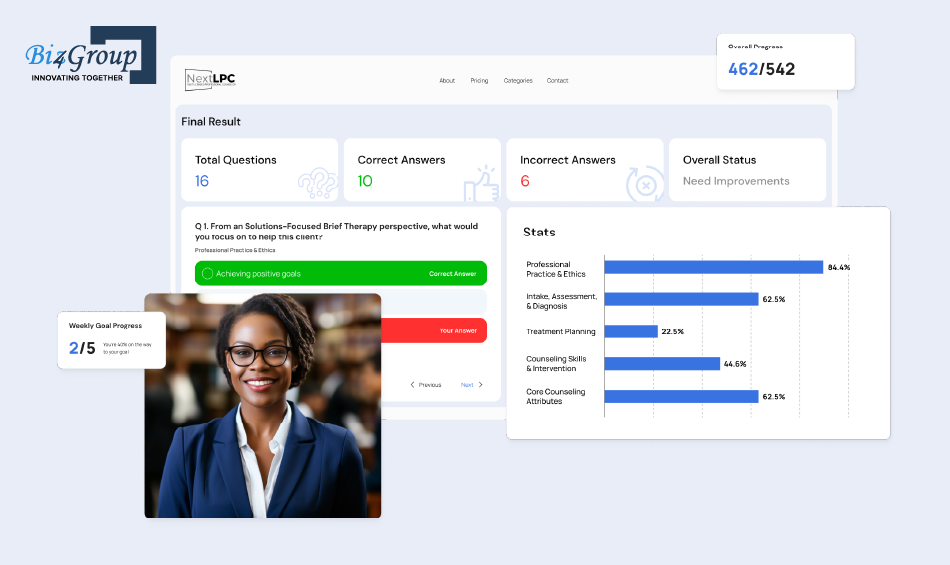
It is an AI-powered learning platform designed for psychology students. Although the product had a different purpose from a mental health therapy app, the path from MVP to scale mirrors what many emotional wellness products go through.
Using our seasoned AI avatar development services, we built MVP that focused on simple interactions between students and AI avatars. After gathering pilot insights, the product expanded in structured stages.
Key learnings from the project’s journey:
This shows that scaling works best when every new layer is guided by real user behavior. The product grew because each feature was added with purpose, not volume. This is the same principle you will use while scaling your AI mental health app MVP.
Growing in measured steps ensures you never dilute user trust. A strong pilot gives you direction and your improvements follow what users genuinely need. This supports how startups can launch a pilot version of an AI mental health therapy app and later turn it into a stable product with strong adoption.
More than 70% of digital wellness apps fail to scale because they skip the insights from their MVP. You don’t have to be in that group.
Scale with Biz4GroupWhen organizations across the USA look for a dependable partner to build an AI mental health app
MVP, they want a team that understands human behavior and AI engineering at a deep and practical
level.
Biz4Group LLC is built around this exact
combination.
We are a USA-based software development company with a strong focus on AI-driven healthcare solutions, and mental health app development. Our team blends thoughtful strategy, clinical awareness, and engineering precision into every project. This helps our clients launch reliable digital wellness solutions that feel personal, safe and meaningful from day one.
For over two decades, Biz4Group LLC has helped wellness companies, mental health clinics, startups, and HR departments turn early ideas into functional MVPs that users trust. We have delivered emotional wellness platforms, cognitive support systems and next-gen learning environments.
What sets us apart is our ability to take complex, sensitive ideas and turn them into accessible products that people feel comfortable using. Our AI app development services reflects strong research, emotional understanding, and human-centered thinking. This balanced approach helps our clients build products that stand out.
Businesses choose Biz4Group LLC because real performance matters. They want a strategic partner who sees their vision clearly and elevates it with practical execution.
They choose us because:
Every project our AI developers complete adds more depth to our expertise, and that collective experience becomes the foundation of every new MVP we create.
Partnering with us means gaining a team that moves with integrity, speed and intelligence. You receive guidance, insight and steady support as your product enters the world. When you launch with us, you launch with clarity and confidence.
Reach out to our experts for that clarity. Let’s talk.
A strong AI mental health app begins with a thoughtful MVP. When you focus on the essentials, you enter the market with clarity instead of guesswork. You learn what users respond to, what content they trust and what features create daily habits.
Scaling an early-stage concept into a reliable emotional wellness platform becomes far more manageable when each decision is shaped by data from your MVP. You reduce risk, protect your budget and create a product that reflects the needs of the people you aim to support. This is the advantage of starting lean, learning early and expanding with intention.
Biz4Group LLC supports businesses across the USA in taking these ideas from the sketch phase into a functioning, validated product. Our AI development team blends user psychology, AI capability, and engineering strength to help organizations launch meaningful solutions in the mental wellness space.
If your next step is to turn an idea into a real product, now is a smart time to move. Contact Biz4Group LLC and start shaping your AI mental health app MVP with a team that brings strategy, skill and creativity together.
Most MVPs take 8–14 weeks to complete. Biz4Group follows a more efficient approach. Our internal libraries, reusable components, and pre-tested modules help us deliver a polished MVP in 2–3 weeks. This lowers development time and reduces overall costs without affecting quality.
Clinical input is not always mandatory for an MVP, but it is very helpful. A short consultation with a licensed therapist or psychologist ensures the tone, content and user flow stay aligned with healthy behavioral principles.
Short guidance snippets, easy journaling prompts and simple self-reflection exercises tend to perform best. Early users prefer lightweight activities they can complete in a few minutes.
Yes, but these formats increase production time. Many teams start with text-based interactions in the MVP and introduce audio or video in later phases once they understand user preferences.
Trust indicators include consistent return sessions, longer interaction durations and higher completion rates for mood or journaling tasks. Tracking these signals during your pilot helps you understand user comfort.
Wearable technology integrations are helpful but not essential for phase one. They are more useful once you understand what type of biometric data supports your long-term roadmap. Most teams add them after the MVP gains traction.
It can, but supporting multiple languages early creates additional content and testing requirements. Most companies release in one language first, validate user behavior, and add localization later.

with Biz4Group today!
Our website require some cookies to function properly. Read our privacy policy to know more.