Location :
Orlando, FL, USA
Location :
Orlando, FL, USA +1 (407) 714-1616
 info@biz4group.com


















Imagine a digital system that doesn’t wait for instructions but instead, understands your business goals, learns from real-time feedback, and takes independent actions to get the job done.
Read More

Let’s be honest. If you are building a product in chronic care today, you cannot afford to spend years developing a full-scale platform only to discover later that users are not engaging or providers are not adopting it. The pace of digital health has changed and so have expectations.
Here is a quick reality check. The global digital health market is projected to surpass USD 387.8 billion in 2025, largely driven by solutions focused on long-term condition management, remote monitoring, and patient engagement.
At the same time, nearly 60% of adults in the United States live with at least one chronic condition, increasing pressure on healthcare systems to adopt smarter, more scalable care models.
Now pause for a moment and ask yourself. Are you confident your product will fit naturally into real care workflows? Will patients continue using it after the first few weeks? Can you clearly prove value to providers, partners, or investors without waiting years?
If any of this feels uncertain, you are not behind. You are exactly where MVP development for chronic care software becomes essential.
We have seen founders invest heavily in building everything at once, only to realize later that adoption, not features, was the real challenge. That is why chronic care software MVP development makes so much sense. It helps you validate real care workflows, test patient engagement, and understand clinical value before scaling.
A focused approach to MVP development allows you to learn fast without overcommitting resources. You get early signals on what works, what does not, and where to double down. This clarity helps you shape custom chronic care MVP development strategies that are grounded in real-world usage, not assumptions.
An MVP is not about cutting corners. It is about building the right thing first. And before we dive into features, tech, or costs, it is important to align on the basics.
So, what exactly qualifies as chronic care software today, and why does starting with an MVP-first mindset give you such a strong edge? That is what we will unpack next.
Validate real care workflows with an MVP that proves adoption before you scale.
Talk to Our HealthTech ExpertsIf you are building in chronic care, you are not building for one-time use. You are building for patients who show up every day, week after week, managing conditions that do not go away. That changes everything.
Chronic care software supports long-term condition management for illnesses like diabetes, heart disease, COPD, and hypertension. Patients use it repeatedly. Care teams rely on track progress, spot risks early, and stay connected. If the experience feels heavy or confusing, people stop using it. We have seen that happen more times than we can count.
This is where many founders get stuck. They try to design for every scenario upfront. More features. More dashboards. More integrations. It sounds safe, but it often leads to slow launches and low adoption.
That is why MVP development for chronic care software should be your first move, not your backup plan.
A well-defined MVP helps you focus on the one care problem that matters most right now and prove it works in the real world. Through chronic care software MVP development, you get answers early instead of assumptions later.
Here is what an MVP-first approach helps you do:
When you develop MVP for chronic care management software, you are not limiting your vision. You are protecting it. You learn what deserves investment and what does not, while your competitors are still guessing.
This learning-driven approach fits naturally with custom MVP software development, especially in healthcare where every user group behaves differently and mistakes are expensive.
Once you know what works at a small scale, deciding how and when to expand into a full chronic care platform becomes far more confident and far less risky.
Most confusion around product scope disappears once you clearly understand what belongs in an MVP and what should wait. Instead of overexplaining it in paragraphs, the difference becomes obvious when you look at it through a practical lens.
Here is how a chronic care software MVP compares to a full product, explained in a way that reflects real startup decisions.
|
Aspect |
Chronic Care Software MVP |
Full Chronic Care Software Product |
|---|---|---|
|
Purpose |
Prove one core care use case works in the real world |
Support multiple conditions, workflows, and stakeholders at scale |
|
Problem focus |
Solves a single, high-impact chronic care problem |
Addresses a wide range of clinical and operational needs |
|
Features |
Only what is needed to validate the main workflow |
Advanced features, automation, analytics, and integrations |
|
Users |
Limited group of patients and providers for pilots |
Large patient populations, hospitals, and care organizations |
|
Feedback |
Fast, direct, and actionable |
Slower, layered, and harder to course-correct |
|
Development effort |
Lean and iterative |
Heavy, structured, and long-term |
|
Cost exposure |
Controlled and staged |
High upfront and ongoing investment |
|
Risk |
Low, learning-driven |
High if early assumptions are wrong |
|
Outcome |
Proof of value and adoption signals |
Market expansion and revenue growth |
A chronic care MVP vs full chronic care software product decision is really a timing decision. With MVP development for chronic care software, you are choosing to learn before you scale. You validate that patients stay engaged, providers trust the workflow, and the care model actually works before committing to a larger build.
When teams skip this step and jump straight into a full platform, they often end up rebuilding core pieces later. UX changes. Features get dropped. Timelines stretch. Costs rise.
That is why many healthcare founders take inspiration from proven approaches used in building an MVP for AI healthcare software, where validation comes first and expansion follows real usage, not assumptions.
Once this distinction is clear, deciding what features truly belong in your MVP becomes much easier.
When you are planning MVP development for chronic care software, the biggest mistake is not building too little. It is building too much, too early. An MVP should help you learn what works in real care settings, not overwhelm users with features they are not ready for.
A strong MVP focuses only on features that validate care workflows, engagement, and outcomes. Everything else can wait.
Below is a focused list of must-have features for chronic care software MVP development, explained so you can clearly see why each one belongs at the MVP stage.
|
Feature Area |
MVP Feature |
Why This Feature Is Essential for a Chronic Care MVP |
|---|---|---|
|
User onboarding |
Simple patient and provider onboarding |
If users struggle to get started, adoption drops immediately. This helps you validate whether your product fits into real-world routines without training overhead. |
|
Patient profiles |
Basic patient profile with condition details |
Enables light personalization and helps you understand what health data users are comfortable sharing long term. |
|
Care plan visibility |
Read-only care plans or goals |
Allows you to test whether patients understand and follow guidance without building complex care logic too early. |
|
Symptom or vitals tracking |
Manual symptom or vitals entry |
Confirms whether patients are willing to log data consistently, which is core to build MVP software for chronic disease management. |
|
Medication reminders |
Simple alerts and reminders |
Helps validate adherence behavior, one of the most important outcomes in creating MVP solutions for chronic disease management. |
|
Basic notifications or check-ins |
Shows whether users return to the app regularly instead of dropping off after initial use. |
|
|
Provider dashboard |
Lightweight patient overview |
Validates whether providers actually see value in monitoring patients digitally before adding advanced features. |
|
Secure communication |
Patient-provider messaging |
Helps test if communication improves coordination and reduces missed information. |
|
Data visualization |
Simple charts or trends |
Makes progress easy to understand without advanced analytics or AI layers. |
|
Security and compliance |
Builds trust while keeping compliance practical for an MVP. |
|
|
Usage analytics |
Basic engagement metrics |
Shows what users actually use, helping you prioritize the next phase of development. |
|
Architecture readiness |
Modular and scalable foundation |
Sets you up to create scalable chronic care software MVP without rebuilding the core later. |
What you will notice is that advanced automation, deep integrations, and heavy AI logic are intentionally missing. Those features matter, but only after you prove engagement and value. At this stage, your priority is to build chronic care MVP applications that patients use and providers trust.
Many teams align these MVP features with early versions of AI-powered patient management software, where validating workflows comes before scaling intelligence.
If these core features perform well, you move forward with clarity instead of assumptions. That is what makes the next development phase far more confident and far less risky.
To make this more concrete, here’s a real project built by Biz4Group LLC that aligns closely with the principles of MVP development for chronic care software.
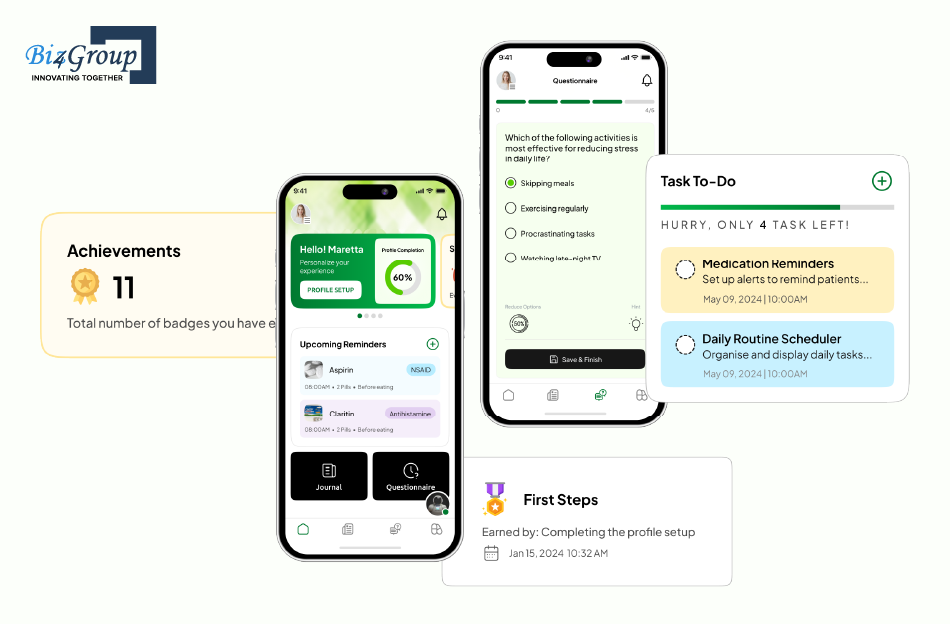
CogniHelp is a mobile application designed to support people living with early to mid-stage dementia and their caregivers. The focus was not on building a large platform upfront, but on validating daily engagement, usability, and caregiver support, which are critical in long-term care scenarios.
CogniHelp helps patients stay mentally active and organized while giving caregivers better visibility into daily routines. The product was built with simplicity and consistency in mind, two factors that matter most in chronic care adoption.
Key highlights connected to chronic care MVP goals
What makes CogniHelp relevant here is the approach. The product validates user behavior and long-term engagement first, instead of leading with complex automation. That is exactly what you want when you build chronic care MVP applications. Prove that users come back, understand the value, and trust the experience. Everything else can follow.
We help you focus only on what patients and providers will actually use.
Plan My MVP Features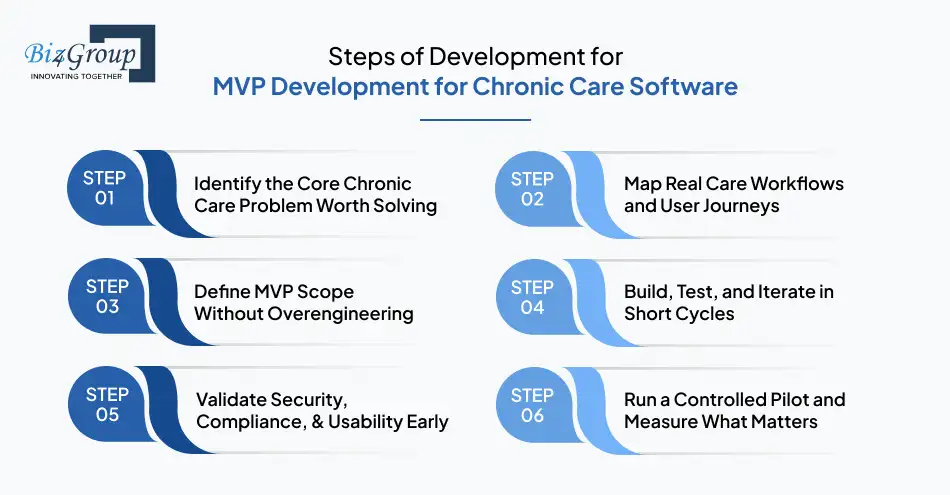
When you approach MVP development for chronic care software, the goal is not speed alone. It is sequencing. Each step should help you validate assumptions early and reduce risk before you invest more time and money.
Below is a clean, practical breakdown of how teams successfully develop MVP for chronic care management software, with each step focused on learning and traction.
Every strong MVP starts with a narrow, well-defined problem. Chronic care is broad, but your MVP should not be. You are validating one pain point, not the entire ecosystem. This step sets the foundation for chronic care software MVP development.
Chronic care products fail when they disrupt routines instead of fitting into them. Before building anything, you need to understand how patients and providers move through care today. This step helps you build chronic care MVP applications that feel natural to use.
Clear journeys are hard to get right without experienced UI/UX design, especially when you want long-term engagement from users managing chronic conditions.
This is where discipline matters most. Your MVP should only include features that help validate your core idea. Anything else belongs later. This step protects you from scope creep while helping you create chronic care management software MVP the right way.
Many teams rely on a structured custom MVP software development approach here to keep expectations realistic and execution focused.
Chronic care products improve through feedback, not assumptions. Short development cycles help you learn faster and adjust without major rework. This is how you build MVP software for chronic disease management that evolves with real usage.
Trust is non-negotiable in healthcare. Even an MVP must feel safe and reliable for users to engage consistently. This step ensures your custom chronic care MVP development effort does not stall due to avoidable concerns.
An MVP launch is not a full release. It is a learning phase designed to give you clarity on what works and what does not. This step turns your MVP into evidence for MVP solutions for chronic care startups and healthcare providers.
When these steps are followed in the right order, MVP development for chronic care software becomes a repeatable process instead of a risk-heavy experiment. You gain real signals early, which makes scaling decisions far more confident and far less expensive.
When you are choosing a tech stack for an MVP, the goal is not to build the most advanced system. It is to build something reliable, secure, and flexible enough to grow once your idea is validated. For MVP development for chronic care software, every technology choice should support learning, iteration, and future scalability.
The table below outlines a practical, MVP-first tech stack that works well when you build chronic care software MVP for startups and want to avoid early lock-ins.
|
Layer |
Recommended Technologies |
Why This Works for a Chronic Care MVP |
|---|---|---|
|
Frontend (Web) |
Makes it easier to iterate quickly on patient and provider interfaces as you test engagement and workflows. |
|
|
Frontend (Mobile) |
React Native, Flutter |
Allows faster rollout across iOS and Android from a single codebase, ideal when you build MVP software for chronic disease management. |
|
Backend |
Handles real-time data, notifications, and APIs efficiently while keeping development speed high. |
|
|
Database |
PostgreSQL, MongoDB |
Supports both structured clinical data and flexible patient-generated inputs common in early MVPs. |
|
Cloud Infrastructure |
AWS, Azure, GCP |
Provides HIPAA-ready services and scalability, which is critical when you create scalable chronic care software MVP. |
|
APIs and Integrations |
REST, GraphQL, FHIR APIs |
Keep your MVP ready for future EHR, device, and third-party integrations without implementing them too early. |
|
Authentication & Security |
OAuth 2.0, JWT, role-based access |
Establishes trust and baseline compliance without slowing down development. |
|
Analytics |
Firebase Analytics, Mixpanel |
Helps you track usage, engagement, and drop-offs to guide MVP improvements. |
|
Notifications |
Firebase Cloud Messaging, Twilio |
Enable reminders and alerts, which are essential for adherence and long-term engagement. |
|
AI readiness |
Modular AI services |
Keeps your MVP flexible so intelligence can be added later through AI integration services without reworking the core. |
|
Workflow automation |
Event-driven logic |
Useful for testing reminders or care alerts that can later scale with AI automation services. |
|
Deployment & CI/CD |
Docker, GitHub Actions |
Supports frequent updates and faster testing cycles during MVP iteration. |
The key takeaway is simple. Your MVP tech stack should help you learn fast today and scale safely tomorrow. Many founders are planning to develop digital health MVP for chronic care start lean, then expand capabilities later with support from an experienced AI app development company once the product proves its value.
Let’s tackle the question that usually decides timelines, scope, and even investor conversations. What does MVP development for chronic care software really cost?
For most startups, the chronic care MVP development cost falls between $15,000 to $100,000+. This range exists for a reason. Costs vary based on feature depth, compliance needs, care workflows, and how future-ready you want the MVP to be. A lean pilot for one condition looks very different from an MVP designed to scale across providers and regions.
The goal is not to minimize spend blindly. It is to spend intentionally.
Here is how costs typically break down when you develop MVP for chronic care management software.
|
Feature or Component |
Estimated Cost Range |
Why This Impacts MVP Cost |
|---|---|---|
|
Product discovery and planning |
$2,000 to $6,000 |
Clarifies scope and prevents expensive rework later. |
|
UI and UX design |
$3,000 to $10,000 |
Critical for long-term engagement in chronic care scenarios. |
|
Patient onboarding and profiles |
$2,000 to $6,000 |
Covers secure access, role setup, and basic personalization. |
|
Symptom or vitals tracking |
$4,000 to $12,000 |
Core feature for build MVP software for chronic disease management. |
|
Medication reminders and alerts |
$2,000 to $8,000 |
Directly impacts adherence and outcomes. |
|
Provider dashboard |
$4,000 to $15,000 |
Cost depends on monitoring depth and data visualization. |
|
Secure messaging |
$2,000 to $7,000 |
Enables care coordination while maintaining compliance. |
|
Compliance and security setup |
$3,000 to $10,000 |
Includes HIPAA-ready access and data protection. |
|
Analytics and reporting |
$2,000 to $6,000 |
Helps validate adoption and engagement. |
|
QA, testing, and pilot support |
$2,000 to $8,000 |
Ensures reliability before real-world use. |
This is why a chronic care MVP development cost estimate can differ widely from one startup to another.
Several variables influence how much you spend when you build chronic care software MVP for startups.
Partnering with an experienced custom software development company often helps founders make smarter trade-offs early instead of fixing costly mistakes later.
Hidden costs rarely show up in initial estimates, but they add up fast if ignored.
Planning for these early keeps your MVP from stalling midway.
Cost optimization is about focus, not shortcuts.
When done right, MVP solutions for chronic care startups and healthcare providers give you clarity on where to invest next and where to pause.
With cost and budgeting clear, the next challenge becomes unavoidable. What can go wrong during development, and how do you solve those issues before they slow you down?
Get a realistic cost breakdown aligned with your goals, not guesswork.
Get My MVP Cost Estimate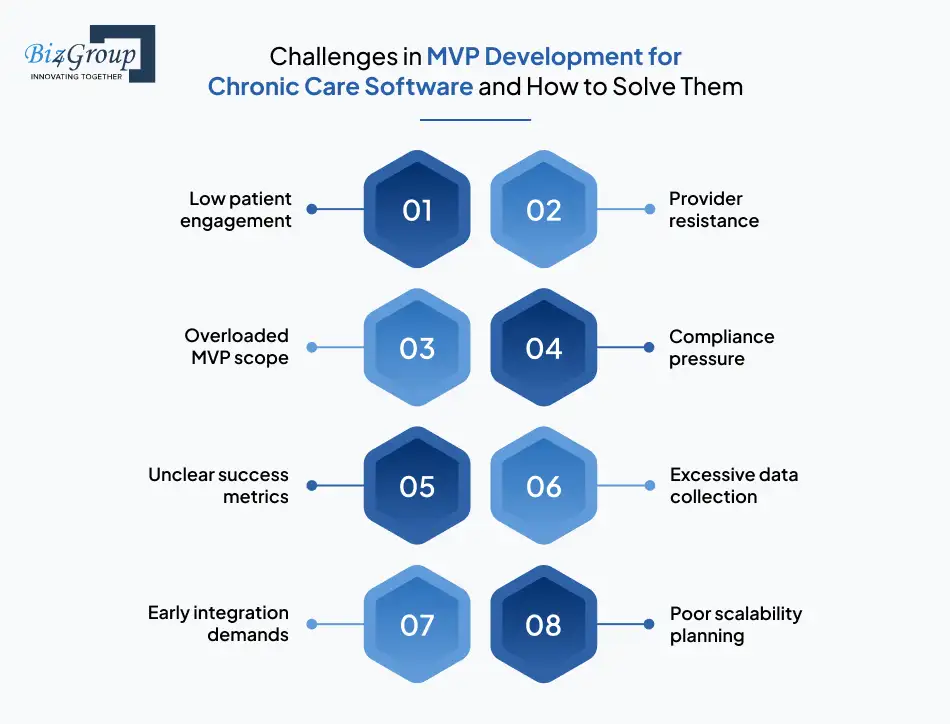
When you work on MVP development for chronic care software, challenges are not exceptions. They are expected. Chronic care products deal with long-term engagement, multiple stakeholders, and strict regulations, even at the MVP stage. The goal is not to eliminate challenges but to design your MVP in a way that exposes and solves them early.
The table below highlights the most common issues teams face during chronic care software MVP development and how to address them without turning your MVP into a full product too soon.
|
Challenge |
Why This Happens in Chronic Care MVPs |
How to Solve It During MVP Development |
|---|---|---|
|
Low patient engagement |
Chronic care requires repeated use, and MVPs often fail to build habits |
Focus on one daily or weekly action when you build chronic care MVP applications |
|
Provider resistance |
Clinicians avoid tools that disrupt workflows |
Keep workflows lightweight and validate adoption with a small pilot |
|
Overloaded MVP scope |
Teams try to support too many conditions early |
Narrow focus when you create chronic care management software MVP |
|
Compliance pressure |
Regulations feel heavy even at MVP stage |
Apply baseline HIPAA controls and expand later |
|
Unclear success metrics |
Teams track downloads instead of outcomes |
Measure engagement, retention, and workflow usage |
|
Excessive data collection |
Too much data without context creates noise |
Capture only data that supports care decisions |
|
Early integration demands |
Stakeholders push for EHR or device links too soon |
Design for future integrations without building them yet |
|
Poor scalability planning |
MVP is built without growth in mind |
Use modular design to create scalable chronic care software MVP |
These challenges become especially visible in patient-facing tools. Teams building early versions of AI patient software often discover quickly that engagement and simplicity matter far more than feature depth at the MVP stage.
When you address these risks while you develop chronic care MVP solutions for digital health startups, your MVP becomes more than a test. It becomes a foundation.
With those risks understood, the final step is strategic. How do you define what comes after the MVP and confidently pitch the next phase to stakeholders?
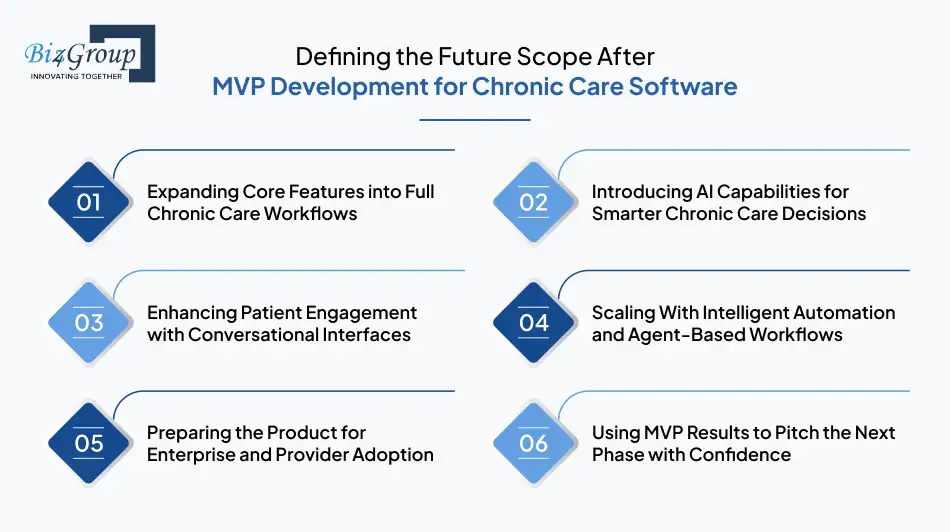
Once your MVP is live, the conversation shifts from validation to growth. This is where MVP development for chronic care software starts paying off. Your usage data, engagement patterns, and workflow feedback now guide what comes next. The goal is to expand with confidence, not assumptions.
Below are the most common and practical directions founders take after they build chronic care software MVP for startups, with each step grounded in real MVP signals.
Your MVP usually proves one high-impact use case. The next phase is about connecting related workflows without breaking what already works. This could mean deeper care plans, better coordination across teams, or condition-specific enhancements. Teams that create chronic care management software MVP first can expand features based on real behavior rather than guesses, which reduces rework and speeds up adoption.
Once engagement is consistent, intelligence becomes valuable. AI can support risk prediction, trend analysis, and proactive interventions, but only when built on validated data flows. Many founders extend their MVP by developing chronic care MVP solutions for digital health startups that gradually layer intelligence, similar to approaches used in chronic disease management software with AI.
As usage grows, communication often becomes a bottleneck. Patients want quick guidance. Care teams want fewer repetitive interactions. This is where conversational experiences make sense. After you build MVP software for chronic disease management, adding support like an AI chatbot for chronic disease management can improve engagement without increasing clinical workload.
Manual processes do not scale well in chronic care. Once your MVP proves value, automation helps maintain consistency while reducing operational load. Founders planning this phase often explore custom chronic care MVP development paths that include intelligent workflows powered by an AI agent, especially for follow-ups, alerts, and routine care actions.
Interest from hospitals, payers, or care organizations usually follows successful pilots. This stage requires stronger reporting, reliability, and governance, but only after value is proven. Teams that create scalable chronic care software MVP early find it easier to align later with broader deployments supported by enterprise AI solutions.
Your MVP becomes your strongest asset in conversations with investors and partners. Engagement metrics, retention data, and workflow adoption tell a clear story. When you position your roadmap this way, MVP solutions for chronic care startups and healthcare providers move beyond experimentation and toward sustainable growth.
At this stage, the question is no longer whether your idea works. It is how deliberately you choose to scale it.
When you plan MVP development for chronic care software, the partner you choose directly impacts how fast you learn and how confidently you scale. Chronic care products are not one-time builds. They require long-term thinking, real user empathy, and disciplined execution.
Biz4Group brings that mindset to every project. Our work on CogniHelp, a mobile application built to support dementia patients and caregivers, reflects how we approach chronic care software MVP development. The focus was on validating daily engagement, simplicity, and caregiver involvement before expanding features. That same MVP-first approach helps founders avoid overbuilding and move forward with clarity.
We work closely with startups that want to build chronic care MVP applications and turn them into scalable products. From defining scope to planning future expansion, we help you develop MVP for chronic care management software that patients use and providers trust.
As an experienced AI product development company, we also help founders plan what comes after validation. When your roadmap includes intelligence or automation, our capabilities as an AI chatbot development company allow you to extend engagement without disrupting your core workflows.
If your goal is to create evidence-backed, scalable MVP solutions for chronic care startups and healthcare providers, Biz4Group gives you the experience and structure to get there faster and with fewer risks.
Validate real care workflows with an MVP that proves adoption before you scale.
Talk to Our HealthTech ExpertsBuilding in chronic care is not about launching fast. It is about launching right. When done well, MVP development for chronic care software helps you validate real care workflows, prove engagement, and reduce risk before you scale. It gives you evidence instead of assumptions and momentum instead of guesswork.
Across startups and healthcare providers, the pattern is clear. Teams that develop MVP for chronic care management software first make better product decisions later. They know which features matter, what users actually adopt, and how to justify the next phase to investors and partners. That clarity is what separates products that stall from platforms that grow.
At Biz4Group, we bring that discipline to every build. From projects like CogniHelp to complex digital health platforms, our focus stays the same. Validate early, design for humans, and scale only when the data supports it. That approach is why founders trust us to build chronic care MVP applications that evolve into real businesses, not just demos.
If you are ready to move from idea to evidence and from MVP to momentum, this is the right time to start building with intent.
An MVP is the first usable version of your product that includes only core features needed to test value with real users. In healthcare, this means validating workflows, engagement, and outcomes early so you don’t build unnecessary features. Launching an MVP helps you refine before full development and reduce risk, which is why many startups begin with chronic care software MVP development instead of a full product.
Your MVP should focus on essentials such as patient onboarding, symptom or vitals tracking, medication reminders, secure messaging, and basic provider dashboards. These help you confirm that users will engage and that the product improves care coordination before you expand capabilities. These are the core elements when you build chronic care MVP applications or create MVP solutions for chronic disease management.
The timeline depends on complexity and compliance needs but typically ranges from 8 to 16 weeks for a focused MVP. This includes planning, design, development, testing, and pilot feedback. Startups that develop MVP for chronic care management software with a narrow scope usually move faster and learn earlier.
Costs vary widely, generally ranging from $15,000 to $100,000+ depending on feature scope, compliance, integrations, and UX needs. Simple MVPs focus on one core workflow, while broader MVPs with early analytics or monitoring sit toward the higher end of the range. This is why founders often ask for a clear chronic care MVP development cost estimate before starting.
Instead of downloads alone, track real usage patterns such as daily engagement, retention rates, symptom logging frequency, and whether providers use the tool as intended. These metrics show if your product is ready to scale from chronic care MVP vs full chronic care software product.
Even MVPs must maintain HIPAA compliant data access and secure authentication. Plan for basic compliance from the start and design workflows that support stronger controls later. This approach is essential when you create scalable chronic care software MVP without slowing early validation.
Yes, remote patient monitoring ideas can be validated early by focusing on basic vitals tracking and alerts rather than full device integrations. This approach works well when you make a chronic care MVP for remote patient monitoring and want to test adoption before investing in advanced infrastructure.

with Biz4Group today!
Our website require some cookies to function properly. Read our privacy policy to know more.