 Location :
Orlando, FL, USA
Location :
Orlando, FL, USA +1 (407) 714-1616
 info@biz4group.com

- SaaS HR tech platform development helps organizations replace fragmented HR processes with a single, scalable system built for hiring, payroll, and performance.
- Modern platforms focus on architecture first, enabling teams to develop SaaS HR technology platform solutions that scale well.
- HR software adoption continues to rise as companies prioritize automation, analytics, and cloud first systems to support distributed and fast-growing workforces.
- Cost for SaaS HR tech platform typically falls between USD 25,000 and USD 400,000+, depending on scope, integrations, security, and more aspects.
- Choosing the right features early makes it easier to create scalable HR tech SaaS product foundations that support long term growth instead of short-term fixes.
You are scaling fast. Hiring is messy. Payroll lives in spreadsheets. Performance reviews happen late or not at all. Teams want clarity, leaders want visibility, and systems are not keeping up. SaaS HR tech platform development becomes part of the discussion when founders and CTOs start asking practical questions like:
- What is SaaS HR tech platform development?
- How to build a cloud-based HR software platform?
- What features are needed in a modern HR SaaS product?
- Can AI be used in HR tech platforms?
- What’s the cost to develop a SaaS HR management system?
The urgency behind these questions is real, here’s why:
- According to Mordor Intelligence, if current trends hold, SaaS HR tech could grow to roughly $740B by the end of the decade.
Another layer often gets overlooked. HR decisions now influence culture, retention, compliance, and leadership credibility. Founders worry about locking themselves into rigid workflows. CTOs think about security, data isolation, and scale. Product leaders focus on adoption and usability. These concerns naturally raise expectations around SaaS HR tech platform development services, often shaped by guidance from an experienced AI development company.
For decision makers, the focus shifts to structure and long term clarity. Leaders planning to develop SaaS HR technology platform solutions evaluate product scope, scalability, compliance readiness, analytics depth, and early thinking around how to build an AI SaaS product without adding unnecessary complexity. The right approach supports a unified HR system that evolves alongside the business.
This guide breaks down the journey from concept to enterprise scale without skipping the hard parts. You will see how strategy, architecture, features, cost, and growth decisions come together in real world SaaS HR platforms.
What is a SaaS HR Tech Platform?
A SaaS HR tech platform is a cloud delivered system designed to manage core HR functions across hiring, payroll, performance, and engagement through a single, scalable product built for growing organizations.
- Centralizes employee data across teams and locations
- Supports continuous hiring and workforce changes
- Enables automation across routine HR workflows
- Aligns HR operations with business growth goals
- Creates room for smarter decisions using AI in HR
At its core, SaaS HR tech platform development focuses on building flexible HR systems that scale with teams, reduce manual work, and support long term workforce strategy without slowing the business down.
How SaaS Based HR Software Operates?
At a practical level, SaaS HR tech platform development focuses on delivering HR capabilities through secure cloud infrastructure that stays accessible, configurable, and reliable as teams grow. The way these platforms operate explains why adoption scales so quickly.
1. Centralized Cloud Architecture
Data lives in a single source of truth accessible across roles and locations. Teams can build SaaS based HR software that supports hiring, payroll, and performance without local installations. This setup simplifies updates, compliance handling, and long-term maintenance.
2. Role Driven Workflows and Automation
Each user interacts with workflows designed around responsibility and permissions. Product teams often create HR tech SaaS platform logic that reduces repetitive tasks while keeping approvals and audits intact. Automation becomes easier to extend with AI automation services layered into routine HR actions.
3. Continuous Scalability and Integration
The platform scales users, features, and data without disrupting operations. This approach aligns closely with HR software development for SaaS companies that expect rapid team expansion. Integrations remain flexible, especially when teams plan to integrate AI into an app over time.
|
Operational Layer |
How It Works |
Why It Matters |
|---|---|---|
|
Infrastructure |
Cloud hosted and centrally managed |
Supports scale without rework |
|
Workflows |
Role based and configurable |
Keeps HR processes consistent |
|
Integrations |
APIs and modular services |
Allows future feature expansion |
As usage grows, the operating model quietly influences how teams think about control, visibility, and long-term flexibility. That foundation shapes the next decision leaders face when evaluating deployment models and ownership choices.
Build an HR Platform That Scales With Your Team
Explore how SaaS HR tech platform development supports long term growth without rebuilding core systems.
Start HR Platform PlanningUnderstanding SaaS HR Platform vs On Premise HR Systems
Every growing business eventually hits this decision point during SaaS HR tech platform development. Do you run HR on systems you manage yourself, or on a platform that grows with the business. The answer shapes cost, speed, and how much effort HR actually demands.
|
Decision Area |
SaaS HR Platform |
On Premise HR System |
|---|---|---|
|
Setup effort |
Ready to use with minimal internal effort |
Requires internal setup and ongoing management |
|
Growth readiness |
Expands smoothly as teams and locations grow |
Becomes harder to scale as complexity increases |
|
Ongoing costs |
Predictable and easier to plan |
Often increases with maintenance and upgrades |
|
Access for teams |
Available securely from anywhere |
Mostly limited to internal environments |
|
Innovation |
Easier to add automation and AI features |
New capabilities take longer to introduce |
|
Ownership load |
Managed largely by the platform provider |
Heavily dependent on internal resources |
For leadership teams, the conversation often moves beyond technology and into operating reality. Organizations that aim to build cloud-based HR tech solutions or automate recruitment process usually continue by examining where investment delivers the most long-term value and flexibility.
Why Businesses Invest in SaaS HR Tech Platform Development?
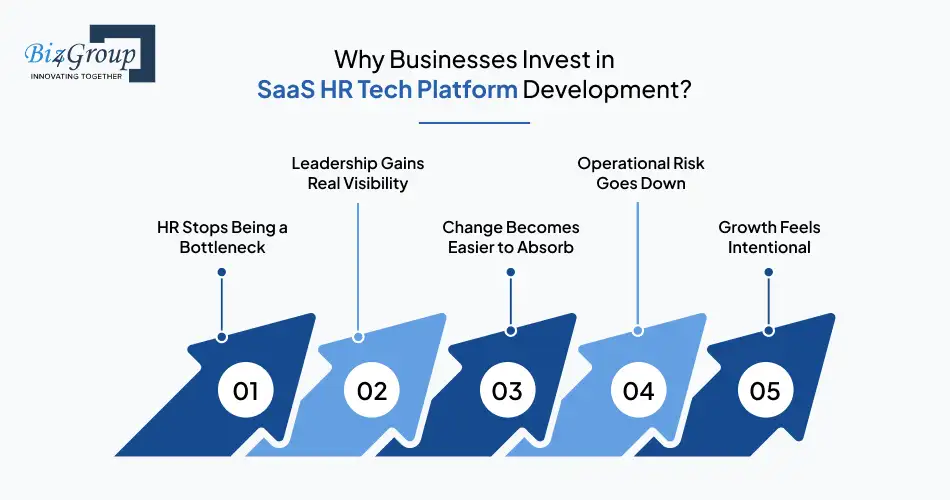
Growth exposes every weak link in HR operations. SaaS HR tech platform development becomes a priority when manual processes slow teams down, visibility drops, and leadership needs HR systems that stop reacting and start supporting the business.
1. HR Stops Being a Bottleneck
When hiring picks up, HR quickly turns into a blocker instead of an enabler. Teams move toward custom SaaS HR platform development so onboarding, approvals, and reviews keep pace with growth instead of chasing it.
2. Leadership Gains Real Visibility
Founders and executives want answers without waiting days for reports. When companies develop HR management SaaS system capabilities, they get live insight into workforce health, backed by data and shaped by the importance of AI in HR.
3. Change Becomes Easier to Absorb
Policies shift, teams go remote, and regulations evolve. SaaS HR platforms make adaptation less painful, especially when the roadmap includes future AI integration services that extend automation without rework.
4. Operational Risk Goes Down
Manual HR processes invite errors, delays, and compliance gaps. Centralized platforms reduce exposure and align HR operations with broader enterprise AI solutions strategies focused on consistency and control.
5. Growth Feels Intentional
Quick fixes crack under pressure. Businesses that create scalable HR tech SaaS product foundations invest in systems that support expansion without forcing constant rebuilds.
Once these motivations surface, the conversation naturally moves from why to how. That is where real-world applications of SaaS HR platforms begin to matter.
Real World Applications of SaaS HR Platforms
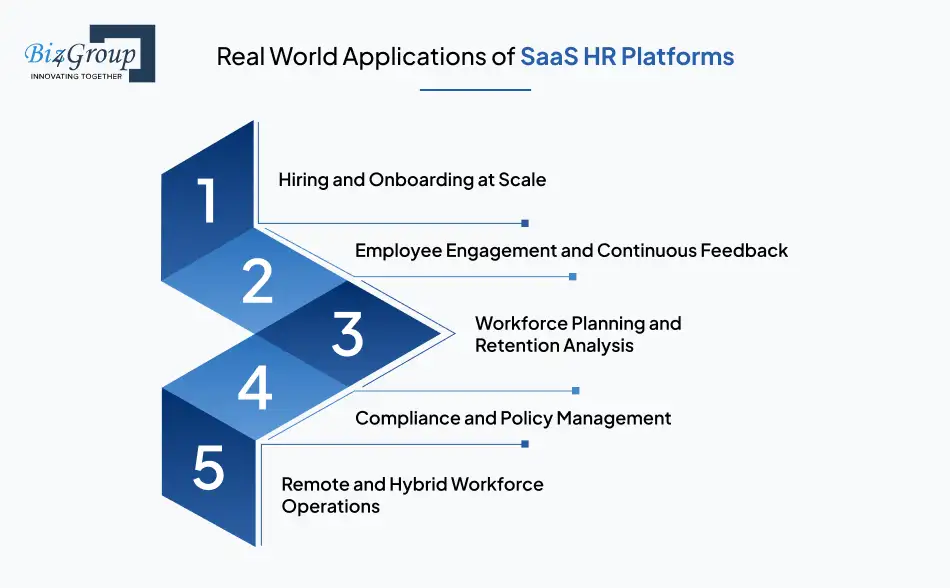
As organizations grow, theory quickly meets reality. SaaS HR tech platform development proves its value in everyday HR moments where scale, people expectations, and operational pressure collide. These platforms tend to show impact first in the following areas.
1. Hiring and Onboarding at Scale
Recruitment volume increases long before HR capacity does. Through HR SaaS application development, teams manage candidate pipelines, approvals, and onboarding steps in one flow that stays consistent across roles and regions.
- Example: Candidate questions and interview scheduling handled through structured workflows that later support use cases of AI chatbot in HR
2. Employee Engagement and Continuous Feedback
Engagement breaks down when feedback cycles feel delayed or disconnected. Organizations create SaaS HR platforms for employee engagement and analytics to capture sentiment, goal progress, and review inputs continuously rather than annually.
- Example: Feedback trends analyzed over time using insights influenced by generative AI in HR
3. Workforce Planning and Retention Analysis
Leaders want visibility into why teams grow or shrink. Businesses develop SaaS HR tech software for long term business growth by tracking headcount movement, performance data, and role changes across time.
- Example: Retention patterns reviewed with structured guidance shaped by AI consulting services
4. Compliance and Policy Management
As teams expand geographically, policies multiply. Centralized HR platforms help maintain clarity around approvals, acknowledgments, and documentation without manual follow ups.
- Example: Policy workflows adjusted once and applied consistently across locations
5. Remote and Hybrid Workforce Operations
Distributed teams require equal access to HR processes. SaaS HR platforms keep documentation, requests, and updates accessible regardless of time zone or location.
- Example: Secure employee self service portals supporting global teams
|
Application Area |
Core Focus |
Practical Outcome |
|---|---|---|
|
Hiring and Onboarding |
Process consistency |
Faster ramp up |
|
Engagement and Feedback |
Continuous input |
Higher trust |
|
Workforce Analytics |
Retention clarity |
Informed planning |
|
Compliance Management |
Policy control |
Lower risk |
|
Remote Operations |
Accessibility |
Team alignment |
As these applications become part of daily operations, the conversation naturally moves toward what the platform must offer at a feature level to support them reliably.
From Idea to Execution
See how to develop SaaS HR technology platform concepts into working products that teams actually use.
Map My HR SaaS RoadmapCore Features in SaaS HR Tech Platform Development
Every HR platform looks promising on paper. What separates usable products from shelfware is how well the core features support daily work at scale. SaaS HR tech platform development succeeds when foundational capabilities are designed to work together from day one.
Here’s all that you need to know:
|
Core Feature |
What It Enables for the Business |
|---|---|
|
Employee Data Management |
A single, reliable source for employee records across teams and locations |
|
Role and Access Control |
Clear permissions that align HR actions with responsibility |
|
Recruitment and Onboarding |
Structured hiring and onboarding workflows that scale with growth |
|
Payroll and Compensation |
Accurate payroll processing and compensation tracking |
|
Performance Management |
Ongoing goal setting, reviews, and performance visibility |
|
Leave and Attendance |
Transparent tracking of time off and availability |
|
Compliance and Policy Management |
Consistent handling of policies, acknowledgments, and records |
|
Reporting and Analytics |
Actionable insights into workforce trends and outcomes |
|
Employee Self Service |
Reduced HR load through employee owned updates and requests |
These features form the baseline that teams expect before any advanced capability enters the picture. Once they are stable, conversations naturally move toward extending the platform with smarter experiences such as AI assistant app design that builds on this foundation. That is where teams begin to develop SaaS HR platforms from MVP to enterprise without disrupting everyday operations.
Advanced Capabilities in Custom SaaS HR Platform Development
Once the foundation is stable, differentiation begins. SaaS HR tech platform development reaches the next level when platforms move beyond record keeping and start shaping decisions, experiences, and outcomes at scale. This is where advanced capabilities quietly change how HR operates.
1. Predictive Workforce Intelligence
Advanced platforms analyze historical and real time data to surface trends before issues escalate. This includes attrition risk, performance dips, and hiring gaps across teams. These insights often rely on carefully tuned AI model development instead of generic reporting modules.
2. Enterprise Grade Customization
As adoption grows, enterprises expect flexibility without instability. Advanced platforms support deep configuration across policies, workflows, and permissions, a capability often delivered through custom SaaS HR platform development services aligned to business structure.
3. Intelligent Employee Interactions
HR platforms begin handling conversations, not just workflows. Features like self service guidance and request handling are enhanced through AI chatbot integration that reduces response delays and improves consistency. Employees get answers without waiting on HR queues.
4. Cost and Scale Visibility
With advanced features comes financial accountability. Leaders track usage, performance impact, and expansion costs more closely, tying roadmap decisions back to a realistic SaaS HR tech platform development cost estimate.
5. Personalized Engagement and Feedback Loops
Engagement stops being one size fits all. Platforms use behavior patterns to personalize surveys, goals, and nudges, creating relevance across roles and seniority levels. Many teams explore this layer with selective use of generative AI.
Here’s how Biz4Group leverages built-in AI capabilities for HR
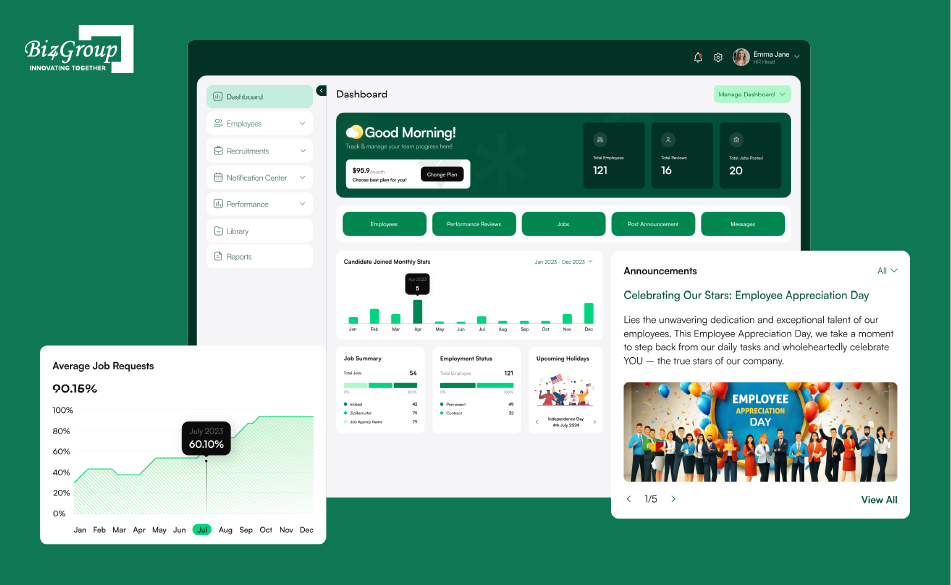
DrHR is an AI driven HRMS platform designed to centralize employee management, automate routine HR workflows, and support data informed people decisions. Built as a scalable web and mobile solution, it reflects how modern organizations approach SaaS HR tech platform development when reliability, usability, and long-term growth are non-negotiable.
Buyers often reassess partners and direction, asking what separates a capable vendor from the best company to develop SaaS HR tech platforms. That question naturally leads into how the platform itself is built, step by step, from concept through scale.
Step by Step SaaS HR Tech Platform Development Process
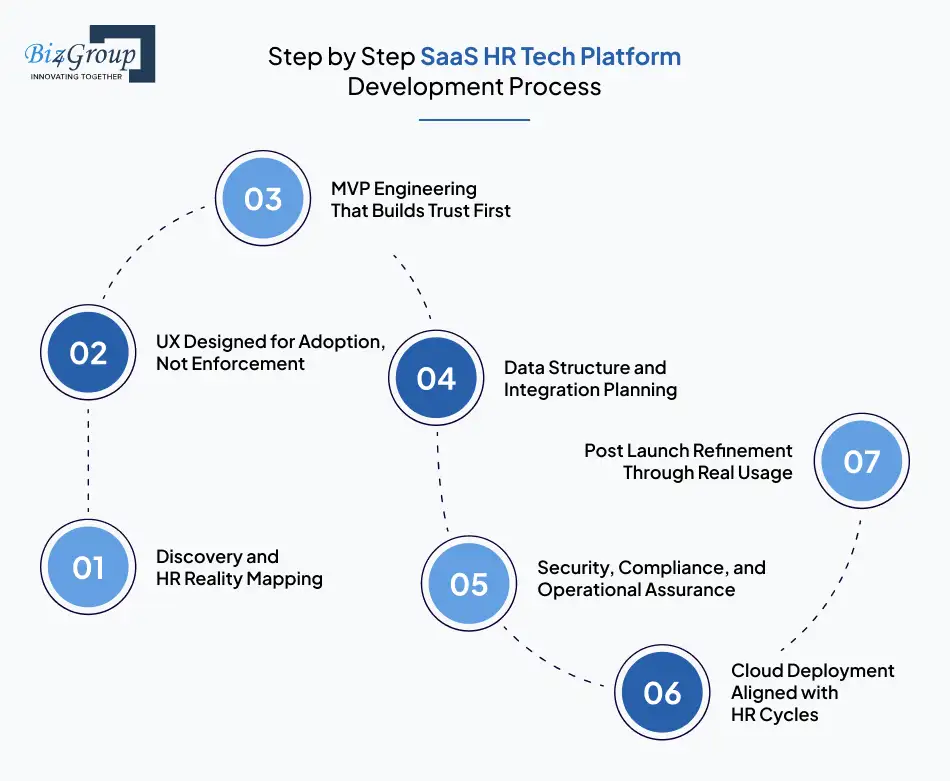
Building an HR platform is rarely about replacing one tool. It is about reshaping how people data, decisions, and accountability flow through a growing organization. SaaS HR tech platform development succeeds when each step is grounded in real HR behavior, not assumptions.
1. Discovery and HR Reality Mapping
This phase starts by understanding how HR actually functions inside the business today. Startups and enterprises experience HR very differently, which is why SaaS HR tech solutions for startups and enterprises must be planned with context, not templates.
- Identify friction across hiring, onboarding, payroll, and performance
- Separate operational pain points from aspirational ideas
- Capture how HR, managers, and employees interact with existing systems
- Define outcomes like reduced manual dependency or faster HR turnaround
2. UX Designed for Adoption, Not Enforcement
HR software fails when people avoid it. Adoption improves when workflows feel intuitive and respectful of time. Teams that create HR tech SaaS platform experiences focus on simplicity, clarity, and familiarity rather than visual complexity.
- Map user journeys for employees, managers, and HR admins
- Design flows that match real workplace behavior
- Test usability with non-technical users
- Keep interactions short and predictable
Thoughtful UX built here with the help of an experienced UI/UX design company reduces resistance before engineering even begins.
Also Read: Top 15 UI/UX Design Companies in USA: 2026 Guide
3. MVP Engineering That Builds Trust First
MVP development services are not about launching small. It is about launching safe. Early engineering decisions should prioritize data accuracy, access control, and audit readiness while teams build SaaS based HR software that people trust with sensitive information.
- Implement employee profiles, roles, and permissions first
- Focus on stability over feature volume
- Design APIs for future expansion
- Validate real usage before adding complexity
This stage often defines whether the platform gains internal confidence or stalls early.
Also Read: Top 12+ MVP Development Companies to Launch Your Startup in 2026
4. Data Structure and Integration Planning
HR platforms depend on clean, structured data. This step ensures the system supports insight and reporting without creating downstream confusion, a common challenge in HR software development for SaaS companies.
- Train AI models around employee lifecycle events
- Integrate payroll, attendance, and benefits systems cleanly
- Prepare analytics foundations without overwhelming users
- Keep flexibility for future intelligence driven layers
Good structure here saves months of rework later.
5. Security, Compliance, and Operational Assurance
HR platforms handle personal and regulated data. Trust is earned through consistency and transparency, especially when teams develop SaaS HR technology platform capabilities meant to scale across regions.
- Enforce role-based access and approvals
- Align with labor and data protection regulations
- Test edge cases like exits and payroll corrections
- Maintain audit trails for accountability
This step reassures both leadership and employees.
Also Read: Software Testing Companies in USA
6. Cloud Deployment Aligned with HR Cycles
HR usage is not linear. Hiring spikes, payroll deadlines, and review periods create uneven load. Cloud deployment must handle these cycles without disruption.
- Deploy scalable infrastructure
- Monitor performance during peak HR activity
- Enable smooth updates without downtime
- Prepare HR teams with clear rollout guidance
7. Post Launch Refinement Through Real Usage
Once live, improvement comes from observation, not assumptions. Platforms evolve as teams learn where time is saved and where friction remains.
- Track how workflows are actually used
- Identify manual workarounds that persist
- Expand features only when adoption supports it
- Measure impact through efficiency and satisfaction
When executed well, SaaS HR tech platform development services deliver platforms that feel less like software and more like organizational infrastructure, setting the stage for deeper technology decisions that follow.
Focus on the Right Features First
Learn how teams create SaaS HR platforms for employee engagement and analytics without overengineering.
Define Core HR FeaturesChoosing the Right Tech Stack to Build Cloud Based HR Tech Solutions
A SaaS HR platform lives at the intersection of people data, workflows, and integrations. For business leaders, the tech stack must support scale, security, and constant evolution without creating long term complexity.
|
Label |
Preferred Technologies |
Why It Matters |
|---|---|---|
|
Frontend Framework |
ReactJS, VueJS |
ReactJS development supports complex admin views, while VueJS works well for lightweight employee facing interfaces. |
|
Server-Side Rendering and SEO |
NextJS, NuxtJS |
Leadership and analytics views benefit from fast load times. NextJS development improves performance for reporting and internal portals. |
|
Backend Framework |
NodeJS, Python |
NodeJS development supports real-time workflows, while Python development handles structured business logic and integrations. |
|
API Development Layer |
REST APIs, GraphQL |
APIs are the backbone of HR platforms. A strong API layer ensures clean communication between modules and enables future third party integrations. |
|
AI and Data Processing |
Python, TensorFlow |
Python supports analytics and intelligence layers that evolve alongside HR operations without rigid models. |
|
Database Layer |
PostgreSQL, MySQL |
HR data must remain accurate and auditable. Relational databases support employee records, payroll history, and compliance reporting. |
|
Cloud Infrastructure |
AWS, Azure |
HR usage spikes during hiring and payroll cycles. Cloud platforms allow scaling without service disruption. |
|
Authentication and Access Control |
OAuth, Role Based Access |
HR systems manage sensitive data. Strong access control protects employee information and maintains internal trust. |
|
Integration Layer |
Webhooks, Middleware |
This layer enables smooth connections with payroll, benefits, and attendance systems. |
|
Analytics and Reporting |
BI Tools, Custom Dashboards |
Decision makers expect clarity. Built in reporting supports workforce planning without manual exports. |
|
DevOps and CI CD |
Docker, CI Pipelines |
HR platforms evolve continuously. Automated deployments reduce risk when rolling out updates. |
When these layers are aligned, technology stops being a constraint and starts supporting growth. This clarity around architecture sets realistic expectations around timelines, scalability, and investment across SaaS HR tech platform development phases.
Cost of HR Software Development for SaaS Companies
Cost is usually the first hard question leaders ask. For SaaS HR tech platform development, budgets typically fall between USD 25,000 and USD 400,000 plus, depending on scope, scale, and long term ambition. This is a ballpark range, not a fixed quote, and real numbers depend on how the platform is shaped:
|
Platform Stage |
What’s Typically Included |
Estimated Cost Range |
|---|---|---|
|
MVP-level SaaS HR tech platform |
Core employee records, basic onboarding, access control, simple workflows built during MVP software development stage |
USD 25,000 to USD 60,000 |
|
Early-Growth SaaS HR tech platform |
Recruitment modules, payroll logic, reporting, integrations |
USD 60,000 to USD 150,000 |
|
Mid-Level SaaS HR tech platform |
Performance management, compliance features, analytics dashboards |
USD 150,000 to USD 250,000 |
|
Enterprise-Ready SaaS HR tech platform |
Advanced customization, scalability, security, multi-tenant architecture |
USD 250,000 to USD 400,000 plus |
Several factors influence where a project lands in this range. Feature depth, integrations, compliance requirements, and scalability planning all shape effort. Teams working with a seasoned custom software development company often budget more intentionally by breaking costs across phases rather than attempting everything upfront.
As cost clarity improves, conversations naturally shift toward strategic tradeoffs. Many teams then ask whether building internally or buying an existing product makes more sense when they plan to build cloud based HR tech solutions that grow with the organization.
Clarity on Tech Stack and Cost
Understand how to build cloud based HR tech solutions with realistic budgets and scalable architecture.
Get My Cost BreakdownHow Can Businesses Monetize SaaS HR Tech Platforms?
Monetization decisions influence how the product evolves and how customers experience value. In SaaS HR tech platform development, revenue models work best when they align with HR buying behavior, internal approvals, and how organizations scale usage over time.
1. Subscription Based Pricing
Recurring subscriptions remain the most familiar and predictable model for HR buyers. Pricing is usually linked to employee count, enabled modules, or usage tiers, which supports steady revenue during custom SaaS HR platform development phases.
- Example: A growing company starts on a base plan for core HR, then upgrades annually as headcount increases and new modules become relevant to leadership.
2. Module Based Upselling
HR needs mature gradually. Many teams develop HR management SaaS system offerings with a strong core and optional modules that unlock advanced capabilities only when customers are ready to adopt them.
- Example: Core onboarding and employee records are standard, while performance management or compliance features are introduced later as paid extensions.
3. Usage Based Pricing
Some HR platforms tie revenue to actual activity rather than fixed licenses. This model fits organizations with fluctuating hiring or seasonal workforce patterns and becomes more viable as teams hire AI developers to optimize usage tracking.
- Example: Charges increase only during periods of active hiring or payroll processing, then normalize when activity slows.
4. Enterprise Licensing and Custom Contracts
Larger organizations expect flexibility around pricing, deployment, and support. Enterprise agreements often reflect scale, customization depth, and long term commitments.
- Example: A multi location enterprise signs a custom annual contract shaped with guidance from a software development company in Florida experienced in complex HR environments.
5. Value Added Services
Revenue can extend beyond the platform through implementation, customization, and advisory services that improve adoption and outcomes. These services often highlight the benefits of HR chatbots and workflow automation inside enterprise setups.
- Example: Paid rollout support and tailored enhancements delivered alongside an AI product development company during large scale onboarding.
When these models are aligned with buyer expectations, they support sustainable growth without forcing adoption. They also influence how teams create scalable HR tech SaaS product strategies that balance revenue, retention, and long-term platform evolution, leading naturally into the practices that keep development disciplined and reliable.
Build vs Buy Strategy for SaaS HR Tech Platform Development
Every leadership team reaches this crossroads early in SaaS HR tech platform development. Do you shape a platform around your workflows or adapt your workflows to someone else’s product. The decision impacts control, cost, and long-term flexibility.
|
Decision Factor |
Build Your Own Platform |
Buy an Existing HR SaaS |
|---|---|---|
|
Control Over Features |
Full control over workflows, data models, and roadmap |
Limited to vendor roadmap and configuration options |
|
Fit With Business Processes |
Designed around internal HR operations |
Requires teams to adjust to predefined flows |
|
Upfront Investment |
Higher initial spend tied to scope |
Lower entry cost with subscriptions |
|
Long Term Cost |
Predictable when planned in phases |
Can increase as users, modules, and contracts expand |
|
Differentiation |
Enables unique HR experiences and analytics |
Little room for competitive differentiation |
|
Scalability |
Built to scale as the business grows |
Dependent on vendor limits and pricing tiers |
|
Data Ownership |
Full ownership and visibility |
Data governed by vendor policies |
Teams choosing to build often work with one of the top AI development companies in Florida to manage complexity and avoid common pitfalls. Others start by buying to validate needs quickly. As HR requirements mature, many organizations revisit this decision during HR SaaS application development discussions when flexibility and ownership begin to matter more.
Now, let’s learn how platforms should be built responsibly, using proven practices that reduce risk while supporting growth.
Make the Right Build vs Buy Call
Compare HR SaaS application development with off the shelf tools before committing long term.
Evaluate My OptionsBest Practices in SaaS HR Tech Platform Development
Strong HR platforms are built through discipline, not feature overload. SaaS HR tech platform development works best when teams follow practices that balance user trust, operational clarity, and long term scalability. These principles consistently separate sustainable platforms from short lived ones.
1. Design for Daily Use, Not Occasional Access
HR tools must fit naturally into everyday workflows. Teams that create SaaS HR platforms for employee engagement and analytics focus on simplicity, quick actions, and clarity so employees and managers actually use the system.
2. Keep Conversations Structured and Supportive
Employees expect guidance, not confusion. Clear interaction patterns reduce friction, especially when future plans include conversational flows similar to an AI conversation app without overwhelming users.
3. Prioritize Data Integrity From Day One
HR decisions depend on accurate information. Clean data models and clear ownership rules prevent reporting issues and reduce rework later, especially when platforms expand beyond early adoption.
4. Build With Growth in Mind, Not Just Launch
Early shortcuts often become expensive constraints. Teams that develop SaaS HR tech software for long term business growth plan architecture, integrations, and permissions with future scale in mind, informed by realistic AI SaaS product development cost considerations.
6. Avoid One Size Fits All Assumptions
HR platforms serve diverse organizations. Recognizing differences between SaaS HR platform vs on premise HR systems helps teams design flexibility into workflows and deployment choices.
5. Make Cost Transparency a Design Choice
Understanding effort and tradeoffs builds trust internally. Clear scoping helps leaders manage custom HR software development cost expectations and make informed roadmap decisions.
When these practices are applied consistently, teams are better prepared to face real world constraints. That naturally leads into understanding the challenges that arise during development and how experienced teams address them.
Challenges in SaaS HR Tech Platform Development and Solutions
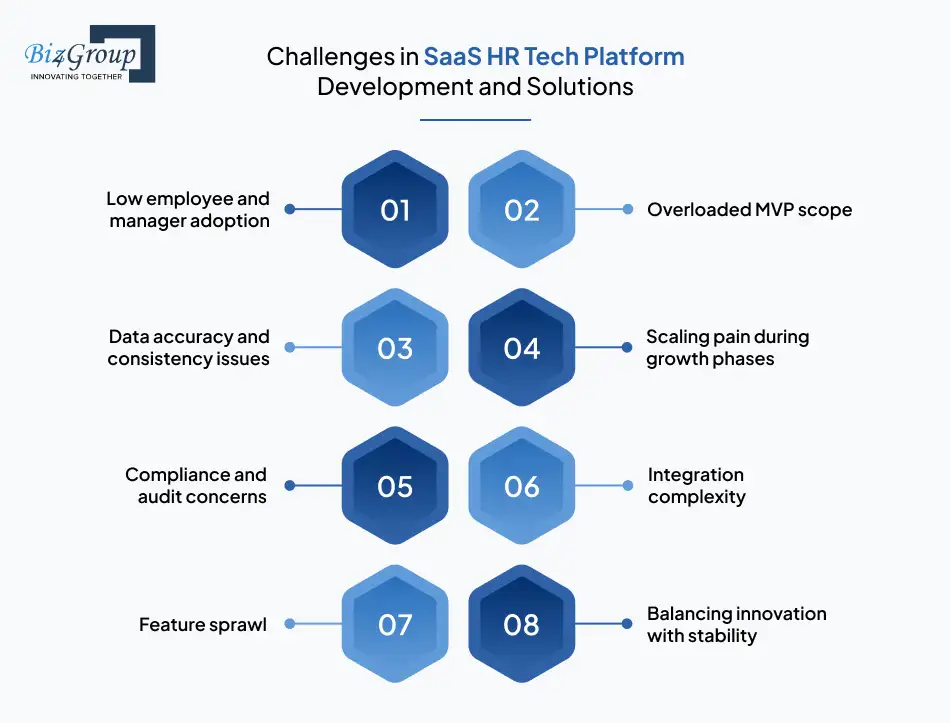
Every HR platform looks straightforward at the idea stage. Reality introduces friction fast. SaaS HR tech platform development brings a distinct set of challenges that surface as teams balance people data, trust, scale, and adoption. The most common hurdles tend to look like this:
|
Top Challenges |
How to Solve Them |
|---|---|
|
Low employee and manager adoption |
Design workflows that mirror real HR behavior and reduce steps for everyday tasks |
|
Overloaded MVP scope |
Focus the MVP on trust building features before expansion and develop SaaS HR platforms from MVP to enterprise in phases |
|
Data accuracy and consistency issues |
Establish clear ownership rules and validation checks early |
|
Scaling pain during growth phases |
Design architecture for gradual expansion instead of reactive fixes |
|
Compliance and audit concerns |
Embed compliance rules into workflows rather than treating them as add ons |
|
Integration complexity |
Plan integrations upfront to avoid rework as systems multiply |
|
Feature sprawl |
Maintain a disciplined roadmap tied to measurable HR outcomes |
|
Balancing innovation with stability |
Introduce intelligence carefully, especially when exploring business app development using AI within HR workflows |
Most teams face these challenges at different stages, not all at once. How effectively they are handled often defines whether the platform feels like a long-term asset or a constant compromise. That distinction becomes even more important when looking ahead at how HR technology is expected to evolve next.
The Future of SaaS HR Tech Platform Development
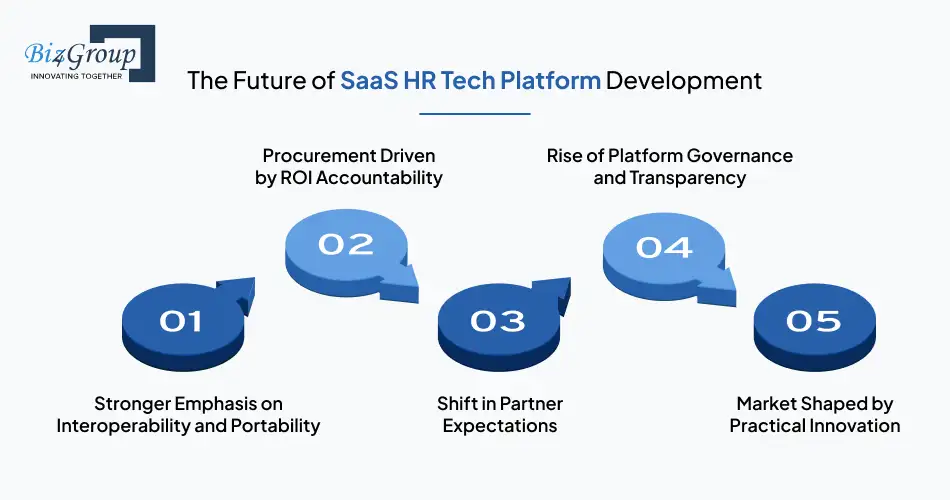
HR platforms are entering a phase shaped less by features and more by expectations around governance, adaptability, and long-term ownership. SaaS HR tech platform development will increasingly be influenced by how well platforms align with evolving business realities rather than short term innovation cycles.
1. Stronger Emphasis on Interoperability and Portability
Organizations want freedom to evolve their HR stack over time. Future platforms will prioritize clean data portability and ecosystem compatibility so teams are not locked into rigid vendor paths.
2. Procurement Driven by ROI Accountability
Buying decisions will involve finance, HR, and technology together. Clear value measurement and predictable planning will matter more than brand promises, often guided by realistic SaaS HR tech platform development cost estimate thinking.
3. Shift in Partner Expectations
Businesses will look beyond vendors that simply deliver code. Demand will rise for teams that think like product partners, similar to how organizations evaluate a trusted AI chatbot development company for strategic alignment.
4. Rise of Platform Governance and Transparency
Enterprises will expect clearer controls around data usage, access, and policy enforcement. Governance layers will become central to vendor selection and long-term platform trust.
5. Market Shaped by Practical Innovation
The next wave of HR platforms will favor grounded ideas over hype. Inspiration will come from execution focused thinking seen in top SaaS startup app ideas, not from chasing trends.
As this landscape takes shape, organizations naturally turn their attention to who can execute responsibly at scale. That decision often leads into evaluating the best company to develop SaaS HR tech platforms and the role of long term custom SaaS HR platform development services in sustaining growth.
Plan Beyond the MVP Stage
See how SaaS HR tech solutions for startups and enterprises evolve into enterprise ready platforms.
Design for ScaleWhy Choose Biz4Group LLC for SaaS HR Platform Development?
Building an HR platform is not just a technical exercise. It is a long-term product decision that touches people data, compliance, trust, and scale. Biz4Group LLC approaches SaaS HR tech platform development with a product first mindset shaped by real delivery experience as an AI app development company.
Our work on AI driven HR SaaS platforms, including production ready solutions like DrHR, gives us direct insight into what happens after launch. These platforms are designed for real employees, managers, and leadership teams, not just demos or feature checklists.
Why teams work with Biz4Group:
- Hands on experience building scalable HR SaaS platforms
- Deep understanding of HR workflows across growing organizations
- Strong alignment between product strategy and engineering execution
- Focus on adoption, security, and long-term maintainability
- Transparent collaboration across every development stage
Biz4Group helps teams build HR platforms that hold up as organizations grow, ensuring the product remains reliable, usable, and relevant well beyond the initial release.
Closing Insights on HR SaaS Application Development
HR SaaS platforms are built for hectic Mondays, quarter ends, audits, hiring spikes, and moments when people expect systems to simply work. SaaS HR tech platform development succeeds when leaders stop asking “what features should we add” and start asking “what problems will exist at scale.” The real work is aligning product decisions, architecture, cost discipline, and timing so the platform grows without dragging the business down. And when the moment is right to build AI software, it should feel like a natural extension of the system, not a bolt on experiment.
FAQs on SaaS HR Tech Platform Development
1. How long does it usually take to build a SaaS HR tech platform?
Timelines vary based on scope, integrations, and compliance needs. An MVP can take a few months, while enterprise grade products take longer. Teams that develop SaaS HR technology platform solutions in phases move faster without locking themselves into early decisions.
2. What is the cost to build a SaaS HR tech platform?
The cost typically ranges between USD 25,000 and USD 400,000+, depending on features, scale, and security requirements. This is a ballpark figure. A realistic SaaS HR tech platform development cost estimate depends on whether you start with an MVP or aim for enterprise readiness.
3. Is SaaS HR tech suitable for both startups and large enterprises?
Yes, but the approach differs. Startups prioritize speed and validation, while enterprises focus on scale and governance. Well planned SaaS HR tech solutions for startups and enterprises support both by evolving the platform as organizational complexity increases.
4. Can a SaaS HR platform be customized as business needs change?
Customization is one of the main reasons teams choose to build instead of buy. Through custom SaaS HR platform development, workflows, permissions, and integrations can adapt as policies, teams, and compliance requirements evolve.
5. How scalable are SaaS HR platforms as headcount grows?
Scalability depends on architecture and early decisions. Platforms designed to create scalable HR tech SaaS product foundations can support growth across locations, departments, and employee volumes without performance or data issues.
6. What makes SaaS HR platforms different from traditional HR systems?
The biggest difference is flexibility and accessibility. Unlike legacy setups, SaaS platforms are cloud based and easier to evolve. This distinction is central to the SaaS HR platform vs on premise HR systems discussion, especially for organizations planning long term growth.
