Location :
Orlando, FL, USA
Location :
Orlando, FL, USA +1 (407) 714-1616
 info@biz4group.com



















Imagine a digital system that doesn’t wait for instructions but instead, understands your business goals, learns from real-time feedback, and takes independent actions to get the job done.
Read More

How do you justify an AI budget when your partners are asking one simple question: where is the proof? That is the real challenge many law firms and legal departments face today. They are being pushed to reduce legal costs, improve turnaround time, and handle growing workloads, yet many AI conversations still revolve around promises instead of measurable outcomes.
The market is already moving with 76% legal professionals believing AI could narrow the access-to-justice gap. More importantly, adoption is producing business value. Here’s what Wolters Kluwer future ready lawyer 2026 report has to say:
For legal leaders, these numbers raise an important question: where can similar gains be achieved inside legal workflows?
This is why searches around AI in legal industry case studies continue to grow. Decision-makers want evidence tied to real results and they start asking:
Well, this blog answers these questions through real examples showing where AI delivered measurable impact and what law firms can learn next. Let's dive in.
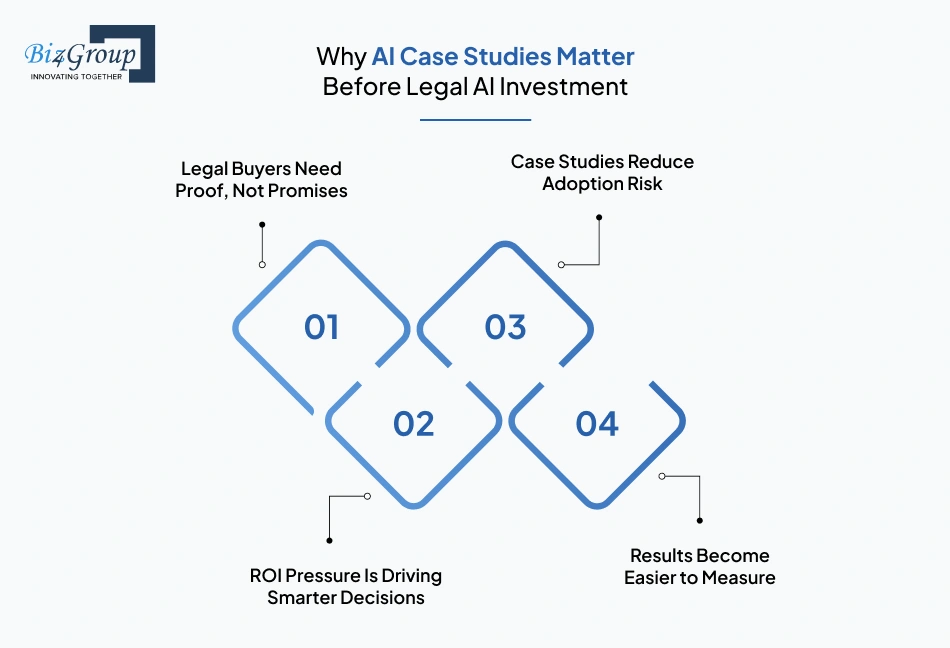
AI investment decisions in legal operations are rarely about curiosity. They are about risk, cost control, client service, and measurable returns. If you are evaluating new tools for contract review, research, intake, or compliance, the real question is not whether AI sounds promising. The real question is whether it has already solved similar problems for firms like yours. That is where case studies become valuable.
Many legal buyers face polished demos and ambitious claims, yet still struggle to understand how results will look inside day-to-day practice. Legal AI success stories show what problem existed, how the AI solution was implemented, and what changed after adoption. It gives decision-makers practical evidence instead of assumptions. Here’s more:
Law firms work in an environment where mistakes carry financial and reputational consequences. That makes untested technology a difficult sell. AI legaltech case studies reveal verified outcomes that helped leadership move forward with more confidence.
Budgets are under pressure, and every new system must justify its place. That is why interest in AI in legal industry case studies continues to rise. Firms want to see where time was saved, costs were reduced, and teams became more efficient.
The strongest examples reveal more than wins. They also show implementation hurdles, workflow changes, and lessons learned. That insight helps you avoid common mistakes before rollout begins.
Strong examples also create benchmarks. If another legal team reduced review time or improved intake speed, you can measure similar goals in your own environment. This is why searches for AI success stories in legal industry showing cost savings and efficiency improvements are becoming more common.
Since, the value is now clear, let us look at real examples that show how legal organizations solved operational challenges with practical technology
See what legal AI can deliver for your workflows and budget today
Get ROI ClarityWhat separates a promising AI tool from one that delivers measurable legal value? Real execution. The top AI legal case studies in 2026 show how firms solved scheduling delays, intake bottlenecks, trial preparation gaps, client growth issues, and expert coordination problems through practical technology decisions.
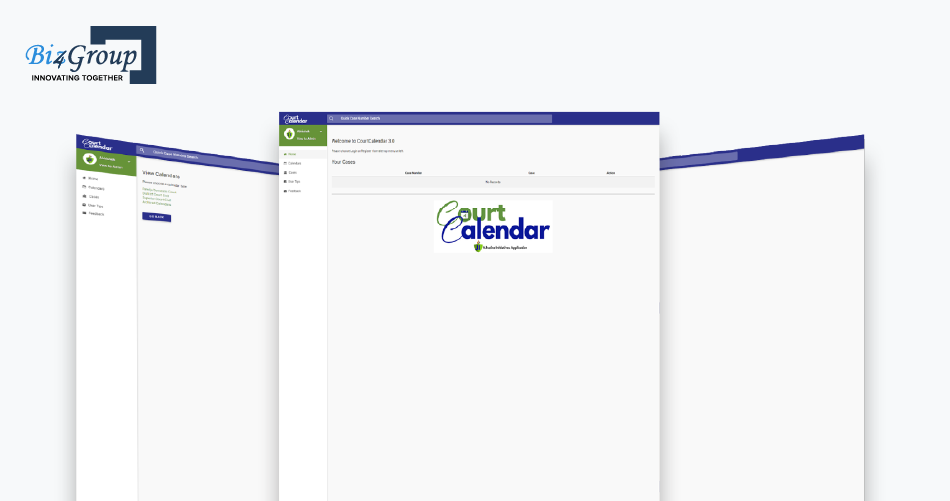
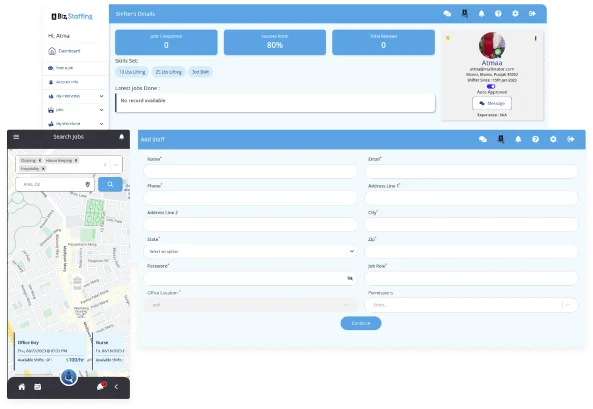
Court Calendar is a judiciary platform developed by Biz4Group for U.S. attorneys to manage, track, and schedule court hearings for ongoing and pending cases. The platform was built to simplify legal operations where schedules, deadlines, case movement, and internal coordination often become difficult to manage through manual systems. It brought core workflows into one platform through case dashboards, live status tracking, secure communication, document handling, and hearing management.
Law firms handling active litigation matters often struggle when court operations depend on disconnected tools and manual follow-ups.
Court Calendar was designed to organize critical legal workflows inside one structured environment.
These capabilities helped convert fragmented legal scheduling into a controlled digital workflow.
With scheduling, communication, and case coordination handled through one platform, firms could operate with stronger consistency and lower administrative friction.
Court Calendar demonstrates that legal efficiency often improves first through workflow modernization rather than complex AI deployment. When law firms centralize scheduling, communication, and case visibility, they create a stronger operational base for future AI adoption in research, intake, compliance, and litigation support.
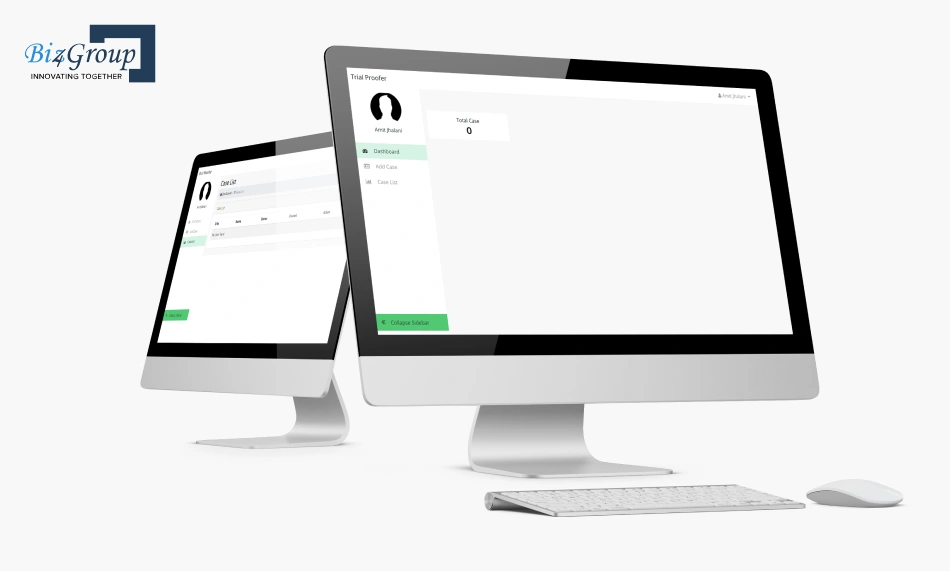
Trial Proofer is a secure legal automation platform that helps legal practitioners prepare trials, organize case materials, and deliver legal services remotely. The platform introduced a virtual law firm model where attorneys could manage cases, track deadlines, coordinate evidence, and structure trial preparation workflows through one digital system. It was built to improve how legal teams handle complex litigation work that often depends on accuracy, timing, and fast access to organized information.
Trial preparation usually involves large volumes of documents, evidence references, witness records, and deadlines. When these processes are handled manually, legal teams lose time and control.
Biz4Group designed Trial Proofer as a structured legal workspace that organized litigation preparation into clear digital workflows.
These features transformed trial preparation from a fragmented manual process into a more controlled digital workflow.
With evidence, witnesses, chronology, and deadlines managed through one system, legal teams could prepare matters with stronger consistency and lower operational friction.
Trial Proofer shows that legal AI transformation often starts with workflow discipline. Before advanced AI tools deliver value, firms need structured case data, connected records, and organized trial processes. By digitizing evidence management, witness preparation, and case timelines, law firms create the foundation required for future AI use cases such as legal research, predictive analytics, and litigation intelligence.

Desc Legal is an online legal service platform which allows individuals to request legal assistance, submit documents, and connect with attorneys through a structured digital interface. The platform was built to simplify early-stage legal engagement where many clients struggle to understand how to begin, what information to provide, and how to reach the right legal professional. By organizing intake, document exchange, and attorney communication into one workflow, Desc Legal created a smoother path between potential clients and legal service providers.
Many law firms lose time and revenue before a case even starts. Traditional intake processes often depend on calls, emails, manual screening, and scattered follow-ups.
Biz4Group structured Desc Legal to digitize the front end of legal service delivery.
These capabilities helped convert unpredictable client intake into a repeatable operational workflow.
With intake, document collection, and engagement workflows managed digitally, firms could improve speed and consistency at the earliest revenue stage.
Desc Legal shows that legal growth often depends on operational efficiency before advanced AI enters the picture. When firms modernize intake, communication, and onboarding, they remove friction that slows revenue generation. Structured intake platforms also create cleaner data foundations for future AI use cases such as lead scoring, document analysis, and automated client assistance.

Big Mouth Marketing is a business growth and digital marketing platform developed by Biz4Group to help service-based businesses manage online presence, customer engagement, and lead generation through one connected system. For legal practices, it solves a common growth challenge where client acquisition depends on scattered marketing tools, inconsistent follow-ups, weak visibility, and poor conversion tracking.
By organizing campaigns, engagement channels, and growth workflows into one environment, the solution helped firms improve how they attract and convert prospective clients.
Many law firms invest in marketing but still struggle to create predictable client growth because operations remain fragmented.
Biz4Group developed a centralized marketing workflow that helped streamline client acquisition and engagement.
These capabilities changed marketing from scattered activity into a more measurable business process.
With growth systems managed through one platform, firms could operate with better control over client acquisition costs and revenue opportunities.
For many law firms, growth problems are operational problems. When lead capture, follow-up, reputation, and campaign visibility are disconnected, acquisition costs rise and opportunities are lost. This case study shows that centralized legal workflow automation can improve client growth before firms invest in more advanced AI tools such as legal intake bots, lead scoring systems, or predictive marketing models.
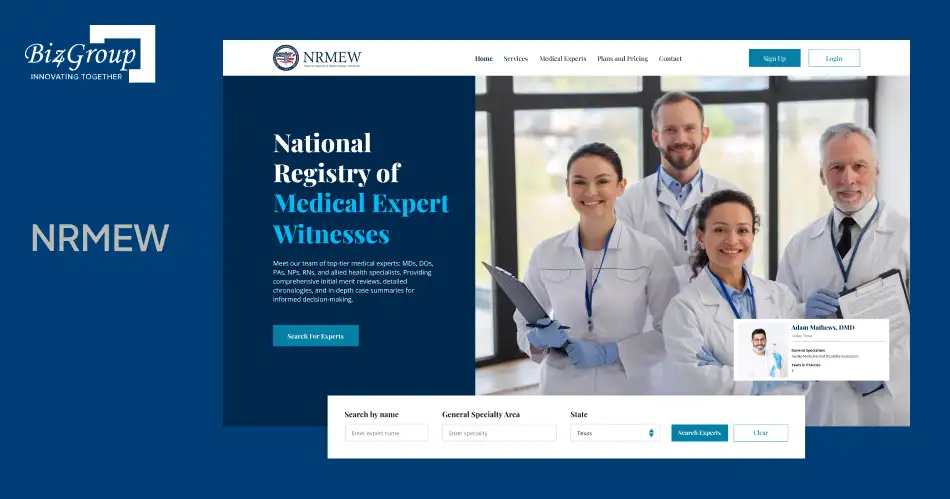
NRMEW is a specialized digital platform that connects lawyers with medical experts through one streamlined interface. The solution was built for legal matters where medical opinions, expert testimony, injury evaluations, and healthcare documentation play an important role.
Instead of relying on scattered outreach, slow referrals, and manual coordination, the platform created a direct system where attorneys could identify, engage, and collaborate with relevant medical professionals more efficiently. It solved a critical gap between two industries that frequently need to work together but often operate through outdated processes.
Law firms handling personal injury, malpractice, workers’ compensation, disability, and related matters often need medical experts quickly. Traditional processes create delays and inefficiencies.
Biz4Group structured NRMEW as a professional connection platform that simplified lawyer-to-expert engagement.
These capabilities helped convert expert sourcing from a slow manual task into a more organized legal workflow.
With quicker access to medical experts, firms could move cases forward with stronger efficiency and better preparation.
NRMEW shows that many legal bottlenecks exist outside the law firm itself. When firms depend on external experts, delays often come from poor coordination rather than lack of talent. By creating a direct platform between lawyers and medical experts, Biz4Group helped remove friction between two connected industries and improve how cases progress.
The strongest results did not come from broad AI claims. They came from fixing specific legal workflow problems with focused solutions. That is why the AI in legal industry case studies matter as they show where measurable efficiency, growth, and operational control were actually achieved.
Turn legal bottlenecks into measurable wins with practical AI execution
Plan My AI RoadmapMany firms begin with one direct question: we are a law firm looking for real AI legal case studies to understand how other firms achieved ROI and efficiency improvements. That concern is practical and timely. Legal leaders want proof tied to revenue, cost control, and productivity. The strongest returns usually come from removing workflow friction that slows daily operations.
A large share of legal spend is tied to repetitive internal work. When scheduling, intake, document sorting, and status updates become faster, teams recover productive hours.
Common ROI gains include:
Profitability often improves when each case requires fewer support hours and fewer avoidable delays. Tools built around AI legal custom workflow management help firms standardize routine processes and reduce hidden waste.
Typical results include:
This creates a healthier margin across growing caseloads.
Review-heavy practices gain ROI when legal work moves faster without losing accuracy. This is where AI legal document analyzing becomes commercially valuable.
Measured benefits often include:
ROI is not only about cutting cost. It also comes from handling more work with the same team size, improving response speed, and increasing client retention through smoother service.
Capacity-driven returns often include:
The most reliable legal AI returns come from targeted operational fixes, not broad deployments. Once ROI patterns are clear, the next step is identifying which legal workflows produce the fastest and most sustainable gains.
Many firms buy tools. Fewer firms prepare the environment where those tools can deliver measurable value. That is the real difference visible in legal industry AI adoption case studies with ROI and performance metrics. Success usually comes from disciplined rollout decisions, clear priorities, and steady operational execution.
Successful firms did not try to change every department at once. They focused on one expensive or time-heavy process first, then expanded after results became visible.
Common starting points included:
Strong adoption happened when technology fit existing routines instead of disrupting them. Firms mapped real tasks first, then applied practical tools.
Many legal automation AI examples show better results when AI is tied to:
Successful firms treated adoption as a people project, not only a software project. Staff understood what would change, where time would be saved, and how quality would be maintained.
Useful actions included:
Top firms tracked outcomes early. Many AI contract review case studies became credible because firms measured review speed, accuracy, and labor hours from the start.
Typical metrics included:
Once one workflow produced results, firms moved into adjacent areas such as an AI consultation platform, research support, or operations automation.
Expansion usually followed:
The strongest rollouts stayed practical, measurable, and phased. That is why the most useful real examples of AI in legal industry with business impact analysis often begin with one focused win, then scale through disciplined execution.
Build your legal AI rollout with strategy that actually gets adopted
Start Smart DeploymentBy now, you have seen how top legal AI case studies translate into lower operating costs, faster workflows, stronger client response times, and scalable service models. The next step is applying those lessons inside your own firm with a roadmap that fits your goals, budget, and operational priorities.
That is usually where many law firms, legal departments, and LegalTech founders pause. They understand the opportunity, but they need the right execution partner, proven experience, and confidence that investment decisions will lead to measurable returns.
At this stage, many legal buyers ask:
These are commercial decisions, not casual searches. They usually come up when leadership teams are planning budgets, improving legal operations, or preparing digital transformation initiatives.
That is where Biz4Group LLC creates value. As an AI legal software development company, the team focuses on practical solutions tied to measurable outcomes rather than trend-driven features. Here’s what we offer:
Success with legal AI rarely comes from adding more tools. It comes from solving the right business problem with systems teams will actually use. With Biz4Group LLC as the right execution partner, legal organizations can turn AI opportunities into measurable and sustainable growth.
The real opportunity in legal AI is not simply adopting new technology. It is knowing where it creates measurable value, where it improves daily operations, and where investment decisions need stronger proof. The firms gaining momentum today are the ones using evidence, timing, and disciplined execution to guide adoption.
That is why top AI legal case studies matter so much right now. They help law firm leaders, in-house counsel, CTO’s, CIOs in legal organizations, and risk management teams move forward with stronger confidence, better budgeting decisions, and more realistic performance expectations. Reviewing top AI legal case studies in 2026 with ROI insights and real-world examples also makes it easier to separate practical solutions from costly distractions.
Whether your next priority is contract review speed, legal workflow efficiency, research productivity, or cost transparency, the smartest path is starting with one meaningful use case and Biz4Group LLC stands strong with you to execute it well.
With the right strategy and an experienced AI development company, legal AI can become a practical growth asset rather than an expensive experiment.
The strongest AI legal case studies usually come from firms that improved contract review speed, automated intake, reduced research time, or streamlined compliance operations. The most valuable examples include clear outcomes such as lower legal costs, faster turnaround times, and higher matter capacity.
Focus on case studies that match your practice model, firm size, and workflow needs. Review whether the results came from contract review, litigation support, intake automation, or internal operations. Strong examples should explain the business problem, rollout process, and measurable gains.
Personal injury, corporate law, employment law, compliance-heavy practices, and high-volume contract teams are seeing strong results. These areas often benefit because they involve document-heavy workflows, recurring tasks, and time-sensitive client communication.
Look for proof of operational value, not only product features. Strong success stories show reduced turnaround times, lower manual effort, cleaner workflows, better reporting, and easier adoption by legal teams already handling heavy workloads.
It depends on your workflow complexity and growth plans. Off-the-shelf tools can solve focused tasks quickly. Custom solutions are often stronger for firms needing secure integrations, branded client experiences, or specialized workflows tied to internal processes.
Many firms begin seeing early returns within the first few months when AI is applied to one clear use case such as intake, review, scheduling, or research support. Faster ROI usually comes from solving repetitive tasks that already consume time and staffing costs.

with Biz4Group today!
Our website require some cookies to function properly. Read our privacy policy to know more.