 Location :
Orlando, FL, USA
Location :
Orlando, FL, USA +1 (407) 714-1616
 info@biz4group.com

 AI Summary Powered by Biz4AI
- AI real estate app development companies in USA build systems for property management, pricing, automation, and market analysis using real data and workflows.
- The top AI real estate app development companies in USA differ based on their strength areas such as analytics, mobile apps, automation, or enterprise systems.
- Choosing between custom, SaaS, or hybrid solutions depends on your data readiness, business model, and long-term scalability goals.
- Biz4Group LLC stands out for building production-ready AI systems that integrate directly into real estate workflows like listings, lead management, and automation.
- Businesses looking for AI-powered real estate app development services companies for brokers and investors should focus on data pipelines, integrations, and model performance.
- The right partner is one that aligns with your workflows, handles real estate-specific use cases, and supports the system after launch.
The real estate industry is quickly moving toward smarter, data-driven systems. This shift is driving demand for AI real estate app development companies in USA, as businesses look for ways to automate processes, analyze property data faster, and improve decision-making. Instead of relying only on manual workflows, companies are now investing in applications that can learn from data and adapt over time.
At its core, real estate AI software development is about building apps that can make sense of large volumes of property data, user behavior, and market trends. These systems go beyond fixed rules and use models that improve with usage. A reliable AI development company brings together data engineering, machine learning, and system integration to ensure these applications actually work in real-world conditions where data is often messy or incomplete.
Many businesses begin by searching for the top AI real estate app development companies in USA, but choosing the right partner requires more than a list. It requires understanding what these companies build, how their solutions work, and whether they align with your goals. This guide is designed to help answer a key question: which AI companies in the USA can develop custom real estate apps for my business, and how to evaluate them with clarity and confidence.
Understanding AI Real Estate App Development Companies In USA
AI real estate app development companies in USA build applications that use data and machine learning to improve how real estate businesses work. These apps help with tasks like pricing, lead handling, listings, and daily operations.
Instead of just building features, these companies focus on creating systems that can learn from data and improve over time. This is useful for businesses that deal with large amounts of property data and changing market conditions.
What Qualifies a Company as an AI Real Estate App Developer?
An AI real estate app developer is a company that can build and use machine learning models inside real estate applications.
This means the company can collect data, train models, and use them in real-world apps. It is not just about adding AI features. The company should be able to build systems like pricing tools or lead scoring systems that actually work with real data.
Strong skills in AI model development are important, along with the ability to run these systems in live environments.
When this matters: This is useful for businesses that depend on data to make regular decisions.
Core Capabilities of AI Real Estate App Development Companies In USA
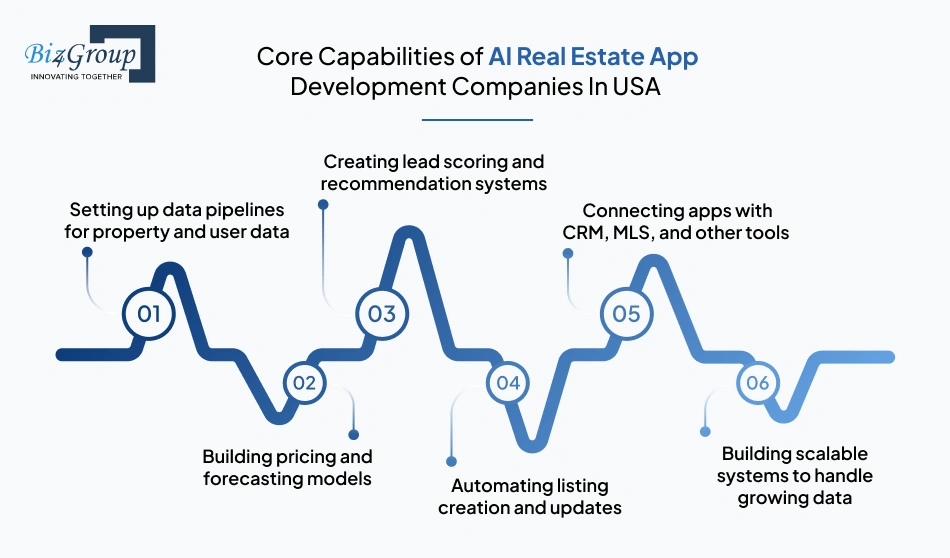
AI real estate app development companies offer a set of capabilities that support both product development and daily operations. Key capabilities include:
- Setting up data pipelines for property and user data
- Building pricing and forecasting models
- Creating lead scoring and recommendation systems
- Automating listing creation and updates
- Connecting apps with CRM, MLS, and other tools
- Building scalable systems to handle growing data
Many companies also offer AI integration services, which help connect AI features with existing systems instead of starting from scratch.
These capabilities make it easier to manage large datasets and improve how different parts of the business work together.
When this matters: This is important for businesses planning to grow or handle more users and listings.
Difference Between Traditional And AI-Driven App Development
Traditional app development follows fixed rules, while AI-driven development uses data to improve over time.
This difference changes how the application behaves and how useful it becomes as data grows.
Aspect |
Traditional Development |
AI-Driven Development |
What It Means |
|---|---|---|---|
Decision Making |
Rule-based |
Data-based |
More flexible decisions |
Data Usage |
Limited |
Continuous |
Better use of data |
System Behavior |
Fixed |
Adaptive |
Improves over time |
Scalability |
Limited |
Grows with data |
More long-term value |
Maintenance |
Code updates |
Model updates |
Needs ongoing tuning |
This difference becomes important when working with custom AI real estate app developers in the USA for small and medium businesses, where systems need to adjust as the business grows.
Summary: AI-driven apps improve over time, making them more suitable for real estate businesses that rely on data and ongoing decisions.
What Problems AI Real Estate App Development Companies In USA Solve
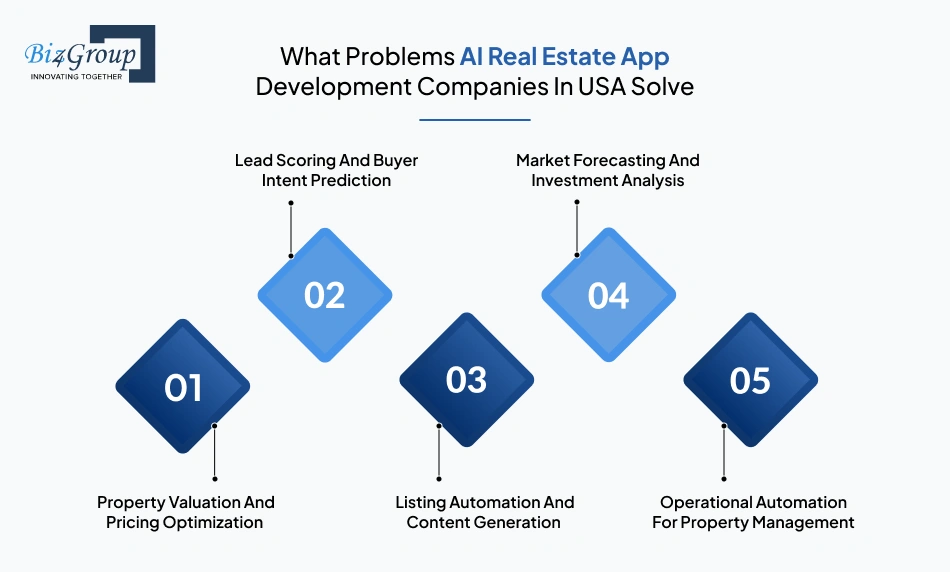
Real estate businesses often deal with scattered data, slow decisions, and repetitive manual work. AI real estate app development companies in USA solve these problems by building systems that can analyze data quickly and support better decisions.
These systems are usually built around key functions like pricing, lead handling, listing management, and daily operations. Instead of changing everything, they improve how these tasks are done.
1. Property Valuation And Pricing Optimization
Property valuation and pricing optimization uses AI models to estimate and update property prices based on market data.
Instead of relying on occasional comparisons, an AI pricing model keeps adjusting prices as new data comes in. It looks at past sales, current listings, and location trends to stay aligned with the market.
Area |
Without AI |
With AI Pricing Model |
Impact |
|---|---|---|---|
Pricing Updates |
Manual |
Continuous |
Faster adjustments |
Data Coverage |
Limited |
Multiple data sources |
Better accuracy |
Market Response |
Delayed |
Real-time |
Competitive pricing |
Many businesses start here when they build real estate AI software, since pricing directly affects outcomes.
Key Takeaway: AI pricing models help keep property prices accurate and up to date.
2. Lead Scoring And Buyer Intent Prediction
Lead scoring and buyer intent prediction helps identify which prospects are more likely to convert.
An AI lead scoring system tracks how users interact with listings and platforms. Over time, it learns which actions indicate serious interest.
Examples of signals:
- Visiting the same property multiple times
- Saving listings
- Sending repeated inquiries
- Changing search preferences
This helps sales teams focus on the right leads instead of treating all leads equally. It is also a common requirement when evaluating the top AI real estate app development companies in USA.
Key Takeaway: AI lead scoring helps teams focus on leads that are more likely to convert.
3. Listing Automation And Content Generation
Listing automation uses AI to create and manage property listings using available data.
A listing automation system can turn property details into ready-to-publish content. With generative AI, descriptions can be created automatically without manual writing.
This is especially useful for businesses managing large numbers of listings or frequent updates.
What improves:
- Faster listing creation
- Consistent descriptions
- Less manual effort
Key Takeaway: Listing automation speeds up content creation and keeps listings consistent.
4. Market Forecasting And Investment Analysis
Market forecasting uses AI to understand trends and estimate future changes in the real estate market. A market analysis model looks at historical data and current signals to identify patterns. These patterns help estimate price movement, demand shifts, and potential risks.
Insight |
What It Helps With |
|---|---|
Price Trends |
Timing buying or selling |
Demand Signals |
Planning inventory |
Location Growth |
Finding opportunities |
Risk Indicators |
Avoiding uncertain areas |
This helps businesses and investors make decisions based on data instead of guesswork.
Key Takeaway: AI forecasting helps plan ahead using data-driven insights.
5. Operational Automation For Property Management
Operational automation uses AI to handle routine property management tasks.
An AI automation system can manage tasks like responding to tenant queries, assigning maintenance work, and sending reminders. This reduces the need for constant manual coordination.
Many businesses choose to integrate AI into an app at this stage to improve efficiency without expanding their teams.
Key Takeaway: AI automation reduces manual work and improves response time.
These problem areas show how AI improves real estate operations in practical ways. The next step is understanding how to choose the right partner, especially when evaluating which AI companies in the USA can develop custom real estate apps for my business based on actual capability and long-term fit.
How AI Real Estate App Development Companies In USA Build Applications
Understand What You Actually Need to Build
Work with AI real estate app development companies in USA to turn real estate workflows into scalable AI systems.
Start Planning Your AI SolutionBuilding an AI real estate application is a step-by-step process where each part depends on the other. AI real estate app development companies in USA do not start with features. They start with how data will flow, how decisions will be made, and how the system will behave once users start interacting with it.
In simple terms, the process moves from data to decisions to delivery. If any one part is weak, the application may work on the surface but fail under real usage.
1. Data Requirements And Data Pipelines
Data is the foundation of any AI-driven real estate application. Property details, user behavior, and market signals all come from different sources, and they rarely arrive in a clean or consistent format.
A data pipeline brings this information together, organizes it, and keeps it updated. Without this step, even a well-designed system will produce unreliable outputs. For example, pricing models depend on current listings and recent transactions, while recommendation systems depend on user activity. Both require data that is accurate and continuously refreshed.
This is often the first layer teams focus on when figuring out how to use AI for real estate in a practical way.
2. Model Types Used In Real Estate Applications
Once the data is ready, the next step is deciding how the system will use it. This is where different types of models come in, depending on the task.
Model Type |
Use Case |
Output Example |
Where It Fits |
|---|---|---|---|
Regression Models |
Property pricing |
Price estimate |
Valuation tools |
Classification Models |
Lead scoring |
High or low intent |
Sales workflows |
Recommendation Models |
Property suggestions |
Suggested listings |
User-facing apps |
NLP Models |
Listing content |
Property descriptions |
Content systems |
Computer Vision Models |
Image analysis |
Feature detection |
Image-heavy platforms |
In some cases, generative AI is used to create listing descriptions or support user interaction, especially in apps where content needs to be created quickly.
The choice of model depends on what the application is expected to do, not on what is technically possible.
3. Integration With MLS CRM And Third-Party Systems
An AI application does not work in isolation. It needs to connect with systems that already hold important data, such as property listings, customer records, and transactions.
Integration makes this possible. It allows the application to pull live data from MLS databases, track user activity through CRM systems, and connect with tools like maps or payment gateways. Without this connection, the application may look complete but will not function properly in a real business setting.
This becomes especially important for custom AI real estate app developers in the USA for small and medium businesses, where new applications must fit into existing workflows instead of replacing them.
4. Infrastructure And Scalability Considerations
Once the system is built, it needs to run reliably as more users and data are added. This is where infrastructure plays a role.
The application must be able to handle increasing traffic, process data without delays, and keep running without interruptions. At the same time, it must protect sensitive information such as user details and transaction data.
In many cases, teams plan this early, especially when working on business app development using AI, so that the application can scale without needing major changes later.
Building an AI real estate application is not a single step but a connected process. Each layer, from data to infrastructure, affects how the system performs in real conditions. This is one of the key areas businesses evaluate when looking at the top AI real estate app development firms that provide property management solutions, since long-term performance depends on how well this foundation is built.
How To Evaluate AI Real Estate App Development Companies In USA
Choosing the right partner depends on how well a company can build and run AI systems in real conditions. AI real estate app development companies in USA differ in how they handle data, build models, connect systems, and support applications after launch. A clear evaluation helps you understand if the company can deliver a system that works reliably as your business grows.
1. Technical Capability Signals To Verify
Technical capability shows whether a company can build and run AI systems for real estate applications.
A capable team can explain how data is collected and processed, how models are trained, and how the system works after deployment. When it comes to AI in real estate development, this also includes how models are updated over time and how performance is monitored.
Clear system flow, simple explanations, and real examples of deployment are good indicators of strong capability.
What this tells you: Whether the company can handle real data and keep the system working over time.
2. Questions To Ask Before Hiring an AI Real Estate App Development Company in USA
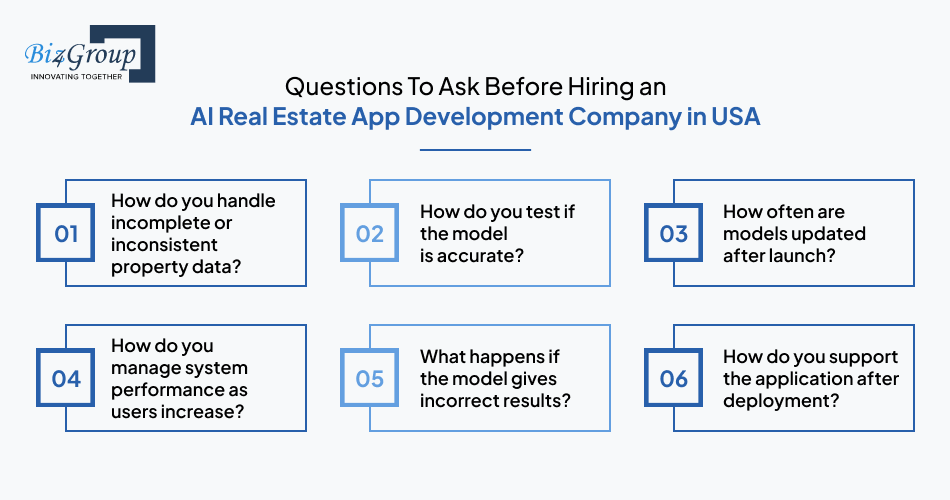
The right questions help you understand how the company builds and maintains AI systems.
Instead of general discussions, focus on how they handle real situations. Companies offering AI-powered real estate app development services companies for brokers and investors should be able to answer clearly.
You can ask:
- How do you handle incomplete or inconsistent property data?
- How do you test if the model is accurate?
- How often are models updated after launch?
- How do you manage system performance as users increase?
- What happens if the model gives incorrect results?
- How do you support the application after deployment?
Clear and direct answers to these questions show how prepared the team is for real-world use.
What this tells you: Whether the company has a clear process for building and maintaining the system.
3. Red Flags That Indicate Weak AI Expertise
Red flags appear when a company cannot clearly explain how its system works.
Common issues include unclear answers about data handling, no explanation of how models are used, and lack of real deployment examples. If a company cannot explain how it plans to build AI software for your use case, it may show limited experience.
Vague timelines and unclear workflows can also create risks during development.
What this tells you: Whether the company has real experience or only surface-level knowledge.
4. Portfolio Versus Production Readiness
A portfolio shows what has been built, while production readiness shows how the system performs after launch.
Real-world systems need stable infrastructure, regular updates, and the ability to handle users without slowing down. This is important when reviewing USA AI app development companies specializing in real estate technology solutions, where systems are expected to run continuously.
Looking at how a system performs after deployment gives a better idea of long-term reliability.
What this tells you: Whether the company can deliver systems that continue to work well over time.
A clear evaluation helps you move from options to a confident decision. Businesses reviewing AI-powered real estate app development services companies for brokers and investors should focus on how systems are built, maintained, and scaled, since these factors directly affect long-term results.
Top 10 AI Real Estate App Development Companies In USA (2026)
The top AI real estate app development companies in USA (2026) include Biz4Group, InData Labs, SoluLab, Chetu, BlueLabel, Vention, Master of Code Global, Plavno, Plego, and Leobit. These companies offer AI-driven solutions for property platforms, analytics systems, and automation, with verified Clutch profiles and real-world implementation experience.
Company |
Hourly Rate |
Min Project Size |
Best Fit For |
|---|---|---|---|
Biz4Group LLC |
$25–49/hr |
$10,000+ |
End-to-end real estate AI platforms |
InData Labs |
$50–99/hr |
$10,000+ |
Data-driven analytics and pricing systems |
SoluLab |
$25–49/hr |
$25,000+ |
Marketplace and recommendation-based apps |
Chetu |
Undisclosed |
$10,000+ |
CRM, MLS, and workflow-based solutions |
BlueLabel |
$100–149/hr |
$75,000+ |
Scalable mobile and user-focused platforms |
Vention |
$50–99/hr |
$50,000+ |
Enterprise-grade AI systems |
Master Of Code Global |
$50–99/hr |
$25,000+ |
Conversational AI and lead engagement |
Plavno |
$25–49/hr |
$25,000+ |
Flexible mid-scale AI applications |
Plego Technologies |
$100–149/hr |
$25,000+ |
Integration-heavy real estate systems |
Leobit |
$25–49/hr |
$25,000+ |
SaaS-based scalable real estate platforms |
1. Biz4Group LLC
- Website: https://www.biz4group.com/
- Headquarters: Orlando, Florida, USA
- Hourly Rate: USD 25–49/hr
- Minimum Project Size: USD 10,000+
- Clutch Rating:9/5
Overview: Biz4Group is one of the leading AI app development firms for real estate in USA, known for building scalable and production-ready AI systems. It focuses on delivering practical solutions that move beyond experimentation and support real-world use cases.
Services Offered
- AI Strategy & Consulting: Defines where AI should be used in real estate workflows such as pricing, lead management, and listing optimization.
- Custom AI Application Development: Builds platforms tailored to property management, brokerage workflows, and investor tools.
- Generative AI Systems: Creates tools for listing descriptions, chat-based interactions, and automated communication.
- AI Automation Systems: Reduces manual work in lead handling, listing updates, and reporting processes.
- AI Integration Services: Connects AI with MLS, CRM systems, and internal dashboards without disrupting operations.
- AI Product Development: Supports building full-scale real estate platforms from idea to deployment.
USPs
- Builds AI that doesn't stop at suggestions—it steps in, executes tasks, and keeps workflows moving without constant human input.
- Designs systems that hold up as complexity increases, scaling with the business instead of becoming a bottleneck.
- Prioritizes real-world usability, making sure every solution is practical, compliant, and simple for teams to adopt.
- Understands how businesses actually operate, so the AI integrates seamlessly into existing processes rather than forcing teams to rethink everything.
Case Studies
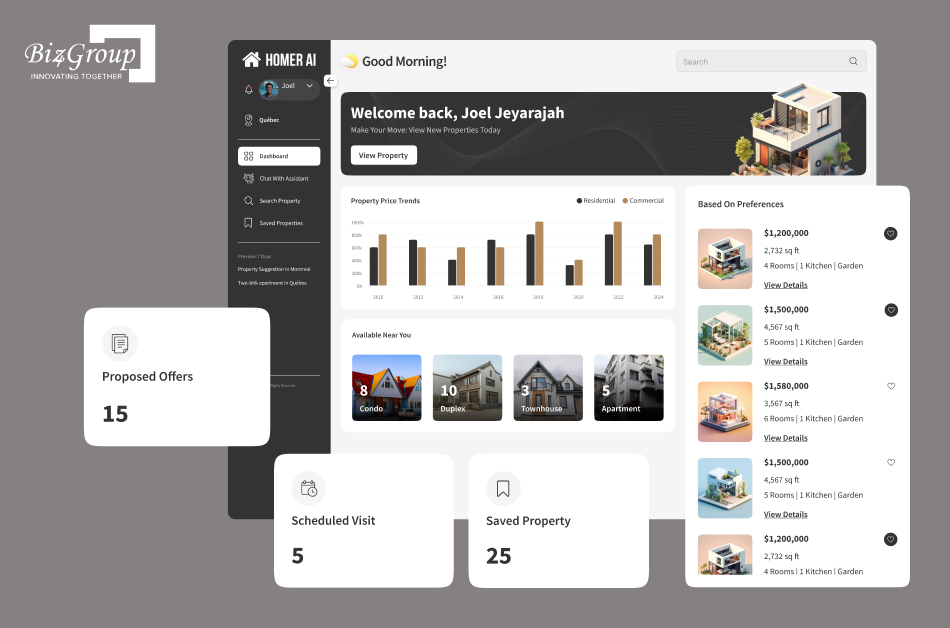
Homer AI: A conversational AI platform that connects buyers and sellers in one place, making it easier to discover properties, evaluate options, and move forward with confident decisions.
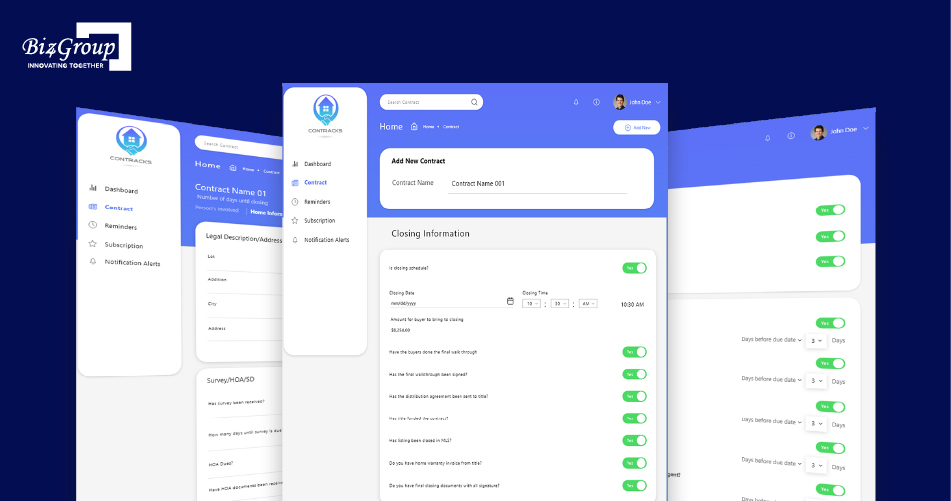
Contracks: A contract management platform for real estate that simplifies deal progression with event-based alerts, task tracking, and better visibility across every stage of the process.
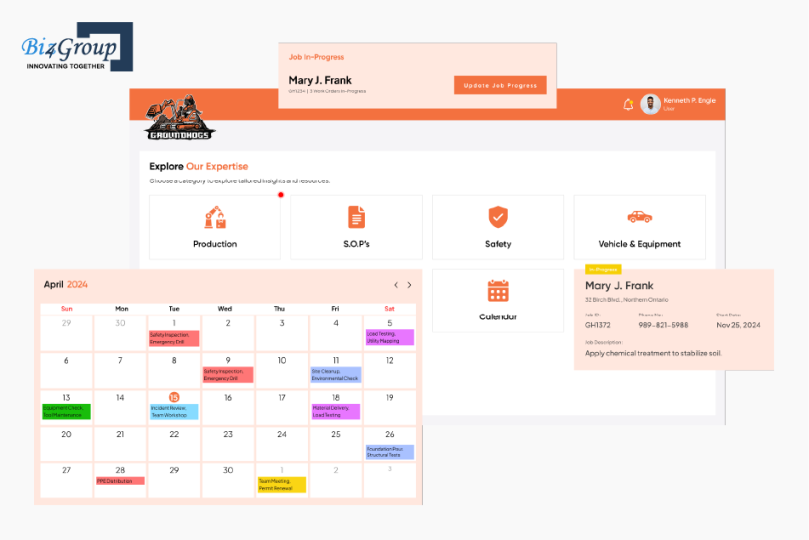
Groundhogs: A construction site management system that streamlines on-site operations with real-time tracking, safety compliance monitoring, and centralized access to project data.
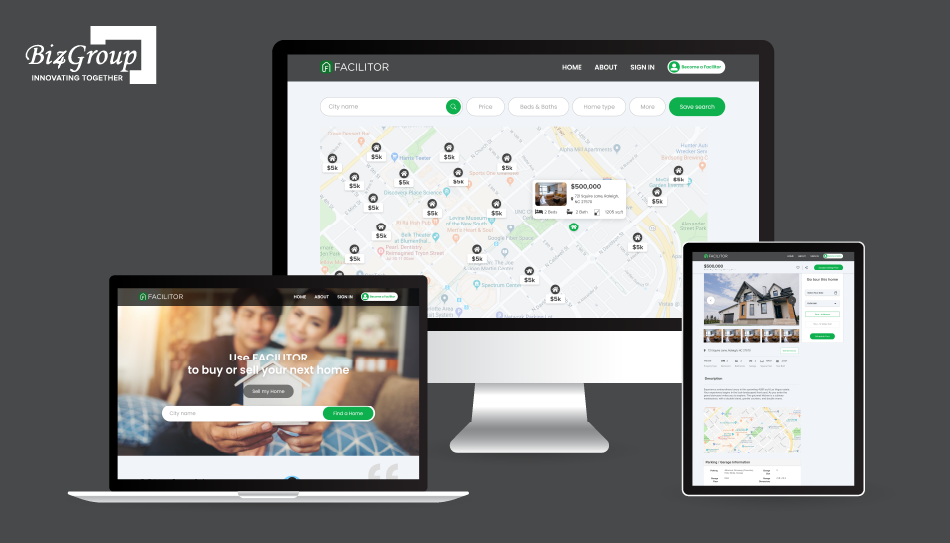
Facilitor: An AI-powered real estate platform that helps users explore properties securely, access guided insights, and navigate the home-buying journey with greater clarity and confidence.
2. InData Labs
- Headquarters: Miami, Florida, USA
- Hourly Rate: $50–99/hr
- Minimum Project Size: $10,000+
- Clutch Rating:9/5
InData Labs is among the top AI real estate app development companies in USA, focused on data-driven AI systems where insights and predictions are central. In real estate, their work includes pricing engines, demand forecasting, and investment analysis tools. Their strength lies in handling structured and unstructured data at scale.
Key AI Services:
- Predictive analytics for property valuation
- Market trend forecasting models
- Recommendation systems
- Data engineering and pipeline development
Industries Served: Real estate, finance, logistics, retail
Notable Strengths:
- Strong data science expertise
- Focus on model accuracy and performance
- Experience with large datasets
3. SoluLab
- Headquarters: New York, USA
- Hourly Rate: $25–49/hr
- Minimum Project Size: $25,000+
- Clutch Rating:9+
SoluLab builds AI-powered applications where user interaction and system intelligence are closely connected. Their real estate solutions focus on recommendation systems, search optimization, and analytics dashboards.
Key AI Services:
- AI-powered recommendation engines
- Workflow automation systems
- Predictive analytics
- AI-based search and filtering
Industries Served: Real estate, fintech, healthcare, enterprise
Notable Strengths:
- Strong focus on user-facing features
- Experience with marketplace platforms
- Balanced cost and capability
4. Chetu
- Headquarters: Sunrise, Florida, USA
- Hourly Rate: Undisclosed
- Minimum Project Size: $10,000+
- Clutch Rating:3/5
Chetu focuses on custom software development where AI is integrated into existing systems. Their real estate work often involves enhancing CRM platforms, listing systems, and internal tools, making them listed among the top AI real estate app development firms that provide property management solutions
Key AI Services:
- Custom AI software development
- CRM and MLS integration
- Listing automation
- Data processing systems
Industries Served: Real estate, healthcare, finance, retail
Notable Strengths:
- Strong integration capability
- Flexible project scope
- Cost-efficient development
Solve Real Estate Bottlenecks with AI
Explore how AI-powered real estate app development services companies for brokers and investors help automate listings, pricing, and lead management.
Build Smarter Real Estate Systems5. BlueLabel
- Headquarters: New York, USA
- Hourly Rate: $100–149/hr
- Minimum Project Size: $75,000+
- Clutch Rating:7/5
BlueLabel builds scalable digital products with AI features focused on user engagement and analytics. Their real estate applications include platforms with behavioral tracking and recommendation systems.
Key AI Services:
- AI product development
- User analytics systems
- Recommendation engines
- Mobile-first application development
Industries Served: Real estate, media, enterprise software
Notable Strengths:
- Strong product thinking
- Focus on scalability
- Experience with high-traffic apps
6. Vention
- Headquarters: New York, USA
- Hourly Rate: $50–99/hr
- Minimum Project Size: $50,000+
- Clutch Rating:9/5
If you're looking for custom AI real estate app developers in the USA for small and medium businesses, Vention is a great choice. It builds enterprise-grade AI systems with strong backend and cloud infrastructure. Their real estate work involves data platforms, analytics systems, and large-scale integrations.
Key AI Services:
- AI system architecture
- Data pipelines and processing
- Cloud-based AI deployment
- Custom enterprise platforms
Notable Strengths:
- Strong engineering depth
- Scalable infrastructure
- Enterprise-level delivery
7. Master Of Code Global
- Headquarters: Redwood City, California, USA
- Hourly Rate: $50–99/hr
- Minimum Project Size: $25,000+
- Clutch Rating:7/5
Master of Code Global specializes in conversational AI systems. In real estate, their solutions are used for lead qualification, property inquiries, and automated communication.
Key AI Services:
- Conversational AI systems
- Chatbot development AI-driven automation
- Customer interaction tools
Notable Strengths:
- Deep expertise in conversational systems
- Strong automation capabilities
- High scalability in communication workflows
8. Plavno
- Headquarters: New York, USA
- Hourly Rate: $25–49/hr
- Minimum Project Size: $25,000+
- Clutch Rating:9/5
Plavno builds flexible AI applications that can adapt to different real estate use cases. Their solutions include recommendation engines, analytics tools, and workflow systems. It's considered one of the leading AI app development firms for real estate in USA, for almost every size of real estate business.
Key AI Services:
- Custom AI development
- Recommendation systems
- Analytics platforms
- Workflow automation
Notable Strengths:
- Fast delivery cycles
- Flexible development approach
- Suitable for mid-scale projects
Build Systems That Work with Your Data
Partner with USA AI app development companies specializing in real estate technology solutions to design scalable, data-driven applications.
Start Your Custom AI Build9. Plego Technologies
- Headquarters: Downers Grove, Illinois, USA
- Hourly Rate: $100–149/hr
- Minimum Project Size: $25,000+
- Clutch Rating: 5/5
Plego focuses on building systems that connect multiple tools and workflows. Their real estate applications include property management platforms and automation systems.
Key AI Services:
- AI integration
- Custom application development
- Workflow automation
- Data synchronization
Notable Strengths:
- Strong integration expertise
- Handles complex systems
- Reliable delivery
10. Leobit
- Headquarters: Austin, Texas, USA
- Hourly Rate: $25–49/hr
- Minimum Project Size: $25,000+
- Clutch Rating:9/5
Leobit is one of the AI real estate mobile app development companies In USA that is know for building SaaS platforms with embedded AI features. Their real estate work includes analytics systems and property management applications designed for long-term scalability.
Key AI Services:
- SaaS platform development
- AI analytics systems
- Custom software development
- Scalable architecture
Notable Strengths:
- Strong SaaS expertise
- Focus on long-term scalability
- Clean architecture design
Choosing from these AI real estate app development companies in USA depends on your data complexity, product goals, and scale requirements. Focus on how well each company handles real estate workflows, integrations, and long-term system performance to ensure the solution remains useful beyond initial deployment.
Selecting AI Real Estate App Development Companies In USA Based On Business Type
Different real estate businesses need different types of systems. AI real estate app development companies in USA offer different strengths, and choosing the right one depends on what your business actually needs. A startup, a brokerage, and a property management company will all require a different approach.
1. For Real Estate Startups
Real estate startups need partners who can build quickly and adapt as the product grows.
a. MVP Development And Fast Iteration
Startups usually begin with a small product to test their idea. The focus is on building something usable and improving it over time. Teams that understand how to build AI real estate app MVP can help focus on core features like search, recommendations, or pricing. This helps launch faster and keeps early costs under control.
b. Flexible Product Development Approach
Startups often change direction as they learn from users. The system should be easy to update without major delays or rework. A flexible approach makes it easier to improve features and adjust the product over time.
2. For Enterprise Brokerages
Enterprise brokerages need systems that work with their existing tools and handle large-scale usage.
a. Integration With Existing Systems
Brokerages already use tools like CRM and MLS platforms. The new system should connect with these tools so that data moves smoothly between them. This keeps operations consistent and avoids duplication of work.
b. Scalable And Stable Systems
Large brokerages deal with many users and listings at the same time. They need systems that can handle this load without slowing down. This is where enterprise AI solutions are often used to support scale and stability.
3. For Property Management Companies
Property management companies need systems that reduce manual work and improve daily operations.
a. Automation Of Routine Tasks
Tasks like handling tenant requests, scheduling maintenance, and tracking payments take time. AI systems can automate these processes and reduce manual effort.
This helps teams manage more properties without increasing workload.
b. Better Task And Process Management
These systems can also help organize tasks, track updates, and keep operations running smoothly. The goal is to improve efficiency in everyday work.
4. For Investment And Analytics Platforms
Investment and analytics platforms need systems that focus on data and insights.
a. Data Analysis And Market Insights
These platforms work with large amounts of data to identify trends and opportunities. The system should be able to process this data and generate useful insights. This supports better investment decisions.
b. Forecasting And Predictive Models
These businesses also rely on models that estimate future trends and risks. Choosing the right partner includes understanding how to find AI companies that build machine learning apps for real estate market analysis and checking their experience with data-heavy systems.
Business Type |
What To Look For In A Company |
Key Focus Area |
|---|---|---|
Real Estate Startups |
Fast MVP development and flexible approach |
Speed and adaptability |
Enterprise Brokerages |
Strong system integration and scalability |
Stability and large-scale handling |
Property Management Companies |
Workflow automation and process efficiency |
Daily operations improvement |
Investment And Analytics Platforms |
Data processing and predictive models |
Insights and decision support |
Choosing the right partner becomes easier when you match your business type with the company's strengths. When reviewing leading AI app development firms for real estate in USA, focus on how well their experience fits your needs and how they can support your growth over time.
Increase Lead Conversion by 35% with AI
Use solutions built by top AI real estate app development companies in USA to improve pricing accuracy, user engagement, and response time.
Scale Your Real Estate PlatformChoosing Between Custom Prebuilt And Hybrid AI Real Estate App Development In USA
Choosing the right development approach depends on how much control, speed, and flexibility your business needs. AI real estate app development companies in USA typically offer three options: custom development, prebuilt (SaaS) solutions, and hybrid models. Each approach affects how your application is built, how it integrates with your systems, and how it scales over time.
1. When Custom AI Development Makes Sense
Custom AI development is an approach where the application is built from scratch to match specific business workflows, data pipelines, and system requirements.
This approach is used when standard tools cannot support your use case or when your system depends on unique data and logic.
Common situations where custom development fits:
- Your workflows are not supported by existing platforms
- You rely on internal or proprietary data
- You need full control over features, integrations, and updates
Teams often hire AI developers in this scenario to build components like pricing models, recommendation systems, or analytics tools that fit directly into their operations. This approach is also useful when testing or expanding real estate AI apps ideas without being limited by prebuilt features.
Decision clarity: Custom development works best when flexibility and long-term control are more important than speed.
2. When SaaS Solutions Are Sufficient
SaaS solutions are prebuilt platforms that provide ready-to-use features for common real estate use cases. They are useful when your requirements are standard and do not need deep customization or complex system integration.
Scenario |
Why SaaS Works |
When To Choose |
Trade-Off |
|---|---|---|---|
Property listing platforms |
Prebuilt listing features |
Fast launch with minimal setup |
Limited customization |
CRM and lead management |
Ready workflows |
Standard sales processes |
Less control over data handling |
Small-scale applications |
Lower complexity |
Early-stage or low-volume operations |
Scaling limitations later |
SaaS tools are commonly offered by AI real estate mobile app development companies In USA for businesses that want to launch quickly without investing in full system development.
Decision clarity: SaaS works best when speed and lower upfront cost are more important than customization.
3. When Hybrid Approaches Work Better
Hybrid development combines prebuilt systems with custom-built components to balance speed and flexibility. This approach is used when some parts of the application are standard, while others require customization.
A typical hybrid setup includes:
- using SaaS tools for basic features like listings or CRM
- building custom modules for pricing, recommendations, or analytics
- connecting both through system integration
For example, a business may use a prebuilt listing system and add a custom recommendation engine or an AI conversation app for user interaction.
Hybrid models are often supported by AI real estate application development companies In USA that specialize in combining existing tools with custom-built systems.
Decision clarity: Hybrid works best when you need faster deployment but still require flexibility in key parts of the system.
The choice between custom, SaaS, and hybrid approaches depends on how your system is expected to evolve. Businesses working with AI real estate application development companies In USA should consider their current needs, data complexity, and future scalability before deciding which approach to follow.
Delivery Timelines Across AI Real Estate Mobile App Development Companies In USA
Delivery timelines across AI real estate mobile app development companies in USA typically range from 2 weeks to 11 months, depending on application complexity, data readiness, and system integrations. Simple applications move faster, while data-heavy platforms with multiple integrations take longer to stabilize.
In most projects, timelines are shaped by how quickly data is prepared, how complex the models are, and how many systems need to work together.
1. Timeline By Product Type
Different products follow different timelines based on their scope and complexity.
- A basic MVP with listing features and limited AI logic usually takes 2 to 4 weeks
- A mid-level application with lead scoring and integrations may take 5 to 8 weeks
- A more advanced platform with predictive models and automation can take 9 to 11 weeks
Longer timelines are usually linked to systems that depend on large datasets, multiple integrations, or continuous model updates. Faster timelines are possible when teams use on-demand app development solutions for standard features.
2. Factors That Delay AI Projects
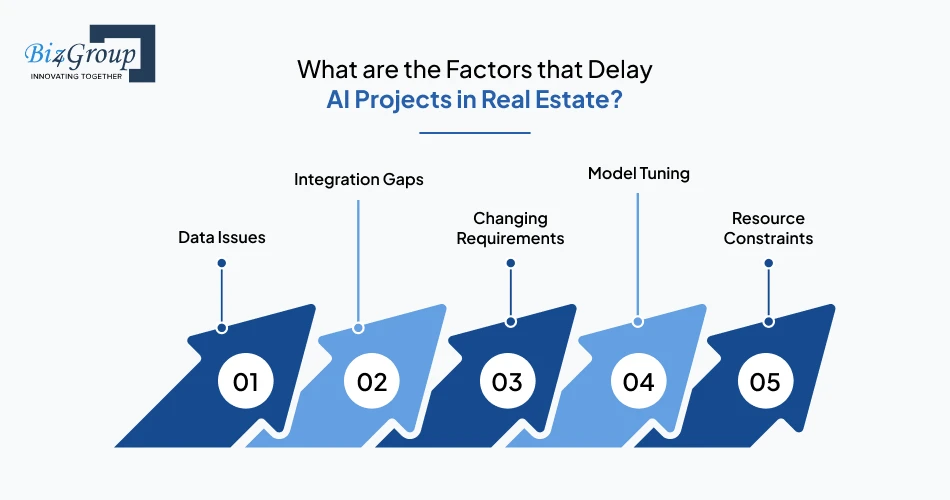
Delays in AI projects usually come from gaps in data, integration, or planning. These delays often build gradually rather than coming from a single issue.
Delay Factor |
What Causes It |
Impact On Timeline |
How To Avoid |
|---|---|---|---|
Data Issues |
Incomplete or inconsistent data |
Slows model training and testing |
Prepare and clean data early |
Integration Gaps |
Systems not aligning with each other |
Delays feature completion |
Define integrations upfront |
Changing Requirements |
Frequent updates in scope or features |
Extends development cycles |
Lock core scope before development |
Model Tuning |
Extra time needed to improve accuracy |
Adds testing and iteration time |
Set realistic accuracy targets early |
Resource Constraints |
Limited availability of skilled teams |
Slows overall progress |
Plan team allocation in advance |
These challenges are common across AI app development companies for real estate in USA, especially in projects that depend on multiple systems and continuous data flow.
3. How To Reduce Time To Market
Reducing timelines depends on making early decisions clear and avoiding unnecessary complexity in the first phase. A practical way to approach this is:
- Start with a focused version of the product instead of a full feature set
- Prepare and validate data before development begins
- Limit integrations in the early stage
- Use existing tools for standard features
- Plan advanced model improvements after launch
For example, building an AI conversation app for property queries as a standalone feature can be completed faster than including it in a larger system from the start.
There is no fixed timeline that applies to every project. The more clearly the scope, data, and integrations are defined at the start, the easier it is to stay on schedule. Businesses working with an AI real estate app development company specializing in custom mobile app should plan timelines based on what needs to be built, not just how fast they want it delivered.
Choose the Right AI Partner with Confidence
Find custom AI real estate app developers in the USA for small and medium businesses that align with your product, data, and growth plans.
Talk to Our AI ExpertsWhat To Prioritize When Working With AI App Development Companies For Real Estate In USA?
When working with AI app development companies for real estate in USA, the focus should be on building features that give quick results and can grow over time. The order in which features are added affects how useful the product is after launch and how well it handles more data and users later.
In most cases, strong planning around data usage, system integration, and scalability makes a bigger difference than adding more features early.
1. MVP Features That Deliver Immediate ROI
MVP features are the basic features that start delivering value as soon as the product goes live.
In real estate applications, early value usually comes from features that improve search, simplify pricing, and help manage leads. These features depend on simple data pipelines and basic model outputs, which makes them faster to build and test.
A quick way to look at early impact:
Feature Area |
What It Does |
Why It Matters |
|---|---|---|
Property Search |
Helps users find listings |
Improves user engagement |
Pricing Tools |
Estimates property value |
Supports faster decisions |
Lead Handling |
Captures and organizes leads |
Improves response time |
Basic Insights |
Tracks user activity |
Helps improve features later |
In some cases, tools built for AI for real estate agents are added early to support lead interaction and simple workflows.
2. Features Often Overbuilt Too Early
Some features are built too early, even though the system is not ready to support them.
These features usually need strong data pipelines, stable user behavior, or advanced model deployment. Without these, they do not perform well and can slow down the project. Examples include:
- predictive models before enough data is available
- complex automation across multiple systems
- advanced personalization without stable usage patterns
This is also common when teams try to implement generative AI in real estate features before the system has enough structured data.
Building these features too early increases cost and delays launch without improving early results.
3. How To Sequence Features For Scale
Feature sequencing means adding features step by step so the system improves as data and usage grow. A simple way to approach this:
- Start with core features that make the app usable (search, listings, basic tools)
- Improve models as more data becomes available
- Add automation and deeper insights after workflows are stable
- Expand the system to handle more users, locations, and integrations
This approach supports better scalability and avoids rework later. It is often used by teams offering product development services, where systems are built and improved in stages.
A clear priority plan keeps development focused and avoids unnecessary delays. Businesses working with top AI real estate app development companies in USA should focus on features that work with current data and expand only when the system is ready to handle more complexity.
Risks When Hiring AI Real Estate App Development Companies In USA
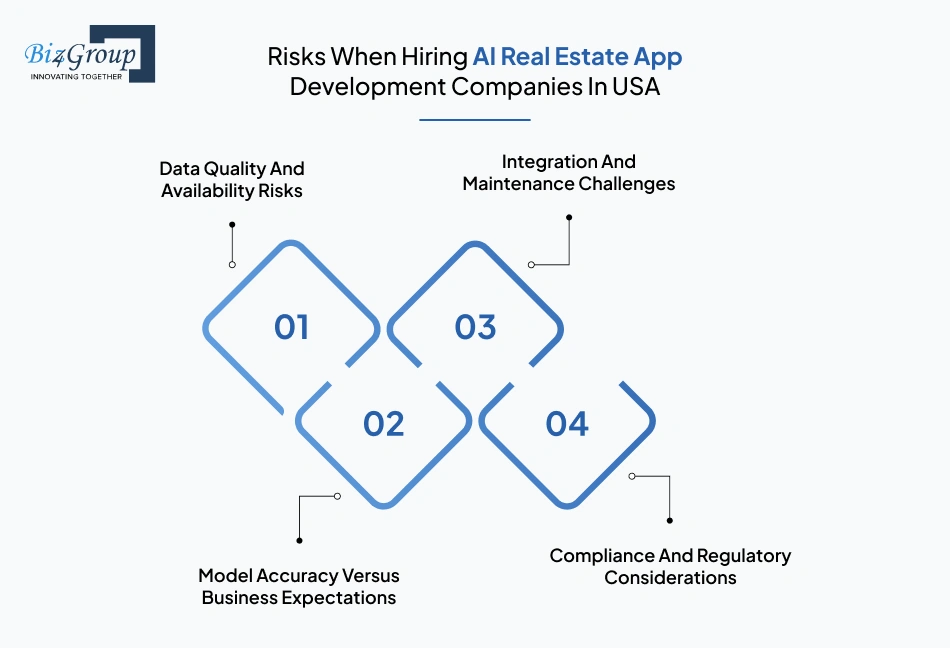
Risks when hiring AI real estate app development companies in USA include data issues, model accuracy gaps, integration problems, and compliance requirements. These risks affect how the system works after launch and how well it performs over time.
Understanding these early helps avoid delays, extra costs, and system issues later.
1. Data Quality And Availability Risks
Data risks happen when property data is incomplete, outdated, or inconsistent.
AI systems depend on data pipelines that collect and process data from different sources. If the data is not clean or updated, the system may give incorrect pricing, weak recommendations, or poor insights.
This can lead to wrong decisions and reduce trust in the application.
2. Model Accuracy Versus Business Expectations
Model accuracy risks happen when the system does not give results as expected.
AI models improve over time, but early results may not be very accurate, especially when data is limited. This is common in systems built around AI automation services, where results depend on regular updates and improvements. During model deployment, testing and updates are needed to improve performance.
If expectations are not set clearly, this can lead to confusion or dissatisfaction.
3. Integration And Maintenance Challenges
Integration risks happen when systems do not connect properly or need frequent updates.
AI applications often connect with CRM, MLS, and other tools. If these connections are not stable, some features may not work correctly. Over time, the system also needs maintenance to update models, manage data flow, and support growth.
This can increase effort and affect system performance.
4. Compliance And Regulatory Considerations
Compliance risks happen when data is not handled according to rules and regulations.
Real estate applications deal with user data and transaction details. These must follow data privacy and security rules. Businesses exploring which AI companies in the USA can develop custom real estate apps for my business should check how these requirements are handled.
Ignoring compliance can lead to legal and security issues.
These risks are common in AI projects, but they can be managed with proper planning. A clear understanding of data, models, and system connections helps in choosing a partner that can build and maintain a reliable system.
Decision Framework For Choosing AI Real Estate App Development Companies In USA
A simple way to choose between AI real estate app development companies in USA is to define your needs, check how they build systems, review their past work, and test with a small project. This helps you compare companies based on how they actually work, not just what they say.
Step By Step Vendor Selection Process
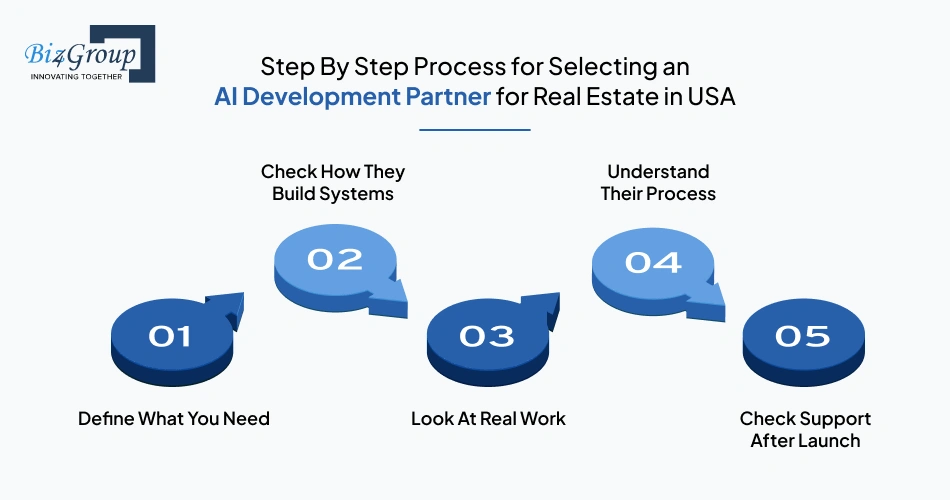
A vendor selection process is a set of steps used to compare companies and find the right fit. A simple way to do this:
1. Define What You Need
Be clear about what you want to build, what data you will use, and what results you expect.
2. Check How They Build Systems
Ask how they handle data, models, integrations, and scaling. The explanation should be clear and practical.
3. Look At Real Work
Review projects that are already being used, not just sample demos. Focus on how they perform in real situations.
4. Understand Their Process
The company should explain timelines, steps, and deliverables in a simple way.
5. Check Support After Launch
Teams offering product development services should be able to maintain and improve the system after it goes live.
These steps help you understand how the company works and what you can expect.
When To Start With A Pilot Project
A pilot project is a small version of the system used to test ideas before full development. It is useful when:
- the use case is not fully clear
- data needs to be tested
- model results are uncertain
- integrations are complex
A pilot helps you see how the system works with your data and processes. It also helps find issues early. This reduces risk and makes it easier to plan the full project.
A clear process makes it easier to choose the right partner. Businesses looking at top AI real estate app development firms that provide property management solutions should focus on how well the company understands their needs and how they plan to build and support the system over time.
Turn Real Estate Data into Actionable Systems
Work with leading AI app development firms for real estate in USA to build platforms that support long-term growth and automation.
Book a Strategy CallTrends Among Leading AI App Development Firms For Real Estate In USA (2026)
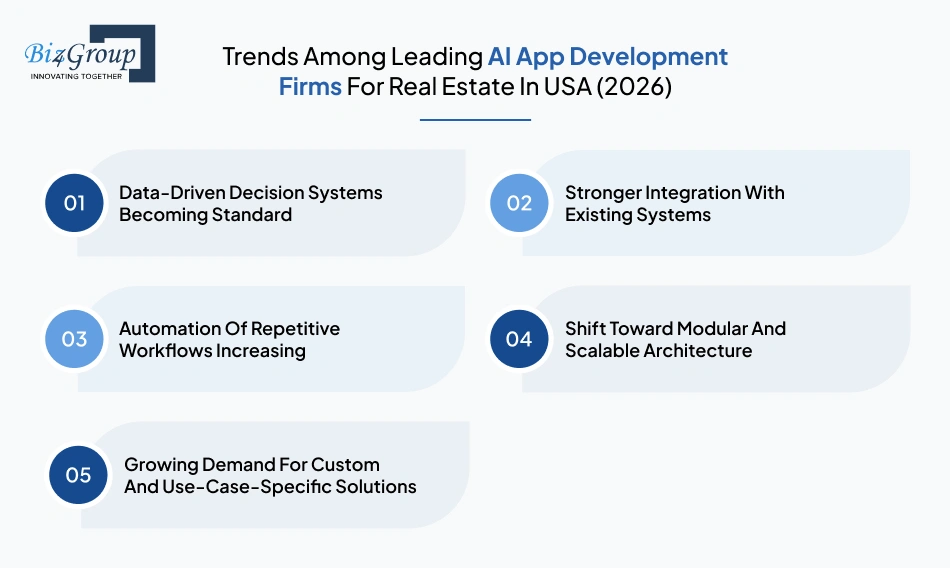
Key trends among leading AI app development firms for real estate in USA (2026) include better use of data, stronger system connections, more automation, modular design, and growth in custom solutions. These trends show how applications are becoming more useful, easier to manage, and better suited for real-world use.
1. Data-Driven Decision Systems Becoming Standard
More applications are using data to support decisions like pricing, demand analysis, and investment planning. This is done through data pipelines and basic prediction models. It helps businesses make quicker and more consistent decisions.
2. Stronger Integration With Existing Systems
Applications are now built to connect with systems like CRM, MLS, and other tools. This keeps data in sync and reduces manual work. It also helps teams use AI features without changing their existing workflow.
3. Automation Of Repetitive Workflows Increasing
Automation is being used to handle tasks like managing leads, updating listings, and responding to users. These automation workflows save time and reduce manual effort. Teams can handle more work without increasing workload.
4. Shift Toward Modular And Scalable Architecture
Applications are being built in smaller parts that can be updated or expanded over time. This makes it easier to scale as more users and data are added. It also reduces the need for major changes later.
5. Growing Demand For Custom And Use-Case-Specific Solutions
More businesses are choosing solutions built for their specific needs instead of using standard tools. This is common with custom AI real estate app developers in the USA for small and medium businesses, where flexibility and cost control are important.
These trends show a clear shift toward simpler, more practical, and scalable systems. Businesses should look for companies that follow these patterns, as they are more likely to build applications that work well over time.
Wrapping it Up
Building a real estate app with AI is all about solving real business problems with the right systems. The difference between a useful product and an expensive experiment often comes down to who builds it and how they approach data, workflows, and scale.
The top AI real estate app development companies In USA listed here show that there's no one-size-fits-all answer. Some are better at analytics, some at automation, and others at full product builds. The goal is to find a partner that understands your use case and can turn it into something that actually works in day-to-day operations.
If you're working with a custom software development company, the focus should stay on practical outcomes, not just technical capability. Clear requirements, clean data, and a well-defined rollout plan will take you much further than chasing features.
In the end, the right AI solution should feel like a natural extension of how your business already runs.
Planning to turn your real estate workflows into AI-powered systems that scale with your growth? Reach out to our AI Experts!
FAQs
1. How long does it take for an AI real estate app to start delivering measurable results?
Most AI real estate applications begin showing measurable impact within 3 to 6 months after deployment. Early results usually come from automation and lead handling, while advanced insights like pricing optimization improve as more data is collected over time.
2. What type of data is required to build an AI real estate application?
AI real estate apps typically require property listings, historical pricing data, user behavior data, and transaction records. The quality, consistency, and volume of this data directly affect how well the system performs.
3. Can AI real estate apps work without MLS integration?
Yes, but with limitations. Without MLS integration, apps rely on external datasets or manual inputs, which may reduce accuracy and real-time capabilities. MLS integration improves data reliability and feature depth.
4. How do AI real estate apps handle changing market conditions?
AI systems adapt by continuously learning from new data. As market conditions change, models update predictions and recommendations based on recent trends, making the system more accurate over time.
5. What skills should an internal team have before starting an AI real estate project?
An internal team should have a basic understanding of data handling, product requirements, and business workflows. Technical expertise in AI is not mandatory, but clarity on goals and use cases is essential.
6. Is it possible to scale an AI real estate app after launch without rebuilding it?
Yes, if the system is built with scalable architecture. Applications designed with modular components and flexible infrastructure can handle growth in users, data, and features without requiring a full rebuild.
