Location :
Orlando, FL, USA
Location :
Orlando, FL, USA +1 (407) 714-1616
 info@biz4group.com


















Imagine a digital system that doesn’t wait for instructions but instead, understands your business goals, learns from real-time feedback, and takes independent actions to get the job done.
Read More

How many suspicious claims slip through because verification happens too late?
How many investigation hours are spent reviewing statements that could have been captured accurately during the first claimant conversation?
These questions sit at the center of modern insurance fraud management. Voice automation is rapidly becoming part of that discussion. The global voice AI agents market is projected to reach $47.5 billion by 2034, with a strong 34.8% CAGR.
North America contributes over 40.2% of global revenue, and the BFSI sector represents more than 32.9% of adoption, showing how strongly financial and insurance institutions are investing in voice systems.
Several industry signals explain why insurers are paying attention:
This guide is written for insurance executives, fraud investigators, and technology leaders exploring voice AI agent development for insurance claim fraud detection. You will understand how these systems operate and where they fit within claim investigations.
Along the way we’ll also touch on how insurers develop AI voice agent for insurance compliance and fraud detection with the support of an experienced AI development company. Such partners help organizations build AI software that aligns with real insurance workflows. Let’s dive in for more insights
Insurance claim investigations often require direct conversations with claimants to verify incident details and confirm the accuracy of reported information. Voice AI agent development for insurance claim fraud detection focuses on designing automated voice systems that conduct these verification conversations and capture signals that may indicate suspicious activity.
A AI voice agent interacts with claimants through phone calls or voice-based communication channels. Using speech recognition and natural language processing, the system understands spoken responses and records them as structured investigation data. These systems rely on conversational AI to guide claimants through clear and consistent verification questions during the early stages of claim review.
Core responsibilities of a voice AI agent in insurance investigations include:
Voice AI agent supports investigators by identifying fraudulent insurance calls within the claim lifecycle, and this voice layer helps collect structured information before detailed fraud investigation begins.
Insurance fraud investigations have traditionally depended on manual verification and rule-based claim screening. As claim volumes grow, insurers are reconsidering their investigation methods and asking a practical question: Is it worth investing in voice AI agent worth investing in for insurance companies handling large claim verification workloads. Then here take a look at the difference created by AI voice agent for insurance claim fraud detection
|
Investigation Factor |
Traditional Fraud Detection |
Voice AI Based Fraud Detection |
|---|---|---|
|
Claim Verification Timing |
Verification usually occurs after the claim is submitted and processed. Investigators review cases later in the investigation cycle. |
AI voice systems interact with claimants soon after a claim is reported. Thsi allows early verification of incident details during the claim intake stage. |
|
Investigation Method |
Fraud detection relies on rule-based checks and manual interviews conducted by claim adjusters or investigation teams. |
Automated voice conversations guide claimants through structured questions that capture consistent responses for investigation review. |
|
Fraud Signal Identification |
Investigators manually review claim statements and documents to identify inconsistencies. Suspicious signals may appear later during the investigation process. |
Voice conversations capture claimant responses in real time and record statements that may reveal inconsistencies during the verification stage. |
|
Investigator Workload |
Fraud investigators spend significant time conducting verification calls and reviewing routine claims before identifying suspicious cases. |
Automated voice verification handles routine claimant interviews which allows investigators to focus on cases that require deeper fraud investigation. |
|
Claim Screening Scale |
Investigation teams can only review a limited number of claims each day due to manual verification requirements. |
Automated voice AI agent screens large volumes of claims simultaneously and maintain consistent verification conversations. |
Investigation teams are gradually adopting automation to handle growing claim volumes while maintaining verification quality. Organizations expanding voice AI agent development for insurance claim fraud detection are introducing structured voice verification that supports more scalable fraud investigation workflows.
Upgrade investigations with voice AI that screens claims instantly and highlights suspicious conversations
See How Voice AI Agent WorksInsurance claim verification usually follows a structured investigation sequence once a claim enters the system. Understanding this workflow helps teams build voice AI agent for insurance claims that guide claimants through verification steps while maintaining consistent investigation procedures.
A structured investigation workflow ensures claim verification remains consistent even when insurers process thousands of claims each month. Organizations expanding voice AI agent development for insurance claim fraud detection rely on this step driven process to support reliable fraud screening.
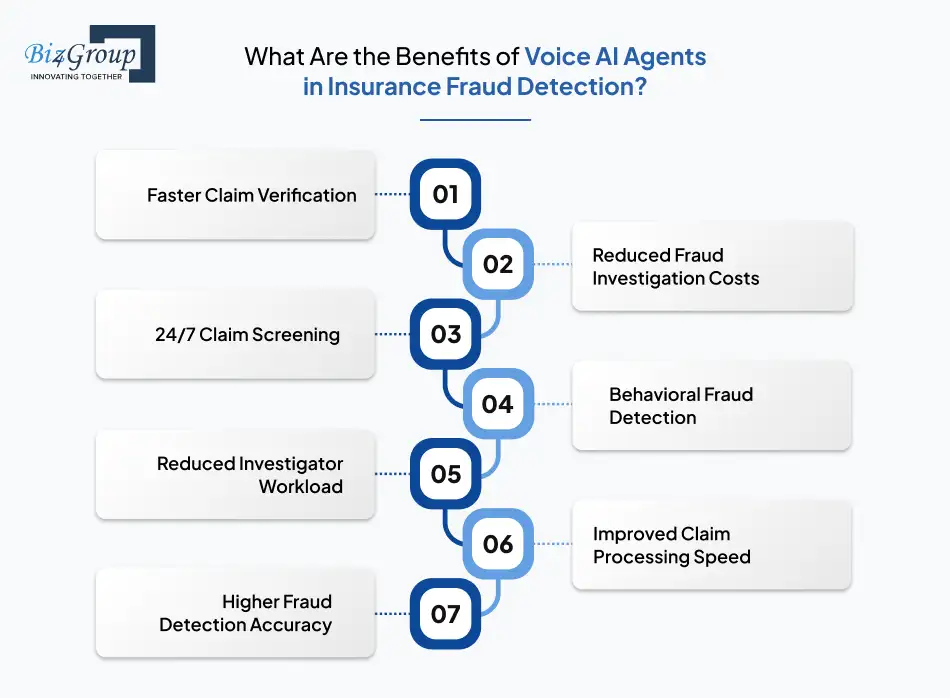
Operational pressure in claim investigations continues to increase as fraud cases grow more complex. This shift raises an important question: why are insurance companies using voice AI agent for fraud detection while expanding modern voice AI solutions. Here’s what you should know:
Voice systems conduct structured verification conversations immediately after claims are reported. This reduces delays during investigation reviews. Real-time interaction through an AI conversation app helps investigators confirm claim details much earlier in the verification process.
Manual investigations require extensive time from fraud analysts and claim adjusters. Automated voice verification reduces repetitive verification work and lowers operational investigation expenses without affecting investigation accuracy
Fraud detection no longer depends only on investigator availability. Modern voice AI solutions for insurance companies review claims at any time of the day. Continuous screening allows suspicious claims to be flagged early before large payouts are approved.
Claim investigations often reveal fraud through inconsistent responses or unusual conversation patterns. Voice analysis systems capture these signals during claimant interviews and help investigators review responses more carefully during fraud investigations.
Large insurers process thousands of claims every week. Automated verification conversations by AI voice agents reduces manual outreach and routine claim interviews. This allows investigators to spend more time reviewing high risk claims that require deeper analysis.
Early verification reduces the time required to confirm claim information. With effective AI integration investigators receive structured claim responses faster, which improves overall claim processing timelines and helps insurance teams maintain smoother investigation workflows.
Fraud detection systems analyze large volumes of claim conversations and investigation signals. Within enterprise AI solutions this helps insurers identify suspicious claim patterns that may be difficult to detect through manual reviews alone.
Organizations investing in advanced voice automation continue to discover measurable operational value. Companies expanding voice AI agent development for insurance claim fraud detection are improving investigation efficiency while strengthening fraud monitoring across modern insurance claim verification systems.
Also Read: AI Insurance Software Development: Benefits & Solutions
Stop chasing suspicious claims manually let voice AI verify claims faster and smarter
Contact Our AI Experts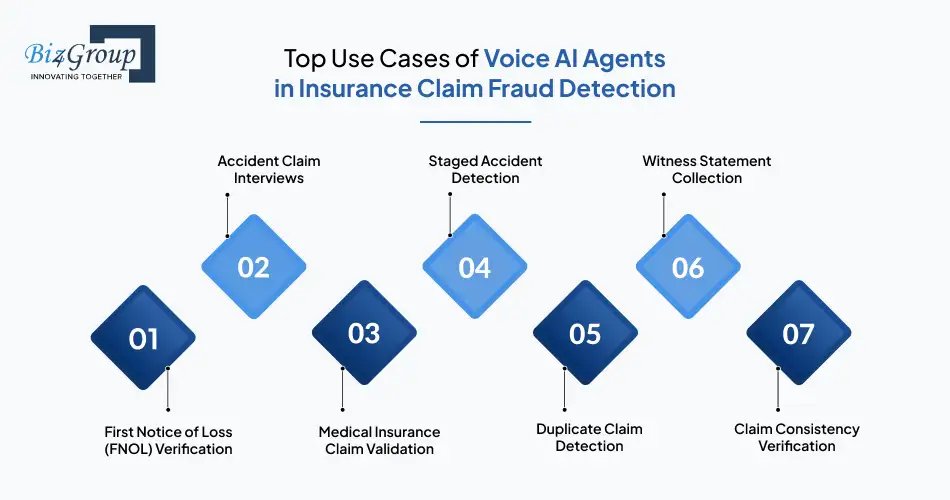
Insurance investigations involve several moments where early verification can expose suspicious claims. These real operational scenarios explain what problems can voice AI agent solve in insurance claim investigations. This helps insurers create voice AI system for insurance fraud detection across claim verification workflows.
Example: An auto insurer uses AI voice calls during FNOL reporting to capture early accident details, reducing suspicious claim escalations by 18% during initial claim review.
Example: An insurer conducts automated accident interviews through voice calls, helping investigators reduce manual interview workload by 30% during peak claim investigation periods.
Example: A health insurer verifies treatment details through automated verification calls, detecting 15% more inconsistent medical claims before reimbursement approval.
Example: An insurer reviews voice interview transcripts across multiple claimants and identifies staged accident patterns 22% faster during fraud investigations.
Example: Automated verification calls helped an insurer detect duplicate damage claims 20% earlier during routine claim investigation workflows.
Example: An insurer collects witness statements through automated voice calls, improving response rates by 25% compared to manual outreach.
Example: Follow-up voice verification calls helped investigators identify conflicting claimant statements, improving early fraud signal detection by 17%.
These operational scenarios show how insurers deploy automated investigation workflows across claim verification processes. Organizations expanding voice AI agent development for insurance claim fraud detection continue to discover new AI voice agent use cases that improve fraud identification while supporting investigation teams.
Insurance fraud investigations require structured voice conversations, reliable data capture, and clear investigation insights. These capabilities help insurers develop voice AI agent for insurance claim fraud detection while ensuring the system supports real claim verification workflows used by fraud investigation teams.
Claim investigations require guided conversations that collect accurate information from claimants. A well-designed AI voice agent ensures every verification call follows a structured interview flow that investigators can rely on.
Voice responses from claimants must be captured clearly so investigators can review them later. Reliable transcription and speech recognition system ensures every response during a claim verification call becomes part of the investigation record.
Also Read: AI Text to Speech App Development for Scalable Voice Solutions
Fraud detection improves when claim responses are evaluated together with claim data. Systems powered by AI automation can identify suspicious responses or inconsistent statements during verification calls.
AI voice agent verification systems should connect with existing insurance claim platforms. Integration ensures the investigation system can access claim records before verification calls begin.
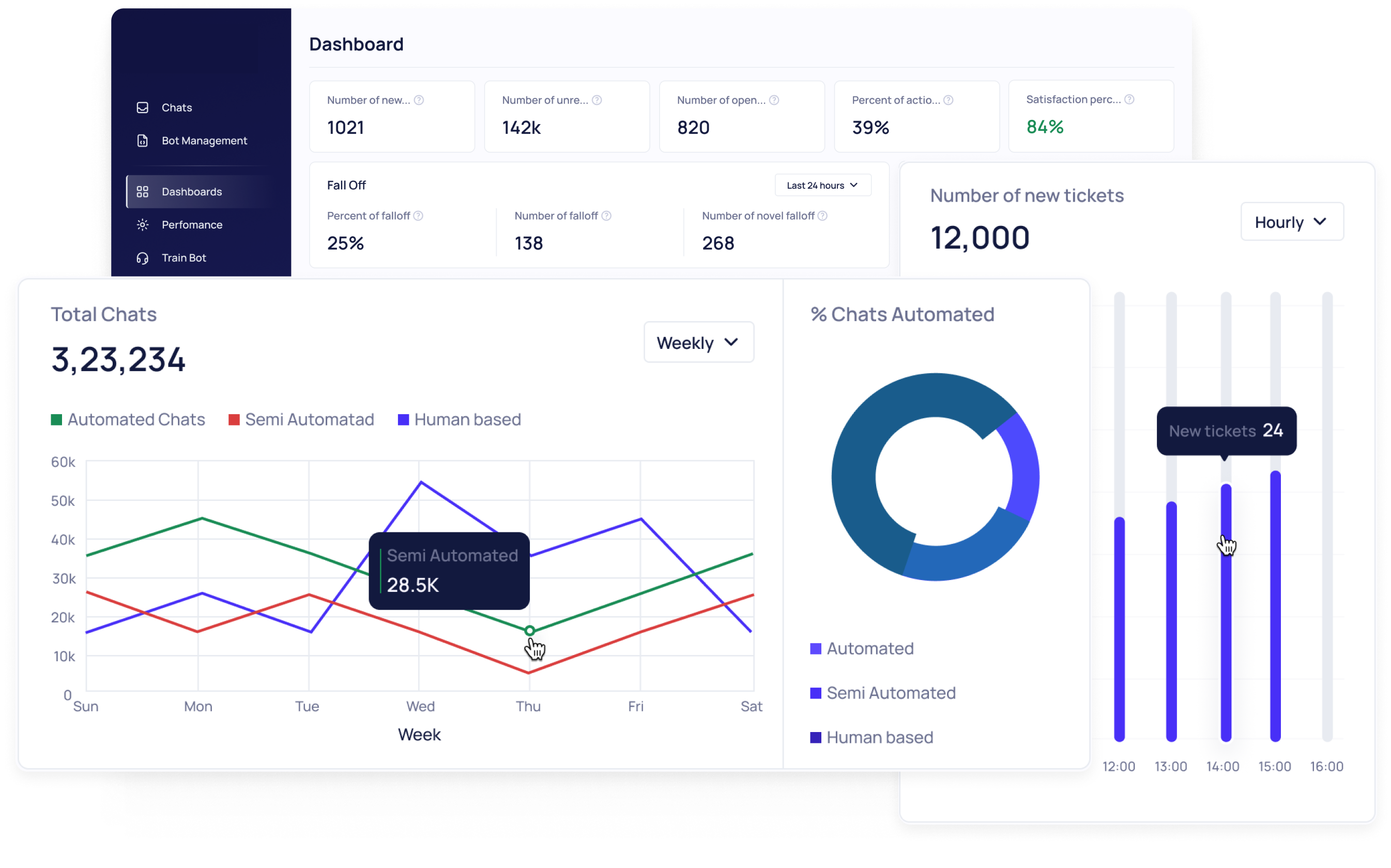
Fraud analysts need clear insights from claim verification calls. A well-designed dashboard allows investigators to monitor alerts generated by an insurance AI agent during claim investigations.
Structured question flows guide the conversation between the system and the claimant. Interview scripts ensure every verification call captures the information investigators need.
Claim verification calls often become part of fraud investigations. Secure storage allows investigators to revisit conversations when reviewing suspicious claims.
Insurance companies serve customers from many regions. Voice systems that support multiple languages help investigation teams verify claims without communication barriers.
Fraud investigations sometimes require verifying the identity of the caller. Voice recognition capabilities can help investigators detect impersonation attempts during claim interviews.
These capabilities help insurers build reliable claim verification workflows and strengthen fraud detection processes. Organizations that plan features carefully can scale voice AI agent development for insurance claim fraud detection while supporting investigators with structured verification tools.
Insurance claim fraud investigations become more effective when voice systems move beyond basic claim verification. Advanced capabilities help insurers create intelligent voice AI agent for insurance companies that can uncover deeper fraud signals and assist investigators during complex claim reviews.
|
Advanced Feature |
Purpose |
|---|---|
|
Emotion and Stress Detection |
Uses voice signal interpretation to identify stress patterns or hesitation that may appear when claimants provide inconsistent responses during investigation calls. |
|
Voice Biometrics for Claimant Verification |
Confirms the caller’s identity using voice patterns. This prevents impersonation attempts and ensures claim interviews are conducted with the actual policyholder or authorized claimant. |
|
Behavioral Fraud Analytics |
Applies predictive analysis on conversation transcripts and claim histories to detect unusual response patterns that may indicate suspicious claim behavior across investigation cases. |
|
AI Driven Interrogation Flow |
Conversation logic powered by generative AI dynamically adjusts follow up questions when claimant responses contain inconsistencies or missing information during fraud verification interviews. |
|
Real Time Deception Signal Detection |
Voice interaction monitoring helps investigators identify unusual pauses, hesitation, or inconsistent explanations while claim interviews are still in progress. |
|
Cross Claim Fraud Pattern Recognition |
Reviews conversation transcripts across multiple claims to detect repeating fraud behaviors that investigators might not identify during individual claim investigations. |
|
Predictive Fraud Risk Scoring |
Each investigation is evaluated by an AI model that analyzes claim details and voice responses to estimate the likelihood of potential fraud before further review. |
|
AI Investigator Copilot |
An AI chatbot voice assistant supports investigators by summarizing interviews, highlighting suspicious responses. It recommends follow up questions during investigations powered through ongoing AI voice chatbot development. |
Advanced capabilities allow insurers to move beyond basic verification calls and uncover deeper investigation insights. Systems that integrate these capabilities help teams strengthen voice AI agent development for insurance claim fraud detection through more intelligent claim analysis.
Also Read: Generative AI Agents
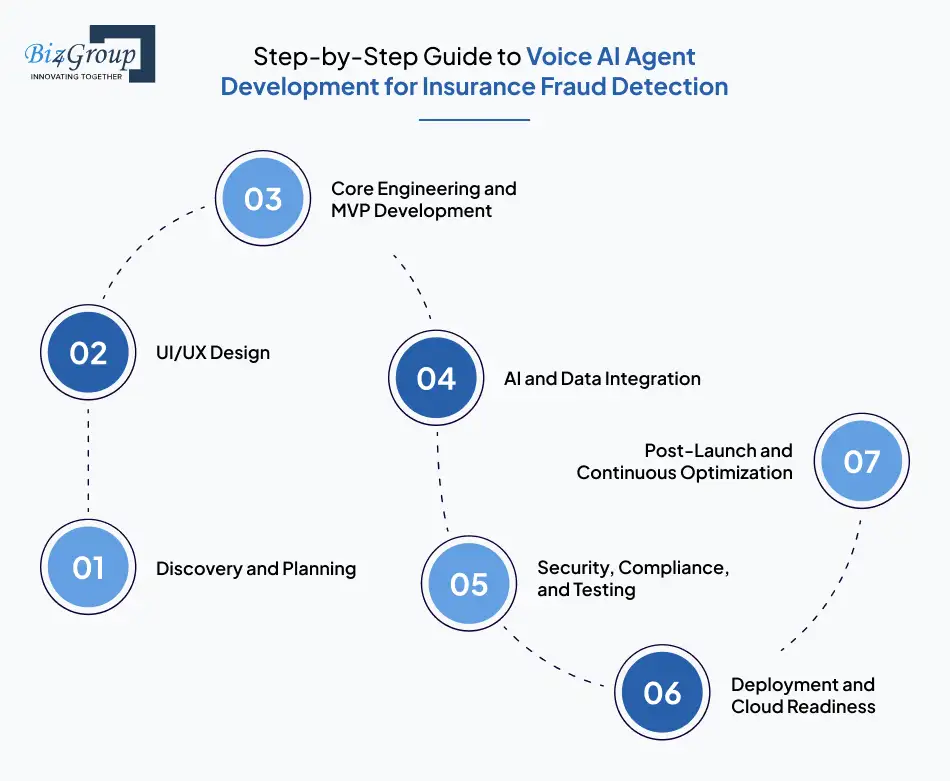
Insurance teams exploring automation often move step by step rather than deploying complex systems immediately. Clear planning, practical design, and controlled engineering decisions help organizations develop AI voice agent for insurance compliance and fraud detection while maintaining reliable workflows and operational clarity.
Also Read: Top UI/UX design companies in USA
Also read: Custom MVP Software Development
Also Read: Software Testing Companies in USA
A structured development approach helps insurers introduce voice automation without disrupting existing fraud investigation processes. Teams that follow these disciplined stages can gradually implement voice AI agent development for insurance claim fraud detection while maintaining reliable claim verification workflows and regulatory alignment.
Turn fraud detection ideas into a working voice system that screens claims automatically
Talk To Our Development TeamReliable fraud detection systems depend on several technology layers working together behind the scenes. These tools support voice conversations, claim analysis, and investigation workflows. The right stack helps insurers run stable systems while scaling voice AI agent development for insurance across different fraud detection operations.
|
Architecture Layer |
Recommended Technology |
Purpose |
|---|---|---|
|
Frontend Interface (Investigator Dashboard) |
Provides dashboards where investigators review claim verification calls, fraud alerts, and investigation insights. |
|
|
Backend Application Layer |
Node.js, Express.js, NestJS |
Handles system logic, manages APIs, processes claim workflows, and connects voice systems with insurance platforms. |
|
Voice Communication Infrastructure |
Twilio Voice API, Amazon Connect, Plivo |
Manages automated voice calls, call routing, and real-time voice interactions during claim verification. |
|
Speech Recognition Layer |
Google Speech-to-Text, Amazon Transcribe, Deepgram |
Converts claimant speech into text so the system can analyze responses during investigation calls. |
|
Conversational AI Engine |
OpenAI GPT Models, Google Dialogflow, Rasa |
Interprets claimant responses and manages structured voice conversation flows for claim verification. |
|
Voice Response Generation |
Amazon Polly, Google Text-to-Speech, Microsoft Azure Speech |
Generates natural voice responses when the AI agent communicates with claimants. |
|
Fraud Detection & Machine Learning |
Python, Scikit-learn, TensorFlow, PyTorch |
Analyzes claim data and conversation signals to identify suspicious patterns and generate fraud risk scores. |
|
Data Processing & Event Streaming |
Apache Kafka, Apache Spark |
Processes real-time claim events and conversation transcripts for fraud investigation analysis. |
|
Data Storage Layer |
PostgreSQL, MongoDB, Amazon S3 |
Stores claim data, call transcripts, voice recordings, and investigation logs securely. |
|
Security & Identity Management |
OAuth 2.0, JWT Authentication, Identity Access Management (IAM) |
Protects sensitive claim data and ensures secure access control for investigators and administrators. |
|
Cloud Infrastructure |
AWS, Microsoft Azure, Google Cloud |
Provides scalable computing resources for voice processing, AI models, and claim investigation workflows. |
|
Monitoring & System Analytics |
ELK Stack, Datadog, Prometheus |
Tracks system performance, voice call success rates, and fraud detection alerts across the platform. |
Careful stack planning supports long term voice AI agent development for insurance fraud investigation systems while ensuring investigation teams receive reliable data during fraud analysis. Insurance platforms built with disciplined architecture and thoughtful full stack development practices can support continuous voice AI agent development for insurance claim fraud detection while keeping fraud investigation workflows stable and secure.
Also Read: Why to Choose the Full Stack Development for Modern Business
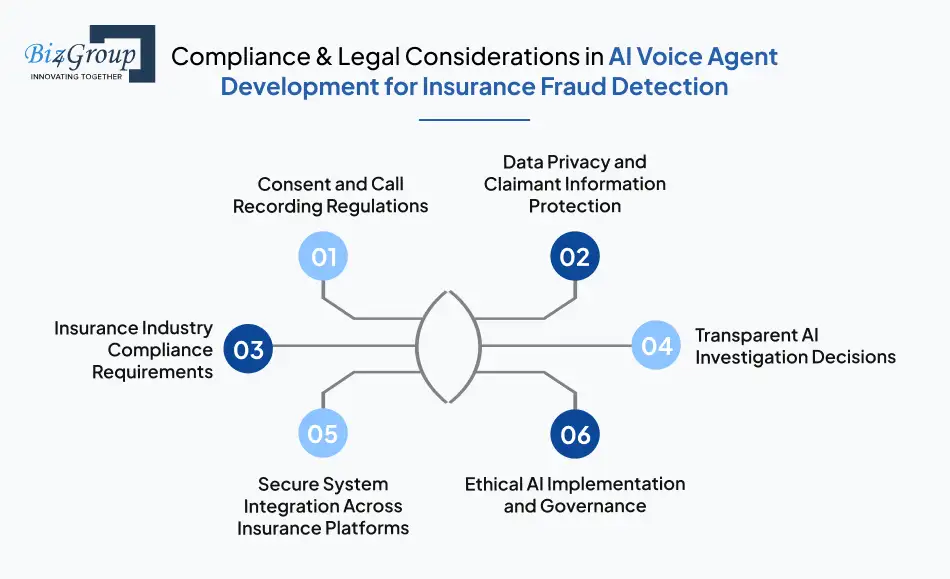
Voice systems used in insurance investigations handle personal conversations, claim records, and sensitive financial information. Clear regulatory planning ensures organizations can create voice AI platform for detecting fraudulent insurance claims while protecting claimant data and maintaining responsible investigation practices.
Insurance verification calls often require recorded conversations for investigation records. The system must inform claimants that calls may be recorded and analyzed before any interaction begins to maintain lawful communication practices.
Voice systems process sensitive personal information during claim investigations. Encryption and restricted access policies help protect claimant data and transcripts when teams make voice AI agent to analyze insurance claim conversations across investigation workflows.
Insurance regulators expect accurate documentation during claim investigations. Voice systems must store call transcripts, verification responses, and claim details so investigators can maintain compliant records during voice AI agent development for insurance claim fraud detection initiatives.
Fraud detection systems should provide investigators with clear reasons behind flagged claims. Transparent decision signals help investigation teams review suspicious responses rather than relying only on automated fraud alerts.
Voice investigation systems often connect with claim management software and fraud monitoring tools. Careful enterprise AI integration planning ensures investigation data moves securely across platforms without exposing sensitive claim information.
Insurance organizations usually hire AI developers who understand responsible system design. Governance policies ensure investigation models remain fair, auditable, and aligned with regulatory expectations when voice systems analyze claimant conversations.
Responsible compliance planning protects insurers, investigators, and claimants during system deployment. Organizations that treat regulation as a core design principle can scale voice AI agent development for insurance claim fraud detection while maintaining secure investigations and trustworthy claim verification processes.
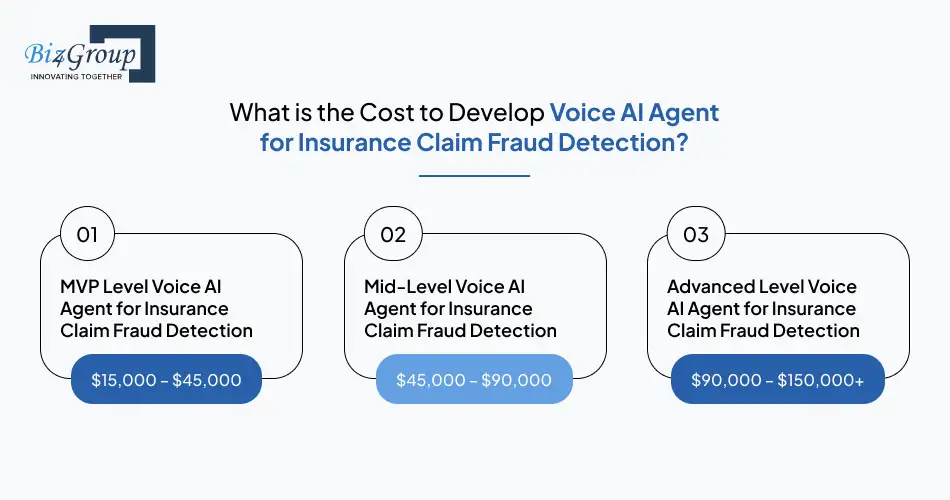
Insurance companies planning voice automation often evaluate costs early in the project. Most projects range between $15,000 and $150,000+, depending on system capabilities and investigation complexity required to develop secure voice AI agent for insurance fraud monitoring within real claim verification environments.
|
Development Level |
Estimated Cost Range |
Scope |
|---|---|---|
|
MVP Level Voice AI Agent for Insurance Claim Fraud Detection |
$15,000 – $45,000 |
Basic claim verification calls, simple conversation flow, transcript storage, and initial fraud signal tracking for early investigation validation. |
|
Mid-Level Voice AI Agent for Insurance Claim Fraud Detection |
$45,000 – $90,000 |
Expanded fraud analysis, conversation intelligence, claim system integrations, and dashboards for investigators handling higher claim volumes. |
|
Advanced Level Voice AI Agent for Insurance Claim Fraud Detection |
$90,000 – $150,000+ |
Scalable investigation automation, advanced fraud detection models, voice analytics, secure cloud infrastructure, and deeper insurance platform integrations. |
Platforms that support multiple investigation workflows, voice analytics, and real time claim verification require more engineering time. These requirements influence overall AI integration costs across the platform architecture.
Natural conversations require speech recognition, response generation, and conversation flow management. More advanced interaction models increase system complexity and overall development effort.
Training models to detect suspicious claim patterns requires historical investigation data. More training data and deeper analysis models increase engineering time during system development.
Connecting the system with claim management tools, investigation dashboards, and internal databases requires API integrations and testing across multiple operational systems.
Scalable systems that support large investigation call volumes require secure cloud infrastructure, monitoring tools, and voice communication services to maintain consistent platform performance.
Begin with a limited fraud detection use case such as claim verification calls. This approach validates the system before expanding into broader fraud investigation automation.
Early planning should determine whether insurers need custom AI agents or off-the-shelf solutions. This decision affects development time, customization effort, and long-term maintenance costs.
Early releases should focus on claim conversation capture and fraud signal tracking. Additional capabilities like analytics dashboards can be introduced gradually after initial validation.
Systems designed with scalable architecture help insurers build scalable voice AI fraud detection system for insurers without expensive system restructuring during later expansion phases.
Operational insights help teams adjust infrastructure and processing capacity. Continuous monitoring helps control AI voice agent cost as investigation workloads grow.
A practical budgeting approach helps insurers introduce voice investigation systems without unnecessary spending. Organizations that plan architecture carefully can scale voice AI agent development for insurance claim fraud detection while maintaining stable investigation workflows and predictable development costs.
Get a practical cost estimate tailored to your claim workflows investigation scale and fraud detection needs
Get Cost Estimation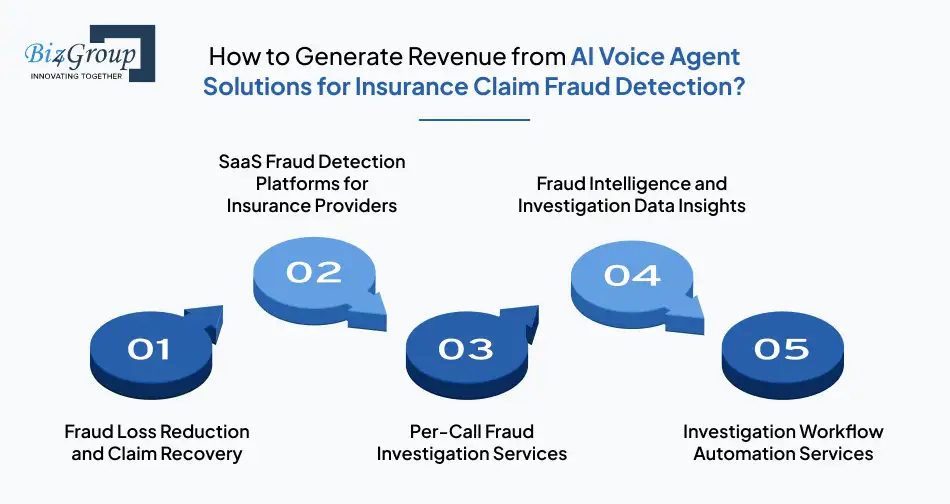
Insurance companies and technology providers increasingly treat voice automation as a revenue opportunity rather than only an operational tool. Many organizations now Build voice AI agent for automated insurance claim verification while designing business models that turn fraud detection capabilities into scalable revenue streams.
Insurance companies generate revenue when fraud prevention systems reduce unnecessary claim payouts. Organizations that create voice AI agents for real-time insurance claim analysis often strengthen financial performance by improving investigation efficiency and claim validation processes.
Revenue impact usually appears through several operational improvements:
These improvements allow insurers to convert fraud detection into measurable financial gains while improving overall claim investigation efficiency.
Technology companies can package voice AI agent investigation systems as subscription platforms for insurance carriers. Instead of building internal systems, insurers subscribe to fraud detection services delivered through cloud platforms.
Revenue is usually generated through recurring pricing models such as:
AI voice agent in investigation platforms can also operate on a usage-based pricing model. Insurance companies pay for each verification call conducted during claim investigations. This model works well for insurers that process high claim volumes. Revenue typically grows through:
Usage-based services allow technology providers to scale revenue alongside claim volume.
Voice conversations produce valuable investigation data that reveals fraud patterns across claims. Platforms can monetize this information through analytics services that help insurers improve fraud detection strategies.
Revenue opportunities include:
Data insights transform investigation information into a strategic business asset.
Insurance companies often seek partners who can manage fraud verification workflows through voice automation platforms. Technology providers can offer investigation automation as a managed service.
Revenue streams may include:
These services help insurers scale investigation capacity without expanding internal teams.
Organizations that approach automation with a business mindset unlock significant financial potential. Companies that invest in voice AI agent development for insurance claim fraud detection can reduce fraud losses while turning investigation technology into scalable revenue generating solutions.
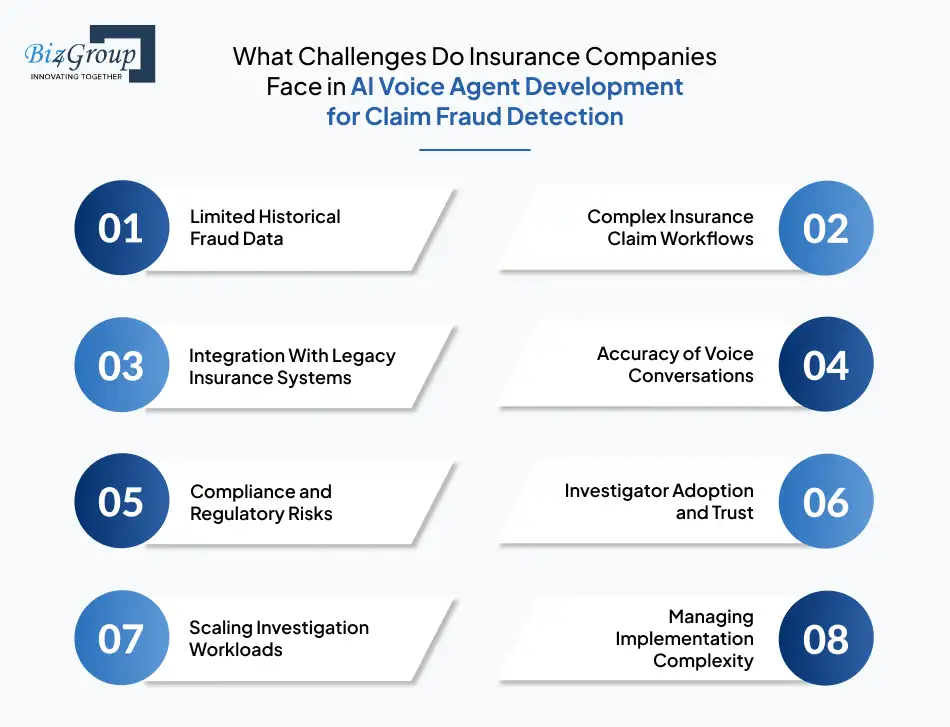
Insurance companies introducing voice investigation systems often encounter practical hurdles during implementation. Planning ahead helps teams manage operational risks and move forward with voice AI fraud detection platform development for insurance while keeping claim verification processes accurate and reliable.
|
Challenge |
How to Overcome It |
|---|---|
|
Limited Historical Fraud Data |
Fraud detection models require reliable investigation data. Start with structured claim records and gradually train models using verified fraud cases collected during investigations. |
|
Complex Insurance Claim Workflows |
Map investigation workflows clearly before automation begins. A well-designed process helps teams build a voice AI claim verification system that aligns with real claim investigation procedures. |
|
Integration With Legacy Insurance Systems |
Older claim platforms may not easily connect with voice systems. API-based integration planning allows investigation data to move safely between claim management tools and voice verification systems. |
|
Accuracy of Voice Conversations |
Claim verification calls must capture information clearly. Regular conversation testing and transcript reviews help improve how the system collects responses from claimants during investigations. |
|
Compliance and Regulatory Risks |
Insurance investigations involve personal and financial data. Compliance planning should include secure data storage, consent notices, and clear documentation of claim verification conversations. |
|
Investigator Adoption and Trust |
Fraud analysts may hesitate to rely on automated systems. Demonstrating investigation insights and clear fraud signals helps investigators understand how the voice platform supports their decision making. |
|
Scaling Investigation Workloads |
Claim volumes may increase during major events. Cloud infrastructure and scalable voice systems allow insurers to expand verification capacity without disrupting investigation workflows. |
|
Managing Implementation Complexity |
Voice investigation systems require coordination between claim workflows, voice infrastructure, and fraud analysis tools. Work with voice AI agent development company teams that understand how claim verification automation should operate within real insurance investigation environments. |
Insurance companies that prepare for these challenges usually achieve smoother implementation. Structured planning and realistic deployment strategies help organizations scale voice AI agent development for insurance claim fraud detection while maintaining reliable investigation workflows and strong regulatory compliance.
Voice-based claim verification systems require structured conversation flows, secure claim data access, and reliable integration with insurance platforms. Biz4Group LLC develops AI solutions that operate within real claim investigation workflows and support insurers during verification and fraud review processes.
Our experience in AI insurance automation software development allows us to design voice systems that interact with claimants, collect structured responses, and organize claim information for investigator reviews. This approach ensures verification conversations produce consistent data that investigation teams can evaluate during fraud checks. With an established background in business app development using AI we ensure these systems connect successfully with claim management platforms, policy databases, and operational tools used by insurance teams.
Organizations evaluating companies that develop voice AI agent for insurance often prioritize implementation experience. As an AI agent development company, we focus on voice systems that align with real claim processing and investigation environments. Here take a look at real world implementation:
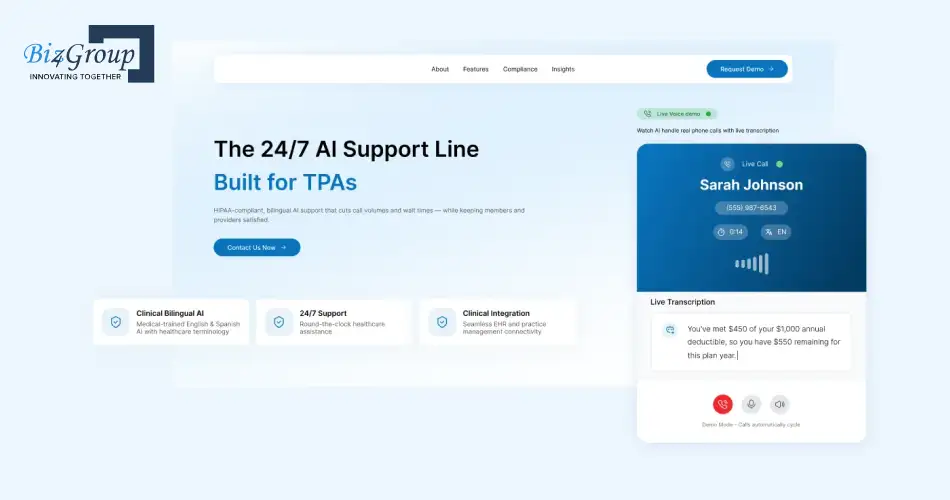
We developed an AI IVR platform for insurance claim that automates claim inquiries, policy verification, and support requests through natural voice interactions. The system retrieves structured insurance data while handling high volumes of incoming calls. This project reflects our ability to design conversational systems that capture claimant information accurately.
Be it early solution planning or compliance-ready deployment, we understand how regulated industries require secure systems and reliable data handling. Our work reflects a practical focus on real operational needs, consistent system performance, and measurable outcomes. With this foundation, we are uniquely positioned to craft AI voice agent solutions that can truly transform insurance claim fraud detection.
Work with experts who design secure voice AI systems for real insurance fraud investigations
Start Your Project DiscussionAI voice agents are gradually becoming part of modern insurance operations as claim volumes increase and fraud tactics grow more complex. Automated AI voice verification helps insurers capture claimant statements early and maintain consistent claim investigation records.
The real opportunity now is deciding how voice technology fits into your fraud detection strategy. Working with an experienced AI product development company helps ensure the system operates naturally and supports real investigation workflows. With the right insurance voice AI agent development services, insurers can introduce reliable automation that strengthens fraud monitoring and claim verification.
Organizations planning voice AI agent development for insurance claim fraud detection need solutions designed for real operational environments. Biz4Group LLC helps insurers design practical AI driven platforms that align with investigation processes. If you are considering the next step, feel free to connect with us to discuss how voice systems can support your fraud detection strategy.
A voice AI agent reviews claimant conversations during verification calls and captures structured responses about the reported incident. The system converts speech into text and evaluates statements for inconsistencies, unusual timelines, or conflicting details. These signals help investigators identify suspicious claims earlier in the investigation cycle.
Insurance companies use voice AI agents to conduct structured verification calls soon after a claim is reported. The system collects detailed claimant responses and records the conversation for investigation review. This process helps insurers verify incident details early and detect suspicious patterns before claim payouts are approved.
Developing a voice AI agent usually begins with defining the claim verification workflow and investigation requirements. Teams then design conversation scripts that guide claimants through structured questions. The system is integrated with claim management platforms so investigators can review claimant responses and fraud signals during investigations.
Voice AI agents help investigation teams manage high claim volumes by conducting automated verification calls. These systems capture claimant statements, document conversation records, and flag unusual responses for investigator review. This reduces manual verification work and allows investigators to focus on higher risk claims.
Many insurers view voice AI as a strategic investment because it improves early claim verification and supports fraud monitoring workflows. Automated conversations allow investigation teams to capture claimant responses consistently while managing larger claim volumes without expanding manual investigation teams.
Insurance organizations usually evaluate vendors based on voice automation experience, claim system integration capability, and compliance readiness. Providers with experience in insurance workflows and fraud investigation systems are better positioned to deliver reliable voice AI solutions that support real claim verification processes.

with Biz4Group today!
Our website require some cookies to function properly. Read our privacy policy to know more.